Jeh Aerospace: The Order Book That Has to Become an Aerospace Business
I. Two Factories, One Unproven Bet
A landing gear has the hardest job on an aircraft. It does nothing for almost the whole flight, and then in a few seconds it has to absorb the full weight of a descending airliner. Every lug, pin and bracket in it is machined to tolerances measured in thousandths of a millimetre. Each part is inspected, traced to its batch of metal and documented before an aerospace customer will accept it.
In April 2026, Liebherr-Aerospace signed a long-term agreement with an Indian manufacturer that was not yet four years old to supply high-precision landing-gear components for high-rate single-aisle commercial programmes.1 The parts would be made in Hyderabad. Liebherr described the deal as bringing the supplier into its global industrial network, and its leadership flew to India for the signing.1
The supplier was Jeh Aerospace. "Landing gear is among the most safety-critical systems on any aircraft," its chief executive, Vishal Sanghavi, said at the signing, and he called the milestone one "earned through precision and process discipline."1 For a company that did not exist in the summer of 2022, it was a remarkable endorsement. It was also, by itself, no more than an endorsement.
Liebherr published no contract value, no volumes and no prices.1
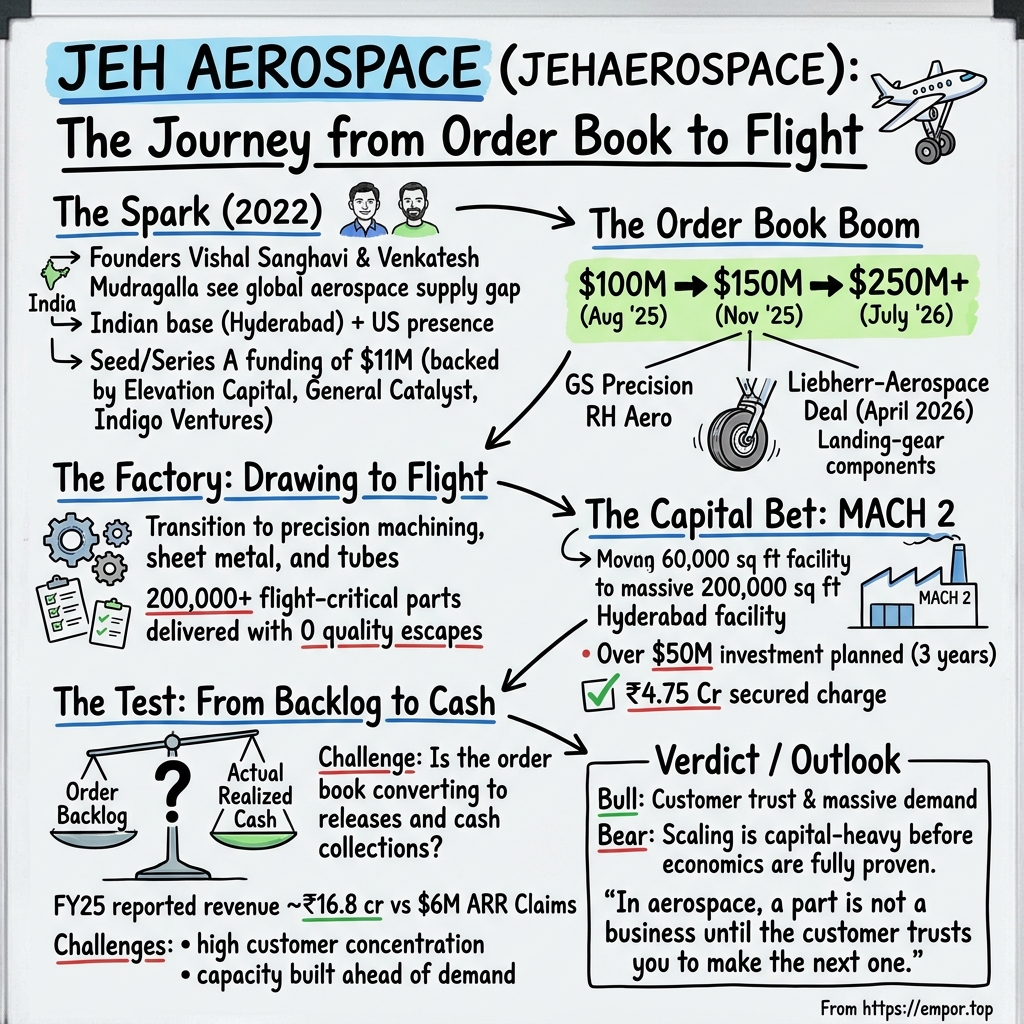
That gap between a signature and a business runs through everything Jeh has achieved. The company says it has delivered hundreds of thousands of flight-critical parts. It reports an order book that grew from about $100 million in August 20252 to more than $150 million that November,3 and BusinessLine reported in July 2026 that it had passed $250 million.4 It has announced a second Hyderabad plant, called Mach 2, and BusinessLine reported a plan to spend more than $50 million on capacity over three years.4
Jeh's own description of itself has grown with those numbers. It now calls itself a US-headquartered precision aerospace and defence manufacturer,5 and by August 2026 it said it employed about 250 people, most of them hired in the previous year.6 It exhibited at the Farnborough air show for the first time that July, the industry's main shop window, presenting a company that it said had delivered 300,000 finished components in about 600 days of operation.7
Set beside those numbers, the audited record looks small. A registry aggregator puts revenue for Jeh's Indian operating company at about ₹16.8 crore in the year to March 2025,8 which is roughly $2 million. The order book is more than a hundred times that.
Four questions follow from that gap, and the rest of this story is about them.
The first is how much of the order book will become delivered parts, accepted invoices and collected cash, and on what timetable. The second is whether a company that says it prefers a few large customers is building dependence on buyers who are much bigger than it is.
The third is whether the factories now being built will be full enough, soon enough, to earn back what they cost. The fourth is how much of the business sits in the Indian company and how much in its American affiliate.
The fourth question needs an answer at the outset, because the company is two legal entities. Jeh Aerospace Private Limited was incorporated in Hyderabad on 23 August 2022, and its registered office is at the Kothur industrial park outside the city.9 Jeh Aerospace Inc. is the American entity. Jeh describes itself as US-headquartered, and reporters have placed that headquarters in Atlanta.2 A government foreign-investment table lists the American company as the Indian company's foreign collaborator.10
What no public document shows is the full ownership chain, which entity investors hold shares in, which entity books customer revenue, and how goods and money move between the two.
The rupee revenue figures in this story belong to the Indian company. The annualised revenue, order-book, customer and headcount claims come from management and describe "Jeh" as a whole. The two sets of numbers should not be added together, and neither should be read as group accounts.
This also is not the story of a stock. Jeh is a private company. It has filed no draft red herring prospectus with India's securities regulator and no registration statement in the United States, and no valuation from any of its funding rounds has been made public.9 Anyone weighing Jeh as a future listing has no trading price, no prospectus and no audited group accounts to work from. What they have is a short operating history and a set of claims that can be checked against one another.
That makes Jeh a venture-backed manufacturing bet.
Manufacturing bets are decided on a factory floor, where machines either run full or sit idle, and in a receivables ledger, where invoices either turn into cash or age. A software company can sell one more licence at almost no cost. Jeh has to buy a machine, hire and train an operator, qualify the part, cut the metal, inspect it and ship it, and then wait to be paid.
The order book shows that customers want Jeh's capacity. Whether that capacity can earn its cost of capital is still unproven, and the evidence on that question is thinner than it would be for any listed peer. The story begins with two men who believed they had already learned how to build this kind of business inside one of India's largest conglomerates.
 Subscribe on LinkedIn
II. The Supply-Chain Gap the Founders Saw
Vishal Sanghavi and Venkatesh Mudragalla did not come to aerospace as outsiders. Between them they had spent close to two decades inside the Tata Group, working on aerospace projects with Boeing, Sikorsky and Lockheed Martin.2 Sanghavi had been chief operating officer of Tata Boeing Aerospace, the Hyderabad joint venture between the Tata Group and Boeing.2 Jeh's own account calls him one of the youngest senior executives in the Tata conglomerate.11
In their own retelling, their careers had been about one task: persuading large Western manufacturers that an Indian plant could make demanding parts to their standard. "Venky and I spent two decades building and running India joint ventures for the world's leading OEMs," Sanghavi said in 2026.5 OEMs, the original equipment manufacturers, are the companies whose names go on the aircraft and the engines. They hand most of the actual making to layers of suppliers below them.
In August 2022 the two men incorporated Jeh Aerospace Private Limited in Hyderabad.9 The beginning was humbler than the later headlines would suggest. "For the first 15 to 18 months, we were essentially two people with a presentation," Mudragalla said in 2026.6 The Indian company earned no revenue in the year to March 2023.12
The gap they saw was real, and it had been widening. Elevation Capital, which later led Jeh's Series A, framed it in two figures: more than 15,000 aircraft were sitting undelivered in manufacturers' backlogs, and about 80% of aerospace manufacturing was concentrated in the United States and Europe.13
Airlines wanted planes, and Airbus and Boeing wanted to build them faster. Below them, the Tier 1 and Tier 2 suppliers that turn bar stock and sheet metal into brackets, fittings, tubes and housings were short of capacity, short of skilled machinists and often short of capital.
The bottleneck is qualification, not demand. An aerospace supplier cannot simply buy a machine and start shipping. It has to win quality certification, prove its special processes, and qualify each part number to each customer's satisfaction, often with a first-article inspection in which the first unit off the line is measured against every requirement on the drawing. That work takes months or years, which is why capacity in this industry is slow to arrive and why customers are slow to leave a supplier once it is approved.
Jeh's bet was that India could add qualified capacity faster than the incumbents. Engineering talent was cheaper there. A new factory could be digital from the start rather than retrofitted. And the founders already knew how Western buyers qualified suppliers. Sanghavi would later argue that Jeh's Hyderabad engineers represented a capability "that would cost multiples of what we pay in equivalent Western markets," and he presented this as a structural advantage rather than simple labour arbitrage.14
They chose not to sell to the plane-makers directly. Jeh targets the Tier 1 and Tier 2 suppliers that sit between raw material and OEM. Sanghavi has estimated that these suppliers make 60% to 70% of an aircraft,2 and he named American Tier 2 suppliers as Jeh's main competition.2 It was a deliberate choice. Selling to suppliers means smaller contracts and less prestige than selling to an OEM. In return it brings faster decisions and customers who are themselves desperate for capacity.
They also built training into the plant from the beginning. The first Hyderabad facility housed what Jeh calls its Center of Aerospace Skill, intended to turn fresh graduates into aerospace machinists and inspectors rather than compete for the few experienced ones.2 For a company starting from nothing in an industry short of skilled labour, that was a necessity rather than a perk.
The digital ambition was there early too. In July 2024, while the first plant was still taking its earliest orders, Jeh announced a partnership with Blackstraw AI to apply artificial intelligence to its manufacturing.12 That was an unusual move for a shop that size. It showed the founders intended to sell a software-led factory, not just cheaper machining, and the claim would grow louder as the company did.
The choice of customers explains the structure the founders built. Jeh describes the United States as the largest aerospace market and its own purpose as building "the most exciting aerospace company in the US-India corridor."11
Sanghavi has also described the combination of an American headquarters and Indian manufacturing as a hedge against export-control risk.14 The arrangement made sense for winning customers, but the structure's economics remain uncertain.
The first customer was RH Aero Systems, an Ohio company. Mudragalla said Jeh had about ten employees when it won that first order.6 In January 2024 it raised a $2.75 million seed round led by General Catalyst, with former Boeing India president Pratyush Kumar and former Airbus India chief Dwarakanath Srinivasan joining as backers and advisers.12 That same month its first Hyderabad plant opened, a 60,000-square-foot unit with room to expand to 160,000 square feet.3 In May 2024, GS Precision, a Vermont-based machining company, announced a long-term partnership with Jeh for aero-engine parts.12
From there the story speeds up.
Manufacturing started around the turn of 2024, the first deliveries went out that year, and the Indian company recorded about ₹0.88 crore of revenue in its first year of real sales.15 That figure was tiny. It was proof that the factory worked, not that the business did.
The founders' ambition was much larger than that first year. In August 2024 Jeh told Inc42 it was targeting $20 million of annual recurring revenue for the year to March 2025, and that it planned to sign 10 to 12 "big-ticket" clients by 2025 on the way to growing fifty-fold.12 Those targets are worth remembering. They are the earliest public yardstick against which Jeh's later results can be measured, and they come back later in this story.
What the founders had brought was a credible diagnosis, relevant experience and the willingness to enter a capital-intensive niche when supply chains were under strain. That was enough to open the door. Whether it amounts to a lasting advantage depends on what happens after an order arrives, and on how a drawing becomes a part and a part becomes cash.
III. From Drawings to Flight-Critical Parts
A Jeh order usually starts as a drawing that someone else designed. Jeh is a build-to-print manufacturer. The customer owns the design and the specification, and Jeh turns them into metal. Its listed capabilities cover precision machining, sheet-metal work, tubes and pipes, surface treatment, structural assembly and some engineering services, for both aerostructures and aero-engine components.16 It says it is compliant with the AS9100 aerospace quality standard and with ISO 9001.16 Mudragalla has said the company also holds Nadcap accreditation for special processes and ISO 27001 for information security.6
Those letters and numbers are entry tickets. Nadcap accreditation matters because aerospace customers do not trust a supplier's heat treatment or surface finishing without an independent audit. AS9100 shows that a quality system exists. Neither one says how profitable the parts are.
The drawing then moves through a sequence that decides the economics. First comes qualification. Next comes the production release, the customer's actual call-off of quantities and delivery dates. Then the parts are machined, finished, inspected and shipped, with traceability back to the raw-material batch. The customer inspects and accepts them, an invoice is raised, and some weeks or months later cash arrives.
Margin can be lost at every one of those steps. A part that fails first-article inspection costs engineering time and earns nothing. A machine waiting for a release burns depreciation. A part scrapped in final inspection costs its titanium and its machine hours, and titanium is expensive.
A part delivered but stuck in the customer's receiving inspection is working capital that Jeh has to finance. A practical way to think about the business is in machine-hours: the factory sells time on qualified equipment, and its profit depends on how many of those hours turn into good, accepted, paid-for parts.
Jeh says it delivered more than 100,000 flight-critical parts and tools by August 2025,2 more than 200,000 by April 2026 with "zero quality escapes,"1 and roughly 300,000 components across about 150 part numbers over two years by August 2026.6 A quality escape is a defect that gets past the supplier's own inspection and reaches the customer. A record of none would be a meaningful achievement. The company reports it about itself, and no customer or auditor has published a figure to confirm it.
Customers pay for this work through contracts, and Jeh describes many of those contracts as long-term. Management and reporters have spoken of multi-year agreements, often lasting five to ten years.17 In aerospace a long-term agreement usually fixes prices, sometimes with escalation clauses for raw materials, and sets out the part numbers and expected volumes. It rarely obliges the customer to take a fixed quantity regardless of its own production. Jeh has not disclosed whether its agreements carry minimum-purchase commitments, cancellation rights, volume bands or price-adjustment mechanisms.17
That is the most important missing piece in the revenue model, because the answer separates a firm contract from a forecast. If the agreements commit customers to minimum quantities, the order book is close to contracted revenue. If they only set prices for whatever quantities customers choose to release, the order book is a measure of opportunity, and a delay in an aircraft programme upstream can empty it.
Management has preferred a different number. When Jeh announced its Series A in August 2025, Sanghavi told TechCrunch the company had reached $6 million of annualised recurring revenue in the previous financial year and had been profitable after tax. He projected that annualised recurring revenue would grow three- to fourfold in the current year.2 He called each paying customer a "high dollar, high ARR customer."2
Annualised recurring revenue is a software metric. A subscription company takes its current monthly subscription income and multiplies by twelve, which is reasonable when customers pay a fixed amount every month until they cancel. A build-to-print manufacturer has no subscriptions.
Its monthly revenue rises and falls with customer releases, new part qualifications and shipping schedules. Applied to Jeh, the term most likely means a recent month or quarter of shipments multiplied out to a year. That says something about the company's current pace. It says nothing about what was booked, accepted and collected over the year.
The registry numbers show how large the gap can be. A registry aggregator records the Indian company's revenue at about ₹0.88 crore in the year to March 202415 and about ₹16.8 crore in the year to March 2025, an increase of roughly 1,800%.8 At the exchange rates of that year, ₹16.8 crore is about $2 million. Management's $6 million annualised figure for the same year is roughly three times higher.
There are several innocent explanations. A company ramping up fast will finish the year running well above its full-year average, so a late-year run-rate can be three times the annual total without any exaggeration. Some revenue may also be booked by the American entity, which does not appear in Indian filings.
Jeh has not published group accounts that would show which explanation applies or in what proportion.9 The Indian company's balance sheet for the year to March 2026 has been filed, but its figures are not freely available, and Jeh does not publish them.9
The ₹16.8 crore figure itself comes from a registry aggregator, not from accounts that Jeh has released. Asked about revenue in 2026, Mudragalla said: "We do not share revenue figures publicly at this stage." He added that the business had grown about fourfold from its first year to its second and expected roughly another fourfold increase.6
The claim of after-tax profitability needs the same care. A small factory that ships its first full year of parts while depreciating new machines can show an accounting profit without generating cash. Inventory and receivables grow with sales, capital spending runs ahead of depreciation, and an exporter's invoices can take months to collect. Jeh has published no cash-flow statement and no ageing of its receivables.
Listed Indian aerospace machinists show why this matters. Aequs, Azad Engineering and Unimech Aerospace, the closest listed comparables, each took between about 117 and 253 days to turn a rupee spent on materials and production into a rupee collected in the years to March 2024 and 2025.18 For businesses like these, a profitable year can still be a year of cash outflow.
Imagine a single part leaving the factory. It has been machined, inspected and boxed for an American customer. Whether it becomes revenue depends on that customer's receiving inspection. Whether it becomes cash depends on the customer's payment terms. Whether it becomes profit depends on how much titanium, labour and machine time it used up, and how many good parts the factory produced in total that month. Jeh has published none of those measures. Customers, though, keep sending orders, and the order book became the headline that defined the company.
IV. A $100 Million Order Book Becomes $250 Million
On 4 August 2025, Jeh announced an $11 million Series A led by Elevation Capital, with General Catalyst participating again. In the same interview Sanghavi gave TechCrunch a number that would follow the company: an order book of $100 million.2 Jeh had about 100 employees, a single 60,000-square-foot plant in Hyderabad, and roughly half a dozen paying customers.2
At that point the Indian company's most recent annual revenue was about ₹16.8 crore.8 The order book was about fifty times that.
The number kept growing. In October 2025, Jeh described its long-term export contracts with American Tier 1 and Tier 2 suppliers as worth more than $100 million.19 On 20 November 2025, announcing Mach 2, the company said its order book had passed $150 million in eighteen months.3 In December 2025, Aviation Week still used the more cautious "more than $100 million."20 In July 2026, BusinessLine reported a figure above $250 million.4
Taken at face value, that is two and a half times as much work in under a year. It is the strongest commercial signal Jeh has produced. Customers do not usually give a young supplier long-term packages unless the first work went well. Aviation Week reported that many of Jeh's customers had moved from pilot work to larger long-term packages,20 and that pattern is how a supplier's position in aerospace grows.
Order books in this industry need careful reading. Each new figure came from Jeh's management in an interview or a press release, and none has been audited. Jeh has not said how it calculates the number, so it remains unclear how much reflects firm customer commitments and how much forecast volume across the agreements.
Spread evenly, $250 million over seven years is about $36 million a year. That is many times the Indian company's last reported revenue, but it is a long way from an annual figure that justifies a $250 million headline. Part of the rise may also come from longer contract periods or higher forecast volumes on programmes Jeh already had, rather than from new customers. The company has given no breakdown.
The customers are easier to see than the dollars. TechCrunch named GS Precision and RH Aero among about six paying customers in August 2025.2 By December, a list named five customers, including RH Aero, "US Precision" and Solestra Group.17 In June 2026, Jeh and Solestra signed a multi-year, multi-million-dollar agreement and opened a dedicated Solestra manufacturing centre inside Jeh's Hyderabad site, with Solestra's chief executive visiting for the inauguration.5 Then came Liebherr.
The Liebherr agreement is the most important item on that list, for one reason: Liebherr's position. RH Aero, GS Precision and Solestra are precision manufacturers of the kind Jeh set out to serve. Liebherr-Aerospace is a Tier 1 systems supplier that delivers complete landing-gear systems to aircraft programmes.1
Its decision to put a young Indian company in its supply chain for safety-critical landing-gear parts, on high-rate single-aisle programmes, is a vote on Jeh's quality and process discipline by a buyer that cannot afford to be wrong.1
The announcement still says nothing about revenue. Liebherr did not say which parts, which aircraft, what volumes, what prices or when production would reach rate.1 As with other aerospace agreements, the parts must be qualified before production can ramp. Over its life the deal could become Jeh's largest relationship. In its first year it may be worth very little.
The way Jeh chooses customers also shapes the risk. The company has said it deliberately prefers fewer, larger customers.17 Sanghavi's description of each account as "high dollar, high ARR" points the same way.2 There is a logic to it. Qualification is expensive, so concentrating that effort on a few deep relationships brings more work per qualification, more chances to win adjacent part numbers, and a better hope of becoming a strategic supplier rather than overflow capacity.
The other side is dependence. Jeh has not disclosed what share of revenue comes from its largest customer or its top five.17 With five or six paying customers in 2025, at least one of them probably accounted for a large share of sales, and that is simple arithmetic rather than criticism. Concentration is normal for young aerospace suppliers. It becomes dangerous when one customer's programme slows, when a customer pulls work back into its own plant, or when a large buyer uses the supplier's dependence to push prices down at renewal.
The early record holds one warning. In August 2024, Jeh said it planned to sign 10 to 12 big-ticket clients by 2025.12 By August 2025 it had about six paying customers,2 and the December 2025 list named five.17
The new names that followed were valuable, but there were fewer of them than planned and they arrived more slowly. This does not disprove the strategy. It does narrow it. Jeh has been better at deepening a few relationships than at multiplying them, and the order book's growth appears to depend on a small number of large accounts.
There is a precise test that would settle whether the order book is real demand. For each of its largest customers, Jeh would compare the volumes the customer committed to in its agreement with the parts the customer actually released and took in each year.
It would then reconcile those shipments with receivables and with the cash that came in. A supplier whose releases match commitments and whose receivables turn over quickly has an order book that works like a contract. A supplier whose releases lag forecasts has an order book that works like a hope.
Jeh has published none of that reconciliation. End-market production rates remain a risk, as delays can reduce customer releases.
So the rising order book shows that customers want Jeh's capacity and are willing to commit to it on paper. It does not show how quickly they will take that capacity up, or at what margin. Jeh's answer to that doubt has been technological: it argues that its software-driven factory makes it a better supplier, not just a cheaper one, and that this is what customers are responding to. That argument needs testing.
V. Can Digital Manufacturing Be a Moat?
On a traditional machine-shop floor, a part's history is kept on paper. A traveller sheet goes with each batch from machine to machine, collecting stamps and signatures. Jeh says its floor works differently. It describes a "completely digital factory floor" that tracks each component from raw material to shipping.13 It promotes a "digital thread" running across its supplier network that, in its words, provides "never-seen-before transparency."16 Its plan for Mach 2 went further: Sanghavi described the new plant as "engineered as a software-defined, AI-augmented system," built around digital twins, autonomous machining and closed-loop quality control.321
This is the part of Jeh's pitch most aimed at venture investors, and the part that most needs to be separated from the parts of the business that can be checked. Every serious aerospace supplier tracks its parts, and the regulations require it. Many established machine shops collect real-time data from their machines. The question is not whether Jeh has software. It is whether that software lets Jeh do something its customers can measure and its competitors cannot easily copy.
The real barrier in this industry is older and less glamorous than software: qualification, the first layer of what Hamilton Helmer calls switching costs.
Once Jeh is qualified on a part, moving that part to another supplier means repeating the qualification, which costs the customer time, engineering effort and risk. That stickiness is real. It is also open to every qualified competitor. Every supplier that has been through qualification enjoys the same protection on its own parts.
For the digital factory to count as a moat, it has to produce what Helmer calls process power: a way of operating that results in lower cost or better quality, and that rivals cannot copy quickly even after seeing it. The test of process power is in operating metrics: on-time delivery, first-pass yield, scrap and rework rates, quality escapes, cycle time, machine utilisation, and the rate at which customers add part numbers. Jeh has published only one of those: zero quality escapes, in its report of more than 200,000 components delivered.1
The company's other claimed advantage is speed in introducing new products. When a customer hands over a new part, a supplier has to plan the machining, design fixtures, write programs and produce first articles before it can quote a delivery date. In August 2025 Jeh said its "Center of Resilience" had cut that new-product-introduction lead time from an industry norm of about 15 weeks to 15 days.213
In December 2025, Sanghavi told Aviation Week that lead times had come down from about 15 weeks to four weeks.20 Construction World reported the claim as a reduction of up to ten times.22 An anonymous customer testimonial on Jeh's website, from "a leading aero-tooling manufacturer," reports a 30% reduction in lead time.16
All of these figures may be true for different parts in different conditions. The best case and the typical case are rarely the same. Read together, though, they narrow the claim. As the descriptions became more detailed, the advantage shrank from a tenfold improvement to roughly a fourfold one, and the only customer-attributed figure, which is anonymous, is 30%. That is still a worthwhile improvement in an industry where a new part can take months. It is a smaller one than the headline suggested.
Liebherr's choice of Jeh is the strongest outside evidence that Jeh's process discipline is real. A Tier 1 landing-gear supplier does not add a new source for safety-critical parts casually, and Liebherr's chief operating officer, Martin Wandel, said the company collaborates with partners capable of fulfilling stringent requirements.1 Solestra's decision to open a dedicated manufacturing centre inside Jeh's plant points the same way.5
Being qualified is still not the same as earning a premium. An endorsement shows that Jeh can make the parts. It does not show that Jeh makes them more cheaply than an established supplier, delivers them more reliably over years, or keeps the business when the contract is renegotiated.
Scale is another way to think about the claimed edge, and it shows how early Jeh still is. An industry report prepared for Aequs's listing put Aequs's revenue at about ₹925 crore in the year to March 2025, Azad Engineering's at about ₹457 crore, and Unimech Aerospace's at about ₹243 crore.18 Jeh's Indian company reported about ₹16.8 crore in the same year.8 Unimech, the smallest of the three, was about fourteen times Jeh's size, and Aequs about fifty-five times.
The comparison is not exact. Aequs also competes for consumer-electronics and consumer-durables work,18 and each listed company has its own mix of products, customers and end markets. None is a pure build-to-print aerostructure and aero-engine supplier of Jeh's type. What the comparison does show is the profits that success in this industry can bring.
In that year Azad's EBITDA margin was about 35% and Unimech's about 38%, while Aequs, still spreading its fixed costs, earned about 12% and reported a loss.18 The gap between those outcomes depends largely on how fully each company uses its plant, which is the subject of the next stage of Jeh's story.
Porter's five forces help explain the economics. The buyers are powerful. A handful of Tier 1 and Tier 2 suppliers decide which parts go where, and those suppliers face the even greater purchasing power of Airbus, Boeing and the engine makers above them. Jeh's preference for a few large customers increases its exposure to them.
Qualification gives Jeh some protection against substitution once a part is approved, because replacing a qualified supplier is slow and risky. It does not protect Jeh when contracts come up for new awards. Rival Indian suppliers are also chasing the same Western work. In 2024 Jeh named Gopalan Aerospace and Kun Aerospace as competitors,12 and larger listed groups are expanding too.
Jeh's own suppliers have power as well. It depends on titanium, Inconel and high-grade stainless steel, which it buys under long-term agreements to avoid the volatility of the spot market,14 and on skilled machinists, whom it now trains itself. Above all, the demand for Jeh's work is set by OEM production rates, which no supplier controls.
Helmer's other sources of power fit Jeh only partly. Scale economies belong to the larger incumbents for now. Jeh has no network effects or brand power that buyers pay extra for. Its closest thing to a cornered resource is its workforce: engineers Sanghavi says would cost several times as much in the West,14 and a pipeline of graduates trained in-house. That advantage is real, but no single company owns it. Any supplier willing to build in Hyderabad can recruit from the same universities, and several established groups already do.
Counter-positioning, in which a newcomer adopts a model that incumbents cannot copy without damaging their existing business, is the most interesting possibility. A Western Tier 2 machine shop cannot easily move its own production to India without stranding its home plants and workforce. Jeh can offer those same shops Indian capacity as an extension of their own operations, which is exactly what the Solestra centre is.5 That turns potential competitors into customers. It also means Jeh's growth depends partly on its customers continuing to see outsourcing as cheaper than building their own Indian operations, and some will eventually do the latter.
The fairest description of the digital moat is that it is plausible and unproven. Jeh's software may well help it qualify parts faster and lose fewer of them in production. The customer endorsements suggest that its quality is good. The public record does not yet show the outcomes that would make the software an advantage rather than a selling point: better yield, shorter lead times confirmed by customers, lower cost per part, or higher retention than competitors.
Jeh's record is short, so there is no history of lost customers or lost market share to test the claim against. The absence of losses so far does not confirm the moat. The test will come when an aircraft programme slows and customers have to decide which suppliers to keep busy. Customers keep the suppliers they cannot easily replace, and Jeh is about to make its largest bet that it will be one of them.
VI. Mach 2: The Factory Before the Cash?
On 20 November 2025, Jeh announced a second Hyderabad plant at the Horizon Industrial Park in Kothur, about 200,000 square feet. With it, Jeh said, its footprint in the city would exceed 250,000 square feet, about four times its original space.323 It also announced a planned investment of about $50 million, or roughly ₹445 crore, over the next six to twelve months.3 The site would become operational in 2026.3 Sanghavi said the expansion represented "more than new square footage; it's the foundation of a new manufacturing paradigm."23
In the same announcement, Jeh said its order book had passed $150 million.3 In July 2026, BusinessLine described a capacity plan of more than $50 million spread over three years, alongside the larger order book.4
The time frame had grown from six to twelve months to three years. That matters. It may mean the spending will be paced to match customer releases, which would be sensible capital allocation, or it may mean the original timetable was optimistic. Jeh has not said which. Either way, the plan has become more gradual.
The reported floor space is also less consistent than it first appears. The first plant was described as 60,000 square feet expandable to 160,000,3 and one report gave it as 50,000.24 Jeh's website advertises "ready capacity of more than 160,000 sq. ft of factory space" across facilities in the United States and India.16 In August 2025 the company reported annual machine capacity of more than 250,000 hours.2 By December 2025, Aviation Week reported 25 advanced machines running around the clock.20 In August 2026, Mudragalla said the first plant ran more than 50 CNC machines across three shifts.6
Square feet are the least useful of these measures. A building becomes capacity only once it holds commissioned machines, qualified processes and trained operators. It becomes revenue only once customers release work for it.
Mach 2's timetable illustrates the point. When it was announced in November 2025, it was expected to be operational in 2026.3 At Farnborough in July 2026, Jeh's chief growth officer, Robb Hudson, described the company as "planning to open a new 200,000 square feet facility on top of its original 60,000 square feet base."7 In August 2026, Mudragalla described Mach 2 as a facility of about 200,000 square feet, more than three times the size of the first.6
As of the latest public statements, Jeh has not announced that Mach 2 has started production. A year after the plant was unveiled,21 it has not been shown to be producing.
The physical economics explain why this matters so much. An aerospace-grade machining centre is expensive. It needs fixtures, tooling, a coordinate-measuring machine to inspect what it produces, and a trained operator for every shift. Then each part it will make has to be qualified with the customer. All those costs come before the first invoice, and depreciation begins whether or not the machine is busy. The plant pays for itself only when enough machine-hours are filled with qualified, released, accepted work.
Listed peers show how wide the outcomes can be. In the year to March 2024 Azad Engineering ran its machining capacity at about 88%. In the year to March 2025 Unimech ran at about 57% and Aequs at about 42%.18 The margins follow: Azad and Unimech earned EBITDA margins in the mid-to-high thirties, while Aequs reported a loss.18 In this business, utilisation is the difference between a high-return manufacturer and a capital sink.
A rough calculation shows the scale of the bet. Aequs generated about ₹1.84 of revenue for each rupee of fixed assets in the year to March 2025, and Unimech about ₹2.30.18 Suppose Jeh's $50 million mostly goes into machines and buildings, and suppose Mach 2 eventually matches those peers' asset productivity. The plant would then need to support roughly $90 million to $115 million of revenue a year.
Set that against the order book. More than $250 million spread over five to ten years is about $25 million to $50 million a year,417 about half or less of what peer-level asset productivity would need. Jeh will either have to keep winning new work at the pace it has recently claimed, or run Mach 2 for years at Aequs-like utilisation rather than Azad-like.
That calculation does not prove Jeh is overbuilding. A supplier that wants to win larger long-term packages has to show customers capacity before they commit, and Aviation Week reported that customers were indeed awarding larger long-term packages after pilot work.20 Building ahead of demand is how small suppliers become large ones. It is also how they get into trouble when demand arrives late. The plan only works if the order book keeps growing faster than the factory.
The funding raises the same question. Jeh has raised roughly $14 million to $15 million of institutional venture capital: the $2.75 million seed in January 2024, the $11 million Series A in August 2025, and an undisclosed strategic investment from IndiGo Ventures in mid-2025.28 Even if all of that money remains, it covers less than a third of a $50 million plan, and some of it has already gone into the first factory and the team.
The rest has to come from operating cash flow, debt, customer advances, government incentives or more equity. Jeh has not disclosed the mix.
There is one visible piece of debt. A registry aggregator records an open charge of about ₹4.75 crore, roughly half a million dollars, created on 31 December 2025, with the lender listed only as "Others."25 A charge is a security interest registered against a company's assets, so this shows Jeh has borrowed against them. It is small against a $50 million plan. The lender's identity, the outstanding balance, the interest rate, the covenants and the repayment schedule are not public. Neither are any lease commitments, which can be substantial for a company operating in an industrial park.25
People are as much a constraint as machines. Jeh had about 100 employees in August 2025,2 about 110 by October,19 and just over 120 by November, when it said it expected the new plant to at least double its workforce.24 In December, Sanghavi said Jeh expected to hire another 20 to 25 people before the year ended to meet accelerating demand.20 By August 2026, Mudragalla put the total at around 250.6
Doubling headcount in less than a year is an achievement for an aerospace manufacturer. It also means that most of the people on Jeh's floor have less than a year of experience. That is why Jeh's training school matters so much, and why first-pass yield, the share of parts that pass inspection the first time, is the measure to watch as Mach 2 fills. Inexperienced crews on new machines making newly qualified parts are where scrap and late deliveries happen.
Jeh's chief growth officer said at Farnborough that the company was competing for local talent.7 Every engineer Jeh trains becomes someone a rival supplier, a global OEM's Indian engineering centre or a new competitor in the same industrial park can hire away. Labour cost is Jeh's structural advantage, and wage inflation as competitors arrive is the most likely way it erodes.
A careful investor would put three questions to management. Which named customer programmes support each phase of Mach 2's equipment purchases? What utilisation does the new plant need to break even at the operating level? And how much of the planned spending can be postponed if customer releases fall behind schedule?
Jeh has not published the answers.
Acquisitions are not part of this story. Jeh has announced no acquisitions and disclosed no acquisition prices. Its capital is going into its own plant, machines and digital systems, so there is no acquisition premium to compare against peers. That makes the Mach 2 decision the main test of how management allocates capital: whether a $50 million plant earns more than its cost of capital, or simply holds machines waiting for work. That makes the record of the people who designed the plan the next thing to examine.
VII. The Founders Have to Deliver the Ramp
In August 2025, Sanghavi made a specific forecast. Jeh, he told TechCrunch, expected its annualised recurring revenue to rise three- to fourfold that year from $6 million.2 That implied a run-rate of about $18 million to $24 million by around March 2026. It was a clear, checkable promise, the kind that lets outsiders judge how reliable a management team is.
It cannot yet be checked. Jeh has not published its results for the year to March 2026. The Indian company's balance sheet for that year has been filed with the registrar, but its figures are not freely available.9 What Jeh has said since is that it delivered about 300,000 components over two years and employed about 250 people by August 2026.6 Mudragalla's 2026 description of growth of about fourfold, followed by an expected fourfold again, does not specify which years or which metric.6 The forecast has been neither confirmed nor withdrawn, and Jeh has replaced it with other numbers.
The earlier record is clearer, and less flattering. In August 2024, Jeh told Inc42 it was targeting $20 million of annualised recurring revenue for the year to March 2025.12 The figure Sanghavi gave for that year a year later was $6 million,2 and the Indian company's recorded revenue was about ₹16.8 crore, or roughly $2 million.8 The 2024 target was missed by more than two-thirds on management's own measure.
Jeh also planned to sign 10 to 12 big-ticket clients by 202512 and reached about six.2 Its six-to-twelve-month investment plan became a three-year plan,34 and its plant announced as opening in late 2025 was still being described as one the company was "planning to open" in July 2026.7 Each of these could have an ordinary explanation. Qualification can take longer than a startup expects, and customers may have slowed their releases. Jeh has not explained them.
To be fair to the founders, at least one forecast seems to have been met. In December 2025, Jeh said it expected to reach about 250 employees by March 2026.17 By August 2026, Mudragalla gave the headcount as around 250.6 The company has also signed Liebherr and Solestra, the kind of substantial accounts the 2024 plan had in mind, even if fewer of them and later than planned. Jeh's record is better on building capacity, people and relationships than on hitting financial run-rate targets, and in this business the financial results are the slower-moving measure.
None of this suggests bad faith. Young industrial companies routinely set targets above what they achieve, especially in an industry where customer qualification sets the timetable. It does change how much weight a reader should give to the next forecast. The founders' record so far is a business that has grown very quickly from almost nothing, more slowly than they said it would. Investors should therefore discount management's numbers until audited accounts confirm them.
What the founders have delivered is real. They built a plant that Liebherr would qualify for landing-gear work.1 They grew the company from about ten people at the first order to about 250 in roughly two years.6 They created a 16-week training programme, which Jeh calls the Jeh Center for Aerospace Skills, to turn new graduates into machinists and inspectors, and more than 100 of its staff were hired straight from college.6 They signed Solestra for a dedicated production centre.5 In an industry where talent is scarce, building a workforce from scratch is a genuine operating asset.
The roles are clearly divided. Sanghavi is the founder and chief executive and the company's public voice.1 Mudragalla, the co-founder, is chief operating officer and runs the factory.6 Both have been directors since the company was incorporated in 2022.9 Jeh has added a chief growth officer, Robb Hudson, to lead its commercial push into the West.7 Pratyush Kumar and Dwarakanath Srinivasan have advised it since the seed round.212
The governance information that public investors would expect is missing. Jeh has not disclosed the founders' current shareholdings, the size of its employee option pool, executive pay, the full capitalisation table, or the terms of the preference shares its venture investors hold. It has published no audited consolidated accounts showing how the Indian and American companies relate. A registry listing shows the Indian company's paid-up share capital as only about ₹1 lakh,9 a figure that excludes share premium and intercompany loans. It therefore cannot show how much of the venture money reached the Indian company or in what form.
The funding history shows who backed Jeh, not how much they paid. The seed round was $2.75 million in January 2024, led by General Catalyst.12 IndiGo Ventures, the corporate venture arm of the airline IndiGo, made an undisclosed strategic investment in mid-2025, less than a month before the Series A.2 The Series A was $11 million, led by Elevation Capital, in August 2025.2 None of these rounds has a published valuation, share price or preference terms.
The investor list is impressive. The underwriting implications are limited. Venture preference shares usually carry a liquidation preference, which returns the investor's money ahead of ordinary shareholders in a sale, and often anti-dilution protection, which adjusts their conversion price if a later round is priced lower. Investors at a future listing would hold ordinary shares without either right.
IndiGo's stake raises a different question. An airline is not a direct buyer of build-to-print parts, but it is a significant buyer of aircraft. A strategic investor of that kind might bring introductions, credibility or simply a view on where the industry is heading. Jeh has not disclosed any commercial arrangement linked to the investment.
Jeh's founders have done plenty of interviews but have faced little cross-examination. Jeh is private, so there have been no earnings calls with analysts. The record consists of the TechCrunch interview in August 2025,2 Elevation Capital's podcast in September 2025,13 the YourStory interview in December 2025,17 the Aviation Week profiles in December 2025 and June 2026,2014 and Mudragalla's long interview in August 2026.6
Across those conversations the prepared themes stay the same: precision, digital systems, Indian engineering talent, the US-India corridor. The figures change from one interview to the next. Utilisation, customer concentration, cash conversion and the relationship between the two entities are rarely discussed. Asked directly about revenue, Mudragalla declined to give it.6
That candour is welcome, and it also marks where the record stops. The founders' credibility should rest on how well forecasts reconcile with audited results, not on the names of their investors. That reconciliation has not yet been published. When the bull and bear cases are set against each other, it is the evidence both sides are missing.
VIII. The Case for Jeh, and the Case Against It
Put the two pictures side by side. In April 2026, Liebherr's leadership stood in Jeh's Hyderabad factory to sign an agreement for safety-critical landing-gear parts.1 In the same year, no outside reader could find out what share of Jeh's revenue came from its largest customer, how long its invoices took to collect, or whether Mach 2 had made a single production part. Both pictures are accurate, and the investment case depends on which one turns out to matter more.
The case for Jeh starts with demand. The world's aircraft makers have a backlog of more than 15,000 undelivered aircraft,13 and the companies supplying them need qualified capacity. India's aerospace component exports rose from about ₹119 billion in the year to March 2019 to about ₹588 billion, roughly $7 billion, in the year to March 2025.18 Airbus has said it aims to double its sourcing from India to $1.5 billion.19
Jeh has won a place in that flow quickly. It has a Tier 1 landing-gear agreement with Liebherr,1 a dedicated production centre for Solestra,5 relationships with RH Aero and GS Precision,2 and a self-reported quality record of more than 200,000 parts with no escapes.1 It has founders who have built aerospace joint ventures before,5 a workforce it trains itself,6 long-term contracts for its main raw materials,14 and a cost structure built on Indian engineering talent.14
If the order book converts at a reasonable pace, Mach 2 fills, and Jeh earns margins anywhere near the mid-thirties EBITDA margins of Azad and Unimech,18 the company could become a very valuable manufacturer within five years.
The case against Jeh starts with the record. Jeh is about four years old and has one closed financial year with meaningful revenue available outside the company: roughly ₹16.8 crore at the Indian entity.8 Its customer concentration has not been disclosed.17 Its order book is a management figure built on contracts whose minimum commitments are unknown.17 Its early targets for revenue run-rate and customer count were missed by wide margins.122 Its plant timetable and investment period have both lengthened.347
The bear case worries most about the plant. If customer releases come in below forecast because an aircraft programme slows, a customer brings work back in-house, or a qualification takes longer, a company that has committed to $50 million of capacity on about $15 million of equity2 will have to borrow or raise money at a moment of weakness. In aerospace, that moment usually comes when the whole industry is slowing, which is when capital is hardest to raise.
The industry's structure decides which of these outcomes is more likely. The listed peers are a useful benchmark, with limits. Aequs, Azad Engineering and Unimech Aerospace are all Indian precision manufacturers that export to Western aerospace customers, and they are Jeh's closest public comparables in geography, labour cost and customer type.18 They are not direct competitors in Jeh's niche. Each has a broader product range than Jeh's build-to-print parts, and Aequs also serves consumer-electronics and consumer-durables customers.18 Their scale, listing history and mix make them benchmarks for what the business can become, not measures of what Jeh is.
Their revenues show what success at scale looks like. They do not measure Jeh's market share. Neither Jeh nor the industry publishes a figure for the market Jeh actually competes in, which is machined parts, tubes and sheet-metal components made to print for American and European Tier 1 and Tier 2 suppliers.
The size of that reachable market matters more than any headline total. A report prepared for Aequs's listing estimated India's aerospace manufacturing market at about ₹131 billion in 2024, growing to about ₹257 billion by 2030, and the global aerospace market at about $188 billion in 2024.18 Those totals are of limited use. Jeh competes for a small slice of them, one contract at a time, against qualified American and Indian suppliers. Sanghavi has said American Tier 2 suppliers are his main competitors.2
Jeh has also started looking beyond the United States. In late 2025 it said it was targeting Western European customers in Germany, France and Switzerland.19 Liebherr-Aerospace is one, so the European push has already produced its most important customer. European customers give Jeh exposure to a different set of programmes from its American Tier 2 base. That spreads programme risk, and it also adds a second currency, the euro, to manage against rupee costs.
Jeh does not need a large share to grow a great deal. At $100 million of annual revenue it would still account for only about one-seventieth of India's current aerospace component exports. The constraint is not the size of the market. It is how quickly Jeh can win qualifications and fill capacity before rivals do the same.
That leads to valuation. Jeh has no public price and no published valuation from any funding round, so any estimate has to start from operating evidence. The listed peers trade at prices that should not be carried over directly. At market prices on 16 November 2026, Azad Engineering's equity was valued at about ₹15,500 crore, Unimech's at about ₹9,500 crore and Aequs's at about ₹15,900 crore.26
Against revenue for the year to March 2025, the most recent year published on a common basis, those equity values are roughly 34 times for Azad, 39 times for Unimech and 17 times for Aequs.2618 Against earnings before interest, tax, depreciation and amortisation, the multiples run to about a hundred times or more.2618
These multiples compare equity value with a revenue figure that is now more than eighteen months old, so they overstate what the market pays for current revenue. They still show something important. Indian investors are paying a large scarcity premium for listed aerospace manufacturing. A private company that one day lists into that market would be priced by that sentiment. Its value would still depend on its own cash flows.
If Jeh does eventually list, the market could value it well above any estimate of cash flow, and for reasons unrelated to the business. Listed aerospace manufacturers are scarce in India, and investors want exposure to the theme of India's growing share of global supply chains.
Young listings often float only a small fraction of their shares, and a thin float with strong demand can push a price far above value in the early months. The same forces work in reverse. When the story falls out of favour, or the first quarter disappoints, a stock priced on scarcity has no cash-flow floor beneath it. Those movements would reflect mood and momentum. They would say little about whether Mach 2 is full.
A fair estimate of Jeh's value therefore has to begin with scenarios about cash flow, five years from now, rather than with a multiple. Take three cases.
In the weak case, the order book converts slowly, Mach 2 runs at the 40% to 45% utilisation Aequs has shown,18 and revenue reaches perhaps $35 million by the end of the decade with EBITDA margins in the low teens. In that world Jeh generates little free cash, needs further equity to finish its build-out, and is worth not much more than the capital put into it. Holders of ordinary shares would sit behind the investors' liquidation preferences.
In the central case, Mach 2 reaches peer-level asset productivity. Revenue approaches the $90 million to $115 million that the $50 million plan implies, and margins settle around 25%, between Aequs and the two high performers. Annual EBITDA would be about $25 million.
Valued at 15 to 20 times EBITDA, a reasonable range for a maturing precision manufacturer rather than a scarce listed one, the enterprise would be worth around $375 million to $500 million five years from now. Discounted back at the high rate a young, concentrated, capital-hungry business deserves, roughly 16% to 18% a year, that is about $165 million to $240 million in today's terms. That figure is before subtracting the debt and the further equity needed to get there.
In the strong case, Jeh keeps adding Tier 1 customers like Liebherr, revenue passes $170 million, margins reach the mid-thirties, and a buyer or the public market pays a premium multiple. Today's equivalent value could then pass half a billion dollars.
These numbers are an illustration, not a target. They show what the business has to achieve, not what it is worth. Three variables dominate the result: how fully Mach 2 is used, how quickly the order book becomes cash, and how much new equity Jeh has to issue along the way.
The last of these cannot be estimated from public information. A $50 million plan against roughly $15 million of equity raised leaves a gap that profits alone will not close quickly. The structure of Jeh's existing shares, its option pool and any convertible instruments are undisclosed. Its cash, debt beyond one registered charge, and lease obligations are also undisclosed.25 An enterprise value bridge, from equity value to the value of the whole business, cannot be built reliably today.
The skeptical investor's test comes down to three measures that would confirm or falsify the case. The first is audited revenue and operating cash flow, set against management's annualised figures. That would show whether a run-rate of $6 million, and the promised three- to fourfold growth, ever became collected cash.
The second is customer concentration together with each large customer's actual releases against its committed volumes. That would show whether the order book is a contract or a forecast. The third is Mach 2's utilisation alongside on-time delivery and quality performance. That would show whether the new plant is building a moat or just carrying depreciation.
Several outside events could break the case. Delays in aircraft or engine production would cut releases. Concentrated buyers could use their leverage on prices at contract renewal. Hiring, machine commissioning or raw-material supply could fall behind the ramp.
Currency is another exposure. Jeh has said it exports all of its production196 while paying Indian wages and Indian overheads, so a strengthening rupee would squeeze its margins. It has not disclosed whether it hedges. Sanghavi has spoken of a possible 70-30 split between exports and domestic sales within four to five years, and of a move into defence aerospace to balance the commercial cycle.19 Both plans would diversify the business. Both would also mean qualifying with new customers and, in defence, new regulators.
Finally, secured borrowing and further equity raises both increase the cost of scaling, and a down round would hurt the founders and early employees most.
Jeh's history is too short to show how it behaves over a full aerospace cycle. It has not yet lived through a slowdown, a lost customer or a failed qualification that is on the public record. The best test available is the one already running: whether the 2025 growth forecast, the customer relationships and the 2026 investment plan turn into audited revenue, cash and repeat programmes. So far the evidence leaves the case intact but unproven. The customer endorsements are real and the financial reconciliation is missing. Whether Jeh becomes a durable supplier depends on the second.
IX. Lessons from the Factory Floor
The first lesson comes from Jeh's first order, when the company had about ten people.6 RH Aero took a risk on a company that had never shipped a part. Jeh earned the chance to make the next one.
That pattern runs from GS Precision and Solestra to Liebherr. In aerospace, a part is not a business until the customer trusts you to make the next one. The business is built in the hundredth delivery.
The order book's rise from $100 million to a reported $250 million234 helped justify further investment. The Indian company's recorded revenue in the year the first figure was announced was roughly $2 million.8
For investors, the order book is worth what customers release and pay for. A backlog can buy time to build a factory; only releases and collections can pay for it.
The lead-time claims narrowed from 15 weeks to 15 days, then to four weeks, while the unnamed customer testimonial reported 30%.22016 The pattern still says something.
A claimed advantage becomes believable as it becomes specific, and it usually gets smaller on the way. Digital manufacturing is an advantage when customers can see it in delivery, quality and cost, not just in the dashboard.
The gap between the 2024 target and the later reported figure122 shows how far ambition and a factory's physical pace can differ. By its own account, Jeh was still a fast-growing, profitable small manufacturer.2 Aerospace sets its own clock. Qualification, release and acceptance move at the customer's speed, and a startup that plans as if they move at its own will keep missing targets even as it grows.
The two entities behind Jeh's US-headquartered description and Indian registration have different public records.5910 Neither is wrong. They are simply not the same thing.
That structure may help Jeh win American customers and manage export controls, but it leaves investors without a clear view of where revenue, profit and cash sit. Until Jeh publishes consolidated figures, the full business remains unseen.
X. The Next Release
Tonight, Jeh Aerospace has two Hyderabad sites at very different stages. The first plant runs three shifts with more than 50 machines and a workforce that has grown to about 250.6 The second, Mach 2, is a 200,000-square-foot building that management describes in the language of digital twins and autonomous machining. As of the company's latest public statements, it had not been shown to be making parts for customers.76
Between the two sites sits an order book that management last put above $250 million,4 a Liebherr landing-gear agreement whose volumes have not been disclosed,1 and a Solestra production centre that has to fill its own floor.5
The next few events will decide which version of the story is true. The first is the publication of accounts. The Indian company's accounts for the year to March 2026 have already been filed with the registrar.9 When they become available, or when Jeh publishes group accounts that show how the Indian and American companies fit together, they will answer the forecast Sanghavi made in August 2025.
If revenue grew three- to fourfold and operating cash flow followed, the founders' credibility will be stronger than their earlier misses suggest. If revenue grew but cash went into receivables and inventory, Jeh will be a growing business that is consuming cash. If revenue rose much less than promised, the order book will deserve even more scepticism.
The second event is Mach 2's first year of production. The measure of the new plant is not its 200,000 square feet. It is how many machines have been commissioned, what share of their hours are used, how reliably they deliver, and what return they earn on the capital that built them.
Timing matters as much as the level. A plant that starts production in late 2026 and ramps over 2027 will carry depreciation and payroll for a year or more before it is anywhere near full. That will weigh on the first audited accounts to include it. Investors should judge that period by the trend in utilisation and in new part qualifications moved to the plant, not by profit in the first year.
If Mach 2 reaches the 57% utilisation Unimech managed in the year to March 2025 within two years of opening, and continues to rise,18 the bet will be on track. If it sits closer to 40%, like Aequs in the same year, the extra floor space will be a cost the order book has to cover.18
The third event is customer diversification. Liebherr and Solestra could each become a large account. If new Tier 1 customers follow, the business becomes less dependent on any one buyer and on any one aircraft programme. If the order book keeps growing mainly through larger commitments from the same few customers, Jeh's growth will also deepen its dependence on them.
Diversification could also come from outside commercial aviation. Sanghavi has spoken of moving into defence aerospace and of shifting toward perhaps 30% domestic sales within four to five years.19 Either move would reduce Jeh's dependence on the commercial aircraft cycle and on the dollar. Each also means a new round of qualifications, with new customers, new security rules and, in Indian defence, a government buyer that pays on its own timetable. If Jeh announces a defence programme, investors should look past the announcement to what the programme pays and when.
The fourth event is the next round of financing, which the arithmetic of a $50 million build-out makes likely. Its terms will be the first market price for Jeh's equity that outsiders may see. A higher valuation from a disciplined investor would be a strong signal. A flat round, a round with heavy downside protection for the new investors, or a sudden increase in borrowing would show that the factory was built before the cash was there to pay for it.
If Jeh ever files a prospectus, it will have to set out everything that is missing today: customer concentration, the ageing of receivables, the group structure, related-party transactions, executive pay, the full capitalisation table and the terms of investors' preferred shares. Until then, those remain the questions to ask.
The central distinction in this story remains. Jeh has won a place in the global aerospace supply chain in under four years. The next test is whether customers can rely on it at scale, through a slowdown, at a price that pays for the factory.
XI. Outro
Go back to the landing-gear component from the start of this story. It is a block of high-grade metal, machined in Hyderabad to tolerances finer than a human hair, inspected, documented and boxed for one of the world's demanding landing-gear makers. It is perfect, and it is also only one part.
What gives it value is the next one, made just as well and shipped on schedule. The machine that made it also has to be busy the next morning, and the invoice that goes with it has to be paid. Jeh Aerospace has already shown that it can make the part. What it has not yet shown is that it can do so repeatedly, economically and on schedule while paying for a footprint four times the one it started with. In aerospace, the next delivery is the real contract.
References
-
Jeh Aerospace signs Long-Term Agreement with Liebherr-Aerospace for precision landing gear components — Liebherr, 2026-04-15 ↩↩↩↩↩↩↩↩↩↩↩↩↩↩↩↩
-
Jeh Aerospace nets $11M to scale the commercial aircraft supply chain in India — TechCrunch, 2025-08-04 ↩↩↩↩↩↩↩↩↩↩↩↩↩↩↩↩↩↩↩↩↩↩↩↩↩↩↩↩↩↩↩↩↩↩
-
Jeh Aerospace to set up 2nd manufacturing unit in Telangana, plans USD 50 mn investment — The Week (PTI), 2025-11-20 ↩↩↩↩↩↩↩↩↩↩↩↩↩
-
Jeh Aerospace lines up over $50 million investment in capacity addition — The Hindu BusinessLine, 2026-07-09 ↩↩↩↩↩↩↩↩↩
-
Solestra Group and Jeh Aerospace sign multi-year agreement, inaugurate dedicated Global Manufacturing Center in India — Airframer, 2026-06-17 ↩↩↩↩↩↩↩↩↩↩
-
Jeh Aerospace and India's Aerospace Manufacturing Opportunity — Aviation Jeta, 2026-08-19 ↩↩↩↩↩↩↩↩↩↩↩↩↩↩↩↩↩↩↩↩↩↩
-
JEH Aerospace scales up to meet parts demand (FIA2026) — Aviation Business News, 2026-08-06 ↩↩↩↩↩↩↩
-
Jeh Aerospace Private Limited company record — InstaFinancials, updated 2026-11-10 ↩↩↩↩↩↩↩↩↩↩
-
Statement on remittance-wise details of FDI equity inflow, Table 19(b) — DPIIT, July 2025 ↩↩
-
Can This Hyderabad Startup Create The 'Make In India' Moment For Defence, Aerospace? — Inc42, 2024-08-22 ↩↩↩↩↩↩↩↩↩↩↩↩↩
-
How Jeh Is Seizing India's Aerospace Opportunity — Elevation Capital, 2025-09-29 ↩↩↩↩↩
-
Supply Chains Tilt Toward India As OEMs Push For Long Term Stability — Aviation Week, 2026-06-17 ↩↩↩↩↩↩↩
-
How Jeh Aerospace is turning global supply pain into India's big aerospace opportunity — YourStory, 2025-12 ↩↩↩↩↩↩↩↩↩↩↩
-
Industry Report: peer benchmarking pp. 72–74; exports and market sizing pp. 36–43 — Aequs, 2025-10 ↩↩↩↩↩↩↩↩↩↩↩↩↩↩↩↩↩
-
Jeh Aerospace Secures $100m Order Book, Eyes Defence Foray — Electronics For You, 2025-10-01 ↩↩↩↩↩↩↩
-
Jeh Aerospace's Scaling Strategy Puts It In OEM Spotlight — Aviation Week, 2025-12-09 ↩↩↩↩↩↩↩↩
-
Jeh Aerospace unveils 'Mach 2' facility to triple its manufacturing capacity in Hyderabad — Machinist, 2025-11-20 ↩↩
-
Jeh Aerospace Raises Rs 920 Million to Scale Precision Manufacturing — Construction World, 2025-08-06 ↩
-
Jeh Aerospace unveils software-defined manufacturing facility at Horizon Park, Hyderabad — Cargo Insights, 2025-11-21 ↩↩
-
Jeh Aerospace To Build Rs 4.2 Billion AI-Led Plant In Hyderabad — Construction World, 2025-11-25 ↩↩
-
Jeh Aerospace Private Limited charges — The Company Check, updated 2026-11-10 ↩↩↩
-
Stock batch quotes for AZAD.NS, UNIMECH.NS and AEQUS.NS — Financial Modeling Prep, 2026-11-16 ↩↩↩
 LinkedIn
 WhatsApp
 Reddit
 Hacker News
 Email
 Kindle
 RSS Feed
 Spotify
 Apple Podcasts
 Amazon Music
 Audible
 YouTube