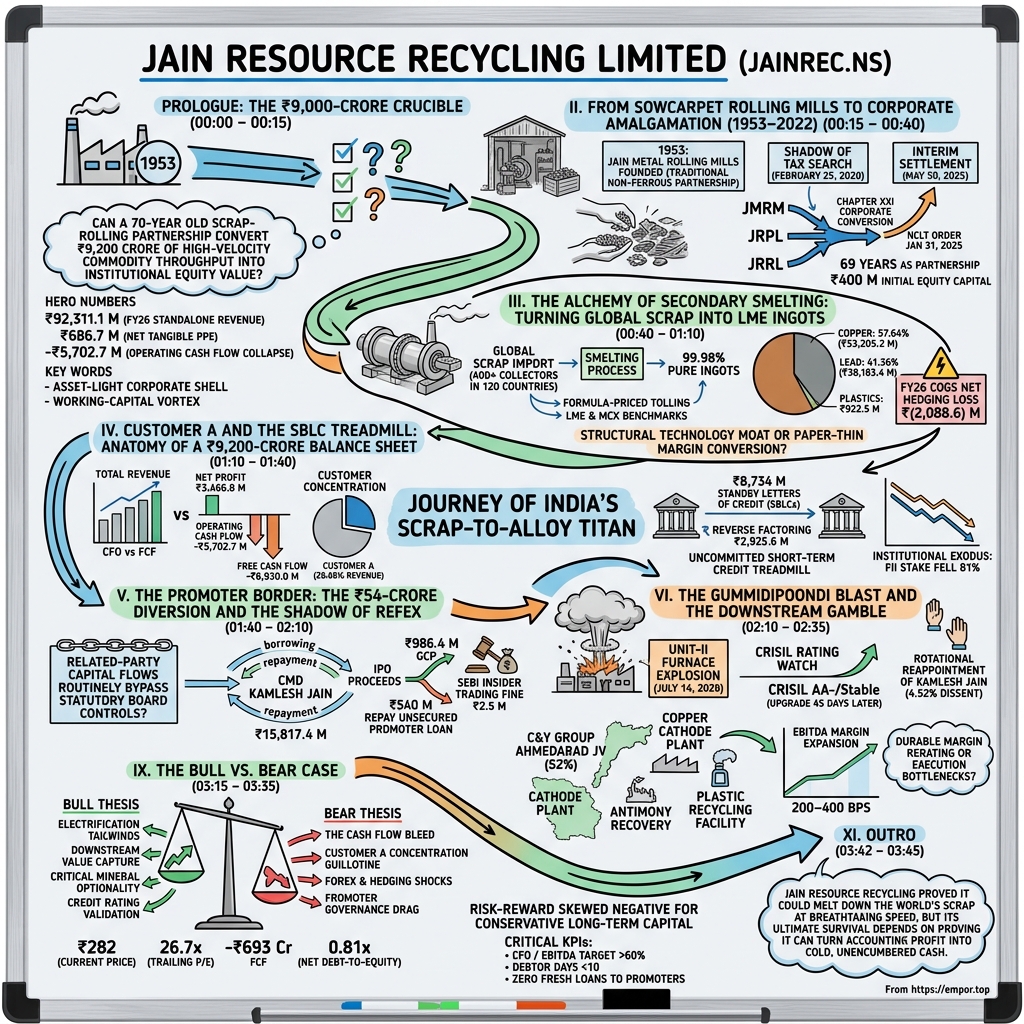
Jain Resource Recycling Limited: The Story of India's Scrap-to-Alloy Titan
I. Prologue: The ₹9,000-Crore Crucible
On October 1, 2025, a company that most Indian investors had never heard of a year earlier began trading on the National Stock Exchange and BSE1. Its book-running story was simple and well timed: the world needs more copper and lead, the cleanest place to find them is in what has already been mined, and an old Chennai family had spent seven decades learning how to melt the world's scrap into exchange-grade ingots. The ₹1,250-crore issue had priced at ₹230 a share1. Within months the stock touched ₹5942.
Meanwhile, far from the trading screens, the actual business looked nothing like a technology story. At the company's furnaces in Gummidipoondi, on Chennai's industrial northern fringe, containers of battery plates, copper wire, and mixed non-ferrous scrap arrived from more than 120 countries1. Most were paid for with standby letters of credit, a form of bank guarantee that lets a supplier on the other side of the world ship scrap to India on the strength of an Indian bank's promise to pay1. The metal came in, got sorted, melted, refined, cast, and sold, mostly abroad, at prices pegged to the London Metal Exchange.
That is the crucible this story is about. Jain Resource Recycling Limited (JRRL) booked about ₹9,231 crore of standalone revenue in the year to March 20261. It did so with a net tangible plant block of roughly ₹69 crore1. Put those two numbers side by side and the company turns over its physical plant about 134 times a year. No steel mill, cement plant, or primary smelter in India comes close. Either JRRL has discovered the most efficient factory model in Indian industry, or most of what passes through its books is something other than manufacturing as investors usually picture it.
The third hero number answers the riddle, and it is the uncomfortable one. In the same year that net profit rose to about ₹347 crore, cash flow from operations fell to roughly minus ₹570 crore1. The company earned accounting profit and consumed more than all of it, plus bank money, to fund inventory, receivables, and supplier advances.
So the question for this episode is not whether JRRL is a good recycler. It plainly can process scrap at extraordinary speed. The question is whether a 70-year-old family scrap business can convert high-velocity commodity throughput into durable equity value for outside shareholders, or whether the listed company functions mainly as a balance sheet through which very large trading flows, and sometimes promoter flows, pass.
The roadmap runs like this. First, the origin: a 1953 rolling-mill partnership that became a company only in 2022 and was stitched together for listing in a hurry. Second, the metallurgy and economics of secondary smelting, and why hedging did not insulate margins the way the pitch implied. Third, the balance sheet: one unnamed customer, an exploding inventory pile, and a credit treadmill. Fourth, the promoter border, where the auditors flagged the most serious issues. Fifth, a furnace explosion and a downstream capex gamble. Then the moat, the lessons, and the bull and bear case.
Why does this matter now? Because the macro story is genuinely strong. India's Battery Waste Management Rules push used batteries out of backyard smelters and into licensed recyclers[^3]. Electrification needs copper. Critical-mineral security has become a policy priority. And yet foreign institutions that bought at listing cut their holdings by about four-fifths within nine months, while domestic funds and retail investors stepped in12. Two groups of sophisticated buyers looked at the same company and reached opposite conclusions. To understand who was right, start with the family that built it.
 Subscribe on LinkedIn
II. From Sowcarpet Rolling Mills to Corporate Amalgamation (1953–2022)
Sowcarpet is the old trading quarter of Chennai: narrow lanes, wholesale shops stacked to the ceiling, and a dense community of Marwari and Jain merchant families who for generations have dealt in textiles, money, and metal. In 1953, six years after independence, a partnership firm called Jain Metal Rolling Mills began there as a non-ferrous metals business13. The work was what it sounds like: buying brass, copper, and lead scrap, rolling and re-melting it, and selling it to the fabricators of a young industrial economy.
For most of the next seven decades, the business stayed a partnership. That detail matters. A partnership has no outside shareholders, publishes no audited accounts to the market, and can move money between family members and family firms as easily as moving cash between pockets. The group grew into lead battery recycling at Gummidipoondi and into copper processing, and the family set up other vehicles alongside, including Jain Recycling Private Limited (JRPL) and promoter companies such as KSJ Infrastructure and KSJ Metal Impex1.
Sixty-nine years, then a sprint
Then, abruptly, the structure changed. On February 25, 2022, Jain Metal Rolling Mills converted into Jain Resource Recycling Limited under Chapter XXI of the Companies Act, 2013, the route that lets an existing firm register as a company1. The new company issued 40 million shares, ₹40 crore of capital, not for cash but as consideration for taking over the partnership1. Sixty-nine years as a family firm ended in a single filing.
What followed looks less like organic evolution and more like a pre-listing assembly line. On January 31, 2025, an NCLT order amalgamated JRPL into JRRL, issuing about 21.2 million shares to absorb it1. In March 2025, the company issued shares on a rights basis at ₹78, converted ₹130 crore of optionally fully convertible debentures into equity, and split its shares five-for-one1. Around the same time, it redeemed about ₹135 crore of preference shares held by promoter-controlled KSJ Infrastructure and KSJ Metal Impex, and in FY25 extended loans of roughly ₹127 crore and ₹267 crore to those same two entities1.
Read in sequence, the steps tell their own story: consolidate the family's operating entities into one vehicle, simplify the capital table, clean up promoter-held instruments, and get the share count to a listable shape. None of that is improper on its face. Many Indian family businesses restructure this way before an IPO. But it does mean the listed company has a very short history as a disclosed, audited, standalone corporate. Investors buying in 2025 were underwriting a company with three years of corporate existence and seven decades of family lore.
The tax search that would not go away
There was also a shadow. On February 25, 2020, the Income Tax Department conducted a search under Section 132 across the premises of JRPL and JRRL's predecessor1. The family filed a settlement application. It was rejected, then remanded by the Madras High Court, and on May 30, 2025, the Interim Board for Settlement quantified additional undisclosed income of about ₹13.9 crore across assessment years 2014-15 to 2020-211. The matter closed with roughly ₹4.5 crore of tax and ₹5.4 crore of interest paid1.
In money terms, this is small next to a business earning hundreds of crores. As evidence, it matters more. It establishes that, during the partnership era, income existed that had not been recorded in the books, and that this was resolved through settlement rather than contested to a clean finding. For an investor, the useful framing is not "fraud" but "regime change": the company has moved from a private family accounting culture into one governed by SEBI, statutory auditors, and independent directors. Whether that culture change is complete is the thread that runs through the rest of the story.
The verdict on this chapter is that JRRL's corporate birth was a late-stage roll-up of family assets ahead of a liquidity event, with legacy issues settled on the way in. What it actually rolled up, and how that business makes money, sits inside the furnaces.
III. The Alchemy of Secondary Smelting: Turning Global Scrap into LME Ingots
Picture a car battery at the end of its life. Inside the plastic case sit lead plates, lead paste, and sulphuric acid. At a licensed recycler, the battery is broken, the plastic separated and washed, the acid neutralised, and the lead-bearing material fed into a rotary furnace, essentially a giant rotating kiln that melts the charge with fluxes and reducing agents. What comes out is crude lead, which is then refined and alloyed to the exact chemistry a battery maker wants, and cast into ingots. Copper follows a cousin of the same path: insulated wire is stripped and chopped, mixed scrap is sorted by grade, melted, and refined.
This is "secondary" metal, recovered from products rather than mined from ore. Chemically, refined secondary copper or lead can be identical to primary metal. That is the whole appeal: no mine, no ore concentrate, much less energy, and a ready supply wherever an economy throws things away.
Where the revenue comes from
JRRL's revenue in FY26 split almost entirely between two metals. Copper and copper ingots brought in about ₹5,321 crore, or roughly 58% of standalone revenue; lead and lead alloys brought in about ₹3,818 crore, around 41%; and plastics and other materials, mostly recovered battery casing, made up the last 1%1. Copper's customers are cable, wire, and transformer makers riding grid investment. Lead's are battery manufacturers, whose demand is tied to the replacement cycle of car, truck, inverter, and UPS batteries.
About 61% of standalone revenue came from exports1, and the company also booked roughly ₹123 crore of government export incentives such as RoDTEP and duty drawback1. That incentive line, worth about a third of a year's net profit, is a policy-dependent cushion investors should not mistake for operating margin.
The pricing formula: a spread business
Here is the mechanism that defines everything. JRRL does not set prices the way a branded manufacturer does. Its contracts are mostly short-term purchase orders, priced on a formula tied to LME or MCX settlement prices, plus or minus a conversion or product premium1. Its scrap purchases are priced off the same benchmarks, at a discount. The company's real product is the gap: buy scrap at "LME minus something," sell ingots at "LME plus a little," and keep the difference after processing costs.
An analogy helps. JRRL is less like a car factory and more like a currency exchange booth at an airport. The booth does not care much whether the dollar goes up or down; it earns the spread between buy and sell rates on enormous volume. That is why revenue can quadruple in four years while operating margins sit stubbornly between roughly 4% and 6%14. When metal prices rise, revenue inflates with them, but the spread does not grow in proportion.
Myth versus reality: "perfectly hedged"
The spread model has one obvious danger. Between buying scrap and selling ingot, weeks pass, and the metal price and the rupee both move. The company's answer is back-to-back hedging: forwards and options on LME prices and currency, typically on a 90-day cycle, meant to lock in the spread at the moment of purchase1.
The myth is that hedging makes the business immune to volatility. The FY26 accounts test it directly. Cost of goods sold carried a net hedging loss of about ₹209 crore, a sharp reversal from a hedging gain of about ₹121 crore a year earlier1. A swing of roughly ₹330 crore in a single cost line is close to the company's entire annual net profit.
In fairness, a hedging loss is not automatically a disaster. If the physical metal rose in value while the hedge lost money, the two should roughly offset, and the inventory note does show hedging adjustments carried inside inventory valuation1. But the size of the swing tells investors two things. First, the gross numbers moving through the income statement are enormous relative to the spread the company actually keeps. Second, reported profit in any year depends on how well the timing of physical flows and paper hedges lines up, a matching exercise that outsiders cannot audit.
The second leak is currency. At March 31, 2026, the company carried net unhedged foreign-currency liabilities of about US$51.6 million, roughly ₹488 crore1. Its own sensitivity disclosure puts the cost of a 5% rupee depreciation at about ₹24 crore before tax1. Not ruinous, but not "fully insulated" either.
The verdict: the history narrows management's claim rather than rejecting it. Hedging limits catastrophic exposure, but it does not make earnings smooth, and it does not create margin. Profit remains a function of the scrap discount, processing yield, and hedge timing.
A global sourcing net, and its chokepoints
JRRL's distinctive asset is the size of its procurement web: more than 400 scrap suppliers across 120-plus countries, plus a 25% equity stake in Kuwait's Abraj Al Khaleej that gives it a first-refusal call on that collector's scrap14. Scale in scrap buying matters, because a recycler that can fill vessels and keep furnaces full pays less per tonne in logistics and suffers less idle time.
The chokepoint is regulation. Battery scrap is hazardous waste, and cross-border movement is governed by international rules and Indian import licensing; pollution-control consents govern every furnace4[^3]. A sourcing network is only as valuable as the permits that let the material move. That is a real barrier to small entrants, and also a single point of failure for incumbents. And the money that pays for all this scrap has to come from somewhere, which brings the reader to the balance sheet.
IV. Customer A and the SBLC Treadmill: Anatomy of a ₹9,200-Crore Balance Sheet
Imagine the finance team in Chennai closing the books for March 2026. The profit and loss statement is a triumph: revenue up about 50%, net profit up about 64%1. Then they open the receivables ledger and the inventory sheets, and the picture changes. Money that used to come back in about a week is now taking two and a half. Material that used to fly through the furnaces is sitting in work-in-progress. And the bank lines that pay overseas suppliers have to be rolled again.
The single-customer trap
Start with who buys. One customer, identified only as "Customer A," accounted for about ₹2,461 crore of standalone revenue in FY26, roughly 27% of the total, up from about ₹1,348 crore, or 22%, the year before1. The company does not name this buyer, which Ind AS 108 permits. That leaves investors unable to tell whether Customer A is a global metals trading house, a large battery maker, or a cable producer, and each would imply very different staying power and credit risk.
What can be said is this. When over a quarter of a commodity business's revenue goes to one counterparty, that counterparty has leverage over price, payment terms, and volume. Revenue from Customer A grew about 83% in a year1. That could signal a deepening relationship. It could equally signal that growth was bought by giving one buyer more favourable terms. The filings do not settle which.
The FY26 autopsy: where the profit went
Now the central forensic finding. Here is the walk, step by step.
The company reported net profit of about ₹347 crore1. Operating cash flow came in at roughly minus ₹570 crore1. The gap between them is about ₹917 crore. Where did it go?
The single largest drain was inventory. Total inventory more than doubled, from about ₹626 crore to about ₹1,403 crore1. Inside that, work-in-progress jumped roughly 7.5 times, from about ₹79 crore to about ₹589 crore, and goods-in-transit stood at roughly ₹343 crore1. In plain terms, far more metal was sitting half-processed in the plant or floating on ships than a year earlier.
The second drain was receivables. Gross trade receivables almost quadrupled, from about ₹123 crore to about ₹463 crore1. Debtor days stretched from 7 to 18, and management's own explanation in the ratio disclosures was blunt: the change was "due to a significant slowdown in collections"1.
The third drain was supplier advances, about ₹396 crore of money paid ahead for scrap not yet received1. And a non-cash mark-to-market hedge adjustment of about ₹281 crore also reduced the operating figure1. Partly offsetting all of this, trade payables rose by about ₹237 crore, a cushion that includes roughly ₹293 crore of supplier financing arrangements, essentially reverse factoring where a bank pays the supplier and the company pays the bank later1.
Add capital spending and free cash flow ends up at roughly minus ₹693 crore for the year1.
Myth versus reality: receivables quality
The reassuring reading is that these receivables are young. None of the gross balance was older than a year, and the overwhelming majority was either not yet due or under six months old1. The expected credit loss allowance is just ₹2.3 crore1. Nothing here looks like a bad-debt time bomb.
But "young" is not the same as "fast." A business whose model is to turn metal into cash in days has seen its collection cycle more than double, with management itself using the word "slowdown." When a provision of about half a percent sits against a receivable book that grew almost fourfold in a year, the provisioning is either rightly confident about a few large, creditworthy buyers or is assuming the slowdown is temporary. Given Customer A's weight, the two explanations are really one: the receivable risk is largely the risk of a handful of big counterparties.
The debt that does not look like debt
On paper, JRRL barely borrows. Long-term borrowings at March 2026 were about ₹0.7 crore, mostly vehicle loans1. That is the number a casual screen picks up.
The real borrowing is short-term and continuously rolled. Short-term bank obligations stood at about ₹1,248 crore, up from roughly ₹811 crore a year earlier1. The bulk, about ₹873 crore, was SBLC-backed import credit; the rest was pre-shipment export credit of roughly ₹194 crore, bill discounting of about ₹124 crore, and a small cash-credit line1. Add the ₹293 crore of supplier financing tucked into payables, and effective trade-linked borrowing exceeds ₹1,540 crore1.
None of this is unusual for a metals trader. It is, however, a different risk profile from a company with "no long-term debt." These lines are typically uncommitted and renewed by banks at their discretion. The business runs on a treadmill: every shipment of scrap requires the banks to keep agreeing, and every rupee of revenue growth demands more of their capacity. Net debt to equity sits around 0.8 times on book equity of roughly ₹1,543 crore12. The 25.7% ROCE that screens display2 is real on the stated capital base, but it measures returns on a base that leaves out much of the trade credit that makes the volume possible.
The institutional exodus
The market noticed. Foreign institutional investors held about 6.4% at listing in September 2025. They cut that to roughly 1.2% by June 2026, a reduction of more than 80%2. Domestic institutions moved the other way, from about 6.4% to around 9.7%, and the number of shareholders jumped from about 63,000 to more than 92,000 in a single quarter2.
Ownership flows are not proof of anything, but they reveal which story each group bought. Foreign funds tend to weigh cash conversion and governance heavily; domestic funds and retail investors in 2025-26 were also buying a critical-minerals and recycling theme. The verdict for this section is stark: headline profit is decoupled from cash, the company depends on rolling short-term bank credit, and one customer controls more than a quarter of revenue. That would be a manageable risk profile in a company with a pristine governance record. JRRL's auditors, however, had more to say.
V. The Promoter Border: The ₹54-Crore Diversion and the Shadow of Refex
April 28, 2026. A postal ballot closed, and the scrutinizer began counting. The question on the ballot was unusual for a company barely seven months into public life: would shareholders ratify, after the fact, the use of ₹54 crore of IPO money for something the offer document had not specifically promised? The money had been raised for "general corporate purposes." It had been used to repay an unsecured loan from the company's own chairman and managing director, Kamlesh Jain1.
Who runs JRRL
To read this chapter fairly, it helps to understand the people. Kamlesh Jain is the central figure: chairman and managing director, and the dominant shareholder, holding about 65.9% directly after the IPO, with the Jain Family Trust holding another 7.2%1. The executive bench is family and long-time associates: Joint MD Mayank Pareek, Director and CFO Hemant Shantilal Jain, and other family members in executive roles1. The board has eight directors, half of them independent, meeting the statutory threshold1.
This is the classic Indian promoter-led company: one person whose judgment, relationships, and personal balance sheet are woven into the business. In a scrap business that structure has real virtues. Decisions are fast, supplier relationships are personal, and the promoter's money can bridge a gap when banks hesitate. The cost of those virtues is that the line between "the promoter's money" and "the company's money" has to be policed constantly, and that is exactly where the auditors found problems.
The treasury churn
During FY26, JRRL borrowed about ₹765 crore from Kamlesh Jain and repaid him about ₹817 crore, paying around ₹6.2 crore of interest1. In total, more than ₹1,580 crore of money moved back and forth between the company and its CMD within a single year1. The statutory auditor, in its CARO report under clause xiii, recorded that these transactions were made without prior approval of the Audit Committee or an omnibus approval, and were ratified only afterwards, on February 9 and May 18, 20261.
Think about what the Audit Committee is for. Under Indian listing rules, related-party transactions need its prior approval precisely so that independent directors can judge them before the money moves. A post-facto ratification turns that control into a formality. The company can reasonably argue that the promoter was lending to the company, not taking from it, and that the loans ended the year at zero1. That is true and it matters. But a control that is bypassed when the flows run in the company's favour is still a control that has been bypassed.
The IPO money
The fresh issue raised ₹500 crore. The offer earmarked ₹375 crore for debt repayment and about ₹98.6 crore for general corporate purposes1. Of the latter, ₹54 crore went to repay the promoter's unsecured loan, which the auditor flagged under CARO clause x(a), and which shareholders were then asked to ratify by postal ballot1.
Here is why investors focus on this even though ₹54 crore is small relative to the company's turnover. When a company sells new shares, the public is paying for growth or balance-sheet repair at the listed company. Using part of that cash to repay the controlling shareholder converts public equity into promoter liquidity. And it happened in addition to the ₹750 crore that Kamlesh Jain and Mayank Pareek already received by selling shares in the offer for sale1.
The subsidiary channel
The second boundary is internal. JRRL extended demand loans of about ₹893 crore to its wholly owned subsidiary Jain Green Technologies during FY26, received back about ₹730 crore, and ended the year with roughly ₹183 crore outstanding1. That subsidiary accounted for nearly 98% of all the company's loans repayable on demand1. Another ₹42 crore or so sat with the UAE subsidiary Jain Ikon Global Ventures, whose precious-metals refining operation was discontinued in FY261.
Lending to a 99.99%-owned subsidiary is not, by itself, a governance failure; consolidated accounts capture it. But it adds another layer through which cash moves, and the scale of the churn, hundreds of crores in and out, makes the flows harder for minority shareholders to follow.
The Refex shadow and the AGM vote
The governance file has an external chapter too. On December 12, 2025, SEBI passed an adjudication order imposing a penalty of ₹25 lakh on Kamlesh Jain and the Jain Family Trust for insider trading in shares of Refex Industries, another listed Chennai company15. The matter did not involve JRRL's own shares. It still bears on investor trust, because the person whose judgment governs the listed company had been sanctioned by the market regulator.
At the August 28, 2026 AGM, the resolution to reappoint Kamlesh Jain as a director retiring by rotation passed comfortably, as it must with a promoter holding nearly three-quarters of the equity. But about 1.1 million votes, roughly 4.5% of public institutional votes cast, were recorded against it6. In absolute terms that is a modest protest. In a company only eleven months listed, a recorded institutional "no" against the founder is a signal worth noting.
Promoter-family remuneration totalled about ₹7.9 crore in FY26, with Kamlesh Jain drawing ₹3.6 crore against nil the previous year, plus about ₹71 lakh of keyman insurance and around ₹68 lakh of office rent paid to related parties1. Those amounts are modest against profit; the jump from nil to ₹3.6 crore in the first listed year is still worth noting.
Weighing it
The case for improvement is real: promoter loans were extinguished by year-end, the transactions were eventually ratified, the board meets independence norms, and no promoter shares are pledged1. The case against is that within its first listed year, the company drew two adverse CARO observations, both centred on money moving between the listed entity and its controlling shareholder.
The verdict: the history does not show money being taken out of the company, but it shows the boundary being crossed casually and repaired after the fact. That is a governance discount the market can price, and FY27's related-party note is where it will be confirmed or dissolved. While investors were digesting that, the plant itself delivered a different kind of shock.
VI. The Gummidipoondi Blast and the Downstream Gamble
On July 14, 2026, a furnace at Gummidipoondi Unit-II exploded4. A secondary smelter is a place of molten metal, high temperature, and hazardous dust; an explosion in such a plant raises immediate questions of worker safety, environmental compliance, and whether regulators will let it restart. Operations at the unit were halted under regulatory oversight1. Nine days later, on July 23, CRISIL placed the company's ratings on "Rating Watch with Developing Implications"4, the agency's way of saying it did not yet know which way the story would turn.
The recovery
The answer arrived faster than many feared. Operations were restored in August 20261. CRISIL estimated the direct financial loss at around ₹3.9 crore, largely insurance-backed4. And on August 27, rather than merely removing the watch, it upgraded the company's long-term bank facilities to CRISIL AA-/Stable from A+4.
That upgrade continues a sequence: CRISIL A/Stable in May 2025, A+ after the IPO in October 2025, and AA- in August 2026784. The agency cited the company's established position in non-ferrous recycling, its LME-registered lead brand, its global sourcing network, low long-term gearing, and the speed of the restart4. It also listed the constraints plainly: thin operating margins of about 4% to 6%, exposure to scrap-to-metal spreads and LME volatility, working-capital-intensive import logistics, and strict pollution-control regulation4.
A credit rating answers a lender's question, not an equity holder's. It says the company is very likely to repay its banks. It does not say whether shareholder returns will justify the multiple. Still, three upgrades in fifteen months, one of them right after an industrial accident, is strong evidence that lenders see the operating franchise as resilient. The incident tested the business, and the business passed. What it did not test is whether the next phase of growth will look the same.
The pivot to manufacturing
Management's plan for FY27 is to move downstream. The headline project is a copper cathode and continuous-cast wire-rod plant, targeted for the second or third quarter of FY271. Alongside: an antimony recovery furnace budgeted at about ₹20 crore, to extract a critical mineral from lead-smelting residues; a standalone six-acre plastic recycling facility costing about ₹15 crore; and a 52%-owned joint venture with C&Y Group in Ahmedabad, incorporated in December 2025, designed to process around 72,000 tonnes of scrap a year in western India1. Management has talked of expanding EBITDA margins by 200 to 400 basis points as these assets mature1.
The logic is easy to follow. An ingot is a commodity. A wire rod made to a cable maker's specification is a step closer to a product, with tighter quality requirements and potentially a better premium. Antimony, which hardens lead alloys and is used in flame retardants, is a scarce critical mineral; pulling it out of material the company already processes is, in principle, extra revenue without extra feedstock.
The disconfirming test
Now the stress test. Indian secondary smelters have long tried to escape the ingot spread by moving into alloys, oxides, and value-added products. Pondy Oxides and Nile operate in the same lead and alloy space and remain low-margin businesses, while Gravita India earns roughly 9% to 10% operating margins on a model built around a wide network of recycling yards2. The lesson from that peer set is that downstream integration helps, but it does not change the basic physics of a business where raw material is priced off the same benchmark as finished goods and primary producers like Hindalco and Vedanta compete for the same copper customers.
JRRL's own record makes the point sharper. Revenue has roughly quadrupled since FY23, and operating margins have stayed within the 4% to 6% band through all of it14. Scale has not, so far, bought margin. The UAE precious-metals refining venture was discontinued during FY26, and the Sri Lankan mineral-sands associate was reclassified as held for sale1, two recent reminders that not every adjacency works out.
The verdict: the downstream push is a reasonable strategy, and the blast showed the operation is robust. But the guided margin expansion is a management target, not an established fact, and the history so far rejects the stronger version of the claim that scale alone lifts margins. Capacity coming online is a milestone; segment margins in audited filings are the proof. Whether there is a moat to protect those margins is the next question.
VII. Strategic Moats & Hamilton Helmer's 7 Powers
Put three Indian recyclers on the same screen. Gravita India trades at roughly 30 to 35 times earnings with operating margins near 10%. Pondy Oxides trades in the low twenties with margins of 4% to 5%. JRRL sits in between, at about 26.7 times trailing earnings, with margins around 5%2. The market is effectively saying JRRL's earnings are worth more than Pondy's but less than Gravita's. The question is whether its competitive position justifies even that.
The 7 Powers, one by one
Scale economies: moderate. Sourcing from 120-plus countries and 400-plus suppliers lets JRRL buy, ship, and blend scrap at volumes regional recyclers cannot match14. That lowers freight and procurement cost per tonne and keeps furnaces full. But the global benchmark players in copper and lead, the primary miners and the large trading houses, operate at many times JRRL's procurement volume. Scale is an advantage within Indian recycling, not against the world.
Network effects: absent. Each scrap purchase and ingot sale is a bilateral spot transaction. More customers do not make the product more valuable to other customers.
Counter-positioning: absent. Primary smelters are not threatened by recyclers in a way that forces them to stand still; many happily blend scrap into their own feed to meet sustainability goals.
Switching costs: negligible. This is the critical one. Refined copper and LME-grade lead are standardized specifications. If Customer A finds a better price from another recycler or a global trader, it can switch quickly, with little technical requalification for standard grades. The 27% concentration therefore sits on top of low switching costs, which is the least comfortable combination in the framework.
Branding: narrow. LME registration of JRRL's lead brand is a genuine credential: it means its ingots are deliverable against exchange contracts, which signals quality and widens the buyer pool4. But it earns access, not a premium. LME-registered metal sells at LME-linked prices.
Cornered resource: weak. The 25% stake in Kuwait's Abraj Al Khaleej gives JRRL a first claim on one regional scrap stream1. It is a useful corridor, not a monopoly over supply.
Process power: moderate. Decades of sorting, blending, and fluxing know-how, plus regulatory permits and LME approval, produce better yields and fewer rejections than an amateur recycler would achieve. This is the most credible power. The company discloses no separate R&D spending1, which suggests the edge lies in accumulated operating practice rather than proprietary technology.
Porter's five forces in brief
Buyer power is very high: one customer is over a quarter of sales, contracts are short-term, and the product is a commodity. Supplier power is also high: scrap sellers want cash or bank-backed letters of credit, which is precisely why the SBLC treadmill exists. The threat of substitutes is low, since recycled metal is chemically equivalent to primary metal and regulation increasingly favours it. The threat of new entrants is moderate: a rotary furnace is not expensive, but pollution licensing, hazardous-waste import permissions, and the working capital to fund global sourcing filter out most newcomers. Rivalry is high, with Gravita, Pondy Oxides, Nile, and a large unorganised sector all bidding for the same scrap.
What explains Gravita's premium
The peer comparison is instructive. Gravita's higher margin reflects a model that controls collection through a network of recycling yards in several countries and owns more of the value chain2. JRRL's model is a high-volume conversion and trading engine built on balance-sheet capacity and sourcing relationships.
The verdict: JRRL has narrow process power and moderate scale economies inside Indian recycling, and no meaningful switching costs, network effects, or cornered resources. Its scale reflects real operational capability, but also, to a large degree, the capacity of its balance sheet and bank lines. That moat is real but thin, and it is most vulnerable exactly where the company is most concentrated: one big buyer and rolling short-term credit. Those weaknesses produce some lessons that apply well beyond scrap.
VIII. Playbook: Business & Investing Lessons
Lesson 1: A plant that turns over 134 times a year is not light. It is leveraged on other people's credit.
Investors celebrate asset-light models because they promise growth without capital. JRRL shows the other side. Its fixed assets are tiny, about ₹69 crore1, but every rupee of sales needs metal in the pipe, receivables in the ledger, and bank guarantees behind the supplier. The capital did not disappear; it moved from the plant line to the working-capital line, and much of it belongs to banks. When an "asset-light manufacturer" shows a stunning fixed-asset turnover, the first question is where the real capital sits.
Lesson 2: Profit without cash is an option written in favour of your banks.
In FY26 JRRL earned about ₹347 crore and burned about ₹570 crore in operations1. As long as banks keep rolling the SBLC lines, that gap is a timing difference. If they ever stop, it becomes a solvency question. In commodity conversion, earnings tell you the spread was positive; only cash flow tells you the business can fund itself. The investor who reads the income statement first is reading the wrong document.
Lesson 3: A ratification is not an approval.
JRRL's two CARO observations in its first listed year, promoter loans moved before the Audit Committee approved them, and IPO money redirected to repay the CMD1, did not cost minority shareholders much money directly. They cost credibility. Foreign institutions sold more than four-fifths of their holdings in nine months2. Governance discounts work like compound interest in reverse: every post-facto fix makes the next promise less valuable, and the multiple pays for it long after the sums are forgotten.
Lesson 4: A furnace commissioned is not a margin earned.
Wire-rod lines, antimony furnaces, and joint ventures are milestones, not margins. JRRL quadrupled revenue while its margin stayed in the same narrow band1. Until audited segment numbers show higher realisations from downstream products, the right working assumption is that secondary metal remains a spread business, whatever the factory looks like.
Lesson 5: In a commodity company, your biggest customer's leverage is your moat's limit.
When one unnamed buyer takes 27% of revenue1 and the product is a standard specification, no amount of sourcing scale protects the spread if that buyer decides to push. The moat question for JRRL is not "how good are the furnaces" but "how much can Customer A squeeze."
IX. The Bull vs. Bear Case
Two analysts sit across a table, each holding the same annual report. One points to a 46% three-year revenue CAGR and a 56% profit CAGR12. The other points to minus ₹693 crore of free cash flow1. The stock sits near ₹282, down about 52% from its ₹594 peak and just above its 52-week low of ₹2712. At about 26.7 times trailing earnings, a ROCE of about 25.7%, and net debt to equity near 0.8 times2, the market is pricing JRRL as a growth company with question marks, not as a broken one.
What does that price appear to assume? At roughly ₹9,740 crore of market value against about ₹360 crore of trailing profit2, investors are assuming that profit growth continues at a healthy rate and, implicitly, that cash flow will eventually catch up with earnings. A pure trading business with persistently negative cash conversion would usually command a much lower multiple; a recycler with Gravita-like margins would command a higher one. JRRL's multiple is a bet that it will migrate toward the latter.
The bull thesis
Regulation is pushing volume toward organised players. The Battery Waste Management Rules, 2022, impose extended producer responsibility on battery makers and require recycling through registered facilities[^3]. Every battery that moves from an informal backyard smelter into a licensed plant is potential feedstock for players like JRRL.
Downstream products could lift the mix. If the copper cathode and wire-rod plant works as planned in FY27, a portion of revenue will shift from commodity ingots to specification products sold to cable makers riding India's grid and building-wire demand1. Bulls argue this can push EBITDA margins toward 8%.
Antimony is genuine optionality. Recovering a critical mineral from residues the company already handles, for a capex of about ₹20 crore1, is a small bet with a potentially attractive payoff.
Lenders are voting with their ratings. Three CRISIL upgrades in fifteen months, ending at AA-/Stable after a furnace explosion487, suggest that the banks financing the treadmill are growing more comfortable, not less.
The working-capital build might be deliberate. Some of the inventory jump could be raw material positioned ahead of the new copper and JV capacity1. If so, FY27 could see inventory release as cash.
The bear thesis
The cash bleed may be structural. The working-capital build accompanied, rather than preceded, growth, and management itself describes a collection slowdown1. If operating cash flow is negative again in FY27, the company will need either more bank lines, already above ₹1,540 crore including supplier financing, or fresh equity.
Customer A is a concentration guillotine. One buyer with negligible switching costs takes over a quarter of sales1. If it diversifies or demands longer credit, growth stalls and receivables lengthen further.
Hedging and currency remain a leak. A ₹330-crore swing in hedging results in one year and about US$52 million of unhedged currency liabilities1 mean earnings can surprise in either direction.
Governance caps the multiple. Until related-party flows stop and auditors issue clean CARO reports, the institutions that left are unlikely to return in size.
The margin history is the hardest fact. The 4% to 6% band has held through a quadrupling of revenue14. The 200 to 400 basis point expansion is management's guidance, not yet any part of the record.
An activist's checklist
A skeptical long-short investor would press on four points. Name Customer A, or at least its type and credit terms. Disclose segment margins for copper and lead separately, so investors can see where the spread is earned. Commit publicly to zero related-party loans with the promoter, in either direction. And publish a working-capital target in days, so the cash conversion claim can be held to account.
Weighing the cases
The bull case rests on regulation, downstream projects, and lender confidence, all real, but mostly forward-looking. The bear case rests on audited facts already in the record: negative cash flow, concentration, hedging volatility, and auditor observations. Weighed that way, the near-term evidence tilts toward the bear side for conservative long-term capital, and the stock is unlikely to command a sustained premium until operating cash flow turns convincingly positive and promoter transactions stay at zero across several reporting periods. That conclusion could change quickly, and three KPIs will show when.
The three KPIs to track
- Operating cash flow relative to operating profit. Latest reading: about minus 89% in FY26, down from positive territory before1. Direction: sharply worse. This is the single number that decides whether the profit is real for shareholders.
- Debtor days and Customer A's share. Latest: 18 days, up from 7; Customer A at about 27%, up from about 22%1. Direction: both rising. Falling numbers would show the growth is broad-based and paid for.
- Related-party loans with the promoter (Note 43). Latest: more than ₹1,580 crore of two-way flows with the CMD in FY26, zero balance at year-end1. A full year with no fresh flows would be the clearest governance signal available.
X. Epilogue
Tonight, JRRL trades around ₹282 a share, a market value of about ₹9,740 crore, roughly half its peak2. The Gummidipoondi furnaces are running again. The credit rating is the best the company has ever held4. The copper wire-rod plant, the antimony furnace, and the Ahmedabad joint venture are all in motion1. And the balance sheet carries more metal, more receivables, and more short-term bank credit than at any point in its history1.
The next eighteen months will be decided by three moments.
The first is the half-year and full-year FY27 cash flow statements. If inventory and receivables unwind and operating cash flow turns strongly positive, the FY26 bleed will be read as a one-time build ahead of capacity, and the central bear argument weakens sharply. If cash flow stays negative while short-term borrowing climbs past ₹1,500 crore of bank lines, the treadmill thesis is confirmed, and equity investors will begin asking about dilution.
The second is commercial production at the wire-rod plant and the Ahmedabad facility. The question is not whether the machines start; it is whether, a few quarters later, the margin line moves out of the band it has occupied for four years.
The third is the FY27 CARO annexure and Note 43. A clean audit report with no post-facto ratifications and no fresh promoter loans would do more for the multiple than any capacity announcement. Another round of observations would tell institutions that the border is still porous.
Underneath all three sits the unresolved structural question: can an Indian family-run scrap business, built in Sowcarpet's lanes on trust, speed, and the promoter's personal balance sheet, complete the transition into a transparent, cash-generative public company where the minority shareholder's rupee is treated as untouchable? The company has shown it can grow. It has not yet shown it can do both of the other things at once.
XI. Outro
In 1953, a small partnership in Sowcarpet bought scrap brass and lead, rolled it, and sold it to anyone who needed metal. Seventy-three years later, the same family's company melts scrap from more than 120 countries into LME-registered ingots, at a pace that turns its plant over more than a hundred times a year1.
That is the extraordinary part of the story, and it is genuine. The unfinished part is simpler and harder. Jain Resource Recycling has proved it can melt the world's scrap faster than almost anyone in India. Its future as a public company depends on proving it can turn that molten speed into something more durable than an accounting profit: cold, unencumbered cash that belongs, without exception, to every shareholder.
References
-
Annual Report 2025-26 (Standalone & Consolidated Financial Statements) — BSE India, 2026-08-05 ↩↩↩↩↩↩↩↩↩↩↩↩↩↩↩↩↩↩↩↩↩↩↩↩↩↩↩↩↩↩↩↩↩↩↩↩↩↩↩↩↩↩↩↩↩↩↩↩↩↩↩↩↩↩↩↩↩↩↩↩↩↩↩↩↩↩↩↩↩↩↩↩↩↩↩↩↩↩↩↩↩↩↩↩↩↩↩↩↩↩↩↩↩↩↩↩
-
JAINREC Consolidated Financials, Ratios, and Balance Sheet History — Screener, 2026-10-01 ↩↩↩↩↩↩↩↩↩↩↩↩↩↩↩
-
Jain Metal Group Corporate Homepage — Jain Metal Group, 2026-10-01 ↩
-
Rating Rationale: Jain Resource Recycling Limited (Upgrade to CRISIL AA-/Stable) — CRISIL Ratings, 2026-08-27 ↩↩↩↩↩↩↩↩↩↩↩↩↩↩↩↩
-
SEBI Adjudication Order in the matter of Insider Trading in Refex Industries Limited — Securities and Exchange Board of India, 2025-12-12 ↩
-
Scrutinizer's Report on the 5th Annual General Meeting Voting Results — BSE India, 2026-08-28 ↩
-
Rating Rationale: Jain Resource Recycling Limited (Initial Rating CRISIL A/Stable) — CRISIL Ratings, 2025-05-22 ↩↩
-
Rating Rationale: Jain Resource Recycling Limited (Post-IPO Upgrade to CRISIL A+/Stable) — CRISIL Ratings, 2025-10-15 ↩↩
 LinkedIn
 WhatsApp
 Reddit
 Hacker News
 Email
Email Kindle
 RSS Feed
 Spotify
 Apple Podcasts
 Amazon Music
 Audible
 YouTube