Jagran Prakashan Limited: The Fortress, the Vault, and the Family Feud
I. Introduction & Episode Roadmap
Every night across Uttar Pradesh and Bihar, presses start turning a little before midnight. By four in the morning, bundles of Dainik Jagran are coming off trucks at roadside depots in district towns most global investors could not find on a map. By six, hawkers on bicycles have pushed them under doors in lanes from Kanpur to Patna. The paper carries state politics, district crime, mandi prices, wedding notices and government tenders. It has been doing some version of this for more than eight decades.
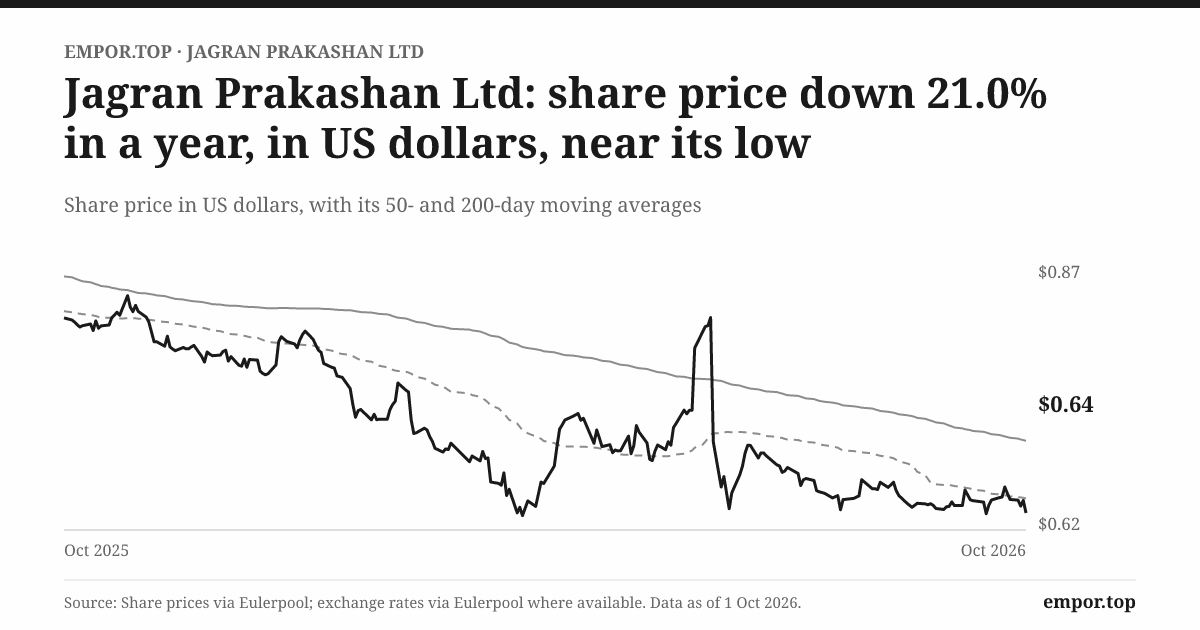
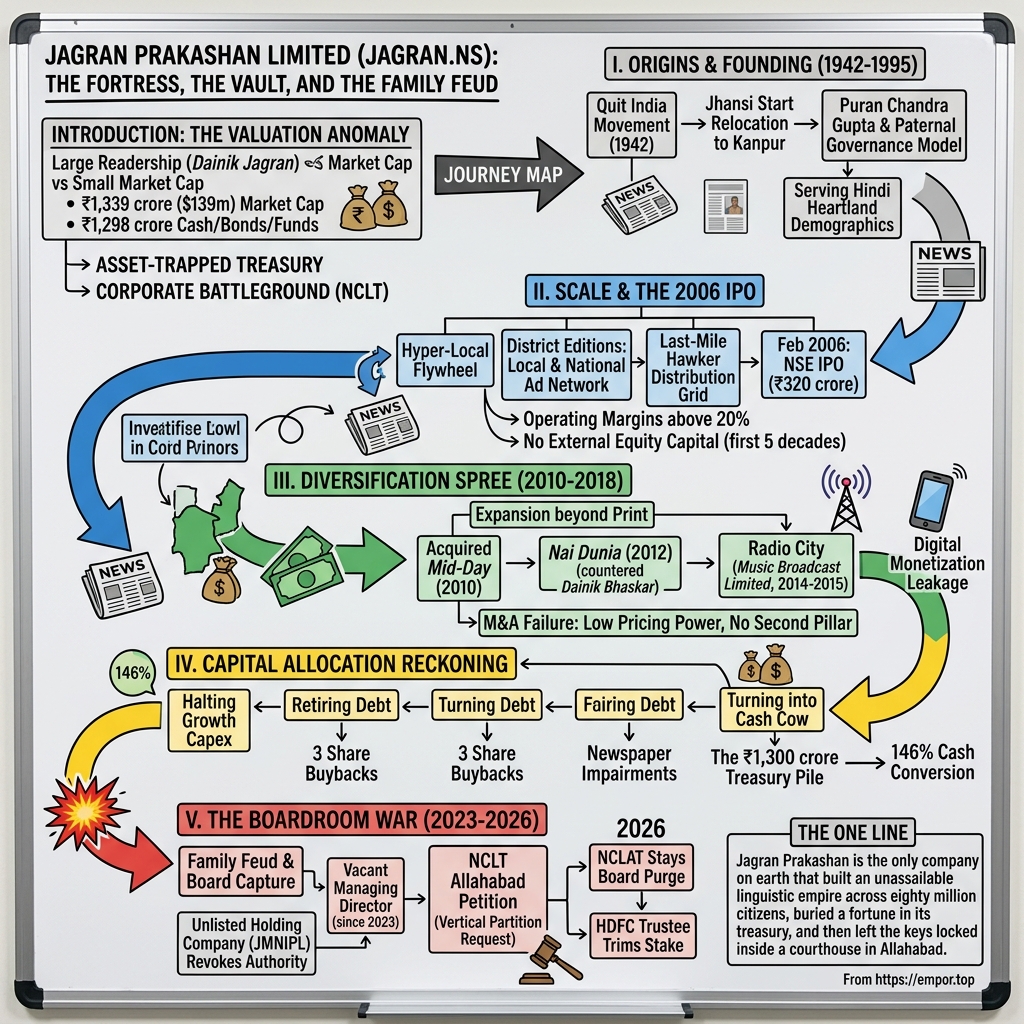
Now look at the same company from a trading terminal in Mumbai. On October 1, 2026, Jagran Prakashan Limited, the listed owner of Dainik Jagran, was worth about ₹1,339 crore on the National Stock Exchange, roughly $139 million.1 Its share price of ₹61.51 sat about a fifth below its 52-week high.1 Inside the company sat more than ₹1,298 crore of cash, fixed deposits, debt mutual funds, credit funds and corporate bonds.23
Put those two numbers side by side and the paradox jumps out. Strip out the treasury and the market is paying about ₹462 crore, or $48 million, for the whole operating business: India's largest Hindi newspaper franchise, a national FM radio network, an outdoor advertising arm, a Mumbai tabloid and a digital portal.1 That enterprise value is about 1.3 times a single year's EBITDA.1 The stock trades at 0.6 times book value and offers a free cash flow yield of about 12.6%.1 In most markets, a debt-free business generating that much cash at that price would attract a takeover bid within months.
Nobody is bidding. The reason sits not in the newsroom but in a courtroom. Since 2023, the Gupta family that founded and controls the company has been fighting itself before the National Company Law Tribunal at Allahabad.45 The company has had no Managing Director since September 30, 2023.2 In 2026, the family holding company tried to remove seven independent directors and a whole-time director, and an appellate tribunal froze the result.26
So which company is this? There are three candidate answers, and this story tests each one:
- A regional media moat that still yields cash from a mature print franchise the internet has not yet broken.
- A trapped treasury vehicle where nearly half of pre-tax profit now comes from bond coupons and mutual fund gains.
- A corporate battleground, where minority shareholders hold about 31% of the economics and close to none of the power.
The route runs through six stops. It starts with the origins of Dainik Jagran in the Quit India era and the climb to dominance in the Hindi heartland. Then it opens up the print engine: district editions, hawker networks, and why newspapers in India kept their margins long after Western print collapsed. Next come the acquisitions of Mid-Day, Nai Dunia and Radio City, the attempt to build a media conglomerate, and the test of whether any of it worked. Then the money: the cash conversion, the buybacks, and the treasury that grew to rival the market value. Then the forensic audit of receivables, related parties and earnings quality. And finally the boardroom war, followed by Hamilton Helmer's 7 Powers, Porter's Five Forces, the bull and bear cases, and the lessons that belong to this company and no other.
The thread that ties it together is simple. Jagran built something hard to copy and then generated more cash than it knew how to use. The question now is who gets the cash, and when.
 Subscribe on LinkedIn
II. Puran Chandra Gupta and the Press of the Hindi Heartland (1942–1995)
A newspaper born in a crisis
In 1942 the Quit India movement was tearing through the United Provinces. Congress leaders were in jail, the colonial administration was censoring the press, and in Jhansi, a garrison town in the Bundelkhand country, a businessman named Puran Chandra Gupta started a Hindi newspaper called Dainik Jagran.7 The name means, roughly, "Daily Awakening." It was a statement of intent as much as a masthead.
The early paper was small and political. What made it unusual was not its cause, since dozens of nationalist sheets were printing in those years, but its language and where it was. English papers such as The Times of India and The Indian Express served officials, lawyers and the urban professional class. The Hindi-speaking plains of the north, home to tens of millions of people becoming literate and political at the same time, had far less serious daily journalism aimed at them. Jagran set out to fill that gap.
In 1947, the year of Independence, the paper moved its base to Kanpur, then the industrial capital of Uttar Pradesh.7 It was a commercial choice. Kanpur had textile mills, leather works, traders and a rail hub that could send bundles of paper out in every direction. A political paper became a business.
The district edition: the real invention
Jagran's most lasting idea came later and was more prosaic than nationalism: the district page. Instead of printing one paper for a whole state, the company built editions and sub-editions so that a reader in Gorakhpur or Bareilly opened a paper with their own district's crime, courts, prices and local notices on the inside pages.
That one move created a two-sided market. Readers bought the paper because it carried news about their own town that nobody else covered. Local merchants, coaching institutes, jewellers and property developers advertised because those readers were there. Then, as India's consumer economy grew, national brands in FMCG, autos and banking found that the cheapest way to reach a small-town household was a page in the local Hindi daily. Each new edition deepened the habit.
The English press, run from Delhi and Mumbai, mostly did not contest this ground. Getting a district edition right takes hundreds of stringers, local printing, and a distribution web reaching villages. Those are slow, unglamorous assets. By the time national advertisers cared about the Hindi heartland, Jagran and a handful of rivals had already taken it.
The family as operating system
Puran Chandra Gupta ran the business as a family enterprise, and the family was large. His sons and, later, their sons took charge of editions, regions and functions. The structure was simple: many branches, one business, one patriarch to settle disputes. For decades it worked. Brothers and cousins could open a new edition, staff it with trusted people and run it without board paperwork.
It also set up the central problem of this story. A family run by consensus has no formal mechanism for when consensus fails, and the governance in this era relied on unwritten loyalty. The arrangement that let six branches act as one in the twentieth century is the same arrangement whose collapse in 2023 froze the listed company.28
What this era built for today's investor
Jagran funded its rise mostly on its own. The family took in outside equity only once the business was large enough to list, which means the asset base on today's balance sheet, the printing plants, the brand and the circulation network, was built over generations from retained cash.9
The lesson for the present is that the advantage was geography and language, not just editorial quality. Jagran owned district-level reach before anyone else wanted it. Whether that reach still matters when news arrives on a smartphone is the question every later section returns to. First, though, comes the period when the business turned that reach into some of the best margins in global print.
III. The Hyper-Local Flywheel: Scale, Distribution, and the 2006 IPO
Private equity knocks
By the early 2000s, Indian print was one of the few growing newspaper markets in the world. Literacy was rising, incomes were rising, and in the Hindi belt newspaper reading was still spreading into homes that had never bought a daily. Global investors noticed. Blackstone took a minority stake in Jagran Prakashan in the years before the listing, bringing institutional governance, audited systems and an eventual exit plan.9
In February 2006, Jagran Prakashan listed on the Indian exchanges, raising about ₹320 crore at ₹320 per share.2 A 5:1 stock split followed, cutting face value to ₹2 per share.2 The listing marked the moment the family became custodians of other people's money as well as their own. Blackstone stayed for years and then sold down through open-market block deals in 2014.9
How a Hindi newspaper actually makes money
Open the revenue line of Jagran's FY2026 accounts and it reads like a summary of Indian media economics:2
- Print advertising: about ₹1,115 crore, close to 60% of revenue. Ads are priced per column-centimetre of page space, which makes a Diwali full-page or an election-season campaign a high-value product.
- Circulation: about ₹329 crore, or roughly 18%. That is the money readers pay for the physical paper.
- Radio, outdoor, events and job printing make up the rest, with radio at about 9% and outdoor at about 8%.
The striking point is that the reader is not the main customer. In India, newspapers sell at cover prices that often do not cover the cost of the newsprint, let alone the journalism. Circulation is a customer-acquisition channel: the publisher partly subsidises the reader so that it can sell the reader's attention to advertisers. Think of it as a membership card for a shopping mall: the mall does not make its money on the card.
This model has a weakness the subscription press in the West does not. Advertising contracts are mostly spot bookings or annual rate cards without minimum commitments.2 When the economy slows, an election ends, or a brand moves budget to Instagram, the money goes the same quarter.
The hawker moat
The other half of the flywheel is physical. A newspaper must reach a doorstep before breakfast, every day, in heat and monsoon. In north India that work runs through independent depots and hawkers who pick up bundles in the dark and cycle routes they have often worked for years. The publisher does not pay for shelf space, as a consumer brand would. It needs relationships, reliability and enough volume to keep each route worth riding.
For a newcomer, replicating that is brutal. A rival would have to print locally, persuade hawkers to carry a second bundle, and sell advertising to merchants who do not yet believe in its readership, all while losing money on every copy sold. This is why the main contest in Hindi print has for decades been among a few incumbents rather than new entrants.
The margin peak
The result was a remarkably profitable business. In FY2016 Jagran reported an operating margin of about 23%, and it held above 20% for several years around that peak.12 No single customer accounted for even 10% of revenue, which kept advertiser bargaining power fragmented.2
There was one more lever: the cost line. Newsprint is a global commodity priced in dollars, while advertising is sold in rupees to local merchants. When paper prices fell and ad rates held, margins expanded; when pulp and freight spiked, they contracted. That spread is the hidden variable in nearly every swing in Jagran's profits, and in FY2026 newsprint alone still cost about ₹396 crore, more than a fifth of revenue.2
What the flywheel was and was not
The honest verdict on this era is that Jagran's edge was distribution and local pricing power, not unique content. That distinction matters later. Distribution moats erode when the distribution channel itself stops mattering, and a smartphone in a village does not need a hawker. In the mid-2000s, though, that threat was still distant, and management had cash to spend. It chose to spend it on becoming more than a Hindi newspaper.
IV. The Diversification Spree: Radio City, Mid-Day, and the Illusion of Synergy (2010–2018)
The pitch in the boardroom
Picture the investor-day logic of the early 2010s. Print is the cash engine, but it is regional and slow-growing. The future belongs to integrated media groups that can sell an advertiser print, radio, outdoor, events and digital as one bundle. Jagran had the cash, the sales force and the relationships. All it needed was the other assets.
So it went shopping. Over roughly five years Jagran bought an English tabloid in Mumbai, a Hindi rival in central India and a national FM radio network. Each purchase came with a story about synergy. A decade later, the question is whether the stories came true.
Mid-Day: buying the city
In 2010, Jagran agreed to acquire the publishing businesses of Mid-Day Multimedia, owned by the Ansari family, bringing in the Mumbai English daily Mid-Day, the Urdu paper Inquilab, and other titles.10 The logic was to get into India's richest advertising market and in front of metropolitan corporate accounts that Hindi papers in Kanpur could not reach.
The idea had one flaw: it bought into a format the smartphone was about to destroy. Mid-Day had grown up as a commuter paper, read on suburban trains, and that is exactly the reading time phones took first. In FY2026, the Mid-Day business posted a loss of about ₹16.8 crore.2 A subsidiary term loan backed by a Jagran corporate guarantee was finally repaid during that year.2 Sixteen years after the deal, Mid-Day is still a cost centre, not a second pillar.
Nai Dunia: buying the battlefield
In 2012, Jagran bought Nai Dunia, a respected Hindi daily in Madhya Pradesh and Chhattisgarh. The strategic logic was defensive and aggressive at once: Dainik Bhaskar, published by DB Corp, was Jagran's main national rival and was strong in the region, and owning Nai Dunia gave Jagran a front line there. The cost of such battles is usually paid in cover-price discounts and promotional spend, the kind of competition that protects market share but rarely improves returns. The company does not report Nai Dunia's standalone profitability, so the deal's return cannot be measured directly. What can be observed is that group margins drifted down from the mid-2010s peak.1
Radio City: the big bet
The largest move came in radio. In December 2014, Jagran agreed to acquire Music Broadcast Limited, the operator of Radio City, from its private-equity owners.11 FM radio looked attractive at the time. India was auctioning a new phase of licences, ad-funded radio had low content costs because it played licensed music, and the format reached the car-driving, aspirational urban audience advertisers wanted.
Music Broadcast later listed separately in 2017, with Jagran keeping a controlling stake, now about 74%.212 The structure was neat: Jagran consolidated the business while public investors put a separate price on it.
Then the format met the smartphone. Spotify, YouTube Music and streaming in cars turned "free music with ads" into a weak proposition. The pandemic hit radio advertising hard, and the recovery never fully came. In FY2025, Jagran recognised an impairment of about ₹130 crore on radio goodwill and brand.2[^13] In FY2026, radio revenue fell about 26%, from roughly ₹234 crore to ₹173 crore, and the segment reported a loss before tax of about ₹56 crore.2
There is a legal overhang, too. Phonographic Performance Limited, which licenses recorded music, has long fought radio operators over royalties. The Madras High Court set a minimum rate of ₹660 per needle hour for 2010 to 2020, and a contempt claim of about ₹69 crore against Music Broadcast is being contested in the Supreme Court.2 It is disclosed as a contingent liability, not a provision.
Digital: the engine that sits outside
The most telling choice is the one Jagran did not make. Much of its digital news business runs through MMI Online Limited, an associate in which Jagran holds about 45%.2 In FY2026, the group paid MMI Online about ₹59 crore for web portal and monetisation services and shared about ₹6.5 crore of ad revenue with it.2 Whatever the operational logic, the result is that a portion of the digital economics of Jagran's brand flows through an entity Jagran does not wholly own. For an investor betting that digital will replace print, that is a structural leak.
The verdict on diversification
Test the conglomerate thesis against its own record and it fails. Fifteen years after the first deal, the non-print businesses have not produced a second engine. Radio has shrunk and been written down, Mid-Day loses money, and digital is partly outside the perimeter. The thesis narrows to something modest: radio and outdoor add roughly a fifth of revenue and some cross-selling, while the Hindi newspaper still carries the group. The KPI that would revive the claim is clear: segment reports showing non-print profits sustainably positive. Until that appears, the money from these deals is best judged by where the cash went next.
V. The Cash Machine: 146% Cash Conversion and the Reinvestment Plateau (2018–2026)
The pandemic and the decision to harvest
In FY2021, Jagran's revenue fell almost 39% as lockdowns stopped print distribution and advertisers froze budgets.1 Hawkers could not ride their routes; many readers, fearful of the virus, cancelled the paper. Operating margin dropped to about 8%.1 It was the worst year in the company's listed history.
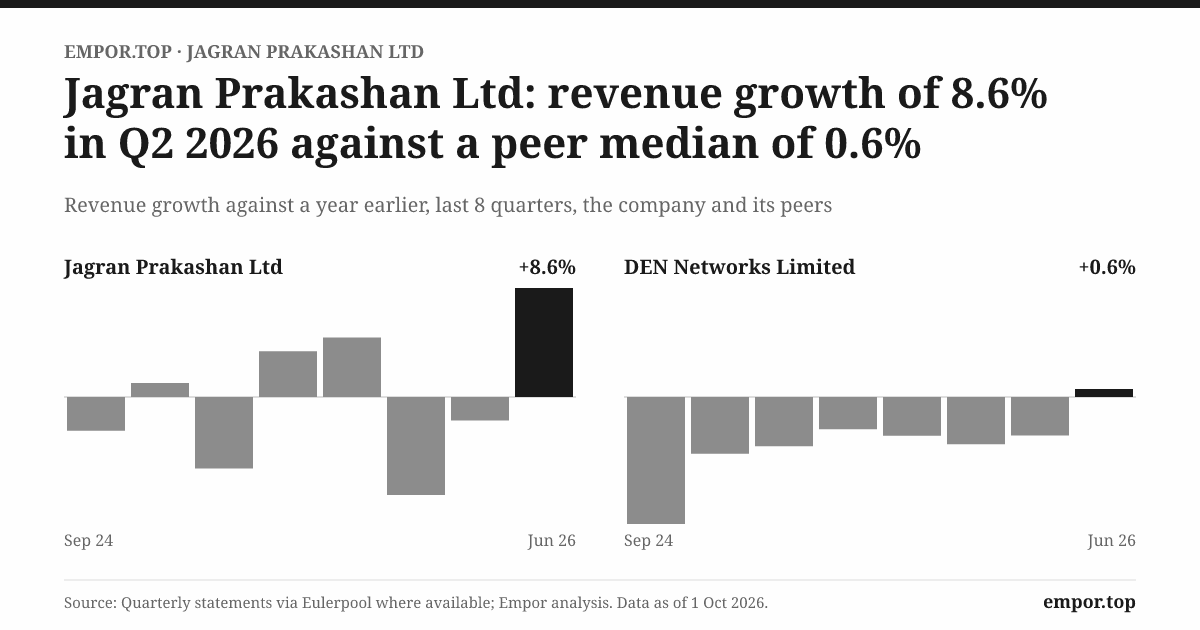
What came after was revealing. Revenue rebounded but never returned to its pre-2018 peak, when it was close to $357 million. By FY2026 it was about ₹1,876 crore, around $213 million.12 Over ten years, revenue shrank about 1% a year in rupees; over the last three, it grew under half a percent a year.1 This is not a business in crisis. It is a business that has stopped growing.
Why cash beats profit
Here is the surprising part. Across the twelve years from FY2015 to FY2026, Jagran reported about ₹2,861 crore of net profit but generated about ₹4,190 crore of operating cash flow, nearly one and a half times its reported earnings.1 Free cash flow after capital spending was about ₹3,221 crore.1
That gap is not mysterious. Three things explain it:
- Depreciation. Printing presses and radio equipment are expensed slowly through depreciation, which lowers reported profit without costing cash in the year.
- Impairments. Write-downs such as the radio goodwill charge reduce profit but involve no cash leaving the bank.
- Working capital. Debtors, inventory and payables net out to a cash cycle of about two months, which does not swallow much cash in a flat business.1
In FY2026, operating cash flow was about $35 million, almost exactly matching EBITDA.1 The machine still produces cash.
The reinvestment test
What a company does with cash tells you what management believes about its future. Jagran spent about ₹69 crore on capital expenditure in FY2026, under 4% of revenue, while depreciation and amortisation ran at about ₹86 crore.2 Net property, plant and equipment shrank from almost $99 million in FY2015 to about $42 million in FY2026.1 Formal R&D is zero; technology spending goes to things like waterless printing plates and content systems.2
Spending less than depreciation for years is a signal. Management is not building new plants because there is no growth to build for. That is rational. A business that cannot earn good returns on new capital should not invest more capital in it. But it also changes what the company is. Jagran is now a harvest, and the investment case depends on what happens to the harvest.
Debt gone, cash piled up
The other half of the story is the balance sheet. In FY2015, Jagran carried about $106 million of borrowings.1 By the end of FY2026, it had retired all long-term debt, including preference shares that matured in August 2025, leaving only about ₹36 crore of short-term working capital lines.2 Debt-to-equity fell from 0.57 to 0.05.1 CRISIL reaffirmed its AA+ rating with a stable outlook in July 2026.3
Where did the free cash go? Dividends took about ₹838 crore, roughly a quarter.1 Three buybacks, covered later, took more. And cash and short-term investments rose from about ₹221 crore to about ₹877 crore, before counting the longer-dated bonds and funds that push the total treasury past ₹1,298 crore.12
The verdict for this era: Jagran is a textbook cash cow on a plateau. The machine works. The problem is that the cash now accumulates inside a company that cannot use it productively and cannot easily decide how to give it back. A closer look at what sits inside that pile, and what it does to reported earnings, is the next stop.
VI. Forensic Audit: The Hidden Treasury, DAVP Receivables, and Related Parties
The note that changes the picture
An investor reading Jagran's FY2026 annual report reaches the other income note and finds a surprise. Of about ₹267 crore of consolidated profit before tax, about ₹123 crore, or 46%, came not from newspapers, radio or billboards but from interest on bonds, fixed deposits, mutual fund gains and miscellaneous receipts, including keyman insurance proceeds.2 In FY2025 the share was even higher: about ₹105 crore of other income against ₹136 crore of PBT, or 77%, although that year's PBT was depressed by the radio impairment.2[^13]
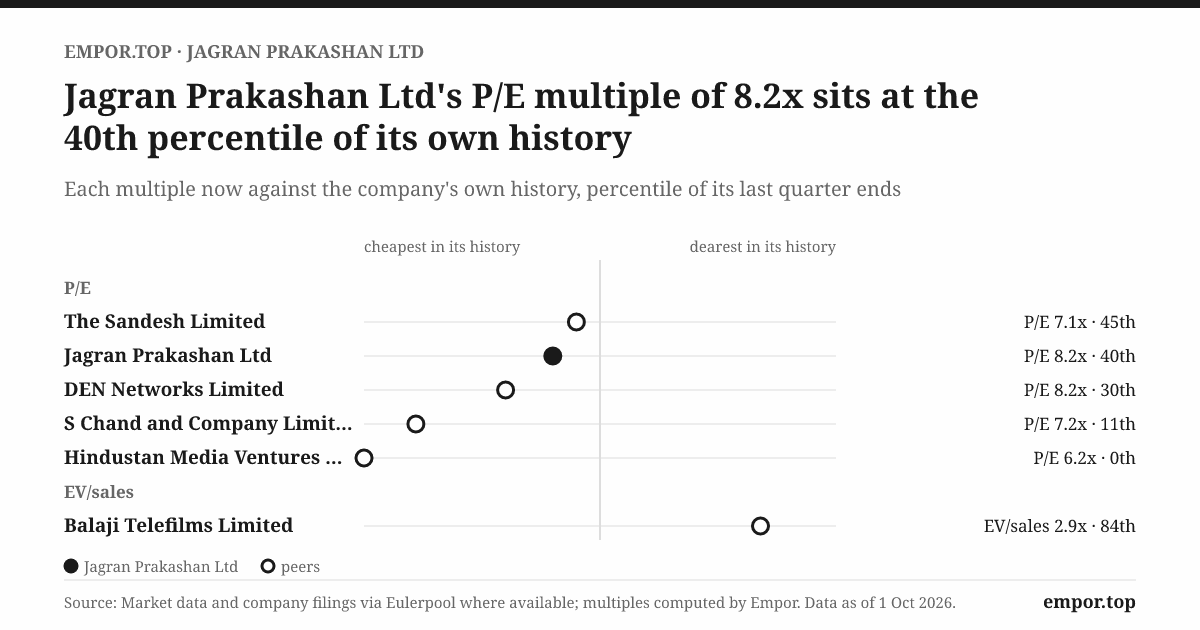
This is the crucial earnings-quality point. When half of pre-tax profit comes from the treasury, the price-to-earnings ratio is a mix of two businesses: a publisher and a fixed-income fund. Some of FY2026's other income, such as insurance proceeds, will not recur. Investors who value Jagran on 8.2 times earnings are partly paying for bond coupons.1
What is in the vault
The treasury is not a pile of cash in a current account. About ₹670 crore sat in debt mutual funds, about ₹26 crore in alternate investment funds run by houses such as ICICI Prudential, 360 One, Aditya Birla Sun Life and ASK, and the rest in quoted corporate bonds and bank deposits.2 The credit funds are the riskiest slice; private credit can carry losses that do not appear until a borrower defaults. The sums are modest relative to the total, but they mean the company is running a credit book alongside its presses. For a minority shareholder, the treasury is also an asset that could be returned to them and instead earns returns of a few percent a year inside a company valued well below book.
When the government is a slow payer
The second forensic trail runs through receivables. At the end of FY2026, gross trade receivables were about ₹576 crore, against which Jagran held about ₹136 crore of expected credit loss provisions, roughly 24%.2 That is a high reserve for an advertising business.
The ageing schedule tells why. About ₹164 crore was overdue by more than a year, and about ₹105 crore by more than three years.2 The company attributes much of the long-dated balance to government advertising: release orders from the central government's Bureau of Outreach and Communication, formerly DAVP, and from state information departments, which go through slow verification before payment.2
Government is an unusual customer. It does not default, but it sets rates, takes its time, and pays no interest for the delay. It is also a customer with political weight over what a newspaper prints, which is a different kind of bargaining power. The test of whether these balances are real money is simple: does the over-three-year bucket shrink in FY2027 without a matching rise in provisions? Debtor days have improved from a peak of 135 in FY2021 to 86 in FY2026, which is encouraging, but they remain above the 76 days of FY2015.1
The family's cut
The third trail runs through related parties. In FY2026, key management personnel were paid about ₹18 crore, and relatives of KMP received about ₹4.5 crore more, for a combined ₹22.4 crore, about a tenth of consolidated net profit.2 The executive directors, all members of the Gupta family except one, earned between 41 and 83 times the median employee's pay, with no stock options or performance-linked pay disclosed.2 Separately, the company paid about ₹2.6 crore in lease rentals to VRSM Enterprises LLP, a promoter entity that also holds ₹2 crore of the company's security deposits.2
None of these numbers is enormous. Together they say something. Pay is fixed regardless of performance, family members sit on both sides of some transactions, and the digital business partly sits in an associate. In a company where the controlling family is fighting over control, these are exactly the channels a minority shareholder would want watched.
The verdict here: Jagran's reported earnings are padded by a treasury the operating business does not need, and its working capital carries a sovereign receivables tail that requires heavy reserves. That is the hidden picture behind the low multiple. The visible one is the fight in the courtroom.
VII. The Boardroom War: The NCLT Petition and the Battle for JMNIPL (2023–2026)
May 2026: a vote that does not count
On May 26, 2026, the National Company Law Appellate Tribunal issued an interim order in a dispute that had been building for three years.26 The family holding company, Jagran Media Network Investment Private Limited, had requisitioned an extraordinary general meeting to remove seven independent directors and whole-time director Shailesh Gupta.2 The tribunal held that removal resolutions could not be implemented pending the final decision of the NCLT.26 The board was spared. Nothing was settled.
The holding-company bottleneck
To understand the fight, start with the structure. Jagran Prakashan does not have a dispersed promoter shareholding. JMNIPL, an unlisted private company, owns about 68% of the listed company; the full promoter group holds 69%.2 Whoever controls JMNIPL's vote controls Jagran Prakashan.
For years that vote was exercised as a single block by Mahendra Mohan Gupta, the long-serving Chairman and Managing Director and a former Rajya Sabha member, under a provision of the family's arrangements. In July 2023, according to filings and media reports, that authority was revoked and passed to other family members, including Dhirendra Mohan Gupta and Sanjay Gupta.48 Mahendra Mohan Gupta's term as Managing Director ended on September 30, 2023, and he became non-executive Chairman.2 The MD seat has been vacant ever since.
The petition
Mahendra Mohan Gupta and his son Shailesh Gupta filed an oppression and mismanagement petition, C.P. No. 64 of 2023, before the NCLT Allahabad, under the sections of the Companies Act that let shareholders seek relief when a company is run unfairly against them.245 In April 2024, the petitioners sought an explicit division of the group's businesses, which would split operating assets among family branches.2
That is the core of the fight. One side wants the empire carved up. The other, holding the JMNIPL vote, wants unified control restored, starting with the board. Courts have so far kept the status quo, which preserves the board but leaves the company without a resolution.
Where outsiders stand
Outside the family, about 31% of the shares are held by roughly 71,600 shareholders.2 HDFC's mutual fund trustee, the only outside holder above 5%, cut its stake from about 8.5% to 5.9% during FY2026.2 Foreign portfolio investors held about 2%; retail individuals about 18%.2 None of them has a seat at the table. With 69% in promoter hands, no outside coalition can force an outcome.
Why the buybacks stopped
The company has bought back stock three times: in 2017 for about ₹302 crore at ₹195 a share, in 2018 for about ₹293 crore at ₹212, and in 2021 for about ₹118 crore at ₹60.2 The first two came at prices more than three times today's; in hindsight, they returned cash at a high price. The third was well-timed.
Since the dispute began, there has been no buyback. A buyback requires board and shareholder approvals, and every such decision now sits in the middle of a contested control fight. Dividends have continued, and generously: payout ratios of about 83% in FY2025 and 66% in FY2026.1 That is the one channel through which minority holders are still being paid.
The verdict: the deepest cause of Jagran's discount is not newsprint or radio. It is the absence of anyone who can make an irreversible decision about the vault. Until a court or a settlement decides who controls JMNIPL, capital allocation is effectively frozen. What that means for founders and investors is the next stop.
VIII. Playbook: Business & Investing Lessons
Lesson 1: The cash-harvest trap
The moment: Jagran generated about ₹3,221 crore of free cash flow over twelve years while its revenue fell from its peak and its owners argued about who controlled the company.1 The cash was real. It piled up because the business could not reinvest it and the family could not agree how to distribute it.
The broader lesson is that cash generation is only half of a valuation. The other half is the path from the company's bank account to the shareholder's. Where that path is blocked, by governance, regulation or a controlling owner, the market applies a discount even to cash that is plainly there.
"A business can turn 146% of its profit into cash, but if the owners cannot agree who holds the key to the safe, the market will value every rupee in it at fifty paise."
Lesson 2: Diversifying into weaker media is not diversification
The moment: the radio impairment of about ₹130 crore in FY2025, followed by a 26% fall in radio revenue the next year, while Mid-Day kept losing money.2[^13] Jagran bought assets exposed to the same force that threatened print, the shift of attention to phones, and in some cases more exposed than print itself.
For managers, true diversification means buying exposure to a different risk, not a different version of the same one.
"When a print franchise buys a radio station and an afternoon tabloid, it is not spreading its risk. It is buying an earlier seat in front of the same disruption."
Lesson 3: Family constitutions break on holding companies
The moment: July 2023, when the authority to vote the holding company's block was taken from the patriarch who had exercised it for decades, and the listed company lost its Managing Director.24 A structure built on trust worked until the second and third generations discovered that control of an unlisted holding company was worth more than any title in the listed one.
For investors in family-controlled companies, the question is not whether the family gets along today. It is whether the holding structure has a written, enforceable answer for the day it does not.
"A family pact made for brothers in Kanpur breaks the moment their heirs realise the vote in the holding company is worth more than the masthead."
Lesson 4: When the state is your customer, receivables age slowly
The moment: about ₹105 crore of receivables more than three years overdue, alongside about ₹136 crore of credit-loss reserves, largely linked to government advertising.2 The state rarely defaults. It simply waits, and the waiting is financed by the publisher.
"A government advertiser never goes bankrupt. It just makes you wait three years, turning your working capital into an interest-free loan to the ministry."
Lesson 5: A treasury can hide a fading engine
The moment: FY2025, when about 77% of pre-tax profit came from other income, and FY2026, when it was still about 46%.2 Read the headline P/E and the business looks cheap. Separate the treasury from the publisher and the operating business looks smaller, though still profitable.
"When half of a publisher's pre-tax profit comes from bond coupons, you are no longer analysing a newspaper. You are analysing a bond fund with a newsroom attached."
IX. Analysis & Bear vs. Bull Case
The Lucknow budget meeting
Picture a regional consumer brand's marketing head in Lucknow planning the festive season. A few years ago, nearly the whole budget would have gone to a front-page jacket in Dainik Jagran, radio spots and hoardings. Now the plan splits differently: a growing share to Instagram and Google, a smaller but still large share to the newspaper, and radio squeezed out. This scene is illustrative, but the revenue lines show the same direction: radio shrinking, print flat, digital taking share across the market.2
That is the question at the heart of the valuation. Does the Hindi print moat erode slowly enough for the cash to keep coming, and does the governance fight end in a way that lets shareholders collect it?
Hamilton Helmer's 7 Powers
- Scale economies: real, local. Jagran's printing network and centralised newsprint buying let it produce a district edition at a cost a newcomer cannot match. The power is genuine but bound to a print volume that is no longer growing.
- Network effects: modest, local. Readers want the paper with the local notices and ads; advertisers want the paper with the readers. It is a two-sided habit at district level, not a network that strengthens nationally.
- Counter-positioning: none. Jagran is the incumbent being counter-positioned against. Programmatic digital ads sold by Google and Meta are cheaper to measure and target, and print has no answer that does not cannibalise itself.
- Switching costs: low. Advertisers book on rate cards without long commitments, and readers can stop delivery any morning.2
- Branding: strong. Dainik Jagran has more than eight decades of recognition in the Hindi belt, and CRISIL cites its readership leadership as a core strength.3
- Cornered resource: fading. The hawker and depot network was a cornered resource when a newspaper was the only way news arrived in the morning. It is worth less every year that phones reach more homes.
- Process power: moderate. Running dozens of overnight editions, with local reporting, printing and delivery on a deadline, is a learned skill. It is hard to copy but only valuable while print is needed.
Net: Jagran has a real but narrowing moat. Branding and local scale are strong; the powers that would protect against digital substitution are weak or absent.
Porter's Five Forces
- Buyer power: high. Advertisers have alternatives, and the largest single buyer group, government, sets rates and pays slowly.2
- Supplier power: moderate and volatile. Newsprint, priced in dollars and globally traded, is the largest input; its swings move margins.2
- Threat of substitutes: extreme. Search, social, short video, regional news apps and now AI-generated answers compete for the same attention and ad budgets.
- Threat of new entrants: low in print, high in digital. Nobody will build a new Hindi print network, but anyone can launch a news channel on YouTube.
- Rivalry: high. DB Corp's Dainik Bhaskar and Amar Ujala contest Jagran's heartland, and the fight is often waged on cover price and ad discounts.
The activist's stress test
A skeptical activist with a large stake would ask for a short list of things. Return most of the treasury through a special dividend or buyback. Sell or close loss-making Mid-Day. Sell the 74% stake in Music Broadcast or merge it into a stronger radio player. Bring the digital economics inside the company. Tie family pay to performance.
The problem is that no activist can force any of it. With 69% in promoter hands and the promoter vote itself contested, outside holders have no lever.2 Activism here is not a strategy; it is a wish.
The bear case
- Paralysis lasts. The NCLT case runs for years. The treasury sits idle, family pay continues, and no strategic decision gets made.
- Print declines faster. Ad revenue goes from flat to falling several percent a year as smartphone penetration deepens in small towns and villages.
- Radio keeps shrinking. Music Broadcast's losses widen and its remaining intangibles get written down again.
- The discount persists. The stock stays between half and three-quarters of book value indefinitely while operating profit slowly declines.
The bull case
- The court forces a resolution. A settlement or court-ordered division, of the kind the petitioners requested, unlocks value either by splitting the businesses or by forcing distributions.
- The dividend keeps flowing. Payouts of two-thirds or more of profit continue, so patient holders collect cash while they wait.1
- Valuation converges. If governance clears, Jagran's 8.2 times earnings could move toward the higher multiples of DB Corp, its unencumbered listed peer.113
Weighing it
The history narrows the bull case. The moat is real but shrinking, the diversification failed, and the treasury inflates earnings. The single variable that could change the picture quickly is legal, not operational. The bear case does not require anything dramatic, only time. This is a stock whose cheapness is explained; whether it is mispriced depends on whether the dispute resolves before the print engine fades.
The three KPIs that matter
- Print advertising revenue. About ₹1,115 crore in FY2026, with group revenue roughly flat for three years.12 Stability means the moat is holding; sustained declines mean it is not.
- Operating profit versus other income. Other income was about 46% of PBT in FY2026, down from 77% in FY2025.2 A falling share driven by rising operating profit would be the healthiest sign.
- Receivables over three years old. About ₹105 crore at March 2026.2 If it shrinks without a bigger reserve, the sovereign receivables were real money; if not, more write-downs are likely.
X. Epilogue
Tonight, Jagran Prakashan is a profitable, debt-free publisher with a treasury of more than ₹1,298 crore, a market value not much larger than that, and no Managing Director.12 Its presses run, its hawkers ride, and its board operates under a tribunal's shield.
Three events will shape the next chapter.
The first is the NCLT Allahabad's handling of C.P. No. 64 of 2023.24 If it orders or approves a division of businesses, the market will finally have a way to price the parts separately, and the vault could be distributed. If the case drags on, the discount is likely to persist.
The second is the final fate of the requisitioned EGM. If the NCLT eventually permits the removal of the independent directors, JMNIPL's controlling faction will hold the board outright, which would end the paralysis but concentrate power in one branch. If it does not, the stalemate continues.6
The third is the FY2027 annual report. Does the dividend hold near recent levels? Does print ad revenue stabilise? Does the over-three-year receivables bucket shrink? Each answer tests one of the central questions: whether Jagran remains a media franchise, a treasury vehicle or a battleground.
The tension that remains is stark. The market has largely written off print. Yet every night, Jagran's presses produce real cash. Whether that cash reaches the 71,600 shareholders outside the family will be decided by judges in Allahabad, not editors in Kanpur.
XI. Outro
Dawn in Kanpur. Before the sun clears the river, bundles of Dainik Jagran are being lashed to bicycle carriers, carrying news of state politics, local weddings and government tenders into lanes that have received them for generations.
Eighty-four years after Puran Chandra Gupta started a nationalist newspaper in Jhansi, his family has built the most powerful Hindi print franchise in India, a treasury bigger than most of its peers' market values, and a dispute that has frozen it. Jagran Prakashan built a language empire, filled a vault, and then left the key in a courtroom in Allahabad.
References
-
Company Profile & Disclosures: Jagran Prakashan Limited (JAGRAN) — National Stock Exchange of India ↩↩↩↩↩↩↩↩↩↩↩↩↩↩↩↩↩↩↩↩↩↩↩↩↩↩↩↩
-
Annual Report 2025-26 — Jagran Prakashan Limited, 2026-08-20 ↩↩↩↩↩↩↩↩↩↩↩↩↩↩↩↩↩↩↩↩↩↩↩↩↩↩↩↩↩↩↩↩↩↩↩↩↩↩↩↩↩↩↩↩↩↩↩↩↩↩↩↩↩↩↩↩↩↩
-
Rating Rationale: Jagran Prakashan Limited — CRISIL Ratings, 2026-07-02 ↩↩↩
-
Gupta family dispute over Jagran Prakashan reaches NCLT Allahabad — LiveLaw, 2023-09-18 ↩↩↩↩↩
-
Internal feud in Jagran Prakashan: Promoters move NCLT over oppression and mismanagement — Economic Times, 2023-09-15 ↩↩
-
NCLAT stays implementation of resolutions for removal of Jagran directors — Lawbeat, 2026-05-29 ↩↩↩↩
-
Jagran Prakashan Limited Corporate Homepage & Portal — JPL Corp ↩↩
-
Company Profile & Announcements: Jagran Prakashan Limited (532705) — BSE India ↩↩
-
Blackstone exits Jagran Prakashan via open market block deals — Reuters, 2014-06-12 ↩↩↩
-
Dainik Jagran publisher Jagran Prakashan acquires Mid-Day Infomedia — Mint, 2010-05-05 ↩
-
Jagran Prakashan acquires Radio City promoter Music Broadcast — Business Standard, 2014-12-16 ↩
-
Music Broadcast Limited Investor Relations & Annual Reports — Radio City ↩
-
Peer Comparison & Financials: DB Corp Limited (Dainik Bhaskar) — National Stock Exchange of India ↩
 LinkedIn
 WhatsApp
 Reddit
 Hacker News
 Email
Email Kindle
 RSS Feed
 Spotify
 Apple Podcasts
 Amazon Music
 Audible
 YouTube