IRB InvIT Fund: The Toll Road That Never Ends
I. Introduction & The ₹5,000 Crore Guinea Pig (00:00 – 10:00)
In May 2017, India's capital markets got a new kind of security, and it arrived with an untested regulatory label. On May 18, units of IRB InvIT Fund began trading on the National Stock Exchange in Mumbai. It was the first Infrastructure Investment Trust ever listed in India1. Behind it stood Virendra Mhaiskar, the civil engineer who had built IRB Infrastructure Developers from a Mumbai contracting business into one of the country's largest private highway operators. His pitch was simple and, at the time, close to radical: take finished, toll-collecting highways off a heavily borrowed developer's balance sheet, put them in a trust, and sell slices of that trust's cash flow to anyone who wanted a steady income.
The trust raised ₹5,035 crore at ₹102 per unit. That was a ₹4,300 crore fresh issue plus a ₹735 crore offer for sale by the sponsor[^2]. Institutions took most of the book. Retail investors mostly watched from the sidelines, unsure what an "InvIT" was or why it should trade like a stock while behaving like a bond. Their caution was understandable. The rules governing the vehicle, the SEBI (Infrastructure Investment Trusts) Regulations, were barely three years old[^3]. Nobody had yet seen how one of these trusts would behave through a pandemic, a concession expiry or a capital raise.
Nine years later there is an answer, and it is not a simple one. By 2026 the trust had paid out about ₹5,230 crore in cumulative distributions since listing. That is more cash than its entire IPO raised2. Yet the units trade around ₹60 to ₹63, the band at which the trust itself sold new units to institutions in 2025 and 20263. That is roughly 39% below the ₹102 debut price.
That gap is the paradox this story is built around. An investor who bought at the IPO and held has received more than their money back in cash, but is sitting on units worth well under two-thirds of what they paid. Did the trust succeed or fail? The honest answer is that it did exactly what a toll-road trust is designed to do, and the market took several years to price what that design really means.
The thesis behind the wrapper
SEBI wrote the InvIT rules in 2014 to solve two problems at once[^3]. India's road builders were drowning in debt. They had bid aggressively for highway concessions in the late 2000s and early 2010s, borrowed heavily from state banks to build them, and then found themselves with operating roads that produced cash but tied up equity they needed for the next project. On the other side sat long-term money: pension funds, insurers, sovereign wealth funds and foreign yield buyers, all looking for rupee-denominated cash flows they could hold for decades.
The InvIT bridged the two. A sponsor moves completed assets into a trust. The trust raises equity from the public and owns the project companies, known as Special Purpose Vehicles or SPVs. The rules then force the trust to pay out at least 90% of its Net Distributable Cash Flow, or NDCF, to unitholders[^3]. In plain terms, the trust cannot hoard cash. Almost everything the roads earn after debt service and upkeep has to go out the door.
For unitholders, the promise was a high single-digit to low double-digit cash yield, backed by toll rates that rise each year with inflation under government concession contracts. For the sponsor, the promise was recycled capital: sell the mature roads, keep managing them for a fee, and use the proceeds to bid for new ones.
The question that hangs over everything
That dual promise contains a tension that this story keeps returning to. A toll-road concession is not a building on freehold land. It is a licence that expires. When it does, the road goes back to the government for nothing. So every rupee a unitholder receives is partly a return on capital and partly a return of capital. If the trust does not keep buying new concessions, it slowly liquidates itself.
So the central question is this: can a trust turn asphalt and FASTag beeps into a compounding yield engine that runs forever, or does it only postpone the day the last concession runs out? The roadmap from here runs through the anatomy of a toll concession, the year the first big concessions expired, the fee streams that flow to the sponsor, the accounting that makes the trust look far less profitable than it is, a ₹1,202 crore arbitration award that landed in June 2026, and a pair of large acquisitions that doubled the unit count.
The verdict, stated once and then tested: IRB InvIT proved that an Indian yield vehicle can survive and return real cash. It also exposed the structural friction between what unitholders want, which is rising cash per unit, and what the sponsor wants, which is a buyer for its finished roads. To see why both are true, it helps to start where the money starts: at a toll gantry in the middle of the night.
 Subscribe on LinkedIn
II. The Anatomy of an Asphalt Cash Machine (10:00 – 22:00)
It is three in the morning on a national highway in western India. A multi-axle truck hauling steel coils rolls toward a toll plaza without braking hard. Overhead, a reader pings the RFID tag stuck to the windscreen. A few hundred rupees leave the fleet owner's prepaid FASTag wallet and, through the electronic toll clearing network, head toward the concessionaire's escrow account. The boom barrier lifts. The driver does not stop for a cashier. Nobody issues an invoice. Nobody chases a payment.
Multiply that moment by millions of vehicles a year and you have the core of IRB InvIT's business. More than 98% of its toll collections now come through FASTag1. That single statistic explains why this is one of the cleanest cash businesses in Indian listed markets, and also why its accounting is so misleading.
How a BOT concession works
Most of the trust's roads run under a Build-Operate-Transfer, or BOT, toll concession. The National Highways Authority of India, NHAI, grants a private company the right to build or widen a stretch of highway, maintain it, and collect tolls for a fixed period, typically 20 to 30 years4. At the end, the company hands the road back to NHAI, in good condition, for zero payment.
Think of it as a very long, very specific lease on a stream of other people's journeys. The concessionaire does not own the land. It owns the right to charge for passage, and it owes the government a road in decent shape at the end.
The pricing mechanism is what makes the model attractive to income investors. Toll rates are set by statute, not negotiated. Each year they are revised in line with the Wholesale Price Index, either fully or through a formula of a fixed 3% plus 40% of WPI movement, depending on the concession vintage1. There are no rate hearings, no customer pushback and no discounting. Inflation flows straight into the top line, with a lag of at most a year.
Volume is the other lever. Traffic on India's freight corridors tracks the industrial economy: steel, cement, containers, agricultural produce, mining output and inter-city passenger travel1. When the economy grows, more trucks roll and heavier trucks pay more, because tolls are charged by axle count and vehicle class, not fuel type. That last detail matters for anyone worried about electric vehicles. An electric truck with six axles pays exactly what a diesel one does1.
The trust also owns a second kind of asset. Two of its ten roads, known as VK1 and VM7, are Hybrid Annuity Model or HAM projects1. Under HAM, NHAI pays 60% of the project cost to the concessionaire in semi-annual instalments over 15 years, with interest linked to the RBI bank rate and operations and maintenance payments indexed to inflation. Traffic does not matter. The government pays the instalment whether a hundred trucks or a hundred thousand use the road. HAM is closer to a sovereign bond than a toll business, and it gives the portfolio a floor.
The debtor-days illusion
Here is where a casual screener goes wrong. Run IRB InvIT through a standard data provider and debtor days, the measure of how long customers take to pay, appear to explode: from 26 days in FY22 to a peak of 208 in FY25, before easing to 131 in FY26. For an ordinary company, that pattern would be a red flag for customers who cannot or will not pay.
For this business, the number means nothing of the sort. Trade receivables from toll users are formally zero on the balance sheet, because FASTag settles within a day or two1. What the data provider is actually picking up sits in a note labelled "Other Financial Assets." It holds two very different things.
The first is about ₹533 crore of claims against NHAI: compensation for construction delays, relief for the toll suspensions during demonetisation and COVID-19, and change-of-scope reimbursements1. These are real and can take years to collect, but they are disputes with a sovereign counterparty, not unpaid bills from motorists.
The second, and far larger, piece is about ₹2,224 crore of what accountants call Service Concession Arrangement receivables1. This is simply the present value of all the future HAM annuity payments NHAI owes on VK1 and VM7. When the trust bought VM7 in late 2025, that receivable ballooned, and the debtor-days ratio ballooned with it. The entire balance sheet carries an expected credit-loss provision of only about ₹0.6 crore1. The auditors, in effect, see no meaningful credit risk.
So the myth is that the trust has a collections problem. The reality is that it has a sovereign annuity book that a generic ratio misreads as late-paying customers.
The accounting mirage
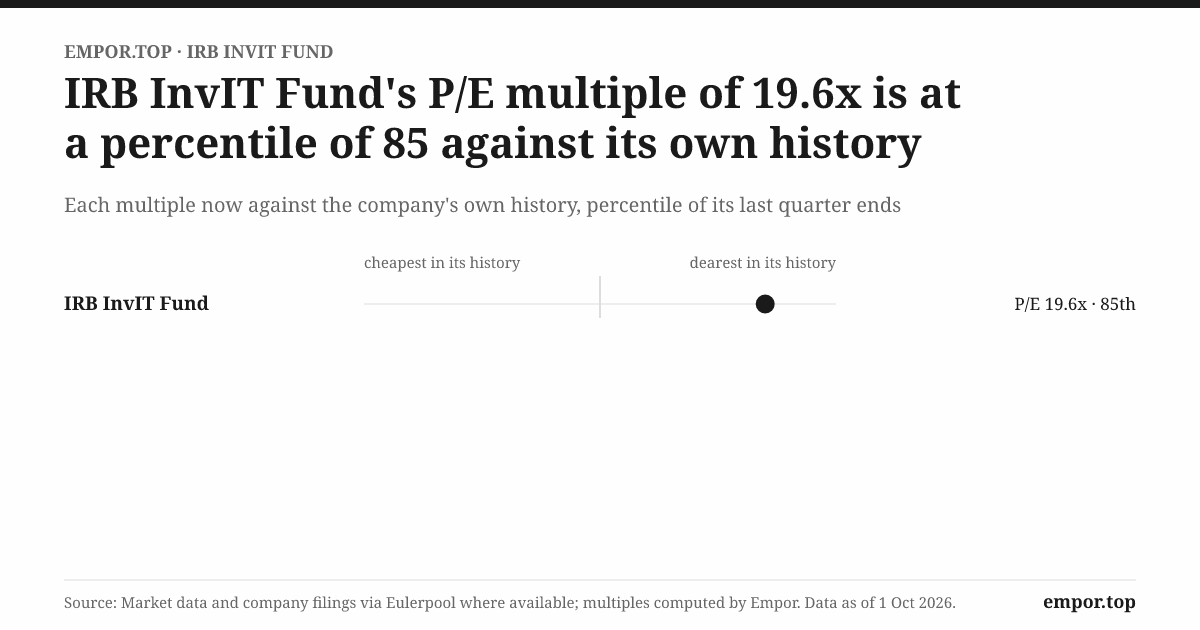
The bigger distortion is in profit. In FY26, the trust reported net profit of about ₹339 crore, or $38.4m1. On the market data, that puts it on a price-to-earnings multiple of about 19.6 times, nearly double its own five-year median of 10.7 times. On that screen alone, the units look expensive and getting more so.
Now look at the cash. Operating cash flow in FY26 was about ₹973 crore, or $101m1. That is almost three times net profit. The gap is mostly two non-cash charges.
The first is amortisation of toll collection rights, about ₹380 crore in FY261. Because a concession expires at a known date, accounting rules require the trust to write down the value of the toll right every year until it hits zero on handover day. That charge reduces reported profit, but no cash leaves the building.
The second is a provision for resurfacing, about ₹312 crore in FY261. Concession contracts require a major relaying of the road surface every five to seven years. Accounting rules make the trust book that future obligation gradually, before the asphalt trucks show up. In FY26 the trust provided ₹312 crore but actually spent only about ₹115 crore on resurfacing1. The rest sits on the balance sheet as a cumulative provision of about ₹334 crore, waiting to be spent.
This is why the trust's dividend payout looks absurd on paper: about 144% of net profit in FY26, and a median of 144% across its listed life. It is not paying out money it did not earn. It is paying out cash that accounting hides.
But a careful investor should not take the comforting conclusion too far. The amortisation charge is not fiction. It is the accountant's way of saying the asset is wearing out toward zero. The resurfacing provision is not fiction either: that money will be spent. The honest reading is that operating cash flow overstates sustainable distributable cash in the long run, while net profit understates it. The truth sits between them, and that truth is captured in the trust's own distribution history. That history is where the story turns dark, because in 2022 the first of the trust's best roads simply stopped belonging to it.
III. The Day the Concessions Expired: The FY23 Cliff (22:00 – 35:00)
For years, the Surat-Dahisar stretch of the old NH-8 was the crown jewel of the IRB portfolio. It ran through one of the densest freight corridors in the country, linking Gujarat's industrial belt to Mumbai's ports and markets. Trucks carrying chemicals, textiles, engineering goods and containers moved along it around the clock. For a toll operator, it was about as good as Indian asphalt gets.
Then, as fiscal 2022 closed, the concession ran out. Surat-Dahisar went back to NHAI. So did the neighbouring Bharuch-Surat stretch1. There was no auction, no compensation and no renewal. The boom barriers stayed up, but the toll money now went to someone else. The trust's single best source of cash disappeared overnight, exactly as the contract had always said it would.
The golden early years
To feel the size of that blow, go back to what unitholders were promised. The portfolio at IPO consisted of six BOT roads: Surat-Dahisar, Bharuch-Surat, Mohania-Sasaram, Jaipur-Deoli, Talegaon-Amravati and Tumkur-Chitradurga[^2]. Between FY18 and FY22 they did what was advertised. Revenue held in a band of roughly $150m to $175m a year, wobbling only during the pandemic year1. Distributions per unit ran between about ₹10.50 and ₹12.25 a year, peaking at ₹12.25 in FY192.
On a ₹102 IPO price, ₹12 a year is a cash yield of nearly 12%. That was the investment case: buy a sovereign-backed, inflation-linked toll stream at double-digit yield and hold. For a while it looked like a better deal than almost anything else in Indian fixed income.
The market, however, was never fully convinced. The units slipped well below their issue price within the first couple of years. Part of the reason was simple unfamiliarity with a new structure. Part of it was a sophisticated concern that turned out to be right: much of that 12% yield was the trust paying unitholders back their own capital, ahead of a concession clock that could not be stopped.
The cliff itself
When Surat-Dahisar and Bharuch-Surat went back to NHAI, the hit was immediate. FY23 revenue fell about 22%, from roughly $174m to $127m1. EBITDA dropped by about a third, from roughly $155m to $102m. Mohania-Sasaram followed the same path; it too has now been handed back to NHAI since listing1.
The distribution line tells the story most clearly. From ₹12.25 per unit in FY19, distributions slid to ₹8.00 in FY24 and FY25, and then to ₹6.60 in FY262. That last step down had a different cause, which comes later in this story. But the first step, from double digits to ₹8, was the concession cliff showing up in unitholders' bank accounts.
Interestingly, the trust's operating margin went up after the cliff, from the mid-30s to the mid-50s or higher as a percentage of revenue1. That sounds like good news, but it largely reflects the shrinking amortisation charge as old toll rights were written off, not a sudden leap in efficiency. Reported margin improved because the trust had fewer expiring assets left to write down. This is another place where the accounting tells a cheerier story than the cash.
Why this is not a REIT
The cleanest way to understand the cliff is to compare it with a real estate investment trust. A REIT that owns an office tower in Bengaluru owns a building on land. When a tenant leaves, another arrives. When the building ages, it can be refurbished. At the end of thirty years, the land is probably worth more than it was at the start. A REIT's assets have terminal value.
A BOT toll road has none. On handover day, the concessionaire's asset is worth exactly zero. Every year in between, part of what the trust distributes is the asset being consumed. An investor who spends the whole distribution is, in effect, eating their own principal.
That is not a scandal. It was disclosed from day one in the offer document[^2]. But the market's treatment of InvITs as "bond proxies" obscured it. A bond returns your principal at maturity. A toll-road trust returns it in slices along the way, and then hands you nothing at the end.
The treadmill
The structural lesson from FY23 is that a toll InvIT has only two choices. It can let itself run down, distributing cash until the last concession expires and the trust winds up. Or it can keep buying new concessions to replace the ones that die.
IRB InvIT chose the second path, and the choice had consequences. Its own record is the disconfirming evidence for the "steady yield" pitch: the six-road portfolio, left alone, delivered falling distributions within five years of listing. The claim that a toll trust is a stable bond proxy is not rejected, but it is narrowed to something much smaller. It is stable only as long as the replacement pipeline is reliable and fairly priced.
That raises the obvious question. Who supplies the replacement roads, and on what terms? In IRB InvIT's case, the answer is the same company that set up the trust, manages its roads and collects fees along the way.
IV. The Sponsor's Toll Gate: Related Parties and Captive Extraction (35:00 – 48:00)
Picture the audit committee room when the trust's Project Implementation and Management Agreement comes up for review. On one side of the table sits the trust, represented by its Investment Manager. On the other sits IRB Infrastructure Developers, the sponsor. The awkward detail is that the sponsor is also on the first side. It owns about 16.6% of the units, and its wholly owned subsidiary is the Investment Manager itself1. When the sponsor negotiates its fee, it is in a real sense negotiating with itself.
That is the most important structural fact about IRB InvIT, and it deserves to be stated without drama. This is not a hidden arrangement. It is how most Indian InvITs are built, and it is disclosed in full. But it shapes where the money goes.
Three parties, one family
The structure has three layers. The trust, IRB InvIT Fund, is the passive capital vehicle. It owns the SPVs and has no employees1. IDBI Trusteeship Services is the trustee.
The Investment Manager is IRB Infrastructure Private Limited, a wholly owned subsidiary of the sponsor. It makes acquisition and financing decisions and takes a fixed annual fee of ₹11.8 crore1. That fee has not changed between FY25 and FY26, and it covers the salaries of the chief executive, Jitender Kumar Chauhan, and the chief financial officer, Rushabh Gandhi. Measured against a ₹1,485 crore revenue base, the management fee is modest.
The Project Manager is the sponsor itself, IRBIDL. This is where the real money flows.
Following the cash
In FY26 the trust paid IRBIDL about ₹198 crore in Project Manager fees, up from about ₹166 crore the year before1. That is roughly 13.4% of consolidated revenue. A separate sponsor-controlled company, Modern Road Makers Private Limited, collected about ₹57 crore for operations, maintenance and contract work in FY26, up from under ₹4 crore in FY25 as newly acquired roads came under its contracts1.
These payments sit above the line that matters to unitholders. They come out before Net Distributable Cash Flow is calculated. Every rupee the sponsor earns as Project Manager is a rupee that cannot be distributed.
There is a defensible logic here. IRB is one of India's most experienced highway operators, and fixed-price, long-term O&M contracts are one of the things rating agencies cite as a strength: they insulate the trust from maintenance cost inflation56. A trust with no staff has to buy expertise from somewhere. The question is not whether the sponsor should be paid, but whether 13.4% of revenue is a market price. The trust does not publish a competitive benchmark for that fee, and the contracts have not been put out to open tender.
The sponsor also earns as an investor. In FY26, distributions to the sponsor and its promoter group came to about ₹111 crore1. Add that to the Project Manager and O&M fees, and the sponsor family drew well over ₹350 crore from the trust in one year, through three different channels, while carrying a much smaller share of the asset-life risk than public unitholders.
The drop-down machine
The other half of the sponsor relationship is asset sales. In FY26 the trust acquired roads worth ₹9,653 crore in enterprise value. It paid about ₹1,554 crore in equity consideration to related parties: about ₹1,488 crore to IRB Infrastructure Trust and about ₹67 crore to IRBIDL1.
IRB Infrastructure Trust deserves a word of explanation. It is a separate, private, unlisted InvIT co-sponsored by IRBIDL and Singapore's sovereign wealth fund GIC1. It holds IRB's newer and larger concessions. When IRB InvIT buys from it, the listed public trust is purchasing assets from a private trust in which its own sponsor is a major owner. The sponsor sits on both sides again.
At March 31, 2026, money still flowed the other way too. The trust owed IRBIDL about ₹437 crore in subordinate debt and about ₹897 crore in "other payables," largely linked to the acquisitions1. Those balances are not hidden, but they underline how financially intertwined the two entities are.
The governance counterweight
Against all this sits a real set of checks, and they deserve a fair hearing. The Investment Manager's board is chaired by R. P. Singh, a retired IAS officer and former chairman of NHAI itself1. That is a notable choice: the person overseeing the trust's dealings with its sponsor once ran the agency on the other side of every concession. Four of the six directors are independent, including two chartered accountants, Nikesh Jain and Anusha Date, and another retired civil servant, Sunil Tandon1.
SEBI's InvIT rules also require related-party acquisitions to be approved by unitholders, with the sponsor and its associates excluded from voting on their own deals[^3]. That matters because institutions hold over 41% of the units. Foreign portfolio investors alone hold about 35%1.
The weakness of this counterweight shows up in the voting record. Unitholder approvals for acquisitions and placements have consistently passed with over 99% of votes in favour1. That could mean the deals were good. It could also mean institutional holders in a sponsor-led vehicle see little upside in fighting. The record does not settle which.
The verdict on independence, then, is narrower than either side would like. IRB InvIT is not a captive vehicle that unitholders cannot influence: the voting rules and the board composition are real. But it is a vehicle whose economics are structured so that the sponsor captures a low-risk fee stream on revenue while unitholders hold the traffic and terminal risk. The test that would change this verdict is specific: an open, competitive benchmarking of the Project Manager and O&M contracts when they next come up. Until that happens, the fee is a negotiated number between related parties. And the sponsor's appetite for selling roads into the trust created the next problem: how to pay for them.
V. The Refinancing and the Dilution Mill (48:00 – 60:00)
In October 2025, investment bankers sat down to price a deal that told everyone what the market thought of IRB InvIT's original promise. The trust was selling about 54.1 crore new units to qualified institutions. The price was ₹60 per unit1. That was 41% below the ₹102 at which the same trust had listed eight years earlier.
The placement raised about ₹3,248 crore1. It was a large deal for an Indian InvIT, and it was well subscribed. But for anyone who bought at the IPO, the price was a mirror. Institutions were willing to buy more of the same asset class, from the same sponsor, only at a steep discount to the original entry point.
Rebooting the portfolio
The money went into the largest reshaping of the trust since listing. The first drop-down, completed in late 2025, brought in three BOT roads from IRB Infrastructure Trust (IRB Westcoast, Kishangarh-Gulabpura and Hapur-Moradabad) for about ₹8,436 crore, plus the VM7 HAM project from IRBIDL for about ₹1,217 crore1. Total enterprise value: ₹9,653 crore.
The second drop-down, announced in September 2026, added Solapur-Yedeshi and Chittorgarh-Gulabpura for about ₹4,605 crore in enterprise value3. After both deals, the trust holds ten operating road assets across eight states, with a weighted average remaining concession life of about 17 years1.
That 17-year number is the strategic payoff. Without the acquisitions, the trust would have been running down a shrinking set of older concessions. With them, it has pushed the next big cliff well into the 2030s.
How the deals were paid for
The trust used every funding source it had. Beyond the October 2025 placement, the sponsor bought about 16 crore units in a preferential allotment in November 2025 at ₹62.95, putting in about ₹1,005 crore1. In September 2026, a further ₹2,351 crore came in: ₹2,000 crore through another institutional placement and ₹351 crore through a preferential issue to IRBIDL, sized so the sponsor would keep its stake near 16%3.
Debt did the rest. In November 2025, the trust issued ₹1,150 crore of AAA-rated listed debentures in three series, maturing in 2030, 2035 and 2040, with coupons of 7.35% to 7.40%1. Bank term loans from State Bank of India and Canara Bank made up the bulk of borrowing, priced at a floating benchmark plus a spread, between about 7.5% and 8.8%1. By March 2026 consolidated financial debt stood at about ₹8,653 crore1.
The sponsor's willingness to buy units in both raises is worth noting fairly. It put about ₹1,356 crore of its own money into the trust across the two preferential issues, at or slightly above the institutional price13. A sponsor dumping assets at inflated prices and walking away would not do that. A sponsor that needs a reliable buyer for its roads, and wants to keep that buyer healthy, would.
The dilution arithmetic
Here is the number that explains the share price. At IPO, the trust had about 58 crore units outstanding. By March 2026 it had about 128 crore1. That is a 121% increase, before the September 2026 raise added more.
Revenue did surge. FY26 revenue rose about 37% to roughly ₹1,485 crore1. In the June 2026 quarter, revenue jumped about 66% year on year to roughly ₹490 crore, as the new roads contributed a full quarter7. In absolute rupees, the trust has never been bigger. Total distributions are at record highs.
But unitholders do not own total distributions. They own distributions per unit. And there the picture is sobering. The June 2026 quarter distribution was ₹1.625 per unit, which annualises to ₹6.507. FY26's full-year figure was ₹6.602. Both are below the ₹8.00 the trust paid in FY24 and FY25, and about half the ₹12.25 peak.
The reason is mechanical. A bigger pie is being cut into more than twice as many slices, and the new slices were sold at ₹60, so the acquired assets had to produce yield at that price, not at ₹102. Interest costs also jumped: finance costs rose from about ₹271 crore in FY25 to about ₹464 crore in FY261. More of each rupee of toll now goes to lenders before it reaches unitholders.
Is this value destruction? Not necessarily. At ₹62, a ₹6.50 distribution is a yield of about 10.5%, which is roughly what the trust offered new investors. For a buyer today, the deals were priced to be fair. For a holder since 2017, the deals locked in a permanently lower rupee distribution per unit than the original pitch implied.
The verdict on the recapitalisation is clear and needs only one hedge. It worked: the trust survived its cliff, extended its life to 17 years and kept a AAA rating. But it did so by resetting the per-unit yield to a lower level rather than restoring the old one. Whether ₹6.50 becomes a floor or a new ceiling depends on traffic growth and interest costs over the next two years. It may also depend on a courtroom in Delhi.
VI. The ₹1,202 Crore Arbitration Ambush (60:00 – 72:00)
In June 2026, an arbitral tribunal delivered its ruling in a long-running dispute between NHAI and Tumkur Chitradurga Tollway Limited, one of the trust's original six SPVs. The concessionaire had hoped to win. Instead, the tribunal rejected its claims and ruled that the SPV owed NHAI ₹1,202 crore, relating to disputed deferred premium calculations and escrow withdrawals1.
To put that in context: ₹1,202 crore is more than the trust's entire FY26 operating cash flow. It is roughly 15% of the trust's market capitalisation at ₹62 a unit. For a vehicle whose whole appeal is predictable cash, a ruling that size is a shock.
Why toll operators and NHAI end up in arbitration
Disputes between concessionaires and NHAI are routine in Indian infrastructure. Construction gets delayed because land is not handed over on time. Traffic falls short because a parallel road opens or a policy changes. Demonetisation in 2016 and the COVID-19 lockdowns in 2020 suspended toll collection for weeks, and concessionaires claimed compensation1. Each of these becomes a claim, and claims become arbitrations that take years.
The trust has won its share. On February 27, 2026, a tribunal unanimously awarded Kaithal Tollway Limited about ₹274 crore plus interest and about a 137-day extension of its concession, for delays and cost overruns attributable to NHAI1. That extension matters as much as the cash: four and a half extra months of toll on an operating road is pure added value.
So the trust's arbitration record is mixed rather than one-sided, and that is the normal state of affairs for an Indian toll operator.
The Tumkur-Chitradurga problem
The Tumkur-Chitradurga dispute is different in scale and origin. It concerns premium payments. In the bidding boom of roughly 2010 to 2012, developers competed for the best stretches by offering NHAI a share of toll revenue, known as a premium, rather than asking for a construction grant. When traffic disappointed, many concessionaires could not afford the premiums, and NHAI allowed some to defer them.
How those deferred premiums are calculated, and whether money withdrawn from the escrow account was properly applied, is what the tribunal ruled on. IRB's SPV lost, and immediately challenged the award in the Delhi High Court under Section 34 of the Arbitration and Conciliation Act, which allows a court to set aside an award on limited grounds1. It is seeking a stay on execution while the case proceeds.
Separately from the arbitration, the trust already carries about ₹768 crore of deferred premium obligations to NHAI on its balance sheet: about ₹405 crore of principal and ₹363 crore of accumulated interest1. That liability is real and recognised. The ₹1,202 crore award is on top of it, at least until a court says otherwise.
A detail that a careful investor should note: the trust reports contingent liabilities as nil1. The legal proceedings are disclosed at length elsewhere in the annual report, but the accounting treatment judges them either remote or not reliably measurable. With a ₹1,202 crore adverse award now on record, that judgment will be worth watching in the next set of accounts.
Why the ratings held
Both CARE Ratings and India Ratings have kept the trust at AAA with a stable outlook56. The agencies point to several reasons. Cash flows from all the SPVs are pooled through escrow waterfalls, so one road's trouble can be absorbed by the others. Net borrowings were about 43% of independently valued assets at March 2026, comfortably below SEBI's 49% threshold that triggers extra unitholder approval1[^3]. And the debt service coverage ratio, the cushion of cash available above what lenders need, was 2.31 times in FY261.
That last figure deserves a caveat. It fell from 3.00 times in FY251. The cushion is still wide, but it is thinner than it was, because the acquisitions added debt faster than they added cash flow.
The ring-fence, and its limits
There is a legal defence that unitholders sometimes overstate. SPV debt is generally non-recourse to the trust: if one SPV fails, its lenders cannot chase the others. That protects the trust from a cascading default.
But the ring-fence protects lenders and other SPVs, not the equity in the troubled SPV itself. If the High Court refuses a stay and the award stands, NHAI could seek to recover from Tumkur-Chitradurga's escrow. Any cash impounded there is cash that cannot flow up to unitholders. In the worst case, the trust's equity in that SPV could be largely wiped out.
The verdict is that this is an acute, quantified overhang, not a fatal one. Sovereign litigation in India moves slowly, stays are common, and the rest of the portfolio is unaffected. But the market cannot treat it as background noise. It is the single largest named risk to near-term distributions, and its outcome is binary in a way that toll traffic is not. That makes the question of what really protects this business, a moat or merely a contract, all the more pressing.
VII. Competitive Landscape & Frameworks: The Moat Around the Tarmac (72:00 – 85:00)
A logistics dispatcher in Delhi is planning a run to Mumbai. The obvious route is the national highway, tolled at several plazas. The alternatives are state highways: two lanes, slower, crowded with tractors and buses, and hard on tyres and suspension. A loaded truck on the national highway burns less diesel, makes the trip faster and arrives with less wear. The dispatcher does not weigh the toll for long. The time and fuel saved are worth more than the toll costs.
That simple calculation, repeated by hundreds of thousands of fleet operators, is the economic foundation of every toll road in India. It is also the beginning of an honest answer to whether IRB InvIT has a moat.
The field
India's listed road InvITs are a small club. Alongside IRB InvIT sit Bharat Highways InvIT and Shrem InvIT1. Then there are large private or privately placed platforms: National Highways Infra Trust, sponsored by NHAI itself, and Cube Highways Trust, backed by global infrastructure investors1. IRB's own private vehicle, IRB Infrastructure Trust, is in a sense a competitor too, since it holds the newer assets.
These trusts do not compete for drivers. No two of them toll the same stretch of road. They compete for assets, in NHAI's monetisation auctions and in sponsor drop-downs, and they compete for the same pool of yield-seeking capital. IRB InvIT's edge in the second contest is scale and track record: it was first to list and has paid distributions every year since. Its edge in the first is narrower than it looks, because its asset pipeline comes overwhelmingly from one source, its own sponsor.
Seven Powers
Hamilton Helmer's framework asks which of seven durable advantages a business has. Applied here, the answer is unusually lopsided.
Cornered resource: strong. The concession agreement is the asset. It gives the trust an exclusive right to toll a specific high-density corridor for a defined period, and no competitor can acquire that right. Building a parallel expressway would require land acquisition on a scale that is economically and politically prohibitive on most of these corridors. With a weighted remaining life of about 17 years1, the resource is cornered for a long time. But it is rented, not owned. The disconfirming evidence is the trust's own history: three cornered resources, including the best one, have already reverted to NHAI. This power is real but has a fixed expiry date on every single asset.
Switching costs: moderate to high. For freight operators, diverting onto untolled roads costs more in fuel, time and vehicle wear than it saves. The toll is a small fraction of total trip economics. This explains why toll traffic tends to track GDP rather than toll rates. But the switching cost is a cost of using worse roads, not loyalty to IRB. If NHAI builds a new expressway nearby, as it has done on several corridors nationwide, the switching cost points the other way.
Scale economies: moderate. The trust pools its treasury, issues debt at the trust level and borrowed in November 2025 at 7.35% to 7.40% for up to 15 years1. A single-project developer could not easily match that. Scale lowers the cost of capital, which is the most important input for a business like this. But it does not lower toll rates' ceiling, and most of the operating cost benefit of IRB's scale flows to the sponsor through fees rather than to the trust.
Network effects, brand, counter-positioning, process power: negligible. Nobody chooses a highway because IRB runs it.
The counter-power: NHAI. The defining feature of this business is that its most powerful counterparty is also its regulator, its grantor, its annuity payer and its arbitration opponent. NHAI sets the tariff formula. It decides whether to build competing roads. It hears and fights compensation claims. And it can win a ₹1,202 crore award. No moat analysis is complete without that fact.
Porter's Five Forces
Buyer power: effectively zero. Millions of motorists and fleet owners pay a statutory toll through FASTag. No single user is more than a sliver of revenue1. They cannot negotiate.
Supplier power: very high. This is the force most screeners miss. The trust's two key suppliers are its sponsor, as Project Manager, and a sponsor-controlled O&M company. Their pricing is set in long-term contracts between related parties, discussed in Section IV. Supplier power here is not market power; it is structural power.
Threat of substitutes: low. The Dedicated Freight Corridors built by Indian Railways may pull some long-haul bulk traffic off roads. But road freight keeps the last mile, intermediate distances and time-sensitive cargo. Passenger rail does not displace trucks.
Threat of new entrants: very low on existing corridors. Concession agreements typically restrict NHAI from building competing toll roads within a defined buffer4. Entry happens only at the asset-acquisition level, where competition is real.
Rivalry: low on the road, moderate in the auction. Once a trust owns a corridor, it owns it. The fight is over what to buy next and at what price.
What the frameworks add up to
The moat is real but entirely contractual. On each corridor, the trust has something close to a monopoly that it cannot lose to a rival and cannot extend by its own efforts. Its pricing power is zero, because NHAI sets the toll formula. Its growth is limited to traffic plus inflation. And its supply chain is concentrated in a related party.
Peer comparison helps calibrate this. Publicly listed peers such as Bharat Highways InvIT face the same statutory economics and similar structural sponsor relationships1. The 53.7% operating margin and 2.31 times debt-service cover are respectable within that group, but they do not mark IRB InvIT as structurally superior. What distinguishes it is history and scale, not a different kind of power.
In plain terms: IRB InvIT owns very good toll booths, on borrowed time, with a landlord who also writes the rules. That combination sets up the debate that matters most to an investor deciding whether 10.5% is enough.
VIII. Bull vs. Bear Case (85:00 – 95:00)
The setting is an investment committee in Mumbai. A pension fund has ₹500 crore to allocate. Option one: ten-year Government of India bonds, yielding around 7%. Option two: IRB InvIT units at about ₹62, distributing about ₹6.50 a year7, roughly 10.5%.
The extra 3.5 percentage points is the whole debate. Is it fair compensation for the risks, or a trap that looks like a bond?
The bull case
The spread is wide. A spread of roughly 350 basis points over the sovereign curve is generous for an asset rated AAA by two agencies56. Investment-grade Indian corporate bonds rarely pay anything close to that.
Inflation is built in. Unlike a fixed-coupon bond, toll rates rise with wholesale inflation every year by statute1. If India's inflation runs hotter than expected, a bondholder loses real value while the trust's toll revenue adjusts upward.
The annuity floor is bigger. The two HAM assets, VK1 and VM7, now contribute about ₹2,224 crore of discounted sovereign receivables1. That cash arrives regardless of traffic, which makes the portfolio less exposed to an economic slowdown than it used to be.
The runway is long. With a 17-year weighted concession life1, the trust has pushed its next big cliff into the 2030s. That buys time for traffic growth and inflation to lift per-unit distributions from the reset level.
The balance sheet has room. Net borrowings at about 43% of asset value sit below the 49% threshold1, and debt service cover is above two times. The trust can absorb a shock without breaching covenants.
The bear case
The treadmill never stops. The trust's own history says concessions die, and replacing them requires equity raised at whatever price the market offers. Each raise since 2025 has been at ₹60 to ₹6313. If the units never trade meaningfully above that, every future acquisition will be funded at the same level, and the unit price has little reason to rise. The cash yield is real; capital appreciation may not be.
Sponsor economics come first. The Project Manager takes about 13.4% of revenue before unitholders see a rupee1. The sponsor also sells assets into the trust at prices set in related-party negotiations, approved by votes that pass with over 99% support1.
The arbitration overhang is large. A ₹1,202 crore award is unresolved1. A refused stay could impound escrow cash at one SPV and dent quarterly distributions.
Inflation can cut both ways. If WPI runs low or turns negative, as it has at times in India's recent past, toll increases flatten. Meanwhile, most of the trust's bank debt floats with lending benchmarks1. A period of low wholesale inflation and sticky interest rates would squeeze distributable cash from both sides.
The "10.5%" includes capital return. Some of each distribution is a return of capital, not income. For the sponsor's group in FY26, about a fifth of distributions received was classified as capital return1. Comparing a toll trust's yield directly with a government bond's coupon flatters the trust, because the bond returns its principal at maturity and the trust does not.
Valuation as the market sees it
On conventional multiples the trust looks odd. The fact sheet shows a P/E of about 19.6 times, well above its five-year median, and an EV/EBITDA of about 9 times1. As Section II showed, the P/E is distorted by amortisation. The more telling point is that the data provider's market value of about ₹3,706 crore reflects an outdated unit count: at ₹62 across the post-raise unit base, equity value is above ₹8,000 crore. The market prices this trust almost entirely on distribution yield, and at about 10.5%, it is pricing in meaningful risk: dilution, sponsor extraction and litigation together.
The activist's question
A sceptical investor would push hardest on one point. Why has the Investment Manager never put the Project Manager and O&M contracts out to open tender?
The arithmetic is worth doing honestly. If an independent operator could deliver the same service for 10% of revenue instead of 13.4%, the saving on FY26 revenue of about ₹1,485 crore would be roughly ₹50 crore a year. Against total distributions in the range of ₹850 crore, that is about a 6% uplift in distributable cash. Some bullish commentary suggests far larger gains; the real number is meaningful but not transformative. It would be worth about 40 paise per unit per year, enough to matter for a yield investor but not enough to rewrite the thesis.
The deeper point is about governance rather than arithmetic. Without a benchmark, nobody outside the sponsor knows whether 13.4% is cheap, fair or rich. The independent board has the power to commission one. It has not published one.
Weighing it
The bull case is strongest for an investor who wants inflation-linked rupee income and accepts that the unit price may go nowhere. The bear case is strongest for anyone expecting the trust to return to its historical per-unit distributions or its IPO price. The trust's own record since 2017 has validated the bears on price and the bulls on cash. What will decide the next decade is whether per-unit distributions climb above the reset level without another round of discounted equity. That leaves the lessons the story has already taught.
IX. Playbook: Business & Investing Lessons (95:00 – 103:00)
1. "Yield without terminal value is return of capital wearing the costume of return on capital."
The moment to remember is the night Surat-Dahisar went back to NHAI. Nothing went wrong. No one cheated. The contract simply ended, and the trust's best asset became worth exactly zero, as the offer document always said it would. An investor who had spent every distribution since 2017 had, in part, been spending their own principal. The wider lesson reaches far beyond Indian highways: whenever an asset has a known expiry date, whether a licence, a patent, a mine or a concession, the headline yield needs to be split into what the asset earns and what it is giving back. Only the first is income.
2. "Watch who gets paid before the distributable line."
IRB InvIT's sponsor earns roughly 13.4% of revenue as Project Manager before unitholders are paid a rupee. It also earns as a unitholder and as a seller of roads. That is the shape of most externally managed yield vehicles: the sponsor takes the low-risk, recurring fee stream, and the public takes the asset life, the traffic and the litigation. For investors, the useful question is never "is the sponsor paid?" but "is the fee benchmarked, and who would notice if it were not?"
3. "In infrastructure, the income statement is the least honest document in the annual report."
A screener sees a 19.6 times P/E and a 144% payout ratio and concludes the trust is expensive and over-distributing. The cash flow statement shows nearly three times as much operating cash as net profit. Neither view is complete: amortisation is real wear, and resurfacing will be paid for. The lesson is to read toll roads, pipelines and towers through distributable cash and remaining asset life, never through earnings.
4. "A bond proxy that issues equity is not a bond."
The October 2025 placement at ₹60 marks the moment the trust chose survival over its original per-unit promise. The unit base more than doubled, the portfolio's life stretched to 17 years, and per-unit distributions settled at about half their peak. That is the hidden price of a self-replenishing yield vehicle. Before buying any trust described as a bond substitute, count how many units it has issued over its life, and at what prices.
5. "When your regulator is also your counterparty, your moat has a judge."
The Kaithal award proved that NHAI can be beaten. The Tumkur-Chitradurga award proved that it can win, and win big. Any business whose most valuable contract is with the state that also adjudicates its disputes has a moat with a gate, and the state holds the key.
X. Epilogue & What to Watch (103:00 – 108:00)
Tonight, IRB InvIT is a different creature from the six-road trust that listed in 2017. It owns ten operating highway assets across eight states, eight of them tolled and two paid for by NHAI annuities1. Trailing twelve-month revenue is around $184m, roughly ₹1,800 crore, the highest in its history. It carries a AAA rating, a 17-year runway and, after the September 2026 raise, a unit base well above 1.3 billion13. Its units trade in the low ₹60s.
What happens next will be decided by three moments, each of which speaks directly to one of the story's central questions.
The first is in a Delhi courtroom. The Delhi High Court will decide whether to stay the ₹1,202 crore award against Tumkur-Chitradurga while the Section 34 challenge proceeds1. An unconditional stay would push the risk years down the road and let the market treat it as a slow-moving contingency. A stay conditioned on a cash deposit would pull money from escrow and could dent quarterly distributions. A refusal would make the overhang immediate. The outcome will show whether sovereign litigation is a background noise for this trust or a genuine threat to its yield.
The second is the FY28 distribution run-rate. Once Solapur-Yedeshi and Chittorgarh-Gulabpura contribute full quarters and their acquisition debt is fully reflected in interest costs, the trust's per-unit distributions will show whether the September 2026 deal was accretive. If the annualised rate rises above ₹7.00 from today's ₹6.507, the treadmill is producing growth, not just survival. If it stays at ₹6.50 or slips, the market's 10.5% yield will look less like an opportunity and more like a fair price for a slowly depleting asset.
The third is a contract renewal. When the Project Management arrangements with IRBIDL next come up, unitholders will see whether the independent board pushes for a lower fee as the portfolio doubles in scale, or rolls the existing terms forward. That decision will answer the independence question better than any governance statement.
For an investor following the trust between those events, two indicators carry most of the signal. The first is like-for-like toll collection growth across the BOT roads, stripping out the effect of acquisitions. That number shows whether traffic and inflation are doing their job. The trust's long-run organic base rate has been roughly 4% to 6% a year; recent headline growth of 37% in FY26 and 66% in the June 2026 quarter was driven by acquisitions17, not traffic. The second is distribution per unit and its split between interest, dividend and capital return. The latest reading is ₹1.625 for the June quarter7, down from ₹2.00 a quarter in FY24 and FY252. Its direction, and the share of it that is capital being handed back, will say more about this trust's health than any profit figure. A third, quieter number sits behind both: net borrowings as a share of asset value, at about 43%1, which shows how much room the trust has left to buy its next road with debt rather than units.
The tension that remains is the one the trust was built on. It can keep buying roads, and the sponsor will keep selling them. The question is whether it can ever buy them at prices that lift cash per unit, or only at prices that keep the treadmill turning.
XI. Outro (108:00 – 110:00)
Dawn at a toll plaza on a Maharashtra highway. The first trucks of the day are rolling through, tag readers chirping, barriers lifting before the drivers have fully slowed. The asphalt under them was laid by IRB, is maintained by IRB, and will be resurfaced by IRB on a schedule set in a contract. One day, on a date already written down, the road will go back to the government, and the money flowing through this plaza will stop arriving in the trust's escrow account. The road will outlive the contract by decades.
IRB InvIT Fund is the definitive lesson in Indian yield: an asset that paid its investors back their entire IPO in cash, while reminding them that in toll roads the road belongs to the nation, the fees belong to the sponsor, and the unitholder has to run as fast as possible just to stay in the same place.
References
-
Annual Report 2025-26 — IRB InvIT Fund, 2026-06-25 ↩↩↩↩↩↩↩↩↩↩↩↩↩↩↩↩↩↩↩↩↩↩↩↩↩↩↩↩↩↩↩↩↩↩↩↩↩↩↩↩↩↩↩↩↩↩↩↩↩↩↩↩↩↩↩↩↩↩↩↩↩↩↩↩↩↩↩↩↩↩↩↩↩↩↩↩
-
Distribution History Since Listing — IRB InvIT Fund, 2026-08-01 ↩↩↩↩↩
-
Press Release: Fund Raise of Rs.2,351 Crs through IP and Preferential Allotment — IRB InvIT Fund, 2026-09-29 ↩↩↩↩↩↩
-
NHAI Toll and Concession Policy Framework — National Highways Authority of India, 2026-01-15 ↩↩
-
Rating Rationale: IRB InvIT Fund — CARE Ratings, 2026-03-31 ↩↩↩
-
Rating Rationale: IRB InvIT Fund AAA Rating Affirmed — India Ratings & Research (Ind-Ra), 2026-04-20 ↩↩↩
-
Press Release: Financial Results for Q1FY27 — IRB InvIT Fund, 2026-07-23 ↩↩↩↩↩↩
 LinkedIn
 WhatsApp
 Reddit
 Hacker News
 Email
Email Kindle
 RSS Feed
 Spotify
 Apple Podcasts
 Amazon Music
 Audible
 YouTube