India Pesticides Limited: The Cash Mirage of an Agrochemical Champion
I. Prologue & Episode Roadmap
In the first week of July 2021, a mid-sized chemical maker from Lucknow rang the opening bell at India's stock exchanges. India Pesticides Limited had just finished an ₹800 crore initial public offering priced at ₹296 a share, the top of its band[^6]8. The timing looked perfect. Indian specialty chemical stocks were trading at the richest multiples in their history, the world was scrambling for any supplier of crop-protection ingredients that was not in China, and here was a company that had just posted one of the most profitable years any Indian chemical business had ever reported. The pitch wrote itself: a quiet family company from Uttar Pradesh that had mastered nasty, dangerous chemistry, now ready to become India's next agrochemical champion.
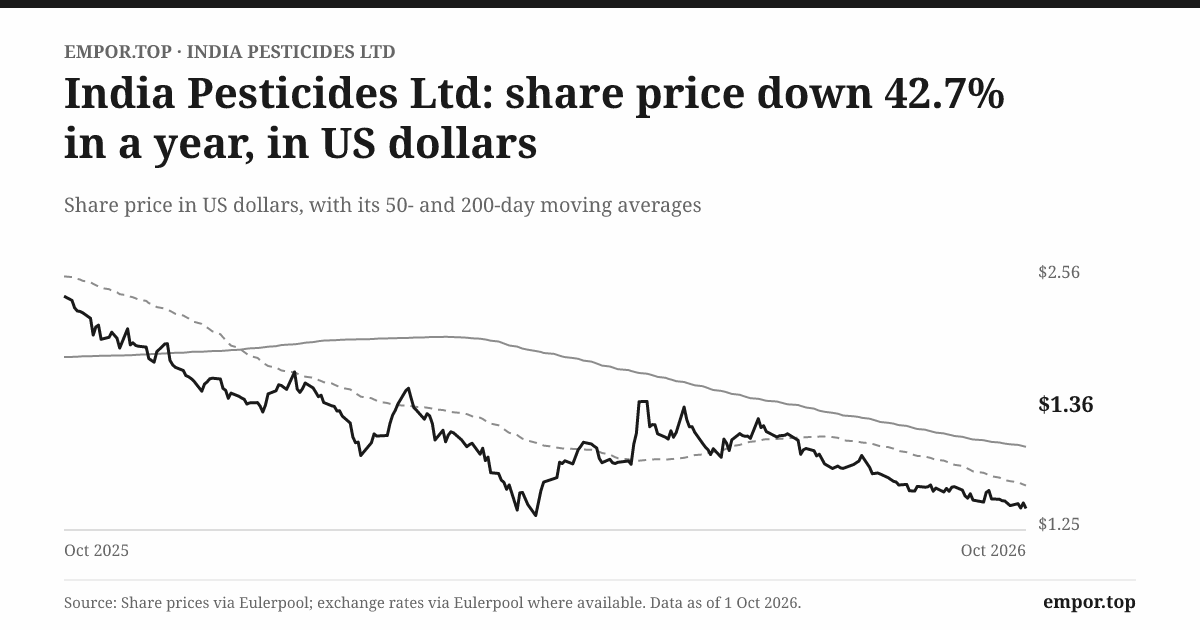
Five years later, on 1 October 2026, the stock closed at ₹130.817. That is about 56% below the IPO price. Over the same five years the shares fell nearly 70% from peak to trough, and the market now values the whole company at roughly ₹1,500 crore, less than half of what public investors paid for it at listing7. Then there is the strangest number on the shareholder register. At the end of March 2026, India's domestic institutions, its mutual funds, insurers and pension pools, together owned exactly 76 shares of India Pesticides17. Not 76 lakh. Seventy-six.
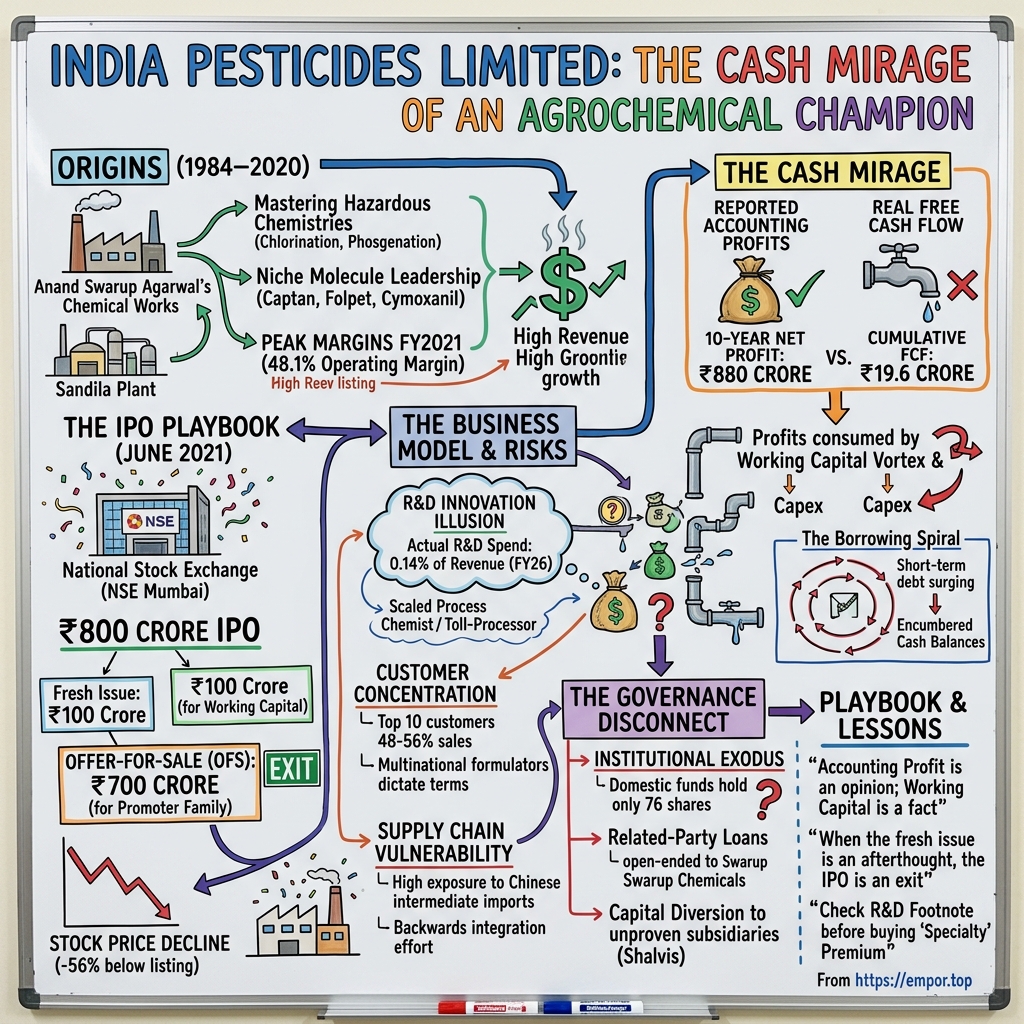
This is the puzzle at the centre of the story. India Pesticides is not a failed company. It is profitable every year, carries a CARE A+ credit rating, makes molecules that few others in India can make, and sells them on five continents6. Its sales grew from about ₹226 crore in FY2017 to about ₹1,057 crore in FY20261. And yet over those ten years, a business that reported roughly ₹880 crore of net profit produced only about ₹20 crore of free cash flow, which is the cash left over after running the plants and building new ones123. It paid out about twice that in dividends. Profits went in at one end of the factory. Very little cash came out of the other.
The question this episode asks is simple to state and hard to answer. Can an off-patent chemical maker with world-scale production of a few molecules turn the profits it reports into cash that belongs to shareholders? Or does the money stay trapped forever in unpaid customer invoices, drums of inventory and new steel reactors?
The trail runs through six stops. First, the founder: how Anand Swarup Agarwal built a chemistry business in Lucknow and the dusty industrial belt of Sandila. Second, the IPO, where ₹700 crore of the ₹800 crore raised went to selling shareholders and only ₹100 crore reached the company[^6]. Third, the gap between how the company describes itself, as research-led, and what it actually spends on research, which in FY2026 came to ₹1.47 crore, or about 0.14% of sales1. Fourth, the working-capital vortex that swallows nearly half of operating earnings. Fifth, the governance plumbing: an open-ended loan to a promoter company, guarantees to a new subsidiary, and the quiet departure of institutional money. Sixth, the strategic verdict, the bull and bear cases, and what the whole thing teaches.
The short version of the verdict, which the rest of the story has to earn: India Pesticides built a real, defensible, low-cost manufacturing position in a handful of difficult fungicides. But it behaves like a working-capital-hungry contract chemist, not like an innovator. The financial risk of that model has landed on a shareholder base made up almost entirely of retail investors. The fair hedge is that FY2026 operating cash flow did recover, and one or two clean cash years could change the picture. To see why that hope has disappointed so often, the story has to begin in Lucknow, four decades ago.
 Subscribe on LinkedIn
II. The Sandila Stills: Building a Chemistry Monopoly from Uttar Pradesh (1984–2020)
A small unit on Dewa Road
India Pesticides was incorporated in 1984[^6]. Lucknow then was a city of government offices and old-world manufacturing, not a chemical hub. India's chemical industry clustered in Gujarat and Maharashtra, around the ports, the petrochemical feedstock and the effluent infrastructure. A founder who wanted to make pesticides in Uttar Pradesh was choosing the harder road: further from the coast, further from suppliers, and further from the customers who mattered.
Anand Swarup Agarwal chose it anyway. The company's first operations sat on Dewa Road on the edge of Lucknow, and over the following decades it added a much larger site at Sandila in Hardoi district, an industrial area about an hour north-west of the city[^6]1. Agarwal has stayed at the centre of the business through all of it. Today he is the non-executive chairman, owns about 39% of the company directly, and with his family and family trusts controls about 64%1. CARE Ratings, which has followed the company for years, lists the promoters' track record of more than three decades among the business's main strengths6. He does not draw an executive salary. His FY2026 income from the company as a director came to about ₹7 lakh in sitting fees1. Like many founder-patriarchs of Indian mid-cap manufacturing, his pay is his ownership.
Technicals versus formulations
To understand what Agarwal built, it helps to know that agrochemicals come in two layers.
The bottom layer is the technical: the pure active ingredient, the molecule that actually kills the fungus or the weed. Technicals are made through multi-step chemical synthesis in reactors and sold, usually business to business, by the tonne to large crop-protection companies.
The top layer is the formulation: the product a farmer actually buys. A formulator takes a technical, mixes it with solvents, wetting agents and fillers, packages it under a brand, and sells it through distributors and village shops. Think of it as the difference between the company that makes paracetamol powder and the company that sells branded tablets in a pharmacy.
India Pesticides does both, but the heart of its economics has always been technicals. It also has a domestic formulations business with about 10,000 tonnes of annual capacity, served through 24 depots across 18 states1. That branded arm gives the company some direct exposure to Indian farmers and the monsoon. The money, though, and the reputation, came from synthesis.
Mastering the chemistry nobody wanted
The molecules that made India Pesticides are old, off-patent fungicides that most of the world takes for granted.
Captan is a broad-spectrum protective fungicide, used for decades on apples, grapes, strawberries and potatoes. Folpet, a close chemical cousin, is a workhorse in vineyards, especially in Europe. Cymoxanil is a fungicide that penetrates plant tissue and is often mixed with other products to fight late blight in potatoes and tomatoes. None of these is new. None is protected by a patent. And that is exactly the opening.
Making them is unpleasant. The chemistry involves chlorination steps and hazardous reagents, and the waste streams need serious effluent treatment and environmental clearances. Many multi-product producers prefer not to deal with it. A company that learns to run these reactions safely, consistently and cheaply, and then gets its plant approved by fussy multinational customers and foreign regulators, ends up with something valuable: a niche where there are few credible suppliers.
That is the position India Pesticides built. It is the only Indian manufacturer of technical-grade Folpet and Cymoxanil, and one of the larger global producers of Captan16. CARE names its "established competitive positioning" in these three molecules as a core rating strength6. The company also holds more than 50 product registrations across export and domestic markets1. Registrations matter: an overseas formulator that wants to switch suppliers often has to re-file data showing the new source's product is equivalent, which takes time and money.
The supercycle years
For most of its history India Pesticides was a solid, unremarkable regional business. Then the world changed around it.
From about 2017, Chinese authorities ran waves of environmental inspections that shut or curtailed many chemical plants, and global buyers of crop-protection ingredients started looking hard for second sources. India, with its chemistry talent and low costs, was the obvious alternative. India Pesticides grew sales by more than 30% a year between FY2018 and FY2021, from about ₹226 crore in FY2017 to about ₹649 crore in FY20215[^6].
Profits grew faster than sales. FY2021, the year ending March 2021, was the high-water mark. Net profit was roughly ₹135 crore on those ₹649 crore of sales, a net margin of about 21%5[^6]. Return on capital employed, which measures how much operating profit the business earns on the money tied up in it, reached about 76%5. For context, a good Indian chemical company might earn 20% to 25%. India Pesticides was earning three times that.
Two things made this possible, and they should not be confused. One was real: the company had built low-cost, reliable capacity in molecules where supply was tight. The other was temporary: pandemic-era hoarding across agrochemical supply chains, Chinese disruption and very high prices for active ingredients. The FY2021 numbers were a cycle peak, not a new normal. The following years would prove that.
What the early record says
The pre-IPO history supports a narrower claim than "chemistry monopoly." India Pesticides earned its position through operational persistence, safely running difficult reactions at low cost in a place others did not want to be. That is a genuine advantage. But it is process know-how, not proprietary science, and its value rises and falls with how tight supply is in a handful of old molecules.
The balance sheet in those years was conservative and closely held, with no outside venture or private-equity money and modest borrowing[^6]. It was a family business run cautiously. The question was what would happen when the family decided to go public at the very moment the cycle peaked.
III. The ₹800 Crore IPO: Fresh Money for Working Capital, ₹700 Crore for the Family (June 2021)
The prospectus lands
In mid-June 2021, the red herring prospectus reached investors[^6]. Specialty chemicals were the hottest theme in Indian equities. The China-plus-one story was everywhere, and companies with the right molecules were being valued like growth franchises. India Pesticides set a price band of ₹290 to ₹296 and priced at the top, valuing the company at about ₹3,400 crore[^6]8.
The headline was ₹800 crore. The structure underneath told a different story.
Where the money went
An IPO can do two very different things. A fresh issue creates new shares, and the cash goes to the company to build plants, pay down debt or fund operations. An offer for sale lets existing shareholders sell their shares to the public, and the cash goes to them, not the company.
Of India Pesticides' ₹800 crore, ₹700 crore was an offer for sale by the promoters and other existing shareholders[^6]. Only ₹100 crore was fresh capital, earmarked for working capital and general corporate purposes[^6]. Seven-eighths of the money raised went out the door to sellers.
That is not illegal or unusual. Promoters are entitled to sell, and plenty of good Indian companies have listed through mostly secondary offerings. But it changes what investors were buying. They were not funding the next leg of growth. They were buying out part of the founding family's position at what turned out to be the peak of the cycle, in a business whose FY2021 profits were inflated by abnormal conditions.
The promoter group still kept about 63.6% of the company after listing, and that stake has barely moved since17. Share capital has stayed frozen at about 11.5 crore shares of ₹1 face value through March 2026. There has been no bonus, no rights issue, no buyback and no warrants, and no promoter shares are pledged1. That last point counts in management's favour. The family has not used its stake as collateral, and it has not diluted minority shareholders.
The timing question
Was the IPO a capital raise or an exit? The test is what happened next.
In the following years, the business needed far more cash than the IPO gave it. The fresh ₹100 crore was absorbed quickly. In FY2025 and FY2026 together, free cash flow came to about minus ₹91 crore12. That gap was not filled by new equity. It was filled by bank debt, which rose from about ₹18 crore in March 2024 to about ₹107 crore in March 202613.
Put the two facts side by side. In 2021, ₹700 crore went to selling shareholders. Within five years, the listed company was borrowing to fund its expansion and its dividends. The family took its liquidity at the top. Public shareholders were left holding a business whose capital needs were larger than its cash generation.
A fair reading has to include the counter-argument. Nobody in June 2021 knew that global agrochemical prices would collapse in 2023. Promoters who sell part of their stake and keep nearly two-thirds still have most of their wealth tied to the company's fate. But the IPO was clearly not designed to finance a capital-heavy growth plan. It was designed to give existing owners liquidity at a rich price, and it did that well.
The courtship and the cooling
Whatever institutional enthusiasm surrounded the listing did not last. As margins came back to earth, institutional money left. By March 2026 domestic institutions held the 76 shares that opened this story, foreign portfolio investors held about 1.9%, and resident individuals held about 29%17. Section VI returns to why. First, the story has to look at what kind of company these investors actually owned, because the answer explains much of the price.
IV. The Folpet & Captan Trap: R&D Innovation or Commodity Toll-Processing?
A footnote in the directors' report
Every Indian annual report contains a dry statutory section on research and development, technology absorption and foreign exchange. Most investors skip it. At India Pesticides it is one of the most revealing pages in the book.
The company describes itself as a research-led maker of technicals, built on process development and optimisation. In FY2026, its total R&D spending was ₹1.47 crore1. On roughly ₹1,057 crore of sales, that is about 0.14%. To put it plainly: for every ₹1,000 of sales, the company spent about ₹1.40 on research.
Testing the "R&D-led" claim
The trend matters more than any single year. R&D spending was about ₹2.2 crore in FY2022 and peaked at about ₹2.6 crore in FY202354. It then fell to about ₹1.7 crore in FY2024 and has sat at ₹1.47 crore in both FY2025 and FY2026321. As a share of sales, it has fallen from about 0.3% to about 0.14%.
Over the same years, the company was spending heavily on other things. Permanent headcount grew from about 800 in FY2022 to about 1,126 in FY202651. Capital spending on plant and equipment reached about ₹91 crore in FY2026 alone, more than 60 times the research budget, and unfinished projects on the balance sheet stood at about ₹68 crore1.
Discovery-led crop-protection companies typically spend something like 2% to 4% of sales on research. India Pesticides is not playing that game. Its capital goes into steel, reactors, people and process scale, not into new molecules or patents.
That is not necessarily a failure. A very good process chemist can create a lot of value by making known molecules more cheaply and reliably than anyone else. But it does change the nature of the moat. A process chemist's edge lasts only as long as competitors cannot match its cost and quality, and in old off-patent molecules, Chinese and other suppliers can and do return when prices are high. The historical record rejects the claim that India Pesticides is an innovation-led specialty company. What it leaves intact is the smaller claim that it is a skilled, low-cost producer of a few hard molecules.
How the company actually sells
The commercial model confirms the verdict. India Pesticides prices its technicals by the tonne, either on spot purchase orders or under short supply agreements of a quarter or six months1. There are no long-term take-or-pay contracts that guarantee volumes or floor prices1. When active-ingredient prices move, the company's prices move with them.
The test of this model came in FY2024. As global distributors worked off the stockpiles they had built during the pandemic, and Chinese producers cut prices to move product, agrochemical prices collapsed. India Pesticides had no contractual protection. Sales fell about 23%, and net profit fell about 58%, to roughly ₹61 crore3. Operating margin fell to about 11%, and in the March 2024 quarter the company roughly broke even at the operating level3. A business with real pricing power does not see its margin cut by more than half in two years.
Customers who are big, but not dominant
Who buys from India Pesticides? The company's large customers are multinational and domestic crop-protection formulators. The ten biggest have historically accounted for roughly half of sales[^6]1. In FY2026, no single customer crossed 10% of revenue1. That sounds reassuring, and partly it is: the loss of any one buyer would hurt but not cripple the business.
The receivables tell a more nuanced story. At March 2026, the top three customers accounted for about ₹61 crore, or about 17%, of trade receivables1. Large formulators are disciplined buyers. They can push for long credit terms and they can shift volume between suppliers when prices diverge. For a company like India Pesticides, the cost of having big customers often shows up not in price but in how long it takes to get paid, which is where Section V picks up the trail.
The China dependency
The supply side mirrors the demand side. India Pesticides depends on imported chemical intermediates, largely from China1. Foreign exchange outgo, mostly raw-material imports, rose about 48% in FY2026 to roughly ₹233 crore1. So the company that the market bought as a China-plus-one beneficiary is, in its raw materials, still heavily tied to China.
Management's answer is backward integration: making more of its own inputs. The flagship project is a tripling of capacity at Sandila for an intermediate used in its fungicide chain, from 2,000 to 6,000 tonnes a year1. If it works, it should reduce exposure to Chinese supply shocks and lift margins. Whether it does is one of the key things to watch, and the company has not yet shown in its reported margins that earlier integration has protected it through a downturn.
The conclusion from this section is uncomfortable but clear. India Pesticides is a capable manufacturer with a niche cost position, selling commodity-like products to powerful buyers on short-term terms, while buying key inputs from the competitor country it was supposed to replace. That is a business whose profits are cyclical. And as the next section shows, it is a business whose profits do not easily turn into cash.
V. The Cash Mirage: When ₹880 Crore of Profit Delivers ₹19.6 Crore of Free Cash
The ten-year ledger
Imagine an analyst lining up ten years of India Pesticides' cash flow statements, FY2017 to FY2026, and adding them up.
Net profit over the decade: about ₹880 crore. Cash from operations, meaning the cash the business actually collected from running itself: about ₹506 crore, or 58% of profit12345. Capital spending on plants and equipment: about ₹486 crore. What was left, free cash flow: roughly ₹20 crore1.
Ten years of work, ₹880 crore of reported profit, ₹20 crore of free cash. That is about 2 paise of free cash for every rupee of profit. Over the same decade, the company paid about ₹41 crore in dividends, roughly double the free cash it generated1. The gap was covered by the IPO money and, more recently, by borrowing.
Where the money hides
Why the gap between profit and cash? Profit is recognised when goods are sold. Cash arrives when customers pay. In between, the money sits in two places on the balance sheet.
The first is receivables, invoices customers have not yet paid. At India Pesticides, the average customer takes about 125 days to pay, around four months1. That figure has ranged between about 108 and 193 days over the decade, and has rarely been below 1201.
The second is inventory: raw materials, half-finished chemicals and finished product sitting in drums and warehouses. Inventory days have risen from under three months before the IPO to about five months in recent years1.
Add those together and subtract the time the company takes to pay its own suppliers, and you get the cash conversion cycle, the number of days between paying for raw materials and collecting cash from customers. Before the IPO it was around 110 to 155 days. In FY2025 it reached about 236 days, and in FY2026 it was about 20812. India Pesticides now finances its customers and its warehouses for roughly seven months on every rupee of sales.
The simplest way to see the consequence: every time sales grow, a large slice of the extra profit is immediately reinvested in more receivables and inventory. Growth does not release cash. It consumes it.
FY2025: the year profit and cash parted ways
FY2025 shows the mechanism at its starkest. Sales recovered by about 22%, and net profit rose to about ₹82 crore2. Operating cash flow was about ₹3 crore2. Nearly all the profit vanished into working capital. Trade receivables jumped by about ₹107 crore and inventory by about ₹35 crore2.
When a company's sales rise and its receivables rise faster, there are a few possible explanations. Customers may have been offered longer terms to win volume. A large chunk of sales may have been booked near year-end. Or collections may simply be slow. The company does not break down the cause in its disclosures. Whatever the reason, the effect was that the recovery in profit did nothing for the cash balance.
FY2026: better, but still short
FY2026 looked better on the surface. Net profit rose about 46% to roughly ₹120 crore, and operating cash flow recovered to about ₹62 crore1. That is about half of profit becoming operating cash, a big improvement on FY2025.
But working capital still absorbed about ₹85 crore1. This time the main culprits were inventory, up about ₹45 crore, and other current assets, up about ₹48 crore1. And capital spending of about ₹91 crore exceeded operating cash flow1. Free cash flow was negative again, at about minus ₹30 crore, after about minus ₹61 crore in FY202512.
The borrowing spiral
A business with negative free cash flow that still pays dividends has to find the money somewhere. India Pesticides found it at the bank.
Borrowings were about ₹18 crore in March 2024. A year later they were about ₹52 crore. By March 2026 they were about ₹107 crore, close to six times the level two years earlier123. Most of that, about ₹76 crore, is short-term working-capital debt; about ₹31 crore is long-term1. The company drew about ₹56 crore of net fresh debt in FY2026 while paying about ₹8.6 crore in dividends1.
In absolute terms the debt is still small. Debt to equity was about 0.11 at March 2026, and CARE describes the company's gearing as low and its debt protection as comfortable61. Nobody should read this as a balance sheet in distress. The point is the direction, not the level. A company that once funded itself and paid dividends from operations is now funding its growth and its dividends with bank lines.
The cash that is not quite cash
There is one more layer. At March 2026 the consolidated balance sheet showed about ₹117 crore of cash and bank balances1. On a quick read, that more than covers ₹107 crore of debt.
The notes tell a different story. About ₹55 crore of those deposits is encumbered, pledged as margin money for overdrafts, letters of credit and bank guarantees, up from about ₹31 crore a year earlier1. That money exists, but the company cannot freely spend it while the facilities are in place. Strip it out, and unencumbered cash is about ₹62 crore against ₹107 crore of borrowings. On that basis the company is in a net debt position of roughly ₹45 crore1.
There is a further subtlety in the profits themselves. Other income was about ₹21 crore in FY2026, around 13% of profit before tax1. About half of it came from foreign-exchange gains, up from about ₹5 crore to about ₹11 crore, and the company uses no formal hedging, relying on the natural offset between export receipts and import payments1. Currency gains are real, but they are not a reliable part of a chemical manufacturer's earning power, and they can reverse.
The verdict of this section is the core of the whole story. India Pesticides reports healthy profits and appears to have a strong, low-debt balance sheet. Underneath, its working capital consumes much of what it earns, its expansion is now funded with debt, and a large share of its cash is tied up as collateral. That is the cash mirage. And it is the context in which institutional investors read the governance pages that follow.
VI. The Swarup Family Vault: Open-Ended Loans, Shalvis Guarantees, and the Exit of Domestic Funds
Clause 3(f)
Picture an investment committee at a Mumbai fund house leafing through the FY2026 annual report. Past the chairman's message and the sustainability pages, past the financial statements, there is an annexure that most retail investors never read: the auditor's report under CARO 2020, a checklist that India's company law requires statutory auditors to complete.
At Clause 3(f), the auditor, Suresh Surana & Associates LLP, made an adverse observation. India Pesticides had made an unsecured loan of about ₹3.25 crore to Swarup Chemicals Private Limited, a company controlled by the promoter group, without specifying the terms or period of repayment1. The loan had been about ₹3.70 crore a year earlier1. Under Clause 16(b), the auditor also noted the existence of a core investment company within the promoter group1.
In money terms, this is small. ₹3.25 crore is about 0.3% of annual sales and about 3% of a year's profit. It does not threaten the company. But to an institutional investor, the size is not the point. A listed company lending money to a promoter company with no repayment schedule is a signal about how the boundary between the family and the listed company is drawn.
The promoter-group web
Swarup Chemicals is not the only related party. The company's related-party note lists transactions with several promoter-group businesses, including Swarup Chemicals, Swarup Publications, Swarup Cold Storage & Ice Factory and Aahana Ventures LLP1. In FY2026, India Pesticides sold about ₹0.8 crore of goods to Swarup Chemicals and bought about the same amount back, and earned about ₹0.3 crore of interest from it1. It also had about ₹2.2 crore of advances to suppliers within the related-party relationships1.
None of these amounts is material to the company's economics. Together they describe a family group that still trades with, borrows from and does business alongside the listed company. Each transaction is disclosed and approved. But for an outside shareholder, each is a reason to ask whose interests come first when the two diverge.
Shalvis Specialities: the Hamirpur bet
A larger issue sits inside the corporate structure itself. In January 2021, months before the IPO, the company incorporated Shalvis Specialities Limited, a wholly owned subsidiary building a greenfield site at Hamirpur in Uttar Pradesh1. A second subsidiary, Amona Specialities, 51% owned, was set up in January 2024 and had no revenue in FY20261.
Shalvis is meant to be the next growth engine. So far it is a cost centre. In FY2026, it reported about ₹3.3 crore of revenue and a net loss of about ₹2 crore1. India Pesticides has put about ₹11 crore into its preference shares and about ₹5 crore into its equity1. More importantly, in FY2026 the parent gave corporate guarantees of ₹38 crore on Shalvis's bank borrowings, ₹19 crore each to HDFC Bank and Bank of India1. A year earlier there were no such guarantees1.
Guaranteeing a subsidiary's debt is normal practice. But it means the listed company's balance sheet now stands behind a project that has not yet shown it can make money. If Hamirpur ramps up as planned, the guarantees will look routine. If it struggles, the parent will have to support it further. Given that the parent itself is now borrowing to fund capex, investors are entitled to ask how many greenfield bets the balance sheet can carry at once.
Pay and the next generation
The compensation picture is mixed. The founder takes no salary. The professional managers are paid modestly by Indian standards: CEO Dheeraj Kumar Jain received about ₹1.1 crore in FY2026 and CFO Satya Prakash Gupta about ₹0.4 crore1. Whole-time director Dr. Kuruba Adeppa received about ₹0.3 crore, and a second whole-time director, Dr. Udaya Bhaskar Mantripragada, joined in July 20251.
In May 2025, two younger members of the promoter family, Adhiraj Swarup Agarwal and Anmol Swarup Agarwal, were appointed to roles in the company and received professional fees of about ₹0.25 crore each1. Together they were paid less than the CEO but more than the CFO or the whole-time director. The amounts are small. The message is clear: the next generation is being brought into the business, and the company remains, first and foremost, a family enterprise.
The board has nine members, including three independent directors1. In March 2026, shareholders approved the reappointment and regularisation of independent directors by more than 99%1. With nearly two-thirds of the votes held by the promoter group, that outcome tells investors little about minority sentiment.
The institutional retreat
Put the pieces together: an IPO that was mostly a promoter exit, a collapse in margins within three years, negative free cash flow, an auditor's observation on a promoter loan, and guarantees to a loss-making subsidiary. For a mutual fund manager who has to justify each holding to an investment committee, that is a long list of awkward questions about a company that is a small part of any portfolio.
The result is visible in the shareholding filings. By March 2026, domestic institutions held 76 shares17. Foreign portfolio investors held about 1.9%, a figure that has moved between roughly 0.3% and 2.4% over the past two years1. Resident individuals held about 29%, spread across about 93,500 shareholders1.
It would be too simple to say that governance alone drove out institutions. Many funds sell mid-cap stocks whose earnings fall by half, whatever the governance. But the combination matters. A cyclical downturn by itself invites patient investors to buy at the bottom. A downturn combined with weak cash conversion and promoter entanglements gives them reasons to stay away. Without institutional owners, the stock has little research coverage and no natural buyer when retail investors sell, which helps explain why it trades where it does.
That leaves the playbook: what founders and investors should take from a business that built genuine manufacturing skill and still disappointed its public shareholders.
VII. Playbook: Business & Investing Lessons
"Accounting profit is an opinion; working capital is a fact."
The lasting image of India Pesticides is FY2025: profit of about ₹82 crore, operating cash of about ₹3 crore. Nothing about that year was fraudulent or even unusual by the standards of Indian chemical companies. Revenue was recognised when goods shipped, as accounting rules require. The cash simply did not arrive.
The wider lesson applies to any business that sells to powerful customers on credit. A margin is only as good as the speed at which it turns into cash. In process chemistry, where customers dictate payment terms and inventory has to be built ahead of the season, a company can report rising profits for years while its bank balance stands still. The first number to check is not EBITDA but the gap between profit and cash from operations over a full cycle. At India Pesticides, over ten years, that gap was more than 40% of everything it earned.
"When the fresh issue is an afterthought, the IPO is an exit."
The structure of the 2021 offering told investors what they needed to know before a single quarter of results came in. When seven-eighths of an IPO goes to selling shareholders and the company keeps only enough to top up working capital, the sellers are saying something about how they value the business at that moment.
That does not make every secondary-heavy IPO a bad buy. But it shifts the burden of proof. Investors should ask what the business will need to fund its plans, and who will pay for it. At India Pesticides, the answer turned out to be the bank, and behind the bank the public shareholders who own the risk. Founders, meanwhile, had their liquidity at the top of the cycle.
"Check the R&D footnote before paying the specialty premium."
The market in 2021 priced Indian specialty chemicals as though they were innovation businesses. At India Pesticides, the statutory R&D disclosure always told a different story, and it has become starker each year. A company spending about 0.14% of sales on research is not discovering molecules. It is manufacturing them.
That is a perfectly respectable business. But it deserves the valuation of a cyclical manufacturer, not of a franchise with intellectual-property protection. The difference between those two valuations explains a large part of the stock's fall from its listing price. The R&D note is one of the cheapest pieces of due diligence an investor can do.
"Related-party loans are never about the size; they are about the plumbing."
A ₹3.25 crore loan to a promoter company could never sink a business with ₹1,000 crore of sales. Its importance lies in what it reveals: that, at least in small ways, the listed company's balance sheet is still available to the wider family group. The same logic applies to guarantees for new subsidiaries and to family members joining the payroll.
For investors, the lesson is that governance is priced at the margin, by the most demanding buyers. Retail shareholders may not care about a footnote in the auditor's annexure. Institutional investors do. And when they leave, they take with them the research coverage, liquidity and patient capital that support a stock's valuation through the bad years.
VIII. Analysis & Bear vs. Bull Case
The comparison table in the analyst's head
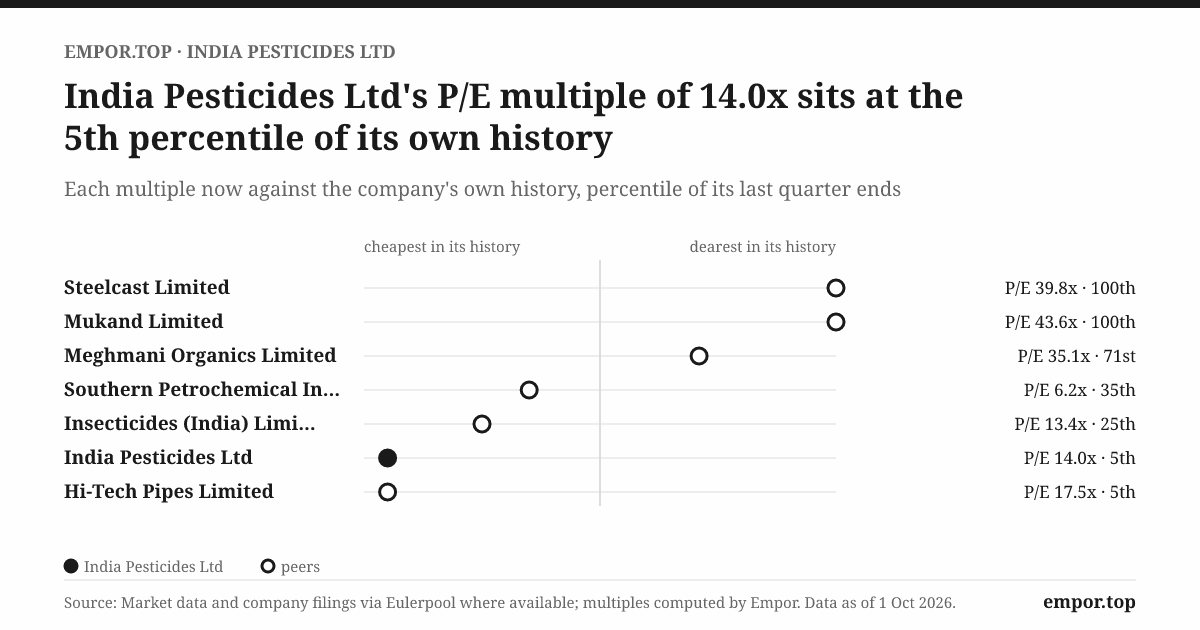
Imagine a hedge-fund analyst in Mumbai lining up India Pesticides against its listed peers. At about 14 times trailing earnings and about 1.5 times book value, India Pesticides is cheap7. Its own five-year median P/E is about 22 times7. Sharda Cropchem trades at roughly 16 to 18 times earnings, Dhanuka Agritech at roughly 18 to 20, Rallis India at roughly 22 to 25, and PI Industries, the closest thing India has to a research-led custom-synthesis champion, at roughly 32 to 367.
The question is whether the gap is an opportunity or a fair price for a weaker business. The enterprise value of about ₹1,500 crore is about 8 times EBITDA7. Return on capital employed, which peaked at about 76% in FY2021, was about 16% in FY202615. A discount that large usually means the market does not believe current earnings will turn into cash. Whether the market is right is what the frameworks below try to test.
Porter's Five Forces
Buyer power: high to moderate. India Pesticides sells mostly to large formulators who have alternatives. The proof is not in prices alone but in collection: debtor days of about 125 and nearly a third of receivables past due at March 2026 show who has the upper hand in the relationship1. About ₹113 crore of the roughly ₹377 crore of gross receivables was overdue, most of it by less than six months, and expected credit-loss provisions have risen from about ₹11 crore to about ₹15 crore over two years123. Buyers do not need to squeeze price when they can squeeze terms.
Threat of new entrants: low. Hazardous chlorination chemistry requires environmental clearances, effluent infrastructure and years of customer qualification. New entrants in India face real barriers. This is the strongest leg of the company's position.
Supplier power: high. The dependence on Chinese intermediates, with about ₹233 crore of foreign exchange outgo in FY2026, means that the company's key costs are set by the country it is meant to replace1. The intermediate expansion at Sandila is the attempted fix.
Threat of substitutes: moderate and slow. Broad-spectrum fungicides face long-term pressure from biological crop protection and newer, lower-dose chemistries. Regulatory reviews in Europe and North America can restrict older molecules. These threats move over years, but they are real for a company concentrated in a few legacy products.
Rivalry: high. In off-patent molecules, competition comes from Chinese, Israeli and other Indian producers. When prices are high, capacity returns. FY2024 showed what happens when it does.
Hamilton Helmer's 7 Powers
Process power: partial. Decades of experience running difficult reactions at Sandila give India Pesticides a real cost and reliability advantage in its niche. It is the company's genuine moat. But the FY2024 margin collapse shows that process power protects market position, not prices.
Cornered resource: absent. No patents, no proprietary molecules, and research spending too small to create them.
Switching costs: weak to moderate. Product registrations in export markets make it costly for customers to switch supplier quickly. But short-term contracts and the absence of take-or-pay terms show those costs are not high enough to secure pricing.
Scale economies: niche. Domestic leadership in Captan, Folpet and Cymoxanil gives the company volume in those molecules, but it remains small next to global crop-protection groups.
Counter-positioning, network effects and brand: absent in a business-to-business technicals model. The domestic formulations brand is too small to change the picture.
The overall verdict: a narrow but real moat in process know-how and regulatory barriers, with no protection against the cycle.
The bull case
The destocking is over. Global channel destocking bottomed in FY2024. FY2026 revenue rose about 28% and net profit about 46%1. If volumes stay strong, profits could recover further from here.
Backward integration should pay. If the tripled intermediate capacity at Sandila replaces imported inputs, it could protect margins and reduce the working capital tied up in imported raw materials.
Shalvis could turn from a cost into a contributor. If Hamirpur reaches commercial scale, the guarantees and investments made so far start earning returns.
The valuation already prices in a lot of bad news. At about 14 times earnings and 1.5 times book, with an A+ credit rating and modest gross debt, the stock does not require heroic assumptions to look reasonable67.
The bear case
The cash trap is structural. Ten years of weak cash conversion suggest the problem is the business model, not a bad year. If capex continues at recent levels and working capital keeps growing with sales, free cash flow will stay negative and debt will keep rising.
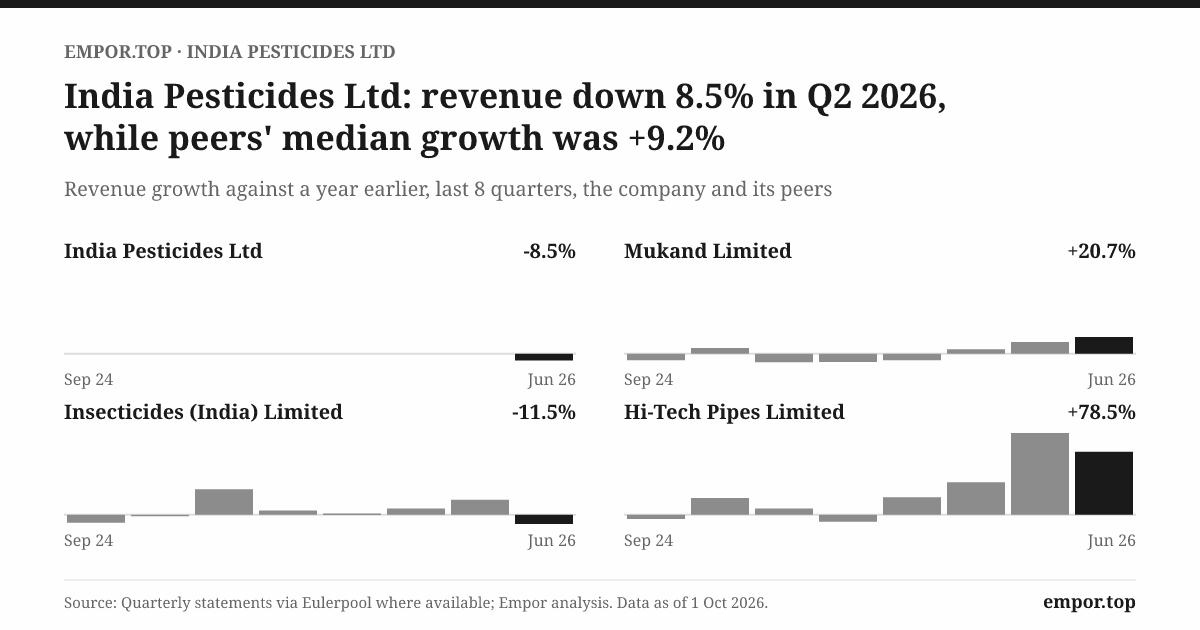
The recovery is already wobbling. In the June 2026 quarter, sales fell about 8.5% and net profit about 35% year on year7. CARE attributes the weaker first quarter of FY2027 to delayed monsoon demand6. That may prove temporary, but it shows how quickly the cycle can turn.
No institutional floor. With domestic funds effectively absent and retail investors holding the float, the stock has no natural support in a downturn.
Molecule and regulatory concentration. Heavy reliance on a few legacy fungicides leaves the company exposed to regulatory reviews in its export markets.
The governance discount persists. As long as related-party loans, guarantees and family appointments continue, the multiple is unlikely to close the gap to peers.
The activist's questions
A skeptical activist would ask three things. Why does a company with net unencumbered debt and negative free cash flow keep lending to a promoter entity at all? What is the hurdle rate for Shalvis, and when will the board report against it? And why has a company that calls itself research-led cut its research budget in each of the past three years while spending tens of crores on new plant? None of these questions has a public answer from the company.
The three KPIs that matter
Free cash flow against profit. The most important number. It was negative in both FY2025 and FY2026, at about minus ₹61 crore and minus ₹30 crore12. A sustained positive reading, ideally above half of net profit, would be the single strongest evidence that the cash mirage is lifting.
Debtor days and overdue receivables. Debtor days were about 125 at March 2026, down from about 152 a year earlier, with about ₹113 crore past due1. A sustained fall toward 100 days would show the company is gaining leverage with its customers.
Domestic institutional ownership. At 76 shares, it cannot fall much further. Any mutual fund building a disclosed stake above 1% would signal that professional investors have become comfortable with the governance and cash story.
IX. Epilogue
On the evening of 1 October 2026, India Pesticides stands at a crossroads. On one side is the owner-run chemical workshop it has always been: skilled, cautious, profitable, and run by a family for whom the listed company and the group businesses blur at the edges. On the other is a modern listed company that converts its profits into cash, explains its capital allocation, and earns back the institutional investors it lost.
The next twelve months will decide which way it leans. The first test is the season itself. The June 2026 quarter showed sales and profits falling, and CARE pointed to a late monsoon6. If the second half of FY2027 recovers, the FY2026 rebound will look like a cycle turning; if it does not, the market will treat FY2026 as a peak and price accordingly.
The second test is Hamirpur. Shalvis now has ₹38 crore of parent guarantees behind it. In FY2027 it either starts producing meaningful revenue and operating cash, or the parent has to support it further. Each quarterly result will show which.
The third test is the cash flow statement for FY2027, due with the annual results in the middle of 2027. If capex falls from its FY2026 peak and working capital stops growing faster than sales, free cash flow could turn positive for the first time in three years. That is the number that could start to reverse the story. If it stays negative, borrowings will keep climbing, and the encumbered deposits will keep growing with them.
The final test belongs to the founder. Anand Swarup Agarwal has built a business that makes molecules few others in India can make. Whether he chooses to close the open-ended loan, set clear hurdles for the subsidiaries and hand capital allocation to a professional process will do more for the company's valuation than any new reactor. Nothing in the company's public statements yet answers that question. The factory works. The open question is whether the cash will ever leave it.
X. Outro
In July 2021, the bell rang for an Indian specialty chemical champion that would conquer global crop-protection supply chains. The listing ceremony was full of that promise. The company itself has kept much of it, in the narrow, physical sense. Its reactors at Sandila still run through the humid monsoon, turning out tonnes of white fungicide powder that is shipped to vineyards in Europe and potato fields across the world.
What the bell did not promise, and what the company has not delivered, is the other half of the chemistry. Profits go into the reactors, into the warehouses and into the customers' unpaid invoices. A growing share of the cash that is left sits pledged at the bank so the overdraft stays open. India Pesticides is a master of chemical synthesis that has never quite learned to synthesize free cash.
References
-
Integrated Annual Report 2025-26 — BSE India, 2026-07-28 ↩↩↩↩↩↩↩↩↩↩↩↩↩↩↩↩↩↩↩↩↩↩↩↩↩↩↩↩↩↩↩↩↩↩↩↩↩↩↩↩↩↩↩↩↩↩↩↩↩↩↩↩↩↩↩↩↩↩↩↩↩↩↩↩↩↩↩↩↩↩↩↩↩↩↩
-
Integrated Annual Report 2024-25 — BSE India, 2025-08-14 ↩↩↩↩↩↩↩↩↩↩↩↩
-
Integrated Annual Report 2023-24 — BSE India, 2024-08-08 ↩↩↩↩↩↩↩↩
-
Integrated Annual Report 2021-22 — BSE India, 2022-08-23 ↩↩↩↩↩↩↩
-
Credit Rating Rationale: Bank Facilities of India Pesticides Limited — CareEdge Ratings, 2026-09-22 ↩↩↩↩↩↩↩↩
-
India Pesticides Limited Consolidated Financials and Shareholding Pattern — Screener.in, 2026-10-01 ↩↩↩↩↩↩↩↩↩↩↩↩
-
India Pesticides Limited IPO Analysis & Listing Coverage — Moneycontrol, 2021-07-05 ↩↩
 LinkedIn
 WhatsApp
 Reddit
 Hacker News
 Email
Email Kindle
 RSS Feed
 Spotify
 Apple Podcasts
 Amazon Music
 Audible
 YouTube