Ipca Laboratories: From Malaria APIs to the Unichem Bet
I. The Drug in the White House Briefing
In the first week of April 2020, the most talked-about medicine on earth was nearly a century old. From the White House podium, President Donald Trump called hydroxychloroquine "a very special thing" and a possible "game changer" against COVID-19.1 Doctors and scientists were far less sure. The drug had been developed for malaria and was prescribed for lupus and rheumatoid arthritis, and experts were openly doubting that it did anything against the new coronavirus.1
Then the story turned into geopolitics. India, which makes much of the world's supply, banned exports of the drug on April 4 as countries rushed to stockpile it.1 Trump called Prime Minister Narendra Modi, then told reporters that if India did not let the pills go, "there may be retaliation."1 On April 7, New Delhi reversed course and said it would license the drug for export to countries in need.1
Somewhere inside that diplomatic storm was a company most Americans had never heard of. Ipca Laboratories, based in Mumbai, was one of the largest makers of hydroxychloroquine in the world, producing both the active ingredient and the finished tablet. Two weeks earlier, on March 23, its shares had jumped 18% to a record ₹1,616 in a falling market.2
The reason for that jump contained a delicious irony. For years, the US Food and Drug Administration had blocked imports from Ipca's main plants over manufacturing failures. Now, facing shortages, the same regulator made an exception. It allowed Ipca's hydroxychloroquine and chloroquine ingredients from its Ratlam plant, and hydroxychloroquine tablets from two formulation plants, back into the United States.2 The FDA added a warning that would prove important: the exception would be reconsidered if the shortage changed.2
For a few weeks, Ipca ran its factories like an emergency service. It supplied about 12 crore tablets to India's central and state governments within roughly 45 days, while also serving export markets.3 In the quarter that ended in June 2020, management estimated that pandemic-driven sales of hydroxychloroquine and chloroquine added about ₹259 crore of business that would not otherwise have existed.3
And then, almost as quickly, it was over. By August, management told analysts that buyers had stocked up in the first quarter and were still holding inventory, and that the US had withdrawn its emergency stance on the drugs. The hydroxychloroquine business, A.K. Jain said, would return to "more or less the normal business."3
That is the first lesson of this story. A molecule can make a company famous for a season. It cannot, by itself, make a company valuable for a generation.
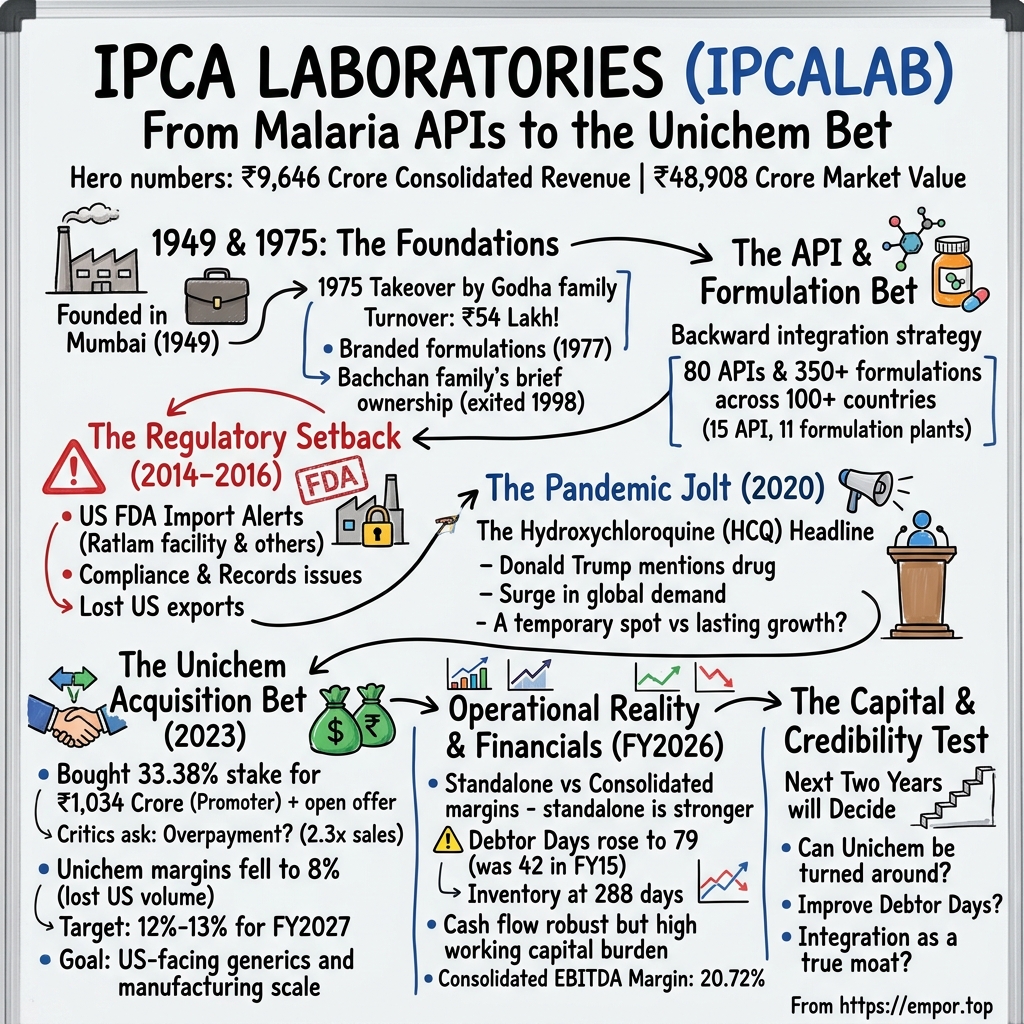
Six years later, Ipca is a much bigger and more complicated business. It reported consolidated revenue of about ₹9,646 crore in the year to March 2026.4 On November 2, 2026, the stock market valued it at about ₹48,908 crore, roughly 37 times its trailing earnings.5 Its antimalarial heritage has faded so far into the background that management now describes malaria as "almost insignificant", about 1% of its Indian branded business.6
What replaced it is the real story. Ipca is a vertically integrated drugmaker that sells branded medicines to Indian doctors, ships generics and branded drugs to more than 100 countries, and makes about 80 active ingredients of its own.7 In 2023, it bought control of Unichem Laboratories, a US-focused generics maker whose margins have been the weakest link in the group ever since.84
The scale of the story needs one correction before it starts. Ipca was founded in 1949, but the company that matters today began in 1975, when a new group took control of a struggling business. Everything before that is prologue.
So the story will be told as three tests. The first is whether Ipca has a real edge: in its factories, its brands, or both. The second is whether Unichem can earn back what Ipca paid for it. The third is whether a family-led management team turns the cash it generates into returns worthy of the price investors are paying. The pandemic briefing room is the hook. The answer lies on the factory floor, the doctor's desk and the cash-flow statement.
 Subscribe on LinkedIn
II. The Company That Changed Hands in 1975
Ipca began life with a name that sounded more like a trade association than a drug company. It was incorporated in Mumbai on October 19, 1949, as The Indian Pharmaceutical Combine Association Limited, set up by businessmen and medical professionals.9 It took the name Ipca Laboratories in 1964, and in 1969 it commissioned a manufacturing plant in Mumbai.9
None of that made it a success. By the mid-1970s the company was losing money and going nowhere.910 What it needed was not a better product. It needed an owner who believed it could be fixed.
That owner arrived in an unlikely form. Premchand Godha grew up in a farming family in Rajasthan where, by one account, every rupee mattered.10 His parents pushed him toward education. He earned a commerce degree from the University of Rajasthan, qualified as a chartered accountant, and opened his practice in 1971.10
Within a few years, the young accountant was handling the personal finances, taxes and investments of one of the most famous families in India: the Bachchans.10 That relationship became a business partnership. In 1975, a group that included Godha, the actor Amitabh Bachchan, his brother Ajitabh, Jaya Bachchan and M. R. Chandurkar took control of the loss-making drugmaker.9
It is a colorful detail, and it has given Ipca a place in Indian business trivia. But the celebrity connection explains very little about what happened next. The Bachchans were investors. Godha was the operator.
He joined the board on October 31, 1975, and set about cutting waste and rebuilding operations.10 Within about a year of the takeover, the company began marketing its own formulations to Indian doctors.9 That decision mattered more than it looked at the time. A company that sells branded medicines to physicians builds relationships, sales teams and brand names. Those assets compound slowly, and they would eventually become the biggest engine of Ipca's revenue.
It took eight years for Godha to take full command. When he became managing director in 1983, the company's turnover was about ₹54 lakh, a sum that would not pay for a single mid-sized drug launch today.910
What Godha did next defined the company's character. In 1984, Ipca commissioned its first plant for active pharmaceutical ingredients, at Ratlam in Madhya Pradesh.9 A small Indian marketer of medicines had decided to make the chemicals inside its own pills, and to sell them to other drugmakers around the world. It became a public limited company in 1993.9
The Bachchan chapter closed quietly. In 1997, the family agreed to sell its roughly 36% stake to the company's four whole-time directors, and left Ipca entirely by 1999.9 Business Today later tied the exit to the family's own financial difficulties in that period.10 Whatever the cause, it left the Godha family and its fellow executives in charge, where they remain.
Today Premchand Godha is the executive chairman, and his success has made him a billionaire on Forbes' list, with an estimated personal fortune of about $1.9 billion.10 The accountant who once balanced a film star's books now presides over a group with more than 18,000 permanent employees.7
The story of those early decades is a familiar one in Indian pharma: a founder-operator buys a neglected asset, builds a domestic brand business, then bets on manufacturing. What sets Ipca apart is how far it pushed that manufacturing bet, and how much it would cost when one of its plants fell short.
That raises the question that drove the next thirty years. If Ipca could make the active ingredients for its own medicines, could it turn that capability into an advantage across markets, from Indian chemists to American pharmacies?
III. The API Bet—and the FDA Setback
Picture the Ratlam plant at full tilt. In tall steel reactors, chemists run multi-step reactions that turn raw chemicals and solvents into a white powder: an active pharmaceutical ingredient, or API. The powder is the part of a medicine that actually does the work. It is dried, tested and packed into drums.
Some of those drums are sold to other drugmakers in dozens of countries. Others travel to Ipca's own formulation plants, where the powder is blended with fillers and binders, pressed into tablets, coated, counted and boxed. That finished pill is the formulation.
A simple way to picture it is flour and bread. The API maker mills the flour. The formulation maker bakes the bread. Most drug companies buy their flour from someone else. Ipca decided to mill its own.
Today the company describes a portfolio of more than 350 formulations and about 80 APIs, sold in over 100 countries.7 Before the Unichem deal, it called itself one of the world's largest manufacturers and suppliers of more than a dozen APIs, made in plants approved by regulators including the UK's MHRA, Europe's EDQM and the World Health Organization.8
The logic of making your own ingredients is easy to state. A company that controls its API supply does not have to wait on a supplier during a shortage, and it captures the margin that a supplier would otherwise take. In products where the chemistry is hard and the regulatory file is long, process know-how can also make a producer cheaper or more reliable than rivals.
There is some evidence that the logic works for Ipca. In mid-2026, management said material costs were only about 25% of standalone sales, an unusually low share that leaves room to absorb shocks in input prices.4 When an investor asked in 2023 why Unichem would benefit from Ipca's ownership, the first answer was Ipca's API franchise and backward integration.11
But integration has a hidden cost. When every part of the chain depends on one upstream plant, a failure at that plant does not stay contained. It cascades. Ipca learned that lesson the hard way.
The inspection that stopped the line
In July 2014, FDA inspectors visited the Ratlam API plant and left behind a Form 483, the list of observations an inspector hands over when something looks wrong.12 On July 24, Ipca announced that it would voluntarily stop shipping APIs from Ratlam to the United States until the issues were fixed. Its shares fell more than 7% that morning.12
The company also warned of the knock-on effect. Its US-bound formulation plants at Pithampur, in the Indore special economic zone, and Piparia, in Silvassa, used APIs made at Ratlam. So stopping the flour also stopped the bread.12
The regulator's response escalated over the next eighteen months. The FDA put the Ratlam plant under an import alert in January 2015, meaning its products could be detained at the US border without inspection.1314 In March 2015, it extended import alerts to the Pithampur and Piparia formulation plants, and Ipca's market value fell by about ₹1,205 crore in a day.13
Then came the warning letter, dated January 29, 2016. Its language was brutal. Inspectors described "systemic data manipulation" at Ratlam, "including actions taken by multiple analysts, on multiple pieces of testing equipment, and for multiple drugs."15 One analyst told investigators that if a test failed, staff would "set back the date/time setting and re-integrate to achieve passing results."15
This was not paperwork. It meant that some quality records at Ipca's flagship API plant could not be trusted, which is about as serious a finding as a drug regulator can make.
Ipca said it had responded with remediation measures and hired outside consultants.16 Since July 2014, it said, it had shipped no APIs or formulations to the US, except for products exempted from the import alert.16
The financial damage showed up quickly. Revenue shrank in both FY2015 and FY2016, and net profit fell by nearly half in the first year and by almost two-thirds in the second.5 Return on equity dropped to about 4% in FY2016, a level at which a business barely covers the cost of the capital it uses.5
Certification can be lost
The episode is the strongest piece of evidence in Ipca's own record against the idea that manufacturing scale and approvals are a moat. A moat protects a business from competitors. Ipca's approvals did not protect it from itself. One plant's data practices closed off the world's most valuable drug market for years, and the integrated design meant that the closure spread across the chain.
The FDA's pandemic exception later proved the point in reverse. Access was granted for shortage reasons, not because the compliance concerns were resolved. By June 2020, with chloroquine no longer in shortage, the FDA withdrew the exception for that API, keeping one only for hydroxychloroquine and repeating that it would be reconsidered if the shortage changed.14
Recovery came slowly. In April 2023, nearly nine years after the first inspection, management described the US situation as "status quo" and said it was still waiting for an inspection.11 Its Pithampur plant was running at around 30% of capacity, and Piparia at about 25% to 30%.11 That is a lot of expensive steel sitting idle.
The turn came later that year. In October 2023, the FDA classified the Ratlam plant as Voluntary Action Indicated after an inspection, meaning it found issues but did not plan regulatory action. The stock rose 7% to a 52-week high on the news.17
By early 2026, Ipca had relaunched about five of its own molecules in the US, all made from its own APIs and sold through Unichem, with four or five more expected over the following six to twelve months.18 For scale, the company said that seven or eight years earlier, before the import alerts bit, it had been earning about ₹300 crore a year from roughly ten molecules in the US.18 In other words, it spent the better part of a decade rebuilding access it had once held.
So what survives of the integration thesis? A smaller and more honest version. Making its own ingredients gives Ipca cost control and supply security, and that shows up in its low material-cost ratio. It does not give Ipca protected access to markets. That access depends on quality systems, inspections and the behavior of individual laboratory analysts.
The KPI that would confirm the revised claim is simple: the number of Ipca's own molecules sold in the US and the revenue they produce, measured against the ₹300 crore the company once earned there. The event that would falsify it is just as simple. Another adverse inspection at a key plant would show that the lesson of 2014 had not been fully learned.
That leaves the question of what kind of business would make best use of a manufacturing base that was strong in chemistry but had been locked out of America. For most of that decade, the answer was not abroad. It was in India.
IV. The Malaria Franchise Meets a Crowded Market
For decades, the Ipca name meant malaria. In the monsoon months, when cases peak across India, its antimalarial medicines and ingredients moved through distributors, chemists, government programs and international tenders. It was a business shaped as much by rainfall, disease patterns and public-health budgets as by marketing.
That heritage gave Ipca something valuable: relationships with doctors, a distribution network that reached small towns, and a reputation as a maker of essential medicines. But it was never going to be enough on its own. Malaria demand rises and falls with the season and the disease. Institutional buyers such as governments and global health programs buy through tenders, which means low prices and lumpy orders.
So Ipca built something broader on top of it. Today, pain management, including rheumatoid arthritis and osteoarthritis, is more than half of its Indian branded business.18 Cardiovascular and diabetes medicines, dermatology, neurology and other chronic therapies have grown fast around it.186 And the old franchise has shrunk so far that, in August 2026, management said antimalarials had fallen about 24% in the quarter and were now hardly 1% of the overall business.6
That is a remarkable reinvention. The company the world met in the pandemic briefing room is no longer, in any meaningful commercial sense, a malaria company.
How the domestic machine works
Ipca's Indian business runs through a large field force. Of its 18,667 permanent employees at March 2026, 10,308 worked in marketing and distribution.7 In August 2026, management said it had about 7,000 medical representatives and planned to add around 200 for new divisions.6
The organizing principle is focus. Management says each of its roughly 20 divisions has two or three "power brands" supported by smaller brands, and that it launches only about one product per division a year.4 Launching too many products, A.K. Jain argued, dilutes the attention of the sales force and takes focus away from the main brands.4
The approach has produced steady results. In FY2026, the domestic formulation business grew about 10% to roughly ₹3,817 crore.4 In the June 2026 quarter, it grew 13%.6 By IQVIA's count, Ipca's chronic medicines grew about 17% against about 15% for the market, and its acute medicines about 9% against a market growing about 4.5%.6 Beating the market in both halves of the business, even by a modest margin, is evidence that the field force is gaining prescriptions rather than simply riding the tide. Six of its brands rank among India's top 300.4
The quality of the growth also looks reasonable. Management said the June 2026 quarter's growth broke down as about 5% from volume, about 4.5% to 5% from price, and about 2% from new launches.6 In plain English, more patients were buying Ipca's medicines, not just paying more for them.
A franchise, not a fortress
Now the reality check. Ipca ranked 16th in the Indian pharmaceutical market in March 2026, with a market share of about 2.09%.4 That is a respectable position in a large and fragmented market, but it is not dominance. Sun Pharma, Cipla, Dr. Reddy's and Lupin are bigger, broader and fight across many of the same therapy areas, though each has its own mix of brands, generics and specialty products.
Pricing tells the same story. Ipca's policy is to raise prices by about 5% to 6% a year, depending on what competitors are doing.4 That last clause matters. It suggests that Ipca follows the market rather than sets it. And for medicines under India's price controls, Jain said, the company "can't increase even a paisa."4
The customer structure does not suggest strong buyer power against Ipca, but it does not suggest lock-in either. No customer accounted for 10% or more of standalone revenue, and no single product exceeded 10%.7 Dealers and distributors carried 82.64% of total sales in FY2026, spread across 5,220 distributors, with the top ten handling about 22% of that channel.7
That spread is a strength: no one buyer can squeeze Ipca. But it also tells you how the business wins. Doctors choose brands, and distributors stock what doctors prescribe. There is no contract that stops a physician from switching to a rival's painkiller tomorrow.
The institutional business shows the other side of the coin. Sales to governments and global programs fell from about ₹355 crore in FY2025 to roughly ₹270 crore in FY2026, which management blamed on funding constraints at the institutions themselves.4 Then, in the June 2026 quarter, institutional sales more than doubled, mostly because about ₹40 crore of shipments slipped from March into April.6 These are "nominated shipments," Jain explained: the buyer's agent decides when to collect the goods.6 When the customer controls the calendar, the supplier's revenue becomes partly a matter of luck. Management now expects institutional sales of only about ₹260 crore to ₹300 crore a year, with single-digit growth at best.6 The business that once defined Ipca has become a side line it no longer counts on.
There is one more competitive test that shows where Ipca's franchise ends. The biggest new wave in Indian pharma is the GLP-1 class of diabetes and obesity drugs. In February 2026, an analyst asked whether Ipca, absent from the first wave of launches, would underperform its larger peers. Jain's answer was that Ipca was looking at in-licensing, bringing in a product developed by someone else, rather than relying only on its own manufacturing.18 For a company whose identity rests on making its own molecules, that is a telling admission. In the fastest-moving parts of the market, Ipca is a follower.
Its branded exports beyond India show a similar pattern of real but uneven strength. In the first nine months of FY2026, sales in French-speaking African markets grew about 41%, Latin America about 20% and East Asia about 36%, while the CIS region was roughly flat in the December quarter.18 Management itself cautioned that the full-year growth rate would come in lower than the nine-month figure.18 These are markets where Ipca's brand and distribution can win, but where currency, politics and tender timing can swing results from quarter to quarter.
So the verdict on Ipca's domestic position is clear. It has a real franchise built on focused brands, a large field force and a broad distributor network. The evidence supports a competitive position, not a protected one. It does not show customer switching costs, leadership across its product portfolio, or a cost advantage quantified against peers.
The test that would strengthen the claim is sustained growth above the market without price-led acceleration. The test that would weaken it is a slip in market rank or share, which has hovered near 2.1% across recent quarters.46
And that leaves the tension that drives the rest of the story. Ipca's mature franchise can keep growing. But a company's profits depend on what it sells, not only how much. As its mix shifts and its input costs move, can it hold its margins?
V. The Pandemic Made Hydroxychloroquine a Headline
That political surge created orders, but it did not establish clinical benefit or durable demand.1
Ipca's managers seem to have understood this almost in real time. On the August 11, 2020 call, A.K. Jain broke down the ₹259 crore of pandemic-related business with unusual care. It included hydroxychloroquine and chloroquine sold through Indian institutions, branded export markets, generic markets and API buyers in India and abroad.3 Some of it, he said plainly, "could be one time business."3
He said COVID-related demand had "significantly come down," buyers had purchased large quantities in the first quarter and were still carrying stock, and he did not expect further business from those markets.3
That is worth noting as a credibility marker. Management did not dress the surge up as a new growth platform. It labeled it a windfall and warned investors not to extrapolate it.
The other side of the pandemic
The pandemic also hurt Ipca in ways the headlines missed. Patients stopped visiting doctors during lockdowns, and Ipca's Indian branded business suffered. Jain said domestic formulation growth in the June 2020 quarter was about 8%, but about half of that came from institutional sales; without hydroxychloroquine, he estimated, underlying growth was around 2%.3 Business from untreated patients, he said, was "lost once and for all."3
Then the malaria season failed to arrive. With people staying indoors, management said the usual peak of July to September brought few cases.3 In the September 2020 quarter, the antimalarial division's sales fell from about ₹95 crore to about ₹59 crore.19 By November, management said hydroxychloroquine sales were back to "regular" rheumatology demand.19
The surge also exposed a quieter operational risk. To make extra hydroxychloroquine and chloroquine, Ipca diverted capacity, and some other API shipments could not be produced.3 API capacity, Jain said, was running at almost full. It also spent about ₹20 crore on extra allowances and incentives for plant workers, as the government pressed for supply.3
The same call revealed how slowly the cure for that bottleneck would arrive. Jain said API capacity constraints would be resolved through a new plant at Dewas, which had just received environmental clearance, with construction to start after the 2020 monsoon.3 Six years later, in August 2026, management was still describing new API plants at Dewas and Wardha as work in progress, needed because Ratlam was "running out of capacities."6 Whatever the reasons for the pace, the gap between a capacity decision and a working plant at Ipca is measured in years, not quarters.
Demand can change in weeks. Plants, staff and inventory take months or years to adjust. That mismatch is a structural feature of pharmaceutical manufacturing, and it would show up again when Unichem lost large US contracts.
The longer record
Now step back and compare the pandemic with the decade around it. Ipca's consolidated revenue grew about 12.6% a year over the ten years to FY2026.5 The pandemic year added a spike, but the line is fundamentally a steady climb.
Profit tells a more surprising story. FY2021, the pandemic year, produced net profit of roughly ₹1,140 crore, a net margin of about 21% and a return on equity of about 24%.5 Five years later, in FY2026, net profit attributable to shareholders was about ₹1,141 crore.45
Read that twice. After five years of growth in revenue, the company earned almost exactly the same profit as it did in the year of the hydroxychloroquine rush. Its net margin had fallen to about 12%, and its return on equity to about 14%.5
What happened in between? Profit fell sharply in FY2022 and fell again by almost half in FY2023, as costs rose and the pandemic tailwinds faded.5 In November 2020, management had projected margins of 25% to 27% going forward.19 That did not hold. By April 2023, an analyst on Ipca's own call reminded management that its margins had slipped to around 16% to 17%.11
So the hydroxychloroquine episode does belong in Ipca's story, but as a burst of attention around an established product, not as proof of a lasting growth engine. The longer record points to a business shaped by its broader portfolio and by margins that rise and fall.
And it sharpened a question that management could not dodge. Where would the next leg of growth come from, after the pandemic profits had faded and the US market was still largely closed to Ipca's own plants?
The answer arrived on April 24, 2023, and it was the most consequential decision the company had made in decades.
VI. Ipca Pays Up for Unichem
On the evening of April 24, 2023, Ipca announced that it had signed an agreement to buy 33.38% of Unichem Laboratories from one of its promoters, Dr. Prakash Mody, at ₹440 a share.8 The block alone cost about ₹1,034 crore.8 Under Indian takeover rules, the deal triggered an open offer to Unichem's public shareholders for up to another 26% at the same price.820
If every eligible shareholder accepted, Ipca's total outlay would reach about ₹1,840 crore.11 Ipca said it would fund the purchase from retained earnings, without borrowing or issuing new shares.11
Unichem was not a startup. It traced its roots to 1944, when Amrut Mody founded it as a sole proprietorship, and its shares had been listed since 1963.8 But in 2017 it had sold its Indian branded business, leaving a company built mainly around generic medicines for the US and Europe, with formulation plants in Goa, Ghaziabad and Baddi and API plants in Roha, Pithampur and Kolhapur.8
The business Ipca was buying had struggled. Unichem's sales had grown only about 4.8% a year between FY2020 and FY2022, to about ₹1,300 crore, and about 58% of its FY2022 sales came from US generics.21 It had swung from an operating loss in FY2020 to EBITDA of about ₹72 crore in FY2022, a margin of only 5.6%.21 Mint reported that it posted a net loss of about ₹158 crore in the nine months to December 2022.22
Generics are copies of off-patent drugs, sold mostly on price to wholesalers and pharmacy chains. In America, a handful of large buyers purchase most of them, and contracts are re-bid often. It is a volume business with thin margins and constant price pressure.
Management's strategic case had three parts. First, Unichem brought US-facing products and approved plants: 76 US drug filings, of which 54 were approved and about 44 were on the market, plus around 78 API filings.11 Second, Unichem had what Ipca lacked: a clean regulatory record, which mattered enormously to a company that had spent nine years under import alert.118 Third, Ipca's cheaper, integrated APIs could lower Unichem's costs, while Unichem's products could be sold through Ipca's channels in Europe, Australia and New Zealand.11
The capacity was there to use. Unichem's new Goa plant was running at only 20% to 30% of capacity, management said.11 Across its plants, Unichem could make about 13 billion tablets a year, according to Motilal Oswal.22
Management also offered an asset-based defense of the price. Jain argued that Unichem carried about ₹1,400 crore of assets on its books plus about ₹950 crore of net working capital, so that buyers were getting roughly ₹2,500 crore of assets for their money.11 The argument has a weakness that any analyst would spot. Assets are worth what they earn, and Unichem's plants were earning very little. Book value is a floor only if the factories can be filled or sold.
The concentration of the portfolio was another clue. Jain said Unichem's top ten products probably made up 70% to 75% of its US business.11 In a market where contracts are re-bid every few months, that meant a few customer decisions could move the whole company.
Investors did not like it. Ipca's shares fell about 9% to a 52-week low on the day after the announcement.23 Mint reported a drop of about 10% on the NSE, leaving the stock nearly 28% below its 52-week high.22
The criticism was specific. The ₹440 price was about 14% above Unichem's closing price of ₹386.80 the day before.21 Motilal Oswal called the deal expensive, pointing to rising competition in US oral generics, increasing regulatory risk, the work needed to turn Unichem around, and a valuation of about 2.3 times trailing sales.2122 It warned that Unichem would dilute Ipca's earnings and returns in the near term, because Unichem had reported an operating loss of about ₹60 crore in the first nine months of FY2023 and because Ipca would lose the interest income on the cash it spent.21
Business Standard framed the issue in a single phrase: the stock had hit a "valuation hurdle."24
One caution belongs here. The criticism rested on a sales multiple and broker estimates. It did not come with a like-for-like set of comparable pharmaceutical deals. The evidence supports the claim that Ipca paid a rich price for a loss-making business. It does not prove that the price was out of line with other transactions.
The call
The next day, April 25, Ipca's management faced analysts on a hastily arranged call. It was one of the more revealing hours in the company's history.11
The first questioner, Pankaj Tibrewal of Kotak Mutual Fund, went straight at capital allocation. Over the previous five years, he said, Ipca had made smaller acquisitions, including Bayshore, Ramdev, Noble and Pisgah, investing about ₹600 crore to ₹650 crore, and their execution had "not been inspiring" and had diluted returns.11 How could investors trust a far larger deployment?
A.K. Jain's answer was a promise. Unichem, he said, could reach about ₹300 crore of EBITDA within roughly two years, on turnover of about ₹1,700 crore to ₹1,800 crore.11 Work it through and that implies an EBITDA margin of around 17%. He also acknowledged that Unichem had high overheads and that its API plants were small and costly to run.11
Tibrewal was not persuaded. He said he wanted "to place on record" that investors had been "negatively surprised by this large capital allocation for a US asset."11
Then Chirag Dagli of DSP Mutual Fund pressed the price. On a ₹300 crore EBITDA target, he calculated, Ipca was paying about ten times EBITDA two years out, which seemed steep.11 Was this really the best deal available, with the US generics market in distress?
Pranay Godha, who had taken over as managing director and chief executive weeks earlier, answered "in one simple sentence": it was "better than most of the deals that had come on our table in the last five years."11 He said the ₹300 crore target included synergies, and that "without that, this number would otherwise be a bit of a challenge."11 When asked about the losing bidder's price, he said he did not know.11
One more detail from that call matters. Asked whether Unichem had any niche or first-to-file products, Jain said, "Most of them are all me-too generic products."11 In other words, the portfolio would have to win on cost and execution, not exclusivity.
The deal went ahead. In September 2023, Ipca bought another 19.29% of Unichem through the open offer for about ₹597.5 crore.25 Together with the promoter block, that gave it 52.67% of the company, making Unichem a listed subsidiary rather than a wholly owned one.258
That structure has a cost of its own. Because Ipca owns only a little over half of Unichem, nearly half of any turnaround profit belongs to Unichem's other shareholders, while Ipca carries the reputational and managerial burden of the whole company. The group then folded its American operations together, transferring the business of Bayshore Pharmaceuticals, Ipca's own US subsidiary, into Unichem's US arm in 2024.9 Unichem became, in effect, Ipca's front door to the American market, the channel through which Ipca's relaunched molecules now reach US pharmacies.18
Promise versus delivery
Now track the promise against what followed.
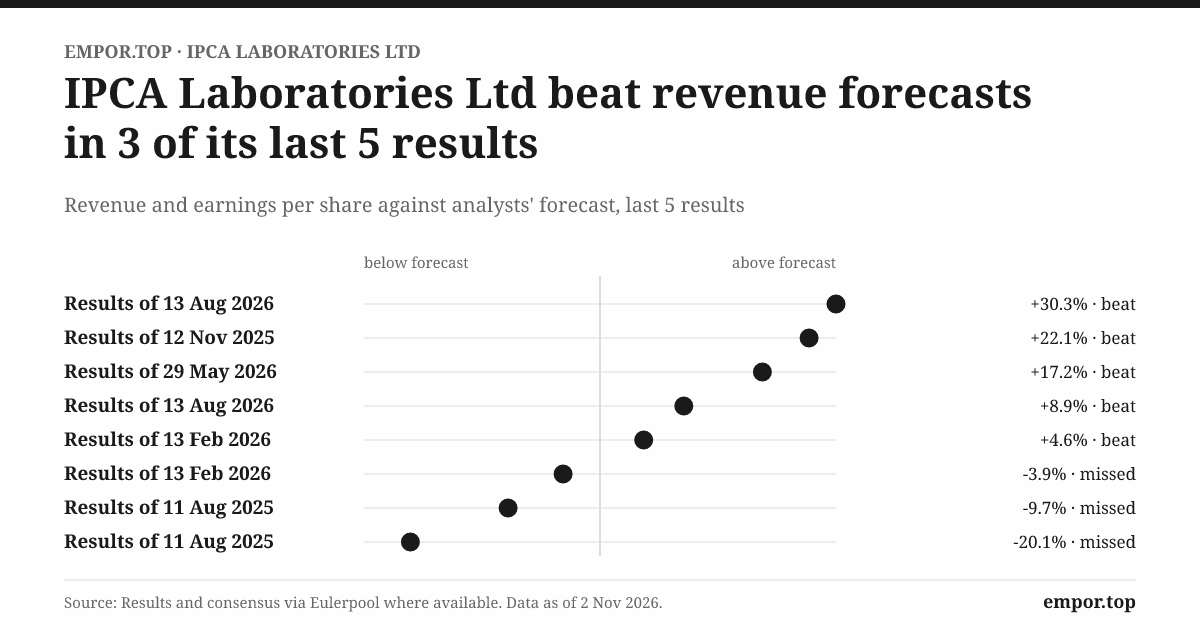
By February 2026, the story had changed. Jain told analysts that Unichem's own business, excluding products it sold for Ipca, had grown only about 2% that year.18 It had lost high-volume US business, which also hurt because those products had been absorbing a large share of the plant's overhead costs.18 Its EBITDA margin in the quarter was close to 8%.18
Harish Kamath, the company secretary, explained the mechanics. US generic contracts run for three to six months, not always a year, and competitors had undercut Unichem on price on two or three major molecules.18 Unichem would win back share, he said, "albeit at a lower price."18
The targets moved too. In February 2026, management said Unichem's aim was to reach about 15% EBITDA margin in two or three years, and about 20% once European filings were approved.18 That is a quiet but important revision. The 2023 plan implied a margin near 17% by around 2025. The 2026 plan pushed 15% out toward 2028 or 2029.
In June 2026, Jain said Unichem's margin had fallen from about 12% to around 8% over the year and that its revenue had not grown.4 He forecast a recovery to 12% to 13% in FY2027, helped by about 10% US growth and by the closure of an Irish plant whose overheads had run to about €4 million to €5 million a year.4 Unichem had also paid about ₹181 crore for a European Union competition fine relating to past conduct, partly funded by about ₹275 crore from a land sale.18
The integration synergies have also been slower than the pitch. In August 2026, asked whether Unichem now bought APIs from Ipca, Jain said supply was "hardly any," because the regulatory source change had been approved for only one product so far.6
There are signs of progress. In the June 2026 quarter, Unichem's US sales grew about 27%, though much of that came from Ipca's own products sold through Unichem; Unichem's own US portfolio grew about 9%.6 Its API business rose sharply and its Brazilian operation turned positive.6 But management declined to raise its Unichem guidance, saying it wanted to see "some more quarters" of performance first.6
The fair conclusion is this. The ₹300 crore EBITDA promise was not delivered on the timetable management set in 2023. At margins of 8% to 12%, Unichem is well short of the roughly 17% the original plan implied. The deal was a material bet on US access and manufacturing capability, and its initial valuation drew credible criticism that the record so far has not refuted.
It has also changed what "Ipca" means. Consolidation brought Unichem's revenue, staff and plants into the group's accounts, and lowered the group's blended margins. Any honest reading of Ipca's numbers now has to separate the two.
So the central operating question becomes sharper. Even if Unichem improves, how much of the group's growth is coming from the acquired business, and how much from Ipca's own franchise?
VII. The Margins Are Moving, but So Is the Mix
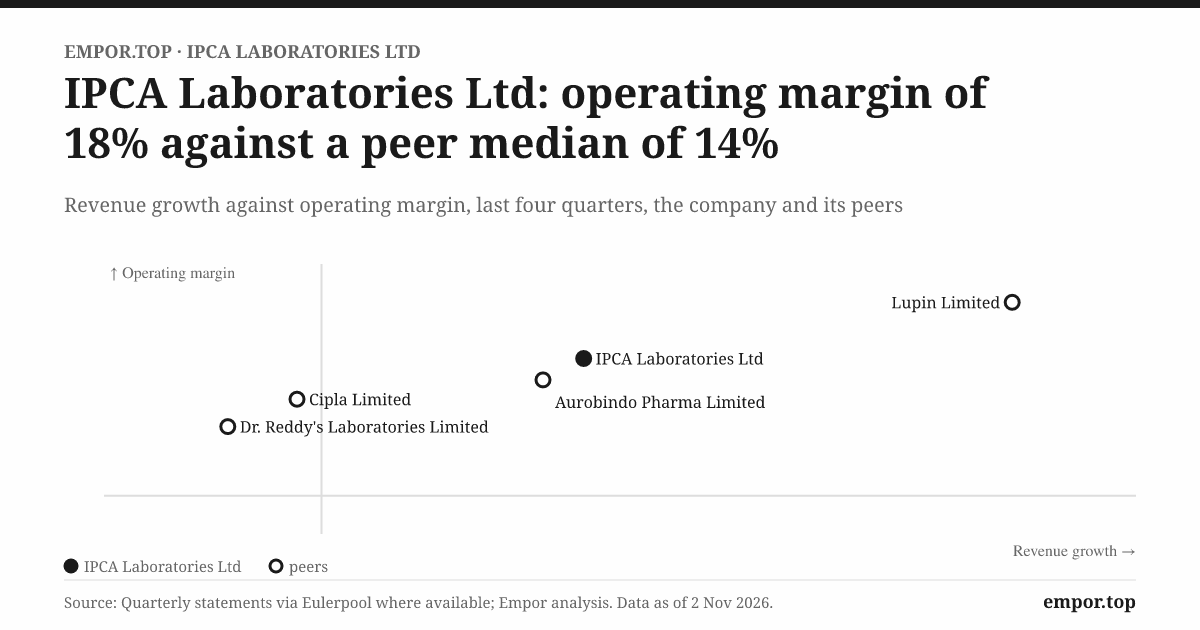
On the afternoon of June 1, 2026, A.K. Jain began the year-end call by reading out a set of numbers that, on the surface, looked like a clean recovery. Ipca's standalone EBITDA margin had risen to about 25.2% for FY2026, from about 22.7% a year earlier.4 The consolidated margin had improved too, to about 20.7% from about 19.9%, beating the company's own guidance of 20%.4
Then he added the caveat: Unichem's margin had fallen, and "otherwise EBITDA margins improvement for consolidated business would have been further higher."4
That sentence is the whole of Ipca's current economics in miniature. The parent is getting more profitable. The acquisition is pulling the group back.
Ipca's consolidated revenue grew about 8% in FY2026, to roughly ₹9,646 crore.4 Standalone revenue, the business Ipca owned before Unichem, was about ₹7,431 crore.5 Consolidated net profit attributable to shareholders was about ₹1,141 crore.5
Inside the parent, the engines moved at different speeds. Domestic formulations grew about 10%.4 Export formulations grew about 9% to around ₹2,083 crore, and within that, branded exports to emerging markets grew about 14% and generics excluding tenders grew about 17%.4 The API business grew about 10% to roughly ₹1,396 crore.4 Only the institutional business shrank, by about a quarter.4
Across the whole group, US sales from Ipca's and Unichem's American operations reached about ₹1,567 crore, up about 14%.4 That makes the US meaningful again, but it remains a market where, as management itself put it, margins "are always under pressure."6
Management attributed the standalone improvement chiefly to product mix. Domestic and rest-of-world branded businesses were doing well, the share of cardiac medicines had risen, and generics and APIs had also improved their margins.4 Over the first nine months of FY2026, standalone material costs fell from about 28.7% of sales to about 25.4%, an improvement of more than three percentage points.18
That is the mechanism to understand. When a company sells more of its high-margin branded medicines and fewer low-margin tender products, each rupee of revenue carries more profit, even if prices are unchanged. The decline in institutional sales, painful at the top line, helped the margin.
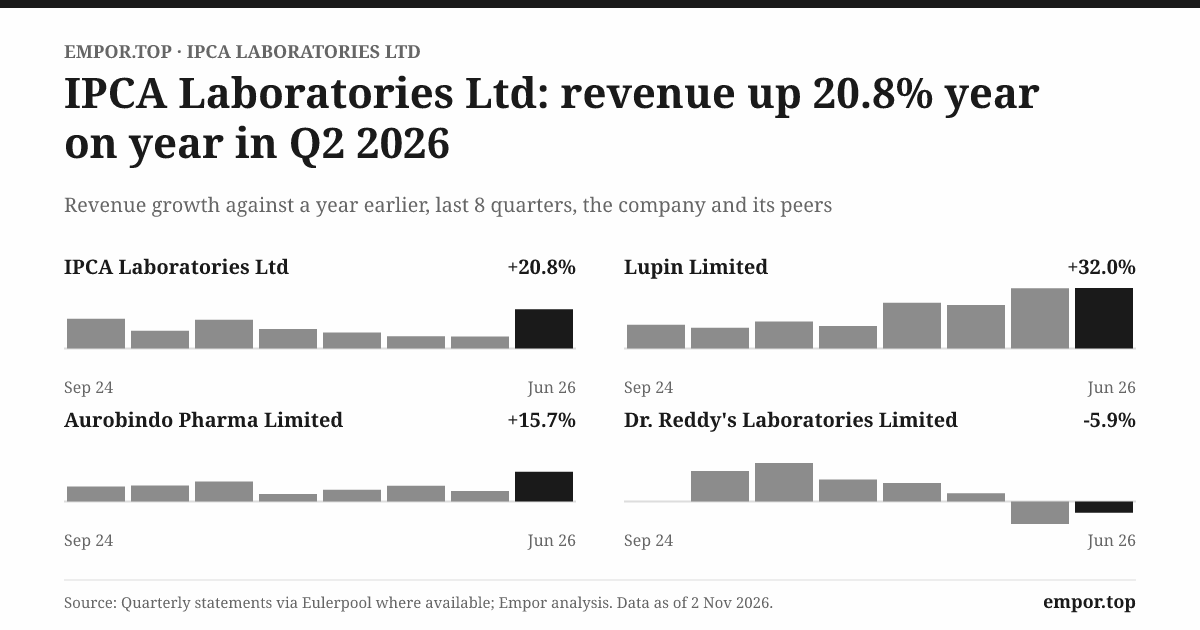
The June 2026 quarter pushed margins higher still. Consolidated revenue rose about 21% to roughly ₹2,788 crore, and the consolidated EBITDA margin reached about 22.9%, up from about 18.4% a year earlier.6 Net profit in the quarter rose about 72%.5
But part of that came from the rupee. Jain said about 5 percentage points of the quarter's 21% revenue growth came from currency depreciation, with the dollar up about 11% from a year earlier.6 He was candid that material costs had grown in line with sales, and that most of the margin gain came from spreading personnel and manufacturing costs over a bigger revenue base.6
A weak rupee flatters an exporter's results. It does not represent better products or stronger customer relationships. If the currency reverses, part of that margin goes with it.
The cash clue
Profits are opinions; cash is a fact. So follow the money.
Over the twelve years from FY2015 to FY2026, Ipca's cumulative operating cash flow was about ₹9,097 crore, against about ₹6,754 crore of net profit.5 That is about 135% of profit, which looks healthy, mainly because depreciation is a non-cash expense that gets added back.7
The latest year looks less comfortable. Consolidated operating cash flow fell to about ₹1,142 crore in FY2026 from about ₹1,321 crore a year earlier, even though profit rose.7 Operating cash flow covered only about 58% of EBITDA, down from about 78%.5
The reason sits in working capital. Ipca's debtor days, the time it takes to collect from customers, stood at 79 in FY2026, close to their peak of 80 in FY2024 and nearly double the 42 days of FY2015.5 Inventory was about 288 days of cost of goods, meaning the company holds roughly nine to ten months of stock.5
That is not automatically a sign of trouble. A company that makes its own APIs, sells in more than 100 countries and ships by sea will always hold more stock than a pure marketer. And the receivables look sound: of about ₹1,272 crore owed to the parent at March 2026, about ₹1,140 crore was not yet due, and only about ₹114 crore was overdue by less than six months.7 The provision for doubtful debts did rise, from about ₹1.6 crore to ₹6.6 crore, but that is small relative to the balance.7
Management also had an explanation for part of the build-up. Unichem had shifted from air freight to sea freight; about 40% of its shipments once moved by air, but by mid-2026 only 4% to 5% did, which cut costs but lengthened the time goods spent in transit.4 As for the parent, Jain said "there's hardly any money" that had gone into working capital over FY2025 and FY2026 combined.4
The consolidated cash flow tells a less tidy story than that claim. So the fair reading is that working capital is a burden on growth, not evidence of widespread bad debts. It is a tax that rises with every rupee of new sales, and it is the reason a company with a 20% EBITDA margin generated relatively modest free cash flow in FY2026.5
The cost wave
There is also a new pressure that did not exist a year ago. In June 2026, Jain said solvent prices were still 40% to 50% above January levels, packaging materials such as aluminium and PVC had risen sharply, and common APIs such as paracetamol and metformin had become much more expensive.4 If oil prices stayed where they were, he expected overall material costs to rise by about 10% to 12%.4
Freight was worse. Ipca's freight costs rose about 25% in the March 2026 quarter, and Jain linked the disruption to the conflict between Iran and the US and tensions around the Strait of Hormuz.4 By August, container rates to South America had roughly tripled, from about $3,000 to $9,000 or $10,000, and space was hard to find.6
Management's plan was to pass the costs through. Ipca said it would raise prices on non-controlled Indian products by about 6% to 7% instead of the usual 5%, pass API cost increases on to buyers in full, and renegotiate generic contracts where possible.4 It expected only about half to three-quarters of a percentage point of extra material-cost pressure.4
That is a testable claim. The low material-cost ratio does give Ipca room. But price-controlled products, longer generic contracts and a competitive Indian market all limit how fast prices can follow costs.
Not all of the group's moving parts are Unichem. Some of the consolidated margin gain in early 2026 came from Trophic Wellness, a domestic subsidiary selling nutraceuticals, which management said earned about ₹40 crore of profit on about ₹125 crore of revenue.184 At the other end, Onyx Scientific, a UK research-services subsidiary, faced weaker demand, and Ipca's UK generics marketing arm lost about £2 million to £3 million in a year of very poor pricing.4 The group is a collection of businesses with very different economics, and the consolidated margin is the average of all of them.
Treasury and currency effects add some noise to the picture. Other income was about ₹174 crore on consolidated profit before tax of about ₹1,573 crore in FY2026, meaningful but not the main source of earnings.7 And despite hedging, the parent booked a net foreign-exchange loss of about ₹44 crore, including about ₹64 crore of unrealized losses on forward contracts.7
Out of all of this, three measures carry most of the information. The first is the consolidated EBITDA margin, which stood at about 20.7% for FY2026 and about 22.9% in the latest quarter, and which tells you whether mix gains are outrunning cost pressure.46 The second is Unichem's EBITDA margin, whose recovery management expects this year.4 The third is debtor days, at 79 and well above where they were a decade ago.5
If the first rises, the second recovers and the third falls, Ipca's growth is turning into durable economics. If not, the earnings story remains fragile. Either way, the outcome depends on decisions made by a small group of people, most of them named Godha.
VIII. The Godha Family's Test of Capital and Credibility
On that April 2023 acquisition call, Ipca’s newly appointed chief executive had spoken in short, confident sentences. Pranay Godha, son of the executive chairman, had become managing director and CEO that month.79 He defended the Unichem deal in a single line, and promised that the team would "continue to work upwards" from the ₹300 crore EBITDA target.11
Since then, the voice of Ipca on its earnings calls has belonged mostly to someone else. On the February, June and August 2026 calls, the management representatives were A.K. Jain, the managing director and CFO, and Harish Kamath, the company secretary.1846 That is not unusual for an Indian mid-cap. But it does mean that the most detailed public accounting of the Unichem deal's progress has come from the finance chief rather than the executive who championed it.
The leadership is family-centered. Premchand Godha remains executive chairman. Pranay Godha is MD and CEO. His brother Prashant Godha is an executive director. Ajit Kumar Jain is MD and CFO.79 The annual report discloses the family relationships among the chairman and the two executive directors.7
Their pay in FY2026 was substantial. Premchand Godha received about ₹14.97 crore, Pranay Godha about ₹9.95 crore, Prashant Godha about ₹7.19 crore, and Ajit Jain about ₹10.60 crore.7 Part of the pay for the chairman, the CEO and the CFO is linked to performance, and the company says whole-time directors' pay is within statutory limits.7 The annual report does not describe a separate share-based incentive plan for executives.
The promoter group, led by the Godha family, owned 44.72% of Ipca at September 2026.2627 That is a large stake, and it aligns the family with minority shareholders: when the share price falls, the Godhas lose more than anyone. But it has also declined, from 46.30% in March 2024 to 44.72% by December 2024, and the company has not publicly explained the transaction behind that drop.27 Over the same period, domestic institutions raised their holdings from about 34% to about 37%, and foreign institutions from about 10.5% to about 11.5%.27 Ipca had about 90,500 shareholders in September 2026.27
The capital allocation record
The real test of a management team is what it does with the cash it does not pay out. Here the record has three layers.
The first layer is the Unichem deal, which has already been weighed: a large deployment whose promised returns have been pushed out in time.
The second layer is the smaller deals that came before it. Kotak's fund manager described them as uninspiring in 2023, and their later history has been mixed.11 Krebs Biochemicals, an associate, required an impairment, and an investor raised the risk of a similar outcome at Lyka Labs, another associate whose performance had been deteriorating.4 In August 2026, another investor noted that Lyka's revenue had not grown and its EBITDA had turned negative, and asked Ipca to publish clearer updates; Jain answered that the business was investing in new divisions and was "on the right path."6
The third layer is the current build-out. The FY2026 annual report describes a formulations plant at Dewas costing about ₹275 crore, a monoclonal antibody plant at Pithampur costing about ₹250 crore, and a US liquids facility of about $22 million.7 In August 2026, management said capex would run at about ₹700 crore to ₹800 crore in FY2027, with new API plants at Dewas and Wardha because Ratlam was running out of capacity.6 Those investments may prove wise. But they are promises until the plants are full.
An activist reading the annual report would linger on a few items. Related-party sales were modest at 3.57% of total sales, mostly to Ipca's own UK and US subsidiaries.7 But related parties accounted for about 92% of the company's total loans and advances, and Ipca had pledged ₹11 crore of term deposits to support an associate's working-capital facility.7 Management describes these dealings as ordinary-course and at arm's length.7 They are not large. They are the kind of exposures that deserve continued disclosure as the group expands.
The audit file contains similar small flags. Contingent liabilities, mainly claims and tax disputes, were about ₹122 crore at March 2026, up from about ₹112 crore.7 The statutory auditor gave a clean opinion, but noted that direct database audit-trail logs were kept for only three days and that logs before November 24, 2024 were unavailable.7 For a company whose worst crisis began with manipulated laboratory data, audit trails are not a technicality. Weak log retention is not evidence of wrongdoing. It is a control that investors would want to see strengthened.
The balance sheet is conservative. At March 2026, consolidated borrowings were about ₹704 crore against about ₹1,198 crore of cash, bank balances and liquid mutual funds, leaving net cash of about ₹389 crore even after lease liabilities.7 India Ratings affirmed its AA+/Stable rating in July 2026.28 In August 2026, Jain said Ipca had prepaid about $50 million of dollar loans before the rupee weakened and had no short-term borrowings.6 He planned to keep about ₹70 crore of cheap term debt to its due date rather than repay it early, because the money earned more sitting in mutual funds.6 It is the instinct of a finance chief who watches every basis point, and it explains why Ipca's treasury rarely surprises anyone.
That conservatism also raises the question of whether too much capital is sitting still. Over the twelve years to FY2026, Ipca generated about ₹4,354 crore of free cash flow.5 It paid out only about 16% of that as dividends, while its cash and short-term investments rose by about ₹1,124 crore.5 The payout ratio was just 5% of profit in FY2026.5
Retained capital is only a virtue if it earns more than shareholders could earn elsewhere. Return on equity was about 14% in FY2026, and return on capital employed about 16%, both well below the levels of the pandemic year.5 Those returns are respectable, but they include a large acquisition still running below its cost of capital.
What the price assumes
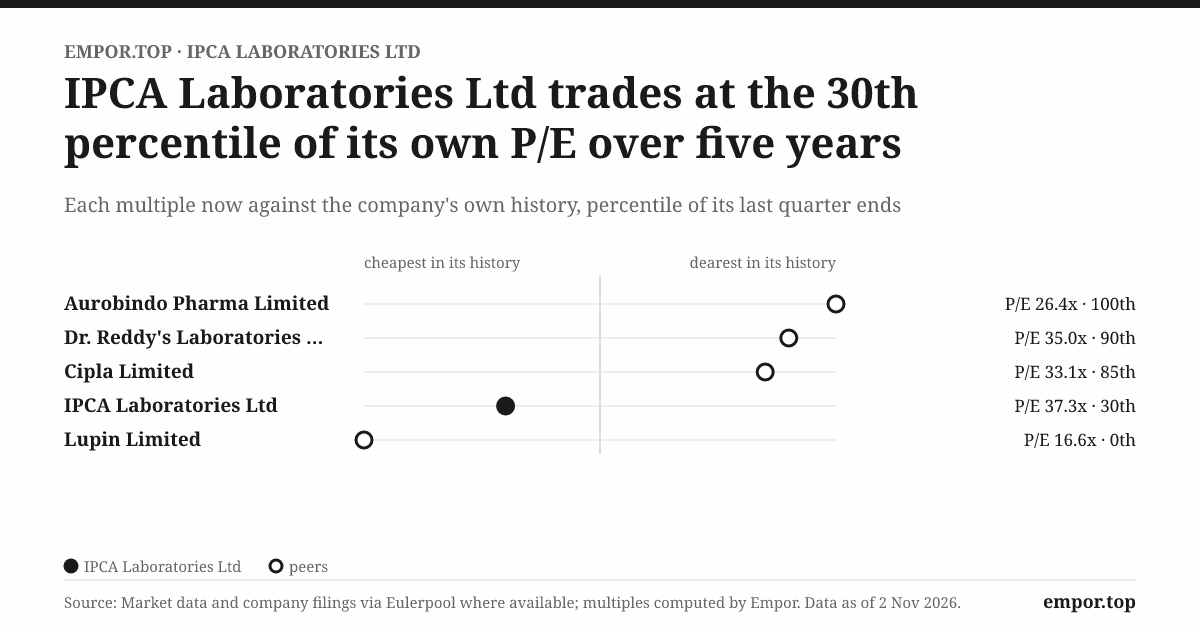
On November 2, 2026, Ipca traded at about 37 times earnings, below its own five-year median of about 41 times, and at about 21 times EV to EBITDA.5 Its earnings yield, the inverse of the P/E, was about 2.7%.5 In a September 2026 snapshot, its multiple sat close to Sun Pharma's, a little above Cipla and Dr. Reddy's, and well above Lupin's.29
That is not a bargain-bin price. A 2.7% earnings yield means investors are paying today for years of growth ahead. The market is extending Ipca the benefit of the doubt on its margin recovery and its Unichem turnaround.
The fair verdict is that family ownership aligns management with shareholders in important ways, and the balance sheet is strong. But concentration of executive roles, a mixed acquisition record and the slipped Unichem targets make board oversight and capital allocation especially consequential. The record supports a testable recovery case, not a blanket presumption of management quality.
The best evidence will come from behavior. Did Unichem's margins track the guidance? Did group growth meet the forecasts? Did new plants fill? And what did shareholders say when they voted at the AGM in August 2026, the outcome of which the company has published?[^30] Those are the questions that turn a family company's reputation into a measurable record.
IX. The Playbook: Build the Factory, Then Prove the Return
Ipca's strategy has repeated one move for half a century. It joins manufacturing capability to commercial reach. First it marketed brands in India, then it built an API plant to supply them, then it exported both. When it lost the US, it bought a company with US access. Each time, the factory came first and the returns were supposed to follow.
That pattern produces a handful of lessons that belong to this company and no other.
The first is that integration is an operating choice, not a moat by itself. Ratlam gave Ipca control of its supply and a material-cost ratio around 25%.4 It also became the single point of failure that kept Ipca out of America for most of a decade. For founders and investors, the wider point is that owning more of the chain raises both the rewards of good execution and the cost of a single lapse.
The second is that a product mix can move margins faster than a slogan. Ipca's standalone margin improved by about two and a half percentage points in FY2026, not because of a new strategy statement, but because cardiac medicines, branded exports and generics grew faster than low-margin tenders.4 When a company says its margins are rising, the first question is what it sold more of.
The third is pay for capability only when the earnings arrive. In 2023, Ipca paid a premium for Unichem's US filings, approved plants and spare capacity, and justified the price with a ₹300 crore EBITDA target.11 Three years later, the capability is real and the earnings are not. The time between buying an asset and filling it is where acquisition returns are won or lost.
The fourth is a strong cash history does not excuse slow working capital. Ipca's cumulative cash flow has exceeded its reported profit for twelve years, which is real evidence of earnings quality.5 Yet debtor days have nearly doubled since FY2015, and inventory remains at roughly nine to ten months.5 Every new rupee of sales now ties up more cash than it did a decade ago.
Where the edge really lies
Run the competitive forces once, and the shape of Ipca's position becomes clear.
Rivalry is intense. Ipca's 2.09% share of the Indian market places it 16th, competing against larger groups such as Sun Pharma, Cipla, Dr. Reddy's and Lupin in many of the same therapies.4 In US generics, management itself describes "cut-throat competition."11
Buyer power varies by channel. In India, it is weak because the buyer base is fragmented: no customer accounts for 10% of revenue.7 In US generics and institutional tenders, it is strong. Unichem lost business when rivals undercut it, and institutional buyers decide when shipments leave.186
Supplier power is moderate. Integration shields Ipca from many API suppliers, but not from solvents, packaging or freight, which spiked in 2026.4 The threat of substitutes is high for any single molecule, because generic competition is the basic design of the industry. New entry is limited by the cost of plants, regulatory approvals and a field force of 7,000 representatives, but those barriers keep out small players, not established rivals.6
Hamilton Helmer's seven powers framework sharpens the question. Ipca shows some evidence of process power, the hard-won manufacturing know-how in complex API chemistry, and some evidence of scale economies, visible in its low material-cost ratio. Its branded business has a modest form of brand power, built on doctor relationships and focused power brands. There is little evidence of switching costs, network effects, counter-positioning or a cornered resource. And the FDA episode showed that the process advantage can be lost.
So the verdict on the moat is narrower than a casual reader of Ipca's history might assume. Ipca has competitive advantages, not a fortress. They are real, they are partly cost-based, and they must be renewed through compliance and execution.
The bull and the bear
The bull case is straightforward. Ipca's branded businesses in India and emerging markets are growing at double-digit rates. Its API capabilities give it a cost advantage and supply security. Its US access is being rebuilt with its own molecules. And if Unichem's margins recover toward the 15% to 20% management now targets, the consolidated margin could rise toward the 25% to 26% that management described for two or three years out.186 Biosimilars, cheaper copies of complex biological drugs, could add a new engine later in the decade.6
The bear case is equally concrete. Unichem's margins could stay weak in a US generics market where contracts last months and rivals underbid. Input and freight costs could outrun price increases. Another adverse inspection could close a market again. The rupee could reverse. And working capital could keep absorbing the cash that growth produces.
The new options deserve a modest place in the story. Ipca says it has seven biosimilar candidates in development, with revenue expected around FY2029 or FY2030, and that it has consulted regulators in the UK, Europe and the US on its trial protocols.6 Those are milestones, not revenue. Ipca's own history shows how long the gap between a capability and a profit can be.
The playbook is clear. Build the factory, then prove the return. The next two years will show which half of that sentence Ipca is better at.
X. Epilogue: The Next Two Years Decide the Deal
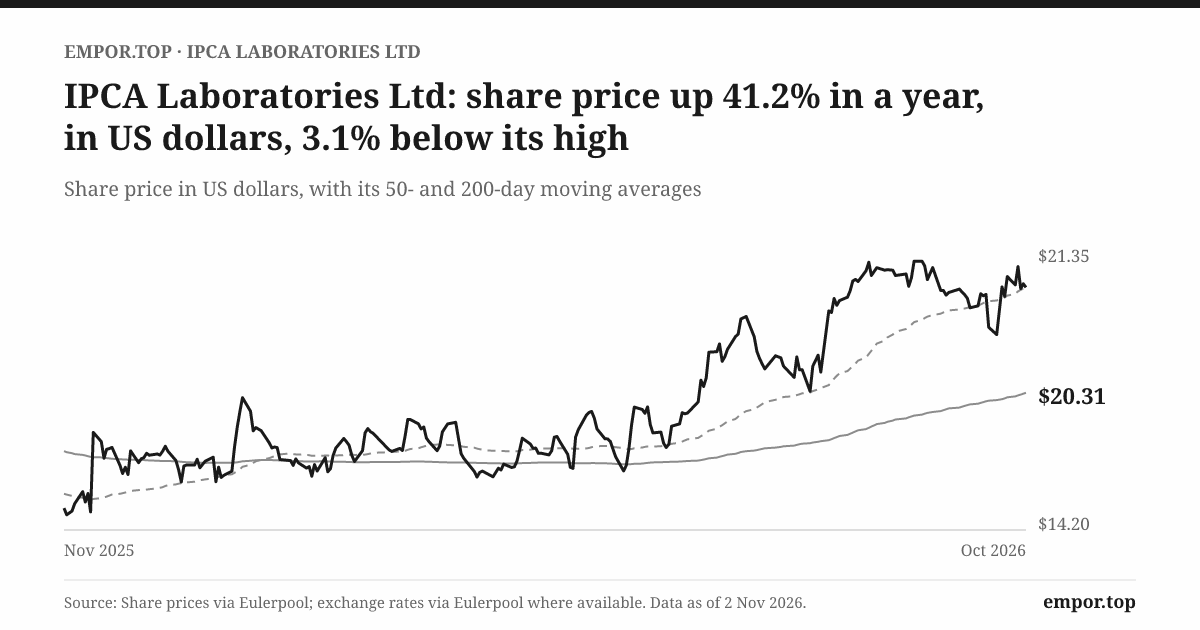
On the evening of November 2, 2026, Ipca's shares closed at about ₹1,928, just 4% below their 52-week high.5 Three days later, on November 5, management was scheduled to host its call on the September-quarter results.30 For a company in the middle of a turnaround, every results day is now a referendum.
Management enters it on a high. In June, it had forecast FY2027 consolidated growth of 12% to 13% and an EBITDA margin rising from 20.7% toward about 22% to 22.3%.4 By August, after a strong first quarter, it raised the growth forecast to 14% to 16% and the margin forecast to about 23%.6 On Unichem, it held the line at a 12% to 13% margin and declined to raise it.6
That combination tells you where confidence lies. Management is raising its forecasts for the business it built. It is holding back on the business it bought.
It also offered a longer horizon. Asked in August where margins could settle once Unichem's synergies played out, Jain said Ipca's own margin, about 26%, could approach 30%.6 The consolidated target repeats the ambition management set in 2020, which evaporated within three years. Ambitious long-range margin talk is not new at Ipca. What would be new is delivering it.
The next moments that will decide the story are easy to name. The first is Unichem's margin, quarter by quarter. A recovery to the low teens in FY2027 would be the first sign that the acquisition thesis is turning into earnings. A margin stuck near 8% would mean that the 2023 promise has been deferred again, and that Unichem is becoming a recurring drag rather than a temporary one.
The second is the consolidated margin under cost pressure. Management has argued that price increases and product mix will offset higher solvent, packaging and freight costs.4 If margins hold or rise while the rupee stabilizes, that claim will look strong. If they fall once the currency tailwind fades, investors will learn how much of the 2026 improvement came from the exchange rate.
The third is working capital. If debtor days fall from 79 while sales grow at double digits, the cash-quality case strengthens. If they climb back toward 80 or above, the growth tax deepens.5
The fourth is the plants. The US formulation facility at Pisgah, North Carolina, is expected to be ready for commissioning around the fourth quarter of FY2027, with meaningful revenue only in the following year.4 The Dewas and Pithampur investments, and the new API plants, have to move from construction to commercial production.76 Approvals and ribbon-cuttings are milestones. Utilization and sales are proof.
And the valuation sits on top of all of it. At about 37 times earnings, the stock still assumes meaningful execution.5 If Ipca delivers its raised guidance and Unichem recovers, the multiple may look reasonable in hindsight. If it does not, the gap between price and performance will show up quickly.
The evidence has narrowed the central bet. Ipca's core business is growing, and its margins improved in FY2026. The questions that remain open are the ones that cost the most money: whether Unichem becomes an earnings engine or a recurring drag, and whether growth converts into cash. The tension is not whether Ipca can make medicines. It is whether it can make the returns.
XI. Outro: Back to the Molecule in the Briefing Room
In the spring of 2020, one molecule put Ipca in front of the world. A president praised it, a prime minister lifted an export ban for it, and a regulator that had kept Ipca's plants out of America for years opened the door a crack to let it in.12 Then the emergency stance receded, the demand faded, and the molecule went back to treating lupus and rheumatoid arthritis.
What remained was the longer story of the company behind the headline: its manufacturing base and its American bet.710
Ipca's story is not that a headline drug made it successful. It is that decades of manufacturing and marketing built a platform whose next test is whether its newest acquisition and its new plants can earn their keep. Somewhere in Ratlam tonight, a reactor is running and a line of tablets is moving toward a packing machine. The next chapter depends on what Ipca can make, sell, collect payment for, and earn from.
References
-
India lifts drug export ban after Trump's 'retaliation' threat — Al Jazeera, 2020-04-07 ↩↩↩↩↩↩↩
-
Ipca Labs surges as USFDA partially lifts import ban for chloroquine supply — Business Standard, 2020-03-23 ↩↩↩↩
-
Q1 FY2021 Earnings Call Transcript — Ipca Laboratories, 2020-08-11 ↩↩↩↩↩↩↩↩↩↩↩↩
-
Q4 FY2026 Earnings Call Transcript — Ipca Laboratories, 2026-06-01 ↩↩↩↩↩↩↩↩↩↩↩↩↩↩↩↩↩↩↩↩↩↩↩↩↩↩↩↩↩↩↩↩↩↩↩↩↩↩↩↩↩↩↩↩↩
-
Financial Results — Ipca Laboratories ↩↩↩↩↩↩↩↩↩↩↩↩↩↩↩↩↩↩↩↩↩↩↩↩↩↩↩↩
-
Q1 FY2027 Earnings Call Transcript — Ipca Laboratories, 2026-08-14 ↩↩↩↩↩↩↩↩↩↩↩↩↩↩↩↩↩↩↩↩↩↩↩↩↩↩↩↩↩↩↩↩↩↩↩↩
-
Annual Report 2025–26 — Ipca Laboratories, filed 2026-07-14 ↩↩↩↩↩↩↩↩↩↩↩↩↩↩↩↩↩↩↩↩↩↩↩↩↩↩↩
-
2023 Acquisition Announcement — Ipca Laboratories, 2023-04-24 ↩↩↩↩↩↩↩↩↩
-
Meet Amitabh Bachchan's former CA, who built a ₹28,000 crore pharma giant — Business Today, 2026-07-19 ↩↩↩↩↩↩↩↩↩
-
Transcript of Q&A on the Unichem Acquisition — Ipca Laboratories, 2023-04-25 ↩↩↩↩↩↩↩↩↩↩↩↩↩↩↩↩↩↩↩↩↩↩↩↩↩↩
-
IPCA Labs slumps after suspending shipments from MP facility — Business Standard, 2014-07-24 ↩↩↩
-
IPCA Lab tanks on USFDA import alert; m-cap down by Rs 1,205 cr — Business Standard, 2015-03-25 ↩↩
-
USFDA has removed partial lifting of import alert on APIs manufacturing facility at Ratlam: Ipca Laboratories — Business Today, 2020-06-24 ↩↩
-
FDA warns Indian drugmaker over major data integrity violations — Regulatory Affairs Professionals Society, 2016 ↩↩
-
USFDA issues warning letter to Ipca Labs for 3 plants — Business Today, 2016-02-01 ↩↩
-
Ipca Labs surges 7%, hits 52-week high on favourable report from USFDA — Business Standard, 2023-10-23 ↩
-
Q3 FY2026 Earnings Call Transcript — Ipca Laboratories, 2026-02-16 ↩↩↩↩↩↩↩↩↩↩↩↩↩↩↩↩↩↩↩↩
-
Q2 FY2021 Earnings Call Transcript — Ipca Laboratories, 2020-11-09 ↩↩↩
-
SEBI Takeover Filing: Unichem Laboratories Limited — Securities and Exchange Board of India, 2023-04 ↩
-
IPCA Labs shares: Unichem acquisition expensive, earnings dilutive in near term, says Motilal Oswal Securities — Business Today, 2023-04-25 ↩↩↩↩↩
-
"Why Ipca Laboratories' stock slipped 10% after Unichem acquisition" — Mint, 2023-04-26 ↩↩↩↩
-
Ipca Labs dips 9%, hits 52-wk low on plan to buy 33.4% stake in Unichem Lab — Business Standard, 2023-04-25 ↩
-
"IPCA Labs stock hits valuation hurdle on Unichem stake acquisition" — Business Standard, 2023-04-25 ↩
-
Ipca Laboratories Acquires Additional 19.29% Stake In Unichem Laboratories — Free Press Journal, 2023-09-21 ↩↩
-
Shareholding Pattern Filings — National Stock Exchange of India ↩
-
Pharma P/E and Five-Year Averages — stockKYC, data as of 2026-09-30 ↩
-
Q2 FY2027 Conference Call Intimation — Ipca Laboratories, 2026-10-28 ↩
 LinkedIn
 WhatsApp
 Reddit
 Hacker News
 Email
 Kindle
 RSS Feed
 Spotify
 Apple Podcasts
 Amazon Music
 Audible
 YouTube