Indian Overseas Bank: The Overseas Bank That Had to Come Home
I. Three Branches, Three Questions
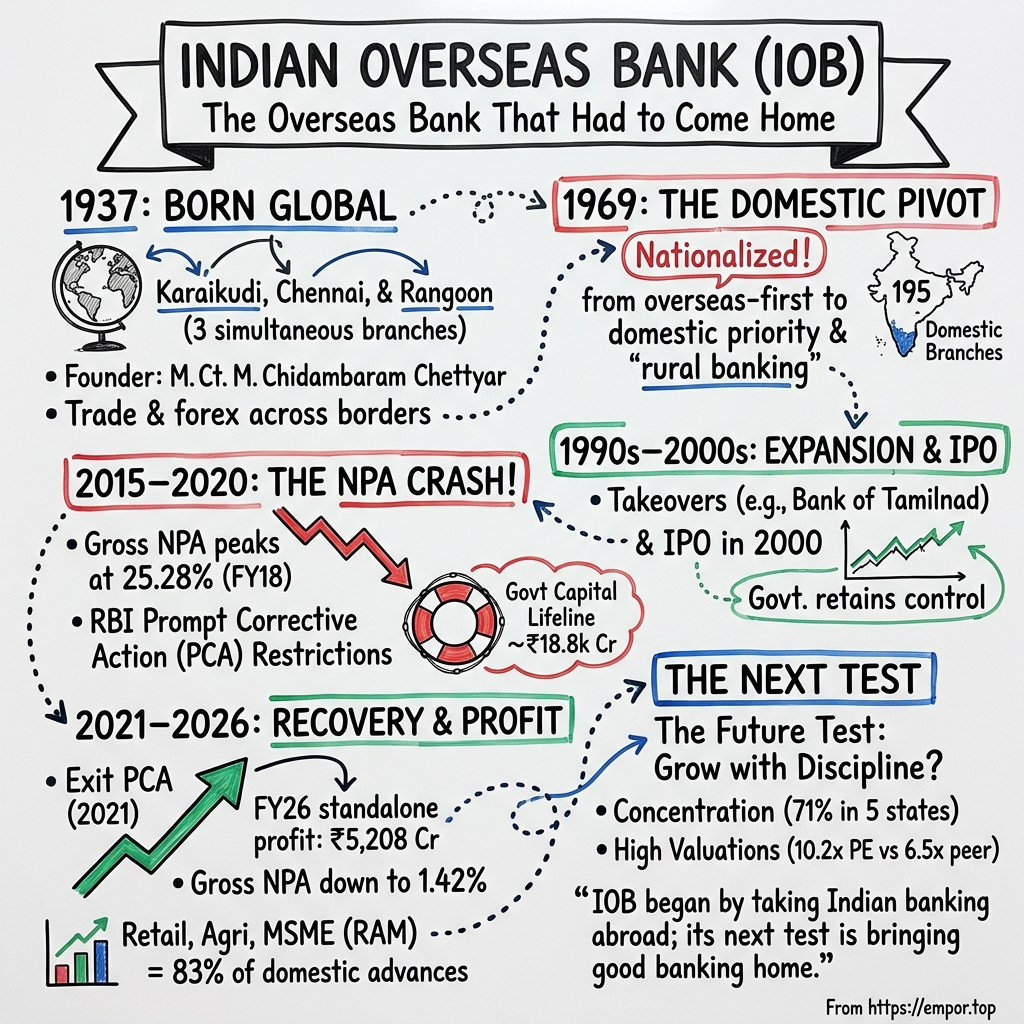
On 10 February 1937, a new Indian bank opened its doors three times on the same day.1 One branch was in Karaikudi, a dusty commercial town in the Chettinad country of the old Madras Presidency. One was in Madras itself, the city now called Chennai. The third was across the Bay of Bengal, in Rangoon, the capital of British Burma.
Most banks begin in one town and earn the right to a second. Indian Overseas Bank began in two countries at once, and its name was a statement of purpose. It was built to follow Indian merchants wherever they traded, and to handle the foreign exchange that their trade required.1
That founding image is worth holding on to, because almost nothing about the modern bank resembles it. Today Indian Overseas Bank, known on the National Stock Exchange by its ticker IOB, is a domestic public-sector lender with branches spread across India's villages, towns and metros. Its overseas presence has shrunk to four countries.1 Its story is now written mostly in rupees, in Indian loan books, and in decisions taken in New Delhi.
The scale is large. At the end of March 2026, IOB held about ₹3.68 lakh crore of deposits and had lent about ₹3.10 lakh crore.2 For every ₹100 that savers and companies left with the bank, it had put roughly ₹84 to work as loans. In the year to March 2026 it earned a standalone profit of ₹5,208 crore.2
It also has an owner whose presence shapes everything. After an offer for sale in December 2025, the Government of India still held 92.44% of the bank.3 Only about seven and a half shares in every hundred trade freely. That makes IOB a listed company in form and a state institution in substance, and it means the market's opinion matters less to the bank's survival than the government's.
The reason that ownership matters is not abstract. Less than a decade ago, IOB was one of the most damaged banks in India. In the year to March 2018, roughly one rupee of every four it had lent was classified as non-performing.4 It lost money for years; it operated under the Reserve Bank of India's tightest supervisory restrictions, and it survived because the government kept writing cheques.56
So the story turns on three questions. The first is what survived when the overseas-first model gave way to a domestic mandate. The second is what caused the collapse in asset quality, and whether the cure was as complete as the headline ratios suggest. The third, and the one that matters most for anyone thinking about the bank today, is whether rapid growth can continue without manufacturing a new generation of bad loans.
There is a reason to ask that third question now. In June 2026, CRISIL upgraded IOB's fixed-deposit rating to its highest grade, citing government support, cleaner asset quality and better profitability.7 The stock market has gone further: it values IOB at a clear premium to most of its public-sector peers.8 Both verdicts reward a repair. Neither can yet reward a full credit cycle survived, because the bank has not lived through one since the repair began.
That sets the test for the end of this story. A bank backed by its sovereign rarely fails in the way a private lender can. But survival is not the same as a good business. For IOB to deserve the confidence now being extended to it, its growth must earn its way through the spread between what it pays depositors and what it charges borrowers, through fees, and through credit losses that stay low, rather than through another rescue when the cycle turns.
To see why that test is hard, it helps to go back to Rangoon, and to the merchants the bank was built to serve.
 Subscribe on LinkedIn
II. The Bank That Started Abroad
Picture the Chettiar trader in Burma in the 1930s. He belonged to the Nattukottai Chettiar community of Chettinad, a caste of bankers and moneylenders whose firms had followed the British Empire across Southeast Asia. Their capital financed rice cultivation in the Irrawaddy delta, rubber estates in Malaya and trade in Ceylon. Their working families moved between Karaikudi and Rangoon the way a modern executive moves between offices.
What that network lacked was a bank of its own. Money earned in Burma had to come home to Chettinad. Goods shipped between ports had to be paid for in different currencies. Every remittance and every trade bill passed through the hands of British exchange banks, which set the terms. A bank owned by Indians, run for Indians and present in the ports where they traded would capture that business directly.
That was the bet of M. Ct. M. Chidambaram Chettyar, the bank's founder and himself a member of that merchant community.1 The business he designed was specific. IOB was meant to specialise in foreign exchange and overseas banking, and its customers were Indian traders abroad who needed to move money across borders.1 It was not a slogan about global ambition. It was an answer to a customer problem that the founder could see from his own community's ledgers.
The opening day explains the logic. Karaikudi was where the merchant families lived and kept their wealth. Madras was the commercial hub of the presidency and the gateway to the rest of India. Rangoon was where much of the money was being made. Opening all three at once let the bank stand at both ends of the remittance from its first morning.1
The network then grew along the routes of Indian trade. Penang followed in the founding year, Kuala Lumpur in 1938, Singapore in 1941, Colombo in 1945 and Hong Kong in 1955.9 The Singapore branch opened in the year war reached Southeast Asia. Each one sat in a city where Indian merchants already did business, which meant each branch could start with customers rather than search for them. In modern terms it was a distribution strategy that rode an existing community network, a cheap way to acquire deposits and trade business in cities a new bank would otherwise struggle to enter.
The weakness of that design was built into its strength. A bank that follows a diaspora depends on the host country's tolerance of that diaspora. Within a few years of the founding, the Second World War brought Japanese occupation to Burma, Malaya, Singapore and Hong Kong, and the network that connected those ports was cut apart. After the war, newly independent governments across the region began to write their own rules for foreign banks and foreign capital. The cities that had made IOB distinctive were also the places where it had the least control.
By the time India became independent in 1947, the bank had built 38 branches at home and seven overseas.1 Its deposits stood at about ₹6.6 crore and its advances at about ₹3.2 crore.1 Those figures look tiny now, but the relationship between them is revealing. The bank lent less than half of what it held. That is the profile of a cautious trade-and-exchange bank, one that kept much of its money liquid because remittance and trade customers can ask for their funds quickly.
Notice also where the branches were. Even at independence, the domestic network was more than five times the size of the overseas one. The name said overseas. The map was already tilting toward India, as a growing country with a new government began to look for banks to finance its own development.
How much of an advantage did the founding design really create? It created a real early franchise: a customer base, a specialism in foreign exchange and a recognisable identity among Indian traders abroad. What it did not create was a moat that would survive changes the bank could not control. An edge that depends on a community's position in foreign ports lasts only as long as those ports welcome the community, and over the following decades they increasingly did not.
That is the first lesson of IOB's history, and it is about the limits of being first. The founder saw an underserved customer and built for him. He could not freeze the map on which that customer lived. And soon a much larger force would redraw the bank's map from home.
III. Nationalization Changed the Map
In July 1969, the Government of India nationalised fourteen of the country's largest commercial banks in a single stroke. Indian Overseas Bank was one of them.1 Overnight, a bank conceived by a merchant community to finance its own trade became an instrument of national economic policy.
The bank the state took over was already a substantial domestic institution. On the eve of nationalisation, IOB had 195 branches in India, deposits of ₹67.70 crore and advances of ₹44.90 crore.1 In the twenty-two years since independence, its deposits had grown about tenfold. And it was lending far more of them: about two-thirds of deposits were now out as loans, compared with less than half in 1947. The cautious exchange bank had become a working domestic lender.
Nationalisation was not mainly about ownership for its own sake. The government's argument was that private banks lent to large industrial houses and urban traders while farmers, small businesses and rural India went without credit. The new mandate was to change that. Banks were pushed to open branches in villages and small towns, and to direct a defined share of lending to so-called priority sectors such as agriculture and small industry.
For IOB, this was a change in the market it was built to serve. Its founding customer was a merchant moving money between ports. Its new customer was, increasingly, a farmer in Tamil Nadu or a small manufacturer in a district town. The skills that had made the bank distinctive, foreign exchange and trade finance, still mattered, but they were no longer the centre of what the state wanted from it.
The overseas story did not disappear overnight. It adapted, often under pressure from foreign governments that wanted their banking systems locally owned or locally incorporated. In Malaysia, in 1973, IOB joined Indian Bank and United Commercial Bank to create United Asian Bank, pooling their Malaysian operations into a single locally incorporated institution.9 In Thailand, the bank used a separate entity, Bharat Overseas Bank, as the vehicle that preserved its presence in Bangkok.1
Both moves reveal the same tension. An Indian state-owned bank operating abroad had to play by two rulebooks. At home, it answered to New Delhi's priorities. Abroad, it answered to host governments that could demand partnerships, local capital or a smaller footprint. Each structure kept a flag flying, but each also meant sharing control, and in some markets the honest description of the change is retreat.
Meanwhile, the domestic network grew in the way the new mandate intended. Branch expansion into rural and semi-urban India became the main engine of the bank's deposit base. That legacy is still visible today: more than half of IOB's current branches sit outside the big cities, in rural and semi-urban locations.10 The modern bank's distribution footprint was largely built in this era, by policy as much as by commercial choice.
There was a quieter consequence, and it would take decades to show itself. When the state directs where credit goes, credit decisions start to carry two objectives at once. One is the bank's own: lend to borrowers who will repay. The other is the nation's: lend to the sectors and regions the government wants to develop. Usually the two objectives can live together. In a downturn, or when political priorities press hard, the second objective can crowd out the first.
So nationalisation did two things to IOB. It scaled the bank's public role and domestic reach far beyond anything the founder could have built from Karaikudi. And it loosened the connection between the bank's founding identity and its day-to-day strategy. The name still said overseas. The business was increasingly a branch network carrying the state's development priorities.
A larger bank with a public mandate would next grow the way many Indian public-sector banks grew in the following decades: by absorbing other banks.
IV. Growth Through Takeovers, Then a Public Listing
In 1990, IOB took over the Bank of Tamilnad, and with it 99 branches.1 It was not the bank's first acquisition. During the 1960s, before nationalisation, IOB had already absorbed six smaller banks.1 By the end of the 1980s, consolidation of weak smaller lenders into stronger ones had become a familiar feature of Indian banking.
These deals belong to a particular era and a particular logic. Small private banks in India often struggled with thin capital and concentrated loan books. When one ran into trouble, the system's preferred answer was frequently to fold it into a larger, sounder institution rather than let depositors suffer. For the acquirer, the prize was a ready-made branch network and a block of deposits in places it might otherwise have taken years to reach.
For IOB, the Bank of Tamilnad deal deepened a home-state footprint that still defines it. Tamil Nadu remains the first name on the list of states where the bank concentrates its lending today.7 Ninety-nine branches in a single transaction is the kind of jump that organic expansion rarely delivers, and it reinforced IOB's identity as a Chennai-headquartered bank with deep roots in the South.
What is harder to say is whether these deals were good or bad buys. IOB records the acquisitions and the branches gained, but does not publish the consideration paid, the assets and liabilities taken over, or the earnings of the acquired banks.1 Without those figures, there is no way to test the price against peers or to say whether IOB bought value or simply bought problems. The honest description is that the takeovers extended the network and the franchise. Whether they created shareholder value is unknowable from what the bank discloses.
It is also worth being clear about what the acquisition record does not show. There is no evidence of a modern, deal-led growth thesis at IOB. The large acquisitions belong to the era of rescue mergers and branch expansion. The bank's recent growth has come from lending more through the network it already owns, not from buying other lenders.
One later transaction closed a loop with the bank's overseas past. In 2007, IOB took over Bharat Overseas Bank, the once-separate entity that had carried its Bangkok presence.1 A vehicle created to work around foreign rules was folded back into the parent. The structure that had been necessary in an earlier era of overseas banking had become unnecessary, and the overseas business was simplified into the listed bank.
By then, the bank was listed. In 2000, IOB came to the stock market, opening its shares to public investors for the first time since nationalisation, and it returned with a follow-on public offer in 2003.911 The Government of India kept control, as it did across the public-sector banks that listed in that period. Public shareholders got a seat at the table, a share price that would comment daily on the bank's performance and a claim on its profits. They did not get control.
The interesting question about the listing is whether it brought market discipline to a state-run bank. In principle, it should have. A listed bank publishes quarterly results, faces analysts and pays a visible price in its share price when it makes mistakes. A bank that needs to raise equity from investors has to persuade them that their money will earn a return.
In practice, the discipline was limited by the ownership structure. As late as March 2017, the government still owned about 80% of IOB.12 Public investors held roughly a fifth of the bank. That was enough to make the share price meaningful, but not enough to change the board, block a strategy or force management to slow down when lending grew too quickly. The market could vote with its feet. It could not veto.
And when the real test came, the ownership numbers moved in the opposite direction from the one the listing had promised. Over the following three years, the government's stake rose to about 96%.12 That rise was not a vote of confidence. It was the arithmetic of a rescue, and it is the story of how a bank with nearly a century of history, a nationwide branch network and a public listing ended up needing repeated capital from its owner simply to keep operating.
V. The Losses Behind the Recovery
In July 2020, CRISIL published a rating rationale on Indian Overseas Bank that read like a casualty report. The bank had lost ₹8,257 crore in the year to March 2020, after losing ₹3,738 crore the year before.5 Those were not one bad quarter. They were the latest chapters in a run of losses that had already consumed much of the bank's capital and forced its owner to step in again and again.
To understand how a bank with a large branch network and a sovereign shareholder got there, start with a simple definition. A loan becomes a non-performing asset, or NPA, when the borrower stops paying interest or principal for ninety days. At that point the bank must stop counting the unpaid interest as income and must start setting aside money, called provisions, against the possibility that the loan will never be repaid.
Now picture a bucket. Capital is the water in the bucket: the shareholders' money that absorbs losses before depositors are touched. Every bad loan is a hole. Every provision drains water out. Profits from good loans pour water back in. A healthy bank pours in more than it drains. IOB, in the second half of the 2010s, was draining far faster than it could refill.
The scale of the holes is the most striking number in the bank's modern history. In the year to March 2018, IOB's gross NPA ratio reached about 25%.4 In plain terms, about a quarter of everything the bank had lent was not being serviced. A year later, the ratio was still about 22%.4 For context, a well-run bank in a normal economy might expect two or three rupees in every hundred to go bad, not twenty-five.
The mechanism was the classic one. Loans written in an earlier period of rapid credit growth went sour as borrowers ran into trouble, and a regulator-driven clean-up of how Indian banks recognised bad loans forced the damage onto the books. Large slippages, the industry's word for good loans turning bad, produced heavy provisions. Heavy provisions produced losses. Losses eroded capital. And thin capital constrained the one activity that could have helped the bank earn its way out: lending to new, healthy borrowers.
The shrinkage is visible in the bank's income. Interest income, the closest thing a bank has to revenue, fell from about ₹23,900 crore in the year to March 2015 to about ₹16,700 crore by the year to March 2022.12 Over seven years, while India's economy grew, IOB's core earnings base contracted by almost a third. The bank was not just losing money. It was getting smaller.
The regulator's response compounded the squeeze, by design. IOB spent years under the Reserve Bank of India's Prompt Corrective Action framework, known as PCA.6 PCA is the supervisory equivalent of intensive care. A bank under it faces restrictions on growth, on riskier lending, on expansion and on paying dividends, so that it cannot gamble its way out of trouble with depositors' money. The restrictions protect the system. They also guarantee that a bank in the framework stays small while it heals.
The rescue was the government's to make, and it made it. Across the three years to March 2020, the Government of India infused about ₹18,874 crore into IOB, including about ₹8,217 crore in the final year alone.5 That capital is the reason the government's stake climbed from roughly four-fifths of the bank to more than nineteen-twentieths. Each infusion was priced at the market value of a distressed bank, so each one diluted the public shareholders who had bought in after the listing.
Then the ratios began to fall, and here the story requires care. By March 2020, gross NPA was down to about 15%.5 On its face, that is a dramatic improvement from a quarter of the book two years earlier. But CRISIL was explicit about one reason for the decline. During that year, IOB wrote off about ₹16,407 crore of loans.5
A write-off is not a recovery. When a bank writes off a loan that it has already fully provided for, it removes the loan from its balance sheet. The NPA ratio falls because the bad loan is no longer counted in either the numerator or the book. The bank keeps pursuing the borrower, and later recoveries from written-off accounts can come back as income. But on the day of the write-off, no cash comes in. The hole in the bucket is not patched. It is simply no longer counted as part of the bucket.
That distinction matters for anyone reading the recovery story. The improvement in IOB's headline asset quality in those years was real in one sense: the bank had recognised its losses and provided for them, which is the necessary first step. But the speed of the decline overstated the speed of the cure. Some of the improvement came from resolution and recovery. Some came from accounting removal of loans that were already lost. The losses that made the removal possible were paid for with provisions, which kept the bank deep in the red and its capital weak.
The exit from intensive care came in September 2021. The RBI released IOB from PCA after its results showed that it met the framework's parameters, and the bank gave a written commitment to continue complying with minimum capital, net NPA and leverage norms on an ongoing basis.6 The RBI said the bank would remain under continuous monitoring.6 It was a release on conditions, not a clean bill of health.
Even after the exit, the government's role did not end. In the year to March 2022, it added another ₹4,100 crore through a preferential allotment of shares.13 By then the government owned about 96% of the bank, a level it would hold for three years.12 The public float, never large, had shrunk to less than four shares in every hundred.
So the bank that walked out of PCA was cleaner, smaller and almost entirely state-owned. The obvious question is what had actually changed. New capital can refill the bucket. RBI controls can stop new holes from being drilled while the bucket refills. Neither, by itself, changes how a bank decides whom to lend to. Did the years of losses, capital and supervision produce a better lending business, or did they simply buy time until the next upswing in credit? The next five years provided the first real evidence.
VI. From PCA Exit to Profitable Growth
On 29 April 2026, IOB published its audited results for the year to March 2026, and the headline would have been unthinkable in 2018. Standalone profit was ₹5,208 crore, up from ₹3,335 crore a year earlier.2 A bank that had lost more than ₹8,000 crore in a single year six years before was now earning more than ₹5,000 crore, and growing that profit by more than half in twelve months.
The asset-quality numbers told the same story more quietly. Gross NPA, about 3.1% of loans in March 2024, fell to 1.4% in March 2026.72 Net NPA, which subtracts the provisions already set aside, was 0.21%.2 In the bucket analogy, the holes that remain are small, and almost all of them have already been paid for.
The sequence of the repair is worth tracing because it shows cause and effect. Once the large legacy losses had been recognised and provided for, the provisions charged against each year's earnings could fall. Lower provisions let more of the bank's operating income reach the bottom line. Higher profits added to capital. More capital allowed more lending. By March 2026, IOB's total capital adequacy ratio was 19.8%, with common equity tier 1, the highest-quality capital, at 16.9%.2 Those are ratios comfortably above regulatory minimums, and a long way from the bank that once needed the government simply to stay solvent.
CRISIL put a single figure on the cost of credit: in the year to March 2026, IOB's credit cost was about 0.9% of loans.7 That is the annual price the bank paid for bad debts, and it is low by the standards of the bank's own past. It is the most important single reason that profits rose.
The flow of bad loans tells the same story from another angle. At the bank's analyst meet in Mumbai on 8 May 2026, Srivastava said fresh slippages for the year were about ₹1,200 crore, against recoveries of about ₹3,700 crore.10 For three years, he said, the bank had pulled more money out of old bad loans than new ones had added.10
Loans showing early signs of stress, which Indian banks call special mention accounts, fell from about 6.7% of credit to about 4.9% over the year.10 And the bank had already set aside about ₹1,750 crore toward the RBI's new expected-credit-loss rules, against an estimated total impact of about ₹3,000 crore that management said it intends to provide for in full by April 2027 rather than spread over five years.10
One caveat sits inside the provision numbers. Management's headline provision coverage of 97.5% counts loans already written off; excluding those, coverage was about 85%.10 Both figures are strong. But the gap is a reminder of how much of the clean-up was done by removing loans from the book.
Still, the year also contained the number that makes the next chapter uncertain. Advances grew about 24%, while deposits grew about 18%.2 Loans were growing about a third faster than the deposits that fund them. And the pace was not the plan. Srivastava told analysts that the bank had budgeted growth of 13% to 15% on both sides of the balance sheet, and then grew credit by 24% and deposits by 18%.10
He said the same momentum would continue.10 A bank growing its loan book at roughly a quarter a year, far above its own plan, is not a bank that is still healing. It is a bank that is pushing hard, and fast loan growth tends to flatter asset-quality ratios in the short run, because new loans have not yet had time to go bad.
That is not a hypothetical worry. Even during the recovery, a single large borrower showed how quickly the book could bite. In the year to March 2025, one large account defaulted and generated about ₹2,332 crore of slippages.14 The bank provided for it fully, and CRISIL noted that it materially contributed to that year's slippages.14 A large, lumpy corporate default in the middle of a clean-up is the kind of event that reminds investors the old risks never fully leave a public-sector loan book.
What the earnings are made of
To judge how much of the rebound is repeatable, the profit has to be taken apart. A bank's pre-tax profit is built from four pieces. First comes net interest income, the spread between interest earned and interest paid. Then other income is added: fees, commissions, treasury gains and recoveries from loans already written off. Operating expenses are subtracted. Finally, provisions for bad loans are subtracted.
IOB's other income is large. In the year to March 2026, it was ₹5,636 crore, against pre-tax profit of ₹6,268 crore.2 In the year before, other income was ₹5,545 crore against pre-tax profit of ₹4,512 crore.2 In other words, in the year to March 2025, other income was larger than the bank's entire pre-tax profit.
The arithmetic says something useful. If other income was larger than pre-tax profit, then net interest income minus operating costs minus provisions must have been negative that year, by roughly ₹1,000 crore. By the year to March 2026, the same combination had turned positive, by roughly ₹600 crore. Other income barely changed between the two years. Of the roughly ₹1,750 crore jump in pre-tax profit, about ₹1,650 crore came from the core engine: wider spread income, operating leverage and lower provisions.
The pieces themselves explain why. Net interest income rose about 15%, to roughly ₹12,600 crore, while operating expenses rose under 6%, to about ₹8,200 crore, and total provisions fell about 10%, to roughly ₹3,800 crore.10 Revenue grew almost three times as fast as costs, and the cost of bad loans shrank. That is what operating leverage looks like in a bank.
Then open up the other income. Fee income was about ₹2,700 crore, up roughly 16%.10 Recoveries from loans the bank had already written off, the technical write-offs of the crisis years, brought in about ₹2,250 crore, down from about ₹2,600 crore the year before.10 The remainder, a few hundred crore, came from treasury and miscellaneous income, and treasury was a drag rather than a help in the final quarter.10
That breakdown is the most important fact in the recovery. Fees are a recurring business. Recoveries from written-off loans are not: they are a stock of old debts being collected, and the stock shrinks with every rupee recovered. Management has already said as much.
Srivastava told analysts the bank used to recover more than ₹4,000 crore a year from bad and written-off loans, and that because the stock of bad debt has come down, it is now targeting about ₹3,600 crore.10 In the year to March 2026, write-off recoveries alone were roughly a third of pre-tax profit. As they fade, the core spread business will have to carry more of the load, and today it contributes only about ₹600 crore after costs and provisions.
Tax adds another layer. The gap between pre-tax profit and net profit in the year to March 2026 was about ₹1,060 crore.2 In the same year, the bank reversed about ₹1,050 crore of deferred tax assets based on management's estimates, a judgment that the auditor singled out for emphasis.2 The near-match suggests that much of the year's tax charge reflected a non-cash write-down of tax credits built up during the loss years, rather than cash paid to the tax authorities. Management's explanation fits that reading.
Srivastava said the bank had moved to India's new, lower corporate tax regime of 25%, and that because accumulated losses remained on its balance sheet, no tax was actually payable.10 Switching regimes can force a company to write down tax assets valued at the old, higher rate, which is consistent with the reversal. The practical point for investors is that reported net profit currently carries a tax charge that is mostly an accounting adjustment, and that the bank will begin paying cash tax once the accumulated losses are used up.
Comparisons with earlier years carry a further caveat. New rules for how banks classify and value their investments took effect on 1 April 2024, which limits direct comparison of treasury and investment income across that date.13
Why cash flow tells a different story here
For an industrial company, a natural test of earnings quality is whether profit turns into operating cash. For a bank, that test is close to meaningless. In the year to March 2026, IOB's reported consolidated cash flow from operations was ₹4,780 crore.2 In earlier years, the same line swung from about negative ₹15,600 crore in the year to March 2023 to about negative ₹1,200 crore a year later and positive ₹3,000 crore the year after.15
Those swings do not mean profit failed to turn into cash. For a bank, deposits flowing in count as operating inflows, and loans going out count as operating outflows. A year in which IOB grew its loan book faster than its deposits will show weak operating cash, however profitable it was. The cash-flow line describes the shape of balance-sheet growth, not the quality of earnings.
The better tests are the ones the crash already taught. Slippages, credit cost, write-offs and the composition of other income tell an investor whether reported profit reflects loans that will be repaid. On those measures, the recovery since PCA is real, and it is supported by improving asset quality, earnings and capital rather than by a low base alone. What the evidence cannot yet show is whether the bank's loan book, growing at nearly a quarter a year, will behave as well when it is older. That depends on where the bank is lending, to whom, and at what price.
VII. Where the Bank Earns Its Spread
Walk into an IOB branch in a district town in Tamil Nadu and the business looks like this. A farmer takes out a crop loan. A shopkeeper deposits the day's cash into a current account. A salaried family applies for a home loan. A small manufacturer draws on a working-capital line. None of it is glamorous, and almost all of it is the business the 1969 mandate set out to build.
In the year to March 2026, that business grew fast. Retail advances rose about 45%, and agricultural advances about 40%.10 The bank's 3,494 domestic branches include roughly 2,040 rural and semi-urban locations, about three in every five.10 The founder's overseas exchange bank has become, in its daily economics, a retail and rural lender.
The simplest way to understand that business is as a shop that buys money and sells it. Deposits are the inventory the bank buys, paying savers interest. Loans and investments are what it sells, earning interest from borrowers and from government securities. The spread between the two prices pays for everything else: staff, branches, technology, bad loans and, finally, a return to shareholders.
IOB's net interest margin, the spread measured against its earning assets, was 3.21% for the bank as a whole in the year to March 2026, and about 3.33% on its domestic business.10 Management told analysts it expects to hold the domestic margin between 3.30% and 3.35%.10 For every ₹100 the bank has deployed in loans and investments, it keeps about ₹3.21 a year after paying its depositors and lenders.
Out of that ₹3.21 come operating costs and credit losses. A bank with a margin of three and a bit percent and a credit cost of about 0.9% has, before operating expenses, a cushion of a little over two rupees per hundred. That is the margin of safety, and it explains why credit cost matters so much: a doubling of bad-loan costs would consume a large part of the cushion.
The cheapest inventory a bank can buy is the money in current and savings accounts, known as CASA. Current accounts pay little or nothing, and savings accounts pay low rates. IOB's CASA ratio was 40.99%.10 Roughly ₹41 of every ₹100 of deposits came from these cheaper accounts, with the rest in term deposits that cost more. The rural and semi-urban branch network is the main reason the bank can gather that kind of low-cost money, because small savers in district towns tend to keep balances in savings accounts at the bank down the road.
On the lending side, the book is weighted toward what the bank calls RAM: retail, agriculture and micro, small and medium enterprises. Together they made up about 83% of domestic advances.10 Within that mix, retail grew faster than small business lending.10 The remaining slice goes to larger corporate borrowers, the kind of exposure that hurt the bank most in the crisis. The shift toward smaller, more granular loans is a deliberate de-risking: a thousand small loans rarely all go bad at once, while one large borrower can, as the earlier default showed.
There is a second reason the agricultural number looks the way it does, and it changes how the book should be read. In Tamil Nadu and the South, Srivastava explained, much of what is classified as agricultural lending is not a classic crop loan secured only by the harvest. It is a jewel loan, backed by gold.10 The bank says gold-backed loans make up around 30% of its total credit, and about 70% of them are classified as agriculture.10 Management described the portfolio as having no NPAs and no stressed accounts, and as needing little capital.10
That is a genuine strength and a hidden concentration at the same time. Gold loans rarely go bad, because the borrower's own jewellery sits in the bank's vault and can be sold if the loan is not repaid. They also carry low regulatory risk weights, which is part of why the bank's credit risk-weighted assets fell from about 59% of advances to about 56% during the year even as the book grew rapidly.10
But a book in which nearly a third of lending is secured by one commodity is exposed to that commodity's price. A sharp fall in gold would erode the collateral behind a large slice of IOB's growth, and the low reported delinquency of the segment says more about the strength of the collateral than about the borrowers' incomes.
Granularity has a cost, too. Retail and agricultural lending at 40% to 45% annual growth is fast in any market. Retail books tend to look excellent while they are young, because a new borrower rarely defaults in the first year. The true quality of a retail loan written in 2025 will only be visible in 2027 or 2028. Investors watching IOB's retail book are, in effect, being asked to trust underwriting that has not yet been tested by time.
A crowded field
IOB is not lending into an empty market. It competes for the same deposits and borrowers as other public-sector banks such as Indian Bank and Bank of Baroda, as State Bank of India, which is many times IOB's size, and as a large and aggressive set of private banks. In that company, IOB is a mid-sized player. It is significant in its home region, and nowhere close to being a price-setter nationally.
Management's own description of its corporate strategy shows what that position means in practice. Asked on the May 2026 call whether the bank should lend more to large companies, Srivastava said IOB politely declines top-rated borrowers who demand loans at around 6% to 6.25%, because the margin is not worth it, and lends to corporates only where pricing makes sense.10
He added that the bank had about ₹13,000 crore of sanctioned corporate loans waiting to be disbursed.10 Refusing thin-margin business is sensible, but it is also an admission: the strongest corporate borrowers in India can get money cheaply elsewhere, and IOB cannot match those prices profitably.
So why should a depositor or a borrower choose IOB? The honest answer has three parts. The first is distribution: a branch in the town where the customer lives, which matters a great deal in rural and semi-urban India. The second is trust: a bank owned by the government is widely seen as safe for deposits, which is why CRISIL's rating rests heavily on government support.7 The third is familiarity, especially in Tamil Nadu and the South, where the bank's roots go back to its founding.
What the bank's disclosures do not establish is anything stronger. IOB does not publish customer-retention measures, evidence that it can charge borrowers more than rivals, or proof that its cost of funds is lower than its peers'. Every other public-sector bank can also claim government backing. Every large bank has a branch network. A distribution footprint is real, and it is valuable, but it is not the same as a moat. A moat would show up as pricing power or as a cost advantage that rivals cannot copy, and neither is visible in the record.
The competitive mechanism that could erode the footprint is deposit competition. When loans grow faster than deposits, as they did at IOB in the year to March 2026, the bank has to attract more money. It can do that by paying more on term deposits, which squeezes the margin, or by borrowing in the wholesale market, which also costs more. Private banks with better digital products are competing hard for the same urban savers, and rural customers are moving onto mobile banking, which weakens the edge a physical branch once gave.
Where the risk sits
The geography of the book is the other half of the risk picture. Five states, Tamil Nadu, Maharashtra, Delhi, Andhra Pradesh and Telangana, account for 71% of IOB's advances.7 That concentration is the residue of the bank's history: a southern home base, plus the large commercial centres where corporate and retail lending cluster.
It means that a regional shock would hit IOB disproportionately. A drought in the South, a property slowdown in Chennai or Hyderabad, or stress among small businesses in Maharashtra would affect a much larger share of the bank's book than it would for a lender spread evenly across India. CRISIL names this concentration explicitly as a constraint on the rating.7
There is also a legacy concentration hiding in the bank's foreign branches. Overseas loans make up only about 5% to 6% of the book, but an analyst on the May 2026 call pointed out that they account for roughly a third of the bank's bad loans.10
Srivastava said these were legacy accounts from 2015 to 2017, now working their way through foreign courts where Indian recovery tools do not apply, and that fresh overseas slippage over the past three years had been negligible.10 He said the overseas book was being kept flat deliberately, because margins abroad are thin.10 The overseas bank, in other words, still exists mainly as a small, low-yielding book carrying a disproportionate share of old problems.
On the deposit side, concentration is much less of a worry. No single depositor accounted for more than 1% of the bank's liabilities at March 2026.13 On the borrower side, the bank reported one borrower above the single-borrower exposure limit, though within the group limit.13 The main concentration risk, then, is geographic and borrower-related rather than dependence on a handful of depositors.
Finally, how much is the bank reinvesting in the franchise? Banks do not report research and development, and IOB does not publish its total technology spending. It capitalises software for core banking and other IT systems and writes it off over three years, and it spent about ₹646 crore on fixed assets in the year to March 2026.13 Its staff grew only slightly, to 21,034 from 20,966.157
That last pairing is telling. Advances grew by almost a quarter while headcount grew by a fraction of one percent. That is operating leverage, and it is part of why profit rose. It also raises a question an investor should hold on to: who is underwriting all those new retail and agricultural loans, and with what systems?
Management's answer is technology and a change in what branch staff do. Executive director Dhanaraj T. said technology investment was rising by up to 15% a year.10 The bank's loan origination system now handles all fresh retail, agricultural and small-business lending, about 21% to 22% of retail loans are sourced fully digitally, and around 96% of transactions happen through digital channels.10 With fewer customers at the counter, Srivastava said, branch employees have been redeployed into sales, sourcing loans and onboarding customers in the market.10 He also said that branch managers across the network take lending decisions, supported by central processing centres.10
Put those pieces together. Thousands of branch managers, newly turned into salespeople, sourcing loans that are approved quickly through standardised systems, in a year when credit grew far faster than plan. It can be the description of a modern, efficient retail bank. It can also be the description of how underwriting quietly loosens in a boom. The evidence that will distinguish the two is how the loans written in these years behave as they age, and that evidence takes years to accumulate. The person accountable for which version proves true is the bank's chief executive.
VIII. Ajay Kumar Srivastava's Growth Test
On the afternoon of 8 May 2026, in a ballroom at the St. Regis hotel in Mumbai's Lower Parel, IOB's leadership walked analysts through the results for the year to March 2026, and told a story every bank chief executive wants to tell.10 Advances had grown more than 24%, and non-performing loans had kept falling.10 One analyst opened his questions by calling the numbers "mind-blowing".10 Growth and quality, together, in the same year. A few months later, at the annual general meeting in July 2026, shareholders authorised the bank to raise up to ₹5,000 crore of fresh capital during the year to March 2027.16
Those two moments frame the test for the man running the bank. Ajay Kumar Srivastava has been IOB's managing director and chief executive since January 2023.16 He inherited a bank that had already left PCA and was beginning to earn money again. His task was different from his predecessors'. They had to stop the bleeding. He has to show that a repaired public-sector bank can grow quickly without reopening the wounds.
The July 2026 meeting also extended his tenure through 8 October 2027.16 That extension matters in a way that is particular to public-sector banks. Chief executives at state-owned lenders are appointed by the government for defined terms, and their incentives are shaped by those terms more than by the share price. A CEO who will leave in a year has every reason to show strong growth during his tenure. The consequences of the loans written in that growth often arrive after he has gone.
On the call, Srivastava described his philosophy in plain terms. Lending, he said, is a risky business, and risk will always be there; the job is to mitigate it.10 He pointed to slippage ratios of around 0.1% a quarter for nearly three years as evidence that underwriting and monitoring were working, while adding that it is never comfortable to claim to have conquered everything.10 His closing message was that he wanted IOB to be known as a consistent bank, delivering double-digit growth.10
That is a measured way to talk, and the recent record backs the specific claims he made. But the bank's actual growth far exceeded its 13% to 15% plan.10 An internal three-year study, he said, pointed to growth of around 14% to 15%, and he added that the bank could do better than that.10 For an industrial company, beating a plan by that margin is a triumph.
For a bank, overshooting its own credit plan by that margin is a question as much as an achievement, because loans are easy to make and their quality is only known later. Consistency, in the sense Srivastava means it, will be tested not by the growth rate but by whether the slippage ratio stays near its lows as the new loans age.
His pay underlines the point about incentives. Srivastava's reported remuneration for the year to March 2026 was ₹66.56 lakh, up from ₹64.41 lakh the year before.17 Against a standalone profit of ₹5,208 crore, that is about one rupee of pay for every ₹7,800 of profit. By the standards of Indian private banks, whose chief executives earn many times more, it is very modest.17
Modest pay is easy to praise, and it does deserve a fair reading: nobody can accuse IOB's chief executive of extracting value from shareholders. But it cuts both ways. Public-sector compensation is set by government pay scales, not by performance, and it carries no meaningful equity stake. The bank's disclosures make the chief executive's pay visible. They do not establish any personal ownership large enough to align his interests with those of the minority shareholders who own the freely traded seven and a half percent. The incentive to grow, in other words, is institutional and political, not financial.
The capital path
The bank's capital history over the past five years reads like a slow handover, from the government's chequebook to the public market. After the crisis-era infusions and the ₹4,100 crore preferential allotment, IOB went to the market itself. In the year to March 2025, a qualified institutional placement raised about ₹1,437 crore and cut the government's stake from 96.38% to 94.61%.1314 In December 2025, the government sold shares through an offer for sale, reducing its holding to 92.44%.3
That direction is driven partly by regulation. Listed companies in India are required to bring their public shareholding up to at least a quarter of the total, and the state-owned banks have long been behind that target. On 20 October 2026, IOB disclosed regulatory approval for an employee stock purchase scheme of up to ten crore new shares, explicitly as one route toward meeting minimum public-shareholding requirements.18 It is an approval, not a completed issue, and on its own it would move the float only modestly for a bank of IOB's size.
The ₹5,000 crore authority is the larger lever, and it invites the sharpest question a skeptical investor could ask. Why would a bank with a capital adequacy ratio of 19.8% need to raise more equity at all? Capital ratios that high are well above what the regulator requires.
There are two plausible answers, and they say different things about the bank. The first is growth arithmetic. A bank that grows its loans about 24% a year, while its retained profits grow its capital by something in the high teens, will see its capital ratio drift down over time. In the year to March 2026, IOB escaped that drift partly because its loan mix shifted toward low-risk-weight gold loans, so its risk-weighted assets grew more slowly than its loans.10 That shift cannot continue indefinitely. Raising capital ahead of the point where growth starts eating the ratio is prudent, if the growth is good.
The second answer is float, and management has been unusually candid about it. Asked on the May 2026 call why the bank's valuation might be held back by its tiny free float, Srivastava said creating a float was a challenge the bank was grappling with.10 He revealed that IOB had planned a qualified institutional placement in March 2026, two months before the call, and had already held roadshows, but dropped the idea when the West Asia crisis flared in the last fortnight of the month.10
He said the bank would be back with it this year, and pointed to the market regulator's rule capping a controlling shareholder at 75%.10 The capital raise, in other words, is at least as much about meeting the public-shareholding rule as it is about funding growth.
Neither answer settles whether a raise would be good for existing public shareholders. That depends on terms the bank has not yet set: the price relative to book value, the timing, the buyers and the use of the money. Shares sold at a large premium to book would add value per share for existing holders. Shares sold cheaply to fund growth that later turns bad would repeat, in miniature, the dilution of the crisis years.
The tax asset the auditor keeps flagging
The most technical governance question at IOB concerns the deferred tax assets built up during its loss years. Accounting rules let a bank record future tax savings as an asset, but only to the extent that it expects to earn enough taxable profit to use them. Whether that expectation is reasonable is a judgment, and judgments are what auditors watch.
At March 2026, IOB still held deferred tax assets after management reversed about ₹1,050 crore during the year.2 The auditors gave the accounts an unmodified opinion, meaning they did not disagree with them, but they included an emphasis of matter drawing readers' attention to the deferred tax position.2 That is the auditor's way of saying: this number depends on estimates, and you should look at it.
The emphasis has a history. At an analyst meet in August 2025, management indicated that the emphasis might be removed after review.19 The audit report for the year to March 2026 still carried it.2 This is not an accounting scandal, and it should not be presented as one. But it is a small example of a promise and an outcome diverging, and the useful thing for an investor is to watch whether management's explanation of the tax asset stays consistent from call to call, and whether the emphasis eventually disappears for the reason management gave.
Provisions for loans were also a key audit matter, which is standard for a bank but worth noting given the pace of growth.2
The board's record shows a similar mix of lapse and repair. During the year to March 2025, as directors' terms expired, the bank went through a period in which board committees were not fully constituted, and its secretarial compliance report recorded the resulting non-compliance.20 The committees were reconstituted in 2025.20 At the July 2026 annual general meeting, every resolution passed, with dissent of about 0.03% against extending the chief executive's term and about 0.01% against the capital-raising authority.2122
Those voting numbers look like overwhelming endorsement. They are mostly arithmetic. With the government holding more than nine in ten shares and voting with management, and with low participation from non-institutional shareholders, a vote at IOB can tell an investor very little about what independent owners think.21 The real check on management is not the AGM. It is the loan book, which will report on this period of growth in its own time.
That leaves Srivastava's record in a clear but provisional place. He has run a bank that became more profitable, better capitalised and cleaner on reported asset quality. His growth is faster than his predecessors could have imagined. What remains unproven is the thing his tenure will be judged on after he leaves: whether the loans written in these years were good ones. That question, more than any other, is what IOB's history has to teach.
IX. Playbook: Business & Investing Lessons
The same institution that opened its doors in Rangoon in 1937, on a founder's bet that Indian merchants deserved their own bank abroad, needed about ₹18,874 crore of government money across three years and a stint under the RBI's tightest restrictions to get through the bad-loan crisis.56 By March 2026, it reported gross NPA of 1.42% and capital adequacy of 19.78%.2 Few Indian institutions have travelled so far, in both directions, in one lifetime of a brand. The lessons are not generic. They belong to this bank.
IOB's overseas branches showed the limits of an early edge: a network built around Indian traders depended on conditions the bank could not control. A first move can build a network, but it cannot freeze the map.
Nationalisation gave IOB a national mission and rural branches that still gather deposits. It also changed how the bank defined success. For investors in any state-owned company, the question is never just whether the business is growing, but which definition of growth it is being asked to deliver. A public mandate can extend reach; it can also change what growth means.
IOB's crisis showed how a falling bad-loan ratio can mask write-offs, while taxpayer-funded capital diluted shareholders. For anyone reading a bank turnaround, the first question is how the bad-loan ratio fell, not how far. Write-offs can clear a ratio faster than they repair a bank.
The recovery is still being written. IOB's rapid loan growth alongside falling bad-loan ratios looks like success, but could also mark the start of the next problem.
Loan growth is the easiest thing in banking to produce, because a bank can always lend more by lowering its standards or its prices. The proof of quality arrives years later, in slippages. Fast lending is a result; disciplined lending is a strategy.
Underneath all four is a warning that is easy to miss with a bank like this. The state stood behind IOB throughout its worst years, and depositors never lost a rupee. That support is genuine, and it is why the bank's credit rating is high. But a government that guarantees survival does not guarantee returns. The public shareholders who held IOB through the crisis were diluted to near-irrelevance by the same capital that saved the bank. State support protects depositors and the institution; it is a shield for creditors, not a promise to shareholders.
X. Analysis & Bear vs. Bull Case
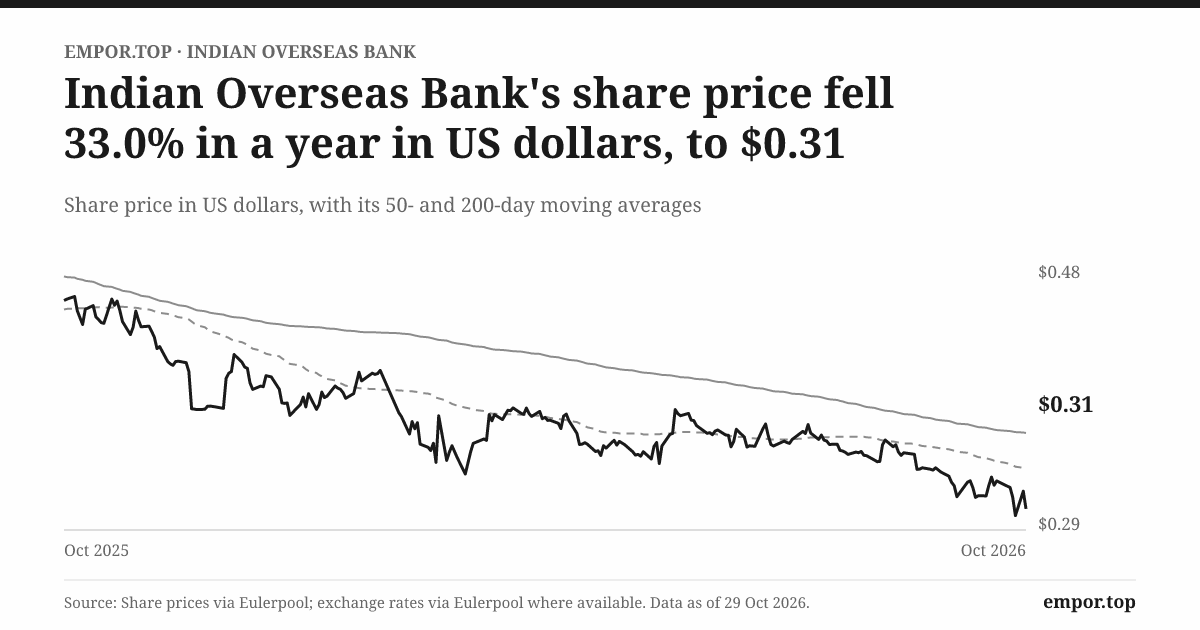
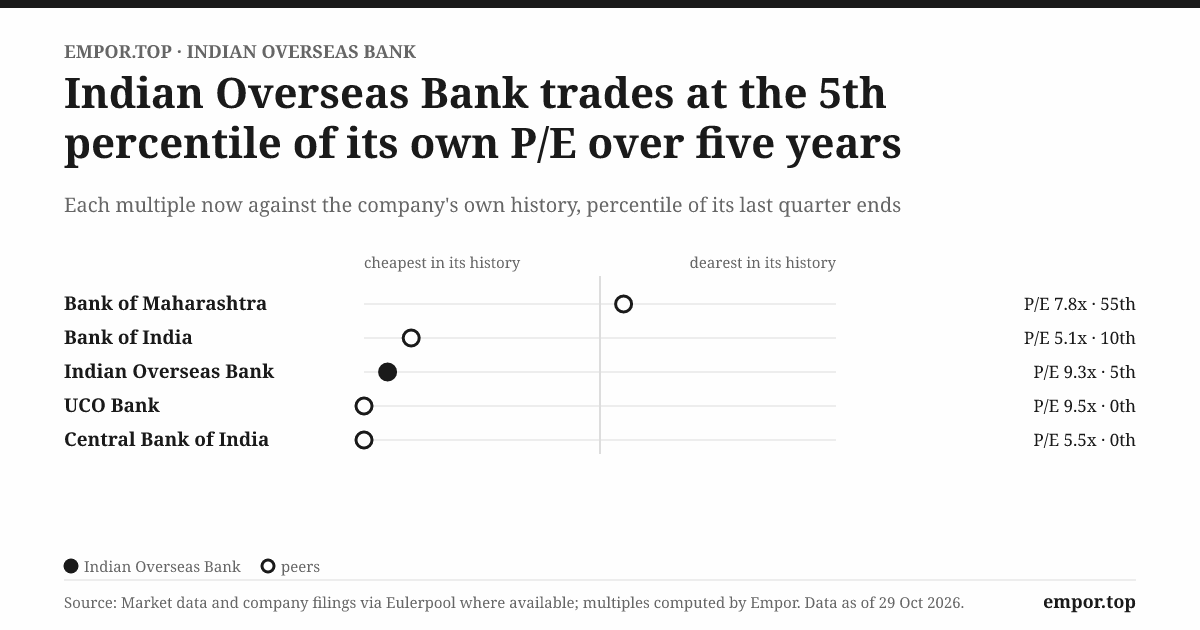
On 26 October 2026, the stock market valued IOB at about 10.2 times its earnings and 1.6 times its book value.8 Across a group of nine public-sector banks, the median was about 6.5 times earnings and 0.9 times book.8 Indian Bank traded at about 8.6 times earnings and 1.4 times book; Bank of Maharashtra at about 7.9 times and 1.8 times.8
A useful trick turns those two multiples into one fact. Dividing a bank's price-to-book ratio by its price-to-earnings ratio gives the return on equity the market is implicitly pricing. For IOB, 1.6 divided by 10.2 implies a return on book of roughly 16%. For Indian Bank, the same sum gives about the same, near 16%. For Bank of Maharashtra, it gives something above 20%. For the peer median, it is closer to 14%, though medians do not combine perfectly.
The bank's own reported return on equity for the year was higher, about 20%, with return on assets of about 1.2%.10 The difference reflects how equity is measured; the market-data figure is the right one for comparing banks on the same basis. Srivastava told analysts that his baseline is a return on assets that should never fall below 1.2%.10
That simple division reveals what the market is assuming. IOB's premium is not mostly explained by higher profitability. On current numbers, it earns about what Indian Bank earns on its equity, and less than Bank of Maharashtra. Yet investors pay roughly a fifth more per rupee of IOB's earnings than of Indian Bank's.
The premium is a bet on the future: that IOB's earnings will grow faster, that its credit costs will stay low, or both. A clean comparison with the bank's own history is not possible, because a price-to-earnings ratio means nothing in years when a company loses money, and IOB lost money for much of the past decade.
There is another possible contributor that has nothing to do with fundamentals. With the government holding more than nine in ten shares, very little IOB stock actually trades. A small float can support a higher price simply because there are few sellers. That makes the minimum-public-shareholding path more than a governance detail. If new shares arrive through a capital raise or a further government sale, the scarcity that may be supporting the multiple will ease.
The bull case starts with the repair itself. Gross NPA is down to about 1.4%, net NPA is close to zero, and the bank carries strong provision coverage against the bad loans that remain.27 Credit cost has fallen to about 0.9%.7 Capital is comfortable at nearly 20%, and liquidity is ample, with a consolidated liquidity coverage ratio of about 122% at March 2026, which management said had risen to around 151% by early May.710 The bank's fixed deposits now carry CRISIL's top rating, and its Tier II bonds were upgraded to AA+.7 Other agencies, including ICRA and India Ratings, also cover the bank's debt.2324
From there, the bull argues that IOB has room to grow. A large rural and semi-urban network gathers deposits cheaply and reaches borrowers in parts of India where credit demand is rising. The shift toward retail, agricultural and small-business loans makes the book more granular than the corporate-heavy book that broke the bank a decade ago. And with profits now flowing, the bank can fund part of its growth from earnings rather than from the government.
The bear case starts with the same growth figure and reads it differently. Advances grew about 24% in the year to March 2026, and retail lending nearly half.210 Loans grew faster than deposits. Five states hold 71% of the book.7 And earnings still rest heavily on other income, which was nearly as large as pre-tax profit in the year to March 2026 and larger in the year before.2 A return of slippages would hit the recovery and the multiple at the same time, because a premium valuation leaves no cushion for disappointment.
There are also accounting and legal judgments worth weighing. IOB faces disputed tax demands of about ₹4,600 crore in income tax, ₹1,600 crore in GST and ₹270 crore in service tax, together more than ₹6,500 crore, larger than a full year's profit.13 The bank contests them and cites appellate rulings and tax opinions, so they are disclosed as contingent liabilities rather than provided for in full.13
Management has a track record to point to: Srivastava said that over the past three years the tax authorities raised about ₹4,800 crore of fresh demands on the bank for assessment years going back to 2013–14, while the bank received about ₹6,300 crore in refunds as older cases were settled in its favour.10 That history narrows the risk without removing it. An adverse ruling on even part of the outstanding demands would land directly on reported earnings. Alongside the deferred tax asset the auditor keeps flagging, they mean IOB's reported profit contains more judgment than the clean NPA ratios suggest.
The structure of Indian banking explains why it is hard for any single lender to sustain an edge. Buyers, in this case both borrowers and depositors, have real power: they can compare rates across public and private banks, and switching a savings account or refinancing a home loan has become easier with digital banking. The threat of new entrants is moderated by licensing, but small finance banks, fintech lenders and non-bank finance companies have pushed into retail and small-business credit.
Substitutes for deposits, from mutual funds to government savings schemes, compete for household savings, which keeps funding costs under pressure. The suppliers of a bank's raw material are, in effect, its depositors, and when deposit growth lags loan growth, as it did at IOB, they gain bargaining power. Rivalry among existing banks is intense, and regulation shapes where every bank must lend through priority-sector obligations.
Hamilton Helmer's framework of seven sources of durable advantage helps test whether IOB has a moat at all. Scale economies exist in banking, but IOB is mid-sized beside State Bank of India and the largest private lenders, so scale is not its edge. Network effects barely apply to a lender. Switching costs are low to moderate: customers do stay out of inertia, but IOB does not publish retention measures that would prove stickiness. Brand, in the form of government backing and long familiarity in the South, is real but shared with every other public-sector bank.
Counter-positioning, process power and cornered resources are hard to find in the record. The one candidate that stands out is the branch network itself, a physical footprint in rural and semi-urban India built over decades of policy-driven expansion, which a new competitor could not easily replicate. That is a concrete advantage in distribution. But IOB shows no evidence that it converts that footprint into pricing power or lower funding costs than peers, which is the evidence a true moat would leave behind. On the record, the advantage is real, narrow and shared, not unique.
Three measures will tell investors more about IOB than any others. The first is slippages and credit cost as the loan book grows: credit cost was about 0.9% in the year to March 2026, and the question is whether it stays near there as the young retail and agricultural loans age.7
The second is deposit growth and CASA relative to loan growth: deposits grew about 18% against loans at about 24%, with CASA at about 41%, and a widening gap would push funding costs up.210 The third is earnings composition: whether the core spread business, which turned from a loss of roughly ₹1,000 crore to a profit of roughly ₹600 crore after costs and provisions, keeps carrying more of the weight, or whether other income continues to do most of the work.2
Each material risk has a clear mechanism. Fast credit growth can weaken underwriting, which shows up as rising slippages with a lag of one to three years. Geographic concentration can turn a regional slowdown into a bank-wide problem. Disputed tax demands and deferred-tax estimates can move reported profits in ways unrelated to banking. And public ownership can sustain the bank through any crisis while leaving minority shareholders with little say in how it is run.
One set of measures does not belong in this analysis. Conventional debt-to-equity and interest-coverage ratios, which matter for an industrial company, are meaningless for a bank, because deposits and borrowings are the raw material of the business and interest is its main cost.
IOB had standalone borrowings of about ₹51,600 crore at March 2026, alongside deposits of about ₹3.68 lakh crore, and issued ₹1,000 crore of Tier II bonds during the year.213 The right tests of its balance sheet are the ones already discussed: common equity tier 1 of about 16.9%, total capital of about 19.8%, a liquidity coverage ratio of about 122%, and a funding mix in which deposits dominate.27
Putting it together: IOB has made a credible operational recovery, supported by cleaner assets, stronger capital and a core business that has finally started to earn its keep. Its valuation already sits well above the public-sector peer medians, and the market-implied return on equity shows that premium is a bet on future delivery rather than a reward for superior current profitability. That bet will be settled by the next few years of credit performance, not by anything the bank has already achieved.
XI. Epilogue
Tonight, IOB stands at a peculiar point in its long history. It is profitable, well capitalised and rated by CRISIL as safely as any deposit-taker in India.7 Its stock trades at a premium to most of its state-owned peers.8 And it is still expanding quickly, while preparing to raise new equity.216
The first moments that will decide what comes next arrive with each quarterly result. Slippages and credit cost will show whether the loans written in the growth years are ageing as well as the young ones look. The states that hold most of the book will matter most: a rise in bad loans in Tamil Nadu, Maharashtra or Telangana would show up in IOB's numbers faster than in a more diversified lender's.7
If credit cost stays low as the retail book matures, the recovery becomes a new operating base. If it climbs back toward the levels of the crisis years, the story of the past five years will have been a cycle, not a repair.
The second test is funding. Deposits have to keep up with loans. If IOB can grow deposits at the pace of lending without losing its low-cost funding mix, its margin is defensible.10 If it has to chase deposits with higher rates, the margin will compress, and the cushion that pays for bad loans will thin at exactly the moment the young loans start to age.
The third is the capital raise. Its price, its timing, its buyers and its use will reveal what management and the government believe about the bank. A raise at a healthy premium to book value, used to fund growth that stays clean, would be the first time in a generation that public investors were offered IOB's equity from a position of strength.
A raise at a discount, or one that mainly serves to reduce the government's stake without a clear growth purpose, would tell a different story. Either way, the government's ownership could fall from 92.44%, and the bank could become, slowly, more of a public company.3
Two dates on the regulatory calendar matter too. The RBI's new expected-credit-loss rules take effect from April 2027, and management has promised to have its full estimated requirement provided before then.10 Meeting that promise without a dent in reported profit would be a meaningful test of earnings quality. And recoveries from old written-off loans, the quiet subsidy to the bank's profits through the recovery years, are budgeted to shrink.10 Each quarter will show whether fees and the core spread are filling that gap.
The fourth is quieter but telling. Each audit report will show whether the emphasis on the deferred tax asset survives, and each analyst call will show whether management's explanation of it holds steady.219 Consistency there would be a small but useful signal of discipline in the bank's reporting. Each new filing on the disputed tax demands will show whether that contingent exposure is shrinking or growing.13
None of these questions will be answered by the bank's founding story or its name. They will be answered in loan files in district towns, in the deposit flows of savers who can now move money with a phone, and in the boardroom where the terms of the next share issue are set.
The tension at the heart of IOB has not gone away; it has only changed shape. A decade ago, the question was whether the bank could survive its loans. Today, it is whether the bank can grow without recreating the conditions that nearly broke it. IOB has rebuilt its profitability. It has not yet proven that it can keep it.
XII. Outro
Go back to that February morning in 1937, when three doors opened at once in Karaikudi, Madras and Rangoon.1 It was a bank designed to cross borders, built for a customer who lived between two countries.
Almost ninety years later, its overseas presence is down to four countries: Singapore, Hong Kong, Thailand and Sri Lanka.1 Those foreign books are small, and they still carry some of the oldest bad loans the bank owns.10 Rangoon is long gone. The overseas name recalls the founder's ambition. The real business lies in thousands of branches across India, in crop loans and savings accounts and home loans, and in the judgment of the people deciding which of them to make.
IOB began by taking Indian banking abroad; its next test is bringing good banking home.
References
-
FY2025–26 audited results and auditor's report — Indian Overseas Bank, 2026-04-29 ↩↩↩↩↩↩↩↩↩↩↩↩↩↩↩↩↩↩↩↩↩↩↩↩↩↩
-
Annual Reports, including Annual Report 2018–19 — Indian Overseas Bank ↩↩↩
-
Exit from Prompt Corrective Action framework — Indian Overseas Bank / Reserve Bank of India, 2021-09-29 ↩↩↩↩↩
-
IOB valuation and peer comparison — Valarth, data as of 2026-10-26 ↩↩↩↩↩
-
Q4 FY2026 Analyst Meet transcript — Indian Overseas Bank, 2026-05-08 ↩↩↩↩↩↩↩↩↩↩↩↩↩↩↩↩↩↩↩↩↩↩↩↩↩↩↩↩↩↩↩↩↩↩↩↩↩↩↩↩↩↩↩↩↩↩↩↩↩↩↩↩↩↩↩↩
-
IOB quote and listing information — National Stock Exchange of India ↩
-
Corporate presentation — Indian Overseas Bank, 2025-11-27 ↩↩
-
Private bank chiefs widen pay lead over PSU counterparts in FY26 — Moneycontrol, 2026 ↩↩
-
Disclosure under Regulation 30: ESPS approval — BazaarWatch, 2026-10-20 ↩
-
Analyst meet transcript — Indian Overseas Bank, 2025-08-05 ↩↩
-
Annual secretarial compliance report FY2024–25 — Indian Overseas Bank, 2025 ↩↩
-
Indian Overseas Bank AGM approves ₹5,000 crore capital raise — Tulsian AI, 2026 ↩↩
-
Rating action on Indian Overseas Bank — India Ratings, 2026-02-17 ↩
 LinkedIn
 WhatsApp
 Reddit
 Hacker News
 Email
 Kindle
 RSS Feed
 Spotify
 Apple Podcasts
 Amazon Music
 Audible
 YouTube