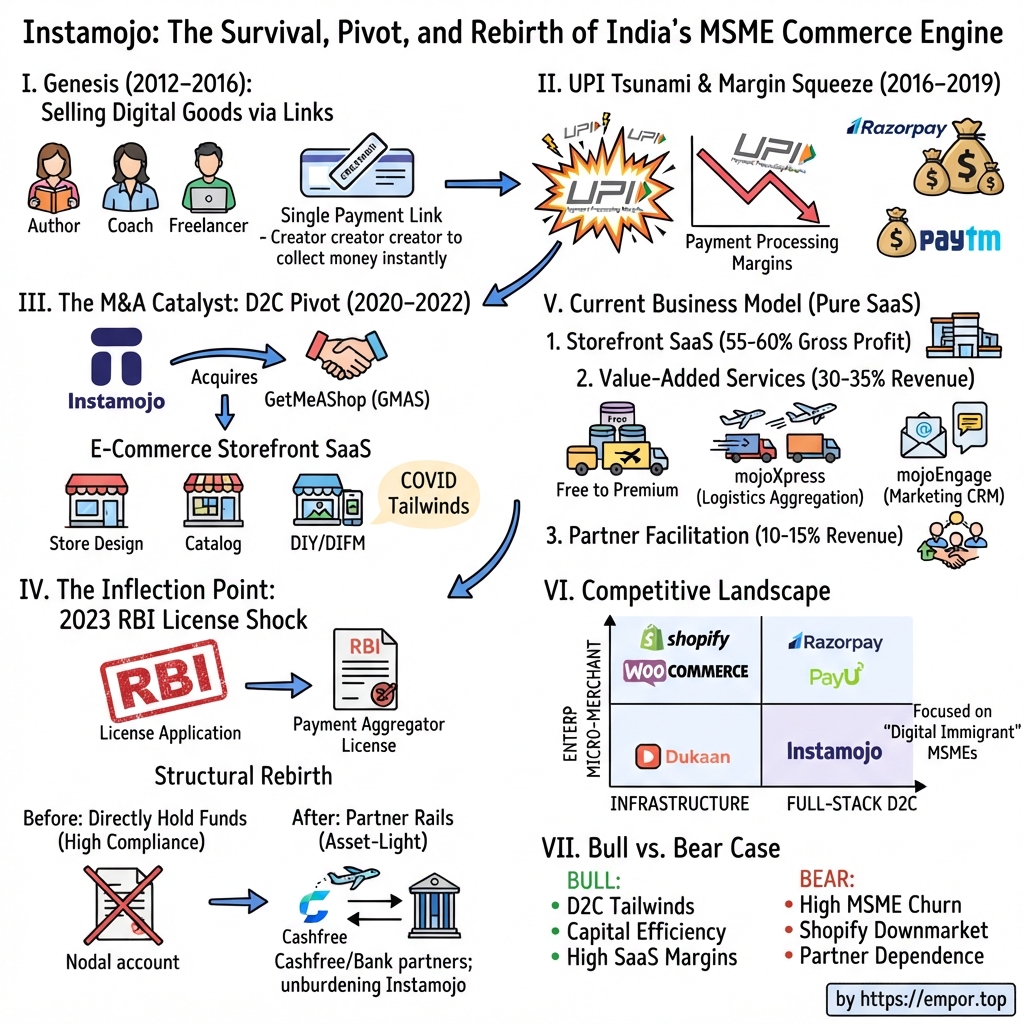
Instamojo: The Survival, Pivot, and Rebirth of India's MSME Commerce Engine
I. Introduction & Episode Roadmap (00:00 – 06:30)
On the morning of September 27, 2023, the leadership of a Bengaluru-based software company learned that the Reserve Bank of India had returned its application to operate as a Payment Aggregator. The stated reason was neither fraud nor customer harm, nor a compliance breach. It was arithmetic. The regulator calculated the company's net worth differently than internal management had, leaving a gap of roughly ₹60 lakh—about $70,000 at the time—against a required regulatory threshold of ₹15 crore.1
Sixty lakh rupees is less than the annual compensation of a single mid-market enterprise sales executive in Silicon Valley. Yet it was enough to disrupt Instamojo's core business model.
Co-founder and Chief Executive Officer Sampad Swain later described the ensuing weeks with rare on-the-record candour for a founder: "September 27, 2023, RBI barred us from operating as a payment aggregator," he said. "October, 2023, we faced an existential crisis. Our terminal valuation was zero."1
That assessment—terminal valuation was zero—captures the structural fragility of the business at that juncture. Instamojo was not an early-stage startup struggling to identify product-market fit. Eleven years prior, it had pioneered the mainstream Indian payment link: by pasting a URL into a messaging channel like WhatsApp, a tutor in Nagpur or a home baker in Kochi could collect payments from customers without building a dedicated website, hiring developers, or paying a ₹30,000 gateway integration fee. By 2023, the company reported millions of registered merchants and had briefly achieved operating profitability. Yet those operational milestones were secondary to regulatory capital requirements, as roughly three-quarters of top-line revenue depended directly on a licence the company was not permitted to hold.2
What followed presents an instructive case study in platform adaptation and operational risk management. Instamojo did not litigate, nor did it pursue an emergency capital raise to bolster its balance sheet and reapply. Instead, management exited the regulated funds-handling business entirely, migrated its merchant base onto third-party payment rails, rationalised compliance-specific overhead, and repositioned the enterprise as pure-play software: an e-commerce operating system for Indian micro, small, and medium enterprises (MSMEs) that integrates with external payment aggregators.
The central analytical question is whether this pivot represented strategic agility or retrospective rationalisation. Both interpretations align with available data. The constructive view suggests that a capital-efficient, founder-led team transitioned away from a commoditised, capital-intensive, zero-margin payments utility into higher-gross-margin subscription software—a playbook comparable to Shopify's model of embedding financial services via partner rails rather than becoming a chartered depository institution. The skeptical view notes that an enterprise stripped of its primary revenue engine constructed a favourable narrative around forced retrenchment, and post-2023 operating metrics remain less transparent than the strategic narrative suggests.
This analysis covers a private, venture-backed enterprise. There is no Draft Red Herring Prospectus (DRHP), no formal red herring prospectus, and—as of August 17, 2026—no publicly disclosed intention by Instamojo to pursue an initial public offering. This analysis relies entirely on public records: published pricing schedules, registry-derived financial filings reported across Indian financial media, regulatory circulars from the Reserve Bank of India, third-party web crawl data tracking active merchant storefronts, and comparative disclosures from publicly filing digital commerce peers.
The roadmap:
- The 2012 origin of the payment link, and why a low-friction on-ramp for long-tail merchants provided rapid initial distribution but weak unit economics.
- The impact of Demonetisation, the rapid adoption of Unified Payments Interface (UPI) rails, and the structural compression of payment processing margins into utility economics.
- The 2020 acquisition of GetMeAShop from Times Internet, which provided the underlying e-commerce software architecture that enabled the subsequent pivot.
- The 2023 RBI regulatory decision: examining the operational fallout across merchant retention, top-line revenue, and headcount.
- The post-pivot operating model—storefront software subscriptions, Smart Pages, logistics take-rates, and value-added marketing tools—and the empirical limits of its disclosed unit economics.
- Capital structure, historical funding rounds, and private market valuation considerations.
- Competitive positioning using Porter's Five Forces and Hamilton Helmer's 7 Powers frameworks, alongside core bull and bear investment theses and critical tracking metrics.
The analysis begins with the origin of the product: a simple payment URL.
 Subscribe on LinkedIn
II. The Genesis: Selling Digital Goods via Links (2012–2016) (06:30 – 16:00)
To understand why Instamojo gained traction in 2012 requires examining the friction involved in accepting digital payments in India at the time.
Consider a freelance illustrator in Pune attempting to sell a ₹300 PDF of her sketches. In 2012, her options were severely constrained. She could convince a commercial bank to grant her a merchant account—a process that required a registered legal entity, a commercial bank account, and months of manual compliance paperwork. Alternatively, she could contract with a traditional payment gateway, which typically demanded an upfront setup fee running into tens of thousands of rupees, an annual maintenance charge, a security deposit, and custom API integration into a dedicated website she did not own. The financial infrastructure was architected for enterprise merchants processing large transaction volumes, not an independent creator selling a ₹300 digital file. Consequently, India's long tail of micro-sellers—tutors, coaches, authors, event organizers, independent consultants, and artisans—relied almost exclusively on cash or direct bank transfers.
Sampad Swain, Akash Gehani, Aditya Sengupta, and Harshad Sharma founded Instamojo in 2012 around a simple operating premise: selling a product online should be as straightforward as sharing a hyperlink.3
The core product was a single hosted checkout page. A merchant registered, entered a product description and price, uploaded a digital file if applicable, and received a unique URL. That link could be embedded in a social media post, an email signature, or distributed directly through messaging channels like WhatsApp. The buyer clicked the link, completed payment via card or net banking, and received immediate access to the digital file. The setup eliminated the need for a standalone website, technical integration, or fixed overhead costs, with Instamojo monetising through a variable transaction fee.
Two structural characteristics of this design explain both the company's rapid early adoption and its subsequent strategic vulnerability.
The first was low-cost customer acquisition. Instamojo's primary distribution engine was the payment link itself. Every URL shared by a merchant served as an organic product showcase to buyers, a portion of whom were micro-merchants themselves. This self-distributing loop enabled a lean team to onboard a large base of registered sellers with minimal marketing expenditure. The company relied on this organic pull over the long term; management later disclosed that its last paid customer acquisition campaign ran in September 2021.1 For a consumer-facing digital commerce platform in India to operate without continuous performance marketing spend is unusual, providing empirical support for the platform's organic distribution efficiency.
The second characteristic was the absence of structural switching costs. A payment link created minimal operational lock-in. The merchant's product catalogue was a single line of text, the customer relationship was ephemeral, and the workflow required no deep software integration to reverse. If a rival processor offered an identical payment link at a lower take-rate, a merchant could switch instantly at zero marginal cost. While Instamojo established durable brand equity and user habits among micro-merchants, it did not construct a defensive moat around payment processing.
The company's funding trajectory reflected this asset-light, low-average-revenue-per-user (ARPU) profile. Instamojo secured early backing from 500 Startups and closed a Series A round in 2014 led by Kalaari Capital, alongside Blume Ventures and 500 Startups.[^4] In January 2019, it raised roughly $5 million in a pre-Series C round led by Japanese investment firms Gunosy Capital and Base, with participation from AnyPay.[^5] These funding totals remained modest compared to broader Indian fintech benchmarks; rival Razorpay, founded two years after Instamojo, went on to raise multiples of Instamojo's total lifetime capital in individual financing rounds.
Rather than viewing this operational frugality purely as a deliberate choice, the financial reality was that Instamojo served price-sensitive micro-merchants generating low revenue per account. That segment could not support an expensive direct sales force or heavy paid marketing acquisition costs. Capital efficiency was an economic necessity imposed by the merchant tier it served. Instamojo established significant brand equity as an accessible on-ramp for Indian micro-merchants, generating sustained organic discovery, but that on-ramp led directly into pure payment processing—a sector where unit margins were about to face severe regulatory and structural compression.
III. Demonetization, UPI, and the Payment Margin Squeeze (2016–2019) (16:00 – 27:30)
On the evening of November 8, 2016, the Government of India demonetised ₹500 and ₹1,000 banknotes, removing approximately 86% of the currency in circulation overnight. For India's digital payments ecosystem, the sudden cash shortage created an immediate surge in transaction activity, prompting long-tail merchants who had historically operated exclusively in cash to adopt digital acceptance solutions.
For Instamojo, this policy shock generated a sharp near-term expansion in transaction volumes and merchant sign-ups. Over the medium term, however, it accelerated a structural shift across Indian payment infrastructure that challenged the economic viability of standalone payment processing.
Payment aggregator unit economics traditionally depended on the Merchant Discount Rate (MDR)—a percentage fee on each transaction apportioned among card networks, issuing banks, and payment gateways. For aggregators, that fee represented the core gross margin pool. The rollout of the Unified Payments Interface (UPI) by the National Payments Corporation of India in 2016 introduced low-friction, real-time, account-to-account mobile settlement. In January 2020, the Indian government abolished MDR entirely on UPI and RuPay debit card transactions via statutory amendments to the Payment and Settlement Systems Act and the Income-tax Act.4
This regulatory mandate converted the fastest-growing payment method in India into a zero-revenue product across the payment value chain. For a platform whose revenue model relied on transaction fees, rising transaction volume no longer translated into proportional top-line growth, as zero-MDR UPI volume steadily displaced fee-bearing credit card, net banking, and digital wallet transactions.
Across the Indian fintech sector, competitors responded by pursuing scale and cross-subsidising zero-margin payments through adjacent revenue streams. Processors such as Razorpay, Cashfree, PayU, Paytm, and PhonePe raised substantial institutional capital to expand into enterprise checkout, developer tooling, merchant lending, neobanking, and offline point-of-sale infrastructure. In this environment, transaction processing became a capital-intensive scale business designed to anchor merchant relationships for higher-margin financial products.
Instamojo occupied a vulnerable position within this industry structure. Having raised modest institutional capital compared to larger peers, the company served a merchant base concentrated in micro-sellers with low transaction values, high customer support requirements, and limited capacity to absorb commercial credit or enterprise payroll tools. A blended fee structure—historically around 2% plus ₹3 per transaction—faced severe margin compression after accounting for interchange, bank fees, operational overhead, and the rising proportion of zero-MDR rails.
Management recognised this dynamic in the late 2010s and introduced adjacent services to diversify revenue: instant payout capabilities, logistics integrations, working capital experiments under the mojoCapital banner, and basic customer management tools. While this product strategy anticipated the need to monetise beyond the transaction, adoption among micro-merchants proved gradual. By fiscal year 2022, payments still generated roughly ₹38 crore of reported revenue, compared to approximately ₹7 crore from IT and software services.1 Software accounted for under a fifth of total revenue nearly a decade after founding.
With payment processing margins compressed by regulation and organic software expansion providing only modest revenue diversification, the core business remained structurally exposed. The critical transition for Instamojo came not from an internal product launch, but through a corporate acquisition in February 2020.
IV. The M&A Catalyst: Acquiring GetMeAShop and the D2C Pivot (2020–2022) (27:30 – 39:00)
Times Internet, the digital arm of India's largest print media conglomerate, had spent years developing GetMeAShop—a do-it-yourself storefront builder aimed at small Indian retailers. It was a functional product in a software category that had historically struggled for adoption in India, and by early 2020 it no longer fit the media company's core strategic focus.
On February 5, 2020, Instamojo announced it had acquired GetMeAShop from Times Internet.5 The strategic rationale was clear: the transaction allowed Instamojo to cross-sell software subscriptions to its existing merchant base, aiming to support an enterprise "from its first sale to full scale," in the company's framing, while expanding its aggregate merchant footprint beyond 1.2 million sellers.5 Swain described the transaction as an operational expansion, stating that GetMeAShop "will help us take our mission to make Indian MSMEs truly enterprising."5
Financial terms were not disclosed in the official announcement. Times Internet took an equity stake in Instamojo as part of the transaction and subsequently participated alongside Mastercard in Instamojo's 2021 funding round. The deal represented a modest bolt-on acquisition by a company whose cumulative lifetime fundraising remained comparable to an average Series B round for an Indian unicorn. Rather than a competitive bidding process, it was an arrangement in which a corporate parent divested a non-core asset to an operator that required the software architecture more than the seller required cash proceeds.
The timing proved consequential. In 2020 and 2021, private valuations across global and Indian software platforms reached historic highs. A well-capitalised competitor might have raised $50 million and spent several years developing storefront infrastructure internally, risking market timing. Instamojo acquired production-ready code and an active customer base within its financial constraints. That purchase embedded a dedicated e-commerce software layer into the company roughly six weeks before the COVID-19 pandemic structurally altered Indian retail.
The pandemic accelerated digital commerce adoption across India much as demonetisation had accelerated digital payments. Physical retail closures forced independent boutiques, home food producers, coaching centres, craft artisans, and regional brands to establish online distribution within days rather than months. Instamojo possessed software infrastructure ready to deploy beyond a single payment link: hosted digital storefronts with product catalogues, custom domains, design templates, integrated order management, and third-party logistics.
The rollout also revealed a foundational consumer insight regarding the target merchant demographic. The typical Indian micro-merchant does not seek a modular website builder; she seeks a finished, functional website. That distinction is central to the platform's economics. The standard global self-serve model assumes a merchant willing to invest hours selecting themes, installing application plug-ins, establishing shipping zones, and drafting product descriptions. A saree retailer in Surat managing inventory via WhatsApp on a mobile handset rarely undertakes that workflow. Handed a blank software interface, seller drop-off is high. Instamojo addressed this friction by productising setup labour through a "Do-It-For-Me" (DIFM) service tier, where internal teams configure the digital storefront for the merchant.
That operational choice introduced a distinct economic trade-off. A DIFM model converts long-tail merchants at higher rates and commands higher upfront fees than pure self-serve software. However, it also represents service revenue packaged alongside software subscriptions. Because it requires manual setup labour, it does not scale at zero marginal cost, creating a structural drag on gross margins relative to pure SaaS businesses. Evaluating Instamojo's underlying profitability requires determining the revenue contribution of recurring software subscriptions versus human-assisted onboarding services—a breakdown management has not publicly disclosed.
Corporate development continued through 2021. In June 2021, Mastercard invested alongside Times Internet in an equity financing round that added a strategic global payments partner to Instamojo's capitalisation table.3 Two months later, in August 2021, Instamojo acquired ShowMyShop, a social and creator commerce platform, in an acqui-hire transaction to bolster product and engineering capabilities.[^8]
Capital structure and disclosure limitations. Standard financial underwriting for a private enterprise relies on an audited capitalisation table, but available public disclosures impose strict analytical constraints. Instamojo has never publicly disclosed a post-money valuation for any financing round. Industry databases and media reports diverge widely on cumulative capital raised, with estimates spanning approximately $12 million to $37 million, while contemporaneous reporting during the 2023 restructuring cited $15.2 million.36 Furthermore, there is no public record detailing employee option pools, preferred share liquidation preferences, participation rights, anti-dilution protections, conversion ratios, or side-letter covenants. The company's fully diluted share count remains private.
These data gaps carry direct implications for institutional valuation analysis. Without a verified share count, estimating enterprise value or market capitalisation relies on extrapolation. Without disclosed preference structures, preferred shares held by institutional backers like Kalaari Capital or Mastercard cannot be assumed to share the same economic payoff profile as common shares held by founders and employees in a downside scenario. Furthermore, strategic corporate investors often allocate capital for commercial partnerships and distribution access rather than purely financial return, meaning investment entry points do not necessarily reflect standalone intrinsic equity valuations.
Consequently, Instamojo cannot be assessed through private funding marks. Any disciplined analysis must evaluate the business purely on its operational mechanics and cash generation. The operational restructuring that unfolded over the following eighteen months tested whether the underlying software enterprise was viable on a standalone basis.
V. The Inflection Point: The 2023 RBI License Shock & Structural Rebirth (39:00 – 52:00)
The regulatory clock had been ticking since March 17, 2020, when the Reserve Bank of India issued its Guidelines on Regulation of Payment Aggregators and Payment Gateways. The framework established a clear boundary: an entity that pools and transfers customer funds directly to merchants is a Payment Aggregator requiring RBI authorisation, whereas an entity that merely provides routing technology infrastructure is a Payment Gateway and does not.2
Operating on the regulated side of that boundary required substantial capital. New applicants were required to show a net worth of ₹15 crore at the time of application and scale to ₹25 crore within three financial years, maintaining that threshold on an ongoing basis. Funds had to reside in non-interest-bearing escrow accounts at scheduled commercial banks under strict settlement timelines, supported by mandatory quarterly escrow audits and annual net-worth certifications.2
For a platform serving long-tail merchants, this regulatory architecture altered operating economics. A permanent ₹25 crore capital commitment, non-interest-bearing escrow balances, and an ongoing compliance apparatus represented substantial fixed overhead. While easily absorbed across high-volume enterprise processors like Razorpay, those fixed costs proved disproportionately heavy when distributed across micro-merchants generating low transaction fees. The regulatory framework effectively undermined the economic viability of standalone, long-tail payment aggregation.
Instamojo submitted its application, but in September 2023 the RBI returned the filing on net-worth eligibility grounds, evaluating calculations against financial statements from 2021. Co-founder Akash Gehani described the decision as a technical discrepancy: "There have been differences in how we arrived at the net worth and how the central bank calculated. Instamojo met all the other required compliance, barring the net worth one."7 The Economic Times first reported the returned application in late September 2023.[^11]
The regulatory action was widespread. During that licensing cycle, 25 existing payment aggregator operators had authorizations rejected or withdrawn and 47 applicants were turned down—affecting 72 firms and an estimated three million merchants across India's digital economy.7
For Instamojo, however, the fallout was severe. Payment processing accounted for roughly 75% of top-line revenue at the time, down from approximately 90% in earlier years.7 On November 15, 2023, the company formally announced the suspension of its direct payment aggregator operations.3
The mechanics of merchant migration. While the strategic narrative describes an orderly migration onto third-party payment rails, the operational transition created significant merchant friction. Media reporting documented settlement delays, backlogged customer support tickets, dashboard reconciliation errors, and frozen balances—including one merchant whose ₹14 lakh balance was temporarily locked without advance notice.7 Merchants were also required to complete fresh Know Your Customer (KYC) verifications with new licensed partners, an onboarding step that typically drives high customer drop-off in Indian financial services. Instamojo stated that roughly 90% of merchant accounts were successfully migrated.3
That headline migration rate warrants qualification. Moving a registered account does not equate to retaining an active, revenue-generating seller. Management later disclosed that the company retained approximately half of its active pre-pivot merchant base, heavily weighted toward sellers with three or more years of platform tenure.1 Retaining half of an active merchant base allowed for organizational survival, but the divergence between a 90% account migration metric and a roughly 50% active merchant retention rate illustrates how headline figures can mask operational churn during a restructuring.
Cost rationalisation followed immediately. Instamojo reduced its workforce by roughly 15% to 20%, concentrated primarily in the dedicated payments compliance division.1 Management reported that broader employee turnover remained below 3% during the transition against an industry average of 20% to 25%—a self-reported metric that cannot be independently audited, but one that points to internal organizational stability during the operational pivot.1
The strategic rationale against reapplication. The RBI framework allowed rejected applicants to reapply in the subsequent financial year, but Instamojo chose not to pursue a renewed licence. Management argued that holding an aggregator licence offered no structural competitive advantage for its targeted software model, and that ongoing regulatory capital requirements represented an operational burden rather than an economic moat.[^12] Swain later framed the strategy directly: "We want to be the Microsoft for small businesses rather than the HDFC bank."1
That rationale carries clear operational merits. By removing itself from the direct flow of funds, Instamojo eliminated the ₹25 crore regulatory net-worth requirement, non-interest-bearing escrow obligations, chargeback reserves, settlement-default exposures, and dedicated compliance overhead. For a company operating on a lean balance sheet, that structural reduction removed the immediate requirement for dilutive equity financing. It also shifted the revenue mix from low-margin payment take-rates dependent on transaction volume to higher-gross-margin software subscriptions.
However, that transition introduced a fundamental structural vulnerability: supplier concentration and platform risk. Instamojo now operates downstream of licensed aggregators—such as Cashfree and Razorpay—that compete directly with its storefront and payment-link products. When critical infrastructure suppliers also compete as downstream distributors, they possess both the commercial leverage and incentive to reprice API access, deprioritise support integrations, or cross-sell competing storefront tools directly to Instamojo's merchant base. Instamojo effectively exchanged regulatory capital requirements for supplier counterparty risk.
A subsequent policy development further complicates the assumption that payment margins are permanently impaired. On August 4, 2026, the Ministry of Finance introduced statutory amendments to the Payment and Settlement Systems Act in the Lok Sabha, empowering the government to notify which digital payment methods may attract Merchant Discount Rates. Industry reporting indicated potential fees of 25 to 30 basis points on merchant transactions exceeding ₹2,000, which could restore an estimated ₹13,000 crore annually to licensed payment processors.4 While person-to-person transfers are expected to remain fee-free and formal rules have not been notified, any restoration of merchant MDR would expand the profitability of licensed aggregators. Having exited direct aggregation, Instamojo would participate in that margin expansion solely through third-party referral arrangements. Exiting the regulated payment layer at the cyclical trough of regulatory pricing carries long-term opportunity costs.
Evaluating executive execution and disclosure. Assessing management performance through this restructuring reveals distinct strengths alongside clear informational gaps.
On execution speed, management acted decisively. The RBI returned Instamojo's application in late September 2023, the business was formally suspended by mid-November, and technical migration onto third-party rails was largely completed within that window.[^11]3 Rapid operational adaptation preserved platform continuity, whereas slower responses among other affected applicants resulted in prolonged merchant disruption.7 Furthermore, executive commentary reflected unusual transparency, exemplified by Swain's public acknowledgment that the firm faced an existential crisis with a terminal valuation of zero.1 Strategic positioning has also remained consistent over time, maintaining the software-first narrative across statements to Livemint in October 2023 and Inc42 in 2024, backed by the concrete decision not to reapply for regulatory licensing.[^12]1
Conversely, corporate disclosures show notable limitations. The discrepancy between an initial "90% migrated" figure and the subsequent acknowledgment that only half of active merchants were retained reflects selective metric reporting during a crisis.31 In addition, management publicly committed to achieving operational profitability by the third quarter of fiscal year 2025, describing it as an existential milestone.1 As of August 2026, the company has not published audited financial statements confirming that break-even target. For private-market analysts, the absence of verification following a specific, self-imposed profitability deadline remains a critical data point.
Instamojo demonstrated organizational resilience and execution speed in navigating an existential regulatory shock, but evaluating its ongoing financial performance requires relying on verified operating data rather than executive projections.
Rather than pursuing regulated financial infrastructure, Instamojo focused entirely on commerce software—specifically digital storefronts managed for the merchant. That operating model defines the enterprise today.
VI. Current Business Model, Segment Economics & Revenue Architecture (52:00 – 1:06:00)
An examination of Instamojo's pricing page reveals the company's core commercial strategy, as the platform publishes its full fee schedule.8
The offering spans three distinct product families, each structured with a free entry tier and paid subscription tiers, with the free tier carrying an elevated transaction fee designed to incentivize upgrades.
Online Stores. The Lite plan requires ₹0 in annual subscription fees and levies a take-rate of 5% plus ₹3 per transaction. Starter costs ₹6,999 annually while maintaining the same 5% plus ₹3 fee, adding premium design themes, a custom domain, and the removal of Instamojo branding. Growth is priced at ₹14,999 annually—or ₹2,999 monthly—and lowers the transaction fee to 2% plus ₹3 while incorporating abandoned-cart recovery, WhatsApp messaging integration, SEO management controls, and a complimentary domain. Above Growth sits the Do-It-For-Me tier at custom pricing.8
Smart Pages, the hosted single-page product, offers a ₹0 tier with a 5% plus ₹3 fee, alongside a ₹12,999 annual tier that reduces the fee to 2% plus ₹3 while adding integrated web analytics and pixel tracking.8
Payment Links, the company's legacy product, operates as a ₹0 tier at 2% plus ₹3, alongside a ₹4,999-per-year Smart tier.8 Goods and Services Tax (GST) at 18% applies on top of all transaction fees.8
Three structural dynamics emerge from this published rate card:
First, transaction take-rates drive conversion incentives. The spread between a 5% and 2% take-rate serves as the primary commercial pitch for subscription upgrades. A merchant generating ₹1 lakh in monthly gross merchandise value (GMV) saves ₹36,000 annually by upgrading from Lite to Growth—more than double the ₹14,999 subscription price. The pricing structure is engineered so that the software subscription pays for itself precisely at the volume threshold where a seller becomes economically valuable to retain, while lower-volume merchants self-select into the free tier, where higher take-rates offset the lack of subscription revenue. Consequently, Instamojo's top line does not represent pure recurring software revenue. A substantial portion remains tied to merchant GMV, fluctuating with the transaction activity of long-tail businesses.
Second, absolute price points remain modest by global standards while tailored to Indian MSME purchasing power. An annual fee of ₹14,999 equates to roughly $170. By comparison, Shopify's pricing in India has historically ranged from approximately ₹18,000 to ₹21 lakh annually across its subscription tiers.1 Rather than competing directly against enterprise feature suites, Instamojo competes on lower total cost of ownership and managed onboarding services.
Third, the free tier operates as the top of an acquisition funnel whose paid conversion rate remains undisclosed. The unit economics of the business model depend directly on that conversion efficiency.
Revenue categorization and composition. The company categorizes its revenue into storefront software, value-added commerce services, and partner-facilitated financial services. In operational terms, this comprises software subscriptions and transaction take-rates from stores and Smart Pages; logistics margins on shipping labels generated through mojoXpress, which aggregates third-party courier networks; add-on fees from domain sales and marketing tools under mojoEngage; and referral or integration commissions from the licensed payment gateways, lenders, and card processors operating across the regulatory boundary.9[^15]
This partner tier illustrates the post-pivot financial model: Instamojo continues to participate economically in transaction flows, but as an intermediary rather than a principal, carrying zero direct capital obligations or settlement default risk while capturing a smaller fee share.
Financial disclosures and reporting gaps. The most recent registry-derived, media-reported financial baseline for Instamojo is fiscal year 2023, capturing performance immediately prior to the regulatory shock. Revenue from operations reached approximately ₹46 crore, essentially flat compared to ₹46.6 crore in FY2022. Total operating expenses declined to ₹38.12 crore from ₹48 crore, driven primarily by a roughly ₹4 crore reduction in employee benefit costs, swinging the company to a net profit of ₹8.26 crore from a ₹1.1 crore loss in the prior year.10
This reported profitability reflected cost rationalization rather than top-line expansion. Revenue remained flat while overhead was cut. Instamojo also reported positive EBITDA with a 15% margin in the second quarter of fiscal year 2024, compared to negative 7% in the prior-year period.3
Following fiscal year 2023, public corporate filings narrowed. Company-verified financial statements for fiscal years 2024 and 2025 have not been widely reported across financial media. Third-party private market trackers suggest a sharp contraction; one registry tracker indicated that the primary operating entity, Instamojo Technologies Private Limited, generated under ₹10 crore in revenue for the fiscal year ended March 31, 2025, implying a revenue decline of roughly 75%.6 This figure requires analytical qualification: it reflects a single legal entity within a multi-entity group structure, registry data remains unaudited, and a structural shift from gross payment processing volumes to net software subscription and referral revenue mechanically compresses reported top-line revenue without necessarily representing a proportional drop in underlying merchant value. Nonetheless, the absence of verified consolidated financials presents a fundamental constraint in establishing precise enterprise valuation.
Management disclosures provide the primary interim operational bridge. In August 2024, Instamojo stated that it had regained roughly 60% of its pre-September-2023 revenue run-rate and was targeting operational profitability by the third quarter of fiscal year 2025 over an estimated eighteen-month recovery window.1 Swain characterized the break-even objective as critical: "This is not a goal, but our survival instinct."1 However, as of August 2026, no independent financial disclosures have verified whether that third-quarter FY2025 profitability target was achieved.
Alternative data and merchant footprint. Triangulating merchant scale using third-party web crawl data provides an external perspective on platform activity. StoreLeads, which tracks e-commerce platform deployments across the web, identified 833 active Instamojo storefronts in its August 14, 2026 report—a decline of approximately 1.5% quarter-on-quarter and roughly 18% year-on-year, down from a detected peak of 1,341 storefronts in the third quarter of 2023. Detected storefronts were concentrated in apparel (19%), food and beverage (11%), and home and garden (9%), with more than 40% of identified stores listing fewer than ten products.11
Interpreting this dataset requires acknowledging technical tracking biases. Web crawlers primarily detect custom domains, whereas Instamojo gates custom domain integration behind paid tiers. Consequently, crawl data largely reflects the paid, custom-domain merchant cohort rather than the aggregate registered user base. While the absolute figure of 833 storefronts undercounts total platform users, the direction of the trend provides a useful indicator. An 18% year-on-year contraction in detected custom-domain stores suggests ongoing churn among paid subscribers nearly three years into the restructuring. This contrasts with promotional statements highlighting "over 20 lakh small businesses" registered on the platform.12 Cumulative registration counts spanning fourteen years diverge significantly from active, revenue-generating commercial storefronts.
Merchant churn and retention dynamics. Micro-merchant attrition represents a structural challenge across Indian digital commerce. A substantial share of long-tail enterprises close within twenty-four months due to underlying business failure rather than software deficiencies. Instamojo has responded by focusing customer acquisition on higher-retention verticals—direct-to-consumer lifestyle brands, online education creators, specialty foods, and professional service providers—while prioritizing retention initiatives around experienced sellers, consistent with management's disclosure that retained merchants after the payments migration were disproportionately those with three or more years of platform tenure.1
However, if gross annual merchant churn approaches the 30% to 50% range typical of Indian micro-business software, maintaining net revenue retention above 100% requires substantial expansion in average revenue per user (ARPU) among surviving accounts. Instamojo relies on DIFM setup services, logistics margins, and marketing add-ons to drive expansion spend. Because the company has not publicly disclosed net revenue retention figures, evaluating whether account expansion offsets underlying cohort churn remains an open analytical question.
Total addressable market sizing. Broad industry narratives frequently cite India's base of over 65 million MSMEs as the relevant market opportunity.1 For commercial underwriting, however, the addressable segment is substantially narrower. The vast majority of these entities are informal micro-enterprises or agricultural operators transacting locally in cash, with limited requirements or budget for standalone e-commerce software.
The addressable target market is confined to merchants selling products or services remotely, requiring an independent branded web presence rather than an online marketplace listing, capable of managing a digital dashboard, and generating sufficient transaction volume to justify an annual software subscription of ₹7,000 to ₹15,000 plus a 2% take-rate. Below that GMV threshold, sellers default to free plans, generating revenue only on realized sales.
The addressable universe comprises the segment of Indian merchants operating independent D2C businesses outside centralized marketplaces. Comparative disclosures from logistics platforms like Shiprocket and payment aggregators like Razorpay indicate that this universe encompasses low single-digit millions of registered sellers and a significantly smaller base of commercially active storefronts.1516 Within this market, Instamojo occupies the tier positioned below Shopify's enterprise cost structure and above the basic checkout tooling provided by payment aggregators.
Assuming an addressable market of several hundred thousand Indian merchants capable of sustaining paid storefront subscriptions at an annual blended ARPU of ₹10,000 to ₹20,000 across software, logistics, and add-on services, the total addressable software revenue pool for this specific segment sits in the low thousands of crores. This revenue pool is distributed among Instamojo, Dukaan, Bikayi, Shiprocket's upstream software assets, payment aggregator storefront tools, and Shopify's domestic footprint. Capturing a meaningful share of this segment supports a viable, focused software enterprise, but it does not represent a multi-thousand-crore standalone revenue opportunity under current market conditions.
Requirements for sustainable profitability. Instamojo demonstrated operational profitability in fiscal year 2023 through cost rationalization on a flat revenue base, followed by further structural headcount reductions during the 2023 payments restructuring.101 Achieving durable profitability over the medium term requires maintaining software gross margins as labor-assisted DIFM onboarding scales, sustaining current fixed-cost discipline, and preserving organic customer acquisition. Operating without paid performance marketing preserves unit economics, but if organic acquisition slows and requires a return to paid marketing spend to replace merchant churn, operating margins would face immediate pressure.
This structural dynamic leads directly to the broader competitive environment, where rival platforms operate with differing capital reserves and strategic priorities.
VII. Competitive Landscape & Industry Structure (1:06:00 – 1:19:00)
The Indian commerce-enablement landscape can be conceptualized along two primary axes: merchant complexity on the vertical axis, running from micro-sellers to enterprise operations, and functional scope on the horizontal axis, spanning pure payment infrastructure to full-stack commerce software.
Global platforms such as Shopify and WooCommerce occupy the upper right: extensible, feature-dense, and demanding substantial technical configuration from the merchant. Enterprise payment processors such as Razorpay, Cashfree, and PayU anchor the left: payments-first infrastructure built around developer mindshare and high-volume checkout. Shiprocket anchors the lower right in logistics execution, expanding upstream into software. Instamojo occupies the lower-middle quadrant alongside regional builders like Dukaan and Bikayi, serving merchants who require digital storefront workflows but cannot manage technical complexity.
Operating in the middle of this matrix presents structural challenges, as a platform faces competitive pressure across all quadrants while lacking the scale or specialization advantages that protect extreme positions.
Against Shopify, from above. Shopify's global product architecture and application ecosystem remain unmatched. However, its primary operational limitation in India has historically been market fit rather than software capability: pricing tiers calibrated to Western merchant margins, a self-serve application model requiring sellers to assemble their own technology stacks, and operational gaps around domestic commerce workflows—including cash-on-delivery reconciliation, GST-compliant invoicing, regional-language interfaces, and courier aggregation across fragmented third-party logistics networks.
Instamojo addresses these domestic frictions natively and, through its DIFM tier, manages the setup process directly. While this provides a tangible operational differentiator, it does not represent a permanent competitive moat if Shopify pursues aggressive local pricing and deeper domestic integrations, a strategy it has executed in other emerging markets. Instamojo's current buffer from above reflects global platform prioritization rather than insurmountable structural barriers.
Against the venture-funded store builders, from beside. Dukaan launched in June 2020 and emerged as a prominent domestic challenger, expanding internationally in 2022 with the explicit ambition of competing with Shopify.13 However, financial disclosures across that peer group demonstrate the structural difficulty of monetising Indian storefront software. Dukaan raised over $20 million and reported fiscal year 2023 revenue of approximately ₹10 crore against a ₹35 crore net loss; DotPe raised more than $90 million and reported FY2023 revenue of ₹36.9 crore against a ₹72 crore loss.1 Compared to Instamojo's FY2023 baseline of roughly ₹46 crore in revenue and an ₹8 crore net profit, Instamojo operated as the most capital-efficient and only profitable player in that comparison.10
That historical outperformance requires two analytical caveats. First, it reflects a fiscal year 2023 baseline established prior to Instamojo's payments regulatory disruption. Second, the vast majority of that ₹46 crore top line consisted of payment processing revenue that has since been restructured. The broader takeaway is not that Instamojo achieved permanent category dominance, but that substantial venture capital investment failed to establish durable market moats for competing storefront builders—reflecting the low willingness-to-pay across the underlying micro-merchant segment. Dukaan subsequently reduced approximately 90% of its customer support staff in 2023 in favour of automated chatbots and shifted focus toward generative AI software tools, highlighting the challenges of scaling standalone storefront subscriptions.
Against Shiprocket, from below and behind. Logistics infrastructure represents a significant competitive vector, supported by recent public disclosures. Shiprocket's initial public offering bid window ran from August 12 to 14, 2026, at a price band of ₹92 to ₹97 per share, raising approximately ₹1,617 crore ahead of its scheduled listing on August 19, 2026.14 Financial reporting around the transaction indicated an implied equity valuation near ₹7,000 crore—roughly 30% below its ₹10,650 crore private valuation established in December 2024—following a fiscal year 2025 net loss reduction to about ₹74.5 crore from ₹595.2 crore in the prior year, alongside first-half FY2026 operating revenue of roughly ₹942.7 crore, up 15% year-on-year.15
This transaction provides a transparent valuation anchor for the Indian e-commerce enablement sector. A market leader with roughly twenty times Instamojo's historical peak revenue, approaching operational break-even, and maintaining dominant logistics distribution listed at a discount to its prior private funding round. Public capital markets are pricing commerce-enablement platforms on realized cash flows rather than growth narratives.
Strategically, Shiprocket presents an asymmetric threat by expanding upstream from shipping execution into one-click checkout, payment routing, and merchant storefront software. With superior transaction volume, unmatched courier rate leverage, and public equity currency for future acquisitions, Shiprocket directly encroaches on Instamojo's core value proposition.
Against the payment aggregators, from the left. Licensed payment aggregators continue to dominate financial infrastructure. Razorpay filed confidentially with the Securities and Exchange Board of India (SEBI) on June 12, 2026, reportedly seeking to raise $500 million to $600 million at an estimated valuation of $5 billion to $6 billion, compared to a peak private valuation of $7.5 billion established over four years earlier. For fiscal year 2025, Razorpay reported revenue of ₹3,783 crore—up 65% year-on-year—with gross profit reaching ₹1,277 crore and a net loss of ₹1,209 crore, driven primarily by one-time share-based payment, corporate restructuring, and tax liabilities associated with shifting its domicile to India in May 2025.16
Razorpay and Cashfree already provide hosted payment pages, payment links, and basic storefront features. They hold direct regulatory licences, maintain millions of enterprise and mid-market merchant accounts, and serve as Instamojo's underlying infrastructure providers. The structural risk is whether enterprise-scale processors expand deeply into managed micro-merchant storefronts, shipping aggregation, and automated marketing tools. Historically, high-volume payment aggregators have deprioritised full-stack software for micro-merchants due to low ARPU and intensive customer support requirements. Instamojo operates in a market segment that larger, better-capitalised financial institutions have largely treated as non-core.
While this specialization provides operating space, it remains a competitive position protected primarily by peer indifference rather than insurmountable structural moats.
VIII. Strategic Frameworks: 7 Powers & 5 Forces (1:19:00 – 1:30:00)
Applying formal competitive strategy frameworks produces a consistent verdict: Instamojo possesses one narrow structural advantage, two partial or emerging capabilities, and limited defensibility elsewhere.
Hamilton Helmer's 7 Powers Analysis
Counter-Positioning. Helmer defines counter-positioning as an operational model that an incumbent cannot adopt without collateral damage to its core business. Instamojo's post-2023 architecture qualifies in a narrow but authentic sense: by exiting direct funds handling, it operates without the permanent ₹25 crore capital commitment, escrow yield drag, fraud reserves, and dedicated compliance apparatus that every licensed aggregator must maintain.2 An incumbent processor like Razorpay cannot dismantle its high-volume aggregator model to replicate that lean cost structure. However, counter-positioning typically describes an attacker capturing market share from an incumbent. Instamojo is not capturing share from enterprise payment aggregators; it is operating in a long-tail merchant segment that large processors largely tolerate. This represents counter-positioning as survival economics rather than an aggressive growth engine.
Switching Costs. A merchant who has configured a product catalogue, mapped a custom domain, accumulated order history, built a customer database, and integrated courier and marketing workflows faces genuine friction when migrating to an alternative platform. This operational lock-in increases with platform tenure, consistent with the observed pattern that long-tenured merchants were retained through the payments restructuring at higher rates.1 However, the strength of this switching cost is proportional to the operational depth of the merchant's deployment. Third-party web crawl data indicating that more than 40% of detected storefronts list fewer than ten products suggests that for a substantial portion of the merchant base, switching platforms requires minimal operational effort.11
Process Power. Over a decade of refining customer support workflows, dispute resolution, low-bandwidth mobile page performance, and Indian MSME onboarding represents an accumulated operational capability. However, process power is difficult to verify independently without internal operational benchmarks. The strongest public evidence of operational efficiency remains the company's fiscal year 2023 profitability relative to heavily funded, loss-making competitors.101 Conversely, the primary counter-evidence is the operational friction and customer support backlog documented during the 2023 payment migration.7
Cornered Resource. The company holds no exclusive regulatory licences, proprietary data monopolies, patents, or exclusive distribution partnerships. While the Instamojo brand retains genuine recognition among Indian micro-merchants, brand awareness alone does not constitute a cornered resource under Helmer's definition.
Network Economies. Instamojo functions primarily as single-player software. A merchant operating on the platform derives no direct utility from the presence of other merchants. There is no integrated consumer marketplace, no shared demand aggregation, and no cross-merchant discovery mechanism. This stands as a fundamental structural difference compared to multi-sided platforms such as Amazon, Flipkart, or even Shopify's third-party application ecosystem, requiring Instamojo to acquire and retain each merchant independently.
Scale Economies. While cloud hosting and server costs decline on a per-unit basis with scale, the labor-assisted Do-It-For-Me onboarding model scales linearly with human effort. Furthermore, while logistics take-rates improve with shipping volume, Instamojo's aggregate parcel volume remains modest compared to dedicated logistics aggregators like Shiprocket.
Branding. Instamojo maintains durable brand recall across Indian micro-merchants, built over more than a decade largely without paid marketing spend.1 This brand equity generates sustained organic customer acquisition. However, it does not confer sufficient pricing power to command premium subscription rates, as evidenced by its accessible entry price points starting at ₹6,999 annually.
In summary, the 7 Powers assessment reveals one defensive power, two moderate capabilities, and four absent structural barriers.
Porter's 5 Forces Analysis
Threat of New Entrants: High. Developing a functional digital storefront builder has become increasingly commoditised, with modern development tooling and generative AI further lowering software barriers to entry. Pure software provision carries no regulatory barriers—indeed, Instamojo deliberately exited the regulated payments layer. The primary barrier to entry remains the high cost and difficulty of merchant acquisition in India, where new entrants frequently exhaust capital on distribution rather than software development.
Bargaining Power of Buyers: High. Indian micro-merchants represent a price-sensitive customer base whose willingness to pay software subscriptions drops rapidly if commercial sales fail to materialise. A merchant's renewal decision depends not only on software utility but on the underlying viability of the merchant's business. Consequently, platform churn is heavily influenced by external macroeconomic factors and merchant mortality that software vendors cannot control.
Bargaining Power of Suppliers: Moderate to High. Instamojo's reliance on third-party payment aggregators represents a critical supplier dependency. While cloud infrastructure, messaging services, and courier networks are largely interchangeable, licensed payment aggregators hold significant operational leverage over downstream software platforms. The extent of this counterparty risk remains opaque, as Instamojo has not publicly disclosed the volume concentration running through any single licensed payment partner.
Threat of Substitutes: High. The most immediate substitute for a dedicated Instamojo storefront is not an enterprise platform like Shopify, but the informal zero-cost stack: a WhatsApp Business catalogue, direct Instagram messaging, a UPI QR code, and manual courier booking. A substantial share of Indian micro-commerce operates entirely on this zero-subscription alternative. Instamojo must convince a seller to pay ₹7,000 to ₹15,000 annually for structured software that the seller can approximate manually for free. For a merchant generating ₹50,000 in monthly sales, the financial case for a paid subscription relies almost entirely on the take-rate discount between the 5% and 2% fee tiers.
Industry Rivalry: Intense but Fragmented. The commerce-enablement segment is populated by numerous competitors, though many venture-backed peers have incurred substantial losses or pivoted their business models. Rivalry manifests less as explicit price discounting and more as fragmented competition across adjacent categories—including payment gateways, logistics aggregators, online marketplaces, and social media platforms—each offering discrete components of the commerce stack.
These analytical frameworks converge on a clear conclusion: Instamojo's market position is viable in an environment where well-capitalised incumbents treat micro-merchant software as a non-core segment, but remains vulnerable if large-scale payment aggregators or logistics platforms choose to focus direct commercial resources on long-tail store management.
IX. Bull vs. Bear Case & Critical KPIs (1:30:00 – 1:41:00)
A disciplined valuation assessment begins with acknowledging structural informational limits. There is no public filing, no disclosed valuation, and no verified current revenue figure. Without disclosures covering fully diluted share counts, option pools, liquidation preferences, cash reserves, or debt schedules, enterprise value cannot be calculated. Nor can a price-to-sales multiple be applied when top-line revenue remains unverified. Any cited valuation for Instamojo reflects third-party registry estimates rather than verified financial reporting.
What can be established are the specific conditions under which the business generates meaningful enterprise value versus when that value deteriorates—and the observable operational indicators that differentiate between those outcomes.
The scenario framework. The starting point rests on the last verified baseline: approximately ₹46 crore in revenue and ₹8 crore in net profit for fiscal year 2023, of which roughly three-quarters was payment aggregation revenue that has since been structurally replaced.107 Management's reported recovery to roughly 60% of pre-pivot revenue by August 2024 implied an annualised run-rate in the high ₹20 crore range at that juncture, operating with higher gross margins and an altered revenue composition.1
In a constructive scenario, the surviving revenue base consists predominantly of software subscriptions and transaction take-rates at SaaS-like gross margins. The paid merchant cohort stabilises and expands steadily as India's independent D2C sector develops, while Do-It-For-Me (DIFM) setup services and integrated logistics increase average revenue per merchant. With operating margins in the low-to-mid teens supported by a lean team, the enterprise operates profitably without requiring external financing. For a strategic acquirer, a self-funding software asset with established brand equity represents a viable acquisition target whose value scales directly with its auditable earnings base.
In a base scenario, revenue stabilises without meaningful compounding, as new paid merchant additions merely offset micro-merchant business mortality. The platform sustains modest operating profitability but experiences gradual strategic marginalisation. In this environment, enterprise value converges on the acquisition value of its merchant base and brand recognition to an external buyer—such as a logistics aggregator, payment processor, or enterprise software vendor seeking long-tail MSME distribution—rather than on the net present value of an expanding cash-flow stream.
In a downside scenario, the active paid merchant cohort contracts at the pace indicated by third-party web crawl data, with account expansion revenue failing to outpace underlying churn. At the same time, upstream payment aggregation partners could reprice API connectivity or introduce competing native storefront tools, leaving a cost structure that has already undergone significant rationalisation with no remaining operational slack. In that situation, equity recovery for common shareholders depends entirely on the seniority of the preferred liquidation stack—the precise capitalisation structure that remains undisclosed.6
The variance across these scenarios is substantial, with the outcome governed largely by an unpublished metric: cohort-level net revenue retention.
Valuation benchmarks and market context. While global platforms like Shopify provide a conceptual template for software-plus-payments monetisation, Shopify operates as a multi-sided global ecosystem characterised by enterprise scale, developer network effects, and vastly superior merchant GMV. It represents an aspirational model rather than a direct valuation comparable.
Relevant public comparables are found in the domestic Indian commerce-enablement sector, where recent transactions provide clear valuation markers. Shiprocket—which serves the same MSME merchant base through an asset-light, API-driven enablement model at significantly larger scale—listed its initial public offering at an implied valuation roughly 30% below its prior private funding round.15 Razorpay—sharing the merchant demographic while generating substantially higher revenue across financial services—approached the market seeking an estimated valuation of $5 billion to $6 billion, compared to a prior peak private valuation of $7.5 billion.16 Meanwhile, closer domestic peers such as Dukaan and DotPe remain unprofitable and lack public market pricing.1
This peer context indicates that public investors have reassessed Indian commerce-enablement assets below historical private market benchmarks, even for category leaders demonstrating revenue growth and narrowing operating losses. A subscale market participant with undisclosed financial statements would face similar valuation discipline. Furthermore, comparing headline equity valuations from Shiprocket or Razorpay directly to Instamojo involves a basis mismatch, as establishing an equivalent valuation multiple requires verified fully diluted share counts and balance-sheet adjustments that remain unavailable.
The Bull Case
The core bull thesis centres on capital efficiency and operational survivorship.
Instamojo is one of the few Indian MSME commerce software platforms to have demonstrated operational profitability, achieving positive net income prior to the 2023 regulatory disruption on a cost structure far leaner than better-capitalised competitors incurring substantial operating losses.101 This historical performance reflects demonstrated cost discipline rather than theoretical operating leverage.
By exiting direct payment aggregation, the company eliminated the structural capital requirements of a ₹25 crore regulatory net-worth mandate and near-zero payment processing margins. The post-pivot revenue model emphasises recurring software subscriptions and variable take-rates with higher gross margins, supported by upfront annual billing that provides favourable working-capital characteristics.8
Customer acquisition remains structurally low-cost, with management reporting no paid performance marketing expenditure since September 2021.1 In an expanding long-tail D2C market where independent merchants seek alternatives to centralised marketplace fees, organic top-of-funnel discovery allows incremental revenue to drop through at high marginal profitability.
Finally, the business retains strategic acquisition optionality. A self-funding merchant platform with fourteen years of brand equity represents a potential tuck-in acquisition for a publicly listed logistics provider like Shiprocket, a payment gateway seeking native merchant storefronts, or a corporate group expanding upstream commerce distribution.
The Bear Case
The bear thesis is grounded in observable platform metrics and structural sector headwinds.
Third-party web crawl data indicates an ongoing contraction in active custom-domain storefronts, showing an 18% year-on-year decline through August 2026 from its detected pre-pivot peak.11 Nearly three years after the regulatory shock, the software platform shows no external evidence of net footprint expansion. Furthermore, management's public target of achieving operational profitability by the third quarter of fiscal year 2025 has not been verified by disclosed financial results.1
A substantial gap remains between promotional statements citing over two million registered accounts and the modest volume of commercially active storefronts detected externally, with the company disclosing no paying-merchant metric to reconcile the difference.1211
Merchant churn represents a structural challenge. The elevated failure rate among Indian micro-enterprises requires Instamojo to continually replace a significant portion of its subscriber base simply to maintain constant revenue. Relying exclusively on organic customer acquisition limits platform expansion to top-of-funnel organic volume.
Platform counterparty risk remains significant, as Instamojo's underlying transaction processing relies on licensed payment aggregators that offer competing merchant checkout tools, with partner volume concentration remaining undisclosed.
Finally, potential regulatory adjustments could alter competitive dynamics. If statutory amendments introduced in August 2026 lead to the reinstatement of Merchant Discount Rates on UPI transactions, licensed payment aggregators would experience margin expansion from which Instamojo would benefit only indirectly through third-party referral fees.4
Institutional diligence questions. Institutional underwriting requires clarity on five core operational questions that public records do not answer: the exact count and trajectory of paying subscribers; net and gross revenue retention across merchant cohorts; the revenue proportion and gross margin profile of human-assisted DIFM onboarding versus automated software; transaction volume concentration across licensed payment partners; and the specific terms of preferred liquidation preferences that determine the distribution of exit proceeds between institutional investors and common shareholders.36
Corporate governance presents similar informational constraints. Public filings indicate the board of directors consists of co-founders Sampad Swain and Akash Gehani.6 While founder control enabled rapid operational decision-making during the 2023 payments exit, the absence of independent directors, an audit committee, or published disclosures on executive compensation and related-party transactions reflects an early-stage private governance framework rather than public-market standards. The absence of formal disclosures reflects a lack of public reporting rather than an absence of risk.
Top 3 KPIs for Investors to Watch
Evaluating Instamojo's operational progress reduces to three core metrics that require verification in any formal diligence process:
1. Cohort-level net revenue retention. Net revenue retention measures churn, plan downgrades, and expansion spend within established merchant cohorts. An NRR exceeding 100% indicates that expansion revenue from surviving merchants offsets cohort attrition, enabling organic compounding; an NRR persistently below 100% indicates that merchant mortality outpaces account expansion.
2. Paying merchant count and average revenue per paying merchant. Tracking the active count of fee-paying merchants alongside ARPU separates paying software subscribers from dormant historical registrations. Growth in the paying subscriber base confirms market adoption, while expansion in ARPU indicates whether DIFM onboarding, logistics margins, and marketing add-ons are successfully deepening customer monetisation.
3. Blended gross margin after service delivery costs. Pure software platforms typically achieve gross margins above 75%. Measuring gross margin after accounting for the labour expenses of DIFM store configuration clarifies whether Instamojo operates primarily as high-margin SaaS or as a technology-assisted onboarding service with lower terminal margin potential.
The Catalysts That Would Force the Reckoning
While private companies can defer public financial disclosure, four market catalysts will provide external clarity on Instamojo's operating model:
First, Shiprocket's public market performance. With trading scheduled to commence on August 19, 2026, public markets will establish a transparent valuation multiple for an asset-light, MSME-focused commerce-enablement platform in India.14 Strong public performance would validate sector economics and support potential M&A exit valuations, whereas weak aftermarket trading or margin compression would pressure valuations across the broader commerce-enablement category.
Second, statutory notification of Merchant Discount Rates. The legislative framework enabling MDR notification was enacted in August 2026, though specific rates and categories have not yet been notified.4 Reintroducing merchant fees on digital payments would expand operating margins for licensed payment aggregators and validate the economic value of licences that seventy-two firms previously surrendered or were denied.7 Instamojo would participate in that expanded margin pool strictly through partner referral commissions.
Third, a corporate capital event. Instamojo has announced no institutional funding rounds since 2021. A new primary equity round would establish an updated valuation and indicate whether internal cash flow is sufficient to fund operations. A secondary share sale, strategic acquisition, or liquidity programme would similarly provide an audited transaction price.
Fourth, the resumption of verified operating disclosures. Instamojo has published fewer operational metrics since its 2024 recovery statements. Any future disclosure of audited financials, paying subscriber counts, or retention figures would provide an updated baseline to assess the long-term viability of its software transition.
These milestones do not represent immediate valuation targets. As evidenced by recent divergences of 30% or more between Indian private valuations and public market prices, market valuations take time to reflect underlying cash generation.1516 These catalysts mark the points at which Instamojo's post-pivot performance will be subjected to external market verification.
X. Epilogue & Playbook Lessons (1:41:00 – 1:49:00)
There is a version of this story that ends in triumph, but that is not the conclusion the available evidence supports. What the record indicates is something less dramatic and, from an analytical perspective, more instructive: an enterprise that made a series of defensible operational decisions under severe constraints, and whose immediate reward for that execution is continued survival.
Playbook Lesson 1: When a core product becomes a commoditised public utility, move up the software stack—with the awareness that ascending from the long tail is structurally difficult. Instamojo diagnosed the margin compression across Indian payment processing early and correctly. What it could not fully overcome is that expanding into workflow software is far simpler when target clients possess substantial commercial budgets. Instamojo's core user base consists of micro-enterprises in a highly price-sensitive commercial environment. The broader strategic takeaway is not merely that commoditised transaction rails should be avoided, but that the viability of an upstream software pivot is bounded by customer willingness to pay. A long-tail merchant footprint that drove rapid organic adoption in the payment-link era became a structural constraint in the software subscription era.
Playbook Lesson 2: Surrendering a regulatory licence liberates balance-sheet capital—while conceding structural market position. Exiting direct funds handling removed permanent capital commitments, escrow yield drag, fraud reserves, and dedicated compliance overhead from an enterprise that could not comfortably support them.2 That operational rationalisation provided immediate relief and represented a defensible decision given the company's capitalisation. However, a regulatory licence also functions as a structural barrier to entry, and Instamojo now operates downstream of licensed processors that compete directly against its storefront products. If merchant discount rates are restored under statutory amendments introduced in August 2026, the regulatory asset that was surrendered will have appreciated.4 The generalisable lesson is that regulatory friction and a regulatory moat are two interpretations of the same statutory threshold viewed across differing balance sheets, requiring management to evaluate whether it can afford to defend that perimeter.
Playbook Lesson 3: For Indian micro-merchants, the product is the completed outcome rather than the underlying tool. The transition from self-serve builders to Do-It-For-Me (DIFM) assisted configuration is one of the most transferable operating insights from the platform's history. Providing a non-technical merchant with an open-ended website builder frequently results in an abandoned draft; delivering a fully configured, functional storefront secures a paying subscriber. Software vendors serving emerging-market small businesses repeatedly encounter this adoption pattern. The commercial tension is that DIFM onboarding requires manual human labour. Consequently, executive positioning around building the Microsoft for small business describes an operating model that partially resembles an agency service—and until gross margins after onboarding costs are publicly disclosed, that structural ambiguity directly affects standalone equity valuation.
Playbook Lesson 4: In private markets, corporate narratives outlast verifiable financial data. The defining characteristic of assessing Instamojo in 2026 is the scarcity of verifiable financial disclosures. An enterprise that reported ₹46 crore in revenue and positive net income in fiscal year 2023 has, three years later, published no verified current revenue, no independent confirmation of its stated third-quarter FY2025 profitability target, promotional claims citing two million registered accounts, and third-party web crawl tracking that indicates an active storefront base undergoing steady contraction.1011211 This absence of continuous public disclosure is standard for private entities, yet it creates an environment where optimistic strategic framing can persist without market verification. When commerce-enablement platforms transition to public scrutiny, market pricing often imposes strict valuation discipline, as evidenced by Shiprocket listing at an implied discount to prior private marks and Razorpay seeking public-market valuations below its previous peak funding rounds.1516
Fourteen years after its founding, Instamojo's leadership has navigated demonetisation, zero-MDR fee compression, a global pandemic, a licensing overhaul that eliminated seventy-two industry applicants and operators, and the sudden loss of roughly three-quarters of its top-line revenue—operating throughout on a cumulative capital base far smaller than the annual marketing budgets of venture-funded peers.73 That execution demonstrates genuine organizational resilience, representing a formidable operational achievement in enterprise survival.
Whether that operational survival translates into a durable, compounding software business remains a separate analytical question that hinges on metrics management has not disclosed. Until cohort-level net revenue retention and paid subscriber economics are independently verified, the broader strategic narrative—the software pivot, the published pricing schedule, the multi-million merchant registration count, and the enterprise analogies—remains an unverified thesis waiting for arithmetic.
References
-
Behind Instamojo's Bold Pivot From Payments To Shopify Challenger — Inc42, 2024 ↩↩↩↩↩↩↩↩↩↩↩↩↩↩↩↩↩↩↩↩↩↩↩↩↩↩↩↩
-
Guidelines on Regulation of Payment Aggregators and Payment Gateways — Reserve Bank of India, 2020-03-17 ↩↩↩↩↩
-
Instamojo suspends payment aggregator biz on RBI direction — Entrackr, 2023-11-15 ↩↩↩↩↩↩↩↩↩↩
-
Finance Ministry introduces Bill to enable MDR on UPI, digital payments; government to decide future levy — Business Today, 2026-08-04 ↩↩↩↩↩
-
Instamojo Acquires Digital Commerce Platform GetMeAShop (GMAS) — Instamojo, 2020-02-05 ↩↩↩
-
Instamojo — Company Profile, Team, Funding, Competitors & Financials — Tracxn, 2026 ↩↩↩↩↩
-
The Instamojo Fallout: What Happened When The RBI Cancelled Payment Aggregator Licences? — Inc42 ↩↩↩↩↩↩↩↩↩
-
Instamojo Pricing — Online Store, Smart Pages and Payment Links Plans — Instamojo ↩↩↩↩↩↩
-
How Instamojo Pivoted from a Payments Link Pioneer to an E-Commerce Enabler for MSMEs — YourStory, 2021-04-22 ↩
-
Fintech firm Instamojo turns profitable with Rs 8.26 crore profit in FY23 — Indian Startup News, 2023-12 ↩↩↩↩↩↩↩
-
The State of Instamojo in 2026 — StoreLeads, 2026-08-14 ↩↩↩↩↩
-
Instamojo — Official Website and Platform Overview — Instamojo ↩↩↩
-
India's Dukaan expands globally to take on Shopify — TechCrunch, 2022-06-15 ↩
-
Shiprocket IPO Date, Price, GMP, Review, Analysis & Details — Chittorgarh, 2026 ↩↩
-
Shiprocket Eyes August IPO at Measured Valuation After Slashing Losses by 88% — Tech Times, 2026-08-03 ↩↩↩↩↩
-
Razorpay Files Confidential IPO Papers With SEBI, June 2026 — Kotak Neo, 2026 ↩↩↩↩↩
 LinkedIn
 WhatsApp
 Reddit
 Hacker News
 Email
Email Kindle
 RSS Feed
 Spotify
 Apple Podcasts
 Amazon Music
 Audible
 YouTube