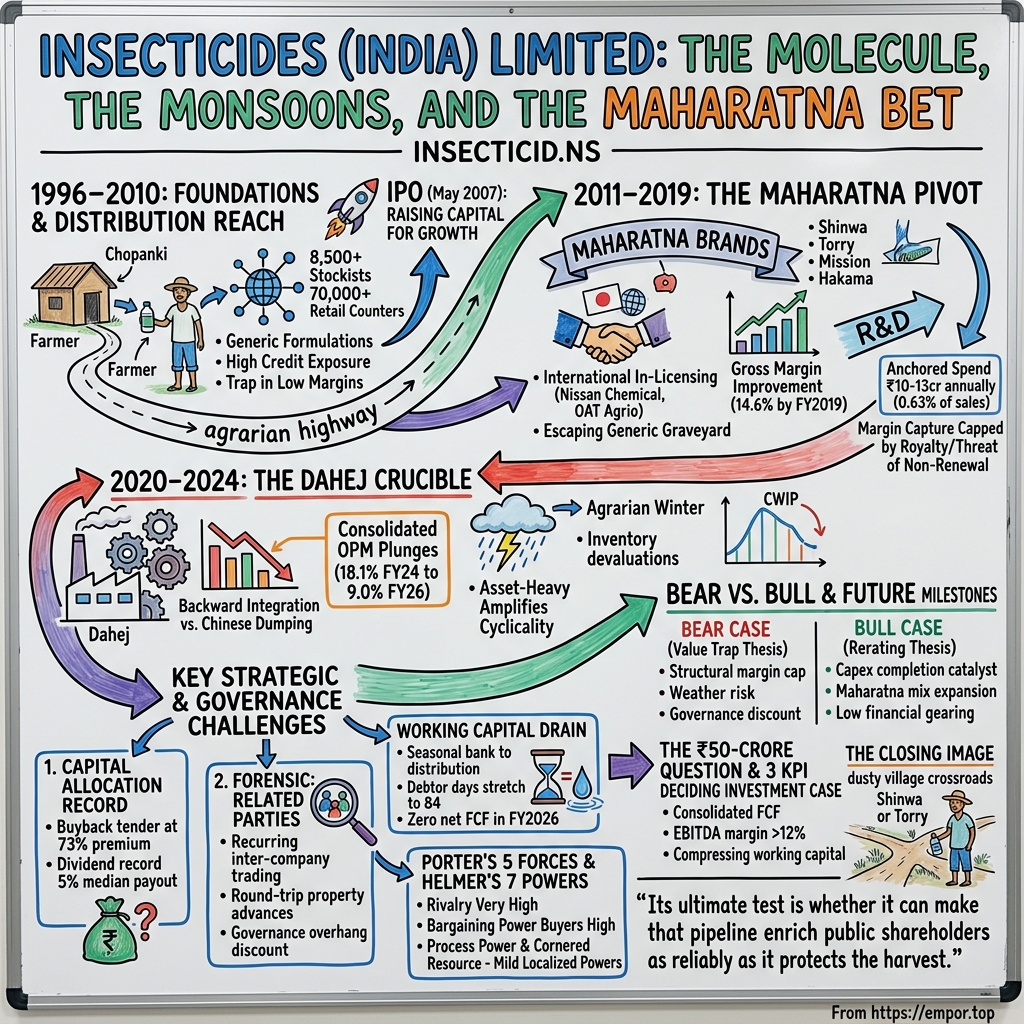
Insecticides (India) Limited: The Molecule, the Monsoons, and the Maharatna Bet
I. Introduction & Episode Roadmap
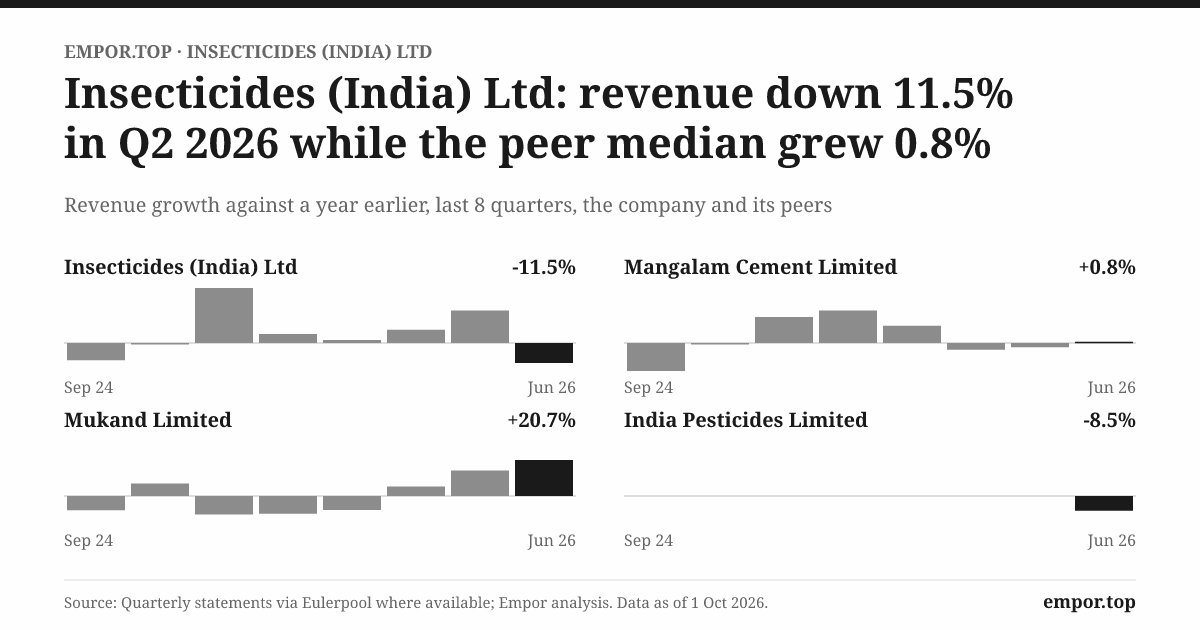
It is the second week of August 2026, and the conference line is full. Analysts dial in from Mumbai and Delhi to hear how one of India's quieter crop-protection companies got through the start of the Kharif season. The management team has a good story to tell. Its premium "Maharatna" brands now make up roughly two-thirds of what it sells.2 The numbers on the screen tell a less comfortable story. Revenue for the June quarter fell about 11.5% from a year earlier, and operating profit fell by about a quarter.12 The rains came late across Central and Western India, and when farmers cannot spray, nobody buys spray.
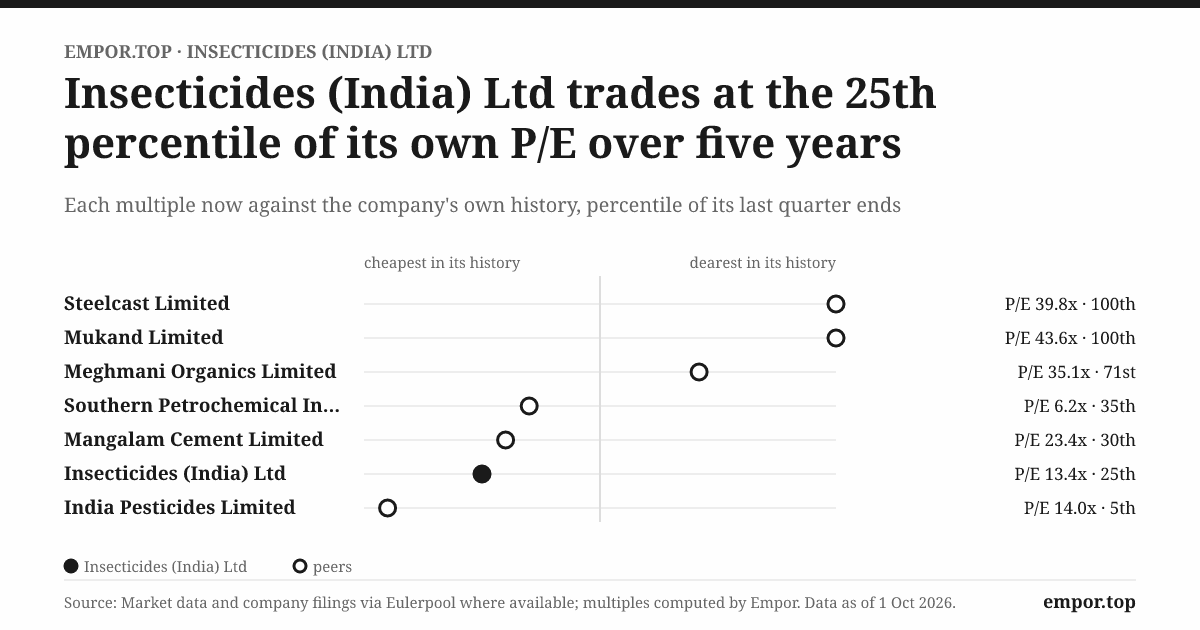
That call captures the whole company in one sitting. Insecticides (India) Limited, known in the industry as IIL, is a ₹1,679 crore (about $174 million) agrochemical maker.9 It sells insecticides, herbicides and fungicides through more than 8,500 distributors who reach over 70,000 retail counters across rural India.1 Over the past decade it has tried to turn itself from a packager of generic, off-patent pesticides into a company that sells branded and in-licensed formulations, many of them built on molecules discovered by Japanese chemical companies. On October 1, 2026, the market prices that effort at about 13.4 times trailing earnings.9 That is below the company's own five-year median of about 15 times, and well below the multiples usually given to branded peers such as Dhanuka Agritech and Rallis India.1112
The discount has a cause, and the cause is cash. Over the twelve fiscal years from FY2015 to FY2026, IIL reported about ₹1,096 crore of cumulative net profit and generated about ₹1,027 crore of cash from operations, a conversion rate of roughly 94%.1 Over a full cycle, then, the profits are real. Any single year can look very different. In FY2026 the company booked about ₹139 crore of net profit, but operating cash flow came to only about ₹101 crore, and after capital spending free cash flow was essentially zero.1 Distributors owed more money at year-end. New plants absorbed what remained.
So this story is built around three questions.
The margin question. Can the move toward proprietary and in-licensed Maharatna products keep operating margins above roughly 12%, or will Chinese price cuts on active ingredients and raw-material inflation hold them in single digits?
The cash question. When the multi-year building programme at Dahej in Gujarat and Sotanala in Rajasthan winds down to maintenance spending, will reported profit finally turn into dependable free cash flow?
The governance question. Does a family-controlled company that trades with businesses run by close relatives, and that bought back its own shares at ₹1,000 when they now trade at ₹577, allocate capital in the interest of minority shareholders?89
The path runs from a formulations business in the agricultural north, to licensing partnerships with Japanese chemists, to a large backward-integration bet that ran straight into Chinese oversupply. It then goes through the balance sheet line by line, and ends at the village shop where all of this either works or does not. The first stop is the moment a family business decided that what Indian farmers really buy is availability and credit, delivered through a dealer they trust, more than any particular chemical.
 Subscribe on LinkedIn
II. The Agrarian Highway: From Chopanki Shed to 8,500 Counters (1996–2010)
Picture a paddy field in Haryana in late July. Planthoppers have arrived, and a farmer has roughly two days before the damage becomes permanent. He does not compare molecular structures or read registration certificates. He walks to the shop at the crossroads, asks the dealer what works, and asks whether he can pay after harvest. The dealer's recommendation and the dealer's credit decide which bottle goes home with him.
Insecticides (India) Limited was built to serve that moment. The company was incorporated in Delhi in 1996, as its corporate identity number records.1 Through its history it has been led by two members of the Aggarwal family: Hari Chand Aggarwal, the Chairman, and Rajesh Kumar Aggarwal, the Managing Director.1 Its early business followed the usual pattern for Indian crop protection. The company bought active ingredients made by other firms, mixed them into sprayable products, packed them, and pushed them through a growing network of dealers in the wheat and paddy belts of the north.
To see why that model works and where it stops working, it helps to understand the two layers of the industry.
Technicals are the raw active chemicals, the molecules that actually kill an insect or a weed. Making them is chemical manufacturing: reactors, solvents, effluent treatment, environmental clearances, and prices set by the global commodity market, which increasingly means Chinese producers.
Formulations are what the farmer buys. The technical is diluted and combined with surfactants and other additives into a liquid, powder or granule that can go into a spray tank. Formulation is closer to consumer goods: branding, packaging, registration and, above all, distribution.
Formulation is easy to enter. Once a molecule's patent expires, dozens of companies can register a generic version. That makes the pricing power of a pure generic formulator weak. Its real assets are the dealer relationships and the willingness to carry inventory and extend credit through the season. The cost of that willingness shows up when the monsoon fails. Dealers cannot sell, they delay payment, and the formulator ends up financing the whole chain.
The company listed on the BSE and NSE on May 30, 2007, after filing its draft prospectus with SEBI in December 2006.110 The IPO capital paid for the first steps toward making technicals in-house, and for expansion beyond the north into Gujarat, Andhra Pradesh and other farming states.
Measured by growth, the model worked. By FY2016 revenue was about ₹988 crore, and over the following decade it compounded at about 9% a year to roughly ₹2,140 crore in FY2026.1 The dealer network now covers more than 8,500 stockists and 70,000 retailers.1 No single customer accounts for even 10% of revenue.1
The early growth, however, came from reach and from extending working capital, not from chemistry. Before its branded pivot IIL had no product that a competitor could not copy, and it had no pricing power to speak of. In FY2016 the operating margin was about 5.5%.1 That is the income of a business that moves goods well, not one that owns anything scarce. The distribution network was valuable, but competitors could build the same thing, and every rival did, with the same credit terms.
For investors, the base rate matters: this company has grown at a high single-digit pace for about ten years. Any forecast that relies on much faster growth needs a new explanation. Management offered one in the early 2010s: give the dealer something worth recommending.
III. The "Maharatna" Pivot: Escaping the Generic Graveyard (2011–2019)
"Maharatna" means "great jewel." The Indian government uses the word for its largest state-owned companies. IIL chose it for its premium product range. The choice tells you what the family wanted. They did not want to be one more generic label on a crowded shelf. They wanted the dealer to point to a brand.
The problem was that IIL did not discover molecules. Discovering a new agrochemical active takes many years and very large sums, which is why most new molecules come from global innovators such as Bayer, Syngenta, Corteva, BASF, and a group of Japanese companies including Nissan Chemical and OAT Agrio. IIL went to them as a distributor: a company with Indian product registrations, field sales staff and thousands of dealer relationships that could take a Japanese molecule to Indian farmers quickly.
The portfolio built through those partnerships now includes brands such as Shinwa, an insecticide co-developed with Nissan Chemical; Torry, a corn herbicide; Hakama; Hercules; and co-marketed Corteva products including GRANUVIA and Spinoace.1[^12] The relationship with OAT Agrio became formal ownership through OAT & IIL India Laboratories Private Limited, a joint venture in which IIL holds 20% and which is accounted for under the equity method.1 IIL also owns a small stake in the listed Japanese partner and received about ₹0.26 crore of dividends from it in FY2026.1 That is a small amount, but it shows the relationship is more than a sales contract.
The mix shift was real. Management says Maharatna and "Focus Maharatna" products rose from about half of sales roughly three years earlier to about 64% by Q1 FY2027.2 In the strong year of FY2019 the operating margin reached about 14.6%, against about 5.5% three years earlier.1 For a while, branding appeared to have solved the commoditisation problem.
The falsification test
The claim that IIL is becoming an innovation-led specialty chemicals company needs testing against its own spending. In FY2026 total R&D spending was about ₹13.4 crore, roughly 0.6% of revenue, made up of about ₹10.5 crore of expense and ₹2.85 crore of capital spending across its Chopanki, Shamli and Dahej facilities.1 Global discovery companies typically spend high single digits of revenue on R&D. IIL spends less than one percent.
The pieces that look like new ventures are small as well. IIL Biologicals Limited was incorporated in July 2022 to make biological crop-protection products, and it is still immaterial to consolidated results.1 Kaeros Research Limited, an R&D and business-to-business formulations unit, was bought from the promoter family in December 2024 for ₹2 crore.1
Taken together, the record narrows the claim. IIL is a branded commercialisation company that depends on molecules it does not own. That model is legitimate and can be profitable; Dhanuka has followed a similar approach for years. Still, the brand premium is limited by royalties, co-marketing terms, the remaining life of patents, and the chance that a licensor someday chooses another distributor or enters India directly. The company does not publish the expiry dates or renewal terms of its main licences, so investors cannot measure how long the premium is secure. The best evidence that the model is holding would be a rising Maharatna share that also lifts consolidated margins. That has not yet happened. The share kept rising after FY2024 while margins fell, and the next section explains why.
IV. The Dahej Crucible: Backward Integration Meets Chinese Dumping (2020–2024)
In late 2021 the global chemical supply chain was in disorder. Chinese factories faced power rationing and environmental shutdowns, shipping costs had multiplied, and Indian formulators who relied on imported technicals could not be sure they would receive them. For a company that sells on availability during a 48-hour pest outbreak, an empty warehouse is the worst possible outcome.
The industry responded by building plants, and IIL did the same. It expanded technical synthesis at Dahej in Gujarat and started a new facility at Sotanala in Rajasthan.13 The logic was straightforward. Making your own actives secures supply, captures the margin that used to go to the supplier, and protects against future disruption.
The timing worked against it. After the pandemic, distributors around the world had overstocked. Chinese technical producers, who had also added capacity, cut prices sharply to raise cash. Indian companies that had bought or built high-cost inventory had to sell into a falling market.
IIL's figures show the effect. In FY2023 revenue grew about 20% as product was loaded into the channel, but net profit fell about 41% to roughly ₹64 crore.1 The company sold more and earned less, which is what happens when inventory costs are high and selling prices are falling. Operating cash flow turned slightly negative that year.1
The recovery that followed was uneven. Reported data shows a sharp jump in FY2024, followed by an operating margin of about 9.7% in FY2025 and 9.0% in FY2026.1 (The data provider's FY2024 operating figure, about 18%, sits awkwardly next to its own EBITDA line for that year. The company's quarterly results from that period show that much of the strength came in a single September quarter, so the 18% should not be read as a normal year.) Capital work in progress peaked at about ₹156 crore in FY2025 and had fallen to about ₹119 crore by March 2026 as Dahej assets entered service.1 Net property, plant and equipment rose from about $37 million in FY2019 to about $54 million in FY2026.1
What the calls revealed
The live discussion on the calls was more revealing than the annual report. On the Q4 FY2026 call in June, management emphasised the rising branded share and the completion of the capex programme.3 By August the conversation had changed. Analysts asked why a business with nearly two-thirds of sales in premium brands was still falling with the weather. Management's answer was the honest one: delayed rains in Central and Western India had shortened spraying windows and slowed dealer buying.2 No branding can make a farmer spray a field that has not been sown.
The conclusion follows. Backward integration did protect supply during the shortage. It also turned a supplier's price risk into IIL's own fixed costs: plants, staff and depreciation that continue whatever happens to technical prices. When Chinese prices collapsed, an integrated producer suffered twice, once on its own technical margins and again through inventory losses. In this industry, heavy manufacturing assets amplify the cycle more than they cushion it. The point at which that changes is when the plants run at high utilisation through a normal season, which neither the company nor the market has yet seen.
That leaves a cash question: with profits under pressure and capital spending high, what did management do with the cash it did have?
V. The ₹50-Crore Question: Capital Allocation, Related Parties, and the Trust Handover
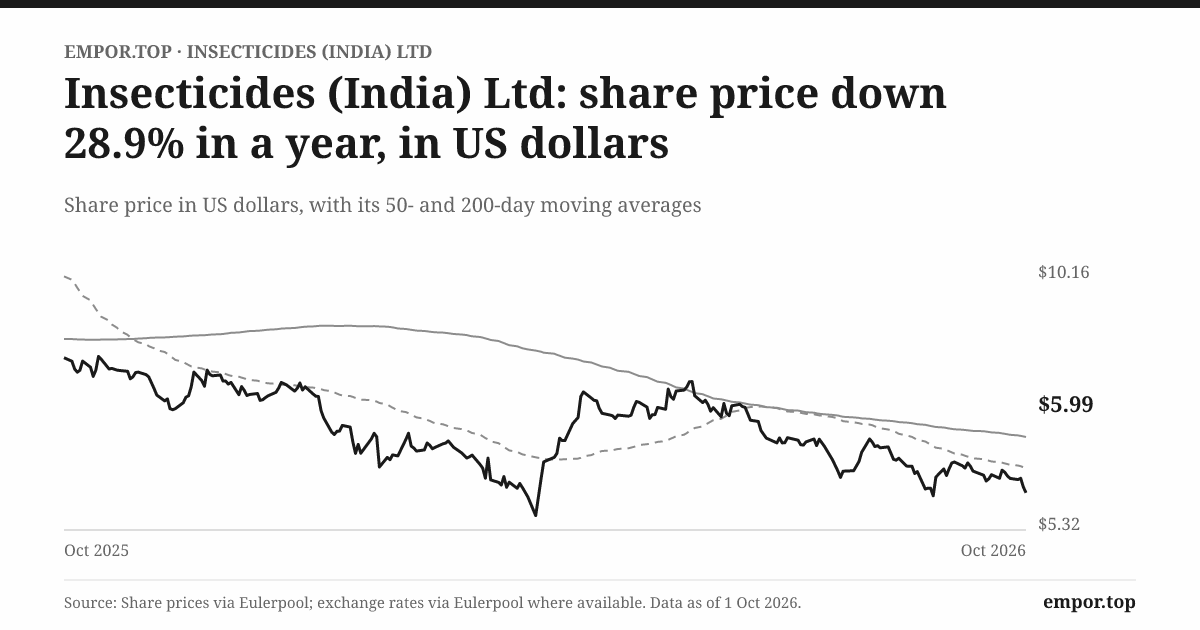
On August 30, 2024, IIL's board approved a tender-offer buyback of 500,000 shares at ₹1,000 each, about ₹50 crore in total, or roughly 1.7% of the company's equity.8 The offer closed in October 2024 and the share count fell to 29,097,837.18 Two years later the shares trade at ₹577.9 In hindsight the company paid about 73% more than today's price for those shares, and it spent the money just before free cash flow dried up.
The buyback record
Hindsight can be unfair, so it helps to look at the whole record. This was not the first buyback. In 2021 IIL had bought about 936,000 shares on the open market for roughly ₹49 crore.1 In October 2022 it issued bonus shares at one for every two held, capitalising about ₹9.9 crore of reserves.1 Over twelve years, cash dividends totalled only about ₹77 crore, around 16% of cumulative free cash flow, with a median payout of about 5% of profit. The FY2026 dividend yield is about 0.3%.19
This shows a preference. Tender buybacks, in which the promoter family can choose not to tender, raise the family's percentage ownership without any cash outlay by the family. Paying dividends would share cash evenly with every shareholder. Promoters hold about 72%.5 A buyback does not take value from minorities if the price is below intrinsic value. The 2024 price, set at what turned out to be a cyclical high, makes that hard to argue. The fairest judgement is that the 2024 buyback looks like poor timing rather than abuse, and that the pattern of small dividends and large buybacks suits the controlling shareholder.
The family's other businesses
The related-party disclosures need closer reading. In FY2026 IIL sold about ₹33 crore of goods to companies run by close relatives of the promoters: Crystal Crop Protection (about ₹26 crore), HPM Chemicals & Fertilizers (about ₹6 crore) and Indogulf Cropsciences (about ₹2 crore).1 It bought about ₹47 crore of materials and traded goods from Crystal Crop and HPM.1 All three are agrochemical companies that compete for the same dealers' shelf space.
In scale this is modest: about 1.6% of revenue on the sales side and under 4% of materials consumed on the purchase side.1 The joint auditors describe the transactions as at arm's length.1 It is still unusual to buy from and sell to relatives' firms that compete with you for the same customers.
Other items add to the concern. IIL pays rent of about ₹2.5 crore a year to promoter entities, ISEC Organics and Smt. Pushpa Aggarwal.1 In FY2026 it advanced about ₹2.8 crore to ISEC Organics against immovable property and was repaid within the year, after a similar round-trip advance of about ₹2.5 crore in FY2025.1 The Kaeros Research purchase from family members in December 2024 was small at ₹2 crore.1 CSR spending of about ₹6.1 crore went through the promoter-governed IIL Foundation.1
None of these items is large. Together, they show a company whose borders with the family's other interests are porous.
Pay and succession
In FY2026 the Managing Director, Rajesh Kumar Aggarwal, earned about ₹5.15 crore and the Chairman, Hari Chand Aggarwal, about ₹5.21 crore. Both figures were lower than the year before.1 Together they equal almost 8% of consolidated net profit, and each is about 130 times the median employee's pay.1 The reductions show some restraint. The level is still high for a company of this size.
The succession plan was carried out through a trust. Under an exemption from SEBI's takeover regulations, the family moved about 18.8 million shares, around 65% of the company, by gift into a private family trust with Hari Chand Aggarwal as first trustee.113 In May 2026 Mrs. Nikunj Aggarwal stepped down as Whole-Time Director, and Sanskar Aggarwal of the third generation joined the board in that role. Shareholders approved the appointment with about 99.9% of votes cast at the August 2026 AGM.14 Promoter shares carry no pledges.5
Formal governance passes. The audit opinion was unmodified, the CARO report raised no issues, and resolutions passed with more than 99.8% support.14 Those approval numbers mostly reflect the family's 72% stake, so they are weak evidence of minority endorsement. Governance at IIL meets the legal standard. The open question is whether it earns the multiple, and the answer depends on whether the cash eventually comes back to shareholders.
VI. The Balance Sheet Under the Microscope: Profit Into Cash, Receivables, and Working Capital Days
On March 31, 2026, IIL closed its books on a year with about ₹139 crore of net profit.1 The cash flow statement shows where most of it went. Trade receivables rose by about ₹101 crore during the year.1 Inventory fell by about ₹106 crore, which released cash, but capital spending used up most of what was left. Operating cash flow was about ₹101 crore and free cash flow was about ₹0.13 crore, effectively zero.1
A seasonal bank
The best way to understand IIL's balance sheet is to think of the company as a seasonal lender with a chemical plant attached. Before each season it buys and makes product, ships it to dealers on 60 to 90 days of credit, and waits for farmers to harvest and pay the dealers.1 When the rains are normal, the loop closes. When they fail, product sits in dealer stores and the receivables age.
The twelve-year cash record shows this pattern. Operating cash flow was negative in FY2015, FY2019 and FY2023, then surged in FY2020 and FY2024 as working capital unwound.1 Over the full period profit and cash roughly match, so the accounting is not inflating anything. Year to year, though, cash is driven by the weather.
At the end of FY2026, debtor days had risen to about 84, from about 56 two years earlier.1 Inventory days fell to about 169 from about 234, and the cash conversion cycle was about 156 days.1 Put simply, the cycle from buying raw material to collecting from the dealer takes about five months.
How old the receivables are
Gross receivables at year-end were about ₹515 crore, with a credit-loss allowance of about ₹28 crore, leaving about ₹487 crore net.1 Of the gross figure, roughly ₹301 crore was not yet due and about ₹100 crore was less than 90 days overdue, which is normal for the business.1 About ₹63 crore was 90 to 180 days overdue, about ₹19 crore was overdue by six months to a year, and about ₹30 crore was more than a year overdue. The oldest ₹20 crore, more than two years overdue, is fully provided for.1
The provision rose by about ₹4.5 crore in FY2026 after a ₹5.6 crore increase the year before, while actual write-offs were almost nothing.1 The company is reserving for bad debts as they age rather than writing them off when a dealer fails. That is conservative, but rising provisions in two consecutive years show that collection quality is getting worse at the margin. Revenue is recognised at dispatch, so there are no contract assets. Price-protection and returns allowances to dealers, which matter during price wars, are not separately disclosed.
Currency and debt
IIL imports much of its raw material in dollars and exports only about 5% of revenue, roughly ₹108 crore.1 The company estimates that a 1% fall in the rupee would reduce pre-tax profit by about ₹1.2 crore, up from about ₹0.4 crore a year earlier.1 That is manageable but growing. Gross bank debt was about ₹144 crore against about ₹87 crore of cash, so net debt was about ₹57 crore. Interest coverage is about 11 times.1 Contingent liabilities fell to about ₹15 crore after a ₹50 crore subsidiary comfort letter was released.1 CRISIL reaffirmed its A+/Stable rating in September 2026.67
The balance sheet is therefore safe without being productive. Solvency is not the risk. The risk is that every rupee of growth requires about four months of working capital, and the company has not shown it can shorten that period.
VII. Porter's Five Forces, Helmer's 7 Powers & Strategic Moat Analysis
Picture the retail counter in a district town in Madhya Pradesh during Kharif. Salespeople from UPL, Bayer, Dhanuka, Syngenta and IIL are all asking the same dealer for the same shelf. Each brings credit terms, volume rebates and incentive schemes, sometimes including trips abroad. The dealer listens to all of them and stocks whatever earns him the most and turns over fastest.
That scene describes the industry's structure better than any market-share chart.
Porter's Five Forces
Buyer power: high. IIL's customers are fragmented, and no single one reaches 10% of sales.1 Each dealer still holds considerable power locally. If IIL will not match a competitor's 60 to 90 days of credit, the dealer simply stocks another brand of the same generic molecule. Rising debtor days are the evidence of that power.
Supplier power: moderate to high. Materials consumed came to about ₹1,200 crore in FY2026, much of it dependent on Chinese intermediates.1 Licensors such as Nissan Chemical and OAT Agrio control the patents behind the highest-margin brands.
Threat of entry: low to moderate. Registration with India's Central Insecticides Board takes years, and building a compliant synthesis plant costs hundreds of crores. These barriers protect technical manufacturers more than formulators.
Substitutes: moderate. Biologicals and integrated pest management are growing slowly. Chemical spraying remains the default for protecting commercial yields.
Rivalry: very high. Multinational subsidiaries, integrated domestic companies such as UPL and PI Industries, and branded formulators such as Dhanuka and Rallis, as well as the family's own Crystal Crop, all compete at the same counter.1112
Helmer's 7 Powers
Scale economies: weak. IIL does not have UPL's global purchasing scale or PI Industries' position in custom synthesis.
Network effects: none.
Counter-positioning: none. In-licensing is the standard strategy across the industry.
Switching costs: weak. Farmers switch brands on the dealer's advice.
Branding: moderate. Shinwa and Torry are recognised, but loyalty attaches to the molecule rather than to IIL.
Cornered resource: moderate and temporary. Exclusive Indian licences work like a cornered resource until they expire or are renegotiated.
Process power: moderate. The company has decades of formulation know-how and runs six manufacturing locations.
The returns show the result. Return on capital employed was about 15% in FY2026, close to its ten-year norm, and return on equity was around 10–12%.1 Dhanuka is commonly reported at roughly 25% returns on capital.11 IIL earns somewhat more than its cost of capital, enough to be a sound business, but not enough to indicate a durable moat. Its real advantage, the distribution network together with temporary licences, is something rivals with similar resources can also build. That shapes the lessons of the story.
VIII. Playbook: Business & Investing Lessons
Lesson 1: A licence is a lease on someone else's moat. IIL's best brands rest on molecules discovered in Japan. Each renewal negotiation with a licensor is a reminder of who owns the asset. A branded share of about 64% looks like a moat, but it is held on terms someone else sets. "If you don't own the patent, your brand premium is rented cash flow with an expiry date."
Lesson 2: Steel turns volatility into fixed costs. The Dahej expansion was justified by a supply shortage and then met a supply glut. Backward integration replaced the risk of a supplier's price with the burden of the company's own fixed costs, at the worst point in the cycle. "Building a plant to insure your supply chain turns someone else's price swing into your own depreciation."
Lesson 3: In Indian agriculture, the real cost of growth is working capital. Profit is booked when the bottle leaves the warehouse. Cash arrives when the farmer sells the crop. In between, IIL carried close to ₹500 crore of dealer receivables. "The P&L counts the sale at the factory gate; the balance sheet waits for the harvest."
Lesson 4: Buyback timing reveals what management believes about the cycle. In October 2024 the company spent ₹50 crore buying shares at ₹1,000 after a strong year, and then watched free cash flow fall to zero. "A premium buyback at peak margins often confuses a good season with intrinsic value."
Lesson 5: Trading with relatives' competing firms creates a discount the market will not remove. Even if every transaction with Crystal Crop and HPM is priced fairly, the public market cannot verify that from outside, so it applies a discount. "Arm's length on paper still means a family dinner across the shelf."
IX. Bear vs. Bull Case & The Skeptical Investor Stress Test
Imagine two fund managers in a Mumbai meeting room. One has IIL at about 13 times earnings and about 7 times EBITDA on the screen.9 The other has Dhanuka at roughly twice that multiple.11 The first argues that free cash flow is about to jump. The second points to the debtor days.
The activist's challenge
A sceptical shareholder would make three demands. First, cut dealer credit: 84 debtor days and about 104 working-capital days are too much capital for a formulator whose rivals turn their capital faster.1 Second, stop premium tender buybacks and raise the dividend payout from about 4% toward the levels typical of peers.1 Third, limit trading with Crystal Crop, HPM and Indogulf, and end advances to ISEC Organics.1 None of these requires new strategy. Each requires the family to give up some convenience.
The bull case
Management has guided that growth capex will finish with Sotanala in FY2027, after which annual capital spending falls to maintenance levels of ₹30–40 crore.2 If operating cash flow returns to its long-run relationship with profit, annual free cash flow in the low hundreds of crores becomes plausible. Against a market value of about ₹1,700 crore, that would make the current multiple look low. The balance sheet carries little debt, the credit rating is A+, and the PEG ratio of about 0.4 reflects the low starting base.79 The rising branded share is evidence that the shelf is improving.
The bear case
CRISIL expects margins to soften to 8–10% in FY2027, and the Q1 shortfall shows that weather still overrides product mix.27 Each weak monsoon requires more dealer credit, so in any year profit can again fail to become cash. Promoter control of 72%, related-party trading and the trust structure suggest the governance discount will persist.5
Weighing it
On the company's own record, management's capex guidance is a reasonable claim that has not yet been tested. Free cash flow has been inconsistent for a decade, and the plants have never run through a normal year with spending at maintenance levels. The current valuation already assumes the margin story is unproven. For the stock to deserve a peer multiple, IIL would need several years of positive cash flow that leaves the balance sheet looking much as it does now.
The three numbers that matter
- Free cash flow. About ₹0.13 crore in FY2026, down from about $6.6 million in FY2025.1 The test is whether it rises above ₹100 crore after Sotanala is complete.
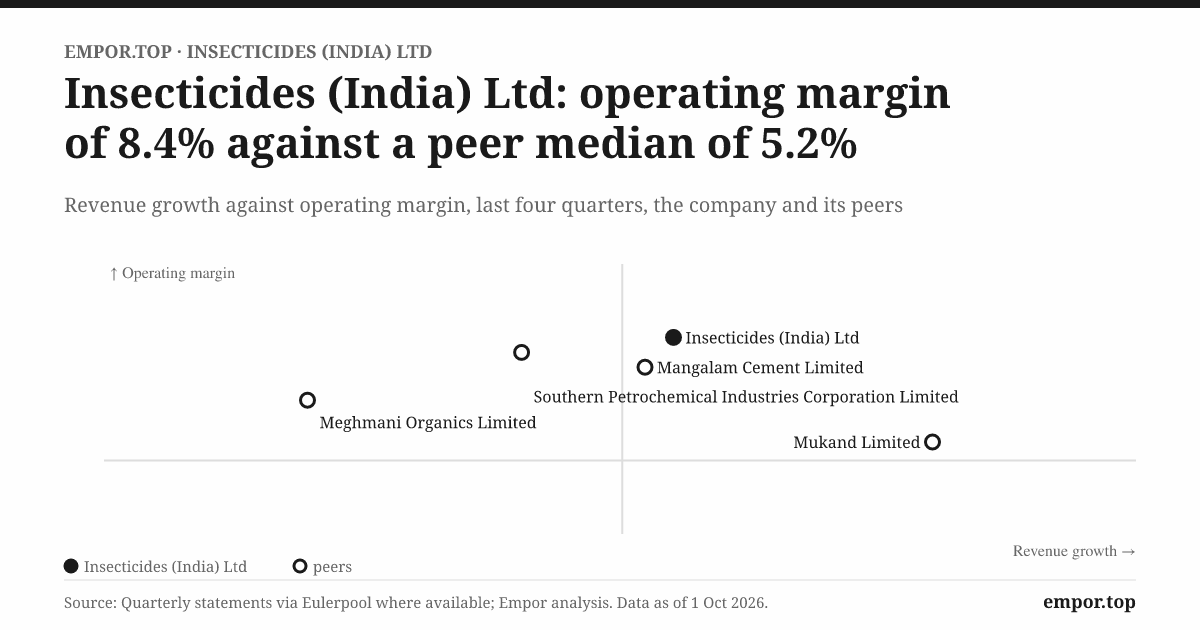
- Operating margin. About 9.0% in FY2026 and about 9.5% in Q1 FY2027, down from the FY2024 peak.1 The test is whether it holds above 12% across a full season.
- Debtor days. About 84 in FY2026, up from about 56 two years earlier.1 The test is whether they fall below 70.
X. Epilogue
As of October 2026, Insecticides (India) is nearly finished with five years of construction. The Dahej synthesis plants are running, Sotanala is close to commissioning, and the dealer network reaches farms across the country.2 On paper the company can generate more than ₹2,100 crore of revenue.1
The next few results will decide the story. The Q2 FY2027 numbers, covering the main Kharif spraying months, will show whether the delayed rains merely pushed demand later or reduced it. They will also show whether receivables are being collected or whether more provisions are needed. The FY2027 cash flow statement will test management's capex guidance: if capital spending falls to ₹30–40 crore and working capital stabilises, the cash question will finally have a positive answer. If capital work in progress stays high, it will not.
Then there is the third generation. Sanskar Aggarwal joined the board just as the family's control moved into a trust, at a time when global agrochemicals are consolidating, environmental rules in Gujarat are tightening, and Chinese pricing remains unpredictable.4 The way the new generation handles related-party trading and capital returns will show the market whether the governance discount reflects lasting behaviour or simply the habits of the generation now stepping back.
The underlying tension remains. IIL makes an essential product for millions of farmers. It still depends on the monsoon, on Chinese chemical prices and on its own balance sheet.
XI. Outro
Back at the Haryana crossroads during Kharif, the farmer walks past shelves of green, red and blue bottles and picks up a pack of Shinwa. He knows nothing about the reactors at Dahej, the licence agreement with Tokyo or the family trust in Delhi. He knows that planthoppers are in his paddy, that the dealer will give him 90 days, and that the product in the bottle works.
Insecticides (India) has already done the hardest thing in rural commerce: it has built a channel that puts its bottle in that farmer's hand. What remains to be seen is whether the same channel can make its public shareholders as reliably richer as it makes the harvest safer.
References
-
Annual Report 2025-26 — Insecticides (India) Limited, 2026-07-18 ↩↩↩↩↩↩↩↩↩↩↩↩↩↩↩↩↩↩↩↩↩↩↩↩↩↩↩↩↩↩↩↩↩↩↩↩↩↩↩↩↩↩↩↩↩↩↩↩↩↩↩↩↩↩↩↩↩↩↩↩↩↩↩↩↩↩
-
Transcript of Q1 FY27 Earnings Conference Call — Insecticides (India) Limited, 2026-08-11 ↩↩↩↩↩↩↩
-
Transcript of Q4 & FY26 Earnings Conference Call — Insecticides (India) Limited, 2026-06-03 ↩↩
-
Voting Results and Scrutinizer's Report of 29th AGM — Insecticides (India) Limited, 2026-08-13 ↩↩↩
-
Shareholding Pattern as on June 30, 2026 — Insecticides (India) Limited, 2026-07-16 ↩↩↩
-
Intimation of Review of Credit Rating — Insecticides (India) Limited, 2026-04-16 ↩
-
CRISIL Ratings Rationale: Insecticides (India) Limited — CRISIL Ratings, 2026-09-26 ↩↩↩
-
Letter of Offer for Buyback of Equity Shares — Insecticides (India) Limited, 2024-09-13 ↩↩↩
-
National Stock Exchange of India Company Profile: INSECTICID — NSE India ↩↩↩↩↩↩↩
-
BSE India Company Profile: Insecticides (India) Ltd (532851) — BSE India ↩
-
Dhanuka Agritech Limited Company Financials & Filings — NSE India ↩↩↩↩
-
Rallis India Limited Company Financials & Filings — NSE India ↩↩
-
SEBI Informal Guidance / Takeover Exemption Order on Aggarwal Family Trust — SEBI, 2025-03-20 ↩
 LinkedIn
 WhatsApp
 Reddit
 Hacker News
 Email
Email Kindle
 RSS Feed
 Spotify
 Apple Podcasts
 Amazon Music
 Audible
 YouTube