Influx Healthtech: The Behind-the-Scenes Manufacturing Machine of India's Wellness Boom
I. Introduction: The B2B Formula of Wellness (00:00 – 00:08)
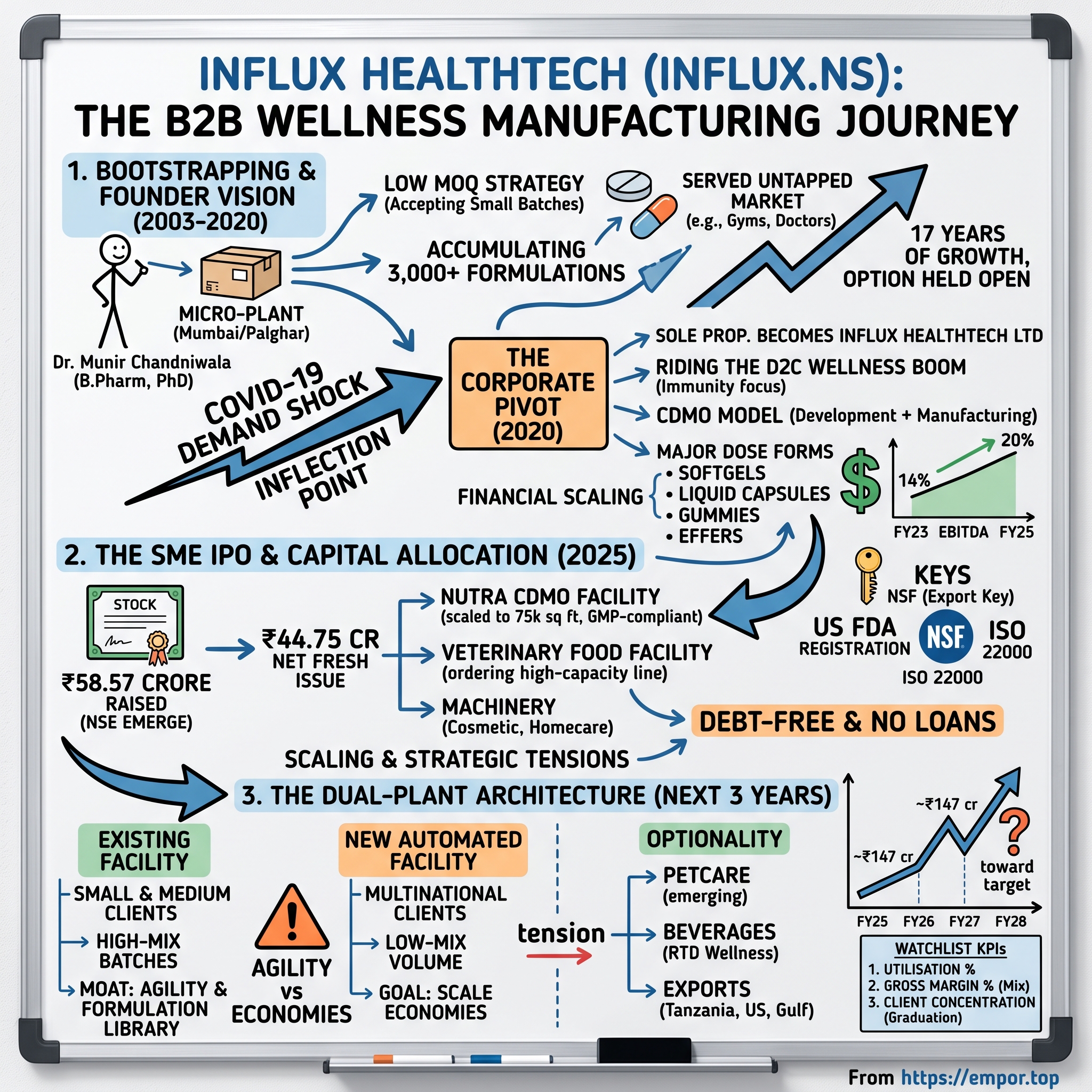
Drive ninety minutes north of Mumbai, past the last of the suburban sprawl and into the industrial estates of Palghar district, and you arrive at a cluster of buildings that no consumer has ever heard of. There is no brand on the gate that anyone would recognise from an Instagram ad. There are no influencers filming reels in the corridor. What there is, inside, is a granulation line producing 480 kilograms of tablet blend a day, a high-speed encapsulation machine rated at 122,000 capsules an hour, a sachet line running 32,000 units a shift, and a gummy line turning warm gelatin slurry into cheerful bear-shaped vitamins.4
On a Friday afternoon in May 2026, the man who owns most of this operation dialled into a conference call to tell public shareholders that the business had just grown revenue 40% to roughly ₹146.8 crore, delivered EBITDA of ₹29.9 crore at a 20.3% margin, and pushed net profit up 54% to ₹20.5 crore.1 Eleven months earlier, almost nobody outside a narrow circle of Indian supplement brands had heard of Influx Healthtech Limited.
This is the part of India's wellness boom that does not get written about. The visible layer is loud and expensive: direct-to-consumer vitamin brands burning venture capital on performance marketing, protein bars in every quick-commerce dark store, ashwagandha gummies advertised by cricketers, "clean beauty" serums with founder stories. The invisible layer is a grid of contract development and manufacturing organisations — CDMOs — that actually make the stuff. Brands like Carbamide Forte, Davaindia, Octavius and Nutriburst do not own factories. They own labels, formulations they commissioned, and customer acquisition funnels. Somebody else owns the tablet press.4
Influx is one of those somebodies. It describes itself as a CDMO serving nutraceuticals, cosmetics, pet care, home care and ayurveda, offering what its founder calls end-to-end service: formulation development, manufacturing, regulatory support, even label design and in-house printing.2 Its clientele runs from multinationals to first-time D2C founders placing a 2,000-unit order. On average, management says, the company launches roughly two new products a day — a claim that sounds like marketing until you look at the product count, which climbed from 3,059 SKUs in FY23 to over 3,700 by the middle of FY26.4
It is worth being precise about what a CDMO is, because the acronym does a lot of concealing. A pure contract manufacturer is a job shop: you hand it your formula and your specification, it runs your batch, it bills you a conversion fee. A CDMO adds the D — development. The customer arrives with an idea ("I want a sleep gummy with melatonin and chamomile that tastes like blackcurrant and costs under twelve rupees a unit") and the CDMO works out what that actually means in chemistry, sourcing, machinery time and regulatory paperwork, then makes it.
The difference matters commercially because it changes who owns the hard part. In pure tolling, the brand owns the intellectual work and the manufacturer competes on price per unit — a race to the bottom. In development-led manufacturing, the manufacturer owns the formulation know-how, the brand owns the label, and the relationship is stickier and better paid. Influx's entire margin structure depends on being on the right side of that line, which is why the mix question recurs throughout this story.
The founder is Dr. Munir Abdul Ganee Chandniwala, a registered pharmacist who started with a micro-plant in 2003 and, twenty-two years later, rang the bell on the NSE Emerge SME platform.5 The question this story tries to answer is not whether that is an impressive personal arc — it plainly is. The question is whether the business underneath it is a durable compounding machine or a well-run job shop riding an unusually good cycle.
Those are genuinely different things, and the distinction matters more here than in most businesses. Influx has no long-term contracts. Its chairman said so plainly on the FY26 call when an analyst asked how long its customer agreements ran: "in our field, we don't have long term contracts."2 It has a single manufacturing location. Its top ten clients account for roughly half of revenue.4 Its entire growth thesis for the next three years rests on one building in Palghar coming online on schedule and then filling up.
There is a further reason to look closely at this particular company rather than at the dozens of similar-sounding SME listings from the same vintage. Influx has held only two earnings calls since listing, and on both of them the chairman answered questions himself, at length, largely without a script. That produces an unusually rich record for a company this small — including several moments where his answers contradicted his own investor presentation, and several more where he volunteered information no investor-relations adviser would have wanted him to.
For an analyst, that combination is more useful than a polished deck. It is also, as this story will argue, a mixed signal in itself.
What follows is the full decode: how a pharmacist's low-minimum-order-quantity survival strategy accidentally became a moat; what the unit economics of gummies, softgels and liquid-filled capsules actually look like; why the switching-cost argument is stronger than the "no contracts" headline suggests but weaker than management implies; and where the bear case has real teeth. We will lean heavily on the two earnings calls the company has held since listing, because they are the only place where management has had to answer unscripted questions — and because on both of them, the answers to some questions did not quite match the numbers in the company's own slide deck.
Start, as these stories usually do, with a young man with a pharmacy degree and no capital.
 Subscribe on LinkedIn
II. Founder's Vision & The Micro-Plant Era (2003–2020) (00:08 – 00:23)
In 2002, Munir Chandniwala graduated with a Bachelor of Pharmacy from the University of Pune and registered with the Maharashtra State Pharmacy Council.5 The obvious path for a newly minted B.Pharm in western India at that moment was clear and well-trodden: join one of the big generics houses, learn the trade, work your way up a hierarchy. India in the early 2000s was in the middle of becoming the pharmacy of the world. Sun, Cipla, Dr. Reddy's and Lupin were building the export machine that would define the decade. A pharmacist with a degree and ambition went into pharma.
Chandniwala did briefly work in the industry, at Griffon Laboratoires, before going in an entirely different direction. In 2003 he set up Influx Healthcare as a sole proprietorship, operating out of a micro-plant.5 Not a factory. A micro-plant — a room with machines, a licence, and a bank of formulations in his head.
Understand what he was choosing. "Nutraceuticals" in 2003 India was not a category so much as a regulatory grey zone. The Food Safety and Standards Act would not exist until 2006, and the FSSAI would not begin meaningfully regulating dietary supplements for years after that. Ayurvedic products sat under a separate, older licensing regime. What passed for contract manufacturing was mostly low-end toll work: someone else's formula, someone else's raw material, your machine, a per-unit conversion fee. It was, in the language of business strategy, about as commoditised as manufacturing gets.
Chandniwala's insight — and it reads more clearly in hindsight than it can possibly have felt at the time — was that being small was a feature in a market where everyone else wanted to be big. The large third-party manufacturers wanted volume. They set minimum order quantities that only established brands could meet. That left an entire population of aspiring brand owners — a distributor with an idea, a doctor with a formulation, a gym owner who wanted his own protein powder — with nowhere to go. Influx said yes to those orders. Small batches, high variety, willing to develop the formulation for you.
It is worth sitting with the economics of that decision, because on paper it looks like a bad one. A minimum order quantity exists for a reason: the fixed cost of a production run — cleaning down the previous batch, calibrating the machine, running trial units until the weight and hardness are right, then cleaning down again afterwards — is roughly the same whether you make five thousand units or five hundred thousand. Accepting small orders means eating that fixed cost far more often per rupee of revenue.
Manufacturers who say no to small orders are not being lazy. They are being rational about asset utilisation. Chandniwala's bet was that the customers nobody wanted today would be the customers everybody wanted in ten years, and that the relationship formed at 2,000 units would still be there at 200,000. That is a bet on the growth rate of your customers, not on your own operating leverage — an unusual thing for a manufacturer to underwrite, and it only pays if the category itself compounds.
For most of the 2000s, it did not obviously compound. Which is why the seventeen years before 2020 are best understood not as a growth story but as a very long option being held open at modest cost.
There is a second, less obvious consequence of that choice. Every time Influx developed a formulation for a tiny client, it kept the know-how. Not the client's brand, not the client's market — the practical, hard-won knowledge of how to make that particular thing without the line jamming. Over two decades, running thousands of small batches for hundreds of customers, the company accumulated a library. By the time it went public it counted over 3,400 products in its portfolio.1 That library was not built by an R&D budget. It was built by saying yes.
Chandniwala kept credentialling himself in parallel. He took a postgraduate management degree at Atharva School of Business in Mumbai between 2004 and 2006, later added an MPhil and a PhD in human resources, and picked up a diploma in nutrition in California in 2019.4 5 The pattern is worth noting for what it says about the man: a technically trained founder who kept deliberately adding the disciplines he did not have. It is also worth noting for what it says about the company's dependence. Twenty-two years in, the FY26 investor deck still listed the MD as the person who "leads business development and daily operations."4
The family stayed close to the business. Shirin Chandniwala, who became a whole-time director, has been described by the company as an integral part of the operation since inception, running financial management and budget oversight; she also became a partner in Shinaf Enterprise, a packaging materials trading firm, in 2012.4 5 Dr. A.A. Chandniwala, a director with over forty years of experience and a background in homeopathic and biochemic medicine, provided the generational link.4 This is, structurally, a family business that later acquired a board.
Two things about the 2003–2020 stretch deserve emphasis for investors, because they shape everything that came after.
The first is that Influx grew for seventeen years without institutional capital, without acquisitions, and without meaningful debt. That is unusual in Indian manufacturing, where the standard growth recipe is a term loan against land and machinery. The discipline shows up in the numbers even now: debt-to-equity was 0.07 in FY23 and 0.01 by FY25, and borrowings were zero by the half-year mark of FY26.4 Chandniwala later described the philosophy on a shareholder call in his own idiom: "in CDMO, we have never taken loans and all such and made a big capacity and run for orders. It's a vice versa."3 Build to demand, not ahead of it.
The second is that the recognition came before the scale. Influx picked up "Best Nutraceutical Company of the Year" in third-party manufacturing in western India in 2015, followed by sports supplement manufacturing awards in 2016 from both CIMS Medica and the World Health & Wellness Congress, and an innovative nutraceuticals award in 2018.4 Industry awards are soft evidence and should be treated as such — they are frequently pay-to-play — but the specificity of "sports supplement manufacturing in western India" tells you where Influx had actually built a reputation by the mid-2010s. It was known, in a narrow trade circle, as the place you went when you wanted something unusual made in a quantity nobody else would touch.
There is a third observation that only becomes visible with the benefit of the later filings, and it complicates the origin myth slightly. The company's own strategic-milestone timeline shows an eighteen-year gap between "entered industry" in 2003 and the first manufacturing units in Palghar in 2021.4 Almost every capability that defines Influx today — the Palghar cluster, liquid-fill capsules, gummies, snacking lines, veterinary — was built after 2020.
So the accurate framing is not that a small business grew steadily for two decades and then listed. It is that a small business survived and accumulated know-how for seventeen years, and then built almost all of its physical capacity in five. The first period produced the formulation library and the customer relationships. The second produced the factory. Investors assessing the durability of the business are assessing the first period; investors assessing execution risk are assessing the second.
That was the position — respected, sub-scale, invisible — when the world changed.
III. The COVID Inflection & The Corporate Pivot (2020–2024) (00:23 – 00:38)
September 2020. India was six months into the pandemic, the first wave was cresting, and an entire nation had suddenly become interested in immunity. Vitamin C, zinc, ashwagandha, chyawanprash — products that had spent decades as marginal purchases moved to the front of the shopping basket. Preventive health stopped being discretionary.
In that same month, Influx Healthcare the sole proprietorship became Influx Healthtech Private Limited.1 The timing was either exceptionally well judged or exceptionally lucky, and from the outside it is impossible to say which. What is clear is that incorporation was the precondition for everything else. A sole proprietorship cannot raise equity, cannot easily attract multinational clients who run vendor due diligence, cannot hold the kind of certifications that export markets demand, and cannot list. The corporate wrapper was the door.
Then the demand shock hit the door. And critically, it did not arrive as a wave of orders from existing pharma clients. It arrived as a wave of new brands.
Here is the mechanism, and it is the single most important thing to understand about why Influx grew the way it did. The D2C model — build a brand online, acquire customers through paid social, ship through marketplaces and quick commerce — has a specific manufacturing requirement that traditional FMCG does not. A traditional FMCG company launches a handful of SKUs a year and sells enormous volumes of each. A D2C wellness brand does the opposite: it launches constantly, because the performance-marketing funnel is hungry and a new SKU is the cheapest new creative. It needs twelve variants of a multivitamin, three formats of the same actives, a gummy version because gummies convert better with younger buyers, an effervescent because it photographs well. Each individual SKU might sell a few thousand units.
That is a nightmare for a high-volume plant and a natural habitat for Influx. The company had spent seventeen years getting good at exactly this: short runs, fast changeovers, a deep formulation library to pull from. What had been a survival strategy in a market that ignored small customers became, almost overnight, the precise capability that the fastest-growing part of Indian consumer goods needed.
Influx moved to capitalise. Manufacturing units for nutraceuticals, cosmetics and ayurveda started up in Palghar in 2021 — the beginning of the consolidation into a single industrial cluster.4 The same year the company installed liquid-fill capsule technology, a genuinely non-trivial piece of process engineering. In 2023 it added snacking and gummy production lines. In 2024 it acquired additional land in Palghar specifically to expand into veterinary foods and began formulation trials.4
It is worth pausing on what those dosage forms actually involve, because the phrase "complex dosage forms" gets used loosely and the difficulty is real.
A standard tablet is compressed powder. It is the Model T of pharmaceutical manufacturing — well understood, forgiving, cheap. A soft gelatin capsule is a sealed shell of gelatin containing an oil or suspension; making it requires precise control of gelatin ribbon thickness, temperature and fill viscosity, and the failure mode is leakage, which ruins an entire batch. A liquid-filled hard capsule is harder still: you are putting a liquid into a two-piece shell that was never designed to hold liquid and then sealing it so it does not weep on a shelf in Chennai in June. A gummy is confectionery pretending to be a supplement — you are trying to hold a precise dose of an active ingredient stable inside a sugar-and-gelatin matrix that wants to crystallise, absorb moisture and degrade the active. An effervescent tablet must be manufactured in a low-humidity environment because the whole point of the product is that it reacts violently with water.
Each of these is a distinct manufacturing discipline with its own machinery, its own environmental controls, and its own catalogue of ways to destroy a batch. Influx built capability across all of them, plus protein bars, powders, creams, gels, oils and soaps.5
The breadth is the point. A brand that wants a tablet, a gummy and a powder version of the same product can get all three from one vendor with one set of paperwork — and, crucially, one supplier audit. For a small brand with no operations team, consolidating dose forms under a single manufacturer is not a convenience; it is the difference between launching three products and launching one.
The other pillar built in this period was compliance. Influx accumulated GMP, HACCP, ISO 22000:2018, ISO 14001:2015, Halal, CE, US FDA registration for food products, NSF certification, and later FSSC 22000 from NSF International Strategic Registration in the USA — valid for three years for manufacturing health, dietary and nutritional supplements.3 4 Nigeria's NAFDAC approval followed. In May 2025 the company received a Grade A+ Exemplar certification from Astraleus Services Private Limited under the GMP audit framework.4
Investors should read that certification stack carefully rather than as a single blob of alphabet soup. Its function is not primarily quality — a competent plant can make a good tablet without any of it.
Its function is access. NSF opens the door to US and European buyers. Halal opens the Gulf and Southeast Asia. NAFDAC opens Nigeria. US FDA food registration is a legal precondition, not a quality award. Each certificate is a key to a specific market, and Influx has been methodically collecting keys. Chandniwala was refreshingly blunt about the commercial logic on the H1 FY26 call regarding African approvals: "It's not compulsory or mandatory, but it's like they will have an edge if you have a Tanzania approval or a Nigerian approval."3
The financial record of this period is the cleanest evidence that the pivot worked. Revenue went from ₹76.1 crore in FY23 to ₹100.0 crore in FY24 to ₹104.9 crore in FY25.6 But look past the top line at the gross margin: 31% in FY23, 35% in FY24, 40% in FY25.4 Revenue grew 38% over two years; gross margin expanded 900 basis points. EBITDA margin followed, from 14.1% to 19.6%.
That combination is the single most informative pair of numbers in the company's history. Growing revenue while expanding gross margin in contract manufacturing means the mix is shifting toward work that is harder to do. If Influx had simply been winning more tolling volume, margins would have been flat or down. They went up, substantially, which is consistent with management's story that the company was moving from making other people's tablets to developing and making complex formats that fewer competitors can produce.
There is a caveat, and it is not small. FY25 revenue grew only 4.9% over FY24 — a near-stall — while margins expanded. Chandniwala later explained the constraint, and the explanation is more credible than a smoother story would have been: the bottleneck was not making things, it was packing them. "Output of machinery of producing tablet capsules was not that challenging, rather than packaging was a major challenge because the products were accumulating."3 Finished goods were piling up behind a packing line that could not keep pace. That is an unglamorous, entirely believable operational failure, and it is the kind of admission that tends to correlate with honest disclosure elsewhere.
A myth worth checking before moving on. The consensus narrative around Influx — repeated in IPO commentary and in the company's own framing — is that COVID transformed the business. The numbers only partly support it.
Yes, incorporation and the demand shock coincided in September 2020, and yes, the category was permanently re-rated by the pandemic. But Influx's fastest revenue growth did not come in the immediate COVID years. It came in FY26, five years later, at 40% — well after the immunity-supplement frenzy had faded.1 FY25, closer to the pandemic, grew under 5%.6
That timing matters, because it points to a different and rather more durable driver. What is powering Influx is not a health scare. It is the structural shift of Indian consumer goods toward asset-light brand building, in which an entire generation of companies has decided that owning a factory is a strategic liability rather than an asset. COVID accelerated the wellness category. It did not create the outsourcing model, and the outsourcing model is what Influx actually sells. A reader who attributes the growth to a pandemic tailwind will expect it to fade; a reader who attributes it to an outsourcing structural shift will expect it to persist. The evidence points to the latter, and it is a meaningfully more attractive setup.
It also explains what the IPO was really for.
IV. Going Public: The 2025 SME IPO & Capital Allocation (00:38 – 00:53)
The Indian SME IPO market in mid-2025 was in a state that regulators had begun to describe, publicly and with some alarm, as frothy. Small companies with modest track records were listing at large premiums to grey-market expectations, retail subscription multiples ran into the hundreds, and the gap between the quality of the business and the quality of the listing pop had become uncomfortably wide.
Influx walked into that market on 18 June 2025. The issue closed on 20 June, allotment was finalised on 23 June, and the shares listed on NSE Emerge on 25 June.6 The structure was ₹58.57 crore in total: a ₹48.00 crore fresh issue and a ₹10.56 crore offer for sale, priced in a band of ₹91 to ₹96 with a lot size of 1,200 shares.6 Promoter holding fell from 99.85% to 73.53%.6
The book was subscribed roughly 183 times.8 The stock listed at ₹132.50 against the ₹96 issue price — a 38.02% first-day gain — and then did something slightly unusual: it opened at ₹132.50 and stayed locked there, with the day's high and low identical, on volume of over 16 lakh shares worth ₹21.6 crore.8 The grey market had been pricing a more modest gain.
None of that tells you anything about the business. Listing pops in the 2025 SME market were a function of allocation scarcity, not fundamental value, and a sophisticated reader should discount them entirely. What does tell you something is where the money was going.
The prospectus earmarked the fresh issue for three specific capital projects rather than for debt repayment or vague "general corporate purposes": approximately ₹22.5 crore to set up a manufacturing facility for the nutraceutical division, ₹11.5 crore for a veterinary food division facility, and ₹2.8 crore for machinery in the homecare and cosmetic divisions, with the balance to working capital and corporate purposes.6 Net of issue expenses, the company took in ₹44.75 crore.1
This is a materially better use of proceeds than the SME cohort average. Influx was not raising money to fix a balance sheet — there was nothing to fix, with debt-to-equity at 0.01.4 It was raising money to build the thing that its own operations had told it was missing: physical capacity to convert demand into shipped product.
The follow-through is where it gets more interesting, and more mixed.
By 30 September 2025, three months after listing, only ₹4.1 crore of IPO proceeds had been deployed into capex, with ₹33.6 crore still sitting in the bank and ₹5.7 crore used for general corporate purposes.3 Chandniwala confirmed the parked funds were held in an RBI account rather than mutual funds — "whenever required, we are taking out from there. We are not keeping in our regular accounts."3 That is conservative treasury management and, for a first-time listed SME, reassuring.
But the plant was late. On the H1 FY26 call, an investor named Damodar Baliga pushed directly on the point: in pre-IPO calls, management had said the new facility would come online by the first quarter — April or May 2026 — and now the guidance was H1. Chandniwala did not deflect. "See, the delay because of rains, definitely there is a delay of one, one and a half month. We do not want to deny that."3 Later in the same call he was more explicit still: "I think we are 1.5 months back, sir. That is very honest with you. We are behind and rain didn't support us, the excavation and all, but we will try to cover it up."3
By the FY26 call in May 2026, the target had moved to July or August 2026 for the facility to be ready, with licensing applications to follow.2 That is roughly a two-to-three month slip against the H1 FY26 statement and more against the pre-IPO version. In the context of Indian industrial construction through a monsoon, a three-month slip is unremarkable. What is notable is the manner of the disclosure: management named the delay, named the cause, did not blame a vendor, and repeated the revised date consistently across two calls. Investors assessing management credibility should weight how a miss is disclosed at least as heavily as the miss itself, and on this one the behaviour was clean.
The more substantive capital-allocation event came in the FY26 disclosure. As of 31 March 2026, ₹13.84 crore of the capex-allocated IPO proceeds had been utilised.2
More importantly, the board approved a reallocation of ₹10 crore — drawn from surpluses across the veterinary, home care and cosmetic division budgets — toward the nutraceutical CDMO facility, which was being scaled up from a planned 35,000 square feet to approximately 75,000 square feet with GMP-compliant design, upgraded HVAC and an enhanced material flow system.2 A variation in the stated use of IPO proceeds requires disclosure to the exchanges, which is how it surfaced.
Management framed the surplus as evidence of good execution: vendor negotiation and a phased, demand-aligned construction approach for the veterinary division had freed up cash.2 That framing is at least partly self-serving. An alternative and equally consistent reading is that veterinary demand did not materialise as fast as hoped, so capital was redirected to where it could actually earn a return.
An analyst from Parekh Family Office put exactly that to Chandniwala: was the reallocation driven by demand weakness in veterinary, or by a bottleneck in nutraceuticals? The answer was candid. "Veterinary as such a business is very small... Right now it is a little bit immature." And on the redirection: "we will be ahead of time investing on the machinery and just keeping it rather than investing on the nutra where we feel we are 100% more confident and the utilization will be much better."2 He closed with the plain version: "in veterinary yes, the industry is growing, but I think nutra is growing faster sir. So that is the strategy behind the reallocation."2
That is the correct capital-allocation decision. It is also an admission that the veterinary thesis, which was a headline plank of the IPO story twelve months earlier, has been pushed out. Both things are true and investors should hold them together.
One governance detail from the FY26 call is worth flagging as a second-layer diligence item rather than an alarm. An analyst noticed that long-term loans and advances had jumped from ₹62 lakh to ₹9.19 crore and asked what it was. Machine advances, Chandniwala replied. She then asked, reasonably, why advances for capital work were not being classified under capital work-in-progress alongside the amount already sitting there. His answer: "I am not sure ma'am I'll ask."2 He followed up with the technically correct treatment — advances are capitalised on delivery — but the exchange showed a chairman answering a balance-sheet classification question in real time without the CFO stepping in. For a company with a market capitalisation in the hundreds of crores and a first-year finance function, this is a depth-of-bench observation worth tracking, not a red flag.
The promoter group retained 73.53% as of March 2026, with domestic institutions at 5.65%, foreign institutions at a token 0.16%, and public shareholders at 20.66% across roughly 1,335 shareholders.9 Heavy promoter ownership is usually presented as alignment, and in the sense that Chandniwala's wealth rises and falls with the share price, it is. It is worth being precise about the limits of that argument, though: 73.53% also means minority shareholders have essentially no ability to influence outcomes, related-party arrangements face limited independent scrutiny, and the float is thin enough that price signals are noisy. Alignment and accountability are not the same thing.
With the money raised and the concrete poured, the question becomes what the machine actually does.
V. The CDMO Engine: Segment Economics & Portfolio Structure (00:53 – 01:13)
Picture the production floor on an ordinary Tuesday. One line is running a private-label omega-3 softgel for a mid-sized pharma distributor. Another has just been cleaned down after a 5,000-unit batch of ashwagandha gummies for a two-year-old D2C brand and is being changed over to a collagen powder for a different customer entirely. A third is producing protein bars — a category where management says demand more than doubled during the year.2 In the corner of the plant, a small pet-food extrusion line is turning out kibble at a rate that would embarrass a serious pet-food company but which represents an entire new division.
That is the shape of the business: high mix, moderate volume, constant changeover. Now the economics.
Nutraceuticals is the whole company, and pretending otherwise is a mistake. The segment generated ₹131.9 crore in FY26, up 40.3%, and accounted for roughly 90% of revenue.1 It has held at approximately that share for years — 92% in H1 FY25, 90% in H1 FY26.4 Management is aware of the optics. On the maiden earnings call, an analyst asked whether the 90% concentration was strategy or accident, and Chandniwala was straightforward: "We are known as a nutra company, because in nutra, our operations are 23 years old and cosmetic we have started in 2019... The idea is to focus on all the segments, because we don't want to be dependent on nutra."3
The stated ambition to diversify is real. The arithmetic makes it very hard. Chandniwala explained the mechanism himself with unusual clarity: because nutraceutical capacity is also doubling, the other segments must grow far faster than nutra just to move the mix a couple of percentage points. "Percentage-wise, it may remain close by to what it is right now, but value-wise, it will grow."3 Investors should therefore treat Influx as a nutraceutical CDMO with option value attached, not as a diversified platform. Any thesis that depends on the mix shifting materially within three years is fighting the maths.
The formulation library is the real asset, but "outsourced R&D" oversells it. Management markets the two-new-products-a-day cadence as innovation, and the SKU count backs the cadence up.3 4 But when an analyst asked directly about R&D spend and team size, Chandniwala gave an answer that a promotional CEO would never give: "we have a team of eight members, qualified members with support staff... there is not much expense in the R&D because we are formulating, we are formulators, we are not innovating any new product and we are not bringing any new molecule."3
That is the truth of it, and it is worth taking seriously in both directions. Influx is not discovering anything. It is recombining known ingredients into new formats and new dose forms, quickly and reliably, using existing raw materials.
The disclosed formulation-and-development spend was ₹39 lakh in FY23, ₹24 lakh in FY24 and ₹4 lakh in FY25 — a rounding error on a hundred-crore revenue base, and declining in absolute terms while revenue grew.4 Anyone building a valuation on the premise that Influx is an R&D-driven business is building on sand.
The defensible version of the claim is narrower and more durable: Influx has process knowledge and speed. Knowing which excipient stops a hygroscopic botanical powder from clumping in a Maharashtra monsoon, or how to keep a liquid fill from weeping through a hard capsule seal, is not patentable and not glamorous. It is also not something a new entrant acquires quickly, because it is encoded in two decades of batch records and in the heads of people who have made the mistake before. That is process power. It is a real advantage. It is just not R&D.
The secondary segments are early, and their growth rates flatter their size. Ayurvedic revenue grew 88.9% to ₹6.1 crore in FY26; cosmetics grew 15.8% to ₹7.4 crore; the "others" bucket of veterinary and home care grew 18.7% to about ₹1.4 crore.1 On a combined basis these three account for roughly 10% of the business. Percentage growth on bases this small should be read as directional information about demand, not as financial contribution.
Cosmetics is the most economically interesting of them, because the margin is better. Chandniwala put nutraceutical gross margin at roughly 30–35%, cosmetics at "around 40% plus," and veterinary and ayurvedic back in the 30–35% band.2 So the mix-shift-drives-margin argument only really works through cosmetics, which grew slower in FY26 than the company average. Management is investing behind it — a new automated line, an aerosol capability, and a brand called SkinInspired 80+ that Chandniwala said Influx manufactures and which he described as ranking first in its niche on Amazon, contributing roughly ₹20–30 lakh a month in peak season.2 The ambition is there. The evidence of a step change is not yet.
Veterinary and pet care is the segment with the widest gap between narrative and current reality. Output stood at 16–18 tonnes a month in May 2026, with near-term capacity heading to 25 tonnes, and the company has ordered a high-capacity extrusion line that would take throughput from 100–150 kg per hour to 1,000 kg per hour — roughly an eightfold increase.2 Chandniwala believes the category is where nutraceuticals were fifteen years ago: "veterinary is right now, how nutra was in 2010-2011. So, next 5-10 years is very amazingly well placed this market."3
He may well be right about the category. He is also competing in it against people with far deeper pockets, and to his credit he said so unprompted: "Reliance has entered into the pet care market. Allana has entered, they are doing 1000 kg per hour, they have booked a machine of 5000 kg per hour."2 By his own arithmetic those competitors would be producing 50,000 kg a day against Influx's 16-18 tonnes a month.
He estimated Influx's share of the total Indian pet market at roughly 1.5%, benchmarked the company against Drools, and admitted, "We must be very small compared to the Indian market completely."2 That is an honest competitive assessment from a chief executive about his own growth story, and it should temper any modelling of veterinary as a near-term profit driver.
The newest bet is beverages, and it comes with a structural quirk. During FY26 Influx incorporated Olahey Wellness Private Limited, a wholly owned subsidiary capitalised with ₹1 lakh, to manufacture ready-to-drink wellness beverages.1 The company is building a canning facility and a carbonated line, has booked a Tetra Pak line, and is targeting roughly 10,000 bottles per hour.2 It has also invested in retort technology, which allows liquid nutrition products — protein shakes in particular — to be shelf-stable, and in what it calls Quick Snap single-dose packaging.2
An analyst asked why the beverage business needed a separate legal entity rather than sitting inside Influx. The answer revealed something about how export markets actually work: "in one city let's say in Nigeria, there is two distributors. And one distributor Influx is doing. I cannot have an NOC for another distributor there. So this company can come into picture and give another NOC to another distributor."2 Chandniwala added a risk-containment rationale: "anything happens to one name then it will reflect to another if in the worst case scenarios. So it will protect each other."2
Both reasons are legitimate. Investors should nonetheless keep an eye on subsidiary proliferation at a company this size. Separate entities are also how related-party complexity begins, and a business with a 73.53% promoter and a first-generation finance function has less structural resistance to it than a widely held company would.
The operational reality underneath all of this is changeover discipline. Running 3,400-plus SKUs across 700-plus clients means constant line clearance, cleaning validation and re-setup. Every changeover is time when the machine makes nothing. Chandniwala described the physics of it in the context of the pet line: at 150 kg per hour, "20%, 30% loss is the operational, like the time which it takes to clean, to calibrate all these things," and moving to a 1,000 kg per hour plant improves margin precisely because the fixed changeover time is amortised over a bigger batch.2
That is the central operating tension in the whole business, and it deserves to be stated plainly because it complicates the bull case. Influx's competitive advantage — willingness to run small, varied batches for small, varied customers — is directly in conflict with the manufacturing economics that produce high margins. Every large multinational client Influx wins improves utilisation and hurts unit margin; every small D2C client does the reverse. Chandniwala said exactly this when asked why gross margin fell in the second half: "the more the production we do, the bigger the client, they'll always squeeze our margin. But the smaller the medium scale client will balance our margin."2
The company's answer is a two-plant architecture: keep the existing facility for medium and small clients, and target the new automated, higher-specification plant at multinationals.2 Segmenting the customer base by plant is a sensible structural response. Whether it works in practice — whether a plant built for large clients can be kept full by large clients — is the single biggest operational question of the next three years.
A note on what 3,400 SKUs actually means, because the number is easy to misread. An analyst on the FY26 call asked the sharpest version of the question: does the company really service 3,400 SKUs, or do 300-400 of them generate 90% of revenue, which would make the whole thing far easier to manage than it sounds?
Chandniwala pushed back, but the detail he gave was more revealing than his rebuttal. Novus, the largest client, accounts for around 160-170 products on its own, and he estimated large clients might represent 15-20% of SKUs.2 Do the arithmetic implied by that and the picture is a long tail: a modest number of clients running large numbers of products at volume, and a very long list of small clients running one or two products at low volume.
That structure is not a weakness. It is the business model working as intended — the long tail is the client-acquisition funnel, and Chandniwala described exactly how it converts, citing Avault going from 2,000-3,000 protein bars to 100,000 and noting "it must have come in top 50 right now."2 The tail is where future top-fifty clients are incubated, at low cost, on machines that would otherwise be idle between big runs.
But the structure has a cost that shows up in the cash flow statement rather than the P&L. Servicing thousands of low-volume SKUs means carrying raw materials and packaging for thousands of low-volume SKUs. Inventory days ran at 112 in FY25 and 99 in FY26 — high for a business with a 64-day cash conversion cycle.2 4 The formulation library is an asset. The inventory required to keep it live is a permanent working-capital charge, and it will scale with SKU count.
Which brings us to who else is competing for that work.
VI. Industry Structure, Competitors, and Helmer's 7 Powers (01:13 – 01:28)
Set the board. India's CDMO industry was estimated at roughly $22 billion in CY24, projected toward $55 billion by CY31 at a 13.8% compound rate — roughly twice the growth rate of the global CDMO market.4 The nutraceutical opportunity underneath it is larger still: an Indian market of about $32 billion in CY24 heading toward $76 billion, with the contract manufacturing services slice alone projected to approach $33 billion by 2030 at a 14% compound rate.4 10
These are third-party forecasts commissioned or cited by interested parties, and they should be treated as scene-setting rather than as inputs to a model. The directional point survives the scepticism: this is a growing market, and Influx at ₹147 crore of revenue is a rounding error within it. Growth from here is not primarily a share-gain problem. It is an execution problem.
Hindustan Foods is the scale titan, and the comparison is instructive precisely because the two companies are so different. HFL reported Q4 FY26 revenue of ₹1,116.75 crore, up 16.5%, with EBITDA of ₹99.97 crore at an 8.95% margin and profit after tax of ₹41.55 crore — a 3.72% net margin.11 Full-year revenue ran above ₹4,200 crore. HFL is roughly thirty times Influx's size and operates a genuinely different model: dedicated, often long-term capacity built for large FMCG principals across home care, personal care, food, ice cream and footwear.
Now hold the margins side by side. Influx: 20.3% EBITDA, 14.0% net.1 Hindustan Foods: under 9% EBITDA, under 4% net.11 That gap is not evidence that Influx is a better-run company. It is evidence that they are in different businesses. HFL's model is capital-intensive volume conversion at low unit margin, funded partly with debt — its Q4 interest cost of ₹22.65 crore was its highest on record and was flagged as a margin headwind.11 Influx's model is high-margin, low-volume formulation work with essentially no debt and no dedicated-asset commitments.
The trade-off is symmetric and investors should see both sides. HFL has contracted visibility and takes utilisation risk off the table; it pays for that with thin margins and leverage. Influx has fat margins and a clean balance sheet; it pays for that with zero contracted visibility. Neither is obviously superior. They are different risk-return packages, and the Influx package is the one where a demand air pocket shows up immediately in the P&L.
Windlas Biotech is the closer functional comparison and the more useful benchmark. Windlas reported FY26 revenue of ₹904 crore, up 19%, with adjusted EBITDA of ₹121 crore at a 13.4% margin, reported PAT of ₹66 crore, a generic formulations CDMO vertical of ₹664 crore growing 20%, exports of ₹46 crore growing 40%, and a net liquidity position of ₹251 crore.12
Influx is roughly one-sixth of Windlas's size but grew twice as fast in FY26 (40% versus 19%) and earns a materially higher EBITDA margin (20.3% versus 13.4%).1 12 The honest interpretation of that comparison is that Influx is enjoying the mathematics of a small base plus a favourable mix, not that it has discovered something Windlas has not. The relevant question — the one a long-term investor should keep asking — is whether Influx's margin holds as it scales toward Windlas's revenue. Windlas operates in regulated pharmaceutical formulations, a harder regulatory environment than food supplements, and still earns less. That is a caution about where Influx's margins converge, not a prediction that they will.
Now apply the frameworks properly, which means testing them rather than asserting them.
Switching costs (real, but narrower than advertised). When a brand registers a product with the FSSAI, the registration is tied to the specific manufacturer and its licence. Moving production to a competitor means re-filing, re-validating, and in practice re-running stability testing on a batch produced on different equipment. For an exported product with a Nigerian NAFDAC or Tanzanian registration attached, the friction multiplies — Chandniwala noted that around 14 or 15 products were mid-registration in Tanzania and that "export registration always take time, dossier is there, everything is there."2
The evidence supports the mechanism. Client retention was 96% in FY25 and 98% in FY26.1 4 Chandniwala's account of client behaviour is consistent: "the clients which are already listed with us, they are with us. So we don't want to leave them. Many are dependent on us."2
But note the boundary. Switching costs are high for a registered, exported, complex product. They are low for a commodity multivitamin tablet sold domestically, where a competitor can replicate the formulation and re-file in weeks. Influx's moat is therefore strongest exactly where its revenue is currently thinnest — exports run at only 15–20% of revenue by management's own estimate, growing 5–7% a year in contribution terms.2 The switching-cost argument is real. It does not yet protect most of the revenue.
Process power (moderate, and the most credible of the three). Two decades of batch data on finicky materials, an eight-person formulation team, and a plant configured for rapid changeover across multiple dose forms constitute genuine accumulated capability. The proof point that carries the most weight is the client-graduation pattern. Chandniwala described Novus Life Sciences, now the largest client, as having been outside the top hundred in 2018-19.2 He described a client called Avault going from orders of 2,000-3,000 protein bars to 100,000.2 Growing with customers from tiny to top-ten is exactly what you would expect if the relationship is sticky and the capability is real.
The vulnerability is that process power lives in people and in a single site. It is not codified in patents. A competitor who hires the right production heads acquires a meaningful chunk of it.
Scale economies (emerging at best, and currently negative). Influx's purchasing power is trivial against national ingredient suppliers. Supplier concentration — the top ten as a share of purchases — was 39% in FY23 and FY24, easing to 36% in FY25, which suggests diversification of sourcing rather than concentration of buying power.4 The FY26 gross margin compression tells the same story from the other side: Chandniwala attributed it to rising packaging laminate and solvent costs following what he called the war crisis, noting that Influx works on a cost-plus basis but with a lag — "when the prices go down again there will be a lag, actually. So this all is a trend."2
That is the honest picture of a sub-scale buyer. Influx passes through input costs, but with a delay, and eats the delta in between. Gross margin fell from 44% in H1 FY26 to 39% in H2.2 Calling this a scale-economies moat today is premature; it is an aspiration attached to the new plant.
Porter's five forces, briefly and without the checklist. Rivalry is intense in commodity formulations, where hundreds of regional third-party manufacturers compete on price, and materially lighter in multi-certified complex dose forms where the certification stack and the process knowledge thin the field.
Buyer power reads as high on paper — no contracts, purchase orders only — but is mitigated in practice by regulatory friction and by Influx's deliberate mix strategy of balancing margin-squeezing large clients against margin-accretive small ones. Supplier power is moderate and currently biting, given the pass-through lag.
Threat of substitutes is low; brands are structurally moving toward outsourcing, not away. New entrants can buy machines cheaply but cannot buy a 3,400-SKU formulation library or an NSF certificate quickly, which raises the barrier from trivial to merely low. The force that deserves the most weight is not on Porter's list at all — it is the risk that a buyer becomes a competitor by building its own plant.
The power Influx claims most loudly is the one it has least of: branding — and it knows it. When an analyst on the FY26 call, apparently thinking about the Olahey beverage subsidiary, suggested Influx was a B2B company moving into B2C and asked how it would handle marketing, Chandniwala interrupted the premise entirely: "We are not entering to B2C. I'm sorry sir, but we are not entering into B2C category, we are only pure B2B category."2
That is the right answer, and the firmness of it is a positive signal. The graveyard of Indian contract manufacturers is populated by companies that decided their own brand would capture more value, discovered that consumer marketing is a completely different business requiring completely different capital, and ended up competing with their own customers. Influx makes products for Nykaa and for a brand called SkinInspired that ranks well on Amazon; the moment it launches a competing house brand, every client's procurement team starts hedging.2 A management team that declines an obvious-looking adjacency because it correctly identifies the channel conflict is displaying strategic discipline that is worth more than most of the moats in the deck.
The counterfactual power — one Influx does not have and should be honest about — is counter-positioning. There is nothing about Influx's model that a well-capitalised incumbent could not copy if it chose to. A large pharma CDMO deciding to serve small D2C wellness brands with low minimum order quantities would face no structural barrier beyond willingness. What protects Influx is not that the strategy is impossible to imitate; it is that imitating it is unattractive to anyone whose cost base is built for volume. That is a real but conditional defence. It holds as long as the small-batch business remains too fiddly for big players to bother with, and it weakens as the category matures and the "small" clients get large.
The verdict a sceptical investor should reach: Influx has one moat that is proven (process knowledge, evidenced by retention and client graduation), one that is real but under-deployed (regulatory switching costs, concentrated in the export book), one that does not yet exist (scale), and one it has sensibly declined to pursue (brand). That is a respectable position for a ₹147 crore company. It is not a fortress, and the numbers need to be read with that in mind.
VII. Financial Scaling & The Neutral Stress Test (01:28 – 01:43)
The FY26 numbers are, on their face, very good. Revenue of ₹146.8 crore, up 40.0%. EBITDA of ₹29.9 crore, up 45.2%, with margin expanding 72 basis points to 20.3%. Profit after tax of ₹20.5 crore, up 54.3%, with net margin up 129 basis points to 14.0%. Earnings per share of ₹9.35, up 27.9%.1
The gap between the 54% profit growth and the 28% EPS growth is not an anomaly to be explained away — it is the IPO. Fresh equity issued in June 2025 raised the share count, so per-share progress lagged absolute progress by roughly 26 percentage points. That dilution is the price of the plant, and it will keep suppressing per-share growth until the new capacity earns a return. Investors modelling this company should track EPS, not PAT.
Working capital is the most improved part of the story and the most misunderstood. The cash conversion cycle came in at 64 days in FY26. Debtor days improved to 84 from 113, inventory days to 99 from 112, and payable days fell sharply to 119 from 248.2 Return on equity was reported at 30% and asset turnover at 5.3x.2
That looks like deterioration in the cash cycle — FY25's reported cycle was actually negative 23 days.4 It is not. FY25's negative cycle was an artefact, and Chandniwala explained it on both calls. Novus Life Sciences, the largest client, supplies some of its own raw materials to Influx, and Influx's arrangement is that it does not pay for those materials until it consumes them. "Unless we utilize their ingredients, we will not pay them. That is our deal."3 That single relationship inflated payable days to 248 in FY25 and made the whole company's working capital look structurally negative when it was really one customer's inventory sitting on Influx's balance sheet.
By FY26 the distortion had unwound as Novus's inventory levels normalised.2 So the "worsening" cash cycle is actually a cleaner one. This is precisely the kind of accounting artefact that a screener-driven investor would misread in either direction, and it is worth knowing that the FY25 negative cycle was never a working capital moat.
Cash flow is the number that deserves the most scrutiny. Cash flow from operations was ₹3.9 crore in FY26 against ₹20.5 crore of net profit.2 In FY25 it was ₹7.1 crore against ₹13.3 crore of profit; in FY24, ₹8.9 crore against ₹11.1 crore.4 Operating cash conversion has been weak and is getting weaker in absolute terms even as profit accelerates.
The explanation is mostly mechanical — receivables and inventory absorbing cash as revenue grows 40%, plus the payables normalisation described above.
Management also noted it had deliberately built inventory of PVC, foil and packaging stock as a hedge against supply disruption: "we have built up a lot of PVC, foil we have kept in stock. We want to play safe. It should not be a shock that we don't have inventory to produce the finished products."2 That is defensible risk management, and it is consistent with the packaging bottleneck that constrained FY25.
But the pattern still means something, and it should be stated plainly rather than explained away. Influx's reported profits have not been converting into cash at anything like a one-to-one rate for three consecutive years. With ₹25 crore of capex in FY26 and cash surplus down to ₹25.2 crore at 31 March 2026 from ₹36.6 crore at the half-year, the IPO cash pile is being consumed by the plant while operations are contributing little to funding it.2 3 The company remains debt-free and management has said it does not intend to take debt or dilute over the next two to three years, with about ₹4.5 crore of internal accruals already deployed.2 That is credible with a plant nearly finished. It would become much less credible if the facility slips again or if working capital keeps absorbing cash at this rate.
Now the stress test — the case a short-seller or an activist would build.
1. There are no contracts, and management has stopped pretending otherwise. Asked directly how long its customer contracts run, Chandniwala said the industry pattern simply does not include them. The best visibility Influx has is a one-year plan from Octavius, its second-largest client, and a three-month projection from Novus, its largest.2 Everything else is purchase orders.
This is worth stating precisely, because it is the single structural fact that separates Influx from most listed manufacturers. There is no order book to disclose, no take-or-pay floor, no minimum volume commitment. The 98% retention rate is a historical observation, not a contractual right.
Now put that next to a 2.5x capacity expansion. Influx is building a plant that could support ₹450-500 crore of revenue on the strength of three-month order visibility and management's read of the market. Chandniwala's own answer to how it gets filled was honest and unreassuring: "It's going to yes, to fill the capacity is big. So it will take time, that is a hard fact. It's not that I can fill it in six months' time."2 If D2C funding tightens — and Indian consumer-brand funding is cyclical — or if a large client insources, the fixed cost of an underutilised 75,000 square foot GMP facility lands directly on a 20% EBITDA margin.
2. Customer concentration is real, and the company's own disclosures on it do not agree. The investor presentation shows top-ten client revenue concentration of 46% in FY23, 49% in FY24 and 48% in FY25.4 On both post-listing earnings calls, Chandniwala answered concentration questions with "approximately 30%-40%."2 3
On the FY26 call, an analyst from SG Securities caught it and pushed back explicitly, noting that the investor presentation showed 49% of revenue from ten clients out of roughly 700.2 Chandniwala did not reconcile the figures; he pivoted to explaining that similar products are made for multiple clients and that "I feel it's more secured to have more clients."2
This is not evidence of anything sinister. It is most likely a chairman speaking from memory rather than from the deck. But it is the kind of imprecision that erodes credibility with institutional investors, and it recurred across two consecutive calls with two different analysts. The disclosed number is roughly half of revenue from ten customers. Management's verbal number is consistently lower. Investors should use the disclosed number and note the discrepancy as a disclosure-quality observation.
The top client alone was around 18% of revenue in FY25.3 Chandniwala volunteered on the H1 call that Carbamide Forte — a large, fast-growing D2C supplement brand — sources "70%-80% business" from Influx.3 Read that from the other direction: a very large share of one major client's production runs through one Influx plant. That is deep integration and high switching cost. It is also concentration risk with a mirror attached, because if that brand stumbles, Influx feels it immediately.
3. Everything is in Palghar. All manufacturing sits in one district in Maharashtra — three facilities as of H1 FY26, four by the FY26 call, plus a new one under construction.2 3 Geographic concentration means a single monsoon flood, labour dispute, power failure or state regulatory action can halt the entire company. The monsoon has already demonstrated it can delay the company's capital programme by six weeks; it can equally delay shipments. There is no second site and no disclosed disaster-recovery arrangement. The planned UAE operation through RAKEZ in Ras Al Khaimah would eventually provide some geographic diversity, but it remains a plan.1
4. Regulatory volatility cuts both ways. The nutraceutical framework under the FSSAI continues to evolve. Chandniwala noted that 430 ayurvedic ingredient categories have been brought under FSSAI, which has pushed formulation demand from the ayurvedic licence into the food-supplement licence.3
Rule changes of that kind reshape which products can be made under which licence, and an abrupt change in ingredient approvals could strand inventory or force reformulation across many SKUs at once. Influx's certification depth is a partial hedge — it is more likely to survive a compliance tightening than a sub-scale competitor, and tightening regulation generally favours certified incumbents. But a 3,400-SKU portfolio has a great deal of surface area exposed to rule changes, and no listed disclosure quantifies that exposure.
5. Guidance discipline is loose. In a pre-IPO interview, management had spoken of an internal target of ₹180-200 crore of revenue for FY26.3 Actual FY26 revenue was ₹146.8 crore.1 On the H1 FY26 call, that gap was already visible; asked about the earlier target, Chandniwala said only, "We will try our best to achieve that."3 He then gave a revised plan on the same call of "around ₹150 plus" for FY26 with H2 at ₹80-82 crore — and H2 came in at ₹80.1 crore, essentially on target.2 3 So the near-term guidance was accurate; the pre-IPO aspiration was not.
The FY26 call produced a live version of the same looseness. In prepared remarks Chandniwala guided to 25-30% growth minimum for FY27. Minutes later, answering a different analyst, he said "the overall growth the company will grow by around 30% to 40% minimum."2 A third analyst noticed and asked him to reconcile. His answer: "only humble manner 25% to 30% is the humble thing which we always look forward. Looking at the 30%, 40% is what we have achieved earlier also."2
The charitable reading is that this is an owner-operator who has not yet learned the discipline of speaking in one number. That reading is probably correct — the same call contained several instances of Chandniwala volunteering unflattering information that a coached executive would have avoided.
But guidance discipline is a learned behaviour and a leading indicator of governance maturity, and Influx has not yet demonstrated it. An investor should anchor on the lower figure and treat the higher one as ambition. The useful test over the next two years is not whether the company hits 30% or 40%, but whether it starts giving one number and then meeting it.
6. Key-person dependency is acute and only beginning to be addressed. An analyst raised it directly on the H1 call: at ₹500 crore of revenue, a single person cannot run business development and daily operations. Chandniwala agreed without defensiveness — "I completely understand" — and described building layers beneath the CFO and COO, adding assistant managers in production and hiring at lower and middle levels.3 By the FY26 call he described a COO team of three people below him, additional headcount under the CFO, expanded QC and F&D teams, and three dedicated business-development hires for Olahey.2
The hiring is visible in the P&L: employee cost rose 34% to ₹11.8 crore in FY26, and H2 employee cost was 31% above H1 following an October increment and pre-hiring for the new units.2 That is a real, deliberate cost taken ahead of revenue, and it explains part of the H2 margin compression. It is the right decision. It is also incomplete — no COO or senior executive has been named to investors as a successor-in-waiting for operational leadership.
Now the other side of the ledger, tested with the same scepticism.
The balance sheet is genuinely clean. Zero borrowings, ₹90.2 crore of equity and reserves at the half-year mark, and no intention to raise debt or equity for two to three years.2 4 In a rising cost-of-capital environment, a debt-free manufacturer with a funded capex programme has strategic freedom that a leveraged peer does not — and the Hindustan Foods comparison, where record interest costs are actively compressing margins, shows what that freedom is worth.11
The export optionality is real but small and slow. Tanzania approval was secured during FY26, adding to Nigeria, with Kenya under consideration and a new UAE office opened.2 Management put export growth at 10-15% annually and exports at 15-20% of revenue.2 Chandniwala was careful not to oversell Tanzania: "it's a slow build up process sir, it's not that immediately the revenue will happen, exports are always documentation based."2 He estimated Tanzania at roughly ₹50 lakh to ₹1 crore.3 The NSF certification is the more valuable key, because it unlocks the US, and Chandniwala said clients including Novus had begun registering products for US export on the back of it.3 This is a credible medium-term growth vector. It is not a FY27 earnings driver.
Client quality is improving. New names disclosed on the FY26 call included Nykaa, Khandelwal Labs and Aristo.2 Winning a Nykaa or an Aristo is a different kind of validation than winning a two-person D2C startup — these are buyers with procurement functions and vendor audits. If the pattern of client graduation holds, and if the new plant's higher specification lets Influx pitch multinationals, the customer base gets structurally better. That is the bull case in its strongest form, and unlike the veterinary or beverage stories, it is already producing evidence.
Two items on the current risk radar are worth isolating, because the business mechanism is specific rather than generic.
The first is input-cost and supply-chain exposure, which has already bitten. Chandniwala attributed the second-half gross margin compression to rising costs in packaging laminates, foils and solvents such as IPA following global disruption, and he was explicit that the cost-plus model contains a timing gap: prices in work-in-process cannot be repriced mid-run.2 Whey protein illustrates the same dynamic from the demand side — he noted prices had risen sharply enough that the market itself had rotated toward plant and yeast proteins, which conveniently carry better margins.2
The mechanism to understand is that Influx does not bear price risk; it bears timing risk. In a stable or falling input environment, the lag works in its favour. In a rising one, it compresses margin for a quarter or two. That is a manageable exposure for a company with no debt, but it means gross margin will be noisier than a casual reading of the cost-plus model suggests, and single half-year margin moves should not be over-interpreted in either direction.
The second is a technology risk that is easy to miss because it does not look like disruption. The threat to Influx is not that artificial intelligence formulates supplements better than an eight-person team. It is insourcing. As a D2C brand scales past a certain revenue, the arithmetic of owning a plant flips — the fixed cost becomes tolerable, gross margin improves, and supply security increases. Every one of Influx's top clients is on a trajectory toward that threshold. Chandniwala's counter is to become the dedicated line rather than lose the account, and he confirmed on the H1 call that the company was in discussions with its largest D2C client about exactly that structure.3 Whether Influx can consistently convert graduating clients into dedicated-capacity partners, rather than watching them leave, is the quiet variable that determines whether the client-graduation flywheel keeps turning or eventually runs in reverse.
VIII. Playbook: Durable Business & Investing Lessons (01:43 – 01:53)
Step back from Influx specifically and three patterns emerge that generalise well beyond one SME-listed contract manufacturer in Palghar.
Lesson 1: In a gold rush, the pickaxe seller has a better business — but only if the pickaxes are hard to make.
The D2C wellness boom has been brutal for the brands participating in it. Customer acquisition costs on Meta and Google have risen relentlessly, quick-commerce platforms extract punishing margins, and differentiation between forty ashwagandha gummy brands is largely a matter of packaging. Many of these brands will not survive.
Influx does not care which of them wins, in the same sense that Levi Strauss did not care which prospector struck gold. Its revenue is a function of aggregate category volume, not of any individual brand's competitive position. That is a structurally more comfortable place to sit.
The comfort is quantifiable, too. A D2C wellness brand spends a large fraction of every rupee of revenue reacquiring customers who churn. Influx spends effectively nothing on customer acquisition, retains 98% of its clients, and earns a 14% net margin on the same end-consumer demand that its clients are fighting each other for.1 The brands carry the marketing risk; the manufacturer carries the utilisation risk. In a category with this much brand churn, the second risk has been much cheaper to bear.
But the pickaxe analogy is regularly misapplied, and the misapplication is expensive. Selling shovels is only a good business if shovels are hard to make. If they are not, the gold rush attracts a hundred shovel makers and margins collapse to cost of capital. The correct question is never "is this company selling picks?" It is "what stops the next person from selling picks?"
For Influx, the answers are specific and testable: a formulation library that took twenty years to build, a certification stack that takes years to accumulate, regulatory registrations tied to its licence, and process knowledge for dose forms that most competitors cannot make at all. Those are real. They are also incomplete — the 90% of revenue that is domestic and largely unregistered abroad enjoys much thinner protection than the export book. An investor buying the pickaxe story here should be buying the certification-and-registration part of it, not the abstraction.
Lesson 2: Agility and operating leverage pull in opposite directions, and choosing between them is the whole strategy.
The conventional manufacturing playbook is scale: build big, run long, drive down unit cost, sign long-term contracts, take utilisation risk in exchange for volume. Hindustan Foods runs that playbook and earns single-digit EBITDA margins on ₹4,200 crore of revenue.11
Influx has run the opposite playbook. Small batches, high variety, no contracts, low minimum order quantities, and margins more than twice as high on a fraction of the revenue.1 11 The trade-off is transparent: HFL has visibility and no margin; Influx has margin and no visibility.
The generalisable insight is that these are not points on a quality spectrum but genuinely different strategies, each internally coherent, each with a characteristic failure mode. Scale players fail when a principal in-sources or renegotiates and the dedicated asset strands. Agility players fail when demand pauses and the fixed cost of high-mix capacity has nothing to absorb it. Neither is safer in the abstract.
What makes Influx's next three years genuinely interesting is that management is attempting to run both playbooks simultaneously — keeping the existing plant for small and medium clients while aiming the new automated facility at multinationals.2 That is intellectually the right answer to the tension. It is also operationally the hardest thing the company has attempted, because it requires two different cost structures, two different sales motions and two different quality regimes under one roof and one management team. Investors should watch this specific execution more closely than any single financial metric.
Lesson 3: Bootstrapping buys optionality, and its cost is showing up now.
Influx grew for seventeen years on its own cash flow before taking outside money.5 The benefits are visible in the culture: an owner who instinctively refuses debt, who expands capacity only against orders in hand, who talks about wanting "to be a little frugal."3 There is no post-merger integration debt, no roll-up indigestion, no acquired cultures to reconcile. Return on equity was 61.8% in FY23 — the signature of a business generating high returns on very little invested capital.4
But bootstrapping has a bill, and it comes due at exactly the moment the company scales. Seventeen years of frugality means the organisation never built the institutional infrastructure that a public company needs: a deep management bench, professionalised guidance discipline, a finance function that can field a CWIP classification question without the chairman improvising, an R&D budget that would justify the innovation narrative. Influx is building all of that now, in public, while simultaneously executing its largest-ever capital project.
Note also the shape of the ROE decline: 61.8% in FY23 to 48.9% in FY24 to 37.0% in FY25, with H1 FY26 annualising at 22.2% before recovering to 30% for the full year.2 4 That decline is not deterioration — it is the arithmetic of raising ₹48 crore of equity and putting it in a bank account while a plant gets built. But it is a reminder that capital-light businesses stop being capital-light the moment they decide to scale, and that the returns that made the company attractive were partly a function of not having much capital to begin with.
IX. Epilogue & Watchlist KPIs (01:53 – 02:00)
By late July 2026, Influx Healthtech sits at an unusually clean inflection point. The story of the past twenty-three years — micro-plant to ₹147 crore CDMO — is finished and documented. The story of the next three depends almost entirely on a building.
Management's stated destination is roughly ₹450-500 crore of revenue by FY29, driven by a 2.5x capacity increase once the new facility commissions.2 Near-term guidance is 25-30% growth in FY27 with EBITDA margin of 20-22% and PAT margin around 14%, with the new plant potentially contributing ₹40-50 crore in its first partial year.2 Chandniwala has been consistent that filling the capacity is a three-year project, not a one-year one: "it will take minimum 2.5 years-3 years, it's very practical."3
Whether that destination is reached will be visible in a small number of things. Not in the quarterly revenue print, which for a company growing off this base will look good for a while almost regardless of underlying health. Three indicators carry nearly all the information.
1. Capacity utilisation by segment. This is the master KPI, because it sits at the intersection of every other question. It tells you whether demand is actually filling the new plant, whether the two-plant customer segmentation is working, and whether the margin story has a foundation. Management discloses it: as of the FY26 call, nutraceuticals ran at roughly 72%, cosmetics at about 55%, and pet supplements at around 75%.2 Note that nutraceutical utilisation was 89% in FY25 and fell to 65% at H1 FY26 before recovering to 72% — the dips are capacity additions landing ahead of volume, which is exactly what should happen and exactly what makes the metric worth watching.2 4 When the 75,000 square foot facility commissions, utilisation will fall sharply by construction. The question is the slope of the recovery afterward. A steep refill validates the whole thesis. A flat line for four consecutive half-years falsifies it.
2. Gross margin. Influx does not have pricing power in the classic sense — it works cost-plus with a pass-through lag.2 What gross margin measures here is mix: how much of the work is complex, differentiated, export-registered formulation versus commodity conversion for large clients who squeeze. The trajectory has been informative in both directions — 31% in FY23 to 40% in FY25, then 44% in H1 FY26 falling to 39% in H2 as input costs rose and large-client volume grew.2 4 If gross margin re-expands toward the mid-40s as cosmetics and exports scale, the differentiation story is real. If it drifts toward the low 30s as the new plant fills with multinational volume, then Influx is becoming a scale converter like Hindustan Foods — a perfectly viable business, but one that deserves a materially different multiple.
3. Top-ten client concentration, and the identity of who is in it. Disclosed at 48% in FY25 and roughly half of revenue in FY26, this number carries two distinct signals.2 4 Falling concentration would mean the client base is broadening and single-point-of-failure risk is diminishing. But rising concentration is not automatically bad, and this is where the nuance sits: if concentration rises because Nykaa, Aristo and Khandelwal Labs graduate into the top ten alongside Novus and Octavius, that is a stronger, more creditworthy revenue base even if it is a more concentrated one.2 The metric to watch is therefore concentration plus composition. Also worth watching: whether the disclosed figure and management's verbal answer converge, which would be a small but genuine signal of institutional maturity.
Three things that will look important but mostly are not, at least for the next two years: the veterinary segment, which management itself calls immature and where Reliance and Allana are building capacity an order of magnitude larger; the beverage subsidiary, which has ordered machines but not yet made a bottle; and the UAE plan, which is a stated intention.1 2 Each may become material. None will move FY27 earnings.
There is also a near-term checkpoint that arrives almost immediately. Management guided in May 2026 that the new 75,000 square foot facility would be ready by July or August 2026, with licensing applications to follow and the Olahey beverage plant on a similar timeline.2 That window is open now. Whether the building is finished on the revised schedule — after a slip already conceded and explained — is the first hard, falsifiable test of this management team's execution as a public company. It is a small event in absolute terms and a disproportionately informative one, because a second delay would say something about planning discipline that the first, monsoon-driven one did not.
A related caution on how to read the FY27 numbers when they arrive. Because licensing follows construction, the plant will contribute little in the first half and management has framed its potential FY27 contribution as ₹40-50 crore against base-business growth of 25-30%.2 A first half that looks merely adequate would therefore be entirely consistent with the plan, and a strong second half would not by itself prove the capacity is filling. The honest read on utilisation will not be available until FY28.
The final thought is about what kind of company this actually is. There is a temptation, with businesses like Influx, to reach for the grand framing: the hidden compounder, the invisible infrastructure of a consumer boom, the founder who saw it coming. Some of that is earned. A pharmacist who started with one room of machines in 2003 and built a business that more than seven hundred brands now depend on has done something genuinely hard, and the FY26 numbers — 40% growth, 20% EBITDA margins, no debt, 98% client retention — are not the numbers of a lucky operator.1
But the sober version is more useful. Influx is a small, well-run, founder-dependent contract manufacturer with one location, no contracts, half its revenue from ten customers, a formulation library it has monetised skilfully, and a certification stack that will matter more in five years than it does today. It has just made the largest bet in its history on a single building, funded with public shareholders' money, in a market that is growing but where the company's share is small enough to be a rounding error.
The bet is reasonable. The disclosure has been better than the SME average. The founder answers hard questions without deflecting, admits delays, names competitors who are bigger, and volunteers that his R&D team formulates rather than innovates. Those behaviours are worth something, and they are not common.
What happens next is not a strategy question. It is an execution question, and it will be settled by whether a plant in Palghar opens roughly on time and then fills up.
References
-
Press Release: Financial Result for Half Yearly & Year Ended March 31, 2026 — Influx Healthtech Limited, 2026-05 ↩↩↩↩↩↩↩↩↩↩↩↩↩↩↩↩↩↩
-
Influx Healthtech Limited H2 FY26 Earnings Conference Call Transcript — Influx Healthtech Limited, 2026-05-22 ↩↩↩↩↩↩↩↩↩↩↩↩↩↩↩↩↩↩↩↩↩↩↩↩↩↩↩↩↩↩↩↩↩↩↩↩↩↩↩↩↩↩↩↩↩↩↩↩↩↩↩↩↩↩↩↩↩↩↩↩↩↩↩↩↩↩↩↩↩↩↩↩
-
Influx Healthtech Limited H1 FY'26 Earnings Conference Call Transcript — Influx Healthtech Limited, 2025-11-12 ↩↩↩↩↩↩↩↩↩↩↩↩↩↩↩↩↩↩↩↩↩↩↩↩↩↩↩↩↩
-
Investor Presentation – H1 FY26 Earnings Update — Influx Healthtech Limited, 2025-11 ↩↩↩↩↩↩↩↩↩↩↩↩↩↩↩↩↩↩↩↩↩↩↩↩↩↩↩↩↩↩↩↩↩↩
-
Influx Healthtech IPO: IPO Date, Lot Size, Price & Details — HDFC Sky, 2025 ↩↩↩↩↩↩
-
Influx Healthtech Lists at ₹132.50 on NSE SME, Surges 38% Over IPO Price — HDFC Sky, 2025-06-25 ↩↩
-
Influx Healthtech Ltd — Financials, Shareholding and Key Ratios — Screener.in ↩
-
India Nutraceutical Contract Manufacturing Services Market Size & Outlook, 2030 — Grand View Research ↩
-
Hindustan Foods Q4 FY26: Contract Manufacturing Giant Posts Robust 31.70% Profit Growth Amid Margin Pressures — MarketsMojo, 2026 ↩↩↩↩↩↩
-
Windlas Biotech FY26 revenue rises 19% to ₹904 crore — ScanX, 2026 ↩↩
 LinkedIn
 WhatsApp
 Reddit
 Hacker News
 Email
Email Kindle
 RSS Feed
 Spotify
 Apple Podcasts
 Amazon Music
 Audible
 YouTube