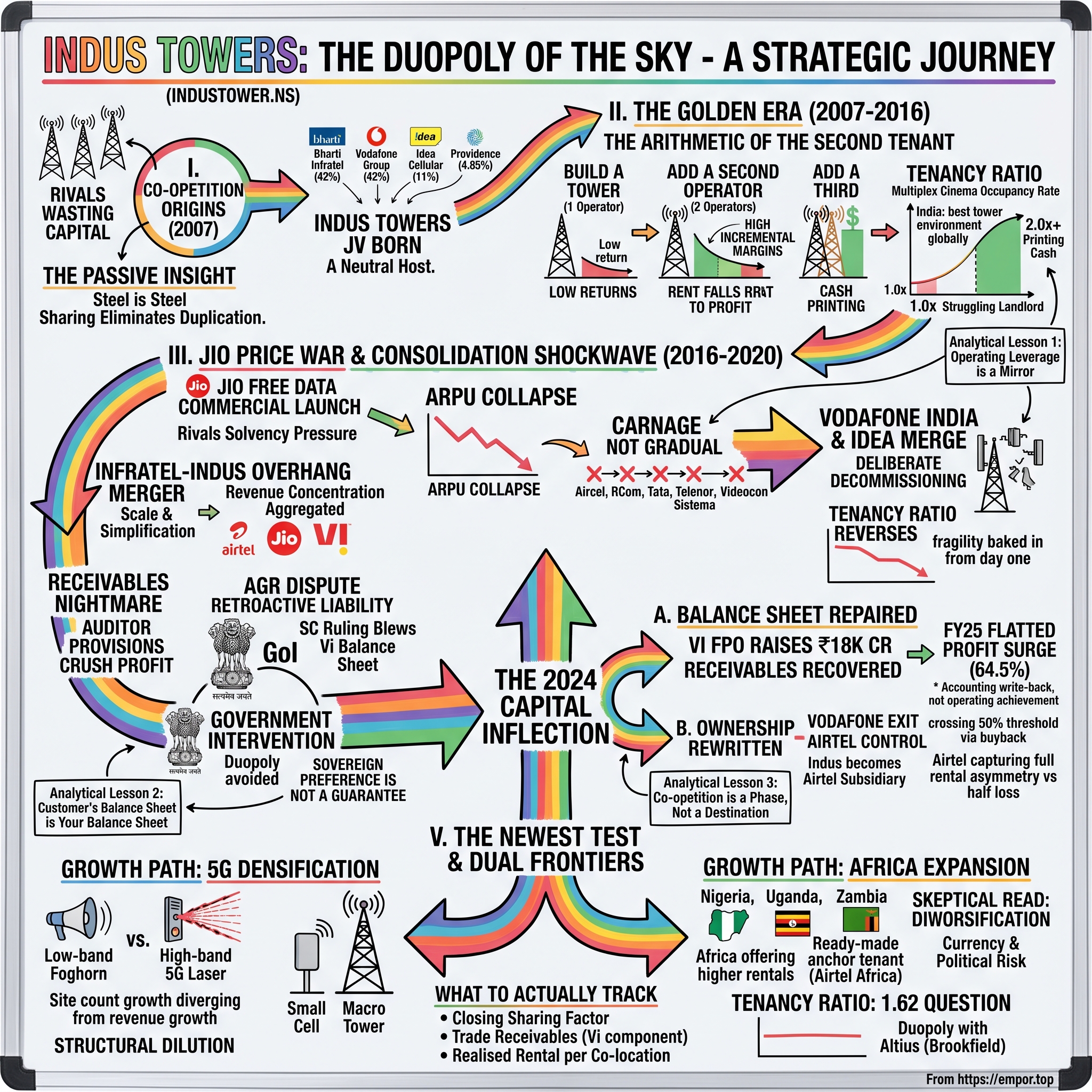
Indus Towers: The Duopoly of the Sky
I. Introduction & Episode Roadmap (10 Minutes)
Drive out of any Indian city — Delhi toward Jaipur, Chennai toward Bengaluru, Guwahati toward anywhere — and count the towers. You will lose count within twenty minutes. Lattice masts on rooftops. Slim monopoles wedged behind petrol pumps. Squat ground-based structures ringed by barbed wire, humming with the sound of a diesel generator, a battery bank sweating under a tin roof, a security guard on a plastic chair. Nobody photographs them. Nobody writes odes to them. They are the least glamorous objects in the entire Indian technology stack.
They are also, collectively, one of the largest single pools of physical infrastructure ever assembled by a private company in India — and for the better part of two decades they have been owned by a business that most of the 1.4 billion people who depend on them have never knowingly interacted with.
That business is Indus Towers Limited. As of March 31, 2026, it operated 264,514 macro towers and 428,014 macro co-locations across all 22 telecom circles of India, generating consolidated revenue of ₹32,493 crore for the financial year.12 It does not sell you a mobile plan. It does not own spectrum. It does not run a network. It owns steel, land, power, and access — and it rents that bundle to the people who do.
Here is the question that makes this a story rather than an asset description: how did a joint venture created by three bitter, cash-burning rivals — a company built explicitly so that no single competitor could control it — end up as the majority-owned subsidiary of one of those rivals? And what happens to minority shareholders when the landlord's biggest tenant also becomes the landlord's boss?
Because that is exactly what happened. Bharti Airtel, which originally held roughly 42% of the venture through a subsidiary, crossed the 50% threshold in 2024 and now sits at just over half the register.34 Vodafone Group, the co-founder that once matched Airtel share for share, sold everything and walked away.[^5][^6] The neutral host is no longer neutral in the ownership sense, even if it remains neutral in the operational sense. Whether those two things can stay separate is the single most important governance question in this story.
There is a second question running underneath, and it is about survival rather than control. For most of the last six years, the market did not value Indus Towers as an infrastructure company at all. It valued it as a credit instrument on Vodafone Idea — a customer that at various points was days away from being unable to pay its bills, and whose largest shareholder is now the Government of India.5 A tower business with 55%-plus EBITDA margins and near-utility revenue visibility traded at single-digit earnings multiples because investors could not answer a simple question: what happens to a third of the tenancy base if one of three tenants disappears?
That question has been partially answered, expensively, over the last two years — and the answer is messier than either the bulls or the bears expected.
This is the story of an industry that invented a way to stop wasting capital, then watched its own customer base collapse from twelve players to three, then watched its shares get valued as a distressed bond, then recovered — and now faces a very different kind of test: growth in a market where the two remaining buyers of scale already have most of the coverage they need, and where the company's own parent has both the incentive and the votes to shape how the rent gets set.
The episode runs in ten parts: the co-opetition origins of 2007, the golden age of multi-tenancy, the Jio price war and the consolidation shockwave, the Infratel–Indus merger, the AGR crisis and the Vodafone Idea death watch, the 2024 capital inflection that changed the ownership structure permanently, the durable business lessons, a strategic teardown against Brookfield's Altius platform using Helmer and Porter, and finally the 5G densification frontier and the Africa gambit that management announced in 2025.
Let's start where every good infrastructure story starts: with an enormous amount of money being wasted.
 Subscribe on LinkedIn
II. The Passive Co-Opetition Play: Origins of Infratel & Indus (20 Minutes)
Picture India in 2006. Mobile subscriber additions were running at a pace no country had ever recorded. Handsets were falling below ₹1,500. Incoming calls had become free. Every month, six, eight, ten million new subscribers joined the network — people who had never owned a telephone of any kind, going straight from no connectivity to a Nokia 1100.
And every one of those operators — Bharti Airtel, Hutchison Essar, Idea Cellular, Reliance Communications, Tata Teleservices, BSNL, Aircel — was racing to plant steel in the ground. Not in different places. In the same places. On the same highways. On the same rooftops. Sometimes literally within visual range of each other, three or four separate towers standing in a cluster, each owned by a different company, each with its own diesel generator burning fuel, its own security guard, its own landowner paying a separate rent, its own electricity connection.
It was a spectacle of capital destruction, and everyone knew it. A tower cost somewhere between ₹20 lakh and ₹35 lakh to build depending on terrain and type. Multiply by tens of thousands of sites, multiply again by four operators duplicating each other, and you had an industry burning billions of dollars to build four copies of the same thing.
The insight that broke the logjam is deceptively simple, and it is worth stating carefully because everything downstream depends on it.
Active versus passive. A mobile site has two layers. The active layer is the radio equipment — the antennas, the base transceiver station, the electronics that turn spectrum into signal. That layer is where an operator actually competes. Better radios, better spectrum, better tuning, better coverage. That is proprietary. That is the product.
The passive layer is everything else: the steel tower itself, the concrete foundation, the compound and fencing, the shelter, the diesel generator, the battery bank, the air conditioning, the grid connection, the security, the landowner lease, the municipal permission. That layer does not differentiate anybody. A Vodafone antenna does not work better on a Vodafone-owned tower than on an Idea-owned tower. Steel is steel.
So why was every operator buying its own steel?
Analogy: imagine four airlines that each decided they needed to build their own airport in every city — their own runways, their own terminals, their own air traffic control — when the only thing that actually differentiates them is the plane, the seat, and the service. Absurd. Yet that is exactly what Indian telecom was doing with towers.
The unbundling happened in two moves. First, Bharti Airtel carved its tower portfolio out into a separate entity, Bharti Infratel — creating a standalone asset that could raise its own capital, be valued on its own terms, and sell space to anyone. Second, in 2007, three competitors did something genuinely unusual: they pooled their towers in fifteen of India's most important circles into a shared company. Indus Towers was born as a joint venture between Bharti Infratel, Vodafone Group's Indian arm, and Idea Cellular, with private equity firm Providence Equity Partners taking a small stake alongside them.
The ownership split reflected the balance of power. Bharti Infratel and Vodafone held roughly 42% each — deliberately symmetric, so neither could dominate. Idea Cellular held 11.15%. Providence took the residual sliver of roughly 4.85%. No single party controlled it. That was the entire point.
Why "co-opetition" was the right word. These companies were not friends. They were spending enormous marketing budgets attacking each other, poaching each other's subscribers, and litigating over interconnection. But on the passive layer they made a rational calculation: cooperating here made all of them stronger against the ones who did not cooperate. A shared tower meant each operator paid a fraction of the cost of a dedicated one. Rollout speed doubled. Capital that would have gone into concrete went into spectrum and subscriber acquisition instead — the things that actually mattered.
The commercial architecture that made this work was the Master Service Agreement. Rather than negotiating each site individually, operators signed long-dated framework contracts specifying rental per tenancy, the escalation formula, energy cost pass-throughs, exit penalties, and uptime obligations. These agreements typically ran for terms measured in years, not months, with contractual escalations built in. That is what converted a pile of steel into something resembling a bond: contracted, escalating, recurring revenue from investment-grade-ish counterparties, with heavy penalties for leaving.
For investors, the analytical point is this: the tower model was never a technology bet. It was a financial re-engineering of an industry's cost structure. The value created came from eliminating duplication, and the value captured came from long contracts with high exit friction. Both halves matter. Eliminating duplication without the contracts would have produced a commodity landlord business. The contracts are what made it an infrastructure asset.
But there was a structural fragility baked in from day one that nobody was worrying about in 2007, because in 2007 there were a dozen operators and the subscriber curve pointed straight up. The fragility was this: the entire economic case for a tower company rests on sharing. And sharing requires that there be multiple people who want to share.
For nearly a decade, that assumption held beautifully.
III. The Golden Era of Multi-Tenancy (2007–2016) (20 Minutes)
To understand why tower executives in this era walked around looking quietly delighted, you have to understand the arithmetic of the second tenant. It is one of the most elegant pieces of economics in infrastructure, and it explains almost everything about how this industry behaved for a decade.
Build a tower. You have spent capital on steel, foundation, land lease, power connection, generator, batteries, fencing. Now put one operator's antennas on it. That operator pays rent. Against that rent you owe: the landowner, the electricity board, the diesel supplier, the maintenance crew, the security guard, the insurance. Single-tenant returns are real but unspectacular — you have carried a lot of fixed cost for one paying customer.
Now add a second operator to the same tower. What incremental cost do you actually incur? Some additional power draw, a marginally heavier maintenance load, a bit more space in the shelter. The steel is already there. The land lease is already paid. The guard is already sitting in his chair. The generator is already running. The overwhelming majority of the second tenant's rent falls straight through to gross profit.
Add a third and the effect compounds again. This is why the tower industry became obsessed with a single metric: the tenancy ratio — total co-locations divided by total towers. It is the entire business model expressed as one number. At 1.0x you are a struggling landlord. At 2.0x you are printing cash.
Analogy for the non-specialist: think of a multiplex cinema. Building the hall is expensive. Selling the first ticket barely covers the projectionist. Selling the two hundredth ticket for the same show is nearly pure profit, because the film is already playing. A tower is a cinema hall for radio equipment, and the tenancy ratio is your occupancy rate.
The boom conditions. India in this period was possibly the best environment for tower economics that has ever existed anywhere. The country ran with ten to twelve operators competing in most circles — Airtel, Vodafone, Idea, Reliance Communications, Tata Docomo, Aircel, Uninor, Videocon, Sistema, MTS, BSNL, MTNL — all of them needing national coverage, all of them under regulatory rollout obligations, none of them wanting to spend on steel. Every new entrant walked into a market where the towers already existed and could be rented immediately.
That is the tower operator's dream scenario: a large number of well-funded buyers, all needing the same footprint, all preferring to rent rather than build. Tenancy ratios climbed comfortably past 2.0x. The businesses generated large, predictable free cash flow with modest incremental capital requirements. Bharti Infratel, which listed on Indian exchanges and held both its own towers and its 42% economic interest in Indus, became a favourite of income-oriented investors — a company that could pay out most of what it earned because it did not need to retain much to grow.
The market rewarded this with an infrastructure-bond valuation: stable, defensive, dividend-heavy, low-drama. Analysts wrote about it in the same language they used for toll roads and regulated utilities.
Here is what the market got wrong, and it is a lesson worth sitting with. Every valuation model in that era treated the tenancy ratio as a ratchet — a number that could go up, plateau, and perhaps flatten, but never meaningfully reverse. The logic seemed sound: contracts were long, exit penalties were punitive, and moving live radio equipment off a tower is genuinely painful and expensive.
But contracts and exit penalties only bind solvent counterparties. A company in liquidation does not pay an exit penalty. A company being merged out of existence does not renew a co-location. The tenancy ratio is not a ratchet; it is a derivative of the number of viable operators in the market. If that number falls, tenancies vanish — not because anyone chose to leave, but because the tenant ceased to exist.
Nobody was modelling that in 2015, because nobody had a reason to. Twelve operators had been twelve operators for years. The subscriber base kept growing. Data was starting to take off. The towers kept filling up.
Then a man who had spent the previous four years quietly buying spectrum and laying fibre decided to give away mobile data for free.
IV. The Telecom Price War & The Consolidation Shockwave (2016–2020) (25 Minutes)
September 2016. Mukesh Ambani stood at Reliance Industries' annual general meeting and announced the commercial launch of Jio. Free voice calls — not cheap, free, forever. Data at prices that were not a discount to the market but a different order of magnitude entirely. And an introductory period during which the whole thing cost nothing at all.
The reaction inside every other operator's headquarters was, by all accounts, somewhere between disbelief and dread. Not because the offer was clever — because it was fully funded. Jio had been built with parent-company balance sheet backing on a scale no telecom competitor could match, on an all-IP 4G network with no legacy 2G revenue to protect. It had nothing to cannibalise and everything to gain.
What followed was, by most measures, the most destructive price war in the history of global telecommunications. Average revenue per user across the industry collapsed. Voice revenue, which had been the profit engine of Indian telecom, went to approximately zero as a standalone product. Data prices fell to among the lowest in the world.
The carnage was not gradual. Operators that had looked merely subscale in 2015 were insolvent by 2018. Aircel entered insolvency proceedings. Reliance Communications — a company that had once been one of India's largest mobile operators — collapsed into bankruptcy. Tata Teleservices' consumer mobile business was effectively handed to Bharti Airtel. Telenor's Indian operation was absorbed by Airtel. Videocon and Sistema disappeared into other balance sheets. Vodafone India and Idea Cellular, both bleeding, merged in 2018 to create Vodafone Idea in an act that was less a strategic combination than a joint attempt at survival.
From roughly a dozen private operators, India arrived at three: Reliance Jio, Bharti Airtel, and Vodafone Idea — plus state-owned BSNL, technically alive but for years effectively absent from the 4G market for lack of funding.
Now apply that to the tower model. Every one of those vanished operators had been a tenant. Aircel's antennas came off the towers. RCom's came off. Telenor's came off. Tata's came off. When Vodafone and Idea merged, the combined company discovered it had two sets of equipment on a very large number of the same towers — and immediately began the rational, unavoidable work of decommissioning the duplicates.
That last point deserves emphasis, because it is the part investors consistently underestimate in consolidation scenarios. A merger between two of your customers does not preserve your revenue. It destroys it, deliberately and methodically, because eliminating the overlap is the entire financial rationale for the merger. Vodafone Idea's synergy plan was, in significant measure, a plan to stop paying rent to tower companies.
The tenancy ratio — the number that the entire industry's economics rest on — went into reverse. From comfortably above 2.0x in the boom years, the industry's sharing factor ground downward through the late 2010s and into the 2020s. By March 2026, Indus Towers reported a closing sharing factor of 1.62.1
Think about what that number means in the context of the multiplex analogy. The tower operator is still running the same hall, still paying the same fixed costs, still burning the same diesel — with meaningfully fewer paying seats than the model assumed when the capital was committed. The revenue fell away far faster than the cost base could be reduced, because the cost base is structurally fixed. You cannot half-lease land. You cannot fire half a security guard.
The analytical conclusion for investors is uncomfortable and important. Operating leverage is not a virtue. It is an amplifier. In the multi-tenant boom it made tower companies look like the best businesses in India. In the consolidation bust it made them fragile in exactly the way a levered business is fragile — the same mechanism, running backwards.
And there was a second-order effect that mattered even more. Before 2016, tower companies had a genuinely diversified customer base; the failure of any one operator was survivable. After 2020, three customers accounted for essentially all revenue, and the relationship between the tower company and each of them became existential in both directions. Concentration risk did not creep in. It arrived all at once, as a direct consequence of someone else's price war.
Faced with that, the two Airtel-linked tower entities concluded that the structure they had inherited from a twelve-operator world no longer made sense in a three-operator one.
V. Simplifying the Giant: The Infratel-Indus Merger (2018–2020) (15 Minutes)
Corporate structures are usually built for the world that exists when they are drawn. Bharti Infratel and Indus Towers had been designed for an India of many competing operators, where a separately-owned shared venture in fifteen circles and a wholly-owned tower arm in the remaining seven made perfect sense as a way of balancing competitive interests.
By 2018, that architecture had become a liability. Two overlapping entities, two management teams, two sets of overheads, two negotiating positions with the same three customers, and a fragmented ownership structure in which the co-owners had radically diverging financial circumstances. Bharti Airtel was under pressure but functional. Vodafone Group was globally leveraged and increasingly desperate to reduce its Indian exposure. Vodafone Idea was fighting for its life.
In April 2018, the boards approved a merger of Indus Towers into Bharti Infratel, creating a single pan-India tower company. The strategic logic was straightforward: scale, simplification, a unified balance sheet, and one entity facing the customers instead of two.
Then it sat there for two and a half years.
The delay was not bureaucratic sloth. It was a genuine standoff produced by a deteriorating industry. Competition and telecom regulatory clearances took time. But the real obstruction was that the deal's terms had been struck in one world and were being executed in another. The AGR judgment landed in the middle of the process, blowing a hole in Vodafone Idea's balance sheet. Vodafone Group was simultaneously trying to extract cash from India and trying to avoid injecting more into it. The parties had to renegotiate protections around what would happen if Vodafone Idea defaulted on its tower payments — a scenario that had gone from theoretical to plausible while the paperwork was being processed.
The merger finally completed on November 19, 2020.6 The merged entity took the Indus Towers name and listed on Indian exchanges, becoming — as the coverage at the time noted — the largest tower company in the world outside China, with a pan-India footprint spanning all 22 telecom circles.7
The ownership outcome told you everything about the relative financial condition of the parties. Bharti Airtel emerged as the largest shareholder with 36.73%. Vodafone Group held 28.12%.6 And Vodafone Idea — the operator that most needed the equity value — took the cash exit option for its 11.15% stake, selling out entirely to fund its own survival rather than hold a stake in the infrastructure it depended on.
That decision is worth pausing on. A telecom operator choosing to sell its ownership in its own landlord, to fund its operating shortfall, is not a portfolio optimisation. It is a distress signal — and it converted a shareholder-tenant into a pure tenant, removing whatever alignment of interests had previously existed.
What the merger achieved and what it did not. It genuinely delivered scale, simplification, and a cleaner story. One company, one strategy, one set of numbers. Costs could be optimised across a single national footprint. Procurement leverage improved. The tower business finally had a corporate structure that matched the industry it operated in.
What it could not do was change the customer base. The merged company was larger, more efficient, and more coherent — and structurally more exposed than either predecessor had been, because it now aggregated the full revenue concentration of the entire Airtel-Vodafone tower complex into a single listed vehicle at precisely the moment when one of its three customers was heading toward possible insolvency.
Investors understood this immediately. The merged company's shares did not trade like a defensive infrastructure asset. They traded like an option on whether Vodafone Idea would survive.
VI. The Sovereign Overhang: Vodafone Idea's AGR Crisis (2020–2024) (25 Minutes)
The phrase "Adjusted Gross Revenue" sounds like an accounting footnote. In Indian telecom it became one of the most expensive four words in corporate history.
The mechanism, in plain terms. Indian telecom operators pay the government a percentage of their revenue as licence fees and spectrum usage charges. The dispute was over what counts as revenue. The operators argued it should mean telecom revenue — the money from selling connectivity. The Department of Telecommunications argued it meant all revenue, including interest income, asset sale gains, rental income, essentially everything on the income statement.
The gap between those definitions, compounded over fifteen years with interest and penalties and interest on penalties, was measured in lakhs of crores. The Supreme Court of India ruled in the government's favour, and the retroactive liability was so large it exceeded the market capitalisation of the affected companies. Vodafone Idea, already the weakest of the three, was hit hardest — the merged entity inherited the accumulated liabilities of both predecessors.
For Indus Towers, this was not an abstraction. It was a receivable.
The receivables nightmare. When a customer that represents a substantial share of your revenue stops paying on time, an infrastructure company faces an ugly sequence. First, days sales outstanding stretch. Then the auditors require provisions for doubtful debt — non-cash charges that nonetheless crush reported profit. Then the question becomes whether to keep serving the customer at all, which for a tower company is not really a question, because switching off a tenant means switching off service to tens of millions of subscribers and inviting regulatory intervention.
Indus Towers took very large provisions against Vodafone Idea receivables through this period, and reported profitability was severely depressed as a result. The company was in the peculiar position of running an operationally excellent business — high uptime, growing tower count, disciplined costs — while its income statement was dominated by a judgment call about whether a customer would ever pay.
The skeptic's questions, and they were fair ones. Was the dividend safe? Indus suspended dividends for three years, so the market's answer was clearly no.8 Would the company be forced to write down stranded assets if Vodafone Idea collapsed? Almost certainly — decommissioning tens of thousands of tenancies would have left towers standing with a single tenant and a cost base built for two. Was management's continued service of a non-paying customer a commercial decision or a political one?
That last question cut closest, because the honest answer is that it was both, and the balance shifted over time. Cutting off Vodafone Idea would have been legally defensible and commercially catastrophic for everyone, including the government, which by then had a direct interest.
The government's intervention changed the nature of the risk. Rather than let Vodafone Idea fail, the Indian state converted a very large quantum of dues into equity, ultimately taking a holding of close to 49% and becoming the company's largest shareholder.5 This was not a rescue in the sense of writing a cheque. It was a conversion — turning a claim into ownership.
The signal, however, was unambiguous, and it is the single most important thing that happened for Indus Towers' risk profile in this entire period. New Delhi had decided that India would not become a two-operator market. A duopoly of Jio and Airtel would have meant pricing power concentrated in two private hands over a service that is now essential to banking, identity, welfare payments, and commerce. The state's revealed preference was for three private players plus a revived BSNL.
For a tower company, sovereign preference for three operators is worth more than any contractual protection, because it addresses the only risk that actually matters: the disappearance of a tenant.
But — and this is where independent analysis has to resist the comfortable conclusion — sovereign preference is not a guarantee. It is a policy stance that can change with a government, a budget, or a fiscal crisis. It does not oblige the state to fund Vodafone Idea indefinitely. And a government that owns nearly half of your customer has interests that are not identical to yours: it is simultaneously Vodafone Idea's largest shareholder, its largest creditor, and its regulator. When those roles conflict, the tower company's receivable is not the priority being optimised.
The AGR saga also has not ended. In October 2025, the Supreme Court signalled that the central government was free to reconsider Vodafone Idea's AGR demand, pointing to the state's own near-50% shareholding and the company's roughly 200 million subscribers.9 The subsequent relief, however, was narrower than markets had hoped: rather than the substantial waiver many had priced in, the government froze the disputed AGR liability at approximately ₹87,695 crore with repayment pushed out over a ten-year window beginning in 2031-32, and constituted a committee in January 2026 — including a retired secretary-level officer and a representative of the Comptroller and Auditor General — to reassess the obligations, with its findings binding on both the department and the company.10
Read carefully, that is a deferral, not a resolution. It buys Vodafone Idea years of breathing room. It does not fix the underlying economics of a third player competing against two vastly better-capitalised rivals.
Still, deferral was enough to change everything about how the market looked at Indus Towers — because a customer with breathing room is a customer that can pay its landlord.
VII. The 2024 Capital Inflection: Vodafone's Exit & Airtel Control (25 Minutes)
If you had to pick a single twelve-month window in which the identity of this company changed permanently, it would be roughly April 2024 to March 2025. Two things happened in parallel: the balance sheet got fixed, and the ownership got rewritten. Neither was entirely within management's control.
Trigger one: the FPO. In April 2024, Vodafone Idea did something that had looked impossible for four years — it successfully raised equity from public markets. The ₹18,000 crore follow-on public offer opened on April 18, 2024, priced in a band of ₹10 to ₹11 per share, and closed on April 22 subscribed roughly 6.4 times, with the institutional tranche covered many times over.11 It was the largest FPO in Indian market history.
The stated use of proceeds was network investment — new 4G sites, expanded capacity, 5G deployment, and deferred spectrum payments to the government.11 But the practical first-order effect for the tower industry was different: a customer that had been unable to clear vendor arrears suddenly had cash.
Trigger two: the cash actually arrived. Vodafone Idea applied a portion of the proceeds to its vendor overdues, and Indus Towers recovered a very large quantum of past-due receivables. The effect on reported earnings was dramatic — because provisions that had been taken against those receivables in prior years were written back as they were recovered. For the financial year ended March 2025, Indus Towers reported consolidated revenue of ₹30,123 crore, up 5.3%, EBITDA of ₹20,845 crore, up 41.9%, and profit after tax of ₹9,932 crore — a 64.5% jump.[^14]
And here is where an independent reading matters more than a celebratory one. That 64.5% profit surge was not an operating achievement. It was an accounting reversal of prior pessimism. The underlying revenue growth was a modest 5.3% — respectable for an infrastructure asset, but nowhere near the headline. The EBITDA jump of nearly 42% was overwhelmingly a function of provision write-backs, not margin expansion.
Investors who anchored on FY25 as the new earnings base were making a mistake, and the subsequent year proved it. For FY26, revenue grew a healthier 7.9% to ₹32,493 crore, but EBITDA declined 13.8% to ₹17,976 crore and profit after tax fell 28.1% to ₹7,145 crore — precisely because the prior year had been flattered by one-time recoveries that could not repeat.1 In the March 2026 quarter alone, profit rose just 0.8% to ₹1,793 crore against a year-ago quarter that had included a ₹226 crore write-back in doubtful receivable provisions.1
The lesson generalises well beyond this company: when a business has taken large provisions and then reverses them, two consecutive years of reported earnings become almost meaningless. You have to look through to the operating line — which, in this case, showed a company growing steadily in the high single digits with margins in the mid-50s.1
The ownership rewrite. While the balance sheet was being repaired, the shareholder register was being rebuilt.
Vodafone Group had been trying to exit India for years. Globally leveraged and under pressure from its own investors to simplify, it began selling. In June 2024, it sold an approximately 18% stake in Indus Towers for roughly ₹15,300 crore — about $1.8 billion.[^5]12 In December 2024, it disposed of the residual holding of roughly 3%, completing a full exit from the joint venture it had helped create seventeen years earlier.[^6]13
There is something quietly poignant in that. Vodafone entered India in 2007 with one of the most expensive telecom acquisitions ever made in an emerging market, spent the following decade fighting tax authorities and price wars, and left having transferred its share of the country's most valuable telecom infrastructure asset to its principal competitor.
Airtel crossed the line. In July 2024, the Indus Towers board approved a share buyback of 5.67 crore shares at ₹465 per share — approximately ₹2,640 crore, executed through a tender offer.1415 The mechanics matter here, and they are worth explaining because they are elegant and slightly under-appreciated.
Bharti Airtel did not need to buy a single additional share to gain control. In a buyback, the company purchases and cancels shares from participating holders. If a large shareholder does not tender, its percentage holding rises automatically as the denominator shrinks. Airtel's stake moved from just under 49% to just over 50% — crossing the threshold that converts an associate into a subsidiary — without deploying its own capital.16 Indus Towers became a subsidiary of Bharti Airtel, consolidated onto Airtel's accounts.4
And Airtel has not stopped. In November 2025, Bharti Airtel's board approved acquiring up to an additional 5% of Indus Towers, to be executed over time in one or more tranches depending on market conditions.17 On the Q2 FY26 earnings call, Airtel's chief executive Gopal Vittal was direct about the rationale: "we see Indus as a very clearly undervalued asset, it is a strong dividend-paying Company, it is a vital infrastructure for us."18 At that point Airtel held roughly 51% of the register.17
What a sophisticated investor should take from this. Three things, and they pull in different directions.
First, the tenant-as-owner has genuinely aligned incentives in one respect: Airtel now benefits from Indus's dividends and equity value, which reduces the incentive to squeeze rents to zero. Vittal's own framing — a "strong dividend-paying company" — makes the point that the cash flow accrues substantially to Airtel itself.
Second, and less comfortably, Airtel captures only about half of any rupee of Indus profit but bears the full cost of any rupee of rent it pays. The arithmetic of that asymmetry does not favour minority shareholders at the margin. A rent reduction transfers value from Indus to Airtel; Airtel absorbs roughly half the loss through its Indus stake and keeps the whole gain.
Third, the buyback mechanism itself — control acquired through a capital return rather than a purchase — meant minority shareholders never received a control premium. That is entirely legal and reasonably common. It is also a reminder that in this structure, the controlling shareholder's interests and the minority's interests are aligned in the good scenarios and divergent in the marginal ones.
Which brings us to the governance question that now sits at the centre of the investment case.
VIII. Playbook: Business & Investing Lessons (15 Minutes)
Strip away the specifics of Indian telecom and three durable lessons remain — the kind that transfer to shipping, data centres, pipelines, and any other business where somebody builds an expensive fixed asset and rents it out.
Lesson 1: Operating leverage is a mirror, not an engine.
The tower model's most-cited virtue is that incremental tenants arrive at extraordinary incremental margins. That is true, and it is the reason these assets deserve infrastructure valuations. But the same fixed-cost structure that magnifies gains on the way up magnifies losses on the way down, and it does so faster, because costs are sticky and revenue is not.
Indus lived both halves of this within a decade. The identical mechanism that produced boom-era returns produced the margin compression of the consolidation years. Nothing about the business changed. Only the direction of the tenancy count did.
The practical discipline this implies: when underwriting any high-operating-leverage asset, model the downside tenancy scenario as your base case for stress purposes, not as a tail risk. Ask what happens if the customer count halves — not because it is likely, but because the answer determines whether you can hold the position through the scenario where it happens.
Lesson 2: Your customer's balance sheet is your balance sheet.
Indus Towers has, on almost any measure, excellent unit economics. Mid-50s EBITDA margins. Contracted revenue. Genuine switching costs. Uptime that management reported at 99.977% in the March 2026 quarter — a level of reliability that would be respectable for a national grid, let alone a distributed network of a quarter-million diesel-and-battery sites, many in places with unreliable grid power.2
None of that mattered for four years. The stock traded on one variable: whether Vodafone Idea could pay.
This is the most transferable lesson in the entire story. Companies with concentrated customer bases do not get valued on their own quality. They get valued on their weakest counterparty's solvency. The market is right to do this, because a receivable from an insolvent customer is not revenue — it is a claim in a queue.
The diligence implication is specific: for any business where the top three customers exceed roughly half of revenue, the credit analysis of those customers is the equity analysis of the company. Read their filings. Watch their refinancings. Track days sales outstanding as a leading indicator, because receivables stretch long before provisions appear.
Lesson 3: Co-opetition is a phase, not a destination.
The original Indus structure was a genuine achievement — three fierce competitors agreeing to share the unglamorous half of their infrastructure, saving the industry an enormous quantity of duplicated capital and accelerating India's mobile rollout by years.
But look at where it ended. The venture designed so that no single party could control it is now controlled by a single party — the strongest one. Vodafone, weakened globally, sold. Idea, absorbed into a distressed merger, sold early. Airtel, the survivor, consolidated.
This is not a scandal. It is a pattern. Shared-infrastructure ventures are stable when the participants are of comparable strength and all face the same capital constraint. They destabilise the moment the participants diverge — because the weak partner needs cash and the strong partner wants control, and those two desires transact very naturally with each other.
The investing implication for anyone holding a stake in a shared venture, joint venture, or industry consortium: watch the relative financial health of the partners far more closely than the venture's own operating metrics. The venture's fate will be decided by whichever partner gets desperate first.
Which is precisely the lens to bring to the competitive landscape Indus now operates in — because the other half of India's tower market went through an almost identical consolidation, with a very different acquirer.
IX. Strategic Analysis: 7 Powers, 5 Forces, and the Brookfield Duopoly (20 Minutes)
For a decade, the Indian tower industry was fragmented — Indus, Bharti Infratel, ATC's Indian business, Reliance's captive tower vehicle, GTL, Viom, a scattering of regional players. Today it is essentially two companies, and the second one was assembled by a Canadian asset manager while most people were watching the telecom operators.
The Altius story, briefly. Brookfield had been building an Indian tower position for years, starting with the acquisition of Reliance Jio's tower portfolio into what became Summit Digitel. It added Crest Digitel. Then, in September 2024, a Brookfield-led consortium — including British Columbia Investment Management Corporation and Singapore's GIC — completed the acquisition of American Tower's entire Indian operation, roughly 76,000 sites, at an enterprise value of approximately ₹18,200 crore.19
The combined platform was rebranded Altius Telecom Infrastructure Trust, structured as an Indian infrastructure investment trust, and now operates in excess of 258,000 towers.20
So the scoreboard as of March 2026 reads roughly: Indus Towers at 264,514 macro towers, Altius at north of 258,000 sites.120 Two platforms, comparable scale, dividing a market of three-and-a-half operators between them.
Why American Tower left, and what it tells you. ATC is the largest tower company in the world and one of the most sophisticated operators of this asset class anywhere. It looked at India — the fastest-growing large data market on earth — and decided to exit entirely. The stated and reported reasons centred on the Vodafone Idea credit exposure and the returns available in a consolidated three-operator market relative to ATC's other geographies.
That is a meaningful data point, and a bearish one that deserves to be stated plainly rather than explained away. The most experienced global operator in this industry concluded that Indian tower economics did not clear its hurdle rate. Brookfield concluded they did — but Brookfield is an infrastructure fund buying at a negotiated price for yield, which is a fundamentally different underwriting than a strategic operator seeking growth.
Hamilton Helmer's 7 Powers, applied honestly.
Scale Economies — strong, but with an asterisk. Indus spreads maintenance, procurement, energy management, and corporate overhead across a base of well over 400,000 co-locations.2 Its diesel procurement, solar deployment — management reported access to solar at 28,000 sites and a 7% year-on-year reduction in diesel consumption in FY26 — and national field-service network are things a subscale competitor cannot replicate.2 The asterisk: Altius has comparable scale. Scale economies confer power against small entrants, not against an equally large duopolist.
Switching Costs — genuinely high, and the most durable power here. Moving a live radio site is not like moving an office. The operator must find an alternative structure with the right height, azimuth, and line of sight, secure municipal permissions, arrange power and backhaul, physically relocate the antennas and base station, and re-tune the surrounding cells — all while avoiding a coverage hole for paying subscribers. It costs real money, takes months, and risks service degradation in the interim. This is why tower contracts renew: not because tenants are happy, but because leaving is expensive and risky.
Cornered Resource — real in dense urban areas, weak elsewhere. In Mumbai, Delhi, Bengaluru — places with restrictive zoning, contested rooftop rights, and residents' associations that fight installations — an existing, permitted, functioning site is close to irreplaceable. Along a national highway in a low-density state, it is not. The power is real but geographically concentrated, and no company discloses the mix in a way that lets an outsider size it precisely.
Process Power — modest and hard to verify. High uptime in difficult conditions suggests genuine operational capability. But this is the power that management teams most reliably overclaim and outsiders can least easily audit, and Altius does not publish comparable figures for a clean read.
Counter-Positioning, Branding, Network Economies — essentially absent. Nobody chooses a tower for its brand. There is no network effect between tenants. This is a real-assets business, and pretending otherwise is analytical sloppiness.
Porter's Five Forces — where the pressure actually comes from.
Buyer power: extremely high, and this is the defining feature of the industry. Three-and-a-half customers, each enormous, each sophisticated, each with in-house engineering capability and the option to build. One of them owns you. Another has a controlling interest in your main competitor's anchor portfolio. This is close to a worst-case buyer structure, and it is the single strongest argument against paying an infrastructure multiple for these assets.
Supplier power: moderate. Steel and equipment are commoditised. Land and rooftop lessors have local leverage, and lease escalations are a persistent cost creep. Electricity boards and diesel prices drive an energy cost line that is substantially passed through — but pass-through mechanisms are contractual, and contracts get renegotiated.
Threat of new entrants: low. Building a competing national footprint would require enormous capital and a decade of permissions to serve customers who already have all the coverage they need. Nobody rational does this.
Threat of substitutes: low today, rising slowly. Active infrastructure sharing — where operators share the radios themselves rather than just the steel — reduces tenancy demand at the margin. Small cells on street furniture, lamp posts, and building façades serve dense urban capacity without a macro tower. Satellite direct-to-device and low-earth-orbit broadband address coverage in remote areas where towers are least economic anyway. None of these replace macro towers in the medium term; all of them nibble at the growth rate.
Rivalry: structurally muted, practically real. A two-player market should produce disciplined pricing. But both players are competing for share of the same limited pool of new sites from the same three customers, and Altius operates as a yield vehicle that may price differently than a listed operator would. Rental rates per tenancy in India are already among the lowest globally.
The governance stress test — the part a skeptical investor should press hardest on.
Here is the scenario that a short-seller would build a thesis around. Bharti Airtel owns just over half of Indus Towers and is simultaneously its largest customer. Every rupee Airtel pays in tower rent is a rupee of Airtel operating cost and a rupee of Indus revenue. Airtel's board has a fiduciary duty to Airtel's shareholders. At renewal, Airtel has both the commercial motive and the voting power to press for terms favourable to itself.
The formal protections exist and are not trivial. Indian listed-company rules require material related-party transactions to be approved by the audit committee and, above defined thresholds, by shareholders — with the interested party excluded from voting. In practice this means a rent renegotiation of any consequence between Airtel and Indus would require approval from the very minority shareholders it would disadvantage. That is a meaningful structural safeguard, and it is stronger than what minorities receive in many jurisdictions.
The residual risks are subtler and harder to police. Terms on new site additions, energy pass-through formulas, service level definitions, the pace at which Airtel routes incremental deployment to Indus versus Altius, and capital allocation decisions — including the Africa expansion — sit in a zone where control is exercised through influence rather than through a votable resolution.
Management, judged on behaviour rather than statements. Managing Director and CEO Prachur Sah has run the company through the recovery period, with FY25 total compensation reported at ₹9.1 crore including cash and ESOP perquisite value.21 The CFO seat is turning over: Vikas Poddar resigned effective August 18, 2026, and Abhishek Maheshwari — previously CFO of Airtel's B2B business and, before that, of Airtel's DTH business for over four years — was approved by the board on July 10, 2026 to take the role from August 19, 2026.2223
An independent reading has to note the obvious: appointing a long-tenured Airtel finance executive as CFO of a company where Airtel is both controlling shareholder and largest customer is entirely normal corporate practice, and simultaneously reduces the perceived independence of the function that signs off on related-party pricing. Both statements are true. Minority shareholders should watch the disclosure quality on related-party transactions in the coming annual report more closely than usual — not because anything improper has been alleged, but because that disclosure is the primary instrument through which this specific risk becomes visible.
On the credibility ledger, management's track record through the crisis was mixed in a defensible way. Dividends were suspended for three years rather than maintained on borrowed money — a conservative choice that annoyed income investors but was the right call given the receivables uncertainty. When asked repeatedly about resumption, the answer was consistently that a decision would come once Vodafone Idea's financial position clarified, and management held that line through FY26 before restoring the payout at the full-year results.8 That is narrative consistency: the same reason given across multiple quarters, and an action that matched the stated condition when the condition was met.
Where the story becomes harder to assess is the newest chapter — a strategic move into a continent the company has never operated in.
X. Epilogue & Future Outlook (10 Minutes)
On September 2, 2025, the Indus Towers board approved something that would have seemed absurd at any prior point in the company's history: an expansion into Africa, beginning with Nigeria, Uganda, and Zambia.24
The logic is not hard to reconstruct. India's tower market is consolidated, its customer base is three deep, and rental rates are among the lowest in the world. Africa offers higher rental economics, less mature infrastructure sharing, and — critically — a ready-made anchor tenant, since Airtel Africa has operated across the continent since 2010 in fourteen markets.24 Following your parent's customer relationship into a new geography is a coherent play.
The execution has been deliberate. A wholly-owned UAE subsidiary, Indus Towers FZE, was established as the holding vehicle, alongside additional UAE entities to house investments.25 Two African step-down subsidiaries were incorporated on January 15, 2026 — Indus Towers Nigeria Limited and Indus Towers Infra Zambia Limited.25 By the Q4 FY26 results in May 2026, management reported operating licences secured in Zambia with regulatory approvals still pending in Uganda and Nigeria.2
The skeptical read, which investors should hold alongside the strategic one. This is the classic "diworsification" pattern that activist investors are trained to flag: a mature, cash-generative domestic asset with limited growth runway deploying shareholder capital into unfamiliar geographies with currency risk, political risk, and counterparty risk that the existing management team has never underwritten. Nigeria in particular has a history of foreign-exchange convertibility problems that have damaged the reported earnings of multiple multinationals operating there.
The market noticed. Coverage at the time of the announcement recorded shares moving lower on the news, and reporting through FY26 noted investor irritation at the combination of an Africa capital commitment and a still-deferred dividend decision.268 Not disclosed publicly is the total capital envelope management intends to commit to Africa — which is precisely the number a minority shareholder most needs to see, and its absence is a legitimate disclosure criticism.
The 5G densification frontier — and the honest version of the growth story. The bullish framing runs like this: 5G uses higher frequency bands, higher frequencies travel shorter distances and penetrate buildings poorly, therefore 5G requires far more sites than 4G, therefore tower demand explodes.
The mechanism is real. Think of low-band spectrum as a foghorn — it carries far but delivers limited information. High-band 5G is closer to a laser pointer — enormous capacity, but you need line of sight and short range. Covering a city with lasers requires many more emitters than covering it with foghorns.
The complication is that the additional emitters are frequently not macro towers. They are small cells on lamp posts, lean poles, rooftop installations, and in-building systems. Indus has been building capability across these formats, and volume growth has been genuine — the company added roughly 15,200 towers and 22,500 co-locations in FY26, reaching a total portfolio of about 442,000 sites including all formats.2 But a small cell generates a fraction of the rental of a macro co-location. Site count growth and revenue growth are diverging, and revenue per site is structurally diluting as the mix shifts.
This is why the FY26 numbers look the way they do: strong physical additions, healthy 7.9% revenue growth, and an EBITDA line going the other way once the accounting noise from provisions is included.1 The volume story is real. The margin story is harder.
The 1.62 question. The tenancy ratio held at 1.62 through FY26 — flat, not falling.1 Stability at this level is genuinely better than the deteriorating trend of the consolidation years, and it means the tower additions are largely being made against committed demand rather than speculatively. But 1.62 is a long way from the 2.0x-plus of the golden era, and with three customers there is a hard ceiling on how far it can recover. The mathematical maximum in a three-operator market is 3.0x; the practical maximum, given that no two operators want identical footprints everywhere, is considerably lower.
What to actually track. Three metrics, and only three, tell you whether this business is working:
-
Closing sharing factor (tenancy ratio). This is the profitability engine expressed as one number. Stability around current levels means the model is holding; a resumption of decline would signal that either a customer is rationalising its footprint or new sites are being built single-tenant.
-
Trade receivables and days sales outstanding, specifically the Vodafone Idea component. Receivables stretch before provisions appear, and provisions appear before the equity story breaks. Indus reported trade receivables falling by ₹406.4 crore with Vodafone Idea repaying ₹88 crore in the first quarter of FY26 — the direction that matters.27 Watch whether that direction persists, particularly as Vodafone Idea's deferred government obligations approach.
-
Realised rental per co-location on Airtel-linked contracts. This is the related-party question expressed as a number. If revenue growth persistently trails co-location growth by more than the small-cell mix shift can explain, the rent is being squeezed — and that is the mechanism through which minority value would erode without any single dramatic announcement.
The bull case, stated fairly. India's data consumption keeps compounding; the two strong operators keep densifying; Vodafone Idea, backed by a state that has demonstrated its preference for three players, keeps paying and eventually invests; the duopoly with Altius supports rational pricing; dividends have resumed, with a ₹14 per share final payout for FY26 supported by free cash flow of ₹3,760 crore, and management has signalled a progressive distribution policy.12 Africa provides a growth option that India cannot. Airtel, having called the asset undervalued and moved to buy more, is a buyer rather than a seller.
The bear case, stated equally fairly. The AGR deferral solved Vodafone Idea's timing problem, not its competitive one; a third player structurally losing subscribers to two better-funded rivals eventually rationalises its network, which means fewer tenancies regardless of whether it formally fails. Rental rates in India are already among the world's lowest and buyer power is extreme. The parent-as-customer has an asymmetric incentive at every renewal. Small cells dilute revenue per site. American Tower — the most experienced operator in the category — chose to leave rather than compete here. And the Africa expansion commits capital to geographies with currency and political risk that this management team has never navigated, with the total envelope undisclosed.
The resolution of that debate does not turn on India's data growth, which is not in question. It turns on something narrower and less discussed: whether a landlord that is majority-owned by its largest tenant, serving a customer base of three in a market with among the world's lowest rents, can grow revenue per site rather than merely site count. Every quarter from here provides evidence on that question. The tenancy ratio, the receivables line, and the gap between co-location growth and rental revenue growth are where that evidence will show up first.
References
-
Indus Towers releases its results for Q4 and full year ended March 31, 2026 — tele.net.in, 2026-05 ↩↩↩↩↩↩↩↩↩
-
Indus Towers Limited: Robust FY26 Performance Driven by Strong Co-location Additions — Q4 FY26 Earnings Call Summary, InvestyWise, 2026 ↩↩↩↩↩↩↩
-
Airtel to Become Majority Shareholder in Indus Towers Post Buyback — Moneycontrol, 2024-07-31 ↩
-
Indus Towers to become Bharti Airtel subsidiary after share buyback — Business Standard, 2024-08-28 ↩↩
-
Supreme Court Relief on AGR Dues Gives Vodafone Idea a Lifeline — Vajiram & Ravi Current Affairs, 2025-11 ↩↩
-
Completion of the merger of Bharti Infratel and Indus Towers — Vodafone Group, 2020-11-19 ↩↩
-
Largest tower company in world outside China! Indus Towers, Bharti Infratel merger complete — Business Today, 2020-11-20 ↩
-
Indus Towers to decide on dividend payouts by Q4FY26: MD & CEO Prachur Sah — Business Standard, 2026-02-03 ↩↩↩
-
Vodafone Idea slumps as Supreme Court limits AGR relief — Business Standard, 2025-10-30 ↩
-
Vodafone Idea to get five-year lifeline on AGR dues of ₹87.7K crore — CAalley, 2026 ↩
-
Vodafone Idea to open Rs 18,000 crore FPO on April 18 — Business Today, 2024-04-12 ↩↩
-
Vodafone Sells 18% Stake in India's Indus Towers for $1.8 Billion — Reuters, 2024-06-19 ↩
-
Vodafone Looks to Sell Remaining Stake in India's Indus Towers — Reuters, 2024-11-20 ↩
-
Indus Towers Approves Rs 2,640 Crore Share Buyback at Rs 465 Per Share — Financial Express, 2024-07-30 ↩
-
Indus Towers spurts on buyback plan — Business Standard, 2024-07-26 ↩
-
Bharti Airtel increases stake in Indus Towers to 47 percent — Data Center Dynamics ↩
-
Indus Towers gains as Bharti Airtel gets board nod to raise stake by up to 5% — Business Standard, 2025-11-04 ↩↩
-
Airtel Chief Calls Indus Towers a Very Undervalued Asset — TelecomTalk, 2025-11 ↩
-
Brookfield-led consortium completes acquisition of ATC India operations — TelecomTalk, 2024-09 ↩
-
Altius Telecom Infrastructure Trust — India's Leading Infra InvIT ↩↩
-
Prachur Sah Biography: Managing Director and CEO of Indus Towers — StockLens ↩
-
Indus Towers gains on appointing Abhishek Maheshwari as CFO — Business Standard, 2026-07-13 ↩
-
Indus Towers appoints Abhishek Maheshwari as chief financial officer — tele.net.in, 2026-07 ↩
-
Indus Towers to enter Nigeria, Uganda and Zambia in African expansion — Business Standard, 2025-09-02 ↩↩
-
Indus Towers Expands African Operations with New Subsidiaries in Nigeria and Zambia — ScanX, 2026-01 ↩↩
-
Indus Towers slides as board approves African expansion — Business Standard, 2025-09-03 ↩
-
Indus Towers' doubtful receivables from Vodafone Idea slips in Q2 — India Infoline ↩
 LinkedIn
 WhatsApp
 Reddit
 Hacker News
 Email
Email Kindle
 RSS Feed
 Spotify
 Apple Podcasts
 Amazon Music
 Audible
 YouTube