IndiGrid Infrastructure Trust: The Yield Machine Behind India's Grid
I. Introduction & Episode Roadmap (00:00 – 08:30)
In May 2017, a roomful of Indian fund managers sat through a pitch for a product their market had never seen. They were used to two kinds of story. There was the equity story: a founder, a fast-growing market, a price-to-earnings multiple that assumed the future would be kind. And there was the fixed deposit: a bank, a coupon, and very little to think about. What the bankers handed them that month was neither. It was a unit in India's first power transmission infrastructure investment trust. It had no factory, no brand, and no product anyone would ever see. What it had was a promise of a cash payment every quarter, backed by steel towers carrying high-voltage lines across central India.
That trust was India Grid Trust, now IndiGrid Infrastructure Trust. When it listed, it held assets worth about ₹5,220 crore1. By March 2026 its assets under management had grown to about ₹33,815 crore, roughly $3.5 billion1. It now owns 55 transmission lines covering about 9,700 circuit kilometres, 18 substations, roughly 1.5 GWp of solar plants and a 2.5 GWh battery storage pipeline1. At its current unit price it pays out somewhere between 10.5% and 11% a year in distributions1.
The story of how a balance-sheet escape hatch for Sterlite Power became a KKR-controlled institutional yield platform is one of the most useful case studies in Indian capital markets. It is a story about what a business really is, as opposed to what its income statement says it is.
The question that runs through everything
Start with the puzzle. Commercial databases describe IndiGrid in the vocabulary of ordinary companies. On that view the units trade at about 27.5 times earnings and 2.6 times book value9. The trust paid out roughly 356% of its reported net profit as distributions in FY20261. Free cash flow looks negative. Read naively, that is a company paying shareholders three and a half times what it earns, funded by borrowing, at a premium multiple. It sounds like a slow-motion liquidation.
The reality is different, and the gap between the two is the point of this story. IndiGrid is not an operating industrial company and it is not a utility developer. It is closer to a securitised tollbooth: a legal wrapper that holds contracted infrastructure and passes the cash through to unitholders. Its economics are set by a regulatory payout mandate and by contracts that pay for keeping lines available, not by reported net profit. The numbers that matter are Net Distributable Cash Flow, or NDCF, and Distribution Per Unit, or DPU. Everything else is translation.
That does not make IndiGrid simple, and it does not make it safe by default. Four tensions run through the story.
The first is moat dilution. Inter-state transmission in India is about as close to a risk-free cash flow as emerging-market infrastructure offers. Solar plants and batteries are not. As IndiGrid moves into them, does it weaken the core that justifies its yield?
The second is the refinancing wall. About ₹4,430 crore of bullet debentures fall due across FY2027 and FY2028, against an average borrowing cost of about 7.4%2. Can that money be rolled over without eating into distributions?
The third is sponsor incentives. KKR controls the investment manager outright but owns only about 1.1% of the units2. The manager earns fees on assets and on deals. Public unitholders carry the equity risk.
The fourth is the accounting illusion. FY2026 revenue jumped 45%, and fourth-quarter revenue jumped 156%1. Underlying tariff revenue grew at a low single-digit pace. Which one is the business?
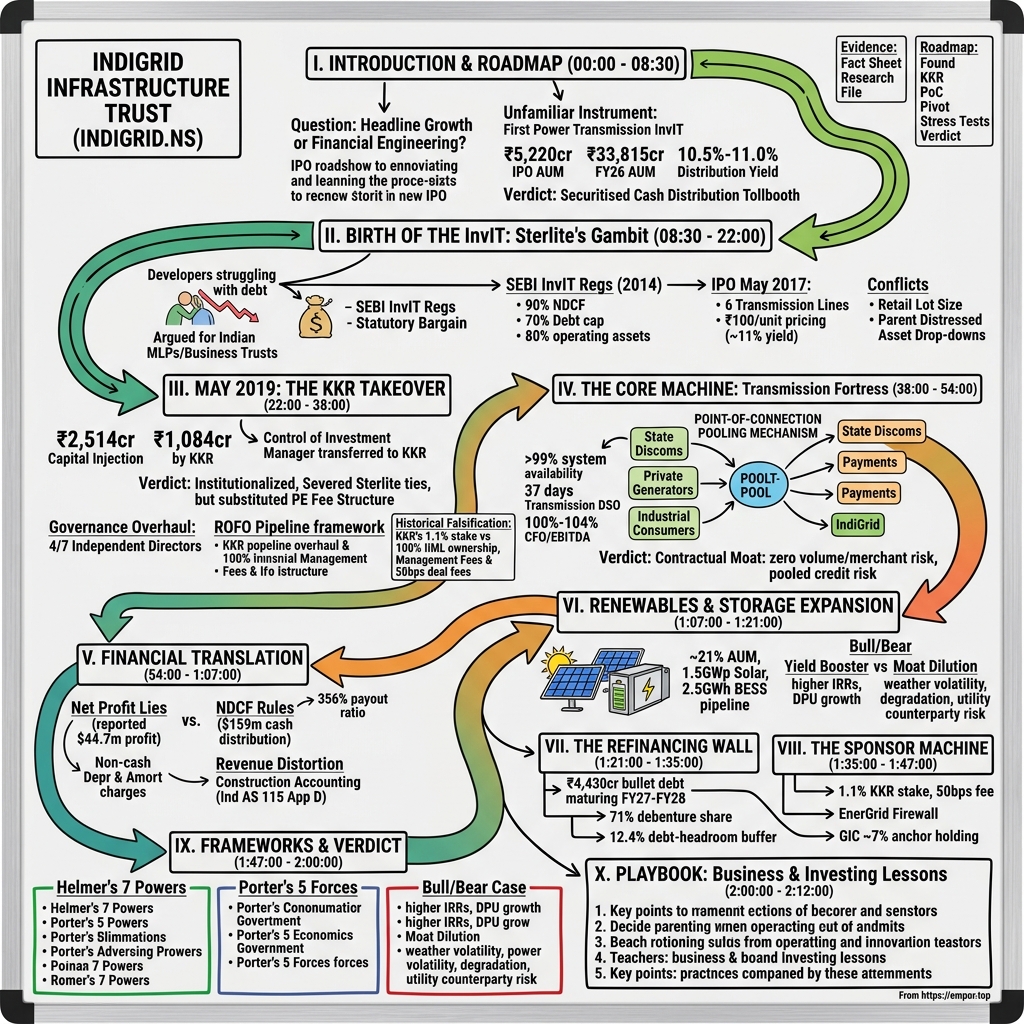
The route through those questions follows the company's life: Sterlite's founding gambit, KKR's 2019 takeover, the plumbing of India's transmission payment pool, the translation from accounting profit to distributable cash, the turn toward solar and storage, the debt wall, the sponsor machine, and finally the frameworks and the bull and bear cases. It begins with a developer that had built more steel than it could afford to own.
 Subscribe on LinkedIn
II. The Birth of the InvIT: Sterlite's Capital Recycling Gambit (08:30 – 22:00)
Picture the problem from the developer's side. In the early 2010s, India was handing out inter-state transmission projects through Tariff-Based Competitive Bidding, or TBCB. A private developer would bid the lowest annual tariff it could stomach, win a 35-year concession, then spend years acquiring right-of-way across farmland and forest, stringing conductor between towers, and fighting for clearances. Once the line was energised, the hard part was over. What remained was decades of steady, contracted income.
Steady income is exactly what a developer does not want to own. A developer's edge is in building. Every rupee of equity stuck in a finished line is a rupee that cannot go into the next bid. Indian banks, meanwhile, were reluctant to lend for twenty years against a single project, and much of the infrastructure sector of that decade was choking on stranded debt. Sterlite Power, part of the Agarwal family's Sterlite group, was one of the most aggressive transmission bidders in the country. It had finished lines and an appetite for more.
The statutory bargain
The escape route came from the regulator. In 2014, SEBI published regulations for Infrastructure Investment Trusts, modelled loosely on American master limited partnerships and Singapore's business trusts[^9]. The rules were a bargain. A sponsor could move completed infrastructure into a listed trust and sell units to the public. In return, the trust had to accept a discipline that most companies would find suffocating.
The core of that discipline is simple. A trust must distribute at least 90% of its net distributable cash flow to unitholders[^9]. It must keep the overwhelming majority of its assets in completed, revenue-generating projects, at least 80%, so it cannot quietly turn into a construction company[^9]. Its leverage is capped, and in its current form the ceiling is 70% of asset value on a net basis3. Its assets must be independently valued at regular intervals[^9].
Think of it as a pipe with a mandatory outflow valve. Cash comes in from the assets, a little is kept back for debt service and maintenance, and almost everything else must flow out to the people who own the units. That is a remarkable constraint for a business. It means growth cannot come from retained earnings. Every new asset has to be bought with new equity or new debt. That single fact shapes the rest of this story.
The listing
IndiGrid registered with SEBI in October 2016 and launched its initial public offer in May 2017[^6]. The issue raised about ₹2,250 crore at ₹100 per unit, and the units listed in June 2017[^6]. The opening portfolio was modest: two inter-state projects held through Bhopal Dhule Transmission Company and Jabalpur Transmission Company, built by Sterlite Power[^6].
The idea was clean. Sterlite would recycle capital by selling finished projects into the trust, and the trust would grow by buying a pipeline of further projects from its sponsor. Public investors would get a yield; the sponsor would get its money back to bid again.
The market's welcome was cool. SEBI's original rules set a large minimum trading lot. IndiGrid's lot was over 10,000 units, a ticket of roughly ₹10 lakh at issue price2. Retail investors were effectively locked out, and institutions had to learn a new instrument. For years the units were thin, illiquid and traded below their issue price. Retail participation only became meaningful after SEBI cut the trading lot to a single unit; today retail and high-net-worth investors own about 30% of IndiGrid2.
The flaw in the design
The early structure had a fault line, and it was not in the assets. It was in the relationship. The trust depended on its sponsor for growth, and the sponsor needed the trust for liquidity. That creates the obvious question every unitholder should ask: at what price is the sponsor selling, and to whom is that price fair?
The fact sheet captures the size of the early vehicle. In FY2018, the first full year after listing, IndiGrid booked about $69 million of revenue with equity of about $443 million and borrowings of about $371 million7. That was a lightly levered trust by later standards. It had room to borrow. What it lacked was an independent source of deals and an owner whose own finances did not hinge on the trust's appetite.
The model solved Sterlite's balance-sheet problem by moving operating assets into public hands. It left the platform exposed to a sponsor that had its own cash needs, and that tension did not stay theoretical for long.
III. May 2019: The KKR Takeover and the Institutional Cleansing (22:00 – 38:00)
By 2019, Sterlite Power was a developer stretched across too many projects at once. For IndiGrid's unitholders, that posed a quiet danger. A sponsor under pressure has every reason to treat its listed trust as a captive buyer for assets it needs to sell. The trust's governance might hold, but the incentives would be pulling in the wrong direction.
Then came the deal that changed IndiGrid's identity. In May 2019, KKR and GIC, Singapore's sovereign wealth fund, agreed to put fresh capital into the trust through a preferential allotment of about ₹2,514 crore, priced at about ₹84 per unit6. Note the price: below the ₹100 the public had paid at the IPO two years earlier. The early unitholders were being told, in the clearest language markets have, that the first chapter had not created the value they had hoped.
KKR did something more consequential than buy units. It took ownership of the investment manager, the company that actually runs IndiGrid. Today IndiGrid Investment Managers Limited, or IIML, is 100% owned by Esoteric II Pte. Ltd, a KKR affiliate2. Sterlite stepped back and eventually exited as a sponsor altogether2.
What the cleansing achieved
The balance sheet shows the reset. Shareholders' equity nearly doubled from about $382 million in FY2019 to about $710 million in FY20207. With a larger equity base, IndiGrid could borrow more and buy bigger. Borrowings went from about $373 million to roughly $900 million in the same year, and then to about $2 billion by FY20217. This was the moment the trust stopped being a Sterlite side vehicle and became a platform.
The governance changed too. IIML's board is now majority independent: four of its seven directors are independent, and two are KKR representatives, Hardik Shah and Vaibhav Vaidya2. The independent directors include Tarun Kataria, Ashok Sethi, Jayashree Vaidhyanathan and Gautam Mehra, a former PwC India tax partner who joined in 20262.
Continuity mattered as much as change. Harsh Shah, who has led IndiGrid since its listing, stayed on as managing director2. That is unusual in a change of control. KKR could have installed its own operator. It kept the person who understood the assets and the investor base, and with him the institutional memory of a trust that had struggled to win friends in its first two years. Alongside him, chief financial officer Meghana Pandit runs one of the more active bond-issuance programmes in Indian infrastructure2.
The investor base changed in character. Domestic insurers, pension funds and mutual funds, the long-duration money that should naturally own a 35-year cash flow, now hold about 42% of the units2. Roughly 19 insurance companies and six pension funds together hold about 18%2. GIC holds about 7%2.
Testing the alignment claim
The tidy version of this story says KKR's stewardship guarantees that the manager and the unitholders want the same thing. The record does not support that strong a claim.
KKR's direct stake in the units has drifted down to about 1.1%2. Its ownership of the manager remains at 100%. The manager earns ongoing asset management fees and an acquisition fee of about 50 basis points on the value of completed deals5. On the Q1 FY2026 call, management indicated that about ₹12–13 crore of such fees were paid to IIML after the ReNew solar acquisition5. That is real money, and it is earned on the act of buying, not on whether the purchase raised distributions per unit.
What tempers the concern is the evidence of how unitholders vote and how DPU has behaved. Votes on major resolutions have passed with very large majorities, and distributions per unit have risen steadily under KKR's ownership. Neither is proof of alignment; both are consistent with a manager that has not, so far, abused its position. The fair verdict is that KKR's arrival lowered the cost of capital and removed the risk of a distressed sponsor, but swapped one alignment problem for another. A founder needing cash has been replaced by an asset manager paid to grow assets. That structural pull toward size, rather than per-unit accretion, is the thing to watch, and section VIII returns to it with the most recent evidence. First, though, the assets themselves deserve a closer look, because they explain why anyone would accept this bargain at all.
IV. The Core Machine: Point-of-Connection Pooling and the Transmission Fortress (38:00 – 54:00)
Somewhere in New Delhi, every month, a settlement system run by the Central Transmission Utility of India does something most infrastructure investors in emerging markets would envy. It bills every user of the inter-state grid, pools the money into one account, and pays every transmission owner its share. No transmission company has to chase a single state electricity board for its bill.
That mechanism is the heart of IndiGrid. To understand why its yield exists, you have to understand why this pool is so unusual.
Paid to keep the lights on, not to sell power
Start with how a transmission line earns money. IndiGrid's inter-state lines operate under Transmission Service Agreements that mostly run for 35 years, with two assets on 25-year terms3. The tariff was fixed at the time of bidding. Crucially, it is an availability payment. IndiGrid gets its full tariff if the line is available to carry power at least 98% of the time, and earns an incentive above about 98.5%3. Whether a single megawatt-hour actually flows across the wire is irrelevant to its revenue.
An analogy helps. A toll road earns more when traffic rises and less when it falls. An IndiGrid transmission line is more like a road where the government pays a fixed annual fee for keeping the lanes open, regardless of how many cars drive on them. There is no volume risk and no price risk. There is only performance risk, and IndiGrid's lines have consistently run above 99% availability3.
The pooling miracle
The second layer is who pays. In most emerging markets, the weak link in a power business is the distribution utility, the state-owned company that sells electricity to households and farms. Indian state distribution companies, or discoms, have a long history of paying late or not at all.
Under India's inter-state charge-sharing regulations, transmission owners do not bill discoms individually8. The Central Transmission Utility bills all designated inter-state customers, including state discoms, generators and large consumers, pools what it collects, and pays transmission licensees pro rata8. If one state discom falls behind, the shortfall is spread thinly across every transmission owner in the country. IndiGrid never stands alone in front of a defaulting state.
The Ministry of Power then added teeth. Under the Late Payment Surcharge rules, a utility that falls behind can lose access to short-term power markets until it pays3. The effect on IndiGrid's collections is visible. Transmission receivables stood at about 37 days in March 2026, with collection efficiency around 102%2. The broader debtor-days measure in the fact sheet has fallen from well over 100 days in the trust's early years to about 60 in FY20261.
For a lender, this changes everything. It is the main reason three rating agencies rate IndiGrid AAA despite a debt-to-equity ratio that would alarm a corporate credit analyst3.
The cost side
The expense side is almost boring, which is the point. A transmission line, once built, needs patrols, vegetation clearing along the corridor, substation upkeep and occasional repairs after storms. IndiGrid uses drones and remote monitoring for much of this. Routine maintenance capex runs below about 1.5% of revenue3. Most of every rupee of tariff becomes operating cash.
The fact sheet confirms the conversion. Cash from operations has run at roughly 100% to 105% of EBITDA in most years, and was about 104% in FY20261. In plain terms, the profit before non-cash charges arrives as cash, almost rupee for rupee.
The corridor as cornered resource
There is one more layer of defence, and it is physical. A 400 kV or 765 kV corridor in India takes years to secure. It crosses thousands of private landholdings, forest land and state boundaries, and every tower footing is a negotiation. Once a corridor exists, nobody builds a parallel line to compete with it, because the line is not competing for customers at all. The grid planner decides where power flows.
The verdict for this section is unambiguous. Inter-state transmission under the pooled-payment regime is one of the strongest contractual cash flows available in emerging-market infrastructure: no volume risk, no merchant price risk, near-zero single-counterparty risk, and very low operating cost. The question for investors is not whether this core is strong. It is how much of IndiGrid still looks like it, and whether its financial statements describe it honestly. The second question comes first.
V. The Financial Translation: Why Net Profit Lies and NDCF Rules (54:00 – 1:07:00)
Imagine an equity analyst opening IndiGrid's FY2026 accounts for the first time. Revenue of about $541 million. Net profit of only about $45 million, a margin of around 8%1. Cash distributions to unitholders of about $159 million1. Payout ratio: 356%.
The instinct is to conclude that the trust is paying unitholders out of their own capital. The truth is subtler, and partly true, which is why it is worth unpicking slowly.
Why the profit line is small
Transmission lines are long-lived, expensive assets. Under Indian accounting standards, the cost of building or acquiring them is spread over decades as depreciation and amortisation. For IndiGrid, that charge runs to roughly ₹700–800 crore or more a year1. It is a real accounting cost, representing the slow consumption of steel and concrete, but no cash leaves the business when it is booked.
Add interest on about ₹21,000 crore of debt, and the profit line shrinks to a sliver. Over the five years to FY2026, IndiGrid generated more than $1.4 billion of cash from operations while reporting only about $244 million of cumulative net profit1. Those two numbers are describing the same business. One is measuring wear and tear; the other is measuring money.
The bridge that actually matters
SEBI's rules sidestep the profit line entirely. The distribution is set by Net Distributable Cash Flow, a defined calculation that starts with the cash earned by each project company, subtracts actual debt service, maintenance spending and taxes, and adds back non-cash charges[^9]. In FY2026, IndiGrid generated NDCF of about ₹1,382 crore1.
Here is the subtle part. Distributions reach unitholders as a mix of interest, dividends and repayment of capital1. That return of capital is exactly what it sounds like: part of what you paid for the unit coming back. Over a 35-year concession, this is entirely appropriate, because the asset itself has a finite life and the tariff ends. But it means the yield is not all income. A unitholder who spends every rupee of distribution, without accounting for the return of capital, is slowly eating a depleting asset. The 356% payout is therefore not a red flag on its own, but it is a reminder that an InvIT yield and a bond coupon are different animals.
The 45% revenue jump that wasn't
Now the accounting illusion. FY2026 revenue rose 45%, and fourth-quarter revenue rose 156% to about ₹2,240 crore1. Taken at face value, this would be the best year in IndiGrid's history.
It was not. Under Ind AS 115's service concession rules, when IndiGrid builds an asset under a build-own-operate-transfer arrangement, it has to book construction revenue as work progresses, with an almost equal construction cost alongside. In FY2026, about ₹1,458 crore of revenue came from this construction accounting1. It produced essentially no profit and no distributable cash. Strip it out, and core operating revenue was about ₹3,311 crore, up a modest 3.1% year on year1.
That is the real growth rate of the business in FY2026: low single digits, which is exactly what you would expect from fixed-tariff assets with a few acquisitions layered on. The quarterly table tells the same story in miniature. In Q4 FY2026 revenue more than doubled while the operating margin collapsed to about 27%, because the construction revenue came with matching construction cost1.
Why the screens say free cash flow is negative
A last translation. Data providers subtract investing outflows from operating cash flow and call the result free cash flow. For IndiGrid, investing outflows are mostly acquisitions of whole operating companies, about $334 million in FY2026 and about $737 million in FY20241. Those are growth purchases, not maintenance. Calling them cash burn misreads the business.
But do not overcorrect. Those acquisitions were paid for with new debt and new units. Growth at IndiGrid is never free; it always comes from outside capital, because the mandatory payout leaves almost nothing behind. The fair verdict is that IndiGrid is a cash compounder disguised as a low-margin accounting entity, but one whose compounding depends entirely on access to capital markets. The proper growth yardstick is not revenue or profit. It is DPU, which rose from ₹15.35 in FY2025 to ₹16.00 in FY20261. That growth had to come from somewhere, and increasingly it came from assets that look less like transmission lines.
VI. The Renewables and Storage Expansion: Yield Booster or Moat Dilution? (1:07:00 – 1:21:00)
In the first half of 2025, IndiGrid's management made a choice that would change the character of the portfolio. It completed the acquisition of utility-scale solar assets from ReNew, and pushed further into battery storage, including a 180 MW / 360 MWh standalone storage project contracted with Gujarat's state utility, GUVNL5. Solar now makes up about 21% of assets under management, roughly 1,155 MW AC, or about 1.5 GWp3.
Why would the owner of one of India's safest cash flows reach for something riskier?
The growth arithmetic
The answer is arithmetic. Management guides to DPU growth of around 3% to 4% a year. Transmission tariffs are fixed. The only way to grow per-unit distributions is to buy assets whose cash yield exceeds IndiGrid's cost of capital. In transmission, that spread has been squeezed. Power Grid, Adani Energy Solutions and other developers bid aggressively in TBCB auctions, driving equity returns on new lines toward the low double digits. Operating transmission assets that come up for sale attract the same competition.
Solar and storage offered higher initial returns. Management's case is that those returns fund distribution growth without pushing leverage toward the cap. FY2027 DPU guidance is ₹16.48, up about 3%1.
What changes when you add sunshine
Transmission and solar look similar on a portfolio slide. They are not the same business.
A transmission line is paid for being available. A solar plant is paid for the electricity it actually produces. Its revenue depends on sunshine, monsoon cloud cover, the cleanliness of panels, inverter reliability and how much the grid accepts on a given day. That is resource risk and operating risk, and there is no national pool to absorb it.
The counterparty changes too. Solar power purchase agreements run for around 25 years with central agencies like SECI and NTPC, and with state discoms in Gujarat, Rajasthan and Maharashtra3. Those state contracts carry direct utility credit risk, outside the transmission pooling mechanism described earlier.
Testing the operating claim
Management's implicit claim is that IndiGrid's operating expertise carries across technologies. The record already contains a counterexample. In Q1 FY2026, an equipment breakdown at a solar installation hurt results, and quarterly profit before tax fell to about $8.6 million from about $17.5 million a year earlier15. A single mechanical failure moved quarterly profit in a way that never happens on a passive transmission line.
The counterweight is collections. Solar receivables fell from about 48 days in March 2025 to about 37 days in March 2026, matching transmission2. The late-payment rules are disciplining state utilities, and IndiGrid recorded no material bad-debt provisions in FY20262.
Storage is the more interesting bet. Battery projects like the Gujarat one are structured as capacity contracts: the utility pays for the battery being available, not for trading power at market prices. That keeps storage closer to the transmission model than to merchant generation. But battery degradation, availability guarantees and technology performance over a decade are new risks for this team, and it has no long record to point to yet.
The verdict is that the history narrows the "seamless diversification" claim rather than rejecting it. Solar and storage do boost yield, and the collection risk has so far been contained. But they introduce operating and weather risk the core does not have, and roughly a fifth of the portfolio now carries it. The number to watch is the non-transmission share of assets at the end of FY2027, and whether solar collection days stay close to transmission through a monsoon or a curtailment quarter. All of this growth, of course, was paid for in part with debt, and the debt has a calendar.
VII. The Refinancing Wall and Capital Allocation Discipline (1:21:00 – 1:35:00)
Inside IndiGrid's Mumbai office, the most important document is not the asset map. It is the maturity ladder: a schedule of when each debenture comes due, set against what the bond market is likely to charge to replace it. For a trust that must pay out nearly everything it earns, every basis point of interest saved or lost lands directly on unitholders.
The shape of the debt
Gross debt stood at about ₹20,964 crore in March 20262. Roughly 71% is in non-convertible debentures, mostly held by insurers, pension funds and mutual funds; the remaining 29% is bank loans and fully hedged foreign-currency borrowings2. About 90% is fixed-rate, at a weighted average cost of about 7.4%2. EBITDA covers interest about 2.1 times by management's count, and about 1.9 times by ICRA's23.
Net debt is about 57.6% of assets under management, against a SEBI ceiling of 70% and a rating-linked internal limit of 65%3. The fact sheet's debt-to-equity ratio of about 3.5 looks alarming, but equity on the balance sheet has been worn down by years of distributions that included capital repayment, so the asset-based measure is the more meaningful one1.
The bullet problem
Here is the catch. Unlike a project loan that is repaid in instalments, most debentures repay in a single lump at maturity. IndiGrid has about ₹2,220 crore due in FY2027 and about ₹2,210 crore in FY2028, followed by roughly ₹1,800–2,600 crore in each of the three years after2. That is about ₹4,430 crore that must be refinanced in two years, and more than ₹11,000 crore over five.
A simple calculation shows the stakes. If the FY2027 and FY2028 maturities are refinanced at half a percentage point above their current cost, annual interest rises by about ₹22 crore. Spread across roughly 86 crore units (FY2026 NDCF divided by DPU), that is about ₹0.25 per unit, close to half of the ₹0.48 increase management has guided for FY2027. A full percentage point would wipe out the guided increase almost entirely. Refinancing is not a footnote to the DPU story; it is a direct input.
The safeguards
The defences are real. All three Indian rating agencies rate IndiGrid AAA with a stable outlook31011. The trust held about ₹1,814 crore of cash and liquid investments at March 2026, including about ₹285 crore in debt service reserve accounts, roughly one quarter's debt service across its facilities2. Ratings this high give access to the deepest pool of domestic long-term money, which is exactly the insurer and pension base that already owns its bonds.
But two caveats deserve air. Not all of that ₹1,814 crore is free: about ₹381 crore was earmarked for the next distribution and about ₹256 crore was borrowed money set aside for project capex2. And the 7.4% average cost reflects debt raised across very different rate environments. The safeguards protect against a failure to refinance; they do not protect against a costlier refinancing.
Equity issuance as discipline, and as dilution
IndiGrid has repeatedly turned to equity to keep leverage in check. After the 2019 KKR and GIC placement came a rights issue of about ₹1,284 crore at ₹110 per unit in 20216, a placement of about ₹405 crore in 2023, and about ₹1,938 crore raised through a placement and preferential issue in FY2026, which brought net debt to assets down from about 59.1% to 57.6%1. At the July 2026 annual meeting, unitholders approved an enabling resolution to raise up to another ₹2,000 crore4.
Each equity raise is a judgement call. If units are issued at a price below the value of the assets they fund, existing holders are diluted. If they are issued above it, the trust is creating value for existing holders. IndiGrid does not publish a per-unit accretion bridge for each raise, so investors have to infer accretion from DPU. On that test, distributions per unit have kept rising, which suggests the raises have not been destructive, but that is evidence at the level of the whole portfolio, not proof for each deal.
The verdict: IndiGrid's balance sheet can almost certainly refinance the wall. Whether it can do so without slowing DPU growth depends on bond yields it does not control. The coupon on the first FY2027 replacement issues will be the cleanest test. And the frequency of equity raises brings back the question of who decides what to buy, and why.
VIII. The Sponsor Machine: KKR, EnerGrid, and the Conflict-of-Interest Crucible (1:35:00 – 1:47:00)
On July 22, 2026, IndiGrid held its ninth annual meeting of unitholders4. Annual meetings of Indian infrastructure trusts are not dramatic events. But the voting results are one of the few hard, public tests of whether institutional owners trust the manager. This one passed easily. FY2026 accounts were adopted with about 99.999% in favour4. Deloitte Haskins & Sells was reappointed as auditor with about 99.98%4. The resolution enabling a ₹2,000 crore capital raise passed with about 98.5% in favour4.
Overwhelming votes are reassuring. They are also exactly what you would expect from passive holders. The more useful exercise is to lay out the incentive structure and ask whether the votes could plausibly change if the manager misbehaved.
The economics of asset-manager capitalism
KKR's economic exposure to IndiGrid comes from two places. As a holder of about 1.1% of the units, it gains very little when distributions per unit rise2. As the 100% owner of IIML, it earns recurring management fees and roughly 50 basis points on the value of each acquisition5.
The arithmetic of that split creates a pull toward size. A manager paid on deals is paid to do deals. An acquisition that is neutral or slightly dilutive to DPU still earns its fee. This is not an accusation against IndiGrid; it is the standard structural critique of externally managed vehicles worldwide, from Singapore REITs to American business development companies, and it applies here with full force.
The EnerGrid firewall
KKR's answer is a structural separation. Greenfield development carries the risks that wreck yields: right-of-way disputes, contractor delays, cost overruns. SEBI already limits how much under-construction exposure a trust can carry[^9]. So KKR and GIC built EnerGrid, a development platform outside the listed trust, to bid for, build and commission new transmission and storage projects5. Once a project reaches commercial operation, IndiGrid has a right of first offer to buy it at an independent valuation5.
This is an elegant design, and it is also the most important conflict in the structure. The same sponsor sits on both sides of the transaction: it owns the seller, and it controls the buyer's manager. The independent valuation, the independent board and the unitholder vote are the only things between public holders and an overpriced drop-down.
How strong are the checks?
Four of IIML's seven directors are independent, and related-party transactions require their approval and, above set thresholds, unitholder approval2[^9]. GIC holds about 7% and domestic institutions about 42%2. That is a concentrated, sophisticated voting bloc that could block a bad deal if it chose to.
The auditor record is clean: unmodified opinions from Deloitte, and contingent liabilities limited mainly to contested tax demands and routine right-of-way compensation claims at district courts43. None of these, on the disclosed record, threaten the trust's ability to distribute.
The verdict is that the governance structure contains the classic sponsor conflict but does not eliminate it. The 2026 votes show trust, not testing. The real test is still ahead: the first large EnerGrid drop-down, its valuation relative to comparable deals, and the voting margin among independent institutions. A ratio of 98% for a routine enabling resolution means little; a contested related-party vote would mean a great deal. With the structure and its tensions mapped, it is time to weigh the whole case.
IX. Frameworks & Bull vs. Bear Case (1:47:00 – 2:00:00)
Imagine an allocation committee at a domestic insurer, deciding between two AAA-rated transmission trusts. On one side sits IndiGrid, yielding around 10.5% to 11%. On the other sits PowerGrid Infrastructure Investment Trust, a pure-play vehicle holding only Power Grid Corporation transmission assets, yielding roughly 9% to 9.5%1. The committee's question is simple. Is the extra yield payment for extra growth, or payment for extra risk?
The answer requires running the moat once, properly.
Hamilton Helmer's 7 Powers
Cornered resource: strong. The existing corridors across many Indian states, and the substations that connect them, cannot practically be duplicated. The right-of-way is the asset. This is the deepest power IndiGrid has, and it applies with full force only to the transmission book.
Switching costs: high on the network, irrelevant on the customer. No discom can disconnect from an individual line; the grid operator directs flows. But the customer never chose IndiGrid in the first place, so this is less a switching cost than a statutory lock.
Scale economies: moderate. Fixed management and monitoring costs spread across about ₹33,815 crore of assets lower the cost per circuit kilometre. Scale also helps in bond markets: a larger, more diversified issuer gets better pricing. But scale does not win acquisitions, because rival bidders have it too.
Process power: moderate and unproven beyond transmission. Drone surveillance and remote substation diagnostics support availability above 99%. The Q1 FY2026 solar outage shows that this process advantage does not yet transfer cleanly to generation.
Counter-positioning, brand and network effects are largely absent. IndiGrid is not doing something rivals cannot copy; PGInvIT and others run the same model.
Porter's 5 forces
Buyers: weak. Tariffs are fixed for decades and the payment pool removes individual buyer leverage on transmission. Solar buyers have more leverage, because state discoms can delay payment and curtail power.
Suppliers: weak. Transformers, conductors, solar modules and maintenance contracts are commoditised.
Substitutes: negligible. Electricity has to move over wires. There is no technology, AI included, that displaces a high-voltage line in the foreseeable future.
New entrants: low to moderate. The barrier to owning existing lines is high; the barrier to bidding for new ones is not. Well-capitalised developers, including Power Grid, Adani Energy Solutions and Sterlite Power itself, compete for every TBCB auction.
Rivalry: moderate and rising. Competition for new and secondary assets compresses returns. That is precisely why IndiGrid reached into solar and storage.
The combined reading: IndiGrid's moat lies in owning assets, not in acquiring them. Its existing transmission cash flows are fortress-grade; its ability to add new cash flows at attractive returns is ordinary. This distinction is the hinge of the whole investment case.
The bear case
Refinancing drag. Maturities in FY2027 and FY2028 rolled at higher rates eat directly into NDCF. A one-point rise across those two years alone would roughly erase the guided FY2027 DPU increase.
Solar operating risk. About a fifth of the portfolio now depends on irradiation, equipment and state utility payment behaviour. A bad monsoon, inverter failures or curtailment could repeat the Q1 FY2026 pattern at larger scale.
Fee-driven growth. A manager paid on deals could keep buying, push leverage toward 65%, and deliver AUM growth without per-unit accretion. The structure allows it; only governance prevents it.
Regulatory change. The payment pool is a regulation, not a law of physics. Any revision by CERC or SEBI to charge-sharing mechanics or InvIT rules would hit the heart of the credit case.
Depleting assets. Concessions end. Part of every distribution is capital coming back. A trust that stops buying would see its distributions decline as concessions mature.
The bull case
The spread. A yield of around 10.5% to 11% sits roughly 350 to 400 basis points above Indian ten-year government bonds, for an issuer rated AAA. Part of that is compensation for complexity and illiquidity that the market may be overpricing.
The transition tollbooth. India's goal of 500 GW of non-fossil capacity by 2030 requires a large build-out of inter-regional transmission. Every new corridor commissioned by EnerGrid or others is a potential acquisition.
The DPU record. Distributions rose from ₹15.35 to ₹16.00 in FY2026, with guidance for ₹16.48 in FY20271. The trust has paid distributions every quarter since listing.
Headroom. At 57.6% net debt to assets, IndiGrid can borrow several thousand crore more before reaching its 65% internal ceiling3.
How the market is pricing it
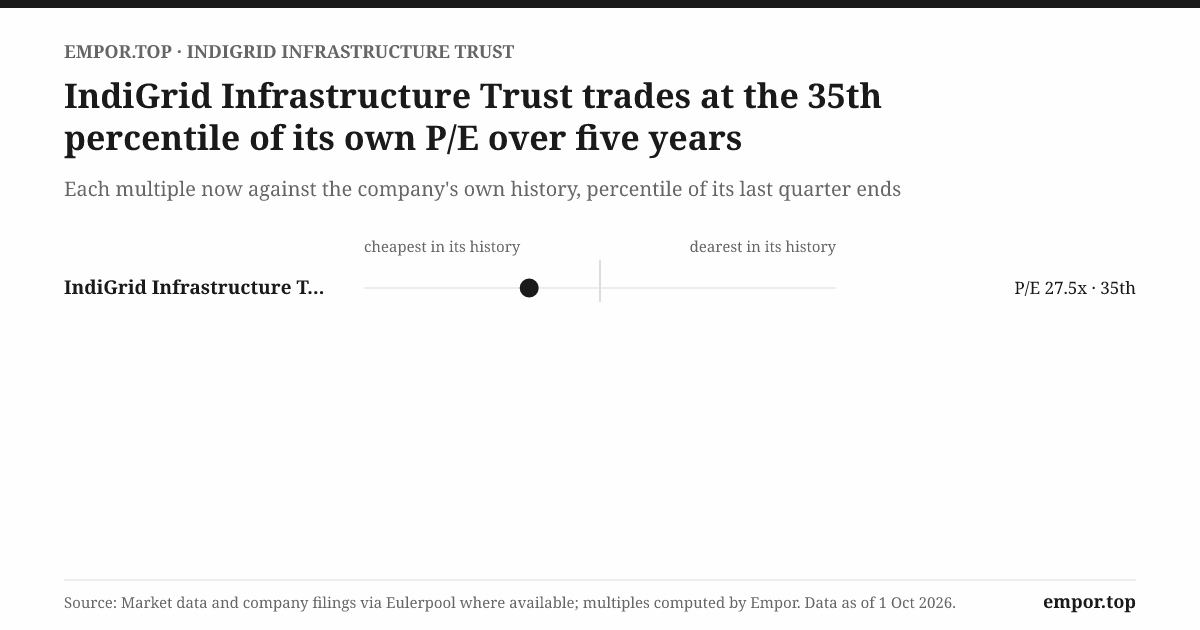
The valuation tells you what the market assumes. Traditional multiples are close to meaningless here, though for what it is worth the P/E of about 27.5 sits slightly below its five-year median of about 309. The yield gap to PGInvIT, about 1.5 percentage points, implies the market charges IndiGrid a risk premium for its solar exposure, its sponsor structure and its acquisition dependence, rather than paying it a premium for growth.
The KPIs that matter
Three numbers capture the case. Distribution per unit: ₹16.00 in FY2026, rising, with ₹16.48 guided1. Net debt to AUM: 57.6%, down from 59.1% a year earlier1. Weighted average cost of debt: about 7.4%, the number that refinancing will move2. If DPU keeps rising while leverage holds and borrowing costs stay near 7.4%, the bull case is working. If any of the three breaks, the bear case is.
The question, in the end, is less about whether IndiGrid is a good business than about what lessons its decade of existence teaches.
X. Playbook: Business & Investing Lessons (2:00:00 – 2:12:00)
In 2016, before it was a trust, the portfolio that became IndiGrid reported a net loss on its accounts1. A decade later, an insurance fund that bought its units at listing had collected a distribution every single quarter. Both facts are true, and the gap between them is the education.
Lesson 1: Pool the counterparty before you build the wire. In most emerging markets, the weakest link in a power business is the buyer. IndiGrid's transmission lines are worth what they are not because the contracts are long but because the payment pool decouples them from any single state utility's balance sheet. A thirty-five-year contract with an insolvent customer is a thirty-five-year argument. A contract is only as strong as the pool that pays it. Founders building in infrastructure-heavy emerging markets should ask first who absorbs a default, and only then how long the contract lasts.
Lesson 2: Depreciation is not a cash bill, but a concession is not forever. The 356% payout ratio terrified anyone reading the income statement and reassured anyone reading the cash flow. Both readers missed half the story. Non-cash amortisation shields distributable cash, but the assets do run out; part of every distribution is the investor's own capital returning. An InvIT yield is a coupon with an expiry date written into the steel. The lesson for investors is to value these vehicles as annuities that need constant refilling, not as bonds that last forever.
Lesson 3: A manager who owns 1% needs guardrails that own the other 99%. When KKR took control in 2019, it brought cheaper capital and institutional discipline. It also brought an incentive to grow assets for the sake of fees. IndiGrid's independent directors and its sovereign and insurance unitholders are not decorative; they are the price of the arrangement. When the manager is paid to buy, the unitholder must be paid to say no. The lesson for anyone investing in an externally managed vehicle is to judge the governance by the deals it blocks, not the resolutions it passes.
Lesson 4: Keep the bulldozers away from the dividend cheque. EnerGrid exists so that right-of-way fights and construction delays never touch IndiGrid's quarterly distribution. It is the cleanest structural idea in the story, and its worth will be determined entirely by the prices at which assets cross from one side to the other. Separate the risk, then audit the bridge.
Lesson 5: Coverage protects today; the maturity ladder protects tomorrow. An interest coverage ratio of about two times says the trust can pay this year's coupons. It says nothing about the cost of the next ₹4,430 crore of bonds. For a vehicle that distributes nearly everything, the refinancing rate is as important as the tariff. In a pass-through vehicle, the bond market is a silent partner in every distribution.
XI. Epilogue (2:12:00 – 2:20:00)
Tonight, IndiGrid stands as one of India's largest private infrastructure trusts: 55 transmission lines, 18 substations, about 1.5 GWp of solar and a 2.5 GWh storage pipeline, valued by the market at about $1.7 billion and yielding roughly 10.5% to 11%19. The founder-sponsor is gone. A global private equity firm runs the manager. Domestic insurers and pension funds own the largest share of the units, and retail investors who were once shut out now trade them a unit at a time.
The next twelve months will answer the central questions more decisively than the last nine years did.
The first refinancing test arrives with the ₹2,220 crore due in FY2027. If IndiGrid replaces it near its 7.4% average cost, the refinancing wall becomes a non-event and the FY2028 tranche looks manageable. If the coupon comes in a full point higher, the guided DPU growth will be under pressure before the solar or sponsor questions even come into play.
The FY2027 DPU is the second test. Management has guided ₹16.48. Delivering it while keeping net debt to assets below about 60% would show that growth is coming from accretive assets rather than leverage. Delivering it by borrowing more would show the opposite, even if the headline number is met.
The solar test comes with each monsoon. If solar collection days stay near transmission's, and the portfolio avoids another Q1 FY2026-style outage, the diversification looks like a yield booster with manageable risk. If they diverge, the market's discount to PGInvIT will look justified.
The EnerGrid vote may be the most revealing of all. The first large drop-down from the KKR and GIC development platform will test the independent board, the valuation process and the institutional voting bloc together. A fair price and a contested-but-passed vote would strengthen the governance case more than any number of 99% approvals.
The tension that remains is the one that has defined IndiGrid since KKR arrived. The manager's growth ambitions and the unitholder's demand for safe, rising, per-unit cash are aligned only as long as each new deal clears the cost of capital. That is not guaranteed by structure. It is earned deal by deal.
XII. Outro (2:20:00 – 2:25:00)
Somewhere in the country between Bhopal and Dhule, a transmission tower stands in a field at dusk. The line strung from it carries hundreds of thousands of volts toward cities that will never know its name. It does not care about interest rates, takeovers or who sits on a board in Mumbai. It is simply available, more than 99% of the time, and for that it is paid.
In 2017, India's markets wondered whether a trust could survive without an industrial parent standing behind it. Nine years later, that trust is run by private equity, owned largely by the country's insurers and pension funds, and distributes more than ₹1,300 crore a year to unitholders who can now buy a single unit at a time. IndiGrid's achievement was not to build the spine of India's grid. It was to turn that spine into an institutional cash machine, and the open question is how carefully its new owners keep feeding it.
References
-
IndiGrid Press Release: Financial Results for Quarter and Full Year Ended March 31, 2026 — NSE India, 2026-05-14 ↩↩↩↩↩↩↩↩↩↩↩↩↩↩↩↩↩↩↩↩↩↩↩↩↩↩↩↩↩↩
-
Investor Presentation: Q4 & FY26 Financial & Operational Performance — BSE India, 2026-05-14 ↩↩↩↩↩↩↩↩↩↩↩↩↩↩↩↩↩↩↩↩↩↩↩↩↩↩↩↩
-
Rating Rationale: IndiGrid Infrastructure Trust — ICRA Limited, 2026-05-27 ↩↩↩↩↩↩↩↩↩↩↩↩↩↩
-
Summary of Proceedings and Scrutinizer's Report of the 9th Annual General Meeting of IndiGrid — BSE India, 2026-07-22 ↩↩↩↩↩↩
-
Transcript of IndiGrid Infrastructure Trust Q1 FY26 Quarterly Conference Call — BSE India, 2025-07-25 ↩↩↩↩↩↩↩
-
Draft Letter of Offer: India Grid Trust Rights Issue of Units — BSE India, 2021-03-13 ↩↩
-
Annual Report and Notice of 5th Annual General Meeting of India Grid Trust (FY2021-22) — BSE India, 2022-06-28 ↩↩↩
-
Central Electricity Regulatory Commission: Sharing of Inter-State Transmission Charges and Losses Regulations — CERC India ↩↩
-
IndiGrid Company Profile and Stock Quote — National Stock Exchange of India ↩↩↩
-
Rating Rationale: India Grid Trust AAA/Stable Reaffirmed — CRISIL Ratings, 2025-09-18 ↩
-
Rating Rationale: India Grid Trust Long-Term Issuer Rating IND AAA/Stable — India Ratings and Research, 2025-11-20 ↩
 LinkedIn
 WhatsApp
 Reddit
 Hacker News
 Email
Email Kindle
 RSS Feed
 Spotify
 Apple Podcasts
 Amazon Music
 Audible
 YouTube