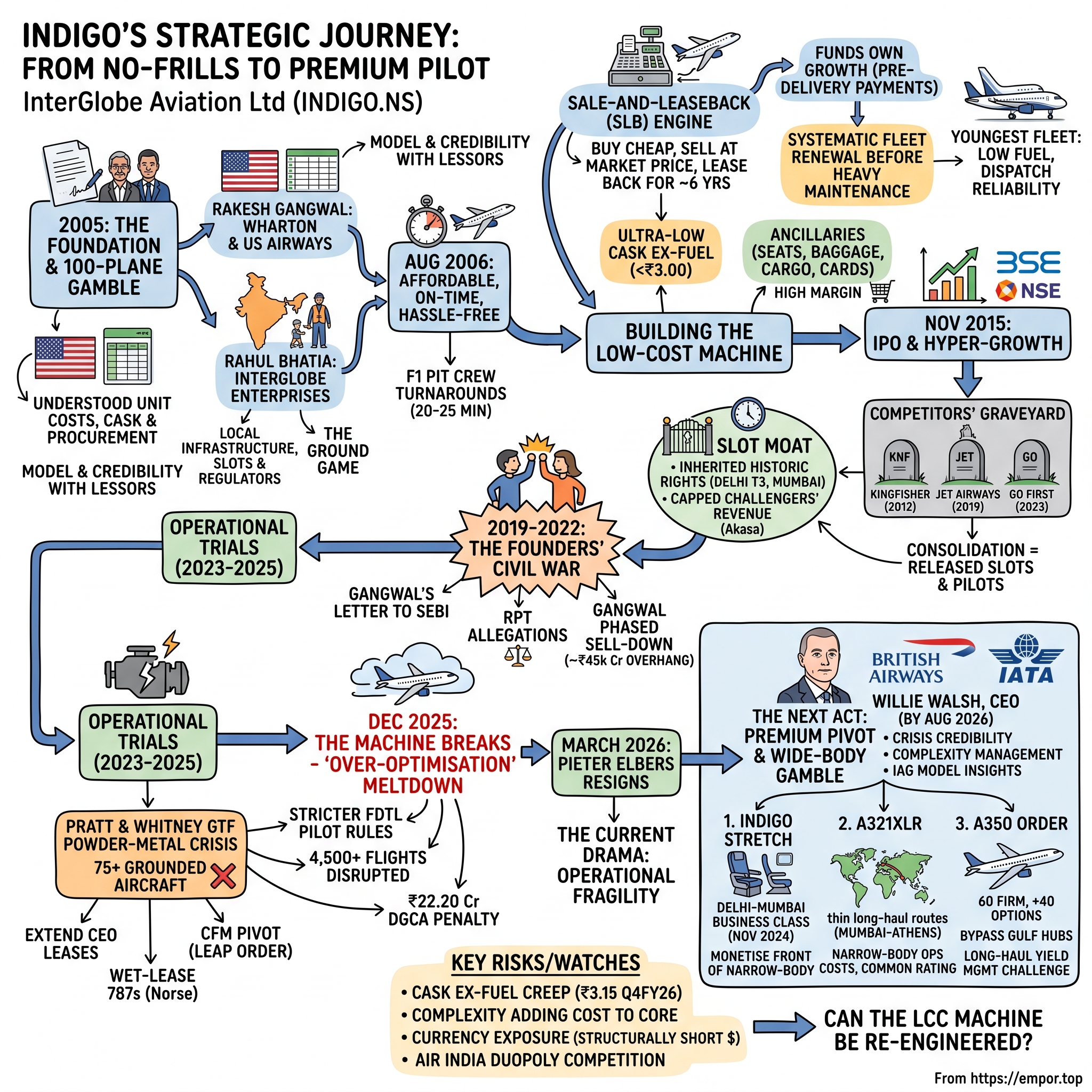
InterGlobe Aviation Ltd (IndiGo): The Sale-and-Leaseback Machine and the Premium Pivot
I. Introduction & Episode Roadmap
On the morning of June 19, 2023, inside a temporary pavilion at Le Bourget airfield outside Paris, a group of executives sat down at a long table under a bank of television lights and signed a piece of paper that made aviation history. On one side sat Guillaume Faury and Christian Scherer of Airbus. On the other sat Rahul Bhatia, the promoter and Managing Director of a company most of the world's aviation press could barely pronounce, alongside Pieter Elbers, the Dutchman he had hired to run it. The order they signed was for 500 A320-family aircraft — the largest single purchase agreement in the history of commercial aviation, with deliveries scheduled between 2030 and 2035.1 It took IndiGo's total order book with Airbus to 1,330 aircraft and made the airline, by a wide margin, the largest A320-family customer on earth.1
Pause on the arithmetic of that for a moment. The order was not for aircraft to be delivered next year, or the year after. It was for aircraft arriving in the 2030s — a delivery stream that would still be landing when the children of IndiGo's current passengers were booking their own honeymoons. An airline that had not existed twenty years earlier had just placed an option on a decade of Airbus's narrow-body production line.
What makes this remarkable is not the size of the cheque. It is where it was written. India is, by reputation, the world's most efficient machine for destroying airline capital. Air Sahara was absorbed and dismantled. Kingfisher Airlines, the flamboyant creation of liquor baron Vijay Mallya, collapsed in 2012 under a mountain of debt. Jet Airways — for two decades the establishment full-service carrier, the one with the corporate accounts and the London slots — went into administration in 2019. Go First filed for insolvency in 2023. The industry has burned through billions of dollars of promoter equity, bank loans and taxpayer money with an almost artistic consistency.
And yet, in the middle of that graveyard, IndiGo built something that looks less like an airline and more like a toll booth. By May 2026 the carrier held roughly 64.9% of India's domestic passenger market, essentially flat against April's 65.0%.2 Over the full financial year ending March 2026 it flew 123.4 million passengers.3 It operates a fleet of 441 aircraft, serves 97 domestic and 45 international destinations, and at peak runs more than 2,200 flights a day.3 In a country of 1.4 billion people entering the steepest part of its air-travel adoption curve, roughly two of every three domestic seats sold belong to one company.
The current drama
Which is what makes the last eight months so extraordinary. Because at the exact moment IndiGo's dominance looked most complete, the machine broke.
Beginning December 3, 2025, IndiGo's network came apart. Over three days the airline cancelled 2,507 flights and delayed 1,852 more, stranding more than three lakh passengers across the country; the disruption ultimately touched roughly 4,500 flights.4 The immediate trigger was a set of stricter Flight Duty Time Limitation norms — rules governing how long pilots may fly and how long they must rest — that had been phased in through 2025. The deeper cause, according to the regulator's own inquiry, was that IndiGo had built its schedule with almost no slack. The Directorate General of Civil Aviation found an "overriding focus on maximising the use of crew, aircraft, and network resources," compounded by deficiencies in planning software, insufficient operational buffers, and lapses in management oversight.5 In January 2026 the DGCA imposed a penalty of ₹22.20 crore, structured as ₹1.80 crore for six specific violations plus ₹20.40 crore accruing at ₹30 lakh a day across 68 days of continued non-compliance, and required the airline to post a ₹50 crore bank guarantee.6
On March 10, 2026, Pieter Elbers resigned as CEO with immediate effect, citing personal reasons, after three and a half years in the job.7 Rahul Bhatia — a founder who had spent much of the previous decade fighting to control the company rather than run it — took interim charge.7 Three weeks later, on March 31, 2026, the board announced its answer: William "Willie" Walsh, the outgoing Director General of IATA, former chief executive of British Airways and architect of International Airlines Group, would become CEO, joining no later than August 3, 2026 once his IATA term expired.8
The thesis
So this is the story of two questions, and they are not the same question.
The first is historical and largely settled: how did a start-up low-cost carrier, in the most hostile large aviation market in the world, build a position that no domestic competitor has been able to dent in fifteen years? The answer involves a piece of financial engineering — the sale-and-leaseback model — that turned aircraft procurement itself into a profit centre, and a set of structural advantages around airport slots that compound with scale.
The second question is open, expensive, and unresolved: can that machine be re-engineered into something else? IndiGo is now attempting a transition that airline history suggests is genuinely difficult — from a single-fleet-type, no-frills, point-to-point domestic operator into a hybrid carrier with business-class cabins, wide-body aircraft, long-haul European routes and a premium brand. It is doing so with a fleet grounding problem it did not create, a reported annual loss on its books, and a new chief executive who has never operated in the Indian market.
The honest summary of where things stand in July 2026 is that IndiGo's competitive position remains formidable and its execution record has just been shown to be fallible in a way it never had been before. Both facts are true simultaneously, and the rest of this story is an attempt to weigh them against each other.
To understand why the December meltdown was so shocking, you have to understand what the company had been optimised for — and that begins in 2005, with two men and an order nobody thought they could pay for.
 Subscribe on LinkedIn
II. The Founders' Pact & The Unprecedented 100-Plane Gamble
The 2005 Paris Air Show was, by the standards of these things, a Boeing year. The 787 Dreamliner programme was gathering momentum, Airbus's A380 was consuming attention and capital, and the narrow-body war for Asia was widely seen as something that would be decided later, by carriers that actually existed.
Into this walked two Indians representing an airline with no aircraft, no route authority, no passengers and no revenue. They placed a firm order for 100 Airbus A320s.
It is worth sitting with how strange this was. IndiGo had not flown a single commercial flight and would not do so for another fourteen months. It had no operating certificate in hand, no slots, no maintenance base, no brand. And it committed to a hundred aircraft — an order that, at list prices, ran to billions of dollars, from a balance sheet that was essentially a business plan and two reputations.
Rakesh Gangwal: the man who knew the numbers
The reason the order was not insane lies almost entirely in the résumé of Rakesh Gangwal.
Gangwal was an IIT Kanpur mechanical engineer who went to the Wharton School and then, unusually for an Indian of his generation, stayed in America and climbed inside the machinery of the US airline industry. He worked at Ford, then at United Airlines, where he rose through network planning and strategy. In 1996 he moved to US Airways, becoming its president and then chief executive officer — an Indian-born immigrant running one of the largest legacy carriers in the United States, a genuinely rare thing at the time.
What that career gave him was not glamour. It gave him an almost forensic understanding of where airline money actually goes. Gangwal had lived through the US industry's brutal education in unit costs: the realisation that a legacy carrier's fate is decided less by its route map or its brand than by its cost per available seat kilometre, its aircraft utilisation, and the terms of its labour and lease contracts. He had seen Southwest Airlines eat the US domestic market from underneath with a single aircraft type and a fanatical devotion to turnaround time. He had seen what happened to carriers that carried complexity they could not afford.
He also understood something about aircraft procurement that most people outside the industry do not: list prices are fiction. The published price of an A320 bears roughly the same relationship to what an airline actually pays as the sticker price on a hotel room bears to what a corporate travel desk negotiates. The real number depends entirely on volume, timing, and how badly the manufacturer wants the deal.
Rahul Bhatia: the man who knew the ground
Gangwal's insight was useless in India without a partner who could actually build the thing. That was Rahul Bhatia.
Bhatia had returned to India after studying in Canada and built InterGlobe Enterprises into an unglamorous but formidable travel infrastructure business: general sales agency work for foreign airlines, travel technology and distribution, ground handling, hospitality. It was not a business that made headlines. It was a business that meant Bhatia knew every airport manager, every regulator's office, every distribution channel, and every operational bottleneck in Indian civil aviation. He understood the licensing regime, the bilateral rights framework, the politics of slot allocation, and the specific ways in which Indian aviation ventures had historically died.
The partnership had a clean logic to it. Gangwal brought the model and the credibility with Airbus and international lessors. Bhatia brought the ground game and the local infrastructure. Neither could have done it alone. This division of labour also planted the seed of a conflict that would erupt fourteen years later — because Bhatia's existing businesses were natural suppliers to the airline, and that overlap would eventually become the subject of a very public war.
Why 100 aircraft was the whole strategy
The strategic logic of the 2005 order was that Airbus, in that moment, needed IndiGo more than IndiGo needed Airbus.
Boeing's 737 had a strong grip on Asian narrow-body fleets. Airbus wanted the A320 to become the default single-aisle aircraft of the region's coming growth wave, and India was the single most important prize on that map. A hundred-frame order from a start-up was risky for Airbus, but it was also a statement — a way of putting a stake in the ground in the market everyone knew was next.
Gangwal traded on that. The reported discounts were deep, and while the specific terms were never disclosed, the subsequent behaviour of the business tells you they were substantial enough to become the foundation of the entire model. A large order does three things at once. It fixes your unit acquisition cost far below what a competitor buying ten aircraft at a time can achieve. It gives you a predictable, contracted delivery stream — meaning you can plan network growth years ahead while rivals scramble for available aircraft. And it makes you commercially important to your supplier, which matters enormously when something goes wrong.
The order also created a discipline. Once you have committed to a hundred aircraft, you must grow into them. There is no option to slow down, no comfortable plateau. The order book became a forcing function for relentless expansion.
August 2006: the pit stop obsession
IndiGo began flying in August 2006 with a proposition that sounds almost aggressively boring: on-time, affordable, hassle-free.
In an Indian market where the competition was selling either legacy prestige — Jet Airways with its business class and lounges — or spectacle, in Kingfisher's case, IndiGo sold punctuality. Not luxury. Not loyalty programmes. The plane leaves when it says it will.
Underneath the marketing sat a hard operational objective. Aircraft only earn money in the air. A jet parked at a gate is a multi-million-dollar asset generating nothing while its lease payment accrues. So IndiGo built its ground operation around turnaround times of roughly 20 to 25 minutes, treating each stop like a Formula 1 pit crew: cleaning, catering, fuelling and boarding compressed into a choreographed sequence. Shave ten minutes off each turn and, over a day of five or six sectors, you gain most of an extra flight per aircraft. Across a fleet, over a year, that is an enormous amount of free capacity.
This is the crucial thing to understand about IndiGo's DNA. Punctuality was never really a customer-service philosophy. It was the visible consumer-facing output of a cost obsession. On-time performance and high aircraft utilisation are the same discipline viewed from two directions. That identity — efficiency as brand — served the company brilliantly for nearly two decades. It also, as December 2025 would demonstrate, contained a failure mode.
Having secured its aircraft at a price nobody else could match, IndiGo then did something genuinely clever with them: it sold them.
III. Building the Low-Cost Machine & The Sale-and-Leaseback Engine
Here is a question that puzzled Indian equity analysts for the better part of a decade. How does an airline in a market with punishing fuel taxes, chronic price wars and thin fares generate consistent operating cash — while its competitors, flying similar aircraft on similar routes, bleed?
Part of the answer is that for much of its history, IndiGo was not purely in the business of flying passengers. It was also in the business of buying aircraft cheaply and selling them at market price.
The flywheel, explained simply
Strip away the jargon and the sale-and-leaseback model works like this.
Imagine you have negotiated the right to buy a car for ₹6 lakh that everyone else buys for ₹10 lakh, because you agreed to buy a hundred of them. When your car is delivered, you immediately sell it to a leasing company for close to the ₹10 lakh market price — and then rent it back from them for six years. You have the car. You are paying rent on it. And you have booked the ₹4 lakh difference as cash, today.
That is the mechanism. IndiGo used its bulk-order discount to acquire aircraft well below prevailing market value. On delivery, it sold those aircraft to international lessors at market price and leased them back on fixed-term contracts, typically around six years. The gap between the discounted acquisition cost and the sale price converted into immediate cash and operating income.
Three things follow from this, and they compound.
First, it funds itself. Aircraft orders require pre-delivery payments — staged instalments paid to the manufacturer during the years before an aircraft actually arrives. These are a significant cash drag for any growing airline. IndiGo's sale-and-leaseback gains funded the next tranche of pre-delivery payments, which secured the next batch of aircraft, which generated the next round of gains. The order book paid for itself.
Second, it keeps the balance sheet light. A conventional airline that buys and owns its fleet ends up with an enormous depreciating asset base financed by debt. IndiGo instead ran an asset-light structure where the aircraft sat on lessors' balance sheets. This is why, for years, IndiGo could describe itself as having no meaningful net debt in the conventional sense — the obligations were lease liabilities, which under modern accounting standards do sit on the balance sheet, but which behave differently from term debt in a crisis.
Third — and this is the part most people miss — it is a maintenance strategy disguised as a financing strategy. Commercial aircraft require progressively heavier scheduled maintenance as they age. The light checks are routine. But the heavy structural overhauls — the C-checks and, further out, the D-checks where an aircraft is essentially disassembled and inspected — start becoming genuinely expensive around years six to eight, and they take the aircraft out of revenue service for weeks. By handing every aircraft back to its lessor at the end of a six-year lease, IndiGo systematically returned each jet just before the expensive part of its life. It replaced them with brand-new aircraft, which burn less fuel and break less often.
The result was one of the youngest fleets in world aviation. That is not a vanity metric. A younger fleet means lower fuel burn per seat, fewer unscheduled maintenance events, better dispatch reliability and therefore better on-time performance. The financial engineering and the operational brand were the same thing.
What the accounting purists said — and what changed
It is worth being clear-eyed here, because this model attracted legitimate criticism and the criticism has aged into relevance.
Sceptics argued for years that IndiGo's reported profits were flattered by transactions that were fundamentally about the timing of recognising a procurement discount, rather than about the underlying economics of flying people. In effect, the argument went, the airline was pulling forward a benefit that a conventional owner-operator would have recognised gradually over the life of the aircraft in the form of lower depreciation. The cash was real. The question was whether it was recurring earnings power or a monetisation of the order book.
That debate matters more now than it did then, for two reasons. Accounting standards on leases tightened, changing how these transactions flow through the income statement and putting lease liabilities squarely on the balance sheet. And as IndiGo's fleet grows into wide-bodies and the airline increasingly takes direct-operating-lease and owned aircraft alongside sale-and-leaseback deliveries, the mix shifts. The lesson for anyone reading IndiGo's numbers today is a durable one: with airlines, always ask which part of the profit came from flying and which part came from financing.
The unit economics that actually matter
Airline analysis has a vocabulary problem, so here is the plain-English version.
An available seat kilometre (ASK) is one seat flown one kilometre — the industry's unit of supply. A revenue passenger kilometre (RPK) is one paying passenger flown one kilometre — the unit of demand. Divide RPK by ASK and you get load factor: how full the aeroplanes are. IndiGo's load factor in the March 2026 quarter was 85.8%, down 1.7 percentage points year on year.3
Yield is what the airline earns per unit of that traffic — essentially, ticket pricing power. CASK is cost per available seat kilometre: what it costs to fly one seat one kilometre. The industry usually separates fuel out, because fuel is a commodity nobody controls, leaving CASK ex-fuel as the cleanest measure of whether an airline is actually well run.
For most of its history, IndiGo held CASK ex-fuel below roughly ₹3.00 — a level Indian competitors could not approach. That gap was the whole game. It meant IndiGo could price a fare that was profitable for IndiGo and loss-making for everyone else, and simply wait.
That number is now moving in the wrong direction. In the quarter to March 2026, CASK excluding fuel and forex came in at ₹3.15, up 7.3% year on year, even as fuel CASK fell 4.8% to ₹1.53.3 Cost discipline, the founding advantage, is under measurable pressure — a thread that runs through everything that follows.
The ancillary machine
The other pillar of low-cost economics is unbundling: charge a low base fare, then sell everything else. Seat selection. Excess baggage. Priority boarding. Food and water on board. Cargo capacity in the belly of the aircraft. Co-branded credit cards and corporate booking portals.
The strategic point of ancillaries is that they carry very high incremental margin — the aircraft is flying anyway — and they are less visible in fare-comparison engines, which lets the headline fare stay aggressive. Over time IndiGo built this into a serious revenue stream alongside passenger tickets, including a cargo operation using dedicated freighters.
By the mid-2010s, this machine was running well enough that IndiGo did something the Indian airline industry had not managed in a generation: it went public, and stayed solvent.
IV. IPO, Hyper-Growth, and the Competitors' Graveyard
On November 10, 2015, InterGlobe Aviation shares listed on the BSE and NSE at ₹856, a 12% premium to the issue price of ₹765.9 The offering had run from October 27 to 29 at a price band of ₹700–765, comprised a fresh issue of about ₹1,272 crore alongside an offer for sale of roughly ₹1,746 crore for a total of ₹3,018 crore, and was subscribed 5.84 times.10
The scepticism in the room was substantial and, in hindsight, instructive. Indian institutional investors had been burned repeatedly by aviation. The pitch — that a low-cost carrier could sustain margins in the most price-sensitive large air travel market on earth — sounded like the same pitch every failed Indian airline had made. Within about five weeks of listing, IndiGo had entered the ranks of India's fifty most valuable listed companies.11
What the sceptics underestimated was not IndiGo's ability to make money. It was IndiGo's ability to make its competitors lose money faster.
Kingfisher: the cautionary tale of the wrong model
Kingfisher Airlines was the anti-IndiGo. Vijay Mallya's carrier was built on spectacle — designer cabin crew uniforms, in-flight entertainment, a calendar, a brand that was really an extension of a liquor empire's marketing budget. It bought Air Deccan, a low-cost operator, and then proceeded to run a confused hybrid with legacy costs and low-cost fares.
Kingfisher's collapse in 2012 was overdetermined: heavy debt, an incoherent fleet, unpaid salaries, unpaid taxes, unpaid lessors. But the mechanism that killed it was the one IndiGo had engineered for. In a market where fares are set by the marginal competitor and the marginal competitor has a structurally lower cost base, a high-cost carrier does not lose gradually. It loses on every single seat, every single day, and the losses scale with its own growth.
Jet Airways: the establishment falls
Jet Airways' 2019 collapse was more shocking because Jet was not a vanity project. It was a genuinely good airline with a loyal corporate following, an international network, and slots at Heathrow. It was also carrying a mixed fleet, legacy labour costs, an expensive full-service product, and a balance sheet that could not absorb a fuel spike and a rupee depreciation at the same time.
The Jet failure is the single most important event in IndiGo's competitive history, and not because it removed a rival. It removed a rival and released its slots and its pilots into the market at the exact moment IndiGo had the aircraft on order to absorb them. Consolidation in aviation does not distribute evenly; it flows to whoever has capacity ready.
The slot moat
Which brings us to the most underappreciated structural advantage in this story.
At a congested airport, the right to land or take off at a particular time is a scarce, administratively allocated resource called a slot. Under the historic-rights convention that governs slot allocation, an airline that has used a slot consistently generally retains the right to keep it. Slots are not really bought and sold in India the way they are at Heathrow. They are inherited, defended, and accumulated.
Now consider what that means at Delhi's Terminal 3, at Mumbai — a two-runway airport operating at brutal saturation — and at Bengaluru. The commercially valuable slots are the early-morning departures and the evening returns, because that is when business travellers, who pay the highest fares and book late, want to fly. IndiGo, by growing continuously for fifteen years while competitors shrank or died, ended up holding the majority of them.
A new entrant cannot solve this with capital. Akasa Air can raise money and buy aircraft. It cannot buy a 7:45 a.m. Mumbai–Delhi slot, because there isn't one for sale. It gets the leftovers — midday departures and awkward late-night returns — which structurally attract leisure traffic at lower fares. The result is that a challenger's revenue per seat is capped by the schedule it is permitted to fly, regardless of how well it executes.
This is why IndiGo's market share has proven so stubborn. It is not solely brand loyalty or price. It is that the physical infrastructure of Indian aviation has, through fifteen years of accumulated historic rights, been substantially allocated to one airline. That advantage is real, durable, and — importantly for investors — largely independent of management quality.
Which is convenient, because for a period in 2019 and 2020, IndiGo's management was mostly at war with itself.
V. The Founders' Civil War: Bhatia vs. Gangwal
In July 2019, Indian business journalists received a document that does not usually enter the public domain: a letter from one co-founder of a ₹60,000-crore listed company to the chairman of the securities regulator, accusing the other co-founder of running the company improperly.
Rakesh Gangwal's letter to the Securities and Exchange Board of India alleged violations at IndiGo relating to related-party transactions, and to the appointment of senior management personnel, directors and the chairman.12 The core of his complaint was structural: he argued that the shareholders' agreement and the Articles of Association gave Rahul Bhatia unusual controlling rights over the company — rights disproportionate to economic ownership.12
The specific accusation was sharper still. Gangwal alleged that Bhatia had built "an ecosystem of other companies that would enter into dozens of related party transactions with IndiGo," and had done so without adequate checks and balances.12
What was actually at stake
To see why this mattered to shareholders rather than just to two billionaires, look at the shape of the alleged problem.
InterGlobe Enterprises — Bhatia's private group — operated in exactly the businesses an airline buys from: travel services, general sales agency work, hospitality, ground infrastructure. When IndiGo needed hotel rooms for crew layovers, or distribution services, or a dozen other operational inputs, there was a natural, and lucrative, counterparty sitting inside the promoter's own group.
Related-party transactions are not illegal. They are, however, the single most common vector by which controlling shareholders extract value from minority shareholders in family-controlled listed companies — not through outright fraud, but through a thousand contracts awarded at slightly favourable terms without competitive tension. The question is never "did money flow to a related party" but "was it at arm's length, was it disclosed, and did an independent process test the price?"
Bhatia's counter was that IGE had taken the early operational risk, built the ground infrastructure, and provided the local capability without which the airline would not exist, and that the transactions were at arm's-length prices. He characterised Gangwal's allegations as a red herring and a "publicity seeking device."13
The regulator's preliminary view was not favourable to the company. A SEBI probe suggested prima facie violations of corporate governance and listing disclosure norms in certain related-party transactions at InterGlobe Aviation, with the news knocking the share price when it emerged in February 2020.14
Why this matters for how you read IndiGo today
There is a temptation to file the Gangwal–Bhatia feud as history. That would be a mistake, for three reasons.
First, it established that IndiGo is a promoter-controlled company where governance rights and economic ownership have been asymmetric by design. The specific provisions changed — in December 2021 shareholders approved removing the right of first refusal and other share transfer restrictions from the Articles of Association — but the underlying reality that one family group holds effective control did not.
Second, it revealed how the company behaves under internal stress: publicly, litigiously, and via the regulator. That is an input into any assessment of governance quality.
Third, and most practically, it set in motion the largest sustained equity supply overhang in the Indian market. Gangwal stepped down from the board in February 2022 and announced a phased sell-down of his stake over roughly five years. He has executed it methodically ever since. His family trust sold a large block in August 2024. In August 2025, a further sale took the Chinkerpoo Family Trust's holding down to 1.78% from 3.08%, reducing the combined Gangwal-family stake to 6.51% from 7.81%.15 Across the sell-down programme, the Gangwal side has raised very large sums — reported at close to ₹45,000 crore in aggregate.15
For a shareholder, a multi-year programmatic seller of this size is a persistent, predictable weight on the stock, independent of operating performance. It is also, arguably, a positive: each tranche moves shares from a departing founder into institutional hands and reduces the odds of a future governance clash. As of the June 2025 disclosure, the promoter group held 43.54%, with InterGlobe Enterprises Private Limited at 35.73%.16
An activist looking at this company would ask a sharper version of the same question: what independent process now tests the pricing of related-party contracts, and does the board have the composition and the willingness to say no to the promoter? The company maintains a formal related-party transactions policy and the governance architecture required of a listed Indian company.17 Whether that architecture has teeth is the sort of thing that is only really tested in a crisis — and a crisis was coming, though it arrived from an entirely unexpected direction.
VI. Operational Trials: Engine Groundings and the Pratt & Whitney Powder-Metal Crisis
In the summer of 2023, an engineer at Pratt & Whitney's parent company confirmed something that would ground aircraft on four continents: a contaminant had been present in the powdered metal used to manufacture certain high-pressure turbine and compressor discs for the PW1100G geared turbofan engine. Microscopic impurities in that powder could, under the extreme heat and stress of a turbine, seed cracks. The fix was not a software patch or a service bulletin. It was pulling engines off wings, sending them to a shop queue that did not have the capacity, and waiting.
For most operators this was painful. For IndiGo it was existential arithmetic.
Why IndiGo was the most exposed airline on earth
IndiGo had built its neo fleet around the geared turbofan. The engine is genuinely clever — a gearbox lets the fan spin slower than the turbine, which improves efficiency and cuts fuel burn meaningfully versus previous-generation engines. That fuel saving was central to the economics of the whole A320neo transition.
But it meant IndiGo's exposure was concentrated. When the inspection programme accelerated, the airline's grounded count climbed relentlessly. Management warned in November 2023 that more than 30 additional aircraft would be grounded in the January–March 2024 window alone.18 Groundings peaked at around 75 aircraft.19
Seventy-five aircraft. Consider what that means for a carrier that at the time operated somewhere in the region of 350 to 380 jets. Close to a fifth of the fleet — capital already committed, lease payments still contractually due, crews already hired and trained — sitting motionless on the tarmac, generating nothing, in the middle of the fastest-growing air travel market on the planet.
The salvage operation
The response, orchestrated by the operations team and CFO Gaurav Negi, was a study in tactical improvisation, and it worked better than it had any right to.
Extending the old aircraft. IndiGo had spent fifteen years building a religion around handing aircraft back before they got expensive. It now did the opposite, extending leases on older A320ceo aircraft that had been scheduled for return. These were thirstier and costlier to maintain. They were also available immediately, which was the only thing that mattered.
Renting capacity wholesale. The airline turned to damp and wet leases — arrangements where you rent not just an aircraft but some or all of the crew and maintenance with it. IndiGo wet-leased narrow-bodies to plug domestic gaps.20 It later damp-leased Boeing 787-9s from Norse Atlantic Airways, taking the first in early 2025 and adding more through the summer, with the aircraft and cockpit crew coming from Norse while IndiGo supplied cabin crew.21 These arrangements are expensive per block hour — you are paying someone else's margin — but they preserve the thing that is genuinely irreplaceable: the slot, the schedule, and the customer relationship on a high-yield route.
Extracting compensation. IndiGo negotiated compensation from Pratt & Whitney for the grounded fleet. The exact aggregate terms were not disclosed.
The accounting question investors should have asked
Here is where an independent reader needs to be careful.
Compensation from an engine manufacturer for grounded aircraft is, economically, a reimbursement for damage — it offsets a cost that should not have been incurred. When it is recognised within operating income, it lands in the same line that investors use to judge how well the airline is flying aeroplanes.
IndiGo reported a net profit of ₹7,258.4 crore for FY25, down 11.2% from ₹8,172.5 crore in FY24, on revenue from operations that rose 17% to ₹80,802.9 crore.22 The March 2025 quarter was particularly strong, with net profit up 61.9% to ₹3,067.5 crore.23
Those were good numbers delivered with roughly a fifth of the fleet unavailable at the worst point — which is genuinely impressive operational management. But the correct analytical posture is to note that a portion of that reported profitability reflected supplier compensation for a problem, rather than underlying earnings power, and to be alert to what happens to the comparison base as compensation flows normalise. This is not an accusation of impropriety; the treatment was disclosed. It is a reminder that a headline profit number and a picture of operating health are different objects.
The CFM pivot
Strategically, IndiGo's most consequential response was to diversify its engine supply. The airline had already begun this before the powder-metal crisis: at the 2019 Paris Air Show it ordered 280 additional A320neo-family aircraft powered by CFM International's LEAP engine, having previously ordered only geared-turbofan-powered neos.19 Incoming aircraft from the enormous current order book are LEAP-powered.19
The lesson is one that applies well beyond aviation: single-sourcing a critical component optimises cost right up until the moment it doesn't, and then the concentration you built deliberately becomes the risk you cannot escape. IndiGo learned this at a cost of several hundred aircraft-years of lost utilisation.
Groundings had steadily fallen by 2026. But by the time the engine crisis was easing, the company had already begun creating a different one — this time entirely of its own making.
VII. The "Over-Optimization" Crisis & The Pieter Elbers Resignation
Pieter Elbers arrived at IndiGo in September 2022 with a specific mandate and an unusual pedigree. He had spent his entire career at KLM, joining as a young manager and rising to chief executive of the Dutch flag carrier — an airline that is the opposite of IndiGo in almost every respect. KLM is a full-service, long-haul, alliance-embedded legacy operator built around a hub-and-spoke network at Schiphol, where the entire commercial model depends on connecting traffic.
Hiring him told you exactly what the board wanted. IndiGo's domestic dominance was approaching its natural ceiling; if the airline held roughly two-thirds of the domestic market, further growth had to come from somewhere else. That somewhere was international, and international meant learning to do things — hubs, connections, premium cabins, long-haul network planning — that a domestic point-to-point LCC had never done.
By most measures Elbers executed the growth mandate. International destinations expanded. The premium product launched. The wide-body order was placed. The record March 2025 quarter arrived. On the financial scoreboard, IndiGo under Elbers looked like a company doing everything right.
The pressure underneath
But there is a version of the same period that reads differently.
Every strategic initiative — more international flying, more destinations, higher utilisation to compensate for grounded aircraft, tighter schedules to maximise slot value — pushed the same underlying resource harder. Not aircraft. People. Specifically, pilots and cabin crew, whose availability is governed not by management ambition but by law.
An airline's crew planning is a constraint-satisfaction problem of genuinely fearsome complexity. Every pilot has a licence, a type rating, a base, a recency requirement, contractual limits, and — critically — legally mandated maximum duty periods and minimum rest periods. The rostering software's job is to build a month of flying that satisfies every one of those constraints simultaneously for thousands of people. Squeeze the buffers and you get better utilisation and lower crew cost per block hour. You also get a schedule with no capacity to absorb a shock, because every crew member is already flying near their legal ceiling.
Think of it as a road network at 100% capacity. It functions perfectly until one car brakes. Then everything behind it stops, and the queue takes hours to clear.
December 2025
The Directorate General of Civil Aviation had been phasing in revised Flight Duty Time Limitation norms to address pilot fatigue — a genuine and long-running safety concern in Indian aviation. The rules increased mandatory rest, tightened night-duty limits, and reduced the number of hours a given pilot could legally contribute. Crucially, these changes were not a surprise. The phased regulatory timetable had been known since 2023, with the sharper tightening landing from November 2025.24
IndiGo went into the winter schedule with rostering assumptions and pilot numbers that did not survive contact with the new rules.
The network came apart beginning December 3, 2025. Across three days the airline cancelled 2,507 flights and delayed 1,852 more; more than three lakh passengers were stranded, and the total disruption ran to roughly 4,500 flights.45 Airports filled with people who could not be rebooked because there was no spare capacity anywhere in the system. The DGCA constituted an inquiry committee on December 5 and granted temporary FDTL relief to let the airline rebuild its rosters and stabilise the network.5
The inquiry's findings were damning in a specific and unusual way. This was not an equipment failure, a weather event, an IT outage or a labour action. The regulator attributed the collapse to an "overriding focus on maximising the use of crew, aircraft, and network resources," inadequate preparation for FDTL norms the airline had years of notice about, deficiencies in planning software, insufficient operational buffers, and lapses in management oversight and crew rostering.5 The airline had, in the regulator's telling, optimised itself into fragility.
The January 2026 penalty of ₹22.20 crore was in absolute terms modest for a company of IndiGo's size.6 What was not modest was the structure of it and what came with it: a ₹50 crore bank guarantee, and formal warnings and cautions issued to named senior executives — including the CEO for inadequate crisis oversight, the accountable manager for failing to assess the impact of the winter schedule against the new norms, and the head of the operations control centre, who was directed to be relieved of duties.6 Regulators do not usually name individuals. When they do, it is a signal about accountability rather than about money.
The resignation
Elbers resigned on March 10, 2026, effective at close of business, citing personal reasons.7 The airline's market value had been substantially reduced in the intervening months.8 Rahul Bhatia assumed management on an interim basis.7
Two observations matter for anyone assessing management credibility here.
The first is about the gap between the crisis and the exit. Three months passed between the meltdown and the resignation. That is a long time in reputational terms, and the sequencing — regulatory findings, then named warnings, then departure — invites the reading that the exit was less voluntary than the stated reason implies. Investors should treat "personal reasons" as a formulation, not an explanation.
The second is more important and cuts against a simple villain narrative. The December failure was not an aberration of IndiGo's culture. It was that culture's logical endpoint. Twenty years of institutional reward for squeezing buffers out of the system produced an organisation extremely good at running at 100% and structurally poor at asking what happens at 101%. Elbers accelerated a machine he did not design.
The board's answer was to hire someone who has spent his career on the other side of that trade-off.
VIII. The Next Act: Willie Walsh, The Premium Pivot, and the Wide-Body Gamble
Willie Walsh began his working life in the cockpit. He joined Aer Lingus as a cadet pilot in 1979, flew the line, moved into management, and became chief executive of the Irish flag carrier — where he acquired a reputation as a man entirely unafraid of confrontation, restructuring the airline aggressively in the years after 2001. He then ran British Airways, where he faced down cabin crew unions in a bitter dispute, and went on to construct International Airlines Group, merging BA with Iberia and later absorbing Aer Lingus and the Spanish low-cost carrier Vueling into a single holding structure. He stepped down from IAG in 2020 and became Director General of IATA, the global airline trade body, in 2021.
On March 31, 2026, IndiGo's board announced his appointment as chief executive, subject to regulatory approvals, with a start date no later than August 3, 2026 following the end of his IATA term on July 31.825
Why this hire, and what it signals
The appointment is legible as three separate bets by the board.
A bet on crisis credibility. Walsh's entire career has been about taking control of airlines in trouble and imposing order, usually unpopularly. IndiGo's immediate problem is operational integrity and regulatory standing, and the board reached for someone whose reputation is built on doing exactly that.
A bet on complexity management. This is the more interesting one. The strategic challenge in front of IndiGo — running a low-cost narrow-body operation and a premium long-haul wide-body operation under one roof without the second destroying the cost structure of the first — is almost precisely the problem IAG was built to solve. IAG's structure kept Vueling's low-cost economics separate from BA's full-service model within a common ownership umbrella. Whether that architectural insight transfers to a single-brand, single-AOC Indian carrier is an open question, but it is not a coincidence.
A bet that the India problem is learnable. Walsh has never operated in the Indian market. He does not have the regulatory relationships, the political fluency, or the ground-level knowledge that Rahul Bhatia's presence supplies. The structure — a founder-MD who has just spent months running the company directly, alongside an imported CEO — is one that has caused friction at IndiGo before. Elbers, after all, arrived with a similar mandate and a similar profile.
An honest assessment: this is a strong appointment on paper and an unproven one in context. The relevant evidence will not arrive until his first full year, and the specific thing worth watching is whether Walsh is given genuine operational authority or whether decision-making continues to route through the promoter.
IndiGo Stretch: breaking the orthodoxy
On November 14, 2024, IndiGo did something it had spent eighteen years telling investors it would never do. It put a business class on an aeroplane.
IndiGo Stretch launched on the Delhi–Mumbai route with an introductory fare of ₹18,018, using RECARO R5 seats in a two-by-two configuration with a 38-inch pitch, a five-inch recline, six-way adjustable headrests and universal power outlets, bundled with a meal box, priority check-in, complimentary seat selection and waived convenience fees.26 The plan was a scale-up across twelve metro routes by the end of 2025.26 It has since spread onto short-haul international sectors including Singapore.27
The commercial logic is straightforward and quite good. Delhi–Mumbai is one of the densest and most business-heavy air corridors in the world. That traffic was previously either flying Air India's business cabin or, in significant volume, buying IndiGo economy because there was no alternative on the schedule the traveller needed. A recliner in a 2-2 layout consumes roughly the floor space of three or four economy seats but can command a multiple of the economy fare. If the yield multiple exceeds the seat-count sacrifice, the cabin is accretive.
Note what Stretch is not. These are recliners, not lie-flat suites. IndiGo is monetising the front of a narrow-body without building a genuinely full-service product — a calculated intermediate step. Whether it holds up against Air India's post-merger cabin refresh on the same routes is not yet demonstrated.
The wide-body bet
The A350 order is a different order of commitment entirely.
IndiGo placed its first wide-body order in April 2024 for 30 A350-900s. On October 17, 2025, it converted an additional 30 into firm orders, doubling the firm book to 60 aircraft and leaving options on a further 40 out of 70 original purchase rights.2829 Deliveries begin in 2027, with more arriving in the early 2030s.28
The strategic rationale is genuinely compelling, and it is about geography. India sits at a point on the map where Gulf carriers built their entire business model on intercepting Indian traffic. A passenger flying Kochi to Toronto, or Hyderabad to London, has historically routed through Dubai, Doha or Abu Dhabi. Emirates, Qatar Airways and Etihad built super-connector hubs specifically to capture origin-and-destination demand from the subcontinent and feed it into their global networks. That is Indian passenger revenue being earned by foreign airlines, and both the Indian government and Indian carriers have wanted it back for two decades.
IndiGo's proposition is to fly those passengers non-stop from Indian metros, capturing the whole fare rather than the domestic feeder segment. The company began proving the concept ahead of the A350s by damp-leasing 787-9s and launching Mumbai–Manchester on July 1, 2025 and Mumbai–Amsterdam on July 2, 2025 — its long-haul debut, with complimentary hot meals for all passengers, three times weekly.3031
Running long-haul on rented aircraft with someone else's cockpit crew is an expensive way to learn. It is also a reasonably disciplined one: it lets the airline test route demand, build the sales and distribution capability, and establish slot presence at European airports years before committing owned wide-body capacity.
The A321XLR: the clever middle path
The most economically interesting aircraft in IndiGo's plan may be neither the A320 nor the A350.
The A321XLR is a narrow-body with extra fuel capacity that can fly seven to eight hours — far enough to reach much of Europe and East Asia from Indian metros. Its appeal is that it lets an airline open a thin long-haul route with 180-odd seats rather than 300, at narrow-body operating costs, with pilots already type-rated on the A320 family. That last point is not trivial: common type rating means crews can move between A320s, A321s and XLRs with minimal additional training, which is precisely the kind of complexity cost that destroys hybrid carriers.
IndiGo took delivery of India's first A321XLR on January 7, 2026, becoming the seventh operator worldwide.32 It is configured with 12 Stretch seats and 183 economy seats, and was deployed on Mumbai–Athens from January 23 and Delhi–Athens from January 24, three times weekly on each.32 The airline holds a large XLR order book and expected nine deliveries during 2026, though delivery timing across the industry has been unreliable.3233
Athens is a shrewd first choice: European, reachable by narrow-body, underserved from India, and low-risk relative to opening London.
All of which sets up the central analytical question. IndiGo has assembled the aircraft, the product and the leadership for a transformation. Whether the underlying business can absorb it is a question about competitive structure.
IX. The Strategy Deep Dive: Powers, Forces, and Unit Economics
Strip away the narrative and ask the question a long-term investor actually needs answered: what, mechanically, prevents someone from taking this business away — and is that mechanism getting stronger or weaker?
Applying Helmer's 7 Powers
Hamilton Helmer's framework is useful here precisely because it insists that an advantage only counts if it both increases value and is genuinely hard to replicate.
Scale economies — strong, and strengthening on the input side. The 500-aircraft order and the 60-aircraft A350 book give IndiGo purchasing leverage no Indian competitor can approach.128 This extends beyond airframe pricing into engine maintenance agreements, spares pooling, ground handling contracts and fuel purchasing. A carrier ordering 20 aircraft simply cannot access the same terms. The caveat is that scale economies on inputs do not automatically translate to margin if the revenue side deteriorates — which is what FY26 demonstrated.
Cornered resource — the strongest and most underrated power. The accumulated portfolio of grandfathered slots at Delhi T3, Mumbai and Bengaluru is the closest thing in Indian aviation to an unassailable asset. It cannot be bought, replicated by capital, or competed away by better execution. It is the primary reason a well-funded competitor cannot simply out-spend its way to share. Watch for erosion only from regulatory change to slot allocation rules, or from major new capacity — the expanding second airports around Delhi and Mumbai are the genuine long-term variable here, because greenfield capacity is the one thing that resets slot scarcity.
Process power — real, but visibly degraded. The turnaround discipline, the sale-and-leaseback machine and the utilisation culture constituted genuine process power for fifteen years. December 2025 exposed the limit. When your process advantage comes from removing slack, it is fragile by construction. CASK ex-fuel and forex rising 7.3% year on year in the March 2026 quarter is the quantitative signature of this power weakening.3
Counter-positioning — inverting. This is the most important shift in the entire story. For fifteen years IndiGo was the counter-positioner: the lean insurgent whose model incumbents like Jet Airways could not copy without destroying their own economics. Today IndiGo is adding business cabins, wide-bodies, hot meals and long-haul complexity. In doing so it is voluntarily walking toward the cost structure it once exploited. That creates space beneath it — space that Akasa Air, a pure-play LCC, exists specifically to occupy. IndiGo's slot position makes this far harder to exploit than the equivalent opening was in 2006. But the direction of travel is unambiguous and investors should not pretend otherwise.
Brand — moderate, and dented. "IndiGo means on-time" was a genuine asset that supported both pricing and preference. Three days of December 2025 did real damage to it. On-time performance across ten major airports ran at 79.9% in the March 2026 quarter with a 0.6% cancellation rate and 99.9% technical dispatch reliability — a recovered operation, though brand repair typically lags operational repair.3
Switching costs — low for individuals, moderate for corporates. A retail passenger switches airlines for ₹500. The stickiness sits in the corporate booking relationships and the loyalty ecosystem, where negotiated fare agreements and integrated booking tools create genuine friction. This is a real but secondary power.
The seventh power, cornered resource's cousin network economies, is largely absent in point-to-point aviation and IndiGo should not be credited with it. A hub-and-spoke long-haul network, if it works, would begin to create some — which is part of the strategic logic of the wide-body bet.
Porter's Five Forces
Supplier power: very high, and this is the defining structural weakness. IndiGo buys airframes from an effective duopoly and engines from a handful of manufacturers. The powder-metal episode was a demonstration in which a supplier's manufacturing defect removed roughly a fifth of an airline's productive capacity, and the airline's only recourse was to negotiate compensation after the fact.19 Fuel is a commodity subject to global price shocks and, in India, to state-level taxation. Labour power is rising: pilots are scarce, mobile, and — as FDTL enforcement demonstrated — protected by a regulator increasingly willing to act.
Rivalry: transformed, and this is the biggest change of the past five years. For most of IndiGo's history, its competitors were failing companies. That is no longer true. The Tata Group's consolidation of Air India, Vistara and Air India Express created a single group with meaningful share, a global network, international slots at premium airports, and — decisively — a parent balance sheet that does not force it to be profitable next quarter. India has moved from a fragmented market with one strong player to something closer to a duopoly with a well-capitalised second entrant. Competing against a rational competitor is different from competing against distressed ones, and generally worse for margins. Akasa occupies the third position with a low-cost model and small share.
Buyer power: high in aggregate. Indian leisure demand is intensely price-elastic and transparently comparison-shopped. Corporate buyers negotiate hard. This is why the international premium pivot matters so much: it is fundamentally an attempt to escape into a customer segment with lower price sensitivity.
Threat of substitutes: low for the relevant routes. India's high-speed rail programme is limited in scope and timeline; it may eventually affect specific short corridors but poses no near-term threat to the metro trunk routes that generate IndiGo's revenue. Video conferencing has permanently removed some business travel, but that adjustment has largely occurred.
Threat of new entrants: low domestically, but that is about infrastructure, not deterrence. Slot scarcity, not IndiGo's strategy, is the barrier. Note also the asymmetric competitive threat on IndiGo's new frontier: on long-haul routes, IndiGo is the new entrant, facing Emirates, Qatar Airways, Lufthansa, British Airways and Air India — all of whom have decades of long-haul yield management experience, established corporate contracts and mature loyalty programmes.
The complexity problem, stated plainly
The single most important analytical point in this section is the one airline history keeps repeating.
Low-cost carriers achieve their cost advantage through radical simplification: one aircraft type, one cabin class, one service model, point-to-point routing, no interlining, high utilisation, fast turns. Every element reinforces every other. Add a second aircraft family and you need separate crew pools, separate spares inventories, separate maintenance capability. Add a premium cabin and you need differentiated catering, separate check-in, cabin crew trained to a different standard, and revenue management sophisticated enough to price two products on the same aircraft. Add long-haul and you need slower turnarounds, crew basing overseas, hotel and per-diem costs, connecting-passenger handling and disruption management thousands of kilometres from your infrastructure.
None of this is impossible. Several carriers have done versions of it. But the historical record of pure LCCs adding long-haul premium operations under a single brand is, at best, mixed — and the mechanism of failure is always the same: costs rise across the entire system, including the profitable short-haul core, while the new premium revenue takes years to mature.
The FY26 numbers do not settle this debate — too much was distorted by currency and one-offs — but the ₹3.15 CASK ex-fuel figure is the first hard data point in the direction the sceptics predicted.3
X. The Investment-Story Spine: Bull vs. Bear Case & Key KPIs to Watch
The case for winning
The tailwind is real and does not depend on management. India's aviation penetration remains extraordinarily low relative to its population and income trajectory. Every meaningful projection has India adding hundreds of millions of air journeys over the coming decades, supported by a substantial airport construction programme. IndiGo's ASK capacity grew 9.5% to 172.4 billion in FY26 while passengers rose 4.0% to 123.4 million.3 An airline holding roughly 65% of that market captures a large share of the growth almost mechanically.2
The balance sheet has genuine capacity. IndiGo closed FY26 with total cash of ₹51,650 crore, of which ₹36,216 crore was free cash and ₹15,434 crore restricted.3 Total debt including capitalised operating lease liabilities stood at ₹77,749 crore.3 That lease number is large — and it is worth understanding that it largely represents contracted future rental obligations rather than borrowed money — but ₹36,000 crore of free cash gives the company the ability to absorb a bad year, which is precisely what FY26 was, without an emergency equity raise. That is not a luxury Indian airlines have historically enjoyed.
The international margin logic is sound in principle. Long-haul premium traffic carries structurally higher yields than Indian domestic economy. If IndiGo can redirect even a modest share of the Indian-originating traffic currently routing through Gulf hubs onto its own metal, the revenue-per-passenger arithmetic improves materially. The company has begun proving route demand on leased 787s and XLRs before the A350s arrive.3032
The underlying operation was profitable even in a disastrous year. Excluding foreign exchange and exceptional items, IndiGo reported a profit of ₹7,502.5 crore for FY26 and ₹1,920.6 crore for the March quarter, with EBITDAR excluding forex at ₹23,189 crore for the year — a 27.3% margin.3 That is a business generating substantial operating cash.
The case for losing
The complexity thesis has started to show up in the numbers. As discussed, CASK ex-fuel and forex rose 7.3% year on year in the March 2026 quarter.3 Some of this is FDTL-related crew cost and retraining, some is labour law provisions, some is the premium and long-haul build-out. Disentangling the temporary from the structural is the single most important analytical task facing anyone following this company, and it will take several more quarters of data.
The FY26 result was genuinely bad, and the framing deserves scrutiny. IndiGo reported a consolidated net loss of ₹2,393.6 crore for FY26 against total income of ₹89,513.4 crore, up 6.4%.3 The March quarter alone produced a net loss of ₹2,536.9 crore versus a ₹3,067.5 crore profit a year earlier, including a ₹250 crore one-time charge, with revenue essentially flat at ₹22,438 crore.334 Passenger traffic actually fell 1.1% in the quarter while capacity rose 3.4%, load factor dropped 1.7 points to 85.8% and yield fell 2.2% — a combination that says the airline flew more seats and filled fewer of them at lower prices.3
The dominant driver of the reported loss was currency: a net foreign exchange loss of ₹4,823 crore in the March quarter alone.34 This is a real and recurring exposure, not an accounting artefact — IndiGo's lease obligations, aircraft-related payments and fuel are substantially dollar-linked while its revenue is overwhelmingly rupee-denominated. Every rupee depreciation revalues those liabilities. Management's emphasis on the ex-forex figure, with Rahul Bhatia describing an "exceptionally challenging operating environment" while stressing that "the underlying performance of the business remains resilient," is defensible as a way of isolating operating performance.3 It is also exactly the framing a sceptic should probe: an airline structurally short the dollar in a depreciating-rupee environment cannot treat currency as permanently exceptional.
Governance and control remain live issues. The promoter group holds effective control of a company whose largest historical governance dispute concerned related-party transactions.1214 The founder has just spent several months as de facto executive. An incoming CEO with no India experience will need real authority to change an operating culture the founders built. These are not accusations; they are open questions with a documented history behind them.
The regulatory overhang is unresolved. The Income Tax Department imposed a penalty of ₹944.20 crore for assessment year 2021-22 under Section 270A in March 2025. IndiGo described the order as "erroneous and frivolous," said it arose from an incorrect assumption that a prior appeal had been dismissed, stated it would contest it through appropriate legal channels, and indicated no significant expected impact on financials or operations.35 It remains a contingent item until resolved. Separately, the DGCA's ₹50 crore bank guarantee requirement keeps the airline under explicit regulatory supervision on crew compliance.6
Supplier and geopolitical exposure is chronic. Aircraft delivery delays are an industry-wide constraint and directly govern IndiGo's growth plan.33 FY26 was affected by Middle East conflict disruptions and geopolitical developments in the subcontinent that constrained capacity deployment across multiple airports.3 These are not tail risks for a carrier whose growth routes run west through contested airspace.
The activist's questions
A sceptical investor examining this company would press on four things. Why did an airline with two years' notice of FDTL changes fail to hire and train sufficient pilots, and what specifically has changed in the planning function beyond personnel removals? What independent process now tests related-party pricing, and can the board demonstrate it has ever rejected a promoter-affiliated contract? Is the wide-body programme a genuine value-creating expansion or an expensive prestige project that a founder-controlled company with cash is unusually free to pursue? And is the ex-forex framing of FY26 a legitimate isolation of operating performance or a habit that will persist through further currency weakness?
None of these have obvious answers. All of them are legitimate.
The KPIs that actually matter
Three metrics, and deliberately no more.
1. CASK excluding fuel. This is the master variable. IndiGo's entire historical advantage was a cost structure competitors could not match, and the premium-plus-wide-body transition is a direct assault on that structure. If CASK ex-fuel drifts persistently higher, the moat is being spent to buy growth. If it stabilises or improves as FDTL-related and one-time costs wash out, the complexity is being absorbed. Read this metric on a rolling multi-quarter basis, not quarter to quarter, and read it alongside management's explanation of the drivers on each earnings call.
2. International yield, and specifically long-haul yield. The entire premium thesis rests on capturing higher revenue per passenger on international routes against Emirates, Qatar Airways and Air India. If IndiGo can only fill A350s and XLRs by discounting to the level of a connecting Gulf itinerary, the wide-body programme adds cost without adding margin. Track yield and load factor on the international segment together — either one alone can be gamed by pricing.
3. Aircraft availability and delivery pace. This is the supply-side constraint on everything. It covers the return-to-service of remaining engine-affected aircraft, the phase-out of expensive leased capacity, and — increasingly the binding constraint — whether Airbus actually delivers the A321XLRs and A350s on schedule. Every delayed delivery is a route not opened and a fixed cost not amortised.
Notably absent from this list: market share. IndiGo's domestic share is high, stable and structurally supported by slots.2 It is a lagging indicator of a position already won, and defending it is not the question in front of the company.
XI. Epilogue & Playbook Lessons
There is a photograph worth imagining from June 2005: two men at the Paris Air Show, one a former US Airways chief executive, the other a Delhi travel-services operator, signing for a hundred aircraft on behalf of an airline that did not fly. Eighteen years later, at the same air show, the same Rahul Bhatia signed for five hundred more, this time on behalf of the airline that carries roughly two of every three domestic passengers in the world's most populous country.1
That is a genuinely great business story. It is also, in July 2026, an unfinished one — and the interesting part is that the questions facing IndiGo now are almost the opposite of the ones it spent twenty years answering.
Three lessons that generalise
Bulk commitment is a strategic weapon, not just a procurement decision. The 2005 and 2023 orders did something that unit-cost analysis alone misses: they inverted the supplier relationship. An airline ordering ten aircraft is a customer. An airline ordering five hundred is a partner whose failure the manufacturer cannot afford. That position produced pricing no competitor could match, a contracted growth runway measured in decades, and leverage during crises. The cost is irreversibility — you have committed capital to a demand forecast a decade out, and you cannot easily stop.
Financial engineering can be a durable engine, or a borrowed one — and the difference only shows up under stress. The sale-and-leaseback flywheel funded IndiGo's expansion, kept its fleet young, and let it avoid the heavy-maintenance cliff that grinds down older fleets. It worked because every component reinforced the others: bulk discount, immediate monetisation, six-year return, new aircraft, low fuel burn, high reliability. But models that depend on continuous flawless execution have no margin for error, and the FY26 currency losses are a reminder that a structurally dollar-liability, rupee-revenue business carries a permanent exposure that no operational excellence can hedge away entirely.
Optimisation has a limit, and the limit is invisible until you cross it. This is the December 2025 lesson and the most transferable one. IndiGo spent two decades being rewarded for removing slack — faster turns, tighter rosters, higher utilisation. Every one of those decisions was individually correct and improved returns. Collectively, they built a system with no capacity to absorb a shock, and when the shock came in the entirely foreseeable form of a regulatory change the airline had years to prepare for, the network did not degrade gracefully. It collapsed.5 The regulator's own word for it was "over-optimisation."5 Buffers look like waste right up until the moment they are the only thing standing between an operational problem and a national news story.
What is actually being tested
When Willie Walsh takes the controls in August 2026, he inherits a company with a formidable and largely intact structural position — the slots, the scale, the order book, the cash — and three simultaneous execution problems that have never been solved together by anyone.
He must restore operational integrity and regulatory standing in a company whose culture rewards the exact behaviour that broke it. He must integrate wide-body long-haul and premium cabins without inflating the cost base of the profitable domestic core. And he must do it while a well-capitalised Air India Group, freed from the constraints that hobbled it for decades, competes for precisely the international premium traffic IndiGo has decided is its future.
The bull and bear cases here are not really disagreements about facts. Both sides accept that the domestic position is strong, that the growth market is real, that the transition is expensive, and that FY26 was a bad year with both structural and transitory causes. The disagreement is about whether a company built on simplification can learn complexity fast enough — and that is not a question anyone can answer from a spreadsheet today. It will be answered over the next three to five years, in the CASK line, in the international yield line, and in whether the aircraft show up on time.
What can be said with confidence is that IndiGo has stopped being a story about a low-cost carrier executing a proven model and become a story about a transformation. The evidence base for judging it is thinner, the range of outcomes is wider, and the margin for error — as December 2025 demonstrated at considerable cost — is narrower than two decades of flawless execution led anyone to believe.
References
-
India's IndiGo places record order for 500 A320 Family aircraft — Airbus, 2023-06-19 ↩↩↩↩
-
InterGlobe Aviation Lead Solidified At 64.9% Market Share As Indian Aviation Braces For Lean Season Capacity Resets — Sahi, 2026 ↩↩↩
-
IndiGo reports Q4 and FY26 results amid challenging operating environment — Travel Turtle, 2026 ↩↩↩↩↩↩↩↩↩↩↩↩↩↩↩↩↩
-
DGCA levies Rs 22.20 crore fine on IndiGo for Dec 2025 flight disruptions — WION, 2026-01-18 ↩↩
-
DGCA's inquiry committee submits report on disruption of IndiGo flights — News on AIR, 2025-12-27 ↩↩↩↩↩↩
-
DGCA Fines IndiGo ₹22.20 Crore After December Operational Meltdown, Issues Warnings To Senior Management — The Logical Indian, 2026-01 ↩↩↩↩
-
IndiGo CEO Pieter Elbers resigns with immediate effect — Gulf News, 2026-03-10 ↩↩↩↩
-
IndiGo Names Ex-BA Chief Willie Walsh CEO After Flight Cancellations Crisis — Bloomberg, 2026-03-31 ↩↩↩
-
IndiGo soars, lists 12% up at Rs 856 per share — Business Standard, 2015-11-10 ↩
-
InterGlobe Aviation IPO Date, Price, GMP, Review, Details — Chittorgarh ↩
-
IndiGo enters top 50 club of most valuable companies — Business Standard, 2015-12-16 ↩
-
Crisis in IndiGo over feud between promoters: full text of Rakesh Gangwal's letter to SEBI — Business Today, 2019-07-10 ↩↩↩↩
-
IndiGo promoters' feud: Bhatia's June 12 letter says Gangwal's allegations nothing but 'publicity seeking device' — Business Today, 2019-07-10 ↩
-
Sebi probe suggests prima facie violations of norms in IndiGo related party transactions — Business Standard, 2020-02-25 ↩↩
-
Gangwal family trust offloads 1.3% stake in IndiGo for ₹2,933 crore — Business Standard, 2025-08-28 ↩↩
-
Policy on Related Party Transactions — InterGlobe Aviation Ltd ↩
-
IndiGo to ground over 30 jets in early 2024 amid mounting PW1100G engine issues — FlightGlobal, 2023-11 ↩
-
IndiGo Enjoys Steady Fall In GTF Groundings — Aviation Week Network ↩↩↩↩
-
IndiGo's 787-9s are heading to Manchester and Amsterdam from July 1, 2025 — Live From A Lounge, 2025 ↩
-
IndiGo's net profit falls 11.19 pc to Rs 7,258.4 crore for FY25 — The Statesman, 2025-05-21 ↩
-
IndiGo Q4 results: Net profit soars 62% to ₹3,067 crore, dividend declared — Business Standard, 2025-05-21 ↩
-
IndiGo Meltdown: Pilot shortage, new FDTL rules, DGCA and Govt intervention and more — Trade Brains, 2025-12 ↩
-
Board of IndiGo announces appointment of William Walsh as Chief Executive Officer — IndiGo, 2026-03-31 ↩
-
IndiGo launches IndiGo Stretch, a tailor-made business product for India — IndiGo, 2024 ↩↩
-
IndiGo launches 'Stretch' Business Class on Singapore flights — Mainly Miles, 2025-07-25 ↩
-
IndiGo places firm order for 30 additional A350-900 Airbus aircraft — Airbus, 2025-10-17 ↩↩↩
-
IndiGo signs contract with Airbus to confirm its order for 30 additional A350-900 aircraft — IndiGo, 2025-10-17 ↩
-
Namaste Manchester: IndiGo announces its long-haul debut with non-stop flights connecting Mumbai and Manchester starting 01 July 2025 — IndiGo, 2025 ↩↩
-
IndiGo opens bookings for its long-haul debut on Mumbai-Amsterdam route starting 02 July 2025 — IndiGo, 2025 ↩
-
IndiGo Takes Delivery Of Its First Airbus A321XLR — Aviation Week Network, 2026-01 ↩↩↩↩
-
IndiGo's Airbus A321XLR network is taking shape, but delivery delays could slow the airline's ambitions — Live From A Lounge, 2026 ↩↩
-
IndiGo Q4 Results: InterGlobe Aviation Faces Rs 2,536 Crore Loss; Airline Flags Fuel & Labour Cost Pressure — Goodreturns, 2026 ↩↩
-
IndiGo faces Rs 944 crore tax penalty, calls it 'erroneous' — The Statesman, 2025-03-30 ↩
 LinkedIn
 WhatsApp
 Reddit
 Hacker News
 Email
Email Kindle
 RSS Feed
 Spotify
 Apple Podcasts
 Amazon Music
 Audible
 YouTube