Indian Bank: The Recovery That Has to Prove Itself
I. The Merger Made a Bigger Bank. Did It Make a Better One?
At 3:41 in the afternoon of 15 October 2026, a short letter left Indian Bank's corporate office in Chennai for the stock exchanges. It was the kind of document that rarely makes headlines: a disclosure under the listing rules, three pages long, full of risk-weighted assets and capital tiers. Its message was blunt. During its annual supervisory inspection, the Reserve Bank of India had redone the bank's capital arithmetic for March 2026 and come up with a smaller answer. The total capital ratio the bank had reported, 17.93%, became 16.53% in the regulator's hands. Common equity tier one, the purest layer of loss-absorbing capital, fell from 16.40% to 15.61%.1
A few hours later, the bank's managing director, Binod Kumar, joined analysts for the second-quarter earnings call and told a very different kind of story. Advances had grown 16.39% from a year earlier. Net interest income, the spread the bank earns between what it pays depositors and what it charges borrowers, was up almost 18%. Quarterly profit was about ₹3,460 crore. And on the strength of all that, he raised his guidance for the full year: deposits would now grow 11% to 12% rather than 9% to 11%, and advances 13% to 14% rather than 11% to 13%.2
Put those two documents side by side and the tension of this story is already on the table. One says the bank is growing faster than its own management expected six months earlier. The other says the bank had been counting its safety cushion more generously than its supervisor would allow. Neither cancels the other.
The regulator's correction did not touch reported profit, and the corrected ratios remain comfortably above the legal minimums of 5.5% for common equity and 11.5% for total capital.1 But a bank is, at bottom, a promise that its capital is what it says it is, and when the referee rescores the cushion in the same week the team celebrates its growth, a long-term investor is entitled to ask which number to lean on.
The recovery itself is not in doubt. In the year to March 2026, Indian Bank earned a net profit of ₹12,156 crore, three times what it made four years earlier.3 By September 2026, gross non-performing assets, the loans on which borrowers have stopped paying, were down to 1.61% of advances, and after provisions, net bad loans were a rounding error at 0.14%.2 For a bank whose combined predecessor balance sheets carried bad loans of about 12% just seven years earlier, that is a transformation.4
But the transformation now faces its first real exam. India's banks are moving to an expected-credit-loss regime, which requires them to provision for losses they can foresee rather than only those that have already happened, and Kumar told analysts the shift would cost Indian Bank about ₹3,500 crore on its credit book alone, with a separate hit from revaluing bonds held to maturity still to come.2 Margins have been thinning. And part of the latest quarter's sparkle came from a one-off gain on the bank's stake in the National Stock Exchange, which is preparing to list.
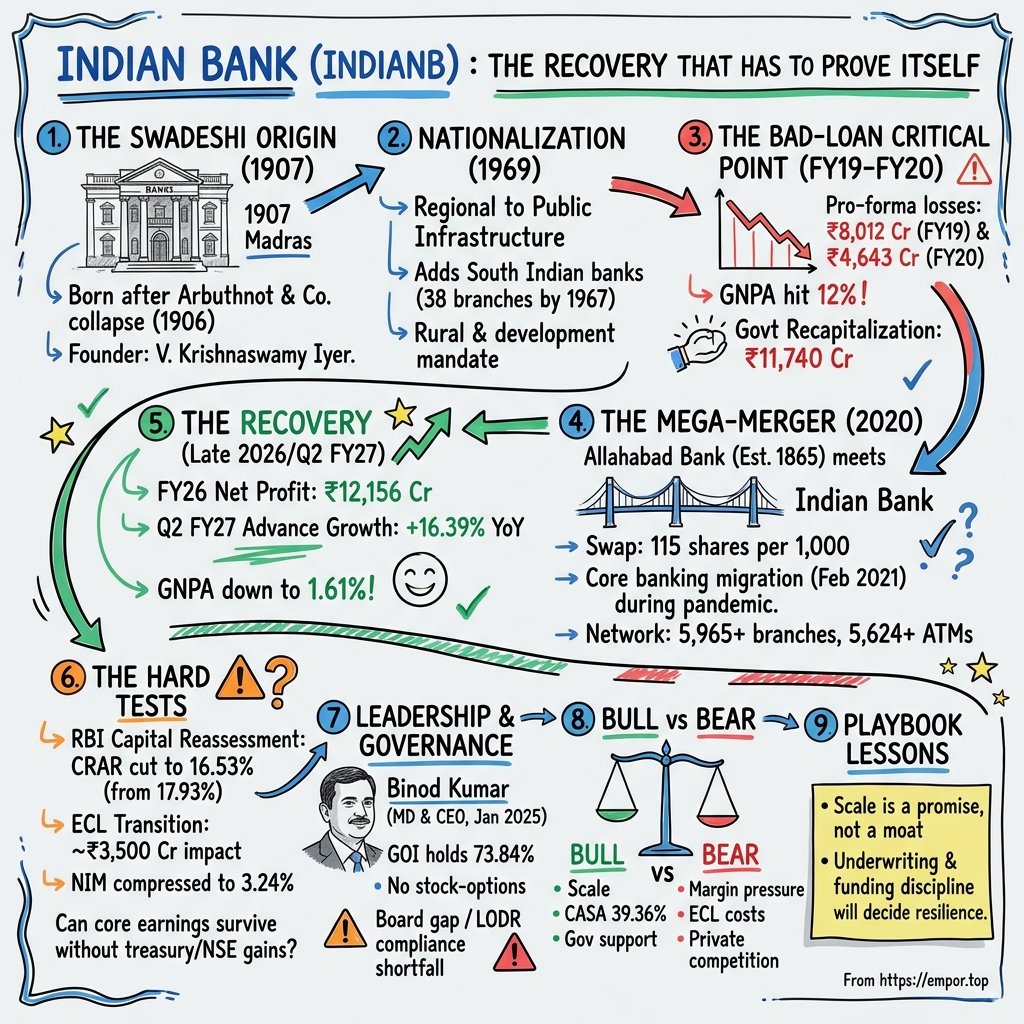
So this is a story about a bank that is unmistakably bigger and unmistakably cleaner, and about whether it is also better. Indian Bank was born in 1907 in a burst of Swadeshi nationalism, nationalised in 1969, nearly broken in the 1990s, battered again by bad corporate loans in the late 2010s, and then enlarged in 2020 when the government folded the 155-year-old Allahabad Bank into it.
Four questions will run through the episode. Does all that scale produce a genuine competitive edge, or just a larger institution to manage? Do today's clean asset-quality ratios mean safer future earnings, or simply a benign point in the credit cycle? Can core profits keep growing when margins compress and treasury gains fade? And can governance, from the boardroom to the capital calculation, keep up with the recovery?
To answer them, the story has to start where the bank did: with a different bank's collapse.
 Subscribe on LinkedIn
II. A Bank Born After Another Bank Failed
In October 1906, one of the best-known names in Madras finance went under. Arbuthnot & Co., the British agency house that held the savings of many of the city's Indian depositors, crashed on 22 October, and those savings went down with it.5 The failure landed at a politically charged moment. Bengal had been partitioned the year before, and the Swadeshi movement was urging Indians to buy Indian goods, build Indian industries and stop trusting their futures to institutions run from London.
Among the people who drew a lesson from Arbuthnot's collapse was V. Krishnaswamy Iyer, a prominent Madras lawyer. If Indians were going to keep losing money to foreign-run firms, the conclusion was that they needed a bank of their own. He gathered a group of Indian backers, with much of the capital coming from Chettiar merchant families, the hereditary bankers of the Tamil country.5
Accounts differ on who deserves the title of founder. The bank's own commemorations have honoured Iyer as the man who helped set it up, while other histories credit the Chettiar financier S. Rm. M. Ramaswami Chettiar.6 What is not in dispute is the outcome. Indian Bank was incorporated on 5 March 1907 with authorised capital of ₹20 lakh, and it opened for business on 15 August 1907.7
That opening date is the kind of coincidence storytellers love. Forty years to the day before India became independent, a group of Madras citizens opened a bank whose very name was a political statement. In a colonial financial system dominated by exchange banks and British agency houses, a locally owned commercial bank was a small act of defiance. Its customers were the people Arbuthnot had failed: the professionals, traders and families of the Madras Presidency who wanted their money with people they knew.
It is worth being precise about what that inheritance amounts to today, because heritage is easy to over-read. A founding myth can lend a bank goodwill in its home region, and Indian Bank's deep roots in Tamil Nadu are real. But the Swadeshi origin does not lower the bank's cost of deposits, raise the price it can charge a borrower, or stop a customer from moving a salary account to a rival with a better app. Those things are decided by underwriting, funding and service, and, since 1969, by the fact that the Indian government owns most of the bank.
The more durable legacy of 1907 is a geographic one. For most of the 20th century, Indian Bank was a southern bank, its branches clustered in Tamil Nadu and the neighbouring states. That regional shape would matter enormously a century later, when the government went looking for a northern partner to merge it with. Before that, though, the bank had to grow beyond its birthplace, and the forces that made it grow were less about entrepreneurship than about the state.
III. Nationalization Turned a Regional Bank into Public Infrastructure
The first growth came the old-fashioned way. In the 1960s, India's banking regulators were pushing small, fragile private banks to merge into stronger ones, and Indian Bank absorbed a string of them across the south: Rayalaseema Bank, Mannargudi Bank, the Bank of Alagapuri, Salem Bank and Trichy United Bank among them. These were modest institutions, and altogether they added only about 38 branches.
When Trichy United came in with its five branches in 1967, Indian Bank's network reached 210. Two decades later, in 1989-90, it took over the troubled Bank of Thanjavur and its 157 branches.8 It is tempting to read this as an early acquisition strategy. It was not. These were rescues and tidy-ups of a fragmented local banking system, and they deepened Indian Bank's southern footprint rather than changing its character.
The change of character came on 19 July 1969. Prime Minister Indira Gandhi's government took over the 14 largest private commercial banks in the country by ordinance, and both "The Indian Bank Limited" and "Allahabad Bank Limited" appeared on the list of undertakings the state acquired, later confirmed by the Banking Companies (Acquisition and Transfer of Undertakings) Act of 1970.9 The two banks that would be merged half a century later had, in effect, become siblings on the same evening.
Nationalisation rewrote the job description. Before 1969, a commercial bank's duty was to its shareholders and depositors; afterwards, it was an instrument of national development. The new public-sector banks were told to open branches in villages that had never seen a bank, to lend to farmers and small businesses under priority-sector targets, and to carry credit to the parts of the economy private bankers had ignored.10 That mission achieved a great deal for India. It also produced a specific kind of bank: one with a large physical network, a heavy staff cost, and a loan book shaped partly by policy rather than purely by the lender's own judgement of risk and return.
That is the durable economic consequence of 1969, and it still sits inside Indian Bank's numbers. The bank today runs close to 6,000 domestic branches, with more than 40,000 employees.113 Those branches gather deposits from places private banks reach late or not at all. They also cost money to staff and run, which is why the bank's cost-to-income ratio, at about 46% for FY26, is the one target its chief executive admitted he missed.12
Public reach is an asset; it is not, by itself, a moat. Every public-sector bank built a version of the same network after 1969, and so the network that serves as Indian Bank's distribution engine is matched, branch for branch, by the State Bank of India, Canara Bank, Bank of Baroda and others.
The risk embedded in that model became visible within a generation. A bank that must lend widely, under government direction, with managers appointed by the state, needs unusually good credit discipline to avoid accumulating bad loans. Indian Bank learned what happens without it. In the early 1990s, under a long-serving chairman, M. Gopalakrishnan, the bank, by Outlook's account, lent to politically connected firms and ignored warnings from the RBI, and it ended up with what the magazine called the highest-ever net loss in Indian banking history: ₹1,336 crore for 1995-96, which wiped out its entire net worth.13 When Ranjana Kumar arrived to run the bank in 2000, its capital adequacy was negative, around minus 13%, and almost half its loans had gone bad. Under her turnaround, gross NPAs fell from about 43% to 15% in less than two years.14
That near-death experience is the first stress test of this story's central question. Indian Bank has already been a fast-growing public-sector lender that discovered its loan book was worse than its accounts suggested. It recovered, sold shares to the public in February 2007 at ₹91 each in an issue that was oversubscribed more than 30 times, and listed on the National Stock Exchange on 1 March 2007.15163 For a few years, it looked like a model of rehabilitation. Then the next credit cycle arrived. Could public reach be matched by disciplined credit selection? The bank was about to answer that question a second time, and not in the way its investors hoped.
IV. The Bad-Loan Cycle Turned Scale into a Capital Problem
The second crisis did not arrive with a single villain, as the first had. It arrived the way most Indian bank crises of that decade did: slowly, through infrastructure and industrial loans written in the boom years after 2008, which turned sour as projects stalled, commodity prices fell and promoters ran out of money. By the time the RBI pushed banks to recognise stressed assets honestly in the middle of the decade, India's public-sector banks were sitting on a mountain of loans that would never be repaid in full.
Indian Bank, on its own, came through that period in better shape than many peers. It reported a profit of ₹1,406 crore in FY17 on total income of about ₹18,250 crore.17 The bank it was about to marry was another matter. Allahabad Bank had been among the hardest-hit public lenders, and when CRISIL later reconstructed the two banks' finances on a combined, pro forma basis, the picture of the merged entity before its birth was grim.
Together, the two banks lost ₹8,012 crore in FY19 and another ₹4,643 crore in FY20. Gross NPAs were about 12% of advances in FY19 and still 11.4% on the day the merger took effect.4 In plain terms, roughly one rupee in every nine lent by the combined bank was on loans that had stopped performing.
The flow of new bad loans tells the same story more vividly. Slippages, the loans that newly fall into NPA status each year, ran at about ₹17,200 crore in FY19 and more than ₹18,000 crore in FY20, equivalent to more than 5% of the opening loan book every year, and CRISIL traced them mainly to large corporate exposures in vulnerable sectors.418 The damage was not spread evenly. By June 2020, gross NPAs were around 13.6% of corporate loans and 13.5% of agricultural loans, but only 3.8% of retail loans.4 That split matters later, because the bank's recovery strategy turned heavily towards retail, agriculture and small business lending.
When losses run that deep, a bank's capital erodes, and with it the ability to keep lending. The owner had to step in. Under the government's recapitalisation programme, the two banks together received ₹1,500 crore in FY18, ₹11,740 crore in FY19 and ₹4,687 crore in FY20, close to ₹18,000 crore across three years.4
That money was the difference between a bank that could keep functioning and one that would have been forced into the RBI's tightest restrictions. It is also worth naming who paid for it. Taxpayers put fresh capital into institutions whose prior lending had destroyed old capital, and existing minority shareholders watched their stakes diluted while the government's holding rose to about 88% of the merged bank.4
From that low point, the recovery looks impressive on any chart. The merged bank returned to profit in FY21 and has stayed there.11 Profit rose from about ₹5,300 crore in FY23 to ₹12,156 crore in FY26.18113 Gross NPAs fell from about 6% at March 2023 to below 2% at March 2026.18113 Slippages shrank to roughly 1% of advances a year.11
But the anatomy of that profit recovery deserves a closer look, because a falling bad-loan ratio can improve earnings in two quite different ways. The first is the healthy way: the bank lends better, fewer loans go bad, and less money has to be set aside. The second is the cyclical way: the bank recovers money from old bad loans that were already written off, and provisions fall simply because the worst of the cycle has passed.
Both are real money. Only the first tells you much about the next cycle. Provisions dropped from about ₹9,400 crore in FY23 to about ₹4,200 crore in FY25, and CRISIL explicitly credits lower provisions as a key driver of profit growth over that stretch.1811 Recoveries from old accounts have also been substantial: about ₹6,650 crore in FY26 alone.12
That is why management's own guidance is so revealing. When Kumar spoke to analysts in April 2026, he named recovery as one of the two challenges of the coming year, because the pool of old bad loans to recover from is shrinking. Recoveries had already fallen by about ₹1,000 crore year on year, and he guided to only ₹4,500 to ₹5,500 crore in FY27.12 In other words, the chief executive was telling investors that one of the engines of the recovery is running down by design.
The bond market's referee recorded the same arc. In August 2020, months after the merger, CRISIL downgraded the combined bank's tier-one bonds to AA with a negative outlook and put a negative outlook on its other ratings, pointing to the weak earnings and asset quality the bank had inherited.4 At the time, common equity was only about 10% of risk-weighted assets, and the bank had provided for barely two-thirds of its bad loans.4
By March 2026, the tier-one rating was back to AA+ with a stable outlook, and common equity, before the regulator's later correction, was above 14%.11 That is a genuine repair. It is also a reminder that a rating agency measures the probability that bondholders get paid, and in a state-owned bank that probability rests heavily on the state.
So what does the 2019-20 episode prove? It does not prove that today's bank will repeat it. The loan book has shifted sharply away from the large corporate exposures that caused the damage, and reported asset quality is far better. What it does prove is that this franchise, with this ownership and this kind of network, has twice in thirty years produced losses large enough to require the state to rebuild its capital. The burden of proof sits with the recovery, not with the skeptic. A clean ratio after five benign years is a starting point; the record that matters is how slippages and credit costs behave when the cycle turns.
And it was in the middle of that crisis, with the balance sheet still under strain, that the government decided the answer was to make the bank much bigger.
V. Allahabad Bank Came with a Swap Ratio, a Network and a Recovery Job
On the evening of 30 August 2019, Finance Minister Nirmala Sitharaman walked into a press conference in New Delhi and redrew the map of Indian banking. Ten public-sector banks merged into four. Punjab National Bank absorbed Oriental Bank of Commerce and United Bank of India; Canara Bank took Syndicate Bank; Union Bank of India took Andhra Bank and Corporation Bank; and Allahabad Bank became part of Indian Bank.
The number of state-owned banks fell to 12, from 27 just two years earlier.19 The timing was not subtle. An hour later, official data showed India's economic growth had slowed to 5%, its weakest in more than six years, and the minister framed the mergers as building "next-generation banks, big banks with the capacity to enhance credit."19
The bride Indian Bank was being handed had an extraordinary pedigree. Allahabad Bank, founded in 1865 by a group of Europeans in the city whose name it carried, was the oldest joint-stock bank in India, a 155-year-old institution with more than 3,000 branches across the north and east.2021 Its pedigree was matched by its problems: it was one of the heaviest contributors to the combined bank's losses.
The strategic logic was geographic, and on paper it was clean. Indian Bank was strong in the south; Allahabad Bank was strong in Uttar Pradesh, West Bengal and the eastern and central states. A senior Allahabad Bank official called it "basically a horizontal merger" and said no branches would close because the two banks operated in different regions; only adjacent branches would be combined.22
At the end of 2019, the two banks together had business of about ₹8.4 lakh crore, and the merged bank was billed as the seventh-largest public-sector bank in the country, with roughly 43,000 employees.2223 The official even projected 10,000 branches and ₹10 lakh crore of business within two to three years.22
The swap ratio and who paid for it
This was not a takeover in the Wall Street sense. No one bid, no premium was negotiated, and no cash changed hands. The government, as majority owner of both banks, notified a statutory scheme of amalgamation in March 2020, and the price was set as a share exchange: Allahabad Bank shareholders received 115 Indian Bank shares for every 1,000 they held.2421 Indian Bank's MD and CEO at the time, Padmaja Chunduru, said valuations had been done transparently by independent firms including Deloitte and KPMG.21 Under the scheme, Indian Bank allotted about 520.56 million new shares to Allahabad Bank's former owners.25
The swap was not kind to Allahabad's minority shareholders. At market prices on the day the ratio was announced, a holding of Allahabad Bank shares worth ₹7,600 would convert into Indian Bank shares worth about ₹5,680, an immediate paper loss of 25%.21 An expert committee was set up to hear minority shareholders' objections.21 From the perspective of Indian Bank's own listed shareholders, that ratio is the most favourable fact in the deal: they gave up fewer shares than the market value of what they were absorbing.
But it would be a mistake to treat that as a bargain. Allahabad Bank's market price in early 2020 reflected a bank with deep losses and a large stock of bad loans; the low price was the market's estimate of the clean-up still to come. A statutory process with independent valuations and fairness opinions makes the ratio defensible. It does not prove the deal created value. That proof has to come from what the combined bank went on to earn.
The timing could hardly have been worse. The merger took effect on 1 April 2020, a week after India entered one of the world's strictest pandemic lockdowns.7 Two banks with different technology systems, different product rules and different cultures had to become one while their staff were working under emergency conditions and their borrowers were asking for moratoriums.
The Allahabad official had warned that complete integration would take 12 to 18 months and that core banking would not merge on day one.22 In the end, the technical migration of Allahabad Bank's core banking software onto Indian Bank's platform ran over the weekend of 13 and 14 February 2021, after customers had been warned of possible disruption.26 It was done in about ten and a half months, inside the official's estimate and in the middle of a pandemic: a genuine operational achievement.
Then came the money. The merged bank still needed equity, and having absorbed a loss-making partner, it now went to the market. In March 2021, shareholders approved raising up to ₹4,000 crore.27 A qualified institutional placement in June 2021 raised about ₹1,650 crore at ₹142.15 per share, and a second, in December 2023, raised up to ₹4,000 crore at ₹394.2829
Those two issues, along with the merger itself, explain most of the path of the government's stake: from about 88% right after the merger to about 80% after the 2021 placement and 73.84% today.4183 The merger, in other words, was followed by real dilution, at prices that tell their own story about the market's changing view of the bank.
What did the larger institution actually deliver? On scale, the promise has been kept and then some. In March 2026, the government told Parliament that Indian Bank's business had grown from about ₹8.6 lakh crore at the time of the merger to ₹13.3 lakh crore by March 2025, and it cited the 2019-20 consolidation as having delivered gains in scale and efficiency.30 Business per employee rose from about ₹32 crore in FY25 to ₹36 crore in FY26, with headcount almost flat at about 40,000.3 The branch count, though, has stayed near 6,000 rather than reaching the 10,000 once projected.11
Productivity gains of that kind are real, but they are also what every Indian bank has reported over the same years, as digital transactions displaced branch visits and loan books grew in nominal terms. Kumar himself noted on the April 2026 call that bank manpower across the industry had stayed roughly constant for five years while business doubled.12 The question the merger has not yet answered is the comparative one: did combining these two banks give Indian Bank better deposit economics, better lending margins or lower costs than comparable public-sector banks that took different paths?
The merger era itself appears to be over. In the same March 2026 reply, the finance ministry said it had no proposal at present to merge public-sector banks, while setting a longer-range ambition of getting two or three state-owned banks into the world's top 20 by 2047.30 Asked about consolidation on the October call, Kumar said he had no additional information.2
For Indian Bank's shareholders that matters, because the next leg of growth will have to come organically, branch by branch and loan by loan, rather than by decree. Management has set itself a target of about 300 new branches over three years and had opened 102 by April 2026.12 Whether those branches, old and new, earn better economics than a rival's is decided at the branch counter, and that is where the story goes next.
VI. The Branch Network Has to Earn Its Keep
Picture a small-business owner in Prayagraj, the city once called Allahabad, walking into what used to be an Allahabad Bank branch. The sign now says Indian Bank. Across the street there is a State Bank of India branch, a few doors down there are Punjab National Bank and Bank of Baroda, and on the owner's phone there are apps from HDFC Bank and ICICI Bank offering instant current accounts and pre-approved overdrafts.
The owner has been banking at this branch for twenty years, and the manager knows the business. What would it take to make the owner leave? And what would it take to make the owner pay a little more for the privilege of staying?
Those two questions are the whole competitive analysis of a bank, and they are worth slowing down for.
How the machine makes money
A bank like Indian Bank is an intermediation machine. It gathers money from depositors and other lenders, and puts that money to work as loans and investments, mostly government bonds. It earns the gap between the interest it receives and the interest it pays, and adds fees, foreign-exchange income and trading gains on top. In FY26, interest income was about ₹67,450 crore, against about ₹10,000 crore of other income.3 Net interest income, the spread after paying depositors, was about ₹26,900 crore.12 The business, in other words, is overwhelmingly about the spread. Everything else is seasoning.
Where does that activity sit? In the September 2026 quarter, Indian Bank generated about ₹8,960 crore of revenue from retail banking, about ₹7,080 crore from corporate and wholesale banking, about ₹6,500 crore from treasury and about ₹800 crore from other banking operations.31 Retail is the largest piece, and it has been the growth engine.
Kumar told analysts that loans to retail, agriculture and small business, which the bank groups as RAM, now make up about 67% of the loan book, and grew almost 18% in the year to September 2026, against about 10% for corporate loans.2 Treasury is big enough to swing a quarter's results, but its income depends on bond prices and one-off gains, so it is the least dependable of the four.
One part of that retail book has an outsized role and deserves a name: gold. Indian Bank's southern roots make it a major lender against jewellery, which Indian families pledge for short-term credit. By March 2026, jewel loans had reached about ₹1.27 lakh crore, roughly a sixth of the loan book, after growing almost 28% in a year.12 By September 2026, the agricultural gold-loan book alone had reached about ₹1.16 lakh crore, up roughly a fifth in a year.2
That is a well-secured, high-turnover business that suits a branch network in Tamil Nadu. But Kumar himself pointed out that part of the growth came from rising gold prices, which inflate the size of each loan, and that the bank should not expect a repeat.12 Growth driven by the price of the collateral is not the same as growth driven by winning customers.
The deposit side shows management working harder for the same money. In FY26 the bank reactivated about 34 lakh dormant accounts, which brought back roughly ₹4,000 crore of balances; it added more than 3 lakh salary accounts in the March quarter alone; and it lifted the average balance in an ordinary savings account from about ₹30,000 to about ₹46,000.12 Those are the right battles to fight, because an account that receives a salary is far stickier than one opened to meet a branch target. They are also battles that every bank is fighting with the same weapons, and the bank's low-cost deposit share has not yet broken out of its range.
Outside India, the footprint is deliberately small. Kumar told analysts that apart from a negligible presence in Sri Lanka, the overseas book runs through GIFT City and Singapore and consists mainly of participations in syndicated loans and trade finance, with no particular sector focus.12 Exposure to non-bank lenders was cut by about ₹8,000 crore in FY26, and about 99% of what remains is rated A or better.12 Neither is a growth engine. Both suggest a bank that has learned to keep its riskier corners small.
The war game
Now run the competitive test, using the five forces Michael Porter described and the seven sources of durable advantage Hamilton Helmer catalogued. The useful question for each is not whether Indian Bank is big, but whether anything in its position lets it earn more than a typical bank over a full cycle.
Start with buyers, which for a bank means both borrowers and depositors. On the lending side, the loan book is diversified. The 20 largest borrowers accounted for about 9% of advances at March 2026, and the 20 largest depositors for about 6% of deposits.3 No single customer can hold the bank hostage. But diversification is not the same as pricing power.
Most of the loan book is now priced by formula. Kumar told analysts in April 2026 that almost half of it is linked to an external benchmark, such as the RBI's policy rate, and that "very few levers are left" to reprice loans when funding costs rise; even the rest is tied to a formula-driven lending rate.12
That shift happened quickly, and on this management's watch. When Kumar took over in January 2025, about 57% of the loan book was tied to the bank's own marginal-cost lending rate and about 37% to external benchmarks.36 By September 2026 the split had flipped, with about half the book benchmark-linked and only about 43% on the bank's own rate.2 The reason is the growth mix.
Retail, gold and small-business loans, the segments driving the recovery, are largely priced off external benchmarks, so the very loans the bank is growing fastest are the ones that leave it least room to set its own price. It also means the margin now rises and falls with the RBI's policy rate more than with anything the bank decides. When rates were cut through FY26 the margin slid, and when the RBI raised rates in 2026 the margin recovered a little.
Retail and small-business loans linked to the benchmark leave no room to widen the spread. Only mid-sized corporates, borrowing between roughly ₹50 crore and ₹500 crore, allow a bank like this to "command little better price," which is why management has made them a focus.12 Large corporates, meanwhile, can and do shop among a dozen banks and the bond market. On the deposit side, buyer power is if anything stronger: savers increasingly move money into mutual funds and higher-yielding products, and Kumar described a structural shift in which "people are becoming investors instead of savers."12
Rivalry is intense and symmetrical. State Bank of India towers over the field, other large public-sector banks offer nearly identical products backed by the same sovereign owner, and private banks compete on speed and technology. In October 2026, Kumar described competition as already very high, with some banks offering home loans below 7%.2 Substitutes keep multiplying: non-bank lenders, fintech partnerships, gold-loan companies, and for depositors, mutual funds and government savings schemes.
The threat of new entry is moderated by licensing and capital requirements, but small-finance banks, payments banks and digital lenders have all chipped at the edges. Supplier power, in a bank's case, is the cost of funding: bulk deposits and certificates of deposit, which made up 18% to 19% of deposits in April 2026, are priced by the market, and Kumar said the bank "cannot do anything" about bulk rates.12
Against Helmer's seven powers, the evidence thins out quickly. Scale economies exist in banking, but every large public-sector bank has them, and Indian Bank's cost-to-income ratio of about 46% in FY26 does not suggest a cost advantage.12 Network effects in the social-media sense do not apply to a lending book. Counter-positioning, cornered resources and process power are hard to identify. Brand is real in Tamil Nadu and parts of the north, but brand in public-sector banking mostly means trust in the sovereign owner, which every rival shares.
That leaves switching costs. A current account linked to a business's collections, payroll and loan limits is genuinely sticky; inertia keeps many savings accounts in place for decades. Indian Bank's low-cost current and savings deposits, known as CASA, were about 39% of deposits in September 2026, a little below the 41.5% of mid-2020, just after the merger.24 Steady, but not rising in a way that shows the network is pulling in sticky money faster than rivals.
Management's answer is technology. The bank's executive director in charge of digital, Ashutosh Choudhury, told analysts that 97% of retail and agricultural loans are now sanctioned through digital channels, that mobile banking customers had reached 2.36 crore, and that the bank is implementing more than ten AI and agentic-AI platforms with more than 160 fintech partners.12 He added that the technology budget will be roughly the size of the bank's employee costs.12 Those are real investments, but they are table stakes, and the chief executive was unusually candid about the payoff.
On the April call he said the bank was "spending huge in IT, but benefit of that, to the extent we desire, is yet to come," and when an analyst asked whether the bank measured the revenue impact, the answer was that it would try to.12 His own measure of the payoff was cost avoidance rather than revenue: about 94% of transactions already run through digital channels, and a customer who visits a branch instead costs the bank, by his estimate, at least five times as much.12 The bank's digital business grew 63% in FY26, to about ₹2.72 lakh crore.12
Put together, the verdict is clear. Scale and reach are evidenced. A diversified, low-concentration customer base is evidenced. Switching costs exist at the level of individual relationships. What is not evidenced is lock-in that shows up in rising deposit share, pricing above peers or a structurally lower cost base. Indian Bank's moat is a broad public-sector franchise backed by the state, and its network has to earn its keep against private-bank service and productivity every year. If the moat were wider, one would see it in margins. And margins are exactly where the recovery is now being tested.
VII. The Profit Recovery Meets Its First Hard Test
On 29 April 2026, Binod Kumar opened the fourth-quarter call with a line that sounded like a victory lap. "It has been a decent year," he said; "almost all parameters except cost-to-income ratio, we have done better than our guidance."12 Net profit for FY26 had risen 11% to ₹12,156 crore, while deposits and advances grew 12% and 13%.123 Analysts on the line congratulated him. Then, almost in the same breath, Kumar listed the problems.
The first was the margin. Net interest margin, the spread earned on the bank's interest-bearing assets, had slipped from 3.41% in FY25 to 3.24% in FY26.12 That is a drop of 17 basis points, or 0.17 percentage points, which sounds trivial until you remember that it is applied to a balance sheet approaching ₹10 lakh crore.11 Every basis point of margin on a book that size is worth tens of crores of annual profit. Net interest income grew only about 7% in FY26, much slower than loans, because the bank was paying more for its deposits while lending at rates that adjusted downwards with RBI policy cuts.12
The second problem was what was holding the profit up instead. Operating profit grew less than 5% in FY26.12 Net profit grew more than twice as fast, and the difference came mostly from lower credit costs and from other income. Other income, about ₹10,000 crore in FY26, was equivalent to roughly 61% of the bank's profit before tax.3
It included almost ₹1,000 crore from selling investments and about ₹700 crore from foreign exchange, but its largest component was a miscellaneous line of more than ₹7,200 crore, which includes recoveries from written-off accounts, fees and other items whose repeatability the bank does not break out in detail.3 When Kumar listed his two challenges for FY27, both were in this territory: lower recoveries and lower treasury profit.12
The cautious stance showed in the guidance. In April, Kumar guided to deposit growth of 9% to 11%, advance growth of 11% to 13%, a net interest margin of 3.10% to 3.25% and return on assets of 1.20% to 1.30%, below the 1.31% just achieved.12 He said he was comfortable growing slightly slower than the industry, which had grown about 16%, to protect margins and asset quality.12 It was a sober plan, built on the premise that the easy part of the recovery was over.
Underneath that cautious guidance sat a much more aggressive pipeline. The bank sanctioned about ₹4.26 lakh crore of loans in FY26, 62% more than the year before, including about ₹1.31 lakh crore to corporates and about ₹48,000 crore spread across roughly 6 lakh small-business loans.12 A sanction is a promise to lend, not a loan; borrowers draw it down over months, or not at all. But the gap between sanctions growing by 62% and the loan book growing by 13% was a reservoir, and it is the reservoir that the raised guidance of October would draw on.
Two other details from that April call show how the headline numbers were shaped. First, Kumar said the bank had sold about ₹23,000 crore of inter-bank participation certificates during the year, instruments that let a bank pass part of its priority-sector lending to another bank for a fee, and that reported advances growth would otherwise have been higher.12
Second, the bank set aside about ₹310 crore in the March quarter as a precaution against stress from the West Asia conflict, even though, Kumar said, it was not yet seeing any.12 Both decisions point the same way: a management willing to give up some reported growth in exchange for fees and cushion. That is a conservative instinct, and it deserves credit. It also means that some of FY26's growth and some of its provisions were choices rather than simply outcomes.
The October quarter, with the lights on
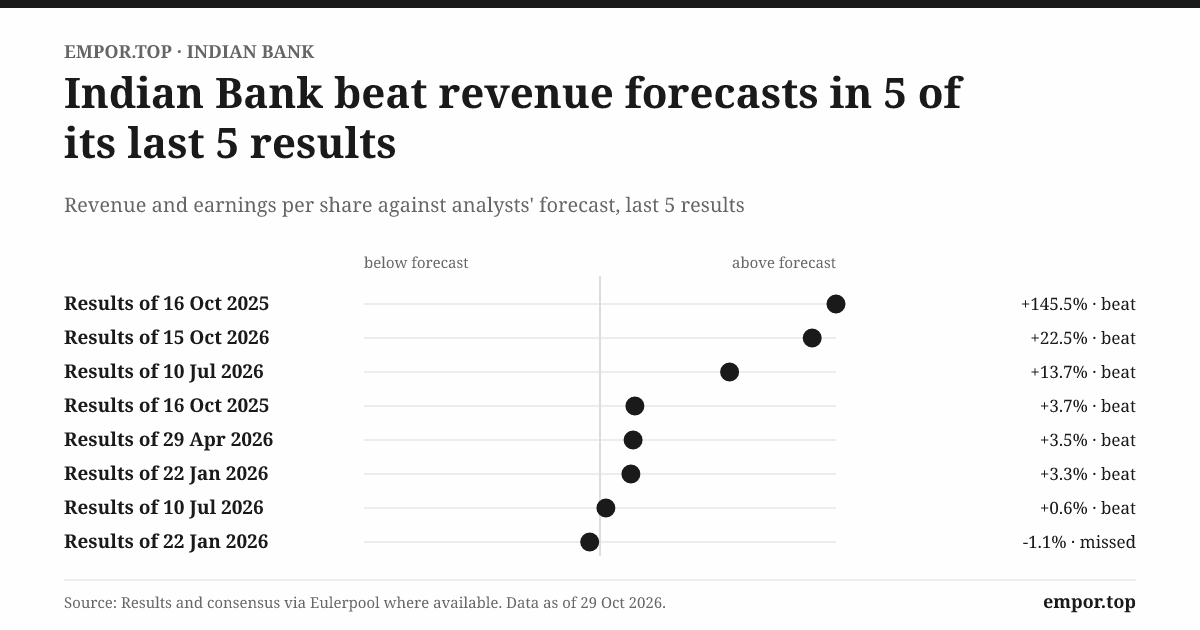
Six months later, the numbers had moved in the opposite direction to the caution. Advances grew 16.39% in the year to September 2026.2 Net interest income grew almost 18%, and the margin rose by eight basis points from a year earlier, helped, Kumar said, by a 25-basis-point rise in the RBI's policy rate that lifted yields on benchmark-linked loans.2 Net profit for the quarter grew about 15% to roughly ₹3,460 crore, and return on equity reached about 19.7%.2 The guidance went up.
Now put the quarter under a brighter light. Other income jumped about 59%, and Kumar was frank that it was "basically contributed by NSE."2 The bank owns a stake in the National Stock Exchange, which is preparing for a public listing, and in the quarter it booked about ₹252 crore of realised gains and about ₹1,134 crore of mark-to-market gains tied to that stake.2 Operating profit, which grew about 47% headline, grew about 18% once the NSE effect was stripped out.2
An analyst also pointed out that miscellaneous income included about ₹271 crore of interest on an income-tax refund, which management confirmed and which is unlikely to recur.2 None of this is improper; it is simply not banking. The NSE gain is a once-in-a-generation revaluation of an investment, and it happened to arrive in the same quarter as a large new provisioning charge.
Beyond the NSE gain, management's own outlook for treasury is subdued. In April, Kumar expected treasury profit of only about ₹1,000 crore to ₹1,200 crore for the whole of FY27, and in October he said treasury income would be "muted" from here.122 The reserve of unrealised gains on bonds held for sale, which had stood at about ₹500 crore in June, had swung to a loss of about ₹120 crore by September as bond yields rose.2 Rising rates help the loan book and hurt the bond book. In the September quarter, the NSE stake masked the second effect.
The provisioning charge is the expected-credit-loss transition. Under India's old rules, banks provided mostly for loans that had already gone bad. Under the new framework, finalised by the RBI in April 2026, they must estimate losses that are likely over a loan's life and provide for them in advance, which front-loads provisioning.
Think of it as the difference between paying for a car repair after the crash and paying a higher insurance premium every month in advance. In April, Kumar declined to give a number, saying he did not want to quote a figure and then have to revise it, and promising only that the impact would "not be very huge" and could be absorbed within a few quarters.12
By October he had a number: about ₹1,000 crore provided in the June quarter and ₹1,500 crore in the September quarter, out of an expected total of about ₹3,500 crore on the credit book.2 He added that the revaluation of bonds held to maturity, which also falls under the new rules, "will be over and above that," and he said banks should take the issue up with the RBI.2 He expects the steady-state cost of the new regime to be 10 to 15 basis points of credit cost a year, which he does not think banks will be able to pass on to borrowers.2
One part of that conversation links directly to the bank's capital story. Kumar explained that some provisioning had been counted in tier-two capital, but that the regulator regarded it as specific rather than general and therefore ineligible, and he confirmed that undrawn credit limits would now carry risk weights as well.2 Those were precisely the two points on which the supervisor had corrected the bank's March ratios.
The ₹3,500 crore figure is worth translating. It is a little under a third of a year's net profit, spread over several quarters. A healthy bank can absorb that without strain, and Indian Bank is absorbing it while still reporting rising quarterly profit. But it is only absorbing it painlessly because of the NSE gain and a strong credit cycle. Take the NSE gain away and the September quarter would have looked much more ordinary.
There is one more nuance an investor should hold onto. For a bank, the usual test of whether profits turn into cash does not work. Indian Bank reported operating cash flow of about ₹18,800 crore in FY26, well above its profit, but that figure is dominated by a deposit increase of more than ₹90,000 crore and borrowing growth.3 Deposits are the raw material of a bank, not free cash. The relevant test is whether reported profits survive honest provisioning, and the ECL transition is precisely that test.
The waiting room
Which brings the story to the loans that have not yet gone bad. Indian Bank tracks special-mention accounts, or SMAs, which are loans that are overdue but not yet classified as non-performing. In a sense, they are the bank's waiting room. At September 2026, the SMA pool was about ₹29,750 crore, or about 4.2% of loans, down from 7.35% a year earlier and from 18% at March 2025.212 That is a dramatic improvement.
It is also partly an accounting of who is in the room: when analysts asked about a sharp fall in the most delinquent bucket in April, Kumar said he would take "no brownie point" for it, because two government-related accounts had moved out of that category.12 Slippages were running at about 0.7% of loans annualised in the September quarter and credit cost at 0.22%, both very low by the bank's own history.2
The evidence therefore supports a narrower version of the bull claim than the headline numbers suggest. The franchise is growing, and its retail-heavy loan book is generating real spread income. But the profit trend rests on two supports: recurring spread income, and a credit cycle that is still unusually kind. The September quarter's NSE gain is not repeatable banking income. The question that will settle it is whether full-year FY27 net interest income and profit, after the ECL charge and without the NSE windfall, still grow. And that depends on the people running the bank and how carefully they count its capital.
VIII. Binod Kumar Inherits a Better Bank—and a Board Gap
Binod Kumar took charge as managing director and chief executive of Indian Bank on 16 January 2025, appointed by the government for three years.32 He was not a Chennai banker. He had spent three decades at Punjab National Bank, which he joined as a management trainee in 1994, rising through corporate credit, running the bank's branch in Dubai's financial centre and becoming one of PNB's executive directors in November 2022.32
He trained in science at Ranchi University, holds banking qualifications from the National Institute of Bank Management and the Indian Institute of Banking and Finance, and is a certified financial risk manager.32 That last credential fits his style on earnings calls: a risk officer's caution, a reluctance to commit to numbers he cannot defend, and an occasional dry joke. Asked in April 2026 how much provision the bank held outside its coverage ratio, he replied that his CFO was "very hard nut" and would not disclose it even to him.12
His predecessors give useful context. Padmaja Chunduru ran the bank through the merger and the pandemic.33 She was followed by Shanti Lal Jain, a career Allahabad Bank officer who had served as its chief financial officer and later as an executive director at Bank of Baroda, and whose term ran to the end of December 2024.3435 Kumar, in other words, inherited a bank whose integration and recapitalisation were already done. His tenure is about the next phase: turning a cleaned-up balance sheet into steady returns.
Promises versus outcomes
Kumar's track record is short, but it can already be tested. In his first weeks, he told Business Standard that the bank's FY25 guidance had been 8% to 10% deposit growth and 11% to 13% advance growth, and that customer focus would be his priority.36 For FY26, his first full year, the bank beat its own guidance on almost everything except cost-to-income.12 He did show a course correction within the year: the ratio fell from about 46.9% in the December quarter to about 45% in the March quarter.12
In FY27 he started cautiously and has since raised his growth guidance, and said he would bring cost-to-income below 45%.237 His candour also counts for something.12
The incentive structure deserves to be described plainly, because it differs from what investors are used to in private banks. Kumar is a government appointee on a fixed term. Key management remuneration at the bank totalled about ₹3.8 crore in FY26, up from about ₹3.1 crore in FY25, partly because FY26 was his first full year.3 There is no employee stock-option plan.3
That means a chief executive of a bank with a market value in the tens of thousands of crores is paid like a senior civil servant and has little personal equity at stake. It reduces the temptation to chase short-term earnings for a share price; it also reduces the alignment between management and minority shareholders. The bank does not disclose any personal shareholding by the CEO that would change that picture. The government, which owned 73.84% of the bank at March 2026 and still did at September, is the real principal.338
On capital allocation, the decisions in Kumar's era have been proportionate. In FY26 the bank issued ₹5,000 crore of ten-year infrastructure bonds at 7.15%, earmarked for infrastructure and affordable-housing lending, and redeemed ₹2,000 crore of perpetual additional tier-one bonds at their first call dates.3 Paid-up equity was unchanged, and Kumar has said he plans only ₹1,000 crore to ₹2,000 crore of tier-two bonds this year, depending on market conditions.32 No new equity has been raised since the December 2023 placement.29
The capital correction and the board
Which brings back the letter from the opening scene. The RBI's inspection found two specific errors in how the bank had calculated its capital for March 2026.1 First, about ₹3,820 crore of specific provisions held against stressed standard assets had been treated as general provisions, which can count towards tier-two capital; that inflated tier-two capital by about ₹2,470 crore.
Second, the bank had not applied a credit conversion factor to undrawn credit limits that it could cancel unconditionally, so it had understated its credit risk-weighted assets by about ₹22,080 crore.1 In plain terms, it had counted a little too much in the numerator and a little too little in the denominator. Both errors flatter the ratio.
Neither error was fraud, and neither affected profit. The bank says it has already adopted the RBI's approach in its September 2026 figures, when common equity tier one stood at a little over 15%.131 Kumar told analysts that the bank had not applied the conversion factor because the limits were cancellable, and he expects capital to rise to about 17% to 17.5% by March as profits are retained.2
But this is a supervisory finding on the most basic job a bank does: measuring its own buffer against loss. CRISIL's March 2026 rating rationale, which cites adequate capitalisation as a strength, relied on December 2025 ratios that predate the correction.11 Anyone reading that report for comfort should use the corrected ratios instead.
The second governance weakness is in the boardroom. As of 31 March 2026, the bank disclosed that it did not meet the listing rules on board composition, which require half the board to be independent and at least one independent woman director, and an independent shareholder-director resigned during the year.3 This is a familiar pattern at public-sector banks, where most board seats are filled by government nomination and appointments can lag for months. It is still a material weakness.
Some appointments have followed: Bhupinder Singh Bhalla, a retired IAS officer, was elected unopposed as a shareholder director from the end of December 2025, and the government appointed Somesh Biswas, a retired LIC officer, as a part-time non-official director in August 2026.3940 Whether those appointments fully cure the disclosed gaps, including the independent woman director, is something the bank's next governance filing has to show.
Shareholders have not used their votes to force the issue. The resolutions at the bank's annual general meetings have passed by the required majorities, which is unsurprising when one shareholder owns almost three-quarters of the shares.41 Related-party transactions reported in FY26 were small, but the bank's disclosure excludes ordinary-course banking dealings and gives no full quantified account of business with government-controlled entities.3 For a state-owned bank, that is where any conflict would sit.
The verdict on management is therefore mixed in a specific way. Kumar's operational record, measured against his own guidance, is promising, and his communication style is more candid than many peers'. But a year and a half is a short record, and the two governance signals of 2026, the capital correction and the board gap, are the kind of evidence that should temper confidence in reported numbers until the next audited disclosures confirm them. Which leaves the investor with the hardest question: what is this bank actually worth?
IX. Analysis & Bear vs. Bull Case
Return to the two statements from 15 October 2026. Advances had grown 16.39% in a year. The regulator had cut the prior year's reported capital ratios.21 An optimist reads the first and sees a recovered franchise finally using its national reach. A pessimist reads the second and sees a state-owned bank whose numbers deserve a discount until they are proven. Both readings have real evidence behind them.
The case for the recovery
The bull case starts with growth that is broad rather than lumpy. In the year to September 2026, deposits grew 12.5%, current and savings deposits grew almost 14%, and their share of total deposits rose to about 39.4%, from about 38.9% a year earlier.2 Bulk deposits fell slightly as a share of the total.2 That is what a healthy funding franchise looks like: low-cost money growing at least as fast as the rest.
On the lending side, the retail, agricultural and small-business engine is growing in the high teens, the corporate book is growing again after several years of near-stagnation, and management describes a corporate pipeline of about ₹63,000 crore, of which roughly ₹30,000 crore is sanctioned but not yet drawn.2
Asset quality is the second pillar, with provision coverage at about 98% and the pool of loans in the waiting room sharply smaller.2 The third is the sovereign. CRISIL rates the bank's infrastructure and tier-two bonds AAA with a stable outlook, its tier-one bonds AA+, and cites strong government support as its first strength.11 The fourth is the return on equity. A bank earning a return on equity of around 19% to 20%, as Indian Bank reported for FY26 and the September 2026 quarter, is generating capital quickly enough to fund its growth without new shares.122
The case against
The bear case starts with the same ownership. The government's support is a strength for bondholders, because it makes default extremely unlikely. For shareholders it is a reminder of state dependence: the bank's board, chief executive and priorities are set by an owner with policy objectives as well as financial ones, and the same structure has twice in thirty years required rescue capital. CRISIL's own description of the bank's weaknesses, "modest, albeit improving, asset quality" and a "modest earnings profile," is not the language one uses for a franchise with superior economics.11
The agency's own list of what could trigger a downgrade is revealing: a material change in the government's shareholding or support, which CRISIL flagged alongside the government's stated plan to privatise two public-sector banks; gross NPAs climbing above 13%; or capital falling below the regulatory minimum.1811 Every one of those triggers is about the owner or the loan book, not the franchise.
The second bear point is margins. Kumar has said plainly that he has few levers on the asset side, and that deposit costs will stay high because loans are outgrowing deposits.12 The September-quarter margin improvement depended on a policy-rate rise that the bank does not control. The third is liquidity. Advances grew about four percentage points faster than deposits in the year to September 2026, and management said that borrowing had weighed on the liquidity coverage ratio, a measure of whether liquid assets cover a month of stressed outflows.
The ratio stood at about 116% in October, down from about 127% at the end of 2025.211 In April, Kumar himself had said he would not want to run below 115% to 120%, citing the example of an unnamed bank that had to raise money at very high cost in a panic.12 The bank is now at the bottom of the range he called prudent. To fund growth, it raised about $2.3 billion of foreign-currency non-resident deposits, and Kumar said there was "no surplus liquidity."2
The fourth bear point is earnings quality: the NSE gain, the tax refund interest, the shrinking pool of old recoveries, and the ECL charge, all of which make reported profit in FY27 harder to read than usual. The fifth is history. The bank's own record contains two episodes in which apparently good growth turned into heavy losses. Neither happened under today's management or with today's loan mix, but both happened under the same ownership model.
A skeptical long-short investor would turn those points into a short list of questions for the board. Why did it take a supervisory inspection to correct the treatment of provisions and undrawn limits, and what has changed in the bank's internal capital review since? Why does more than ₹7,000 crore of other income sit in a miscellaneous line, and how much of it is recurring fee income rather than recoveries from loans written off years ago? How much of FY27's reported profit will rest on the NSE revaluation, and will the bank present its earnings with and without it? And when will the board meet the independence requirements it says it is missing? None of these questions implies wrongdoing. Each concerns the quality of disclosure at a bank whose shares trade at one of the higher book multiples among its public-sector peers.
How do Porter and Helmer settle it? The competitive analysis points to no moat beyond shared scale and state backing, with only modest switching costs and regional brand; neither produces superior pricing. So the investment case cannot rest on a moat. It rests on execution within a commodity-like industry: growing faster than peers without lending worse, and keeping costs and funding in check. That is a perfectly respectable thesis, but it is a cyclical one, and it must be re-earned each year.
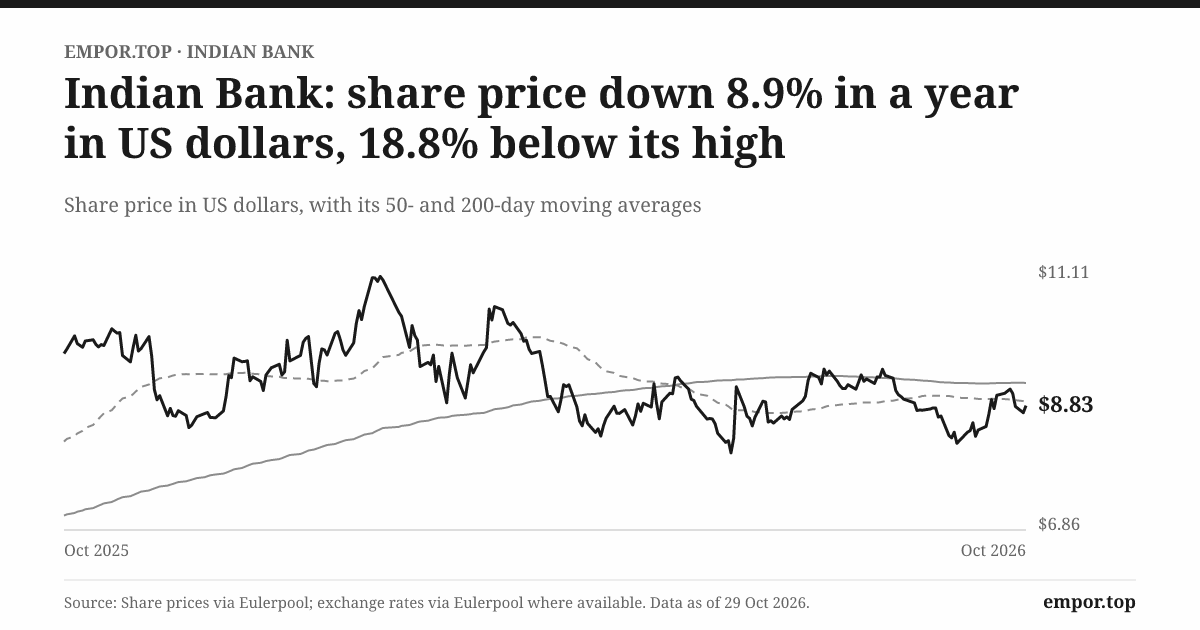
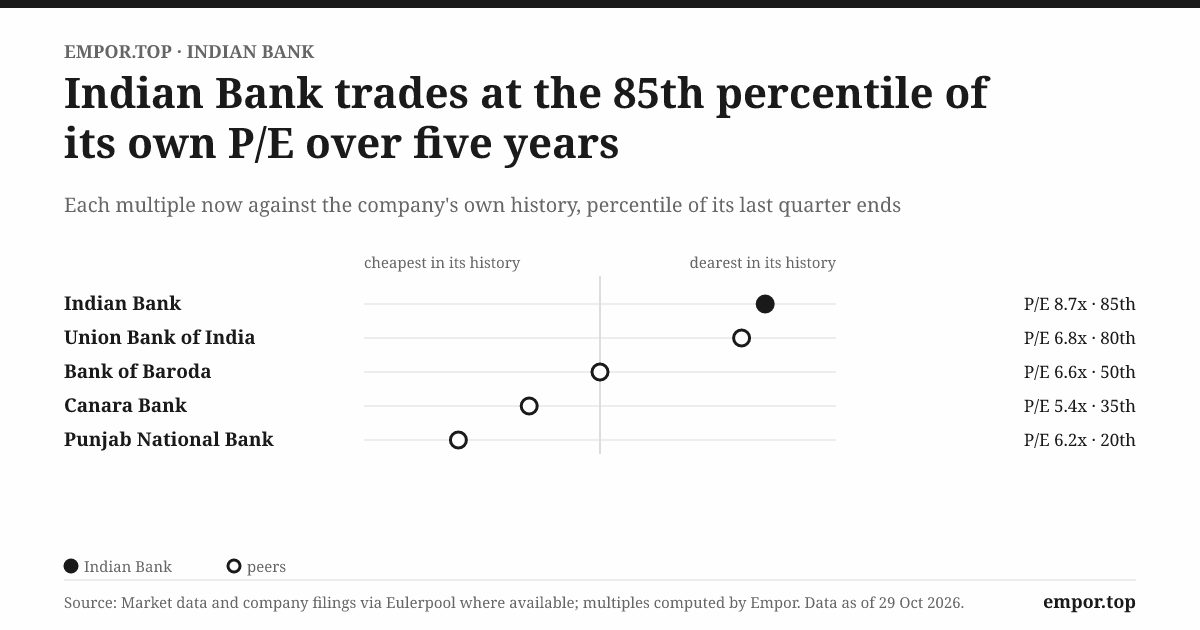
How is the market pricing that thesis? On 26 October 2026, Indian Bank traded at about 1.3 times book value, compared with about 1.4 times for State Bank of India, about 1.0 for Union Bank, 0.9 for Punjab National Bank and 0.7 for Bank of Baroda.42 Set against a return on equity near 19% to 20%, that multiple is not demanding in the abstract. But it places Indian Bank near the top of the public-sector group, above several large peers and close to SBI.
The market, in other words, is already giving the bank credit for its recovery relative to most of its public-sector rivals. Whether that premium is deserved depends on whether its return on equity holds up through the ECL transition and whether the corrected capital base can fund growth. A one-day comparison of book multiples cannot answer that; it would take a peer comparison of returns over a full cycle, and Indian Bank's own history of valuations through it.
That reduces the forward watch list to three measures. The first is recurring net interest income and margin, which weakened in FY26 before improving modestly in September.122 The second is credit cost, read alongside slippages and the SMA pool, which continued to improve in the September quarter.2
The third is corrected common equity, read alongside the deposit mix and liquidity, which remain under watch.312 If those three hold, the bull case holds. If any of them breaks, the history of this bank suggests the others will not be far behind. And that history has lessons of its own.
X. Playbook: Business & Investing Lessons
In spring 2020, Indian Bank absorbed Allahabad Bank and issued more than 520 million new shares; six years later it was earning more than ₹12,000 crore a year.253 That arc is a success by any reasonable measure. It also teaches five lessons that belong to this bank and no other.
The first lesson is that a bigger balance sheet is a promise, not a moat. The merger gave Indian Bank a national footprint, close to 6,000 branches and a seat among India's largest lenders. What it has not yet given the bank is any measurable advantage in pricing, funding cost or efficiency over the rivals that built similar footprints. For founders and investors, the wider point is that scale assembled by decree must still be earned through customers. Size buys an opportunity to compete; it does not decide who wins.
The second lesson is that a clean NPA ratio is a snapshot; a lending culture is a record. The combined bank's earlier losses and Indian Bank's near-collapse remain the warning; today's clean NPA ratio is one frame from a long film.413 The record that matters is how the bank's slippages and credit costs behave through the next downturn, and that frame has not yet been shot.
The third lesson is that state support can stop a crisis from becoming an ending, but it cannot make every return shareholder-owned. The state's recapitalisation and continuing majority stake remain central to the recovery and to its governance trade-offs.43 Minority shareholders own a slice of a public institution, and they should price it that way.
The fourth lesson is that a bank's best technology is a loan it should never have made. Indian Bank is investing heavily in AI assistants, digital lending journeys and fraud detection, and those investments may well lower costs. But every crisis in this story was caused by credit decisions, and the 2026 capital correction was a classification problem. The bank's competitive future will be decided less by its app than by the discipline with which it says no.
The fifth lesson is that a capital ratio is a calculation, not a fact. The supervisor's March 2026 correction showed how its calculation of capital differed from the bank's.1 Nothing was lost, and the bank remains well capitalised. But investors who treat a reported ratio as a measurement rather than a judgement will always be surprised by the next inspection. The best capital cushion is the one that survives someone else's calculator.
XI. Epilogue
Tonight, Indian Bank is a recovered bank in the middle of a test. Its September-quarter results are in, its guidance was raised, its capital was recalculated, and the next set of numbers, the December 2026 quarter, will arrive early in the new year. What will they need to show?
Start with growth and its funding. Management promised advance growth of 13% to 14% and deposit growth of 11% to 12% for FY27.2 If deposits keep pace and the cost of deposits stays contained, the growth story strengthens. If the bank has to keep turning to foreign-currency deposits, bulk money and borrowings to fund loans, with its liquidity ratio already near the floor its own chief executive called prudent, then the growth will be bought with margin, and the margin is the thing the bank can least afford to lose.
Then the credit book. The ₹3,500 crore ECL estimate will be tested against the actual charge, and the revaluation of bonds held to maturity is still to come. More important than either is the SMA pool. If it keeps shrinking and slippages stay below 1%, the recovery will have crossed from repair into something more durable. If small-business or agricultural stress starts showing up in the waiting room, the bank's history says it will move fast.
Then the capital and the board. The next audited capital disclosure must reconcile cleanly with the RBI's corrected approach, and the board must reach the independent-director thresholds it disclosed it was missing. Either outcome would be a quiet sign that governance is catching up with growth. Another supervisory correction, or a board still short of independent members a year from now, would be a louder sign that it is not.
There is also the NSE listing itself. If and when the exchange lists, the bank's stake will be priced by the market every day, and the one-off gains of the September quarter could be followed by further revaluations, in either direction. Investors who want to see the bank's real earning power will have to keep stripping that stake out of the numbers, and the easier the bank makes that, the more its reported profit will be believed.
None of these outcomes is decided. The recovery is credible and still unfinished. A full year of recurring earnings after the ECL transition, with a clean capital reconciliation, would make it much stronger. Renewed slippages, deposit strain or another capital correction would weaken it quickly. And beyond those near-term tests lies the question the merger was supposed to answer six years ago: whether a national network can produce better economics than comparable public-sector banks. Heritage cannot settle that. Only future reporting can. Kumar's three-year term runs to early 2028, which means the years that will settle this question are the ones he will be judged on.32
XII. Outro
Somewhere in Chennai this week, a customer is opening an account at a bank that was founded because another bank failed. The branch belongs to an institution that has survived more than a century of upheaval and has come out of it still standing. Behind the counter, the network stretches from the Coromandel coast to the Gangetic plain.
That is the image to hold onto. Indian Bank's scale is visible; its durability still has to be earned, one deposit at a time. Every rupee gathered at that counter is both an inheritance and an obligation, and the bank's 119-year story will be decided by whether it puts each one to work with discipline, without needing another rescue.
References
-
Disclosure under Regulation 30: RBI Observations on Computation of RWA and CRAR — Indian Bank, 2026-10-15 ↩↩↩↩↩↩↩
-
Q2 FY27 Earnings Call Transcript — Indian Bank (StockAnalysis), 2026-10-15 ↩↩↩↩↩↩↩↩↩↩↩↩↩↩↩↩↩↩↩↩↩↩↩↩↩↩↩↩↩↩↩↩↩↩↩↩↩↩↩
-
Annual Report 2025–26 — Indian Bank, 2026-05-23 ↩↩↩↩↩↩↩↩↩↩↩↩↩↩↩↩↩↩↩↩↩↩
-
Indian Bank Remembers Its Founders — Mylapore Times, 2010-11 ↩
-
Banking Companies (Acquisition and Transfer of Undertakings) Act, 1970 — Department of Financial Services, Government of India ↩
-
Banking in India: Evolution and Structure — Reserve Bank of India ↩
-
Rating Rationale — CRISIL Ratings, 2026-03-16 ↩↩↩↩↩↩↩↩↩↩↩↩↩↩
-
Q4 FY26 Earnings Call Transcript — Indian Bank, 2026-04-29 ↩↩↩↩↩↩↩↩↩↩↩↩↩↩↩↩↩↩↩↩↩↩↩↩↩↩↩↩↩↩↩↩↩↩↩↩↩↩↩↩↩↩↩↩
-
NextGen PSBs: Government Unveils Mega Bank Mergers to Revive Growth — Business Standard, 2019-08-30 ↩↩
-
AllBank Shareholders to Lose 25% Post-Merger with Indian Bank — Business Standard, 2020-03-19 ↩↩↩↩↩
-
Post Merger, Allahabad and Indian Bank to Have 10,000 Branches in 2 Years — Business Standard, 2020-03-02 ↩↩↩↩
-
10,000 Branches in 2 Years: Result of Merger of These Two Banks — Business Today, 2020-03-03 ↩
-
Amalgamation of Allahabad Bank into Indian Bank Scheme, 2020 — Government of India, 2020-03-05 ↩
-
Indian Bank Integrates Core Banking Software of Erstwhile Allahabad Bank — Business Standard, 2021-02-15 ↩
-
Extraordinary General Meeting Scrutinizer's Report and Voting Results — Indian Bank, 2021-03-02 ↩
-
Indian Bank Allots 11.60 Crore Equity Shares under QIP Issue — Business Standard, 2021-06-25 ↩
-
Outcome of Qualified Institutions Placement — Indian Bank (BSE filing), 2023-12 ↩↩
-
No Proposal for Mergers of Public Sector Banks Currently, Says Finance Ministry — Mint, 2026-03-23 ↩↩
-
Integrated Filing (Banking), Q2 FY27 — Indian Bank / NSE, 2026-10-15 ↩↩↩
-
Appointment of Shri Binod Kumar as MD & CEO — Indian Bank (BSE filing), 2025-01-16 ↩↩↩↩
-
How Padmaja Chunduru Used People Power to Grow Indian Bank — Business Today, 2022-03-08 ↩
-
Extension of Term of Shri S. L. Jain as MD & CEO — Indian Bank (BSE filing), 2024-07 ↩
-
Customer Centricity Will Be Our Focus Area: Indian Bank MD Binod Kumar — Business Standard, 2025-01-30 ↩↩
-
RAM Growth Momentum to Continue in FY27 — Business Standard, 2026-05-03 ↩
-
Shareholding Pattern as on 30 September 2026 — Indian Bank ↩
-
Election of Shareholder Director — Indian Bank (NSE filing), 2025-12-30 ↩
-
Appointment of Shri Somesh Biswas as Part-time Non-Official Director — Indian Bank (NSE filing), 2026-08-13 ↩
-
19th AGM Proceedings and Scrutinizer's Report — Indian Bank, 2025-06-17 ↩
-
Bank Stocks in India: Price and P/B — SectorAlpha, 2026-10-26 ↩
 LinkedIn
 WhatsApp
 Reddit
 Hacker News
 Email
 Kindle
 RSS Feed
 Spotify
 Apple Podcasts
 Amazon Music
 Audible
 YouTube