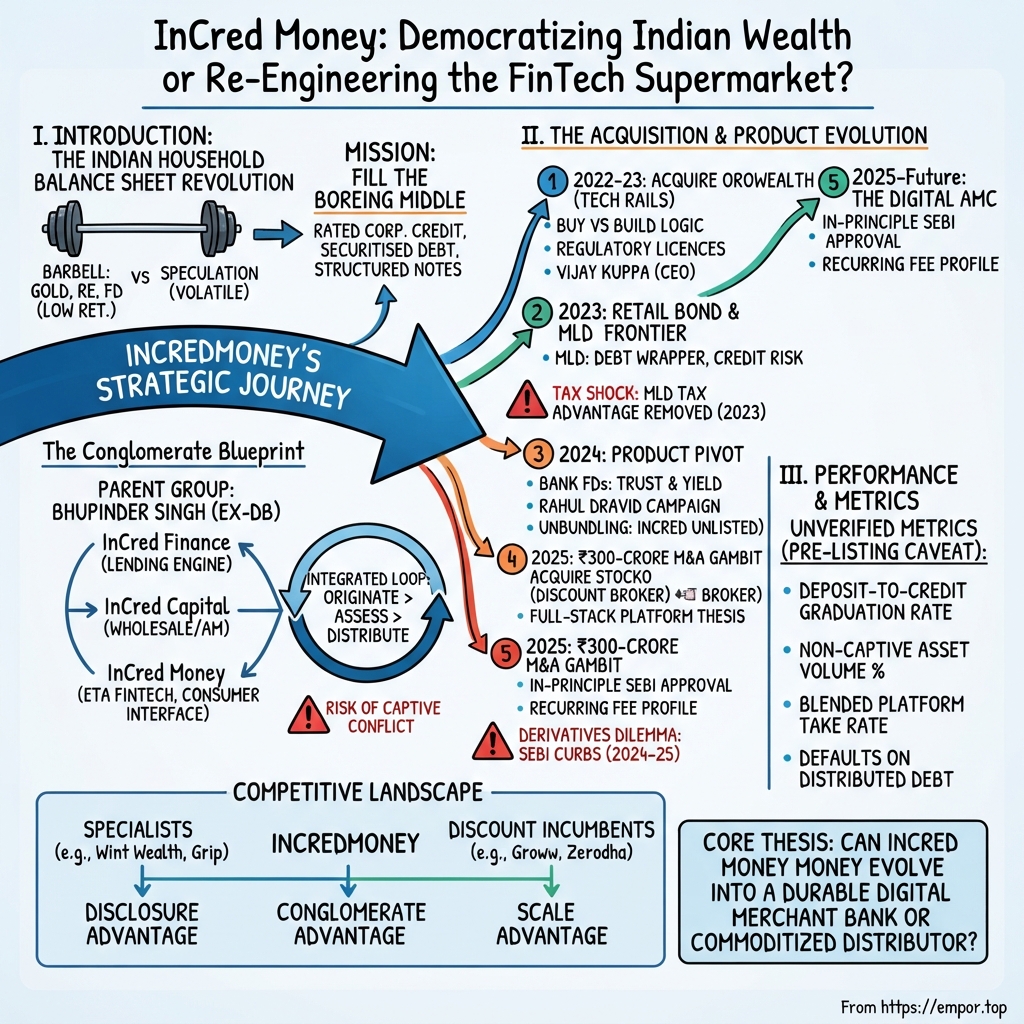
InCred Money: Democratizing Indian Wealth or Re-Engineering the FinTech Supermarket?
I. Introduction & The "Indian Household Balance Sheet" Revolution (~15 mins)
For most of the post-liberalisation era, the Indian household balance sheet resembled a barbell with almost nothing in the middle. At one end sat a massive, hyper-conservative base: physical gold in lockers, real estate, and bank fixed deposits that, after factoring in income tax at slab rates and persistent inflation, frequently delivered negative real returns. At the other end sat a narrow but volatile band of speculation: small-cap tips circulated across messaging apps and, in recent years, weekly index options traded by retail participants without portfolio hedges. What Indian savers lacked was the boring middle—the rated corporate credit, securitised debt, and structured notes that supply ballast to household portfolios in developed capital markets.
That void was not a matter of consumer preference; it was an artefact of market structure. Historically, India's corporate bond market operated as a wholesale, over-the-counter venue where privately placed debt carried a statutory minimum face value of ₹10 lakh, and where meaningful allocations required ticket sizes ranging from ₹10 lakh to ₹1 crore. Structured debt instruments, market-linked debentures, and pre-IPO unlisted shares were sold almost exclusively across private-banking desks to ultra-high-net-worth clients. The mass-affluent Indian—the salaried professional with ₹10 lakh to ₹1 crore in investable surplus, a segment numbering tens of millions by standard measures—was left to choose between a mutual fund and a fixed deposit, with little available in between.
InCred Money was designed to intermediate that middle ground. Its operating premise is that institutional-grade alternate fixed income can be broken down into ₹10,000 increments and distributed digitally to mass-affluent investors, backed by credit assessment from an affiliated group that underwrites loans for a living.12 The business operates as a retail-facing consumer wealth platform under the corporate name ETA Fintech Private Limited, housed within a broader financial services group led by a former investment-banking executive and supported by a multi-thousand-crore non-bank lending balance sheet.34 That arrangement—a digital distribution front-end integrated with an active lender and merchant bank—is the defining feature of the business, as well as the source of its central strategic friction.
This analysis traces five distinct developments. The first is the founder's move from leading Deutsche Bank's Asia-Pacific investment banking franchise into Indian non-bank finance. The second is the decision to buy rather than build a retail wealthtech platform through the acquisition of Orowealth, which provided InCred Money with its operating company, technical infrastructure, and chief executive. The third is the regulatory double-strike of 2022 and 2023, when the Securities and Exchange Board of India introduced a mandatory licensing and unbundling framework for online bond platforms just as the Finance Act removed the capital-gains tax advantages of the company's core product. The fourth is the ₹300 crore purchase of Delhi-based discount broker Stocko in 2025—an initiative to assemble a full-stack investment platform carried out during an extensive regulatory intervention against retail derivatives trading. The fifth is the central question confronting any pre-listing assessment of the firm: can InCred Money evolve into a durable digital merchant bank that manufactures proprietary, recurring revenue, or will rising customer acquisition costs and regulatory fee caps turn it into a commoditised financial distributor with limited pricing power?
Two structural themes run through this trajectory. The first is that retail democratisation and risk-shifting are often two sides of the same trade: every ₹10,000 ticket in a securitised debt instrument widens retail access while simultaneously shifting credit risk from institutional balance sheets capable of evaluating it to individual households that generally cannot. The second is that regulation in Indian retail distribution acts as both moat and trap. The licensing requirements and capital minimums that keep out early-stage competitors can, through a single regulatory circular, extinguish an entire product line. InCred Money has encountered both realities.
An initial operational caveat is warranted. InCred Money is evaluated here as a venture-backed enterprise, reflecting its corporate maturity rather than an exchange listing. The company has not filed a draft red herring prospectus or formal offer document, nor has it published audited, consolidated segmental reporting of the type required for a public listing. This assessment is drawn from corporate disclosures, regulatory orders, capitalisation records, and industry reporting. Where the verifiable record ends, the analysis explicitly acknowledges the limit.
 Subscribe on LinkedIn
II. The Architect, The Megamerger, & The Conglomerate Blueprint (2016–2022) (~25 mins)
Bhupinder Singh's career before 2016 was the kind that in India typically led to a private-equity partnership rather than the operational grind of building a domestic lender. He had run corporate finance and investment banking for Deutsche Bank across Asia-Pacific—a vantage point that offered a decade-long view of which Indian borrowers secured capital, at what price, and through which intermediaries.4 The thesis he drew from that experience was unsentimental: India's state-owned banks, burdened by bad loans during the 2014–2018 asset quality recognition cycle, had pulled back from entire segments of the credit market. Retail borrowers without established credit bureau histories, small enterprises managing uneven cash flows, and students seeking overseas education loans were being rationed out—not necessarily because they were uncreditworthy, but because incumbent institutions lacked the risk capital and underwriting machinery to evaluate them.
InCred was founded in 2016 to target that credit vacuum through technology-enabled underwriting.5 The early shareholder register was unusual for an Indian non-bank of that vintage: it was anchored by the late Anshu Jain, former co-chief executive of Deutsche Bank, alongside Ranjan Pai of the Manipal Group, industrialist Gaurav Dalmia, and Landmark Holdings. That backing provided more than early equity; it delivered an institutional credibility signal. In Indian non-bank finance, where liability costs dictate survival, a first-time lender with global investment-banking pedigree and prominent backers can borrow earlier and on more favourable terms than operational track records alone would normally allow.
The group that took shape around that balance sheet rests on three distinct pillars, and understanding how they interact explains why InCred Money functions differently from a conventional consumer fintech app. The first pillar is InCred Finance, operating through InCred Financial Services Limited—the primary lending engine that originates personal loans, student education credit, school financing, and small-business loans, while anchoring the group's principal borrowing programmes and credit ratings.5 The second is InCred Capital, the wholesale and asset-management franchise, spanning investment banking, institutional equities, asset management through InCred AMC, and private wealth advisory through InCred Wealth, which the group has credited with managing assets well above ₹15,000 crore.4 The third is InCred Money, the retail-facing consumer interface operating through the corporate entity ETA Fintech Private Limited, which was acquired rather than built internally.3
The strategic architecture operates as an integrated loop. InCred Capital originates and structures corporate debt. InCred Financial Services applies credit assessment discipline and, when required, provides balance-sheet capacity to warehouse the paper. InCred Money then aggregates retail capital to distribute that debt into individual investment portfolios. In theory, each division lowers transaction and funding costs for the others. In practice, as Section IV examines, linking debt origination directly to retail distribution invites intense regulatory and investor scrutiny: the structural incentive to place a financial conglomerate's weakest or most illiquid paper with its least sophisticated retail buyers exists regardless of whether management ever acts on it.
The turning point that converted this structure from a blueprint into institutional scale was the merger with KKR India Financial Services, negotiated through 2021 and completed in 2022. The transaction combined InCred's retail lending franchise with KKR's domestic non-bank arm in a reverse-merger format, producing a diversified lender with an equity base expanding past ₹2,500 crore and a loan book that rose above ₹5,000 crore.5 For a young non-bank lender founded only six years earlier, absorbing the capital base and institutional relationships of a global alternative asset manager's Indian credit arm provided an immediate step-change in wholesale credibility.
That sequencing inverted the conventional Indian fintech playbook. The standard industry model begins by amassing millions of consumer accounts through free software utilities—such as payments apps, portfolio trackers, or charting tools—and later attempts to monetize that user base by distributing credit as a broker on partner bank balance sheets. That route leaves pure-play fintechs vulnerable to third-party lenders who can reprice terms, reduce volumes, or terminate partnerships at will. InCred pursued the reverse: it built underwriting discipline, institutional capital-markets access, and balance-sheet capacity first, and only then acquired a retail distribution front-end. Whether that inverted sequence creates an enduring economic moat or simply represents a costlier route to a commoditized retail distribution model remains the central question explored in Sections VIII and IX.
Across capital allocation and corporate governance, the factual record substantiates some strategic achievements while leaving others untested. Bhupinder Singh has maintained substantial personal equity ownership and raised institutional capital at a measured pace, culminating in an approximately $60 million Series D funding round in late 2023 that valued the parent entity at roughly $1.04 billion and established InCred as India's second unicorn of that year.5 While that transaction remains the group's primary valuation anchor, it warrants careful interpretation: it reflects a privately negotiated price on preferred shares rather than public market pricing for common equity, and it values the consolidated group—overwhelmingly the lending balance sheet—rather than InCred Money in isolation.
The group's operational record reveals consistent capital discipline in one key respect: management has repeatedly pursued inorganic expansion into undemonetized or structurally constrained fintech infrastructure rather than paying growth-stage premiums for consumer brands. The acquisition of Orowealth in 2022–2023 and Stocko in 2025 both involved buying operational technology stacks and regulatory licences for cash rather than using equity currency. While this demonstrates valuation discipline, it also reflects a pattern of acquiring subscale businesses whose standalone unit economics had already proven difficult—the very dynamic analyzed in Section III. What the record does not yet contain is performance across a complete credit downturn: the group's lending book has expanded through a prolonged period of benign domestic credit conditions and rising household leverage. Furthermore, comprehensive disclosures on board independence and related-party transactions will only emerge in future public offering filings; until then, their absence remains an analytical diligence gap rather than proof of structural soundness.
III. The Orowealth Acquisition: Buying the Tech Rails for Retail Wealth (2016–2022) (~20 mins)
Orowealth was founded in 2016—the same year as InCred—by Nitin Agrawal, Vijay Kuppa, Yogesh Powar, and Sougata Basu, incorporated under the legal name ETA Fintech Private Limited.23 Its founding strategy reflected one of the core ideas in early Indian wealthtech: zero-commission, direct-plan mutual fund distribution combined with automated, algorithmic portfolio advice. The underlying consumer proposition was mathematically straightforward. Regular mutual fund plans embedded an ongoing trail commission paid to intermediaries, reducing an investor's net compound return over time; direct plans eliminated that intermediary fee, delivering materially higher capital accumulation across multi-year holding periods. Orowealth constructed its platform to transition retail savers into direct plans and automate asset allocation through algorithmic models rather than traditional relationship managers.
The commercial challenge, which emerged over several years of operation, was that the regulatory structure that benefited investors eliminated the distributor's revenue model. By regulatory mandate, direct plans pay distributors no distribution fees. Orowealth was therefore required to charge the consumer directly. Indian retail investors—long accustomed to financial advice being funded through bundled product commissions—showed little willingness to pay explicit recurring subscription fees for software-based recommendations. That consumer reluctance created a revenue ceiling that challenged India's first generation of standalone robo-advisors.
In response, Orowealth adjusted its business model. The company launched Wealthnest, a business-to-business wealth-as-a-service suite that provided transaction and portfolio-tracking infrastructure through application programming interfaces for banks, brokerages, and registered advisers to embed within their own consumer interfaces. Although the direct consumer portal remained active—eventually gathering more than ₹1,350 crore in platform assets across roughly 25,000 retail accounts—enterprise software sales into traditional Indian financial institutions required extended sales cycles, relationship-driven business development, and substantial balance-sheet support. By 2022, Orowealth held a functional technology stack, regulatory registrations with the Securities and Exchange Board of India for distribution and advisory services, and an active retail client roster, but had not demonstrated a path toward standalone profitability.
That operational infrastructure provided the rationale for InCred's acquisition. Structured as an all-cash buyout, the deal was negotiated in late 2022 and completed in the first half of 2023, establishing ETA Fintech as the corporate operating entity for InCred Money.23 The capital allocation logic favored an acquisition over an internal build. Distributing corporate debt to retail investors was an open market concept; what InCred required was a compliant, live operating platform with existing users, an established microservices architecture tested by transaction volume, and an engineering team that had already built the domestic payments, identity verification, and depository infrastructure. Replicating those systems and securing the necessary regulatory clearances from scratch would have required a multi-year integration runway, during which competitors could have captured early market share in alternate fixed income.
Executive continuity was an additional factor in the transaction. Orowealth co-founder Vijay Kuppa took charge as chief executive of InCred Money and has served as the operational lead of the franchise through the Stocko acquisition and the group's mutual fund licence application.67 Founder retention past the eighteen-month mark is historically uncommon in Indian fintech mergers; maintaining founding leadership through successive integration stages gave InCred operational stability.
The pricing of the deal also reflected broader market dynamics. Across the 2021–2022 funding cycle, domestic fintech platforms engaged in a wave of infrastructure and licence acquisitions—including PhonePe acquiring WealthDesk and OpenQ, and Groww purchasing Indiabulls Asset Management to secure an asset management licence. Most of these deals prioritized regulatory authorisations and functional code over consumer acquisition metrics. InCred deployed modest cash reserves to acquire a platform overseeing ₹1,350 crore in assets under management alongside active regulatory licences, avoiding the elevated valuation multiples paid by standalone consumer wealth applications that had raised venture capital on unproven subscription projections. In a licensed financial sector, purchasing operational, distressed infrastructure offered a capital-efficient method to compress development time.
The Direct-Distribution Trap—a thesis tested. The core assumption frequently made in robo-advisory acquisitions is that algorithmic portfolio management and direct-plan mutual fund distribution can serve as the primary engine of a scalable consumer franchise. Orowealth's seven-year operating record between its 2016 founding and its 2023 acquisition provided direct empirical evidence against that hypothesis. Zero-commission direct-plan distribution consumed equity capital without establishing a self-sustaining margin profile; retail investors resisted standalone software subscription fees; and the enterprise software pivot converted a high-multiple consumer model into a slower, relationship-heavy vendor business. The historical evidence indicates that direct mutual fund aggregation on its own was insufficient to sustain an independent business model.
InCred's transaction, therefore, did not validate the stand-alone economics of robo-advisory. Rather, the group acquired operational digital rails at a distressed valuation and repurposed them to distribute alternative fixed-income products that carried significantly higher revenue margins per rupee transacted. That distinction establishes the standard against which InCred Money must be assessed: digital distribution infrastructure has little standalone economic value unless paired with higher-margin origination. If product yields narrow or retail demand for alternative credit softens, the platform faces the same unit-economic pressures that constrained Orowealth as an independent entity. A central operational metric for evaluating the business post-listing remains the proportion of net revenue generated by products earning take rates above 75 basis points, compared to commoditised investment distribution generating under 25 basis points.
IV. The Retail Bond & MLD Frontier: Slicing the ₹10 Lakh Barrier (2022–2023) (~25 mins)
To understand what InCred Money was selling in 2023, it helps to understand what an Indian corporate bond represented as a retail proposition before that point: an asset class that was virtually inaccessible. The overwhelming majority of Indian corporate debt was issued through private placements rather than public offerings, carrying a statutory minimum face value of ₹10 lakh per security. Secondary trading took place over the counter, conducted over the telephone between institutions at prices that were not systematically published. Retail investors could neither discover transparent pricing nor purchase fractional lots, and they possessed no practical liquidity mechanism to exit.
Meanwhile, Indian households held well over ₹150 lakh crore in bank deposits earning interest rates that, after accounting for top-bracket income tax rates, frequently trailed realised inflation. The theoretical yield arbitrage was clear: single-A to AAA-rated corporate issuers paid a measurable spread over deposit rates for taking an incremental, rated step out on the credit curve. The barrier preventing households from capturing that spread was institutional infrastructure rather than risk appetite.
InCred Money set out to re-engineer that infrastructure. The platform sliced wholesale debt into retail-accessible tranches across three product categories: senior secured corporate bonds, securitised debt instruments—pools of underlying loans housed within bankruptcy-remote special purpose vehicles—and market-linked debentures, offering minimum investments ranging from ₹10,000 to ₹1,00,000.12 In August 2023, it launched its maiden retail market-linked debenture tranche, a structured note offering equity index upside participation alongside contractual downside capital protection.8
The mechanics of the market-linked debenture explain both its initial popularity and its underlying risk profile. An MLD is a bond whose coupon is not fixed, but determined by a mathematical formula tied to the performance of a reference benchmark, typically an equity index. Issuers commonly purchase options to hedge that market exposure. For the investor, this packaging translated equity-linked market exposure into the legal wrapper of a debt instrument—a structure that, before regulatory and tax reforms in 2023, enjoyed significantly more favourable capital gains tax treatment than direct equity holdings. In economic substance, an MLD is a structured derivative embedded within a debenture. Consequently, an investor’s ultimate return depends not only on the performance of the underlying index, but on the ongoing creditworthiness and solvency of the issuing institution that has contractually obligated itself to pay.
The unit economics behind this distribution model were compelling. Under the group's originate-to-distribute framework, InCred Capital structured the transaction, InCred Financial Services applied underwriting and credit evaluation, and InCred Money aggregated retail distribution. On alternate credit products, the platform could capture 100 to 250 basis points in combined structuring and distribution economics—a stark contrast to the 10 to 25 basis points typically available on liquid mutual fund distribution. That tenfold differential in take rates constituted the core commercial rationale for acquiring Orowealth’s rails: running higher-margin credit products across the platform rather than low-margin mutual funds.
The Captive Conflict of Interest — a thesis tested. The thesis that a fintech distributor linked to a non-bank lending parent enjoys an unassailable competitive moat through captive deal flow is a narrative management teams often promote and investors should evaluate sceptically. The breakdown mechanism is direct: captive distribution risks turning a retail investment portal into a captive disposal channel for a parent balance sheet's higher-risk, lower-rated, or subordinated debt. When an affiliated lender can offload its own balance-sheet exposures directly to retail clients, it solves a wholesale liquidity challenge by creating a structural conduct risk.
The historical record highlights this exact operational tension. When InCred Money introduced its maiden retail market-linked debenture tranche in August 2023, the issuer of the underlying securities was InCred Financial Services itself.8 On its face, this arrangement was entirely permissible: InCred Financial Services was a regulated, rated non-bank lender issuing debt under its own name, and relying on internal inventory is the standard method to seed a nascent distribution channel. Yet that structure immediately raises questions regarding arm's-length pricing: who established that the coupon offered to retail purchasers reflected the yield an independent market would have demanded from that issuer? Retail investors were being asked to underwrite the credit risk of the parent company that owned the distributing platform, while the platform collected distribution fees funded by that same parent entity.
This dynamic narrows rather than substantiates the origination moat thesis. Captive origination is an effective tool to prime the pump and ensure steady inventory during the initial build-out of a distribution channel. However, it does not constitute a sustainable moat because it cannot survive its own commercial maturity. To establish credibility as a neutral, open-architecture wealth platform—the only posture capable of competing for retail trust against discount incumbents such as Groww or Zerodha—third-party paper originated by external non-banks and corporate issuers must eventually account for the overwhelming majority of transaction volume. Every incremental rupee of third-party distribution inevitably dilutes the captive origination advantage upon which the original moat claim relied. These two strategic imperatives remain in tension, and management cannot optimize for both simultaneously.
This friction explains why the ratio of non-captive asset volume serves as a critical forward-looking benchmark, as detailed in Section XII. That single metric separates a genuine digital merchant bank with an independent distribution arm from a captive conduit burdened by conflicts of interest. As of 2026, InCred Money has not disclosed that volume breakdown, and existing reporting mandates do not require it to do so. Until granular disclosures separate captive from third-party distribution, the assertion that conglomerate integration delivers a durable origination advantage remains unverified, and prospective public-market investors should treat it as an unproven operational thesis.
A parallel structural risk exists within securitised debt instruments. In these structures, the credit risk of an underlying loan portfolio is transferred directly to the retail investor, while the originating lender retains primary loan servicing. The ultimate performance of that transfer hinges entirely on underwriting rigor, meaningful skin-in-the-game risk retention, and transparent loan-pool selection—none of which a retail investor committing ₹10,000 can independently audit. During periods of macroeconomic expansion and benign credit conditions, these asset-backed structures function smoothly and meet expectations. The genuine operational test arrives during a severe credit contraction, an environment that India's retail alternative debt market has not yet weathered at this scale of digital distribution.
V. The Tax Shock & The OBPP Crucible: Surviving the 2023 Regulatory Upheaval (~25 mins)
Within a span of roughly four months, Indian financial regulators and tax authorities introduced two structural interventions that dismantled much of the business model InCred Money had acquired the technical rails to execute.
The first arrived in November 2022, when the Securities and Exchange Board of India published its registration and regulatory framework for Online Bond Platform Providers.[^13] Until then, a cohort of Indian fintech startups had been selling over-the-counter corporate bonds to retail investors without a specific distribution licence, sourcing wholesale paper and reselling it with embedded markups. The regulator's circular ended that practice. It required online bond platforms to register as stock brokers in the debt segment, placed their operations under direct regulatory oversight, and routed bond execution through stock exchange Request for Quote systems, establishing an auditable order and settlement trail. For investor protection, this was a marked institutional advance; for casual, unlicensed entrants, it created an immediate barrier to entry.
The framework also contained an unbundling restriction that reshaped industry business models. Under the circular, registered online bond platform providers were barred from offering unregulated, non-debt products on the same digital interface—a rule designed to prevent regulated bond portals from functioning as marketing storefronts for unlisted shares, fractional real estate, digital gold, or other unregulated asset classes.[^13] For InCred Money, whose operating strategy depended on cross-selling a ladder of financial assets—from fixed deposits to corporate debentures and pre-IPO private equity within a single mobile application—that condition imposed a hard structural division. Section VI details the operational reconfiguration this mandate required.
The second disruption arrived in March 2023 through the Finance Act. Section 50AA eliminated the long-term capital gains tax treatment previously applied to market-linked debentures held beyond twelve months. Under the new provision, returns on these instruments were taxed at an investor's marginal income-tax slab rate—which, for the high-earning individuals who formed the primary customer base for structured paper, increased the effective tax rate from roughly 10 percent to as much as 39 percent. Within the same statute, open-ended debt mutual funds lost their indexation benefits, which had allowed long-term investors to adjust cost bases for inflation. In a single legislative revision, the post-tax yield advantage of packaged retail fixed income was compressed toward parity with traditional bank deposits.
For InCred Money's flagship product, the commercial impact was immediate. The marketing narrative for retail market-linked debentures had rested on delivering equity-like tax efficiency alongside bond-like capital protection. In economic substance, an MLD is an illiquid, credit-dependent, and complex structured derivative; favorable tax treatment was the primary incentive compensating retail investors for accepting those underlying risks. With that fiscal advantage removed, distributors had to market MLDs purely on their pre-tax credit spread against liquid, government-insured bank fixed deposits. Notably, InCred Money launched its maiden retail market-linked debenture in August 2023—five months after the statutory tax concession had been eliminated.8 That sequence reflected either high managerial confidence that retail appetite for structured credit could survive without tax incentives, or an underwriting pipeline that was already too committed to halt. In either case, the shift challenged the assumption that demand for retail structured notes represented a permanent, tax-agnostic consumer franchise.
Regulators did provide an offsetting measure that lowered operational entry barriers. Over subsequent regulatory updates, the Securities and Exchange Board of India reduced the statutory minimum ticket size for privately placed listed corporate debt from ₹10 lakh to ₹1 lakh, and later introduced a ₹10,000 threshold for listed debt securities and securitised debt instruments distributed through registered platforms.[^13] The micro-ticket access that InCred Money had spent months assembling through bespoke structures became standard industry infrastructure by regulatory decree. While that shift expanded the total addressable market for retail debt, it also diluted the platform's early-mover advantage: a statutory ₹10,000 ticket size became instantly accessible to incumbent discount brokerages with customer bases exceeding twenty million accounts. In platform finance, regulatory tailwinds that equalize access for all participants do not build defensible moats; they expand a market whose economics flow disproportionately to incumbents that already control distribution volume.
At the same time, onboarding friction across digital bond platforms increased. Exchange-routed trade execution, mandatory demat accounts, broker-grade identity verification, and the physical separation of product categories introduced several distinct checkpoints into what had once been a streamlined signup funnel. In digital retail finance, every incremental compliance step compounds conversion drop-offs, driving up customer acquisition costs across the industry.
The Fragility of Regulatory Tax Arbitrage — a thesis tested. The hypothesis that structured alternative debt provides a retail wealthtech platform with a durable competitive moat rested heavily on delivering superior post-tax net yields. The aftermath of the 2023 Finance Act functioned as a clean empirical test of that assumption: once the legislative tax preference was removed, retail and mass-affluent appetite for illiquid structured debentures contracted sharply across the domestic fintech landscape. The historical record disproves the thesis: the pricing power did not reside in proprietary structuring or digital product packaging, but in a specific clause of the tax code. When the statutory concession ended, the pricing advantage disappeared with it.
The strategic takeaway for assessing InCred Money's forward unit economics is that revenues generated from regulatory or fiscal arbitrage operate as terminating annuities of uncertain duration rather than perpetual franchise moats. Building sustainable enterprise value in retail credit requires far more demanding operational assets: credit underwriting that preserves capital through adverse cycles, verifiable default-free track records on distributed paper, and genuine secondary-market liquidity that allows retail investors to exit holdings at transparent market prices. InCred Money has continued to pursue all three capabilities, though none has yet been tested across a prolonged domestic credit downturn.
VI. The Product Pivot: The Rahul Dravid Campaign, Bank FDs, and Segregating Unlisted Equities (2023–2024) (~20 mins)
The response to the 2023 regulatory interventions was a deliberate pivot down-market in complexity and up-market in trust. If structured debt could no longer be distributed on the back of preferential capital-gains tax treatment, and if exchange-routed onboarding friction was depressing digital conversion, the practical path forward was to anchor the platform with an asset class every domestic saver already understood.
In April 2024, InCred Money launched digital fixed deposits, aggregating offerings from a panel of scheduled commercial banks, small finance banks, and non-bank lenders—including AU Small Finance Bank, Utkarsh Small Finance Bank, South Indian Bank, Unity Small Finance Bank, Suryoday Small Finance Bank, Shriram Finance, and Slice Small Finance Bank.110 The platform advertised annualized yields ranging between 9.01 and 9.25 percent, materially above the rates offered by established public- and private-sector incumbents, with eligible deposits at scheduled banks covered by Deposit Insurance and Credit Guarantee Corporation insurance up to ₹5 lakh per depositor per institution.1 The underlying product design was straightforward: rather than asking retail savers to evaluate complex credit structures, the platform offered higher yields from emerging or specialized institutions, insulated by sovereign deposit insurance that fully covered typical mass-affluent deposit allocations.
The principal operational challenge, however, was not product comprehension but platform trust. Convincing an Indian saver to route core household capital through an unfamiliar digital distributor represents a much higher psychological barrier than attracting speculative trading volume. To bridge that gap, InCred Money signed former Indian cricket captain Rahul Dravid in April 2024 for its #InvestConfidentlyinFDs promotional campaign.9 The casting choice was deliberate. Dravid’s public profile—defined by disciplined defensive technique, patience, and reliability—served as an explicit counterweight to the speculative, hyper-growth imagery common across consumer fintech. The initiative represented an effort to import institutional credibility that a young consumer platform could not cultivate organically. While the brand strategy was coherent, it introduced significant customer acquisition costs that, as Section VIII details, proved difficult to amortize on thin fixed-deposit distribution margins.
The second operational shift required extensive structural surgery. To comply with the Securities and Exchange Board of India's online bond platform provider unbundling mandates and broker conduct guidelines, InCred Money was required to remove its highest-margin product category—unlisted, pre-IPO equity—from its primary retail interface.[^13] Investor accounts, transaction histories, and ongoing offerings were migrated to a distinct legal brand and standalone domain operating as InCred Unlisted.13 While this restructuring satisfied regulatory compliance, it carried substantial commercial costs. Segregation dismantled the integrated cross-sell funnel that formed the core strategic rationale for building a multi-product wealth application. By forcing duplicate onboarding processes and separate login credentials, the separation prevented the acquisition spending deployed on fixed-deposit users from being monetized through high-margin private equity transactions carrying spreads of 2 to 5 percent. The company achieved full regulatory compliance, but forfeited seamless product aggregation.
In September 2025, InCred Money introduced digital gold and silver through an integration with MMTC-PAMP, allowing purchases starting at ₹10 for vaulted, 24-karat, 999.9-fine physical bullion.110 In economic substance, micro-ticket digital bullion operates as an activation and engagement mechanism carrying minimal distribution spreads rather than a core wealth management pillar. Because it generates negligible revenue per user and skews toward smaller, price-sensitive retail accounts, micro-bullion serves primarily to stimulate daily application traffic. While defensible as an account-activation tool, it adds little enterprise value to a high-margin investment franchise.
The Sub-Agent Distribution Limit — a thesis tested. The hypothesis that aggregating digital fixed deposits creates a defensible, high-lifetime-value consumer fintech platform is challenged by basic unit economics. Sourcing commissions paid by partner banks and non-banks typically range from 20 to 50 basis points as a one-time referral fee on originated principal. A ₹1 lakh deposit therefore generates just ₹200 to ₹500 in one-off platform revenue. In contrast, acquiring a fully verified, know-your-customer-compliant transacting user in the Indian fintech market—particularly while funding nationwide celebrity brand campaigns—requires marketing and acquisition expenditures that substantially exceed the revenue generated by that initial deposit.
Industry-wide operating data reinforces this constraint. Across the domestic wealthtech landscape, platforms aggregating fixed deposits—including Stable Money, Grip, and InCred Money—have consistently functioned as low-margin user-acquisition funnels rather than self-sustaining profit centers. Competitors uniformly rely on a graduation thesis: acquiring mass-affluent savers through familiar deposit products and subsequently migrating them into structured credit, corporate bonds, or broking services. That universal reliance on cross-selling confirms that third-party deposit intermediation cannot sustain stand-alone platform economics.
This dynamic narrows the distribution thesis considerably. Fixed-deposit aggregation is a functional, and perhaps necessary, customer acquisition wedge for an ecosystem designed to generate revenue through higher-margin products downstream. However, it does not constitute an independent business model. Its ultimate enterprise value depends entirely on a customer graduation rate—the proportion of deposit-acquired savers who subsequently invest in corporate debentures, securitised debt instruments, or equities. As of 2026, InCred Money has not disclosed this conversion metric, and it remains unobservable in public records. That graduation rate represents the central undisclosed operating metric of the business, and it remains the primary benchmark against which management's multi-product distribution model must be evaluated.
VII. The ₹300-Crore M&A Gambit: Buying Stocko and the Derivatives Dilemma (2025–Present) (~25 mins)
In June 2025, InCred Money acquired Delhi-based discount broker Stocko, operating as South Asian Stocks Limited, in a transaction reported at approximately ₹300 crore—roughly $35 million—structured across cash and equity.611 It represents the largest capital allocation decision in InCred Money's operating history, and the transaction upon which any pre-listing assessment most directly turns.
The underlying infrastructure was substantial. Stocko was founded in 2013, held a full broking licence with exchange memberships, and processed a daily notional turnover reported at around ₹1 lakh crore across equities, commodities, and derivatives on a flat-fee execution model of ₹12.99 per trade.611 Chief executive Vijay Kuppa and group chief executive Bhupinder Singh framed the acquisition as supplying the missing equity trading engine for an integrated investing platform, rebranded as InCred Stocko.6 Stocko chief executive Shrey Jain was retained to lead retail broking under the InCred umbrella—consistent with the group's established practice of acquiring operating management alongside regulatory licences.11
The strategic rationale rested on two pillars. The first was speed to market in licensing and technology rails, mirroring the logic of the Orowealth acquisition: building a brokerage from scratch requires satisfying capital-adequacy thresholds, securing exchange memberships, establishing clearing arrangements, building risk-management architecture, and navigating a protracted regulatory approval process. The second was repairing the customer acquisition funnel disrupted by the online bond platform unbundling rules. A broking relationship provides the deepest commercial anchor in Indian retail finance: it controls the depository account, holds investor trading balances, and commands regular user attention, thereby enabling cross-selling into fixed-income paper, bank deposits, and margin trading facility credit.
The transaction's valuation warrants careful examination, though public disclosures offer limited visibility into its underlying economics. A reported ₹300 crore valuation against ₹1 lakh crore in daily notional turnover appeared superficially modest, but notional derivatives turnover is largely uninformative as a valuation metric: it represents a gross exposure figure that can be generated by a relatively small cohort of high-frequency options traders paying flat per-order fees. The economically decisive metrics—active transacting clients, average revenue per user, client contribution margins, and the underlying split between derivatives speculation and cash delivery—remain undisclosed. Relative to the private-market valuations per active client achieved by market leaders such as Groww during peak funding cycles, ₹300 crore for a licensed broker with meaningful volume represented a contained absolute commitment. Whether it constituted an attractive price depends entirely on those private unit economics and the long-term durability of the acquired revenue base.
The proposed cross-selling synergies also require scrutiny from the perspective of investor behaviour rather than corporate design. Selling a five-year, illiquid securitised debt instrument to an options trader whose trading activity centres on weekly contract expiries reflects a fundamental mismatch of investor risk profiles rather than a natural cross-sell: these two products cater to conflicting financial psychologies within a single interface. A more plausible synergy runs in reverse: providing margin trading facility credit, funded at the parent non-bank's borrowing costs, to affluent cash-segment equity investors, while offering fixed deposits and bonds to the conservative, delivery-oriented minority of the brokerage client base. While viable, that addressable cross-sell opportunity is considerably narrower than the broad "full-stack super-app" narrative suggests.
The Great Retail Derivatives Squeeze — a thesis tested. The hypothesis that acquiring a high-volume discount brokerage provides a platform with resilient, high-margin transaction fee streams from active retail traders faces a direct structural challenge: Indian regulatory authorities concluded that retail derivatives speculation was systematically eroding household savings and intervened to curb it.
The empirical evidence driving that intervention was extensive. A landmark study published by the Securities and Exchange Board of India revealed that roughly 93 percent of individual retail traders in equity futures and options incurred net losses between financial years 2022 and 2024, with aggregate retail losses exceeding ₹1.8 lakh crore and an average loss of approximately ₹2 lakh per unprofitable participant. In response, the regulator issued an October 2024 framework designed to tighten equity index derivatives trading, phased in throughout 2025. The rules raised minimum derivative contract sizes from approximately ₹5 lakh to between ₹15 lakh and ₹20 lakh, restricted index derivative weekly expiries to a single benchmark per exchange, mandated the upfront collection of option premiums from buyers, eliminated calendar-spread margin benefits on expiry days, and introduced stricter intraday position monitoring, alongside statutory increases in the securities transaction tax on derivatives.[^14]
Each of these regulatory interventions was explicitly designed to filter out smaller retail participants and suppress trading frequency. The resulting industry-wide impact was a structural, rather than cyclical, contraction in retail derivatives volumes—the primary operational engine behind the ₹1 lakh crore notional turnover that had established Stocko's initial commercial appeal.
This regulatory shift disproved the assumption of volume resilience and heightened the commercial risk embedded in the acquisition. Stocko was acquired near the culmination of India's post-pandemic retail derivatives expansion, through a transaction justified by turnover metrics that market regulators were already actively dismantling. This was not an unforeseen development: the regulatory framework was published in October 2024, eight months before the transaction closed in June 2025, establishing clear public notice of the regulatory trajectory before capital was deployed. Consequently, the burden of proof rests on management to demonstrate that the acquisition purchased durable client relationships rather than peak-cycle trading turnover.
The forward test of this strategy is measurable: whether InCred Stocko can reorient its revenue base away from derivatives execution fees toward cash delivery broking, margin trading facility net interest income, and third-party product distribution, alongside sustaining the growth of active funded accounts rather than headline notional volumes. Without that transition, the group faces potential goodwill impairment on a ₹300 crore asset and, more critically, the invalidation of the customer-acquisition thesis that motivated the purchase.
VIII. Business Model & Unit Economics: Dissecting the Take-Rates (~20 mins)
Any pre-listing assessment of InCred Money must confront a fundamental reporting constraint: the platform does not publish segment revenues, realized take rates, customer counts, contribution margins, or cohort retention data, and no statutory mandate currently requires it to do so. ETA Fintech Private Limited files standalone statutory accounts as an unlisted Indian private company, while group investor disclosures remain tailored toward institutional debt programmes rather than equity analysts evaluating a retail distribution engine.125 Evaluating the platform's commercial trajectory therefore requires separating verified regulatory disclosures from operational inferences.
The economic architecture of InCred Money is fundamentally dictated by its product mix. Retail corporate debt and alternate bonds generate the highest transactional economics on the platform: structuring and distribution fees paid by issuers generally range from 1.0 to 2.0 percent on alternate credit, supplemented by secondary-market bid-ask spreads. While highly lucrative on a per-transaction basis, these revenues remain lumpy, volume-constrained, and tethered to primary issuance supply. Securitised debt instruments improve on this structure by pairing upfront placement fees with ongoing servicing fees from the underlying special purpose vehicle; because these servicing fees are annualized across the multi-year life of the loan pool, they represent the platform's most commercially valuable revenue stream: recurring cash flow. Fixed deposits occupy the opposite end of the spectrum, yielding a one-time referral commission from partner banks of roughly 20 to 50 basis points on originated volume, with no recurring trail fees and zero contractual lock-in once the principal matures. Retail broking through InCred Stocko generates flat execution revenue at ₹12.99 per order alongside net interest margins on margin trading facility credit—funded through group treasury at borrowing costs lower than standalone discount brokers typically pay, providing an authentic structural funding advantage.6 Digital gold and silver sales provide a nominal distribution markup on MMTC-PAMP transactions.1 Meanwhile, pre-IPO unlisted equities generate significant procurement-to-placement spreads of several percent, but regulatory segregation mandates mean this high-margin revenue stream can no longer be cross-sold within the core retail application.[^13]
The resulting portfolio reveals a fragmented revenue engine: one high-margin product constrained by wholesale origination capacity and retail credit appetite (alternate debt); one high-margin asset class ring-fenced into a separate domain by regulatory decree (unlisted equity); one high-volume retail wedge whose thin commissions barely offset onboarding expenses (fixed deposits); one product line with genuine recurring fee potential that remains untested across a credit cycle (securitised debt); and an acquired transactional brokerage confronting industry-wide regulatory curbs on trading turnover (discount broking). Rather than operating as an integrated, self-reinforcing flywheel, InCred Money functions as an aggregation of disparate distribution experiments organized around an unproven cross-selling thesis.
On the cost ledger, customer acquisition remains the decisive operating variable. Over the past decade, the unit economics of onboarding Indian mass-affluent savers have deteriorated markedly. While acquiring a registered account cost a few hundred rupees during the early robo-advisory wave, converting a verified user into an active, know-your-customer-compliant participant in alternative credit now routinely exceeds several thousand rupees. This inflation reflects heightened compliance checkpoints, exchange-routed onboarding funnels, and intense bidding against heavily capitalized consumer platforms targeting the same affluent demographic. Superimposing high-profile marketing initiatives, such as the nationwide Rahul Dravid promotional campaign, expands brand recall but inflates upfront customer acquisition costs well before scale efficiencies can amortize the expenditure.9
Consequently, the lifetime-value hurdle rate for the platform is steep. To generate sufficient gross margin to recoup a four-figure acquisition cost and contribute to enterprise overhead, a fixed-income investor cannot remain a one-time purchaser of a single ₹10,000 bond. Instead, that user must build a multi-lakh portfolio of alternate credit assets and systematically reinvest proceeds as maturities roll over. On the broking side, achieving a positive unit return requires either highly active trading accounts or clients utilizing margin trading facilities, where net interest income produces predictable, recurring yields rather than volatile transaction fees. The commercial viability of the entire model rests on what percentage of acquired users convert into these high-value cohorts—a metric that remains entirely undisclosed.
Available filings offer limited but instructive visibility into the platform's underlying financial health. Standalone financial statements for ETA Fintech Private Limited show operating losses driven by heavy upfront advertising outlays, brand endorsements, technology infrastructure investments, and regulatory compliance expenses, bridged through equity capital infusions from the parent group.312 Operating deficits of this magnitude are characteristic of a venture-stage financial distributor midway through a structural business-model transition. However, assessing the durability of that investment requires tracking contribution margins per transacting user and the proportion of revenue generated by recurring fee streams—neither of which can be verified from current public disclosures.
The platform's reliance on parent-group financing represents both an operational asset and an analytical blind spot. Sourcing capital through InCred Financial Services provides an authentic competitive advantage in margin trading facility lending: an affiliated broker can access debt at institutional rates unavailable to standalone discount brokerages, enabling the business to capture 400 to 600 basis points of net interest margin on an active margin book.5 Yet this symbiotic relationship also obscures InCred Money's standalone economic viability. A distribution business sustaining operating losses while supported by related-party capital and group debt facilities has not established that it can function as an independent, self-funding enterprise. For prospective public investors evaluating a consolidated group offering, this structure means underwriting an undisclosed internal cross-subsidy.
A credible path to standalone profitability requires satisfying four operational benchmarks in sequence: first, customer acquisition costs must plateau and decline as brand recognition matures; second, the graduation rate of users moving from low-margin deposits and execution broking into alternative credit must expand sufficiently to push the blended take rate above 50 to 75 basis points on transacted volume; third, high-quality recurring revenues—derived from securitised debt servicing fees, margin lending net interest income, and future asset management advisory fees—must expand to represent more than half of consolidated net revenues; and fourth, fixed administrative and compliance expenses must grow at a substantially lower rate than top-line revenues. The failure of any single component would leave InCred Money reliant on parent balance-sheet subsidies indefinitely.
IX. The Competitive Battlefield: InCred Money vs. Wint Wealth, Grip, Groww, and Zerodha (~20 mins)
InCred Money competes in two distinct arenas simultaneously, facing two entirely different categories of rivals, and its competitive standing is materially weaker in one than in the other.
In alternate fixed income, the direct rivals are category specialists. Wint Wealth is the recognized brand pioneer in retail debt democratisation, backed by Zerodha's Rainmatter, focused on senior secured bonds and securitised debt instruments, and—most crucially for competitive positioning—distinguished by publishing detailed underwriting scorecards on every issue it distributes. That disclosure standard has cultivated an organic community trust that remains exceedingly difficult to purchase through marketing, representing the closest thing to a durable franchise asset developed within the sector. Grip Invest approached the market from an alternative angle, establishing early traction in equipment leasing and inventory finance before moving quickly to secure online bond platform provider compliance, supported by strong corporate origination networks. Meanwhile, platforms such as Jiraaf and AltGraaf compete on higher-yielding unlisted corporate paper, invoice discounting, and real-estate credit—offering higher stated coupons to an investor base with a higher risk tolerance.
Against these specialists, InCred Money's differentiation is authentic but narrow: it is the only participant backed by an active investment bank and a rated lending balance sheet.54 InCred Capital can originate and structure primary transactions that pure-play fintech distributors must negotiate from third parties on prevailing wholesale terms, while InCred Financial Services provides the balance-sheet capacity to warehouse unsold tranches during periods of sluggish retail demand—precisely when an alternative debt distributor requires underwriting support. That balance-sheet integration is unavailable to standalone distributors such as Wint Wealth or Grip. Yet what InCred Money conspicuously lacks relative to Wint is a comparable standard of published, investor-auditable underwriting disclosures—the primary operational currency for earning retail trust in structured credit.
The second arena is retail broking, and here the competitive asymmetry is acute. Discount incumbents Groww and Zerodha oversee a combined active client base exceeding twenty million accounts, assembled over a decade at customer acquisition costs no new entrant can replicate. Both platforms have natively embedded treasury bills, sovereign debt, corporate bonds via online bond platform provider frameworks, and direct mutual funds at zero distribution cost to the end investor. Concurrently, Angel One commands extensive penetration across tier-two, tier-three, and tier-four cities, driven by aggressive digital onboarding and a substantial margin trading facility loan book. InCred Stocko enters this field with an operating licence, an execution tech stack, and an active client base that, even under generous assumptions, remains more than an order of magnitude smaller.611
The economic consequence of this disparity is direct and structural. In an industry where market leaders capture the majority of new depository accounts through organic brand equity and low-cost member referrals, smaller entrants must spend heavily to purchase customer attention. With an estimated transacting base of roughly 1.5 lakh users confronting incumbent platforms serving tens of millions, InCred Money is structurally positioned as the marginal bidder across every paid acquisition channel. This disadvantage inflates its customer acquisition costs, and no degree of product packaging can independently resolve that dynamic.
The platform's primary strategic vulnerability lies not in its current competitive positioning, but in the incumbents' logical next move. Nothing prevents Groww, Zerodha, Angel One, or PhonePe from aggressively expanding their distribution of alternative fixed-income paper into their existing customer networks. These platforms already distribute sovereign debt and listed corporate debentures. Should any major incumbent conclude that retail securitised debt or high-yield corporate credit warrants focused expansion, it can present those offerings to millions of active, verified, and pre-funded accounts at negligible incremental acquisition cost. In that scenario, specialist platforms—including InCred Money, Wint Wealth, Grip, and Jiraaf—would be forced to compete on product origination alone against a distribution network holding a hundred-to-one scale advantage.
Evaluating this competitive structure through standard strategic frameworks clarifies the distribution of economic power across the ecosystem. Supplier power remains elevated on both sides of the platform: creditworthy corporate issuers with diverse financing alternatives dictate transaction yields and underwriting fees, while commercial banks unilaterally determine referral commissions on deposit distribution. Buyer power is equally pronounced: mass-affluent savers are acutely yield-sensitive, have been conditioned by discount brokerages to expect zero explicit commissions, and routinely seek secondary liquidity on fundamentally illiquid debt structures. The threat of substitution is acute, as retail investors can readily turn to transparent, liquid alternatives—including insured bank deposits, debt mutual funds, direct sovereign securities, and listed blue-chip equities that carry well-understood risk profiles. Competitive rivalry is intense across both alternative debt and retail broking, where digital interfaces face negligible user switching costs. The single dynamic working in favor of incumbents is the barrier to new entry, which remains moderate rather than low: online bond platform provider licensing, broking capital adequacy mandates, and escalating customer acquisition expenses effectively deter casual market entrants. However, that regulatory and capital barrier protects scaled incumbents such as Groww and Zerodha at least as effectively as it protects InCred Money.
X. Playbook & Strategy Lessons: The Merchant Bank Approach to Fintech (~15 mins)
Three transferable lessons emerge from this record, and each carries a caveat that InCred's own operating history illustrates.
Lesson one: the fintech flywheel can be run in reverse. The conventional Indian fintech playbook amasses retail users through free software utilities and attempts to monetize them years later through credit distribution, typically as an intermediary operating on a partner bank's balance sheet. That model contains an inherent vulnerability: the distributor rarely controls the underlying economics, because the balance-sheet owner can renegotiate commercial terms, reduce lending allocations, or exit the partnership at will. InCred inverted that sequence—establishing a capitalized lending and capital-markets franchise first, and subsequently deploying that balance-sheet capacity and cash flow to fund and acquire digital retail distribution.54 The structural advantage is genuine: InCred Money can absorb operating losses over extended development cycles without depending on venture-capital market windows, while the wider group captures net interest spreads and structuring fees rather than thin referral commissions.
The accompanying caveat is that balance-sheet ownership resolves liability funding, not consumer distribution. Having access to an affiliated balance sheet does not reduce customer acquisition costs, which remain the decisive operational bottleneck identified in Section IX. Patient corporate capital allows an enterprise to endure a difficult market; it does not ensure competitive scale.
Lesson two: in a licensed industry, buy the licence. InCred Money developed neither its core wealth platform nor its broking infrastructure through internal builds. It acquired Orowealth for the former and Stocko for the latter, in both transactions purchasing an operational, regulated corporate entity alongside established management rather than building an unproven tech stack from scratch.26 Where statutory hurdles—online bond platform provider authorizations, broking exchange memberships, and asset-management clearances—impose multi-year integration runways, purchasing compliant operational infrastructure is frequently less expensive than internal development, and consistently faster.
The operational risk, however, is structural, and InCred's record demonstrates both dimensions. Infrastructure assets available for acquisition under these conditions are, by their nature, either businesses whose standalone unit economics have already proven unviable—as direct-plan mutual fund distribution proved for Orowealth—or enterprises acquired near the culmination of an operating cycle, as occurred with the derivatives-driven thesis underlying Stocko.[^14] Purchasing speed delivers tangible commercial value, but absorbing structurally constrained unit economics creates liabilities that emerge over time. The managerial discipline distinguishing the two lies in pricing acquired revenue as cyclical rather than perpetual—an underwriting assumption that available public disclosures do not yet allow investors to verify in the Stocko transaction.
Lesson three: regulatory arbitrage is a revenue stream, never a moat. InCred Money provides an unusually clear case study because it encountered this vulnerability twice within an eighteen-month window. The retail market-linked debenture proposition relied on preferential capital-gains tax provisions that the Finance Act 2023 eliminated by statute. Concurrently, the integrated multi-product cross-selling architecture depended on a single storefront that the Securities and Exchange Board of India's online bond platform provider framework prohibited.[^13] In both instances, an operating vertical was curtailed not by market competition or operational execution, but by statutory revision executed on a timetable outside corporate control.
The constructive corollary is that durable competitive advantage in retail finance must rest on capabilities that regulation cannot dismantle: underwriting rigor that delivers a verifiable track record of zero or well-managed credit defaults, operational efficiency in structuring and bringing primary issues to market, and a structurally lower cost of funding. Through parent-group treasury access, InCred Money plausibly commands the third, while attempting to build the first two. However, only liability access has been empirically demonstrated to date.
XI. Strategic Analysis: Hamilton Helmer's 7 Powers & Porter's 5 Forces (~15 mins)
Evaluated through Hamilton Helmer’s 7 Powers framework, InCred Money presents a sparse scorecard—a diagnostic that is typical for a venture-stage platform at this point in its development rather than an indictment of its long-term viability.
Scale economies remain weak to moderate. While core software infrastructure scales efficiently—the marginal cost of serving an incremental transacting user approaches zero—the platform's heaviest operating burdens scale nearly linearly with volume. These include compliance and regulatory reporting across multiple oversight regimes, custody and depository reconciliation, and customer support for complex structured products that retail savers struggle to understand independently. InCred Money lacks the fixed-cost absorption that scaled brokerages like Groww or Zerodha achieve across tens of millions of accounts. In a market where category leaders can subsidize basic distribution at zero cost, that structural cost gap defines the competitive challenge.
Network effects are virtually negligible, despite how consumer wealth applications are frequently marketed. An incremental retail saver buying a corporate bond or a securitised debt instrument does not directly enhance the utility of the platform for existing participants. A faint second-order dynamic exists—greater aggregate transaction volume can deepen secondary-market liquidity in distributed paper, benefiting all holders seeking an exit—but at current transaction volumes, this liquidity pool is far too shallow to function as a defensive barrier.
Counter-positioning is authentic but non-exclusive. Slicing institutional-grade corporate debt into ₹10,000 increments without charging traditional private-wealth advisory fees is a structural model that established wealth managers cannot easily replicate without cannibalising their existing fee schedules. However, this counter-position offers little proprietary protection: category specialists such as Wint Wealth and Grip Invest established the identical retail posture earlier and have built stronger organic brand associations around it.
Switching costs are practically nonexistent, representing an underappreciated structural vulnerability. Corporate debentures, securitised debt instruments, and listed equities purchased through the platform reside directly in the investor’s personal demat account, while fixed deposits sit on the balance sheets of issuing banks. If a user uninstalls the application, their underlying asset ownership remains entirely intact. The platform retains no proprietary data lock-in or switching friction; customer retention must be won anew every time an instrument matures.
Branding remains an emerging asset rather than an established moat. The InCred name carries recognized credibility in wholesale capital-markets circles, and the promotional campaign featuring Rahul Dravid represented a focused effort to convert that institutional reputation into household trust for retail savings.9 Yet financial brand equity in India is built over decades, anchored by banking giants like HDFC Bank, ICICI Bank, and the State Bank of India. For now, brand development remains an operating expenditure requiring ongoing funding rather than an enduring balance-sheet asset.
Cornered resource represents the platform's most credible power, though it remains moderate and constrained. Captive access to InCred Capital’s institutional origination pipeline and InCred Financial Services’ underwriting engine provides proprietary product supply that an independent distributor must negotiate from external issuers.54 However, as established in Section IV, this advantage is inherently self-limiting: leaning heavily on internal inventory exposes the platform to perceived conflicts of interest, whereas expanding third-party distribution progressively dilutes the captive origination edge.
Process power remains unverified. Group leadership asserts a differentiated capability in evaluating small-business and mid-market corporate credit—a notoriously difficult segment in Indian lending where an authentic underwriting edge would be highly valuable. Yet genuine process power in credit risk can only be verified across a full default cycle. Because the group’s operating record has unfolded during a decade of broadly benign domestic credit conditions and expanding consumer leverage, that underwriting advantage remains an untested hypothesis rather than a demonstrated moat.
The industry analysis detailed in Section IX reinforces these findings from a market-structure perspective. InCred Money operates between high supplier power from issuing banks and corporate borrowers, elevated buyer power from yield-sensitive retail savers, low user switching costs, and ubiquitous substitutes ranging from insured bank deposits to mutual funds. The only structural barrier working in its favour is the regulatory friction of licensing and compliance, which ultimately shelters scaled incumbents far more effectively than emerging challengers.
The strategic conclusion is that InCred Money possesses an authentic operational asset in its conglomerate integration, but lacks an enduring power in Helmer’s strict economic sense—a structural condition that permanently shields returns from competitive arbitrage. Its current standing reflects an early foothold in a developing niche that India's dominant distribution giants have not yet prioritized.
XII. The Bear vs. Bull Case: The Core Investment Spine (~15 mins)
Before weighing the bull and bear cases, the question of pricing must be separated from the question of value—two concepts routinely conflated in pre-listing assessments of Indian fintech.
The primary public valuation anchor remains the approximately $60 million Series D funding round that valued the InCred group at roughly $1.04 billion in late 2023.5 Four qualifications apply before that headline figure can serve as an analytical baseline. First, it prices the consolidated group—an enterprise whose economic value is overwhelmingly derived from its lending book and wholesale capital-markets franchise—rather than InCred Money, which operates as an unlisted, loss-making retail subsidiary. Second, raising $60 million on a post-money valuation of $1.04 billion represents a primary transaction of less than 6 percent of the company's equity; small minority rounds reflect marginal demand and specific syndicate dynamics rather than a market-clearing price for the entire enterprise. Third, late-stage private rounds issue preferred securities. Terms governing liquidation preferences, participation rights, anti-dilution or ratchet protections, conversion mechanics, and side letters remain undisclosed—and their absence is consequential, given that a preferred share carrying a liquidation preference and downside ratchet is worth materially more than common equity struck at the same nominal valuation. Prospective public-market investors purchase common shares that sit strictly junior to those structural protections. Fourth, the transaction closed in late 2023, prior to the regulatory tightening of retail derivatives, the acquisition of Stocko, and the current competitive configuration across alternative fixed income.
The valid inference is therefore strictly bounded: $1.04 billion represents an observed private transaction price for preferred equity in a minority financing, not a reliable proxy for the common equity value of the consolidated group, and certainly not a standalone valuation for InCred Money.
Nor can enterprise value be rigorously computed. For a financial conglomerate whose principal operation is lending, debt constitutes operating raw material rather than corporate leverage in the industrial sense, rendering a conventional net-debt bridge conceptually unworkable for the group. For InCred Money specifically, essential inputs—including standalone cash balances, intercompany borrowing terms, the cash-versus-equity consideration paid for the ₹300 crore Stocko transaction, and any anticipated primary capital proceeds—remain undisclosed.611 Without those variables, calculating an enterprise value is impossible, and any valuation multiple applied to the platform must be classified as an equity-based approximation.
The capitalisation structure is similarly opaque. Authorised and issued share counts across common and preferred classes, employee stock option pools and their associated dilution overhang, outstanding warrants, convertible debentures, governance and voting covenants between the founder and institutional sponsors, and potential pre-IPO capital structures are not publicly available for either the parent group or ETA Fintech Private Limited.12 Because a fully diluted share count cannot be verified from public filings, any headline market capitalisation extrapolated from private rounds represents an indicative estimate rather than an audited calculation, and headline equity value should not be confused with the liquid free float that would trade following an exchange listing.
Under these constraints, assessing intrinsic value requires a wide, scenario-based framework. In a constructive bull case, InCred Money expands its active transacting client base to several hundred thousand accounts, while its blended take rate on transacted volume climbs above 60 to 75 basis points as higher-margin securitised debt and margin trading facility lending outpace commoditised fixed deposits. Concurrently, recurring revenue—supported by servicing fees, margin lending net interest margins, and management fees from a future asset management operation—expands to exceed half of net revenues, while customer acquisition costs moderate as brand equity takes hold, enabling the retail platform to achieve operating breakeven on modest incremental capital. In a downside bear case, the structural contraction in retail derivatives volumes permanently impairs the unit economics of InCred Stocko, deposit-acquired savers fail to graduate into alternative credit, category specialists maintain their community trust advantage in retail debt, and an incumbent brokerage enters alternate fixed income at scale. Under that scenario, InCred Money remains indefinitely reliant on parent balance-sheet subsidies, culminating in goodwill impairment on the Stocko acquisition. These diverging paths generate intrinsic valuations separated by orders of magnitude rather than modest margins. The decisive variables—the deposit-to-credit graduation rate, the long-term trajectory of customer acquisition costs, and realized credit losses on distributed paper—remain entirely undisclosed, making spurious precision an analytical hazard.
A comparable-company analysis demands equal methodological discipline. The platform's direct operational peers—sharing the same product mix, target demographic, domestic regulatory perimeter, and revenue model—are category specialists such as Wint Wealth, Grip Invest, Jiraaf, and AltGraaf. Because all four remain closely held private entities that do not disclose audited revenues or valuation multiples, the most relevant peer set provides no observable market pricing. Conversely, scaled domestic brokerages like Groww, Zerodha, and Angel One illustrate the unit economics of mature broking and wealth distribution, but serve as aspirational benchmarks rather than direct valuation peers: they operate at a scale, sustained profitability, and organic acquisition efficiency that InCred Money has not approached, making any direct multiple transfer a category error. Listed international wealthtech and online brokerage comparables operate under fundamentally different regulatory regimes, fee architectures, and capital-intensity profiles, providing directional insight into business models rather than applicable valuation multiples. The disciplined conclusion is that a peer-multiple valuation of InCred Money cannot currently be constructed with integrity. The consolidated group's valuation in an eventual public offering will be determined predominantly by its lending book and institutional capital-markets franchise, with InCred Money priced primarily as strategic growth optionality.
The bull case rests on product convergence and captive economics. As domestic financialisation matures, mass-affluent Indian savers will inevitably progress beyond vanilla mutual fund systematic investment plans, seeking diversified multi-asset portfolios that combine bank deposits for capital preservation, corporate credit for enhanced yield, and equities for long-term growth within a single ecosystem. InCred Money stands out as one of the few consumer platforms positioned to manufacture those assets internally rather than merely acting as an open-architecture distributor, anchored by the group's proprietary debt origination pipeline.4 In parallel, margin trading facility lending, financed through the parent non-bank's institutional borrowing lines, provides an attractive and defensible recurring profit pool, generating 400 to 600 basis points of net interest margin.56 If the group successfully connects InCred Wealth's high-net-worth client base, InCred Capital's institutional origination deal flow, and InCred Money's digital distribution network, it can internalize structuring, distribution, and financing margins that competing standalone fintechs must share with third-party intermediaries.
The bear case centers on simultaneous margin compression from three distinct directions. The most immediate operational risk is the contraction in retail brokerage turnover: the regulatory framework governing index derivatives was explicitly engineered to curb the high-frequency retail speculation that generated Stocko's headline turnover, and InCred completed the acquisition after the regulatory trajectory had already been made public.[^14] The most severe existential risk is a credit event: retail alternative debt platforms remain uniquely vulnerable to a reputational shock, where a single high-profile default on a widely distributed corporate bond or securitised tranche could undermine consumer confidence, trigger regulatory intervention, and freeze retail inflows—a crisis that subscale distribution platforms rarely survive. The most probable competitive threat is distribution crowding by incumbents: if market leaders like Groww, Zerodha, or PhonePe systematically prioritize retail alternative debt across their active user bases, customer acquisition costs for independent platforms will escalate toward commercial unviability, regardless of the proprietary quality of InCred's originating paper.
Three forward-looking operating metrics provide the clearest empirical test of which trajectory will materialize. The first is non-captive asset volume—the proportion of distributed fixed-income volume originated by independent third-party issuers rather than InCred group entities, testing whether the portal functions as an authentic open-architecture wealth platform or primarily as a captive funding channel for an affiliated lender. The second is the blended platform take rate—net platform revenue divided by gross transacted volume across deposits, credit instruments, and broking execution—which measures whether product mix is shifting toward high-margin structured assets or diluting into commoditised distribution. The third is the ninety-day delinquency and default rate on distributed debt, the sole empirical validation of underwriting discipline and credit selection that cannot be engineered through promotional campaigns. None of these three metrics is currently disclosed in public filings. Prospective public-market investors should treat their audited disclosure in pre-listing filings as the prerequisite for completing an authentic credit and equity underwriting of the franchise. In public markets, equity valuations can undoubtedly decouple from operational fundamentals, propelled by narrative momentum, scarcity premiums, or sector liquidity over extended horizons; that reality reflects market sentiment rather than underlying enterprise durability.
XIII. Epilogue: The Digital AMC, Gift City, & The Path to an InCred IPO (~10 mins)
In July 2025, InCred Money secured in-principle approval from the Securities and Exchange Board of India to launch a mutual fund business, with management indicating a target launch window of roughly six to nine months from receipt of that clearance.7 Across the company's retail evolution, this initiative carries the most profound implications for long-term enterprise value, and it is easily underestimated because an in-principle nod represents a preliminary procedural milestone rather than a commercial deployment.
The strategic rationale turns on the fundamental divide between distributing financial assets and manufacturing them. A pure distributor collects a transaction fee once, when capital is committed, and must continually spend marketing capital to re-engage the user for subsequent transactions. In contrast, an asset manager collects an ongoing management fee on assets under management every year they remain on the platform—typically 1.0 to 1.5 percent on actively managed equity funds, scaling down to lower basis points on passive indices and fixed income—for as long as the client stays invested. That compounding, recurring fee profile is what commands premium valuation multiples in public markets, and it is precisely the revenue quality that InCred Money's current operational mix lacks. A digital-first asset manager anchored by an execution brokerage and cross-sold into an affluent deposit base represents a strategically sound and commercially attractive architecture.
However, three significant operational caveats qualify that transition. First, an in-principle authorization is not a final operating licence: converting that approval into an active fund house requires clearing detailed infrastructure, risk-management, and compliance inspections, meaning operational timelines remain projections rather than contracted realities. Second, the Indian asset management industry is among the most congested and price-competitive financial sectors in the world, dominated by entrenched bank-sponsored institutions, experiencing an accelerating shift toward low-cost passive funds, and subject to persistent regulatory pressure on total expense ratios; newer entrants have consistently discovered that gathering profitable retail assets requires protracted multi-year investment. Third, as documented in Section VI, InCred Money's customer acquisition funnel has yet to demonstrate that deposit-oriented savers can be systematically graduated into higher-margin investment categories; an internal mutual fund business simply introduces another sophisticated product dependent on that same unverified graduation rate.
Alongside domestic asset management sits the strategic optionality of Gujarat International Finance Tec-City (GIFT City)—leveraging the International Financial Services Centre framework to intermediate dollar-denominated outbound investments into foreign equities alongside inbound fixed-income allocations for non-resident Indian savers. While cross-border remittance and diaspora savings pools represent a substantial macro opportunity, cross-border operations remain a stated corporate ambition rather than an audited, revenue-generating reality, and prospective investors should discount them accordingly.
The broader corporate endgame framing these initiatives is Bhupinder Singh's stated ambition to take the InCred group public through a domestic initial public offering.5 The narrative architecture underpinning that flotation is straightforward. Evaluated on its own, an Indian non-bank lender managing a loan book exceeding ₹5,000 crore alongside a wholesale capital-markets franchise is valued according to traditional credit metrics: price-to-book multiples, return on equity, and asset quality across cyclical downturns. InCred Money serves as the strategic asset designed to supply a different valuation narrative: a digital consumer interface, a retail broking engine, and an emerging asset-management franchise—attributes that historically command the higher revenue multiples reserved for technology-enabled wealth platforms. This dynamic is precisely why disciplined investors must demand verifiable operational data rather than accepting strategic narratives. The disclosure benchmarks outlined in Section XII—specifically non-captive asset volume, blended platform take rates, and long-term credit default performance—remain the essential empirical tests for separating promotional positioning from underlying operating value.
Two structural conclusions close the analysis, and they exist in productive tension. The first is that financial distribution without product manufacturing is an inescapable race to the bottom: when an intermediary sells products that are commoditised and fungible, and when customers face negligible switching costs to exit, platform margins are ultimately dictated by whichever competitor is willing to distribute at the thinnest spread. Orowealth's seven-year record demonstrated this dynamic within direct mutual funds, and digital fixed-deposit aggregation is confirming it again across the contemporary wealthtech landscape. InCred Money's sequential expansion—into structured credit, securitised debt, margin trading facility lending, and asset management—represents a sustained effort to escape that gravitational pull by controlling manufacturing and balance-sheet economics.
The second conclusion is that navigating structural regulatory intervention is a vital operational capability rather than an unexpected misfortune. Between November 2022 and October 2024, the enterprise saw the preferential tax treatment of its flagship structured debentures dismantled by statute, its integrated cross-selling funnel partitioned by regulatory mandate, and the speculative retail derivatives volume behind its primary brokerage acquisition targeted for deliberate curtailment.[^13][^14] The company responded by restructuring onboarding funnels, establishing legally segregated corporate entities, and deploying capital to acquire regulated infrastructure and operational licences. Whether that managerial agility ultimately compounds into an enduring, highly profitable franchise, or simply leaves the platform one step ahead of the next regulatory circular, remains the defining question that a prospective public offering filing will finally put to the test.
References
-
InCred Money Official Platform & Corporate Disclosures — InCred Money, 2026-03-01 ↩↩↩↩↩↩↩
-
About InCred Money, Vision, and Orowealth Heritage — InCred Money, 2026-03-01 ↩↩↩↩↩
-
Legal, Entity Details, and Regulatory Disclosures — InCred Money, 2026-03-01 ↩↩↩↩↩↩
-
InCred Capital Corporate Governance & Wealth Management Overview — InCred Capital, 2026-03-01 ↩↩↩↩↩↩↩
-
InCred Financial Services Investor Relations & Debt Disclosures — InCred Financial Services, 2026-03-01 ↩↩↩↩↩↩↩↩↩↩↩↩
-
InCred Money Enters Into Retail Broking With Stocko Acquisition — The Economic Times, 2025-06-16 ↩↩↩↩↩↩↩↩↩
-
InCred Money Gets SEBI In-Principle Nod for Mutual Fund Licence — The Economic Times, 2025-07-28 ↩↩
-
InCred to Launch Maiden MLD for Retail Investors — The Economic Times, 2023-08-17 ↩↩↩
-
InCred Money's #InvestConfidentlyinFDs Onboards Rahul Dravid for Campaign — The Economic Times Brand Equity, 2024-04-02 ↩↩↩
-
InCred Money Press Releases & Corporate Milestones Archive — InCred Money, 2025-09-01 ↩↩
-
InCred Money Acquires Delhi-Based Stocko, Enters Retail Broking Space — Moneycontrol, 2025-06-16 ↩↩↩↩↩
-
Investor Relations & Corporate Filings — InCred Money, 2026-03-01 ↩↩↩
 LinkedIn
 WhatsApp
 Reddit
 Hacker News
 Email
Email Kindle
 RSS Feed
 Spotify
 Apple Podcasts
 Amazon Music
 Audible
 YouTube