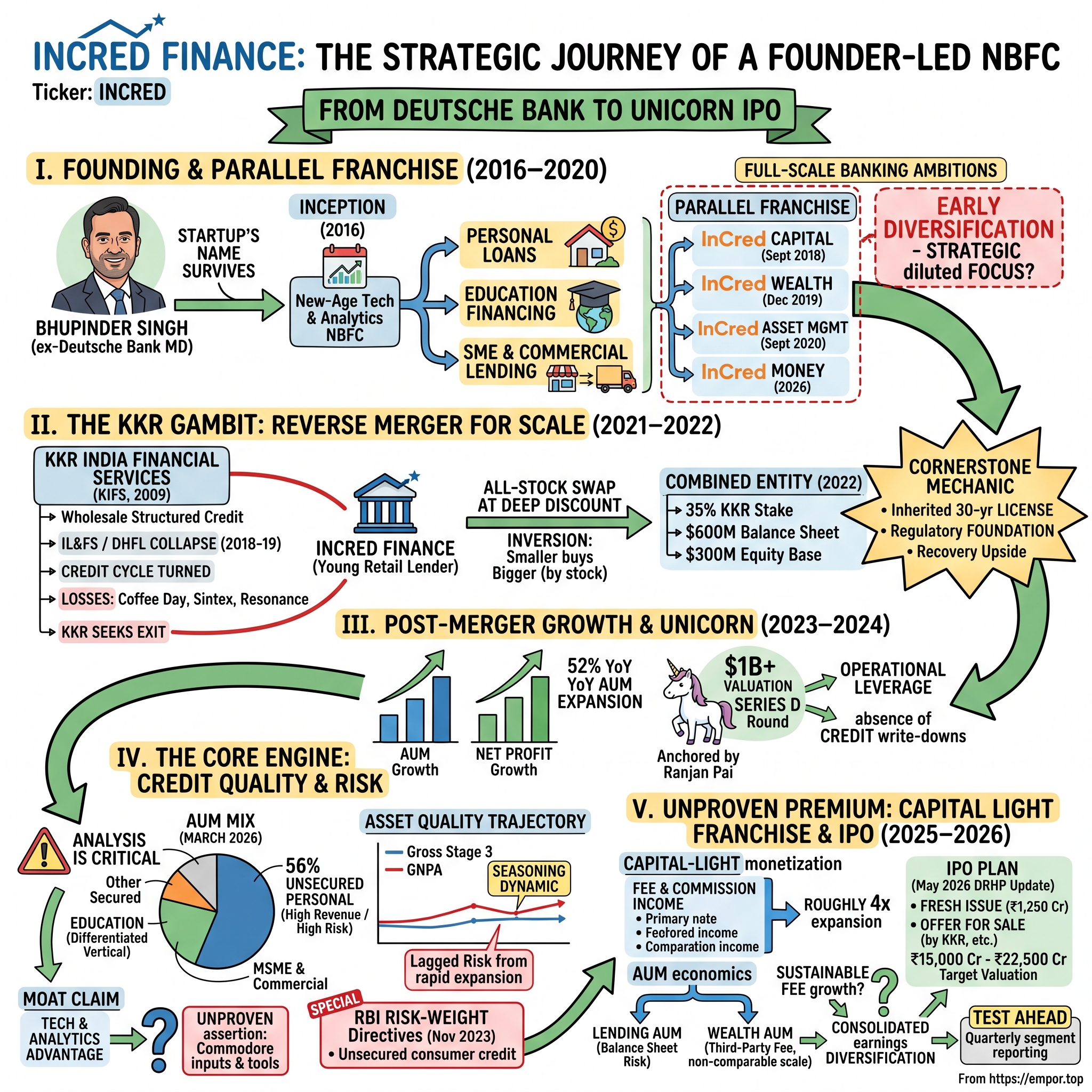
InCred Finance: The Deutsche Bank Banker Who Bought a Bigger Company With Stock
I. Introduction & Episode Roadmap
In July 2022, a five-year-old Indian lending startup completed a merger with a nearly thirty-year-old balance sheet backed by KKR — and the startup's name survived, its founder took charge of the combined enterprise, and the older entity's brand vanished from the signage.1 Corporate filings capture that inversion in a single telling phrase that still appears on credit ratings and regulatory records: "InCred Financial Services Limited, formerly KKR India Financial Services Limited."2 The younger, smaller platform took the operating identity; the older, institutional balance sheet supplied the non-bank financial licence, the equity base, and the legacy shareholders.
That reversal explains why InCred warrants close scrutiny four years later as it prepares to list on Indian stock exchanges. It represents a rare instance in modern Indian shadow banking where a founder-led startup acquired institutional scale through an equity swap rather than building it over decades — paying with its own stock at a moment when the private-equity sponsor was seeking an exit.
The resulting operating entity is a mid-sized non-banking financial company (NBFC) — a lender that cannot accept retail deposits under Indian financial regulations, funding its loan book instead through bank credit lines, bond markets, and equity capital.3 InCred deploys capital across three primary segments: unsecured personal loans, education financing for students in India and abroad, and secured and unsecured credit to small and medium-sized enterprises.4 Alongside the balance-sheet lender sits a less visible parallel franchise: InCred Capital, an institutional and wealth-management platform covering equity research and broking, investment banking, asset management, and, introduced in 2026, a dedicated wealth office for ultra-high-net-worth clients branded InCred Black.5
The broader group crossed a $1 billion private valuation in late 2023 in an equity funding round anchored by Ranjan Pai's Manipal Education and Medical Group.6 It secured further domestic backing in mid-2025 when Zerodha co-founders Nikhil and Nithin Kamath invested ₹250 crore ahead of the planned public issue.7 InCred filed a confidential draft red herring prospectus in November 2025, cleared the Securities and Exchange Board of India's review in February 2026, and filed an updated draft in May 2026 proposing a ₹1,250 crore fresh issue alongside an offer for sale led by KKR's investment vehicle.8 Reported target valuation ranges have clustered between ₹15,000 crore and ₹22,500 crore.9
Those figures reflect pricing expectations rather than intrinsic value. The analysis that follows evaluates the underlying business mechanics.
The roadmap traces how a former Deutsche Bank managing director in Singapore relocated to Mumbai to launch a credit business and immediately pursued a diversified financial conglomerate rather than a pure-play digital lending app; how the KKR transaction was structured and whether it demonstrates repeatable capital-allocation acumen or a singular, opportunistic trade; how the loan portfolio is constructed today and where it stands against entrenched competitors; whether the fee-generating capital markets business provides genuine diversification or strategic dilution; how executive equity ownership aligns managerial incentives; what the IPO structure signals for incoming public investors; and where the fundamental bull and bear cases truly diverge.
One initial caveat on disclosure: InCred has operated exclusively as a private, unlisted company. It lacks the continuous record of public quarterly earnings calls, historical guidance tracking, and audited analyst transcripts that allow investors to evaluate corporate disclosures across a full credit cycle. Available public information — credit rating rationales from ICRA, private equity transaction filings, and press summaries of draft regulatory documents — is narrower and naturally more curated than the statutory disclosures of an established listed institution.10 That information gap is itself analytical evidence: it means several critical operating assumptions can be framed and pressure-tested, but will remain open until the full prospectus becomes public.
 Subscribe on LinkedIn
II. Origins: Deutsche Bank to Day One (2016–2020)
Bhupinder Singh spent roughly sixteen years at Deutsche Bank, rising to managing director and co-head of corporate banking and securities for the Asia-Pacific region from Singapore after earning an MBA from IIM Ahmedabad.11 That background proved consequential: it explains strategic choices that look counterintuitive if InCred is viewed merely as a consumer fintech startup.
Most Indian lending startups of the 2015–2017 vintage began with a customer-facing product—a payday app, a point-of-sale instalment loan, or a merchant cash advance—and worked backward toward securing a balance sheet and an operating licence. Singh began with the institutional architecture and worked forward. Having spent his career where funding costs, rating agencies, regulatory capital, and wholesale banking relationships determine survival, he operated with a mental model distinct from growth-at-any-cost customer acquisition. That orientation shaped nearly every structural decision InCred subsequently made.
The founding thesis in 2016 was framed in the parlance of the era: a "new-age tech and analytics-driven NBFC" serving India's underbanked by treating credit as an analytics problem rather than purely a distribution problem.12 India then had a vast population with thin or nonexistent formal credit histories, rapidly improving credit bureaus, and a digital-identity and payments infrastructure poised to lower customer verification costs dramatically. The premise was straightforward: a lender starting fresh, with data analytics placed at the core rather than bolted onto a legacy branch network, could underwrite borrowers whom incumbent banks either overlooked or could not serve profitably.
It was a compelling pitch, but by 2016 it was also a crowded one. Nearly every emerging NBFC and lending fintech in India presented a version of the same claim in almost identical terms. That proliferation warrants treating any asserted "analytics edge" with caution—an issue this analysis examines in detail, as it represents the most critical assumption supporting any case for InCred commanding a valuation premium over peers.
What InCred secured early was institutional credibility. The company attracted prominent backers in its first year, an achievement that operates as a direct funding-cost input for an NBFC rather than a vanity metric, because the composition of an equity cap table heavily influences wholesale borrowing costs.13 In 2017, InCred signed former Indian cricket captain Rahul Dravid as brand ambassador.14 While celebrity endorsements in consumer businesses are often superficial marketing exercises, in retail credit trust functions almost as an underwriting feature. Borrowers submitting financial records and identity documents through digital channels face high perceived risk; Dravid, whose public profile in India was synonymous with dependability and restraint, offered a reassuring signal in an era when digital lending was plagued by headlines over aggressive collections and predatory apps. It was an effective branding measure rather than an enduring competitive moat—competitors could readily enlist rival sports figures—yet it represented an efficient acquisition of consumer legitimacy.
The more revealing pattern from this initial period was the institutional machinery Singh assembled alongside the core lender, and how early he did so. InCred Capital, the institutional equities and investment-banking arm, was launched in September 2018—in just the second year of operations, well before the credit book had achieved the scale typically required to justify an institutional affiliate.15 InCred Wealth followed in December 2019, and InCred Asset Management in September 2020.16 Singh stated publicly in a 2021 interview that the group harboured full-scale banking ambitions—not merely an intent to expand the loan book, but an explicit goal to construct a comprehensive institutional franchise.17
That progression reflected deliberate strategy rather than opportunistic diversification: Singh was constructing a diversified financial-services group almost from inception. The core assumption underlying that approach was that a conglomerate spanning balance-sheet lending, wealth management, and capital markets—sharing brand equity, corporate infrastructure, and institutional relationships—would command greater long-term value than a monoline lender of equivalent balance-sheet scale. While commercially defensible, that structure complicates institutional valuation and raises legitimate governance questions regarding whether multi-segment expansion diluted executive focus during the formative phase when credit underwriting discipline needed to be established.
Hard financial metrics from this period remain sparse. InCred operated as a private, pre-merger entity outside statutory public reporting obligations, leaving little beyond funding announcements to evaluate. This early phase therefore serves as narrative context rather than an audited operational record, providing limited empirical basis for standalone valuation models. What it does establish is managerial character: a founder who prioritized balance sheets, regulatory capital, and institutional architecture from the outset. That disposition set the stage for the transformative transaction that followed.
III. The KKR Gambit: A Reverse Merger for Scale (2021–2022)
Understanding what InCred acquired requires examining what went wrong at the other end of the transaction.
KKR India Financial Services (KIFS) launched in 2009 as the Indian structured-credit arm of one of the world's largest private-equity firms.18 Its business model was wholesale: large, bespoke, often promoter-financed loans to substantial Indian corporations—the variety of credit that generates high headline yields alongside concentrated single-borrower risk. For much of the 2010s, the model generated steady returns. Then India's credit cycle turned.
The collapse of Infrastructure Leasing & Financial Services (IL&FS) in 2018, followed shortly by Dewan Housing Finance Corporation (DHFL), triggered an Indian liquidity crunch comparable to the 2008 wholesale funding freeze in Western markets. Short-term commercial paper and bank credit lines dried up for lenders holding illiquid long-term assets, penalizing institutions that had funded long-tenor corporate loans with short-term wholesale debt. Wholesale non-banking financial companies suffered disproportionately because their loan tickets were large, client concentration was acute, and underlying security often took years of court proceedings to enforce.
By 2021, KIFS was bearing the brunt of that downturn. Its loan book held soured exposures to cafe chain Coffee Day Enterprises, textile and auto-parts manufacturer Sintex, and test-preparation company Resonance Eduventures; cumulative write-offs of roughly $141.5 million and gross non-performing assets near 6% reflected the balance-sheet damage.19 For KKR, an asset manager whose franchise depends on returning capital to fund investors cleanly, the Indian lending subsidiary had evolved from a high-yield growth platform into an operational distraction.
InCred presented the inverse profile: retail-oriented, growing rapidly, but constrained by regulatory vintage and equity capital.
The transaction, announced in 2021 and concluded in July 2022, brought the two balance sheets together.20 Structured as an all-stock merger rather than a cash acquisition, the transaction created a combined entity with roughly a $600 million balance sheet and a $300 million equity base. KKR, the Teacher Retirement System of Texas, and the Abu Dhabi Investment Authority held a collective 35% stake in the merged operating business.21 InCred's management took operational control and retained the InCred branding, even though KIFS was the legally larger, older, and directly RBI-licensed institution.22
The standard question in corporate M&A is whether the acquirer paid too much. In this case, the question reverses: InCred appears to have secured institutional scale at a deep cyclical discount, an outcome that forms the cornerstone of the management bull thesis.
First, InCred paid with stock rather than cash, avoiding the depletion of lending liquidity. For a non-bank lender, cash is raw inventory; committing liquid reserves to an acquisition immediately curbs loan disbursement capacity. Issuing unlisted equity at a buoyant private valuation in exchange for discounted wholesale credit assets represented an advantageous currency trade.
Second, the inherited loan book had already endured severe impairment recognition. The $141.5 million in write-offs were absorbed before InCred assumed control.23 Taking over a credit portfolio following aggressive provisioning shifts the recovery upside to the acquirer. Any subsequent recoveries KIFS secured on accounts like Coffee Day, Sintex, or Resonance flowed directly to the merged entity against carrying values that had already factored in the losses.
Third, and most structurally valuable, InCred secured a decades-old RBI NBFC registration and a substantial regulatory equity foundation.24 In India, an NBFC licence with decades of continuous operating history cannot be acquired off the shelf or formed rapidly, particularly as the Reserve Bank has tightened non-bank registration criteria. Balance-sheet equity is equally critical: an NBFC's borrowing limits and bond yields are tied to its net worth and credit ratings. An equity cushion of $300 million opens wholesale borrowing windows and credit pricing inaccessible to an earlier-stage lender, directly improving lending margins. In a single equity transaction, InCred obtained the balance-sheet stature that would have otherwise required multiple private equity rounds and years of internal profit accrual.
Viewed against historical base rates, the transaction was shrewd rather than unprecedented. The liquidity strains between 2018 and 2021 prompted widespread consolidation across Indian shadow banking: capital-constrained lenders yielded equity control in exchange for liquidity, while distressed sponsors agreed to merger terms they would have rejected in earlier years. InCred's arrangement was distinctive because the smaller retail operator preserved its brand and executive control while the institutional seller supplied the licence and balance-sheet equity. Yet the opening itself was cyclical, available to well-positioned management teams with unencumbered platforms; timing and institutional credibility were the deciding factors, and Singh possessed both.
The merger serves as the principal evidence supporting the view that InCred's leadership exercises superior capital-allocation discipline.
The confirming record is clear. InCred integrated the inherited wholesale book ahead of internal schedules, and consolidated financial results accelerated in the subsequent two fiscal years: net profit climbed from ₹120.9 crore in FY23 to ₹316.3 crore in FY24, while assets under management expanded 52% year-on-year to ₹9,039 crore by March 2024.25 If the merger had simply inflated headline assets, book growth would have diluted return metrics; instead, operating earnings grew alongside loan balances. The restructuring did not cause protracted operational disruption, and credit rating filings have not indicated unexpected credit-loss spillovers from the acquired book.
The disconfirming evidence is structural rather than negative. The KIFS merger remains the sole corporate acquisition InCred has executed. All other group operations—InCred Capital, Wealth, Money, Asset Management, and the InCred Black wealth office—were established organically from the ground up.26 Investors lack a second transaction to confirm whether Singh's execution reflected a repeatable programmatic M&A capability or a single, opportunistic trade captured during an extraordinary period of market distress.
The balanced takeaway is that the KKR transaction represented well-timed, disciplined opportunism by an executive equipped by sixteen years of institutional banking experience to price distressed corporate debt. However, a single successful transaction represents an isolated proof point rather than an established capital-allocation playbook. That distinction is pivotal for public equity pricing, where valuation multiples depend on whether strategic execution can be replicated systematically.
The definitive test will be whether InCred executes a subsequent acquisition or deliberately chooses to bypass one. Following its public listing, investors will need to observe whether management deploys its liquid public equity with comparable discipline—or whether public-market currency encourages the dilutive, scale-seeking acquisitions that have periodically impaired newly listed Indian financial institutions.
IV. From Merger to Unicorn (2023–2024)
The two years following the close of the merger represent the strongest operational stretch in InCred's corporate history, but the underlying drivers behind that performance require careful dissection.
Assets under management reached ₹9,039 crore by the end of fiscal 2024, a 52% expansion year-on-year.27 Consolidated net profit more than doubled over the same period, climbing from ₹120.9 crore in FY23 to ₹316.3 crore in FY24.28 That momentum carried into the following fiscal year, with the loan book reaching ₹12,384 crore by March 2025, an increase of 37%.29
In lending, net profit growth is a far more revealing health metric than top-line asset growth. Any non-bank lender can expand its loan book quickly; borrower demand is rarely the bottleneck, whereas institutional risk tolerance is. When a loan book expands by 50% while net profit rises by only 10%, the growth has typically been bought by sacrificing lending spreads or consumed by rising delinquency provisions. By contrast, an asset book expanding 52% alongside a 162% surge in net earnings points to genuine operating leverage: fixed investments in digital architecture, regulatory compliance, risk infrastructure, and executive overhead spread across a substantially larger earning asset base. Critically, it also reflects the absence of major new credit write-downs eating into incremental revenue.
That operational surge, however, requires the same caution that applies across any young credit platform: reported profit in lending is as much a function of provisioning discretion as it is of cash economics. Provisions on a rapidly expanding portfolio are forward-looking estimates set against loans that have not yet had time to season through an economic downturn. Rapid balance-sheet growth mechanically flatters short-term profitability because the denominator—the expanding volume of freshly disbursed, performing loans—grows faster than delinquent loans in the numerator can physically default. This does not imply aggressive accounting; it is a mathematical reality common to every fast-growing lender, and it explains why the asset-quality trajectory examined in the next section carries far more analytical weight than the net profit trend.
In late 2023, InCred Holdings crossed the private unicorn threshold, securing a valuation of roughly $1.04 billion in a Series D round anchored by Ranjan Pai's Manipal Education and Medical Group, with a commitment to raise approximately ₹500 crore.30 The strategic identity of that lead investor is more informative than the headline valuation. Pai's business empire spans healthcare and higher education—the latter directly aligned with InCred's student lending vertical, which finances attendees at the very types of domestic and overseas institutions Manipal operates. Backing from an industry-adjacent sponsor possessing first-hand exposure to the underlying borrower demographic represents a different signal than a paper markup from a generalist venture fund during a buoyant market cycle. While not definitive proof of underwriting resilience, it provides tangible evidence that a capital allocator familiar with education credit risk was willing to underwrite the platform's equity.
Yet private unicorn valuations must be interpreted with analytical discipline, particularly ahead of a public listing. A $1.04 billion post-money figure in a Series D financing simply marks the price at which a specific class of preferred shares was exchanged on negotiated terms on a specific date. It is not an objective assessment of enterprise value, nor does it translate directly to a public market capitalization. Public reporting surrounding the round disclosed the headline valuation and the approximate capital raised, but left undisclosed any liquidation preferences, participation rights, anti-dilution ratchets, conversion ratios, or bespoke side letters.31 Those legal provisions are integral to pricing. A preferred share carrying senior liquidation preferences and full-ratchet protections possesses materially greater economic value than an ordinary common share, because it conveys downside safeguards that common equity holders do not share. In private venture rounds, headline valuations frequently extrapolate the price paid for a protected instrument across an unprotected capital structure.
In practical terms, the valuation step-up from roughly $1.04 billion in late 2023 to the reported ₹15,000 crore to ₹22,500 crore IPO target range in 2026 does not cleanly represent a two- to three-fold expansion in corporate value.32 A portion of that repricing reflects the retirement of the preferred-share preference stack upon conversion into common equity at listing; another portion captures real operational scaling, as the loan book roughly doubled over that span; and the remainder reflects the spread between a privately negotiated structured round and a marketed public issue. In the absence of disclosed conversion covenants, disaggregating those components with complete precision is impossible from public records alone. Acknowledging that structural opacity provides a firmer analytical foundation than relying on speculative estimates.
Prior to its public filing, InCred accumulated roughly $320 million in total primary capital across thirteen funding rounds and approximately 130 distinct investors.33 That cumulative financing history highlights two structural realities. First, InCred's expansion has been an equity-intensive undertaking. Because non-bank lenders operate under strict regulatory leverage caps, each incremental rupee of loan assets must be supported by proportionate net worth, requiring management to finance balance-sheet scale by repeatedly selling equity. Second, thirteen financing rounds distributed across 130 backers create an unusually fragmented cap table. That dispersion carries direct consequences for executive voting control and creates a wide pool of pre-IPO investors seeking liquidity upon listing—governance dynamics examined in Section VII.
V. The Core Engine: Lending Segments, Competitors, and Credit Quality
The corporate maneuvers and funding milestones described so far serve as prologue to the question that determines whether InCred is a durable credit institution: does it underwrite well?
The segment map, and who actually drives the P&L.
Personal credit forms the core of the balance sheet by a considerable distance. These unsecured loans, ranging from roughly ₹50,000 to ₹15 lakh, represented 56% of assets under management as of March 2026, carrying an average tenure of approximately four years.34 Unsecured lending carries no pledged collateral: if a borrower defaults, the institution possesses legal claims and recovery workflows rather than an underlying asset to liquidate. Consequently, this vertical generates the bulk of operating revenue alongside, by design, the vast majority of balance-sheet risk.
Education loans represent InCred's most differentiated vertical, extending facilities from ₹2 lakh to ₹100 lakh across domestic and overseas study, with more than 12,000 students financed to date.35 Education credit exhibits an atypical risk profile. Underwriting is extended to applicants with negligible current earnings against prospective cash flows that hinge on academic institutional quality, degree employability, and, for overseas programs, foreign immigration regimes and post-study labor markets. Loan tenures are correspondingly long. The underwriting inquiry centers less on immediate debt-service capacity than on post-graduation employability—evaluating institutional caliber rather than standard credit bureau metrics.
SME and commercial lending spans ₹1 lakh to ₹20 crore in working capital and term loans, extended through digital MSME originations and embedded-financing distribution.36 Ancillary lines encompass secured loans against property, school financing, and wholesale credit extended to partner financial institutions through co-lending and on-lending arrangements.37
That last category warrants analytical attention. Co-lending and on-lending structures—where a non-bank lender originates credit jointly with, or lends wholesale to, another financial intermediary—offer a capital-efficient mechanism to expand loan balances, but they interpose an external party between the principal balance sheet and the ultimate obligor. Credit quality becomes partially dependent on the partner's origination and monitoring standards. While these arrangements constitute a modest portion of InCred's book, indirect exposures represent the channel where asset-quality distress in Indian shadow banking has historically surfaced with a lag.
The competitive landscape, named and sized.
In personal and consumer credit, the primary listed comparisons are Bajaj Finance and Poonawalla Fincorp. Bajaj Finance operates as the scale benchmark in Indian consumer lending, anchored by an exponentially larger balance sheet, an omnichannel distribution footprint spanning consumer durables to home loans, and a decisively lower wholesale borrowing cost derived from its size and top-tier credit ratings. For its part, Poonawalla Fincorp has articulated a technology-led underwriting strategy, including a collaboration with IIT Bombay announced in 2025.38 InCred operates at a fraction of either competitor's scale.
Wholesale funding costs compound relentlessly across balance-sheet lending. A non-bank lender's gross margin is fundamentally the spread between customer lending yields and wholesale borrowing expenses, reduced by credit write-downs and operating overhead. A dominant peer funding its balance sheet 100 to 150 basis points cheaper can either underprice smaller rivals while protecting identical margins or generate substantially higher returns at equivalent borrower pricing. That funding advantage is structural, tied directly to institutional size and credit ratings, and it does not erode simply through proprietary software.
In education financing, InCred faces specialized non-bank competitors including HDFC Credila, Avanse Financial Services, and Auxilo Finserve, all contesting the ₹20 lakh to ₹1 crore study-abroad segment.39 The specialist non-bank value proposition—rapid turnaround times, up to 100% financing coverage, and unsecured terms requiring neither collateral nor family margin money—delivers a tangible product advantage over traditional banking alternatives. Yet public-sector banks still command roughly 48% of study-abroad loan volume.40 That market share is the single most instructive statistic about the competitive reality: even when non-bank lenders offer superior digital velocity and broader coverage, state-owned banks remain the default choice for nearly half the market because their borrowing costs are lower and retail households committing to generational education outlays gravitate to institutions perceived as safe. The non-bank opportunity is expanding, but private players are contesting market share against incumbents whose core moats are price and public trust rather than product design.
In MSME credit, Tata Capital—operating at vastly greater scale with a physical branch network exceeding 1,500 locations—and digital specialist Lendingkart serve as primary comparisons in collateral-free small-business lending.41 Branch networks remain far more consequential in commercial credit than in consumer finance, because small-business underwriting still requires direct inspection of commercial premises, operating inventory, and proprietor character.
What this does to the moat claim.
InCred's central assertion is that it operates as a "tech and analytics-driven" lender.42 Evaluating that claim against available operating disclosures leads to an uncomfortable finding: public data does not demonstrate that InCred's credit-loss rates or loan approval speeds are structurally superior to the digital-underwriting operations of Bajaj Finance or Poonawalla Fincorp. They are not shown to be worse; they are simply unproven to be better.
This distinction matters because of the precise conditions under which an analytical edge creates economic value. A genuine underwriting advantage manifests in one of two ways: maintaining an identical loss rate at a higher approval rate by extending credit to viable borrowers whom competitors incorrectly turn down, or sustaining a lower loss rate at an equivalent approval rate by correctly screening out applicants that competitors accept. Over time, that capability appears as lower credit costs relative to portfolio yield, sustained across a full economic cycle and benchmarked against peers. Because InCred has operated as an unlisted company without public quarterly reporting, comparative data across a full credit cycle does not exist in available disclosures.
Meanwhile, digital origination and app-based onboarding have become baseline operational requirements across the sector. Every major Indian retail lender now originates digitally; credit-bureau records, automated bank-statement analysis, and Account Aggregator data streams are accessible to every market participant through uniform digital public infrastructure. Poonawalla's partnership with IIT Bombay reflects the same technology narrative deployed across a larger balance sheet.43 When underwriting inputs are commoditized and analytical tooling can be licensed off the shelf, an enduring edge must stem from proprietary data, captive distribution channels, or sustained institutional underwriting judgment—none of which is decisively demonstrated in InCred's historical disclosures.
The analytically disciplined treatment is to view the analytics advantage as an unproven management assertion rather than an established structural moat, evaluating InCred as a capable, fast-growing lender in an intensely competitive market. If a structural underwriting edge exists, it will become visible across the initial four to eight quarters of statutory credit-cost reporting benchmarked against listed peers. That marks the specific falsification test awaiting the company after listing.
Asset quality: the disconfirming evidence, placed where it belongs.
Gross Stage 3 assets—the accounting classification designating loans where credit has deteriorated significantly, representing the primary impaired bucket—rose from 1.9% in March 2025 to 2.1% in March 2026.44 Similarly, gross non-performing assets edged up from 2.05% in December 2024 to 2.28% in December 2025.45
In absolute terms, these figures remain moderate. An Indian retail lender operating with gross impairment around 2% is far from distressed; several established institutions absorb higher delinquency ratios. The analytical concern lies not in the absolute level, but in the upward trajectory when evaluated alongside rating-agency commentary regarding delayed portfolio seasoning.
Rating rationales from ICRA flag that rapid balance-sheet expansion has constrained portfolio seasoning, particularly in longer-tenure products such as student loans and secured loans against property carrying tenures of nine to sixteen years that have not yet traversed a full credit cycle.46 Seasoning describes a fundamental dynamic in retail lending: newly originated loans rarely default during their initial payment cycles. A loan book compounding at 37% to 50% annually is structurally dominated by fresh vintages that have not yet reached peak delinquency windows. Reported impairment ratios on such portfolios are inherently flattered by an asset base skewed young. When balance-sheet growth eventually normalizes, existing cohorts age, and impairment ratios rise mechanically even if underlying underwriting quality remains unchanged.
That seasoning dynamic interacts directly with portfolio concentration. Unsecured personal lending accounts for 56% of total assets under management.47 The segment that has grown fastest is also the vertical carrying the highest loss-given-default profile during an economic downturn, and its headline impairment trend is drifting upward from a low initial base. While none of these individual factors indicates acute distress, together they mirror the classic pattern through which rapid retail credit expansion conceals emergent stress: rapid balance-sheet growth dilutes immediate delinquency metrics, while credit losses emerge two to three years later as legacy vintages season.
This dynamic does not signify poor underwriting execution. Rather, it indicates that current asset-quality metrics offer an incomplete picture of terminal credit risk, making vintage seasoning the single most important operational indicator for public equity investors to track.
The regulatory mechanism, named explicitly.
In November 2023, the Reserve Bank of India raised risk weights on unsecured consumer credit from 100% to 125% for both commercial banks and non-banking financial companies, while explicitly carving out housing, education, vehicle, and gold loans.48 In practical terms, lenders must now hold 25% more regulatory capital against each rupee of unsecured personal loans. Because return on equity measures net earnings against required capital, higher risk weights directly compress the return profile of unsecured lending—elevating the regulatory capital cost of the exact asset class that constitutes 56% of InCred's book.
Two strategic consequences follow. First, credit expansion across unsecured consumer lending has moderated industry-wide following the directive, fulfilling the central bank's regulatory objective.49 Second, the carve-outs reorder product economics: because education financing was excluded from the risk-weight increase, InCred's student lending vertical operates with superior capital efficiency relative to its personal-loan book on a regulatory basis. That differential provides a structural incentive to expand the education portfolio faster than the existing asset mix would otherwise indicate.
Concurrently, the Reserve Bank's 2022 Digital Lending Guidelines established strict underwriting accountability and third-party outsourcing regulations governing the app-based origination model InCred relies on. Under these rules, a regulated lender retains sole accountability for partner conduct and borrower underwriting, restricting how non-banks structure embedded-finance partnerships and digital co-origination alliances.
The net read. The core lending operation is real, rapidly expanding, and genuinely profitable. Yet it competes against larger, better-funded incumbents that enjoy lower funding costs, extensive physical distribution, and no demonstrated underwriting disadvantage. Headline asset-quality metrics are drifting upward from a low baseline in the firm's most concentrated and vulnerable credit segment, precisely as macroprudential regulations have made that vertical structurally more capital-intensive. The result is a capable business navigating intense competitive pressures rather than a structurally insulated franchise.
VI. The Second Business: Capital Markets, Wealth, and the UHNW Bet
In financial analysis of non-bank lenders, non-lending subsidiaries are frequently treated as peripheral sidecars. For InCred, however, that dismissal overlooks a rapidly emerging revenue contributor.
Group-level fee and commission income expanded roughly fourfold year-on-year to ₹137 crore in FY25, measured against consolidated group net profit of ₹372 crore.50 While gross fee income precedes the operational expenses required to generate it, an auxiliary revenue stream expanding at that velocity against a net profit base of that scale is no longer an accounting rounding error. It marks the transition of a diversification strategy from pitch-deck narrative into audited financial materiality.
The reported scale metrics reach further still. InCred Capital administers approximately $11.5 billion in assets across institutional equities, wealth advisory, and investment-banking operations.51 InCred Wealth separately crossed ₹1 lakh crore—north of $10 billion—in assets under management within six years of its December 2019 launch.52
Those headline figures demand analytical distinction, because "assets under management" in wealth advisory represents a fundamentally different economic concept than loan AUM, and conflating the two obscures business reality. A rupee of lending AUM sits directly on the institution's balance sheet, funded through borrowings and equity capital, generating a net interest margin while bearing direct credit default risk. By contrast, a rupee of wealth AUM represents third-party client capital that the institution advises or administers, generating fee income measured in basis points without carrying balance-sheet credit exposure. Consequently, a ₹1 lakh crore wealth portfolio and a ₹12,384 crore credit book are economically non-comparable: the wealth book is substantially larger in aggregate volume, but yields far less revenue per rupee. Furthermore, wealth assets at Indian intermediaries frequently encompass low-margin custody and execution-only mandates with thin realization rates, and available public disclosures do not disaggregate blended revenue yields across these asset pools.53
The rigorous framing, therefore, separates headline volume from cash economics: the wealth and capital-markets arm has accumulated significant client assets under a metric that is only loosely correlated with top-line revenue, while separately delivering fee income that is both financially material and expanding rapidly. The second metric reflects operational monetization; the first simply provides the platform scale that makes that fee velocity credible.
The strategic rationale behind this parallel structure is direct. Balance-sheet lending is inherently capital-intensive: expanding a loan book requires proportionate wholesale funding and statutory equity reserves, meaning asset growth continually absorbs shareholder equity. That dynamic explains why InCred required thirteen primary funding rounds to reach its current lending scale. Wealth management and advisory services operate under inverse economics: onboarding an incremental relationship manager or winning an advisory mandate requires negligible balance-sheet capital, allowing additional fee income to convert at high operating margins once fixed overhead is absorbed. A financial institution that expands capital-light fee income faster than balance-sheet credit becomes progressively less dependent on dilutive equity financing and more cash-generative. For an institution approaching public markets to finance loan expansion, this counter-cyclical fee engine represents a crucial valuation dynamic.
In August 2026, InCred Capital introduced InCred Black, a dedicated wealth office for ultra-high-net-worth clients offering asset allocation, alternative assets, private markets, credit structuring, and global investment access to entrepreneurs and family offices.54 Operating for barely a month, the platform offers virtually no empirical track record yet.
Applying consistent analytical discipline, a product launch does not constitute revenue. Ultra-high-net-worth wealth advisory in India represents an attractive economic niche—characterized by higher fee realization, sticky advisory relationships, and long client tenures—but it remains fiercely contested by established domestic private banks, global wealth managers, and well-capitalized boutique advisory firms. Furthermore, client loyalty in ultra-high-net-worth advisory often adheres to individual relationship managers rather than corporate platforms, meaning client rosters frequently migrate when bankers change institutions. InCred Black represents plausible future optionality, but it remains unproven at scale and provides negligible empirical support for current valuation multiples beyond signaling management's intent to allocate resources toward capital-light, higher-margin financial services.
The structural thesis centers on how financial markets categorize corporate earnings. Monoline balance-sheet lenders are conventionally valued on price-to-book multiples and return on equity, because their net earnings are strictly bounded by regulatory capital and balance-sheet capacity. Diversified financial conglomerates with sizeable fee-generating franchises typically command higher price-to-earnings multiples, reflecting earnings streams that do not consume balance-sheet equity as they grow. The valuation spread between those two methodologies is substantial. Public markets that perceive InCred's fee engine as durable and institutionalized would price the group at a premium relative to peers viewed strictly as balance-sheet lenders with auxiliary advisory desks.
That prospective re-rating constitutes the principal upside optionality embedded in the equity story. Yet it currently rests on a single fiscal year of fourfold fee expansion from a low initial baseline—a data point that enlivens an investment thesis but provides limited statistical comfort. The decisive test following the public listing will be whether fee and commission income continues outstripping balance-sheet net interest income across four to eight consecutive quarters of audited segment reporting. Sustained execution across that timeframe would substantiate management's diversification thesis; until then, it remains an unproven valuation premium.
VII. Management, Ownership, and Capital Allocation
Bhupinder Singh serves as Founder, Whole-time Director, and Group CEO, holding roughly 0.75% of InCred Holdings, while the broader promoter group controls about 21%.55
That first figure warrants close examination rather than casual dismissal. A founder who established the business in 2016, orchestrated the reverse merger that transformed it, and remains the defining executive behind the franchise holds well under one percent of its direct economics. The historical financing mechanics—thirteen funding rounds and roughly $320 million of equity raised—explain how that dilution occurred: compounding share sales across a decade of balance-sheet expansion reflect standard capital requirements rather than managerial failure, an arithmetic reality familiar to founders of balance-sheet lenders who lack the personal resources to participate pro rata in successive funding rounds.56
Yet explanation is not the same as structural alignment. Incentive alignment in lending operates over a far longer horizon than in software or consumer internet, because the true cost of an underwriting decision surfaces three to five years down the road. A founder-CEO holding a substantial equity stake internalizes the ultimate loss of a 2026 loan that defaults in 2030. By contrast, a chief executive holding 0.75% absorbs only a negligible fraction of that terminal loss while capturing immediate reputational prestige and executive compensation from near-term balance-sheet expansion. This distinction does not suggest InCred will recklessly chase loan growth at the expense of asset quality. Rather, it highlights that the ownership structure does not mechanically safeguard against that risk, presenting a structural governance question that public market investors must evaluate directly.
There are partial offsets to that dilution. InCred established an Employee Incentive Scheme in 2018, recording significant option exercises in FY23.57 Stock options can restore executive alignment, but they do so with a recognized structural bias: options are convex instruments, generating windfalls on equity appreciation while expiring worthless on downside distress. An executive compensated predominantly through call options is rewarded for volatility and rapid asset growth in a manner an equity-owning shareholder is not—an asymmetry ill-suited to the risk profile of a leveraged credit institution. Crucially, the strike prices, vesting schedules, and performance hurdles governing Singh's option grants remain undisclosed, while the promoter group's 21% stake is reported as an aggregate figure that obscures how much economic interest belongs to Singh versus allied corporate entities.58 Both details represent essential diligence items for the formal prospectus rather than settled governance arrangements.
Gaurav Maheshwari serves as Whole-time Director and CFO—the other named executive with disclosed governance responsibility.59 Beyond these two leadership roles, available public records disclose sparse detail regarding board composition, independent-director oversight, audit-committee autonomy, executive compensation structures, or formal conflict-of-interest policies. In a financial group operating balance-sheet lending alongside wealth management, institutional equities, and asset management under unified corporate control, conflict-of-interest architecture is a vital institutional safeguard: an institution that advises wealth clients while simultaneously originating credit faces inherent structural conflicts that require transparent governance firewalls. While nothing in the public record indicates regulatory impropriety or governance lapses, the absence of public criticism in private filings cannot be equated with institutional robustness. That disclosure void marks a key scrutiny item for the final prospectus and the initial quarters of public reporting, where regulatory silence should not be mistaken for structural assurance.
The capital-allocation record, honestly graded.
InCred's operational record rests on a single, well-timed, equity-funded acquisition that was swiftly integrated, followed by organic diversification: launching InCred Capital in 2018, InCred Wealth in 2019, InCred Asset Management in 2020, and subsequently InCred Money and InCred Black in 2026.60 Public disclosures reveal no evidence of abruptly terminated business lines, material write-downs tied to post-2016 originations, distress-driven down rounds, or structured rescue capital. The characteristic warning signs of a decade-old venture-backed platform—the quiet product pivot, the disguised flat round, or waves of senior executive departures—are noticeably absent from the historical record.
That favorable evaluation, however, requires two rigorous qualifications. First, the absence of negative headlines at a private, unlisted company carries materially less evidentiary weight than a clean record at a publicly listed institution; discontinued initiatives or internal recapitalizations at an unlisted non-bank lender rarely require statutory public disclosure. Second, while the group traces a ten-year corporate history, only the four post-merger years provide meaningful operational disclosure. InCred is an emerging financial institution with a single macroeconomic stress test behind it rather than a tenured track record of capital-allocation cycles. The assertion that management allocates capital with superior discipline survives scrutiny, but in a provisional form: it stands uncontradicted rather than empirically proven.
The dilution and cap-table reality.
Across thirteen financing rounds that accumulated approximately $320 million in primary capital, InCred assembled an institutional shareholder register featuring KKR, the Teacher Retirement System of Texas, ADIA, Investcorp, Oaks, Moore Capital, Elevar Equity, Paragon Partners, Ranjan Pai's Manipal vehicle, and most recently the Kamath brothers.61 When evaluating an impending public listing, the composition of that cap table matters as much as the operating performance of the founder.
Yet constructing a precise capitalization table from public records remains impossible, and analytical rigor requires stating what remains hidden rather than relying on speculative estimates. What the public record supports: a rough total of equity capital raised, a set of named holders, a founder stake of about 0.75%, a promoter-group stake of about 21%, and the existence of an employee option scheme since 2018.62 What public filings do not reveal is the fully diluted share count, the breakdown between common equity and distinct preferred classes, unallocated employee option reserves, convertible warrants or debt instruments, special voting covenants, or the conversion formulas governing how preferred instruments convert into ordinary equity upon listing.
That conversion mechanic represents the critical analytical variable. Any headline valuation derived from an initial offering price multiplied by a provisional share count remains purely indicative until statutory prospectuses disclose the fully diluted share base, complete with option dilution and preferred conversion ratios. That structural opacity reinforces why the reported ₹15,000 crore to ₹22,500 crore IPO target should be treated as a marketing range rather than an objective reflection of enterprise value.
Furthermore, overall corporate valuation and market float represent distinct economic forces that are routinely conflated in initial public offerings. The fresh issue of shares combined with the offer-for-sale component dictates the actual trading liquidity made available to the public, while the remaining equity remains locked up under private shareholder arrangements. A constrained public float against a substantial paper valuation can artificially sustain market pricing that a fully liquid secondary market might discount—a technical market dynamic that public-market investors must distinguish from intrinsic corporate value.
VIII. The Road to the Public Markets (2025–2026)
The timeline leading to InCred's planned initial public offering has progressed in an unusually orderly, methodical sequence.
In June 2025, the board approved an initial public offering plan. Around the same period, Zerodha co-founders Nikhil and Nithin Kamath invested ₹250 crore for a minority equity stake, with Nikhil Kamath framing the capital commitment as an endorsement of an Indian credit ecosystem becoming "more formal, more digital, more accessible."63 The Kamaths built India's largest retail brokerage without institutional capital and had little structural need to participate in late-stage private financings purely for financial returns. Their involvement functions primarily as a domestic credibility signal to retail investors who recognize the Zerodha brand far more readily than InCred's. A more skeptical interpretation is that a late pre-IPO cheque from prominent domestic entrepreneurs serves as a corporate marketing asset whose endorsement value to the issuer exceeds the nominal equity capital received. Both perspectives are valid simultaneously, and neither offers insight into underlying loan quality.
In November 2025, InCred Holdings filed a confidential draft red herring prospectus with the Securities and Exchange Board of India. Regulatory clearance followed in February 2026. In May 2026, the company filed an updated draft red herring prospectus proposing a ₹1,250 crore fresh issue alongside an offer for sale, with KKR India Financial Investments leading the secondary divestment at 4 crore shares, joined by MNI Ventures, Moore Strategic Ventures, and Dalmia Enterprises Holdings.64
The designated use of proceeds is straightforward: net capital from the fresh issue will be injected into the operating subsidiary, InCred Financial Services, to augment capital adequacy and finance balance-sheet lending growth.65 This capital allocation is designed to sustain existing lending operations rather than finance speculative acquisitions or unproven product ventures. For a regulated balance-sheet lender, that allocation aligns with standard capital management: equity serves as raw balance-sheet inventory, and the Reserve Bank of India's November 2023 risk-weight increase made each rupee of unsecured consumer credit structurally more capital-intensive. Yet that allocation also highlights an essential operational reality: an institution raising primary equity chiefly to sustain current loan disbursements is inherently capital-constrained, indicating that compounding balance-sheet growth at historical rates will inevitably demand recurring equity infusions. That requirement is fundamental to leveraged lending, and it reinforces why developing high-margin, capital-light fee streams remains strategically vital to the group.
The composition of the secondary offering warrants analytical context rather than an instinctive negative reaction. KKR's secondary sell-down aligns with the natural lifecycle of a private equity investment originating in a 2009 vintage platform. By 2026, that capital had been committed for well over a decade, and fund mandates require returning liquidity to limited partners. Interpreting that exit as an institutional vote of no confidence confuses fund lifecycle mechanics with fundamental business judgment. The more relevant structural details are that KKR opted for a partial sell-down rather than an outright exit, and that the transaction pairs secondary liquidity with a substantial primary capital raise—a customary, balanced structure for a maturing, institutional-backed enterprise rather than a distressed divestment.66
The reported target valuation range of ₹15,000 crore to ₹22,500 crore—roughly $1.8 billion to $2.6 billion—represents a substantial advance over the approximately $1.04 billion valuation recorded during the late-2023 funding round.67 Three analytical observations frame that figure. First, the range remains an indicative marketing band ahead of final book building rather than a transacted clearing price. Second, the breadth of that band—with the upper bound sitting 50% above the floor—indicates that institutional investors have not formed a consensus on how to value an enterprise that combines a balance-sheet credit book with an emerging fee-based franchise. Third, while a valuation expansion of this scale across three years is not inherently excessive given that the loan book roughly doubled and consolidated profits expanded significantly, public disclosures do not allow investors to isolate how much of that repricing reflects fundamental earnings growth, the retirement of private liquidation preferences upon equity conversion, or promotional positioning ahead of listing.
What the target range would have to embed.
Evaluating the economic assumptions embedded in that target range requires testing the business from two distinct valuation perspectives, neither of which yields definitive precision from unlisted disclosures.
The first perspective is intrinsic, and for a financial intermediary it must focus on equity rather than enterprise value. Because a non-bank lender's borrowings constitute operational inventory rather than surplus corporate leverage, enterprise-value bridges are economically uninformative, and comparing financial lenders using enterprise-value multiples represents a fundamental methodological error. The appropriate framework assesses sustainable return on equity against the firm's cost of capital: a lender commands a valuation above book value only if it earns returns on equity that exceed its cost of equity, and creates incremental economic value only to the extent it can redeploy retained earnings at that positive spread. Available public evidence supports the directional premise but lacks the granularity required for absolute pricing. Consolidated group net profit reached ₹372 crore in FY25, while FY26 performance showed revenue expanding 36% and net earnings rising 17%, supported by successive equity top-ups; however, public records do not provide an audited current net worth, segment-level return on equity, seasoning-adjusted credit costs, or a blended wholesale borrowing cost.68 Attempting a discounted-cash-flow or residual-income calculation without those baseline inputs would produce spurious mathematical precision. Directionally, an equity valuation between ₹15,000 crore and ₹22,500 crore against prevailing net earnings implies that public markets would be paying a sizeable premium to tangible book value for a lender exhibiting gross impairment just above 2% on an unseasoned, predominantly unsecured credit book. Sustaining that premium requires either that credit losses remain subdued as early vintages season, or that the capital-light fee and wealth businesses expand rapidly enough to generate an outsized share of group earnings. Those two operational variables represent the critical sensitivities governing post-listing equity performance.
The second perspective is comparative, which requires rigorous discipline regarding peer selection. The most direct operating benchmarks are domestic retail and SME lenders operating with comparable borrower profiles, unsecured concentrations, and wholesale liability structures—most notably Poonawalla Fincorp, Tata Capital across overlapping small-business credit, and specialized unlisted student-lending peers such as HDFC Credila, Avanse Financial Services, and Auxilo Finserve.69 Bajaj Finance serves as a scale benchmark and an aspirational industry leader rather than a direct pricing proxy: its balance-sheet magnitude, lower wholesale funding costs, physical distribution depth, and product breadth reflect a structurally different competitive tier, making the direct application of its trading multiples to InCred analytical overreach. Global digital lenders warrant complete exclusion given divergent regulatory environments, wholesale funding architectures, and credit reporting ecosystems. Similarly, recent Indian consumer-fintech listings reflect prevailing liquidity appetite within specific issuance windows rather than comparable lending economics. When comparative multiples are applied, analytical rigor requires pairing price-to-book ratios with return on equity, and price-to-earnings ratios with normalized earnings growth, while discarding revenue multiples entirely, as top-line figures in lending merely reflect gross interest collections.
Reconciling the intrinsic and comparative perspectives reveals that the target valuation range assumes InCred can maintain rapid balance-sheet expansion without experiencing an upward normalization in credit losses, while simultaneously growing fee income into a more prominent contributor to group profit. Secondary market pricing could exceed that baseline valuation for reasons detached from fundamental corporate value—such as the scarcity of publicly traded private-credit platforms, an artificially restricted free float, the prestige of institutional shareholders like KKR and the Kamath brothers, or broader market momentum surrounding initial public offerings.70 Conversely, the stock could clear below the marketing band if the unsecured consumer credit cycle softens before recent loan cohorts complete their seasoning cycle. Both dynamics reflect market-clearing pricing mechanics rather than the intrinsic value of the underlying loan assets.
A note on sources, because it governs everything that follows.
Because InCred has operated entirely as a private corporation, it lacks the multi-year archive of statutory quarterly earnings calls, transcribed analyst Q&A sessions, and historical forward-guidance tracking that investors typically rely on to evaluate managerial credibility across shifting credit cycles. The closest available analytical substitutes are credit rating rationales published by ICRA—which provide longitudinal asset-quality metrics and gearing commentary from an independent agency evaluated on credit assessment accuracy—alongside the risk-factor disclosures compiled in the draft red herring prospectus.71 While these institutional filings establish a credible baseline until formal quarterly reporting commences post-listing, they represent a narrower informational foundation than public market allocators conventionally demand prior to committing capital.
IX. Industry Structure: Five Forces and Durable Advantage
Strategy frameworks prove instructive in Indian shadow banking because the underlying industry mechanics produce unambiguous structural conclusions rather than academic checklists.
Rivalry is intense and compounding. Bajaj Finance, Poonawalla Fincorp, Tata Capital, and a long tail of digital lending platforms compete for the same digitally sourced borrowers using largely identical data inputs.72 In retail credit, rivalry takes a particularly insidious form: lenders compete by extending higher loan limits or accepting marginal credit profiles at prevailing interest rates, while the financial consequences remain concealed across two- to three-year vintage seasoning cycles. An intensely contested market characterized by delayed risk feedback allows every participant's headline metrics to appear pristine until loan cohorts mature and stress surfaces simultaneously across multiple balance sheets.
Threat of new entrants remains active, bounded primarily by capital and regulatory clearances rather than proprietary technology. Underwriting infrastructure is largely commoditized: credit bureau feeds, automated bank-statement analyzers, and Account Aggregator data streams are shared digital utilities available across the market. The genuine barriers to entry are assembling regulatory equity capital, securing an investment-grade credit rating that yields viable wholesale borrowing costs, and obtaining a non-banking financial company licence with decades of clean operating history—precisely the institutional assets InCred acquired through the KKR transaction rather than developing organically. That distinction contextualizes the merger: InCred's most durable balance-sheet foundations were bought, not built.
Supplier power rests with commercial banks, institutional bondholders, and credit rating agencies—and this represents the most decisive competitive force across non-bank finance. Because non-deposit-taking lenders cannot gather low-cost retail deposits, they procure their primary inventory—capital—from wholesale debt markets at prices determined almost entirely by credit ratings and balance-sheet scale.73 This dynamic grants top-tier incumbents a permanent, self-reinforcing cost-of-funds advantage that operational software cannot overcome. It also positions rating agencies as de facto arbiters of balance-sheet expansion: a one-notch downgrade immediately raises borrowing costs and can abruptly restrict debt-market access. Consequently, an institution's survival remains tethered to macroeconomic liquidity, as the 2018–2019 domestic liquidity squeeze demonstrated when wholesale funding channels seized up for solvent lenders alongside troubled ones.
Buyer power is fragmented among individual borrowers but intensifying in the aggregate. Rate-comparison aggregators, fintech marketplaces, and transparent digital onboarding have made consumer lending terms increasingly legible, steadily eroding pricing power on standard personal loans. As borrower price sensitivity increases, competitive advantage shifts decisively toward the lowest-cost balance sheets.
Regulatory power functions as a commanding external force in Indian credit, exerting an influence substantial enough to warrant treatment as a primary structural pillar. When the Reserve Bank of India raised risk weights on unsecured consumer loans in November 2023, the administrative directive unilaterally compressed the return on regulatory capital across 56% of InCred's loan book overnight.74 Similarly, the central bank's 2022 Digital Lending Guidelines reshaped third-party origination and embedded-finance distribution models across the sector. Operational agility offers little insulation from regulatory mandates that can reset unit economics with a single circular.
Through the 7 Powers lens, the structural diagnosis is concise. Scale economies tilt heavily toward Bajaj Finance by an order of magnitude, translating into unmatched distribution density and wholesale borrowing spreads. Brand—whether bolstered by the Rahul Dravid endorsement or general retail recognition—functions as a valuable marketing asset rather than an unassailable cornered resource, easily countered by competitor ad campaigns. Switching costs for retail borrowers are virtually nonexistent, as personal loans are readily refinanced whenever a cheaper facility appears. Network effects are absent across balance-sheet lending, operating only marginally within wealth management and institutional advisory where client referral loops can compound. Counter-positioning against traditional commercial banks—delivering superior digital speed, flexible underwriting, and a willingness to serve overlooked borrowers—served as an effective early wedge. However, counter-positioning sustains an enduring moat only when incumbents cannot match the challenger without undermining their core operations; India's commercial banks and large non-banks are actively investing in digital origination and matching turnaround times without compromising their legacy franchises.
The analytical conclusion is direct: InCred's operational success stems from executive agility, sharp transaction timing, and rapid capital deployment rather than an unassailable structural moat. That assessment does not minimize what management has built. Highly profitable financial institutions are regularly constructed on superior execution, and disciplined operators can outperform larger incumbents across extended phases of industry expansion. However, it indicates that public markets should not award InCred the premium multiples conventionally reserved for businesses insulated by structural competitive barriers. Ultimately, an investment case must rest on managerial execution and broader credit market expansion rather than on an impregnable competitive fortress.
X. Bull Case, Bear Case, and the Trust Test
The bull case rests on operational integration rather than financial engineering. InCred absorbed a much larger, distressed wholesale balance sheet from a global private-equity sponsor and turned it rapidly profitable, with consolidated net profit rising from ₹120.9 crore in FY23 to ₹316.3 crore in FY24 alongside a 52% expansion in assets under management.75 In a shadow-banking sector where inorganic acquisitions frequently create prolonged asset-quality drag, that turnaround provides tangible evidence of operating execution rather than merely an opportunistic balance-sheet trade.
Second, the parallel capital markets and advisory franchise provides counter-cyclical, capital-light earnings. The fee-generating network—spanning InCred Capital, Wealth, Money, Asset Management, and the newly introduced InCred Black—is expanding faster than the loan book, with fee and commission income surging roughly fourfold to ₹137 crore in FY25.76 If that growth trajectory compounds, it fundamentally alters the group's financial mechanics, reducing its dependence on dilutive primary equity rounds and justifying an earnings multiple closer to a diversified financial conglomerate than a monoline balance-sheet lender.
Third, the shareholder register provides an informed institutional signal. KKR opting to retain a substantial equity stake through the public offering rather than executing an outright exit, alongside the Abu Dhabi Investment Authority, the Teacher Retirement System of Texas, Investcorp, and Manipal's Ranjan Pai, represents a group of sophisticated capital allocators who have evaluated internal financials for years and elected to retain substantial equity positions.77 The Kamath brothers' ₹250 crore pre-IPO commitment reinforces that domestic institutional backing.78 Moreover, Bhupinder Singh's sixteen years in institutional banking and debt markets directly match the defining bottleneck for a non-bank lender: managing wholesale funding costs, rating agencies, and capital adequacy.79 Above all, operating earnings have expanded in step with loan disbursements rather than being inflated by young, unseasoned vintages—distinguishing InCred from several digital lending peers of the same vintage.
The bear case does not simply invert the positive thesis; it rests on separate, structural vulnerabilities.
First, asset quality is drifting upward in the firm's most vulnerable vertical. Gross Stage 3 assets edged upward from 1.9% in March 2025 to 2.1% in March 2026, while gross non-performing assets rose from 2.05% in December 2024 to 2.28% in December 2025—drift occurring within an unseasoned portfolio where unsecured personal loans represent 56% of assets under management.80 While the absolute increase remains modest, its direction, timing, and concentration are adverse, surfacing precisely after the Reserve Bank of India raised risk weights by 25 percentage points on unsecured consumer lending, making that specific asset class structurally more capital-intensive.81
Second, founder economic ownership of approximately 0.75% creates an inherent horizon mismatch between near-term loan disbursement incentives and credit-loss consequences that surface years later.82 In a balance-sheet credit business, that divergence between executive compensation and terminal credit outcomes represents a genuine governance risk rather than an academic footnote.
Third, the core "tech and analytics" underwriting proposition remains unproven against larger competitors with lower wholesale borrowing costs, while the digital tooling and public data infrastructure behind it are widely accessible across the industry.83
Fourth, historical balance-sheet scaling has accumulated approximately $320 million across thirteen financing rounds, and the planned public issue features legacy private-equity backers partially selling down their holdings even as the company raises fresh primary capital to sustain ongoing loan disbursements.84
Finally, the capital-allocation record rests on a single successful, distressed transaction rather than an established, repeatable institutional playbook.85 Meanwhile, the student financing and secured loan books feature tenures spanning nine to sixteen years that have barely begun to season, leaving the longest-dated assets on the balance sheet supported by the shortest historical record of credit performance.86
The trust test.
Every financial institution approaching the public markets faces one question whose answer reveals how leadership communicates when trends turn unfavorable. For InCred, that question is direct: why is credit impairment drifting upward in the exact personal-lending segment that management expanded most aggressively?
There are two distinct ways an executive team can answer that question.
The specific answer provides verifiable operational granularity: identifying the precise origination vintages where delinquencies are surfacing, explaining what underwriting parameters were adjusted in response and when, detailing how subsequent cohorts are performing at identical months on book, and establishing a revised steady-state credit-cost expectation supported by transparent loss assumptions. An answer structured that way is auditable—every underlying assertion can be verified against subsequent statutory disclosures, which is precisely why it carries institutional credibility.
The general answer retreats into broad macro framing: citing sector-wide stress in unsecured lending, post-pandemic normalization, elevated system delinquencies, and the comforting assertion that the portfolio remains best in class against peer averages. Every component of that response might be factually defensible. Yet none of it is verifiable against company-specific disclosures, and all of it deflects accountability for an asset-quality trend that emerged inside a portfolio concentration management deliberately chose to build.
That distinction matters far beyond this specific credit metric. A management team that defaults to macroeconomic generalizations on its first uncomfortable operational trend typically applies that same narrative playbook across subsequent challenges. In leveraged balance-sheet lending—where several years can elapse between an underwriting error and its emergence as a recognized credit write-down—the institutional willingness to identify deterioration early and measure it transparently marks the difference between lenders that navigate credit cycles intact and those that compound hidden losses. Following the public listing, how management addresses this asset-quality trajectory during initial quarterly earnings calls will provide the most dependable gauge of long-term corporate governance.
XI. Risks and KPIs on the Dashboard
Three operational metrics provide the clearest signals of whether InCred's underwriting discipline and strategic diversification are performing as management contends.
KPI 1: The Gross Stage 3 and GNPA trajectory, specifically within unsecured personal lending. Headline asset quality across the consolidated portfolio provides a high-level snapshot, but segment-level disclosures reveal the true underwriting signal. The critical threshold to monitor is the 2.5% to 3% range: crossing that band would indicate that delayed portfolio seasoning has evolved into a structural credit problem rather than remaining an optical artifact of rapid balance-sheet expansion. Equally revealing is the velocity and shape of any deterioration: a gradual drift as the portfolio ages reflects standard vintage maturation, whereas a sudden step-change concentrated in specific origination cohorts points to flawed initial credit filters. As of March 2026, Gross Stage 3 assets stood at 2.1%, while gross non-performing assets reached 2.28% as of December 2025.87 The clearest falsification of the bear thesis would be asset quality stabilizing near these levels as recent cohorts mature through a full credit cycle—providing empirical proof of an underwriting edge that has so far remained an unproven management assertion.
KPI 2: Fee and commission income as a share of consolidated profit. This metric offers the most direct read on whether management's capital-light diversification strategy is converting into operating reality, and it carries disproportionate leverage over how public markets will value the group's equity. In fiscal 2025, InCred generated ₹137 crore in fee and commission income against ₹372 crore in consolidated group net profit.88 The critical test for fiscal 2027 and 2028 is whether that fee contribution continues expanding as a proportion of total earnings, and whether that top-line acceleration translates into demonstrable segment operating profit. A wealth-management franchise can rapidly expand headline fee revenue by recruiting relationship managers at top-of-market compensation, yet generate negligible incremental operating profit after absorbing their fixed overhead.
KPI 3: Cost of funds and credit-rating trajectory following the public listing. In Indian shadow banking, liability pricing separates enduring market leaders from cyclical participants. A successful initial public offering should theoretically compress wholesale borrowing costs by expanding the tangible equity base, enhancing disclosure transparency, and introducing the continuous governance discipline of public markets. Whether that compression materializes—and by what margin—will be visible across the initial quarters of statutory reporting through blended borrowing costs and credit-rating agency actions. This metric also serves as an external, independent audit of the first two indicators: rating agencies examine private, segment-level vintage data and reprice balance-sheet risk accordingly.
The material risks, with their mechanisms stated rather than listed.
Regulatory risk-weight directives. The Reserve Bank of India demonstrated in November 2023 that it can unilaterally elevate the regulatory capital required to support unsecured consumer credit with a single administrative circular.89 Any subsequent regulatory tightening would directly compress return on equity across the personal-credit vertical that constitutes 56% of InCred's loan portfolio, leaving management with no immediate countermeasure beyond gradually shifting asset mix across several years.
Refinancing and cost-of-capital vulnerability. Non-banking financial companies routinely finance long-dated loan assets using shorter-tenor wholesale credit lines and commercial paper, establishing an asset-liability mismatch that demands continuous debt refinancing.90 This structural maturity transformation triggered the downfalls of Infrastructure Leasing & Financial Services and Dewan Housing Finance Corporation: the primary threat was not immediate asset write-offs, but the sudden inability to roll over short-term liabilities when wholesale debt markets froze. InCred's exposure to education financing and loans against property carrying tenures of nine to sixteen years—funded against wholesale liabilities of significantly shorter duration—renders asset-liability refinancing a concrete structural vulnerability rather than a generic industry disclaimer.91
Portfolio seasoning and credit-cycle exposure. InCred's loan book expanded at annual rates between 37% and 52% during a structurally benign phase of the domestic credit cycle, leaving the portfolio unseasoned by a protracted macroeconomic downturn.92 In balance-sheet lending, underwriting resilience that has never been stress-tested across an adverse credit environment remains an unverified hypothesis, regardless of how clean initial delinquency metrics appear.
Structural competitive displacement. As digital onboarding and algorithmic underwriting become standardized utilities across the financial sector, competitive differentiation shifts inevitably toward price. In credit markets, borrower pricing is dictated almost entirely by wholesale funding costs—a dynamic that structurally favors balance-sheet-advantaged giants like Bajaj Finance. InCred's operational defense relies on defending specialized niches where it possesses distribution or underwriting moats, particularly student lending, rather than attempting to outprice incumbent balance sheets in commoditized personal loans.
Governance architecture and managerial incentive alignment. A founder-CEO holding roughly 0.75% direct economic ownership, operating within an unlisted conglomerate that spans balance-sheet lending, wealth advisory, asset management, and institutional equities, introduces structural agency conflicts that necessitate transparent, institutionalized governance safeguards.93 Detailed disclosures regarding independent board oversight, audit committee autonomy, executive compensation hurdle rates, and related-party transaction firewalls remain vital diligence items for the pending public prospectus. Their historical absence from private filings represents an informational void that public markets must scrutinize, rather than a certified clean bill of health.
XII. Playbook: Lessons for Builders and Investors
Buy scale and a licence with stock, not cash, when an incumbent balance sheet is distressed and management possesses the credibility to run the combined enterprise. InCred's defining strategic maneuver was recognizing that the truly scarce assets in Indian non-bank finance were a vintage operating licence and a substantial regulatory equity foundation, and that an institutional sponsor under stress would part with both in exchange for equity when the buyer's private paper carried momentum.94 That dynamic extends broadly across capital-intensive, heavily regulated sectors where operating permissions cannot be formed overnight and cyclical downturns periodically strand legacy balance sheets. The analytical caveat is that this represents an isolated case study executed by an executive whose prior career centered on pricing structured credit risk. It illustrates a compelling strategic opening rather than an established, repeatable corporate acquisition playbook.
Constructing a multi-vertical financial group before any single arm achieves scale is a deliberate strategic gamble with tangible structural costs. Singh launched institutional equities and investment banking in the firm's second year, followed by a dedicated wealth-management platform in year three.95 The underlying thesis assumes that distribution synergies and capital-light fee streams will ultimately compensate for substantial complexity costs—including dispersed executive focus, expanded compliance overhead, and broader regulatory oversight across distinct licensing regimes. Group-level fee income expanding to ₹137 crore in fiscal 2025 indicates that the diversification strategy is beginning to generate financial traction.96 Yet the counterfactual remains unobservable: an alternative iteration of InCred that devoted those formative years exclusively to credit underwriting might have developed a more seasoned, resilient loan book today. Strategic expansion that succeeds is celebrated as foresight; an identical maneuver that falters is diagnosed as managerial distraction, with the distinction often legible only in retrospect.
In leveraged lending, balance-sheet expansion and credit discipline exist in perpetual tension, making rapid asset growth an ambiguous indicator of health. That principle provides the single most reliable framework for assessing any credit institution. An annual asset growth rate of 52% represents a direct statement about how much incremental underwriting risk an institution has chosen to absorb, with the ultimate financial consequences deferred until loan cohorts mature.97 For InCred, this dynamic means the most celebrated operational milestones in the corporate record—the post-merger surge in loan disbursements—are precisely the reason prevailing asset-quality figures cannot yet be accepted as definitive evidence of superior underwriting.
Brand recognition and consumer trust are valuable customer-acquisition assets, but they cannot compensate for underwriting discipline or structural funding-cost disadvantages. Enlisting Rahul Dravid represented a cost-effective acquisition of institutional legitimacy in a consumer lending market where borrower skepticism was widespread.98 Yet branding does not alter portfolio loss rates or wholesale borrowing spreads—the two fundamental variables that govern long-term profitability in balance-sheet finance. A trusted brand drives loan applications through the door; underwriting rigor determines whether the balance sheet should have accepted them in the first place.
XIII. Epilogue & What's Next
As of mid-September 2026, InCred sits in the narrow corridor between regulatory clearance and final pricing. With an updated draft prospectus filed, SEBI clearance secured, and an issuance structure established around a ₹1,250 crore fresh issue alongside a secondary offer for sale led by KKR's investment vehicle, reported valuation targets cluster between ₹15,000 crore and ₹22,500 crore.99 The remaining variables—issue pricing and listing date—will be determined largely by broader market liquidity and issuance windows rather than any incremental operating action by the company.
What warrants analytical attention over the subsequent twelve to twenty-four months is far narrower than standard pre-listing commentary suggests. Offering-day pricing and early aftermarket trading will measure institutional liquidity appetite rather than fundamental corporate value; a first-day premium in a newly listed Indian financial institution with a constrained public float reflects market mechanics and scrip scarcity rather than underlying credit quality. The initial quarters of statutory reporting carry far greater diagnostic weight. For the first time in InCred's ten-year history, external investors will receive audited, segment-level disclosures that can be benchmarked directly against Bajaj Finance, Poonawalla Fincorp, and Tata Capital across the metrics that dictate long-term balance-sheet durability: credit costs, portfolio yields, blended wholesale borrowing expenses, and operating efficiency. A decade-long thesis claiming an analytical underwriting edge will face an empirical test within four to eight reporting cycles.
Two operational questions will dictate that trajectory. First, will Gross Stage 3 assets stabilize near current levels, or will they continue drifting upward as portfolio seasoning catches up with decelerating balance-sheet growth? Second, can the wealth and investment-banking franchise sustain anything close to its fiscal 2025 fee-generation velocity—the precise variable that separates a monoline balance-sheet lender from a diversified financial conglomerate commanding a re-rated valuation multiple?
The concluding analytical frame circles back to the transaction that defined the institution. In 2021, an executive steeped in corporate debt markets recognized that a distressed wholesale loan book tethered to an established non-bank licence possessed far greater utility on his emerging retail platform than on the balance sheet of the global private-equity sponsor seeking to divest it—and paid for it with unlisted equity at an opportune cyclical moment. That transaction was itself an act of underwriting, executed on an entire corporate balance sheet rather than an individual credit facility.
The challenge ahead is different in kind. Underwriting a single corporate acquisition opportunistically, with complete structural access and flexible timing, is an entirely different analytical undertaking than underwriting hundreds of thousands of unsecured consumer borrowers continuously, at digital velocity, under the scrutiny of public equity markets that reward loan volume while penalizing the underwriting restraint that curbs credit risk—all while the balance-sheet consequences of current disbursements remain masked for several years. Whether the institutional discipline that produced the KKR transaction survives the demands of quarterly public reporting will determine what InCred is intrinsically worth across the coming credit cycle. Market price will be discovered within weeks; corporate value will require several years of portfolio seasoning to reveal itself.
References
-
InCred and KKR India Financial Services Complete Merger — official release, 2022-07-26 ↩
-
InCred Financial Services Limited — ICRA rating rationale report ↩
-
InCred Capital launches UHNW platform InCred Black — Caproasia, 2026-08-27 ↩
-
InCred secures commitment to raise Rs 500 crore to join unicorn club — Business Standard, 2023-11-09 ↩
-
Kamath brothers invest Rs 250 Cr in InCred as firm prepares for IPO — YourStory, 2025-06 ↩
-
InCred Holdings files updated DRHP; plans Rs 1,250 Cr fresh issue — Entrackr ↩
-
InCred Holdings UDRHP: IPO, OFS & Risks Explained — Precize ↩
-
InCred Financial Services Limited — ICRA rating rationale report ↩
-
Dravid roped in as brand ambassador of InCred — Business Standard, 2017-08-04 ↩
-
"We do have banking ambitions," says InCred Group's Bhupinder Singh — Business Standard, 2021-07-04 ↩
-
InCred and KKR India Financial Services Complete Merger — BusinessWire India, 2022-07-26 ↩
-
InCred and KKR India Financial Services Complete Merger — official release, 2022-07-26 ↩
-
InCred Financial Services Limited — ICRA rating rationale report (prior period) ↩
-
InCred and KKR India Financial Services Complete Merger — official release, 2022-07-26 ↩
-
Incred Finance saw a saviour in KKR, but itself became a hero post-merger — The Ken ↩
-
Incred Finance saw a saviour in KKR, but itself became a hero post-merger — The Ken ↩
-
Incred Finance saw a saviour in KKR, but itself became a hero post-merger — The Ken ↩
-
InCred Financial Services Limited — ICRA rating rationale report ↩
-
InCred secures commitment to raise Rs 500 crore to join unicorn club — Business Standard, 2023-11-09 ↩
-
InCred secures commitment to raise Rs 500 crore to join unicorn club — Business Standard, 2023-11-09 ↩
-
InCred Holdings UDRHP: IPO, OFS & Risks Explained — Precize ↩
-
InCred Holdings UDRHP: A Look at Shareholding Pattern & Key Executives — Inc42 ↩
-
InCred Holdings Limited — Updated Draft Red Herring Prospectus (UDRHP), May 2026 ↩
-
InCred Financial Services Limited — ICRA rating rationale report ↩
-
InCred Holdings UDRHP: IPO, OFS & Risks Explained — Precize ↩
-
InCred Holdings UDRHP: IPO, OFS & Risks Explained — Precize ↩
-
InCred Holdings UDRHP: IPO, OFS & Risks Explained — Precize ↩
-
InCred Holdings UDRHP: IPO, OFS & Risks Explained — Precize ↩
-
InCred Holdings UDRHP: IPO, OFS & Risks Explained — Precize ↩
-
InCred Holdings Limited — Updated Draft Red Herring Prospectus (UDRHP), May 2026 ↩
-
InCred Financial Services Limited — ICRA rating rationale report ↩
-
InCred Financial Services Limited — ICRA rating rationale report ↩
-
InCred Holdings Limited — Updated Draft Red Herring Prospectus (UDRHP), May 2026 ↩
-
Unsecured loan growth to remain strong even with high risk weights — Business Standard, 2023-11-07 ↩
-
Unsecured loan growth to remain strong even with high risk weights — Business Standard, 2023-11-07 ↩
-
IPO-Bound InCred's FY26 Revenue Rises 36%, Profit Up 17% — Outlook Business ↩
-
InCred Capital launches UHNW platform InCred Black — Caproasia, 2026-08-27 ↩
-
InCred Wealth crosses Rs 1 lakh Cr in AUM within 6 years of launch — Entrackr ↩
-
InCred Wealth crosses Rs 1 lakh Cr in AUM within 6 years of launch — Entrackr ↩
-
InCred Capital launches UHNW platform InCred Black — Caproasia, 2026-08-27 ↩
-
InCred Holdings UDRHP: A Look at Shareholding Pattern & Key Executives — Inc42 ↩
-
InCred Holdings UDRHP: A Look at Shareholding Pattern & Key Executives — Inc42 ↩
-
InCred Holdings Limited — Updated Draft Red Herring Prospectus (UDRHP), May 2026 ↩
-
InCred Holdings UDRHP: A Look at Shareholding Pattern & Key Executives — Inc42 ↩
-
InCred Holdings UDRHP: A Look at Shareholding Pattern & Key Executives — Inc42 ↩
-
InCred Holdings UDRHP: A Look at Shareholding Pattern & Key Executives — Inc42 ↩
-
InCred Holdings Limited — Updated Draft Red Herring Prospectus (UDRHP), May 2026 ↩
-
Kamath brothers invest Rs 250 Cr in InCred as firm prepares for IPO — YourStory, 2025-06 ↩
-
InCred Holdings files updated DRHP; plans Rs 1,250 Cr fresh issue — Entrackr ↩
-
InCred Holdings files updated DRHP; plans Rs 1,250 Cr fresh issue — Entrackr ↩
-
InCred Holdings UDRHP: IPO, OFS & Risks Explained — Precize ↩
-
InCred Holdings UDRHP: IPO, OFS & Risks Explained — Precize ↩
-
IPO-Bound InCred's FY26 Revenue Rises 36%, Profit Up 17% — Outlook Business ↩
-
InCred Holdings UDRHP: IPO, OFS & Risks Explained — Precize ↩
-
Kamath brothers invest Rs 250 Cr in InCred as firm prepares for IPO — YourStory, 2025-06 ↩
-
InCred Financial Services Limited — ICRA rating rationale report (prior period) ↩
-
InCred Holdings UDRHP: IPO, OFS & Risks Explained — Precize ↩
-
InCred Financial Services Limited — ICRA rating rationale report ↩
-
Unsecured loan growth to remain strong even with high risk weights — Business Standard, 2023-11-07 ↩
-
Incred Finance saw a saviour in KKR, but itself became a hero post-merger — The Ken ↩
-
IPO-Bound InCred's FY26 Revenue Rises 36%, Profit Up 17% — Outlook Business ↩
-
InCred Holdings UDRHP: A Look at Shareholding Pattern & Key Executives — Inc42 ↩
-
Kamath brothers invest Rs 250 Cr in InCred as firm prepares for IPO — YourStory, 2025-06 ↩
-
InCred Financial Services Limited — ICRA rating rationale report ↩
-
Unsecured loan growth to remain strong even with high risk weights — Business Standard, 2023-11-07 ↩
-
InCred Holdings UDRHP: A Look at Shareholding Pattern & Key Executives — Inc42 ↩
-
InCred Holdings UDRHP: IPO, OFS & Risks Explained — Precize ↩
-
InCred Holdings files updated DRHP; plans Rs 1,250 Cr fresh issue — Entrackr ↩
-
InCred Financial Services Limited — ICRA rating rationale report ↩
-
InCred Holdings Limited — Updated Draft Red Herring Prospectus (UDRHP), May 2026 ↩
-
IPO-Bound InCred's FY26 Revenue Rises 36%, Profit Up 17% — Outlook Business ↩
-
Unsecured loan growth to remain strong even with high risk weights — Business Standard, 2023-11-07 ↩
-
InCred Financial Services Limited — ICRA rating rationale report (prior period) ↩
-
InCred Financial Services Limited — ICRA rating rationale report ↩
-
Incred Finance saw a saviour in KKR, but itself became a hero post-merger — The Ken ↩
-
InCred Holdings UDRHP: A Look at Shareholding Pattern & Key Executives — Inc42 ↩
-
InCred and KKR India Financial Services Complete Merger — BusinessWire India, 2022-07-26 ↩
-
IPO-Bound InCred's FY26 Revenue Rises 36%, Profit Up 17% — Outlook Business ↩
-
Incred Finance saw a saviour in KKR, but itself became a hero post-merger — The Ken ↩
-
Dravid roped in as brand ambassador of InCred — Business Standard, 2017-08-04 ↩
-
InCred Holdings files updated DRHP; plans Rs 1,250 Cr fresh issue — Entrackr ↩
 LinkedIn
 WhatsApp
 Reddit
 Hacker News
 Email
Email Kindle
 RSS Feed
 Spotify
 Apple Podcasts
 Amazon Music
 Audible
 YouTube