Insolation Energy: The Scaling Story of an Indian Solar Champion
I. Introduction & Episode Roadmap
There is a particular kind of industrial building that has multiplied across India's highway corridors over the last decade: long, low sheds with corrugated roofs, fenced yards, humming transformers, and stacks of blue-black solar panels wrapped in plastic awaiting transport. From the outside, they resemble standard light-engineering units. Inside, automated production lines perform a deceptively straightforward process: taking imported silicon solar cells, soldering them into strings, laminating them between protective glass and polymer layers, fitting an aluminum frame around the edges, and attaching a junction box.
That is a solar module factory. For most of the past decade, that basic assembly operation defined Insolation Energy Ltd., which markets its products under the brand INA Solar.
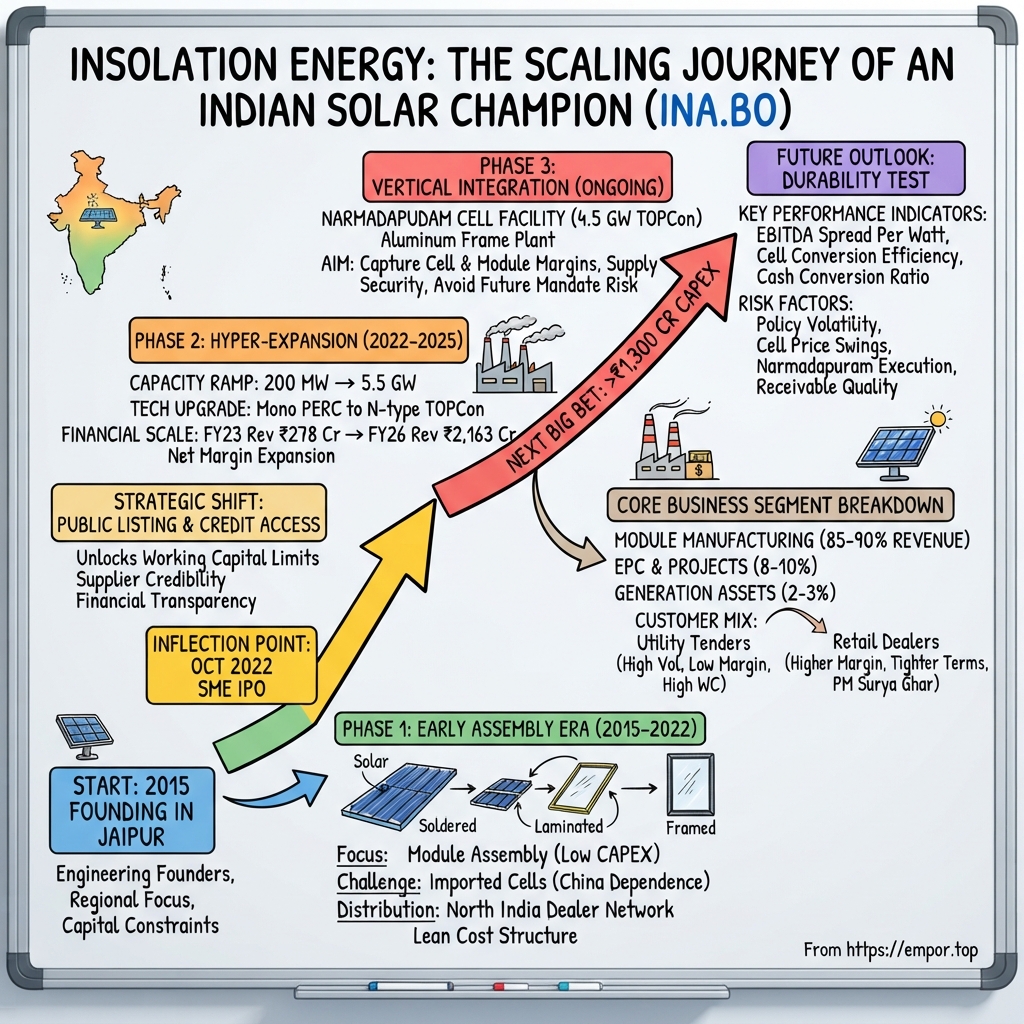
What stands out is the rapid scale of operations behind those factory walls. Founded in Jaipur in 2015 with an initial module assembly capacity measured in tens of megawatts, the company reported revenue of ₹2,163.52 crore and a net profit of over ₹200 crore for FY26, alongside an installed module capacity management describes as 5.5 GW.1[^2] Year-over-year revenue grew roughly 61%, while profit after tax expanded by about 59%.[^2] For comparison, the company generated ₹278 crore of revenue in FY23.8 That represents nearly an eightfold revenue expansion in three years—achieved not through major acquisitions or large equity capital raises, but by reinvesting operational cash flow into additional assembly capacity while domestic policy sheltered local module manufacturers.
The key strategic question is not whether this expansion occurred—it is clearly documented in audited financials and exchange filings—but what structural factors drove it and whether those drivers remain durable.
The debate around the business reflects two distinct interpretations. On one hand, Insolation Energy can be viewed as an expanding vertically integrated solar manufacturer that leveraged an SME initial public offering into an established balance sheet, scaled working capital into multi-gigawatt assembly capacity, built a retail distribution network across North India, and is spending north of ₹1,300 crore to become a maker of solar cells rather than a buyer of them.[^3] On the other hand, it can be viewed as a high-beta cyclical converter whose gross margin per watt relies heavily on protectionist policy. Specifically, the Ministry of New and Renewable Energy's Approved List of Models and Manufacturers (ALMM) makes it illegal for most subsidized Indian projects to buy lower-cost foreign modules, and because Basic Customs Duty makes the imported alternative expensive at the border.2 Remove that policy shield, and the core business remains a mechanical assembly operation competing against foreign scale that is an order of magnitude larger.
Both perspectives capture real aspects of the business model. The analytical challenge lies in determining which dynamics will prevail over time.
This story unfolds across eight sections. First, the 2015 founding in Jaipur and the low-capital assembly playbook through 2022 that established the company's operating baseline. Second, the BSE SME IPO of October 2022 and the subsequent capacity ramp from a few hundred megawatts to a claimed 5.5 GW.3 Third, the underlying unit economics: module margins, revenue drivers, and why the mix between utility tenders and retail dealers shapes overall profitability. Fourth, competitive positioning against peers such as Waaree Energies, Premier Energies, and Vikram Solar, along with the regulatory environment that shapes the industry.
Fifth, the strategic impact of the Narmadapuram cell manufacturing facility, an investment that will largely determine the company's medium-term margin trajectory. Sixth, an evaluation of management's execution record, testing the bull case against disclosed financial results and operational milestones. Seventh, structural analysis through competitive frameworks alongside operational risks that directly transmit into earnings. Finally, a synthesized investment framework detailing the core metrics required to track thesis execution over time.
The analysis begins with the company's origins: two engineers in Rajasthan who built an assembly business to capture rising domestic demand for solar modules.
 Subscribe on LinkedIn
II. Founding Context & The Early Assembly Era (2015–2022)
In the mid-2010s, Rajasthan presented a clear industrial contrast: abundant solar potential paired with scarce capital. The state receives among the highest solar irradiance in India, meaning a panel installed near Jodhpur or Bikaner generates significantly more electricity annually than an identical panel in Kolkata or Kerala. Land was cheap, flat, and plentiful. What the region lacked was manufacturing equipment, domestic financing, and a local supply chain. At the time, nearly every solar module installed in India was imported.
To capitalize on that gap, Manish Gupta and Vikas Jain incorporated Insolation Energy in 2015 and established module assembly operations in Jaipur.4
Neither founder came from an established industrial dynasty. Both were engineers with experience in regional power project execution and industrial distribution across Rajasthan. That background provided two practical advantages: an understanding of how power projects navigate state utilities and local distribution companies, and direct experience selling industrial goods to small-town electrical dealers rather than corporate procurement departments.
As first-generation entrepreneurs without large balance sheets, their choice of entry point reflected those capital constraints. They did not attempt to build a silicon wafer or cell manufacturing plant, nor did they bid for utility-scale engineering, procurement, and construction contracts against national conglomerates. Instead, they focused on module assembly, the segment of the solar value chain requiring the lowest capital expenditure per unit of output and offering the fastest payback.
A solar module is effectively a laminated sandwich. The core is the solar cell—a thin wafer of processed silicon that converts photons into electrical current. Manufacturing that wafer requires semiconductor-level processing, but assembling it into a panel does not. An assembly line takes pre-fabricated solar cells, solders thin ribbons to connect them in series, lays the strings on tempered glass, covers them with protective polymer film and a backsheet, and runs the stack through a laminator to create a sealed unit. An aluminum frame is added for structural rigidity, a junction box is attached to export current, and the finished panel is flash-tested to verify its wattage rating.
While managing line speed, yield, breakage rates, and lamination quality at scale requires engineering discipline, the underlying technology is standardized and commercially available. That made assembly accessible for founders with limited capital, but it also meant the business lacked a proprietary technological moat.
During this early period, Insolation relied on imported cells from major Chinese manufacturers. This created a structural dependency: the primary input cost was controlled by overseas suppliers operating at massive scale, whose production decisions were driven by foreign industrial policy as much as global market demand.
India's policy environment shifted steadily over the decade. The government moved from unrestricted module imports toward Domestic Content Requirement rules for public projects, eventually establishing the Approved List of Models and Manufacturers (ALMM) framework and basic customs duties.2 While policy gradually favored domestic production, early protection was limited and operating margins remained thin. Assembly in 2016 was working-capital intensive: manufacturers paid for imported cells in U.S. dollars under letters of credit, carried inventory through transit and customs, and often waited months for payment from cash-constrained local contractors.
Currency exposure added further risk. Because imported cells were priced in dollars while finished modules were sold in rupees, any depreciation of the rupee between order placement and delivery eroded margins on fixed-price contracts. Lacking the scale for formal currency hedging, small assemblers had to rely on tight inventory management, short order-to-delivery cycles, and disciplined cash collection.
In response, the founders targeted a distinct distribution segment. Rather than competing in low-margin utility-scale reverse auctions—where winners faced delayed payments from state entities—they built a dealer and installer network across Rajasthan, Uttar Pradesh, and Madhya Pradesh. Selling to commercial rooftop installers and small contractors required a larger sales network, but it yielded a fragmented customer base, smaller order sizes, better payment terms, and pricing power driven by local availability and service.
By 2022, Insolation had built an operational cadence and a regional distribution network funded through retained earnings and bank credit. However, it still lacked proprietary technology or protection from volatile cell prices. To capture the expanding market created by tightening domestic trade protections, the business needed substantial fresh capital to scale up capacity.
The company's corporate structure also took shape during this period. The founders established separate subsidiaries, including Insolation Green Energy Private Limited, which holds generation and project assets and maintains its own credit rating.[^18] Separating manufacturing from asset ownership is standard practice in Indian renewables to isolate distinct risk profiles, but it requires investors to analyze multiple entities and track intra-group transactions between manufacturing operations and project-holding affiliates.
By the end of 2022, the early assembly era had established four foundational pillars: an operational assembly line with yield discipline, a regional dealer network across three states, an asset-holding corporate architecture, and a lean cost structure. What Insolation still lacked was technological differentiation and the capital required to build gigawatt-scale capacity.
III. The SME IPO Catalyst & Hyper-Expansion: 200 MW to 5.5 GW (2022–2025)
The capital figures behind Insolation Energy's public debut were modest relative to the scale that followed. In October 2022, the company raised roughly ₹22.16 crore through a fresh issue on the BSE SME platform at ₹38 per share.3 At prevailing exchange rates, ₹22 crore represented just a couple of million dollars—less than a typical Series A round for a mid-tier software startup. While the issue was subscribed many times over, reflecting strong retail appetite for solar equities at the time, the absolute quantum of capital remained small.3
Yet the SME listing proved to be the pivotal inflection point in the company's growth trajectory, primarily for reasons unrelated to equity capital.
In solar module assembly, machinery is rarely the primary constraint. Module lines are relatively capital-light compared to their total output; the true bottleneck lies in working capital. Operating a gigawatt of module assembly requires purchasing a gigawatt's worth of solar cells, glass, aluminum, and encapsulants—inputs that are largely imported and must be paid for before finished panels are shipped. This requires substantial credit facilities, including non-fund-based tools like letters of credit and bank guarantees, as well as traditional fund-based working capital limits. Commercial banks extend these limits based on net worth, financial disclosure quality, and the regulatory oversight that comes with a public listing.
A public listing converted a private Jaipur entity into a transparent corporate balance sheet operating under mandatory quarterly reporting standards. It also altered supplier dynamics. Global cell manufacturers allocate volume and offer credit terms based on counterparty risk; during supply shortages, guaranteed allocation matters more than unit price. A listed company with audited financials and a public order book presents a fundamentally different risk profile to suppliers than an unlisted regional assembler. Consequently, the ₹22 crore of fresh equity mattered far less than the leverage it enabled by unlocking expanded bank credit limits. Rather than funding expansion directly through equity, the public listing provided the credibility needed to finance growth through working capital.
What followed was one of the fastest capacity expansions in the domestic solar module sector.
While establishing direct causality between listing status and credit access remains difficult from external filings alone, observable evidence aligns with this mechanism. The public listing coincided with a sharp expansion in inventory levels and order execution, alongside rating agency commentary highlighting significant reliance on short-term bank borrowings, letters of credit, and trade payables.[^8] Management reported expanding module capacity from roughly 700 MW in 2022 to approximately 1.2 GW in 2023, 3.0 GW in 2024, and reaching 5.5 GW of operational capacity across its Jaipur facilities by 2025.15 Parallel to this physical expansion, the company upgraded its technology profile from standard Mono PERC cell architecture toward N-type TOPCon lines capable of producing modules rated between 400W and over 700W.1
This technology transition reflected broader shifts across the solar industry. In standard solar cells, energy is lost at the interface between the silicon wafer and the metal contact, where charge carriers recombine as heat rather than escaping as current. PERC technology mitigated this by placing a reflective passivating layer at the rear of the cell to bounce unabsorbed light back through the silicon. TOPCon, or Tunnel Oxide Passivated Contact, advances this design by adding an ultra-thin silicon oxide layer. This structure allows useful electrons to tunnel through while preventing recombination losses. In practice, TOPCon cells achieve one to two percentage points of additional efficiency and exhibit slower degradation rates over time. For utility-scale project developers, higher panel efficiency reduces land requirements, mounting structures, and cabling costs per megawatt installed—accelerating industry adoption.
However, adopting TOPCon at the assembly stage represents an operational adjustment rather than proprietary innovation. Module assemblers purchase pre-fabricated TOPCon cells and calibrate their soldering and lamination equipment accordingly. The shift maintains product competitiveness against industry standards, but it does not establish a technological moat.
The financial trajectory over this period illustrates the pace of operational scaling. Revenue grew from ₹278 crore in FY23 with profit after tax of approximately ₹15 crore, to ₹737 crore in FY24 with PAT of roughly ₹55 crore, accelerating to ₹1,343.62 crore in FY25 with PAT of ₹125.80 crore, and reaching ₹2,163.52 crore in FY26 with PAT of ₹200.47 crore.8[^2] For Q1 FY27, the company reported revenue of ₹745.40 crore and PAT of ₹38.02 crore.[^2]
Three key analytical observations emerge from these financial results.
First, net margins expanded alongside revenue, moving from roughly 5.4% in FY23 to approximately 9.3% in FY26. In module assembly, this expansion reflects operating leverage as fixed overhead is distributed across higher production volumes, alongside improved purchasing terms on bulk raw materials.
Second, the Q1 FY27 results present a notable shift in margin trajectory. While annualized revenue based on Q1 output exceeds FY26 levels, the quarter's PAT of ₹38.02 crore represents a net margin of approximately 5.1%—a significant compression from FY26 full-year profitability.[^2] While single-quarter figures can fluctuate based on product mix between lower-margin utility tenders and higher-margin retail distribution, the margin contraction highlights potential competitive pricing pressure or a strategic pivot toward higher-volume, lower-margin institutional contracts.
Third, rapid top-line expansion in an assembly operation consumes significant cash to fund expanding inventory and accounts receivable. Credit evaluations from CARE Ratings have repeatedly highlighted this structural balance-sheet pressure, citing stretched working capital cycles alongside rapid revenue growth.[^8]
In March 2026, Insolation Energy completed its transition from the BSE SME platform to the mainboards of the BSE and NSE.6 Beyond increasing share liquidity and enabling participation from institutional investors and mutual funds, the mainboard listing subjects the business to heightened continuous-disclosure requirements, broader equity analyst coverage, and institutional shareholder scrutiny.
This transition sets the stage for a closer examination of the underlying economics driving the core assembly model.
A final caveat tempers the historical expansion narrative. In a capital-light assembly model, reported profitability remains heavily dependent on procurement timing—specifically, the price of solar cells at the time of purchase relative to module contract prices at delivery. During periods of falling cell prices, inventory holding costs can compress margins, whereas rising module prices yield inventory gains. Distinguishing management's procurement execution from broader tailwinds—such as protective tariff umbrellas—remains difficult based on multi-year upward trends alone. Evaluating performance across a complete market cycle, characterized by expanding domestic capacity and evolving trade policies, will provide a clearer test of operational durability.
IV. Core Business Segment Breakdown & Economic Drivers
Walk the length of Insolation Energy's order book and the business resolves into three distinct operating segments.
The overwhelming majority—roughly 85% to 90% of revenue and a similar share of profit in company disclosures—is solar photovoltaic module manufacturing, comprising Mono PERC and TOPCon panels sold under the INA Solar brand.1 A smaller slice, on the order of 8% to 10%, is solar engineering, procurement, and construction (EPC) and turnkey project work, including institutional and commercial installations and decentralized ground-mounted plants under government schemes such as PM-KUSUM, which subsidizes solar pumps and distributed generation for farmers.1 A residual 2% to 3% comes from owning and operating solar generation assets through subsidiary structures, including Insolation Green Energy Private Limited.[^8]
For investment analysis, the EPC and generation segments function primarily as channel support and strategic options rather than core earnings engines. EPC projects pull module volume through the system and provide access to institutional tenders, while owned generation assets are small and capital-intensive relative to manufacturing. Neither is large enough today to alter overall earnings trajectory; the module business drives the enterprise.
Within module manufacturing, profitability is primarily determined by customer mix.
On one side are institutional and utility buyers: state power utilities, independent power producers, and central-sector renewable developers. A prominent example is a supply order worth ₹558.29 crore from NTPC Renewable Energy, alongside arrangements with developers including KPI Green Energy.[^10] These contracts generate substantial volume and headline revenue growth, but their economics reflect low-margin commodity execution: high volume, rapid asset turnover, and gross margins in the high single digits to low teens. Institutional buyers run competitive reverse auctions where panels are specified to standardized technical parameters, making price per watt the primary selection criterion. NTPC does not pay a brand premium.
On the other side sits the retail and dealer channel—a network of more than 300 dealers and distributors across northern and central India built during the pre-IPO era.1 This segment benefits directly from PM Surya Ghar: Muft Bijli Yojana, the residential rooftop subsidy scheme under which the government supports household solar installations, and under which Insolation has publicized solarizing tens of thousands of homes.71 The economics of retail distribution are structurally superior: gross margins sit in the low-to-mid teens, payment terms are tighter, and pricing power depends on local availability, dealer relationships, and service responsiveness rather than auction bidding.
This customer split creates a critical operating asymmetry. Consider two hypothetical financial years with identical revenue. In the first, three-quarters of module volume goes to utility buyers at a high-single-digit gross margin against 90-day receivables. In the second, half of the volume flows through the dealer network at mid-teens margins against near-cash terms. The second year generates substantially higher operating profit and free cash flow from the exact same plant and nameplate capacity. Selling one gigawatt to a state utility and one gigawatt to 300 regional dealers yields vastly different returns while consuming different levels of working capital. Consequently, customer mix—rather than headline nameplate capacity—is the primary variable shaping profitability. Quarters dominated by utility volume will show high revenue alongside compressed margins, whereas quarters weighted toward retail distribution will display the reverse.
The cost structure highlights where operational fragility resides.
In module assembly, raw materials typically represent 85% to 90% of cost of goods sold.1 Within raw material expenses, solar cells alone account for roughly 65% to 70%, followed by solar tempered glass at 8% to 10%, aluminum frames at 6% to 8%, and encapsulants or backsheets at 5% to 7%.1 Labor, power, depreciation, and factory overhead constitute a minor fraction of total operating costs.
This breakdown underscores the underlying nature of the assembly model. Insolation does not manufacture modules in an integrated chemical or semiconductor sense; it converts purchased solar cells into completed panels, capturing an added-value spread historically estimated between ₹1.50 and ₹2.50 per watt. That processing spread represents the core operating margin. Line automation, throughput speed, yield management, and procurement timing all operate within this narrow band between cell input costs and panel selling prices.
Furthermore, roughly two-thirds of the input cost is tied to global silicon cell prices determined primarily by Chinese manufacturing supply, while output prices in India's protected market depend on the price gap created by Basic Customs Duty on imported modules relative to domestic purchasing power. Insolation sets neither boundary; it operates within the middle of the value chain.
Consequently, describing the company simply as a "solar manufacturer" can obscure its economic reality. A more precise mental model is a high-volume converter operating on a purchased commodity with policy-sheltered output pricing—economically analogous to a steel re-roller rather than a proprietary technology developer. Steel re-rollers can run profitable operations, but they rarely command high valuation multiples, and their margins depend on spread management rather than technological moats.
This structural reality explains why assembly margins can fluctuate sharply without operational changes, why inventory procurement timing directly drives profit and loss, and why management is deploying over ₹1,300 crore toward vertical integration.
Before evaluating that capital expenditure program, it is worth examining the competitive landscape of peers occupying that same middle market.
Finally, the secondary business segments warrant monitoring. The EPC division acts as a vehicle for participating in government distributed-generation schemes like PM-KUSUM, converting product sales into project relationships with state agencies. However, EPC contracts carry execution risks distinct from manufacturing, including performance guarantees, multi-year retention money, and potential liquidated damages for delay. At 8% to 10% of revenue, it is not currently a major concern.1 It would become one if it grew faster than the core without a corresponding improvement in cash conversion.
Similarly, the generation segment remains a small asset portfolio producing predictable, long-duration cash flows. However, holding generation assets requires long-term capital that competes directly with balance-sheet capacity allocated to the cell project.[^18] Maintaining a small asset base keeps capital focused on the core manufacturing integration strategy.
V. Competitive Landscape & Industry Mechanics
If you want to understand the Indian solar manufacturing market in 2026, start with a single observation: almost every major player announced a gigawatt-scale expansion at roughly the same time.
That sentence encapsulates the industry's entire competitive dynamic. Protected margins attract capital. Capital builds capacity. Capacity, in aggregate, erodes the very margins that attracted it. The only question in a protected industry is how long that lag lasts, and whether an individual company can use the window to build an enterprise that survives the inevitable margin compression.
At the top of the domestic hierarchy sits Waaree Energies, with module capacity around 13.3 GW, revenue exceeding ₹11,300 crore, a meaningful export franchise into the United States, and integrated cell manufacturing.9 Waaree serves as the scale benchmark—generating roughly five times Insolation's revenue, backed by a matching balance sheet and national brand recognition.
Premier Energies offers a more instructive comparison because it demonstrates the thesis Insolation is attempting to prove. With module capacity around 4.1 GW and cell capacity around 2.0 GW on revenue exceeding ₹3,100 crore, Premier is closer to Insolation in size but structurally distinct in where it captures value.10 Because Premier manufactures its own cells, it captures both the cell and module margins, yielding a historically higher gross margin profile. Premier serves as proof that backward integration in India creates a superior business model—while also providing a realistic timeline for how long and expensively that transition unfolds.
Vikram Solar, with roughly 4.5 GW of module capacity, has leaned heavily toward government-backed utility contracts with NTPC and SECI.11 Goldi Solar and Websol Energy occupy adjacent positions, with Websol notable as a cell specialist whose commissioning history offers a cautionary reference point for cell-plant execution.
Against this field, Insolation's reported 5.5 GW of module capacity places it near the top of the domestic table in nameplate assembly capacity—ahead of Premier and Vikram on modules, though well behind Waaree.1910 Its genuine differentiation, however, is not nameplate capacity; it is its retail rooftop distribution network across Rajasthan, Madhya Pradesh, and Uttar Pradesh. That dealer network is harder to replicate than an assembly line and sits closer to the higher-margin end of the demand curve.
However, capacity figures in this industry require careful scrutiny. Nameplate capacity represents the theoretical annual output of installed lines running continuously at design speed. Actual utilization depends on real demand, cell availability, order mix, and working capital constraints. When the entire sector announces expansion simultaneously into a domestic market of finite size, aggregate nameplate capacity can quickly outpace domestic demand. Under those conditions, excess capacity transforms from a competitive asset into fixed operational overhead. The broader industry risk is not that any single manufacturer fails to execute its expansion, but that widespread overbuilding depresses utilization across the sector, competing away the protected margin spread from within the domestic market rather than from foreign imports.
That dynamic makes policy architecture the critical determinant of sector profitability.
There is also the question of what a "top-five by module capacity" ranking is actually worth as a competitive statement. Capacity rank dictates the ability to bid for large utility volumes, but it does not determine unit profitability. Waaree's structural advantage over Insolation is not merely its additional assembly lines—it is its integrated cell capacity, an export channel into higher-priced foreign markets, and a national brand.9 Premier's advantage is narrower but equally clear: it retains the processing spread that a non-integrated assembler surrenders to cell suppliers.10 Consequently, ranking companies solely by assembly capacity overstates Insolation's position within the industry's true profit pool.
Two primary policy instruments maintain this domestic market umbrella. First, the Approved List of Models and Manufacturers (ALMM), maintained by the Ministry of New and Renewable Energy, requires government-backed, grid-connected, and subsidized projects—including PM Surya Ghar residential installations—to procure modules exclusively from listed domestic facilities.2 Inclusion on the list is a prerequisite for tapping mainstream Indian demand; exclusion bars a manufacturer regardless of price. Second, a Basic Customs Duty of 40% on imported modules and 25% on imported cells significantly elevates the landed cost of foreign competition.2
Together, these trade barriers create a protected domestic pricing environment. It is essential to analyze the exact nature of this advantage: it is not a company-specific moat, as every ALMM-listed domestic manufacturer operates under the exact same trade shelter. Instead, it functions as an industry-wide policy subsidy. Competition within this protected zone is still decided on unit cost, distribution efficiency, and execution.
Applying standard competitive frameworks clarifies these industry dynamics.
The threat of new entrants is high in module assembly because capital expenditure per megawatt is low, turnkey equipment is readily available, and recent years demonstrate how quickly an operator can scale from hundreds of megawatts to gigawatt scale. In contrast, barriers to entry in cell manufacturing remain high due to capital intensity and process complexity. Bargaining power of suppliers remains the most challenging force in the model: Chinese silicon, wafer, and cell producers control the pricing of nearly two-thirds of total raw material costs, leaving non-integrated domestic assemblers with minimal negotiating leverage. Bargaining power of buyers is high in the utility tender market, where state utilities and central developers run aggressive, price-driven auctions that compress margins, but remains moderate across the fragmented retail dealer network. The threat of substitutes is low, as solar photovoltaic generation maintains the lowest levelized cost of electricity among domestic power sources. Finally, competitive rivalry is intense and expanding, driven by simultaneous capacity additions from Waaree, Premier, ReNew, and Adani Solar.
Evaluating the business through strategic frameworks like Hamilton Helmer’s 7 Powers is equally revealing, primarily by highlighting which structural powers are absent. Insolation holds a faint version of a Cornered Resource through its ALMM approvals and product certifications, though this advantage is shared across all registered domestic peers and remains subject to regulatory modification. The company demonstrates elements of Process Power through its capital-efficient assembly rollouts in Jaipur, supported by its rapid capacity expansion from FY23 to FY26. However, it lacks global Scale Economies, Switching Costs (as modules are standardized and commoditized by design), Network Effects, Counter-Positioning, or national Brand Power in the institutional utility market, where procurement decisions are driven primarily by price per watt.
The core analytical conclusion is straightforward: under its legacy assembly model, Insolation's competitive positioning relies on execution speed, regional distribution coverage, and a government trade policy it cannot control. While that combination supported rapid initial scaling, it does not constitute a durable long-term moat. Management's strategy acknowledges this reality, driving its decision to deploy significant capital toward backward integration into solar cell manufacturing.
VI. The High-Stakes Bet: Narmadapuram TOPCon Cell Capex
Every assembly business eventually reaches an economic ceiling. An operator can accelerate line speeds, optimize procurement, and build superior distribution channels, but the underlying reality remains unchanged: the most technologically complex and value-dense component in the final product is manufactured elsewhere and priced accordingly. In solar photovoltaic manufacturing, economic value concentrates in the solar cell; everything downstream is mechanical conversion.
This structural limit is further compressed by a shifting regulatory policy. India's Approved List of Models and Manufacturers (ALMM) framework was designed with an intended expansion from modules to cells—creating a secondary domestic requirement that would mandate locally manufactured cells for subsidized projects.2 When that rule takes effect, the unit economics for a non-integrated assembler change dramatically: imported cells will no longer qualify finished panels for policy-protected markets. Unintegrated assemblers would be forced to purchase domestic cells from integrated competitors, placing them in a vulnerable position—reliant on direct rivals for their primary raw material.
These dynamics explain the rationale behind Insolation Energy's expansion in Narmadapuram, Madhya Pradesh. From management's perspective in the mid-2020s, maintaining the status quo carried mounting structural risk. While gross spreads were healthy and order books full, roughly two-thirds of every rupee in raw material costs was remitted to overseas cell manufacturers whose pricing and allocation remained outside domestic control. With regulators signaling a transition toward domestic cell mandates, remaining solely an assembler risked eventual margin erosion and market exclusion.
To address this vulnerability, Insolation committed to a greenfield project in Narmadapuram with planned capital expenditure exceeding ₹1,300 crore, centered on a 4.5 GW N-type TOPCon solar cell manufacturing line paired with an 18,000 metric tonnes per annum (MTPA) aluminum frame plant.[^3] The aluminum frame line represents a straightforward operational addition; frame fabrication uses established extrusion processes, accounts for 6% to 8% of raw material expenses, and provides both incremental margin capture and supply security.
The selection of Madhya Pradesh reflects broader industrial policy trends. The state government has actively solicited renewable manufacturing projects, offering custom incentive packages covering land, power tariffs, and fiscal subsidies for large greenfield investments. While specific incentive terms for Narmadapuram are not detailed in public disclosures, state subsidies can significantly alter a plant's effective capital outlay and initial operating economics.
In contrast, the 4.5 GW solar cell line represents a fundamentally different operational challenge. Describing the project as an expansion into cells understates the technical leap involved. Module assembly is essentially mechanical integration: soldering, laminating, and framing packaged components in a light-manufacturing setting. Cell manufacturing, by comparison, is high-precision semiconductor fabrication. It requires Class 10,000 cleanrooms, chemical etching of silicon wafers at microscopic scales, diffusion furnaces running phosphorus oxychloride to establish electrical junctions, plasma-enhanced chemical vapor deposition (PECVD) of nanometer-thick passivation layers, and screen printing of silver paste grid lines within tolerances of a few microns. The process demands ultrapure water, specialty gases, uninterruptible power, and continuous process control.
Operationally, module assembly resembles commercial baking: inputs are purchased, recipes are standardized, and success depends on line speed, consistency, and material yield. Cell manufacturing resembles biopharmaceutical processing: subtle variations in environmental control can render entire production batches worthless. The financial difference between a facility operating above 25% cell conversion efficiency with low breakage and one stuck at 22% to 23% with elevated scrap rates is the difference between operating profitability and cash losses.
Cell conversion efficiency—the proportion of incident sunlight converted into electricity—directly determines unit margins. Cells reaching 25% efficiency command premium market pricing. Cells stabilizing at lower efficiency bands cost the same to produce but yield lower selling prices per watt, compressing gross margins. During the initial commissioning of a new fabrication plant, low yields and technical bottlenecks are standard operational hurdles that require months of process tuning to overcome.
The Narmadapuram project therefore presents a complex strategic trade-off. Strategically, backward integration is essential to avoid long-term margin compression and regulatory exclusion. Financially, it represents the largest capital commitment in the company's history. Operationally, it requires a management team with a proven record in lean assembly to master advanced semiconductor engineering.
This transition involves two structural risks. The first is scale ambition: 4.5 GW is a full-scale commercial fab rather than a phased pilot line. Building a multi-gigawatt line immediately leaves little room for operational learning before full capital deployment. The second is technology timing. While N-type TOPCon is the current commercial standard, next-generation technologies—such as perovskite-silicon tandem cells—are advancing in commercial laboratories. Should alternative cell architectures reach cost-effective mass production faster than anticipated, a single-junction TOPCon facility could face economic obsolescence before fully amortizing its capital cost. While tandem commercialization faces unresolved durability challenges, technological shifts remain a key long-term risk for a decade-payback asset.
Ultimately, both the optimistic and cautious cases for Insolation center on Narmadapuram's execution. Evaluating management's operational track record becomes the natural next step in assessing thesis durability.
A final consideration involves project financing. Executing a project exceeding ₹1,300 crore for a business that generated roughly ₹200 crore in net profit in its highest-earning fiscal year requires capital well beyond internal cash generation.[^2][^3] Funding the expansion will depend on a combination of retained earnings, term debt, and potential equity capital. Each source carries distinct financial implications. Long-term debt introduces fixed interest obligations that accrue during construction prior to revenue generation, creating interest drag on earnings. Equity issuance avoids fixed debt servicing but dilutes existing shareholders. The ultimate financing structure and its interest rates will determine how much operational profit from Narmadapuram flows through to bottom-line earnings.
VII. Management Credibility, Governance & Historical Falsification Pass
Evaluating management starts with foundational structural metrics. Founders Manish Gupta and Vikas Jain hold a promoter stake of approximately 66.12%, with no promoter shares pledged.12 In the Indian mid-cap market, an unpledged promoter holding is a crucial safeguard: pledged stock is frequently the vehicle through which a working-capital crunch escalates into a governance crisis when lenders force share sales during market declines. The absence of pledged equity eliminates a major vulnerability.
The company's capital allocation during its initial assembly expansion reflects disciplined execution. Scaling from a few hundred megawatts to a claimed 5.5 GW between 2022 and 2025 on a single ₹22 crore equity issuance—funded primarily through internal accruals and bank credit lines—represents a remarkably frugal trajectory for the sector.31 Investors who entered during the SME initial public offering were not subjected to equity dilution while revenue expanded nearly eightfold.
However, structural metrics provide an incomplete assessment of management capability. High promoter ownership aligns financial interests, but it does not guarantee strategic foresight. Capital discipline in light assembly does not automatically translate to complex semiconductor fabrication. Assessing true credibility requires testing core thesis claims against disconfirming empirical evidence.
Claim 1 — High returns and asset turnover in module assembly reflect a genuine operating edge.
The disconfirming evidence is visible in the temporary suspension of the Approved List of Models and Manufacturers (ALMM) mandate during fiscal 2024.2 When the government temporarily lifted import restrictions, lower-cost foreign modules entered the domestic market, stripping local assemblers of their trade protections and causing margin volatility across the industry. This episode demonstrates that return profiles were largely dictated by trade policy rather than proprietary operating advantages.
Verdict: The claim does not hold up without qualification. While historical performance confirms efficient assembly execution and solid operational utilization, it does not demonstrate intrinsic pricing power. Insolation operates as an efficient converter capturing a policy-sheltered margin spread. A key metric to monitor is the gross spread per watt during periods of sharp movements in global cell and module prices. If gross spreads remain stable when import costs drop, it would indicate proprietary pricing strength; if spreads track import price gaps, it confirms policy dependency.
Claim 2 — Management's capital allocation and execution track record supports the Narmadapuram build.
The primary challenge to this claim is one of scale and technical complexity. Management's past execution covers module assembly lines requiring individual project outlays of roughly ₹20–50 crore per phase. In contrast, Narmadapuram represents a capital commitment exceeding ₹1,300 crore in solar cell fabrication—a twenty-fold increase in project scale alongside a transition into semiconductor manufacturing.[^3]
Industry precedents highlight the execution risks involved. Greenfield solar cell facilities in India have historically faced extended yield stabilization phases and substantial initial cash burn, as demonstrated by Websol Energy's multi-year commissioning challenges. Insolation possesses no direct cell manufacturing experience to counter these industry base rates, meaning its historical discipline in assembly cannot be assumed to guarantee success in cell fabrication.
Verdict: The claim remains unproven. Assembly execution reflects operational discipline, but it applies to a fundamentally different manufacturing process. Success or failure will depend on concrete operational milestones: meeting the target commercial operation date, achieving cell conversion efficiencies above 25%, and maintaining low breakage rates during ramp-up. Commissioning the facility near schedule with target efficiency will validate management's execution capability; delays exceeding a year or sustained efficiency shortfalls will undermine it.
Claim 3 — The company's financial position is sound and self-funding.
Disconfirming evidence appears in rating agency evaluations. CARE Ratings assigned the company a BBB+ rating with a Stable outlook, noting that rapid top-line growth has stretched working capital requirements and increased reliance on short-term bank borrowings, letters of credit, and trade payables.[^8] In an assembly business where raw materials comprise 85% to 90% of costs, rapid expansion causes operating cash flow to lag reported net profit during inventory accumulation.
A BBB+ rating is investment grade, but it leaves limited margin for error. Elevated working capital intensity or substantial debt additions could trigger credit pressure, while borrowing costs at this tier remain higher than those of larger competitors—a critical factor when financing a ₹1,300 crore plant.
Verdict: The assertion that the business is self-funding is unsupported by financial disclosures. While profitable, expansion has been heavily financed by supplier credit and bank facilities. Crucial indicators to track include operating cash flow relative to net profit and working capital days. Sustained cash flow below net profit alongside a lengthening working capital cycle would confirm that balance-sheet demands are absorbing reported earnings.
Claim 4 — Governance is clean.
Auditor disclosures and regulatory filings document related-party transactions with promoter-controlled entities for logistics, freight, and civil construction services.13 These transactions comply with Section 188 of the Companies Act and show no evidence of impropriety in available disclosures.
However, related-party transactions require heightened scrutiny as transaction volumes scale alongside rapid top-line growth. As the company expands onto mainboard exchanges and executes major civil construction projects—where third-party pricing is difficult for external investors to benchmark—transparent governance becomes increasingly critical. This remains an active monitoring item rather than a governance breach.
Finally, management's communication across exchange filings and public releases has maintained a consistent focus on capacity expansion, backward integration, and retail network growth. The primary untested element is how executive leadership communicates during operational setbacks. Evaluating management's transparency during periods of margin compression—such as the profitability drop recorded in Q1 FY27—will offer a key test of reporting candor.[^2]
VIII. Risk Radar & Stress Test
Before analyzing potential risk factors, it is worth establishing what the preceding empirical checks did not reveal. Across reviewed company disclosures, credit rating rationales, and exchange filings, there are no records of financial restatements, going-concern qualifications, auditor resignations, or adverse regulatory actions against Insolation Energy.14[^8] While this observation is strictly bounded by the scope of public records—and the company's brief history as a listed entity leaves a relatively thin historical trail—the absence of these immediate red flags provides a clean baseline.
A practical risk assessment avoids cataloging every theoretical misstep; instead, it isolates specific operational mechanisms that directly transmit into earnings. For Insolation Energy, four primary risks shape the downside profile.
Regulatory policy volatility. This is the dominant risk, and it is not a theoretical tail event—it has already materialized once. Any decision by the Ministry of New and Renewable Energy to extend ALMM exemptions, lower Basic Customs Duty, or delay mandatory domestic cell sourcing flows directly into domestic module pricing.2 Transmission occurs rapidly: because domestic umbrella prices are set by the landed cost of imports, tariff adjustments reprice local panels within weeks. The asymmetry is stark: policy protection currently sits near maximum favorability for domestic manufacturers, leaving the distribution of potential policy changes skewed to the downside. Crucially, the upcoming cell-level sourcing mandate serves as both the strategic justification for the Narmadapuram facility and a policy rule subject to administrative deferral. A deferral would simultaneously narrow the window for vertical integration returns and prolong competitive pressure from imported-cell assemblers.
Chinese cell price swings and inventory exposure. With solar cells comprising roughly two-thirds of raw material costs, and cell and glass inventories held across multi-week shipping and manufacturing cycles, a sharp drop in global cell prices creates a dual hit: inventory on hand must be written down toward current market value, while finished module selling prices reset downward while higher-cost inventory is still being processed.1 Persistent Chinese polysilicon and wafer overcapacity has repeatedly generated these pricing downdrafts over the past decade. This exposure remains structural to the assembly model and diminishes only when internal cell production begins—making the capital expenditure program partly a strategic margin hedge.
Execution and obsolescence at Narmadapuram. The operational transmission into earnings operates through three distinct channels: a delayed commercial operation date accumulates interest and depreciation on ₹1,300 crore of capital without matching revenue; low stabilized yields force cell production at above-market unit costs, destroying rather than expanding operating margins; and accelerated technology obsolescence truncates effective asset life against a long payback timeline.[^3]
Customer concentration and receivable quality. Utility-scale supply contracts with NTPC, state distribution companies, and major developers concentrate revenue among buyers with significant bargaining power and, in the case of state distribution utilities, established patterns of payment delays.[^10] The transmission mechanism operates through working capital: a lengthening receivable cycle increases short-term interest costs and restricts the liquidity needed to procure inventory for upcoming orders. In severe cases, large disputed receivables can require balance-sheet provisions that absorb a substantial portion of annual operating profit.
One additional factor warrants monitoring as a secondary operational variable rather than a headline catalyst: the company's credit rating. Rated at BBB+, a rating downgrade remains a practical risk if working capital metrics deteriorate during major construction projects. In Indian credit markets, a rating downgrade elevates interest rates and restricts non-fund-based credit lines—the precise facilities that enable the import-and-convert assembly model.[^8] For a business reliant on trade finance to fund raw material imports, rating trajectory functions as a direct operational constraint rather than a simple corporate finance metric.
An activist or short-seller would focus primarily on the intersection of these vulnerabilities: a company whose reported profits have consistently outpaced cash generation, attempting a twenty-fold increase in capital deployment into unfamiliar semiconductor fabrication, protected by a tariff regime that has already been temporarily suspended, while engaging related-party entities for civil construction. While none of these factors individually confirms a structural breakdown, their confluence represents the core risk profile to track over time.
IX. Analysis & Bear vs. Bull Case
Strip away the narrative and the investment proposition resolves into a central question: can Insolation Energy successfully transition into an integrated cell manufacturer, or will it remain a converter whose elevated returns depended on temporary trade protection?
Why it wins.
The strongest version of the bull case rests on three distinct pillars.
First, successful commissioning of the Narmadapuram cell facility would allow the company to capture both cell and module manufacturing margins rather than relying solely on an assembly conversion spread. Premier Energies provides domestic proof that integrated producers earn structurally higher gross margins than non-integrated assemblers.10 Management's ambitions imply an EBITDA margin expansion from the low teens toward the high teens or low twenties—a plausible outcome with industry precedent, though one contingent entirely on achieving target production yields.
Second, the retail distribution network represents the company's most defensible asset. A network of more than 300 dealers across Rajasthan, Madhya Pradesh, and Uttar Pradesh took years to assemble and cannot be easily replicated by competitors.1 The PM Surya Ghar scheme directs government subsidies into the residential rooftop market that this network serves, generating higher gross margins and tighter payment terms than institutional tenders.7 As residential rooftop adoption expands across Northern India, Insolation can serve that demand through established distribution infrastructure.
Third, combining module assembly scale with captive cell production would enable competitive bidding for large utility tenders from NTPC and SECI without surrendering operating margins, as the company would compete against non-integrated assemblers purchasing cells at market rates.
Why it may not.
The bear case relies on established industry base rates rather than unlikely scenarios.
First, execution at Narmadapuram could slip or stabilize at disappointing production yields. Carrying interest expense and depreciation on unearned capital while producing below-specification output would compress return metrics, converting a major capital commitment into a financial drag.
Second, trade policy could dilute. Reductions in Basic Customs Duty, extensions of ALMM import exemptions, or delays to mandatory domestic cell sourcing would narrow the domestic price umbrella. As the temporary ALMM suspension in FY24 demonstrated, regulatory changes can swiftly compress policy-sheltered assembly margins across the domestic industry.2
Third, working capital strain could compound. Rapid revenue growth, delayed receivables from state power utilities, and a major capital expenditure program could strain liquidity simultaneously—putting credit ratings under pressure, elevating borrowing costs, and forcing management to choose between curtailed expansion or equity dilution.[^8]
Finally, industry-wide overcapacity poses a sector-level risk. Aggregate domestic module and cell capacity additions across India could outpace national demand, converting nameplate gigawatts into idle overhead and depressing capacity utilization across all domestic manufacturers regardless of individual execution.
Weighing the evidence.
Applying structural business frameworks clarifies these dynamics. Porter's Five Forces indicates that supplier power represents the primary operational threat to non-integrated assemblers, making backward integration a necessary strategic response independent of tariff policy. Under Hamilton Helmer’s 7 Powers framework, the company currently relies on a shared, policy-dependent Cornered Resource and modest Process Power. Successful integration would not create a unique structural moat; rather, it would shift a low-margin assembly business into a mid-margin integrated operation alongside peers like Premier Energies. Even a fully operational Narmadapuram plant would leave Insolation competing in standardized products under the same regulatory umbrella as integrated domestic rivals.
The evidence supports a bounded conclusion. Insolation Energy has demonstrated strong operational execution in capital-light module assembly and regional retail distribution. However, it has not established pricing power independent of trade protection, nor has it proven capabilities in semiconductor-grade cell fabrication—a project more than an order of magnitude larger than its past assembly rollouts. The bull case represents a well-identified strategic opportunity pursued by a management team expanding beyond its historical expertise, operating within a policy environment subject to administrative change.
The KPIs that matter.
Three primary metrics, tracked through future financial disclosures, will determine thesis execution over time:
First, EBITDA spread per watt. This metric measures whether the company is capturing an integrated producer's margin profile rather than an assembly converter's spread. Expansion toward integrated peer levels signals successful operational integration; flat or narrowing spreads during capacity growth indicate thesis failure regardless of top-line revenue gains.
Second, Narmadapuram cell conversion efficiency and its stabilization timeline. Operational success depends not merely on completing plant construction, but on reaching competitive cell conversion efficiencies above 25% within a defined ramp-up window, transforming a ₹1,300 crore capital expenditure into an earning asset.
Third, cash conversion ratio and working capital days. Tracking operating cash flow relative to net profit alongside working capital cycles reveals whether expansion is funded through internal cash generation or growing reliance on debt and supplier credit.
X. Epilogue & Key Takeaways
There is a familiar pattern in industrial policy that Insolation Energy illustrates cleanly. A government erects trade protections to foster domestic manufacturing, creating a policy-sheltered margin spread. Capital-constrained entrepreneurs enter the least capital-intensive segment of the value chain, where that protected margin is most quickly accessible. Once early domestic assembly is established, policy objectives shift deeper into the value chain—requiring manufacturers to either execute the far more complex transition into core component fabrication or watch their economic returns migrate to integrated competitors.
Insolation Energy stands at that exact junction. The company converted a ₹22 crore SME listing and a favorable tariff regime into multi-gigawatt assembly capacity and a ₹2,000 crore-plus revenue base within four years.3[^2] What it has not yet proven is whether that rapid scaling can be replicated in semiconductor-grade cell fabrication, where performance depends on precision process control inside a cleanroom rather than light-assembly automation.
For business builders, the strategic lesson is that policy umbrellas offer rented margin rather than permanent moats. The profit spread generated behind a tariff wall represents a temporary window to accumulate balance-sheet strength and operational capabilities. Companies that survive the tightening of trade policy are those that deploy that temporary spread to build durable, vertically integrated assets. For investors, the takeaway is equally pragmatic: when corporate returns depend heavily on protective regulations, the burden of proof rests on demonstrating operational differentiation. High historical growth rates alone do not resolve whether outperformance resulted from management execution or regulatory shelter.
The Narmadapuram cell facility will ultimately provide that answer, though full operational clarity remains several years away.
In the interim, evaluating thesis execution requires tracking three primary operational metrics rather than top-line momentum: the EBITDA spread per watt, Narmadapuram cell yields and commissioning timelines, and the conversion of reported profit into operating cash flow. Top-line revenue expansion has already been established; long-term economic durability remains the open question.
References
-
Insolation Energy Official Website & Investor Relations ↩↩↩↩↩↩↩↩↩↩↩↩↩↩
-
Approved List of Models and Manufacturers (ALMM) — Ministry of New and Renewable Energy ↩↩↩↩↩↩↩↩
-
Insolation Energy SME IPO Prospectus & Listing Details — Chittorgarh ↩↩↩↩↩
-
Insolation Energy Ltd (INA / 543620) Security Information — BSE India ↩
-
Insolation Energy Concall Transcripts & Investor Presentations — Trendlyne ↩
-
PM Surya Ghar: Muft Bijli Yojana Official Portal — Government of India ↩↩
-
Insolation Energy Ltd Financial Ratios & Balance Sheet Data — Screener.in ↩↩
-
Waaree Energies — company and capacity benchmarking, Screener.in ↩↩↩
-
Premier Energies — company and capacity benchmarking, Screener.in ↩↩↩↩
-
Vikram Solar — company and capacity benchmarking, Screener.in ↩
-
Insolation Energy Limited — shareholding and promoter holding disclosures, BSE India ↩
-
Insolation Energy — Corporate Governance & Related Party Transaction Policies ↩
-
Insolation Energy Financial Results & Annual Reports Repository ↩
 LinkedIn
 WhatsApp
 Reddit
 Hacker News
 Email
Email Kindle
 RSS Feed
 Spotify
 Apple Podcasts
 Amazon Music
 Audible
 YouTube