IIFL Finance: The Gold Loan Business That Had to Earn Back Its License to Grow
I. The Lender That Could Not Lend Against Gold
On March 4, 2024, the Reserve Bank of India told one of the country's largest gold lenders to stop lending against gold. The order was blunt. IIFL Finance had to cease and desist from sanctioning or disbursing gold loans, with immediate effect, and it could no longer assign, securitise or sell the gold loans already on its books.1 It could still collect what borrowers owed. It could not make a new loan.
The regulator's reasons read like an inventory of everything a gold lender is supposed to get right. Its inspectors had found deviations in how the company assayed and certified the purity and net weight of gold, both when loans were sanctioned and when defaulted jewellery was auctioned.
They found breaches of the loan-to-value ceiling, cash disbursements and collections far above the statutory limit, departures from the standard auction process, and a lack of transparency in the charges levied on customer accounts.1 The RBI added that it had raised these issues with senior management and the statutory auditors over several months without seeing meaningful corrective action.1
Picture what that meant across the branch network the next morning. A small trader who had planned to pledge a chain to buy stock before a festival found the counter could take repayment but not the chain. A farmer whose loan was coming up for renewal had to find another lender, or another way, because IIFL could no longer roll the loan over.
Within five months more than a million customers had closed their accounts and taken their jewellery home, and the gold book had shrunk from about ₹26,100 crore on the day of the order to about ₹12,200 crore by early August.2 More than half the gold business walked out of the vaults.
The order came to an end on September 19, 2024, after a special audit and the company's remedial work, and the shares jumped more than 9% on the news, on the heaviest single-day trading volume in over a decade.3 What followed is one of the sharper recoveries in Indian finance.
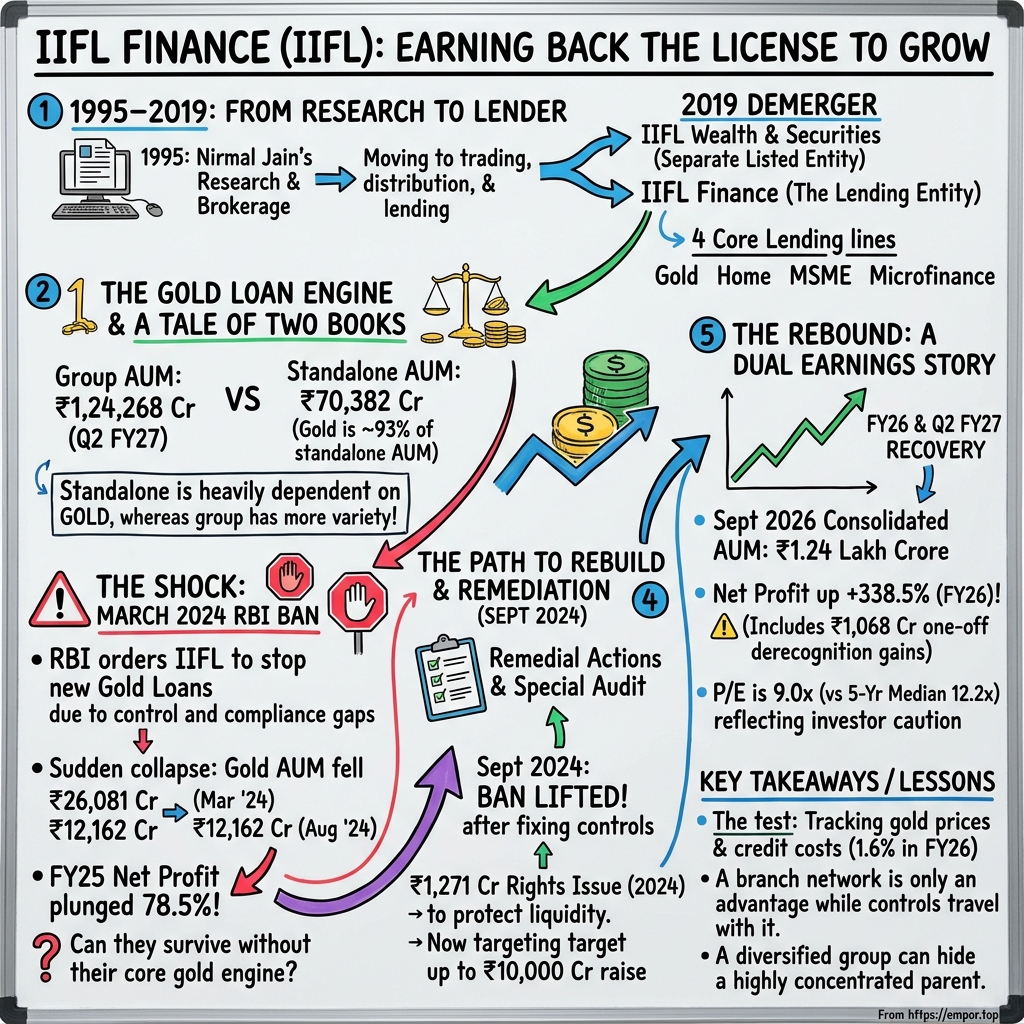
By September 2026, the consolidated group, which includes a housing finance company and a microfinance lender, managed loans of ₹1,24,268 crore, up 38% in a year.4 The standalone parent, the listed company that had been barred from gold lending, managed ₹70,382 crore, and about 93% of that was gold.5
That last figure is the hinge of this story. IIFL Finance is often described as a diversified retail lender, and the group is. But the listed parent is, in economic substance, a gold-loan company with some small side books, sitting on top of two subsidiaries.
When the RBI shut its gold counter, it was shutting down nearly the whole standalone franchise. And today, when the gold counter is busy again, that same concentration is driving the parent's growth, its profits and its need for fresh capital.
So the episode has four questions to answer. What failed in the gold-loan controls, and is there evidence that the fix held? How much of the profit rebound reflects repeatable lending economics rather than a depressed base and accounting gains from selling loans?
Is the growth of the group creating value for IIFL Finance's own shareholders, or merely moving value and risk between related companies? And can the equity raise that management now plans fund the growth at a price that does not give away the gains?
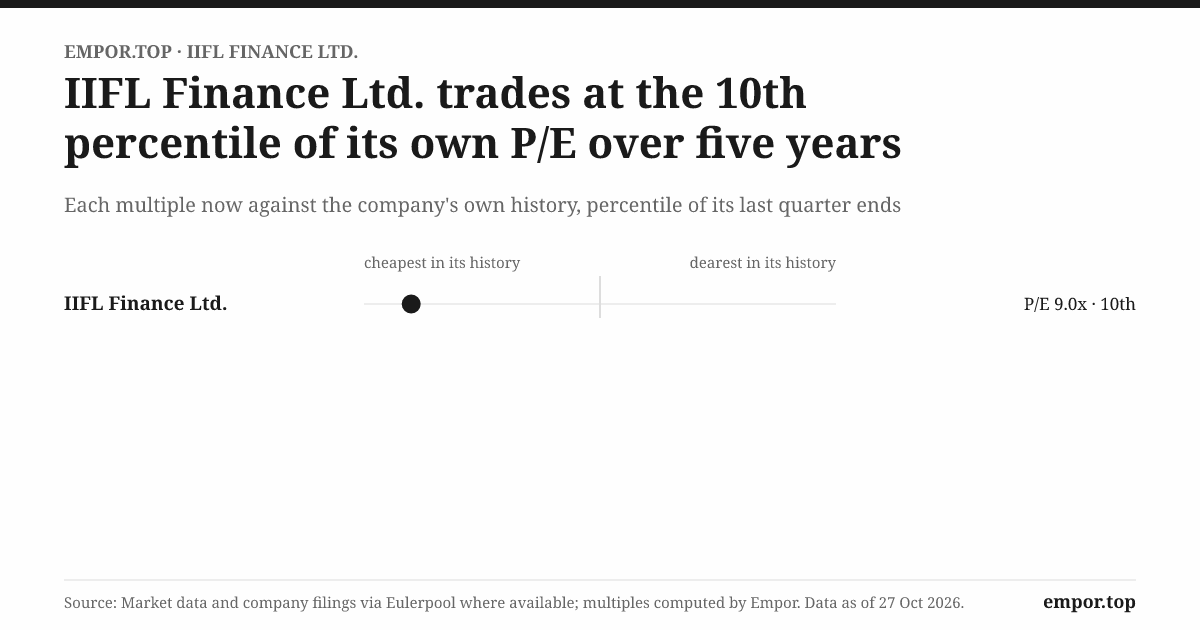
The market has an opinion, or at least a mood. On October 27, 2026, IIFL Finance traded at about 9 times trailing earnings, against a five-year median of about 12 times, and at roughly 1.5 times book value.6
The group had just reported a record quarter, with ₹805 crore of profit before minority interests, the first time it had crossed ₹800 crore in a quarter.5 Strong growth and a discounted multiple can both be true at once. Investors are being asked to decide which one is telling the truth about the next five years.
The answer starts not with gold, but with a research report that almost nobody paid for.
 Subscribe on LinkedIn
II. From Research Desk to Listed Lender
In 1994, Nirmal Jain was running research at Inquire, a unit of the broking house Motilal Oswal. A year later he left to start his own firm, with no family money and no business dynasty behind him, just an IIM Ahmedabad degree and a conviction that independent research was worth selling.7 The company was incorporated in Mumbai in 1995 as Probity Research and Services, an information-services business that would later be renamed India Infoline.[^8]
The early years were a lesson in how markets refuse to pay for what they admire. In 1999 the firm produced a research report on the information-technology sector that was widely read and barely bought. Jain's response was to give the research away online, which turned the firm into a financial portal rather than a subscription shop.7
Then the dotcom bust arrived and left the company with only a few months of cash. Jain and his co-founder, R. Venkataraman, reached for a business that would earn money from the very readers they had attracted: in 2001 they launched an online broking platform, later known as 5paisa, that charged far less than the industry norm.7[^8]
That pattern, a cheap product that pulls in a crowd and a second product that monetises it, would define the next two decades. Brokerage income compounded through the 2003–2008 bull market.7 The firm became a corporate agent for life insurance, picked up a commodities licence and listed on both Indian exchanges.[^8]
Jain hired whole teams and gave them equity: he recruited an institutional-equities desk from CLSA in 2007 and a wealth-management team under Karan Bhagat in 2008.7 He was, in the words of a 2017 profile, a financier who cared about return on equity and believed that a business with a weak balance sheet could get into big trouble.7 Keep that line in mind. The next chapter would test it.
Between 2006 and 2010, the group made the move that matters most for today's company. It began lending, shifting from fee income to a business that earns its living on its own balance sheet, and it started a gold-loan business as part of that new product range.[^8] It also registered with the National Housing Bank to write home loans.[^8]
The group applied twice for a banking licence and was turned down twice.7 Without deposits, it would have to fund every rupee of lending in the wholesale and bond markets, which made the cost of money, and the credit ratings that set it, a continuing part of the strategy.
Lending changed the character of the company in ways that a research-and-broking founder had to learn on the job. A broker's risk is mostly operational and reputational; it holds client money, but it does not lend its own balance sheet for years. A lender's risk is that it gets paid back late, or not at all, and that it finds out only after the money has gone.
By 2017, the profile writers were crediting the non-bank lender, then run by chief executive Rajashree Nambiar, with doubling its loan book as it moved toward retail lending.7 The shift from fees to spread had begun to dominate the group's economics, and with it came a new kind of dependency: on the people in branches who decided, one loan at a time, whether a borrower and a piece of collateral were good enough.
The financial supermarket kept adding aisles. In the late 2010s the group acquired Samasta Microfinance, a Bengaluru-based lender to women's groups in rural India, and raised capital from Fairfax, CDC Group and General Atlantic.[^8]
By then it had wealth management, asset management, broking, investment banking, housing finance, microfinance, business loans and gold loans under one holding company. The structure was full of talent and empty of focus. Investors valuing a wealth manager, a broker and a lender in a single stock had to argue about three businesses at once.
So in January 2018 the board approved a reorganisation, and on May 13, 2019 it took effect. The wealth business and the securities business were carved out as separately listed companies, IIFL Wealth and IIFL Securities, and the holding company that remained was renamed IIFL Finance.8
For every seven shares a holder owned, they received seven shares of IIFL Finance, seven of IIFL Securities and one of IIFL Wealth.8 The lender inherited the original 1995 corporate identity, and with it the founder: Nirmal Jain stayed on as managing director of the finance company.5
The demerger matters for two reasons. The first is accounting. Any long-run growth series for IIFL Finance crosses that 2019 change in perimeter, so a ten-year record of about 13% annual revenue growth and about 12.5% annual profit growth mixes a financial conglomerate with today's lender.9 It is not a clean like-for-like history. The second is reputational.
When SEBI barred IIFL Securities in June 2023 from taking on new broking clients for two years over the handling of client funds between 2011 and 2014, the headlines said "IIFL," and many readers assumed the lender was in trouble.10 It was not the lender's case. The broker was a separate listed company by then, and in December 2023 the Securities Appellate Tribunal set aside the two-year ban, found no misuse of client funds and cut the penalty to ₹20 lakh for a technical breach.10
The regulatory event that does belong to IIFL Finance arrived three months later: the RBI's restrictions on gold lending. That is the line to hold for the rest of the story. The founder's history explains the group's structure, its appetite for building new businesses and its comfort with partners and minority investors.
But today's investment case rests on something much narrower and more mechanical: whether a lender can weigh gold correctly, lend against it prudently, fund itself cheaply and convince a regulator that it can be trusted to do all three. To see why that is narrower than the group's own presentation suggests, look at where the loans actually sit.
III. Three Businesses, One Listed Parent
Open the group's results for the September 2026 quarter and the first number is the big one: ₹1,24,268 crore of loans under management.4 The mix looks reassuringly balanced. Gold loans are about 53% of the group book, home loans about 27%, loans to small businesses about 10% and microfinance about 8%, and roughly 90% of everything is secured by collateral.45 Read that slide alone and IIFL looks like a diversified retail lender with a gold-loan specialism.
Now turn to the parent. IIFL Finance on a standalone basis managed ₹70,382 crore, and ₹65,729 crore of it, or about 93%, was gold.4 Small-business loans were under 3% and a winding-down collection of older books, from commercial real-estate loans to discontinued digital and unsecured lending, made up most of the rest.4
The home loans live in IIFL Home Finance, which managed about ₹43,070 crore, and the microfinance loans live in IIFL Samasta Finance, which managed about ₹10,816 crore.5 The diversification is real at the group level. At the level of the company whose shares trade as IIFL on the National Stock Exchange, it is mostly an idea.
That distinction would be academic if the parent were a small part of the group. It is the largest part. In the September quarter the standalone company earned ₹548.5 crore after tax, against ₹805 crore for the group before minority interests.5
Roughly two-thirds of the group's profit came from the gold-heavy parent, with IIFL Home Finance earning about ₹189 crore and Samasta about ₹69 crore.5 The subsidiaries matter, but they are not ballast that can steady the ship if gold lending stumbles. They are the smaller cargo.
Each of the four lending lines serves a different customer with a different kind of collateral, and the yields tell the story. Gold loans are short, small advances against household jewellery, with an average ticket of about ₹1.2 lakh, and they earned about 18.7% in the quarter.4 Home loans are long mortgages to lower- and middle-income families and earned about 10.4%.4
Small-business loans, mostly secured against property, earned about 15.4%, and microfinance, unsecured group loans to rural women, earned about 24%.4 The spread between the cheapest and the dearest product is nearly fourteen percentage points, which is another way of saying these are four different businesses that happen to share a logo.
Gold is the interesting one because it seems too good. Why does a loan backed by metal sitting in the lender's own vault carry a yield almost twice that of a mortgage? The answer is that the borrower is paying for speed and access as much as for money.
A gold loan can be made in under an hour, with little paperwork, to someone who may have no credit history and no other collateral. The lender is paid for running a branch, testing the gold, storing it safely, insuring it, and chasing and sometimes auctioning it. And the loans are short, so the lender reprices and re-earns its fees again and again.
But secured does not mean safe. The collateral is only as good as the assay that valued it, the vault that holds it, the ceiling that limits how much is lent against it, and the auction process that sells it when a borrower defaults. Every one of those steps was on the RBI's list of failures in March 2024.1
The risk in a gold-loan book is not mainly that borrowers stop paying. It is that the lender's own processes stop working, so that a loan which looked 70% covered turns out to be backed by less gold, or lighter gold, or gold that cannot be sold transparently.
Group figures can blur this. The standalone company reported 97% of its loans as secured and a gross non-performing ratio of 1.30%; the group reported 1.48%, a number that blends in housing and microfinance.54 The two are honest measures of different entities. An investor who wants to understand IIFL Finance's shareholders' exposure should start with the first and treat the second as context.
The most delicate line in the parent's income statement is the one labelled "income from off-book." A large part of IIFL's growth is funded by other people's balance sheets. It sells pools of loans to banks through direct assignment, or originates loans jointly with banks through co-lending, and keeps servicing them.
Across the group, ₹42,796 crore, or about 34% of loans under management, sat off the balance sheet with 18 banking partners.5 On the standalone books in the September quarter, off-book income was about ₹540 crore against net interest income of about ₹838 crore.4 More than a third of the parent's income in the quarter, in other words, came from loans it had partly or wholly passed to others.
Management's explanation on the October 15 call was candid and worth hearing precisely. When IIFL assigns loans, part of the income is recognised upfront and the rest amortises as the book runs off; in co-lending, there is no upfront income at all, and IIFL's share simply accrues like interest.5
Nirmal Jain said that as co-lending grows, upfront income will decline or at least grow more slowly, while net interest income keeps building.5 That is a sensible transition, and it also means that the reported mix of earnings is going to change shape for reasons of accounting as much as economics. The puzzle of how much of the profit is repeatable belongs to that line, and the next section on earnings will return to it.
The parent's smaller books carry a lesson of their own about how IIFL allocates capital. Its presentation lists about ₹2,000 crore of "discontinued" business, digital, personal and unsecured business loans that the company has stopped writing, plus a commercial real-estate book being wound down.4 On the October call, Jain recalled a time when the group ran a micro loan-against-property product yielding as much as 34% that produced "massive losses," and explained that the company had deliberately moved its small-business lending toward better borrowers at yields of about 12.5–13.5%.5
That is a credible correction, and it is also a record: the founder who prizes return on equity has also funded high-yield experiments that failed. The lesson IIFL drew was to give up yield for quality. Whether it applies the same restraint to gold, its most profitable product, is the question that runs through the rest of this story.
One more business deserves a sentence, mostly so it does not get more. IIFL formed a joint venture with Open Financial Technologies to build a neobank for small businesses.[^8]
It is a reasonable experiment, but nothing in the company's disclosures establishes it as a material source of revenue or profit, and a digital banking app is not evidence of a lending moat. The moat question is about the branches, the vaults and the people behind the counter. That is where the competition is fiercest.
IV. The Branch Network Meets Muthoot’s Scale
Walk into an IIFL gold-loan branch in a small town and the transaction follows a script. The customer, often a shopkeeper or a farmer, sometimes a salaried worker short of cash before school fees are due, lays family jewellery on the counter. Two valuers test it independently, and the company says it lends against the lower of the two valuations.4
The gold is sealed in a tamper-proof packet marked with the loan number and stored in a vault with OTP-based access and central monitoring.4 The customer walks out with cash or a bank transfer. A few months later, they will decide whether to repay, renew, or take their gold to the shop across the street.
That last choice is the whole competitive game. Gold loans are not a product with deep switching costs. The customer owns the collateral and can move it the moment the loan is repaid. Competitors include public-sector and private banks, which can lend cheaply against gold; specialist gold-loan companies, which have the longest-standing branch networks; and a growing crowd of other lenders that have noticed gold's yields and secured status.
They compete on speed, branch proximity, how much they will lend per gram, the interest rate and fees, and the hardest thing to measure: whether the customer trusts the lender to give the jewellery back intact.
The specialist that sets the bar is Muthoot Finance. At March 31, 2026, Muthoot's gold-loan book was about ₹1.54 lakh crore, up by roughly half in a year.11 On the same date, IIFL's standalone gold book was about ₹52,600 crore.4
Muthoot was nearly three times larger in IIFL's core product, with a group network of about 7,568 branches.12 Manappuram Finance, the third large listed specialist, adds to the crowd. IIFL is a major player in gold finance, but it is not the scale leader, and any claim of advantage has to start from that fact.
What about momentum? IIFL's standalone gold book went from about ₹21,000 crore in March 2025 to about ₹52,600 crore in March 2026, and then to about ₹65,700 crore by September 2026.4 Muthoot grew by about half in the year to March 2026; IIFL's gold book grew by about 150%.114 It is tempting to read that as market-share capture. Much of it is recapture. IIFL was rebuilding from the trough the embargo had dug, and gold prices had risen enough to lift every lender's book, because the same necklace now secures a bigger loan.
Management made the same point on the October call, describing the growth as "recouping our market share" two years after resuming business, and adding that the market itself was expanding.5 The cleanest evidence of genuine customer gains is in grams, not rupees. Gold tonnage in the standalone book rose from about 64 tonnes to about 69 tonnes in the September quarter, and the company added about 3.5 lakh new customers and 105 new branches during those three months.54 More gold in the vault, rather than more rupees against the same gold, is the signal that matters.
Branch productivity is the next test. The standalone company ran 3,128 branches at the end of September 2026, which puts gold loans at roughly ₹21 crore per branch.4 That is respectable, and it rose quickly as the book recovered. But IIFL does not publish retention or repeat-borrowing rates, it does not disclose win-loss data against competitors, and it gives no same-period, like-for-like productivity comparison with peers.
A moat built on distribution should show up as customers who return, branches that become more productive with age, and pricing that holds when rivals discount. The first two are not disclosed, and the third has only a quarter of evidence.
That quarter is still worth listening to. On the October call, an analyst observed that larger competitors had run lower-rate schemes in September, yet IIFL's gold yield had risen to about 18.7%.54 Jain's answer was that the company focuses on customers rather than competition and does not lure borrowers with a low teaser rate only to raise it to 16% or 18% within a month.5
That is a claim about pricing discipline and transparency, and transparency in charges was one of the RBI's original findings against the company.1 So the claim is both encouraging and pointed: the company is now selling as a strength the very thing it was faulted for. One quarter of holding yield against discounting rivals is a data point, not a pattern.
To see why yield is only half the story, follow a rupee through a gold loan. The parent earned about 18.6% on its loans in the September quarter and its reported spread of about 9.2 percentage points implies a borrowing cost of roughly 9.4%.5 Running the branches, staff, vaults and technology cost about 3.1% of average loans.5
What is left must cover credit losses and auction costs before it becomes profit. Gold has historically had very low loss rates because the collateral can be sold, but the arithmetic changes when gold prices fall sharply, because the cushion between the loan and the metal shrinks for every borrower at once.
There is also a regulatory constraint that applies to everyone. On September 30, 2024, eleven days after IIFL's restrictions were lifted, the RBI sent a circular to banks and non-bank lenders listing irregular practices it had found across the industry: valuation of gold without the customer present, weak use of third-party agents, poor monitoring of loan-to-value ratios, opaque auctions, cash disbursements above legal limits, top-up loans that looked like evergreening, and overdue loans not classified as bad.13
Lenders were told to review their policies and report remedial action within three months.13 The industry then moved to new gold-loan rules; by the September 2026 quarter, analysts on IIFL's call described a sharper competitive landscape after lenders adapted their products to the changed regulations, and IIFL said it had begun processing a portion of its loans as "income-generating loans," with income checks using credit-bureau, bank and GST data.5 Compliance is now a cost every gold lender pays. It is also a field where IIFL has already lost once.
The new rules cut both ways for growth. Jain explained that the income-generating loan process allows a lender to go up to 85–90% loan-to-value on qualifying borrowers, although he said IIFL does not lend that high, and that the company's average loan-to-value on its standalone gold book was about 70%.54
He estimated that only about 20–25% of loans were yet being processed this way, but that 70–80% of customers were small-business owners who would qualify.5 More room to lend per gram is an opportunity in a rising gold market and a source of thinner cushions if prices turn. The lender that pushes hardest on loan-to-value will win volume first and test its auction process first.
The verdict for this part of the case is a narrowed claim. IIFL has meaningful branch reach, a large and fast-recovering gold book, and some evidence that it can add customers and grams, not just rupees. It does not yet have evidence of a durable moat against a competitor almost three times its size.
Retention, branch productivity over time, auction losses and risk-adjusted returns through a gold-price decline are the tests, and the company publishes only some of them. The most important evidence about the moat is not in the good quarters. It is in the six months when the counter was closed.
V. The RBI Stops the Gold Loan Machine
The regulator's inspection that triggered the order looked at IIFL's books as of March 31, 2023.1 So the problems the RBI described were visible roughly a year before it acted, and by its own account it had spent months raising them with management and the auditors.1
When the order came, it was not a bolt from the blue so much as the end of the regulator's patience. That matters for judging management. The failure was not only that branches had cut corners on assaying and cash. It was that the institution did not fix them quickly once the supervisor pointed them out.
The design of the order was surgical in a way that made it brutal. By barring new loans, the RBI stopped the renewals that keep a gold book alive, because so much of the business consists of customers rolling over short loans.
By barring assignment, securitisation and sale, it shut a funding channel too: IIFL could no longer sell gold-loan pools to banks to free up capital for new lending.1 The company was left with a book that could only shrink, and a funding model that had depended in part on selling that book.
The shrinkage was fast. Between March 5 and August 5, 2024, IIFL paid about ₹10,900 crore to its co-lending and assignment bank partners and repaid about ₹2,600 crore of loans, returning roughly ₹13,500 crore to banks as the gold book liquidated.2
By the end of June 2024, gold-loan AUM was down about 37% from the previous quarter.2 Kapish Jain, then group chief financial officer, said the quarter's performance had been "hugely impacted" by the embargo.2 Annualised return on equity for that quarter fell to about 10%.2
Nirmal Jain's commentary from that period is revealing for its framing. He called the episode a "trial by fire" and argued that the smooth liquidation proved the strength of the asset quality: over a million customers had closed their accounts and retrieved their jewellery, and the banks had been repaid without incident.2 There is something to that.
A gold book that can return half its value in cash in five months, with no reported crisis of missing gold, is not a fraud book. But the argument answers a different question from the one the RBI asked. The regulator had not said the gold was missing. It had said the company was measuring it badly, lending too much against it, handling too much cash and running opaque auctions.1
On the remediation itself, the company's August 2024 disclosure listed the steps: full adherence to RBI directives, a root-cause analysis, hiring to strengthen senior management and the risk, audit and compliance functions, and submission of a compliance certificate.2 The RBI's special audit was completed on May 27, 2024.2
The company told investors it expected the restrictions to be lifted shortly, and said it was dedicated not just to surviving, but to emerging stronger.2 It took another four months. On September 19, 2024, the RBI lifted the restrictions with immediate effect.3
Then came the industry-wide circular eleven days later, which put the IIFL case in context. Many of the practices identified across supervised lenders overlapped with the findings against IIFL.13
It would be easy to conclude that IIFL was simply the lender caught first in a sector-wide clean-up. That reading is half right. Compliance standards were an industry problem. But IIFL was the one whose shortcomings were serious enough, and whose response slow enough, to earn a company-specific embargo. The circular spread the blame. It did not erase the distinction.
Since then, the supervisory record has been quieter but not silent. In February 2026, the RBI fined IIFL ₹5.30 lakh for failing to classify certain restructured accounts as non-performing, based on an inspection of its position as of March 31, 2024; the company said the accounts were no longer on its books and the penalty had no material impact.14
In May 2026, the RBI imposed a further ₹3.1 lakh penalty because the company had failed to pay some borrowers the surplus realised when their pledged gold was auctioned, a finding from an inspection of the books as of March 31, 2025.15 Neither fine is remotely comparable to the 2024 order. The second, though, concerns gold auctions and a period after the embargo had been lifted, which makes it a small but relevant signal about whether the auction process had fully healed.
Management's account of what changed has also been consistent across calls, which counts for something. In May 2025, Jain told analysts that the regulatory environment had become progressively more stringent and that the company had strengthened its compliance framework to meet the RBI's scale-based rules for upper-layer non-bank lenders, with tighter board-level oversight, automated compliance systems and proactive monitoring and reporting.16
Eighteen months later, his October 2026 description of the gold business emphasised transparent pricing and trained staff rather than raw growth.5 The language has not drifted back toward the volume-first tone of a lender eager to make up for lost time. Words are not controls, but a management that keeps repeating the lesson is at least not pretending it never happened.
The company's own annual report adds one more datapoint. The FY26 auditor's statement records a fraud of about ₹9.2 crore detected in lending operations, of which about ₹1.6 crore had been recovered, with no fraud by the company itself identified.9 For a lender with tens of thousands of crore in loans, that is small. It is still a reminder that branch-level controls are a daily operating problem, not a box ticked after a special audit.
What does the company's current presentation say about controls? It says its gold-loan risk system includes bureau and AI-based fraud checks at onboarding, two independent valuers, real-time vault monitoring, scheduled and surprise audits including purity verification of nearly all packets, and AI image analysis to flag duplicate pledging or quality mismatches.4 These are exactly the safeguards the 2024 findings called for.
They are also management's description of its own system. The independent evidence that controls held is narrower: the RBI lifted the embargo, no repeat company-specific business restriction followed, and the later penalties were small. That is meaningful, but it is a record of two years in a rising gold market. The harder test of an auction process comes when gold prices fall and auctions multiply.
So when gold AUM came back, did the control environment come back with it, and better? The best answer the record allows is: probably better, not yet proven. And the recovery in gold volumes created its own problem for anyone trying to read the profits.
VI. The Rebound Has Two Earnings Stories
Look at the profit line over three years and it reads like a cardiogram. Net profit fell about 78% in the year to March 2025, as the embargo choked the gold book and microfinance credit costs spiked. Then it rose about 340% in the year to March 2026.9 And in the September 2026 quarter, profit attributable to shareholders roughly doubled again from a year earlier.6
Anyone quoting those growth rates is technically correct and analytically lost. Over the full three years to March 2026, net profit grew only about 3.4% a year.9 The company is roughly back where it was before the RBI's order, with a bigger balance sheet. That is a recovery, not a growth record.
The first story inside the rebound is a straightforward one, and it is good. The gold book came back, and gold loans are the highest-earning product in the parent. Credit costs came down sharply. In May 2025, management told analysts that credit cost had been 3.1% of loans in FY25 and guided to 2.5–2.7% for FY26.16
CRISIL later reported a group credit cost of about 1.6% for FY26, well inside that guidance.17 Operating costs fell as a share of the book, to about 3.3% of average loans in the September 2026 quarter against a peak of about 4%.5 That is the kind of improvement management promised and then delivered, which deserves to be said plainly: on credit costs, the company beat its own guidance.
The second story is about how the money is booked. When IIFL assigns a pool of loans to a bank, accounting rules allow it to recognise a gain on derecognition of those loans, essentially part of the future spread it expects to earn on the pool.
In FY26 that gain was about ₹1,069 crore at the consolidated level and about ₹735 crore at the parent.9 Set against consolidated profit before tax of about ₹2,409 crore, the derecognition gain was roughly 44% of the group's pre-tax profit.9
That does not make the profit fake. Assignment is a routine business for IIFL, not a one-time sale; the company says it has originated more than ₹1.7 lakh crore of loans over ten years that were assigned or co-lent to banks.5 As long as it keeps originating and selling, there will be gains to book.
But the gain depends on the volume of new assignments in the year, which depends on bank appetite, regulation and the company's own capital needs. It brings forward income that a pure on-book lender would earn over the life of the loan. And it is the first line to shrink if the company changes its mix toward co-lending, which management says it is doing.5
The quarter-by-quarter evidence is already showing that shift. In the September 2026 quarter, the parent's off-book income fell about 7% from the previous quarter even as off-book loans rose, while its net interest income jumped about 21%.4 Jain told analysts that this was co-lending at work: no upfront income, but steady interest accrual "quarter after quarter."5
He also addressed the long-running analyst concern head-on, arguing that the upfront component exists only on the flow of new loans and "harmonizes over a period of time."5 It is a coherent explanation. It is not a published bridge. The company does not provide a reconciliation that strips out derecognition gains and fair-value movements to show what profit would be on a pure accrual basis.
So build a rough one from what is published. In the September 2026 quarter the parent earned about ₹838 crore of net interest income, ₹540 crore from off-book loans and ₹40 crore of other income.4 It spent about ₹525 crore on operations and set aside about ₹137 crore for loan losses, and it took a small loss of about ₹14 crore on fair-value changes.4 Net interest income alone more than covers operating expense and provisions, which is a healthy sign.
But a large share of the profit margin above that line still comes from the off-book income, whose shape management itself expects to change. The honest conclusion is that the recurring lending engine is clearly profitable, while the exact size of the "normal" earnings run rate, after the off-book line has been fully converted to co-lending accrual, remains unknown.
The small-business book shows the opposite trade-off in action. Group small-business loan yields fell by almost a percentage point in a single quarter, to about 15.4%, and by more than two points in a year, as IIFL moved toward safer borrowers.4 An analyst on the October call pointed out that credit costs would not fall by as much as yields had, and asked what that meant for returns.
Jain answered that the segment's return on assets would be roughly break-even this year, before returning to the 2.5–3% target next year, and argued that lower yields would bring lower credit and collection costs and steadier reported numbers through the cycle.5 That is an honest answer, and it means one of the group's diversification engines is, for now, contributing growth but little profit. The rebound's earnings power is therefore even more concentrated in gold than the loan mix implies.
Fair-value gains add another, smaller wrinkle. Group fair-value gains were about ₹219 crore in FY25 and only about ₹30 crore in FY26, which flattered the depressed year and dragged slightly on the recovery year.9
In the September 2026 quarter, the parent's fair-value line was a small loss.4 Reported other income was trivial, about ₹23 crore for the whole group in FY26.9 The profit is not coming from treasury trading. It is coming from lending and from the accounting treatment of loans sold.
Funding costs are the slow variable underneath. The group's cost of funds was about 9.5% in FY26 and 9.6% in the June 2026 quarter, by CRISIL's measure; the company's own reported cost of borrowing was about 9.1% in the September quarter, with an interest spread of about 7.4% across the group.174
Those are labelled differently and measured differently, and they belong to the group, not the parent. The direction is what matters: funding costs have been stable rather than falling, so the margin recovery has come from mix and volume rather than cheaper money.
One trap remains, and the fact that it is a trap is itself a lesson about lenders. IIFL's operating cash flow was negative in FY23, FY24 and FY25 and positive in FY26.9 For an industrial company that pattern would scream that profits are not turning into cash.
For a lender it means almost nothing on its own, because every new loan is an operating cash outflow and every loan collected or sold is an inflow. The FY26 swing to positive reflects collections, assignments and funding movements as much as profitability.9 The real conversion tests are credit losses, write-offs and capital, not the cash-flow statement.
The calls give a useful credibility read. In May 2025, management promised an acceleration in profit and assets toward the pre-embargo trend line, a return on assets closer to 3%, and pickup in co-lending and assignment.16 By October 2026 the company reported a group return on assets of about 3.1% and return on equity of about 20% for the half year, both annualised.5
On the headline promises, management delivered. Where it has been less concrete is the bridge analysts keep asking for: how much of the profit is upfront, and what remains when it is gone. The more the company leans on co-lending, the more that bridge will matter, because the growth also has a cost that the profit and loss account does not show. It needs capital.
VII. The Group Grows; The Parent Needs Capital
In May 2024, two months into the embargo, IIFL Finance went to its own shareholders for money. The rights issue was oversubscribed and raised ₹1,271 crore.[^19]
It was an act of faith from investors who could see the gold book shrinking month by month, and a signal that the founder and major holders were willing to stand behind the company. It also bought time. A lender whose largest product is frozen still has to service debt, keep ratings and be ready to restart.
Two years later, the board was back with a much bigger ask. On June 27, 2026, it approved seeking shareholder authority to raise up to ₹10,000 crore through equity or eligible securities.18 At the July 2026 annual general meeting, shareholders approved it, but about 14% of the votes cast on that resolution were against, a meaningful level of dissent for an enabling authority.19
On the October call, Jain said the company was committed to raising equity "at the earliest opportunity," hoped to close something in the December quarter, had not decided between private equity and a qualified institutional placement, and expected dilution of "anywhere from 10% to 20%."5 With a market value of about ₹22,500 crore, that range implies roughly ₹2,250 to ₹4,500 crore of new equity, well below the authorised ceiling.6 None of it has happened yet.
Why does a lender that just earned a record profit need equity? Because lending growth eats capital. Every loan kept on the balance sheet requires the lender to hold a slice of equity against it, and every rupee of growth must also be funded with debt that creditors will only lend against an equity cushion. IIFL's debt was about five times its equity at March 2026, which is normal for a non-bank lender but makes liquidity and ratings central to the model.9
The standalone company's capital adequacy ratio was about 17% in September 2026 and its net gearing about 4.7 times, against 39% capital adequacy at the housing finance subsidiary and 26% at Samasta.45 The capital is in the wrong place. The fastest-growing business is in the parent, and the parent is the thinnest.
The most striking sentence of the October call came when an analyst asked why IIFL co-lends gold loans at all, given its own large branch network. Jain answered candidly: the company does not have enough capital, and its capital adequacy is not sufficient to keep everything on its own books.5 That is an important admission.
Co-lending is often described as a strategic, capital-light choice, and the company's presentation calls it exactly that. In this case, it is also a necessity. An analyst put the share of gold loans that were assigned or co-lent at close to 40%, and Jain did not dispute it; those arrangements share the yield with bank partners because the parent cannot afford to keep the loans itself.5
The obvious question is why the group cannot move capital from the well-capitalised subsidiaries to the thin parent. Jain gave the answer on the call: subsidiaries can raise equity, but sending money up to the parent as dividends is taxed, so the efficient route is to sell part of a subsidiary.5 He confirmed that a sale of Samasta had been considered and said divestment or part sale of a subsidiary would take time, so a primary raise was needed first so that growth would not be affected.5
He also said that within six or seven quarters there would be an opportunity to demerge, divest or unlock capital in the subsidiaries.5 Later in the same call, asked about any specific divestment plan, he said there was none at that point.5 Those statements fit together, barely: options are open, and none is ready.
The history of minority capital in the group is relevant here. In 2022, the Abu Dhabi Investment Authority agreed to invest about ₹2,200 crore for a 20% stake in IIFL Home Finance.[^8] That money went into the subsidiary and strengthened its balance sheet; it did not reach the parent's capital ratio.
The episode shows that the group can attract sophisticated outside capital to its subsidiaries, and also explains why the subsidiary is now so much better capitalised than the parent it belongs to.
Then there is the web of transactions between the parent and its affiliates. In FY26, the standalone company paid about ₹160 crore of referral fees to Samasta and about ₹21 crore to IIFL Capital, earned about ₹84 crore of referral and other income from Livlong Protection, assigned about ₹830 crore of loans to Samasta and bought about ₹42 crore of assigned loans, and paid IIFL Home Finance a small guarantee fee while standing behind a ₹163 crore corporate guarantee for it.9
Its investment in subsidiaries was about ₹2,160 crore.9 These are disclosed related-party transactions, not external customer revenue, and the annual report gives no comparable denominator to show how much of each business's profit they represent.9 They are not, by themselves, evidence of anything improper. They are evidence that the parent's standalone numbers depend partly on prices that the group sets for itself, which is exactly why a clean parent-to-subsidiary profit and capital bridge would help shareholders.
An activist reading the same documents would push on three points. First, the issue price: on the call, a shareholder urged management to hold a minimum price-to-book line, and Jain acknowledged a trade-off between price and growth, stressing that an equity cushion would also help ratings and funding costs.5 At 1.5 times book and 9 times earnings, any raise now would sell new shares well below the company's own historical valuation.6
Second, the order of operations: if a subsidiary sale could release capital in six or seven quarters, why dilute now rather than slow growth? Management's answer is that growth would suffer; the counter is that growth only creates value if its return beats the cost of the equity issued to fund it. Third, accountability: the 14% vote against the authority is a measurable sign that a minority of holders shares those concerns.19
On governance, the record is mixed but not alarming. Nirmal Jain remains founder and managing director and held about 12.6% personally in March 2026; promoters and the promoter group held about 24.8% in September 2026, and Fairfax FIH Mauritius held about 15.2% in March 2026.209 Promoters had no pledged shares at March 31, 2026.9 The board of nine had an independent chair and a majority of non-executive directors.9
Jain's salary and perquisites were about ₹14.7 crore in FY26, unchanged from the year before.9 One notable personnel move came in June 2026, when Kapish Jain, the group CFO who had walked investors through the embargo and its aftermath, left the role and Vikas Jain took over; it was Vikas Jain who opened the October call.165 The company gave no indication that the change was tied to any issue. It does mean the next equity raise will be run by a new finance chief.
One more ownership change is worth a passing glance. Smallcap World Fund, a large long-only fund, raised its disclosed stake from about 5.2% to about 6.0% in the year to March 2026.9 It is a vote of confidence from a patient institution, but one holder's stake does not explain the broader flows, and the stock still trades at a discount to its own history.
The equity raise will be the true test: the price paid by the new investors, the dilution borne by the existing ones, and whether the capital lifts the parent's returns or merely keeps it running faster to stay in place. And capital is only one of the things that could go wrong.
VIII. What Could Break the Recovery?
On the October 2026 call, the first analyst question was not about the record profit. It was about gold-loan bad loans. Gold non-performing loans had risen by about 30 basis points in a single quarter, to about 0.9% of the group's gold book, from almost nothing a year earlier.45
The analyst noted that almost 7% of the gold book was between one and thirty days overdue and asked what would happen if gold fell another 10%.5 Jain's answer was direct: non-performing loans could rise to 1%, 2% or even 3% in such a scenario, but ultimate losses would remain minimal because customers know their jewellery is worth more than the loan.5
That answer is the cleanest statement of the bull case on gold risk, and it is also the place to test it. It is true that gold loans have historically produced low losses because the collateral is liquid. But Jain also told the same analyst that the loan-to-value ratio on the 90-day-overdue cohort was around 85%, against a portfolio average of about 70%.54 The loans that go bad are the ones with the thinnest cushion.
A 10% fall in gold on a loan at 85% loan-to-value leaves a loan at about 94% of the collateral, before interest accrues. A 15% fall leaves no cushion. The scenario Jain describes is plausible. It is not the same as a realised loss record through a real downturn, and the company's own management had just reported that a 10% correction earlier in the year had already lifted delinquencies.5
Auctions are where that risk becomes cash. Jain said the company processes about 40–50 lakh gold transactions a year and that roughly 1–2% go to auction in a typical year, adding that auctions had been almost negligible in the previous two or three quarters before rising slightly.5
The company does not publish a time series of auction volumes, recovery rates or loss severity by segment. For a lender whose 2024 embargo was triggered in part by its auction process, that series would be the single most persuasive disclosure it could make.1
Credit quality outside gold has improved, but it is not uniform. Group small-business loans had a gross non-performing ratio of about 3.0% and microfinance about 2.9% in September 2026, both down sharply from about 5% a year earlier.4 CRISIL's August 2026 rationale gave the context that a raw ratio hides: group gross non-performing loans were about 1.6% in June 2026, but about 3.9% once the write-offs of the previous twelve months were added back.17
Write-offs make a book look cleaner without making the losses disappear. CRISIL named asset-quality stress, elevated credit costs, write-offs, security-receipt redemption and funding cost as constraints on the rating.17 The group's 90% secured share reduces risk. It does not remove borrower-level credit risk, and the secured share is concentrated in a single collateral.
Funding is the next pressure point. IIFL has no deposits, so it borrows from banks, bond markets and overseas investors. In the first half of FY27 it raised about $800 million through international bonds, including a $300 million social-bond tap that was about 2.3 times subscribed, and Fitch upgraded its rating to BB-.5 That is real evidence of market access, and the liquidity cushion has grown with it: the group held about ₹13,800 crore of cash and undrawn lines in September 2026, against a buffer of over ₹5,200 crore that management described in May 2025.516 Jain said the higher-than-usual liquidity reflected global uncertainty and an expected tightening in local markets.5
A lender that stockpiles cash ahead of a storm is behaving prudently; the cost is that idle liquidity earns less than loans. But ICRA's long-term rating carried a negative outlook in February 2026, and the standalone gearing of about 5.4 times reported by CRISIL keeps the company dependent on lenders' confidence.2117 The mechanism to fear is simple: if funding costs rise faster than gold-loan rates can be repriced, the spread compresses before any loan goes bad. A rating downgrade would make every future rupee of growth more expensive at precisely the moment the company is trying to grow fastest.
Legal and tax overhangs are smaller but material enough to name. At March 2026, the standalone company carried disputed income-tax demands of about ₹338 crore and indirect-tax matters of about ₹136 crore as contingent liabilities.9 Separately, after an income-tax search in January 2025, the company received a demand of about ₹476 crore in May 2026, which it appealed and sought to stay.6
In October, Jain said a stay had been obtained and the matter was being litigated.5 These are separate exposures, and none of them, even if lost in full, would overwhelm the balance sheet. Together, they are a reminder that the company's relationship with its regulators extends beyond the RBI.
There is also a regulatory threat aimed at the subsidiaries. An insurance-regulator consultation paper on commissions could cut cross-selling income, which management put at about ₹250–260 crore across the group, mostly at the housing finance and microfinance subsidiaries; the parent earns hardly any.5 It is a group earnings risk, not a parent franchise risk, and management said it was working on ways to replace the income.5
The market's own verdict sits in the valuation. At about 9 times trailing earnings, against a five-year median of about 12 times, IIFL trades at roughly a quarter less than its own history.6 In a September 2026 peer snapshot, Muthoot traded at about 10 times earnings and Bajaj Finance at about 32 times; those are different dates and should be read as context only.22
What the discount appears to assume is that IIFL's earnings are less durable, more exposed to gold and to regulators, and soon to be spread over more shares. That is skepticism, not a forecast. Whether it is too much skepticism or too little depends on what happens to the very risks in this section. On the evidence, the downside mechanisms are visible and the through-cycle returns are not yet established, which is why the bull and bear cases deserve to be set out side by side.
IX. Analysis & Bear vs. Bull Case
Set two documents beside each other. One is the September 2024 letter from the RBI lifting restrictions on a business that had shrunk by half. The other is the company's October 2026 presentation, with its FY27 targets of about 25% loan growth, credit costs of 1.5–1.7% and return on assets of 3.1–3.3%, and a three-year plan aiming for roughly 20% annual loan growth and credit costs falling toward 1.0–1.2%.4
Between those documents lies the whole argument: a company that was told it could not be trusted to grow its main product now promises to grow it faster than the market.
The bull case starts with a franchise that survived a stress test few lenders face. A large gold book, more than 3,000 standalone branches, an average ticket of about ₹1.2 lakh and 25 lakh standalone customers give IIFL a platform to serve a type of secured credit demand that banks reach only partially.4
Gold-loan yields are high, credit losses on gold have been low, and the parent's annualised return on equity was about 26% in the first half of FY27.4 Funding access has returned, with dollar bonds, a rating upgrade from Fitch and 18 bank partners.5 Management beat its own credit-cost guidance in FY26.1617 The market, at 9 times earnings, does not appear to be paying for much of this.
The bear case starts in the same vault. The company's 2024 embargo proved that a distribution franchise can be switched off by a control failure, and the parent is almost entirely the franchise that was switched off. Muthoot is roughly three times larger in gold loans.114
The recent growth has come in a rising gold market that lifts every lender's book, the profit rebound is flattered by a depressed base, almost half of FY26 group pre-tax profit came from derecognition gains, and the parent needs fresh equity at a discounted valuation to keep growing.95 Gold non-performing loans have started to rise from very low levels.4
Now run the industry through Michael Porter's five forces, using the evidence rather than the textbook. Rivalry is intense and rising: banks, specialists and new entrants are all chasing gold, and analysts on IIFL's own call described lower-rate schemes by larger competitors.5 Buyer power is significant, because a gold-loan customer can repay and walk the collateral across the street, and IIFL publishes no retention data to show that it does not happen.
Supplier power belongs to the lenders who fund IIFL, the banks, bond investors and co-lending partners, whose appetite and pricing set IIFL's spread; the negative outlook from ICRA shows that supplier leverage is not theoretical.21 The threat of substitutes is moderate: unsecured personal credit, microfinance and bank gold loans can all meet the same need, although tightening in unsecured credit has recently pushed borrowers toward gold, as Jain noted.5 The threat of new entrants is limited by regulation and the cost of building branches and vaults, but the regulator also writes the rules that every incumbent must follow, which makes it less a barrier than a landlord.
Hamilton Helmer's seven powers sharpen the moat question further, and most of them come back empty. There are no network effects in gold lending: one more customer does not make the product better for another. Switching costs are low. There is no cornered resource, because the licence to lend against gold is shared by many and, as 2024 showed, can be withdrawn. Counter-positioning does not apply, since incumbents can and do copy every product feature. Brand matters in a business built on trust in the custody of family jewellery, but IIFL's brand took a visible hit in 2024 and has no demonstrated pricing premium over Muthoot.
Scale economies exist in branch density, vault security, technology and funding, and IIFL has some of them, but Muthoot has more. That leaves process power, the possibility that IIFL's risk systems, valuation discipline and AI-assisted controls become a genuine advantage. Process power is exactly what failed in 2024. If the company has rebuilt it to a higher standard than its peers, the evidence will come through lower auction losses and fewer supervisory findings over a full cycle, not through a presentation slide.
Weigh that, and the moat claim narrows. IIFL has scale and presence, a recovering franchise and a management team that has delivered on its recent headline promises. It does not have a demonstrated durable advantage over the scale leader, and its own history rejects the strongest form of the distribution claim, because a distribution network without controls proved worthless overnight.
The surviving claim is smaller and testable: that IIFL can run a large, profitable gold-loan business at roughly the same economics as its peers, with controls that now hold.
Three measures will decide whether that claim survives, and they belong in every investor's quarterly checklist. The first is gold-loan asset quality: group gold non-performing loans were about 0.9% in September 2026, up from about 0.1% a year earlier, and the direction is up.4 The second is credit cost against target: the company aims for 1.5–1.7% in FY27, after about 1.6% in FY26.417
The third is the parent's capital adequacy, about 17% in September 2026, which the planned raise is meant to lift.4 If gold delinquencies keep rising while capital stays thin, the bear case strengthens fast. If they stabilise and the new equity earns its keep, the bull case earns its first proof.
Two traps remain for anyone doing the comparison. IIFL's consolidated figures include housing finance and microfinance, while Muthoot's headline gold figure is a standalone gold book; comparisons should be like-for-like on date and entity, which is why this story compares the two companies' March 2026 standalone gold books.
And growth in rupees during a gold rally is not proof of share gains; tonnage and customer counts are better clues. With those caveats in place, the case is neither the bargain the multiple might suggest nor the broken franchise the 2024 headlines implied. It is a lender with a second chance, being priced as if it may still need a third. Out of that story come a few lessons worth taking beyond IIFL.
X. Playbook: Business & Investing Lessons
The first lesson begins in the branch on March 5, 2024, when a counter that had lent against gold for more than a decade could take repayments but not pledges. A branch network is an advantage only while the controls travel with it. IIFL built thousands of branches, hired thousands of staff and built a gold book worth more than ₹26,000 crore, and it took one regulatory letter to make much of that infrastructure idle.2
The RBI did not question the demand. It questioned the weighing, the cash and the auctions.1 For any founder building a physical distribution business in a regulated industry, the moat is not the footprint. It is the discipline that lets the regulator trust every outlet in it.
The second lesson sits in the rights issue of May 2024 and the authority to raise ₹10,000 crore two years later. Growth bought with capital still has to earn a return. Shareholders handed IIFL ₹1,271 crore when it needed a lifeline, and they are now being asked for perhaps another 10–20% of the company.[^19]5
The first raise bought survival. The second will buy growth, and growth funded with stock sold at 1.5 times book must produce returns well above the cost of that stock to create value.6 Investors should judge the next raise not by how fast the book grows after it, but by whether return on equity per share holds up after the dilution.
The third lesson is visible in a single slide. A diversified group can hide a concentrated parent. IIFL's group book looks like a balanced mix of gold, homes, small businesses and microfinance; its listed parent is about 93% gold.45
The parent earns most of the profit and holds the least capital, while the best-capitalised subsidiary has an outside shareholder of its own.4[^8] Anyone analysing a holding-company lender should start with the standalone statements and ask where the risk, the capital and the profit each sit, because they rarely sit in the same place.
The fourth lesson lives in the FY26 income statement. Recovery is not the same as normalisation. A profit increase of about 340% from a crippled year, with a derecognition gain worth almost half of group pre-tax profit, tells an investor that the business came back; it says much less about what the business earns in an ordinary year.9
The tell for IIFL will be the moment the off-book line stops falling as co-lending replaces assignment, and net interest income alone carries the profit. Until that moment, the cleanest IIFL rule is the simplest: a gain on a loan sold is a forecast of future spread, not a rupee already earned.
XI. Epilogue
Tonight IIFL Finance stands at a peculiar high point. The group has just reported its largest-ever quarterly profit, loans under management have reached a record, gold tonnage in the vaults is rising, and the founder sounds confident that the second half of the year looks good if gold prices stay within about 10% of current levels.5
At the same time, the stock trades well below its own historical multiple, the parent's capital ratio is thin enough that management admits it co-lends because it cannot afford to keep its own loans, and management hopes to close an equity raise that could dilute shareholders by up to a fifth in the December quarter.65
The next few months will bring the decisive moments. The first is the equity issue itself: its size, its price against book value, whether the buyer is a strategic investor or a broad institutional placement, and what the parent's capital ratio looks like afterwards.
A raise at a reasonable price, from a high-quality investor, followed by a parent return on equity that recovers within a few quarters, as Jain predicted, would answer the dilution question in the company's favour.5 A raise at a deep discount, followed by returns that stall, would confirm the 14% of shareholders who voted against the authority.19
The second moment is the December quarter's results, and beyond them the following year's: whether gold non-performing loans keep climbing or flatten, whether auctions stay at the 1–2% range Jain described, and whether credit costs land inside the 1.5–1.7% target.54 The confirming path is easy to describe.
Gold and secured small-business lending keep growing, credit costs stay controlled, and net interest income rises enough to absorb the decline in upfront income as co-lending takes over. In that world, the earnings recovery becomes a normal earnings base, and the discount the market applies starts to look like a leftover from 2024.
The falsifying path is just as clear. Gold reverses meaningfully, the thin-cushion loans at 85% loan-to-value tip into auction, and the auction process the RBI once faulted is tested at scale. Funding costs rise as ratings stall. The new equity arrives but returns do not follow.
A supervisory finding, larger than the small fines of 2026, could revive the question of whether the controls rebuilt in 2024 can hold in a bad year. Any one of those would put the company back on the defensive, and two of them together would test the franchise's survival instinct for a second time.
Some questions will stay open even after the next results day. The final terms of the equity issue are unknown. The company has not published a full bridge from reported earnings to recurring earnings without assignment and fair-value effects.
And no one, including management, has seen how IIFL's rebuilt gold-loan machine performs through a serious and prolonged fall in gold prices. Until that happens, every record quarter will carry a quiet asterisk: this is what the business does when the metal is rising.
XII. Outro
Go back to the counter. A borrower slides a pair of bangles across it, the kind of jewellery that was a wedding gift, or an inheritance, or a family's only savings in a form that a bank never offered to hold. Two valuers weigh it. The clerk seals it in a packet with the loan number on the outside, and the borrower walks away with cash for the shop, the harvest or the school fees.
For the borrower, the gold is liquidity. For IIFL Finance, it is a promise that every step behind that counter, the weighing, the custody, the lending limit, the auction if it ever comes to that, will work exactly as the rules say.
In 2024 the company learned that the right to keep that promise can be taken away in a single letter. The measure of its next chapter is not how much gold it can lend against. It is whether each rupee of growth earns both a return and the regulator's continued trust, because at IIFL, the licence to grow has had to be earned twice.
References
-
RBI Bars IIFL Finance from Disbursing Gold Loans, Flags Supervisory Concerns — The Week, 2024-03-04 ↩↩↩↩↩↩↩↩↩↩↩
-
IIFL Finance Disclosure on RBI Gold-Loan Restrictions and Special Audit (Q1 FY25 Results) — NSE, 2024-08-06 ↩↩↩↩↩↩↩↩↩↩
-
IIFL Finance Surges Over 9% After RBI Lifts Restrictions — Angel One, 2024-09-20 ↩↩
-
Q2 FY27 Investor Presentation — IIFL Finance, 2026-10-15 ↩↩↩↩↩↩↩↩↩↩↩↩↩↩↩↩↩↩↩↩↩↩↩↩↩↩↩↩↩↩↩↩↩↩↩↩↩↩↩↩↩↩
-
Q2 FY27 Earnings-Call Transcript — IIFL Finance via NSE, 2026-10-22 ↩↩↩↩↩↩↩↩↩↩↩↩↩↩↩↩↩↩↩↩↩↩↩↩↩↩↩↩↩↩↩↩↩↩↩↩↩↩↩↩↩↩↩↩↩↩↩↩↩↩↩↩↩↩↩↩↩↩↩↩↩
-
IIFL Finance Q2 FY27 Results Filing — FinancialFilings, 2026-10-15 ↩↩↩↩↩↩↩↩
-
Prudent Financier: Nirmal Jain and IIFL — Outlook Business, 2017 ↩↩↩↩↩↩↩↩
-
IIFL Securities Makes Debut on Bourses With 2.04% Gains — Outlook Business, 2019-09-20 ↩↩
-
Annual Report FY2025–26 — IIFL Finance, 2026-04-29 ↩↩↩↩↩↩↩↩↩↩↩↩↩↩↩↩↩↩↩↩↩↩
-
SAT Sets Aside SEBI Order Prohibiting IIFL Securities From Taking New Clients for 2 Years — Outlook Business, 2023-12-08 ↩↩
-
Muthoot Finance Q4 FY26: Gold Loan AUM Surges — AskFuzz, 2026-05-14 ↩↩↩
-
Muthoot Finance Q4FY26 Results: AUM Crosses Rs 1.81 Lakh Crore — DSIJ, 2026-05 ↩
-
Gold Loans: Irregular Practices Observed — RBI, 2024-09-30 ↩↩↩
-
Intimation of RBI Penalty Under Regulation 30 — IIFL Finance via NSE, 2026-02-13 ↩
-
RBI Imposes Penalty on IIFL Finance — ETV Bharat, 2026-05-15 ↩
-
Q4 FY25 Earnings-Call Transcript — IIFL Finance, 2025-05-09 ↩↩↩↩↩↩
-
Board Outcome on Proposed Fundraising — IIFL Finance via NSE, 2026-06-27 ↩
-
AGM Voting Results and Scrutinizer Report — IIFL Finance via NSE, 2026-07-28 ↩↩↩
-
IIFL Finance P/E and Peer Comparison — Smart-Investing, 2026-09-07 ↩
 LinkedIn
 WhatsApp
 Reddit
 Hacker News
 Email
 Kindle
 RSS Feed
 Spotify
 Apple Podcasts
 Amazon Music
 Audible
 YouTube