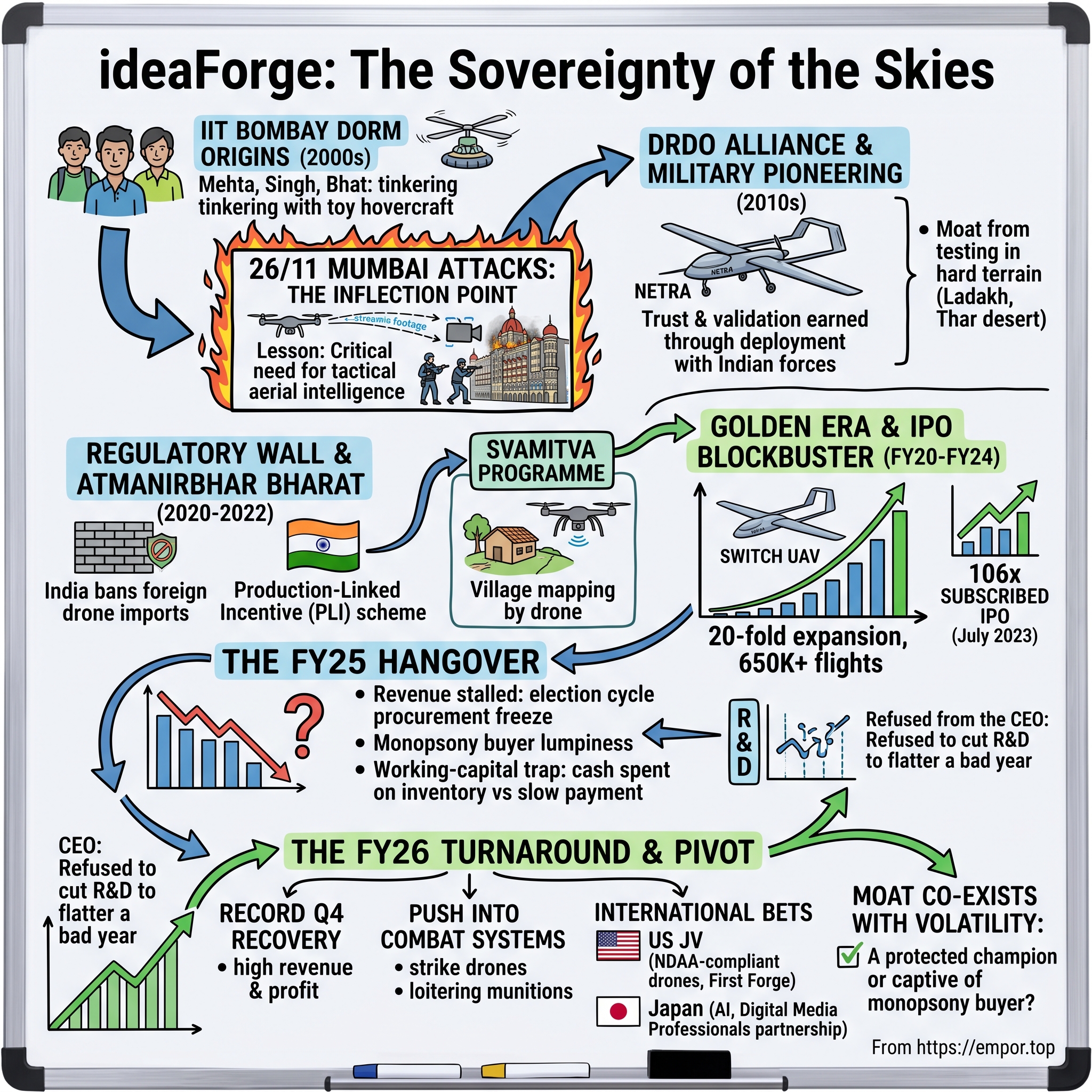
ideaForge: The Sovereignty of the Skies
I. Introduction & Episode Roadmap
Somewhere in India, roughly every three minutes, a drone lifts off to map a village boundary, inspect a power line, or watch a stretch of contested border. A growing share of those aircraft are not built by DJI in Shenzhen, nor by Lockheed Martin or Boeing in the United States. They are designed and assembled in Navi Mumbai by a company that began as three graduates of the Indian Institute of Technology Bombay building toy hovercraft in a campus lab. The company, ideaForge Technology, says its drones have collectively logged more than 650,000 flights across Indian terrain — a fleet-hours record no domestic rival comes close to matching.1
That statistic is the seed of the entire investment case, and also the seed of its risks. ideaForge (NSE and BSE: IDEAFORGE) is, on the numbers the company and independent trackers publish, the market leader in the Indian small-and-mini unmanned aircraft systems (UAS) space, with an estimated 50% share of the overall market and a dominant position — north of 90% at points — inside the specific defence and homeland-security surveillance niche where it made its name.23 Drone Industry Insights, an independent industry researcher, ranked it the third-largest dual-use drone manufacturer in the world in its 2024 global review.4 For a hardware company that emerged from a country with almost no venture appetite for deep-tech hardware, that is a genuine achievement, not a marketing line.
But this is not a coronation. It is an underwriting. And the thing that makes ideaForge such an unusual object to underwrite is the violence of its financial swings. In July 2023 the company staged one of the most euphoric public-market debuts India had seen in years: an initial public offering subscribed roughly 106 times, listing at about ₹1,300 against an issue price of ₹672 — a first-day premium of over 90%.56 Barely two years later, in the fiscal year ended March 2025 (FY25), revenue collapsed 48.7% to ₹161.2 crore and the company swung to a net loss of roughly ₹62 crore.78 Then, in the fiscal year ended March 2026 (FY26), it staged a record-breaking recovery — a single quarter, Q4 FY26, that produced its highest-ever revenue and profit and rescued the year from disaster.9 A company cannot easily be both a 106-times-subscribed growth darling and a business whose revenue can nearly halve in a year. Reconciling those two facts is the work of this story.
The reader should hold one distinction from the first page: ideaForge is tagged here as a "Startup," but it is not a private company hunting for a first listing. It is an already-listed public company whose economics still behave like an early-stage venture — lumpy, founder-driven, dependent on a single dominant customer, and repeatedly returning to the capital markets to fund its working capital. Indeed, as this is written on 10 July 2026, the company is in the middle of raising up to ₹500 crore through a qualified institutional placement (QIP) that opened on 7 July, with a floor price of ₹835.86 a share.10 So the pre-IPO framing here is really a re-underwriting: taking the three years of hard public disclosure the company has now produced and asking what a long-term owner, not a listing-day flipper, should actually believe.
Hold, too, the central analytical tension that will run through every section. ideaForge is simultaneously the beneficiary of one of the strongest structural tailwinds available to any Indian company — a state that has decided, for reasons of national security, to build a domestic drone industry behind a wall — and the captive of one of the harshest customer structures in business: a single dominant buyer that dictates terms, pays slowly, and can turn the revenue tap on and off with the political calendar. Almost everything attractive about the company and almost everything dangerous about it flow from the same fact, that it sells mainly to the Indian government. The bull sees a protected champion riding a decade-long procurement supercycle; the bear sees a monopsony-dependent hardware firm with volatile cash flows and eroding pricing power. The evidence supports both, which is why the discipline of this piece is to keep asking not "is the story good?" but "what would have to be true, and how would an owner know?"
The roadmap. First, the IIT Bombay sandbox and the existential catalyst of the 26/11 Mumbai attacks that turned a generic robotics lab into a defence company. Then the DRDO alliance and the decade of "hardware desert" survival that built the performance moat. Then the regulatory fortress — India's ban on foreign drone imports and the Atmanirbhar Bharat industrial policy — that walled off the domestic market. Then the golden era and the IPO blockbuster; the brutal FY25 hangover and the analyst showdowns it produced; and the FY26 turnaround, with its pivot into combat drones and its bets on the United States and Japan. Finally the strategic anatomy — Helmer's 7 Powers and Porter's Five Forces — the bull-versus-bear valuation debate, and the three metrics that will confirm or falsify the whole thesis after listing. The story starts where the company was born: in a dorm, over a toy that could fly.
 Subscribe on LinkedIn
II. The IIT Bombay Dorm & The 26/11 Inflection Point
Every hardware company has an origin myth, and most of them are sanded smooth for the IPO roadshow. ideaForge's is more interesting than most because for its first several years there was no company worth the name — only a group of engineers who liked building flying machines and had no idea how to sell them.
The three protagonists met at IIT Bombay in the early 2000s. Ankit Mehta, who would become chief executive, took a dual bachelor's-and-master's degree in mechanical engineering with a specialisation in computer-aided design, graduating in 2005.11 With Rahul Singh and Ashish Bhat, he began tinkering with what would eventually become unmanned aircraft — carbon-fibre rods, hobby motors, early lithium batteries — and formally registered the company in 2007.12 In those first years ideaForge was not a drone champion; it was a low-margin engineering-and-robotics consultancy that happened to be very good at making small things hover. A prototype the team built even earned a fleeting piece of Bollywood immortality, appearing in the 2009 hit 3 Idiots as a camera-carrying flying machine — proof of technical capability, and proof of nothing commercial.13
The pivot came from horror, not strategy. On the night of 26 November 2008, ten heavily armed attackers laid siege to Mumbai, and one of the longest and most visible stand-offs unfolded at the Taj Mahal Palace hotel. The founders, watching security forces struggle to see inside a burning, smoke-filled building, absorbed a lesson that would define the company: that a small, autonomous aircraft able to take off vertically from a rooftop and stream a live picture through a window could be the difference between blind assault and informed rescue.14 The realisation reframed the entire enterprise. A generic robotics lab that could have wandered into a dozen low-margin markets instead aimed itself at a single, hard, defensible one: real-time tactical intelligence for security forces.
The years between registration and relevance are the ones an underwriter should dwell on, because they explain the company's character. For roughly the first decade, ideaForge was not venture-funded in any recognisable sense — Indian venture capital in the late 2000s and early 2010s flowed to e-commerce and software, not to a handful of engineers hand-building airframes with no obvious path to a billion-rupee market. The founders financed the company the hard way: with revenue from engineering-services work, with government grants and prototyping contracts, and with a frugality that later hardened into a competitive habit. There is a temptation, in a company that eventually IPO'd at a 90% pop, to narrate these lean years as heroic foreshadowing. The more useful reading is economic: because ideaForge learned to build advanced hardware without the cushion of abundant capital, it developed real cost discipline and deep in-house engineering — but it also emerged structurally undercapitalised for the working-capital demands of selling to a government, a mismatch that would still be visible in the equity raises of 2023 and 2026. The founding constraint became the operating constraint.
It is worth being precise about why this origin matters to an investor rather than merely to a documentary. The 26/11 epiphany did two things that still shape the economics today. It chose the customer — the Indian state, in its defence, paramilitary, and disaster-response guises — which is both the source of ideaForge's moat and the source of its lumpiness. And it chose the product philosophy: not the cheapest possible consumer quadcopter, but a ruggedised, autonomous, vertical-take-off machine engineered to fly where consumer drones fail. Everything good and everything painful about the business downstream — the government concentration, the working-capital drag, the certification barriers that keep rivals out — traces back to the decision made in the days after that siege. The founders did not pick an easy market. They picked a defensible one, and then spent a decade learning how expensive "defensible" can be.
III. The DRDO Alliance & Pioneering the Military Drone
Choosing to sell autonomous drones to the Indian armed forces in 2009 was, on paper, close to commercial suicide. There was no venture capital in India for deep-tech hardware, no established procurement pathway for a startup selling to the military, and no domestic supply chain for the specialised components a serious UAV requires. The founders' answer was to attach themselves to the one institution that had both the mandate and the money to want what they were building: the state's own laboratories.
The breakthrough partnership was with the Defence Research and Development Organisation (DRDO). Working alongside DRDO, ideaForge developed the NETRA series — a compact, autonomous vertical-take-off-and-landing micro-UAV that entered service with Indian security forces and became the company's calling card.15 The significance was less any single contract than the validation: a bootstrapped startup had built a flying system the state was willing to field in operations. In a market where the buyer trusts almost nothing it has not seen work, that first operational credential is worth more than any pitch deck.
Surviving the years in between is the part of the story most easily romanticised and most worth taking seriously. Building hardware in India through the 2010s meant living on government grants, prototyping contracts, and a discipline about cost that would later look like a competitive weapon. There was no capital cushion to waste, so the company learned to develop technology cheaply — a habit that, as later sections show, management refused to abandon even when public-market investors begged them to spend more freely on some things and less on others.
There is a plainer way to see why the DRDO relationship was worth more than its rupee value. In defence hardware, the binding constraint on a new supplier is not manufacturing — it is trust, and trust is earned only through operational deployment that the buyer has witnessed. A startup can build a technically excellent drone and still never sell one, because no procurement officer will stake a mission on an unproven vendor. By co-developing NETRA with a state laboratory and getting the aircraft into the hands of actual operators, ideaForge crossed the chasm that kills most defence startups: it converted a prototype into a fielded system with a service record. Every subsequent advantage — the switching costs of trained operators, the credibility to win the next tender, the 350,000-and-then-650,000-flight track record it would later put in a prospectus — descends from that first act of institutional validation. The moat, in other words, began not as technology but as permission to be taken seriously.
The durable asset that came out of that decade was the performance moat, and it is a genuinely physical one. ideaForge tested and hardened its aircraft in the places where flying is hardest: the thin air of Ladakh, the heat of the Thar Desert, the cold of the Siachen Glacier at altitudes above 15,000 feet. Off-the-shelf consumer drones simply do not work well in those conditions — rotors bite less in thin air, batteries fail in extreme cold, and flight-control software tuned for a suburban park does not cope with mountain turbulence. ideaForge engineered around each of those failure modes: lightweight carbon-fibre airframes, thermal management, and proprietary flight-control and autopilot software (marketed under the BlueFire family). The claim an investor should test is whether this is a real, hard-to-replicate advantage or just rugged marketing. The strongest evidence that it is real is behavioural: the Indian Army has repeatedly come back for high-altitude variants of ideaForge's platforms, including a high-altitude SWITCH contract worth roughly $20 million awarded in 2021 and a repeat delivery the following year.16 Buyers who could choose anything, and who operate in the world's most demanding terrain, keep choosing the same supplier. That is the kind of proof that matters.
IV. The Sovereign Wall: Regulatory Winds & Atmanirbhar Bharat
A moat built on engineering can be crossed by a competitor with enough money and time. A moat built on engineering and reinforced by national policy is a different proposition — and this is where ideaForge's story stops being purely about clever founders and starts being about the Indian state deciding, for reasons of its own, to wall off a market.
The decisive move came on 9 February 2022, when India's Directorate General of Foreign Trade shifted the import of drones from "restricted" to "prohibited," effectively banning the import of finished foreign drones for civil and commercial use, with carve-outs only for defence, security, and R&D subject to approval.17 The policy logic was partly industrial and partly security-driven: to build a domestic industry, and to keep Chinese-made aircraft and components out of sensitive Indian airspace. Whatever the motive, the effect for ideaForge was to lock out the single most dangerous global competitor — DJI, whose consumer-grade drones dominate most of the world on price — from the mainland market ideaForge had spent a decade cultivating. Importantly, the ban applied to finished drones, not components, so it did not solve ideaForge's own supply-chain dependence on imported sensors and chips; it simply removed the foreign finished-goods competition.
Alongside the wall came the subsidy. Under the broader "Atmanirbhar Bharat" (self-reliant India) push, the government notified a Production-Linked Incentive (PLI) scheme for drones and drone components in September 2021, with an initial outlay of about ₹120 crore across three years, and ideaForge was among the manufacturers named as beneficiaries.18 The PLI money is modest in absolute terms — this is a nudge, not a firehose — but it signalled the direction of policy, and policy direction is what a defence buyer watches.
There is an important asymmetry buried in the import ban that the bull case tends to gloss over. The prohibition covers finished drones, not components — and India does not yet manufacture the full stack of high-end sensors, imaging payloads, flight-controller chips, and specialised materials that a competitive drone requires. So ideaForge sits on the fortunate side of one wall (foreign finished-goods competition is locked out of its home market) and the exposed side of another (it still imports critical components, which leaves it hostage to global supply chains and, as management noted during the FY26 supply squeeze, to geopolitical disruptions in the flow of chips and materials). This is why the "indigenous champion" framing should be read with care: ideaForge is indigenous in design, integration, and the parts of the value chain that matter most for defence trust, but it is not, and cannot yet be, indigenous all the way down. The sovereignty moat protects its revenue; it does not fully protect its costs or its supply.
The third pillar was civilian demand, and it matters because it is the company's clearest route away from pure defence dependence. The SVAMITVA programme, launched in 2020, set out to map the inhabited land of hundreds of thousands of Indian villages using drones, giving rural residents formal property records for the first time.19 It created exactly the kind of large, repeatable, mapping-focused government demand that a company with a strong survey drone could serve — and ideaForge's mapping and survey platforms were built for it. The honest investor's caveat is that even this "civil" revenue is still government revenue: it diversifies the use case away from surveillance, but not the customer away from the state. The sovereign wall keeps foreign rivals out; it does nothing to change the fact that, on the far side of that wall, ideaForge is selling almost entirely to one buyer.
V. The Golden Era & The IPO Blockbuster
By the early 2020s the pieces had aligned: a proven product, a walled-off market, a supportive industrial policy, and a defence customer finally writing large cheques. The result was the steepest stretch of the company's growth curve and the euphoria that carried it public.
The revenue line tells the story of the boom in one arc. From roughly ₹14 crore in FY20, ideaForge scaled to ₹314 crore in FY24, turning a net profit of about ₹45 crore that year — a more than twenty-fold revenue expansion in four years, driven heavily by Indian Army orders for platforms like the hybrid vertical-take-off SWITCH UAV, which pairs the convenience of a helicopter's take-off with the endurance of a fixed-wing aircraft.20 The prospectus that took the company public leaned on exactly the credentials this growth implied: a fleet that had logged, at the time, more than 350,000 operational flights across varied terrain, and a customer base overwhelmingly concentrated in Government of India entities — a concentration the company disclosed candidly as a risk, with the great majority of revenue tied to government demand.21
The offering itself, in June 2023, was structured as a ₹567 crore issue: a fresh issue of about ₹240 crore that put new money on the balance sheet, and an offer for sale of about ₹327 crore that let existing shareholders — early venture backers and, in part, promoters — sell down.22 That split is worth pausing on, because it separates two very different things a listing can do. The fresh-issue portion funds the business; the offer-for-sale portion simply transfers shares from private hands to public ones and puts no cash into the company. More than half of ideaForge's IPO was the latter, which is normal and not sinister, but it means the listing was as much an exit for early investors as it was a capitalisation of the company.
Demand was ferocious. The book was subscribed roughly 106 times overall, led by qualified institutional buyers at around 126 times their allotment, and the company raised close to ₹255 crore from anchor investors before the offer opened — a roster that included the technology names Infosys and Qualcomm.235 On 7 July 2023 the stock listed at about ₹1,300 on the NSE against the ₹672 issue price, a premium north of 90%.6 For a single day, the market valued ideaForge as though its recent hyper-growth was the permanent state of affairs.
It is worth understanding what the SWITCH represented technically, because it is the platform on which the golden era was built. A conventional fixed-wing drone flies far and long but needs a runway or a launcher; a conventional quadcopter takes off vertically from anywhere but has limited range and endurance. The SWITCH is a hybrid — it lifts off vertically like a helicopter, then transitions to fixed-wing flight for range and endurance measured in hours. For an army operating in mountainous terrain where there are no runways, that combination is close to ideal, and it is why the high-altitude variants drew repeat orders. The product was a genuine engineering answer to a specific customer problem, not a commodity — which is exactly the kind of thing that commands pricing power while the customer has no equally good alternative, and exactly the kind of thing that comes under pressure when well-funded rivals build their own hybrids.
Here the underwriter must be blunt about the difference between price and value. A 106-times-subscribed book and a 90%-plus listing pop are pricing signals — expressions of scarcity, narrative, momentum, and a very small free float chasing a novel "sovereign drone" story — not evidence about the durability of the underlying cash flows. The IPO priced ideaForge on a trailing year of extraordinary growth. The very next fiscal year would test whether that growth was a trend or a spike, and the answer, painfully, was the latter.
VI. The Hangover: The Brutal FY25 Collapse & Analyst Grillings
The reckoning arrived fast. In FY25 — the first full year for which ideaForge reported as a scrutinised public company through a downturn — the revenue engine did not slow. It stalled. Full-year revenue fell 48.7% to ₹161.2 crore, EBITDA swung to roughly negative ₹31.5 crore (an EBITDA margin of about negative 19.6%), and the company reported a net loss of around ₹62 crore against a ₹45 crore profit the year before.78 The single worst quarter, Q4 FY25, saw revenue crater roughly 80% year on year to about ₹20 crore, with a net loss of roughly ₹26 crore.24 A company that had gone public as a growth story spent a year contracting.
The cause was structural, and it is the single most important thing to understand about ideaForge as an investment. The company's dominant customer is the Indian government, and government defence procurement in India is not a smooth annuity — it is a lumpy, politically sensitive, multi-stage process. Management attributed the FY25 collapse to the general-election cycle in the first half of the year, which froze budget allocations, and to a broader slowdown in the conversion of orders into deliveries.25 The mechanism is worth spelling out in plain language: winning a defence tender in India often means being declared the "L1," or lowest qualifying bidder, but L1 status is not a purchase order. Months — sometimes many months — can pass between L1 and a signed, cash-backed contract, and until that conversion happens the revenue simply does not exist, even though the company has often already spent money preparing to deliver.
That gap is where the working-capital bleed lives. To be ready to deliver the moment orders convert, and spooked by the global component shortages of the early 2020s, ideaForge carried heavy inventory — carbon fibre, sensors, chips — while waiting months for government milestone payments. Cash went out to build and stock; cash came in slowly and unpredictably. A cash-conversion cycle that would be uncomfortable for any hardware company is, for one selling almost entirely to a monopsony buyer that dictates payment terms, a structural handicap rather than a one-off.
The plainest way to feel the working-capital problem is to imagine the timeline of a single order. ideaForge wins a tender and is declared L1. To be ready to deliver on the government's schedule — and to protect itself against the component shortages that spooked every hardware firm in the early 2020s — it buys carbon fibre, sensors, and chips and builds inventory, spending cash now. Then it waits: for the L1 to convert to a firm purchase order, for delivery milestones to be inspected and accepted, and finally for the government to release payment, which can lag acceptance by further months. Across that whole arc, cash is going out and almost none is coming in, and the faster the company grows, the more orders are simultaneously stuck in this pipeline, so growth itself deepens the cash hole before it fills it. This is not a failure of a single year's management; it is the arithmetic of selling capital equipment to a slow-paying monopsony. It is also why, structurally, ideaForge has repeatedly needed external capital — the IPO's fresh issue in 2023 and the QIP in 2026 — to fund the working capital that its own operations do not yet throw off. An investor who does not internalise this will mistake every order-book announcement for imminent cash, when in fact it is imminent cash consumption that only becomes cash much later.
The FY25 earnings calls turned into genuine confrontations, and they are instructive because they reveal management's real priorities under pressure. Analysts pressed on the obvious tension: why keep spending — sustaining research and development, holding inventory — when order visibility had frozen? Ankit Mehta's answer was consistent and, to his credit, candid about its own trade-off: he refused to gut R&D, arguing that pausing technology development to flatter a single bad year would forfeit the very edge that justified the company's premium. He characterised the lumpiness as an industry reality of defence procurement rather than an execution failure. An independent observer can grant that this is partly true — the lumpiness is real — while still noting that "it's the industry" is exactly what every management team says when a concentrated customer base bites, and that consistency of message is not the same as being right. The test is not the rhetoric; it is whether the R&D that was defended in FY25 shows up as durable, diversified revenue later.
The FY25 episode also exposed something about the quality of the IPO-era narrative that only a downturn could reveal. When a company grows twenty-fold in four years and then lists into a 106-times-subscribed book, both management and the market have every incentive to describe the growth as a durable trend driven by a structural shift — the sovereign-drone thesis — rather than as a burst of front-loaded government orders that happened to cluster. FY25 forced a re-rating of that story in real time: the same demand that looked structural in the prospectus turned out to be highly sensitive to the electoral calendar and the pace of a single buyer's paperwork. An independent reader should draw a specific lesson from this, and carry it into every subsequent bullish quarter, including Q4 FY26: with a monopsony customer and lumpy procurement, a single strong period is weak evidence about the run-rate, in either direction. The company's revenue is best understood as a multi-year order book being recognised in an uneven pattern, not as a smooth curve — which means the honest unit of analysis is orders booked and the order backlog, not any one quarter's reported sales.
Meanwhile the competitive ground was shifting. The Indian drone sector, seeded by the same policy tailwinds that helped ideaForge, attracted deep-pocketed entrants: Reliance-backed Asteria Aerospace, Adani's defence arm, and the listed defence-electronics firm Zen Technologies among them. As larger balance sheets began bidding on the same government tenders, the risk was no longer that a foreign giant would undercut ideaForge — the import ban had handled that — but that domestic conglomerates with more capital and more political weight would compete away its pricing power from the inside. FY25 was the year the market learned that ideaForge's moat, real as it is, does not make its earnings smooth.
VII. The FY26 Turnaround: Redemption, Combat Drones & The US Pivot
If FY25 was the argument for the bears, FY26 was the argument for the bulls — and the whiplash between them is precisely why this company is so hard to value. After a year of contraction, ideaForge booked the strongest order inflow in its nearly two-decade history: roughly ₹530 crore of orders across defence and civil customers during FY26, and it entered FY27 with an opening order book of about ₹310 crore that management expects to execute largely within the year.926
The recovery was concentrated, almost violently, in a single quarter. Q4 FY26 delivered record revenue of about ₹141 crore — up roughly 594% from the ₹20 crore trough of Q4 FY25 — and a net profit of about ₹60 crore at an EBITDA margin of 52.6%.9 That quarterly margin is the number that makes drone bulls giddy and skeptics wary in equal measure, and it demands context. Read across the whole year, the picture is far more sober: FY26 full-year revenue was about ₹286.1 crore, EBITDA about ₹27.1 crore (an EBITDA margin near 12%), and the company still reported a full-year net loss of roughly ₹17 crore — a loss narrowed from the prior year's ₹62 crore almost entirely by the Q4 blowout.27 (It is worth flagging that this ₹286 crore full-year figure is materially higher than the ₹226 crore that circulated in some early secondary summaries; the audited-results reporting puts FY26 revenue near ₹286 crore, and that is the number an underwriter should use.) In other words: the 52.6% margin is real but is a single-quarter artefact of a business that recognises a year's worth of lumpy government deliveries in bursts. Annualising it would be a serious analytical error.
The genuinely important development in FY26 was not the recovery quarter but the strategic widening of the company's aim, because ideaForge's core problem — the ceiling on Indian ISR (intelligence, surveillance, reconnaissance) defence budgets — cannot be solved by executing the existing model better. Two moves stand out.
The first is the push into combat systems. ideaForge has begun extending its technology base from pure surveillance toward long-range strike platforms, loitering munitions, and so-called kamikaze drones — single-use aircraft that fly to a target and detonate.28 The stated approach is hybrid: in-house airframes and flight software paired with munition and warhead technology licensed from specialised defence partners, since ideaForge is an aircraft company, not a weapons-effects company. This is a logical adjacency — the hard part of a strike drone is often the flying, which ideaForge already does well — but it is early, unproven at scale, and pushes the company into a more heavily regulated, more politically fraught, and more competitive part of the defence market.
The second is internationalisation, and here the company is placing several distinct bets. In the United States, its wholly owned subsidiary formed a 50/50 joint venture, First Forge Technology Inc., with the US ammunition-component maker First Breach Inc., to design, manufacture, and distribute ideaForge platforms that comply with the US NDAA Section 848 rules that effectively bar Chinese-origin drones from federal and many commercial buyers.29 Separately, ideaForge made a small strategic equity investment — about $1.83 million — in the Silicon Valley nano- and micro-drone maker Vantage Robotics in early 2025, buying itself a foothold in US micro-drone technology and the American commercial market.30 And in Japan, in April 2026 it signed an MoU with Digital Media Professionals (DMP) to integrate DMP's "Di1" edge-AI chip into ideaForge's VTOL platforms, with DMP acting as go-to-market partner in Japan for infrastructure-inspection drones.31 During FY26 the company also notched its first US purchase order (from a Texas school district), trained NATO personnel at a US test-pilot facility, and demonstrated to the US Department of Defense in Alaska.32
These three international bets are not interchangeable, and an underwriter should grade them separately. The Vantage Robotics investment is the smallest and the most clearly logical: for under $2 million, ideaForge bought a stake in, and a technology relationship with, a Silicon Valley firm that makes the nano- and micro-drones that sit below ideaForge's own size class, plus a foothold in the US commercial market and, implicitly, some access to US customer relationships that a foreign entrant cannot easily build cold. It is cheap, sensible, and immaterial to near-term financials. The First Forge JV is more consequential and more uncertain: pairing ideaForge's airframes with a US partner's manufacturing and munition components to sell NDAA-compliant drones into a market that is actively trying to de-risk from Chinese hardware is precisely the right idea at the right time, but a 50/50 JV with a relatively unknown partner carries execution, governance, and IP-ownership questions that the public disclosures do not fully answer, and its revenue contribution to date is negligible. The Japan MoU is the most preliminary — a memorandum, not a contract, to integrate a partner's edge-AI chip and use that partner as a distributor — and should be valued as a research relationship with option value, not as a revenue line. The common thread is that ideaForge is buying cheap options on large foreign markets using equity, small cheques, and partnerships rather than betting the balance sheet — a rational way for a small company to pursue asymmetric upside, provided investors price the options as options.
The strategic logic of the US pivot is the single most important optionality in the whole story: the American market for non-DJI, NDAA-compliant drones is potentially many times larger than India's, and ideaForge's decade of building "Chinese-component-free" hardware is, for once, a fashionable qualification rather than a cost. But an investor must weigh these announcements for what they currently are — a first small order, an MoU, a sub-$2-million equity stake, and a newly formed JV — not for the multi-billion-dollar markets they gesture at. None of them yet contributes material revenue. They are call options on a much bigger business, purchased cheaply. Whether any of them pays off is a FY27-and-beyond question, and the honest answer today is that it is unknowable.
VIII. The Playbook: 7 Powers & Porter's 5 Forces Analysis
Strip away the narrative and the question underneath ideaForge is simple: does it have durable competitive advantage, or merely a temporary head start protected by a policy that could change? Two frameworks help discipline the answer — Hamilton Helmer's 7 Powers for company-specific advantage, and Porter's Five Forces for industry structure — but only where the evidence supports them.
On Helmer's framework, three powers are worth testing. The first is switching costs, and here the evidence is moderately strong. Thousands of military and police operators have been trained on ideaForge's ground-control software (the BlueFire family), and a security force that has standardised its training, maintenance, and operational doctrine around one platform does not casually re-train on a rival's. Switching costs in defence are real, but they are not absolute: they protect the installed base and repeat orders, not necessarily new tenders, where a competitor can bid from scratch. The second is what Helmer calls a cornered resource — the proprietary, hard-won IP in extreme-altitude autopilot and airframe engineering. The behavioural proof is the Army's repeated purchases of high-altitude variants, which is about as clean a demonstration of a resource rivals cannot easily match as one could ask for. The third, counter-positioning, is the weakest and weakening. ideaForge historically counter-positioned against slow public-sector undertakings by being nimble and product-led; but that advantage normalises as private giants like Adani and Reliance-backed Asteria — themselves nimble and far better capitalised — enter the field. A power that depended on your rivals being sluggish evaporates when your rivals are Reliance.
On Porter's Five Forces, the structure is unusually stark. The bargaining power of buyers is extremely high, approaching a textbook monopsony: the Indian Ministry of Defence and allied government entities set testing standards, dictate payment terms, and can freeze procurement at will — as FY25 demonstrated in the crudest possible way. This single force explains most of ideaForge's financial volatility. The threat of new entrants is high but gated: India has spawned well over a hundred drone startups on the back of policy tailwinds and VC money, yet the certification and field-trial barriers for military-grade UAVs — type certification, rigorous defence trials, an operational track record — are severe, and they are exactly why a first-mover with 650,000 logged flights has an advantage a well-funded newcomer cannot buy overnight. The threat of substitutes for tactical, low-altitude surveillance is genuinely low: satellite imagery is too static and expensive for the "eyes over the next ridge in the next ten minutes" problem that drones solve, and there is no cheaper agile alternative.
One power is conspicuously absent from ideaForge's arsenal, and its absence is the crux of the bear case: scale economies. In many hardware businesses, the largest player enjoys a structural cost advantage that lets it win price wars a smaller rival cannot survive. ideaForge is the largest drone player in India, but it is a minnow next to the conglomerates now entering its market — Adani and Reliance can absorb losses on a defence tender for years to build position, funding that loss from cash flows ideaForge does not have. In a market where the buyer is a monopsony that can and does run price-competitive tenders, the entrant with the deepest balance sheet, not the incumbent with the best track record, may win the marginal contract. This is the mechanism by which a real moat (trust, switching costs, cornered engineering) can still coexist with deteriorating economics: ideaForge can keep its installed base and still see its growth competed away at prices that do not clear its fixed-cost base. The 7 Powers framework is useful here precisely because it forces the distinction between the powers ideaForge has (which defend the base) and the one it lacks (which would defend the growth).
The synthesis an investor should carry forward: ideaForge's advantages are real but asymmetric. They are strongest in defending the installed base and repeat high-altitude orders (switching costs, cornered resource, entry barriers) and weakest against new competitive tenders from well-capitalised domestic rivals (the erosion of counter-positioning, the monopsony buyer's power to commoditise). The moat protects yesterday's revenue better than it guarantees tomorrow's growth.
IX. The Investment Story Spine: Bull vs. Bear Case
With the structure understood, the valuation debate comes down to a fight between two internally coherent stories. Neither is obviously right, and the gap between them is enormous — which is itself the central fact about owning this stock.
Begin with what price is actually observable, because price is not value. As of early July 2026, ideaForge traded around ₹865 a share, giving a total equity value of roughly ₹3,700 crore, within a 52-week range of about ₹368 to ₹997.33 That is the market's current price. Against FY26 revenue of about ₹286 crore, it implies a price-to-sales multiple in the low teens — a rich figure for a company that lost money at the net line for the year, and one that can only be justified by belief in a much larger, more profitable future. The equity value is not the same as enterprise value; the company carries some borrowings (it earmarked ₹120 crore of its 2026 QIP for debt repayment) and holds cash, but a precise, current net-debt bridge is not cleanly disclosed in the public secondary record, so any enterprise-value multiple quoted here would be an estimate, not a fact. The disciplined move is to treat the ₹3,700 crore equity value as the observed price and interrogate what it embeds.
The capital structure is actively changing as this is written, and that is material. The ₹500 crore QIP that opened on 7 July 2026 — floor price ₹835.86, with proceeds earmarked roughly ₹165 crore for working capital, ₹120 crore for debt repayment, and ₹90 crore for product development — will issue new shares and dilute existing holders, including the promoters.10 This is not incidental: it is a direct admission that the working-capital cycle described in Section VI is severe enough that the company must raise external equity to fund it, rather than generating that cash internally. The reported promoter shareholding — cited variously around 28.96% and, on some March-2026 snapshots, near 33% — will settle lower again after the placement, and the drift of that number over time is one of the cleanest tells about how much the founders are being diluted to keep the business capitalised.34 Any headline market capitalisation should therefore be read as a moving, roughly-implied figure: the fully diluted share count is in flux, and until the QIP closes and is disclosed, the precise post-issue capitalisation is unknowable.
The funding history, and what the private marks do and do not say. Because ideaForge is already public, the temptation is to skip the venture archaeology — but the shape of its cap table before the IPO still informs how to read it now. The company was, for most of its life, a capital-starved deep-tech firm that raised comparatively modest sums from a mix of strategic and financial investors — names associated with its journey include Infosys co-founder-linked and corporate strategic capital, Qualcomm Ventures, Celesta Capital, and Florintree, among others, several of which appeared as anchor or pre-listing holders around the 2023 offering.23 Two disciplines apply to any such round. First, a strategic investor like Qualcomm or Infosys does not buy a stake for the financial return alone; it buys optionality on a technology relationship, which means the price it paid is a poor proxy for intrinsic value — a strategic will rationally overpay for access. Second, private preferred shares typically carry protections — liquidation preferences, anti-dilution ratchets, information rights — that public common shares do not, so a headline "last private valuation" is not economically equivalent to the same number of common shares in the open market. The cleaner fact is that at IPO, more than half the ₹567 crore raised was an offer for sale — early holders and, in part, promoters, taking money off the table — which tells you the private backers treated the listing partly as an exit, and that the public float from day one was small.22 A small float is why the stock could be subscribed 106 times and then swing between ₹368 and ₹997 within a single subsequent year: thin free float amplifies both euphoria and despair. None of this is scandalous; it is simply the reason a public investor should anchor on operating cash flow and a fully diluted, post-QIP share count rather than on any carried-forward private mark.
Revenue quality: what kind of revenue is this? The single most important question for valuing ideaForge is whether its revenue is an annuity or a series of one-off wins, and the honest answer is: overwhelmingly the latter, with a thin and growing recurring layer. The core business is transactional hardware — the government issues a tender, ideaForge wins it, builds the drones, delivers them, and recognises the revenue, often in a lump. There is little contractual recurrence: winning this year's SWITCH order does not guarantee next year's, which must be competed for again. That is the opposite of the software-style net-revenue-retention that public markets pay premium multiples for, and it is why "annualising Q4 FY26" is not merely optimistic but category-error wrong — there is no subscription base compounding underneath the quarter. What recurrence exists comes from three thinner sources: spares, service and training on an installed base of thousands of deployed aircraft; the switching costs that make repeat orders from the same force more likely than a competitive displacement; and the still-nascent drone-as-a-service (DaaS) model, where the company would sell flight-hours or data rather than aircraft. DaaS is the piece that could, over years, convert some transactional revenue into recurring revenue — and it is precisely why management talks about it — but as of FY26 it is a stated ambition, not a disclosed, material, recurring revenue line. Until it is, an investor should treat ideaForge's revenue as high-quality in margin (defence hardware gross margins reported above 60%) but low-quality in predictability — the reverse of a SaaS business, and a profile that deserves a lower, not higher, multiple of any single year's sales.20
The path to durable profitability. Adjusted profitability and durable profitability are not the same thing, and ideaForge's history makes the distinction concrete. The company can produce a 52.6% EBITDA margin in a delivery-heavy quarter and a deeply negative EBITDA margin over a lean full year, which means the relevant question is not "is it profitable?" but "at what sustained annual revenue, and with what cost structure, does it produce reliable free cash flow through a full procurement cycle?" The building blocks are visible. Gross margin is high and probably durable, because it reflects genuine engineering value-add and a protected market. Operating expense is dominated by R&D and specialised engineering payroll that management deliberately holds roughly flat through downturns — a fixed-cost base that crushes margins in a ₹161 crore year and looks trivial in a ₹300-crore-plus year. So the model has powerful operating leverage: above some revenue threshold, incremental sales drop through to profit at a high rate; below it, the fixed R&D base drives losses. The two things that must improve for durable free cash flow are therefore (1) a higher and steadier revenue base — comfortably above the roughly ₹300 crore level — so the fixed cost base is always covered, and (2) a shorter, more predictable cash-conversion cycle, so that growth stops consuming working capital faster than it generates cash. The FY26 QIP is direct evidence that (2) is not yet solved: a genuinely self-funding business does not raise ₹165 crore of equity for working capital after a record quarter. The falsification test is clean: if, across FY27 and FY28, revenue holds above the fixed-cost threshold and operating cash flow turns reliably positive without another equity raise, the durable-profitability thesis is confirmed; if the company must return to the market again to fund the next up-cycle's working capital, it is not.
The addressable market, with restraint. Bulls quote enormous numbers for the global drone market, and management's international push implicitly leans on them. Discipline requires separating the category TAM from the reachable market at ideaForge's present product, price, geography, and distribution. The reachable market today is narrow and specific: Indian government demand for tactical ISR and mapping drones, where ideaForge already leads but where the total annual procurement budget is finite and set by the state, plus a modest and growing Indian civil-mapping and inspection market. That is a market measured in a few thousand crore of annual demand, not the tens of billions of dollars in global category figures. Everything beyond it — the US NDAA-compliant commercial and law-enforcement market, the Japanese inspection market, the global combat-drone market — is aspirational reachable market: real, potentially far larger, but gated by certifications, local competition (in the US, well-funded players like AeroVironment, Skydio, and Red Cat already hold the ground ideaForge wants), distribution the company does not yet own, and a track record it has barely begun to build abroad. The correct way to size ideaForge is to value the Indian core it demonstrably owns, and treat the international and combat-drone expansions as options with a probability-weighted, heavily discounted contribution — not to apply a global TAM to a company whose FY26 international revenue was, in practice, a single school-district order and a set of demonstrations.32
A genuinely comparable peer set. ideaForge has no perfect public comparable, which is itself a valuation problem — scarcity inflates the multiple. The most useful direct operating peer is the US-listed AeroVironment: like ideaForge, it sells tactical drones and loitering munitions largely to a single dominant government customer, and its history of lumpy, procurement-driven revenue is instructive precisely because it is the mature version of the model ideaForge is trying to grow into — but AeroVironment is far larger, consistently profitable, and priced accordingly, so it is better read as the aspirational category leader than as a like-for-like comp. Closer to home, the more honest peer group is the basket of listed Indian defence-technology firms that share the same monopsony customer, the same lumpy tender-driven revenue, and the same policy tailwind — companies such as Zen Technologies (anti-drone systems and simulators), Data Patterns, Paras Defence, and, among pure drone plays, the far smaller DroneAcharya. These match on customer type, geography, and revenue rhythm, though they differ in product and margin. The relevant point for valuation is structural rather than a single number: this Indian defence-tech cohort has, through the mid-2020s, traded at rich multiples of sales and earnings on the strength of the same "sovereign / Atmanirbhar" narrative that lifts ideaForge — which means ideaForge's low-teens price-to-sales multiple is not an outlier within its cohort, but the cohort as a whole is priced for years of sustained, policy-driven growth. Pulling each peer's exact revenue multiple, EV/EBITDA, share count, and net-debt basis onto a common footing is a filing-by-filing exercise and should be treated as a diligence item; what the qualitative comparison already establishes is that ideaForge is expensive on trailing fundamentals but not obviously expensive relative to its narrative peers — the risk is a re-rating of the whole cohort, not just this stock.
An intrinsic-value sketch: three scenarios. Price anchoring aside, it is worth asking what set of business outcomes would justify the roughly ₹3,700 crore of equity value the market currently assigns, using a transparent, deliberately rough scenario frame rather than a false-precision model. Take FY26 revenue of about ₹286 crore as the base. In a bear scenario, the Indian defence budget cycle stays lumpy, conglomerate competition compresses pricing, the international bets fizzle, and revenue grows only modestly to perhaps ₹450–550 crore by FY30 at a through-cycle operating margin in the high single digits — a business worth, on any sober multiple of normalised earnings discounted at the 14–16% cost of capital appropriate for a volatile Indian small-cap, materially less than today's price. In a base scenario, ideaForge compounds revenue at roughly 20–25% as order conversion steadies and civil revenue grows, reaching perhaps ₹700–800 crore by FY30 at a normalised operating margin in the mid-teens, with international revenue a small but real contributor — an outcome that broadly supports something in the region of today's valuation, but does not leave much margin of safety and assumes the working-capital cycle is tamed. In a bull scenario, the US NDAA-compliant business and combat-drone lines convert, revenue pushes past ₹1,000 crore with operating margins moving toward 20% as scale covers the fixed R&D base, and the multiple expands on evidence of durable, diversified, partly-recurring revenue — the case in which today's buyer looks prescient. The point of the exercise is not the specific figures, which are illustrative, but the sensitivities they expose: the valuation is extraordinarily sensitive to two variables — the through-cycle operating margin (a function of whether revenue stays above the fixed-cost threshold) and the discount rate (a function of how lumpy and how dependent on a single customer the cash flows remain). Small changes in either move the intrinsic range by a wide margin, which is a mathematical restatement of why this stock is so volatile.
Governance and diligence items for a future owner. A re-underwriting must look at control and alignment, not just cash flow. The promoter trio's combined shareholding has drifted from roughly a third toward the high-20s-percent and will fall further with the QIP, which cuts two ways: it dilutes the founders' economic and voting control (a governance risk if execution stumbles and the register becomes contestable), but it also means the founders are increasingly aligned with, rather than dominant over, minority shareholders.34 The items a diligent owner would still want, and which the public secondary record does not fully resolve, are: the composition and genuine independence of the board; the structure of executive and founder equity incentives and whether they reward through-cycle value creation or short-term order announcements; any related-party dealings between ideaForge and its network of partners, JVs, and strategic investors; the pattern of insider selling around the IPO's offer-for-sale and since lock-ups expired; and the precise terms of the international JVs, whose economics (who funds what, who owns the IP, how profits split) are only lightly disclosed. None of these is a known red flag; all of them are legitimate questions that a full filing — an annual report read line by line, or the offer document for the current QIP — should answer, and their absence from casual coverage should be treated as an open diligence item, not as evidence of safety.
The Activist / Skeptical Investor Stress Test. A hard-nosed public-market investor would press two points. First, the working-capital trap is not a bug management can engineer away — it is intrinsic to selling complex systems to a monopsony that pays slowly. Every rupee of growth ties up more inventory and receivables, so faster growth can worsen cash flow before it improves it, and the FY26 QIP is the proof of that mechanism in action. Second, the margins are a mirage in the way that matters most for valuation. Gross margins on the hardware are attractive — often reported above 60% — but the heavy, largely non-capitalised R&D and specialised engineering payroll that ideaForge deliberately protects (as Mehta did through FY25) mean that net margins are violently volatile and, across FY25 and FY26 combined, negative. A business that earns a 52.6% EBITDA margin in one quarter and a negative EBITDA margin over an entire adjacent year cannot be valued on either extreme; it must be valued on a normalised, through-cycle basis, and the through-cycle number is not yet visibly positive.
The Bull Case rests on three pillars. The sovereignty moat: India cannot fight a war with Chinese DJI drones and will not want to depend entirely on expensive American platforms, so a credible indigenous champion has structural demand behind it. Product and revenue diversification: scaling higher-margin, non-defence uses — mapping, inspection, and eventually drone-as-a-service models — to reduce the roughly 90%-plus government concentration toward something like 70% over time, smoothing the lumpiness that has defined the stock. And global optionality: if First Forge and the Vantage relationship convert the US commercial and law-enforcement opportunity, the addressable market is a large multiple of India's, and ideaForge's Chinese-component-free heritage becomes a moat rather than a cost. If even one of these plays out, today's price looks cheap in hindsight.
The Bear Case is the mirror image. The extreme lumpiness makes the company genuinely hard to value and hard to own: a stock that can fall to ₹368 and rise to ₹997 inside a year on the timing of government orders is priced by momentum and mood as much as by cash flow. The conglomerate rivalry — Adani, Reliance-backed Asteria, Zen — threatens to turn the walled Indian garden into a low-margin bidding war precisely because the wall keeps everyone inside competing for the same government budget. And there is real key-man risk: the technology edge is concentrated in the founding trio, and with promoter ownership already diluted below a third and falling with each capital raise, the founders' control is not as entrenched as it is at many owner-operated firms — a governance dynamic a public shareholder should watch rather than assume away.
Reconciling the two views: the market is not pricing ideaForge on its trailing, through-cycle cash flow, which is negative. It is pricing a call option on the company becoming the durable, diversified, internationally relevant sovereign-drone champion — with the option's value inflated by scarcity (few listed pure-play Indian drone stocks), a small free float, a powerful national-security narrative, and post-turnaround momentum. Those forces are real and can keep the price elevated for a long time. They are not the same as business value, and the distance between the two is the risk.
X. Epilogue & Key KPIs to Watch
The lesson ideaForge teaches is compact: hardware is hard, but sovereign-gated hardware can be extraordinarily valuable — if, and only if, the company can survive its own cash-conversion cycle long enough for the gate to pay off. ideaForge has proven it can build drones the world's most demanding buyer will field, that policy has walled off its home market, and that it can recover violently from a bad year. It has not yet proven that it can produce steady, through-cycle free cash flow, that it can diversify off its single dominant customer, or that its international bets are more than options. The three years of public disclosure since the 2023 IPO have answered the first set of questions and left the second set wide open — which is exactly what makes the current QIP-era re-underwriting live rather than academic.
For a long-term owner, three metrics will confirm or falsify the underwriting more directly than any quarter's headline profit.
First, the L1-to-order conversion time — how quickly the company turns lowest-bidder status into signed, cash-backed purchase orders. This single operating variable drives the working-capital cycle, the lumpiness, and the recurring need to tap equity markets. If conversion tightens and becomes predictable, the whole valuation debate changes; if it stays slow and erratic, the QIP of 2026 will not be the last.
Second, the non-defence revenue share — progress toward reducing government concentration from north of 90% toward the ~70% the bull case requires. Every point of diversification into civil mapping, inspection, and drone-as-a-service is a point of insulation from the monopsony buyer whose budget cycles nearly destroyed FY25.
Third, US and international order inflow — real purchase orders through First Forge and the Vantage and DMP relationships, not MoUs and demonstrations. A single Texas school-district order and a NATO training session are seeds. The thesis needs them to become a harvest, and the first evidence of that will be a recurring, dollar-denominated order line that the company can point to without a footnote.
The events that could force a reckoning are the obvious ones inverted: another election-cycle procurement freeze, a lost flagship tender to a conglomerate rival, or a QIP that funds working capital without the diversification and conversion improvements ever arriving. After listing, ideaForge's price will keep moving on national-security headlines, order announcements, and momentum — sometimes far from anything happening in the business. The discipline for the long-term investor is to keep watching the three KPIs above and let the mood-driven price do what it will around them, because in the end a sovereign gate is only worth as much as the free cash flow that eventually walks through it.
References
-
ideaForge Wins $11M Indian Military Drone Deal — The Defense Post, 2025-11-20 ↩
-
Buoyed by strong IPO response, ideaForge Technology eyes scalable and profitable growth — Forbes India, 2023 ↩
-
Meet CEO who turned his IIT project into Rs 2500 crore company — DNA India, 2024 ↩
-
ideaForge unveils new UAVs at Aero India 2025 — Shephard Media, 2025 ↩
-
ideaForge Technology IPO subscribed 106x; Cyient booked 67x on final day — Business Standard, 2023-06-30 ↩↩
-
ideaForge Technology IPO: allotment status & grey market premium — Business Today, 2023-07-03 ↩↩
-
Ideaforge's Q4FY25 Revenue Drops by 80%, Sees Losses as Drone Sector Slows — MediaNama, 2025-05 ↩↩
-
FY25 Financial Tracker: Tracking the Financial Performance of Indian Startups — Inc42, 2025 ↩↩
-
ideaForge reports its Strongest Quarterly performance in Q4 with INR 141 Cr revenue and INR 60 Cr PAT — sUAS News, 2026-05 ↩↩↩
-
ideaForge Opens QIP, Sets Floor Price At ₹835.86 — Inc42, 2026-07 ↩↩
-
How ideaForge Became the Game Changer in the Drone Industry — Indian Startup News ↩
-
Ankit Mehta: The Deep-Tech Visionary Who Built India's Drone Empire — Founder Thesis ↩
-
The story of ideaForge: From humble beginnings and 26/11 terror attacks to an IPO — Zee Business, 2023 ↩
-
Partnering with Indian Industries for UAV Development — DRDO, India ↩
-
SWITCH UAV designed for ISR missions procured by Indian Army — Military Embedded Systems ↩
-
Aviation ministry releases list of beneficiaries under PLI scheme for drone manufacturers — Business Today, 2022-04-20 ↩
-
Drone Rules 2021 and Policy Updates — Ministry of Civil Aviation, India ↩
-
Ideaforge Technology Ltd — Exencial Research Partners, 2025 ↩↩
-
ideaForge successfully delivers another SWITCH UAV order to the Indian Army — MyBrandBook, 2025 ↩
-
ideaForge Technology IPO opens: OFS, issue price, lot size, listing date — Zee Business, 2023 ↩↩
-
ideaForge Technology IPO Date, Price, GMP, Review, Details — Chittorgarh, 2023 ↩↩
-
ideaForge Back In The Black, Posts ₹60 Cr PAT In Q4 — Inc42, 2026-05 ↩
-
ideaForge Technology Q4 FY26 Earnings: Record ₹141 Cr Revenue, 52.6% EBITDA Margin and ₹310 Cr FY27 Order Book — ScanX, 2026-05 ↩
-
IdeaForge Technology narrows net loss to ₹199.36 million in FY26 — ScanX, 2026-05 ↩
-
ideaForge launches Rs 500 crore QIP after strong Q4, eyes expansion into combat drones and logistics — Indian Startup News, 2026-07 ↩
-
ideaForge Forms JV With First Breach To Scale Offerings In US — Inc42, 2025 ↩
-
ideaForge Strengthens its Global Reach with Strategic Investment and Partnership with Vantage Robotics — PR Newswire, 2025-02 ↩
-
ideaForge Signs MoU with Japan's DMP to Develop AI Drones — DroneLife, 2026-04-28 ↩
-
ideaForge Posts Q4 Profit and Record Order Booking — SMEStreet, 2026-05 ↩↩
-
ideaForge Technology Ltd share price and key insights — Screener.in, 2026 ↩
-
Ideaforge Technology Shareholding Pattern 2026 — Choice / Trendlyne, 2026 ↩↩
 LinkedIn
 WhatsApp
 Reddit
 Hacker News
 Email
Email Kindle
 RSS Feed
 Spotify
 Apple Podcasts
 Amazon Music
 Audible
 YouTube