ICICI Bank: The Reinvention That Had to Survive Its Own Credit Boom
I. The Bank That Had to Earn Back Trust
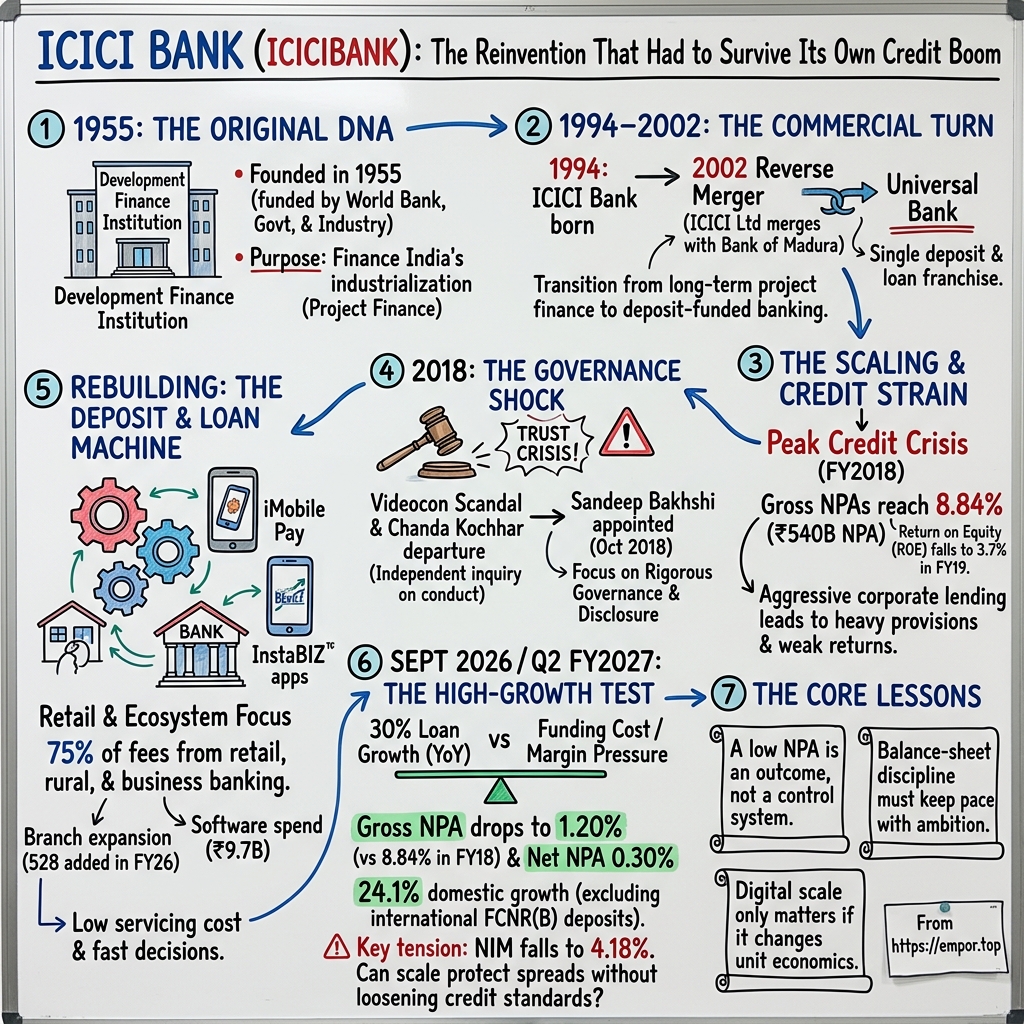
On October 4, 2018, ICICI Bank's board met with the bank's reputation in pieces. For months its managing director and chief executive, Chanda Kochhar, had been on leave while a retired Supreme Court judge investigated whether she had hidden a conflict of interest involving loans to the Videocon group and a company run by her husband.1 That day she quit, and the board named Sandeep Bakhshi, a group veteran who had joined ICICI in 1986 and worked across its insurance businesses, as the new chief executive.23 The bank he took over was also carrying one of the heaviest bad-loan burdens in Indian private banking. A few months earlier it had reported gross non-performing assets of about ₹540 billion, close to 9% of its loans.1
Eight years later the same board went back to the same man. In January 2026 it approved a further two-year term for Bakhshi, from October 2026 to October 2028. The Reserve Bank of India approved it in May, and shareholders voted it through with about 96% of the votes cast.24 In mid-October 2026 the bank reported a quarter that looked nothing like the one he had inherited. Gross NPAs had fallen to 1.20% of loans, net NPAs to 0.30%, and loans had grown 30% in a year.5 Quarterly profit was up about a fifth.5
Put those two scenes side by side and the turnaround looks complete. This story argues that the record is more interesting than that and less settled. ICICI's history repeats a pattern. A big ambition produces a big institution, the institution stretches, the stretch shows up as bad loans or bad conduct, and then the bank has to reinvent itself again. A development lender became a commercial bank. That bank swallowed its parent and became India's most aggressive private lender, and the aggression ended in a credit clean-up that took the better part of a decade. A governance scandal then forced the board to prove it would put the institution ahead of its chief executive.
The current growth spurt needs the same scrutiny. Strip out a special category of overseas lending funded by foreign-currency deposits from non-resident Indians, the FCNR(B) deposits, and loan growth was 24.1% rather than 30%.5 That is still fast. Fast growth is where ICICI got hurt last time.
Four questions run through this story. The first is what made the original merger strategy work, and what it cost. The second is whether the bank really repaired the credit and governance failures of the 2010s, or only outlived them. The third is whether its distribution and digital reach are an advantage rivals cannot copy, or just good execution on infrastructure anyone can use. The fourth is how much of today's growth will last.
The stakes are large. ICICI is one of three Indian banks the RBI treats as systemically important. ICRA estimated its share of all Indian bank lending at about 7.4%, and its share of private-sector lending at nearly a fifth.6 State Bank of India is bigger and HDFC Bank is the largest private-sector lender. ICICI is the challenger that, at about ₹10 lakh crore of market value, investors now treat almost as an equal.7 Around the bank sits a financial-services group with life and general insurance, a brokerage, a home-finance company and, since FY2026, a majority-owned asset manager.8
The path ahead runs from a development-finance institution in the 1950s, through the 2002 reverse merger, through the credit boom of 2010 to 2012 and its expensive aftermath, through the Videocon affair, and into Bakhshi's second act. One tension sits underneath all of it. A 1.20% gross NPA ratio tells you the loans that went bad in the past have been dealt with. It does not tell you how the loans being written today will behave when the next cycle turns. A low NPA ratio describes the past, and the investment case is a claim about the future.
 Subscribe on LinkedIn
II. A Development Lender Finds a New Job
India in 1955 had a planned economy, scarce capital and an industrial base mostly still to be built. Into that gap stepped the Industrial Credit and Investment Corporation of India, a joint initiative of the World Bank Group, the Indian government and Indian business.9 ICICI's own chairman described it decades later as "a development finance bank" founded that year.1 Its job was simple to describe and hard to do: lend long-term money to the factories, refineries and plants the country needed, at a time when ordinary banks would only lend short.
For almost four decades that model worked because the economy was built around it. Development institutions like ICICI raised cheap, often government-backed long-term money and lent it to industrial projects. Because they mostly competed with other state-linked lenders, the spread they earned was comfortable. Then came liberalisation in 1991. Interest rates were freed, cheap concessional funding started to disappear, and the long-dated project loans that had been ICICI's franchise now had to be funded at market rates. A lender that borrows at market rates for long-dated assets and cannot take deposits has a structural problem. Its cost of money is set by bond markets, while its competitors are commercial banks that fund themselves from savings accounts paying almost nothing.
The man who saw this most clearly was K. V. Kamath. Born in Mangalore, he trained as a mechanical engineer, took an MBA at IIM Ahmedabad, and joined ICICI's project-finance division in 1971.9 He was not a typical development banker. In 1983 he set up ICICI's leasing business, which became the first part of an Indian bank to use computers for data processing. He later worked in the strategy team under chairman Narayan Vaghul, helped plan the venture-capital arm and co-founded the rating agency CRISIL. In 1989 he left for the Asian Development Bank in Manila.9 Seven years later he came back, and Vaghul handed him the chief executive's title.9
The commercial-banking door had already been opened before Kamath returned. In 1994 ICICI set up ICICI Bank as a wholly owned subsidiary to lend to consumers.96 A 1998 public offering reduced the parent's stake to 46%.6 What Kamath added was speed, technology and a willingness to let the subsidiary become the centre of the group. In 1999 he won board approval to build up the consumer business sharply.9 He spent nearly $200 million building what the bank considered the fastest and most flexible technology platform in Indian banking.
He told staff that every new product had to reach the market within 90 days of being conceived.9 Branches stayed open from 8am to 8pm, which was a provocation in a banking culture used to short counter hours.9 In 2000 ICICI Bank listed American depositary receipts on the New York Stock Exchange, and it later hired Amitabh Bachchan as its brand ambassador.9 Vaghul's own explanation of the transformation was short: technology first, and then Kamath's leadership.9
To understand what changed, look at the balance sheet. A development finance institution looks like a bond fund that lends: long-term borrowing on one side, long-term project loans on the other. A commercial bank looks very different. Its money comes from millions of depositors who can withdraw at short notice and who also want mortgages, car loans, credit cards and current accounts. By moving towards the bank, ICICI swapped a narrow, wholesale funding problem for a broad, retail one. Deposits would give it far cheaper and more stable funding. The price was exposure to household and small-business credit cycles the old institution had never faced, and a duty of care to depositors that is far stricter than anything a bondholder expects.
The early bank was a fast-growing satellite next to a big, troubled parent. ICICI Limited still held the large project-finance book, with all the stressed industrial loans the late 1990s produced. ICICI Bank held the deposits, the branches and the new retail franchise. Each needed what the other had. The parent needed cheap funding, and the bank needed the parent's corporate relationships and capital. As long as they stayed separate, valuable pieces were stranded in different companies under different regulators. That raised the question that would define the next stage of the story: could the young bank absorb its own parent, liabilities and all, without being dragged down by it?
III. The Reverse Merger Made the Bank the Group
On April 26, 2002, K. V. Kamath had a regulatory approval in hand that much of Indian finance had thought would take far longer. The Reserve Bank of India had approved the merger of ICICI Limited and two of its wholly owned retail-finance subsidiaries, ICICI Personal Financial Services and ICICI Capital Services, into ICICI Bank.10 The board confirmed Kamath as managing director and chief executive of the combined bank, with Lalita Gupte as joint managing director.10 Kamath said he was "delighted" to have won the regulatory and statutory approvals "within six months."10
The structure was the unusual part. Normally a parent absorbs its subsidiary. Here the child swallowed the parent: the subsidiary bank was the surviving entity, and the bigger, older institution disappeared into it. Institutional Investor called it a reverse takeover, made possible only after the RBI began permitting universal banking around 2001.9 The logic was a universal bank, meaning one licensed entity with one deposit franchise and one balance sheet, offering everything from savings accounts to project loans. In the integrated bank, ICRA later wrote, the group's financing and banking operations, wholesale and retail, sat inside a single entity.6
That design gave ICICI a weapon no other private bank had at the time. The parent's corporate relationships came with large balance-sheet capacity, and a fast-growing retail deposit base could now fund them. A corporate client could borrow, keep its cash, pay its staff and run its trade finance at one institution. Its employees could then be offered mortgages and cards. A retail customer could be sold insurance and investment products from group companies. The idea was that each relationship would carry several revenue lines instead of one.
The reverse merger also brought the old institution's problems inside the bank. ICICI Limited's long-dated industrial loans were now funded by depositors instead of bondholders. They also counted against the bank's regulatory requirements, which forced it to hold a share of deposits in cash reserves and government securities, something the development lender had never needed to do. The merger was not an acquisition at a price the market could check. It was a structural bet that the combined bank could manage a project-finance legacy and a retail franchise under one roof. The bet paid off in scale. Whether it paid off in risk management would take another decade to find out.
Around that core, ICICI also used acquisitions to buy reach. The first was Bank of Madura, an old private bank in Tamil Nadu. The RBI approved the merger effective March 10, 2001.11 It was an all-stock deal: Bank of Madura shareholders received two ICICI Bank shares for every share they held.11 On paper, the combined bank had assets of about ₹17,300 crore, deposits of about ₹13,500 crore, a customer base of over 3 million, and more than 350 branches and 450 ATMs across about 100 cities.11 For a bank that had launched only in 1994, inheriting an established southern branch network was a shortcut. Building it from scratch would have taken years and a slow, expensive hunt for deposits.
The second deal shows how much ICICI had grown in five years. In December 2006 ICICI agreed to absorb Sangli Bank, an unlisted lender based in Maharashtra, in another all-stock amalgamation.12 The exchange ratio was 100 ICICI shares for every 925 Sangli shares. Deloitte Haskins & Sells recommended that ratio, and it meant ICICI would issue about 3.45 million new shares, roughly 0.4% of its equity.12 Sangli brought 198 branches and extension counters, most of them in Maharashtra and Karnataka, and about ₹2,000 crore of deposits. It had lost ₹29 crore in the previous year.12 ICICI then had 632 branches and extension counters, so Sangli added close to a third to its physical footprint for a sliver of its equity.12
The obvious way to judge acquisitions like these is to compare the price paid with an industry multiple. Bank deals resist that test. The real price is not just the shares issued. It includes the bad loans you inherit, the capital you must set aside against them, the systems you have to migrate, the staff whose culture you must absorb, and the depositors who might leave during the transition. The swap ratios came from independent valuers, and Sangli's dilution was trivial against ICICI's equity, but neither fact settles whether ICICI overpaid. The real test is whether the branches turned into lasting, low-cost deposit franchises. The filings for these deals do not report that branch-level return. The fair verdict is narrower: both deals bought reach cheaply in shares and left the real cost to integration and clean-up.
Taken together, the merger and the acquisitions changed what ICICI was. In under a decade it went from a project lender with a bank subsidiary to a universal bank with a project-finance desk, branches in small towns and an appetite for growth to match. By September 2006, the bank Sangli was joining had about ₹2.8 lakh crore of assets, more than 2,300 ATMs and about 31,500 employees.12
That leaves a question no structure can answer. A bigger bank with a wider product range and more branches can distribute credit much faster than before. Can it judge the risk of that credit as fast as it can sell it?
IV. Credit Growth Became the Price of Scale
ICICI's fiscal 2018 annual report carried a statistical table that told the story of the previous four years better than any chairman's letter. At the end of March 2015, the bank's gross NPAs (loans in or near default, net of write-offs) stood at about ₹152 billion. A year later, ₹267 billion. A year after that, ₹426 billion. By March 2018, ₹541 billion.1 Bad loans had more than tripled in three years. Net NPAs, after provisions, had climbed to about ₹279 billion, close to 5% of net customer assets.1 Gross NPAs reached about 8.8% of loans.1 For a bank that had sold itself as India's modern private lender, those were state-bank numbers.
The bank's own account of how this happened was in the same report. The new chairman, writing his first letter to shareholders, explained that in 2010 to 2012 the Indian economy had gone through "a strong investment phase," and banks like ICICI, which were involved in project finance, had "participated in financing this investment activity." Those loans then ran into a global slowdown, commodity cycles and a stricter regulator.1 The management discussion listed the specifics: delayed projects, environmental and land clearances that never came, the Supreme Court's cancellation of coal-block allocations, a commodity price collapse in fiscal 2015 and 2016, and then the disruption of demonetisation and GST.1 Corporate cash flows fell short of projections, and corporate India's leverage did not fall.1
The sector table makes it concrete. At March 2018, power loans made up nearly a fifth of the bank's gross NPAs. Mining was about a sixth, and iron and steel and construction together about a quarter.1 Retail loans, the business Kamath had built so loudly, were under 9%.1 In other words, the damage came overwhelmingly from the corporate and project-finance book. That was exactly the part of the institution that the 2002 merger had moved onto a deposit-funded balance sheet.
The RBI made the reckoning both faster and harder. In 2015 the regulator ran an asset quality review and pushed banks to recognise stress early and conservatively. ICICI's chairman noted that gross NPAs across the Indian banking system rose by an estimated ₹2.5 trillion in just six months after October 2015.1 In February 2018 the RBI withdrew a series of restructuring schemes that had let banks keep troubled loans classified as standard. ICICI said this pushed further loans into the non-performing category in fiscal 2018.1 Gross additions to NPAs that year were about ₹287 billion, of which power and mining alone accounted for about ₹105 billion.1
The damage reached earnings directly. Provisions, the money a bank sets aside against expected losses, rose to about ₹173 billion in fiscal 2018 from about ₹152 billion the year before.1 Standalone profit after tax fell by nearly a third, to about ₹68 billion.1 Interest income suffered too, because a bank stops booking interest on a non-performing loan and only recognises it when cash actually arrives.1 Return on equity fell from about 14.5% in fiscal 2015 to under 4% in fiscal 2019.13 For half a decade, a bank that was growing its balance sheet was earning less than its own cost of capital. The dividend payout was cut sharply in the same years, which shows what the board thought of the situation.13
There was also an uncomfortable footnote. In March 2018 the bank received an anonymous whistleblower complaint alleging that, in fiscal 2016 and earlier, some borrower accounts had been handled in ways that delayed their classification as non-performing. The complaint also alleged that NPA recoveries were booked as fees and that collateral was overvalued.1 An internal enquiry run by the head of internal audit, under the audit committee, found transactions in certain accounts that "may have delayed the classification" of loans in earlier years.
It concluded that the impact was not material to the financial statements, and the bank said it had tightened its controls since April 2016.1 Separately, the US Securities and Exchange Commission had been asking about the timing and size of ICICI's loan-impairment provisions under US accounting rules.1 None of this proved misreporting. It did show that the bank's own credit reporting had come under question at the worst possible moment.
That leads to the version of events most people prefer: ICICI was a victim of the cycle. Every Indian lender with a corporate book suffered after 2012, the argument goes, and ICICI's later recovery proves the losses were temporary. The record supports part of this. The macro shock was real and the RBI's tougher rules hit every bank. But the size of the hit depended on choices the bank had made. A downturn reveals risk; underwriting decides how much risk was there to reveal.
ICICI chose to be a large, enthusiastic financier of the 2010 to 2012 investment boom. Its concentrations in power, mining and steel were its own. The history therefore rejects any claim that the bank's scale or processes made it immune to bad credit. What remains is a narrower and more useful claim: the bank can absorb and work through a severe credit cycle without needing to be rescued. It did exactly that.
The repair took years, and the numbers tracked it. Return on equity climbed back to about 15% by fiscal 2023 and has stayed around that level since.13 Net profit compounded at about 24% a year from fiscal 2021 to fiscal 2026, starting from the depressed base the clean-up had left.13 Gross NPAs fell year after year through September 2026.5 None of that makes the earlier losses an accounting blip. Hundreds of billions of rupees of capital were lost or tied up, and several years of compounding were lost with them. Today's investors should not read the recovery as a sign that the risk has disappeared. The test that matters is how many new loans go bad, and how much they cost, during the next expansion.
By 2018, though, the bank's problem was no longer only loan quality. A second question had become just as urgent: had the people at the very top put the bank's interests first?
V. The Videocon Scandal Changed the Standard of Proof
On August 26, 2009, a sanctioning committee of ICICI Bank met to consider a ₹300 crore rupee term loan to Videocon International Electronics, part of the consumer-electronics group run by Venugopal Dhoot. Chanda Kochhar chaired the meeting.14 She had become managing director and chief executive only that May.14 The loan was approved, and ₹300 crore was disbursed on September 7. According to the later account of India's money-laundering appellate tribunal, Dhoot moved ₹64 crore the next day, through an intermediary company, to NuPower Renewables, a firm managed by Deepak Kochhar, her husband.14 The tribunal later recorded that, between June 2009 and October 2011, ICICI sanctioned six high-value loans to Videocon group companies.14 Press accounts in 2018 put the disputed lending at ₹3,250 crore.3
For years none of this was public. When allegations surfaced in early 2018, through media reports, a whistleblower complaint and letters from a private individual to government officials and regulators, the board's first instinct was to defend the chief executive. It said publicly that the bank's credit processes were robust and that it had full faith in her.3 That position did not last. The board's audit committee then commissioned an independent enquiry led by retired Supreme Court judge B. N. Srikrishna, supported by an outside law firm and a forensic firm. Its brief covered allegations of "nepotism, quid pro quo" and undisclosed conflicts of interest arising from transactions between borrowers and entities controlled by Kochhar's husband.1 SEBI sent show-cause notices to Kochhar and the bank in May 2018, and the Central Bureau of Investigation opened a preliminary enquiry.1 Kochhar went on leave. In June, Sandeep Bakhshi was named whole-time director and chief operating officer, reporting directly to the board.12
The board's October 4, 2018 appointment of Bakhshi as her successor took effect with RBI approval on October 15.23 Her resignation did not close the matter. When the Srikrishna report arrived, the board met on January 30, 2019. It concluded that she had violated the bank's code of conduct and its framework for handling conflicts of interest, along with her fiduciary duties and RBI rules on conflicts in lending. It found her guilty of "wilful and gross misconduct" and "gross negligence," and decided her departure would be treated as a "termination for cause."1415 The board also moved to claw back the bonuses she had received since April 2009.15
It is worth being precise about what each body found, because the scandal is often retold more loosely than the record allows. The bank's own enquiry found conduct and disclosure violations: Kochhar had not handled a conflict of interest that she should have declared, and she should have stepped back from the decisions involved. That finding belongs to the board. The criminal and money-laundering cases belong to the courts. In July 2025 the Appellate Tribunal under SAFEMA, ruling on an appeal by the Enforcement Directorate, criticised a lower authority for ignoring evidence. It found a prima facie case of money laundering, held that the ₹64 crore had been diverted from the purpose for which ICICI had lent the money, and confirmed the provisional attachment of assets the Directorate had seized in January 2020.14 The tribunal itself noted that the underlying issues will be decided by the trial court.14 So a tribunal's prima facie finding is on record, but a criminal conviction is not, and the story should be read with that distinction kept clear.
The governance failure is easier to assess than the legal one. A chief executive chaired loan committees for a borrower whose founder had business dealings with her husband. The bank's systems for declaring and managing that conflict did not catch it, and the board's first public response was to back her rather than investigate. That was a failure of disclosure and of oversight. The board's later actions were real corrections: an outside judge, forensic support, a termination for cause, and a clawback. Taken together, they say the institution ultimately chose itself over its most famous executive. They do not undo the original breach.
The financial tail is still visible eight years later. The bank still records about ₹74 million of variable pay paid to Kochhar as subject to recovery proceedings from past years.16 Legal and governance exposure did not end with the change of chief executive, and the money-laundering case continues. The bank's wider legal exposure is also not trivial. As of March 2026 it carried about ₹32 billion of provisions for legal, fraud, operational-risk and other contingencies, down from about ₹40 billion a year earlier. It reports tax disputes, legal claims and customer fraud claims that it does not acknowledge as debts as contingent liabilities, and management says it does not expect them to have a materially adverse effect.16 An unmodified audit opinion and shrinking provisions are reassuring, but they are management's and the auditors' judgment, not the end of the proceedings.
What does this mean for how investors should judge the people who run ICICI now? It sets the standard of proof. After 2018, "trust us" stopped being an acceptable answer from this bank's management. Credibility has to be shown in behaviour: a consistent strategy, clean financial reporting, and the willingness to explain a miss with numbers rather than adjectives. On the evidence so far, Bakhshi's tenure passes several of those tests. The FY2026 accounts received unmodified audit opinions.1718 His pay rose by under 2% in a year when the bank's profit growth slowed to about 6%, which does not look like a board rewarding headline growth.1619 The board's Governance, Remuneration and Nomination Committee sits behind variable pay that is subject to malus and clawback.2 When the board reappointed him, it chose a two-year term rather than the full five allowed. That reads as succession planning rather than permanence.2
The more demanding test is whether the people who succeed Bakhshi inherit a culture or just a clean balance sheet. That cannot be judged until it happens. For now, a cleaner board process has made the next question more important, not less: what exactly does this bank do to earn its returns, and how protected is that engine?
VI. The Deposit-and-Loan Machine: Can Scale Protect the Spread?
On October 17, 2026, ICICI's management opened its second-quarter results call with the line it had repeated for most of the Bakhshi era. The strategy, it said, remained growth in "core operating profit" and profit before tax excluding treasury, pursued through a customer-centric, "ecosystem-led" approach.20 The phrasing matters because of what it leaves out. Bakhshi's ICICI has never asked to be judged by loan growth or market share for their own sake. It asks to be judged by recurring profit from customers, stripped of the trading gains that can flatter a bank's results in a good bond market. That is a reasonable standard, and the second quarter is a good place to test it.
To see what is being tested, picture the bank as a machine with three moving parts. Deposits come in: savings accounts, current accounts, fixed deposits. That is the raw material, and the cheaper it is, the better. Money goes out as loans and as the government bonds the RBI requires banks to hold. The difference between what the bank earns on its assets and what it pays for its funding, minus what it loses on loans that go bad, is the core profit pool. Fees from payments, cards, trade, wealth and services sit on top. Treasury income, from buying and selling bonds and currencies, adds a third and more volatile layer.
In the September 2026 quarter, net interest income, the spread layer, rose about 18% from a year earlier to about ₹253 billion. Fee income rose about 20% to nearly ₹78 billion.5 About three-quarters of those fees came from retail, rural and business-banking customers, not from large corporations.521 Treasury, the third layer, lost about ₹2.3 billion in the quarter.5 Profit before tax excluding treasury grew about 23%.20 On the bank's own scorecard, then, the quarter was strong: the customer engine was growing faster than profit, and it was not leaning on bond trading.
The weak spot was the margin. Net interest margin, which is net interest income as a share of interest-earning assets, fell to 4.18% from 4.30% a year earlier and 4.36% in the previous quarter.521 Part of the sequential drop was a one-off. The first quarter had included about eight basis points of interest on income-tax refunds, which barely featured in the second.21 Even so, the underlying margin was lower. A falling margin can coexist with rising net interest income when the loan book grows fast enough, and that is exactly what happened here. The risk is that the bank needs more and more volume to stand still. If funding costs stay high, ICICI has to grow faster, sell more fees, or accept lower returns.
How does ICICI compare? Indian banking has a clear pecking order. State Bank of India leads by sheer scale. HDFC Bank, after its 2023 merger with its mortgage-lending parent, is the largest private-sector lender. ICICI is the leading challenger, with about 7.4% of all bank lending and about 18.6% of private-sector lending on ICRA's mid-2025 numbers.6 Axis Bank and Kotak Mahindra Bank fight for the same affluent customers and high-quality corporates. None of them has a product ICICI cannot match, and ICICI has none they cannot match. The question is not whether ICICI is unique. It is whether it is better at turning the same products into profit.
Look at the competitive forces once, carefully. Depositors hold real bargaining power. When rates rise they move money into term deposits or to banks paying more, and the cost of the raw material rises for everyone. Borrowers, especially good ones, are rarely loyal: a creditworthy company or salaried professional can borrow from three or four banks at once and play them against each other. The RBI shapes products, capital and pricing, so regulation sets the board everyone plays on. Fintechs and payment apps have unbundled the most visible layer of banking. A customer can pay through a third-party app on the national UPI network without ever opening the bank's own app. ICICI's answer is distribution, underwriting and cross-selling: the ability to serve a salaried employee, her employer, the employer's suppliers and the family's insurance needs in one ecosystem.
There is evidence for that answer, and it should be weighed honestly. ICRA rated the bank's cost of interest-bearing funds among the lowest of private-sector banks, at 4.93% against a banking-sector average of 5.30% in mid-2025. It also found deposit concentration unusually low, with the top 20 depositors holding just over 4% of deposits.6 Both point to a broad, granular deposit franchise that a newcomer would struggle to replicate. The same breadth shows up in liquidity. In the June 2025 quarter the bank's average liquidity coverage ratio, which compares high-quality liquid assets with the cash that could leave in a 30-day stress, was about 127%.
Its net stable funding ratio was about 126%, against a regulatory floor of 100% for each.6 A bank that holds that much more liquidity than the rules require is not one that needs to chase deposits at any price, which is part of why its funding costs stay low. On the lending side, retail and rural loans made up about 51.6% of advances at September 2026, so the book is not dominated by a few large borrowers.5 The fee mix, three-quarters from retail and small business, suggests the relationships go beyond a single loan.
The evidence also has limits. ICICI does not publish customer-level retention, product-per-customer or customer-profitability data in a way that would let an outsider prove the ecosystem keeps customers better or earns more from them than rivals do. App downloads and transaction counts are not loyalty. Cheap funding is a real cost advantage, but it is earned against competitors with similar branch networks and a similar push for deposits. The plausible verdict is that ICICI has a distribution and funding advantage that is real but contestable. Its customer engine is diversified and growing. It is not a moat in the strict sense of something rivals cannot copy, because HDFC, Axis and Kotak are copying it every day.
So the margin question becomes the competitive question. If funding costs keep rising and rivals keep chasing the same depositors, a shrinking spread will test whether ICICI's relationships give it any pricing power at all. The bank has spent heavily to make those relationships digital. Does that technology strengthen the customer engine, or does it simply make routine banking cheaper for everyone?
VII. Digital Reach Is a Tool; the Moat Still Needs Proof
Kamath's 90-day rule for new products set the tone for ICICI's relationship with technology long before smartphones.9 By fiscal 2018, the bank said most customer transactions happened outside branches, products like credit cards could be approved and used straight from a phone or computer, personal loans were sold through ATMs, and APIs let business clients plug into the bank.1 The bank said it had onboarded 250 corporate clients onto a blockchain trade platform that year and was pushing payments through WhatsApp and voice assistants.1
It has positioned itself as India's technology-first private bank for a quarter of a century. Even at the bottom of the credit cycle, the bank kept pushing that strategy into places most private banks ignored. In its fiscal 2018 report, the bank said it had 2,432 branches in semi-urban and rural areas and more than 600 "digital villages" across 21 states, where it tried to move farmers and small traders onto cashless payments.1 Those choices matter today, because the rural and small-business customers they reached are now a large share of the fee pool.
Today that heritage shows up in a family of products: the iMobile Pay app for retail customers, InstaBIZ for small businesses, digital account opening, and a set of internal engines that underwrite and process loans. The bank says it uses tools such as DigiEase for business-banking onboarding and iLens, a loan-processing platform that now covers mortgages, personal loans, education loans, credit cards, and since fiscal 2026 auto and farm-equipment loans.19 The bank reported no material security breaches or data loss during the year.19 The digital layer connects to the branch and relationship-manager network. The pitch is that a customer can open an account online and get a loan decision in minutes, while still having a branch to visit.
The economics of that pitch are straightforward. Automation lowers the cost of serving a customer, faster decisions win business at the margin, and more digital touchpoints mean more chances to sell another product. None of that guarantees pricing power. A cheaper process helps whoever owns it, but when every large bank automates the same workflows on the same public payment rails, the savings tend to flow to customers rather than shareholders.
ICICI's financial history shows both the strength and the limit of this argument. Over the decade to fiscal 2026, consolidated revenue grew about 12% a year while net profit grew about 18%.13 Profit grew faster than revenue, which is what operating leverage looks like, and technology is part of the reason. But the decade began near the bottom of the credit cycle. Much of the profit growth came from provisions falling back to normal, not from cheaper servicing. Untangling the two is hard because the bank does not report a cost-per-customer series.
Look instead at how the bank spends. ICICI does not report research and development as a separate line, so technology has to be read from its capital spending and staffing.16 Capital expenditure was about ₹42 billion in fiscal 2026, unchanged from the year before. Software additions rose to about ₹9.7 billion from about ₹6.2 billion.16 In the same year the bank added 528 business centres, its term for branches, while its headcount fell to about 124,300 from about 131,000.1922 Fewer people serving more branches and more customers is the clearest sign in the record that automation is changing the bank's cost structure. It is not proof of a moat. It shows a bank investing in physical reach and digital capability at the same time, and using technology to keep staff growth under control.
UPI deserves a separate word, because it sits at the centre of the claim that digital is a moat. The Unified Payments Interface is public infrastructure. It lets any customer of any bank pay any other through any app. That is wonderful for Indian consumers and terrible for anyone hoping to build an exclusive payments franchise. If the most valuable customer interaction, paying someone, can happen in a third-party app linked to an ICICI account, the bank keeps the deposit but loses the screen. ICICI's digital strength is therefore best described as capability and efficiency. It has been an early mover, its platforms are deep, and it can process loans cheaply. The idea that technology locks customers in is unproven at best.
The same discipline applies to AI, cloud and embedded finance, which feature prominently in the bank's annual messaging. They are options. Until the bank discloses durable gains in revenue, productivity or credit performance that can be traced to them, they belong in the "maybe" column.
There is a clear way to settle the digital question: track customer activity, cost-to-income, digital customer acquisition and credit performance across years and against peers. If ICICI's digital lead is real, its cost of serving a customer should fall faster than HDFC's or Axis's, its digitally sourced loans should perform at least as well, and its share of new customers should rise. Until those numbers are visible, the claim stays a strong capability with an unproven edge. That brings us to the quarter in which the bank's capacity to grow was tested more directly than at any time in Bakhshi's tenure.
VIII. Bakhshi's Growth Test: More Loans, More Funding Questions
On the morning after the September 2026 quarter's results, the headline numbers looked almost too good. Loans up 30% in a year. Deposits up 27%. Profit up about 20% to roughly ₹148 billion.521 For a bank whose annual profit growth had slowed to about 6% in fiscal 2026, the acceleration looked dramatic.19 The analyst questions that followed went straight to the asterisk.
The asterisk was FCNR(B). The letters stand for Foreign Currency Non-Resident (Bank) deposits. These are term deposits held by non-resident Indians in foreign currencies such as dollars, which the bank can deploy without the depositor taking on rupee risk. Over the quarter ICICI had taken in a large volume of these deposits and used them to fund international loans. Stripping out the international lending against FCNR(B) deposits, loan growth was 24.1% rather than 30%. Stripping out the FCNR(B) deposits themselves, deposit growth was 17.0% rather than 27.1%.5 Domestic advances grew about 22.8%.5 Overseas loans made up about 7.8% of the book.5
In its prepared remarks, management stuck to its core metric. Profit before tax excluding treasury, it said, was up about 23%, and the strategic priorities were "customer-led, risk-calibrated profitable growth," market-share gains and balance-sheet strength.20 In the question-and-answer session the conversation shifted to funding, margins and credit. Management acknowledged that the full-quarter effect of FCNR funding and the overseas assets would weigh on the third-quarter margin. It expected margins to start recovering from the fourth quarter, even without further rate increases, and said surplus liquidity would be deployed over the next two quarters.20 It guided that normalised credit cost would stay at up to 50 basis points, after adjusting for one-off corporate recoveries, FCNR-related standard provisions and seasonal provisioning on farm loans.20 It also confirmed that fees for facilities against FCNR deposits had contributed to fee income.20
That is a candid answer, and it should be read as one. Management did not claim the 30% was the underlying rate. It also did not hide that the margin would get worse before it got better. But the commentary includes a forecast that investors can check: margins bottoming in the third quarter and recovering from the fourth. If that recovery does not show up, the explanation will matter.
FCNR(B) money is not free fuel. Overseas loans funded by foreign-currency deposits earn far thinner margins than a domestic rupee book. The FCNR inflow also changed the deposit mix. Term deposits rose to about 63.9% of total deposits, and the average ratio of low-cost current and savings deposits (CASA) fell to about 35.8%.5 In mid-2025, ICRA had put the period-end CASA ratio at about 41%.6 CASA deposits still grew about 10.7% on average, so the low-cost franchise did not shrink.5 It was simply swamped by expensive term money.
That explains most of the margin decline without any mystery: the bank grew its assets with funding that costs more and lending that earns less. The bank also tapped wholesale markets abroad. In August 2026 it issued $300 million and $750 million of senior unsecured fixed-rate notes, adding term funding at a time when it was growing its overseas book.4 Nothing in the filings points to refinancing pressure, and deposits of about ₹20.5 trillion at September 2026 still dwarf borrowings.5 The point is mix, not distress: a growing share of the bank's money now comes from sources that cost more than a savings account.
Even after adjustment, the underlying domestic numbers are strong. Loan growth of about 24% and deposit growth of about 17%, excluding FCNR(B), are rapid for a bank of ICICI's size. That raises the right question for a bank with ICICI's history. Rapid growth during benign credit conditions is precisely what preceded the last crisis. The relevant comparison is not between 1.20% gross NPAs today and nearly 9% in 2018. It is between the bank's appetite for risk now and its appetite then.
On that comparison, today's bank looks very different, and the differences are substantial. The 2010 to 2012 expansion was concentrated in long-dated project finance in power, mining and steel. Today's growth is spread across retail, rural and business banking. Large corporate exposure is mostly to highly rated companies: the bank reported that 71.9% of corporate loans in fiscal 2026 were to borrowers rated A- or better on its internal scale.19 Capital is much stronger. The common equity tier 1 ratio was 16.01% and total capital 16.68% at September 2026, well above the regulatory minimums of 8.2% and 11.7%.521 The bank also holds about ₹131 billion of contingency provisions, set aside against stress not yet visible in any single loan.5 ICRA reaffirmed its AAA issuer rating in October 2026 and cited those provisions, at about 0.72% of standard advances, as a buffer.[^23]
The real test is the flow, not the stock. In the September quarter, gross additions to NPAs were about ₹48 billion. Recoveries and upgrades were about ₹36 billion, so net additions were about ₹12 billion, and the bank wrote off about ₹16 billion.5 The low ratio is the result of new bad loans being offset by recoveries and write-offs. That balance holds as long as recoveries keep pace. In a downturn, additions rise and recoveries fall at the same time, and the ratio moves very quickly. ICRA's 2025 rationale showed where slippages come from now: retail, including rural, accounted for most of them, with a retail slippage rate running at a little under 3% a year in mid-2025.6 Credit costs were 0.34% of loans in that quarter and 0.23% for fiscal 2025.6 Provisions in the September 2026 quarter were about ₹8.5 billion, slightly lower than a year earlier.5
The verdict is clear and conditional. The underlying domestic growth is strong, and the headline overstates it because of FCNR(B)-funded international lending. The bank is well capitalised and well provisioned. But rapid expansion makes three numbers decisive. The first is domestic loan growth excluding FCNR(B), currently about 24%. That rate shows whether the bank is growing by winning customers or by buying volume. The second is net interest margin read together with the CASA ratio, currently 4.18% and about 35.8%, both lower than a year ago. That pair shows whether the funding franchise still earns a premium. The third is slippages and credit cost, against management's guide of up to 50 basis points of normalised credit cost. These show whether today's loans are being written better than the last cycle's.
Read the three together through the rest of fiscal 2027 and the bank's growth story will either be confirmed or punctured. For now, the growth is real, the margin cost is visible, and the credit test has not yet arrived. There is one more layer to examine before judging what investors are paying for: the group around the bank.
IX. One Listed Bank, Several Financial Businesses
In the second quarter of fiscal 2027, while analysts were asking about FCNR deposits, ICICI quietly wrote another kind of cheque. It paid about ₹1,470 crore to raise its stake in its life insurer by 2 percentage points.21 The purchase was small next to the bank's balance sheet. It was a reminder, though, that the listed company investors buy is not only a bank. It is a bank at the centre of a financial-services group: ICICI Prudential Life, ICICI Lombard in general insurance, ICICI Securities, ICICI Home Finance, banking subsidiaries in the UK and Canada, and since fiscal 2026 ICICI Prudential Asset Management as a consolidated subsidiary, with the bank holding 53% at December 2025.8
The first discipline is to keep the bank's own economics separate from the group's. Within the standalone bank, profit before tax for fiscal 2026 came from four segments. Retail banking earned about ₹232 billion, wholesale banking about ₹245 billion, treasury about ₹172 billion, and other banking about ₹13 billion.16 Two surprises stand out. Wholesale banking, the corporate book that caused so much pain a decade ago, now earns slightly more than retail. And treasury is large, at roughly a quarter of segment profit.
The treasury segment's size does not mean trading gains were large. It mostly reflects interest earned on the bank's huge portfolio of government securities, the roughly ₹4.9 trillion of investments it holds largely to meet liquidity rules. Actual trading gains were only about ₹12 billion in fiscal 2026, down 37% from the year before.168 Profit before tax excluding those gains grew about 7%, faster than total profit before tax.8 The FY2026 slowdown was a slowdown in the core business, not a treasury windfall going into reverse.
The strategic logic for the group is easy to state. Insurance, asset management and broking let the bank deepen relationships with customers it already serves. A mortgage customer is offered life cover, a salaried account holder a mutual fund, an affluent client a broking account. Each subsidiary is regulated separately, has its own capital needs and competes in its own market against specialists. The group creates opportunities to cross-sell. It does not make the bank's lending business any better. Investors should resist treating the subsidiaries' revenues as if they were bank revenues.
The AMC's move into subsidiary status is a good example. A majority-owned asset manager in a country where household savings are moving rapidly into mutual funds is a meaningful option. Consolidation means its profits now run through the group's numbers. But the bank has not yet published a sustained contribution bridge showing how much of consolidated profit growth comes from consolidating the AMC rather than from organic growth. Until it does, the AMC should be treated as optionality, not a new core profit engine.
Related-party dealings deserve a look in a group this connected, especially after the Videocon affair. The numbers are small. In fiscal 2026 the standalone bank earned about ₹6.7 billion from services provided to related parties, against standalone total revenue of about ₹2 trillion.16 That is about a third of one percent. The flows going the other way are recurring and worth naming. The bank paid about ₹9.6 billion to I-Process Services for outsourced services, about ₹3.1 billion in insurance premiums to ICICI Lombard, and about ₹3.6 billion in shared services and other payments to ICICI Home Finance.16
At year-end it held about ₹13.5 billion of investments in related parties and had issued about ₹2 billion of guarantees on their behalf.16 The bank describes its international related-party dealings as primarily at arm's length.16 A sceptic would not find anything alarming here. The point is transparency: these are routine links inside a group, but a group this interconnected should keep publishing them clearly.
What investors still lack is a regular bridge from the standalone bank's profit and capital generation to consolidated profit, showing each subsidiary's contribution and the share that belongs to minority shareholders. With subsidiaries this large, and with one newly consolidated, that bridge would let investors see whether the bank is compounding or simply adding consolidated earnings.
Capital allocation is the decision that ties the group together. ICICI is well capitalised, and ICRA has noted that most subsidiaries are large and well funded, with no material capital requirements.6 Buying more of an insurer at a time when the bank is growing loans at 24% domestically is a choice to put capital into a business with different economics. It may be a good choice. It is still a choice, and the history of Indian financial conglomerates contains plenty of capital put into lower-return group businesses. The question for the next few years is whether management keeps capital concentrated where the bank earns most, or uses the group to support growth that returns less.
That question leads straight into valuation. A bank with strong distribution, recovered earnings and a group of valuable subsidiaries is easy to like. The harder question is how much the market is paying for all of that, and what it expects in return.
X. Analysis & Bear vs. Bull Case
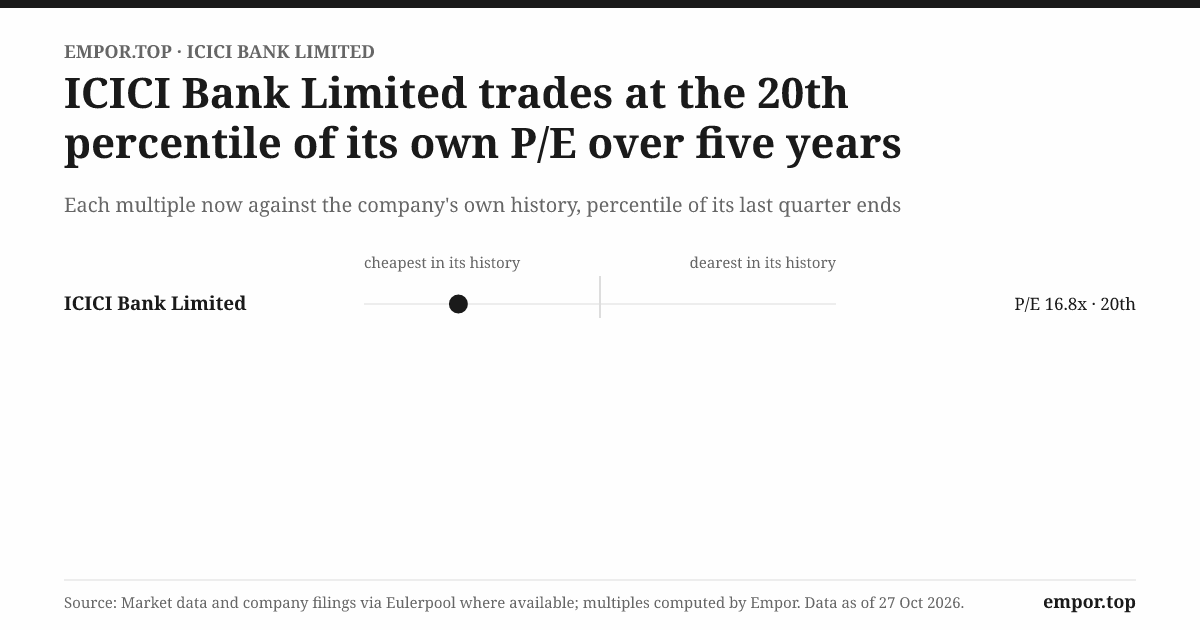
On October 16, 2026, the day before the quarter's results, ICICI's shares closed at about ₹1,397. That valued the bank at a little over ₹10 lakh crore, several percent below the 52-week high it had reached in July.7 On a peer snapshot taken the same day, ICICI traded at about 17 times trailing earnings and about 2.6 times book value.23 HDFC Bank was at about 14 times earnings and 1.9 times book, Axis Bank about 13 times and 1.7 times, and Kotak Mahindra Bank about 22 times and 2.4 times.23 By late October, after the results, ICICI's multiple on trailing earnings was a shade under 17. That is below its own five-year median of about 18 times, with return on equity running at about 15%.513
The price says something specific. Investors are paying a premium to HDFC and Axis on earnings, and more for each rupee of book value than for any of the three peers. They are paying less than they did, on average, over the past five years. The market rates ICICI as one of the best franchises in Indian banking, but it is not paying for an unbroken run of fast growth. It is paying for durability.
Start with the bull case. ICICI's deposit franchise remains broad and low-cost.6 Its fee mix is diversified and retail-led. Its underwriting has been tested by one of the worst credit cycles in Indian banking history, and the bank came out solvent and profitable. Its capital and provisions are strong.5 Earnings have reaccelerated after the slow fiscal 2026.5 On that view, the bank deserves a premium to HDFC, which is still absorbing its own merger, and to Axis.
Now the bear case. HDFC and Axis chase exactly the same high-quality borrowers and depositors, so ICICI's advantage depends on executing slightly better rather than on any barrier. UPI and fintech apps have weakened the exclusivity of digital payments. Fast lending growth can outrun risk controls, and this bank has done that before. Low-cost deposits are not guaranteed: the CASA ratio has already slipped and margins are lower. Fiscal 2026 net profit grew only about 6%, which shows how quickly growth can stall when margins compress and credit costs normalise.13 On that view, the premium to HDFC and Axis rests on execution that has not yet been tested through a full cycle under the current leadership.
Run the five competitive forces through those facts. Rivalry is intense: four or five banks of national scale are competing for the same profitable customers. Buyer power is real on both sides of the balance sheet. Good borrowers multi-bank, and depositors move money when rates rise, though the granularity of ICICI's deposits blunts the second. Supplier power belongs in effect to depositors and to the RBI, which sets the cost of reserves and the shape of products. The threat of substitutes comes from fintech lenders and payment apps, which can capture the customer interface without holding the deposit. The threat of new entrants at full-bank scale is low, because licences, capital and trust take decades to build. Small finance banks and digital lenders, however, nibble at profitable niches. Overall this is an industry where a large incumbent can earn good returns but cannot charge much more than its rivals.
Hamilton Helmer's seven powers give a sharper test of what kind of advantage ICICI actually has. Scale economies exist: a large bank spreads technology, compliance and brand costs over more customers. The evidence is a cost of funds below the sector average and the ability to invest in software while cutting headcount.616 They are shared, though, with HDFC and SBI. Switching costs are moderate. Moving a salary account, its linked loans and its standing instructions is a nuisance, but customers do it, and the bank does not publish retention data to show how sticky they are.
Branding matters in Indian banking, where trust in an institution is part of the product, and the Videocon affair shows the brand can be damaged too. Process power, the ability to underwrite and serve more cheaply and accurately than rivals, is ICICI's strongest claim. It is also the one it has to keep proving loan by loan. Network economies, counter-positioning and cornered resources barely apply: ICICI holds no unique licence, no proprietary network effect and no strategy its rivals cannot copy.
So the history narrows the moat claim. ICICI has real scale, a strong brand and good processes. It does not have a structural barrier that guarantees above-market returns. That is a common position for a top-tier bank, and it is not a weakness. It does mean the valuation premium rests on execution.
A sceptical investor, the kind who writes letters to boards, would ask a direct question. Suppose the margin stays below 4.2%. Suppose domestic loan growth, excluding FCNR(B), slows from about 24% towards the mid-teens, and credit costs rise from today's low levels to management's guided 50 basis points or above. How much earnings growth is left without treasury gains or headline FCNR volumes? The answer is uncomfortable for a premium valuation. In that scenario earnings growth would likely look much more like fiscal 2026's single digits than the September quarter's 20%. The same investor would ask for a regular bridge from standalone to consolidated profit. They would also ask why the bank, with surplus capital, keeps putting money into subsidiaries rather than paying a larger dividend. The payout ratio has been about 14% of profit, against about a third in the years just before the credit cycle peaked.13
Who is setting that price has changed too. ICICI has no promoter: there is no founding family or parent company with a controlling stake. At September 2026, foreign portfolio investors held about 35% of the shares and domestic institutions about 42%.24 Foreign ownership had been around 44% to 46% for most of 2023 to 2025 before falling to about 34% by March 2026, while domestic institutions bought more.24 The marginal buyer of ICICI is now an Indian institution rather than a foreign fund. The capital base has also stayed stable. The bank had about 7.16 billion shares at March 2026, and in fiscal 2026 it issued new shares only under employee stock schemes, with no rights issue, buyback or preferential allotment.8 It has funded its growth from retained profit, not new equity, which is what a 16% CET1 ratio after years of rapid growth implies.
The balanced reading is that the bull case is supported by today's numbers: earnings reaccelerating, headline NPAs at multi-year lows, and strong capital. The bear case is supported by the bank's own history: the slowdown in fiscal 2026, the credit peak of fiscal 2018, and the fact that rapid growth has hurt this bank before. ICICI trades below its own median valuation but above most of its peers. The market is paying ICICI to prove that this time growth and discipline can coexist.
XI. Playbook: Business & Investing Lessons
The first lesson begins in April 2002, with a young bank absorbing its own parent. The reverse merger is often told as a story about product breadth: one bank, one customer, everything on offer. The real change was quieter and more consequential. Long-term industrial loans that bondholders had once funded were now funded by depositors, inside an institution with reserve requirements, a regulator and a duty to repay savers on demand. The product catalogue was the visible part. A universal bank is a funding model and a risk model before it is a product catalogue. Founders building financial businesses and investors analysing them should look first at where the money comes from and who bears the loss when it goes wrong, and only then at what is being sold.
The second lesson comes from the long climb in NPAs and the even longer descent. By March 2018 ICICI's gross NPAs had more than tripled in three years. Eight and a half years later the ratio was 1.20%.15 Both numbers describe outcomes. Neither describes the processes that produced them. A low ratio can hide a portfolio that will sour when conditions change, just as a high ratio can follow years of reasonable lending caught by an unusually brutal cycle. A low NPA ratio is an outcome, not a control system. Investors who want to judge a bank's discipline should watch the flow: new slippages, recoveries, write-offs and credit costs through a period of fast growth. Those, not the headline ratio, show whether a lender has changed.
The third lesson comes from the fiscal 2026 accounts. The bank added 528 business centres while its headcount fell by about 6,600, and software spending rose by more than half.192216 That is not a digital bank replacing branches. It is a bank using technology to run a bigger physical network with fewer people. Digital scale is useful when it changes the cost of serving a customer. The lesson is to stop counting downloads and start counting cost per customer, decision time and credit performance of digitally sourced loans. A technology lead that does not show up in those numbers is a marketing claim.
The fourth lesson comes from a boardroom in 2018. When allegations against Kochhar emerged, the board's first reaction was to stand behind her. Months later it commissioned an outside judge, accepted his findings, treated her exit as a termination for cause and moved to recover her bonuses.11514 The second set of decisions repaired some of the damage the first had done. When trust fails, the board's correction becomes part of the product. A bank sells safety, and depositors and shareholders judge it by how quickly and completely its governors admit a failure. The lesson for every board is uncomfortable but simple: the speed and credibility of the correction becomes the reputation.
The fifth lesson comes from two small-town banks. Bank of Madura and Sangli Bank gave ICICI hundreds of branches in places it had barely reached, in exchange for shares.1112 The swap ratios were set by independent valuers, and in Sangli's case the dilution was about 0.4%.12 What those terms do not show is whether the branches became durable, low-cost deposit franchises or expensive problems to clean up. Acquisitions buy reach; integration earns the return. Investors evaluating any bank merger should ask not "was the price fair?" but "what did the bank inherit, and what did it cost to make it work?" ICICI's record of these deals is honest about the first question and silent on the second.
XII. Epilogue
Tonight ICICI Bank stands where its story has stood several times before: growing quickly, well capitalised, and confident. The September quarter's results are in. Profit grew about a fifth, NPAs are at a low and capital is strong.5 Bakhshi has just begun the two-year term the board gave him in January.2 The question for his successors is: can the bank grow fast without repeating its old mistakes?
The next answers arrive in three moments. The December-quarter results, due early in 2027, will be the first full quarter carrying the FCNR(B) funding and overseas loans that management said would weigh on the margin.20 If the margin falls further in that quarter and then starts to recover in the March quarter, as management guided, the funding-led burst will look like a planned trade-off that worked.20 If the margin keeps falling and the CASA ratio does not recover, the market will start asking whether the bank bought its growth.
The second moment is the full fiscal 2027 picture of domestic growth. If loans excluding FCNR(B) keep growing in the low twenties, ICICI is winning share organically. If that rate slips towards the high teens once the overseas lending is set aside, the headline growth of 2026 will look like a burst rather than a trend. In either case, watch how management explains the result. After 2018, this bank's credibility depends on quantifying effects, such as funding mix, credit costs or regulatory changes, rather than retreating into broad commentary about the macro environment.
The third moment is the credit test. India's banks are preparing to move to an expected-credit-loss provisioning framework. Under it, banks will set aside money for expected losses on loans as soon as they are written, instead of waiting for trouble. ICRA has flagged the transition, along with geopolitical uncertainty, as something to watch. It judges the impact manageable for ICICI given its capital and its ₹131 billion of contingency provisions.[^23]5 If those provisions absorb the transition without slowing growth, the bank's conservatism of the past few years will have paid off. Through it all, the slippage figure, the new NPAs each quarter, will be the most honest number on the page.
There are also smaller threads to follow. The bridge from standalone to consolidated profit will show how much the asset manager's consolidation adds. The Kochhar recovery suit and the money-laundering proceedings will continue in the courts.1614 And the board will need to plan for a successor to a chief executive whose current term ends in October 2028.2
The tension does not resolve. The next few years of results will test whether the bank can sustain its clean asset quality.
XIII. Outro
In 1955 a new institution opened to lend long-term money to India's industrial future, backed by the World Bank, the government and the country's business leaders.91 Seventy-one years later the same name sits over more than 7,000 branches6. It finances that future with money gathered from millions of ordinary savers, every rupee of it a promise to pay back on demand.
That change is the whole story. The development lender had only bondholders to answer to. The bank answers to depositors, regulators and shareholders, all at once. By 2026, its balance sheet had recovered, and the board had acted on a public governance failure.15 Its defining skill has been reinventing itself. Its defining risk has been the confidence each reinvention produces.
ICICI Bank's story is not just how it learned to grow, but whether it can keep learning what growth costs.
References
-
Annual Report FY2018 — ICICI Bank, 2018 ↩↩↩↩↩↩↩↩↩↩↩↩↩↩↩↩↩↩↩↩↩↩↩↩↩↩↩↩↩↩
-
FY2026 AGM Notice and Shareholder Resolutions — ICICI Bank, 2026 ↩↩↩↩↩↩↩↩
-
ICICI's Scandal-Hit Chanda Kochhar Quits as CEO; Sandeep Bakhshi Gets Top Job — Reuters via Business Standard, 2018-10-04 ↩↩↩↩
-
Q2 FY2027 Results — ICICI Bank, Form 6-K, 2026-10-17 ↩↩↩↩↩↩↩↩↩↩↩↩↩↩↩↩↩↩↩↩↩↩↩↩↩↩↩
-
ICICI Bank Limited: Ratings Reaffirmed — ICRA Rating Rationale, 2025-10-30 ↩↩↩↩↩↩↩↩↩↩↩↩↩↩
-
ICICI Bank Q2 Results: Profit Rises 20% YoY to ₹14,843 Crore; NIM Down 12 Basis Points — Upstox, 2026-10-17 ↩↩
-
ICICI's Race Against Itself — Institutional Investor, 2004-12-13 ↩↩↩↩↩↩↩↩↩↩↩↩↩
-
RBI Approves the ICICI-ICICI Bank Merger — ICICI Bank, 2002-04-26 ↩↩↩
-
Bank of Madura Merger Announcement — ICICI Bank, 2001-02-27 ↩↩↩↩
-
Sangli Bank Merger Announcement and Exchange Ratio — ICICI Bank, Form 6-K, 2006-12-09 ↩↩↩↩↩↩↩
-
Key Financial Indicators: Last 10 Years — ICICI Bank, FY2026 ↩↩↩↩↩↩↩↩
-
Deputy Director, Directorate of Enforcement v. Chanda Kochhar and Others, FPA-PMLA-3802/DLI/2020 — Appellate Tribunal under SAFEMA, 2025-07-03, via Bar & Bench ↩↩↩↩↩↩↩↩↩
-
Videocon Loan Case: Independent Enquiry Finds Chanda Kochhar Violated Code of Conduct — Indian Express, 2019-01-31 ↩↩↩
-
Schedules Forming Part of the Accounts FY2026 — ICICI Bank, 2026 ↩↩↩↩↩↩↩↩↩↩↩↩↩↩
-
Independent Auditor's Report on Financial Statements FY2026 — ICICI Bank, 2026 ↩
-
Business Model, Integrated Report FY2026 — ICICI Bank, 2026 ↩↩↩↩↩↩↩
-
ICICI Bank Q2 FY2027 Earnings Call Summary — Quartr, 2026-10-17 ↩↩↩↩↩↩↩↩
-
ICICI Bank Q2 Results: Net Profit Jumps 20% to Rs 14,843 Crore; NIM Contracts — Business Today, 2026-10-17 ↩↩↩↩↩↩
-
Human Capital, Integrated Report FY2026 — ICICI Bank, 2026 ↩↩
-
Peer Comparison: Kotak Mahindra Bank, HDFC Bank, ICICI Bank, Axis Bank — Value Research, 2026-10-16 ↩↩
 LinkedIn
 WhatsApp
 Reddit
 Hacker News
 Email
 Kindle
 RSS Feed
 Spotify
 Apple Podcasts
 Amazon Music
 Audible
 YouTube