ICICI Prudential AMC: The Business That Manages Everyone Else’s Money
I. Seventeen Million Customers, One Earnings Question
On the evening of October 12, 2026, ICICI Prudential Asset Management Company put out the kind of quarter that most businesses would frame and hang in the lobby. Operating revenue for the three months to September came to ₹1,674 crore, up 16.3% from a year earlier.1
The mutual funds it runs held an average of ₹11.61 lakh crore over the quarter, roughly ₹11.6 trillion of Indian savings, up 14.4%.2 It counted 17.8 million unique customers, more people than live in most of the world's countries.3 Then came the line that changed the tone of the evening. Profit after tax was ₹889 crore, up just 6.1%, and down almost 8% from the quarter before.3
That gap, between a fee business growing in the mid-teens and a bottom line growing in the low single digits, is where this story starts. It is a small gap in one quarter. It is also the cleanest possible way into the question every long-term investor in an asset manager eventually has to answer: is this a compounding franchise, a business that gets stronger and more valuable with each passing year because savers keep choosing it, or is it a leveraged bet on the stock market wearing a franchise's clothes?
Before going further, it helps to draw a boundary that is easy to blur. The listed company is not the mutual funds. When a schoolteacher in Pune puts ₹5,000 a month into an ICICI Prudential equity fund, that money belongs to her. It sits in a scheme, held by a trustee and a custodian, and it rises and falls with the shares the fund owns.
None of the ₹11.61 lakh crore is on the company's balance sheet.4 What the company owns is the right to charge a fee for managing that money, a sliver of a percentage point each year, for as long as the money stays. The trillions are the river. The listed company is the mill on its bank.
That distinction is why the October quarter is so interesting. The river was running higher. The mill was turning faster. And yet less of the extra water seemed to reach the shareholders who own the mill. Was something wrong with the machinery, or was something else, outside the fee business entirely, muddying the numbers? The answer, which arrives later in this story, turns out to be mostly the latter, and that answer itself teaches something important about how to read this company.
There are three questions worth carrying through the whole episode. The first is what makes ICICI Prudential win: whether its lead rests on something durable, such as brand, distribution and investment skill, or on having been in the right place when Indian households discovered mutual funds. The second is how much of its growth survives contact with weaker markets, fee regulation and cheaper passive products.
The third is the one that only a listed subsidiary raises: the company is controlled by ICICI Bank, which owned 53.00% of it at the end of September 2026, while Prudential, the British-born insurer that co-founded it, owned another 32.59%.5 Together they hold more than 85 cents of every rupee of equity. When a company's two largest owners are also its brand licensor, a distribution partner, a vendor and now the seller of a business it is buying, every outside shareholder has to ask whether the arrangements serve them as well as they serve the group.
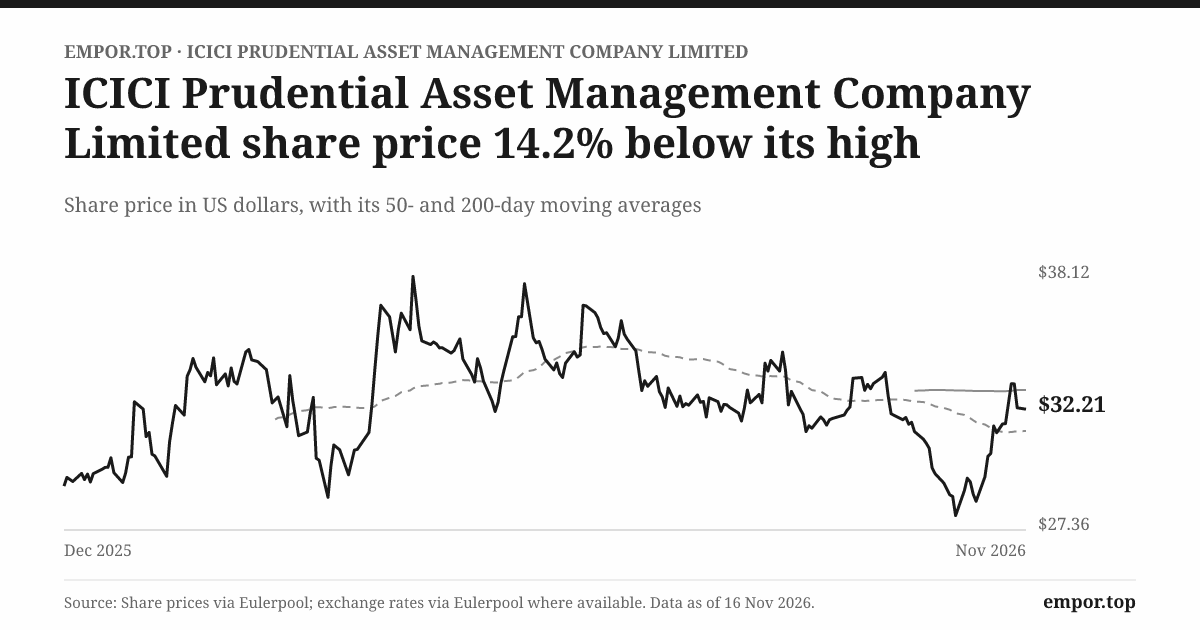
The stock market's own verdict so far is short and noisy. On November 16, 2026, the shares closed at ₹3,025, about 14.5% below their 52-week high of ₹3,538.50 and comfortably above the low of ₹2,585.90. They had swung with an annualised volatility of about 32% over the year.
The company listed less than a year earlier, which means there is no five-year history of how the public market has priced it, no median multiple to compare today's price against, and no full cycle of good and bad years to judge how investors treat its earnings when markets turn. Anyone claiming to know what a "normal" valuation for this stock looks like is extrapolating from a handful of months.
What can be judged is the business itself, and it has a long record. To understand why the mill sits where it does on the river, the story has to go back to the late 1990s, when India's fund industry was barely more than a government monopoly and a handful of brave newcomers.
 Subscribe on LinkedIn
II. A 1998 Partnership Finds Its Scale
The corporate entity is older than the brand. By the year to March 2017, the company was already publishing its twenty-fourth annual report, which tells you the shell had existed since the early 1990s, when ICICI, then a development-finance institution rather than the retail bank it later became, set up its own asset-management arm.6 The decisive moment came in 1998, when ICICI and Prudential formed the joint venture that gave the business its name and its second parent.4
It is worth pausing on why that partnership made sense to both sides at the time. India's mutual-fund industry in the late 1990s was dominated by Unit Trust of India, a state-backed giant, and private asset managers had only been allowed in since the early part of the decade. Household savings went overwhelmingly into bank deposits, gold, real estate and small-savings schemes run by the post office.
ICICI brought an Indian name, an emerging network and an understanding of the domestic market. Prudential brought a global asset-management and insurance heritage, and a long-term ambition in Asia that it pursued market by market. The joint venture was a bet by both that India's savers would one day move from fixed deposits into market-linked products. It was a bet on behaviour that did not yet exist at scale.
For most of its first fifteen years, that bet paid off slowly. Then the pace changed. The company crossed ₹1,000 billion, or ₹1 lakh crore, in mutual-fund assets in 2013.4 That figure looks modest beside today's ₹11.61 lakh crore, which is the point: more than nine-tenths of the assets the company manages today arrived after its fifteenth birthday. In 2022, it became the second-largest asset manager in India by quarterly average assets under management.4
The man most associated with that climb is Nimesh Shah, who became managing director in 2007 and still led the company as MD and CEO in FY2026.7 Tenure of that length is unusual in Indian financial services, and it matters for this story in two ways.
It gives the franchise a continuity of strategy and culture that few rivals can match: the same leader through the 2008 crash, the 2013 currency scare, demonetisation, the pandemic and the retail boom that followed. It also means the company's record is, to an unusual degree, his record, which makes the question of how he explains good and bad quarters a central test of management credibility.
Alongside him, Sankaran Naren, executive director and chief investment officer, has shaped how the funds invest.4 On the October 2026 call, Shah described the house in words that sound like a philosophy rather than a sales pitch: when the firm thinks small and mid-cap stocks should be bought, he said, it says so when there is "blood on the street", which is precisely when investors do not buy.3 That contrarian, valuation-conscious streak is part of why ICICI Prudential is seen as a conservative manager. It is also, as later sections show, part of why it has missed some of the most crowded trades of recent years.
The financial arc over the decade is steep. In FY2017, revenue from operations was about ₹1,301 crore and profit after tax about ₹480 crore.6 By FY2026, revenue had reached roughly ₹5,765 crore and profit roughly ₹3,298 crore.7 Revenue grew about four and a half times in nine years. Profit grew almost seven times.
That second number is the more revealing one, because it says the business became more profitable per rupee of revenue as it grew: costs rose, but far more slowly than fees. Even by FY2018, profit had jumped to about ₹626 crore on revenue of about ₹1,819 crore, an early sign of how quickly scale fed through to earnings.8
The most recent stretch was the fastest. Between FY2023 and FY2025, operating revenue compounded at 32.0% a year and profit at 32.2%.4 In FY2026, growth moderated to 23.1% for revenue and 24.4% for profit.7 Twenty-plus percent growth is still very strong. But it is a slowdown from the prior pace, and the October quarter's numbers suggest the curve was still flattening.
Here is the uncomfortable question the decade raises. How much of the growth came from ICICI Prudential being better than its rivals, and how much came from simply standing in the path of a once-in-a-generation shift in Indian household savings? Those are related but distinct sources of growth, and confusing them is the most common mistake in reading an asset manager.
The industry itself has grown enormously: by September 2026, India's mutual funds held an average of ₹87.49 lakh crore, and the industry counted 63 million investors, up 11% in a year.3 A manager that merely held its share through that boom would have grown spectacularly without doing anything remarkable.
The record shows ICICI Prudential did somewhat better than merely hold its share. Its rise from the pack to second place by 2022, and the fact that its active assets grew faster than the industry's in the three years to FY2025, are evidence of genuine competitive gains.4 But that evidence is narrower than a decade of headline growth implies. Most of the decade's revenue came from the tide. A smaller but real part came from swimming faster than the people around it.
The 2025 listing changed the audience for that record without changing the business. In December 2025, the company went public through an offer for sale, in which Prudential sold shares it already owned.4 The AMC itself received no proceeds.4 Nothing was raised to fund new products, technology or acquisitions, because nothing needed to be raised: the business generates more cash than it can usefully reinvest.
What the listing did bring was a new set of owners who could sell if they were unhappy, quarterly earnings calls with analysts who ask awkward questions, and disclosure obligations that make the company's inner workings far more visible. To understand what those analysts are actually scrutinising, the next step is to open up the machine and see how the fee is earned.
III. The Fee on Every Rupee Managed
Picture a young software engineer in Bengaluru who signs up for a monthly systematic investment plan, an SIP, of ₹10,000 into an ICICI Prudential equity fund. On the fifth of every month, the money leaves her bank account and buys units of the fund. She sees a statement, a fund value and, if she is lucky, a growing number. What she probably never sees is the AMC's cut, because it is not charged as a bill. It is taken quietly, a tiny daily slice of the fund's assets, through the scheme's expense ratio.
That slice is the entire business. In FY2025, management fees were about 94% of the company's revenue from operations.4 These fees are calculated primarily as a percentage of assets under management, under the terms of each mutual-fund scheme's documents and, for the smaller portfolio management services, alternative investment funds and advisory mandates, under individual agreements.4 Some of those alternative mandates can also earn performance fees when returns clear a hurdle, but they are a modest part of the whole.4 In the October quarter, mutual funds produced almost 90% of operating revenue, alternatives about 9% and offshore advisory a little over 1%.3
The mechanics are simple enough to work through with a single example. On the October call, the company disclosed that for the first half of FY2027 it earned, on an annualised basis, about 67 basis points on equity assets, 32 basis points on debt funds, 29 basis points on arbitrage funds, and just 12 basis points each on liquid funds and passive products.3
A basis point is a hundredth of a percentage point. So for every ₹1 lakh sitting in an equity fund for a year, the AMC keeps about ₹670 after paying distributors. For every ₹1 lakh in a liquid fund or an index fund, it keeps about ₹120. The same rupee of savings can be worth more than five times as much to the company depending on where the saver puts it.
That single fact explains most of what moves this company's revenue, and it is worth tracing the causal chain step by step. First, market levels change the value of the assets. If the stock market rises 10%, the equity funds' assets rise roughly 10% with no new money coming in, and fees follow. Second, net flows, the gap between money coming in and money going out, add or subtract assets.
Third, product mix decides the yield on those assets: a shift from equity to liquid funds can shrink revenue even if total assets hold steady. Only after those three forces have done their work do fees meet costs. Across the whole company, the blended gross yield in the first half of FY2027 was about 53 basis points, and the operating margin on assets, what was left after operating costs, was about 37 basis points, slightly better than a year earlier.3
As established at the outset, the AMC earns fees on assets; it does not share in investors' returns.
Nor is this business built like a factory. The AMC holds no inventory, so inventory turnover tells you nothing about it.7 It has few fixed assets, so the standard test of how hard a company sweats its plant and machinery is meaningless here. The company reported nil borrowings in its prospectus.4 Its main long-term obligations are leases on offices, about ₹170 crore at March 2026, and finance costs of under ₹18 crore a year were simply the interest component of those leases.7
The most notable capital spending of recent years was a one-time step-up in FY2025, when capex jumped to about ₹412 crore, mostly for a new corporate office, from roughly ₹41 crore and ₹55 crore in the two years before.4 Even that, in a year when profit was about ₹2,650 crore, was a modest call on cash. The things that actually require investment are people, technology and distribution relationships. The company had 3,585 permanent employees at March 2026, a remarkably small number for a business serving 17.8 million customers.7
So the right instruments for reading this company are not the usual industrial ratios. They are quarterly average assets under management, the yield earned on those assets, the operating profit those fees produce, and the flows of customers and money that feed future assets. Everything else is commentary.
The economics that follow from this model are striking. Because the main input is human talent and software, and because a fund that manages ₹50,000 crore needs not vastly more people than one managing ₹10,000 crore, each additional rupee of assets is mostly profit. That helped drive the profit growth. It is also why cash generation is exceptional. In FY2026, the company reported profit after tax of ₹32,983 million and net cash from operating activities of ₹32,816 million: almost exactly one rupee of cash for every rupee of profit.7
Many businesses report profits that take years to turn into cash, or never do, because the money is tied up in unpaid invoices or unsold stock. Here, the receivables at the year-end were about ₹186 crore, all considered good and all outstanding for less than six months.7 The fees are deducted from fund assets on a schedule the AMC controls, so there is little to chase.
That near-perfect conversion is the single best piece of evidence on earnings quality in the whole record. It says the profits are real, collected and repeatable in the sense that they recur as long as the assets do. But "as long as the assets do" is the heavy clause in that sentence, and it is where the business model's vulnerability lives.
The two ways a bad market bites
Recurring fee income is not the same as contracted revenue. The company does not disclose a standard contract length, a minimum commitment or a recurring-revenue percentage, and for good reason: none exists in the way it would for a software subscription.4 An open-ended mutual-fund investor can redeem on any business day. An SIP can be paused with a few taps on a phone. What looks like an annuity is really a daily referendum.
This is why a weak market can hurt the business twice. The first blow is mechanical. If equity markets fall 20%, the equity assets fall roughly 20% the same day, and because equities carry the richest fees, revenue falls even more steeply than total assets would suggest. The second blow is behavioural, and it arrives with a lag.
Investors who see red on their statements become less willing to add money to active funds, more tempted to redeem, and more inclined to ask whether a cheap index fund would have done as well. A business that looks wonderfully operationally levered on the way up, where every extra rupee of assets is mostly profit, is just as levered on the way down, because the costs of the people and systems do not fall when the market does.
The October call showed what this looks like in practice, even in a market that was merely mixed rather than collapsing. The company's systematic transactions, which combine SIPs and systematic transfer plans, eased to about ₹4,672 crore in September from about ₹4,872 crore in June.3 One analyst observed that the company's systematic book had barely grown year on year while the industry's kept growing in double digits.3
Management's explanation, that money was shifting towards small and mid-cap categories where the firm is underweight and that some investors brought forward money they had planned to transfer in instalments, was plausible and specific.3 It also confirmed the point: flows go where investors want, not where the AMC prefers.
There is one more feature of the model that the next section will make central. The fee per rupee is not set by the company alone. Mutual-fund expense ratios in India are capped by the Securities and Exchange Board of India, and every scheme's total expense ratio is published for any investor to compare.9 The company can choose where within the cap to price, but it cannot charge whatever the market would bear. That regulator sits, in effect, at the table whenever revenue per rupee is decided.
None of this makes the business fragile. Twenty-plus years of growth through several crashes say otherwise. It makes it a business whose revenue is a moving product of market levels, flows, product mix and regulation, rather than a fixed stream. Which raises the obvious next question: in a business where customers can leave daily, what actually keeps them, and keeps distributors recommending ICICI Prudential rather than one of dozens of rivals?
IV. The Leader Has to Keep Earning the Lead
Every month, India's mutual-fund industry produces a league table, and in September 2026 it produced an odd one for ICICI Prudential. Count only the actively managed funds, the ones where a manager picks stocks or bonds and charges for the judgement, and ICICI Prudential was first in the country, with 13.3% of active assets and about ₹9.59 lakh crore under management.3
Narrow the lens further to equity and equity-oriented schemes and it held 13.7%, also the highest.3 Widen the lens to include everything, index funds and ETFs included, and it slipped to second.3 The same company is both the leader and the runner-up, depending on which product the saver chose.
That double ranking is the right starting point for a war-game analysis of this market, because it shows where the company's strength lies and where it does not. ICICI Prudential is a leader in the expensive, judgement-heavy part of the market. It is less dominant in the cheap, commoditised part, where the product is simply tracking an index and the winning attributes are low cost and big scale.
Start with the closest rivals. At September 2025, ICICI Prudential managed about ₹8.64 lakh crore of active assets on a quarterly average basis. SBI Funds Management had about ₹8.24 lakh crore and HDFC Asset Management about ₹8.16 lakh crore. Nippon Life India was a distant fourth at about ₹4.55 lakh crore.4 The gap between first and third was less than 6%. That is not a runaway lead. It is a three-horse race in which a few bad quarters of fund performance, or one hot product at a rival, could change the order.
Growth rates tell the same story. Across FY2023 to FY2025, ICICI Prudential's active assets grew about 29.7% a year. HDFC's grew 29.6%, essentially identical. Nippon's grew 33.2%, faster than both, albeit from a smaller base.4 ICICI Prudential outgrew the industry. It did not uniquely outrun every major rival. Whatever its advantages, they were not large enough to stop HDFC keeping pace or Nippon gaining ground.
That record tests a claim the company's co-owner made five years earlier. At a 2021 investor day hosted by Prudential, the AMC's market share was presented as consistently above 13%.10 Today's 13.3% active share sounds like continuity, and in a sense it is. But the measures are not identical, and the period in between included the company's move into second place overall. The most defensible reading is that ICICI Prudential has held a share in the low teens of the profitable active market for at least half a decade. That is a sign of durability. It is not evidence of a widening lead.
What actually keeps a saver
So what keeps the customer? The bull case for a moat in asset management usually rests on three pillars: brand, distribution and performance. Nimesh Shah named the same three on the October call. It is, he said, "a mix of brand, distribution, and fund performance", and he went further, in a remark that cuts against any idea of captive customers: "If an AMC does well, it gets money."3 He described the industry SEBI has built as "very simple": small or big, an AMC that shows performance gets flows, and one that does not, does not.3 Coming from the chief executive of the market leader, that is a candid admission that leadership is rented, not owned.
Distribution is the pillar with the most evidence behind it. The company works with more than 118,000 empanelled distribution partners, spanning independent mutual-fund distributors, national distributors and banks.2 Its equity assets came from a balanced mix in September 2026: about 36% through independent distributors, about 30% from investors going direct, about 16% through national distributors, about 11% through banks other than ICICI Bank, and about 7.5% through ICICI Bank itself.3 That last figure is important for the governance questions to come. The parent bank is a meaningful channel, but this is not a captive bank-distribution story. Nine-tenths of the equity business arrives through doors ICICI Bank does not control.
The October call exposed a subtler wrinkle in that channel story. One analyst pointed out that equity assets sourced through ICICI Bank had not grown over the previous four quarters, while other channels had grown at a decent pace.3 He also suggested, and the CFO agreed, that ICICI Prudential captured around 70% of the mutual-fund business the parent bank sells.3
Read together, those two facts say something interesting. Within its parent's branches, the company already has most of the shelf, so the bank channel cannot be a big source of share gains. And the channel's stagnation, in management's framing, reflected the bank's own strategy about what it sells.3 The group link provides reach and some stability. It is not the growth engine.
The direct channel, almost 30% of equity assets, is double-edged. Investors who come direct, through the company's own platforms or fintech apps, pay lower expense ratios because there is no distributor commission. That is good for loyalty to the brand. But direct investors are also, by definition, comparison shoppers. Shah observed on the call that persistency, the tendency of SIP investors to keep investing, was lower in digital channels and higher where a distributor had sold a goal-based plan with an explanation.3 The growth of digital investing, much of it from smaller towns, expands the customer base while making the average customer easier to lose.
Distribution also carries a price war beneath the surface. An analyst noted that, after several rounds of commission cuts at larger fund houses, some mid-sized rivals were paying distributors 20% to 30% more.3 Shah's response was that the gap had existed a year earlier too, when large AMCs were gaining share, and that performance, not commission, ultimately decided flows.3 That may be true over a cycle. In any given quarter, a distributor with a family to feed has an incentive to sell the fund that pays him more.
The product-mix map
Look at where the company's market share is highest and a clear personality emerges. In equity-oriented hybrid funds, which blend shares and bonds and often adjust the mix as valuations change, ICICI Prudential held about 26% of the industry, by far its strongest category.3 In its wider equity franchise, it held 13.7%. These are the products of a house that likes to manage risk on the client's behalf.
That positioning has a cost, and management admitted it. Asked how the company navigates periods when small and mid-cap funds draw the bulk of flows, Shah said frankly that "we have not built a big business on that side" and that building one would require "a strategy" over the next five to seven years.3
That matters because, in the first half of FY2027, small and mid-cap categories captured about 36% of the industry's equity net sales, up from 22% in FY2026.3 The company's conservatism has served many investors well. It also means that when the crowd chases the riskiest equity categories, ICICI Prudential's market share in new money tends to lag.
The other two pieces of the map point in different directions. The company's passive assets grew about 33% year on year, faster than the industry's 23%, but passive products earn only about 12 basis points, so growth there does little for revenue.23 Debt fund assets fell about 9% year on year.2 The product mix is quietly shifting in ways that do not all favour the fee pool.
Then there is the hardest question in the moat debate: does the company's investment skill justify its fees? The prospectus presents scheme-by-scheme performance against benchmarks, and the company's case rests on its funds having delivered competitive returns.4 But AUM leadership and investor returns are two different things. Assets can grow because of brand, distribution and a rising market even if returns are merely average.
Shah himself framed the selling job as finding the funds "where my performance is" and taking them to market, while products change from one cycle to the next.3 That framing is honest, and it implies a moat that depends on always having some category where recent performance is strong. A broad shelf is a real advantage there, because a manager with dozens of strategies rarely has none in favour. It is not the same thing as a fund lineup that beats the market across the board.
Put the evidence together and the verdict on the moat narrows. Scale is real: it lets ICICI Prudential spread technology, compliance and investment-team costs over more assets than nearly anyone else. Brand is real: the ICICI and Prudential names carry decades of trust. Distribution is real and diversified. What the record does not show is high switching costs.
Investors can switch fund houses with little friction, the peer group grew as fast or faster, and the CEO himself says money follows performance. The franchise looks like a strong, durable competitor in a market where the customer remains free. That freedom becomes most visible when the market softens, which is where the October quarter comes back into focus.
V. When the Market Grows Faster Than the Profit
Back to the October call, and to the moment when the analyst questions turned from flows to treasury. One analyst, noting that other income had held up better than he expected after a September equity drawdown, asked how the company thought about managing its own investment book.3
The CFO, Naveen Agarwal, explained that much of the company's own money had to sit in its funds as required seed capital, and that the discretionary part was invested conservatively, mostly in debt.3 Then Nimesh Shah stepped in, and addressed not the analyst but, as he put it, "the larger audience". Please, he said, "keep the focus on operating income". AMC price-to-earnings ratios, he argued, were too high for investors to apply the same multiple to other income.3
It was an unusual thing for a chief executive to say. In effect, the head of the company was telling the market to look past a part of his own reported profit. And the October numbers show exactly why he wanted it looked past.
Here is the puzzle, laid out with the few clues that solve it. Operating revenue grew 16.3%. Profit after tax grew 6.1%. Something between the top line and the bottom line absorbed most of the growth. The first clue is operating expenses, which rose about 17.9% year on year to ₹493 crore, slightly faster than revenue.3
That alone would shave a little off the growth, but not ten percentage points. The second clue is the company's own measure of core profit: operating profit before tax, which strips out other income, reached ₹1,181 crore, up 15.7%.3 So the fee business, after paying for its people, systems and distribution costs, grew its profit almost exactly in line with its revenue.
The third clue delivers the reveal. Other income, the returns on the company's own investments, came to just ₹16.9 crore in the quarter, which management said had fallen mainly because of mark-to-market movements.3 If operating profit grew nearly 16% and after-tax profit grew 6%, the arithmetic implies that the year-earlier quarter carried several times as much treasury income. The slowdown was almost entirely in the part of profit that has nothing to do with managing anyone else's money.
That verdict needs one qualification. Expenses did rise a little faster than revenue, and part of that reflects a new cost of being a public company with employee equity. The CFO guided that stock-based compensation would cost between ₹64 crore and ₹68 crore across FY2027, charged pro rata through the year.3 He added that, excluding the fee and commission expenses tied to the alternatives business, the cost run rate was in line with normal increases.3 The company does not break operating costs down by business line, citing shared departments.3 So the core engine is mostly intact, but it is not quite accelerating either.
The full-year record shows this pattern was already visible before listing. In FY2026, other income was about ₹236 crore, down from about ₹297 crore the year before, mainly because mark-to-market gains on investments declined.7 That was about 5.4% of profit before tax.7 A small slice in a normal year. But the slice is volatile, and the book it comes from is large.
At March 2026, the company held about ₹3,857 crore of investments carried at fair value, spread across mutual funds, debt and equity securities, REITs and alternative funds.7 The company itself estimated that a 5% move in investment prices would swing profit or equity by about ₹193 crore before tax.7 For comparison, that is roughly a fifth of a quarter's after-tax profit. A bad month in the bond and equity markets can therefore move reported quarterly earnings materially, without a single customer changing behaviour.
There is an accounting wrinkle that makes comparisons treacherous. In the FY2026 annual report, the company reclassified interest, dividend and fair-value gains out of revenue from operations and into other income.7 That is a cleaner presentation, because it separates fees from treasury results. It also means older figures must be restated before they can be compared, and anyone reading a pre-reclassification growth rate risks mixing fees with market gains.
So Shah's request to focus on operating income is analytically fair. It is also a reminder that, until the listing, the treasury line was part of what made the headline numbers look smooth or bumpy, and that investors should judge the company by the same yardstick in good treasury years as in bad ones. A management team that asks shareholders to ignore treasury income when it falls earns credibility only if it asks them to ignore it when it rises too.
The flow test and the regulator
If treasury explains most of the October gap, flows and fees explain what comes next. The industry backdrop was mixed. Equity net flows across the industry were about ₹1.06 lakh crore in the quarter, roughly 7% lower than the previous quarter, and more of that money went into small and mid-cap categories.3 Industry SIP contributions were about ₹32,490 crore in September and broadly stable through the quarter.3 ICICI Prudential's equity assets still grew 16.3% year on year, faster than the industry's 15.3%, and the company said it continued to receive one of the highest net flows in the industry in the first half.3
Management's explanation of the softer flow picture was specific. Gross sales, Shah said, were running at similar levels to the previous year; what had changed was redemptions, which in markets like this one tend to rise.3 He added that redemptions should be understood in relation to the assets a manager holds, not its gross sales, and that the company could not track how much redeemed money came back later.3
That is a coherent account, and it is consistent with a business that is large and mature: the bigger the asset base, the bigger the absolute outflows when sentiment cools. The right question is not whether one quarter of eased systematic flows proves a break in the franchise. It does not. The question is whether flows normalise over the next several quarters, and whether the company's share of new money holds up while the crowd prefers categories where it is underweight.
The other force acting on future revenue is the regulator. In December 2025, SEBI announced a major overhaul of mutual-fund rules that cut expense-ratio limits.11 Expense ratios are the mechanism through which the AMC earns its fee, so any reduction in the cap is a direct claim on the industry's revenue pool, even if part of the cut falls on distributors or on statutory levies rather than on the AMC's own margin.
Here the October call offered a useful data point on how management talks about yield. When an analyst asked whether rising mutual-fund yields would continue, the CFO said the company does not give guidance on yields because "it's an outcome", and Shah added: "we wouldn't know".3 The honesty is welcome. It also means investors should not assume yields are a lever the company can pull.
Passive products add a quieter, slower pressure. At that low fee rate,3 every saver who decides that active management is not worth paying for, and moves to an index fund, shrinks the fee pool even if she stays with ICICI Prudential. The company's passive business is growing fast, but that is a defensive success, keeping customers in the house, more than a growth engine.
All of this reduces to three numbers worth watching. The first is the company's share of active and equity quarterly average assets, 13.3% and 13.7% at September 2026, the clearest measure of whether it is still winning the money that matters most.3 The second is revenue yield, about 53 basis points gross at the company level in the first half of FY2027, which captures product mix, regulation and pricing in one figure.3
The third is profit growth measured against operating revenue growth, ideally using operating profit before tax: in the October quarter, operating profit grew about 15.7% against revenue growth of 16.3%, which says the engine is roughly keeping pace with its own top line.3 If share holds, yield stabilises and operating profit tracks revenue through a weaker market, the franchise is compounding. If any of the three slips for several quarters, the story is changing.
Those are questions about the business. The listing also raised a different set of questions, about who decides what happens to all that cash.
VI. The IPO Sold Shares, Not a Growth Plan
In December 2025, Prudential sold up to about 49 million shares in ICICI Prudential AMC to the public.4 The listing created a market price and a new body of public shareholders. But follow the money and the event looks very different from a typical growth IPO. Every rupee raised in the offer went to Prudential. The AMC received nothing.4
That design tells you what the IPO was for. It was a liquidity event for a co-founder that had held its stake for more than a quarter of a century, and a way to put a market value on a business both parents had built. It was not financing a new product push, a technology programme or an acquisition, because the company did not need outside capital for any of those.
Ahead of the offer, the company split its shares from ₹10 to ₹1 face value in June 2025 and approved a 1.8-for-1 bonus issue in October 2025, mechanical moves that changed the number of shares without changing anyone's economic ownership.4
The ownership story is one of a co-founder stepping back and a parent stepping forward. Before the offer, ICICI Bank held 51% and Prudential 49%.4 After the corporate actions and the listing, ICICI Bank's stake had risen to 53% while Prudential's had fallen, to 34.59% at March 2026 and then 32.59% at September 2026.57 The two promoters together still held 85.59%.5 Mutual funds held about 5.1% and foreign portfolio investors about 2.4% at March 2026.7 In practice, the public float is small and control is unambiguous: ICICI Bank runs the company, Prudential retains a large minority voice, and outside shareholders hold a thin slice.
That structure frames every capital-allocation decision. Consider the dividend. In FY2026, the company paid about ₹1,361 crore in dividends to ICICI Bank and about ₹1,188 crore to Prudential, roughly ₹2,549 crore in total, against profit for the year of about ₹3,298 crore.7 In the October quarter, the board declared another interim dividend of ₹30 a share.3
For a business that needs little capital and generates cash almost equal to its profit, high payouts are a rational choice. Holding cash it cannot deploy productively would only depress returns on equity. The dividend is not an operating expense, and it is not a sign of anything improper. It is the natural use of surplus cash in a capital-light fee business.
What does deserve scrutiny is the other ledger: the money that flows between the company and its parents for services. In FY2026, the AMC paid ICICI Bank about ₹26.5 crore in trademark licence fees for the right to use the ICICI name, about 0.46% of revenue.7 It paid ICICI Bank about ₹51.4 crore in common costs, commission and marketing expenses, about 3.2% of total expenses, and paid ICICI Securities, a wholly owned bank subsidiary, about ₹14.6 crore for similar services.7 It also kept about ₹125 crore of cash and bank balances and a small fixed deposit with ICICI Bank.7
The ledger runs both ways. Eastspring Investments, Prudential's Singapore-based asset manager, paid the AMC about ₹85 crore in advisory fees, about 1.5% of revenue, and Prudential reimbursed about ₹20 crore of expenses.7 The annual report describes the related-party transactions as being at arm's length.7 None of the individual amounts is large relative to the business. The trademark fee is less than half a percent of revenue, and the advisory income from Eastspring arguably exceeds the brand cost.
The risk is not that any one line is outrageous today. It is that the structure creates many small points where pricing is set between related parties, and that over years, as the company grows, those points multiply. The October call illustrated one of them: the company captures roughly 70% of the mutual-fund business ICICI Bank sells, which is excellent for the AMC, and also means the bank's distribution decisions and the AMC's commissions are negotiated within one group.3
Who runs the company, and how they are paid
Nimesh Shah's long tenure has already appeared in this story as a source of continuity. The listing adds a new question about incentives. In FY2025, Shah's remuneration was about ₹9.5 crore and Sankaran Naren's about ₹5.9 crore, figures that included deferred bonuses earned in FY2021 to FY2023 and paid in FY2025.4
Deferral of that kind, common in regulated financial firms, means part of the reward depends on the business holding up over several years. In FY2026, the company disclosed that the ratios of the two executives' pay to the median employee's were 90 to 1 and 54 to 1 respectively, while median employee remuneration rose around 15.5%.7 The company does not set out comparable individual FY2026 totals alongside those ratios.
After listing, a new layer arrived. Shareholders approved an employee stock option scheme in 2025 and an employee stock-unit scheme in 2026, and by the September quarter the company had granted about 0.76 million options and 0.19 million units.71 Equity grants tie employees to the share price, which can align them with outside shareholders, but they also cost money: that is the ₹64 crore to ₹68 crore of stock-based compensation guided for FY2027.3 Whether the scheme proves aligned depends on vesting conditions and performance hurdles over time, not on its existence.
The June 24, 2026 annual meeting provided one small test of shareholder sentiment. About 1.37% of votes cast opposed the employee stock-unit resolution.12 That is a modest level of dissent, the kind that registers a view without signalling a revolt, and it is worth tracking as a baseline as the institutional base grows. The board at FY2026 included six independent directors out of ten, and shareholders were asked to approve the appointment of independent director Prashant Kumar.7
The audit record is clean in the ways that matter. The statutory auditor gave an unmodified opinion on the FY2026 accounts.7 Its report under the Companies (Auditor's Report) Order noted one limited observation: the company had not physically verified its property, plant and equipment during the year under a phased three-year programme, so the auditor could not comment on discrepancies that might have arisen.7 For a company whose fixed assets are mainly offices and computers, that is a procedural note rather than a warning sign. Contingent liabilities were small, about ₹2.5 million of disputed indirect-tax claims and a ₹10 crore bank guarantee backed by deposits.7
One regulatory matter deserves mention in proportion. In April 2026, the company disclosed a settlement with SEBI concerning the winding up of an older real-estate venture-capital scheme, ICICI Prudential Venture Capital Fund – Real Estate Scheme I, which had run past its permitted tenure.13 The settlement cost ₹14.36 lakh, and the company said it had no material financial impact.13 It is a footnote about how older alternative products were managed, not evidence of a problem in the mutual-fund core. It does, however, sit next to the company's growing ambitions in alternatives, which is exactly where the next decision took the story.
VII. A Related-Party PMS Deal, Priced by Assets
On August 10, 2026, the AMC's board approved buying the portfolio management services business of ICICI Securities.14 On November 19, 2026, the company told the exchanges that SEBI had approved the transfer.15 It was the first sizeable expansion move since the listing. And the seller was a wholly owned subsidiary of ICICI Bank, the AMC's own parent.14
A portfolio management service, or PMS, is the wealthy investor's version of a mutual fund. Instead of buying units in a pooled scheme, the client owns a separate account of shares, managed to a strategy, with a high minimum investment set by SEBI. Fees are higher than in mutual funds, and sometimes include a share of gains above a hurdle.
For an asset manager, PMS clients are attractive because they are wealthier and often stickier, and because the fee per rupee is richer. ICICI Prudential already runs a large PMS business of its own: its PMS assets averaged about ₹30,791 crore in the September quarter, up 21% year on year.3
Against that, the business being acquired is small. ICICI Securities' PMS business managed about ₹2,910 crore at March 2026 and earned about ₹20.9 crore of revenue in FY2026.14 It would add something under a tenth to the AMC's existing PMS assets, and its revenue is less than half a percent of the AMC's annual operating revenue. Whatever this deal is, it is not a transformation.
The price was set by a formula rather than a fixed sum: 1.20% of the actual assets under management transferred.14 At the March 2026 asset level, that implies about ₹35 crore. Compare that with the business's revenue and the consideration works out at about 1.7 times FY2026 sales. For a fee business, that sounds inexpensive.
But revenue is not profit, and the company has not disclosed the acquired business's profit, the cost of serving its clients, or what share of clients and assets will actually move across. The price cannot fairly be called cheap or expensive on what has been published, and an invented peer multiple would not settle the question.
There is a more revealing comparison hiding in those numbers. Divide the acquired business's FY2026 revenue by its year-end assets and the implied revenue yield is about 0.7%, a rough measure because assets moved during the year. ICICI Prudential's own PMS and AIF business earned a gross yield of about 1.92% and a net yield of about 0.96% in the first half of FY2027, after fees and commissions paid to distributors.3
If the acquired book continues at its historical economics, it earns less per rupee than the AMC's own alternatives business. If the AMC can reprice or upgrade the clients into its own strategies, the economics could improve. That is the real investment case, and it is a case about execution, not about the purchase price.
The trajectory complicates any growth pitch. The business's revenue rose from about ₹14.9 crore in FY2024 to about ₹25.3 crore in FY2025, then fell to about ₹20.9 crore in FY2026.14 A business whose revenue fell by about a sixth in its most recent year is not obviously a growth asset. It may reflect market conditions, client outflows or a change in mix, and the company has not said which.
Inside the group, at arm's length
Because the seller is a sister company, the deal is a related-party transaction, and the board described it as being on an arm's-length basis.14 The company's stated rationale, on the October call, was that integrating the ICICI Securities PMS business would let it "engage with incremental new clients" and that certain products being acquired were complementary to its existing PMS offerings.3 Press coverage of the August announcement presented it as the AMC taking over its sister company's PMS business.16 The logic is easy to see: a group with two PMS businesses under one roof has an obvious reason to put them together, and the AMC is the natural home.
What is notable about the October call is what analysts did not ask. Across the question-and-answer session, the questions centred on flows, SIPs, yields, alternatives, SIFs, commissions and treasury.3 No analyst asked about the PMS acquisition's valuation, expected profit or client-retention assumptions. Given the deal's small size, that is understandable. It is also a reminder that small related-party deals are where scrutiny is easiest to skip, and where a pattern, once set, tends to persist.
The PMS purchase also sits beside a second intra-group move. In April 2026, the AMC acquired certain funds from ICICI Venture, the group's private-equity arm, and restated its comparative figures to reflect them.3 Shah said on the call that this gave the company capability in private equity, and that it had launched a fund mixing listed and unlisted investments, with at least 51% in private markets.3
The alternatives business averaged about ₹80,965 crore of assets in the quarter, and the company was explicit that the AIF assets it reports are only the fee-bearing, drawn-down portion of commitments.3 When an analyst asked about moving into infrastructure funds, Shah said there were no plans and that the priority was to scale the categories already started.3 That restraint is worth noting: management is building alternatives step by step rather than buying its way into every adjacent market.
Still, strategic fit is not a return on capital. The tests of this deal come after closing: the actual assets transferred, which determine the final price; how many clients stay; the fee yield on the acquired book; incremental profit; and any integration costs. Until those are disclosed, the deal is a small, sensible, related-party consolidation whose economics remain unproven. Which brings the story to the larger question every investor eventually faces: weighing all this, what has to remain true for the company to keep winning?
VIII. Analysis & Bear vs. Bull Case
Imagine an investor sitting down in late November 2026 with two numbers on a notepad. One is 13.3%, the company's share of India's active mutual-fund assets, the highest in the country.3 The other is 6.1%, its latest quarter's profit growth.3 Beside them sits a share price of ₹3,025 and a public-market history of less than a year. Which number tells the truer story?
The bull case begins with the first number and the cash behind it. ICICI Prudential is the largest manager of active money in a country where household savings are steadily shifting from deposits and gold into market-linked products, with the industry adding more than 11% to its investor count in a single year.3 The company has built a customer base of 17.8 million and a distribution network of more than 118,000 partners that no newcomer could replicate quickly.2
Its economics are about as asset-light as a business can be, and it converted FY2026 profit into operating cash at nearly one for one.7 Its October quarter, read properly, showed the core engine growing in line with its top line, with the headline slowdown explained mostly by treasury marks.3 If India's financialisation runs for another decade, the bull says, a well-run leader with this cost structure compounds.
The bear case begins with the second number and the freedom behind it. Investors can choose direct plans, which strip out distributor commissions; passive funds, which earn the AMC a fraction of active fees; and dozens of rival fund houses, several of which grew as fast or faster over the past three years.43 The CEO himself says money follows performance, which means leadership must be re-earned with every market cycle.3
Market gains have flattered organic strength for a decade. A sustained equity downturn would cut assets and fees at once, while the cost base and the dividend expectations stay where they are. Fee regulation is moving in one direction, towards lower expense limits.11 And the treasury book adds earnings volatility that the company asks investors to look past.3
Why the toll road has other booths
A structured lens helps settle which case the evidence favours, and this is the place to argue the moat in full.
Start with Michael Porter's five forces. The threat of new entrants is moderate: SEBI licences are required, and building trust with millions of savers takes years, but new licences keep being granted and fintech-backed entrants can acquire customers digitally. The bargaining power of buyers is, at the level of each individual saver, low, since no single investor can negotiate fees, but collectively high, because investors can redeem daily and switch with almost no friction. Concentration is not a risk here: the fees are generated across millions of accounts, and no individual customer matters. The bargaining power of suppliers is significant in one specific place: distribution.
Distributors, banks and platforms control access to a large share of investors, and the fact that some rivals reportedly pay 20% to 30% higher commissions is supplier power in action.3 Fund managers, the other key supplier, can move between firms. The threat of substitutes is real and growing: passive funds, direct equity investing, bank deposits when rates rise, and insurance-linked savings all compete for the same rupee. And rivalry among existing competitors is intense, with three firms within about 6% of one another in active assets.4 Taken together, the industry is attractive, because of its growth and its low capital needs, but it is not a protected one.
Now Hamilton Helmer's seven powers, which ask what lets a company earn persistently better returns than rivals. Scale economies are this company's clearest power: fixed costs in technology, compliance, research and brand are spread across a larger asset base than almost anyone else's, and the steep rise in profit relative to revenue over the decade is the evidence.67 But scale economies only matter relative to rivals with similar scale, and SBI and HDFC are nearly as large. Branding is a genuine power: the ICICI and Prudential names reduce the trust gap for first-time investors, which is why the company pays a trademark fee for the ICICI name.7
Counter-positioning is weak. Its conservative, hybrid-heavy positioning is distinctive, but rivals can and do offer similar products. Switching costs are low, as the daily-redemption structure and the CEO's own words make clear.3 Network economies do not really apply: an investor's fund does not get better because more people use it. Cornered resource is limited to the investment team, which, unlike a patent, can walk out of the door. Process power, the embedded organisational know-how that is hard to copy, may exist in the firm's risk-management culture and product discipline, but it is very hard to prove from outside.
The verdict is that ICICI Prudential has two real powers, scale and brand, and a strong distribution position, but no structural lock-in. The moat is a narrower version of what the bull case implies: durable enough to keep the company in the top tier for a long time, not strong enough to guarantee leadership or protect fees against regulation and substitution.
The cash that leaves, and the deal that arrives
A skeptical investor reviewing the capital-allocation record would press on three points. The IPO raised no company cash, so the listing's benefit to the AMC was visibility and liquidity for its owners, not growth capital.4 The dividend sends the large majority of surplus cash to the two promoters, which is rational in a capital-light business but means outside shareholders depend on the promoters' preferences for payout policy.7
And the first sizeable post-listing expansion is a small related-party purchase from the parent's own subsidiary.14 None of these is a red flag on its own. Together, they define the governance test: the board will have to show, over years, that the minority's interests are weighed alongside the group's.
The material risks can be stated by mechanism. A market fall reduces assets and therefore fees, with the richest-fee equity assets falling most. Fee regulation and passive substitution press on revenue per rupee. Treasury marks add volatility to reported profit. A cyber attack or service failure, at a firm serving 17.8 million customers through digital channels, could damage trust at scale, and trust is the product.
Artificial intelligence belongs in proportion. Automation may lower service costs, improve customer acquisition or help research teams process information faster. It does not replace the regulated mandate of managing portfolios, and there is no evidence that AI is, or is about to become, a separate revenue engine. If anything, it intensifies the existing pressure on fees by making low-cost digital distribution and passive investing easier.
Finally, valuation. The share price of ₹3,025 sat about 14.5% below its 52-week high in mid-November, with the stock having fallen as much as about 25% from a peak in its short history. Standard multiples such as price to earnings are not available in comparable form for the stock's brief public life, and there is no company-specific five-year median to compare against.
Shah's comment that AMC price-to-earnings ratios are "too high" to apply to other income suggests management knows the market prices the sector at a premium to most financial businesses.3 That premium appears to assume that the fee engine keeps compounding at well above the economy's growth rate. The company's first full public-market cycle, including a meaningful equity downturn, will reveal how investors price its earnings when the tide turns.
IX. Business & Investing Lessons
There is a quiet moment in the FY2026 accounts that captures this business in one line: profit of about ₹3,298 crore, operating cash of about ₹3,282 crore, and about ₹2,549 crore paid out to the two promoters.7 Cash generation nearly matched profit, and most of it went to the promoters. That symmetry contains the lessons this company teaches.
The first lesson: when the product is trust, scale is an advantage, but it is never the same thing as customer captivity. ICICI Prudential's network is large, but every customer can leave tomorrow, as its CEO has acknowledged.23 For founders and investors, the wider lesson is to separate reach from retention. A big network brings customers to the door. Only performance keeps them in the room.
The second lesson: AUM can grow in a bull market; the harder proof is the fee and the cash it leaves behind. The October quarter showed the distinction: treasury, not the fee engine, explained most of the gap between revenue and headline profit.3 The lesson cuts both ways. Investors should not panic over a treasury mark, and they should not celebrate a quarter flattered by one either. The numbers to watch are yield on assets and the operating profit they produce.
The third lesson: a dividend is only disciplined capital allocation if the next rupee has nowhere better to go. In a business that needs almost no capital, paying out most of its profit is usually right. But it also means the test of management's judgement shifts to the small amounts it does reinvest. The ICICI Securities PMS purchase will test how the company prices deals inside its own group.14
The fourth lesson: long tenure is a credential, not a guarantee. Shah has led the company since 2007.7 His candour on flows and weaknesses is worth something.3 But credibility is earned forward, quarter by quarter, through transparent answers on flows, yields, treasury, related-party pricing and the milestones of every acquisition.
X. Epilogue
Tonight, the PMS assets that ICICI Securities manages are on the verge of crossing the group boundary. The regulator has approved the transfer.15 The final price will depend on how much money actually moves, which will depend on how many clients agree to follow their portfolios to a new manager.14 It is a small deal. It will also be the first time the listed AMC reports the results of buying a business from within its own group.
Over the next few reporting periods, a handful of disclosures will tell investors whether this franchise is still compounding on its own merits. The first is market share. If the company's lead holds through a weaker or more volatile market, its scale-and-brand advantage is doing its job. If it slips steadily while small and mid-cap categories keep drawing the crowd, its conservative positioning will have become a drag on growth.
The second is revenue yield and core profit. Stable yield and operating profit that tracks revenue would show that the fee engine is weathering regulation and mix shifts. Continued yield declines would mean that assets and revenue are starting to diverge, and that growth in the headline AUM figure is no longer translating into profit.
The third is the PMS closing disclosure: the actual assets transferred, the final consideration, how many clients stayed, and the revenue and profit the business produces in its first year under the AMC. Those figures will show whether the small acquisition earns its keep.
The fourth is related-party disclosure. Clear explanations of pricing would help answer the governance question; terse disclosures as intra-group arrangements grow would keep it alive.
None of these answers will arrive in one quarter. Each will come slowly, through the ordinary rhythm of results days, calls and annual reports. The tension that remains is the one the October quarter revealed: a business whose engine is still running strongly, inside a structure where outside shareholders must trust that the engine's output is shared fairly, and in a market where the customer can always walk away.
XI. Outro
The schoolteacher in Pune's ₹5,000 SIP remains the clearest picture of the business: multiplied across millions of savers, such investments make up ₹11.61 lakh crore, but the money belongs to them; the company earns a fee for managing it.2
That is the bargain at the heart of ICICI Prudential AMC: one of the busiest booths on India's growing investment road, with 17.8 million travellers3 but a toll set by a regulator and travellers free to choose another route. Its lasting edge depends on earning the next contribution.
References
-
Unaudited Financial Results for the Quarter and Half Year Ended September 30, 2026 — ICICI Prudential AMC, 2026-10-12 ↩↩
-
Investor Presentation for Earnings Call of October 12, 2026 — ICICI Prudential AMC, 2026-10-12 ↩↩↩↩↩↩↩
-
Earnings Conference Call Transcript, Quarter Ended September 30, 2026 — ICICI Prudential AMC, 2026-10-12 ↩↩↩↩↩↩↩↩↩↩↩↩↩↩↩↩↩↩↩↩↩↩↩↩↩↩↩↩↩↩↩↩↩↩↩↩↩↩↩↩↩↩↩↩↩↩↩↩↩↩↩↩↩↩↩↩↩↩↩↩↩↩↩↩↩↩↩↩↩↩↩
-
Red Herring Prospectus — ICICI Prudential AMC, 2025-12-05 ↩↩↩↩↩↩↩↩↩↩↩↩↩↩↩↩↩↩↩↩↩↩↩↩↩↩
-
Shareholding Pattern as on September 30, 2026 — ICICI Prudential AMC, 2026-10 ↩↩↩
-
24th Annual Report and Accounts for FY2017 — ICICI Prudential AMC, 2017-04-18 ↩↩↩
-
Annual Report 2025–26 — ICICI Prudential AMC, 2026-05-21 ↩↩↩↩↩↩↩↩↩↩↩↩↩↩↩↩↩↩↩↩↩↩↩↩↩↩↩↩↩↩↩↩↩
-
25th Annual Report and Accounts for FY2018 — ICICI Prudential AMC, 2018-04-23 ↩
-
Prosperity through Progress: ICICI Prudential AMC Investor Day Transcript — Prudential plc, 2021 ↩
-
SEBI Announces Major Overhaul of Mutual Fund Regulations, Cuts Expense Ratio Limits — The Indian Express, 2025-12-18 ↩↩
-
Outcome of Annual General Meeting held on June 24, 2026 — ICICI Prudential AMC, 2026-06-24 ↩
-
Settlement Order in respect of ICICI Prudential Venture Capital Fund – Real Estate Scheme I — ICICI Prudential AMC, 2026-04-20 ↩↩
-
Outcome of Board Meeting, August 10, 2026 — ICICI Prudential AMC, 2026-08-10 ↩↩↩↩↩↩↩↩↩
-
Intimation of SEBI Approval for Transfer of PMS Business — NSE filing, 2026-11-19 ↩↩
-
ICICI Prudential AMC Set to Acquire ICICI Securities' PMS Business — Moneycontrol, 2026-08-10 ↩
 LinkedIn
 WhatsApp
 Reddit
 Hacker News
 Email
 Kindle
 RSS Feed
 Spotify
 Apple Podcasts
 Amazon Music
 Audible
 YouTube