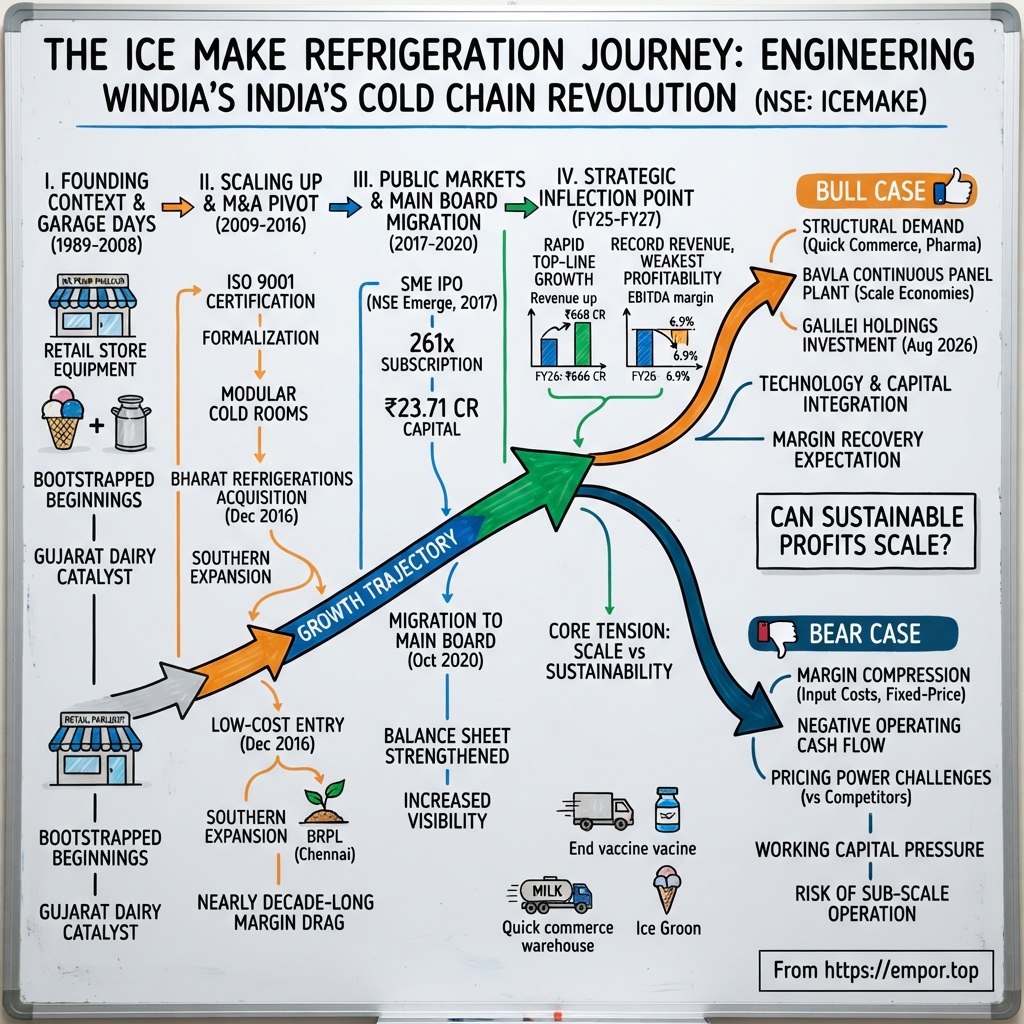
Ice Make Refrigeration Limited: Engineering India's Cold Chain Revolution
I. Introduction & Episode Roadmap
There is a particular kind of Indian industrial company that rarely receives detailed scrutiny. It does not sell directly to consumers, nor does it operate a consumer app. Its products sit quietly in the back rooms of ice cream parlours, in the loading bays of dairy plants, inside dark stores powering quick commerce, and within insulated truck boxes transporting vaccines along national highways. When these systems work, they are invisible. When they fail, harvests rot, vaccine batches spoil, and financial losses mount unrecorded in official statistics.
Ice Make Refrigeration Limited fits this profile. The business began in 1989 as a small shop in Ahmedabad fabricating refrigeration equipment for retail stores.1 By the financial year ended March 2026, consolidated revenue reached roughly ₹668 crore, up 39.3% year over year.2 Sales quintupled from ₹135 crore in FY21 to ₹668 crore in FY26, representing a five-year compound annual growth rate of nearly 38%.3
Yet the same fiscal year that brought record top-line growth also delivered the company's weakest profitability since its public listing. EBITDA margin compressed to 6.9% from 9.1%, while profit after tax fell to ₹5.13 crore from ₹22.90 crore in FY25.24 In the first quarter of FY27, despite revenue expanding another 60.4% year over year to ₹178.88 crore, Ice Make posted a net loss of ₹1.65 crore as its EBITDA margin dropped to 1.7%.5 Meanwhile, operating cash flow, which had been positive every year through FY25, swung negative in FY26.3
This dynamic presents a company expanding top-line revenue rapidly while generating virtually no current earnings—a core tension framing its business trajectory.
The macro hook. India's post-harvest losses remain among the highest globally, driven by a fragmented and unorganized cold chain sector. Demand fundamentals remain robust across dairy, ice cream, quick-service restaurants, pharmaceuticals, and quick commerce dark stores. Each sector relies on the same core engineering: insulated enclosures, compressors, and specialized design, fabrication, and installation delivered on tight schedules. On its Q4 FY26 earnings call, management disclosed that quick commerce accounted for roughly 13% of FY26 revenues.4 That represents a demand driver that barely existed five years earlier.
Two analytical framings explain this combination, leading to starkly different conclusions.
The first is the strategic land-grab hypothesis: the company is deliberately trading near-term margins to capture market share as the sector shifts from unorganized fabricators to organized players, filling new plant capacity and accepting temporary margin pressure to build a larger platform.
The second is the cyclical fabricator hypothesis: profitability remains dictated by uncontrollable raw material costs. In this view, benign input prices in FY23 and FY24 created an illusion of operating leverage, prompting capacity expansion just as cycle dynamics reasserted themselves.
The empirical evidence supports elements of both interpretations.
Key analytical themes. Rather than adopting promotional narratives, this analysis evaluates key operational and financial claims against disclosed evidence:
Origins and the bootstrap. From a repair-and-fabrication shop to a formalized private limited company in 2009, and the operational capabilities built during that extended apprenticeship.1
The M&A pivot. The December 2016 acquisition of Chennai-based Bharat Refrigerations Private Limited—and an assessment of what nine years of ownership have delivered.6
Capital markets. The November 2017 NSE Emerge SME IPO, heavily oversubscribed at launch, and the subsequent October 2020 migration to the main board.76
Segment economics. The distribution of revenue across product lines and the structural difference between top-line volume and long-term earnings power.
Competitive positioning. Industry dynamics alongside competitors such as Blue Star, Voltas, Rinac, Frick India, and regional fabricators, evaluated through established competitive frameworks.
Management and governance. Three founding promoters maintaining a combined stake above 74% until recently, alongside a capital allocation strategy shifting from conservative to expansionary.3
The Japanese transaction. In August 2026, Tokyo-listed Galilei Holdings agreed to invest ₹180 crore in Ice Make and establish a 60:40 commercial refrigeration joint venture.8 This transaction requires careful evaluation regarding its strategic implications and impact on existing shareholders.
The central question facing Ice Make is straightforward: the company has demonstrated an ability to expand sales rapidly, but it has yet to prove it can generate sustainable profits at scale. The analysis that follows evaluates which of these two conditions is temporary.
 Subscribe on LinkedIn
II. Founding Context & The Garage Days (1989–2008)
In Ahmedabad during the late 1980s, Gujarat's industrial belt was expanding. The White Revolution had already established the state as the dairy capital of India, with district cooperatives collecting milk twice daily from smallholder farmers. Milk is among the most perishable commercial commodities, deteriorating rapidly after extraction. Consequently, the operating economics of a dairy cooperative depend directly on how quickly milk temperature can be reduced and how reliably it can be maintained.
In this environment, Chandrakant Patel started on a modest scale. Company records date the enterprise to 1989, when it was "originally started in a small shop for manufacturing retail store refrigeration equipment," before formalizing as a proprietorship in 1993 under the Ice Make Refrigeration and Hi Make Engineers names.1 A retrospective review by CARE Ratings describes the original entity as a partnership firm prior to its 2009 reconstitution as a private limited company.6
Rather than a high-tech enterprise, Chandrakant Patel operated a fabrication and service business for nearly two decades: working with sheet metal, insulation, off-the-shelf compressors, refrigerant lines, and field repairs. This craft-level operation provided essential practical experience. Operators learned which components failed under extreme field conditions, such as the heat and dust of a Gujarat summer; recognized that dairy clients required reliable temperature control rather than complex hardware; and developed disciplined pricing habits, as there was no balance-sheet cushion to absorb costly estimation errors.
Many durable Indian industrial firms share this background. A repair-based business serves as a practical, customer-funded study in failure modes. Every service call highlights specific operational vulnerabilities, from leaking panel joints and overheating compressors to control boards vulnerable to voltage fluctuations. By the time an enterprise begins manufacturing its own products, design specifications reflect thousands of real-world breakdowns. However, hands-on fabrication does not inherently teach corporate finance, scaling strategies, or disciplined customer selection—gaps that can create operational friction as an organization grows.
The Gujarat dairy catalyst. Geographic proximity provided a major structural advantage. The cooperative dairy network around Anand and the broader Gujarat milk economy provided Ice Make with a concentrated group of demanding, repeat industrial customers. Bulk milk coolers, ice cream hardening tunnels, and small cold-storage units represent capital equipment where operational failure carries immediate financial cost, making reliable field service valuable. Ice Make's eventual positioning as a comprehensive solutions provider, rather than a commodity equipment seller, originated in these early customer relationships.
Early product-market fit was built on operational responsiveness rather than pricing power or brand distinction. Ice Make's early clients purchased capital equipment on tight operating budgets from a local fabricator. Decision criteria centered on delivery timeliness, custom sizing flexibility, and rapid repair availability. These requirements prioritized logistics and responsiveness over proprietary design—advantages that competitors willing to execute similar service models could potentially replicate. This operational constraint remained a defining feature of the business model.
The 2009 formalization. A major structural transition occurred in 2009, when the business incorporated as a private limited company and obtained ISO 9001:2008 certification.1 The ISO certification signaled an effort to qualify for institutional contracts across dairies, pharmaceutical companies, food processors, and government-assisted cold-storage projects, which required formal compliance standards.
Around this time, Ice Make also brought polyurethane foam (PUF) panel manufacturing in-house. PUF panels form the structural insulation of cold rooms, functioning like modular building blocks composed of rigid foam sandwiched between thin steel sheets. In-house production allowed the company to standardize panel dimensions and interlocking joints, converting cold-storage construction from custom masonry into a faster assembly process.
Historical falsification: was there ever proprietary technology here? Market narratives sometimes suggest that early technological differentiation created proprietary lock-in. However, industry data and corporate disclosures do not support that conclusion. Key refrigeration components—including compressors, expansion valves, refrigerants, and electronic controls—are standard items sourced from third-party global suppliers. CARE Ratings notes that primary raw materials include polyurethane chemicals, galvanized steel sheets, and copper and aluminum components, with raw material costs representing approximately 75% of sales.6 A manufacturing model where three-quarters of input cost consists of purchased commodities relies on operational execution—such as assembly speed, custom sizing, and service coverage—rather than patented intellectual property.
This operational focus defines the company's economics. While operational capabilities create competitive advantages, they require continuous re-earning in a price-sensitive market against competing fabricators. This structural reality helps explain the margin fluctuations that emerged in later fiscal years, including FY26.
By 2008, Ice Make had established itself as a regional refrigeration supplier with an active customer base, though it lacked substantial capital. The subsequent decade focused on expanding its financial scale and operational reach.
III. Scaling Up & The Bharat Refrigerations M&A Benchmark (2009–2016)
The modular cold room was a practical innovation that altered the industrial refrigeration landscape. Prior to modular designs, a food processor in a small Indian town constructing cold storage relied on traditional masonry and cement—a process taking weeks and resulting in insulation performance that degraded steadily as moisture seeped into the walls. Heat leaked, compressors ran longer, electricity bills mounted, and the physical asset degraded over time.
The modular alternative functioned more like industrial furniture assembly. Panels pressed in a factory to standardized thicknesses were shipped flat and locked together on site by a small crew in days rather than months. Factory-controlled manufacturing also ensured predictable thermal performance compared to variable field construction.
Ice Make capitalized on this shift through the early 2010s, securing routine industry recognitions: an Indian Leadership Award for Industrial Development in 2011, OHSAS 18001 certification in 2013, and a Best Medium Enterprise manufacturing award alongside ISO 14001 in 2014.1 These qualifications served less as economic moats and more as prerequisites for bidding on larger institutional tenders.
Standardized modularity provided an additional operational advantage: predictable project quotations. While custom fabricators priced jobs through site visits and estimation, panel manufacturers priced predictably by square meter and thickness. This accelerated estimating, improved tender competitiveness, and enabled Ice Make to serve clients hundreds of kilometers away without requiring on-site promoter inspections. However, geographic expansion via standardized manufacturing also allowed national competitors to enter Ice Make's core markets.
The southern problem. By the mid-2010s, Ice Make confronted a common physical constraint: logistics. Cold room panels are bulky, insulated structures; shipping them from Gujarat to South India meant paying to transport low-density cargo. Furthermore, installation, commissioning, and maintenance required localized technical support. Meanwhile, South India's dairy, seafood, quick-service restaurant, and hospitality sectors were already served by established regional fabricators.
Addressing this geographic barrier typically offered three options: constructing a greenfield facility and building local market presence over several years, appointing third-party dealers while accepting lower margins and minimal operational control, or acquiring an established local manufacturer with existing facilities, customer relationships, and brand equity.
The December 2016 acquisition. Ice Make selected the acquisition route, acquiring Chennai-based Bharat Refrigerations Private Limited (BRPL) effective December 2016.9 Founded in the late 1980s, Bharat had operated as a family-owned integrated refrigeration equipment manufacturer across South India.9 The deal provided Ice Make with a local manufacturing plant, a southern client base, and product lines including transport refrigeration.
Financial disclosures reveal the modest scale of the transaction. CARE Ratings reported the total purchase consideration for BRPL at ₹2.26 crore.6 Relative to Ice Make's FY17 revenue of ₹88 crore, the transaction represented a low-cost entry into the southern market rather than a transformative financial bet.3
The low purchase price reflected the target's underlying economics. Acquiring a two-decade-old equipment manufacturer for ₹2.26 crore indicated a business generating modest returns rather than a high-margin franchise.
The disconfirming evidence, nine years later. While initial narratives suggested the transaction would immediately expand southern margins and yield operational synergies, subsequent financial disclosures present a more subdued picture. Objects of Ice Make's 2017 initial public offering included allocating additional capital to upgrade the Chennai plant.7 By January 2026, CARE Ratings highlighted the "subdued performance of its subsidiaries present in the same line of business" as a key weakness, noting that BRPL generated operating income of ₹34.64 crore in FY25 with an operating margin of 2.49% and net profit of ₹0.20 crore, following a net loss of ₹0.18 crore in FY24.6
Nine years after the acquisition, BRPL operated at a 2.5% operating margin, barely reaching profitability. Compared to the consolidated group's FY25 operating margin of 8.89%, the southern subsidiary functioned as a margin drag rather than a profit driver.6
From a capital allocation perspective, paying ₹2.26 crore for ₹35 crore in annual revenue and a regional manufacturing footprint did not represent capital destruction. However, claims of rapid accretive synergies are unsupported by disclosed figures. Instead, the acquisition secured geographic presence cheaply while operating at low profitability for nearly a decade. Sustainable turnarounds at BRPL would require its operating margins to converge toward the parent company's levels—a metric tracked in annual rating rationales and segment disclosures.
The transaction also established a template for Ice Make's geographic expansion: acquiring small stakes in regional operators and funding them over extended horizons. In FY24, the company formed Ice Best Private Limited, acquiring a 60% stake for ₹2.00 crore in a joint venture to expand into East India; Ice Best reported operating income of ₹2.76 crore in FY25.6
Governance and credit analyses reflect this integrated funding model. CARE Ratings evaluates the group on a consolidated basis, noting that BRPL is managed by the parent's promoters, while Ice Best is jointly managed by parent promoters and local partners, with Ice Make providing ongoing financial support as required.6 Consequently, evaluating Ice Make solely on standalone parent metrics would overlook the ongoing margin drag of its regional subsidiaries.
Ice Make's expansion model proved low-cost but slow to generate strong earnings. Whether this approach reflects disciplined risk management or prolonged sub-scale operation depends on how effectively the company deploys larger capital pools—such as those raised in public equity markets.
IV. Public Markets: From SME Platform to Main Board (2017–2020)
By late 2017, India's SME initial public offering market was experiencing a period of heightened speculative interest. The National Stock Exchange's Emerge platform was established to enable smaller enterprises to raise equity capital under streamlined compliance requirements with a dedicated investor base. In practice, during bull markets, these listings frequently generated heavy retail and institutional speculation.
Ice Make's public offering opened on November 28, 2017, and closed on November 30 at a price band of ₹55 to ₹57 per share. Lead-managed by Vivro Financial Services, the issue offered 41.60 lakh shares to raise ₹23.71 crore.710 The minimum lot size of 2,000 shares required a minimum retail investment of roughly ₹1.14 lakh—a threshold intended to filter for higher-conviction applicants.
The high application threshold did little to cool investor interest. The offering was subscribed 261 times, generating orders of roughly ₹6,200 crore against the ₹23.71 crore target.7 The non-retail portion was subscribed approximately 400 times, while retail individual investor bidding reached 149 times.7 The stock subsequently listed on NSE Emerge on December 8, 2017.10
A 261-fold subscription rate primarily reflected broader market liquidity rather than a detailed institutional validation of industrial refrigeration economics. Given that a ₹23.71 crore issue was smaller than the daily trading volume of a typical mid-cap stock, total demand of ₹6,200 crore signaled high listing-day speculation in late 2017. The primary structural outcome was that Ice Make secured roughly ₹24 crore in permanent equity capital at a time when its annual revenue stood at ₹103 crore.3 For a previously bootstrapped manufacturer, this significantly strengthened the balance sheet.
Where the money went. Capital deployment focused on operational infrastructure: constructing a coil manufacturing facility near Ahmedabad, upgrading existing plants, building an administrative office, expanding brand marketing, and funding the Chennai facility of subsidiary Bharat Refrigerations.7 Notably, the issue included no secondary share sales by founding promoters, no acquisition war chest, and no expansion into unrelated sectors. Instead, the capital supported vertical integration—producing coils internally rather than purchasing them from third parties—and upgrading newly acquired regional assets.
Migration to the main board. On October 12, 2020, Ice Make migrated from NSE Emerge to the main board of the National Stock Exchange.6 While this transition did not alter daily operations, it established stricter financial disclosure requirements, quarterly reporting standards, higher trading liquidity, and enhanced institutional visibility—providing a regulatory foundation for future equity capital raises.
The falsification pass on capital deployment. The fresh equity did not deliver an immediate step-up in financial returns. Revenue rose from ₹103 crore in FY18 to ₹132 crore in FY19, but flattened over the next two years to ₹138 crore in FY20 and ₹135 crore in FY21.3 Over the same period, operating margins compressed from 12% in FY18 to 9% in FY19 and 8% in FY21, while net profit dropped from ₹7 crore in FY19 to ₹4 crore in FY21.3
Although pandemic-related disruptions affected FY21 site installations, the operational slowdown predated COVID-19. Revenue growth had already slowed to 4% in FY20 alongside narrowing margins, indicating that Ice Make added manufacturing capacity and overhead costs ahead of revenue demand—a common scaling challenge for growing industrial fabricators.
Following this absorption phase, top-line expansion resumed. From the FY21 base of ₹135 crore, revenue grew to ₹206 crore in FY22, ₹312 crore in FY23, ₹378 crore in FY24, ₹480 crore in FY25, and ₹668 crore in FY26.3 Operating margins recovered to between 10% and 11% in FY23 and FY24, while return on capital employed (ROCE) reached 37% in FY22.3
This expansion phase was subsequently accompanied by changes in capital efficiency and leverage. ROCE declined to 21% in FY24 and 12% in FY25.3 Concurrently, after operating with minimal debt—carrying ₹11 crore in borrowings in FY22—total debt expanded to ₹86 crore by March 2025 and ₹158 crore by March 2026.3 This shift marked a strategic transition toward a more leverage-intensive capital structure, reflecting underlying changes in segment economics.
V. Segment Deep Dive & Business Economics
A tour of a modern Ice Make facility reveals an operation that resembles a panel factory far more than a traditional refrigeration plant. This operational layout reflects a deliberate strategy—one that explains both the company's rapid top-line expansion and its recent profitability pressures.
How the revenue actually splits. Disclosures to CARE Ratings for FY25 outline the product mix: cold room storage solutions generated roughly 51% of sales (up from 47% the prior year); commercial refrigeration accounted for 16% (down from 20%); other refrigeration products brought in 9% (down from 19%); transport refrigeration contributed 8%; industrial refrigeration made up 4%; and two new divisions—continuous panels and economy-range commercial refrigerators—represented approximately 5%, having become operational in November and December 2024, respectively.6 By comparison, at the time of the company's FY17 initial public offering, the revenue mix stood at 63.4% for cold rooms, 14.4% for commercial refrigeration, 13.5% for industrial refrigeration, and 5.8% for transport refrigeration.7
This eight-year shift highlights a structural trend. Industrial refrigeration—the company's most customized, longest-cycle, and typically highest-margin category—contracted from 13.5% of sales to 4%. Meanwhile, cold rooms retained their dominance. Ice Make expanded by scaling its existing core lines and entering high-volume product categories, rather than moving up the value chain.
A second structural feature sits within this distribution model: Ice Make generates roughly 70% of its revenue from direct sales and 30% through nationwide dealers and distributors.6 A direct-heavy approach offers a double-edged trade-off. While it captures distribution margins and secures direct customer relationships, it requires maintaining a field sales, design, and commissioning organization as fixed overhead rather than variable channel expense. When management pointed to "channel expansion" as a driver of FY26 margin compression, it was referring to this rising overhead.4 Direct sales models generate operational leverage only when revenue per salesperson increases; until then, geographic expansion functions primarily as a cost center.
Cold room systems: the engine and its tax. Cold rooms are large-ticket systems that require on-site installation and commissioning.6 This operational reality dictates much of the financial profile, resulting in uneven revenue recognition, heavy fourth-quarter concentration ahead of the Indian summer, and expanding year-end receivables. CARE Ratings noted that this seasonality—with most commissioning occurring in the fourth quarter—naturally inflates year-end trade receivables.6 Consequently, debtor days climbed from 63 in FY24 to 72 in FY25, and reached 84 in FY26.3
This dynamic acts as a structural tax on the business model: scaling cold room sales mechanically demands larger allocations of working capital.
Commercial refrigeration: volume and competition. Covering deep freezers, visi coolers, glass-door display units, and bulk milk coolers, this segment places Ice Make in direct competition with major appliance manufacturers. To compete in this category, the company invested ₹17 crore from internal accruals in FY25 to establish a dedicated plant for economy-range commercial refrigerators, which became operational in December 2024.6 Notably, this expansion was funded entirely without debt—making it the smaller of two simultaneous capital bets.
The continuous panel plant: the ₹79 crore decision. The company's larger capital commitment was a ₹79 crore continuous panel manufacturing facility in Bavla, Gujarat, funded at a debt-to-equity ratio of 1.55:1, which began operations in November 2024.6
This facility represents the most significant capital allocation decision in Ice Make's history. Traditional polyurethane foam (PUF) panels are produced discontinuously, pressing and curing one panel at a time. A continuous manufacturing line automates the process: steel coils unwind, foam is injected between the moving sheets, the sandwich cures in transit, and finished panels are cut to specified lengths at the end of the line. This approach dramatically increases hourly output, improves product consistency, and lowers unit production costs—provided the facility operates near capacity.
That capacity requirement carries substantial financial risk. Continuous production lines involve heavy fixed overheads, making under-utilization costly. CARE Ratings highlighted this exposure as a key rating weakness, citing the "scaling up risk associated with recently concluded debt funded capex," and observed that the new divisions generated roughly ₹23 crore in FY25 and ₹43 crore in H1FY26, compared to full-year FY26 revenue projections of approximately ₹100 crore.6
Strategic logic drove the Bavla investment. During FY23 and FY24, Ice Make purchased a significant portion of its panel requirements from third parties, embedding supplier margins into its cost structure. Backward integration into continuous panels eliminated that intermediate cost while establishing a new merchant product line for sale to external fabricators and construction projects. However, the timing and capital structure posed challenges: a ₹79 crore project leveraged at 1.55:1 debt-to-equity was commissioned amidst rising input cost inflation and lengthening receivable cycles.6 Good strategy executed on a stretched balance sheet can still produce difficult fiscal years.
Transport refrigeration and the Bharat brand. Refrigerated truck bodies and transport reefer units accounted for 8% of FY25 revenue.6 Following the expansion of its Mehsana manufacturing facility in 2021, the segment remains tied to commercial vehicle demand cycles and logistics capital expenditures.1 Despite its inherent cyclicality, transport refrigeration serves as a direct beneficiary of pharmaceutical cold chain compliance and expanding quick-commerce logistics network requirements.
Ammonia, solar, and product commercialization. Ammonia-based industrial systems fall under the "others" category in Ice Make's revenue classification.6 Ammonia offers superior thermodynamic efficiency, zero global warming potential, and low refrigerant costs for large installations. However, its toxicity demands certified installations, safety engineering, and specialized operators—creating operational entry barriers for higher-margin industrial projects.
The development of solar cold storage illustrates the company's product commercialization record. Ice Make launched agricultural solar cold rooms in 2018, introduced a heat pump food dehydrator in 2019, launched a freeze dryer in 2020, and introduced the "SOLOPerifresh" solar cold room brand in 2022.1 Despite four product introductions over five years targeting agricultural storage needs, none has generated material disclosed revenue. The entire "others including ammonia" segment accounted for 9% of FY25 revenue, down from 19% previously.6
This pattern highlights a persistent commercialization gap between product launches and disclosed, material revenue contributions. The underlying economics clarify the challenge: off-grid solar cold rooms require agricultural producers or cooperatives to finance solar arrays and energy storage alongside refrigeration units. Without sustained government subsidies, these upfront capital costs present a barrier in price-sensitive agricultural markets. Consequently, solar and dehydration lines function as unproven optionality rather than established growth drivers.
Accounting practices also influence reported earnings. Large cold room and industrial contracts involve design, equipment supply, site installation, and commissioning phases that often span multiple financial quarters. Because commissioning concentrates heavily in the fourth quarter, revenue recognition involves significant percentage-of-completion accounting judgments.6 As a result, quarterly profitability reflects a higher degree of estimation management than standard product sales, helping explain the margin volatility between Q4 FY26 and Q1 FY27, when a record top-line quarter was followed immediately by a net loss.25
Operating margins and cost pass-through. In FY26, Ice Make reported EBITDA of ₹46.04 crore on revenue of ₹668.20 crore, yielding a 6.9% margin, down from 9.1% in FY25.24 Management attributed the margin compression to investments in manufacturing capacity, sales channel expansion, product development, and one-time regulatory compliance costs, while citing raw material price volatility and supply chain disruptions as operational headwinds.4
The underlying financial trajectory illustrates this operating leverage challenge. Between FY24 and FY26, overall revenue expanded 77%, whereas EBITDA grew roughly 13%, rising from ₹40.83 crore in FY24 to ₹46.04 crore in FY26.62 Two years of rapid top-line growth generated limited incremental operating profit. In Q1 FY27, revenue expanded 60.4% year over year, but the EBITDA margin contracted to 1.7%, resulting in a net loss.5
Cost structures explain this margin pressure. Raw materials account for approximately 75% of sales costs, while orders are typically executed under fixed-price arrangements. CARE Ratings noted that high competitive intensity poses "a major challenge for its profitability" when the company attempts to pass along input price increases on new orders.6 On its Q1 FY27 earnings call, management disclosed that while it had instituted two price increases, competitors had raised prices more frequently, leaving cost pass-through incomplete in newer verticals. Consequently, management lowered its full-year FY27 EBITDA margin guidance to 6.0%–6.5%, projecting commodity cost pressures to persist through the third quarter.5
These developments outline two competing interpretations. The expansionary view holds that Ice Make is prioritizing market share capture—filling new plant capacity and securing quick-commerce and distribution accounts before adjusting prices. The structural view holds that a business with 75% commodity input costs, fixed-price contracts, and limited pricing power remains a cyclical fabricator that temporarily benefited from favorable raw material prices in FY23 and FY24. Whether operating margins recover as utilization increases at the Bavla facility remains the central metric determining which hypothesis holds.
VI. Competitive Landscape, Porter's 5 Forces & Hamilton Helmer's 7 Powers
A procurement manager for a dairy cooperative in Maharashtra needing four cold rooms, a blast freezer, and two bulk milk coolers faces a fragmented vendor landscape.
Buyers can turn to Blue Star or Voltas—large, listed, pan-India incumbents with balance sheets and service networks Ice Make cannot match, and prices that reflect their corporate scale. They can select a specialist: Rinac, Western Refrigeration, or for heavy ammonia installations, Frick India, which has operated in Indian industrial refrigeration for generations. They can choose Carrier or Daikin for premium transport and commercial units. Or they can hire one of several hundred local unorganized fabricators quoting 15% to 20% below organized players, delivering functional equipment without guaranteeing long-term service support.
Ice Make operates in the middle of that spectrum—a market segment defined by intense competition and high price transparency.
Hamilton Helmer's 7 Powers, applied without flattery.
Scale economies — present but modest and currently unrealized. The Bavla continuous manufacturing line represents a scale asset: higher production volume lowers the cost per square meter of panel, an advantage small fabricators buying panels on the open market cannot replicate.6 However, an underutilized scale asset acts primarily as a fixed cost drag. CARE Ratings highlighted this scaling-up risk, noting the gap between the ₹43 crore in H1 FY26 revenue from new divisions and full-year revenue expectations of roughly ₹100 crore indicates that while the scale mechanism exists on paper, its financial benefit remains unproven.6 Verdict: potential mechanism, unrealized in earnings.
Process power — moderate and well-evidenced. Designing, engineering, delivering, installing, and commissioning custom cold rooms on tight timelines requires accumulated operational experience rather than proprietary machinery. CARE Ratings notes that top clients accounted for only 20% to 40% of total revenue over the three years through FY25, and that 70% of revenue comes from direct sales with the balance through dealers and distributors.6 A diversified customer base spanning pharmaceuticals, dairy, ice cream, healthcare, and food processing provides empirical evidence of execution capability across end markets. Verdict: moderate power, the most defensible of the framework.
Counter-positioning — weak. Counter-positioning requires that incumbent competitors cannot replicate a challenger's business model without damaging their own core profits. While Ice Make targets mid-sized custom orders that larger multinationals may overlook, pan-India competitors like Blue Star can quote on these projects without altering their business model, while local fabricators compete aggressively on price. Ice Make occupies a market niche rather than a structurally defensible position. Verdict: absent.
Cornered resource — absent. Key inputs—including compressors from global suppliers, refrigerants from chemical manufacturers, and steel and polyurethane chemicals—are sourced from open commodity markets.6 Disclosures indicate no exclusive supply arrangements, unique licenses, or proprietary patent assets. Verdict: absent.
Network economies, switching costs, and branding — absent to minimal. Industrial refrigeration offers no network effects. Switching costs remain low for standard products like deep freezers and visi coolers, though moderate for integrated industrial installations requiring ongoing technical support. Brand equity matters primarily as institutional buyers seek suppliers capable of honoring warranties over multi-year asset lifespans—a factor that benefits organized competitors generally rather than Ice Make uniquely. Verdict: absent.
The overall scorecard reflects one moderate power (process), one potential power contingent on plant utilization (scale), and five absent. This profile is typical for an industrial fabricator, but it sets clear limits on sustainable margin expansion.
A related claim frequently emphasized in company communications is Ice Make's positioning as a "total solutions provider" rather than an equipment vendor. CARE Ratings notes this positioning, while observing that it has not translated into scale advantages or pricing power.6 A solutions model creates economic defensibility when it generates recurring maintenance contracts, spare parts annuities, and specification lock-in. Because Ice Make does not disclose separate service and spare parts revenue streams, this positioning currently reflects a sales strategy rather than a structural economic moat.
Porter's Five Forces.
Supplier power: high. Raw materials account for roughly three-quarters of sales costs, with prices set by crude oil derivatives and global metal markets.6 Management has described pre-purchasing raw materials as a mitigation strategy; however, pre-buying operates as a temporary timing hedge rather than a structural fix, while consuming working capital.64
Buyer power: moderate to high. Institutional customers source equipment through competitive multi-vendor tenders. CARE Ratings noted that the presence of larger organized competitors with superior financial flexibility limits the bargaining power of mid-sized players like Ice Make and constrains overall profitability.6 Furthermore, expanding customer segments like quick-commerce operators—which accounted for roughly 13% of FY26 revenue—exercise strong pricing leverage due to standardized dark store unit economics.4
Threat of substitutes: low. Mechanical refrigeration has no direct technological substitute in cold chain preservation.
Threat of new entrants: bifurcated. Capital barriers are low for standard fabrication, resulting in hundreds of regional workshops. Conversely, high-end industrial projects—such as certified ammonia plants and pharmaceutical-validated facilities—require engineering credentials and regulatory compliance. This structural difference underscores the rationale for expanding higher-margin industrial work; however, the decline in industrial refrigeration from 13.5% of revenue in FY17 to 4% in FY25 indicates the product mix has shifted away from high-barrier lines.76
Rivalry: high and intensifying. Price competition across mid-market refrigeration remains intense. Management's disclosure during the Q1 FY27 earnings call that competitors implemented price increases more frequently than Ice Make indicates that the company was slower than competitors to adjust pricing and defend operating margins.5
For investors, this structural environment caps long-term margin potential. Rather than expecting EBITDA margins to expand to 15%, a realistic investment thesis hinges on Ice Make sustaining high-single-digit to low-double-digit operating margins while scaling revenue significantly under controlled capital intensity. Whether management can achieve that operational balance remains the key question.
VII. Management, Governance & Credibility Audit
Indian promoter-led manufacturers tend to fall into two camps: families who treat the listed enterprise as a personal asset, and families who view it as an institution they happen to control. Ice Make's public record over the past nine years places it closer to the second group—though recent strategic decisions introduce new analytical questions.
Who actually runs the company. The promoter group consists of Chandrakant Patel, Rajendra Patel, and Vipul Patel.6 CARE Ratings describes Chandrakant Patel as the primary promoter with over two decades of experience in refrigeration equipment manufacturing, overseeing general operations, while co-promoters Rajendra Patel and Vipul Patel—each with comparable industry tenure—manage production, procurement, accounts, and finance.6 Equity ownership is unusually evenly divided among the three founders, standing at 23.5%, 23.2%, and 23.0% as of March 2026.11
This ownership symmetry represents a notable governance structure. Without a single dominant shareholder holding a controlling stake, strategic decisions require consensus among three executives with near-identical economic stakes. While this structure can lengthen decision-making cycles, it also creates an internal check against unilateral value extraction.
Skin in the game—and the recent dilution. Promoter equity remained remarkably stable across the company's public history, standing at 73.46% in March 2018, 74.89% in March 2022, 74.49% in March 2024, and 74.41% in March 2025.3 Nearly a decade without meaningful promoter share sales provided a reassuring signal uncommon among Indian small-cap industrial firms.
That stability shifted in late 2026. By September 2026, promoter ownership declined to approximately 64.52%, reflecting a preferential allotment of 23.67 lakh shares announced that month.3 This shift represented dilution by choice rather than financial distress: the founders did not liquidate personal holdings, but rather issued fresh equity to a strategic partner. Nevertheless, existing public shareholders now own a reduced percentage of the enterprise, creating a tangible cost that future operational benefits must justify.
Capital allocation: the pivot from conservative to aggressive. For most of its listed history, Ice Make operated with a conservative capital structure. As of March 2024, overall gearing stood at 0.27 times, while interest coverage reached 19.31 times.6 Dividend payouts remained modest—including a dividend of ₹2.25 per share going ex-dividend in September 2025 and paid in October 2025—aligning with a capital allocation policy that prioritized internal reinvestment over cash distribution.12
The fiscal year 2025 capital expenditure cycle marked a clear turning point. Gearing rose to 0.70 times by March 2025 as term debt funded construction of the Bavla continuous panel facility, causing interest coverage to fall to 10.35 times.6 Total debt expanded rapidly, climbing from ₹27 crore in March 2024 to ₹86 crore in March 2025, and reaching ₹158 crore by March 2026.3 Management layered on additional credit lines during FY26, including a ₹17 crore term loan reimbursing prior capital spending, a ₹10 crore working capital demand facility, and a ₹13 crore short-term revolving loan used in part to finance ₹14.4 crore of land acquisition and construction for a new corporate office.6
This debt allocation warrants critical scrutiny. During a fiscal year in which operating cash flow turned negative and profit margins compressed significantly, the company drew on short-term revolving credit to finance real estate and headquarter construction. While corporate real estate acquisitions add physical assets to the balance sheet, funding them with short-dated debt during a period of cash flow pressure reflects questionable capital discipline.
Does management deliver on its guidance? Tracking management's public commitments against reported financial results highlights distinct operational patterns.
On top-line expansion, management has consistently aimed toward a target of ₹1,000 crore in annual revenue, delivering sales growth that has frequently outpaced internal forecasts.4 Annual revenue expanded 39.3% in FY26, followed by 60.4% top-line growth in Q1 FY27, confirming strong commercial momentum.25
Profitability forecasting, however, has proven far less reliable. In a January 2026 rating rationale, CARE Ratings noted that operating margins had moderated to 5.48% in the first half of FY26 from 7.76% in the prior-year period, while projecting full-year margins to recover to roughly 8% as operating scale expanded.6 Full-year FY26 EBITDA margin ultimately landed at 6.9%.2 Similarly, management anticipated that the new continuous panel and commercial refrigeration divisions would generate approximately ₹100 crore in FY26 revenue; actual first-half contributions totaled ₹43 crore.6
Guidance volatility re-emerged during 2026 earnings updates. On its Q4 FY26 earnings call, management projected annual revenue growth of 22% to 23% for FY27 and FY28—signaling a deliberate moderation—supported by an order book of approximately ₹237 crore.4 Just one quarter later, Q1 FY27 revenue jumped 60.4% year over year, while management lowered full-year EBITDA margin guidance to 6.0%–6.5% after the quarter yielded a net loss.5 Meanwhile, reported order backlog stood at over ₹220 crore.5
This execution history across FY25, FY26, and Q1 FY27 outlines a clear pattern: Ice Make's leadership systematically under-forecasts revenue expansion while over-estimating operating margins. Rather than reflecting intentional misdirection, this gap highlights a founder-led management team with strong commercial selling capabilities but limited visibility into input cost pass-through timing. Investors should treat management's revenue projections as conservative and its margin expectations as overly optimistic until operational results demonstrate otherwise.
Management deserves credit, however, for detailed disclosure practices. When explaining operational shortfalls, executives identified specific drivers: commodity inflation, foreign exchange headwinds, price adjustments that trailed competitor actions, and delayed cost pass-through in newer product lines.5 Explicitly reducing margin guidance rather than ignoring prior targets demonstrates constructive transparency, framing the core challenge as forecasting precision rather than executive candor.
The Galilei transaction. In August 2026, Ice Make signed definitive agreements with Galilei Holdings Co. Ltd., a Tokyo Stock Exchange-listed refrigeration group, under which Galilei agreed to invest ₹180 crore through a preferential share allotment, with an additional ₹10 crore raised from other investors for a total capital infusion of ₹190 crore.8 Alongside the investment, the parties agreed to form a commercial refrigeration joint venture—Ice Make Horeca Private Limited—owned 60% by Galilei and 40% by Ice Make, focused on manufacturing, marketing, and distributing upright and counter-top commercial refrigerators and related equipment.13 Stated uses of proceeds include facility expansion and modernization, construction of a new corporate office, a center of excellence and testing laboratory, potential acquisitions, funding the joint venture, and repayment of existing debt.8 KPMG served as financial advisor, while Cyril Amarchand Mangaldas acted as legal counsel.8 The transaction remained subject to shareholder approval, exchange approvals, and standard closing conditions.8
This transaction presents three distinct analytical considerations.
First, the balance sheet rationale is clear. With total borrowings at ₹158 crore, negative operating cash flow in FY26, and compressed profit margins, an equity infusion of ₹190 crore provides necessary financial relief, offering a more stable funding structure than additional short-term credit.
Second, the strategic rationale offers potential operational benefits. Galilei brings specialized refrigeration technology and manufacturing practices into commercial refrigeration—a segment where Ice Make has faced intense price competition and margin pressure.
Third, structural terms warrant attention: Ice Make holds a 40% minority stake in the joint venture.13 The company has relinquished majority control of a core product category to a foreign partner, in a market segment where it recently invested ₹17 crore building a dedicated facility for economy-range commercial refrigerators.6 Participating as a 40% partner in a larger joint venture could improve long-term segment returns compared to operating an independent, lower-margin business line. Alternatively, it could represent a gradual shift away from categories with attractive long-term unit economics. Public disclosures reviewed do not state the per-share allotment price or specific governance provisions, both of which are central to evaluating shareholder value creation.
The decisive test will be whether consolidated group margins improve as Galilei's capital and technology are integrated. If margins fail to recover, the equity dilution will have provided temporary liquidity rather than durable competitive capability.
VIII. Investment Story Spine: Bull vs. Bear Case & Skeptical Stress Test
                       +-----------------------------------+
                       |   ICE MAKE REFRIGERATION (NSE)    |
                       +-----------------------------------+
                                         |
                +------------------------+------------------------+
                |                                                 |
                v                                                 v
  +---------------------------+                     +---------------------------+
  |         BULL CASE         |                     |         BEAR CASE         |
  +---------------------------+                     +---------------------------+
  | * Structural cold-chain   |                     | * Margin compression      |
  |   demand (dairy, QSR,     |                     |   (input costs, fixed-    |
  |   pharma, quick commerce) |                     |   price orders)           |
  | * Bavla continuous panel  |                     | * Working capital and     |
  |   line + Galilei capital  |                     |   rising leverage         |
  | * Proven selling machine, |                     | * No pricing power vs     |
  |   diversified customers   |                     |   organized + unorganized |
  +---------------------------+                     +---------------------------+
Evaluating both investment cases requires stress-testing their core assumptions rather than merely listing competing arguments.
Why Ice Make wins from here.
The demand thesis represents the strongest element of the bull case, supported directly by disclosed operating performance rather than external market projections. Revenue quintupled over five years without requiring proprietary technological breakthroughs.3 Customer concentration remains low, with top clients accounting for 20% to 40% of revenue over three years, demonstrating that expansion stems from a broad customer base rather than a few concentrated accounts.6 Furthermore, quick commerce—which accounted for roughly 13% of FY26 revenue—emerged rapidly to become a meaningful growth channel tied to evolving urban retail habits.4 When revenue expands 39.3% in FY26 and another 60.4% in Q1 FY27, top-line trajectory reflects robust underlying demand across key end markets.25
Operating leverage forms the second leg of the thesis. Capital-intensive assets operating at partial capacity depress earnings, but at high utilization, they can deliver structural unit-cost advantages. The Bavla continuous panel line was designed around this operational dynamic. If the facility achieves or exceeds the ₹100 crore full-year revenue scale management projected, incremental gross profit will flow disproportionately into operating profit.6
Capital structure reinforcement provides the third leg. The ₹190 crore total equity capital raise from listed strategic investor Galilei Holdings and participating investors—with proceeds allocated in part to debt repayment—directly addresses the balance sheet leverage built up during recent margin compression.8
Why it might not.
The bear case begins with cash flow performance. In FY26, despite generating ₹668 crore in revenue, Ice Make posted negative operating cash flow of approximately ₹11 crore and free cash flow of roughly negative ₹50 crore—marking a third consecutive year of negative free cash flow following negative ₹23 crore in FY24 and negative ₹52 crore in FY25.3 Sustaining three straight years of negative free cash flow while operating margins compress and borrowings expand from ₹27 crore to ₹158 crore reflects an enterprise whose top-line growth consumes more cash than it generates.3
Working capital dynamics highlight additional structural friction. In FY26, trade receivables stood at 84 debtor days and inventory at 114 days, offset by 108 payable days.3 While net working capital of 23 days appears manageable on the surface, this figure relies heavily on supplier financing, as payable days expanded from 76 in FY24 to 121 in FY25 before adjusting to 108 in FY26.3 Extending supplier credit terms while customer collection cycles lengthen tempers headline working capital metrics without alleviating underlying cash flow pressure.
Pricing power constraints represent a second structural vulnerability, underscored by management disclosures. Although Ice Make instituted two price increases, industry competitors adjusted pricing more frequently, leaving raw material cost pass-through incomplete in newer product categories and prompting management to reduce full-year FY27 EBITDA margin guidance to 6.0%–6.5%.5 Lagging peer price adjustments during inflationary periods indicates limited pricing leverage across competitive segments.
A third analytical concern centers on product mix evolution. Over an eight-year span, industrial refrigeration—the company's highest-value-add category—declined from 13.5% of sales to 4%.76 Top-line expansion has been concentrated instead in cold rooms and standard commercial products, shifting the overall portfolio toward more price-sensitive product lines.
A fourth vulnerability involves operational and organizational complexity. Relative to its operating scale, Ice Make manages a Chennai subsidiary operating near breakeven, a 60%-owned eastern subsidiary generating under ₹3 crore in sales, a 40:60 commercial refrigeration joint venture with Galilei Holdings, a foreign strategic equity investor, two recently commissioned plants, and plans for potential inorganic acquisitions funded by equity proceeds.6813 Managing multiple disparate corporate structures and geographic ventures requires substantial executive bandwidth while core operating margins remain under pressure.
Weighing it. A balanced evaluation requires assessing each core premise against empirical evidence.
The structural demand thesis remains supported by commercial execution. The scale-economies argument remains plausible but unproven, as new production capacity is in place while utilization lags—evidenced by the ₹43 crore generated by new divisions in H1 FY26 against full-year expectations of roughly ₹100 crore.6 Conversely, the premise of a durable margin structure is refuted by reported results: operating margins have fluctuated between 7% and 12% over eight years without establishing an upward trend, with recent metrics trending downward.3 Management capabilities reflect a clear split between strong commercial sales execution and less disciplined margin forecasting and capital timing. Finally, capital allocation records demonstrate historical discipline, but managing a levered balance sheet through cost inflation represents a new operational phase.
The key metric confirming the bull thesis would be consolidated EBITDA margins recovering and stabilizing above 8% alongside sustained top-line expansion and positive operating cash flow. Conversely, the bull thesis would be falsified by a fourth consecutive year of negative free cash flow alongside EBITDA margins below 7%, signaling that top-line growth continues to depend on cash-absorptive expansion.
IX. Playbook: Key Business & Investing Lessons
1. The SME platform is a capital ladder, not a validation. Ice Make's 261-times-subscribed SME IPO raised ₹23.71 crore in 2017 before the company migrated to the main board in October 2020.76 The enduring value of the listing was not the subscription headline, but the roughly ₹24 crore in primary equity that enabled a fabricator generating ₹103 crore in revenue to fund capital equipment it could not otherwise afford—and the main-board standing that later established credibility with a Tokyo-listed strategic investor. For investors, SME IPO subscription multiples reflect short-term market sentiment, whereas the specified objects of the issue reveal actual corporate direction.
2. Cheap regional M&A buys presence, not profitability—and the clock runs long. Ice Make acquired a two-decade-old southern manufacturer for ₹2.26 crore, yet nine years later, that subsidiary operated at a 2.49% operating margin on ₹34.64 crore of revenue.6 The transaction was not a failure—the purchase price was too modest to create material risk. However, the broader lesson holds: acquiring a regional operator delivers physical facilities and client accounts, but neither constitutes an integrated corporate culture, an efficient cost structure, or an execution-ready management team. Post-merger integration in fragmented B2B manufacturing absorbs far more time and capital than financial models project, requiring the acquirer to provide sustained funding—as Ice Make did using IPO proceeds.7
3. Revenue growth without pass-through pricing is a liability, not an asset. Between FY24 and FY26, revenue expanded 77% while EBITDA grew roughly 13%.62 Each incremental rupee of top-line expansion arrived with working capital requirements attached, but yielded very little incremental operating profit. When a manufacturer with 75% bought-in raw material costs accepts fixed-price orders in an inflationary environment, volume expansion transfers economic value from shareholders to customers.6 The diagnostic question for any fast-growing industrial firm is not how rapidly sales expand, but what happens to operating cash flow alongside that growth.
4. Modularity converts craft into manufacturing—and manufacturing into a utilization problem. Converting cold storage construction from on-site masonry into modular panel assembly represented a genuine operational advance and laid the foundation for the business. However, industrialization introduces a central trade-off: heavy fixed overheads that reward high plant utilization and penalize idleness. The ₹79 crore continuous panel facility is the purest expression of that dynamic.6 A small fabrication business fails slowly; a capital-intensive plant degrades rapidly if volume falls short of capacity.
5. Watch which partner takes the majority. When a larger foreign partner brings technical expertise and capital, transaction terms reveal relative bargaining power. Galilei Holdings secured a 60% stake in the commercial refrigeration joint venture, leaving Ice Make with 40%.13 Joint venture ownership splits provide a clear signal regarding which partner's contribution holds greater strategic scarcity.
X. Risk Radar & Core KPIs to Watch
The genuine risks facing Ice Make are not abstract macroeconomic categories; they stem from three specific operational mechanisms already visible in disclosed financial records.
Input cost pass-through failure. Raw materials—including polyurethane chemicals derived from crude oil, as well as globally priced galvanized steel, copper, and aluminum—account for roughly 75% of total sales costs, while orders are predominantly executed under fixed-price contracts.6 The company's primary defense—advance raw material bookings and inventory pre-buying—provides only temporary timing protection for a quarter or two while tying up substantial working capital.64 Management expects commodity price pressures to persist through the third quarter of FY27.5 Input cost inflation is not a distant tail risk; it is an active operating constraint.
Working capital and balance sheet leverage. Consolidated gearing expanded from 0.27 times in March 2024 to 0.70 times in March 2025, with rating agencies expecting moderation for FY26.6 Credit rating agency CARE Ratings has established explicit negative rating triggers that define where balance sheet leverage becomes an operational risk: total operating income falling below ₹300 crore or PBILDT margins remaining below 8%; gearing exceeding 0.75 times alongside total debt to PBILDT above 2 times; or an elongation of the working capital cycle beyond 90 days funded by external borrowings.6 Ice Make's operating cycle stood at 62 days in FY25, while average fund-based working capital utilization over the twelve months through November 2025 remained moderate at approximately 70%.6 CARE reaffirmed the company's ratings at CARE A-; Stable for long-term facilities and CARE A-; Stable / CARE A2+ for short- and long-term facilities on January 8, 2026, while enhancing limits to ₹62.07 crore and ₹125.00 crore, respectively.6 Having already breached the margin threshold in FY26, the company's proximity to the remaining debt and working capital thresholds requires close monitoring.
Scaling-up and execution risk on recent capital expenditure. Construction of the ₹79 crore Bavla continuous panel facility is complete and operational, leaving ramped-up capacity utilization as the critical test.6 In a fixed-cost-intensive manufacturing facility, under-utilized capacity does not simply delay earnings growth—it depresses operating margins through ongoing depreciation charges and debt servicing costs.
Secondary operational risks warrant equal attention. The global regulatory transition toward low global warming potential (low-GWP) refrigerants will require continuous product engineering, favoring manufacturers backed by experienced technology partners—underscoring the strategic rationale of the partnership with Galilei Holdings. In addition, while overall customer concentration remains low, the fast-growing quick commerce segment—which accounted for roughly 13% of FY26 revenue—exerts disciplined pricing pressure on equipment suppliers.46
The KPIs that actually matter. Three core operational metrics will determine the trajectory of the business.
Consolidated EBITDA margin. Operating margin is the central financial metric evaluating the investment thesis. Ice Make's operating margin has fluctuated between roughly 7% and 12% over the past decade, while management guided to 6.0%–6.5% for FY27—below the 8% benchmark set by rating agencies to maintain credit stability.356 Plant utilization rates, raw material cost pass-through, product mix shifts toward industrial equipment, and technology transfer benefits from Galilei Holdings will all register first in this consolidated figure.
Operating cash flow and the working capital cycle. Three consecutive years of negative free cash flow distinguish Ice Make's financial profile from self-funding industrial compounders.3 Key indicators to track include whether FY27 operating cash flow returns to positive territory and whether debtor days stabilize, given that fourth-quarter commissioning concentration naturally expands year-end trade receivables.36
Revenue contribution from new divisions and higher-margin verticals. The mix-shift test centers on continuous panels, commercial refrigeration, specialized industrial systems, and ammonia refrigeration. Between FY17 and FY25, product mix shifted away from customized lines, with industrial refrigeration contracting from 13.5% of revenue to 4%.76 Demonstrating a structural improvement in business quality—rather than mere volume expansion—will require higher-margin product categories to outpace standard cold room growth.
Evaluating Ice Make's trajectory highlights what stakeholders are underwriting: not proprietary technology, brand dominance, or structural economic moats, but an experienced operating team executing an industrial expansion through an input cost cycle—funded with higher leverage than historical levels and partnered with an international strategic investor. These represent familiar industrial expansion risks. Across the Indian manufacturing sector, the factor separating successful transitions from prolonged underperformance has rarely been end-market demand; it has been whether operating cash flow recovered before balance sheet leverage exceeded financial flexibility.
XI. Epilogue & Outro
There is a narrative version of this story that reads as an unequivocal triumph: a modest repair shop in Ahmedabad grows into a ₹668 crore equipment manufacturer riding one of India's most reliable structural demand curves, attracts a Tokyo-listed strategic investor willing to write a ₹190 crore cheque, and anchors itself at the centre of the nation's cold chain expansion.28
Every element of that summary is accurate. It is also incomplete. The same growth period yielded three consecutive years of negative free cash flow, a fivefold increase in debt, a halved operating margin, a net loss in the most recent first quarter, and a product mix that has drifted toward lower-margin, highly competitive categories rather than moving up the value chain.35
Reconciling these two realities yields a clear conclusion: Ice Make has demonstrated strong market demand for its product lines, but it has not yet proven that it can generate sustainable profits at its expanded operating scale. Over thirty-five years, the founders built an enterprise adept at winning orders and executing deliveries. They have now placed two major strategic bets—a debt-funded continuous panel facility and a dilutive partnership with a foreign strategic investor—on the premise that scale efficiencies and advanced technology can solve its underlying economic constraints.
Those bets remain unresolved, but their resolution is approaching: capacity utilization at the continuous panel plant, input cost pass-through timing, and the integration of Galilei's capital will unfold over the next two years. Ultimately, the next chapter for Ice Make is not simply about the expansion of India's cold chain, which will proceed regardless of vendor selection. It is about whether a company built on operational execution rather than a structural economic moat can retain enough of the value it generates to justify its growth.
References
-
Gujarat: Ice Make Posts Record Rs.256 Cr Q4 Revenue, FY26 Up 39 Pc — The Blunt Times, 2026 ↩↩↩↩↩↩↩↩↩↩
-
ICE Make Refrigeration Ltd — Consolidated financials, shareholding, borrowings, working capital and cash flow — Screener.in ↩↩↩↩↩↩↩↩↩↩↩↩↩↩↩↩↩↩↩↩↩↩↩↩↩
-
Ice Make Refrigeration Ltd (NSE:ICEMAKE) Q4 2026 Earnings Call Highlights — GuruFocus via Yahoo Finance, 2026 ↩↩↩↩↩↩↩↩↩↩↩↩
-
Ice Make Refrigeration Ltd (NSE:ICEMAKE) Q1 2027 Earnings Call Highlights — GuruFocus via Yahoo Finance, 2026 ↩↩↩↩↩↩↩↩↩↩↩↩↩↩
-
Press Release: Ice Make Refrigeration Limited — CARE Ratings Ltd., 2026-01-08 ↩↩↩↩↩↩↩↩↩↩↩↩↩↩↩↩↩↩↩↩↩↩↩↩↩↩↩↩↩↩↩↩↩↩↩↩↩↩↩↩↩↩↩↩↩↩↩↩↩↩↩↩↩↩↩↩↩↩↩↩↩↩
-
Overwhelming response for Ice Make Refrigeration's SME IPO — Motor India, 2017 ↩↩↩↩↩↩↩↩↩↩↩↩
-
Ice Make Refrigeration Receives ₹180 Cr Strategic Investment from Japanese Galilei Holdings — DNA India, 2026 ↩↩↩↩↩↩↩↩
-
Ice Make Refrigeration Acquires Bharat Refrigerations — ISHRAE ↩↩
-
ICE Make Refrigeration IPO — Date, Price, Details — Chittorgarh ↩↩
-
ICE Make Refrigeration Latest Shareholding Pattern — Trendlyne ↩
-
Ice Make Refrigeration Partners With Galilei Holdings For ₹180-Crore Investment And 60:40 JV — Sahi, 2026 ↩↩↩↩
 LinkedIn
 WhatsApp
 Reddit
 Hacker News
 Email
Email Kindle
 RSS Feed
 Spotify
 Apple Podcasts
 Amazon Music
 Audible
 YouTube