IBS Software: The Systems Behind the Journey
The company behind the listing that hasn’t happened
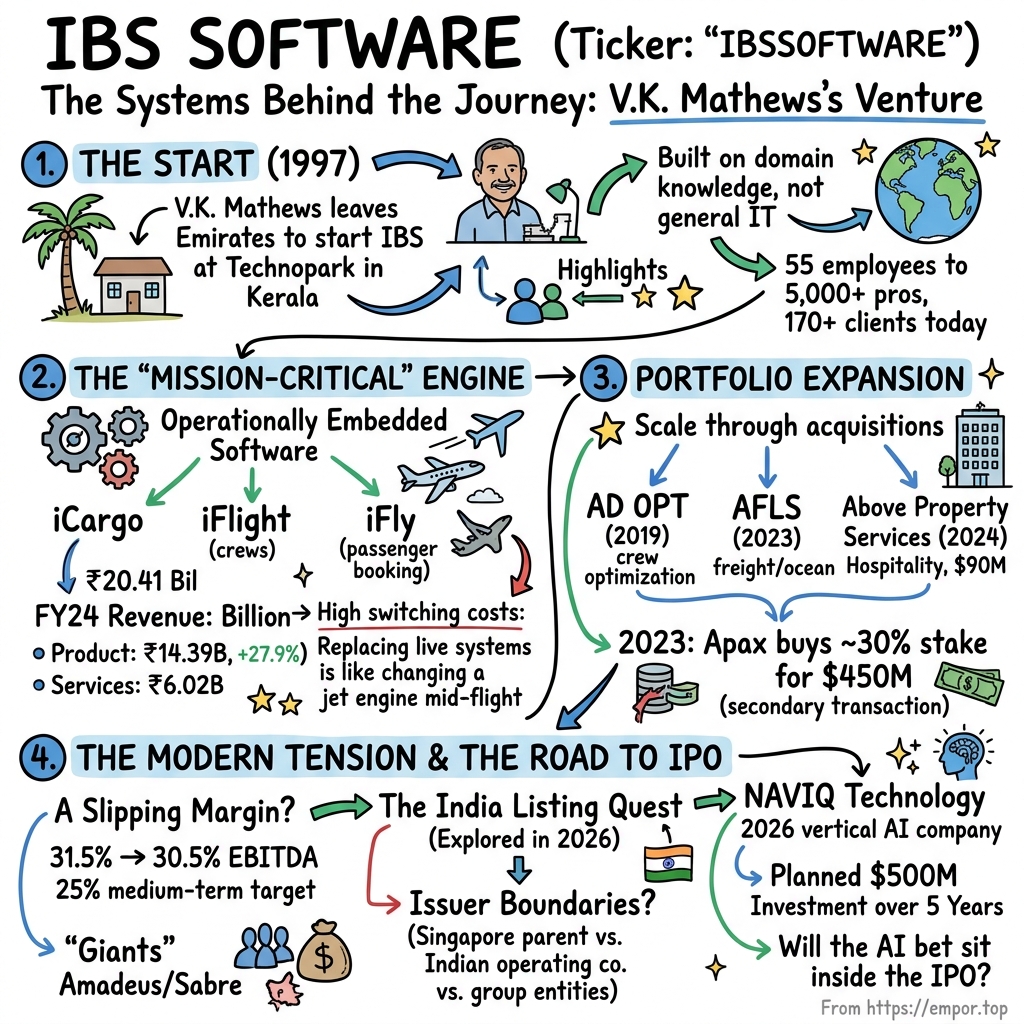
In the middle of July 2026, V.K. Mathews gave the kind of interview that usually opens an IPO story. The Singapore-headquartered IBS Group, the travel-software business he had founded almost three decades earlier, would list its shares "at the right time," he said. The group had first looked at the United States, but India now looked promising, even if its stock market was not performing well at that moment. And if the group did come to Indian investors, it had the option of using IBS Software, its Indian operating company, as the holding company for the listing.1 A few days earlier the group had launched a new artificial-intelligence company, Naviq Technology, with a plan to invest $500 million in it over five years.2
Four months on, that is still where the story stands. No draft red herring prospectus has been filed. The processing-status list that the Securities and Exchange Board of India published on 9 November 2026, which tracks every draft offer document under review, carries no IBS entry, and the regulator's public-issues filings show none either.34 There is no price band, no named issuer, no list of selling shareholders, and no statement of what the money would be for. What exists is a founder's stated intention and a business that is unusually hard to see from the outside.
That gap is the strange thing about IBS. This is a company whose software has run flight and crew operations for British Airways and the core cargo business of Lufthansa Cargo, and whose group revenue in the year to March 2024 was about ₹2,040 crore.567 Yet a public investor cannot say what a share would cost, what it would contain, or even which company would issue it. Before anyone can ask whether IBS is worth owning, they have to ask what owning it would mean.
The story that follows turns on three questions. The first is whether mission-critical travel software can keep compounding once the post-pandemic recovery in air travel stops doing the heavy lifting. The second is whether a specialist of IBS's size can defend its place against platforms such as Amadeus and Sabre that are many times larger. The third is newer and, for a prospective shareholder, the most immediate: if the group spends hundreds of millions of dollars building an AI business, will that spending, and whatever value it creates, sit inside the company that investors are eventually offered?
The corporate map explains why the third question is not a technicality. Three different entities carry the IBS name or sit in its chain of control, and each answers a different question. When India's competition regulator approved a change in ownership in 2023, it described IBS Software Pte. Ltd., incorporated in Singapore, as the parent company of the IBS group of companies.8 IBS Software Private Limited is the Indian operating company; it is the direct parent of IBS Software Europe Limited, the UK subsidiary whose accounts are among the few detailed financial statements the group makes public. Those UK accounts, for the year to March 2025, go one level further up and name IBS Technology and Consulting Services FZ-LLC, a company in the United Arab Emirates beneficially owned by Mathews, as the ultimate controlling entity.9 Singapore at the top of the operating group, India at the heart of the engineering, the UAE at the apex of control: a listing of the Indian company "as the holding company" would therefore imply moving assets or ownership around, and the group has not said how.
The 2023 transaction that the regulator reviewed is the only hard ownership event in recent years, and it is easy to misread. Pelipper HoldCo SARL, a vehicle indirectly owned by funds advised by Apax Partners, agreed to buy approximately 30% of the issued share capital of IBS Software Pte. Ltd., on a fully diluted basis, from Techware Singapore Holdings, a Blackstone portfolio company.8 IBS announced the deal in May 2023 as an investment of approximately $450 million for a significant minority stake, with Mathews remaining the majority shareholder.10 The money went to Blackstone, not to IBS. It was a secondary sale: one private-equity owner handing its seat to another. It did not fund a single new product.
Still, the deal is the nearest thing IBS has to a market price. If roughly $450 million bought roughly 30%, then the buyer valued the whole equity at about $1.5 billion in mid-2023. That number deserves suspicion before it deserves use. A minority stake in a founder-controlled company usually trades with negotiated rights attached, such as board seats, information rights and exit provisions, and none of those terms are public. It is also lower than an earlier aspiration. In June 2022, people familiar with the matter told Bloomberg that IBS had confidentially filed for a US listing with Goldman Sachs and JPMorgan, aiming to raise at least $500 million at a valuation above $2 billion.11 That listing never came. A year later a private buyer paid a price that implied about a quarter less for the whole company. Asking prices and clearing prices are different things, and IBS has already lived through the difference once.
The venue has moved too. After the 2022 US plan stalled, IBS said in 2023 that it would consider an IPO if large acquisitions came up, which made a listing a tool rather than a goal.12 In 2026 the conversation became India.1 None of these statements is a transaction, and none is evidence of anything improper; plans change with markets. But a public investor should register the pattern. IBS has talked about listing for at least four years without listing, and each version of the plan has had a different shape.
That brings the story back to Naviq. The group launched it as a separate company that would operate independently within IBS Group, and said it would be the preferred implementation partner for IBS Software's customers.1314 A business that sells into the same airline and cruise customers, staffed with people who used to run IBS Software's consulting work, and funded at a scale comparable to IBS Software's own revenue, could end up inside the listed company, beside it, or as a related party trading with it. Each answer produces a different investment. Until a filing draws the boundary, anyone valuing IBS is valuing a company whose edges have not yet been drawn.
To understand why the boundary matters, and why the core business is worth the trouble, the story has to go back to an aeronautical engineer leaving Dubai for a technology park in Kerala.
 Subscribe on LinkedIn
A founder carries the airline’s operating problem to Kerala
V.K. Mathews did not come to software from software. He trained as an aeronautical engineer, with a master's degree from IIT Kanpur, and spent more than a decade at Emirates before setting out on his own.15 An airline in the 1990s was a machine of interlocking schedules. Aircraft had to be in the right place, maintained and fuelled; pilots and cabin crew had to be legal to fly under duty-time rules; cargo had to be booked, loaded and tracked; passengers had to be sold seats, rebooked when things went wrong, and rewarded for loyalty. Each of those jobs ran on systems, many of them old mainframe applications, and when any of them failed the airline felt it within hours. Mathews had seen that problem from the inside. In 1997 he started IBS at Technopark in Thiruvananthapuram, with 55 employees joining him.15
The choice of place mattered as much as the choice of problem. Kerala in 1997 was not Bengaluru. Technopark was an early, government-backed bet on bringing technology employment to the state, and a company that set up there had to win work from customers who would never visit. That pushed IBS away from the generalist outsourcing model that was making India's large IT-services firms rich by selling engineering hours to anyone who needed them, and towards something narrower: selling domain knowledge about how travel operations work, packaged first as services and increasingly as products. A generalist competes on price and headcount. A specialist competes on knowing the customer's operation better than the customer's other vendors do.
The portfolio grew in both directions, by building and by buying. By October 2012 IBS said it had made six acquisitions in its first fifteen years, one in India, two in Europe and three in the United States, and Mathews described buying companies in the industry it served as "a deliberate growth strategy."16 The sixth of those deals was Hotel Booking Solutions of Atlanta, a distribution business that connected hotel reservation systems to booking channels and counted more than 80 multinational hotel chains and over 30 distributors among its clients.16 It gave IBS a foothold in hospitality that it would later deepen.
By its twentieth anniversary in 2017, IBS described itself as a company of nearly 3,000 people from 20 nationalities, with more than 200 active customers, including ten of the twenty largest airlines, four of the five oil majors, and more than 80 of the largest hotel chains. It said it held the intellectual-property rights to 17 large software products, sold under names such as iFly, iFlight, iCargo, iTravel and iLogistics.17 Those are company claims, made in an anniversary release, and they should be read as such: a count of products is not a measure of how many earn money, and a count of customers says nothing about how much each pays. The same release recorded the moment the business acquired outside institutional money: in December 2015, Blackstone invested $170 million for a minority shareholding.17
Today the company describes itself as serving more than 170 clients worldwide and employing more than 5,000 professionals from more than 40 nationalities.15 Set the two self-portraits side by side and something curious appears. Headcount has risen by roughly two-thirds since 2017, through a figure of about 4,000 that IBS cited in 2023, while the stated client count has fallen from more than 200 to more than 170.10 There are innocent explanations. Customers merge, the company may count differently now, and shedding small accounts while deepening large ones is a common and often healthy move for a product company. IBS does not say which explanation applies. What the numbers do show is that the business has not grown by adding ever more logos. If it has grown, it has grown by selling more to fewer, larger customers.
That pattern sharpens the question that defines IBS. Its software is woven into the daily operation of airlines, cruise lines and hotel groups, and the deeper the weave, the harder it is to remove. But its customers are some of the largest and most sophisticated buyers of technology in the world, they are few in number, and they negotiate hard. How much of the value of being indispensable can a specialist vendor actually keep? The answer starts with what IBS sells and how it gets paid.
When an airline’s software becomes part of the operation
Picture a long-haul airline on a winter morning when fog has closed its hub for three hours. Dozens of aircraft are out of position. Crew members who were due to fly the afternoon departures will run out of legal duty time before they reach their destinations. Pallets of pharmaceuticals booked on a delayed flight need to be re-routed. Thousands of passengers need new connections, and the most valuable of them expect their loyalty status to count. Each of those problems lives in a different system, and IBS sells software for most of them.
Its product names map onto those jobs. iFlight handles flight and crew operations: building schedules and rosters, tracking aircraft and crews in real time, and re-planning when the day goes wrong. When British Airways chose iFlight in 2018, the contract was to replace its legacy mainframe systems for operations control and crew tracking, covering about 270 aircraft and 4,500 pilots.5 iCargo runs an airline's cargo business, from capacity and booking through handling and billing; Lufthansa Cargo began implementing it in 2012 and was still celebrating the partnership a decade later.6 The iFly family covers passenger-facing work such as reservations, loyalty programmes and staff travel. Beyond aviation sit a cruise platform covering onshore, online and on-board operations, the hotel distribution and reservation business, and logistics software for the energy industry.8 These are not interchangeable labels. A crew-optimisation engine and a hotel central reservation system have different buyers, different competitors and different economics, and treating them as one "travel software" business hides most of what matters.
The latest group-wide figures come from India Ratings and Research, which rates the Indian company's bank facilities on a consolidated view of IBS and its subsidiaries. In the year to March 2024, consolidated revenue grew 21.7% to ₹20.41 billion. Within that, software product revenue grew 27.9% to ₹14.39 billion, while services revenue grew 8.9% to ₹6.02 billion.7 Products therefore supplied about 70% of revenue and almost all of the acceleration. Aviation, meanwhile, contributed about 70% of total revenue.7 Two different 70% figures describe two different concentrations: the business is mostly products, and it is mostly airlines. The breadth of the portfolio, from cruise ships to hotel rooms, still rests on an aviation core.
How those product rupees are earned is described in detail only for one entity, the UK subsidiary, and its contracts are a window rather than a map. IBS Software Europe recognises software-as-a-service revenue in two parts: an implementation fee for getting the customer live, and recurring fees afterwards, which are either transaction-based charges subject to minimum commitments or fixed monthly fees. Some long-term contracts link prices to consumer-price inflation or give discounts once transaction volumes pass set thresholds. Consulting and digital-transformation work is sold on fixed-fee or time-and-material terms.9 The group as a whole does not disclose what share of revenue is recurring, how long its typical contract runs, or how often customers renew.
The pricing structure creates a useful tension. A minimum commitment works like a floor: if an airline's traffic collapses, as it did in 2020, the vendor still collects the agreed minimum. Transaction fees above that floor work like an escalator: when passengers, bookings or cargo shipments grow, IBS's revenue grows with them without a new sale. The same mechanism that cushions the downside also means that a good year for travel flatters the vendor's growth. Amadeus, the industry's largest technology provider, is explicit about this in its own airline IT business, where revenue in 2024 grew with the number of passengers boarded on its systems and the revenue it earned per passenger.18 IBS's disclosures do not let anyone separate how much of its growth came from new customers and new modules and how much simply rode the travel recovery.
The UK subsidiary also offers a glimpse of contracted work. At 31 March 2025 it reported £159.98 million of unsatisfied performance obligations, the accounting term for revenue under signed contracts that has not yet been earned, excluding certain time-and-material arrangements. About 31% was expected within a year and 63% within two to five years.9 For a subsidiary whose own revenue in that year was about £65 million, that is roughly two and a half years of revenue already under contract, which is the profile of a business with long agreements rather than one-off projects.9 It is tempting to scale that up to the group. That would be a mistake. The UK entity is one part of the group, its contracts may be unusually long or unusually large, and the group publishes no backlog figure of its own.
The distinction between contracted revenue and durable economics is where the investor's real work begins. A signed seven-year contract is valuable; it is not the same as a seven-year annuity. The vendor must keep the software competitive, fix what breaks, absorb the cost of regulatory changes, and then, at renewal, face a customer who knows precisely how hard it would be to leave and how much the competitors would discount to win the business. What IBS earns over a customer's lifetime depends less on the first contract than on the second and third. And one way IBS has tried to make itself harder to replace is by buying the pieces it did not have.
The suite grows by buying missing pieces
In September 2019, IBS announced that it had bought AD OPT, a Montreal company that had been building airline crew-optimisation software since 1987, from the workforce-management group Kronos.19 Crew optimisation is one of the hardest mathematical problems in an airline: millions of possible pairings of pilots, cabin crew and flights, constrained by union agreements, rest rules and aircraft types, have to be reduced to a roster that is both legal and cheap. AD OPT brought decades of algorithmic work in that niche, more than 20 airline customers, among them Air Canada, Qantas and FedEx, and a base in North America, where IBS had been comparatively thin. Its Montreal headquarters became IBS Canada and a global centre for crew optimisation. IBS did not disclose the price.19
The logic of buying rather than building is straightforward in a market like this one. Airline software is specialised, slow to sell and slower to implement, and a credible product needs reference customers before most airlines will even shortlist it. An acquisition buys the product, the engineers who understand it, and the customers who prove it works, all at once. IBS had followed that playbook from early on, which is how it got into hotel distribution in 2012.16 The company made no acquisitions between 2012 and 2017.1617 Then came three in five years.
The second of the recent deals extended cargo. In February 2023 IBS bought Accenture Freight and Logistics Software, a set of platforms used by airline and ocean transportation companies, and opened a new development centre in Chennai, its fourth in India. Mathews called it "a strategically important milestone for our cargo and logistics business," and presented ocean freight as a natural adjacent industry.20 For a company whose iCargo product already ran airline cargo operations, the move made sense on paper: the same shippers and forwarders buy capacity on ships and aircraft, and a platform that spans both could be worth more to them. Again, no price was disclosed.
The third deal is the only one with a published price, and it is the most revealing. In January 2024, IBS agreed to buy Above Property Services, an Atlanta-area hotel-technology company founded in 2012, for $90 million. APS brought a central reservation system, a property-management system and revenue-management tools, the core software a hotel chain uses to sell rooms, run the front desk and set prices. IBS's existing booking engine and distribution platform was already used by more than 36,000 hotels, and the company pointed to industry research suggesting that one in five hotel organisations planned to replace their central reservation system within three years.21 The pitch was a unified, cloud-native platform for hotel groups at the moment many of them were shopping.
To feel the size of that cheque, set it against IBS itself. The group's revenue in the year to March 2024 was ₹20.41 billion, roughly $246 million at that year's average exchange rate of about ₹82.8 to the dollar; its EBITDA, the profit before interest, tax, depreciation and amortisation, was about ₹6.23 billion, or roughly $75 million.722 The APS purchase therefore cost more than a full year of the group's operating profit and a bit over a third of a year's revenue. That is a meaningful bet for a company of this size. Whether it was a good one cannot be judged from the outside, because IBS has not disclosed APS's revenue, its profitability, or the multiple it paid. Calling the price cheap or expensive without those figures would be guesswork dressed as analysis.
The 2023 ownership deal belongs in the same frame only as a contrast: the $450 million secondary sale did not fund AFLS or APS.810 It changed who sat at the board table; it did not pay for AFLS or APS. It does, however, give a rough sense of how the earlier private-equity era went for its investor. Blackstone put $170 million into IBS for a minority stake in December 2015.17 Its portfolio company sold about 30% on a fully diluted basis in 2023.8 If the stake Blackstone sold was broadly the stake it had bought, which the public record does not confirm, its money grew about two and a half times in a little under eight years, a return of roughly 13% a year. That is respectable rather than spectacular for a private-equity holding, and it is consistent with a business that grew steadily rather than explosively over that period.
Here the story needs to test its own thesis. The case for IBS as a platform rests partly on the idea that acquisitions have built a coherent suite, with each piece making the others more valuable. The best evidence for that is circumstantial: the company still sells the products it bought, AD OPT's crew engine now sits inside the iFlight family, and the hotel business that began with the 2012 purchase grew into a platform big enough to justify a $90 million add-on in 2024.21 The strongest evidence against it is an absence. IBS has published no deal-by-deal record of what each acquisition cost, what revenue it brought, how that revenue has grown since, or whether any goodwill has been written down. A company that calls acquisitions "a deliberate growth strategy" has made that record relevant, and its absence means the thesis is plausible but unproven.16 The useful test lies ahead: if hospitality and cargo revenue grow faster than the aviation core after APS and AFLS, and margins in those lines hold, the buying strategy will have earned its reputation. If a future offer document shows impairments or flat acquired revenue, it will not have.
That leaves a tension that runs through the rest of the story. In the space of three years IBS has bought cargo and hotel capabilities, absorbed a change of private-equity partner, and announced, at group level, a $500 million AI programme. Each move may be sensible on its own. Together they raise the question every public investor eventually asks of an acquisitive company: what cash pays for each move, and where do the returns land? Before answering, it helps to look at the one year of group results that shows what the business looked like while all this was happening.
The travel rebound lifts growth, then the margin slips
The year to March 2024 was the year air travel finished coming back. Planes were full, airlines were flush enough to sign technology contracts they had postponed during the pandemic, and cruise lines were sailing again. IBS's EBITDA rose from ₹5.28 billion to ₹6.23 billion.7 India Ratings attributed the revenue growth to orders from existing and new customers and to an improving environment in travel.7
The interesting part is the mix. Product revenue grew much faster than services.7 If the rebound had simply lifted everything, services, which are tied to project work and consulting hours, might have been expected to grow about as fast as products. Instead the product line pulled away. That is genuine evidence of a shift towards software that customers license and pay for repeatedly, which is the more valuable kind of revenue. It is not proof that the shift will continue. One strong year after a pandemic trough can contain deferred implementations, catch-up transaction volumes and newly acquired revenue, and the published figures do not separate those effects.
The margin moved the other way. EBITDA margin slipped from 31.5% to 30.5%, and management told the rating agency to expect further moderation over the medium term as it expanded the product range and invested in development, with about 25% regarded as a sustainable level.7 That is an unusual thing for a company to say on the eve of possible listing talk: in effect, the best margin it had recently reported was not the margin it planned to defend. It is also candid in a way that deserves credit. Software companies that are building new products often see margins fall before revenue from those products arrives, and IBS was preparing its lenders for that rather than hiding it. But candour cuts both ways for the valuation. A company growing 20% at a 30% margin is a different asset from one growing at a similar rate at 25%, and management has told the market which it expects to be.
The limits of the record matter here. The group publishes no consolidated ten-year series of revenue and profit, so there is no way to say whether the year to March 2024 was typical or exceptional, how the business fared through the pandemic, or how much of the growth came from acquisitions. AFLS was bought in February 2023 and APS was agreed in January 2024, so some inorganic revenue is probably in the comparison, but the amount is not disclosed.2021 The UK subsidiary's revenue grew 17% to £65.0 million in the following year, to March 2025, which is a sign that growth continued in at least one part of the group.9 It cannot stand in for the group's results, and because IBS does not publish its consolidated accounts, the rating agency's series remains the latest group-wide yardstick.
The industry's giants offer perspective on what IBS is and is not. Amadeus, the Spanish company that runs much of the world's airline distribution and passenger systems, reported 2024 revenue of €6.14 billion, up 12.9%, with an EBITDA margin of 38.0% and free cash flow of €1.33 billion. Its airline IT segment alone earned €2.20 billion and grew 15.8%.18 Sabre, the American distribution and airline-technology group, reported 2024 revenue of about $3.03 billion, up about 4%, and still recorded a net loss of about $279 million after years of heavy debt.23 IBS's entire group revenue in its fiscal 2024 was a little over a tenth of Amadeus's airline IT business. Those companies are not identical to IBS; most of Amadeus's revenue comes from distribution, the business of connecting airlines to travel agents, which IBS barely touches, and their fiscal years differ. But the comparison makes two things concrete. IBS was growing faster than both giants in its latest disclosed year. And the industry's most profitable operator earns a margin several points higher than the one IBS reported and well above the 25% IBS says it can sustain. Scale buys margin in this business, and IBS does not have it.
So the investor's question about this period is not whether IBS grew; it plainly did. It is whether customers were buying a better product suite or whether IBS was riding the same travel cycle that lifted its customers. The fast growth in products points towards the first answer. The transaction-linked pricing and the lack of any longer record keep the second answer alive. A public investor would want to see the business grow through a year when airline traffic is flat. That year has not yet been disclosed.
The moat is written into the switching project
British Airways' 2018 contract offers a measure of what such a change entails.5 It is worth dwelling on what that means in practice. An airline cannot stop flying while it changes the software that tracks its aircraft and tells its pilots where to be. It has to run the old and new systems in parallel, migrate decades of rules and data, retrain controllers who work under pressure, and accept that a mistake on cut-over day could ground flights. Projects like that take years and are approved at board level. Once they are done, few airlines want to do them again soon.
That is the core of IBS's moat, and it is a real one. Its software sits inside the workflows that keep flights, crews, cargo and passengers moving, so changing vendors carries operational risk, not just cost. India Ratings named customer stickiness and long-term contracts among IBS's strengths when it affirmed the Indian company's ratings at IND A+/Stable for long-term facilities and IND A1+ for short-term ones in March 2025.7 The UK subsidiary goes further in its own accounts, noting that its customers have historically not terminated contracts without cause where substantive termination penalties apply.9 And there is at least one long, named relationship to point to: Lufthansa Cargo, which chose iCargo in 2012, marked ten years of working with IBS in 2022.6
The same switching story also reveals the moat's limit. IBS won British Airways by displacing a mainframe incumbent. It won Lufthansa's crew management in 2016 by replacing legacy applications built on Unisys, under a ten-year contract.24 Switching costs in airline software are high, but they are not infinite; they are paid every decade or two, when technology shifts and the old system becomes more dangerous to keep than to replace. IBS's growth has come from being the challenger in exactly those moments. The question for its own customer base is whether the next shift, towards cloud-native and AI-driven operations, turns IBS into the incumbent someone else displaces. Its own marketing hints at how quickly modern deployments can now happen: when the Canadian low-cost airline Lynx Air adopted iFlight in 2022, IBS said the system went live in about four months.25 A short implementation is a selling point for a challenger and a weakness for an incumbent, because it lowers the cost of leaving as well as joining.
Lynx carries a second, smaller lesson. The airline stopped flying in February 2024 amid debt and financial pressure, only two years after IBS had announced it as a customer.26 It was a small customer, and its failure says nothing about IBS's product. But it is a reminder that in a sector where airlines fail, merge and restructure regularly, customer concentration and credit risk are part of the moat calculation. India Ratings flags high revenue concentration as a constraint on IBS's rating, though IBS does not disclose the share of revenue from its largest customers.7
The competitive field is crowded with larger and differently shaped rivals. Amadeus and Sabre operate at many times IBS's scale; airline-owned technology arms such as Lufthansa Systems, the industry cooperative SITA, China's TravelSky and Navitaire in low-cost passenger systems compete in parts of IBS's territory, alongside specialist vendors and airlines' own in-house teams. The overlap shows up in IBS's flagship accounts. British Airways, the reference customer for iFlight, is also among the airlines that have contracted for Amadeus Nevio, a new modular airline retailing platform that Amadeus says is built on open technology and AI; so are Saudia, Finnair and Air France-KLM.18 Nevio addresses passenger retailing, not flight operations, so it does not displace iFlight. It does show the largest platform pushing modular, AI-flavoured products into the same airlines, and an airline that standardises with one big vendor for retailing may be tempted to consolidate other modules later. No independent, current estimate of IBS's market share in any of its segments is published.
Seen through the lens of industry structure, the picture is mixed. Buyer power is high, because IBS sells to a limited set of large airlines and travel groups that run formal tenders and know their alternatives. Switching costs work in IBS's favour once it is installed and against it when it is trying to get in. Substitutes are real: an airline can extend an old system, build in-house, or buy a broader suite from one of the giants. Rivalry is intense in some niches and modest in others. Hamilton Helmer's framework for durable advantage would put most of IBS's power under switching costs, with some claim to a cornered resource in its accumulated domain knowledge and engineering talent in Kerala. Neither is the kind of power that lets a vendor raise prices freely; both are the kind that make losing a customer rare and winning one slow.
That leaves the moat claim intact but unquantified. IBS has not published customer retention rates, renewal terms, price realisation on renewals, or win-loss data in competitive tenders. A label such as "mission-critical" describes the customer's dependence; it does not prove the vendor captures the value of that dependence. The evidence that would strengthen the claim is specific: group-wide renewal rates, revenue growth from existing customers that does not rely on price concessions, and named wins against Amadeus or Sabre. A future offer document is the natural place for it. Until then, the moat looks like the kind that protects a business's existing revenue better than it guarantees its future pricing, and the question becomes how much financial room IBS has to keep investing in staying ahead.
A balance sheet that can fund growth, with a margin to protect
A rating agency and a management team looked at the same company in early 2025 and drew a careful line between them. India Ratings saw a business growing quickly with little net debt. Management, for its part, had already flagged pressure on margins. Both views can be true at once, and the balance sheet shows why.
At the end of March 2024, IBS held ₹5.39 billion of cash and equivalents against ₹7.50 billion of adjusted debt. Net leverage, the debt left over after subtracting cash, measured against a year's EBITDA, was 0.3 times, and EBITDA covered interest 9.8 times.7 For a business generating about ₹6.2 billion of EBITDA, that is a light load: on paper, the group could repay its net debt with about four months of operating profit. Cash, however, had fallen from ₹7.82 billion a year earlier, a drop of about ₹2.4 billion in a year when profits rose.7 IBS does not explain the decline. A year that included acquisition activity, continued product investment and possibly payments to the holding structure could account for it, but the group publishes no consolidated cash-flow statement that would show which.
The composition of the debt is more interesting than its size. At the level of the Indian company alone, India Ratings counted ₹7.37 billion of adjusted debt, of which ₹542 million was bank overdraft and most of the remainder was compulsorily convertible debentures linked to the holding company, carrying a 9% coupon.7 A compulsorily convertible debenture is a hybrid: it pays interest like a bond until a set date or event, and then it must turn into shares. In other words, most of what looks like the Indian company's debt is money supplied from within the group, structured so that it will eventually become equity. That matters enormously for an Indian listing. If IBS Software Private Limited becomes the issuer, those debentures will very likely convert before or at the listing, which would reduce reported debt and increase the share count at the same stroke. The conversion terms, and therefore how many new shares would be created and who would own them, are not disclosed. A public investor cannot build a share count, let alone a fully diluted one, without them.
The same uncertainty limits any attempt to bridge from equity value to enterprise value, the measure of what the whole operating business is worth to all its capital providers. The only observed equity price is the one implied by the 2023 Apax deal, roughly $1.5 billion for the Singapore parent.810 Consolidated net debt at March 2024 was about ₹2.1 billion, or roughly $25 million at the year-end exchange rate of about ₹83.4 to the dollar.722 Add the two and the implied enterprise value is a little over $1.5 billion, about 20 times the year's EBITDA and about six times its revenue. But the bridge is shaky at both ends. The equity price belongs to the Singapore parent; the debt and EBITDA belong to the rating agency's consolidated view of the Indian company and its subsidiaries. Those perimeters may overlap almost entirely, or they may not, and the CCDs blur the line between debt and equity inside them. The multiple is a rough orientation, not a valuation.
The rating agency also drew a line of its own. It said that net leverage rising above 2.0 times on a sustained basis could lead to a negative rating action.7 That threshold makes the funding question concrete. Two times FY2024 EBITDA is about ₹12.5 billion, so the Indian company had room for roughly ₹10 billion, around $125 million, of additional net debt before reaching the line. The group's AI plan calls for about $500 million over five years, or roughly $100 million a year.27 If IBS Software were to fund that plan with borrowing alone, it would exhaust its rating headroom in a little over a year. It almost certainly would not, and the group has not said it will. But the arithmetic shows why the question of who pays for Naviq is a balance-sheet question, not just a strategic one.
Working capital adds a further layer that only the UK subsidiary illuminates. At March 2025 IBS Software Europe held contract liabilities, money collected from customers before the work is delivered, of £39.06 million, up from £35.20 million, against trade debtors of just £7.13 million.9 Customers were paying ahead, which is the healthy pattern for a software vendor with implementation fees and annual billing. The same accounts show a dense web of intercompany balances: £14.10 million owed by its parent and £12.48 million by other group companies, against £8.44 million owed to its parent and £22.32 million to other group companies, all described as interest-free, unsecured and repayable on demand.9 Another £12.31 million of its contract liabilities had been collected through group companies for customer contracts still being implemented.9 None of these figures says anything about the group's collection quality; they say a great deal about how intertwined the group's entities are. A listing that puts one of them in public hands will have to price those internal flows at arm's length and disclose them.
On reinvestment, IBS's own claim is that 10% of its revenue is focused on innovation.28 That is a marketing statement rather than an audited research-and-development series, and the group does not publish its capital spending, capitalised development costs or headcount trend. It does fit the margin pressure management had already flagged. A company spending a tenth of revenue on product, and planning to spend more, is a company choosing growth over near-term profit.
That choice is defensible, and the balance sheet can support it. It is not unlimited capacity, and it is not yet tested. Whether IBS turns its 30% EBITDA margin into cash at a high rate, how much of that cash leaves the Indian company for the holding structure, and how the debentures convert are all unanswered in public. Those questions were manageable while IBS was a private group with patient owners. They became urgent the week the group announced it would spend half a billion dollars on a new company.
The new AI company makes the listing boundary urgent
On 23 July 2026, at Infopark in Kochi, Kerala's chief minister V.D. Satheesan and minister P.K. Kunhalikutty inaugurated the operations of Naviq Technology. The company said it opened with about 2,000 employees. Mathews reiterated the group's $500 million investment plan, saying a substantial share would be spent in Kerala, and that the workforce would grow to 5,000.27 The group had announced Naviq two weeks earlier as a company that would work with airlines, airports, cruise operators, hospitality groups and travel agents.29 Mathews called it a "vertical AI company for the travel sector."27
Start with what is actually known. Naviq is led by Moizzur Rahman, who previously ran consulting and digital transformation at IBS Software. It describes itself as an AI-first company of around 2,000 professionals in 16 offices.13 It is positioned as the preferred implementation partner for IBS Software's customers.14 It plans to charge on outcomes rather than through traditional pricing, with fees tied to measures such as passengers boarded, revenue passenger-kilometres or the number of members in a loyalty programme.12 It has named cruise lines it hopes to work with, from Royal Caribbean to Hurtigruten, but has not said which of them, if any, are customers.14 It has not disclosed revenue, contracts or a funding structure beyond the headline investment.
Now size the ambition. Spread evenly, $500 million over five years is about $100 million a year. IBS's group revenue in the year to March 2024 was about $246 million and its EBITDA about $75 million.722 The plan therefore amounts to roughly twice a full year of revenue in total, about 40% of that revenue each year, and more each year than the whole group earned in operating profit. These are comparisons of scale, not claims that IBS Software will write the cheques. But they explain why Naviq cannot be treated as a side project. A venture of that size inside the listed company would weigh heavily on its margins and cash flow for years; outside it, it would become one of the listed company's most important related parties.
The strategic logic is easy to state and harder to prove. IBS already understands how travel operations work, and it already sits inside the systems where operational data flows. AI tools that predict disruptions, re-plan crews automatically or personalise offers could be sold to that installed base, and an implementation partner with domain knowledge has an advantage over a generalist AI firm. Mathews was candid about a key constraint: "We don't own the data, but we will be able to use it to develop predictive tools."27 The data belongs to the airlines and hotels, which means Naviq's ability to train and sell models depends on contracts that customers can renegotiate.
Outcome-based pricing is less novel than it sounds. Amadeus already earns much of its airline IT revenue per passenger boarded on its systems, and IBS's own contracts include transaction-linked fees.189 What would be new is tying AI fees to measured improvements in operations. That is attractive in a sales meeting and difficult in a contract: someone has to agree on the baseline, the measurement, and who gets credit when a delay is avoided. It also links Naviq's revenue directly to travel volumes, the same exposure that already dominates IBS's core.
There is a structural question hiding in Naviq's leadership. Its president came from IBS Software's consulting and digital-transformation business, and it describes itself as a technology and consulting firm.13 IBS Software's services line earned about ₹6.02 billion in the year to March 2024, around 30% of group revenue.7 If consulting capability is migrating from IBS Software into Naviq, the company eventually offered to investors could be a purer, higher-growth product business, with a separately owned sister company doing the implementation work and billing the same customers. That might suit a valuation. It would also make the relationship between the two companies, who wins which contract and at what price, one of the most important disclosures in any offer document. The group has not said whether any such transfer has happened.
The story's habit of testing claims applies here with particular force, because a hiring target and an investment budget describe inputs, not outcomes. IBS's own history offers little to calibrate against. The company claimed 17 large software products in 2017, but it has never disclosed revenue by product, so there is no public record of how often its launches or acquired capabilities turned into lasting revenue.17 The case studies Naviq cites, such as work with TUI Group and an unnamed cruise line where response times fell by 90%, are useful illustrations of capability; they are not signed contracts with disclosed value.14 The evidence that would matter is concrete: named paying customers, recognised revenue, gross margin on the outcome-based contracts, cash consumed against the $500 million plan, and, above all, which company's books carry the spending.
That last point returns the story to where it began. A public investor who buys IBS could be buying the established product business, the AI venture, both together, or a company that bears some of Naviq's costs without owning its upside. Each would deserve a different price. The man who will decide which one is offered is the founder who has run IBS for nearly thirty years.
Mathews’s next chapter faces a credibility test
V.K. Mathews has been the constant in every chapter of IBS. He remains its executive chairman and majority shareholder.1510 Beside him today sit Somit Goyal as chief executive and Ashish Nanda as chief financial officer, with Christopher Branagan as chief technology officer and Abha Dogra as chief product officer.30 The team has changed recently. When IBS announced the Apax deal in May 2023, its chief executive was Anand Krishnan; the leadership page now names Goyal.1030 IBS does not publicise when or why that transition happened. A chief executive change after an ownership change is common, and nothing in the record suggests a problem, but it means the current operating team has a short public record of its own.
The 2023 ownership change shaped the governance: Apax acquired a significant minority stake, while Mathews remained the majority shareholder.810 Jason Wright of Apax has sat on the board as a nominee director since August 2023, and the board also includes Douglas Steenland, a senior adviser to Blackstone, whom the company lists as an independent director.30 Under Indian listing rules, the board would need a substantial block of independent directors, and investors would reasonably ask how independence is judged for a director tied to a former shareholder.
The group's control structure ends with Mathews, whom the UK subsidiary's accounts name as the ultimate controlling entity.9 Founder control is not a flaw; it is often why specialist companies stay focused on the long term. It does mean that a public shareholder in an Indian issuer would sit beneath a controlling shareholder whose interests span the issuer, Naviq and whatever other entities the group contains. The protections that matter are the ones that govern transactions among them.
On pay and incentives, the public record is nearly empty. Group-level executive compensation, bonus design, share-based incentives and management's equity ownership beyond the founder's are not disclosed. The UK subsidiary's sole director received no emoluments in either of its last two years, which says nothing about how the group's executives are paid.9 An offer document would have to disclose all of this, and it would be one of the first places a careful investor would look, because incentives tied to revenue growth or to completing a listing reward different behaviour from incentives tied to returns on capital.
Judged by behaviour rather than biography, the record is mixed in a way that calls for scrutiny rather than suspicion. On the credit side, management was candid about margin moderation, and the business has maintained long relationships with demanding customers while carrying modest net debt.767 On the other side, the listing plan has shifted venues and conditions over four years.11121 The acquisition record remains untested in public. And the AI plan's funding remains unexplained.
A prospectus would let investors test the growth, margin and acquisition record against management's claims. Those comparisons are the real test of credibility, and until a filing appears they cannot be made.
The skeptical investor's challenge is simple to state. If management believes IBS is a predictable, cash-generating business with low debt, what exactly would a listing fund? A fresh issue would bring new money into the issuer; an offer for sale would hand money to existing shareholders, including Apax, which has now held its stake for more than three years. The answer would reveal whose needs the listing serves. And whatever the answer, public shareholders would need clear protections over dealings between the listed company, its controlling shareholder and Naviq. With those questions framed, the case for IBS can be set out on its merits.
The case for IBS turns on three numbers
Put the optimist and the skeptic in the same room and give them the same year of results. The optimist points to the product mix shift and says customers are buying software, not hours.7 The skeptic points to aviation's roughly 70% share of revenue and says IBS is a bet on airlines with extra steps.7 The optimist cites the still-high EBITDA margin; the skeptic notes that management expects it to fall further.7 Both are reading the record correctly. The difference is which number they believe will move.
The bull case is coherent. Over nearly three decades, IBS has built a suite of software for the operational core of airlines, cruise lines and hotel groups. Its products have displaced mainframe incumbents at demanding carriers, and some customer relationships have lasted more than a decade.5246 Product-led growth, contractual protections and acquisitions across adjacent niches give it room to deepen that franchise, while its low net leverage leaves capacity to invest.91920217 In this telling, IBS is a vertical software franchise that a public market has simply never been offered, and the AI push is a chance to sell more into an installed base that already trusts it.
The bear case is equally coherent. Aviation's dominance makes growth sensitive to a cyclical, frequently distressed industry. Rivals such as Amadeus have many times IBS's scale and are pushing new modular, AI-flavoured platforms into IBS's own reference customers.18 India Ratings flags customer concentration without quantifying it.7 Margins have already slipped and management expects them to slip further. The acquisitions carry undisclosed prices and returns. The group's stated client count has fallen even as headcount has grown.1715 And the most ambitious new investment, Naviq, sits in an undefined relationship with the company that might list. In this telling, IBS is a good niche business being asked to carry a valuation and an expansion plan that its record does not yet support.
The way to adjudicate between them is to stress the business where it is most exposed. If air traffic stops growing, minimum commitments will protect a floor, but transaction fees will flatten, and product growth would have to come from new customers and new modules; the published record cannot show whether IBS has done that before in a flat year. If AI requires heavy hiring and outcome-linked fees, software margins could be squeezed by a cost base that looks more like consulting; whether that happens inside or outside the listed company depends on where Naviq sits. And if the group lists, the share count will depend on how the holding-company debentures convert, which is not disclosed.7
What the price would have to believe
None of this produces a share price, and it should not be made to. What it can produce is a sense of what different prices would require. The 2023 Apax deal implied roughly $1.5 billion for the Singapore parent, while the reported 2022 US listing target exceeded $2 billion.10811 Both are pricing signals. Neither is a measure of value, and the 2023 figure was set in a private negotiation that may have carried rights a public shareholder would never receive.
A simple, transparent framework helps. Start from the year to March 2024, when revenue was about $246 million and EBITDA about $75 million.722 Imagine three paths over five years. In a cautious path, revenue grows about 8% a year and EBITDA margin settles near 22%, slightly below management's sustainable level; revenue reaches about $360 million and EBITDA about $80 million. In a central path, growth averages about 13% and the margin sits at the 25% management has signalled; revenue reaches about $450 million and EBITDA about $115 million. In an ambitious path, growth averages about 18%, close to the pace of the latest disclosed year, and the margin holds near 28%; revenue reaches about $560 million and EBITDA about $160 million. Then assume that a little over half of EBITDA becomes free cash flow after tax, capital spending and capitalised development, a reasonable figure for an Indian-engineered software business with customers who pay ahead, but an assumption, because IBS does not publish its cash conversion.
Discount those cash flows at about 10%, a plausible cost of capital for a private, founder-controlled, mid-sized software company with dollar revenues and rupee costs, and assume growth of about 4% a year after the fifth year. The cautious path is worth roughly $600 million, the central path roughly $850 million, and the ambitious path roughly $1.3 billion. Lower the discount rate to 9% and raise long-run growth to 5%, and the central path rises to about $1.25 billion and the ambitious path to about $1.9 billion. Each ten-point change in the share of EBITDA that becomes cash moves every figure by around a fifth.
The point of the exercise is the shape, not the numbers. The 2023 private price of roughly $1.5 billion sits above the central path at a conventional cost of capital. To justify it, a buyer needed to believe something close to the ambitious path: growth in the high teens sustained for years and margins that do not fall to management's 25%, or to accept a lower required return than a public investor would typically demand of a business this concentrated. That may be reasonable; Apax had access to information that outsiders do not, and private-equity buyers often underwrite an eventual exit at a higher multiple. But it means that any listing price at or above the 2023 mark would embed sustained product-led growth, stable margins and high retention, rather than the moderation management has described. The analysis also ignores Naviq entirely, which would add a large cost and an unknown, unproven stream of revenue to whichever entity carries it.
Comparable companies narrow the range less than one might hope. Amadeus is the category leader and an aspirational benchmark rather than a direct peer, given its distribution exposure and higher margins.18 Sabre is closer in airline IT exposure but burdened by debt and still loss-making, which makes its valuation a poor anchor for a low-leverage company.23 Indian-listed software product companies serving global industries are few, and those that exist serve banking, insurance or enterprise customers with different growth and margin profiles. There is no listed pure-play airline-operations software company of IBS's size against which to set a multiple, which is one reason an Indian listing could attract scarcity demand. A market short of global vertical-software stories, and receptive to anything with "AI" attached, could price IBS above its central intrinsic range. A small free float, a controlling shareholder with interests in a sister company, and undisclosed concentration could just as easily push it below. Neither force would change what the business earns.
Three numbers and one document
That is why the case for IBS turns on three numbers a public investor should watch. The first is product revenue growth relative to services: if products keep outgrowing services by a wide margin, the mix shift is real; if the gap closes as travel volumes normalise, the 2024 surge was partly cyclical. The second is EBITDA margin against management's roughly 25% medium-term level: holding near 30% while investing would point towards the ambitious path, while falling below 25% would suggest that growth is costing more than promised. The third is concentration, aviation's share of revenue and the share from the largest customers, read alongside renewal evidence; diversification through hospitality and cargo, without customer losses, would strengthen the moat claim.
A fourth item is not a number but a document. A draft offer document would have to name the issuer and its subsidiaries, describe the group perimeter, set out related-party arrangements with Naviq and the controlling shareholder, disclose management incentives, explain the use of proceeds, and state who funds Naviq. Every other question in this story depends on it.
The balanced conclusion is that IBS has real evidence of a valuable specialist franchise: products embedded in operations, long relationships with demanding customers, a product line that was outgrowing services, and a conservative balance sheet. What the record does not yet show is the size of its moat in numbers, the returns on its acquisitions, or the economics of its newest and largest bet. The franchise is proven enough to take seriously. The price it deserves is not proven at all.
Business & Investing Lessons
Go back to the fogbound hub, the morning when aircraft are stranded, crews are running out of legal hours, and nobody in the terminal has heard of the software deciding what happens next. IBS was built for that morning. Its story offers lessons that belong to it rather than to software in general.
The first comes from the founding. Mathews brought a market's problem looking for a technology, and 55 people willing to build it.15 A generalist outsourcing firm would have sold the airline engineers. IBS sold an understanding of the airline's bad day. For founders, the lesson is that the deepest moats in software are often dug by people who once had to live with the customer's failures. For investors, it is a reason to ask where a company's knowledge came from before asking how big its market is. The fog at the hub is the product specification.
The second comes from the switching projects. IBS won British Airways by replacing a mainframe and Lufthansa's crew management by replacing Unisys-era applications.524 Each of those wins proves both halves of the moat: incumbents are hard to remove, and they are removed anyway when the technology turns. An investor who hears "mission-critical" should ask which kind of incumbent the company is, the one that defends its installed base or the one that will be displaced at the next turn. Every switching cost IBS now enjoys is one it once had to overcome.
The third comes from the acquisitions. AD OPT, AFLS and APS each made the suite broader on the day the deal was announced.192021 None has a public record of what it earned afterwards. Breadth is visible in a press release; value appears only years later, in renewals, cross-sales and margins that the press release cannot promise. A portfolio gets broader on the day of the deal; it gets better only at renewal.
The fourth comes from Naviq's opening in Kochi and its $500 million plan.27 Every one of those numbers is an input. None is a customer. Outcome-based pricing, AI capability and a famous installed base are reasons to expect revenue; they are not revenue. A hiring target is a plan; a paying customer is evidence.
The fifth is the one that hangs over the listing itself: as Naviq makes clear, a public market asks what a share owns. For any founder-controlled group heading to market, the answer to that question is worth more than the answer to which exchange it chooses. Before you price the company, find the company.
Epilogue
Tonight, in the middle of November 2026, IBS is in an in-between state. Naviq's offices in Kochi are four months old and hiring. The Indian operating company holds an A+ credit rating built on numbers that are now more than two years old.7 The Singapore parent has the same two principal shareholders it has had since 2023: a founder with majority control and a private-equity fund that bought its stake from another fund.810 And the regulator's list of draft offer documents under review, updated a week ago, still has no IBS on it.3
The next moments that will decide the story are easy to name. The first is a filing. A draft red herring prospectus filed with SEBI would end the guessing about the issuer, the share count after the debentures convert, the split between new money and shares sold by existing owners, and Naviq's place inside or outside the perimeter. If it shows an issuer that owns both the product franchise and the AI venture, with Naviq's costs fully visible, investors can judge the whole bet. If it shows a product company that pays a sister company for implementation work, investors will need to read the related-party section before the business section.
The second is a fresh set of group results. Extending the series beyond the year to March 2024 would show whether product growth stayed well ahead of services after the travel rebound faded, and whether margins settled around 25% or held near 30%. Sustained product growth, evidence of renewals, and margins that stabilise as investment rises would confirm the core thesis. Product growth slowing in step with travel volumes, or margins sliding below 25% without visible customer expansion, would weaken it.
The third is Naviq's first proof. A named airline, cruise line or hotel group signing an outcome-based contract, with disclosed revenue and a clear statement of which company books it, would turn a hiring story into a business. A year of spending without such contracts would turn it into a cost.
Behind all three sit forces IBS does not control: the mood of the Indian IPO market, which Mathews himself described as not performing well in July; the pace of air travel; and the timetable of a private-equity owner that has now held its stake for more than three years.1 Any of them could bring a filing forward or push it back.
The tension the story began with remains unresolved. IBS may be a focused vertical software company, proven in the hardest operational environments in travel, ready to explain itself to public shareholders. Or it may be a complex group whose most ambitious new investment has not yet been assigned to the company investors would own. The software has spent three decades working out of sight. The listing, whenever it comes, will be the first time IBS has to show its own workings.
Outro
Somewhere tonight a departure board is changing by the minute. A gate moves, a flight slips by forty minutes, a connection is protected, a crew is swapped, a pallet of cargo finds another aircraft. Passengers see the board. They do not see the rostering engine, the cargo platform or the operations control system behind it, and they never will unless something breaks.
That is what makes IBS unlike a conventional software story. Its product is most valuable when it is invisible, and the business behind it has remained largely out of public view. Becoming a public company means making that hidden machinery legible, measurable and priced. The journey is visible to everyone; the software that keeps it moving is the bet.
References
-
Singapore’s IBS Group plans India listing at right time, says Executive Chairman VK Mathews — Moneycontrol/PTI, 2026-07-14 ↩↩↩↩↩
-
IBS Software Eyes India Listing After $500M AI Venture Launch — Whalesbook, 2026-07-14 ↩↩
-
Processing Status of Draft Offer Documents — Securities and Exchange Board of India, 2026-11-09 ↩↩
-
Public Issues: Filings — Securities and Exchange Board of India ↩
-
IBS Software Signs Multi-year Contract With British Airways — IBS Software via Newswire, 2018-06-21 ↩↩↩↩↩
-
Lufthansa Cargo celebrates 10 years of transforming core cargo business with IBS Software — PR Newswire, 2022 ↩↩↩↩↩
-
India Ratings affirms IBS Software Private Limited at IND A+/Stable (Press Releases: Financial Insights) — India Ratings and Research, 2025-03-18 ↩↩↩↩↩↩↩↩↩↩↩↩↩↩↩↩↩↩↩↩↩↩↩↩↩↩↩
-
Commission approves acquisition of certain stake of IBS Software Pte Limited by Pelipper HoldCo SARL — Competition Commission of India, 2023-08-16 ↩↩↩↩↩↩↩↩↩
-
Annual report and financial statements for the year ended 31 March 2025 — IBS Software Europe Limited, 2025-12-30 ↩↩↩↩↩↩↩↩↩↩↩↩↩
-
Apax funds make approximately $450m investment in travel tech company IBS Software — IBS Software, 2023-05-15 ↩↩↩↩↩↩↩↩↩
-
Blackstone-backade IBS Software Services överväger notering — Realtid/Finwire, citing Bloomberg, 2022-06-30 ↩↩↩
-
IBS Software to consider IPO if large acquisitions come up — Financial Express, 2023-06-06 ↩↩
-
Technology and consulting firm Naviq launches for the travel sector — Consultancy.uk, 2026-08-13 ↩↩↩
-
New $500m AI travel company targets cruise sector — Cruise Trade News, 2026-08-11 ↩↩↩↩
-
V.K. Mathews, Founder and Executive Chairman — IBS Software ↩↩↩↩↩↩
-
IBS acquires US-based hospitality company — IBS Software, 2012-10-24 ↩↩↩↩↩
-
20 years on, IBS Software is a leading IT provider for the travel, transportation and logistics industry — IBS Software, 2017-09-28 ↩↩↩↩↩↩
-
IBS Software acquires AD OPT to advance airline crew management platform and expand footprint in North America — PR Newswire, 2019-09-10 ↩↩↩↩
-
IBS Software forays into ocean freight logistics with the acquisition of AFLS — IBS Software, 2023-02-22 ↩↩↩↩
-
IBS Software acquires APS for $90 million as it targets major growth in hospitality sector — IBS Software, 2024-01-16 ↩↩↩↩↩
-
Table 139: Exchange rate of the Indian rupee vis-à-vis the SDR, US dollar, pound sterling, D.M./euro and Japanese yen (financial year annual average and end-year rates) — Reserve Bank of India ↩↩↩↩
-
Sabre reports fourth quarter and full year 2024 results (Form 8-K) — Sabre Corporation, 2025-02-20 ↩↩
-
IBS Software Signs 10 Year Contract With Lufthansa — IBS Software via Newswire, 2016-04-04 ↩↩↩
-
Lynx Air, Canada’s new ultra-affordable airline, uses IBS Software’s iFlight to power its operation — IBS Software, 2022 ↩
-
What Lynx Air’s failure tells us about the state of the Canadian airline industry — The Conversation, 2024 ↩
-
From Kochi to the world: Naviq Technology begins operations to power global travel with AI — The Week, 2026-07-24 ↩↩↩↩↩
-
IBS Group bets on airline AI with launch of Naviq Technology — Aviation Business News, 2026-07-10 ↩
 LinkedIn
 WhatsApp
 Reddit
 Hacker News
 Email
 Kindle
 RSS Feed
 Spotify
 Apple Podcasts
 Amazon Music
 Audible
 YouTube