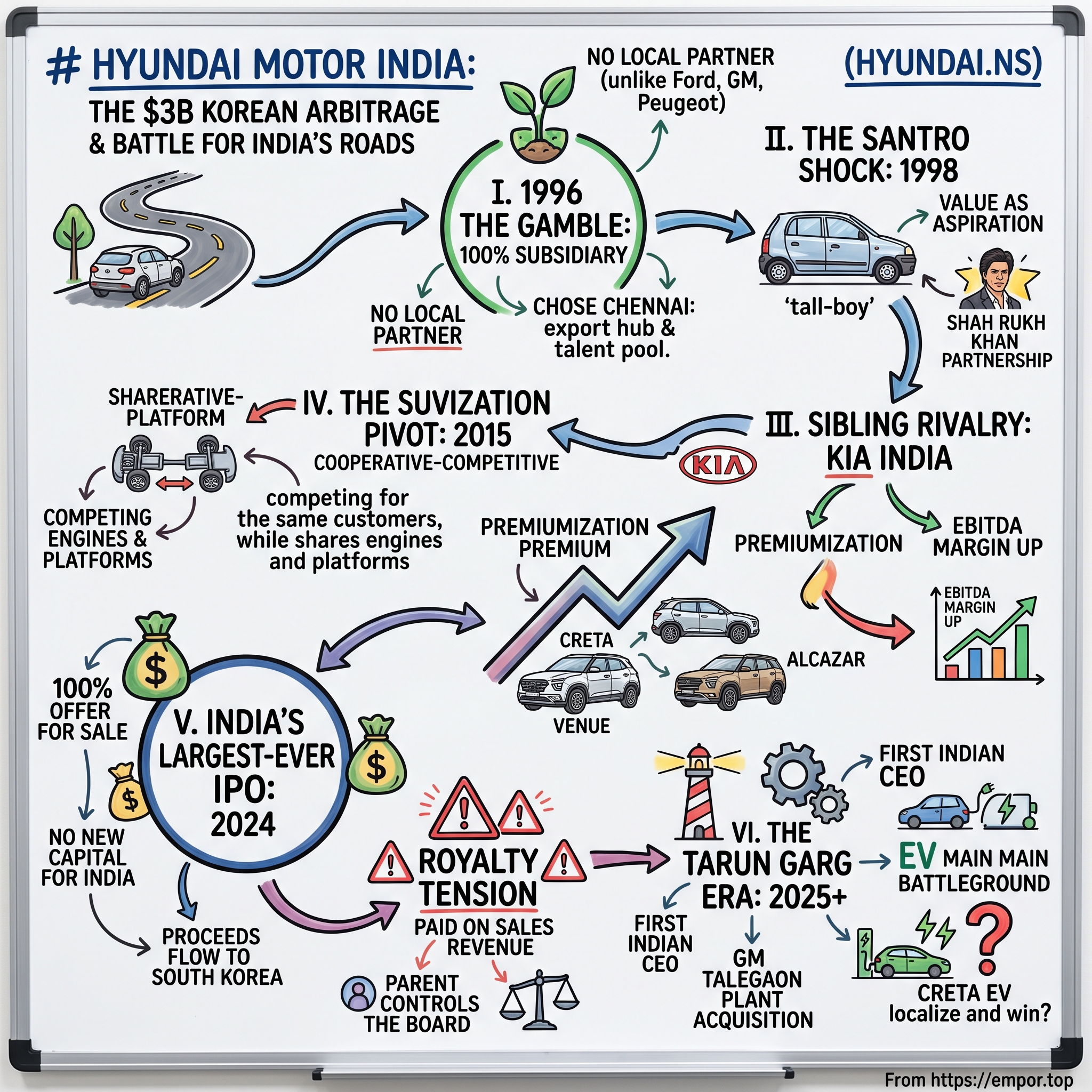
Hyundai Motor India: The $3B South Korean Arbitrage and the Battle for India's Roads
I. Introduction & Episode Roadmap
A Record Set, and Immediately Undercut
On the morning of October 22, 2024, a crowd gathered on the trading floor of the National Stock Exchange of India in Mumbai's Bandra Kurla Complex, waiting for a number that had already made history before a single share traded. Hyundai Motor India Limited was about to list after raising ₹27,870 crore — roughly $3.3 billion — the largest initial public offering the country had ever seen, edging past the state-owned insurer LIC's ₹21,000 crore sale two years earlier.12
And then the anticlimax arrived. The stock opened below its ₹1,960 issue price and drifted lower through the session, closing its debut day in the red.1 A record on the way in, a stumble on the way out.
That contradiction is the whole story in miniature. Something about this company was simultaneously enormously valuable and, to the marginal buyer of shares on day one, not quite worth the asking price. Understanding the gap between those two facts is what the next several hours are for.
The Paradox Buried in the Prospectus
Here is the structural oddity that makes this listing worth studying rather than merely reporting.
A conventional IPO raises fresh capital. A company sells newly created shares, the money lands on its own balance sheet, and management goes off to build factories, fund research, or repay debt. The existing owners get diluted; the business gets stronger. That is the deal every retail investor implicitly assumes they are participating in.
Hyundai's IPO did none of that. It was a 100% Offer for Sale. Every rupee of the $3.3 billion flowed not to the Indian company but out of the country, into the treasury of the South Korean parent, 현대자동차주식회사 Hyundai Motor Company (HMC), which sold down a 17.5% slice of a subsidiary it had built from nothing over three decades.23 No new shares were created. The share count before the offer and after the offer was identical.2
What the Indian entity received was a listing, a public share price, thousands of new minority shareholders, quarterly disclosure obligations, and a permanent audience of analysts. What it did not receive was a single rupee of new cash.
This is not illegitimate — offers for sale are a standard and perfectly legal mechanism, and every prospective buyer was told exactly what they were buying. But it reframes the transaction. This was not a company raising money to grow. This was a parent converting an illiquid thirty-year-old bet into liquid cash at the best price it could find, anywhere in the world. Which raises the obvious follow-on question: why was the best price in the world available in Mumbai rather than Seoul? We'll get there.
The Core Question
So the question worth asking is not "did the IPO succeed?" That's a first-day-pop question, and first-day pops are noise — they tell you about allocation dynamics and sentiment, not about business quality.
The real question is the one a long-term owner should ask. How did a mid-tier Korean carmaker, arriving in a still-protectionist India in 1996, outlast Ford, General Motors, and Peugeot — three genuine giants that entered around the same time, with more money, more brand recognition, and more automotive history, and who eventually gave up and went home? How did it build the country's second-largest passenger-vehicle business behind Maruti Suzuki? And how did it create an asset so valuable that carving out a minority stake implied a valuation for the whole Indian operation near $19 billion?
Then the harder follow-up, which is where the analysis actually lives. Now that the easy decades are over — now that the market is crowded, the growth is slowing, and the margins are visibly compressing — is what Hyundai built in India a durable compounding machine? Or is it a mature, cash-generative business being quietly harvested by its parent through royalties and dividends while three well-funded rivals grind away at the segment that generates all its profit?
Episode Roadmap
This is where we're going.
First, the 1996 bet: why Hyundai refused the joint-venture template that literally everyone else followed, and planted a wholly-owned factory in Tamil Nadu instead — a decision that looks obvious in hindsight and looked reckless at the time.
Then the Santro and Shah Rukh Khan: how a boxy "tall-boy" hatchback and a rising Bollywood star turned a foreign badge into a household name across small-town India.
We'll trace the strange sibling dynamic with 기아주식회사 Kia Corporation — the sister brand that shares Hyundai's engines and platforms while fighting it for the exact same customers, and why that arrangement is better for the parent than it is for you.
We'll dig into the "SUVization" pivot around the Creta, the single decision that rebuilt the company's entire margin structure and changed what the Indian car market looks like.
We'll go inside the royalty and transfer-pricing tensions that surfaced during the IPO roadshow, and treat them as what they are: a live governance question, not a scandal and not a non-issue.
And we'll close on the Tarun Garg era — the first Indian to run the company in its history, the bargain-hunting acquisition of a dead General Motors factory, and an electric-vehicle roadmap that is, as of today, still mostly a promise.
Throughout, keep one lens fixed. Empor tells the stories of top companies, not the stories those companies tell about themselves. Where management says Hyundai will keep winning, we'll ask what evidence supports the claim and what would falsify it. A strategy is not credible because an executive articulated it well on an earnings call.
Let's start at the beginning, in the mid-1990s, when almost nobody thought this bet would pay off.
 Subscribe on LinkedIn
II. The 100% Subsidiary Gamble: Why Hyundai Chose Chennai over Joint Ventures (1996–1998)
The Door That Had Just Been Kicked Open
Picture the Indian auto market in the early 1990s as a door that had just been kicked open after forty years bolted shut.
For four decades after independence, the "License Raj" had rationed who could build what, in what quantity, using which technology. The roads reflected it with almost comic precision. The Hindustan Ambassador — essentially a 1950s Morris Oxford, still in production largely unchanged — was the car of bureaucrats and politicians. The Premier Padmini, a licensed Fiat of similar vintage, was the alternative. The one genuinely modern vehicle was the Maruti 800, a small Suzuki that the government itself had brought into the country through a joint venture in the early 1980s, and which had promptly become the default car of the emerging middle class.
Three cars. In a country approaching a billion people. That was the competitive landscape.
Then in 1991, facing a severe balance-of-payments crisis, India dismantled industrial licensing and opened to foreign capital. To the world's carmakers, what appeared was the last great untapped automotive market on earth: enormous population, a middle class about to inflate, and vehicle penetration so low it barely registered on global charts. If you believed in mean reversion toward developed-market car ownership, India was the single largest option on the board.
Everybody Chose a Partner. Hyundai Didn't.
The giants came running. And almost every one made the identical choice: find a local partner.
Ford paired with the Mahindra family. General Motors went in with Hindustan Motors — the makers of that ancient Ambassador. Peugeot linked up with Premier Automobiles. The logic seemed unimpeachable to every board that approved it. India was culturally opaque, bureaucratically labyrinthine, and politically tricky, with land acquisition, labor law, state-level politics, and a fragmented dealer landscape all functioning as traps for the unwary foreigner. A local industrial house knew where the bodies were buried. The joint venture was the prudent, risk-managed, defensible-to-the-board entry.
Hyundai looked at that consensus and walked directly the other way.
Still a second-tier global player at the time — better known in Western markets for cheap, cheerful, somewhat disposable cars than for engineering prestige — Hyundai insisted on 100% ownership. Hyundai Motor India Limited was established as a wholly-owned subsidiary. No local partner. No shared board. No diluted control. No negotiation.
To appreciate why this mattered, you have to understand what the JV structure actually did to the companies that chose it. It split decision-making between two parties with genuinely different objectives. The global carmaker typically wanted to invest heavily for a decade before seeing returns, importing its own designs and processes. The local conglomerate often wanted nearer-term profitability, protection for its existing product lines and factories, and a say in the strategy commensurate with its equity. Neither party was behaving irrationally. But the combination meant that strategy got negotiated rather than set — and negotiated strategy in a market that rewarded speed and conviction is a structural handicap.
The scoreboard eventually made the point. Ford, GM, and Peugeot all unwound, restructured, or exited their Indian arrangements over the following two decades. Hyundai, owning everything, could point its Indian operation at a single objective and pour capital into it without asking anybody's permission or defending the plan to a partner with different incentives.
This is the first lesson of the story, and it recurs: in an emerging market, the freedom to make fast, large, unhedged bets can be worth considerably more than the local hand-holding you give up by making them alone.
Why Chennai, of All Places
Then came the second unconventional choice: where to build it.
The obvious homes for a car plant were Pune, already India's automotive cluster with an established supplier base, or the industrial belt around Delhi with its proximity to political power and the northern market. Hyundai chose neither. It built at Sriperumbudur, near Chennai in Tamil Nadu, roughly 40 kilometres from the state capital — a site that would become only its second major production hub anywhere in the world outside Korea.
The reasoning combined hard logistics with softer advantages.
Chennai sat beside deep-water ports, and that mattered enormously because Hyundai never conceived of India as a purely domestic play. From the outset, the intention was a dual-track model: a low-cost manufacturing base that could serve Indian buyers and simultaneously export small cars to Europe, Africa, the Middle East, and Latin America off the same production lines. Volume from exports would help fill the plant during the years when domestic demand was still developing — a crucial de-risking mechanism when you've committed enormous fixed capital ahead of a market that doesn't yet exist at scale.
Tamil Nadu also offered a deep pool of engineering talent and widespread English fluency, which reduced the friction of transplanting Korean processes into an Indian workforce. And the state government, hungry for a marquee foreign investor, was willing to compete on land and incentives in a way that more established industrial states felt less pressure to.
There was also a subtler benefit in choosing a location without an existing auto cluster: Hyundai got to build the ecosystem to its own specifications. Over the following years, Chennai grew into one of India's densest auto-component clusters, with vendors physically locating around the plant and organizing their capacity around Hyundai's requirements. That kind of supply chain — built for you rather than inherited — becomes a quiet, compounding cost advantage that is very hard for a later entrant to replicate.
The Timing Was the Audacious Part
And then the money.
Hyundai committed on the order of $614 million to the Chennai plant just as its home economy slid toward catastrophe. In 1997, the Asian Financial Crisis tore through South Korea. The won collapsed. The chaebol conglomerates buckled under debt loads that had looked manageable weeks earlier. The government accepted an IMF bailout with brutal restructuring conditions attached. Korean corporates were selling assets, not buying them.
In that environment, a Korean industrial group sinking hundreds of millions of dollars into a greenfield factory on another continent was not a hedge or an option. It was a burn-the-boats commitment. There was no cheap way to reverse it, no partner to share the loss with, and no obvious buyer if it failed.
For investors weighing the company today, this origin matters for a reason beyond storytelling. It establishes a behavioral pattern that recurs throughout Hyundai's Indian history: concentrated, high-conviction capital deployment made ahead of demand rather than in response to it. That pattern is what built the moat. It is also — and we will return to this — the same instinct the market now scrutinizes most nervously, as competition intensifies, margins wobble, and the company lines up fresh capital expenditure into a slowing market.
The bet was placed. The factory was built. The next question was whether anybody would actually buy the cars, and answering it meant taking on the most beloved small car in India.
III. The Santro Shock: Redefining the Compact Car & Battling Maruti Suzuki (1998–2010s)
One Answer, and Its Name Was Maruti
In 1998, the Indian small-car market had exactly one answer, and its name was the Maruti 800.
It was cheap. It was reliable. It fit down a village lane and could be fixed by a mechanic in any town in the country. After fifteen years, it had become something closer to a national institution than a product — the car in which a generation of Indians learned to drive, took their families on their first road trip, and announced to their neighbors that they had arrived in the middle class. For most families, "buying a car" and "buying a Maruti" were the same sentence.
Any newcomer who tried to beat Maruti at its own game — smaller, cheaper, simpler — was walking into a wall the incumbent had spent a decade reinforcing with scale, a national service network, and the most valuable asset in the business: default status.
So Hyundai didn't play that game.
The Tall-Boy Insight
Its opening move was the Santro, and the insight behind it was less about engineering than about anthropology — about how Indians actually used a car rather than how automotive engineers thought they did.
Where the Maruti 800 was low and squat, in the conventional idiom of European small cars, the Santro was tall. A "tall-boy" design with a high roofline and an upright seating position.5 It looked, to eyes trained on sleek hatchbacks, faintly odd — a little box on wheels.
But it solved real problems. A high roof and upright seats make a car dramatically easier to climb in and out of, which matters enormously for older passengers, for the multi-generational families who often travel together in India, and for anyone getting in wearing traditional dress rather than folding themselves into a low bucket seat. Tall seating also gives a better view over traffic, which in Indian road conditions is a genuine driving benefit rather than a marketing line. And a boxy shape yields more usable interior space per unit of exterior footprint — meaningful when parking is scarce and roads are narrow.
Under the hood, Hyundai brought a technology edge that mattered in a market still running older carburetted engines: multi-point fuel injection, which meters fuel electronically to each cylinder rather than relying on a mechanical mixing device.5 In practical terms — because this is the kind of specification that means nothing to most buyers until you translate it — MPFI delivered smoother starting, better fuel efficiency, and fewer of the running problems that plagued older engines. Alongside it came power steering and air conditioning offered as genuine, attainable propositions rather than distant luxuries.5
The Santro's pitch was therefore not "cheaper than a Maruti." It was "more car, more modern, for a price you can still stretch to."
That distinction — value as aspiration rather than value as bargain — became Hyundai's signature, and it echoes all the way forward to the Creta and beyond. It is the single most important strategic idea in this company's Indian history.
Borrowing an Emotional Vocabulary
But a better product does not win a market where the rival's badge means trust and yours means "foreign, unfamiliar, and possibly gone in five years." Indian buyers in 1998 had watched foreign brands come and go. Committing to a car meant committing to a decade of parts availability and service.
Hyundai's answer to that problem was the marketing masterstroke of the era. In 1998 it signed a young, fast-rising Bollywood star named Shah Rukh Khan as brand ambassador — a partnership that would run for roughly a quarter of a century and become one of the longest-lived celebrity endorsements in Indian corporate history.6
The genius was in what Khan specifically represented. Not distant Hollywood glamour, and not inherited privilege. Khan's public persona was that of the outsider who made it — aspirational, accessible, self-made, and unmistakably Indian. Through him, a Korean brand borrowed the emotional vocabulary of the country it was trying to enter. The "foreign carmaker" objection quietly dissolved, particularly across the Tier-2 and Tier-3 towns where trust is built slowly, by association and repetition, and where a familiar face on a hoarding does work that a spec sheet cannot.
It is genuinely difficult to price a moat like this on a balance sheet, and analysts are right to be skeptical of brand claims that can't be measured. But the effect here was observable in outcomes: by the time competitors woke up, Hyundai had become the default second name in Indian cars, and frequently the first name for a family trading up from their starter Maruti. That "trade-up destination" position is strategically precious, because it means you capture customers at the exact moment their willingness to spend increases.
Climbing the Ladder: i10, i20, and the Experiment That Worked
From that beachhead, Hyundai methodically climbed the price ladder — and this is the part of the history that most directly explains the company you can buy shares in today.
The entry-level Santro gave way to the i10, a more refined small car pitched slightly upmarket. Then in 2008 came the i20, and the i20 was an experiment that nobody was certain would work.
The question it tested was simple and consequential: would famously value-conscious Indian buyers actually pay a meaningful premium for a small car if it came loaded with safety equipment, styling, and technology? Conventional wisdom said no. Conventional wisdom held that in a price-sensitive market, small cars are bought on price and running cost, full stop, and that anyone wanting features would simply buy a bigger car.
The i20 offered a feature and safety content level that punched far above its footprint, and the market answered emphatically yes.5
That single data point became the intellectual foundation for everything Hyundai did afterward. It reframed the entire opportunity. The prize was not to sell the most cars at the lowest price — a war Maruti was always going to win on scale, cost position, and distribution depth. The prize was to sell somewhat fewer cars at materially higher prices and better margins to buyers who wanted to feel they had bought up.
What This Chapter Means for an Owner Today
The takeaway here is about durability, not nostalgia.
Hyundai spent roughly two decades converting a technology-and-design edge into brand equity, and brand equity into pricing permission. That is a genuine competitive advantage, and it is the reason the company earns what it earns.
But be clear-eyed about its nature. It is an advantage that must be continually re-earned, because a hatchback buyer's loyalty is shallow, switching costs in automobiles are close to zero, and every feature Hyundai pioneers can be copied by a competitor within a product cycle. Brand pull in cars is a flow, not a stock. Stop investing in it and it drains.
The Santro playbook told Hyundai where the profit really was. Going to get it required a bet bigger than the tall-boy. But before that, the company acquired a sibling — and the family dynamics got complicated.
IV. Sibling Rivalry: The Cooperative-Competitive Dynamic with Kia India
Your Fiercest Rival Is Your Brother
There is a peculiar feature of Hyundai's competitive landscape in India that looks, from outside, like a strategic error: one of its most dangerous rivals is, in effect, its own brother.
Rewind to that same 1997–98 Korean crisis. As Kia collapsed into bankruptcy during the national restructuring, Hyundai Motor Company acquired a controlling stake — settling around 51% — folding the smaller carmaker into what became the Hyundai Motor Group. The two brands have shared a corporate parent ever since. More importantly, they share the expensive internals of a modern car: platforms, engines, transmissions, electrical architectures, and the R&D organizations that produce them.
For two decades this arrangement stayed offstage in India, because Kia simply wasn't present. It arrived late, opening a large plant at Anantapur in Andhra Pradesh and launching its first Indian products in 2019 — more than twenty years after Hyundai planted its flag in Chennai.
And when it arrived, it did something only a sibling could get away with. It launched vehicles built on the same underlying architecture as Hyundai's own bestsellers and aimed them squarely at Hyundai's customers. The Kia Seltos is a platform twin of the Hyundai Creta. The Kia Sonet shares its underpinnings with the Hyundai Venue. Same skeleton, same heart — different skin, different showroom, different sales pitch, and a genuinely different design language.
Why a Rational Parent Fields Two Teams in One League
This is the "co-opetition" at the center of the group's Indian strategy, and it's worth unpacking why a rational parent would deliberately do this.
The answer is economies of scale on the back end paired with shelf-space coverage on the front end.
Engineering a modern vehicle platform and powertrain is staggeringly expensive — hundreds of millions of dollars in fixed cost before a single unit is sold, spread across years of development, testing, and homologation. That cost is almost entirely independent of how many cars you eventually build on it. So the single most powerful lever in automotive economics is volume amortization: the more units carry the platform, the lower the development cost embedded in each one.
When Hyundai and Kia amortize a shared platform and powertrain across the combined volume of two brands, the per-car development burden drops sharply. A standalone rival selling a single badge into the same segment cannot match that arithmetic without either selling far more units or accepting thinner margins. This is a structural cost advantage, and it is real.
Then, on the retail floor, the two brands are kept deliberately and rigorously separate. Independent dealer networks. Distinct design languages. Separate marketing organizations and brand positioning — Kia leaning younger and sportier, Hyundai broader and more established. Enough differentiation in styling, feature packaging, and pricing that a buyer cross-shopping a Seltos against a Creta genuinely feels they are choosing between alternatives rather than the same car wearing two badges.
The strategic effect is that Hyundai Motor Group occupies substantially more of the mid-size SUV shelf — both the physical space in the market and the mental space in a buyer's consideration set — than either brand could alone. Every slot the group fills is a slot Tata, Maruti, or Mahindra doesn't.
The Part That Doesn't Serve You
But we should be honest about the cost of this cleverness, because it cuts differently depending on which entity's shares you actually hold.
As a public investor, you own a piece of Hyundai Motor India. You do not own Kia India, which sits elsewhere in the group's corporate structure. And at the margin, every Seltos sold is a Creta not sold — with the profit accruing to a different pocket of the parent's empire rather than to the company whose shares are in your account.
The shared-platform savings are genuine and they do flow into HMIL's cost structure, so this is not a one-way extraction. But the front-end cannibalization is a real tension baked into the ownership arrangement, and a skeptical investor is entitled to note it rather than wave it away.
The deeper point generalizes well beyond Kia. The parent optimizes for the group. The group's interests and the listed Indian subsidiary's interests are aligned most of the time — but not all of the time, and the mechanism for resolving the disagreement when it arises is controlled by the parent.
That structural question — whose interests come first when Seoul, the listed Indian company, and its minority shareholders don't perfectly align — is the thread running through the remainder of this story. Before it surfaced in an IPO prospectus, though, it was buried inside the single most important product decision Hyundai ever made in India.
V. The SUVization Pivot: Redefining Margins and the "Premiumization Premium" (2015–Present)
The Bet Nobody Would Have Taken in 2015
In 2015, if you had told a room of Indian auto executives that within a decade sport-utility vehicles would constitute roughly two-thirds of a mass-market carmaker's sales, most would have smiled politely and changed the subject.
SUVs were a niche. Tall, thirsty, expensive things for a small slice of buyers — a rounding error in a market defined by small cars. The mass market was hatchbacks, and hatchbacks were a grind: enormous volume, ferocious price competition, and EBITDA margins stuck in the high single digits because every rupee of cost eventually showed up in a sticker price that customers scrutinized down to the last thousand rupees. In the hatchback business, you win by being relentlessly cheaper, and Maruti had a twenty-year head start on being relentlessly cheaper.
Then Hyundai launched the Creta, and the arithmetic of the entire Indian car market began to change.
Reading India Correctly
The Creta arrived as a mid-size SUV built on a bet about where India was heading, and the bet had two independent legs.
The first was economic: rising disposable incomes and increasingly available auto finance meant a growing cohort of families could stretch their budgets meaningfully beyond the entry-level hatchback — not into luxury, but into the next tier up.
The second was almost literally on the ground: India's road infrastructure, outside a handful of new highways, remained rough, potholed, and prone to flooding. Higher ground clearance and a tougher-riding vehicle stopped feeling like an indulgence and started feeling like common sense. An SUV in India isn't primarily a lifestyle statement about weekend adventures, as it often is in the West. It's a practical response to the surface you actually drive on — with the status signal as a very welcome bonus.
What had looked like a speculative niche turned out to be the most profitable segment in the market, and the Creta became its defining nameplate — the vehicle that would go on to sell more than a million units over its lifetime and effectively define the category for Indian buyers.
Crucially, this was not a one-off hit product. It was the leading edge of a deliberate, sustained mix shift. By FY24, SUVs accounted for roughly 63% of Hyundai's domestic volume; by FY25 that figure had climbed to 68.5%.14 In under a decade, a company built on tall-boy hatchbacks had remade itself into an SUV company that still happened to sell some hatchbacks.
Why This Is a Margin Story, Not a Volume Story
Here is why this matters more than almost anything else in the company's history, and it requires thinking about the cost structure rather than the sales chart.
A hatchback and a mid-size SUV do not cost proportionally different amounts to build. They share engineering approaches, much of the supply chain, the same assembly plants, the same dealer network, and the same overhead. The SUV costs meaningfully more — more steel, larger components, more content — but nowhere near enough to explain the price gap.
Because the price gap is enormous. Move a buyer from a ₹7-lakh hatchback to a ₹15-to-₹25-lakh SUV and you have roughly doubled or tripled the revenue per unit while increasing the cost per unit by far less. The incremental gross profit is captured almost entirely.
And there's a second-order effect that's arguably more important. In the hatchback segment, buyers optimize hard on price and running cost, which caps what you can charge regardless of how good your product is. In the mid-size SUV segment, buyers choose substantially on features, styling, and image — which means a manufacturer that is genuinely better at features and styling can convert that skill into price rather than merely into share.
That combination is how a company operating in a notoriously thin-margin global industry pulled its consolidated EBITDA margin up into the low-to-mid teens. The SUV mix, more than any single cost-reduction program, is what generates the bulk of the operating profit. The Creta and its siblings — the compact Venue, the larger Alcazar, the Tucson above them — became the engine room of the P&L, with the hatchbacks increasingly functioning as volume filler for the factories and an on-ramp for future SUV buyers.
The Feature War as a Pricing Mechanism
The mechanism Hyundai used to defend this position deserves its own explanation, because it's the operational core of the strategy.
Rather than compete with Maruti on price or fuel efficiency — a fight Maruti wins with its scale, its CNG lineup, and its dominance of roughly 40% of the overall market — Hyundai competed on aspiration.
It repeatedly brought features down-market ahead of rivals: panoramic sunroofs, ventilated seats, large digital instrument clusters and touchscreens, connected-car telematics, and advanced driver-assistance systems. That last one is worth translating, because ADAS is jargon that obscures a simple idea. It's a suite of cameras and radar sensors that watch the road and can intervene — braking automatically if you're about to hit something, nudging you back if you drift out of your lane, holding a set distance from the car ahead in traffic. In Western markets these had been luxury-car features. Hyundai put them in vehicles priced for India's upper-middle class.
To a buyer standing in a showroom, these features do something quite specific and psychologically potent: they make an ₹18-lakh car feel like it belongs to a more expensive class. That feeling is exactly the permission a value-conscious buyer needs to stretch their budget past the number they walked in with.
Hyundai monetized that permission. Call it the premiumization premium — the willingness of a genuinely value-conscious buyer to pay up when the product feels aspirational. It's the same insight the i20 first proved in 2008, now applied to a segment where the absolute rupees per transaction are several times larger.
The War Game: Who's Coming for This
But the analytical honesty required here means naming the threat clearly, because this position is under sustained assault.
Hyundai holds the number-two spot in Indian passenger vehicles, but its market share has been contested and has drifted — hovering in the mid-13% to mid-14% range in recent years, below its earlier perch.15 In FY25 it sold 598,666 units domestically, retaining second place, but the margin of safety was thin: Tata Motors sold 553,585 and Mahindra & Mahindra 551,487.15 Two rivals, each within roughly 8% of Hyundai's volume, both growing from a position of attacking rather than defending.
And they attacked precisely where Hyundai is strongest.
Tata surged with aggressive, distinctive SUV styling, strong safety ratings that resonated with a market becoming safety-conscious, and — critically — an early and decisive lead in electric vehicles that built brand association with the future of the category.
Mahindra leaned into rugged, larger, more powerful SUVs and a genuine brand heritage in the segment stretching back decades, which Hyundai cannot claim. Where Hyundai's SUVs are urban and refined, Mahindra's read as capable and tough — a different emotional pitch to the same wallet.
The result is that the mid-size SUV space Hyundai effectively created is now the most crowded and most heavily discounted battlefield in the Indian market. And discounting is corrosive to exactly the premium margins that justified the pivot in the first place. When three manufacturers are all offering ₹1 lakh off the same class of vehicle, the aspirational pricing mechanism stops working, because the buyer learns to wait for the discount.
So the honest investor read here is genuinely two-sided, and both sides are true. The SUVization pivot was a brilliant, margin-transforming strategic move that demonstrated real market insight and execution. And it created a position that well-capitalized competitors are now spending aggressively to erode, in the segment where all the profit lives.
Which brings us to the moment the parent decided to convert some of that hard-won value into cash.
VI. The $3.3 Billion Capital Arbitrage: Inside India's Largest-Ever IPO (2024)
Two Stock Markets, One Business, Two Prices
To understand why Hyundai listed its Indian jewel in October 2024, you have to hold two stock markets in your head simultaneously.
In Seoul, HMC traded under the long shadow of what investors call the "Korea Discount" — the persistent tendency of Korean listed companies, particularly the sprawling chaebol with their tangled cross-shareholdings, complex governance, and history of minority-unfriendly restructurings, to trade at depressed multiples relative to comparable global peers. This is not a temporary sentiment problem. It has been a structural feature of Korean equities for decades, and it means that a Korean parent's stock price frequently fails to give it credit for the value of what it owns.
In Mumbai, meanwhile, Indian equities were trading near record valuations. Domestic investors — increasingly retail, increasingly channeled through systematic monthly investment plans that create relentless bid pressure — were paying rich multiples for businesses tied to India's demographic and consumption growth story.
Same underlying business. Two radically different prices, depending entirely on which exchange stamped the certificate.
That gap — not any need for cash — is the engine of this entire transaction.
The Engineering, Stated Plainly
Here's the mechanism.
By listing 17.5% of Hyundai Motor India on the NSE, HMC established a public market price for its Indian operation for the first time. At the IPO's ₹1,960 top price, the implied valuation of the entire subsidiary sat near ₹1.6 lakh crore — on the order of $19 billion.23
The parent sold 142,194,700 shares — its own existing shares, not newly issued ones — and collected the entire ₹27,870 crore of proceeds itself.2 The share count was unchanged before and after.2
The purpose was not to fund HMIL's growth. It was to let the parent monetize, at a rich Indian multiple, an early-stage bet it had placed three decades earlier at the bottom of a currency crisis — recycling that capital toward the global electric-vehicle and software programs consuming Seoul's strategic attention and enormous amounts of its capital.3
Read cynically, this was an elegant arbitrage: manufacture value patiently in a market that pays high multiples, book the gain, send the money home. Read charitably, it was rational capital allocation by a parent unlocking value that its own depressed share price refused to recognize, and redeploying it into the technology transition that will determine whether the group survives the next twenty years.
Both readings are accurate simultaneously, and a sophisticated investor should hold both without needing to resolve them. What matters is understanding the incentive structure it reveals, because that structure persists after the IPO.
The Royalty: The Fault Line Made Public
The prospectus also exposed the fault line we've been tracing since the Kia chapter, and it became the most contested feature of the entire roadshow.
Buried in the related-party disclosures was the royalty. HMIL pays its parent a fee for the use of the Hyundai brand and its technology — levied on sales revenue, agreed at approximately 3.5%, with terms permitting the parent to raise it toward 5% without requiring separate approval from independent minority shareholders.4[^5]
To see why this lit up institutional investors, think carefully about where a revenue royalty sits in the P&L.
It is charged off the top line. Not off profit — off revenue. Which means it is paid in full whether the Indian business is having an excellent year or a terrible one. In a strong year, the parent takes its cut. In a weak year with heavy discounting and compressed margins, the parent takes the same percentage of a top line that is now generating far less profit — so the royalty consumes a much larger share of what's left. A revenue royalty is, structurally, a fixed claim dressed as a variable one, and its bite is worst precisely when the business can least afford it.
Then consider the increment. Moving from 3.5% to 5% sounds modest. On a company generating tens of thousands of crores in annual revenue, 1.5 percentage points of the top line is a very large number in absolute terms — and because it comes off revenue rather than profit, it lands with disproportionate force on the operating margin. Every incremental point is a direct transfer from the listed company's shareholders, including the new minority investors, to Seoul.[^5]
Institutional investors pushed back hard during the roadshow, framing it as a structural profit-leakage mechanism and a live test of whether minority interests would be protected against a parent that controls the board.4
The Neutral Read on the Governance Question
This is the crux, and it deserves an evidence-based answer rather than either outrage or reassurance.
Royalty payments from Indian subsidiaries to foreign parents are common and, in principle, entirely legitimate. The parent genuinely does supply the brand equity and the R&D that the local company benefits from — we spent an entire section establishing how valuable that Hyundai badge is in Tier-2 India, and another explaining why access to shared global platform architecture is a real cost advantage. HMIL is not paying for nothing. It is paying for something quite valuable that it could not produce itself.
The problem is not the existence of the royalty. It's the asymmetry of control around setting it.
When the party that receives the fee also controls the board that would have to approve raising it, the ordinary check on related-party pricing is substantially weakened. Minority shareholders are effectively asked to trust that the parent will exercise restraint — and trust, however well-founded, is not a governance mechanism. It's the absence of one.
This is precisely the kind of arrangement a skeptical activist investor is trained to challenge, and it helps explain why the stock, despite the record fanfare and the enormous institutional attention, opened below its issue price and stayed there through the debut session.1 The market was pricing not just the quality of the business but the terms on which outside investors would be permitted to participate in it.
The IPO, in other words, did not resolve the tension between Seoul and its Indian minority holders. It disclosed the tension, attached a price to it, and handed it to the public.
Managing that tension — and everything else — would shortly fall to a new kind of leader.
VII. The Tarun Garg Era: The First Indian CEO, Talegaon Plant, & EV Battleground (2025–Present)
Twenty-Nine Years, and Then a Change
For twenty-nine years, the person running Hyundai Motor India had always been a Korean executive dispatched from headquarters. That structure told you, without anyone having to say it, exactly where final authority sat.
That changed on January 1, 2026, when Tarun Garg became Managing Director and Chief Executive Officer — the first Indian national to lead the company in its history, succeeding Unsoo Kim, who returned to South Korea for a strategic role at the parent.[^11]9 The transition was ratified by shareholders through a postal ballot in mid-December 2025, with 99.75% of votes cast in favor — an emphatic mandate that reads as much as a signal to the Indian market as an internal personnel decision.9
The Man Who Came from the Enemy
Garg is an interesting choice precisely because of where he came from.
He spent roughly 25 years at Maruti Suzuki — the very rival Hyundai has spent its entire Indian existence chasing — before joining Hyundai in late 2019, rising through the organization to Chief Operating Officer and Whole-time Director before taking the top job. In total he brings over three decades in the Indian automotive sector.910
That pedigree matters more than the usual executive-biography boilerplate.
Maruti's institutional genius is not product design. It's mass-market distribution, relentless cost discipline, and an almost anthropological understanding of the value-conscious Indian buyer in small towns and rural districts — the customer segments that are growing fastest and that foreign carmakers have historically read poorly. Garg carries that knowledge into a company whose instinct has always run the other direction, toward premiumization and feature-led pricing.
The combination is potentially powerful: Hyundai's aspirational product instinct paired with Maruti's distribution and cost DNA. It is also potentially a source of tension, because those two philosophies pull in opposite directions when it comes to discounting and entry-level volume.
Garg's public framing has centered on what the company calls a "Quality of Growth" strategy — language signaling a preference for profitable, higher-value sales over chasing volume and share at any cost.
For investors, the appointment of a local veteran with deep rival-side experience is a credibility signal worth taking seriously. But it is a signal to be tested against results rather than accepted at face value. The genuinely relevant question over the next several years is whether an Indian CEO gains real strategic latitude from Seoul — particularly on pricing, product specification, capital allocation, and that royalty — or whether the change is primarily one of face rather than of power. That question will be answered by behavior, not by press releases.
The Talegaon Trade: Buying a Rival's Failure
Garg inherits a capital-allocation story that is, on its face, one of the shrewder moves in recent Indian automotive history.
Rather than build a second factory from the ground up, Hyundai in 2023 signed to acquire a shuttered General Motors facility in Talegaon, Maharashtra — a plant GM had abandoned when it exited the Indian market, one of those joint-venture-era casualties we met back in section two.7
Hyundai then committed roughly ₹6,000 crore to gut, modernize, and re-equip it to the group's global manufacturing standards. Commercial production began on October 1, 2025, with an initial annual capacity of 170,000 units, set to scale toward 250,000 over the following three years.8 With Talegaon added to Chennai, Hyundai's total Indian installed capacity pushed past 870,000 units, on a trajectory toward the symbolic threshold of one million.8
The strategic logic of buying rather than building deserves genuine attention, because it's a small masterclass in capital efficiency.
A greenfield car plant in India is not primarily a construction problem. It is a permitting, land-acquisition, and environmental-clearance problem — a gauntlet that routinely consumes years before a single beam is raised, and that has derailed major industrial projects entirely when local politics turned against them. Land acquisition in particular has historically been the graveyard of Indian manufacturing ambition.
By purchasing a distressed but functional asset that already possessed the land, the basic infrastructure, the environmental approvals, the industrial zoning, and much of the physical shell, Hyundai bought time. And in a fast-moving market where competitors are adding capacity, time is the scarcest resource on the board. It converted a rival's failure directly into its own acceleration, and did so at a cost well below building new.
This is the concentrated-capital-deployment DNA of the 1996 Chennai bet, expressed in a more mature and more disciplined form: still high-conviction, but now bargain-hunting rather than boat-burning. On the evidence, this is capital allocation done well.
There is, however, a caveat worth naming. Capacity is only an asset if you can fill it. Adding roughly 170,000 units of annual capacity into a market where the company's share has been drifting and industry growth is moderating creates operating leverage that works in both directions. Full plants are enormously profitable; underutilized plants carry fixed costs that grind margins down. The Talegaon bet is therefore also a bet on demand — and that bet is not yet settled.
Electrification: Capability Without Proof
The harder and more uncertain front is electrification, and here the honest assessment is that Hyundai is a fast follower playing catch-up rather than a leader.
Tata Motors seized an early lead in India's still-small electric passenger-vehicle market with the Nexon EV and later the Punch EV, building a brand association with electric cars in the Indian consumer mind while Hyundai's early electric offerings were expensive, largely imported, low-volume products aimed at a narrow premium buyer. In a nascent category, being the name people think of first is worth a great deal.
Hyundai's answer is localization. It brought an electric version of its most trusted nameplate — the Creta — to market, fighting for the mainstream EV buyer with a badge that already carries enormous consumer familiarity. Rather than asking Indians to trust an unfamiliar electric product, it asked them to consider an electric version of a car they already know. That is a genuinely sensible way to attack the trust problem in a new technology category.
Management has laid out plans for a pipeline of dedicated, deeply localized electric vehicles by 2030, supported by local battery-pack assembly to attack the cost problem that keeps EVs out of reach for most Indian buyers.1617 On the FY26 results, the company outlined two entirely new nameplates for FY27 — one targeting the mid-size SUV segment and one marking its entry into the compact SUV EV space.1216
The plug-and-play access to the parent's global EV architecture is a real asset. Hyundai Motor Group is a genuinely credible EV engineer by world standards, and that lets the Indian entity move faster and cheaper than a from-scratch developer possibly could.
But every element of this EV story is, as of mid-2026, a promise rather than a proof point, and it should be scored accordingly.
India's EV penetration in passenger vehicles remains low. Charging infrastructure outside major metros is thin, which sustains genuine consumer range anxiety. Battery costs remain the dominant component of vehicle cost, and battery cell supply is concentrated among a handful of largely Asian manufacturers where Hyundai has limited bargaining leverage. And the unit economics of localized EVs at the volumes Hyundai needs are unproven — for Hyundai and for nearly everyone else in India.
The company has the technology and the balance sheet to compete. It has not yet demonstrated that it can win the mainstream Indian EV buyer at an acceptable profit. That gap between demonstrated capability and demonstrated commercial success is exactly where a long-term investor's attention belongs over the next several years.
Which feeds directly into the harder analytical question: how durable, structurally, is Hyundai's competitive position from here?
VIII. Hamilton Helmer's 7 Powers & Porter's 5 Forces for HMIL
The Right Question to Ask
Strip away the narrative, put Hyundai Motor India on the analyst's dissection table, and the useful discipline is not to ask "is this a good company?" It plainly is. Good companies with weak structural advantages get their profits competed away all the time.
The better question is: which of its advantages are structural and durable, and which are merely the residue of past execution that competitors can erode with enough money and time?
Hamilton Helmer's 7 Powers framework exists for exactly this distinction, so let's run Hyundai through it honestly, resisting the very strong temptation to grade generously.
The Powers That Are Real
Scale Economies — strong. With a dual-plant network approaching a million units of installed capacity, and with platform and powertrain development shared across both Hyundai and Kia, the group spreads enormous fixed R&D and tooling costs across a volume base few competitors in India can match. We walked through this arithmetic in the Kia section: it is a genuine, structural, per-unit cost advantage rather than a claimed one, and it grows more valuable as vehicle development costs rise with electrification and software content.
Brand — strong, with an asterisk. Two-plus decades of Shah Rukh Khan, of the Santro-to-i20-to-Creta trust ladder, have made nameplates like Creta and Verna into genuine consumer pull mechanisms that command real pricing permission. Buyers walk into showrooms asking for a Creta by name, which is worth more than any amount of advertising spend directed at an unknown product. The asterisk is the one we established earlier: brand pull in automobiles must be continually re-earned and locks nobody in. It is a depreciating asset requiring constant reinvestment.
Cornered Resource — strong, and under-appreciated. This may be Hyundai's most defensible edge, and it's the one least visible in the financials. HMIL's near-fractional-cost access to HMC's multi-billion-dollar global vehicle architectures — including the group's dedicated electric-vehicle platform and its alternative-fuel research — is something a domestic-only rival simply cannot purchase at any price. Tata and Mahindra must fund their own EV development against Indian volumes alone. Hyundai India inherits work amortized across global sales. That asymmetry is structural, and notably, it is the flip side of the same parent relationship that creates the royalty problem. The parent extracts value, and it also supplies value. Any honest assessment has to book both.
The Powers That Aren't
Process Power — medium at best. Flexible manufacturing lines capable of shifting between hatchbacks and SUVs on the same assembly line are genuinely valuable, particularly in a market where segment mix has shifted as violently as India's has. But they are broadly replicable by any competent global carmaker. This is good operations, not a moat.
Switching Costs — low. A car buyer owes their next purchase to nobody. The only meaningful offset is the friction of a trusted, nationwide dealer and service network of well over a thousand touchpoints, which nudges repeat buyers back through familiarity and service-history convenience but manifestly does not trap them. Compare this to a software business where migration costs months of disruption, and the difference is stark.
Counter-Positioning — essentially absent. Hyundai is the incumbent giant here, not the insurgent with a business model that rivals cannot copy without damaging their own economics. If anything, the counter-positioning runs the other way: Tata's EV-first posture is closer to a genuine asymmetric attack on Hyundai than anything Hyundai currently deploys against Tata.
Network Effects — none. As with virtually all hardware manufacturing, selling one more Creta makes the next Creta no more valuable to the next buyer. There is no flywheel here, and investors should be suspicious of any narrative that implies otherwise.
The sober conclusion: Hyundai's durable moat rests on three legs — scale, inherited technology, and brand. That is a solid stool. It is not an impregnable fortress, and two of the three legs require continuous reinvestment simply to remain standing.
Porter's Forces: Where the Pressure Comes From
Porter's 5 Forces sharpens the same picture from the industry's angle rather than the firm's.
Threat of New Entrants — low. The capital intensity of automobile manufacturing, the multi-year slog of building a localized component supply chain, the distribution and service network requirements, and the regulatory homologation burden together form a formidable barrier. The one crack in this wall is electrification: electric drivetrains have dramatically fewer moving parts than internal combustion engines and lower some traditional engineering barriers, which is precisely how new entrants have broken into automotive markets elsewhere in the world. Watch that crack.
Bargaining Power of Buyers — high. Indian consumers are famously value-conscious and now genuinely spoiled for choice across Maruti, Tata, Mahindra, Kia, Toyota, and others. This is exactly why discounting is chronic and why pricing power in this market must be manufactured through product features rather than assumed from brand position.
Bargaining Power of Suppliers — low to medium. The consolidated vendor clusters around Chennai and Pune are heavily dependent on Hyundai's volumes, which tilts leverage decisively toward the carmaker in conventional components. The sharp and growing exception is electric-vehicle battery cells, where global supply is concentrated among a handful of predominantly Asian manufacturers and the power sits emphatically with the supplier. As the EV mix grows, this force shifts against Hyundai — a structural change worth tracking.
Threat of Substitutes — low. Ride-hailing and public transit function as complements to, rather than replacements for, private car ownership in aspirational India. Owning a car remains a status milestone as much as a transport decision, and status is not easily substituted.
Rivalry Among Competitors — extremely high. This is the single most important line in the entire framework.
The mid-size SUV segment Hyundai pioneered has become a knife fight: aggressive discounting, compressed product life cycles, and constant feature one-upmanship, waged simultaneously by a scale-defending Maruti, an EV-leading Tata, an SUV-native Mahindra, and a sibling Kia crowding the same shelf from inside the family.
Rivalry at this intensity is the mechanism that turns even a well-moated business into a margin grinder. A company can hold its share, execute competently, launch good products, and still watch its profitability erode — because the competitive equilibrium itself has shifted against everyone in the segment.
And that is precisely what the most recent results have begun to show. Which takes us to the argument.
IX. Bull vs. Bear Case: The Strategic Stress Test
Two Camps, Same Facts
Every mature, cash-generative business eventually gets argued over by two camps looking at identical facts and reaching opposite conclusions. Hyundai Motor India is an unusually clean example, because the bull and the bear here don't actually dispute the quality of the underlying company. They dispute what it is worth given who controls it and how hard the competition is punching.
Let's steel-man both properly.
The Bull Case
The bull case rests on three pillars, and they are substantive rather than promotional.
The Talegaon tailwind. Fresh, cheaply acquired capacity gives Hyundai the physical headroom to grow domestic volume and expand exports as India's passenger-vehicle market compounds over the long term — without the multi-year drag and execution risk of a greenfield build. India remains structurally under-penetrated in car ownership relative to comparable economies. If that gap closes even partially over a decade, the manufacturer with available, modern, flexible capacity captures the growth while capacity-constrained rivals scramble.
The premium SUV moat. A sales mix approaching 70% SUVs keeps Hyundai's margin structure structurally richer than rivals still weighted toward cheap hatchbacks.14 As long as that mix holds, the company earns materially more per vehicle than its unit volume alone would imply — and mix, unlike share, is substantially within the company's own control through product and pricing decisions.
Global EV pipeline leverage. Rather than shouldering the full R&D risk of developing electric vehicles from scratch, HMIL can adapt the parent's world-class, already-amortized EV technology for Indian conditions at lower cost and higher speed than a purely domestic rival.17 This turns the parent relationship — so contentious on royalties — into a genuine competitive asset on technology. The bull would argue that investors focused on the royalty are looking at the cost of the parent relationship while ignoring the benefit.
Taken together, the bull sees a highly efficient compounding machine with a structural margin edge and a wealthy parent's technology cupboard to raid.
The Bear Case
The bear answers each pillar with a live, evidenced concern rather than a hypothetical.
The market-share leak. Hyundai's passenger-vehicle share has been drifting downward, and critically, the slippage is concentrated in exactly the mid-size SUV segment that generates its profits, as Tata and Mahindra spend aggressively to take it.15 Losing share in a low-margin segment is an annoyance. Losing share in your single most profitable segment is the most dangerous kind of share loss there is, because the profit decline outruns the volume decline.
The royalty friction. The prospect of the parent lifting the royalty toward 5% of sales represents a standing extraction mechanism transferring value out of the listed entity — and its mere existence, set by a parent controlling the board, justifies a governance discount that the market is entitled to apply and has arguably applied since day one.4[^5]
The margin proof point. This is the bear's strongest card, because it is not a projection. It already happened.
When Hyundai reported fourth-quarter FY26 results in May 2026, the EBITDA margin had compressed to 10.4%, down sharply from 14.1% a year earlier. Net profit fell roughly 22% to ₹1,255.6 crore, even as revenue edged up 5.4% to ₹18,916 crore.1112
Read that combination carefully, because the shape of it matters more than the levels. Revenue grew. Profit fell by more than a fifth. That is the signature of a company selling roughly as much as before but capturing far less of it — the fingerprint of discounting, input-cost pressure, and competitive intensity working together. It is what margin erosion looks like in its early, visible stage.
For the full year FY26, the EBITDA margin slipped to 12.2% from 12.9% in FY25, and net profit declined about 3.7%.1213 The full-year figure is far less alarming than the quarter, which is exactly why both matter: the annual number says the structure is still broadly intact, while the quarterly number says the pressure is intensifying. Whether the fourth quarter was an aberration or the leading edge of a trend is, quite literally, the central open question for this company.
The Activist Stress Test
Now push harder than either camp would, because a skeptical long/short investor or an activist would.
They would ask whether "Quality of Growth" is a genuine strategy or a well-crafted euphemism for ceding volume share while the market's growth slows — a way to reframe retreat as discipline. The language is unfalsifiable as stated, which is itself a reason for scrutiny.
They would probe whether the parent's royalty and dividend extraction is being prioritized over reinvestment in the listed entity, the classic minority-shareholder concern in any controlled subsidiary.
They would note that on the FY26 results, management guided to an EBITDA margin band of roughly 11–14% and lined up capital expenditure of about ₹7,500 crore — and they would immediately test that guidance against the 10.4% the company had just printed in the fourth quarter.1316 A guidance floor that sits above your most recent actual result is not automatically wrong, but it places the credibility of the guidance squarely on the table and makes the next few quarters a direct test of management's forecasting discipline. Investors should watch whether management explains a miss specifically or reaches for generic industry conditions.
They would question deploying ₹7,500 crore of capital expenditure into a market showing signs of saturation, immediately after commissioning a major new plant — asking whether this is conviction investing in the 1996 tradition or capital deployment running ahead of demand.
And they would ask the uncomfortable governance question directly: when Seoul's interests, the listed company's interests, and minority shareholders' interests diverge, what mechanism actually protects the minority? The honest answer today is disclosure and reputation, not structural control.
The Synthesis
Here is what a neutral investor should carry forward.
The bull and the bear are not really arguing about whether Hyundai Motor India is a good business. It is — genuinely well-run, structurally advantaged, and cash-generative.
They are arguing about two specific things that the next several years will resolve empirically. First: is the premium margin structure durable, or is it cyclically peaking and about to be competed away by three well-funded rivals in the segment that matters? Second: does the parent extract enough value, through royalties and dividend policy, to meaningfully dilute what minority owners actually capture from a good business?
Those two questions are the entire game. Everything else is commentary.
X. The Investment-Story Spine & Core KPIs
The Story in One Sentence
Boil ten sections down to a single sentence and it reads like this.
Hyundai Motor India is not a growth start-up promising to reinvent an industry. It is a mature, efficient, cash-generative business whose central drama is whether it can defend a premium position against intensifying rivals while sending an acceptable share of the spoils to its own shareholders rather than to its parent.
That is the investment spine, and everything preceding is a variation on it. The thesis does not hinge on Hyundai discovering a new market or inventing a new technology. It hinges on three things holding together simultaneously: pricing power, the transition of its SUV franchise into electrification, and capital discipline without disproportionate leakage to Seoul.
Because the story is fundamentally about defense rather than discovery, the metrics that matter are those revealing whether the margin structure and competitive position are holding — not the vanity volume figures that dominate automotive headlines. Monthly sales numbers are the most reported and least informative data this industry produces.
Three metrics stand out. A long-term owner should track them and let the company do the calculating.
KPI One: SUV Sales Contribution as a Percentage of Volume
This is the single cleanest proxy for whether the premiumization strategy remains intact.
As long as it holds above roughly 60%, the mix supporting elevated margins is in place.14 A sustained slide would signal that Hyundai is being pushed back down the price ladder into the low-margin hatchback grind it spent two decades escaping — which would be a far more serious development than an equivalent decline in total units.
Watch the direction more attentively than the absolute level. A stable or rising SUV share alongside falling total volume is a company executing its stated strategy. A falling SUV share is a company losing the war where it counts.
KPI Two: Consolidated EBITDA Margin
This is where the entire bull-versus-bear debate gets settled, quarter by quarter, in public.
The relevant historical band has been the low-to-mid teens. The FY26 full-year figure of 12.2% sits inside it; the fourth-quarter print of 10.4% is a warning flare, and management's own guided band of roughly 11–14% sets a floor worth holding them to.111216
The line to watch is approximately 11%. A structural, multi-quarter slip below it would suggest that discounting and input costs have overwhelmed the premium pricing that was the entire point of the SUV pivot — that the moat is being competed away in real time rather than in theory.
This is the KPI that most directly and most quickly tests the bear case. It is also the one where management's guidance credibility is now on the line.
KPI Three: EV Volume and EV Segment Market Share
This measures whether the company can carry its existing SUV buyers across the electric transition, or gets left behind by an early mover.
Absolute EV units matter, but segment share matters considerably more, because it reveals whether the localized Creta EV and the promised 2030 pipeline are genuinely winning mainstream buyers or merely occupying a slot on the price list for optical purposes.17 A manufacturer can sell a respectable number of electric vehicles while steadily losing relevance in the category if the category is growing faster than they are.
Today this is the KPI with the least evidence behind it and the most riding on it — which is precisely why it deserves patient attention rather than a verdict.
Why These Three
Track those three and you are monitoring the three pillars of the spine directly: pricing power through SUV mix, profitability durability through EBITDA margin, and the future through EV share.
Everything else — monthly sales, individual model launches, dealer expansion announcements, award wins — is detail that will resolve into these three numbers eventually.
XI. Outro & Lessons for Long-Term Investors
Step back from the quarterly numbers and Hyundai's three decades in India yield lessons that outlive any single results season — the durable pattern-recognition that is the real reason to study a company's history rather than only its spreadsheet.
Lesson One: The Power of 100% Ownership in an Emerging Market
Hyundai succeeded where Ford, General Motors, and Peugeot ultimately failed, and the cleanest explanation is structural rather than merely operational.
By refusing the joint-venture template that every peer adopted, Hyundai could set a single strategy, deploy capital at conviction speed, and absorb the pain of long-term bets without a local partner second-guessing the plan or optimizing for a different time horizon. The joint venture was the choice that looked safe to every board that approved it — and it turned out to be the fragile one, because shared control in a market that rewards fast, large, unhedged commitments is a recipe for hesitation at exactly the moments that demand decisiveness.
Full alignment beat local hand-holding. That is a genuinely transferable insight for anyone evaluating how foreign capital should enter a hard, opaque market — and a useful corrective to the instinct that partnership always reduces risk. Sometimes partnership relocates the risk from the market into the boardroom, where it is harder to see and harder to fix.
Lesson Two: The Premiumization Arbitrage
The second lesson is the one most likely to be mis-learned, so it's worth stating carefully.
Indian consumers are value-conscious. But Hyundai proved, across the Santro, the i20, the Creta, and the feature-loaded SUVs that followed, that "value" and "cheap" are not the same word. Buyers will stretch — will pay a genuine premium — if the product feels aspirational. If a sunroof and a digital cockpit and a driver-assistance suite make an affordable car feel like it belongs to a richer class, a substantial number of buyers will find the extra money.
Hyundai monetized aspiration in one of the most price-sensitive markets on earth. That is a real and repeatable commercial insight.
But the same story carries its own warning, and the FY26 margin compression underlines it in red. Aspiration-based pricing is powerful precisely because it is psychological — and psychology can be competed against far more easily than a genuine cost advantage can. When three rivals flood the same segment with their own sunroofs, their own ADAS suites, and their own discounts, the premium narrows, and the margin follows it down. The feature that differentiated you in 2015 is table stakes by 2026.
A premium built on features is a premium on a treadmill. It can run for a very long time. It cannot stop.
The Final Irony
And the final surprise — the thing that makes this a business story worth telling rather than a specification sheet — is what the 2024 IPO actually was.
A South Korean parent, suffering from a persistent and structural valuation discount at home, reached into an emerging-market subsidiary it had nurtured for thirty years and used India's richly priced public market to solve a problem in Seoul.
It monetized three decades of Indian execution at an Indian multiple. It sent the cash home to fund its global ambitions. And in the same motion, it transferred the burdens of the next chapter — the royalty debate, the margin pressure, the competitive knife fight in mid-size SUVs, the expensive and unproven electric transition — onto the Indian public shareholders who bought in.
Whether that was a fair trade or a clever extraction is, in the end, the question every prospective owner of this company has to answer for themselves. The record-breaking IPO did not settle it.
It merely, for the first time in thirty years, put a public price on it.
References
-
Hyundai Motor India shares fall on market debut after historic $3.3 billion listing — Reuters, 2024-10-22 ↩↩↩
-
About Hyundai Motor IPO — price band, offer for sale and listing details — 5paisa, 2024-10 ↩↩↩↩↩↩
-
Hyundai Motor India shares debut in Mumbai after record IPO — Bloomberg, 2024-10-21 ↩↩↩
-
Hyundai's mega India IPO poses royalty test for minority shareholders — Financial Times, 2024-10-15 ↩↩↩
-
How Hyundai conquered the Indian car market with the Santro and Creta — Moneycontrol, 2024-10-10 ↩↩↩↩
-
Shah Rukh Khan and Hyundai: a 25-year-old partnership built on trust — The Hindu BusinessLine, 2023-12-18 ↩
-
Hyundai completes acquisition of GM Talegaon plant — Autocar India, 2024-01-19 ↩
-
Hyundai Motor India begins production at new Talegaon manufacturing facility — Autocar Professional, 2025-10 ↩↩
-
Tarun Garg becomes first Indian to lead Hyundai Motor India as MD & CEO — Autocar Professional, 2025-11 ↩↩↩
-
Tarun Garg named Hyundai Motor India's first Indian MD and CEO — People Matters, 2025-11 ↩
-
Hyundai Motor India Q4 results: net profit declines, EBITDA margin compresses — Moneycontrol, 2026-05-14 ↩↩
-
Hyundai Motor India Limited Q4 & FY26 financial results — Hyundai Motor India press release, 2026-05 ↩↩↩↩
-
Hyundai India FY26 profit falls 3.7%; company lines up capex of Rs 7,500 crore — Forbes India, 2026-05 ↩↩
-
SUV contribution rises to 68.5% of overall sales in FY25: Hyundai — Outlook Business, 2025 ↩↩↩
-
Hyundai maintains second position in Indian passenger vehicle market for FY24-25 — Autocar Professional, 2025 ↩↩↩
-
Hyundai Motor India FY26 results: two new SUVs for FY27, 11-14% EBITDA margin guided — ScanX, 2026-05 ↩↩↩↩
-
Hyundai to bring 26 new models in India till FY30 — evo India, 2025 ↩↩↩
 LinkedIn
 WhatsApp
 Reddit
 Hacker News
 Email
Email Kindle
 RSS Feed
 Spotify
 Apple Podcasts
 Amazon Music
 Audible
 YouTube