Home First Finance: The Pani Puri Vendor's Mortgage
I. The Loan That Shouldn't Have Worked
Picture a railway platform somewhere in western India. A man stands behind a small cart, cracking hollow puris with his thumb, filling them with potato and chickpea, dunking them in spiced water and handing them over one at a time to commuters who eat standing up. He is good at this. On a busy evening the queue never quite disappears. His wife earns money tailoring from home. Between them the family has a steady, real income, the kind that pays school fees and buys gold at Diwali. What they do not have is a salary slip, a Form 16, or a bank statement that looks like anything a mortgage underwriter has been trained to read.
Now picture that man walking into a bank branch to ask for a twenty-year home loan. The officer is polite. The form asks for income proof. There is none in the format the form wants. The conversation ends there, not because anyone decided the vendor was a bad credit risk, but because the process was never built to find out.
That gap is where Home First Finance Company India began. When its founders later told the story of how the company came to be, they kept returning to the same figure: the pani puri vendor at a railway station, whose income nobody could document but anybody could observe. Staff from the young lender went and watched. They visited the stall on odd days and on weekends, counted the footfall, and worked backwards to an estimate of what the household earned.1 It was slow, unglamorous and entirely unscalable as a description, which is exactly why it was interesting. If you could turn that kind of judgment into a repeatable system, you would have access to millions of borrowers that the formal mortgage market had politely turned away.
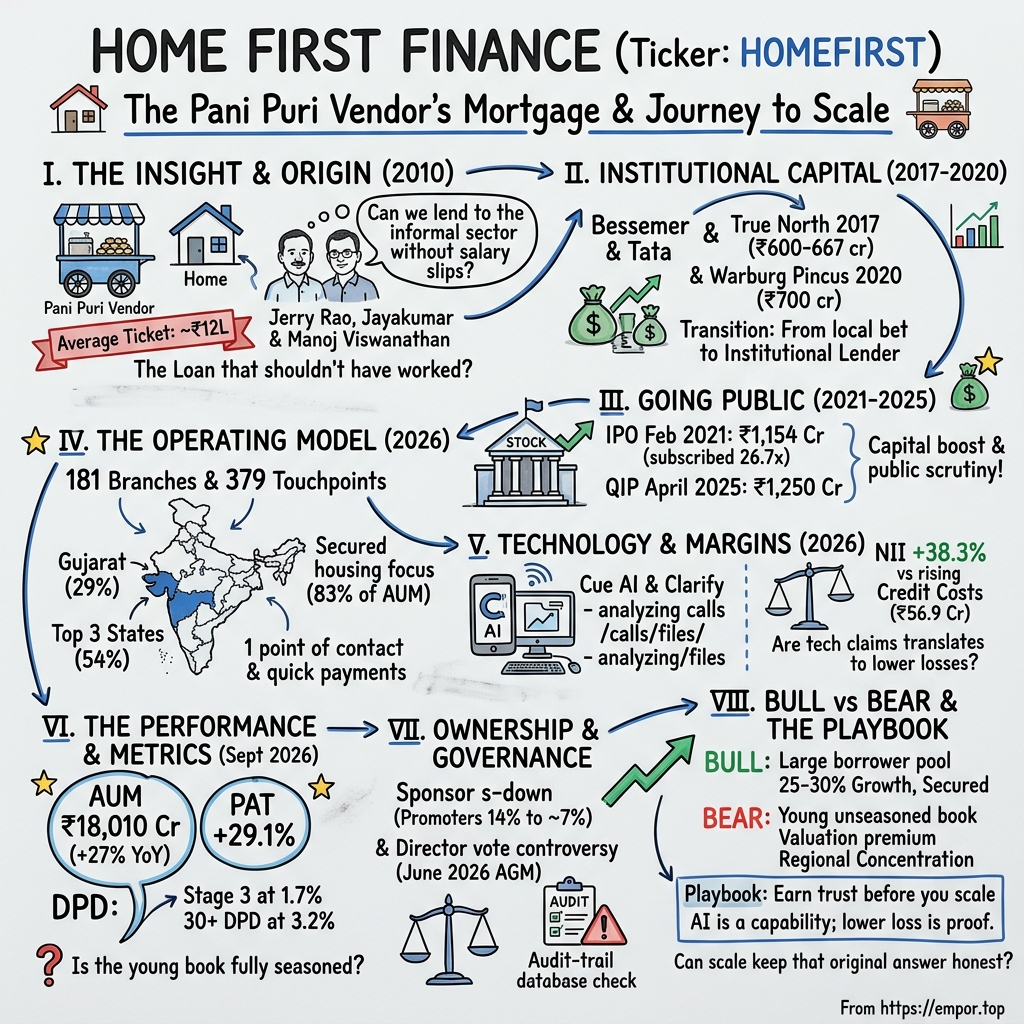
Sixteen years later, the system exists, and it is large. By the end of September 2026, HomeFirst managed a loan book of ₹18,010 crore, up 27% from a year earlier, and earned ₹170 crore of profit in that single quarter.2 About 84% of the book was individual home loans, and new loans, excluding a small co-lending programme, were being written at a yield of about 13%.2 It operated 181 branches and 379 customer touchpoints.2 This is no longer a founder's experiment. It is a listed, AA-rated institution that borrows from dozens of banks and answers to global fund managers every ninety days.3
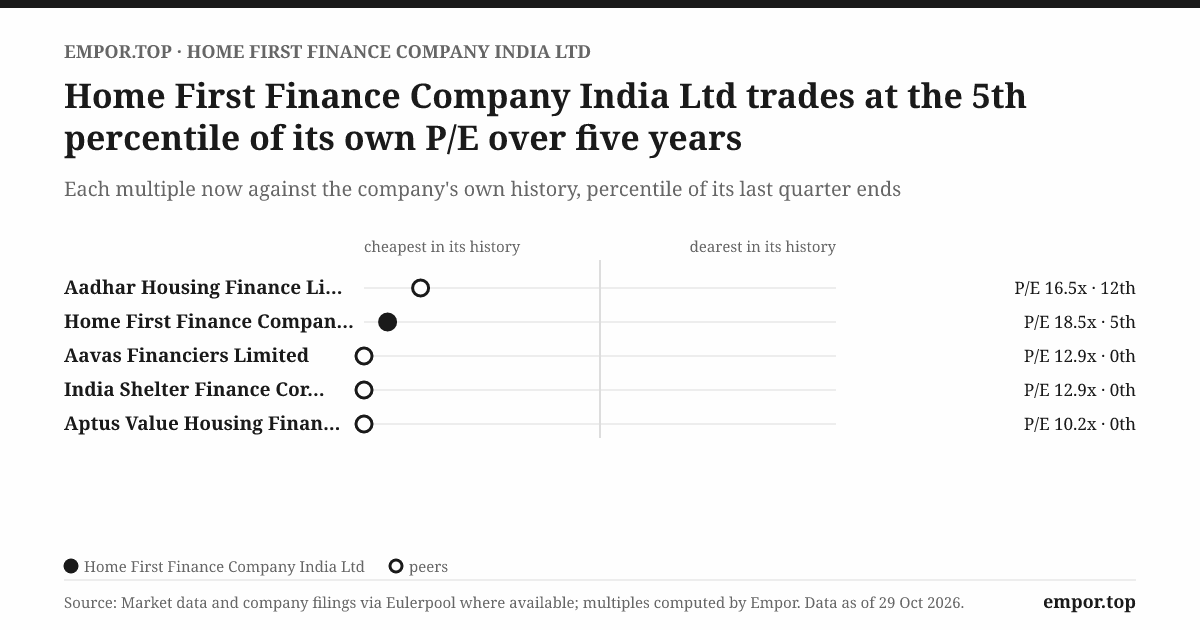
And the stock market has a complicated opinion of it. As of October 29, 2026, HomeFirst's shares traded at about 18.5 times trailing earnings, roughly half their own five-year median of about 33 times.4 Yet even at that compressed multiple, the company was priced above most of its listed affordable-housing peers, whose median sat closer to 11 times in a snapshot taken the day before.5 The market, in other words, has stopped paying the old premium for HomeFirst's growth but has not stopped paying a premium altogether. Something about this lender still looks special to investors. The question is whether it actually is.
That is the real subject of this story. Not whether a pani puri vendor deserves a home, which is a moral question with an easy answer, but whether a lender can make long-term mortgages to households whose income is real but hard to document, and still earn a durable return on the capital it ties up for two decades at a time. Mortgage lending has a cruel property. The money goes out on day one, and the verdict on whether lending it was wise arrives years later. A lender growing at 25% a year can look immaculate for a long time simply because most of its loans are too young to have gone bad.
So this story will test four things. The first is whether HomeFirst's underwriting and distribution are genuinely hard to copy, or merely good execution in a market where several rivals execute well. The second is whether the loans written in the recent burst of growth will season gracefully, or whether today's clean delinquency numbers are flattered by a book that is mostly new. The third is whether the profits reflect repeatable lending economics, or whether fresh equity and treasury effects have been doing quiet work in the background. And the fourth is whether, as the private-equity sponsors that built the company sell down and a dispersed crowd of institutions takes their place, anyone is still holding management firmly to account.
The answer will not be a pitch. HomeFirst is clearly growing quickly, and much of the evidence about its credit quality is encouraging. But a story about lending to people the system misread has to apply the same discipline to the lender itself: look past the paperwork, observe the actual behaviour, and see what the evidence really says. That begins with the three men who first sat down to ask how the vendor on the platform might buy a home.
 Subscribe on LinkedIn
II. Three Citi Colleagues Choose the Borrower Banks Missed
Around 2010, three men who had spent much of their careers inside Citibank's Indian consumer business started talking about a problem that their old employer had never quite solved. They had built credit cards, auto loans and mortgages for India's salaried middle class. They knew exactly how a well-run consumer lender decided who to trust. And they had begun to suspect that the method itself, not the borrower, was the reason so many working families could not get a home loan.1
The three were an unusual mix. Jaithirth "Jerry" Rao was the elder statesman: he had led Citicorp's businesses in India for nearly two decades before leaving to build the IT services company Mphasis, which he ran as chairman and managing director, and he had chaired the software industry body NASSCOM.6 Rao was a restless, bookish entrepreneur, a man who wrote poetry and essays on the side and who had already founded an affordable-housing developer, VBHC, before HomeFirst existed. P.S. Jayakumar was the banker's banker, a chartered accountant who had run Citibank's consumer banking division for twenty years and who would later serve as managing director and chief executive of Bank of Baroda, steering its merger with Dena Bank and Vijaya Bank.6 Jayakumar co-promoted HomeFirst alongside VBHC.6 The third, Manoj Viswanathan, was the operator. An engineer from BITS Pilani with a management degree from XLRI, he had started at Asian Paints and then spent years in consumer lending at Citibank and CitiFinancial, where he oversaw a network of about 450 lending branches serving a million customers.7 He would become HomeFirst's managing director and chief executive, and he still is.
What bound them, Viswanathan has said, was a shared question about that gap.1 Rao's housing company was building homes for exactly these families. The missing piece was a lender who would finance them.
To understand why that was a business opportunity rather than a charity, it helps to think about how a conventional mortgage underwriter works. A big bank processing tens of thousands of applications needs a standard. The salary slip is that standard. It tells the bank what someone earns, who employs them, and that the income arrives every month. It is cheap to verify and easy to audit. Anyone who cannot produce it falls into a pile marked "needs judgment," and judgment is expensive. So the bank either declines the file or prices it as if it were risky. Neither outcome tells you whether the family will actually pay.
HomeFirst's founding bet was to make judgment cheaper rather than avoid it. Rather than demand mandatory income proof, the company would assess each customer on their own facts, visiting the home or the business, talking to the family, checking the property, and building an income estimate from what it could see.1 Its later marketing captured the idea in a line: "We see you, not your documents."1
It is tempting to turn this into a market-size story, and plenty of brokers have. India's urban housing shortage has been projected in the tens of millions of units, and the founders themselves cited a projected urban shortfall of 34 million homes by 2025.1 But a shortage of houses is not the same thing as a pool of creditworthy borrowers waiting for a loan. Many of those households cannot afford any home at any interest rate. Others live in places where no lender can verify title or recover a property if the loan fails. The investable question was never how many families lacked a house. It was what share of eligible borrowers a disciplined lender could reach, assess and collect from, profitably, one file at a time.
That is also why the origin story, compelling as it is, proves less than it seems. Lots of people have noticed that informal workers are underserved by banks. India's affordable-housing finance sector is crowded with specialists founded on some version of the same insight. Aavas, Aptus, India Shelter and Aadhar Housing all built businesses around households the large banks found awkward to serve. The insight was necessary, but it was not scarce.
What would have to be scarce was the execution. Every loan HomeFirst made in those first years was a small experiment in whether an officer's visit to a railway platform could substitute for a salary slip. If the estimates were too generous, the company would discover it years later as defaults. If they were too cautious, it would never grow. An idea about inclusion becomes a business only when a company can make consistent credit decisions loan by loan, across hundreds of officers who never met the founders. HomeFirst's first job was to show it could do that at all. Its second, which would require far more money than three Citi veterans could supply, was to show it could do it at scale.
III. From a Local Bet to an Institutional Lender
For a mortgage lender, growth is a hunger for capital that never quite goes away. Every new home loan locks up money for something like nineteen years; the company's own disclosures put the average maturity of its housing loans at about 230 months.8 Some of that money can be borrowed. But lenders and regulators insist that a slice of every loan be backed by the owners' equity, so a lender that wants to double its book must, sooner or later, find more owners.
HomeFirst's early years were spent proving the model on a small scale. Bessemer Venture Partners backed the founders in the first institutional round.1 The company approved its thousandth loan in March 2013 and declared itself profitable in 2014, about four years after starting operations in 2010.1 Within roughly two more years, it had passed 5,000 disbursals.1
Some of what made those early loans work had little to do with credit models. In 2010, the founders built the process around the customer's convenience as much as the underwriter's: one point of contact who would handle every step of the loan, staff who would collect documents from wherever the customer chose, and payments sent straight into the builder's bank account.1 That last detail sounds trivial now. It was not then, when electronic transfers through NEFT and RTGS were far less widely used, and a buyer of a modest flat in a peri-urban project might otherwise wait days for cheques to clear before a builder would hand over keys.1 Faster payment to the builder made HomeFirst a lender that builders liked to recommend, which in turn made the builder a source of new customers. A small piece of plumbing became the first piece of distribution.
The step change came in 2017. True North, a Mumbai private-equity firm with deep roots in Indian financial services, agreed to take a majority stake in HomeFirst in a deal reported at around ₹600 crore.9 True North entered in February 2017 and, alongside it, came Aether (Mauritius), an affiliate of Singapore's sovereign fund GIC.7 Earlier minority investors such as Bessemer stayed on the register.
It is worth being precise about what this was. True North did not acquire an operating business to fold into another; it bought shares in HomeFirst. The company's own economics did not suddenly include the sponsor's other holdings, and HomeFirst's later filings list True North Fund V and Aether as shareholders with significant influence, not as a parent whose accounts should be consolidated.10 There is no acquisition-price-versus-comparable test to run here. The right questions are simpler. How much capital actually reached HomeFirst's balance sheet, and what growth and returns followed?
What followed was rapid scaling. With an institutional owner behind it, the company could borrow more cheaply and in larger amounts, open branches beyond its early base, and build a loan book long enough to fund. By March 2020, assets under management had reached ₹3,618 crore, net worth was ₹933 crore, and gross non-performing assets were just 0.87%. HomeFirst had lent to more than 50,000 customers across 60 districts in 11 states and a union territory.11 In three years, a local experiment had become a mid-sized lender with a real credit record.
True North also brought something harder to measure: institutional oversight. A sponsor that intends to sell its stake eventually needs the business to look like a public company long before it becomes one, with audited controls, board committees and reporting that outsiders can trust. Viswanathan later credited True North with supporting HomeFirst's growth "from a small to a mid-sized" company.11
Then, in October 2020, in the middle of the pandemic, Warburg Pincus agreed to invest about ₹700 crore, roughly $95 million, through its affiliate Orange Clove Investments.11 The headline was striking, coming at a moment when many lenders were hoarding liquidity and nursing moratorium-hit books. But the structure mattered more than the headline. The deal combined a small primary investment with secondary purchases of shares from existing holders.11 Only about ₹75 crore was fresh capital issued to Orange Clove ahead of the IPO; the rest, roughly ₹632 crore, bought out earlier investors.1213
That distinction is easy to miss and important to keep. A secondary sale changes who owns the company. It does not give the company a rupee to lend. Warburg's arrival was a vote of confidence, and it gave earlier backers a route to liquidity, but it was not, for the most part, growth capital delivered to HomeFirst. When people later describe the company as "Warburg-funded," the accurate version is that Warburg became a large shareholder, for a time the largest, while the money mostly went to the sellers.
So by the end of 2020, HomeFirst had travelled from a founders' idea to an institutionally owned lender with a PE-grade board and a clean credit record built through the IL&FS liquidity crunch and the first year of COVID. It had also accumulated a cap table full of investors who would, at some point, want to sell. That combination pointed in one direction: a public listing. And a listing would ask a harder question than any private investor had. Would the model still attract investors when it had to show its performance, quarter by quarter, to anyone who cared to look?
IV. Going Public Made the Growth Story Measurable
On January 21, 2021, HomeFirst's initial public offering opened for bids at a price band of ₹517 to ₹518 a share.13 It was only the third Indian IPO of the year, launched in the same week as the railway financier IRFC and the paint maker Indigo Paints, at a moment when Indian retail investors were discovering the stock market in record numbers.13 By the time the books closed on January 25, the offer had been subscribed about 26.7 times.14
That is the version of the IPO that made the newspapers: a hot deal, priced at the top of its range, in a hot market. The version that matters for an owner of the business is in the structure of the offer. The total size was about ₹1,154 crore, but only ₹265 crore of that was a fresh issue of new shares, money that went into HomeFirst's own balance sheet to strengthen its capital base.13 The remaining ₹889 crore or so was an offer for sale by existing shareholders.13 True North sold about ₹436 crore of stock, Aether about ₹291 crore, Bessemer about ₹120 crore, and Jayakumar and Viswanathan together up to about ₹41 crore.13 The fresh issue had already been trimmed from ₹344 crore because the pre-IPO placements to Warburg's Orange Clove and to employees had raised some of the money in advance.13
So for every rupee investors paid in the IPO, roughly 23 paise reached the company and 77 paise reached the sellers. That is not a criticism. Private-equity sponsors exist to buy, build and eventually sell, and a liquid public market for their stake is part of what made them willing to fund the build in the first place. But it means the IPO was as much a liquidity event as a financing event, and anyone who later credits it with "funding growth" should remember how small the primary component was.
What the listing undeniably did was make the story measurable. Before 2021, HomeFirst's investors saw its numbers on their own schedule. After the listing, the company's assets under management, delinquencies, spreads and credit costs became public every quarter, alongside an earnings call where analysts could press management on anything that wobbled. A lender's most dangerous moments are often the ones when it is tempted to grow into a weakening market. Quarterly disclosure makes that temptation more visible, though it does not remove it.
The next big capital decision came four years later. In April 2025, HomeFirst raised ₹1,250 crore through a qualified institutional placement, issuing almost 12.9 million new shares at ₹970 each.10 This time all of the money went to the company. The issued share count rose from about 90 million in March 2025 to about 104 million a year later, as the placement and employee stock option exercises added about 16% more shares.10
The reasoning was straightforward. A lender growing its book by a quarter every year will run down its capital cushion unless profits alone can keep pace, and HomeFirst's profits, healthy as they were, could not. Before the placement, the company's debt had climbed to almost four times its equity on the reported balance sheet.10 After it, leverage fell back to about two and a half times.10 The company could now fund branch expansion, a bigger underwriting team and a much larger loan book without having to slow down to rebuild capital.
The cost of that flexibility is dilution, and the arithmetic is unforgiving. New equity is a promise to existing holders that the money will earn more than it costs. If HomeFirst lends the ₹1,250 crore at its usual spreads and keeps losses low, return on equity recovers and per-share earnings catch up. If it deploys the money into riskier or thinner-margin loans to keep the growth target alive, the dilution becomes lasting. That is why the year after the placement showed a dip in reported return on equity, from about 15% in fiscal 2025 to about 12% in fiscal 2026, even as profits rose sharply.10 The numerator grew; the denominator grew faster. Whether that dip is temporary is the real test of the capital raise, and it is one this story returns to.
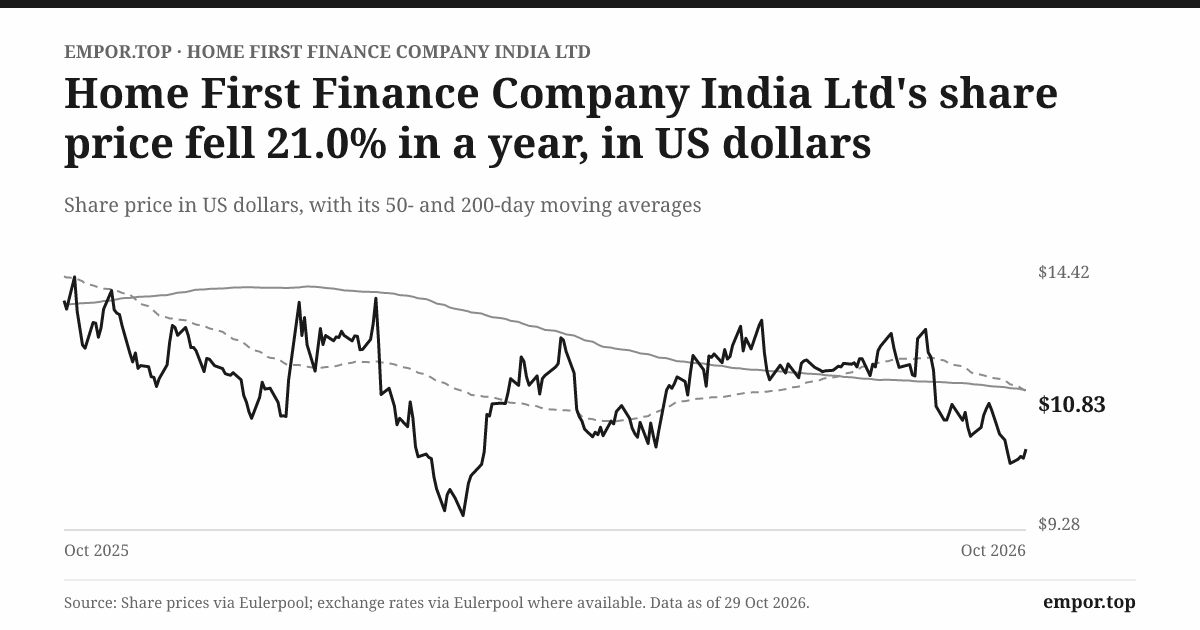
Meanwhile, the market's view of the stock had shifted. As of October 29, 2026, HomeFirst traded at about ₹1,032 a share, a market value of roughly ₹10,700 crore, about 6% above the placement price eighteen months earlier and nearly a fifth below its 52-week high.4 At about 18.5 times trailing earnings and 2.4 times book value, the multiple sat well below the company's own five-year median of around 33 times.4
It is tempting to read that gap as a bargain. But a lower historical multiple does not, by itself, establish that the shares are cheap. HomeFirst's old multiple was set when it was smaller, faster-growing in percentage terms, and trading on a market that paid generously for anything with "affordable housing" in its description. Against its listed peers, it still looked expensive: a peer comparison taken the day before put HomeFirst at about 17 times earnings and 2.3 times book, against a peer median of about 11 times earnings and 1.75 times book.5 Aadhar Housing traded near 16 times, Aavas near 13 and Aptus near 10.5
The market is therefore making two judgments at once. It no longer pays HomeFirst the premium of its early public years. But it still believes the company deserves more than its peers, which implies either faster sustainable growth, better long-run credit quality, or both. To decide whether that belief holds, you have to go inside a branch and watch how the loans are actually made.
V. The Local Branch and the Long Mortgage
Walk into a HomeFirst branch in an industrial town in Gujarat or on the edge of Pune, and the first surprise is how small it is. A handful of desks, a few relationship managers, a wall of brochures promising a home of your own. The second surprise is how much of the work happens outside. The loan officer's real office is the customer's living room, the shop counter, the half-built house on a plot at the end of a dusty road.
Follow one file. A borrower, say a factory supervisor on a modest wage whose spouse runs a small tailoring business, wants about ₹12 lakh to buy a flat in a new low-rise project. The relationship manager visits. They look at payslips if there are any, but also at the bank statement, the business, the household's spending and the way the family talks about money. A software tool called BankLens turns months of bank statements into a cash-flow view in about a minute; another, DocIQ, reads the documents; and a third, Clarify, assembles everything into a single case page that an underwriter reviews.2 The property is checked for legal title and valued. The loan is sized so that the borrower's equity in the home is meaningful; across new loans in late 2025, the loan was on average about 55% of the property's value.7 Then a human underwriter decides. Management is explicit that every credit decision still rests with an underwriter, not an algorithm.2
And then, for the next fifteen or twenty years, the company has to collect.
That is the business in plain language. HomeFirst borrows money, mostly from banks and the National Housing Bank, at about 7.8%, and lends it to households at about 13%.2 The difference, its spread, was about 5.2% in the September 2026 quarter.2 Out of that spread it pays for branches, staff and technology, and it absorbs the losses when a borrower cannot pay. What is left, after tax, is profit. Because the company uses a mixture of its own equity and a lot of borrowed money, a thin profit on each rupee of loans becomes a respectable return on each rupee of equity.
The hard part is the middle of that sentence: the losses. Informal income demands judgment and verification, and judgment can be wrong in two directions. Lending against a house helps, because a borrower with real equity in their home has a strong reason to keep paying and the lender can, in the last resort, recover the property. But security does not remove the underlying risks. If a factory town loses its biggest employer, a whole street of borrowers can fall behind at once, and repossessing and selling small homes in a weak local market is slow, costly and reputationally fraught. The collateral limits the loss. It does not stop the default.
HomeFirst's borrowers are, by design, exposed to exactly those shocks. More than 70% of its customers have household incomes below ₹6 lakh a year, and about 18% are new to formal credit altogether.7 The average home loan was about ₹12 lakh in March 2026, and loans of ₹20 lakh or less made up about 78% of assets under management.10 These are the loans that change lives, and they are also the loans most sensitive to a lost job.
A network built to see the borrower
Distribution is where the operating model becomes visible. In March 2026, HomeFirst had 171 branches and 373 touchpoints; by September, 181 branches and 379 touchpoints.2 The touchpoints include what the company calls digital branches, lighter outposts used to test a new district before committing to a full office, with the decision to convert driven by how fast loans start flowing.7 About 4,400 active connectors, local agents, builders and referrers, feed applications into the network, but the company says it keeps all loan conversion and underwriting in-house, executed by its own staff.27
The striking thing is how productive that network appears relative to peers. In fiscal 2025, HomeFirst ran 155 branches with 1,634 employees, a fraction of the footprint of Aavas, with almost 400 branches and over 7,000 people, or Aadhar, with 580 branches.7 Yet each HomeFirst branch carried about ₹82 crore of loans, against roughly ₹31 crore to ₹51 crore at the four large affordable-housing peers, and each employee managed about ₹7.8 crore of book against ₹2.1 crore to ₹5.6 crore elsewhere.7 A loan decision took about two days, against six or seven at India Shelter and Aavas.7
The productivity story continued into fiscal 2026. Employees rose about 13.5%, from 1,634 to 1,855, while assets under management grew about 25%.10 That gap is what operating leverage looks like: each new person is supporting more lending than the last. By September 2026, cost-to-income had fallen to about 31%, and operating costs were 2.6% of assets, a level management has committed to trimming by about a tenth of a percentage point each year.2
Before crediting all of this to technology and culture, though, there is a less flattering explanation to weigh. HomeFirst's branches are productive partly because its loans are bigger and its footprint more urban. Its average ticket is higher than the roughly ₹10 lakh norm at Aavas, Aptus, India Shelter and Aadhar, and it lends more to salaried borrowers.7 Bigger loans to better-documented borrowers in denser cities naturally produce more book per branch. Some of the efficiency is genuine process; some of it is simply a different customer.
Who it competes with, and on what
That leads to the competitive map, which is best drawn by borrower rather than by slogan. At the top of the market, banks and the large housing-finance companies compete hard for salaried, well-documented borrowers with loans above about ₹25 lakh.7 Below them sit the listed affordable-housing specialists. In a March 2026 sector comparison, Aadhar Housing, with about ₹28,800 crore of assets at December 2025, was the largest of them, ahead of HomeFirst's ₹14,900 crore at that date; Aavas was a little above ₹22,000 crore, Aptus about ₹12,300 crore and India Shelter about ₹9,800 crore.7
Where HomeFirst stands out is in who it lends to. About 68% of its customers were salaried, the highest share among the listed specialists: Aadhar was at 56%, Aavas 40%, Aptus 24% and India Shelter 25%.7 It was also the most concentrated in home loans proper, at 84% of its book, against India Shelter's mix of 57% housing and 43% other loans.7 That positioning is a deliberate trade. Salaried borrowers in cities are steadier payers, but they are also the customers that banks and big housing-finance companies most want to poach as soon as a borrower's credit file matures. HomeFirst's yield of about 13.5% in fiscal 2025 sat below Aptus's 17.4% and India Shelter's 14.9%.7 Its net interest margin, at about 5.2% in that comparison, was the lowest of the group, and its return on assets, about 3.5%, trailed Aptus at 7.1% and India Shelter at 5.6%.7
That comparison deserves a moment, because it cuts against the easy story. HomeFirst is not the most profitable affordable-housing lender per rupee of loans. Aptus is. HomeFirst earns a comparable return on equity, about 16.5% in the fiscal 2025 comparison against Aptus's 16.0%, because it runs with more leverage, roughly 4.7 times assets to equity.7 Leverage is a perfectly legitimate tool for a secured lender with low losses. But it means HomeFirst's return on equity is more sensitive to a rise in credit costs than a lender earning twice the margin on each loan.
So does HomeFirst have a moat? The honest test looks at the mechanisms that would make one real. Borrower concentration is negligible: the twenty largest borrowers were about 0.17% of advances in fiscal 2026.10 That means no single customer has bargaining power, but it also means there is no lock-in from relationships with large clients. Switching costs are the more interesting question. A home-loan borrower can refinance with another lender, and the industry calls this a balance transfer. HomeFirst says its balance-transfer outflows had fallen to about 4.5% of the book, from 5% to 6% previously, after it began explaining the costs of switching, offering top-up loans and selectively trimming rates for good customers.2 That is real evidence of retention effort, and it suggests the company can defend its best borrowers. It does not prove they would stay without the rate breaks, and the company does not publish acquisition cost per loan or price realisation against peers, the two numbers that would show whether its distribution is cheaper or simply bigger.
Geographic concentration is the moat's weak flank. Gujarat accounted for about 29% of assets in March 2026, and the top three states about 54%.10 That share has been drifting down; Gujarat's slice of gross loans fell from about 31% in March 2024 to about 28.5% by December 2025, while Madhya Pradesh grew from about 6% to almost 10%.7 But a lender whose largest state is nearly a third of its book is exposed to that state's employment cycle in a way a nationally diversified lender is not.
The verdict on this part of the case is therefore narrower than the marketing. HomeFirst is a focused, secured mortgage lender with an unusually productive distributed operating model, not a technology company that happens to make mortgages. Its retention efforts and branch productivity are measurable and good. Its claimed edge in seeing informal income is plausible but, on the disclosed evidence, unproven against peers, because the company's lower margins and higher salaried mix mean it is often competing for a somewhat different and safer borrower than the pani puri vendor of its origin story. What would confirm the moat is continued branch productivity in new states, stable balance-transfer outflows without heavier rate cuts, and delinquencies in new geographies that match the old ones.
One stray number in the standard financial screens shows why this kind of business needs its own lens. Conventional ratios put HomeFirst's "debtor days" at about 2,495 in fiscal 2026, a figure that would signal catastrophe at a manufacturer.10 It means nothing here. Trade receivables were tiny, about ₹7.8 crore, and almost all of it unbilled; the formula is being thrown by a balance sheet whose main asset is a ₹13,238 crore loan book.10 For a lender, the collection measures that matter are delinquencies and credit costs.
And that brings the story to its central tension. If local underwriting is the edge, the edge has to show up in how loans behave over time, not just how quickly they are made. HomeFirst has been making them very quickly indeed.
VI. The Loan Book Grew Faster Than Its History Could Season
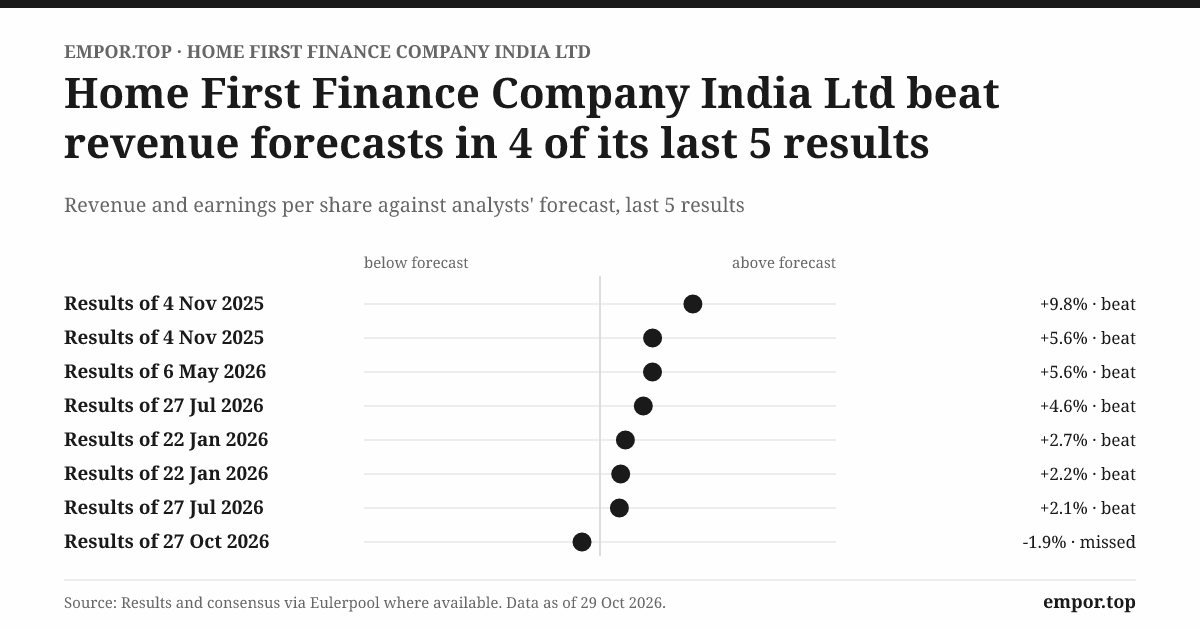
On October 27, 2026, HomeFirst reported its September-quarter results, and on the surface they were exactly what a growth investor wants to see. Assets under management were up 27% from a year earlier. Disbursements, the new loans written in the quarter, were up 32% to about ₹1,705 crore.2 Profit was up 29%.2 And the share of loans classified as Stage 3, the accounting term for loans that are seriously delinquent or impaired, had actually improved, slipping to 1.7% from 1.8% a quarter earlier.2
Faster growth with cleaner books. If there is a more seductive sentence in lending, it is hard to think of one. It is also exactly the sentence that should make an investor slow down.
Start with the long arc. Over the decade to fiscal 2026, HomeFirst's reported revenue compounded at about 55% a year, and its profit at about 57%.10 That is the arithmetic of a company starting from almost nothing. Over the last three years, revenue growth was about 40% a year and profit growth about 33%.10 In the September 2026 quarter, total income rose about 18% from a year earlier.2 The business is still growing fast in absolute terms, but it is no longer growing at its historical pace, and the gap between asset growth near 27% and revenue growth near 18% is partly an echo of falling interest rates being passed on to borrowers, which lowered the yield on the book by about a tenth of a percentage point in the quarter.2 For a lender, slowing percentage growth is normal and healthy. A ₹18,000 crore book cannot grow like a ₹1,800 crore one. The question is not whether growth decelerates but whether credit quality holds as it does.
What the clean numbers can and cannot tell you
The credit indicators look steady. At March 2026, the rating agency ICRA put gross non-performing assets at 1.8% and loans more than 30 days past due at 2.9%.3 In September, management reported Stage 3 at 1.7% and 30-plus days past due at 3.2%, with the 30-plus figure flat on the previous quarter.2 Those two sets of numbers are close cousins rather than twins, since Stage 3 and gross NPA are defined slightly differently, but the direction is clear: severe delinquency edged down, while the earlier, milder sign of stress edged up from March and then held.
The credit cost for the quarter, the provisions set aside against expected losses, was about 0.4% of assets on an annualised basis, and management has said it intends to hold it near that level.2 Provision coverage on Stage 3 loans was about 24% under the expected-credit-loss model, rising to about 46% once management's additional overlays were included.2
Here is the problem with all of these numbers, and it is not specific to HomeFirst. A delinquency ratio is a fraction. The top is the loans that have gone bad; the bottom is all the loans. When a lender grows its book by a quarter every year, the bottom of the fraction is dominated by loans written in the last two or three years. Most borrowers do not default in the first year of a mortgage. They default when something goes wrong in their lives, a job loss, an illness, a business failure, and that takes time to happen. So a fast-growing lender's delinquency rate is mechanically flattered: the new loans have not had time to fail. It is like judging a restaurant's food-poisoning record on the evening it opened.
The way around that problem is to look at loans by vintage, the year they were written, and to track what share of each year's loans has gone bad after one year, two years, three years. If the fiscal 2024 loans are behaving like the fiscal 2020 loans did at the same age, underwriting has held. If they are behaving worse, the clean headline ratio is hiding a deterioration. ICRA put the point directly in May 2026: HomeFirst's loan book remains relatively unseasoned, and that is a constraint on its rating.3 The vintage curves for loans originated from fiscal 2023 to fiscal 2027, as they mature through a full employment cycle, are the single most important evidence on whether the company's underwriting edge is real.
There is a piece of evidence in HomeFirst's own history that bears on this. Its fiscal 2025 gross NPA, about 1.7% in a March 2026 sector comparison, was the highest among the five listed affordable-housing specialists, whose ratios ranged from about 0.9% at Aavas to 1.2% at Aptus; by December 2025, HomeFirst's figure was about 2.0%, again the highest in that group.7 That does not mean HomeFirst's underwriting is weak. Its peers lend to different borrowers, and some of them write off or sell bad loans on different schedules. But it does puncture the casual assumption that HomeFirst's larger salaried mix automatically produces the cleanest book in the sector. It has not, at least not on that measure.
Management's measured target, and what tested it
On the September-quarter call, Viswanathan described demand as good "across the board" and said the company expected the usual seasonal pickup in housing demand in the second half.2 He kept the target for fiscal 2027 asset growth at 25%, implying a book of about ₹20,000 crore by March 2027, and said there might be one or two percentage points of upside if the current tailwind persisted.2 He characterised the quarter's 27% growth as partly tailwind-driven, rather than a new baseline.2
That restraint is worth noting, because lenders that raise growth targets after a strong quarter often regret it. It is also worth testing against what happened in the months before. Earlier in the year, management had flagged headwinds that hit two of its important states: tariffs had dented employment in export-oriented manufacturing in Gujarat and Tamil Nadu, and the company had leadership gaps in some markets.2 Tamil Nadu's book actually declined slightly in the first half before returning to 12% growth in the September quarter.2 Management said both problems had been addressed. That is a useful real-world stress test in miniature. A trade shock hit the employment of exactly the kind of borrower HomeFirst serves, in its largest market, and the group-wide 30-plus delinquency rate rose from 2.9% to 3.2% across the period rather than spiking.32 That is reassuring. It is also a small shock, observed over a few months, and it is not the same thing as a full downturn.
Regional concentration remains a constraint, even as it declines.3 Management says asset quality in Gujarat and Madhya Pradesh has consistently been better than the national average, and when an analyst asked about drought-declared districts in those states, management answered that its borrowers work mainly in manufacturing and services, with little dependence on farm income.2 That answer is plausible, and it also illustrates the real exposure: a borrower base tied to industrial employment, which is sensitive to export demand, interest rates and global trade.
ICRA flagged one more mechanism to watch: the employment effects of instability in West Asia.3 The concern is not geopolitics in the abstract. It is that a meaningful number of Indian households depend on remittances from family members working in the Gulf, and on jobs in industries sensitive to oil prices and shipping costs. If those incomes falter, so does repayment capacity among lower-income borrowers. On the September call, management did not discuss West Asia by name, only noting that rising oil prices had not yet fully passed through to the Indian economy.2
The verdict on this chapter is cautiously positive and explicitly incomplete. The latest indicators are encouraging, and the company came through a real, if modest, regional employment shock without a jump in serious delinquency. None of that settles how loans written in the last three years will behave through a weaker job market or a falling local property market. That evidence arrives slowly, vintage by vintage, and it is the only evidence that can convert a good growth record into a proven underwriting advantage.
Meanwhile, profits have been growing faster than the book. That deserves its own investigation.
VII. Better Margins, More Capital, and the AI Claim
In fiscal 2026, HomeFirst's net profit rose about 41%, to roughly ₹540 crore, while its loan book grew about 25%.1510 When profit outruns the book by that margin, there are only a handful of possible explanations. The lender is earning a wider spread on each loan, or spending less to run itself, or losing less to bad debts, or making money somewhere other than lending. Sometimes it is all four. The job is to find out which.
First, the right scorecard. A lender is not judged on EBITDA, free cash flow or operating margin, the metrics that dominate most stock screens, because interest costs and new lending are the business itself rather than incidental to it. The measures that matter are net interest income and spread, which show what the lender earns on each rupee of loans after paying for its funding; operating efficiency, which shows what it costs to run the machine; credit cost, which shows what bad loans take away; and then return on assets, return on equity and capital adequacy, which show how all of that adds up for shareholders and how much cushion remains.
On that scorecard, fiscal 2026 tells a clear story. Net interest income grew about 38%, while operating expenses grew about 25%.15 The gap between those two numbers is operating leverage: the company was earning more from each branch and each employee without adding cost at the same pace. The spread, excluding co-lending, rose to about 5.3%.15 Part of that was a happy accident of the capital raise. The ₹1,250 crore of fresh equity in April 2025 replaced borrowed money that would otherwise have cost interest, so a larger share of the loan book was funded by equity that carries no interest charge. That flatters net interest income in the year after a capital raise, and it is one reason profit grew so quickly. It is not, by itself, evidence of better lending.
Then comes the line that keeps this from becoming a victory lap. Credit cost nearly doubled in fiscal 2026, to about ₹57 crore.15 That is still a small number against a book of more than ₹13,000 crore, but the direction matters. Rising provisions on a growing, young book are exactly what the seasoning problem predicts. The best reading is that a little of the extra profit came from wider margins and operating leverage, a meaningful slice came from the capital raise reducing funding costs, and some of it was given back in higher credit costs.
Management itself has been disciplined about not overselling the spread. On the September call, an analyst asked whether a rising-rate environment could widen HomeFirst's spread further. The answer was a firm no: management's framework targets a spread of 5.0% to 5.25%, and it noted that spreads of 5.5% or more had happened only briefly after COVID and were never considered sustainable.2 By September, the spread had already slipped to about 5.2%.2 That is an honest answer, and it bounds the bull case. If the spread has peaked near its ceiling, future earnings growth must come from asset growth and cost efficiency, not from margins.
The treasury question can be settled quickly. Other income was about ₹8 crore in fiscal 2026, roughly 1% of pre-tax profit, and fair-value gains on investments, mostly realised gains on mutual funds, were about ₹5 crore.10 Those are supportive but trivial. HomeFirst's profits come from lending, not from trading its treasury book.
Co-lending, where HomeFirst originates loans jointly with banks that fund most of the balance, is similarly a footnote for now. It was about ₹593 crore, or 3.3% of assets, at September 2026, and only about ₹2 crore was disbursed in the quarter because partners were still implementing new regulatory guidelines.2 It may eventually let HomeFirst grow without consuming as much capital, but it does not yet change the economics of the core book.
Proof of deployment is not proof of value
Now the AI claim. Over the past two years, HomeFirst's management has described the company increasingly as a technology-led lender, and on the September call it set out a stack of tools in production. Cue records and analyses about 95% of customer calls. Clarify builds a single case page for underwriters on every loan file. BankLens turns a bank statement into a cash-flow summary in about a minute. DocIQ reads the documents used in underwriting and operations.2 Over the next eighteen months, the company plans to merge these tools into a single data and decision platform and extend AI into sourcing, collections and servicing.2
These are real deployments, not slideware. But notice what the numbers actually measure. "95% of calls analysed" and "100% of files prepared" are measures of coverage. They tell you the tool is running everywhere. They do not tell you whether underwriters are making better decisions, approving good borrowers faster, rejecting bad ones more reliably, or spending less time per file. Management itself framed AI as potential upside to an existing opex target of trimming costs by about 0.1 percentage point of assets a year, not as a source of savings already banked.2 That is the right framing, and it means the financial effect of AI on HomeFirst is, today, not disclosed and probably not yet material.
The evidence that would convert the claim into proof is straightforward to name: approval rates and turnaround times by cohort, files handled per underwriter, cost per loan, and above all early-delinquency rates for loans underwritten with the new tools compared with those underwritten before. A lender that can show those numbers moving in the right direction has a technology advantage. A lender that shows only adoption rates has a technology programme.
There is also a reason to ask harder questions about the infrastructure under those tools, which belongs in the governance story but starts here. In fiscal 2026, the auditor's opinion was clean, but it noted that the company's loan-origination and loan-management software lacked sufficient third-party reporting to confirm that audit-trail logging was enabled at the database level.10 For a lender that describes itself as digital, the integrity of its loan records is not a technicality.
The cash-flow puzzle that isn't one
A reader looking at HomeFirst's cash-flow statement for the first time might see something alarming. For most of the past decade, cash from operations was deeply negative, by hundreds of crores a year, and then in fiscal 2026 it suddenly turned positive.10 For an industrial company, years of negative operating cash flow would suggest profits that never turn into money.
For a lender, it means almost nothing on its own. Under Indian accounting, new loans are classified as an operating cash outflow, because lending is the operating business. Every year HomeFirst grew its book, the cash spent on new loans swamped the profit, and operating cash flow went negative. In fiscal 2026, the headline figure swung positive even though the statement recorded about ₹2,516 crore of growth in loans given, alongside non-cash add-backs for impairment, depreciation and share-based pay.10 A line that can flip sign in a year when the company lent more than ever is telling you about classification and funding flows, not about whether profits are turning into cash. In the first half of fiscal 2027, loans grew again by about ₹1,800 crore.4 The conventional free-cash-flow test is simply the wrong instrument. The right ones are collections, credit losses and continued access to funding, which, with a funding base spanning dozens of institutions and an AA rating, remained solid.103
The real return question is the one the capital raise posed. Return on equity fell to about 12% in fiscal 2026 as the new equity diluted it, then climbed back to about 14.9% by the September 2026 quarter on management's annualised measure.102 Management has set targets of a 15% return on equity at the end of fiscal 2027 and 16% at the end of fiscal 2028, and said current momentum suggested it could exceed them.2 That is the right test of the placement: not how much money was raised, but whether the return on the enlarged equity base climbs back to where it was before. So far, it is heading that way.
That makes it all the more important to ask who, among HomeFirst's increasingly dispersed owners, is watching whether it gets there.
VIII. The Promoters Sell Down; Shareholders Send a Signal
The seventeenth annual general meeting of Home First Finance, held on June 24, 2026, was in most respects a quiet affair. Shareholders adopted the accounts with essentially unanimous support. They approved a final dividend of ₹5.20 a share. They noted the retirement of Divya Sehgal, the True North partner who had sat on the board as the sponsor's nominee and who did not seek reappointment. They approved a new joint statutory auditor.16
And then they voted down resolution six. Anuj Srivastava, an independent director, had been put forward for reappointment to a second term. The resolution failed to achieve the required majority. In a letter the next day, the company secretary reported that every resolution except number six had passed, and the company later said Srivastava would leave the board when his term ended in October.1610 The filing gave no reason for the rejection.
It is a small event, and it is easy to overread. One director, one vote, and the company otherwise ran its meeting without dissent. But a failed board reappointment at a large listed Indian company is uncommon enough to deserve attention, and at HomeFirst's meeting institutions otherwise backed every resolution almost unanimously.16 It is a concrete signal that the people who now own HomeFirst were prepared to say no to the board's own recommendation. What it is a signal about, the company has not explained, and neither has any shareholder publicly. The cause therefore remains open, and any account that supplies one is guessing.
What is clear is that the vote happened in a company whose ownership had changed beneath it. At March 2025, the promoter group, True North and Aether, owned about 14.3% of HomeFirst. A year later, after the placement diluted everyone and after both sponsors sold shares, it owned about 7%.17 True North's stake fell from about 8.6% to 4.7%, and Aether's from about 5.7% to 2.3%.10 Warburg's Orange Clove, which had been the largest single shareholder with about 10.6% in late 2025, held none at March 2026.710 By September 2026, promoter holding stood at about 6.97%.4 In their place came a broad base of institutions: about half the company was owned by foreign portfolio investors and about a third by domestic institutions by June 2026, with the public and others holding the remaining sixth.18
It is worth separating the share sales from the business. Private-equity sponsors selling down a decade-old investment is the system working as designed, not a vote of no confidence in the company. The IPO, the secondary sales and the placement were all steps in that planned exit, and the falling promoter percentage partly reflects dilution from new shares rather than selling alone. The March 2026 shareholding pattern showed no pledge of promoter shares, though it did disclose a non-disposal undertaking.17 None of this proves a change in operating strategy.
But it does change the accountability structure. When True North owned a controlling stake and sat on the board, there was an owner with a concentrated financial interest, deep sector knowledge and the power to change management. Today, there is no such owner. HomeFirst is effectively a professionally managed, widely held company, and its board, now without the sponsor's nominee, is the primary check on management. Sector analysts have made the same point, noting that HomeFirst's roughly 7% promoter holding could limit alignment over the long term, partly offset by strong institutional oversight.7 In that structure, institutional voting at the AGM is one of the few visible mechanisms of discipline. Which is precisely why the Srivastava vote matters.
The man in the chair
Manoj Viswanathan has led HomeFirst since its founding and has run it through the whole of its public life. His record over that period is, on the numbers, strong: a book that has grown roughly fivefold since March 2020, profits that have compounded at about 40% a year over five years, and credit losses that have stayed low through a pandemic and a trade shock.1110 His pay is modest by the standards of Indian financial services. In fiscal 2026, he received about ₹3.66 crore, including a one-time bonus of about ₹1.92 crore; his remuneration rose about 14% in a year when profit rose about 41%.10
His term runs to July 2028, and when an analyst on the September call asked whether a change in his role was under discussion, Viswanathan answered directly: "There is no such conversation going on," adding that he was available for reappointment.2 That is a clear answer to a question that clearly occurs to investors in a company whose sponsors have left and whose founder-CEO has been in place for sixteen years. Succession planning at HomeFirst is not disclosed in detail, and in a widely held company it is the board's most consequential job.
The chief financial officer seat changed hands in the same period. Nutan Gaba Patwari resigned with effect from August 31, 2026, and the board appointed Rinkoo Somani, who brings more than 25 years of finance experience, on October 27.4 The filings do not give a reason for the departure, and on the September call management simply welcomed Somani.2 Two months without a permanent CFO in the middle of a growth phase is not a crisis, but continuity in the finance function is something to monitor rather than assume.
Then there is the audit-trail observation. For fiscal 2026, the auditor issued an unmodified opinion, and the company reported no contingent liabilities.10 The gap in database-level audit-trail evidence remains something shareholders can reasonably expect the company to remediate and the auditor to confirm as closed. There is no suggestion that any record was altered.
So the accountability picture is mixed but not alarming. Management has a long record of meeting its targets, communicates in specific numbers, and has resisted the temptation to oversell spreads or raise growth guidance after a strong quarter. Against that sit a falling sponsor stake, a rejected director, a CFO transition and an open audit-control observation. None is damning alone. Together they say that the governance load has shifted from a concentrated owner to a dispersed one, and that the dispersed owner has just shown it is paying attention. The test from here is whether management's targets, loan quality and returns keep moving together, and whether, when they do not, future calls explain misses with specific evidence rather than broad commentary about the market.
That test sits at the heart of the investment case itself, where the bull and the bear make their arguments.
IX. Bull and Bear: A Specialist Lender at a Premium to Its Peers
Imagine two investors reading the same September 2026 results on the same evening. Both see a book up 27%, profit up 29%, and a share price that has drifted about a fifth below its high of the past year.24 One sees a high-quality compounder that the market has temporarily stopped paying for. The other sees a lender priced above its peers on the strength of a growth record that has not yet been tested by a real downturn. Both are reading the evidence honestly. The question is which reading the evidence supports more.
The bull case starts with growth that is both large and, so far, clean. ICRA expects HomeFirst's assets to keep growing at 25% to 30% a year over the near to medium term, and it reaffirmed the company's AA (Stable) rating in May 2026, citing strong capitalisation, healthy asset quality and profitability.3 India Ratings affirmed its own AA (Stable) rating in June, pointing to diversified funding and the salaried tilt of the borrower base.19 The company's capital adequacy ratio was about 39.8% at September 2026, far above the regulatory minimum, which means HomeFirst could grow for several years without needing more equity.2 Its funding is diversified across banks, which supply about 58% of borrowings, the National Housing Bank at about 14%, and loan sales and co-lending at about 20%.2 The book is secured, the borrowers are granular, and its branches are among the most productive in the sector.
The bear case begins exactly where the bull case is weakest: time. The book is young. ICRA itself calls it relatively unseasoned and names geographic concentration and exposure to vulnerable low-income borrowers as constraints.3 HomeFirst's delinquency ratios, while low in absolute terms, were the highest among its listed specialist peers in the most recent comparison.7 Its margins are the thinnest of that group, so it relies more on leverage to produce its returns. And it trades at a premium to those peers.
Five forces and seven powers
To decide between them, it helps to run the business through two frameworks that sophisticated investors use to think about durable advantage.
Michael Porter's five forces ask how much of an industry's value its participants get to keep. HomeFirst's borrowers have little individual bargaining power, though the balance-transfer outflows described earlier show that stronger borrowers can switch as their credit histories mature.2 Suppliers, in this case lenders to HomeFirst, have moderate power: the company borrows from dozens of institutions, but its cost of funds tracks the policy rate, and management estimates that a cumulative half-point rise in rates could add about 0.2 percentage point to its borrowing cost within three to six months.2 Because its loans are fully floating, HomeFirst can pass on rate rises, but it reprices only when its own funding cost has moved by 0.1 to 0.15 percentage point, which means a lag.2 The threat of new entrants is real but bounded. Starting a housing-finance company requires a regulatory licence, years of credit history to win a rating and cheap funding, and a branch network; that keeps out casual entrants but not well-capitalised banks and large finance companies moving downmarket. Substitutes are limited: informal lenders, self-construction financed by savings and gold loans are the alternatives, and management said it had not seen a significant rise in borrowers taking gold or personal loans to service home loans.2 Rivalry among existing players is the strongest force. Aadhar, Aavas, Aptus and India Shelter all chase overlapping borrowers, and the larger banks press from above.
The verdict from Porter is that affordable housing finance is a decent industry, not a great one. Sector-wide returns on equity of about 14% to 20% are respectable, but no single force protects any player from the others.7
Hamilton Helmer's seven powers ask a narrower question: what, specifically, lets this company earn more than its competitors for a long time? Run through them honestly, and most do not apply. HomeFirst has no network effects; one borrower's loan does not make the product better for the next. It has no cornered resource, such as an exclusive licence or a unique data set others cannot obtain. Branding exists but matters little in a product chosen mainly on availability and rate. Switching costs are modest: refinancing a mortgage is a hassle but not a barrier, and the company actively spends money to retain customers who might leave. Scale economies are real in principle, since fixed technology and head-office costs spread across a bigger book, but HomeFirst is not the largest specialist, and Aadhar's book was about twice as large at December 2025.7
That leaves two candidates. The first is process power: the accumulated, hard-to-copy way an organisation does something. HomeFirst's claim to process power rests on its fast decisions and productive branches.7 That is meaningful evidence. But process power is proved by results that competitors cannot match over many years, and on the outcome that matters most, credit losses, HomeFirst does not yet lead its peers. The second is counter-positioning, where an incumbent cannot copy a newcomer without damaging its own business. That was HomeFirst's story in 2010, when large banks could not lend to the pani puri vendor without dismantling their own templated underwriting. It is a much weaker story in 2026, when four other listed specialists do much the same thing.
So the moat is narrower than the multiple implies. HomeFirst has a credible but unproven process advantage, centred on productivity and speed rather than on demonstrably lower losses. That is a real edge. It is not, on the evidence available, a fortress.
What the price assumes
The valuation still sits below HomeFirst's history and above peers.45 A PEG ratio of about 0.7 suggests the price looks undemanding relative to recent growth, but that ratio uses past growth, and the question is future growth.4 Put simply, the market is paying a premium for HomeFirst over Aavas or Aptus on the assumption that it will keep growing faster without losing more. If it delivers 25% growth with stable losses and rising returns, the premium looks reasonable. If returns stall or losses rise, there is no obvious reason for HomeFirst to trade at a higher multiple than Aptus, which earns a much higher return on each rupee of assets.
Two policy and funding risks bear directly on that bet. The first is regulation. On the September call, management estimated that a draft rule on insurance-distribution fees could cut about 0.35 percentage point from its return on assets and profit if implemented as proposed; it hoped regulators would concede part of that and planned to offset the rest through more loans against property, more loan-sale income and changes to pricing or fees.2 That is a significant number against a return on assets of about 4.2%, and it shows how much of a specialist lender's return can depend on income earned around the loan rather than on the loan itself.2 The second is funding cost. A sharp rise in rates would compress spreads temporarily until HomeFirst reprices its loans, and the lag would show up directly in net interest income.
Capital allocation so far has been simple, which is a virtue. HomeFirst has no subsidiary, associate or joint venture,4 and it has not bought another operating company; its capital has gone into the loan book, branches and technology. Dividends have been low, about 7% of profit in fiscal 2026, which is appropriate for a lender with a large growth runway and ample uses for retained earnings.10 The company has not bought back shares in the past five years.10 The relevant test is not whether that capital was spent wisely in some abstract sense but whether it earns its keep: whether incremental return on equity rises as the placement capital is deployed, and whether credit outcomes hold as the book grows.
The operating tests remain the same: asset growth alongside vintage delinquency2, credit cost near the 0.4% annualised target2, and return on equity moving toward 15% for fiscal 2027 and 16% for fiscal 2028.2
Here is the question a skeptical investor would put to the board. Suppose HomeFirst hits its 25% growth target next year, but return on equity stalls around 14% and the 30-plus delinquency ratio drifts up by half a point. What, at that point, would justify paying a higher multiple than for its peers? The honest answer is that nothing would, except a credible demonstration that the company's underwriting is better than theirs. That demonstration is not yet in the record. It is in the loans, and the loans need more time.
X. Playbook: Earn the Trust Before You Scale the Loan
Every lending story eventually reduces to a single file on a single desk. For HomeFirst, that file once belonged to a man selling pani puri on a railway platform, and the company's answer to his application was to send someone to stand by his cart on a Saturday afternoon and count the customers. Sixteen years later, that file has become a network of 181 branches and a loan book of more than ₹18,000 crore.2 The lessons worth carrying away are the ones that link the platform to the balance sheet.
The first is about what inclusion really demands. If the borrower's income is informal, make the evidence more thoughtful, not the credit standard more forgiving. The founders' insight was never that informal earners deserved easier credit. It was that they deserved a better method of being measured. Watching footfall at a stall, reading a bank statement as a cash-flow story, and checking the house and the family were all ways of collecting more evidence, not less. Lenders that confuse inclusion with leniency tend to discover the difference in their third year of defaults. The lesson for any founder building a product for an underserved customer is that the hard part is not deciding to serve them. It is building a cheaper way to know them.
The second is about the physical machine. A branch network is an advantage only when each branch earns its keep. HomeFirst's network was among the most productive in the sector in fiscal 2025, carrying far more loans per branch and per employee than its peers, and in fiscal 2026 it grew its book about twice as fast as its headcount.710 It also quietly closes one or two underperforming branches a year as routine.2 That combination, opening fast but pruning without sentiment, is what separates a distribution advantage from a cost base. For investors, the lesson is to measure branches by their output, cost-to-income and local delinquencies, never by their count. A lender that boasts about how many branches it opened is telling you how much it spent.
The third is about the technology that every lender now advertises. An AI tool is a capability; a lower loss rate is proof. HomeFirst's call-analysis and underwriting assistants are running on almost every call and every file, which is a genuine operating achievement.2 But the lender's own framing puts their financial value in the future, as possible upside to a cost target rather than savings already earned.2 The broader lesson travels well beyond housing finance: in any business, the honest unit of measurement for technology is the outcome it changes, not the share of the workflow it touches.
The fourth is about the money. Fresh capital buys time and capacity, not returns. The ₹1,250 crore placement in April 2025 gave HomeFirst room to grow for years without rationing loans, and it diluted every existing shareholder by roughly an eighth to do it.10 Return on equity fell in the first year and has since climbed back toward management's targets.102 Whether the placement was a good decision will be decided not by the size of the cheque or the price at which it was written, but by whether the enlarged equity base ends up earning more than it did before. For founders, it is a reminder that raising capital is the easy half of the transaction. For investors, it is a reminder to judge every equity raise on the return it eventually earns, not on the growth it immediately enables.
XI. Epilogue
Tonight, at the end of October 2026, HomeFirst stands at an interesting point in its life. It is large enough to be an institution and young enough that its most important test has not yet happened. The September quarter was strong, with a book of ₹18,010 crore, Stage 3 at 1.7% and return on equity close to 15%.2 Management has a target on the table, 25% asset growth for fiscal 2027, and it has said the quarter's faster pace owed something to a tailwind.2 The next three or four results days will begin to show whether that measured tone was wisdom or caution.
The first moment to watch is the December quarter. Housing demand usually picks up in the second half of India's fiscal year, and management has said it expects that seasonal lift.2 If the company meets its growth target with delinquencies flat, it will have shown that the expansion into Madhya Pradesh, Uttar Pradesh, Rajasthan and the National Capital Region can carry the book while Gujarat's share keeps falling. If growth comes in above target and early delinquencies tick up at the same time, that will be the first warning that the machine is being pushed harder than its underwriting can bear. And if growth misses, the useful question will be whether management explains it with specific operating evidence, a branch, a state, a funding constraint, rather than with broad commentary about the market.
The second set of moments is slower. As the loans written from fiscal 2023 onwards pass their third and fourth birthdays, their delinquency curves will become the most important evidence on whether HomeFirst actually sees borrowers more clearly than its rivals. Those curves, more than any quarter's headline ratio, are what to watch. If they hold steady through a softer employment market, the case for an underwriting edge becomes very strong. If credit costs drift above the roughly 0.4% that management is aiming for, the premium to peers will be hard to defend.
The third is the return on the new capital. Management has promised a 15% exit return on equity for fiscal 2027 and 16% for fiscal 2028.2 Meeting those targets while holding the spread inside the 5.0% to 5.25% band management itself has drawn would show that growth, efficiency and capital are working together. Missing them, especially if the insurance-fee rule takes its estimated bite, would show how thin the cushion is between a good lender and an ordinary one.
The fourth is governance. Srivastava's board term ends on October 31, this week.10 Who replaces him, whether the board explains how it responded to the shareholder vote, whether the new CFO settles in smoothly, whether promoter holdings continue to fall, and whether next year's auditor confirms that the loan systems' audit trails have been fixed are all small events. Together, they will show whether a company without a controlling owner can hold itself to the standards its sponsors once imposed.
The question underneath all of these is the one the founders first asked, now turned around. In 2010, the problem was whether a lender could learn to see the person behind missing documents. In 2026, the problem is whether a lender with thousands of employees, a decision platform and a stock-market valuation can keep seeing that person as clearly as one officer once did, standing next to a cart on a railway platform, counting customers.
XII. Outro
Go back to the platform one last time. The vendor is still there, or someone like him, cracking puris for the evening rush. The difference is that if he walks into a HomeFirst branch today, there is a process waiting for him and, on average, a loan of about ₹12 lakh.10 Multiply that file by more than a hundred thousand households and you arrive at a ₹18,000 crore balance sheet.2
A modest mortgage is a large promise in both directions. The family promises to pay for twenty years. The lender promises to have judged them fairly and to still be standing when the last instalment clears. HomeFirst began by asking how a pani puri vendor could get a home loan. The test now is whether scale can keep that answer honest.
References
-
Home First Finance Company: the story behind the affordable housing lender — Paytm Money ↩↩↩↩↩↩↩↩↩↩↩
-
Home First Finance Q2 FY27 earnings-call transcript — Stock Analysis, 2026-10-28 ↩↩↩↩↩↩↩↩↩↩↩↩↩↩↩↩↩↩↩↩↩↩↩↩↩↩↩↩↩↩↩↩↩↩↩↩↩↩↩↩↩↩↩↩↩↩↩↩↩↩↩↩↩↩↩↩↩↩↩
-
Home First Finance Company India Limited: rating rationale — ICRA, 2026-05-27 ↩↩↩↩↩↩↩↩↩
-
Q2 FY27 reviewed results and security-cover certificate — Home First Finance, 2026-10-27 ↩↩↩↩↩↩↩↩↩↩
-
Housing-finance peer valuation snapshot — StockKYC, 2026-10-28 ↩↩↩↩
-
Our leadership: Jaithirth (Jerry) Rao and P.S. Jayakumar — VBHC ↩↩↩
-
Affordable Housing Finance sector report: India Shelter, Home First, Aadhar, Aptus — IDBI Capital, 2026-03-30 ↩↩↩↩↩↩↩↩↩↩↩↩↩↩↩↩↩↩↩↩↩↩↩↩↩↩
-
Red Herring Prospectus — Home First Finance Company India, SEBI, 2021-01-16 ↩
-
Private equity firm True North looks to buy major stake in Home First Finance Company for Rs 600 crore — The Economic Times, 2017-03-03 ↩
-
Integrated Annual Report FY26 — Home First Finance, 2026 ↩↩↩↩↩↩↩↩↩↩↩↩↩↩↩↩↩↩↩↩↩↩↩↩↩↩↩↩↩↩↩↩↩↩
-
Warburg Pincus to invest $95mn (INR 700 Cr) in Home First — Warburg Pincus, 2020-10-08 ↩↩↩↩↩
-
Home First Finance Company India Limited: rating rationale — CARE Ratings, 2021-01-06 ↩
-
Home First Finance Company IPO to open on Jan 21 — Outlook Business, 2021-01-19 ↩↩↩↩↩↩↩
-
Home First Finance IPO subscribed 27 times on the final day — The Economic Times, 2021-01-25 ↩
-
Investor press release Q4 FY26 — Home First Finance, 2026-05-06 ↩↩↩↩
-
17th AGM voting results and scrutinizer report — Home First Finance via BazaarWatch, 2026-06-25 ↩↩↩
-
Presentation by MD & CEO at 17th AGM — Home First Finance via NSE, 2026-06-24 ↩
-
India Ratings affirms Home First Finance Company India at IND AA/Stable — India Ratings, 2026-06-03 ↩
 LinkedIn
 WhatsApp
 Reddit
 Hacker News
 Email
 Kindle
 RSS Feed
 Spotify
 Apple Podcasts
 Amazon Music
 Audible
 YouTube