HLE Glascoat: The Story of the Glass-Lined Reactor Maker That Grew Revenue 30% a Year and Lost Its Margin
I. Introduction & Episode Roadmap (0:00–6:00)
Somewhere in Gujarat's chemical belt, a plant manager walks a new bay where a squat, blue-white vessel the size of a small room is being bolted into place. Inside, the steel is coated with glass, fused at furnace heat, so that the acids, solvents and chlorinated intermediates that will churn through it for the next decade never touch metal. Nobody outside that plant will ever see this reactor. But someone had to build it, price it, ship it, get the customer to sign off on it, and then wait to be paid. That chain of small, unglamorous steps is the whole story of HLE Glascoat.
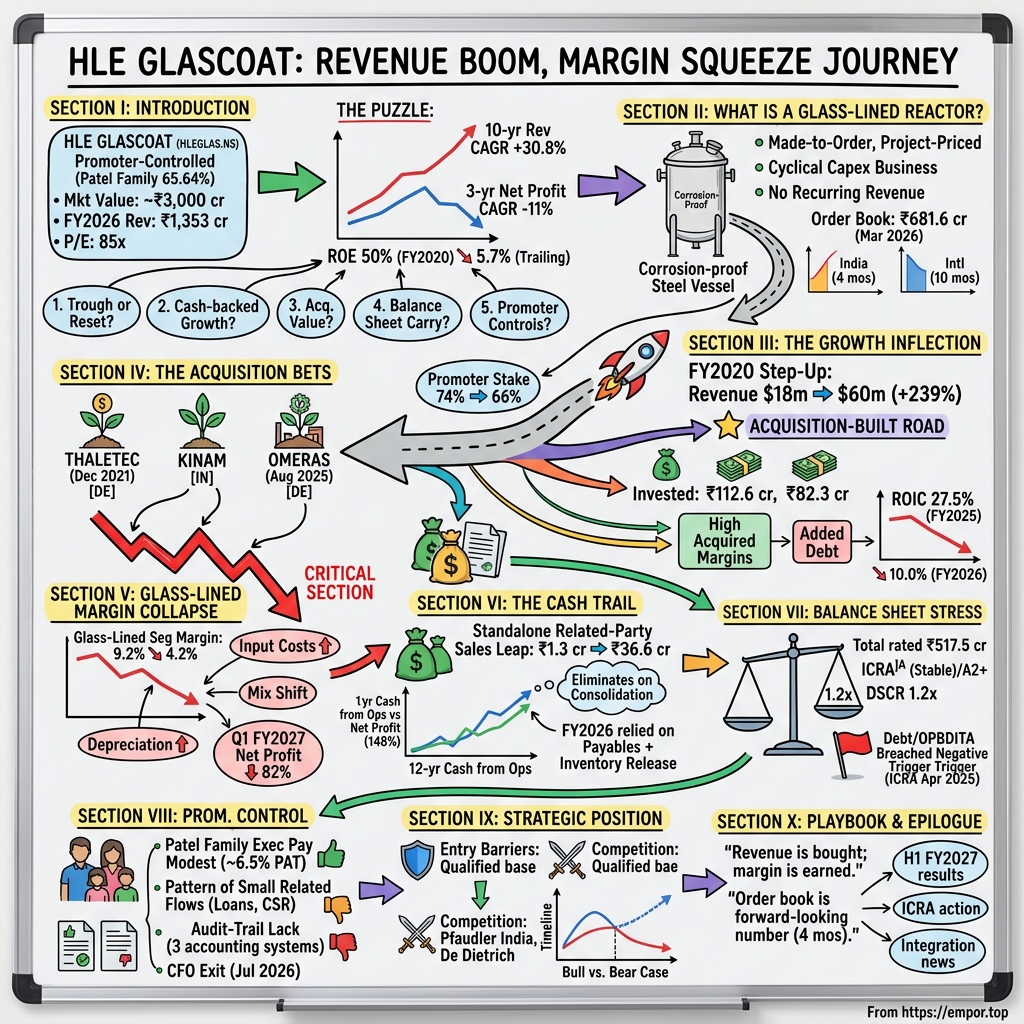
HLE Glascoat makes glass-lined reactors and storage vessels, filters and dryers, and heat exchangers for pharmaceutical, specialty chemical and agrochemical plants1. It is controlled by the Patel family, which held about 66% of the company at the end of March 20261. On 1 October 2026 the stock market valued it at roughly ₹3,000 crore, on consolidated revenue of about ₹1,353 crore for the year to March 20261.
Here is the puzzle that makes the company worth two hours. Over ten years, revenue compounded at about 31% a year1. Few Indian engineering companies of any size can say that. Yet over the last three years net profit has shrunk by about 11% a year1. Return on equity, which touched 50% in FY2020, sits at under 6% on the last twelve months of earnings1. The company has become roughly ten times bigger and, by the measure that matters most to owners, much less profitable.
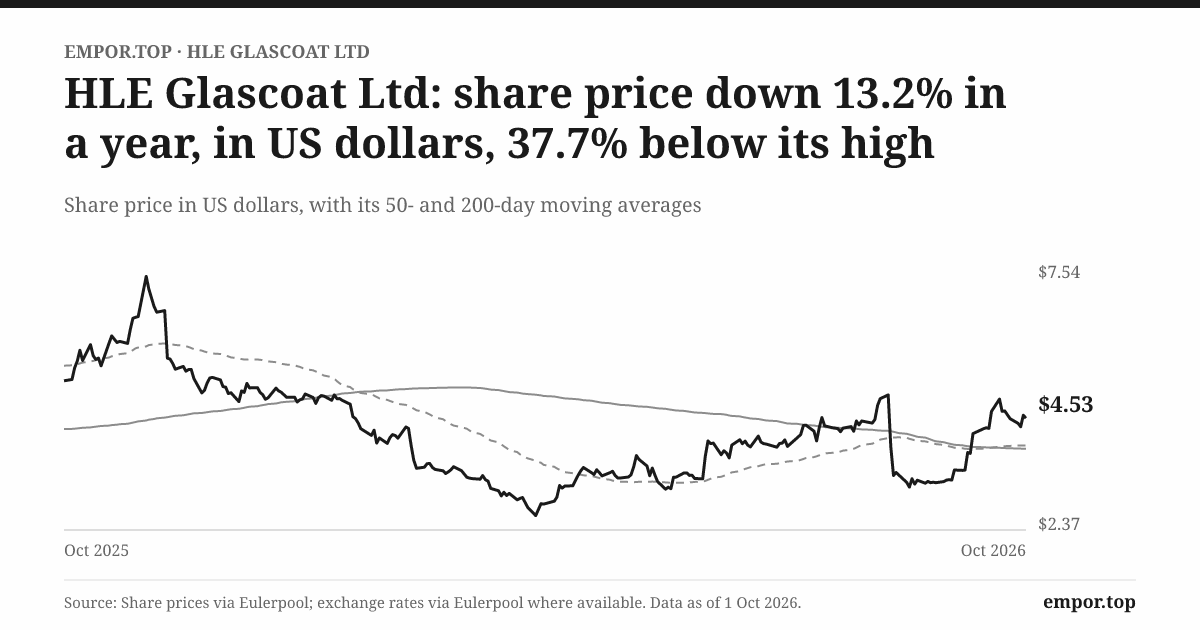
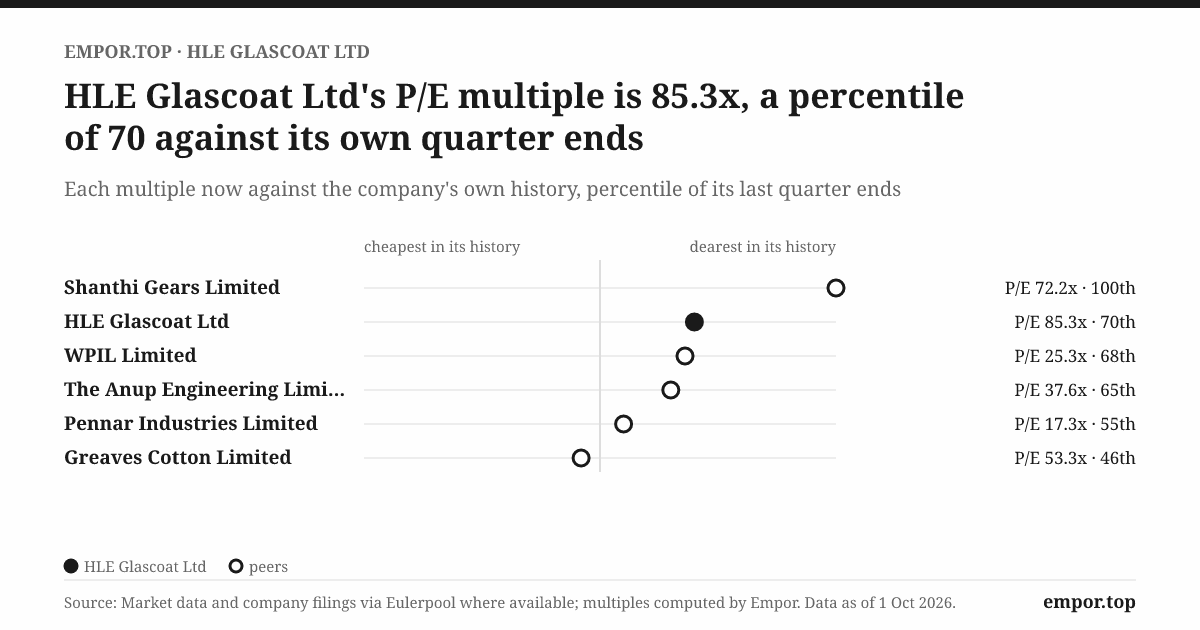
The market has noticed, in its own volatile way. The share price of about ₹436 stands roughly a third below its 52-week high of ₹645 and well above a low of ₹251 set in the same year4. Over five years the stock suffered a peak-to-trough fall of about 85%. And it still trades at around 85 times trailing earnings, above its own five-year median of about 74 times4. Whatever the market is paying for, it is not this year's profit.
The episode is built around five questions. First, is the glass-lined business, still the largest segment, in a cyclical trough or a structural margin reset? Second, was the 32% revenue jump in FY2026 real, cash-backed growth, or did it come from acquisitions and sales between group companies? Third, are the acquisitions of Thaletec, Kinam and Omeras earning their cost of capital? Fourth, can the balance sheet carry a longer downturn without a rating or funding squeeze? And fifth, does promoter-family control show up in how the company handles its own money?
One boundary to keep in mind throughout. The figures that matter for shareholders are consolidated: the Indian parent plus German, American and Indian subsidiaries. The standalone Indian parent booked about ₹723 crore of revenue in FY2026, a little over half the group1. The two views tell different stories in places, especially about receivables and related-party sales, and the story keeps them apart. One more caution: some data providers show "operating profit" for FY2024 and FY2025 above EBITDA, which cannot be right, so margins here are built from EBITDA and the company's own cost lines.
To understand why a margin can vanish in a business like this, it helps to start with the object itself.
 Subscribe on LinkedIn
II. What a Glass-Lined Reactor Is, and Why Anyone Pays for One (6:00–17:00)
Picture a pressure cooker the height of a two-storey building, made of carbon steel, then painted inside with a special glass slurry and baked in a furnace until the glass and steel become one surface. That is a glass-lined reactor. Steel gives it strength. Glass gives it immunity to the acids that would eat bare steel in months, and a smooth, inert surface that will not contaminate a batch of drug intermediate. It is one of the workhorses of batch chemistry, and the analogy most engineers reach for is enamel cookware scaled up to industrial violence.
A plant buys these vessels when it builds or expands capacity, and replaces them roughly every decade or when the glass chips and the steel starts to corrode. That buying pattern is the first thing an investor needs to absorb. There is no subscription and no consumable stream worth speaking of. HLE sells each piece of equipment against a contracted order at a contracted price1. The adjustments to that price, discounts and charges for late delivery, are tiny: about 0.1% of standalone sales in FY20261. Revenue is booked when the equipment is delivered and accepted. In plain terms, the company lives order to order, and its quarters swing with when customers sign off on what has been built.
So the only forward-looking number that matters is the order book. At the end of March 2026 it stood at about ₹682 crore1. Managing Director Himanshu Patel described it as "ten months of visibility for the international business and four months for the Indian business"1. That second half of the sentence deserves to be read twice. A ₹680 crore backlog sounds comfortable against ₹1,350 crore of annual revenue, but the Indian business, which is where the glass-lined margins have been crushed, has only about a season of work in hand. The order book was ₹479 crore in March 2024 and ₹683 crore in December 20242, so it has been broadly flat for more than a year while revenue grew. After the June 2026 quarter, management said it was above ₹700 crore at the end of July3.
The product mix has shifted, and that shift matters later. In the first nine months of FY2025, the credit agency ICRA estimated revenue at about 60% glass-lined, 30% filtration and drying, and 10% heat transfer2. By FY2026 the segment note shows roughly 50%, 35% and 15%1. The newer, mostly acquired lines have grown faster than the original franchise.
What about input costs? Steel and exotic alloys such as Hastelloy make up about 40–50% of manufacturing cost2. ICRA notes that HLE buys steel soon after it receives a firm order, which largely protects it from swings in the steel price2. That point will come back to bite the bullish case: if steel price risk is mostly hedged by purchasing timing, then a rising materials bill is less about commodity bad luck and more about price competition or mix.
Who are the rivals? In India the best-known name is GMM Pfaudler, the local arm of the American glass-lined pioneer Pfaudler, and there are smaller domestic fabricators such as Standard Glass Lining. Globally the field includes Pfaudler and the French group De Dietrich Process Systems, and, until HLE bought it, Thaletec of Germany. Credible published market-share data for glass-lined equipment in India is thin, and HLE does not publish its own share, so any claim that HLE is number one or number two should be treated as unproven. What can be said is that the domestic market has at least one larger, better-capitalised competitor, and that ICRA explicitly names competition as a pressure on glass-lined margins2.
HLE's claimed edges are its R&D centre at Anand, recognised by the government's Department of Scientific and Industrial Research, a pilot plant at Maroli, and a broad product range1. ICRA credits "consistent investment in research and development"2. But the company does not disclose an R&D spend in rupees or as a share of revenue1. A recognised lab is a credential; it is not evidence of pricing power.
Nor is technology disruption the threat here. Artificial intelligence does not fuse glass to steel. The threats are older and duller: customers who delay capital spending, and competitors who cut price to fill their furnaces.
The verdict on the business model is simple. HLE is a made-to-order, project-priced, cyclical capital-goods maker with no recurring revenue and four to ten months of visibility. That is not a criticism, but it changes how every later number should be read. Growth here can be bought, borrowed from the next cycle or simply delayed by a customer's sign-off. Which raises the obvious question: how did a business like this grow 30% a year for a decade?
III. From a Small Anand Fabricator to a 30%-a-Year Grower (17:00–27:00)
For most of the 2010s, HLE Glascoat was a small company. In FY2019 its revenue was roughly $18 million, net profit under $1 million, and a few thousand shareholders owned the publicly traded part14. It was a family fabrication shop from Anand, in central Gujarat, with a listing.
Then, in a single year, it changed size. FY2020 revenue was about three and a third times FY2019's, an increase of about 240%1. Net profit rose more than fivefold. Return on equity hit 50%1. A jump of that size in a fabrication business does not come from selling more reactors from the same shop floor; it comes from a change in what the listed company contains. The annual figures show it plainly, and ICRA describes the growth of FY2020 to FY2023 as "driven by organic as well as inorganic expansions"2. Investors who want to narrate the founding myth should look to that year's corporate restructuring, not to a sales miracle.
What followed was a capital build. Shareholders' equity roughly tripled between FY2020 and FY2022, from about $11 million to about $34 million1. Over a similar period the promoter stake fell from its 74% peak in March 2020 toward the mid-60s, where it sits today4. Put those two facts together and the shape is clear: the company brought in outside equity in this phase, and the family accepted dilution to fund growth. Since then, share capital has stayed unchanged at ₹13.89 crore, and the company raised no money through a preferential allotment or a qualified institutional placement in FY20261.
The turning point that made HLE a global player came in December 2021, when it acquired Thaletec, a German maker of glass-lined equipment2. Overnight the Anand fabricator had a European plant, a European brand and a foothold in the US through Thaletec Inc.1 It also took on debt: borrowings more than doubled in FY2022, and cash spent on investing that year was about five times the level of any earlier year1. Return on equity began its long slide, from 50% in FY2020 to about 21% by FY20231.
Then growth stopped. ICRA records that revenue "stagnated over FY2024–9MFY2025" on weak demand for glass-lined equipment from agrochemical and chemical makers2. The consolidated figures show revenue growth of about 4% and 6% in those two years1. This was the period when Chinese agrochemical overcapacity and inventory destocking pushed Indian agrochemical makers to defer new plants, and when it was HLE's customers, not HLE, who decided the timetable.
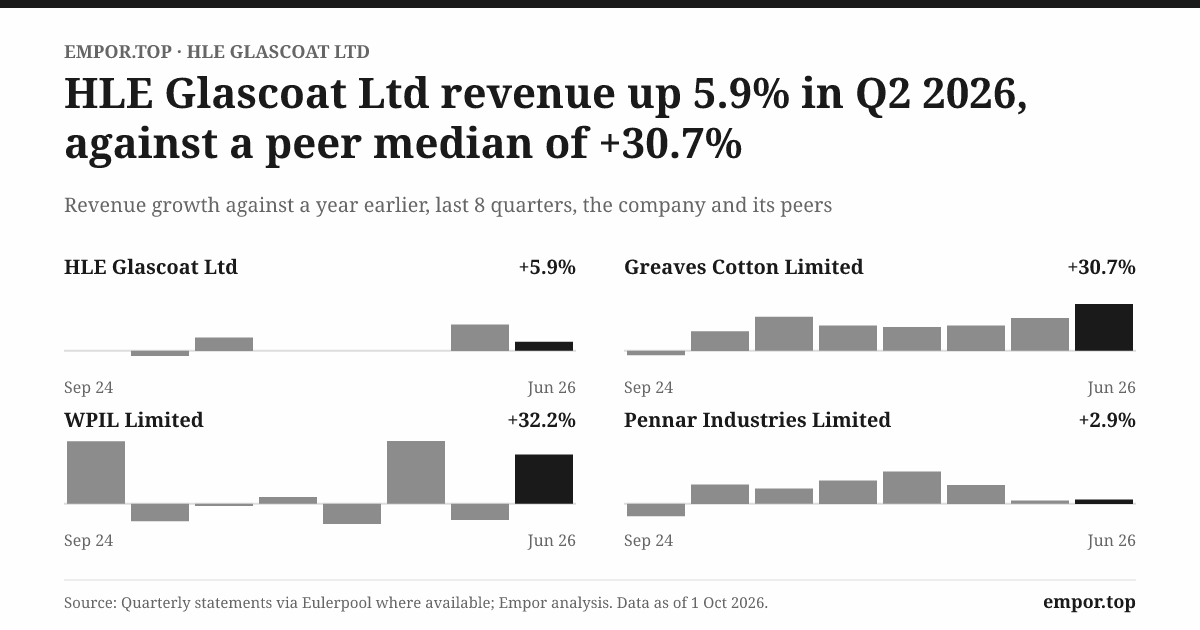
FY2026 broke the pause with a revenue jump of about 32%, to ₹1,353 crore1. Quarter by quarter, growth ran from about 25% in June 2025 to almost 49% in September, then cooled to about 17% by March 2026 and just under 6% in June 20261.
Look at the growth rates over different windows and a pattern appears. The ten-year rate is about 31% a year, the five-year rate about 23%, the three-year rate about 13%1. Each shorter window is slower. That is the signature of a company whose biggest leaps came from acquisitions and restructuring, and whose underlying organic engine has been running at a far more ordinary pace. The long record, in other words, is mostly acquisition-built, and the organic business stood still in FY2024 and FY2025.
Which brings the story to the deals themselves, and the question of what HLE actually paid for its growth.
IV. The Thaletec, Kinam and Omeras Bets: Did They Overpay? (27:00–45:00)
Imagine the German plant of Thaletec, a few hours' drive from Frankfurt, loading a finished reactor onto a truck bound for a customer elsewhere in Europe. Now imagine that, a year later, a growing share of what that business sells in India has to pass through an HLE entity first. And imagine the Omeras deal closing in August 2025, with ₹2.3 crore of transaction costs written straight off as an exceptional charge1. These are the three bets that turned HLE from a single-country fabricator into a small international group. The question is whether they are paying.
Start with what was spent. The Indian parent carries its investment in Thaletec GmbH at about ₹113 crore and in Kinam Engineering Industries, the heat-transfer specialist, at about ₹82 crore, plus a further ₹7 crore in Kinam Process Equipments1. HLE owns roughly 70% of Kinam, with the rest held by outside shareholders1. Kinam was consolidated from September 2023, with a second tranche completed by 20251. Omeras and its related German entities came in from July–August 2025, at an acquisition outflow of about ₹30 crore1. On top of equity, the parent lent Thaletec GmbH about ₹16 crore repayable on demand and guaranteed a ₹21 crore bank loan for Thaletec LLP1. All told, something above ₹250 crore of shareholder capital and credit is tied up in these acquired businesses.
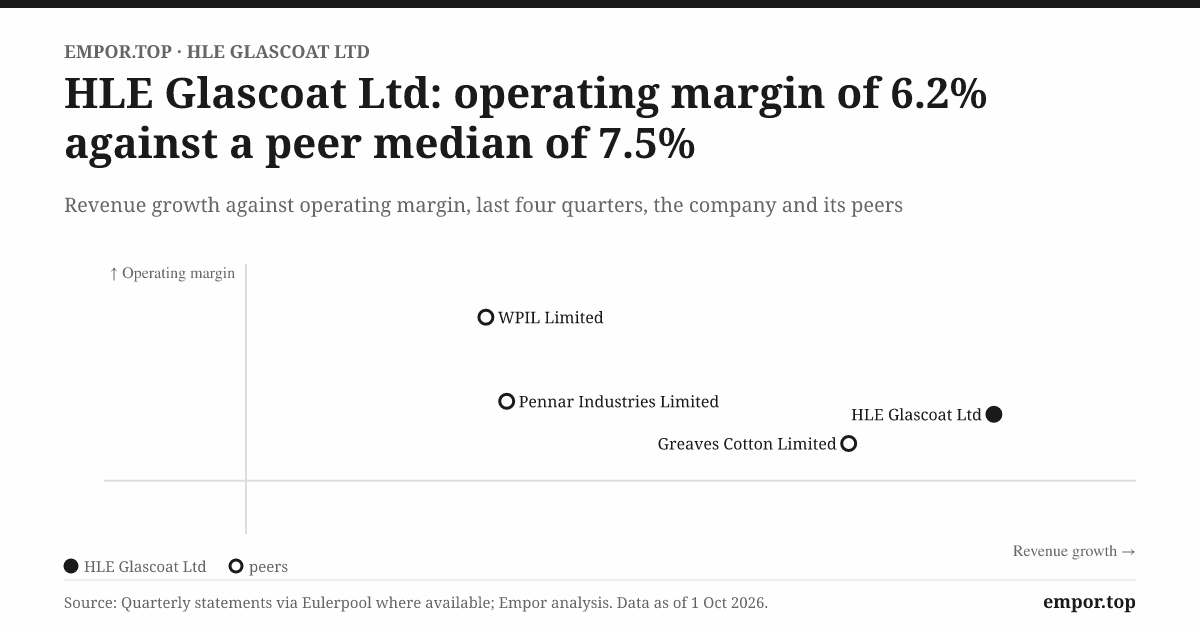
Now the returns. Here the segment note is the best witness, and it is more favourable to the deals than the headline numbers suggest. In FY2026, filtration, drying and other equipment, the segment that houses most of the Thaletec-era product broadening, earned about 12% on roughly ₹474 crore of revenue, a margin that held steady1. Heat transfer, which is largely Kinam, earned about 14% on ₹200 crore, down from about 19% but still more than three times the glass-lined margin1. Thaletec GmbH paid the parent an ₹8 crore dividend in the year1.
So the acquired lines are carrying the group's profit. Of roughly ₹114 crore of segment profit before interest and tax, about three quarters came from the two segments built or enlarged by deals1. That is the strongest evidence that buying Kinam and building out filtration was not a mistake.
A rough payback calculation helps frame the cost of capital. Suppose heat transfer's ₹28 crore of segment profit, after tax at around 25%, leaves about ₹21 crore, and HLE's 70% share is about ₹15 crore. Against an investment of roughly ₹89 crore in the Kinam entities, that is a return in the mid-teens, above the group's cost of borrowing. But this is generous: segment profit is before interest and before an allocation of unallocated corporate costs, and FY2026 was a good year for the segment. Kinam's profitability had dipped in the first nine months of FY2025, according to ICRA2, and the June 2026 quarter's shortfall was blamed on "delayed delivery acceptance, especially in heat transfer equipment"3. Thaletec's return is harder to estimate, because the company does not split its segment profit by subsidiary; the ₹8 crore dividend on a ₹113 crore investment is about 7%, below a reasonable cost of equity, though dividends understate earnings.
The honest verdict is that the case for "earning their cost of capital" is unproven rather than rejected. HLE does not publish a return on invested capital for each acquisition. The best available evidence says the acquired segments earn better margins than the original business and explain much of the FY2026 growth.
But test the deals against the record at the level shareholders actually own. Group return on capital employed was about 57% in FY2019 and about 18% in FY20261. Return on invested capital fell from about 28% in FY2025 to about 10% in FY2026, though the earlier figure leans on the provider's suspect operating profit1. Return on equity went from 50% to about 9% for FY2026 and under 6% on trailing earnings1. And the most damning comparison of all: consolidated net profit in FY2026, about $5.6 million, was below FY2023's $8.7 million, earned on about a third more revenue and a much larger equity base1. Per share, shareholders own a bigger, more diversified company that earns less.
The broader capital-allocation pattern fits. Capital spending has run at roughly one and a half times depreciation1, so the company keeps investing ahead of profits. Dividends have taken between 6% and 33% of profit over twelve years, 15% in FY2026, and add up to about 29% of free cash flow over that period1. There have been no buybacks.
Here is the myth and the reality. The myth is that HLE bought its way into better businesses and the group is now structurally more profitable. The reality is narrower: it bought into segments that earn double-digit margins, but its own original segment has collapsed underneath them, so the group as a whole earns less per rupee of capital than it did before the deals. The claim that the acquisitions created value per share is not supported by the record so far. What would change that? Two years of heat-transfer and filtration margins holding above 12% while the glass-lined business recovers.
Which means the real story of FY2026 is not the acquisitions at all. It is what happened to the business HLE started with.
V. The Largest Segment Stops Earning: The Glass-Lined Margin Collapse (45:00–62:00)
On the results day for the June 2026 quarter, the numbers landed with a thud. Revenue was up about 6% on the year. Operating margin was about 3.7%. Net profit was down about 82%1. Management's explanation was "delayed delivery acceptance, especially in heat transfer equipment", while it pointed to a strong order book and a "demand revival"3. That quarter was not a shock out of a clear sky. It was the continuation of a margin collapse that had already played out across FY2026 in the company's biggest segment.
Here is the core fact of the entire story. In FY2026, glass-lined equipment revenue rose about 16%, to roughly ₹676 crore. Its segment profit nearly halved, from about ₹54 crore to about ₹29 crore. Its margin fell from about 9% to about 4%1. Half the company's revenue now earns barely enough to cover its share of interest. The entire FY2026 profit shortfall sits here; the other two segments, together, earned more than the year before1.
Walking the bridge
Why did a business that grew its sales lose half its profit? Walk down the consolidated income statement and the clues line up.
Materials. Raw materials and inventory changes rose from about 44% of revenue to about 47%1. On ₹1,353 crore of sales, three points is about ₹40 crore, more than the whole glass-lined profit decline. Remember ICRA's point that steel is bought against firm orders2. If the purchase timing protects against steel price swings, a rising materials share most likely means lower realised prices on new orders, a richer mix of costly alloys, or acquired businesses with a heavier bill of materials. That is a pricing story, not a commodity story.
People. Employee costs actually fell as a share of revenue, from about 19.5% to about 18.7%1. This line did not cause the damage.
Other expenses. These rose slightly, to about 24% of revenue1, reflecting the costs of a larger, more international footprint.
Add those up and EBITDA rose only about 5%, to roughly ₹149 crore, on revenue up 32%1. The EBITDA margin compressed from about 13.6% to about 10.9% of total income1.
Below EBITDA, depreciation climbed from about ₹30 crore to ₹37 crore as new capacity came on line1. Interest was about ₹34 crore, a slight improvement, but still roughly a quarter of EBITDA1. Exceptional charges of about ₹6.7 crore, including Omeras deal costs and a ₹2 crore charge for India's new labour codes, came off the bottom1. What was left was profit after tax of about ₹57 crore, roughly ₹50 crore attributable to shareholders after Kinam's minority share1.
The bridge tells a clear story. Volume came through; price and mix did not. Fixed costs grew with capacity, and the company's original product no longer carried them.
Reading the quarters without being fooled
A warning about quarterly data. Data providers show an operating margin of about 25% for the March 2025 quarter, followed by 3.4% in December 20251. The first figure almost certainly reflects the same provider classification problem as the annual operating profit; the second reflects real weakness in a lumpy, acceptance-driven business. Quarters here swing with a few large deliveries. Reading them one at a time is how investors got whipsawed into an 85% drawdown.
Trough or reset?
The case for a cyclical trough is real. Agrochemical and chemical capex was weak, and ICRA tied glass-lined softness to it2. Fixed overhead added for growth looks worse when orders slow and should look better when they return. The order book is above ₹680 crore, and management said deferred projects were reviving3. ICRA expected margins to recover with better absorption2.
The case for a reset is also real, and, on the evidence so far, slightly stronger. Glass-lined revenue grew, so this was not mainly a volume problem; margin fell on rising sales. ICRA flags competitive pricing pressure in the segment2. The Indian order book covers only four months1, so the company has no long backlog of older, better-priced orders to work through. And the first quarter of FY2027 showed no turn3.
Management's word against the record
How credible is management's recovery narrative? On the evidence of what was said and what followed, the pattern is consistent but not reassuring. Through FY2025, management pointed to a strong order book and a revival in demand. In FY2026, revenue duly arrived, but margin did not. After the June 2026 quarter, the message was again a strong order book and a demand revival3. The concrete parts of these messages, the order book and months of cover, have generally held up. The vague part, when margins recover, has repeatedly slipped. Analysts have pressed on margins and receivables; the clearest answers concern the size of the backlog, not its pricing.
The verdict: the evidence leans toward a partial reset in glass-lined economics, with input cost, mix and depreciation all moving the wrong way together. A pure cyclical trough is not yet supported. The settling numbers are the glass-lined segment margin in the September and December 2026 quarters, against 4% for FY2026 and 9% for FY2025.
The moat, argued once
This is the place to ask whether HLE has a durable edge at all. The evidence is mixed. On the customer side, concentration is high: one unnamed customer accounted for about 23% of standalone revenue in FY20261, and the top 15 customers made up roughly 37% of glass-lined revenue and about 65% of filtration and drying revenue2. Big buyers demand long credit periods; ICRA attributes debtor days of around 90 to "higher credit period being demanded by HGL's marquee customers"2. Switching costs exist in principle, since pharmaceutical customers qualify vendors and an installed base creates replacement and spares demand, but HLE does not publish repeat-order rates or spares revenue to prove it. A customer who can squeeze both price and payment terms, while the margin falls by half, is a customer with power. The conclusion: HLE has an established position, but its durable edge is unproven.
If the margin is the first test of the business, the second is simpler and more basic: is the revenue real, and did it turn into cash?
VI. Is the Revenue Real? Receivables, Related Parties and the Cash Trail (62:00–80:00)
Open the standalone related-party note and one line jumps off the page. In FY2025, the Indian parent sold about ₹1.3 crore of goods to its own subsidiary, Thaletec LLP. In FY2026 it sold about ₹36.6 crore, roughly 28 times as much1. At year-end, about ₹13.7 crore of that was still owed1. In the same year, consolidated receivables absorbed about ₹130 crore of cash1. For a skeptical investor, those two facts together are the opening scene of every revenue-quality investigation.
Follow the trail carefully, because the answer is more reassuring than the scene.
The intragroup surge
Related-party sales rose from about 2.5% of standalone sales to about 6.4%1. Receivables from related parties at the parent went from about ₹0.3 crore to about ₹17.9 crore, roughly 14% of the parent's receivables1. That certainly inflates the standalone picture: the parent's sales and receivables look bigger because some of them are owed by its own subsidiary.
But on consolidation, sales between group companies are eliminated. At group level, related-party receivables were only about ₹3 crore1. So the Thaletec LLP surge does not inflate consolidated revenue. It shows that HLE is increasingly routing work through its Indian Thaletec arm, which matters for how the standalone accounts should be read, not for whether group sales are real. One more point: the company describes these transactions as on arm's-length terms, and the auditor named related-party transactions as a key audit matter in both the standalone and consolidated reports1. That is attention, not a qualification.
Where the cash came from
The group's operating cash flow looked strong in FY2026: about ₹161 crore, slightly above operating profit before working-capital changes1. (Data providers show a lower figure, about $15 million, likely a definitional difference; the trend, not the precise level, is what counts.) But look at how that cash was assembled. Receivables consumed about ₹130 crore. Inventory released about ₹46 crore, as inventory days fell sharply. Trade payables added about ₹73 crore1. In plain English, the group paid its suppliers more slowly and worked down stock, and that funded customers who paid more slowly. That is not the same thing as collecting.
Is the receivable book healthy? At the parent, about half the ₹128 crore balance was not yet due, and nearly all of the rest was less than six months overdue; only about ₹3 crore was more than a year old1. That is a clean ageing profile for a capital-goods supplier. But the allowance for expected credit losses has doubled two years running, from about ₹0.6 crore to ₹1.3 crore to ₹2.7 crore at the parent1. The amounts are small. The direction is not.
Group debtor days were about 73 in FY2026, up from 66 a year earlier but well below the 98 reached in FY20191.
The long view of cash
Over twelve years, cash from operations added up to about 148% of net profit1. That is excellent conversion, flattered by heavy depreciation, which is a non-cash charge. But the record also contains a warning. In FY2022 and FY2023, the years of the Thaletec integration and peak inventories, operating cash flow collapsed to about 10% and 3% of EBITDA1. Cash conversion recovered to about 82%, 100% and 92% across FY2024 to FY20261. A business that can swing from 3% to 100% conversion in two years does not have a reliable cash engine; it has a working-capital cycle that sometimes runs in its favour.
Customers and suppliers
The supplier side of the story is ordinary: about 27% of purchases came through trading houses in FY2026, down from 31%, spread across 274 of them1. The customer side is where risk sits. The one customer above 10% of parent revenue, at about ₹161 crore, is not named by the company1. A customer of that size that both receives long credit and has the bargaining weight to set prices is the single most important commercial relationship HLE has, and investors cannot see it.
The verdict
FY2026's revenue was real at group level and was not manufactured by sales to subsidiaries. It was, however, partly acquired, and it was funded by suppliers and inventory release rather than by customers paying faster. The receivable build and the rising credit-loss allowance are early-stage cautions, not red flags.
Where did the cash go? Over twelve years, free cash flow added up to about ₹161 crore, and dividends took about ₹47 crore of it1. The rest, and much more, went into plants and acquisitions funded partly with debt. Which leads to the next question: how much stress can that balance sheet take?
VII. The Balance Sheet Under a Longer Downturn (80:00–92:00)
In April 2025, ICRA reaffirmed HLE's ratings at [ICRA]A with a Stable outlook on long-term facilities and A2+ on short-term facilities, covering about ₹518 crore of bank lines2. Buried in the rationale was a sentence that every lender reads first: "Debt/OPBDITA has breached ICRA's negative trigger"2. The agency kept the outlook Stable but said a negative action was possible if earnings did not improve2. The Stable outlook, in other words, was a bet on recovery.
FY2026 delivered half of that bet. Consolidated borrowings fell from about ₹348 crore to about ₹313 crore1. Debt-to-equity improved from 0.83 to 0.651. The company repaid about ₹60 crore of term loans while taking about ₹36 crore of new long-term debt1. Separately, it carries about ₹34 crore of lease liabilities1.
But three facts temper the improvement. First, roughly two thirds of the borrowings, about ₹213 crore, are current: working-capital lines and the current portion of term loans1. Those lines are renewed every year by banks that read the same ICRA note. Second, the deleveraging was funded by working capital, especially stretched payables, rather than by rising profit. Third, interest cover stays thin. Profit before interest and exceptional items covered interest about 3.3 times in FY20261. ICRA had measured 3.0 times in the first nine months of FY2025, against 8.0 times in FY2022, and a debt service coverage ratio of just 1.2 times in FY20242. Cash and short-term investments were about ₹59 crore at March 20261.
Then came the June 2026 quarter, when profit fell about 80%1. If that run-rate persisted for a full year, debt to EBITDA would move back toward, or past, the trigger ICRA flagged. Reports after the quarter indicated that ICRA had noted moderation in profitability and coverage, but the decisive document is the agency's next formal rating action. That is the event to watch.
How would a longer downturn play out? HLE's debt is mostly short-term bank credit, which reprices and resizes quickly. A rating cut from A to A- would not threaten solvency, but it would raise borrowing costs, tighten working-capital limits and make customers' advance payments more important at exactly the moment customers are least willing to give them. The balance sheet can carry a longer downturn; it cannot carry one cheaply.
Dilution and the family's position
Shareholders have not been diluted recently. Share capital has been unchanged since April 2024, and no preferential issue or QIP took place in FY20261. The earlier equity build, during FY2020–FY2022, was when outside capital came in and the promoter stake fell from about 74% toward 66%4. The company reported no promoter pledge as a concern in its FY2026 annual disclosures, and checking quarterly encumbrance filings remains a routine diligence step.
Small items
Currency is a passing point. The parent is a net importer, with about ₹39 crore of foreign-exchange spending against about ₹20 crore earned in FY20261. Its US dollar loan halved to about $1.8 million, and the net foreign-exchange loss was only about ₹46 lakh1. Contingent liabilities are three old service-tax disputes totalling about ₹69 lakh, plus the ₹21 crore guarantee for Thaletec LLP1. Neither changes the picture.
The balance sheet, then, is adequate but leaning on recovery. And a promoter-controlled company that leans on its lenders invites a final internal question: whose money is it, and how is it handled?
I have launched the validation check and will verify the output once complete.
VIII. Whose Money Is It? Promoter Control, Pay and Audit Trails (92:00–104:00)
In FY2026, the group's key managerial personnel lent the company about ₹11.1 crore and were repaid about ₹26.9 crore, shrinking the outstanding balance from about ₹16 crore to under ₹0.3 crore, with about ₹72 lakh of interest paid along the way1. At the parent, a further ₹10 crore loan from the promoter side was taken and repaid within the same year1. In the same annual report, the auditor noted that three of the company's accounting systems did not have a database-level audit trail switched on, and that master logs did not capture the old and new values of edited data1. Neither fact is a scandal. Together, they are the kind of detail that a careful minority shareholder underlines.
The family at the top
HLE is run by the Patel family. Himanshu Patel is Managing Director. Aalap Patel is an Executive Director and Harsh Patel a Whole-time Director; Nilesh Patel sits on the board as a non-executive promoter director1. The board has eight members, four of them independent1. The executive contracts run three years from December 2025, with six months' notice and no severance; there is no employee stock option scheme1. The family's stake, about 66%1, is its incentive. That is a powerful alignment on the value of the shares, though not automatically on how minority shareholders are treated.
Pay is not the problem
The three family executives were paid about ₹3.7 crore in FY2026, roughly 6.5% of consolidated profit after tax1. Himanshu Patel received about ₹1.84 crore, including a commission set at 1% of net profit1. One oddity: the remuneration annex reports his pay down about 6%, while the commission component rose from about ₹24 lakh to about ₹53 lakh1. The company does not explain the gap. KMP received about ₹4.8 crore in dividends1, a reminder that the family earns more as owners than as managers.
Where the concern actually sits
The governance concerns are in the pattern of small flows between the family and the company. Besides the loans, the parent paid about ₹37 lakh in rent to related parties, charged about ₹1 crore in rent to an entity in which directors are interested, has a ₹1 crore capital advance outstanding with KMP, and gave ₹21 lakh of CSR money to a trust controlled by a director1. Each is small against ₹1,350 crore of revenue. But each is a decision the family makes on both sides of the table.
Add two other signals. The audit-trail observation, which the auditor repeated in the consolidated report for the holding company, though it said it saw no evidence of tampering1. And the departure of Chief Financial Officer Naveen Kandpal, listed as CFO "up to July 03, 2026"1, at the moment the company most needed a steady hand on its lenders and its working capital.
The comfort case is not empty. The auditor's opinion was unmodified, the CARO report showed no adverse remarks on the Indian subsidiaries, related-party purchases are only about 1.5% of the total, and executive pay is modest1. The verdict is narrowed, not cleared: there is no evidence of value extraction at scale, but there is a family that moves money in and out of the company more than a widely held company would, in a period when the control environment had a documented gap. The confirming evidence would be a named, experienced CFO, the audit trail fixed in the next auditor's report, and clean votes on related-party resolutions at the next AGM.
Promises against delivery
How has management fared against its own words? The record is mixed. The company has delivered on scale: it said it would build an international, multi-product group and it did. It has not delivered on margin: recovery has been promised through two years of compression. Some of the misses were genuinely macro, notably the agrochemical downturn. Others, such as glass-lined pricing and the timing of delivery acceptance, sit closer to the company's own control. When management blames delays on customers' sign-off, an investor is entitled to ask why HLE's contracts and project management leave it so exposed to that timing.
The register
One last fact explains the stock's behaviour. HLE had about 5,000 shareholders in 2018; it had about 71,000 by June 20264. Institutions hold only about 7%1. A retail-heavy register, thin institutional coverage and lumpy quarters together produce exactly the 58% volatility and 85% drawdown that the share price has shown. Which brings the story to the price itself.
IX. Strategic Position: Competitive Forces, Valuation and the Bull vs. Bear Case (104:00–115:00)
Within a single year, the same HLE share traded at ₹645 and at ₹2514. On 1 October 2026, it closed around ₹4364. Over that year, the company's earnings did not rise; they fell. Whatever moved the share price, it was not the profit already reported. It was a story about the profit to come.
What the price assumes
At about 85 times trailing earnings, the stock trades above its own five-year median of roughly 74 times4. Enterprise value is about 24 times EBITDA, the price is about five times book value, and the free cash flow yield is under 2%4. Trailing twelve-month net profit, about $3.9 million, is well below FY2026's $5.6 million1. Put simply, the market is paying for the company HLE would be if glass-lined margins returned to the high single digits or better and the acquired businesses kept compounding at double-digit margins. Against listed peers such as GMM Pfaudler, the comparison is one investors should make with current multiples in hand rather than assume a premium or a discount.
Five forces
Buyer power is high. Concentration, long credit terms and the ability to defer orders all favour the customer, as the margin compression shows. Supplier power is moderate: steel and specialty alloys are a big cost, but purchase timing limits the price risk. Rivalry is intense in glass-lined equipment, where ICRA names competitive pressure2 and the segment margin halved on rising volume. The threat of new entrants is modest, since glassing furnaces, know-how and customer qualification take years to build. The threat of substitutes, such as alloy or fluoropolymer-lined vessels, exists but is slow-moving.
Seven powers
Of Hamilton Helmer's seven powers, the evidence for HLE is thin. Scale economies are limited; HLE is not clearly the largest domestic player. Network effects are absent. Switching costs exist through installed base and qualification but are not demonstrated in disclosed repeat orders. Counter-positioning and branding are weak. There is no cornered resource. Process power, the craft of fusing glass reliably to steel, is real but shared by rivals. The calibrated conclusion: an established position, with a durable edge unproven.
The bull case
The order book sits above ₹680 crore and was above ₹700 crore in July13. Inventory days fell from about 239 to about 121, a much leaner working cycle1. The acquired segments earn 12–14% margins1. Debt is falling. If agrochemical and chemical capex recovers, the fixed costs added over the last three years will be absorbed and margins could rebound sharply.
The bear case
Indian order cover is about four months1. The glass-lined margin has halved on rising volume, which points at price, not just volume. The June 2026 quarter showed no turn. Two thirds of the debt is short-term and the rating trigger has already been breached once. And the acquisitions have not yet raised returns per share.
The activist's question
A skeptical activist would ask a simple question: why does a ₹3,000 crore company with only 7% institutional ownership pay out 15% of its profit in dividends, most of which flows to the controlling family, while it refinances short-term bank debt and its return on equity is under 6%? The honest answer may be that the dividend is small and sends a signal. But the question exposes the trade-off at the heart of the capital-allocation record.
The risk radar
Only five risks are material: a longer agrochemical and chemical capex slowdown; input cost or price competition in glass-lined; refinancing of short-term debt if ratings slip; integration execution across Germany, the US and India; and delivery-acceptance timing that pushes revenue between quarters.
Three numbers to watch
First, the glass-lined segment margin: about 4% in FY2026, down from 9%1. Second, the order book and its months of cover: about ₹682 crore at March 2026, with four months of Indian cover1. Third, receivables plus customer advances against revenue: debtor days rose from 66 to 73 in FY20261. If those three move the right way together, the market's story will start to come true. If not, the multiple has a long way to fall.
X. Playbook: Business & Investing Lessons (115:00–120:00)
Revenue is bought; margin is earned. In FY2026, HLE grew revenue by almost a third and EBITDA by about a twentieth. The acquired businesses delivered the growth; the original business lost its profit. For founders, it is a reminder that buying sales is the easy part of a roll-up. For investors, it is a rule to strip acquisitions out before celebrating a growth rate.
In capital goods, the order book is the only forward-looking number that doesn't lie, but it only speaks for four months. HLE's ₹680 crore backlog sounds like comfort until the managing director's own words reveal the Indian half covers a season. Backlog measures quantity. It says nothing about the price at which it was won.
Cash conversion is a seasonal visitor. The same company converted 3% of EBITDA into operating cash in FY2023 and 100% in FY2025. Long-run averages hide the years when the cycle runs against you, and those are exactly the years when lenders call.
A group that sells to itself should be read twice. The 28-fold jump in sales to Thaletec LLP did not inflate group revenue, but it changed what the standalone receivables mean. Every intragroup line is a door the reader should open before deciding nothing is behind it.
When the multiple is above the median on falling earnings, the price is a story about next year. At 85 times trailing profit, HLE's share price is not a valuation of what the company earns. It is a forecast that the glass-lined margin comes back. The investor's job is to decide which quarter would prove it.
XI. Epilogue (120:00–124:00)
Tonight, HLE Glascoat stands at an awkward point. It is bigger than it has ever been, more international, broader in product and less leveraged than a year ago. It is also less profitable per rupee of capital than at almost any time since it changed size in FY2020, and its last reported quarter showed no sign that the slide has ended.
The next few months will answer most of the five questions. The first moment is the half-year result for the six months to September 2026. If the glass-lined margin climbs back toward the high single digits and the heat-transfer deliveries delayed from June are accepted and billed, the trough case gains its first hard evidence. If the margin stays near 4%, the reset case becomes the base case. The same results will show organic growth excluding Omeras, and whether the receivable build of FY2026 has reversed or deepened.
The second moment is ICRA's next formal rating action, set against half-year net debt and interest cover. A reaffirmed Stable outlook would tell investors that lenders still believe in the recovery. A negative outlook would make the short-term bank lines more expensive at the wrong time.
The third is governance: who replaces the departed CFO, whether the auditor's next report confirms the audit trail has been fixed, and how independent shareholders vote on related-party resolutions.
The fourth is integration. Thaletec, Kinam and Omeras now earn most of the group's profit. Whether they continue to do so, and whether the order book converts at decent prices, will decide whether the deals created value per share or merely size.
The tension remains exactly where the story began: a fast-growing, acquisition-built engineering group whose profits have not followed its revenue.
XII. Outro (124:00–125:00)
Back to that blue-white vessel being bolted into the Gujarat plant. The glass is what makes it valuable: inert, impervious, able to hold the most aggressive chemistry for a decade. The glass is also what makes it fragile: one chip, and the steel underneath begins to corrode.
HLE Glascoat has fused a ₹1,350 crore revenue line onto a margin as thin as that glass. It has already proved it can build revenue. It has not yet proved it can keep any of it as profit.
References
-
Annual Report 2025-26 — HLE Glascoat Limited (NSE archive), 2026-09-07 ↩↩↩↩↩↩↩↩↩↩↩↩↩↩↩↩↩↩↩↩↩↩↩↩↩↩↩↩↩↩↩↩↩↩↩↩↩↩↩↩↩↩↩↩↩↩↩↩↩↩↩↩↩↩↩↩↩↩↩↩↩↩↩↩↩↩↩↩↩↩↩↩↩↩↩↩↩↩↩↩↩↩↩↩↩↩↩↩↩↩↩↩↩↩↩↩↩↩↩↩↩↩↩↩↩↩↩↩↩↩↩
-
Intimation of credit rating with ICRA rationale — HLE Glascoat / ICRA, 2025-04-15 ↩↩↩↩↩↩↩↩↩↩↩↩↩↩↩↩↩↩↩↩↩
-
HLE Glascoat Sees Profit Squeeze in Q1 FY27 but Banks on Strong Order Book and Demand Revival — TipRanks ↩↩↩↩↩↩↩
-
HLE Glascoat consolidated financials, shareholding trend, concalls and documents — Screener ↩↩↩↩↩↩↩↩↩↩
 LinkedIn
 WhatsApp
 Reddit
 Hacker News
 Email
Email Kindle
 RSS Feed
 Spotify
 Apple Podcasts
 Amazon Music
 Audible
 YouTube