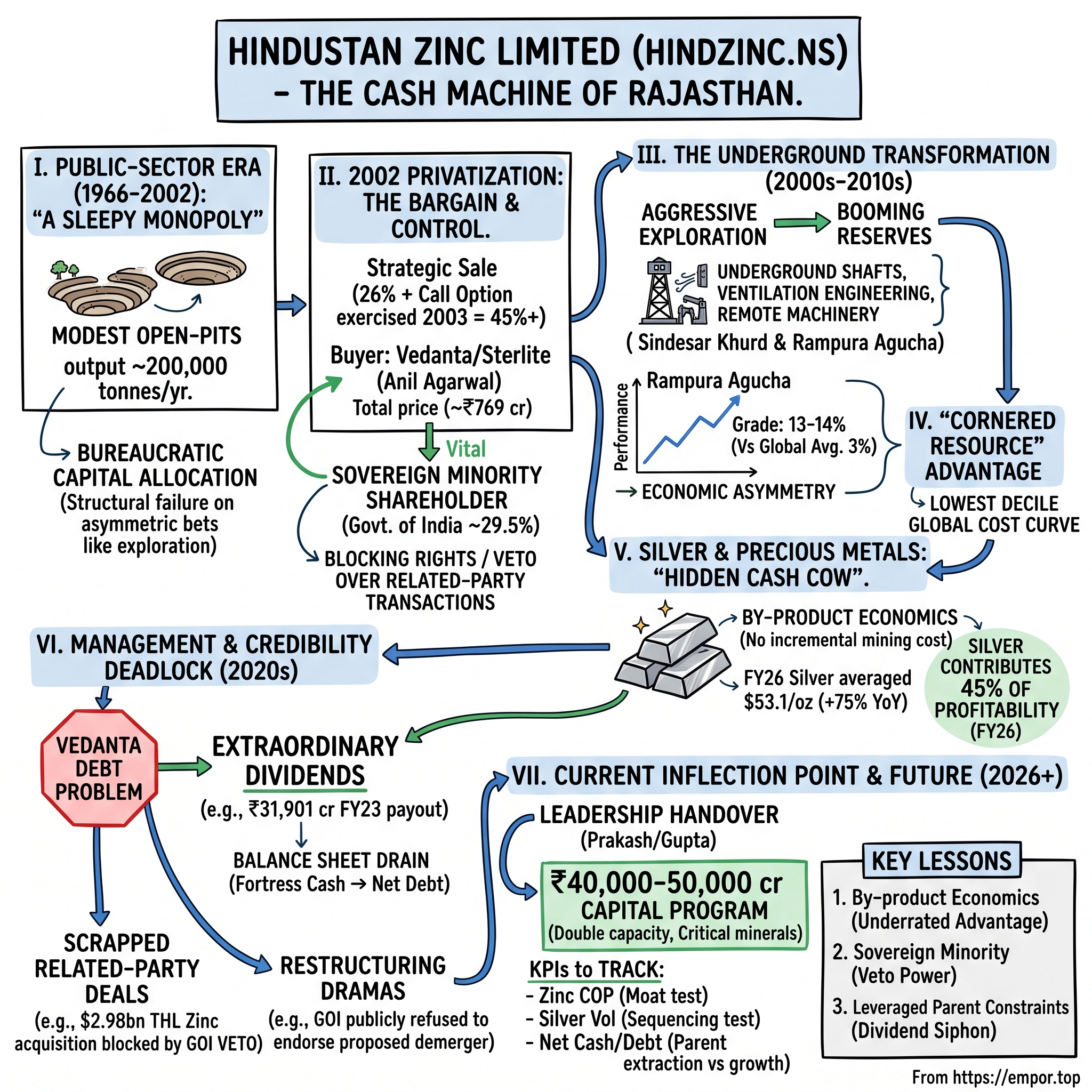
Hindustan Zinc: The Cash Machine of Rajasthan
I. Introduction & Episode Roadmap
Drive north-east out of Udaipur, past the lake palaces and the tourist buses, and the landscape flattens into the dry scrub of southern Rajasthan. Two hours later, in the district of Bhilwara, the road opens onto something that looks less like a mine than a wound in the earth: a terraced pit nearly a kilometre across, cut in concentric rings down into the rock. This is Rampura Agucha. For most of the last three decades, the ore hauled out of that pit — and now out of the tunnels beneath it — has been among the richest zinc ore mined anywhere on the planet.
The company that owns it was, for thirty-six years, a state enterprise notable mostly for being unremarkable. It ran modest open-pit operations, produced a couple of hundred thousand tonnes of metal a year, and generated the kind of returns that make finance ministries sigh. In 2002, the Government of India sold control of it. The total consideration for a 26% strategic stake was ₹445 crore. A follow-on tranche in November 2003 took the buyer's holding past 45% for another ₹324 crore — roughly ₹769 crore for 45% of the company in total.1
In the financial year that ended on March 31, 2026, that same company reported revenue of ₹40,844 crore, EBITDA of ₹22,162 crore, and net profit of ₹13,832 crore.2 The annual profit is now something on the order of eighteen times what the government received for nearly half the equity. Strategic disinvestment has produced few results this stark anywhere in the world.
But this is not a story about a bargain. It is a story about what happens after the bargain — about an asset so structurally advantaged that it generates cash almost regardless of who runs it, and about the twenty-four-year fight over where that cash goes. Because Hindustan Zinc Limited today sits at the intersection of three forces that rarely coexist so visibly in one listed company.
The first is geology. HZL's ore bodies in Rajasthan carry zinc grades that are multiples of the global average, and its lead-rich ores carry silver as a by-product. That combination places it in the lowest cost decile of the global zinc industry — a position that is not a management achievement so much as a gift from the Proterozoic, though management has spent two decades learning to exploit it properly.
The second is a parent with a debt problem. Vedanta Limited holds roughly 61% of HZL and sits beneath Vedanta Resources Limited, a London-domiciled holding company whose obligations have, for the better part of a decade, been serviced substantially by cash pulled up the chain from operating subsidiaries. HZL is the best of those subsidiaries. Its dividend policy has been shaped accordingly.
The third is a sovereign minority shareholder. The Government of India retained roughly 29.5% at privatisation and still held 27.92% as of March 31, 2026.3 It is not a passive holder. It has voted down a $2.98 billion related-party acquisition, publicly refused to endorse a proposed three-way demerger, and stationed nominee directors on the board specifically to scrutinise transactions with the parent.
Layered on top, in the last few months, is a leadership change. On June 19, 2026, HZL appointed Amarendu Prakash — until recently Chairman of the state-owned steel giant SAIL — as Chief Executive Officer-Designate, succeeding Arun Misra, who moved up to become Group CEO of Vedanta Limited.4 A new Chief Financial Officer, Amit Gupta, took office on June 1, 2026.5 A company that has been operationally led by the same hand since 2020 has changed both of its top executives inside a single quarter — while simultaneously announcing the largest capital programme in its history.
Over the next several sections we will work through how a sleepy public-sector monopoly became an automated underground mining operation; why Rampura Agucha and Sindesar Khurd are genuine cornered resources rather than marketing language; how silver quietly became the swing factor in HZL's earnings; what the fight over dividends and demergers actually reveals about who controls this company; and what a sceptical investor should watch to know whether the story is holding or breaking.
It begins, appropriately for India, with nationalisation.
 Subscribe on LinkedIn
II. The Sleepy State-Run Monopoly: Nationalization to Privatization (1966–2002)
The zinc of Zawar was old before the British arrived. In the hills south of Udaipur, archaeologists have documented retort furnaces used to smelt zinc metal centuries before European metallurgists worked out how to condense zinc vapour at scale — a genuinely difficult problem, because zinc boils below the temperature at which its ore reduces, so the metal wants to vaporise and burn away rather than pool at the bottom of the furnace. Rajasthani smelters solved it with downward-distillation retorts. Then the knowledge faded, the workings flooded, and the hills went quiet.
Modern mining at Zawar restarted in the 1940s under the Metal Corporation of India. In 1966, the Government of India took over those assets and folded them into a new public-sector enterprise called Hindustan Zinc Limited. The logic was the logic of the era: base metals were strategic, foreign exchange was scarce, and India intended to build its industrial base behind a wall of state ownership. Zinc mattered because zinc galvanises steel, and a country planning railways, transmission towers, and sheet-metal roofing needs galvanised steel or it watches its infrastructure rust.
For thirty-six years HZL did exactly what it was designed to do, which was not very much. It mined, it smelted, it employed people in Rajasthan, and it produced metal at a scale that would today be rounding error — output at the point of privatisation was roughly 200,000 tonnes per annum of mined metal.6 Exploration was chronically underfunded. Mining stayed shallow and open-pit, because open-pit is cheaper in the near term and public-sector capital budgets rarely reward decade-horizon thinking. The company was sitting on one of the world's great polymetallic provinces and treating it like a municipal utility.
It is worth pausing on why. The failure was not that state employees were incompetent — HZL's technical cadre was respected, and several of its long-serving engineers stayed on through privatisation and built the underground mines. The failure was one of capital allocation authority. A public-sector undertaking answerable to a ministry cannot easily commit hundreds of crores to drilling holes in the ground that may find nothing, because the downside is a Comptroller and Auditor General audit paragraph and the upside accrues to a successor's tenure. Exploration is the purest form of asymmetric bet: mostly failures, occasionally a Rampura Agucha. Bureaucracies are structurally bad at asymmetric bets.
Then came the window. The Vajpayee government's disinvestment programme, run through a dedicated ministry, shifted Indian policy from selling small minority stakes to selling control — strategic sales with management transfer. HZL had been earmarked for a 26% strategic sale as far back as August 2000.1 The bidding concluded in 2002, and Sterlite Industries, the vehicle of a Bihar-born scrap-metal trader turned metals industrialist named Anil Agarwal, bid ₹40.5 per share and won.1
The structure of that deal is the seed of everything that followed, and it deserves more attention than it usually receives. Sterlite did not simply buy 26%. It bought 26% from the government, picked up roughly another 20% from the public, and — critically — negotiated a call option allowing it to buy a further tranche from the state at the same price. It exercised that option in November 2003, acquiring 18.92% for ₹324 crore.1 The buyer thereby reached a commanding position for a price fixed years earlier, before anyone knew what exploration would reveal.
The government kept roughly 29.5%. That residual is the single most consequential term in the contract. Under Indian company law, a 25%-plus holder can block a special resolution. Under SEBI's related-party transaction rules, transactions above the materiality threshold require approval of the minority shareholders excluding the related party — which means, in HZL's case, that the state's block vote is effectively decisive on any material dealing with the parent. Whether by design or by accident of the disinvestment formula, India sold operational control while retaining a veto over value transfer.
That veto would sit dormant for two decades. In the meantime, the new owner had a company to rebuild — and a conviction, not yet shared by anyone else, that the real asset was not the metal HZL was producing but the metal it had never bothered to look for.
III. The Sterlite Takeover and the Great Underground Transformation (2002–2010s)
Imagine the first months after handover. On one side, an organisation with public-sector service rules, a seniority-based promotion ladder, and an institutional memory of budgets that arrived annually from Delhi. On the other, a promoter group whose operating instinct was to buy distressed metal assets, run them harder than the previous owner thought possible, and reinvest the cash into the next one. The cultures were not merely different; they were built for opposite objectives. One optimised for the absence of error. The other optimised for the presence of tonnage.
What Vedanta brought was not, initially, technology. It was a change in the question being asked. The public-sector question had been: how much can we produce from the reserves we have booked? The private-sector question was: how much is actually down there?
So they drilled. Sustained, aggressive, unglamorous exploration spending, year after year, aimed at converting geological inference into booked reserves. The result compounded quietly across two decades. As of March 31, 2026, HZL reported record ore reserves and resources of 468.6 million tonnes, containing 29.2 million tonnes of contained metal and 24.2 kilotonnes of contained silver — enough, at current mining rates, to underpin a mine life of more than twenty-five years.2
That last clause is the part investors should sit with. A mining company is a melting ice cube: every tonne sold is a tonne of the asset gone. The only defence is replacement, and replacement is a function of exploration success and grade. HZL has managed, through a period in which it roughly quintupled output, to grow its reserve base rather than deplete it — and in FY26 it crossed 13.9 million tonnes of reserves (the higher-confidence, economically demonstrated category) and 10.9 kilotonnes of silver reserves for the first time since the underground transition began.2 That is the single cleanest evidence that the exploration-first philosophy was not a slogan.
The scale-up itself came in phases that read almost like a manufacturing ramp: roughly 0.2 million tonnes per annum of mined metal at privatisation, about 0.5 MTPA by 2005, roughly 0.8 MTPA by 2008, and approximately 1 MTPA by the middle of the last decade.6 Each phase required a new smelter or a debottlenecked one, new power, and new mine capacity. India's own demand pulled it along — galvanised steel for infrastructure, construction, and automobiles — and HZL, as effectively the only primary producer of scale in the country, absorbed most of that growth.
But the hardest thing HZL ever did was not adding tonnes. It was changing how it mined.
Around 2012, the geology at Rampura Agucha forced a decision.6 An open pit is a cone: to go deeper you must strip an ever-wider ring of waste rock, and eventually the ratio of waste moved to ore recovered becomes economically absurd. The ore body at Agucha continued far below the practical limit of the pit. HZL could either accept decline, or commit to building a large-scale underground mine beneath an operating open pit — which is a bit like installing a basement under a house while the family lives upstairs.
Underground mining at this scale is a different industry. It requires sinking production shafts, in Agucha's case on the order of a kilometre deep, to hoist ore rather than truck it up a ramp. It requires ventilation engineering, because rock gets hot and diesel engines consume oxygen and emit particulates. It requires ground control, backfill, and a workforce that can operate remotely-guided machinery in confined spaces. It requires, above all, patience: the capital goes in for years before the tonnes come out.
The transition worked, but it was neither instant nor painless. Mined metal production dipped and plateaued during the changeover, and the cost base rose before it fell — underground mining is intrinsically more expensive per tonne than open-pit, and HZL's later cost leadership was achieved despite that structural headwind, not in the absence of it. The company only surpassed its pre-transition reserve and silver-reserve marks in FY26, more than a decade after the shift began.2 Anyone modelling a mining company's transition timeline should study that lag.
By FY26, HZL reached its highest-ever mined metal production of 1,114 kilotonnes, alongside refined metal output of 1,048 kilotonnes, having completed debottlenecking at the Chanderiya smelting complex on top of earlier enhancements at Dariba.2 Roughly a fivefold increase in mined metal from the privatisation base, achieved while migrating the flagship asset from surface to depth.
The strategic lesson generalises beyond mining. The value in this acquisition was never in the assets on the balance sheet at the time of purchase. It was in the option to spend capital that the previous owner had been institutionally incapable of spending. Which raises the obvious question about the flagship itself: what exactly is down there that justified all of it?
IV. The Crown Jewel: Rampura Agucha & The Integrated Smelting Moat
Here is the number that explains Hindustan Zinc better than any other single fact. The global average grade of zinc ore mined today runs in the low single digits — around 3% zinc content by weight is a reasonable benchmark for a commercial deposit. Rampura Agucha has been mined at roughly 13% in the open pit and around 14.1% in the underground operation.6
Translate that from geology into economics. If you are mining 3% ore, you must move, hoist, crush, and grind roughly thirty-three tonnes of rock to liberate one tonne of zinc. At 13%, you move under eight. Every fixed cost in the system — the drilling, the blasting, the trucks, the shaft, the mill, the labour, the diesel, the electricity — is spread across four times as much payable metal. Ore grade is not one input among many in mining. It is the master variable, and it is the one variable no amount of management brilliance can change. You either have it or you buy someone who does.
This is what Hamilton Helmer means by a Cornered Resource: preferential access to a coveted asset that independently enhances value. Nobody can build a second Rampura Agucha. Nobody can copy it, undercut it, or innovate around it. A competitor with better managers, cheaper capital, and superior technology mining 3% ore will still lose to an average operator mining 13% ore. That asymmetry is the entire foundation of HZL's business, and it is why the company's competitive position is best understood as geological rather than strategic.
Around that core sits the second power: Scale Economies, in the specific form of vertical integration. HZL is not merely a miner selling concentrate at the pit gate. Its mines — Rampura Agucha, the silver-rich Sindesar Khurd, Rajpura Dariba, the historic Zawar group, and Kayad — feed its own smelting complexes at Chanderiya, Dariba, and Debari, backed by captive power. Concentrate never leaves the system, which means HZL captures the treatment charge that an independent miner would pay a third-party smelter, and it is insulated from the notoriously volatile spot TC/RC market that whipsaws concentrate producers worldwide.
The result is visible in the cost line, and the trajectory over the last two years is the operating story of the company. Zinc cost of production excluding royalty was $1,052 per tonne in FY25. In FY26 it fell to $959 per tonne — a 9% year-on-year improvement and the lowest annual figure since the underground transition began. In the fourth quarter alone, it dropped to $903 per tonne, the lowest ever recorded.2
What drove it matters more than the number. Management attributed the improvement to lower power costs from higher domestic coal usage and softer coal prices, increased renewable energy in the mix, better by-product realisation, better mined grades, and higher metal volumes — partly offset by higher mine development spend.2 Read that list carefully: roughly half is structural (renewables displacing purchased power, grade, fixed-cost absorption from volume) and roughly half is cyclical (coal prices, by-product credits, which are simply high silver and lead prices flowing through as a cost offset). A sceptic is entitled to note that a cost number improved partly by high by-product prices will deteriorate when those prices fall, mechanically, without anything going wrong operationally. HZL's own FY27 guidance implicitly concedes this: the company guided to zinc cost of production of $975–1,000 per tonne for FY27, above the FY26 outturn.2 Management is telling you the $903 quarter was a peak, not a run rate.
Still, the position holds. A cost base under $1,000 per tonne places HZL firmly in the lowest decile of the global zinc cost curve. In a commodity business, cost curve position is the only durable form of pricing protection, because it determines who survives the trough. When zinc prices fall — and in FY26 the average realised zinc LME price was $2,970 per tonne, up only 3% year-on-year even as revenue rose 20%, which tells you the year was made by silver rather than zinc2 — high-cost mines in Australia, Europe, and North America curtail production, supply tightens, and prices eventually recover. HZL keeps mining through the cycle. It does not merely survive downturns; it benefits from them, because competitor shutdowns are what rebalance the market.
Domestically, the position is close to unassailable. HZL supplies to more than 40 countries and holds a market share of about 74% of India's primary zinc market.2 The remainder is served largely by imports, because India simply does not host another zinc-lead province of comparable scale. That gives HZL a landed-cost advantage against imports — freight, insurance, and duty are structural friction that a domestic producer collects for free — without needing pricing power in the conventional sense.
And that caveat matters. HZL is a price taker. Zinc is a fungible commodity quoted on the London Metal Exchange; the company sells at LME-linked prices with a modest premium and cannot decide to charge more. Its advantage is entirely on the cost side of the equation, which means its earnings are levered to commodity prices in a way no operational excellence can offset. Investors sometimes describe HZL as having a moat and infer pricing power. It has a moat and it has margin power. The two are not the same thing, and conflating them is the most common analytical error made about this company.
Which brings us to the part of the ore body nobody was really thinking about when Vedanta bought it.
V. The Hidden Cash Cow: Silver & Precious Metals
Sindesar Khurd was never supposed to be the headline. It is a lead-zinc mine in the Rajsamand district, developed as part of the broader expansion programme, notable in engineering circles for its mechanisation and, more recently, for hosting India's first battery-electric underground vehicles. But lead ore in this district carries silver — and as HZL's lead output grew, so did a metal stream that appeared on no one's original investment thesis.
The economics of by-product silver are worth explaining slowly, because they are genuinely unusual and they are the single largest driver of HZL's recent earnings.
When a mining company produces two metals from the same rock, it must allocate costs between them. In practice, most operators treat the primary metal as the reason the mine exists and credit the secondary metal's revenue against the cost of producing the primary. Under that convention, silver at HZL has essentially no attributable cash cost. The drilling, blasting, hoisting, grinding, and flotation were all going to happen anyway to produce zinc and lead. The silver arrives in the lead concentrate as a passenger. The only genuinely incremental cost is the refining step that separates it out.
The consequence is that HZL's silver revenue converts to profit at a rate that no dedicated primary silver miner can match. A primary silver producer must cover its full mining cost from the silver price alone; when silver falls, its margin compresses hard. HZL's silver margin barely moves, because its cost was already covered.
Now apply a price cycle to that structure. In FY26, silver averaged $53.1 per troy ounce, up 75% year-on-year — and in the fourth quarter it averaged $84.3, up 165% from the same quarter a year earlier.2 HZL's silver revenue for the year came in at ₹9,841 crore, up 61%, and in the fourth quarter alone silver revenue was ₹4,032 crore, up 139% year-on-year.2 For context, quarterly silver revenue in Q4 FY26 was well over half of quarterly zinc revenue of ₹6,997 crore, from a metal that contributes almost nothing to the cost line.
The company stated plainly that silver, at 627 tonnes of annual production, contributed 45% of overall profitability.2 That is a remarkable disclosure for a business that most investors still describe as a zinc company. Nearly half the profit came from the by-product.
Two important qualifications, both of which a promotional treatment would skip.
First, volume went the wrong way. Silver production fell 9% in FY26, from 687 tonnes to 627 tonnes, tracking a 13% decline in refined lead output.2 The earnings explosion was a price event, not a production event. Investors extrapolating FY26 silver economics forward are extrapolating a commodity price, and silver is among the most volatile major commodities in existence — it reached an all-time high above $121 per ounce in January 2026 before consolidating to the $79–80 range by mid-April.7 A company that earns 45% of its profit from a metal that halved and re-doubled inside a single fiscal year has a genuinely volatile earnings stream, however stable its cost base.
Second, the ranking claim deserves scrutiny. HZL has publicly described itself as the world's third-largest silver producer.8 Its own FY26 results release, issued in April 2026, described the company as "amongst the top 10 silver producers globally."2 Both statements can be technically true at different moments — rankings shift with peer output, and HZL's own silver volume declined — but the quiet downgrade in the company's self-description, from a specific top-three claim to a top-ten band, is exactly the kind of language drift worth noticing in investor materials. The 9% production decline is the likely explanation. Management has guided to 680 tonnes of saleable silver in FY27,2 which if delivered would reverse the slide; that guidance is now the cleanest test of whether the FY26 dip was a mine-sequencing artefact, as management has framed it, or the start of something structural.
The demand backdrop is genuinely constructive but not one-directional. The Silver Institute has projected a sixth consecutive annual structural deficit in the silver market in 2026.7 Solar photovoltaics, historically the largest industrial consumer, has responded to high prices by "thrifting" — engineering less silver into each cell — with PV silver demand reportedly falling sharply in 2026 even as the overall market stayed in deficit.7 That is the classic commodity dynamic: high prices call forth substitution and efficiency, which caps the upside. Silver's bull case now leans more on investment demand, electronics, and AI-datacentre-related hardware than on the solar story that dominated the narrative three years ago. Investors should update the reason they own the exposure, not just the exposure.
The strategic point is this: HZL's by-product silver is a structurally advantaged position in a cyclically dangerous commodity. The advantage is real and permanent. The earnings it produces are neither. And in FY26, that windfall arrived precisely when the company's controlling shareholder needed cash more than at any point in its history.
VI. The Corporate Governance Tug-of-War: Vedanta Debt & The Dividend Siphon
Every investor in Hindustan Zinc eventually has to confront an uncomfortable fact: they do not control the capital allocation of the company they own. Someone else does, and that someone has obligations of their own.
The structure runs like this. Vedanta Resources Limited, incorporated and financed abroad, sits at the top. Beneath it, through intermediate holding vehicles, sits Vedanta Limited, listed in India. Vedanta Limited held roughly 60.71% of Hindustan Zinc as of March 31, 2026, with total promoter holding around 61.84%.3 Cash flows up that chain in three principal forms: dividends, brand and strategic services fees, and — where the operating companies permit it — intercompany arrangements.
The compression point is that Vedanta Resources carries substantial debt at the top of the structure while owning no operations of its own. Its ability to service that debt depends on extracting cash from below. And the single most cash-generative entity in the group is HZL.
The extraction reached its most spectacular in FY23. Hindustan Zinc declared dividends totalling ₹31,901 crore — ₹75.50 per share, paid across four interim tranches during the year.9 To put that in perspective, it exceeded the company's entire net profit for that year by a wide margin, and it drained an accumulated cash pile that had taken years of disciplined operation to build. A company that had long been characterised by a fortress net-cash balance sheet was pushed into net debt; by the end of FY25, HZL carried a modest net debt position.
The recovery since has been genuine. As of March 31, 2026, HZL held gross cash and investments of ₹13,846 crore against total borrowings of ₹8,252 crore — a net cash position of roughly ₹5,594 crore — and maintains a AAA credit rating from CRISIL.2 Free cash flow before growth capex was ₹13,337 crore for the year.2 The balance sheet healed, but it healed because a silver price shock arrived, not because dividend policy changed. The first interim dividend of FY27 was declared at ₹11 per share, amounting to approximately ₹4,648 crore in total payout, up from ₹10 the prior year.10
This is where an activist would start asking questions, and several already have.
In 2025, the short-seller Viceroy Research published a series of reports on the Vedanta group, characterising Vedanta Resources as "a parasite holding company with no meaningful operations of its own, propped up entirely by cash extracted from its dying host," and alleging that interest and principal repayments were funded almost entirely through dividends and brand fees that were neither sustainable nor at arm's length.11 Viceroy specifically flagged brand fees totalling $338 million across FY23–24, questioned their commercial justification given that subsidiaries market products under their own brands, and calculated a free-cash-flow shortfall against declared dividends at Vedanta Limited exceeding $5.6 billion across FY22–FY25.11
The group rejected the allegations, and a detailed legal opinion issued by former Chief Justice of India D.Y. Chandrachud concluded that the group's conduct complied with Indian law and regulatory frameworks.12 That opinion addresses legality. It does not address the separate question a minority investor actually cares about, which is whether the pattern of capital allocation optimises for HZL's shareholders or for the holding company's maturity schedule.
Two disclosures from the last few weeks make the entanglement concrete and current.
On June 30, 2026, Vedanta Limited created an encumbrance over 50.10% of its shareholding in HZL — a non-disposal undertaking — to secure a ₹1,624 crore facility availed by its subsidiary Ferro Alloys Corporation Limited.13 The HZL stake, in other words, is collateral for group borrowing unrelated to HZL's own business.
Then, on July 15, 2026, Twin Star Holdings as borrower and Vedanta Resources as guarantor entered into a $1 billion facility agreement. HZL disclosed it to the exchanges on July 18, 2026 under SEBI LODR Regulations 30 and 30A, clarifying that HZL is not a party to the agreement — but that the facility imposes covenant-based restrictions on HZL itself, including limits on creating security over its assets, on selling assets outside the ordinary course of business, and on investing in or acquiring material assets or businesses outside the core mining and metals sector.14 The company stated that the impact could not be quantified in monetary terms because the restrictions are covenants rather than financial obligations.14
Sit with that for a moment. A promoter-level borrowing, to which the listed company is not a party, contractually constrains what the listed company may do with its own balance sheet — three weeks after that company's shareholders approved a strategy of expanding into critical minerals. Whether those covenants prove binding in practice is unknown. That they exist is a governance fact that belongs in any assessment of HZL's strategic freedom.
The government's position throughout has been consistent: as the largest minority shareholder, it has argued that HZL's capital is better deployed in mine expansion, safety, and domestic capacity than in servicing obligations further up a chain it does not own. The state has also been notably unhurried about exiting. Reports in June 2026 suggested the Centre was weighing a sale of about 2% to raise roughly ₹5,000 crore,15 and HZL formally clarified to the exchanges that it had received no communication from the government regarding divestment of the residual stake.16 The steady dividend stream is, from the state's perspective, an argument for staying.
Which is precisely why the parent has repeatedly tried to restructure its way around the problem.
VII. The Scrapped Deals and Restructuring Dramas: THL Zinc & The Demerger War
January 2023. Vedanta Resources faced a wall of bond maturities, and the group needed dollars — not rupees trapped in an Indian subsidiary, but hard currency at the holding company level. A dividend from HZL is taxed and diluted on its way up, and 38-odd percent of every rupee paid leaks to minority shareholders including the Indian state. There is a more efficient route: sell an asset to HZL for cash.
So Vedanta proposed exactly that. HZL would acquire THL Zinc Ltd, Mauritius — the vehicle holding the group's international zinc assets, principally Black Mountain Mining in South Africa (zinc, lead, silver, copper) and the Skorpion zinc refinery in Namibia — for $2.98 billion in cash.17
The strategic rationale offered was diversification: HZL would become a global zinc player rather than a single-country producer, gaining assets including the large Gamsberg deposit. The rationale was not absurd on its face. It was, however, a transaction in which the buyer and seller shared a controlling shareholder, the consideration was 100% cash, and the cash would travel directly from a company where the government owned 29.54% to a company where it owned nothing.
The government's response was unusually direct. The Centre opposed the offer publicly, said it would vote against any related resolutions, and indicated it would explore all legal avenues available to it. The mines ministry urged Vedanta to consider cashless structures — a share swap, for instance, which would have transferred the assets without draining HZL's balance sheet.17 Reports indicated the government intended to vote the deal down at the extraordinary general meeting.18
The deal never reached a vote it could win. By May 2023, the proposal lapsed: three months had passed without the requisite shareholder clearance, and HZL confirmed the process was closed.19
This was the moment the theoretical veto became a demonstrated one. For twenty-one years the government's 29.54% had been a line in a shareholding table. In 2023, it became the reason a $2.98 billion transaction did not happen. For a minority shareholder in HZL, that single event is worth more than any governance policy document the company could publish — it is behavioural evidence that a structural check exists and will be used.
Denied the direct route, the group pivoted to a structural one. On September 29, 2023, HZL's board directed management to explore a corporate restructuring creating separate legal entities for zinc and lead, for silver, and for the recycling business.20
The stated rationale was value unlocking, and it is not without merit as a matter of market mechanics. Pure-play silver producers trade at valuation multiples that base-metal miners do not, because silver attracts investors seeking precious-metals exposure who will not buy a zinc company to get it. Carving out the silver stream into a separately listed entity could plausibly attract that capital and re-rate the asset. The FY26 numbers, where silver drove 45% of profitability while the company was still valued as a zinc business, made the argument look stronger than ever.
The government did not buy it, and its objections were substantive rather than reflexive.
The first is physical. Zinc, lead, and silver at HZL are not separate businesses that happen to share an office. They come out of the same ore body, are separated in the same flotation circuits, and are refined in the same integrated smelters. Silver is recovered from lead concentrate during smelting and refining. You cannot demerge them the way you demerge an aluminium division from an oil division; you would have to construct an elaborate architecture of intercompany supply agreements, transfer prices, and shared-service arrangements to simulate a separation that does not physically exist. Every one of those transfer prices becomes a new related-party transaction — which is to say, a new opportunity for value to move in directions minority shareholders cannot control.
The second is transactional. The government has been trying to monetise its residual holding for years, most recently selling roughly 1.6% via an offer for sale in November 2024 that raised about ₹3,449 crore.16 Converting one liquid holding into three separate holdings in three newly listed entities of uncertain liquidity makes that exit materially harder to execute.
Mines Secretary V.L. Kantha Rao put the position without diplomatic padding: the government was "not convinced as a shareholder," adding, "Demerger, anyways, we have not agreed."20
The proposal has not died. Management has continued to raise it, telling investors it would keep discussing the plan with the government,21 and in April 2026 — with silver prices at extraordinary levels — indicating that groundwork on a demerger could begin in FY27, a signal that moved the stock more than 6% on the day.20 Whether renewed enthusiasm during a silver price spike strengthens or weakens the credibility of the value-unlocking argument is a fair question. Proposing a silver carve-out when silver is at record prices is defensible timing for a seller and questionable timing for a long-term owner.
Meanwhile the parent completed its own restructuring. The Mumbai bench of the NCLT approved Vedanta Limited's demerger into five listed entities on December 16, 2025, with the power division cleared on January 9, 2026; the scheme became effective April 1, 2026, with listings completed by May 2026 and roughly ₹48,000 crore of group debt allocated across the resulting companies.22 Hindustan Zinc remained with the residual Vedanta Limited, which retained its roughly 60% holding.23 The group reorganised around HZL. HZL itself did not move.
Into that unresolved standoff walked a new chief executive.
VIII. Management, Credibility & The June 2026 Leadership Handover
Arun Misra's final quarter as CEO could hardly have been better scripted. On April 24, 2026, he presented record annual results and told the market that the company had crossed "a key milestone of 1.1 million tonnes of mined metal production" while delivering record quarterly refined metal output "at the lowest cost of production of $903 per tonne despite the ongoing geopolitical challenges."2 Then he was elevated to Group CEO of Vedanta Limited, and on June 19, 2026, HZL announced Amarendu Prakash as CEO-Designate.4
Consider what that sequence signals. The executive who ran HZL through the underground ramp, the THL controversy, and the demerger standoff was promoted to run the entire group — a group whose most urgent problem is converting subsidiary cash flow into holding-company solvency. Whatever else it means, HZL's operating discipline is now the template the parent intends to apply everywhere, and the person most familiar with HZL's cash generation now sits on the receiving end of it.
Amarendu Prakash is an unusual choice, and an interesting one. He arrives from the chairmanship of the Steel Authority of India Limited, the state-owned steel producer — three decades in a public-sector industrial giant, with a background spanning operations, project execution, and strategic management.24 SAIL is not a nimble organisation, but running it demands a specific competence set: managing enormous fixed-asset bases, executing multi-year capital projects through Indian permitting and land-acquisition processes, and — crucially — operating fluently in the environment where boardrooms meet ministries.
That last skill is almost certainly the point. HZL's operational problems are largely solved; its unresolved problems are political. A demerger requires government assent. A ₹40,000–50,000 crore capital programme requires mining leases, environmental clearances, and state cooperation in Rajasthan. Critical-minerals expansion requires block auctions run by the Ministry of Mines. Appointing a former PSU chairman to lead a company whose largest minority shareholder is the Government of India is a legible strategic decision, and arguably a better-targeted one than hiring another mining engineer.
The risk is symmetric. Prakash is a steel man, not a base-metals or underground-mining man, arriving at a company whose core competence is deep hard-rock mining and hydrometallurgy. He inherits a business at a cyclical peak, where the year-on-year comparisons for FY27 will be brutal if silver mean-reverts. And he inherits it alongside a brand-new CFO: Amit Gupta took office June 1, 2026, succeeding Sandeep Modi. Gupta is a career Vedanta insider — with the group since July 2006, with roles across Cairn, Vedanta Corporate, and BALCO, most recently Deputy CFO of Vedanta Aluminium and CFO of the Jharsuguda operations — a chartered accountant with more than 22 years of group experience.5 The pairing is telling: an outsider with government fluency in the operating seat, a group loyalist controlling the finance function.
Priya Agarwal Hebbar, daughter of the group founder, has served as Chairperson since January 2023,25 which keeps board-level strategic direction aligned with the promoter. On the other side sit the government nominee directors, whose function on this board is not ceremonial — the THL episode demonstrated what happens when they and the ministry behind them decide a transaction is unacceptable.
On management credibility, the record splits cleanly in two, and honest assessment requires holding both halves.
On operations, the track record is strong and verifiable. Guidance has generally been met or beaten. FY26 delivered mined metal at the upper end of expectations, cost of production below prior-year levels for the second consecutive year, and completed projects at Chanderiya and Dariba. The project pipeline is disclosed with specific dates rather than vague ambitions: a 510 ktpa fertiliser plant targeted for completion by Q2 FY27, hot acid leaching technology at Dariba for lead and silver recovery from smelting waste by Q2 FY27, a 250 ktpa integrated refined zinc expansion targeted for Q2 FY29, and India's first 10 million tonne per annum tailings reprocessing plant at Rampura Agucha targeted for Q4 FY28.2 Named projects with named quarters are how credible operators communicate; they create a scoreboard the market can check.
FY27 guidance follows the same pattern: 1,150 ±10 kt mined metal, 1,100 ±10 kt refined metal, 680 ±10 tonnes of saleable silver, zinc cost of production of $975–1,000 per tonne, and growth capex of $500–600 million.2 Note that this guidance is honest about cost inflation and about capex stepping up materially — it is not a document written to flatter.
On strategy and capital allocation, credibility is weaker, and for structural reasons. The narrative has shifted repeatedly in response to parent-level pressures rather than operating logic: a global acquisition in 2023, then a three-way demerger, then a demerger deferred, then a demerger revived in 2026, alongside a dividend policy whose peak year drained the balance sheet into net debt. Each individual decision has had a rationale. The pattern, viewed across four years, looks less like a strategic plan than like a sequence of responses to a financing problem that does not originate at HZL. That is not a character judgment about the executives; it is an accurate description of what it means to be the profitable subsidiary of a leveraged holding company.
Hedging deserves a mention here too, because it is where financial policy becomes visible. On the Q4 call management disclosed forward positions for FY27 — 71 kilotonnes of zinc hedged at $3,225 per tonne and 59 tonnes of silver at $60 per troy ounce, with Q1 FY27 positions of 20 kt of zinc at $3,100 and 25 tonnes of silver at $57.10 Hedging a modest fraction of output at prices above the prior year's realisation is defensible risk management. It also means a portion of any further upside is already sold, and investors should not model spot prices against ungated volumes.
The immediate test of the new team arrives quickly: HZL scheduled its Q1 FY27 results for July 24, 2026.26 It will be the first quarter in which the new CEO and CFO must explain results shaped by decisions they did not make, against a comparison base set at the top of a silver spike.
IX. Operational Decarbonization: Green Power (Serentica) & Fleet Electrification
Go a kilometre underground at Sindesar Khurd and the first thing you notice is heat. Rock temperature rises with depth; add diesel engines burning fuel in a confined space, and you have created an environment that must be continuously cooled and ventilated. That ventilation is not a minor overhead — moving enough air down a shaft and through kilometres of tunnels to keep hundreds of workers safe is one of the largest single power draws in a deep mine. Underground ventilation is, in effect, a tax that diesel imposes on every tonne mined.
Which is why HZL's electrification programme is best understood as a cost project that happens to have an emissions benefit, rather than the reverse.
In January 2023, HZL deployed India's first battery-operated vehicle in an underground mining operation, working with the Finnish equipment maker Normet to induct SmartDrive battery-electric service and utility vehicles at Sindesar Khurd.27 Separately, Sandvik signed a memorandum of understanding to supply a battery-electric underground fleet to the same mine, including an LH518B loader, three TH550B trucks, and a DD422iE drill rig featuring the company's patented "charging-while-drilling" technology — the rig plugs into the mine's electrical supply while working and recharges itself, eliminating separate charging downtime.28 HZL has stated an intention to convert its roughly 900 diesel mining vehicles to battery power over a five-year horizon, with investment earmarked at over $1 billion.[^29]
The operating case is straightforward once you understand the ventilation problem. Remove diesel combustion and you remove diesel particulate matter, a recognised carcinogen and a persistent occupational health liability. You lower ambient temperature. And you cut the volume of air that must be forced underground, which cuts the fan power bill. Electric drivetrains also have fewer moving parts and lower maintenance intensity. The capital cost per unit is higher; the operating cost is meaningfully lower, and the health and safety exposure drops.
The honest caveat: a $1 billion, 900-vehicle, five-year conversion is a stated ambition, and progress disclosure has been sparse relative to the size of the number. Investors should treat fleet electrification as an option with real economics rather than as a programme with a verified delivery schedule, and should look for HZL to report converted-unit counts and realised ventilation savings the way it reports project completion dates elsewhere.
The power side of decarbonisation is further along and more concrete. On March 11, 2025, HZL signed a power delivery agreement with Serentica Renewables that augmented its round-the-clock renewable supply to 530 MW, up from a previously contracted 450 MW.[^30] The structure is the interesting part. This is not a conventional solar PPA that delivers power when the sun cooperates. It is a first-of-its-kind round-the-clock arrangement guaranteeing a minimum of 315 MW of uninterrupted supply in every fifteen-minute time block, achieved by combining solar, wind, and energy storage, under a captive structure with generation assets spread across high-resource sites in India.[^30] Serentica will supply for 25 years, and HZL's board approved investing ₹3.27 billion for a 26% equity stake in Serentica and its affiliates — the shareholding required under Indian captive-generation rules.29 The project is set to be fully operational by 2027.
Why does the time-block guarantee matter so much? Because a smelter cannot be intermittent. Electrolytic zinc production runs continuously; interrupt the current and you damage the cell house. For an industrial user with a flat, unforgiving load curve, renewable energy is only useful if it is firm. The Serentica structure converts variable renewables into something a smelter can actually consume, and once operational will lift renewables to over 70% of HZL's total power requirement.[^30]
The financial logic is more compelling than the environmental logic, and management has been reasonably candid about this. Power is among the largest components of zinc cost of production, and HZL's FY26 cost improvement was attributed in part to increased renewable energy usage alongside cheaper domestic coal.2 A 25-year contract at a fixed structure replaces exposure to coal price volatility and grid tariff escalation with a known cost. In an industry where cost curve position determines survival, locking a majority of your energy cost for a quarter-century is a competitive act, not a compliance one.
The recognition has followed. HZL secured a top 1% ranking in the S&P Global Sustainability Yearbook 2026,30 having previously held the number one position in the metals and mining category in the Corporate Sustainability Assessment. It launched EcoZen, described as Asia's first low-carbon zinc brand with a carbon footprint 75% below the global average, and has partnered with Tata Steel and Silox India on adoption for galvanised steel production — an early attempt to convert a green attribute into a commercial premium in a market that has historically paid only for purity and delivery.2 Whether low-carbon zinc commands a durable price premium in India remains unproven; European buyers have shown some willingness to pay, Indian buyers less so. It is an option, not yet a revenue line.
All of which sets up the more interesting question: what is the transferable lesson here for anyone evaluating a resource business?
X. Playbook: Business & Investing Lessons
Strip away the Rajasthani specifics and Hindustan Zinc offers three lessons that generalise well beyond mining.
Lesson 1: By-product economics are the most underrated structural advantage in resources.
When two metals come out of the same rock, the accounting convention that credits one against the cost of the other creates a genuine economic asymmetry, not merely a presentational one. The secondary metal's margin is nearly invariant to its price, because its cost was already covered. HZL's FY26 demonstrated this at scale: silver contributed 45% of profitability from a stream carrying essentially no attributable mining cost.2
The investment implication is that when screening resource companies, you should look specifically for co-mingled deposits where a high-value metal rides along with a bulk one. Copper mines with meaningful gold credits, lead-zinc mines with silver, nickel operations with platinum-group metals — these businesses have a cost structure that dedicated producers of the precious metal cannot replicate, and they are frequently valued as though they were pure plays on the base metal.
The counter-lesson matters equally: by-product leverage cuts both ways on volume. HZL's silver output is not a decision variable. It is determined by how much lead ore the mine plan calls for and what grade that ore carries. Management cannot choose to mine more silver because silver is expensive; it can only sequence the mine plan at the margin. That is why FY26 silver volumes fell 9% during the greatest silver price rally in decades.2 A pure-play silver miner would have pushed production hard into that price. HZL could not.
Lesson 2: A minority stake in a subsidiary of a leveraged parent is a different security than it appears.
You own the cash flows. You do not own the decision about what happens to them. HZL's operating performance and HZL's shareholder outcome are related but distinct variables, and the connecting function is set by someone whose priorities are visible in Vedanta Resources' maturity schedule rather than in HZL's project pipeline.
This is not automatically bad. Minority holders of HZL have received extraordinary dividends precisely because the parent needed cash — the ₹31,901 crore FY23 payout enriched every shareholder, not just the promoter.9 The structural bias runs toward distribution rather than empire-building, which in a cyclical commodity business is often the better policy anyway.
But it imposes three costs. It limits the retained cash cushion available to absorb a downturn or fund counter-cyclical acquisition. It generates a steady stream of related-party transactions, each of which requires scrutiny. And, as the July 2026 facility agreement showed, it can transmit constraints from the parent's borrowing directly into the subsidiary's operating freedom — including restrictions on acquisitions outside core mining and metals, disclosed by HZL as covenant-based and unquantifiable in monetary terms.14 Anyone underwriting this security should price the promoter structure as a live variable, not as background.
Lesson 3: Governance is a mechanism, not a policy document.
The most valuable governance feature at HZL is not a code of conduct. It is the arithmetic of a 27.92% shareholder with statutory blocking rights, institutional independence from the promoter, and demonstrated willingness to use both.3 That combination stopped a $2.98 billion cash transfer17 and has held up a restructuring for nearly three years.20
The generalisable insight is that when evaluating a company with a dominant shareholder, the question is not "does the board have independent directors?" It is: who, specifically, can stop a bad transaction, do they have the votes, and have they ever actually done it? Independent directors nominated through a promoter-influenced process rarely clear that bar. A sovereign shareholder with a 25%-plus block and a public track record of voting against management does.
The corollary is a genuine risk, and it is one bulls on this stock rarely acknowledge. That protection is contingent on the government continuing to hold. Reports in June 2026 of a possible 2% sale to raise ₹5,000 crore15 are a reminder that the state's stake is officially destined for eventual disposal. Every tranche sold moves the block closer to the 25% threshold below which the veto weakens materially. The most important governance asset at Hindustan Zinc is, by policy, for sale.
Applying Helmer's framework directly, HZL scores high on exactly two of the seven powers, and honestly on the rest. Cornered Resource is unambiguous and dominant — the grade at Rampura Agucha cannot be competed away. Scale Economies is real through integrated mine-to-smelter infrastructure and India's largest primary zinc position at roughly 74% share.2 Process Power is moderate: two decades of underground mining, automation, and tele-remote drilling — the company introduced tele-remote drilling on two long-hole production drills at Rajpura Dariba in FY262 — constitute accumulated capability that a new entrant could not assemble quickly. But Switching Costs are essentially absent, because zinc is a commodity priced off the LME. Branding is negligible; EcoZen is an early experiment. Network Effects and Counter-Positioning do not apply.
Two strong powers and one moderate one is enough to build an exceptional business. It is not enough to make that business's earnings predictable, and the distinction is where the bull and bear cases separate.
XI. Analysis & Bear vs Bull Case
The bull case, stated at its strongest.
Start with duration. HZL's reserves and resources of 468.6 million tonnes support a mine life exceeding 25 years at current rates.2 Very few businesses of any kind have twenty-five years of visible raw material. For a mining company, this removes the existential question — replacement risk — that hangs over most of the sector.
Add cost position. At $959 per tonne for FY26 excluding royalty,2 HZL operates in the lowest decile of the global zinc cost curve, and the improvement is partly structural: renewable power under a 25-year contract, higher grades, and volume absorbing fixed costs. In a commodity business, the low-cost producer is the last one standing in a trough and the biggest beneficiary of the recovery that competitor closures create.
Add optionality on silver. Nearly half of FY26 profitability came from a metal facing a projected sixth consecutive structural supply deficit,7 produced at effectively zero incremental cost. If silver stays elevated, HZL's earnings power is far above what a zinc-multiple valuation implies. If a separately listed silver entity ever emerges, the re-rating argument is straightforward.
Add growth. At its 60th AGM on June 29, 2026, shareholders approved a strategy to invest roughly ₹40,000–50,000 crore over five years to double capacity from 1.1 to 2 million tonnes per annum, expand into critical minerals including tungsten, potash, and rare earths, and grow metal reserves substantially while extending mine life beyond 25 years.31 The company executed a deed for a composite licence over the Nawatola Laband rare earth elements block in Sonbhadra district, Uttar Pradesh, on June 27, 2026 — 210 hectares.31 India's critical minerals policy push gives this a policy tailwind that a foreign entrant would not enjoy.
Add balance sheet. Net cash of roughly ₹5,594 crore and a CRISIL AAA rating2 mean the expansion is fundable without balance-sheet stress at current prices.
The bear case, stated at its strongest.
The most important bearish observation is simple: FY26 was a price year, not a volume year. Mined metal grew 2%, refined metal fell slightly, and silver production fell 9%.2 Revenue rose 20% and profit rose 34% because silver averaged 75% higher and the rupee weakened. Strip out the price and currency effects and the underlying operating business grew modestly. Extrapolating FY26 economics is extrapolating a commodity spike, and management's own FY27 cost guidance of $975–1,000 per tonne — above FY26's outturn — signals that the by-product credits and coal price relief that drove the cost improvement are not permanent.2
The second is the parent. The dividend policy is set by a shareholder with obligations outside HZL. The FY23 payout of ₹31,901 crore drove the company into net debt at exactly the moment it should have been accumulating for a capital cycle.9 The company now proposes to spend ₹40,000–50,000 crore over five years31 while continuing to distribute aggressively — ₹4,648 crore in the first interim dividend of FY27 alone.10 Those two policies are in tension. If commodity prices normalise, something has to give, and history suggests it will not be the dividend. Add the collateralisation of the promoter's HZL stake for unrelated group borrowing13 and the covenant restrictions transmitted from the July 2026 Twin Star facility,14 and the governance overhang is not historical — it is current and expanding.
The third is the structural deadlock. Nearly three years after the board directed exploration of a three-way split, the government remains publicly unconvinced.20 The proposal is neither dead nor alive. That is the worst state for an overhang, because it periodically moves the stock on headlines while never resolving.
The fourth is commodity beta. HZL sells into LME-determined prices. Zinc demand is driven overwhelmingly by galvanised steel, which is driven by construction and infrastructure, which is driven disproportionately by China. A Chinese property and industrial slowdown transmits directly to zinc prices and therefore to HZL's earnings, with no operational lever to offset it. And silver's own bull case has a substitution problem: solar photovoltaics, historically its largest industrial buyer, cut silver intensity sharply in 2026 in response to high prices.7 High prices are curing high prices.
Porter's Five Forces, applied briefly and honestly.
Rivalry within India is minimal — HZL holds roughly 74% of the primary zinc market with no domestic peer of comparable scale.2 Globally, rivalry is intense but structurally muted for a first-decile producer, since the marginal competitor sets the price and HZL sits far below them on cost.
Threat of new entrants is close to nil in India. Deposits of this grade and scale are not being discovered domestically, and even if one were, the lead time from discovery to production is a decade-plus.
Supplier power is moderate but managed. Power was the key exposure, and the Serentica structure converts a volatile input into a contracted one.[^30] Mining equipment suppliers — Sandvik, Epiroc, Normet — have some leverage in a specialised market, though HZL's scale makes it a customer they want.
Buyer power is the genuinely weak flank. Buyers pay LME plus a premium; the premium is negotiable, the LME is not. Zinc is fungible, and no galvaniser pays extra for HZL's brand. EcoZen is an attempt to change this and remains unproven.
Substitutes are a slow-burn structural risk worth taking seriously. Zinc's core use is corrosion protection for steel. Aluminium substitution in automotive body panels, composites in construction, and improved coating technologies that use less zinc per square metre all nibble at intensity of use over decades. Nothing here is a five-year threat. Over twenty-five years — the length of HZL's reserve life — it is a real consideration.
The activist stress test. A sceptical investor looking at HZL today would press hardest on four things. First, disclosure quality on related-party economics: brand and strategic services fees paid to the promoter group have been publicly challenged as lacking commercial justification,11 and the group's defence has been framed as legal compliance rather than commercial arm's-length benchmarking.12 Second, the coherence of doing a record capital programme and a record dividend simultaneously — one of those is the real priority, and the market deserves to know which. Third, the demerger: either execute it or withdraw it, because a permanent maybe is value-destructive. Fourth, the covenant restrictions from the parent's July 2026 borrowing that limit HZL's ability to invest outside core mining and metals14 — announced within weeks of shareholders approving a critical-minerals diversification strategy.31 Those two facts sit uncomfortably together, and reconciling them should be a live question on the next earnings call.
The KPIs that actually matter. Ignore the noise and track three things.
Zinc cost of production per tonne, excluding royalty. This is the moat expressed as a number. Management has guided to $975–1,000 for FY27.2 Watch whether it holds when by-product credits normalise — because a cost line that only looks good when silver is expensive is not a cost advantage, it is a price advantage in disguise.
Annual silver production volume in tonnes. Guidance is 680 ±10 tonnes for FY27 against 627 delivered in FY26.2 This is the cleanest test of whether the FY26 decline was mine sequencing, as management has said, or the beginning of a grade or mine-plan problem. Volume, not the silver price, is the metric management controls.
Net cash or net debt position. The single sharpest indicator of whether capital discipline or parent extraction is winning. HZL ended FY26 at roughly ₹5,594 crore net cash.2 With a multi-year capital programme now approved and dividends still rising, the direction of this line over the next eight quarters will reveal, more honestly than any management commentary, whose interests are actually being served.
XII. Epilogue
There is a certain irony in how this story has run. India nationalised zinc in 1966 because the state believed strategic minerals were too important to leave to private hands. It privatised the same assets in 2002 because the state had concluded the opposite. And a quarter-century later, the most valuable thing the government owns in Hindustan Zinc is not the metal or the mines — it is a block of shares large enough to say no.
What Vedanta bought in 2002 was not, in the end, a zinc company. It was a call option on Rajasthani geology and on the willingness to spend money finding out what was there. That option paid off spectacularly: from roughly 200,000 tonnes of mined metal to over 1.1 million, from shallow pits to kilometre-deep automated mines, from a reserve base that was steadily depleting to one that set records in FY26 — and, almost incidentally, into a position where a by-product metal nobody underwrote at acquisition now generates nearly half the profit.
The next chapter is genuinely open, which is what makes it worth watching. Amarendu Prakash takes over an asset in its best financial condition in years, at what may prove to be a cyclical top, with a mandate to double capacity, a new CFO learning the business alongside him, a demerger proposal in permanent suspension, and a parent whose financing needs shape the boundaries of what he can do — boundaries now written explicitly into a facility agreement his own company is not a party to.
The operating question is whether Hindustan Zinc can convert ₹40,000–50,000 crore into two million tonnes without giving back its position on the cost curve. The governance question is whether a company can execute the largest capital programme in its history while also functioning as the group's principal source of distributable cash. And the structural question underneath both is what happens to minority protection as the Indian state slowly sells down the very stake that has been protecting minorities.
The cash machine of Rajasthan will keep running. The rock is too good for it not to. The interesting part was never whether the metal would come out of the ground — it was always about where the money goes once it does.
References
-
Govt sold 45% of Hindustan Zinc for Rs 769 cr in 2002. Its 30% stake is now worth Rs 27,000 cr — ThePrint ↩↩↩↩
-
Hindustan Zinc clocks record Q4 net profit of ₹5,033 crore, up 68% YoY — Hindustan Zinc Media Press Release, 2026-04-24 ↩↩↩↩↩↩↩↩↩↩↩↩↩↩↩↩↩↩↩↩↩↩↩↩↩↩↩↩↩↩↩↩↩↩↩↩
-
Hindustan Zinc appoints Amarendu Prakash CEO-Designate — Business Standard, 2026-06-19 ↩↩
-
Hindustan Zinc appoints Amit Gupta as CFO — Business Standard, 2026-06-01 ↩↩
-
Beneath the Surface: How Hindustan Zinc grew to become the world's second largest zinc producer — Forbes India ↩↩↩↩
-
Silver Institute: Sustained Supply Deficit Exposes Market to Squeezes — Investing News Network, 2026 ↩↩↩↩↩
-
Hindustan Zinc says it has become world's 3rd largest silver producer — Investment Guru India ↩
-
Hindustan Zinc dividend: 5 things you should know — Business Today, 2023-03-29 ↩↩↩
-
Hindustan Zinc Q4 FY26 Results: PAT ₹5,033 Crore +68% YoY, Revenue ₹13,544 Crore, Dividend ₹11 — Univest, 2026 ↩↩↩
-
Vedanta Empire on the Brink? Viceroy Research Alleges Ponzi-like Structure, US$5.6Bn Cash Shortfall, Hidden Loans — Moneylife, 2025 ↩↩↩
-
Former CJI Chandrachud Defends Vedanta Group in Legal Opinion against Viceroy Research's Claims — Moneylife, 2025 ↩↩
-
Vedanta encumbers 50.10% of Hindustan Zinc shares for ₹1,624 crore facility — ScanX, 2026-06-30 ↩↩
-
Hindustan Zinc discloses $1 billion facility agreement by related parties — ScanX, 2026-07-18 ↩↩↩↩↩
-
Govt considers selling 2% stake in Hindustan Zinc to raise ₹5,000 crore — Business Standard, 2026-06-05 ↩↩
-
Hindustan Zinc Clarifies 29.54% Government Stake Sale Reports as Mere Speculation — Sahi, 2026 ↩↩
-
Centre opposes Hindustan Zinc's $2.98 billion offer to buy Vedanta's zinc assets — Deccan Herald, 2023 ↩↩↩
-
Govt aims to vote out Vedanta's Hindustan Zinc deal at EGM: Report — Business Today, 2023-02-20 ↩
-
Hindustan Zinc's proposal to purchase international assets of Vedanta is now closed: Report — Business Today, 2023-05-02 ↩
-
Hindustan Zinc plans to double output by 2030, may revive demerger plan — The Economic Times ↩↩↩↩↩
-
Hindustan Zinc to continue to discuss demerger proposal with govt: CEO — Business Standard, 2024-04-19 ↩
-
Vedanta's demerger plan gets NCLT nod; can now split business into 5 units — Business Standard, 2025-12-16 ↩
-
Vedanta Demerger: Five Pure-Play Entities to Be Listed — ICICI Direct Research ↩
-
Who Is Amarendu Prakash? Former SAIL Chairman Joins Hindustan Zinc as CEO — Indian Masterminds, 2026 ↩
-
Hindustan Zinc to Announce Q1 FY2027 Results and Host Earnings Call on July 24 — ScanX, 2026 ↩
-
HZL deploys Normet SmartDrive unit at Sindesar Khurd – a BEV first for India — International Mining, 2023-01-31 ↩
-
Sandvik to supply underground BEV fleet to Hindustan Zinc — Sandvik, 2022-05 ↩
-
Serentica, Hindustan Zinc expand renewable power partnership to 530 MW — pv magazine India, 2025-03-11 ↩
-
Hindustan Zinc Secures Top 1% Ranking in S&P Global Sustainability Yearbook 2026 — Hindustan Zinc ↩
-
Hindustan Zinc Clears All AGM Resolutions, Plans Critical Minerals Push and Capacity Doubling — ScanX, 2026-06-29 ↩↩↩↩
 LinkedIn
 WhatsApp
 Reddit
 Hacker News
 Email
Email Kindle
 RSS Feed
 Spotify
 Apple Podcasts
 Amazon Music
 Audible
 YouTube