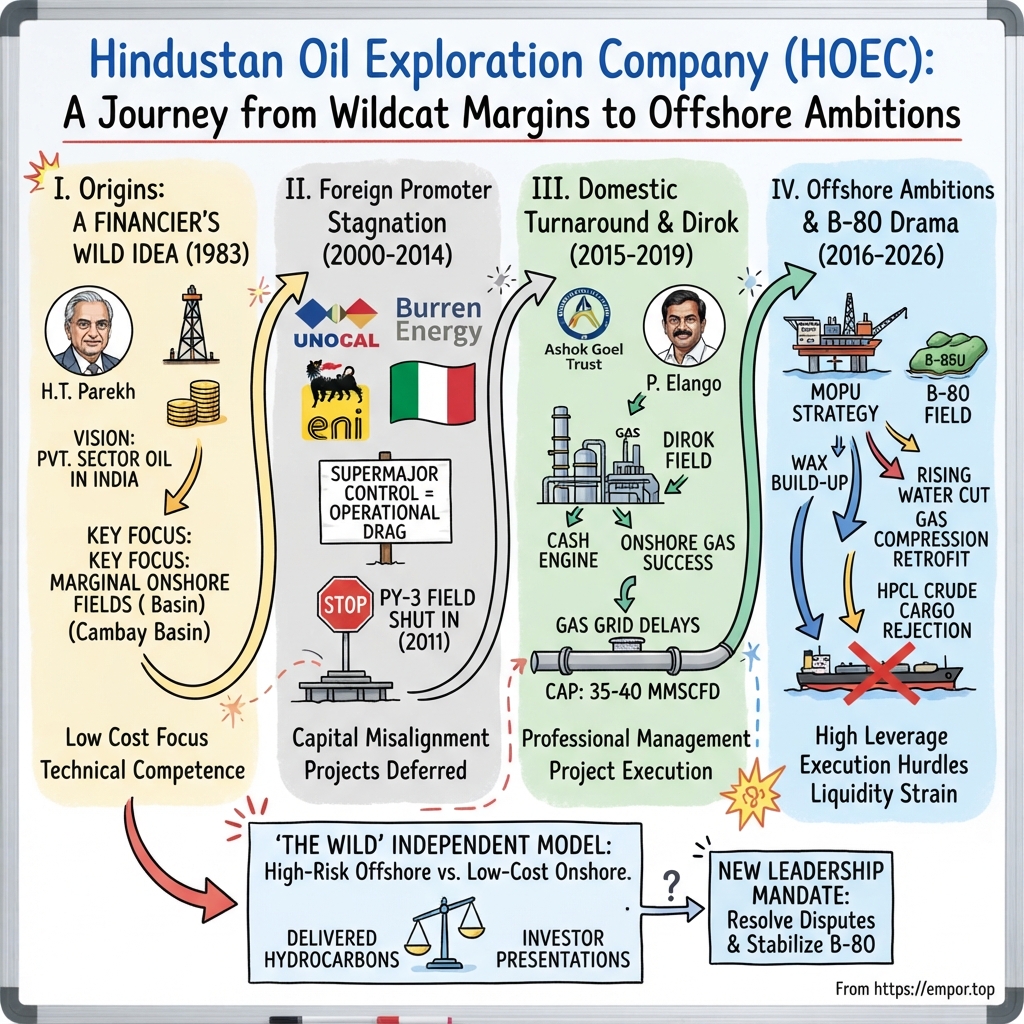
Hindustan Oil Exploration Company: The Wildcat Independent of Indian Upstream Energy
I. Introduction & Episode Roadmap
There is a particular kind of loneliness that belongs to the small oil company. It is the loneliness of a 400-foot processing platform bobbing in the Arabian Sea, eighty kilometres off the Maharashtra coast, connected to the rest of the world by a single subsea flowline and a chartered storage tanker. When a wax plug forms inside that flowline — a slow, invisible thickening, like cholesterol in an artery — nobody comes to help. There is no adjacent field to borrow capacity from, no sister platform to reroute production through, and no integrated downstream refining arm to absorb an off-spec cargo. There is one asset, one buyer, and one balance sheet, and all three belong to a single operator.
That is the operating reality of Hindustan Oil Exploration Company Limited, which trades as HINDOILEXP on the National Stock Exchange and as security code 500186 on the BSE.12 The company has an unconventional origin story, an unusually cosmopolitan list of former owners, and a complex operational landscape: a producing offshore oil field whose flagship crude cargo was rejected by its state-owned buyer, a producing onshore gas field whose output has been capped for years by pipeline constraints rather than geology, and a third offshore asset shut in for over two decades.
The central paradox of HOEC lies in the contrast between its origins and its present scale. Founded in 1983 by H.T. Parekh — the architect of HDFC who also helped shape ICICI — as India's first private-sector oil and gas exploration company, it represented a visionary act of institution-building launched more than fifteen years before India formally opened upstream acreage to private competition.[^3] Yet four decades on, HOEC remains a small-capitalisation company whose quarterly fortunes hinge on whether a compressor on a converted jack-up rig can be reconfigured to run at lower suction pressure.4 In upstream energy, strategic vision matters far less than delivered hydrocarbons.
This trajectory is instructive precisely because it is not a story of effortless triumph. Corporate history often highlights compounding businesses where each success eases the next step. Upstream exploration and production functions differently. Each barrel produced permanently depletes the asset base. Wells encounter water cut over time, and maintaining operations requires continuous reinvestment: finding or acquiring hydrocarbons demands capital, which requires cash flow, which requires steady production, which in turn requires more capital. HOEC has operated on that treadmill for more than four decades under four distinct controlling shareholders, neither achieving dominant scale nor being eliminated from the market.
Distinguishing technical success from commercial success is essential to understanding this business. In the upstream sector, technical success means the drill bit found hydrocarbons where seismic surveys indicated they would be. Commercial success, by contrast, requires those hydrocarbons to flow to the surface at a sustainable rate, pass through processing facilities that separate gas, oil, and water, move through a pipeline or tanker to a buyer who accepts the cargo quality, and realize a price exceeding the fully loaded extraction cost after government royalties and profit shares are settled. Multiple potential points of failure exist between the drill bit and the bank account, and HOEC's history highlights how those failure points manifest.
The narrative begins in 1983 with a financier's expansion into upstream energy, tracing the company's early decades as a marginal-field operator in Gujarat's Cambay Basin. It follows the subsequent foreign-promoter era, during which an American energy group, a London-listed independent, and eventually Italian supermajor Eni S.p.A. held controlling stakes — examining why supermajor ownership proved to be a constraint rather than a catalyst. The analysis then covers the 2015 domestic turnaround under the Ashok Goel Trust, the entry of professional upstream management, and the development of the Dirok gas field in Assam, which established a steady cash engine for the business. Finally, it details the offshore B-80 project, covering the mobile offshore processing unit, wax formation, water cut challenges, and the rejection of a crude cargo by Hindustan Petroleum Corporation Limited (HPCL).
The examination then transitions from narrative history to operational and fiscal analysis: the economics of Indian upstream fiscal regimes, the structural differences between cost-recovery production sharing contracts and revenue-sharing contracts, the impact of administered gas pricing caps, and the key operating metrics that dictate value creation. Management claims are systematically evaluated against the company's historical execution record, concluding with bull and bear cases framed through Helmer's 7 Powers and Porter's Five Forces.
Empor evaluates companies from the perspective of long-term investors rather than management. Where HOEC's leadership projects future growth, the critical task is identifying what evidence would validate or invalidate those claims, then evaluating whether the company's historical performance supports them. In an operationally sensitive business, the gap between investor presentations and actual production reports defines the investment thesis.
The story begins where all of this started: with a banker who calculated that India's state oil monopoly was leaving valuable resources unexploited.
 Subscribe on LinkedIn
II. The Origins of Private Oil in India: H.T. Parekh's Wild Idea (1983–1990s)
In Bombay during the early 1980s, the Indian economy was a tightly controlled, permit-bound system. The experts who understood its inefficiencies best were often financiers who could see where capital was being misallocated by tracking institutional credit flows. Hasmukhbhai Thakordas Parekh was among the most influential of these figures. Having spent decades at the Industrial Credit and Investment Corporation of India (ICICI) before founding the Housing Development Finance Corporation (HDFC) in 1977, Parekh possessed the institutional imagination to spot commercial opportunities where others saw only regulatory barriers.
Parekh viewed India's energy landscape as a structural capital allocation problem. Crude oil imports placed a persistent strain on the country's balance of payments, while domestic production remained entirely in the hands of two state enterprises: the Oil and Natural Gas Corporation (ONGC) and Oil India Limited (OIL). Both state entities were bound by annual public sector budget allocations rather than driven purely by geological potential. High-risk exploratory drilling was chronically underfunded, as exploration failures carried political costs for state-owned entities that private risk capital could absorb. Parekh reasoned that India's hydrocarbon deficit was fundamentally rooted in a financial constraint.
In 1983, Parekh founded Hindustan Oil Exploration Company — India's first private oil and gas exploration company.[^3] The venture was a bold departure from prevailing industry norms. At the time, no formal licensing rounds existed, no legal framework governed private domestic operators, and virtually all domestic petroleum engineering talent resided within state monopolies. A financier without an operational background in oilfields was entering one of the world's most capital-intensive and geologically uncertain sectors in an economy where energy production was a state prerogative.
Working the margins of a monopoly
The regulatory framework prior to 1999 tightly circumscribed HOEC's scope. The New Exploration Licensing Policy (NELP), which eventually introduced transparent competitive bidding for exploration blocks, was still years away. Before NELP, private participation was restricted to negotiated farm-ins or government rounds offering fields that state companies had discovered but deemed too small or marginal to develop. Prime exploration blocks remained off-limits; private companies were left to target small, geologically complex accumulations in mature basins.
HOEC established its initial operational footprint in Gujarat's Cambay Basin, taking on fields such as North Balol, Asjol, and Palej — small onshore oil and gas accumulations of a size that a state enterprise with a national mandate could reasonably ignore.3 While producing a few hundred barrels per day lacked dramatic scale, operating marginal acreage forced HOEC to master the core operational metric that defines independent upstream success: the operating cost per barrel.
In a marginal asset, fixed operating costs represent a high proportion of potential revenue. Because commodity prices are determined by global benchmark markets rather than individual producers, operators cannot increase realized unit prices to offset inefficiencies. Profitability depends entirely on strict cost control: minimizing surface processing infrastructure, utilizing shared field facilities, maintaining lean operational teams, and avoiding top-heavy corporate overhead. Across global upstream energy, successful small independents function essentially as cost engineering entities operating within a geological framework.
The 1991 inflection
The 1991 balance-of-payments crisis transformed India's economic policy landscape. With foreign exchange reserves depleted to just a few weeks of imports, the Indian government initiated broad economic reforms, dismantling industrial licensing, opening sectors to foreign investment, and gradually allowing private capital into natural resource development.
For HOEC, these economic reforms validated Parekh's original 1983 thesis that India would ultimately require private upstream capital. However, pioneer status brought severe operational liabilities. The company had spent nearly a decade building technical capability in a market without formal private framework rules, absorbing exploration risks on a balance sheet too small to diversify away geological failures. By the time NELP established a transparent, competitive market in 1999, major global energy firms and well-capitalized domestic conglomerates entered the fray. HOEC's early start yielded valuable operational experience, but its first-mover commercial advantage had largely dissipated.
Pioneering a regulated sector often forces the first mover to absorb the frictional costs of policy establishment — navigating novel regulatory approvals, establishing tax precedents, and resolving contractual ambiguities — only to see better-capitalized entrants exploit the resulting framework. HOEC effectively served as the initial test case for Indian private upstream policy, bearing regulatory friction without capturing the economic scale that later market openings enabled.
By the late 1990s, two decades of operation had yielded a distinct profile: a disciplined, technically competent onshore operator with a portfolio of modest producing fields, but a capital base inadequate to fund major offshore expansion independently. This structural gap — real operating capability paired with limited balance sheet scale — set the stage for foreign strategic investors seeking an entry point into India's emerging private energy sector.
III. Foreign Promoters & The Stagnation Years: Unocal, Burren, & Eni (2000–2014)
A review of HOEC's shareholder register at five-year intervals between 2000 and 2014 would initially suggest a company on a remarkable growth trajectory. First came an American energy group with extensive Asian experience; then a London-listed independent with offshore operational credentials; and finally an Italian supermajor with a balance sheet measured in tens of billions of euros. Three successive controlling owners each appeared to represent a step up in financial and technical firepower. Yet across this period, HOEC's revenue stagnated, and its flagship offshore field ceased production entirely.
This sequence provides an instructive case study in corporate governance: does ownership by a well-capitalized parent automatically strengthen a small subsidiary?
The relay of owners
The progression began when Unocal, the US energy group, acquired a strategic stake in HOEC to build a South Asian footprint. During that era, Unocal was among the more adventurous American independents, heavily invested in Southeast Asian gas assets, accustomed to frontier jurisdictions, and well-positioned to partner with a sub-scale Indian operator.
In February 2005, UK-listed Burren Energy plc acquired Unocal's 26% controlling stake in HOEC.7 Burren brought a different operational profile — a focused, aggressive London-market independent with producing assets in Congo and Turkmenistan. Its management prioritized converting discovered reserves into rapid cash flow. Initially, the alignment appeared strong, as Burren introduced capital-markets discipline and offshore project expertise to an operator that had spent two decades focused on small onshore fields.
Industry consolidation soon altered the picture. In November 2007, Italian state-backed energy major Eni S.p.A. agreed to acquire Burren Energy for approximately £1.73 billion, inheriting the 26% controlling interest in HOEC, which formally passed to Eni in 2008.7 On paper, HOEC gained one of the world's most technically accomplished exploration companies as its controlling promoter — an operator whose geoscientists would later discover the massive Zohr gas field off the coast of Egypt.
Why the supermajor did nothing
Despite Eni's technical stature, HOEC's operational progress stalled. The fundamental constraint was not technical incompetence, but financial materiality.
From Eni's corporate perspective, capital was being deployed across deepwater West Africa, Kazakhstan's Kashagan field, Egyptian gas developments, and European refining assets. With an annual capital budget running into billions of euros, individual board-level decisions at Eni routinely involved sums exceeding HOEC's entire market valuation. Consequently, a small Indian onshore gas project requiring forty million dollars, even one with a five-year payback and a healthy internal rate of return, struggled to compete for senior executive bandwidth against deepwater appraisal wells capable of adding hundreds of millions of barrels to global reserves.
Large corporate entities do not allocate capital purely by expected return; allocation is filtered through scale and managerial attention. Projects that are too small to be material rarely get explicitly rejected; instead, they are deferred. Submissions sit in approval queues, awaiting sign-offs from headquarters in Milan for projects in Assam. Decisions that an agile independent could execute in weeks stretched across quarters, causing operational velocity to slow dramatically.
Historical falsification: does supermajor parentage deliver?
The core premise held by many investors — that a major oil promoter guarantees technological transfer, balance-sheet backing, and superior financial results — was directly tested by HOEC's record during the Eni era.
The evidence disproving that thesis emerges across three key operational areas:
First, top-line performance. Throughout Eni's period of control, HOEC's consolidated revenue failed to compound, oscillating within a narrow band well below the threshold needed to fund major capital developments. Financial disclosures from the period record a multi-year stretch of depressed turnover through the early 2010s.3 A controlling shareholder with virtually unlimited access to capital chose not to deploy it toward expanding the subsidiary's asset base.
Second, profitability. Rather than generating steady earnings, the company posted sustained losses as exploration write-offs and asset impairments eroded the cash flow generated by producing fields.3 While dry holes are an inherent cost of exploration, write-offs without offsetting commercial developments represent unrecovered capital destruction.
Third, operational continuity. The PY-3 field in the Cauvery Basin offshore Tamil Nadu — a key oil asset with favorable reservoir characteristics — was shut in during 2011 following an unresolved dispute over the charter of its floating production facility among joint venture partners, including ONGC and HOEC.36 Under the ownership of a world-class offshore operator, a producing offshore field was halted because partner negotiations over vessel contract terms broke down, and the asset remained inactive for years.
The empirical record refutes the assumption that supermajor backing necessarily accelerates growth. For HOEC, supermajor control functioned as an operational drag. The parent company provided neither the growth capital nor the decision velocity expected by the market, and the asset where offshore expertise was most critical was left idle. Ultimately, a controlling shareholder's capability matters far less than its strategic incentive to direct attention and resources toward a minor asset.
Around 2014, as Eni sought to divest non-core holdings globally, its stake in HOEC became a prime candidate for sale. While the exit of a major international energy firm might ordinarily be viewed as a negative signal, for HOEC it marked a turning point — clearing the way for a controlling structure focused entirely on the company's standalone portfolio.
IV. The Domestic Turnaround: Ashok Goel, Professional Management, & Dirok (2015–2019)
Every turnaround story features a pivotal moment when new ownership evaluates inherited assets. For HOEC in 2015, that portfolio presented steep operational challenges: several declining onshore fields in the Cambay Basin, a minority stake in Arunachal Pradesh's Kharsang field, an offshore Bay of Bengal field shut in since 2011, and an undeveloped Upper Assam gas discovery that had remained appraised but unmonetized on the books for nearly a decade.
The new promoter and the new management
The buyer was industrialist and investor Ashok Kumar Goel, best known in Indian markets for leading the packaging firm Essel Propack. Goel acquired control through the Ashok Goel Trust and joined the board as a non-executive promoter director.54 Rather than assuming direct operational command, Goel installed professional leadership with deep upstream experience.
The most consequential appointment was P. Elango as Managing Director. Elango brought an established operational track record from Cairn India, where he had served as Managing Director during the development of Rajasthan's landmark Mangala field. Joining alongside him as Chief Financial Officer was Ramasamy Jeevanandam, who would later succeed Elango as Managing Director.5
Elango instituted a pragmatic operational shift: pivot from speculative exploration to field development. Exploration offers unlimited potential upside but carries high geological risk and capital intensity. Development of discovered fields presents primarily engineering, procurement, and project execution risks. For a company with HOEC's constrained balance sheet, fast-tracking discovered resources to generate cash was an operational necessity before taking further exploration risks.
Dirok: the asset that changed the arithmetic
The immediate proof case was the Dirok field in block AA-ONN-2001/1 in Upper Assam. HOEC served as operator with approximately a 27% participating interest, alongside state-owned entities Oil India Limited at 44% and Indian Oil Corporation at 29%.34
This structure highlighted where a small independent could add distinct value. While its state-owned partners commanded far greater capital, HOEC offered operational agility and streamlined execution. The Hollong gas processing plant was designed, constructed, and commissioned in 2017 on a compressed timeline and lean budget.3
The commercial result fundamentally altered HOEC's financial profile. Cash flow from Dirok transformed the company from a sub-scale operator of declining oil fields into a business underpinned by a contracted, high-margin revenue stream. Top-line revenue expanded beyond the threshold needed to cover corporate overhead, while operating margins improved significantly because onshore gas processed on-site represents one of the lowest-cost production units in the Indian energy landscape.3
Analytically, Dirok provided HOEC with self-sustaining capital generation. For a small upstream independent, funding growth through operating cash flow rather than debt or dilutive equity issuances allows existing shareholders to capture the economic value of development success.
Historical falsification: is Dirok an unconstrained engine?
Bullish narratives during this era framed Dirok as a cash engine capable of continuous volume expansion, with subsurface reservoir capacity as the sole constraint.
Historical execution data refutes that assumption. The binding constraint at Dirok was never the reservoir. Management commentary over multiple years acknowledged that field deliverability substantially exceeded permitted sales volumes, with output capped in the range of 35 million to 40 million standard cubic feet per day.45 The primary constraint was regional evacuation infrastructure: Upper Assam lacked sufficient local industrial demand, and the regional transmission pipeline—the North-East Gas Grid under construction by Indradhanush Gas Grid Limited—faced repeated delays extending into the 2020s.
Unlike liquid crude oil, which can be transported by road or rail tankers, natural gas requires dedicated pipeline connections or capital-intensive liquefaction infrastructure. Without pipeline evacuation, a gas field's production is strictly limited to nearby off-takers, which for Dirok meant local industrial users, regional tea estates, and the Assam Gas Company network.
Evaluating this claim demonstrates that while Dirok established low-cost, cash-generative operations, assertions of unconstrained growth were inaccurate throughout its early production life. Upstream deliverability remains bound by midstream infrastructure. Verifying future volume expansion requires observing sustained daily sales volumes above historical plateaus alongside fully commissioned grid connections.
Rather than remaining solely an onshore gas producer, management sought greater operational scale in 2016, leading the company back into offshore development in the Arabian Sea.
V. Offshore Ambitions & The B-80 Drama: MOPUs, Wax, & HPCL (2016–2026)
The Mumbai Offshore basin is India's primary hydrocarbon province, containing Bombay High and the bulk of the country's domestic oil production. It also holds numerous small discoveries that ONGC made decades ago and left undeveloped; on a state enterprise's project ranking, a field capped at a few thousand barrels per day carries insufficient scale to justify capital prioritization.
In 2016, the Government of India launched the Discovered Small Field (DSF) policy, auctioning these unexploited discoveries under a simplified revenue-sharing framework designed to attract independent operators. HOEC secured Block B-80 with a 100% participating interest, assuming complete operational control, economic upside, and execution risk.34
The thesis, and the clever plan
The investment thesis appeared compelling. B-80 contained high-quality oil and gas, with an initial target production rate of roughly eight thousand barrels of oil equivalent per day. Relative to HOEC's existing production base at the time, successful commercialization promised to roughly double the company's total output.
Management's execution strategy aimed to bypass the heavy capital requirements of traditional offshore infrastructure. Conventional development requires installing a fixed steel platform—pinning a heavy jacket into the seabed, mounting processing topsides, and laying an expensive subsea pipeline to shore. For a mid-sized asset targeting eight thousand barrels per day, such upfront capital expenditures often render development economically unviable.
HOEC instead adopted a Mobile Offshore Processing Unit (MOPU) strategy. The company acquired an existing jack-up drilling rig, the Garo 1, stripped its drilling equipment, and retrofitted oil and gas processing facilities onto its deck. Once towed to location and jacked down onto the seabed, subsea wells were connected directly to the MOPU via flexible flowlines. To eliminate the cost of a subsea export pipeline, HOEC moored a Floating Storage and Offloading (FSO) vessel nearby to store crude until shuttle tankers could collect it.4
This mobile infrastructure approach requires a fraction of the upfront capital of fixed platforms, shortens project delivery timelines, and eliminates costly fixed-decommissioning campaigns at the end of field life. While variants of this strategy are used globally to commercialize marginal offshore fields, its success depends entirely on seamless technical execution.
The world where it did not quite work
Execution obstacles rapidly accumulated. B-80 was initially scheduled for commissioning in early 2020, but COVID-19 disruptions halted shipyard work and restricted international specialist crews. Operating in the Arabian Sea introduced severe seasonal constraints: the annual southwest monsoon closes offshore installation windows for months, meaning a minor schedule delay can defer field work by a full year. Subsea hookups between seabed wells and the surface facility also encountered technical complexities, delaying first production by more than two years.46
For a project representing such a large portion of HOEC's enterprise value, schedule slippage proved financially damaging. Charter rates for the MOPU and FSO accrued continuously regardless of production, alongside debt service and corporate overhead. Each month of delay converted prospective cash generation into immediate cash drain.
Compounding the delays, subsurface and fluid dynamics presented ongoing operational hurdles. Crude oil from B-80 contains high wax concentrations. While high temperatures keep wax dissolved in the reservoir, fluid passing through subsea flowlines surrounded by cold seawater cools rapidly. Wax crystallizes and deposits on pipe walls, restricting flowlines, increasing back-pressure, and creating risk of total line blockage. Mitigating wax build-up requires chemical inhibitors, specialized thermal insulation, continuous pigging, or heated flowlines—adding operational complexity and expense to a compact mobile processing facility.
Simultaneously, the field experienced an accelerating water cut. As water production increases relative to oil, it consumes deck processing capacity, separation volume, and disposal handling. On a MOPU with fixed deck dimensions and weight constraints, processing higher fluid volumes of water directly reduces net oil production.
Gas processing faced similar design mismatches. Associated gas requires compression before export or facility power use. As reservoir pressure declined below the original suction pressure design threshold, the installed compressor could no longer process incoming gas. Consequently, gas output remained shut in through mid-2026 while the compression unit underwent engineering modifications for low-suction operation.46 While technically solvable, the retrofit underscored that initial facility specifications failed to match actual reservoir behavior.
The cargo that came back
In August 2025, operational friction escalated into a direct liquidity strain. State-owned refiner Hindustan Petroleum Corporation Limited (HPCL), the contracted offtaker, rejected a crude oil cargo of approximately 417,000 barrels from B-80, citing elevated organic chloride levels.65
Organic chloride contamination poses severe refinery risks. During refining, these compounds break down into hydrochloric acid within preheat trains and hydrotreating units, causing extreme metal corrosion and risking extensive plant shutdowns. Refiners strictly enforce chloride thresholds, as the cost of potential equipment damage far outweighs the commercial penalty of rejecting suspect crude cargoes.
For HOEC, the commercial fallout was immediate. HPCL cancelled the purchase invoice, and the dispute entered formal conciliation proceedings presided over by a retired Chief Justice. HOEC was forced to seek alternative buyers in the spot market for a cargo carrying a public quality dispute.6 The rejection effectively froze hundreds of thousands of barrels of crude as unsold inventory, locking up critical working capital on a balance sheet with limited liquidity buffer.
Historical falsification: does HOEC have offshore execution capability?
The core premise of HOEC's offshore growth strategy was that the company possessed the specialized capability to re-engineer mobile offshore units and rapidly commercialize small offshore fields.
Empirical evidence from B-80 challenges that assertion across multiple operational dimensions: multi-year schedule slippage, a gas compression system requiring field retrofitting, flow assurance issues restricting uptime, rising water cut limiting throughput, and a rejected cargo converting operational delays into a liquidity strain.46 Rather than a single isolated setback, B-80 revealed challenges spanning project management, facilities engineering, reservoir monitoring, and product quality control.
The historical record invalidates the thesis that HOEC possesses a streamlined, repeatable offshore execution capability. The evidence demonstrates that while the company can eventually bring a small offshore field into production, it has done so at capital costs and on timelines substantially worse than originally projected—a far more modest capability than initial strategy presentations suggested.
Re-establishing investment credibility requires verifiable operational milestones: maintaining B-80 facility uptime above 85% across consecutive quarters, restoring stable gas exports following compression retrofits, and securing consistent crude cargo acceptances without specification rejections.
New hands on the wheel
Amid these operational headwinds, HOEC enacted an executive leadership change. Baroruchi Mishra was appointed Managing Director and Chief Executive Officer effective April 1, 2026, succeeding Ramasamy Jeevanandam.5 Mishra's immediate mandate centers on resolving the HPCL conciliation, monetizing the disputed crude inventory, stabilizing B-80 oil and gas throughput, and executing planned well workover programs.
This executive transition carries dual interpretations for investors. It may reflect board accountability and a determination to address operational underperformance, or it may introduce management disruption during a critical legal and commercial conciliation. Evaluating the new leadership requires monitoring subsequent quarterly disclosures to determine whether operational guidance becomes more precise and measurable, or relies on generalized macro explanations. In small-cap upstream exploration, management credibility rests on aligning production guidance with verified operational delivery.
To evaluate these operational dynamics effectively, investors must examine the underlying fiscal framework governing HOEC's assets—where government revenue-sharing terms influence the profitability of every barrel produced.
VI. The E&P Playbook: Industry Economics, Field Portfolio, & Segment Breakdown
Behind the overarching corporate narrative, HOEC functions as a portfolio of four economically distinct businesses sharing a single balance sheet. Each segment presents a unique cost structure, commodity price exposure, customer profile, and operational risk profile. Evaluating them as a monolithic entity obscures the core drivers of company performance.
The onshore gas business
Dirok represents the company's most cash-generative segment. Onshore gas wells paired with an adjacent processing facility keep operating costs in the low single digits of dollars per barrel of oil equivalent, allowing the field to generate positive cash flow across virtually any commodity price environment.3 Long-term gas sales agreements with regional industrial buyers provide structural revenue predictability that offshore crude liftings rarely match.
However, price realization is constrained by regulatory policy. Domestic natural gas in India does not trade at unconstrained market clearing prices. Pricing for legacy and regulated fields follows government formulas—notably the framework based on the Kirit Parikh committee recommendations—linking domestic gas prices to the Indian crude basket subject to an explicit floor and ceiling. While the price floor shelters producers during global downturns, the price ceiling limits revenue upside during global gas spikes. For instance, when global LNG prices soared during the 2022 energy crisis, domestic pricing caps prevented Indian producers from capturing those windfall margins.
Consequently, the thesis that domestic market deregulation will drive sharp margin expansion during global energy shocks fails on regulatory structure rather than operational execution. Upstream operators cannot capture price spikes that are legally capped. What remains is a more realistic and still valuable characteristic: Dirok provides stable, floor-protected cash flows that cushion the company against offshore volatility. The key metric to track is net realized price per million British thermal units alongside quarterly daily sales volumes, which indicate whether volume growth is driving financial expansion.
The offshore oil and gas business
B-80 represents HOEC's highest-leverage asset. Offshore field operations carry substantially higher fixed overhead than onshore fields, driven by chartered vessels, helicopter crew transports, offshore supply craft, and specialized subsea maintenance. This fixed-cost burden creates substantial operational leverage in both directions. When field uptime and Brent crude prices are high, B-80 generates strong free cash flow; when technical disruptions lower production, high fixed charter and operating expenses quickly erode profitability.
This cost structure makes facility uptime the primary operational metric at B-80. Because fixed costs remain constant regardless of output, margin compression accelerates rapidly as production falls. Technical challenges such as flow assurance wax buildup, rising water cut, and gas compression mismatches directly impair financial performance by lowering output against an inflexible cost base.
Crude realizations at B-80 track Brent benchmarks but remain subject to fiscal policy interventions. For example, India's Special Additional Excise Duty—introduced in 2022 as a windfall tax on domestic crude production—demonstrated that government policy can siphon off outsized profits during commodity price surges. Valuation models incorporating sustained high oil prices must account for the likelihood that fiscal authorities will capture a portion of peak realizations.
The onshore crude businesses
Kharsang, an onshore field in Arunachal Pradesh in which HOEC holds an approximate 30% participating interest, has undergone a multi-well infill development program designed to offset natural field decline and stabilize crude output.34 Infill drilling within established reservoir boundaries carries lower geological risk than exploratory drilling, as it targets known hydrocarbon accumulations. Consistent execution at Kharsang serves as a test of HOEC's core onshore engineering capabilities.
Meanwhile, the legacy Cambay Basin fields yield a modest, mature stream of onshore crude. While these fields provide baseline production, their limited scale makes them immaterial to the broader investment thesis.
The dormant asset
PY-3 occupies a distinct position: an offshore oil field in the Cauvery Basin with identified reserves that has remained shut in since 2011 due to unresolved joint venture agreements regarding production facility arrangements.36 Management has periodically highlighted redevelopment potential that could restore several thousand barrels per day of production.
However, fifteen consecutive years of inactivity across four controlling shareholder eras and multiple management teams provide strong empirical grounds for skepticism regarding near-term monetization. While remaining hydrocarbon reserves exist, PY-3 represents idle capital with embedded option value. Sound analytical practice requires valuing the field near zero until a binding facility agreement is signed and a field development plan receives formal regulatory approval with a committed timeline. Repeated projections in presentation materials without executed contracts represent speculative optionality rather than active operational value.
Fiscal regimes: who actually owns the barrel
Two distinct contractual frameworks govern HOEC's asset portfolio, directly influencing corporate capital allocation and risk exposure.
Legacy exploration blocks operate under Production Sharing Contracts (PSCs). Under a PSC, the operator recovers approved capital and operating costs from initial field revenue ("cost petroleum") before splitting the remaining "profit petroleum" with the government on a sliding scale. While this structure offers downside protection by allowing capital recovery, it introduces administrative friction. Because recovered expenses reduce the state's share of profits, government authorities scrutinize operational expenditures, historically leading to prolonged cost-recovery audits and disputes.
Conversely, newer blocks—including Discovered Small Field awards like B-80—operate under Revenue Sharing Contracts (RSCs). Under an RSC, the government receives a fixed percentage of gross revenue starting from first production, eliminating cost-recovery mechanisms entirely. While administratively straightforward, this framework transfers all cost-overrun risks to the operator. On projects completed within budget, revenue sharing operates predictably; on projects experiencing capital overruns or delayed ramp-ups, the contractor absorbs the full financial burden while government revenue claims remain fixed. The execution hurdles at B-80 illustrate the financial impact of cost inflation under a revenue-sharing framework.
The three numbers that matter
Evaluating HOEC's operational trajectory requires focusing on three primary operational metrics:
First, consolidated net production expressed in barrels of oil equivalent per day. Production volume directly drives top-line revenue, unit operating costs, operating cash flow, and reserve depletion rates.
Second, blended unit lifting cost per barrel of oil equivalent across onshore and offshore assets. Tracking unit operating costs over time provides a clear measure of operating efficiency and cost discipline across commodity cycles.
Third, certified independent reserve audits. HOEC has historically engaged Gaffney, Cline & Associates to evaluate and certify proved and probable (2P) reserve balances.3 Tracking certified reserve replacement ratios relative to annual production indicates whether the company is expanding its resource base or depleting existing reserves.
VII. Strategic Powers, Moat Assessment, & Porter's Five Forces
Evaluating Hindustan Oil Exploration Company through Hamilton Helmer’s 7 Powers framework—which identifies the structural conditions allowing a business to sustain differential returns—yields immediate constraints. Most of the seven powers collapse when applied to an upstream oil and gas producer, as they assume businesses selling differentiated products to fragmented buyers. A barrel of crude oil or a cubic metre of gas is neither differentiated nor sold into a fragmented customer base.
Branding is irrelevant, as no refinery pays a premium for HOEC’s molecules. Network economies are absent, given that a producer's barrel gains no value because another buyer purchased one. Switching costs are effectively zero for a commodity delivered by vessel or pipeline. Counter-positioning was arguably present at the company's 1983 founding, when a private operator entered a state-dominated market, but decades of regulatory evolution through competitive bidding rounds have eliminated any initial structural asymmetry.
That leaves three powers worth examining in detail.
Process Power — moderate, and partially falsified. The primary candidate for a structural advantage at HOEC is operational speed and frugality: the demonstrated capability to bring a discovered field into production faster and cheaper than a state enterprise. The Hollong gas processing plant serves as supporting evidence—a facility designed and commissioned on a compressed timeline that a public-sector procurement process would have struggled to match, executed by a minority partner leading two larger state-owned entities.3
However, process power must be durable and difficult to replicate. The B-80 offshore development served as the test case, and the execution failed to validate the thesis. The same organization that executed effectively onshore encountered multi-dimensional operational setbacks offshore.46 The most defensible interpretation is that HOEC’s process advantage is real but narrow: it applies to domestic onshore developments where the company holds decades of accumulated relationships, regulatory familiarity, and contractor networks. That advantage does not translate to the offshore environment, where technical requirements differ and the financial penalty for operational failure is substantially higher.
Cornered Resource — weak. Exploration and production licenses are technically cornered resources; HOEC holds complete ownership of Block B-80, preventing competitors from producing its reserves. Similarly, the Hollong plant is the sole gas processing facility in its immediate vicinity. However, because these licenses were acquired through open competitive bidding, auction prices naturally competed away much of the potential excess return. A resource acquired at auction against informed market rivals provides limited moat protection. Furthermore, because the underlying commodity is globally fungible, even a fully controlled field yields output that prices off external benchmarks beyond the operator's influence.
Scale Economies — negative. Scale limitations represent HOEC's most acute structural handicap. Relative to major domestic players such as ONGC, Oil India, and Cairn Oil & Gas within Vedanta, HOEC operates at a persistent scale disadvantage. In the upstream sector, scale dictates unit economics: rig day rates negotiated across multi-well programs, vessel charters spread over multiple fields, and the ability to maintain in-house subsea engineering teams rather than hiring external consultants at premium rates. A single-asset offshore operator chartering a mobile processing unit and a storage vessel for a single field pays retail prices across its supply chain. This is not merely the absence of a competitive moat—it represents a structural cost penalty.
Ultimately, HOEC does not possess a durable moat under the 7 Powers framework. What the company maintains is an operating niche: developing smaller fields that state majors overlook, at unit costs low enough to generate positive financial returns. While that represents a legitimate business model, it is not a structural moat, and distinguishing between an operating niche and a durable moat remains critical to how an investor values the company's cash flows.
Porter's Five Forces
An analysis of industry structure further clarifies the competitive pressures facing the business.
Buyer power: extreme. Buyer concentration represents the defining structural feature of HOEC’s competitive landscape. Unlike standard commodity producers selling into deep, liquid markets with multiple counterparties, HOEC sells its crude oil exclusively to state-owned refiners, while its Assam gas is delivered to a handful of regional industrial off-takers and a state distribution utility. When a single state-owned buyer can reject a crude cargo and freeze hundreds of thousands of barrels of inventory pending formal conciliation, counterparty power directly dictates quarterly cash flows.6
Supplier power: high and cyclical. The offshore oilfield services market—encompassing jack-up rigs, supply vessels, subsea engineering, and specialized technical crews—is highly consolidated and subject to global demand cycles. When offshore activity tightens globally, day rates escalate, leaving smaller independent operators with limited bargaining power. Because HOEC charters its operational infrastructure rather than owning it, cost inflation passes directly into the company's operating structure.
Threat of substitutes: low to moderate. India's expanding primary energy demand and government policy support for domestic natural gas provide structural demand tailwinds. While electric vehicles and renewable energy will gradually alter long-term liquid fuel demand, that transition unfolds beyond the economic life of HOEC's current producing reserves. The more immediate substitution risk stems from imported liquefied natural gas competing for regional industrial gas customers—representing a price realization risk rather than a volume displacement risk under domestic pricing formulas.
Rivalry: low in production, intense in acreage bidding. HOEC does not compete directly with state majors for end-customer market share, as refiners absorb production from all domestic suppliers. Instead, rivalry is concentrated in competitive licensing rounds under the Open Acreage Licensing Policy and Discovered Small Field framework. In these auctions, aggressive bidding for marginal acreage poses a constant risk of capital destruction. The central test of corporate discipline is whether management can refrain from acquiring blocks at valuations that undermine economic returns.
New entrants: low. High capital intensity, strict regulatory hurdles, and specialized technical requirements limit new market entrants. While this entry barrier protects existing operators from market crowding, it does not enhance profitability, as competition has rarely been the primary constraint on HOEC’s returns. The binding constraints remain operational execution and buyer concentration.
In summary, HOEC operates as a sub-scale producer of an undifferentiated commodity, selling to concentrated state-linked buyers, purchasing from consolidated suppliers, and operating under capped regulatory price regimes. In such a structural position, long-term value creation depends entirely on sustained operational excellence—the precise standard against which the company's historical record must be judged.
VIII. Historical Falsification & Skeptical Stress Test
Individual claims have been evaluated as they arose across prior sections. Examining the four core claims that shape the investment case together reveals a pattern more informative than any single asset test in isolation.
Claim one: offshore development expertise. Tested in Section V and rejected in its strong form. The evidence comes from HOEC's flagship offshore project at B-80, which suffered multi-year schedule slippage, in-service compression rework, flow assurance failures, and a rejected crude cargo.46 Four distinct failure modes on a single asset represent a capability limitation rather than isolated misfortune. The surviving version of this claim is that HOEC can eventually bring small offshore fields into production, albeit at higher costs and on longer timelines than originally budgeted. The operational metrics that track performance are quarterly B-80 facility uptime and a clean record of accepted crude liftings.
Claim two: PY-3 restart optionality. This optionality narrows near zero until binding contracts are executed. Fifteen years of non-production across four distinct owner eras represents the disconfirming historical record, while the sole confirming event would be a Directorate General of Hydrocarbons-approved field development plan backed by a committed first-oil target date.36
Claim three: capital allocation discipline. This claim warrants close scrutiny, as capital allocation remains within management's direct control, yet the historical record presents a mixed picture.
The affirmative evidence is substantial. The post-2015 strategic pivot toward developing discovered resources rather than funding high-risk exploration was appropriate for an operator of HOEC's scale, and the Dirok project validated the approach. That deployment represented disciplined capital allocation and yielded the most cash-generative operating period in the company's history.3
The disconfirming evidence is equally clear. The B-80 capital program locked significant capital into a converted mobile processing unit and offshore infrastructure that has yet to deliver the production profile originally underwriting the investment case, with cost overruns absorbed entirely by HOEC under the revenue-sharing framework.4 Layered on top is the working capital trapped in disputed crude inventory.6 Meanwhile, the company's dividend history remains minimal; capital has rarely been returned to shareholders, leaving equity holders to fund operational experiments while absorbing the downside of project delays.
Two governance considerations further complicate the capital allocation record. First, ownership concentration: HOEC's promoter holding rests with a trust associated with a single individual, while operating performance has historically hinged on a small group of key executives.5 Key-person dependency in a sub-scale technical business represents an ongoing operational risk. Second, executive turnover: transitioning across three managing directors—from P. Elango to Ramasamy Jeevanandam to Baroruchi Mishra within approximately a decade—is a rapid cadence for a business requiring multi-year project execution. Maintaining continuity of technical leadership across five-year field development cycles is essential for preserving reservoir-specific operating knowledge.
The verdict on capital allocation is therefore a narrowing of claims rather than a complete rejection. Management's strategic framework of monetizing discovered fields remains sound, and onshore execution supports that logic. However, offshore capital deployment has yet to cover its fully loaded cost. The primary metric that resolves this balance is cumulative free cash flow conversion—operating cash flow minus capital expenditures measured across a multi-year cycle rather than an isolated quarter. Sustained capital allocation discipline ultimately manifests in cumulative free cash flow generation.
Claim four: gas pricing upside. Rejected in its unlimited form on structural grounds in Section VI, and narrowed to the genuinely valuable but bounded claim of floor-protected stability.
What the pattern says
Stepping back, all four assessments reveal a consistent pattern. In each case, the core strategic rationale is sensible and onshore operational execution supports it. Conversely, claims dependent on offshore execution or external variables—such as regional pipeline completions, joint-venture partner alignment, refiner cargo acceptances, or unconstrained pricing power—fail or narrow significantly. This distribution indicates that HOEC's core operational competence resides in onshore asset development, whereas corporate strategy over the past decade has repeatedly pushed into higher-risk offshore domains.
An activist investor examining the balance sheet would focus on this precise divergence: why should a company with proven onshore development capabilities and a cash-generative gas asset in Assam maintain a single-asset offshore project large enough to imperil the overall portfolio? Furthermore, what is the realized return on offshore capital deployed to date when measured against original sanction economics? Why does an asset idle for fifteen years remain framed as growth optionality without a binding path to production? And what is the explicit, dated schedule for converting disputed crude inventory into realized cash?
For investors, the appropriate posture is neither uncritical enthusiasm nor outright dismissal. HOEC's investment thesis rests almost entirely on forward operational execution rather than structural economic moats. Validating that thesis requires evaluating performance quarter by quarter based on delivered operational milestones rather than forward management guidance.
IX. Bear vs. Bull Case, Key Investment KPIs, & Forward Outlook
Why this could work
The bull case for HOEC does not require heroic assumptions about oil prices or new discoveries. It requires a sequence of specific, identifiable operational unlocks, each of which is plausible and none of which is guaranteed.
The first is the conciliation over disputed inventory. If the HPCL dispute resolves on terms that allow HOEC to sell the roughly 417,000 barrels of rejected crude without a severe haircut—either back to HPCL after technical remediation or into the spot market—a meaningful block of frozen working capital converts to cash.6 The organic chloride issue is technically resolvable through chemical treatment, blending, or independent assay certification, meaning the dispute centers on product specification rather than asset existence.
The second is the offshore facility reconfiguration. The compression engineering rework at B-80 for low-suction service addresses a specific, understood operational issue: declining reservoir pressure dropping below the original equipment design envelope.4 If the reconfigured compression system successfully restores natural gas exports, and if planned subsea interventions mitigate wax crystallization and water cut, B-80's field uptime will improve, allowing the asset's substantial operating leverage to work in shareholders' favour.
The third is midstream pipeline evacuation. The completion and commissioning of the North-East Gas Grid would remove the regional demand cap that has restricted production at Dirok throughout its operating life, enabling the company's primary cash-generative asset to deliver gas into a wider national market.4 This represents the largest structural value unlock in the portfolio, requiring no additional capital execution from HOEC itself.
The fourth is low-risk onshore drilling. The infill development program at Kharsang represents a low-geological-risk effort to generate incremental production, an area where HOEC's established onshore operational experience should convert most reliably into output growth.3
Combining these four operational outcomes makes management's stated ambition of reaching a consolidated production run rate near 25,000 barrels of oil equivalent per day arithmetically reachable.4 However, achieving that milestone requires stacking four independent events, three of which have suffered material schedule slippages and one of which relies entirely on a third-party pipeline project. A forecast built by combining best-case assumptions across four separate execution paths carries a low joint probability, even if each individual component appears plausible.
Why it might not
The bear case presents the mirror image, driven by realistic operational downside.
First, subsea interventions at B-80 could fail to control rising water cut and wax buildup. Subsea workovers are capital-intensive, weather-dependent, and technically uncertain. An expensive intervention campaign that fails to restore sustained throughput would turn B-80 into a structural cash drain, consuming continuous MOPU and FSO charter fees against inadequate production. Given the high fixed overhead of offshore operations, this outcome poses the greatest risk to company liquidity.
Second, the commercial conciliation could drag on indefinitely. Legal and administrative proceedings often extend across multiple quarters. Prolonged dispute resolution leaves crude inventory illiquid while eroding HOEC's negotiating leverage, as potential spot buyers demand discounts on publicly disputed cargoes.
Third, broader commodity price weakness could compress operating margins. With Brent crude trading significantly below $60 per barrel, B-80's offshore operating leverage turns negative, while the onshore gas business remains protected only down to its regulated price floor.
Fourth, regional pipeline construction could suffer further delays. Infrastructure projects in India's northeast have faced recurring delays over the past decade, making production expansion models based on official grid completion schedules vulnerable to historical base rates of postponement.
Finally, capital structure and financing risks overhang forward operations. A sub-scale exploration and production company carrying fixed charter commitments, frozen inventory, and impaired cash flow from its primary growth asset has limited options if offshore intervention costs overrun. Financing additional shortfalls through debt increases fixed obligations against volatile revenues, while equity issuances dilute existing holdings. While neither scenario implies immediate insolvency, both transfer economic value away from existing equity holders.
The three things to actually track
Evaluating HOEC's forward trajectory requires monitoring three primary operational key performance indicators:
Consolidated net production, in barrels of oil equivalent per day. Reported quarterly across Dirok, B-80, and Kharsang, this serves as the foundational metric. Sustainable volume growth confirms operational turnaround, whereas flat or declining figures invalidate forward growth narratives regardless of planned workovers or pipeline projections.
Cash actually realized from B-80. This metric encompasses two distinct elements: net proceeds from monetizing the disputed crude cargo and ongoing monthly cash collections from crude and gas liftings once field output stabilizes. Tracking realized cash collections rather than gross production figures remains essential for assessing true balance-sheet liquidity.
Blended lifting cost per barrel of oil equivalent. This metric provides an empirical test of HOEC's operational efficiency across its onshore and offshore asset base. Genuine cost discipline manifests in stable or declining unit operating expenses over full commodity cycles.
If these three indicators demonstrate consistent quarterly improvement, management's narrowed strategic claims will be validated by empirical evidence. Conversely, if production, cash collection, and unit costs stagnate, underlying operational constraints will remain the primary barrier to long-term value creation.
X. Outro & Key Takeaways
Revisiting the platform in the Arabian Sea clarifies where value actually resides in the upstream energy sector. The primary lesson lies not in the operational friction of subsea wax buildup or a rejected crude cargo, but in what those friction points reveal about asset commercialization.
In upstream exploration and production, discovering hydrocarbons represents only a fraction of commercial success. Finding oil or gas accounts for perhaps one-fifth of the overall challenge. The remaining four-fifths requires subsea logistics, facility engineering tailored to dynamic reservoir behavior, midstream evacuation infrastructure beyond the operator's direct control, and a commercial off-taker willing to accept the delivered product specification and settle invoices. Across its history, HOEC has repeatedly demonstrated technical competence in subsurface discovery, while encountering severe friction across downstream logistics and off-take execution. For investors evaluating exploration and production companies, the analytical mandate remains consistent: certified reserves do not equal production, production does not equal sales, and sales do not equal realized cash.
The second key takeaway centers on asset concentration. HOEC spent years developing a disciplined, low-cost onshore gas operation at Dirok in Assam—a contracted, cash-generative asset capable of generating steady baseline returns. However, the decision to undertake the B-80 offshore development allowed a single project to dominate the company's capital allocation, managerial focus, and quarterly financial performance. While Dirok remained a cash-generative asset, it ceased to be the primary driver of corporate outcomes. When a sub-scale independent undertakes a project large enough to overwhelm its core cash engine, the enterprise effectively transforms into a single-asset bet.
The third takeaway defines the structural reality of the independent E&P playbook. Surviving as a small operator in a market dominated by state enterprises requires targeting marginal fields overlooked by national majors and developing them under lean cost structures. While this strategy offers a viable operational niche, that niche remains defined by what state majors choose to ignore rather than by structural entry barriers. Sustaining performance within that niche demands strict capital discipline—specifically, the willingness to decline unremunerative acreage, resist scope creep, and reject capital projects outside the company's proven onshore execution capabilities.
Four decades after H.T. Parekh envisioned a private upstream sector in India, the institution he founded remains active in a state-dominated landscape: smaller than its initial ambition, constrained by offshore execution hurdles, and reliant on a cash-generative onshore gas field whose growth hinges on third-party pipeline construction. Whether HOEC's next chapter validates the wildcat independent model or simply prolongs its capital treadmill will not be determined by strategic presentations, but by verified quarterly production reports.
References
-
NSE India — Hindustan Oil Exploration Company Limited (Symbol: HINDOILEXP) ↩
-
BSE India — HOEC Stock Information & Regulatory Disclosures (Security Code: 500186) ↩
-
Hindustan Oil Exploration Company — Official Annual Reports Archive ↩↩↩↩↩↩↩↩↩↩↩↩↩↩↩↩
-
Hindustan Oil Exploration Company — News, Filings, and SEBI Disclosures ↩↩↩↩↩↩↩↩↩↩↩↩↩↩↩↩
-
Economic Times — HOEC Stock Price, News Updates, and Executive Appointments ↩↩↩↩↩↩
-
Moneycontrol — Hindustan Oil Exploration Company Share Price & Corporate Announcements ↩↩↩↩↩↩↩↩↩↩↩↩↩
-
Business Standard — HOEC Corporate Profile & Upstream Sector Coverage ↩↩
 LinkedIn
 WhatsApp
 Reddit
 Hacker News
 Email
Email Kindle
 RSS Feed
 Spotify
 Apple Podcasts
 Amazon Music
 Audible
 YouTube