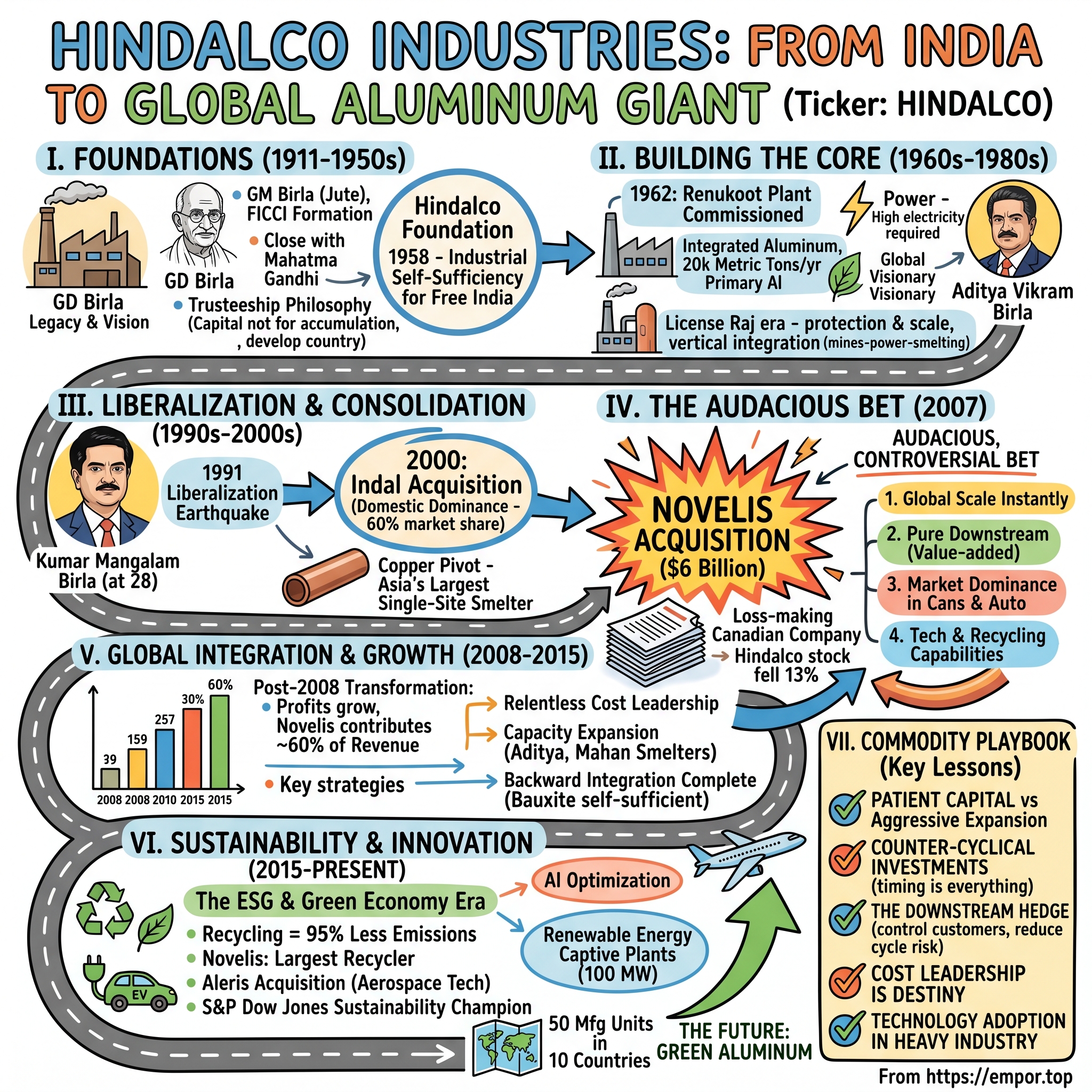
Hindalco Industries: The Alchemist of Aluminum
I. Introduction & Episode Roadmap
On the evening of February 10, 2007, a board of directors in Mumbai signed off on a transaction that much of the financial world viewed as an act of corporate overreach. Hindalco Industries — a company whose primary business was smelting aluminium ingots in an industrial township in eastern Uttar Pradesh — agreed to buy Novelis Inc., the world's largest aluminium rolling company, for approximately $6.0 billion including assumed debt.1 Hindalco paid $44.93 a share in cash for a business that shipped roughly three times the volume of metal Hindalco produced, funding a major portion of the purchase with a bridge loan.2 The acquisition target was, by almost every operating measure, larger than the buyer. Forbes covered the transaction with open skepticism.3
Eighteen months later, Lehman Brothers collapsed, global automotive manufacturing plunged, aluminium demand cratered, and Novelis — burdened by leverage and locked into unfavorable fixed-price supply contracts with beverage can makers — began burning cash. Hindalco turned to its own shareholders with a rights issue to repair its balance sheet, launching the offering into the teeth of the 2008–2009 global financial crisis.[^4] For a period in 2009, the pressing question was not whether the Novelis acquisition would clear its cost of capital, but whether Hindalco itself would survive.
Nearly two decades later, the financial profile looks fundamentally transformed. For the financial year ended March 31, 2026, Hindalco reported consolidated revenue of ₹2,74,944 crore — roughly $31 billion — alongside record consolidated EBITDA of ₹38,097 crore.4 In the June 2026 quarter, the company delivered its highest quarterly results on record: revenue of ₹84,825 crore, EBITDA of ₹14,989 crore, and net profit of ₹7,013 crore, as all four of its reporting segments achieved simultaneous internal records.5 The Indian upstream aluminium division generated an EBITDA margin above 50%, an operating margin profile rarely observed in primary metals smelting.6 Trading near ₹1,078 in mid-August 2026, the stock had roughly doubled from its 52-week low.7
Yet this run of operating profitability coincided with the costliest industrial disruption in the company's history. Two fires — one on the night of September 16, 2025, and another in November 2025 — crippled the hot mill at Novelis's facility in Oswego, New York, a primary supplier of aluminium auto sheet to North American vehicle manufacturers.8 The mill remained offline for nearly nine months. Ford, the facility's largest customer, quantified the disruption as a $2 billion operational headwind.9 Novelis estimated the total negative cash-flow impact at approximately $1.7 billion before insurance recoveries.8 In December 2025, Hindalco injected $750 million in fresh equity into the subsidiary to stabilize its balance sheet.10
That duality defines the modern enterprise. Hindalco operates as two distinct businesses under a single corporate umbrella. The first is a low-cost, vertically integrated Indian primary producer that mines its own bauxite, refines alumina, generates captive thermal power from coal, and sells into an expanding domestic market. The second is Novelis: a global, capital-intensive downstream conversion business that recycles used beverage cans into high-specification rolled sheet while navigating one of the largest capital expenditure cycles in its history.
The fundamental strategic question for equity investors is whether the downstream rolling model — originally acquired to insulate earnings from upstream commodity swings — has delivered its promised margin stability, or whether the group has traded commodity price risk for megaproject execution and operational risk. The historical record remains nuanced.
This breakdown traces the Birla industrial lineage and the low-cost Renukoot operational foundation; the Novelis leveraged buyout and its subsequent restructuring; the domestic capacity expansion that intersected with India's landmark coal block deallocations; the Aleris acquisition and downstream consolidation; an economic teardown of the three operating divisions; the Bay Minette rolling mill expansion, its cost inflation, and the deferred public listing; a strategic assessment through standard competitive-advantage frameworks; key corporate lessons; and the valuation drivers, downside risks, and core metrics that govern the investment thesis.
 Subscribe on LinkedIn
II. Dynasty, License Raj & The Renukoot Redoubt (1958–1995)
To understand why Hindalco exists at all requires examining the Indian economy of the late 1950s: a newly independent state with grand industrial ambitions, an embryonic heavy manufacturing base, and a foreign exchange position so fragile that importing capital equipment required complex bureaucratic clearance. Aluminium was a strategic metal — essential for electrical transmission, national defence, and the basic electrification of a country where most villages lacked power. Yet domestic production was negligible.
Ghanshyam Das Birla, patriarch of one of India's prominent industrial houses, had spent decades building businesses across textiles, jute, and paper. In 1958, he moved into heavy metallurgy. Hindustan Aluminium Corporation Limited was incorporated on December 15, 1958, in collaboration with Kaiser Aluminum & Chemical Corporation of the United States — then the third-largest aluminium producer in the world — which supplied the technology and process know-how that India lacked.11
The choice of operating location reflected the core economics of the industry. Renukoot, situated in what is now the Sonbhadra district of eastern Uttar Pradesh, was not located near major ports, metropolitan customer bases, or urban centers. Instead, it sat at the intersection of two critical physical inputs: the bauxite reserves of central India and the newly constructed Rihand Dam. Because primary aluminium smelting relies on the Hall-Héroult electrolytic reduction process — consuming massive electric currents to separate aluminium from alumina — electrical energy typically represents a third or more of cash production costs per tonne. Siting the smelter adjacent to a hydroelectric power source was an operational necessity. Commercial production began in March 1962.12
Hydroelectric power alone proved insufficient. The regional electrical grid in the 1960s suffered from severe unreliability, creating operational risk for potlines where an unexpected power disruption of even a few hours can cause molten metal to freeze inside electrolytic cells, triggering weeks of downtime and costly pot relining. In response, Hindalco commissioned a dedicated captive thermal power plant at Renusagar in 1967, the first captive facility built for an aluminium smelter in India.12 The operational philosophy that would guide the enterprise over the subsequent six decades was established at its inception: secure proprietary control over core inputs rather than relying on external infrastructure.
Growing Up Inside the License Raj
The regulatory environment of the period imposed strict administrative constraints. Under the Aluminium Control Order, the central government regulated pricing and mandated that a substantial portion of output be sold as electrical-grade metal directly to state electricity boards at administered rates. Manufacturers had little flexibility to optimize product mix toward higher-margin commercial applications. Expanding smelter capacity required state industrial licenses, while equipment and raw-material imports required discretionary foreign-exchange permits.
These constraints shaped a distinct corporate operating discipline that continues to influence modern strategy. Lacking the ability to compete on pricing, commercial distribution, or product differentiation, management focused on the single variable within its control: unit cost of production. In an environment of chronic infrastructure bottlenecks, the primary mechanism for cost reduction was backward integration. Over the next three decades, Hindalco methodically secured bauxite mining leases, developed coal supply linkages, and expanded captive power generation. When economic liberalization began in 1991, this defensive integration had established an upstream cost structure that positioned Hindalco's Indian smelters among the lowest-cost operations globally.
Yet this operating history also established a structural bias: an institutional conviction that vertical integration is an absolute operational virtue. That premise would later face scrutiny when the company attempted to replicate integrated value chains on a global scale.
The Sudden Succession
In 1995, Aditya Vikram Birla — grandson of Ghanshyam Das Birla, who had led the initial internationalization of the conglomerate across Southeast Asia — died at age 51. The business group he left behind was a sprawling collection of operating companies characterized by cross-holdings, decentralized oversight, and a management culture centered on individual executive authority.
His son, Kumar Mangalam Birla, assumed leadership at age 28. A chartered accountant holding an MBA from the London Business School, the new chairman initiated a structural overhaul across the group: recruiting professional external management, consolidating fragmented cross-shareholdings, and establishing clearer portfolio boundaries. Within this reorganized framework, aluminium was prioritized as a primary strategic pillar rather than one non-ferrous holding among many.
The strategic blueprint became concrete between 2000 and 2004, when Hindalco acquired control of Indian Aluminium Company (Indal) from Canada's Alcan and subsequently merged the business. Indal brought significant alumina refining capacity, domestic rolling and foil plants, and high-quality bauxite deposits. The acquisition established Hindalco as a fully integrated domestic player across the value chain from mined bauxite to finished sheet.
In retrospect, the Indal acquisition served as an operational template. It demonstrated that the management team could acquire, restructure, and integrate a Western-managed operating asset. Just three years after completing the Indal integration, Hindalco applied that same acquisition strategy at roughly twenty times the scale — purchasing Novelis at the height of a global commodity cycle.
III. The Audacious Bet: Buying Novelis for $6 Billion (2007–2010)
In 2007, Novelis was an orphan asset. Alcan had spun off the business in January 2005 to separate its downstream rolling operations from upstream smelting — an arrangement that appeared tidy on paper but proved messy in execution. The independent entity emerged carrying roughly $2.8 billion in debt, zero primary smelting capacity, and a portfolio of long-term beverage can supply contracts that soon became a severe liability.2
The mechanics of those contracts explain much of the subsequent turmoil. In the aluminium rolling industry, standard commercial terms operate on a conversion-fee model: the customer pays the prevailing metal price — benchmark London Metal Exchange (LME) cash plus a regional physical delivery premium — alongside a separate fee for transforming ingot and scrap into rolled coil. In a standard pass-through structure, the rolling mill assumes no direct commodity price risk, operating effectively as an industrial toll converter.
Novelis, however, had entered into major can-sheet supply agreements that featured fixed ceiling prices, capping the metal costs it could pass along to beverage can makers. When global primary aluminium prices surged during 2006, Novelis had to purchase metal at rising market rates while delivering finished sheet at capped contract prices. Involuntarily short aluminium, the company reported substantial net losses, replaced its chief executive, and entered 2007 as a vulnerable acquisition target.
Why an Indian Smelter Wanted It
For Kumar Mangalam Birla, the strategic rationale centered on countercyclical diversification. Primary aluminium smelting is an undifferentiated commodity business: producers sell metal at fluctuating global market prices outside their control, corporate earnings track volatile commodity cycles, and competitive advantage rests almost entirely on maintaining the lowest cash cost curve. Downstream rolling offered a different financial model. When stripped of the metal pass-through, rolling functions as a conversion business where operating margins per tonne reflect manufacturing utilization and regional conversion spreads rather than raw LME movements.
Pairing low-cost Indian primary smelting with an international rolling network held theoretical appeal: Renukoot's low-cost metal could underpin global conversion capacity, moderating the group's aggregate earnings volatility. Birla framed aluminium as a core corporate vertical with substantial expansion potential, characterizing the Novelis purchase as a decisive step in that direction.1
The transaction closed on May 15, 2007. Hindalco paid $44.93 per share in cash for the equity, totaling approximately $3.4 billion, and assumed roughly $2.8 billion in Novelis net debt.13 The equity payment was funded largely through debt raised at the Hindalco parent level, anchored by a bridge financing facility that required near-term refinancing.
The valuation carried substantial execution risk. At approximately 11.5 times trailing EBITDA, Hindalco paid a premium compared to prevailing multiples for integrated peers like Alcoa and Alcan. Proponents argued the multiple looked artificially elevated because Novelis's baseline earnings had been depressed by legacy can contracts that would eventually expire. Skeptics cautioned that Hindalco was committing peak-cycle valuation multiples for peak-cycle volumes, funded with substantial balance sheet leverage. Within two years, that skepticism appeared fully justified.
The Near-Death Experience
The 2008–2009 global financial crisis struck Novelis across several fronts. End-market demand dropped as automotive and beverage container customers cut orders; falling metal prices generated severe inventory write-downs; and global credit markets seized up precisely as Hindalco needed to refinance its bridge facilities. Debt covenant compliance became an acute operational focus. Hindalco launched a domestic rights issue to inject capital into the parent balance sheet, but the offering coincided with a severe downturn in Indian equities and saw weak subscription.[^4] In 2009, Hindalco secured a syndicated loan of approximately $982 million from a consortium of international banks to refinance the remaining acquisition bridge loan.[^4]
The enterprise survived the downturn less through market foresight or commodity hedging than through conglomerate staying power. The Aditya Birla Group relied on promoter backing, existing banking relationships, and sustained cash flow from Hindalco's low-cost Indian upstream smelters to service debt while Novelis absorbed operational losses.
The Business Model Pivot
With balance-sheet stability gradually restored, Novelis executed a structural turnaround across three core operational initiatives.
First, commercial teams renegotiated or allowed unprofitable legacy can contracts to lapse, re-establishing standard metal pass-through mechanisms across its customer base. This removed direct exposure to LME metal price swings and realigned Novelis with a toll-conversion revenue model.
Second, the company shifted its primary raw material mix toward recycled aluminium. Producing primary aluminium via electrolytic smelting requires intense electrical energy, whereas remelting recycled scrap consumes roughly 95% less energy. When a rolling mill sources scrap at a discount to the LME ingot price, melts it, and sells finished coil priced against primary metal benchmarks, that scrap discount expands gross conversion margins. Novelis deployed substantial capital into recycling furnaces, scrap sorting systems, and closed-loop collection logistics, targeting an increase in recycled content to 75% by 2030, up from roughly 63%.14
Third, management targeted high-margin automotive body sheet. Rising regulatory fuel economy standards and, subsequently, electric vehicle battery mass prompted automakers to substitute aluminium for steel to reduce vehicle curb weight. Ford's 2014 introduction of an aluminium-intensive body for the high-volume F-150 pickup truck marked an inflection point for automotive metallurgy, with Novelis acting as a primary sheet supplier.
The automotive shift reshaped the commercial predictability of the business. Replacing steel on vehicle body panels requires automotive original equipment manufacturers (OEMs) to re-engineer stamping presses, convert spot-welding lines to self-piercing rivets and structural adhesives, and conduct multi-year crash-testing certifications. Because qualifying automotive sheet requires three to five years of engineering collaboration, winning an automotive model platform typically secures supply volumes across the vehicle's five- to seven-year lifecycle — providing multi-year volume visibility compared to shorter-term beverage packaging cycles.
By the mid-2010s, the operational turnaround was reflected in operating results: conversion EBITDA per tonne expanded, recycled scrap utilization climbed, and the automotive order backlog deepened.
Myth vs. Reality
Corporate commentary often framed the Novelis acquisition as an unambiguous triumph for cross-border mergers and acquisitions. A closer examination shows a more complex reality. While the strategic logic of acquiring downstream conversion capacity was coherent, the acquisition multiple was rich, the debt-funded financing structure was vulnerable, and survival depended on navigating an unmodeled macroeconomic crisis. The economic value generated over the subsequent decade stemmed from sustained operational restructuring — resetting customer contracts, shifting toward scrap recycling, and securing automotive platform wins — executed largely by an operational management team that took over after the transaction closed.
Furthermore, while the acquisition insulated Hindalco from pure primary commodity price volatility, it did not eliminate operating risk. Rather, it substituted LME price risk for conversion asset execution, supply chain complexity, and megaproject capital allocation — vulnerabilities brought into sharp relief during the fiscal 2026 industrial disruptions.
With Novelis stabilized, Hindalco faced a very different structural disruption in its domestic upstream operations.
IV. The Domestic Crucible: Coalgate, Megaprojects & Crisis (2011–2016)
While Novelis was being stabilized overseas, Hindalco was simultaneously executing the largest domestic capital expenditure programme in its history. Three greenfield projects ran in parallel: the Mahan aluminium smelter in Madhya Pradesh, the Aditya aluminium smelter in Odisha, and the Utkal alumina refinery, also in Odisha. Together with captive thermal power plants and dedicated coal and bauxite mines, the expansion programme absorbed nearly $5 billion.
The strategic rationale mirrored the original Renukoot playbook, scaled up for a larger domestic market. Indian per capita aluminium consumption remained a fraction of global averages, while Odisha's high-grade bauxite reserves ranked among the most economical to extract worldwide. Siting integrated capacity across the entire production chain — from mine mouth to alumina refinery, electrolytic smelter, and captive power plant — was designed to anchor Hindalco's Indian cost structure in the bottom quartile of the global cost curve for decades.
Yet the financial returns of that multi-billion-dollar capex cycle rested on a single critical operating assumption: that captive coal blocks allocated to the company by the central government would deliver cheap, uninterrupted thermal fuel.
September 24, 2014
On September 24, 2014, the Supreme Court of India delivered a landmark ruling that cancelled the allocation of 214 coal blocks awarded to commercial enterprises between 1993 and 2011, sparing only a handful operated by state-run entities and the Sasan ultra mega power project.15 The Court deemed the administrative allocation framework arbitrary, non-transparent, and illegal. In addition to cancelling the mining rights, the Court imposed a retrospective penalty levy of ₹295 per tonne on all coal extracted from those blocks, benchmarked against the Comptroller and Auditor General's valuation of windfall gains.16
For Hindalco, the immediate cash liability was manageable — its operational Talabira I block incurred an estimated levy of approximately ₹500 crore, while its Talabira II, Mahan, and Tubed blocks had not yet commenced commercial production.17 Nevertheless, the company's equity value dropped sharply following the ruling.17
The strategic damage proved far more severe than the initial cash penalty. Overnight, an enterprise that had built its structural advantage on proprietary raw-material integration lost its captive fuel security. Hindalco was forced to procure coal through competitive e-auctions run by state-owned Coal India at market rates or import higher-cost seaborne thermal coal. Newly commissioned smelters that required continuous, low-cost baseload power were suddenly exposed to volatile market fuel prices outside management's control. The group subsequently spent over a decade reassembling captive coal linkages through competitive government auctions.
The regulatory shock coincided with a severe cyclical downturn in global metals markets. Between 2015 and 2016, primary aluminium prices fell toward multi-year lows, driven by massive domestic capacity additions across China from low-cost smelters such as China Hongqiao Group and Chalco that reset the global cost curve. Hindalco's new Indian smelters ramped production directly into this depressed pricing environment. As cash flows compressed under the weight of unhedged construction debt, Hindalco's consolidated net debt to EBITDA climbed above five times, raising concerns among institutional lenders and credit rating agencies.
This episode illustrates a recurring dynamic in capital-intensive resource extraction. Hindalco's underlying industrial premise in 2011 — building low-cost, integrated domestic capacity — was operationally sound and ultimately generated substantial economic value. However, funding multi-year construction cycles with balance-sheet leverage exposed equity holders to systemic variables the company could not control: regulatory shifts in domestic resource allocation and global commodity price swings. For public shareholders during that five-year interval, the divergence between long-term asset value and multi-year cash outflows proved severe.
Enter Satish Pai
In 2016, Satish Pai assumed the role of Managing Director. His professional background differed markedly from traditional leadership in Indian primary metals: he had spent three decades at oilfield services multinational Schlumberger, rising to Executive Vice President of Worldwide Operations. In that sector, mechanical failure in remote operating environments carries severe financial penalties, making predictive maintenance, operational uptime, and unit-cost discipline the primary determinants of profitability.
Pai introduced a systematic operating framework centered on asset efficiency rather than aggressive capacity expansion. Applied across Hindalco's smelters and refineries, this approach prioritized specific power consumption per tonne, electrolytic potline lifespans, chemical alumina recovery yields, and cash cost reductions, paired with an explicit deleveraging mandate to repair the balance sheet.
Utkal Alumina emerged as the operational anchor of this turnaround. Odisha's gibbsitic bauxite features mineralogical properties that permit digestion at lower temperatures and pressures than most international alumina refineries require, consuming less thermal energy and caustic soda per tonne. Sited directly adjacent to the mine mouth with dedicated conveyor logistics, Utkal established a cash conversion cost among the lowest in the global alumina industry. Because alumina typically accounts for roughly one-third of the total cash cost of primary aluminium production, Utkal's cost advantage flowed directly into downstream smelting economics at Aditya and Mahan.
The economic resilience of that domestic upstream infrastructure was demonstrated in the financial results for the June 2026 quarter: Hindalco's Indian upstream aluminium business delivered EBITDA of ₹7,390 crore on revenue of ₹13,403 crore — representing an EBITDA per tonne of approximately $2,331 and an operating margin exceeding 50%.5 While elevated LME aluminium prices contributed to those top-line realizations, converting high commodity prices into a 50% operating margin requires a structural unit cost profile anchored firmly in the bottom tier of global production.
That domestic upstream cash generation proved critical for Hindalco's corporate trajectory. The cash flows generated by the Indian smelters provided the financial foundation to fund Novelis's ongoing global investments — including a strategic acquisition that completed its value-added downstream portfolio.
V. The Aleris Acquisition & Consolidating Global Downstream (2018–2020)
By 2018, Novelis occupied a leading global position in beverage can sheet and automotive body sheet, but lacked a meaningful presence in aerospace plate — the highest-margin, highest-barrier segment of the rolled aluminium industry. Aerospace alloys require multi-year qualification cycles with airframe manufacturers such as Boeing and Airbus, specialised thick-plate heat treatment and stretching equipment, and command substantially wider conversion spreads than standard packaging sheet.
Aleris Corporation possessed those capabilities. Its facility in Koblenz, Germany, was one of only a handful worldwide certified to supply aerospace-grade plate, supported by a newly constructed rolling mill in Zhenjiang, China. Aleris also held automotive sheet capacity through facilities in Lewisport, Kentucky, and Duffel, Belgium.
Novelis agreed to acquire Aleris in July 2018, initiating a prolonged antitrust review process across multiple regulatory jurisdictions.
The Antitrust Grind
The regulatory challenge centered on market concentration. Novelis and Aleris represented two of the few established suppliers of aluminium automotive body sheet in both North America and Europe. Antitrust regulators expressed concern that consolidating the two producers would grant the combined entity excessive pricing power over vehicle manufacturers.
To resolve these competition concerns, the European Commission cleared the transaction in October 2019 on the condition that Novelis divest the Duffel plant to an approved buyer.18 Liberty House Group — later operating under the ALVANCE Aluminium banner — was approved as the buyer, and Novelis agreed to provide a €55 million capital contribution, approximately $60 million, to fund facility investments at Duffel.19 In the United States, the Department of Justice required a separate divestiture of Aleris's North American automotive sheet assets at Lewisport.19
The acquisition formally closed on April 14, 2020, during the initial wave of global pandemic lockdowns when automotive assembly lines worldwide were temporarily halted.20 The total consideration of $2.8 billion consisted of roughly $775 million in equity value, approximately $2.0 billion to extinguish existing Aleris debt, and a $50 million contingent earn-out.19
Reading the Deal
A comparison between Hindalco's 2007 Novelis buyout and the 2020 Aleris acquisition highlights an evolving transaction discipline. Novelis had been acquired at roughly 11.5 times trailing EBITDA at the peak of a global commodity cycle, funded with bridge financing in a competitive auction. By contrast, Novelis structured the Aleris transaction at approximately 8.4 times trailing EBITDA before synergies, falling closer to 6.5 times net of management's targeted $120 million in annual synergies, while proactively anticipating regulatory divestitures.21
The transaction pricing was improved in part because antitrust remedies required Novelis to shed the overlapping automotive assets that had driven initial regulatory scrutiny. The resulting asset mix left Novelis with Aleris's high-value aerospace franchise at Koblenz and Zhenjiang alongside Asian automotive capacity, while forfeiting the Duffel and Lewisport automotive rolling mills. As commercial aerospace production schedules gradually recovered and automotive sheet capacity expanded globally, that portfolio configuration proved strategically resilient.
Yet the commercial dynamics of aerospace plate reflect specific structural trade-offs. The technical moat protecting aerospace aluminium is substantial: alloys are proprietary, thick-plate stretchers require heavy capital commitments, and original equipment manufacturer (OEM) qualification cycles span several years per plant. However, this high-barrier segment addresses a relatively narrow total volume compared to packaging or automotive sheet. Furthermore, aerospace demand is tethered to cyclical aircraft build rates: when OEM production slows or halts, conversion volumes drop while fixed manufacturing overhead persists. Closing an aerospace-heavy transaction during a global aviation freeze presented immediate volume headwinds, even as long-term aircraft build cycles eventually normalized.
The transaction carried two broader strategic consequences. First, assuming Aleris's obligations increased consolidated debt just as Novelis was preparing for a major capital expenditure cycle, elevating leverage ratios across the business. Second, integrating Aleris expanded Novelis's operational footprint and manufacturing complexity — operational factors that would intersect with plant performance across its North American network in subsequent years.
Following the integration of Aleris, Hindalco's operating profile settled into three distinct businesses, each governed by different economic drivers.
VI. Anatomy of the Business: Three Engines & Segment Economics
If you want to understand Hindalco as an investment rather than as a history, you have to stop thinking of it as an aluminium company and start thinking of it as a holding structure over three businesses whose earnings are driven by entirely different variables.
Engine One: Novelis — Conversion, Not Commodity
Novelis is the biggest of the three and, in most years, the largest single contributor to consolidated EBITDA. In fiscal 2026 it generated net sales of $18.4 billion on shipments of 3,557 kilotonnes and adjusted EBITDA of $1.6 billion.22 It operates a global network of rolling and recycling plants across North America, Europe, Asia and South America.
The pricing formula is the thing to internalise. A tonne of coil is sold at LME plus a regional physical premium plus a conversion fee. The first two components pass through — Novelis buys metal and sells metal, and hedges the timing mismatch. The third component, the conversion fee, is where the company actually earns its living. This is why management and investors track a single number obsessively: adjusted EBITDA per tonne.
In fiscal 2026 that number was $462, down 4% year on year, dragged by the Oswego outage and by tariffs.22 In the June 2026 quarter it recovered sharply to $563, up 30%.23 Management has held to a long-term ambition of $600 per tonne through the cycle.24
The second economic lever is the scrap spread. Novelis buys used beverage cans and industrial scrap at a discount to prime ingot, remelts it, and sells product priced off prime. The wider the discount, the more margin the company captures — and the discount tends to widen when metal prices rise, which gives Novelis a partial natural hedge against exactly the LME volatility it was bought to escape. It also cuts the other way: when scrap tightens relative to prime, the spread compresses, and this has periodically been the single largest swing factor in Novelis's quarterly results.
Regional detail from the June 2026 quarter is instructive about where the earnings actually sit. South America contributed $186 million of adjusted EBITDA, Asia $121 million, North America $111 million and Europe $101 million.23 That distribution will surprise anyone who assumes the value is concentrated in the United States. The Brazilian business — high recycled content, strong can demand, hydro-powered, operating in a market with one of the world's highest can recycling rates — has quietly been one of the best assets in the portfolio. North America's contribution was still depressed by the Oswego ramp, and Europe has been the structural laggard, squeezed between high energy costs and soft demand.
The end-market mix is the other thing to hold in mind. Beverage can sheet is the largest block and the most stable — people drink through recessions — but it is also the most commoditised, sold to a handful of concentrated buyers. Automotive is a smaller share with better margins and multi-year visibility, but it swings with vehicle build rates. Specialties and aerospace are the smallest and richest, with the longest qualification barriers. A useful way to think about Novelis is that can sheet pays the fixed costs, automotive provides the growth, and aerospace and specialties provide the margin mix. The risk profile of each is different, which is why "Novelis had a good quarter" is rarely a sufficient description of what happened.
Engine Two: India Aluminium — Cost Curve as Moat
The Indian aluminium business runs from bauxite mine through alumina refinery through smelter through captive power, and increasingly into downstream products. It is where the group's cost advantage lives.
In fiscal 2026 Indian upstream aluminium delivered record EBITDA of ₹18,884 crore, up 16%, on shipments of about 1,350 kilotonnes.4 The downstream Indian business — extrusions, rolled products, foil — is much smaller but growing, with fiscal 2026 EBITDA of ₹978 crore, up 55%.4
The strategic direction here is unambiguous, and it was made concrete on January 27, 2026, when Hindalco announced a ₹21,000 crore expansion adding 360,000 tonnes of smelting capacity at the Aditya complex in Sambalpur, Odisha, alongside a ₹4,500 crore flat-rolled products and battery foil facility with 170,000 tonnes of FRP capacity.25 Total planned Odisha investment runs to around ₹37,000 crore, within an overall Indian growth capex envelope of roughly ₹55,000 crore.25 Chairman Kumar Mangalam Birla framed it as building "a fully integrated aluminium ecosystem," and Satish Pai described it as the upstream–downstream strategy made physical.25
Fuel security is being rebuilt in parallel. Management has said the Chakla coal block should deliver first coal in the fourth quarter of fiscal 2027, Bandha has completed its box cut, and Meenakshi is expected around fiscal 2029, with captive coal contributing around half a million tonnes in fiscal 2028.24 That is a slow, permit-dependent process, and the timelines have moved before.
The battery foil piece deserves a caveat rather than a fanfare. Aluminium foil is used as the cathode current collector in lithium-ion cells, and India's cell manufacturing ambitions imply large future demand. But on the fiscal 2026 fourth-quarter call, analysts pressed on precisely this point, and management acknowledged that the Indian battery sector was developing more slowly than expected, affecting related project timelines.24 This is optionality, not an earnings driver, and it should be valued as such.
Engine Three: India Copper — The Toll Booth Nobody Talks About
The copper business at Dahej in Gujarat is one of the largest single-location custom smelters in the world, and it is the least understood part of Hindalco. It does not mine copper. It buys concentrate from global miners and is paid treatment and refining charges — TC/RCs — for turning it into cathode. It also sells by-products: gold, silver, sulphuric acid, and continuous cast copper rod.
It has been quietly excellent. Fiscal 2026 copper EBITDA was ₹2,809 crore, with a record fourth quarter of ₹907 crore, up 48%.4 The June 2026 quarter set another record at ₹918 crore on revenue of ₹17,232 crore — more revenue than the entire Indian aluminium upstream business, at roughly an eighth of the EBITDA, which tells you everything about the difference between a toll business and an integrated one.5
The segment is also being extended downstream. Hindalco has invested in inner-grooved copper tubes — thin-walled tubing with a micro-ridged interior that increases heat transfer surface area, used in the heat exchangers of energy-efficient air conditioners, a product that matters in a country adding room air conditioners at pace. A copper recycling facility was reported as nearing commissioning for launch in the first half of fiscal 2027.4 Both are small in the context of consolidated earnings today. Their relevance is that they apply the same logic the company applied to aluminium three decades ago: take a commodity you already produce and attach a manufacturing margin to it.
Here is the uncomfortable part. Spot TC/RCs have gone deeply negative — analysts on the fiscal 2026 fourth-quarter call cited spot levels around minus $0.21 to minus $0.25 per pound, meaning smelters are effectively paying miners for the privilege of processing concentrate.24 Global concentrate supply is tight and smelting capacity, particularly in China, has been overbuilt. Hindalco's copper profits have held up because a large share of volume runs on annual benchmark contracts rather than spot, and because by-product and downstream rod margins carry real weight. But investors should understand that the copper segment's earnings quality depends on a concentrate market that has turned structurally hostile to smelters, and that the buffer is contractual rather than permanent.
The through-line across all three engines is that Hindalco's Indian operations are generating exceptional cash right now, and nearly all of it — plus more — is being spent. Which brings us to the most consequential capital allocation decision the company has made since 2007.
VII. The 2024–2026 Turning Point: Bay Minette, Capex Inflation & The Postponed IPO
In May 2022, Novelis announced plans to construct a fully integrated aluminium rolling and recycling facility in Bay Minette, Alabama — the first greenfield mill of its kind built in the United States in more than four decades. With an initial design capacity of 600,000 tonnes targeted primarily at beverage packaging and automotive sheet, the project carried an initial capital budget of $2.5 billion.[^27]
The strategic rationale was straightforward. North American can-sheet demand had outpaced domestic production, leaving a structural deficit filled by imports, while an integrated recycling and rolling facility in the US South offered a lower carbon and operating cost footprint. Novelis secured multi-year customer commitments for its beverage packaging volume in advance, with automotive contracts scheduled to follow.
The subsequent escalation in capital costs, however, reshaped the economics of the project.
By early 2024, the projected capital outlay had climbed 64% to $4.1 billion, with targeted completion deferred toward late 2026. On an earnings call in November 2025, management adjusted the budget again, lifting the expected investment to approximately $5 billion.26 By the end of the first quarter of fiscal 2027, cumulative spending had reached roughly $3.8 billion.27 Cold mill commissioning commenced in March 2026, with full plant commissioning scheduled for the second half of calendar 2026 and initial commercial shipments anticipated in the first quarter of fiscal 2028.45
A doubling of capital expenditure on a project of this scale represents a significant test of capital discipline. Management attributed the inflation to broad-based civil engineering cost escalation, construction labor shortages along the US Gulf Coast, and higher equipment and installation expenses — pressures experienced across major North American industrial projects during the period. Yet these inflationary dynamics were already visible by 2022, and building a greenfield rolling complex carries construction risks distinct from Novelis's historical brownfield expansion program. The resulting cost overrun suggests that while the company has maintained strong operational execution across existing brownfield assets, its initial budgeting for novel greenfield megaprojects proved overly optimistic.
Consequently, the hurdle to achieve projected investment returns has risen. Management continues to project double-digit internal rates of return, guiding to an EBITDA per tonne exceeding $1,000 once Bay Minette reaches steady-state operations following an 18- to 24-month ramp — a level well above the historical system average, driven by higher-value product mix and modern equipment efficiency.24 That guidance provides a concrete operational benchmark: from fiscal 2029 onward, operating results will reveal whether the new capacity delivers on its modeled return profile.
The IPO That Wasn't
Alongside the capital expansion, management pursued an international public listing. On May 14, 2024, Novelis filed a registration statement with the US Securities and Exchange Commission for a proposed initial public offering on the New York Stock Exchange.[^30] The marketed transaction was structured as an offer for sale of 45 million shares within an indicative price range of $18 to $21, implying an equity valuation of up to $12.6 billion.28 That target was consistent with long-term internal expectations; Kumar Mangalam Birla had publicly valued Novelis at approximately $12 billion as early as 2018.29
On June 4, 2024, Novelis postponed the offering, stating that prevailing market conditions did not support achieving its targeted valuation.30 Hindalco's equity shares declined roughly 6% following the announcement.31 Satish Pai subsequently noted that the group would reconsider a public listing when market conditions and valuations aligned with management's expectations.32
The decision offers two interpretations. Viewed favorably, management demonstrated capital discipline by refusing to monetize equity in its primary downstream subsidiary at what it viewed as a discount to intrinsic value, particularly given available liquidity. Viewed more critically, withdrawing the offering eliminated both an independent valuation benchmark and a dedicated equity funding channel just as the capital expenditure cycle accelerated — signaling that public markets were unwilling to underwrite management's valuation target given Novelis's leverage and project execution risks.
What the Balance Sheet Now Says
The capital cycle is directly visible in consolidated leverage metrics. Hindalco concluded fiscal 2026 with a net debt-to-EBITDA ratio of 1.83x, up from 1.06x a year earlier, after deploying ₹31,619 crore in capital expenditure — a 47% annual increase.424 By the June 2026 quarter, consolidated net leverage reached 1.95x, remaining within the group's stated 2.0x ceiling but leaving limited financial cushion.5 Management guided to domestic capital expenditure of approximately ₹12,000 crore in fiscal 2027, rising to between ₹15,000 crore and ₹17,000 crore in fiscal 2028, with consolidated gross debt expected to peak between ₹80,000 crore and ₹90,000 crore over the subsequent two years.24
At the subsidiary level, balance-sheet leverage expanded further. Novelis reported net leverage of 4.1x in March 2026, rising to 4.5x by June 2026, with total debt of $8.9 billion against $2.1 billion in available liquidity.2223 Adjusted free cash flow reflected an outflow of $2.4 billion in fiscal 2026, with an additional outflow of $1.1 billion during the June 2026 quarter.2223 Novelis's capital expenditures totaled $2.3 billion in fiscal 2026 and $775 million in the June 2026 quarter.2223 The chief financial officer indicated that Novelis expects to return to positive free cash flow generation by the fourth quarter of fiscal 2027.2223
The divergence between parent-level consolidated leverage of under 2.0x and subsidiary leverage of 4.5x reflects the group's corporate financing structure. Novelis maintains independent bond indentures and debt covenants, with debt that is not cross-guaranteed by the Indian parent. Consolidated debt ratios are supported by upstream cash generation in India. While this ring-fenced structure has protected Hindalco historically, it also means the two entities operate with different funding costs and operational flexibility, and capital shortfalls at Novelis cannot be seamlessly offset by domestic earnings. When liquidity tightened at Novelis in December 2025, capital was provided directly through parent equity rather than third-party debt markets.
Domestic upstream margins also face near-term cost pressures. During the first-quarter fiscal 2027 earnings call, management noted that Indian aluminium unit production costs were projected to increase by 5% to 6% in the subsequent quarter due to higher domestic coal prices, while describing current Indian downstream conversion margins of roughly $300 per tonne as below long-term sustainable levels.35 These dynamics suggest that the record margins achieved in the domestic upstream segment were aided by temporary cost advantages that have begun to moderate.
The Oswego Interruption
Compounding these capital allocation demands was a major operational disruption at Novelis's core North American manufacturing hub. Two fires at the Oswego facility in New York — an initial incident on September 16, 2025, that caused a partial roof collapse over the hot mill, followed by a secondary fire in November — halted operations at a plant capable of rolling roughly 1.7 billion pounds of aluminium sheet annually and serving as a critical supplier to the North American automotive sector.833 Following extensive repairs, the hot mill resumed operations on June 10, 2026, after nearly nine months offline.33
The operational outage generated significant financial impacts across consecutive quarters. Novelis recognized pre-tax losses attributable to the fires of $327 million in the December 2025 quarter, $925 million across fiscal 2026, and an additional $265 million in the June 2026 quarter, partially offset by $93 million in insurance recoveries received during that period.342223 The disruption reduced shipment volumes by an estimated 145 kilotonnes in fiscal 2026 and 33 kilotonnes in the June 2026 quarter.2223 Management estimated the cumulative net cash impact at roughly $1.4 billion after insurance recoveries, indicating that the majority of fire-related financial headwinds should normalize during the subsequent fiscal year.35
To support the subsidiary's balance sheet during the outage, promoter entity AV Minerals injected $750 million in equity into Novelis in December 2025.10 Group CFO Dev Ahuja characterized the infusion as promoter backing designed to stabilize the business through "a difficult but temporary situation."34
While operations have resumed and end-market demand remains intact, the Oswego disruption highlighted structural concentration risk across Novelis's production network: a single mill disruption affected approximately 40% of regional automotive sheet capacity and resulted in a quantified $2 billion operational headwind for Ford, its primary automotive customer.369 Although insurance proceeds will offset direct property damage and business interruption losses, secondary supply-chain adjustments generated a $70 million quarterly tariff expense in the June 2026 quarter — roughly triple the prior quarter's run-rate — reflecting operational frictions that take time to unwind.35
This operational and financial turbulence brings into focus the core structural question governing Hindalco's valuation: how durable are the underlying competitive advantages across its upstream and downstream franchises through full macroeconomic cycles?
VIII. Strategic Analysis: 7 Powers & Porter's 5 Forces
Evaluating Hindalco's long-term competitive durability requires examining the structural barriers that prevent competitors from contesting Novelis's market share or eroding its Indian upstream cash generation. Standard strategic frameworks provide a clear view of where those advantages exist and where they break down.
Hamilton Helmer's 7 Powers, Applied Honestly
Scale Economies — present, in a specific place. The primary scale advantage does not reside in rolling mills, which any well-capitalized competitor can construct given sufficient capital, as Bay Minette's $5 billion budget illustrates. Rather, it lies in the closed-loop recycling network. Collecting, sorting, and remelting used beverage cans at continental scale requires dense collection logistics, proprietary alloy-sorting technology, and long-standing commercial arrangements with scrap dealers and beverage can makers — fixed assets and network relationships that amortize over massive volume. A competitor can build a rolling mill; replicating a closed-loop scrap supply chain capable of feeding that mill with more than 60% recycled content requires years of logistical development, creating an enduring cash-cost disadvantage in the interim. This closed-loop recycling infrastructure represents Novelis's most defensible operational moat.
Process Power — present in India, less so globally. The low-temperature digestion economics at Utkal Alumina, refined through decades of operating experience with Odisha's specific gibbsitic bauxite deposits, cannot be easily replicated. Process know-how embedded within a specific mineral deposit is functionally non-transferable. However, this advantage is structurally asymmetrical: process power insulates the Indian upstream smelting business — the cyclical commodity segment of the group — rather than the global downstream rolling business the corporate strategy was designed to expand.
Switching Costs — present and operationally significant. Automotive structural sheet and aerospace plate require qualification cycles spanning three to five years. Once an alloy formulation is engineered and certified for a specific vehicle architecture or airframe program, switching suppliers requires substantial re-testing, regulatory re-certification, and tooling modifications across stamping presses. Vehicle platforms typically run for seven to ten years, providing multi-year volume visibility. As the Oswego disruption demonstrated, this dependency cuts both ways: automotive customers could not readily substitute alternative suppliers, which contributed to Ford absorbing a quantified $2 billion operational headwind rather than shifting procurement elsewhere.9
Counter-Positioning — largely absent. Novelis operates no unique business model that established competitors cannot adopt. Every major global aluminium rolling enterprise is actively investing in scrap recycling and closed-loop sorting systems.
Cornered Resource, Branding, and Network Economies — absent. Beverage packaging sheet is manufactured to standardized industrial specifications rather than brand equity, and aluminium rolling exhibits zero network effects.
In aggregate, Hindalco's competitive moats are concentrated across three distinct mechanisms: recycling logistics scale, location-specific metallurgical process know-how, and multi-year customer qualification lock-in. While these factors establish a defensible operating position, they protect specific operating segments rather than insulating the entire consolidated enterprise from macro-cyclical pressures.
Porter's Five Forces
Barriers to entry: high and rising. Greenfield rolling mill construction requires prohibitive capital commitments. If constructing a 600-kilotonne modern rolling complex requires $5 billion and over four years of execution, the barrier to de novo entrants is formidable. Perversely, Novelis's capital cost escalation at Bay Minette reflects broader industry cost inflation, elevating replacement costs across the sector and reinforcing the economic value of incumbent manufacturing assets.
Buyer power: moderate to high and structurally concentrated. Beverage can manufacturing is dominated by a tight oligopoly comprising Ball Corporation, Crown Holdings, and Ardagh Group, while automotive purchasing is concentrated among a handful of global vehicle manufacturers. These sophisticated industrial buyers negotiate multi-year supply agreements with deep visibility into supplier cost structures. Conversion spreads expanded primarily during periods of industry-wide capacity tightness rather than through unilateral pricing power. As Bay Minette and competing capacity expansions enter commercial service, that supply tightness is poised to moderate.
Threat of substitutes: low in core applications, with price-sensitive margins. Aluminium continues to gain beverage packaging market share from polyethylene terephthalate (PET) and glass due to superior recycling rates and brand sustainability commitments, while carbon fiber composites remain cost-prohibitive for high-volume automotive platforms. The primary substitution risk is economic rather than technological: when aluminium prices surge, alternative materials become viable at the margin. In the United States, can packaging costs rose by roughly 30% during tariff-driven increases in the Midwest physical premium, prompting select beverage manufacturers to re-evaluate glass container options.37
Supplier power: moderate and evolving. In primary smelting, captive Indian bauxite mines and recovering domestic coal linkages effectively mitigate supplier leverage. In downstream rolling, recycled scrap represents the primary vulnerability: as global rolling mills expand scrap utilization to fulfill customer sustainability mandates, competition for used beverage containers intensifies, compressing the scrap discount relative to primary ingot. In the copper division, supplier leverage has shifted decisively toward mining conglomerates, as evidenced by deeply compressed spot treatment and refining charges.
Industry rivalry: moderate, oligopolistic, and entering a supply test. Novelis competes with Arconic, Constellium, Speira, UACJ, and Kobe Steel across premium packaging, automotive, and aerospace segments, alongside Chinese producers in standard commercial sheet. The competitive environment has historically remained disciplined, supported by high replacement costs, multi-year supply contracts, and heavy capital intensity that penalizes speculative overbuilding. However, multiple global rolling expansions are scheduled to commission across the late 2020s. Historical precedents in capital-intensive processing industries suggest that sustained periods of elevated conversion margins often stimulate the very capacity additions that ultimately compress industry spreads.
A structural comparison with global peers highlights Hindalco's distinct corporate configuration. Competitors such as Constellium and Arconic operate primarily as pure-play conversion businesses without captive primary smelting assets, purchasing all raw metal inputs at market rates. While this pure-play structure offers direct leverage to conversion margins, it leaves those businesses vulnerable during severe downstream downturns. Hindalco's hybrid structure combines an upstream low-cost primary commodity producer with a global toll converter. While this structure introduces analytical complexity and contributes to a persistent conglomerate holding discount in equity markets, it provided the internal cash flow necessary to simultaneously fund a $5 billion greenfield megaproject and execute a $750 million equity stabilization at Novelis without turning to public equity markets.
Hindalco's competitive moat is real but narrowly focused, and a meaningful portion of its recent earnings expansion reflects cyclical commodity pricing and temporary regional capacity constraints rather than permanent structural pricing power. Distinguishing between cyclical operating tailwinds and sustainable structural advantages remains central to evaluating the corporate investment thesis.
IX. The Playbook: Durable Business & Investing Lessons
Inside a Novelis recycling facility, the process appears deceptively industrial. Baled used beverage cans — crushed and dirty — enter at one end. They are shredded, de-coated in a furnace to burn off lacquer and printing inks, melted, cast into slab, and rolled into coil ready to be reformed into beverage packaging. The complete cycle can run in under sixty days. The facility resembles a scrap yard with precision machinery rather than an unassailable economic moat.
That reality highlights a fundamental dynamic in heavy manufacturing: durable competitive advantages are rarely visible in the finished product. Instead, they reside in cost curves, contractual risk-sharing, customer qualification barriers, and balance-sheet staying power. Five broader business and investing lessons emerge from Hindalco's corporate trajectory:
1. Moving downstream reduces price risk but substitutes new operational vulnerabilities. The core rationale behind the 2007 Novelis acquisition was coherent: a conversion business earning a toll margin per tonne is insulated from benchmark London Metal Exchange price swings. Hindalco successfully decoupled a substantial portion of its top-line volume from raw metal prices. However, that shift substituted commodity price exposure for project execution risk on a $5 billion greenfield development, single-asset operational concentration at Oswego, cross-border trade and tariff exposures, and scrap-market supply tightness. In fiscal 2026, Novelis's adjusted EBITDA declined 9% during a period of firm primary aluminium prices, demonstrating that downstream earnings can compress for reasons entirely unrelated to LME movements.22 Diversifying the source of volatility is not equivalent to eliminating risk.
2. Circular economics functioned as a cost advantage before evolving into a commercial narrative. Remelting aluminium scrap consumes approximately 95% less energy than primary smelting, making recycled metal both lower-cost and less carbon-intensive. Novelis expanded recycling capacity primarily to capture conversion margins and later leveraged that infrastructure as automotive and packaging customers adopted formal decarbonization targets. However, this advantage is subject to rising competition: the target of increasing recycled content toward 75% is shared across the global rolling industry, creating structural competition for a finite pool of clean scrap.14
3. Large-scale cross-border acquisitions require balance-sheet resilience to endure multi-year downturns. Hindalco survived the post-acquisition crisis of 2008–2009 not through precise cash-flow modeling, but because promoter backing and access to institutional credit allowed the group to refinance maturing obligations through a prolonged downturn. That pattern recurred in December 2025, when promoter entity AV Minerals injected $750 million in equity into Novelis to stabilize the subsidiary following the Oswego fires.10 For public equity investors, strong controlling shareholder support serves as a critical backstop during capital shocks, though concentrated ownership also consolidates strategic decision-making.
4. Low-cost upstream assets provide vital counter-cyclical capital. Hindalco's integrated Indian smelters and refineries generated record cash flow precisely as the international downstream operations faced severe capital outlays and operational disruptions. In fiscal 2026, domestic upstream earnings absorbed the Novelis outage while lifting consolidated EBITDA to new highs.4 Pure-play downstream rolling peers lack an equivalent captive cash generator. However, this internal subsidy depends on favorable primary metal realizations — meaning the group's capacity to fund its global downstream capital expenditure remains partially tied to the upstream commodity cycle it sought to balance.
5. Asset operating discipline and greenfield megaproject execution require distinct organizational capabilities. Hindalco has demonstrated consistent execution across existing brownfield operations: maintaining low unit cash costs at domestic smelters, optimizing extraction yields at Utkal Alumina, and executing Novelis cost-reduction programs that delivered over $125 million in fiscal 2026 savings and $225 million in cumulative realized savings by the June 2026 quarter.435 Conversely, its record in budgeting and scheduling major greenfield construction has faced notable friction. Operating efficiency and megaproject construction demand different organizational skill sets, and capital-intensive companies often possess one without the other. Investors must distinguish between asset-level operational guidance and greenfield capex budgets.
A broader operational pattern emerges across the group's history: Hindalco has completed two consecutive multi-year capital expenditure cycles that experienced material cost inflation or severe external disruption. The domestic expansion of 2011–2015 collided with judicial coal block cancellations, while the Bay Minette development encountered severe North American construction cost escalation. While both episodes involved external variables, they suggest that initial megaproject budgets warrant scrutiny as baseline floors rather than definitive caps — a perspective relevant to assessing the ₹55,000 crore domestic growth programme currently underway.25
Ultimately, long-term economic value in heavy metallurgy is generated through incremental operational execution rather than headline-grabbing transactions. Transformational acquisitions such as Novelis and Aleris provided asset scale and market access, but compound returns depended on repetitive, disciplined operational improvements: reducing specific power consumption at potlines, increasing scrap melt ratios by several percentage points annually, securing long-cycle vehicle platform qualifications, and lowering debt financing costs across cycles.
For investors evaluating Hindalco's multi-year outlook, the immediate horizon hinges on two distinct elements: the discrete operational and financial ramp of Bay Minette toward steady-state targets, and the continuous unit-cost discipline across its domestic upstream network. The megaproject ramp will drive near-term earnings sentiment, while sustained operational execution will determine capital returns through the subsequent industry cycle.
X. Risk Radar, Bull vs. Bear & Key Investor KPIs
The Risk Radar
Bay Minette execution and ramp. The plant is in commissioning with initial commercial shipments anticipated in the first quarter of fiscal 2028.5 Roughly $3.8 billion of an estimated $5 billion capital budget had been deployed through the June 2026 quarter.27 The remaining execution risks center on commissioning bottlenecks, a slower-than-modeled yield ramp, and potential cost creep. A greenfield rolling mill typically requires several quarters to reach designed metallurgical recovery rates; management's guided steady-state economics of more than $1,000 in EBITDA per tonne assume the operational ramp proceeds without major disruption.24
Leverage and cost of capital. Consolidated net debt to EBITDA stood at 1.95x in the June 2026 quarter, just below the group's stated 2.0x ceiling, while Novelis's standalone net leverage reached 4.5x — an elevated level for a cyclical downstream manufacturer.523 If the projected return to positive free cash flow slips past the guided fourth quarter of fiscal 2027, or if underlying operating earnings soften, that leverage ceiling could be breached, narrowing management's strategic flexibility between slowing capital expenditure, divesting non-core assets, or tapping equity markets.22
Scrap spread compression. Scrap capture remains the central operational driver of Novelis's gross margins. Industry-wide competition for recycled aluminium feedstock, accelerated by customer decarbonization and packaging targets, threatens to structurally narrow the pricing discount between scrap and primary ingot over the medium term.
Trade policy and cross-border friction. The doubling of Section 232 tariffs on aluminium imports to 50%, effective June 4, 2025, drove the US Midwest delivery premium to elevated levels.3837 While a higher premium supports domestic sheet pricing, Novelis absorbed a $143 million negative adjusted EBITDA impact from tariffs in fiscal 2026, alongside a further $70 million tariff expense in the June 2026 quarter as post-Oswego supply-chain reconfigurations required increased cross-border freight.2235 Tariffs also raise the final unit cost of beverage containers, creating substitution risks at the consumer margin.
Carbon border adjustment mechanisms. The European Union's Carbon Border Adjustment Mechanism entered its definitive phase on January 1, 2026, requiring importers of covered industrial goods, including aluminium, to hold authorized declarant status and, starting in February 2027, surrender certificates benchmarked against EU emissions trading auctions.39 For Indian primary aluminium smelters that remain reliant on captive thermal coal, these compliance requirements represent a rising cost to access European markets, while the operational remedy — transitioning to renewable and hybrid captive generation — requires substantial multi-year capital deployment.
Chinese export volumes. Export volumes of rolled aluminium from China continue to direct tonnage into regional markets across Southeast Asia, the Middle East, and Latin America, exerting competitive pressure on conversion premiums where Novelis operates without regional tariff insulation.
Copper concentrate market dynamics. Deeply negative spot treatment and refining charges reflect a structural supply squeeze across custom copper smelting, a headwind that long-term annual benchmark contracts and downstream rod fabrication only partially mitigate.24
Corporate governance and structural complexity. Three structural elements warrant ongoing scrutiny. First, portfolio complexity: an Indian-listed parent whose largest operating contributor is an overseas subsidiary with independent bond indentures, separate accounting standards, and ring-fenced leverage covenants contributes to an analytical holding discount. Second, capital allocation sequencing: postponing Novelis's initial public offering in mid-2024 eliminated a dedicated public equity channel, followed eighteen months later by a $750 million equity injection from the promoter entity without an external valuation anchor. Third, capital discipline on megaprojects: Bay Minette's project budget expanded significantly across three revisions, with cost increases primarily attributed to broader civil engineering and labor inflation.
Management credibility across operational cycles. The historical record demonstrates clear strengths alongside persistent forecasting friction. On capital management, the leadership team successfully reduced consolidated net debt from over 5.0x to approximately 1.0x EBITDA between 2016 and 2023 before initiating its current growth capex cycle, while maintaining transparency around its 2.0x consolidated leverage ceiling and a projected gross debt peak of ₹80,000 crore to ₹90,000 crore.24 Operational targets, such as the through-cycle $600 per tonne EBITDA ambition at Novelis, have been stated consistently, and management quantified the outage timeline and cash-flow impact at Oswego with granular operational detail.35 Conversely, initial projections for major greenfield developments have faced recurring extensions: Bay Minette's cost estimates underwent multiple upward revisions, the commercialization of domestic battery foil was pushed out alongside broader domestic cell manufacturing timelines, and captive coal block commissioning has progressed more slowly than initially indicated.
The Bull Case
The optimistic investment thesis envisions new conversion capacity entering structurally tight regional end-markets. North America faces a supply deficit in beverage can sheet and automotive body sheet; Bay Minette introduces 600 kilotonnes of modern rolling and recycling capacity into that deficit, backed by multi-year customer commitments and an operating cost profile anchored in modern equipment efficiency.[^27] The Oswego hot mill has returned to commercial operation, and management expects the majority of fire-related volume and cash-flow headwinds to normalize by fiscal 2028.35 Domestically, the Indian upstream business continues to generate strong operating cash flows from its low-cost bauxite and alumina asset base, while the ₹37,000 crore Odisha investment program adds 360,000 tonnes of integrated smelting capacity alongside specialized flat-rolled products designed for domestic rail, transport, and industrial infrastructure.25 The copper business maintains record quarterly EBITDA contributions. As major capital projects reach completion and free cash flow turns positive, balance-sheet deleveraging proceeds systematically, while an eventual public listing of Novelis remains an available option when equity market conditions permit.32
The Bear Case
The cautious thesis argues that recent operating records reflect cyclical tailwinds rather than permanent structural pricing power. Upstream operating margins exceeding 50% in India were supported by firm London Metal Exchange cash realizations and temporary domestic thermal cost dynamics that can reverse as commodity prices normalize or domestic fuel costs climb. Bay Minette's ultimate capital outlay could exceed $5 billion while experiencing a protracted yield ramp, commissioning precisely as competing global rolling mill expansions enter commercial service and compress regional conversion spreads. Novelis, carrying 4.5x net leverage alongside negative free cash flow during its peak construction phase, possesses limited balance-sheet cushion if automotive OEMs moderate aluminium procurement or if macroeconomic conditions soften container demand. Concurrently, intensifying competition for used beverage cans threatens to compress recycled scrap discounts, European carbon border levies raise the cost of Indian metal exports, and the group's historical base rate includes consecutive multi-year capital cycles marked by construction inflation or external regulatory shocks.
Furthermore, Hindalco's equity valuation appreciated substantially over the preceding twelve months despite elevated consolidated leverage and earnings disruptions at Novelis. Current market pricing assumes that ongoing capital expenditure will convert into free cash flow largely on schedule — an operational assumption that remains subject to execution risk.
The Three KPIs That Matter
1. Novelis adjusted EBITDA per tonne. This metric serves as the primary gauge of the downstream conversion model, isolating conversion spreads and scrap discounts from benchmark metal prices and volume swings. The metric recorded $462 in fiscal 2026, recovered to $563 in the June 2026 quarter, and benchmarks against management's through-cycle target of $600 per tonne.222324 Key variables include whether conversion spreads hold as post-Oswego supply chains normalize and whether early Bay Minette volumes support or temporarily dilute average realized spreads during commissioning.
2. Consolidated net debt to EBITDA. This ratio governs the group's financial flexibility and balance-sheet discipline. Consolidated leverage stood at 1.95x in the June 2026 quarter against an internal ceiling of 2.0x, with substantial capital outlays scheduled across both domestic and overseas projects.524 Maintaining leverage within that boundary dictates whether growth investments can proceed without requiring asset sales, debt restructuring, or dilutive external financing.
3. Indian aluminium cash cost of production versus LME realization. The spread between Hindalco's domestic cost per tonne and prevailing benchmark metal prices generates the operating cash flow that funds consolidated group capital commitments. This spread reflects captive coal integration, bauxite mining logistics, alumina recovery yields, and captive power efficiency. If commercial output from new captive coal mines scales as projected and unit cash costs remain in the bottom quartile of global production, the domestic upstream business provides an enduring cash engine; if domestic operating costs rise while benchmark metal prices retreat, internal funding capacity compresses at a critical juncture in the group's capital cycle.
XI. Epilogue & Outro
A clear symmetry runs through this corporate arc. In 1958, an industrial enterprise was established at Renukoot on a foundational premise: in a business where a producer cannot dictate selling prices, it must control every physical input it can. Secure proprietary bauxite, generate captive power, and optimize internal process costs. Nearly seven decades later, that same operational philosophy — scaled from an industrial township in eastern Uttar Pradesh to a greenfield mill in Alabama and a closed-loop recycling network spanning four continents — remains the core premise an equity investor underwrites.
Hindalco has evolved into a rare corporate construct among emerging-market resource producers: a globally diversified industrial enterprise, the largest aluminium company in the world by revenue, and a market leader in rolled products and recycled aluminium.440 The 2007 cross-border transaction that drew widespread market skepticism assembled an asset portfolio whose replacement cost today stands substantially higher. That operational transformation was overseen by a management team that systematically reduced consolidated net leverage from above 5.0x to roughly 1.0x EBITDA before deliberately re-leveraging to finance its current growth cycle.
Yet in August 2026, Hindalco remains in the middle of that capital commitment rather than at its resolution. The domestic upstream division is operating near cyclical highs, generating record operating cash flow. Simultaneously, the international downstream business has absorbed a nine-month outage at its primary North American automotive rolling mill, carries elevated subsidiary leverage, and is commissioning a capital-intensive greenfield development whose budget expanded to approximately $5 billion and whose projected returns remain an operating forecast rather than a realized outcome.2623
Two fundamental variables will determine the ultimate return on capital. The first is whether Bay Minette delivers on management's guided unit economics and recovery yields within its projected ramp timeline. The second is whether downstream conversion margins and scrap capture spreads prove durable as new regional rolling capacity enters commercial service and competition for clean scrap intensifies. Closed-loop recycling logistics, proprietary refining process know-how at Utkal Alumina, and multi-year OEM qualification barriers establish meaningful competitive moats. Whether those advantages are sufficient to generate economic returns on a $5 billion US rolling mill alongside a ₹55,000 crore domestic capital programme remains the defining operational test over the coming investment cycle.
The central industrial objective was never merely refining bauxite into primary aluminium, but transmuting cyclical commodity cash flows into durable, value-added downstream earnings. Hindalco has pursued that strategic transformation across two decades — building an asset base whose long-term economic durability remains actively tested.
References
-
Hindalco Industries Ltd. and Novelis Inc. Announce an Agreement for Hindalco's Acquisition of Novelis for Approximately $6.0 Billion — Novelis Inc., 2007-02-11 ↩↩
-
Hindalco Industries Completes Acquisition of Novelis Inc. — Novelis Inc., 2007-05-16 ↩↩
-
Hindalco To Buy Novelis For $6 Billion — Forbes, 2007-02-11 ↩
-
Hindalco Posts Strong FY26 Results Led by India Business Momentum, Novelis Makes Steady Progress — Hindalco Industries, 2026-05 ↩↩↩↩↩↩↩↩↩↩
-
Hindalco Reports Q1 FY27 Financial Results — Hindalco Industries, 2026-08-07 ↩↩↩↩↩↩↩↩
-
Hindalco Q1 FY27 Slides: Record Aluminium Margins Drive 58% EBITDA Surge — Investing.com, 2026-08-07 ↩
-
Hindalco Industries (NSE: HINDALCO) Stock Price & Overview — StockAnalysis.com ↩
-
Novelis Faces Extended Production Disruption After Fire, Impacting Auto Supply Chain — Supply Chain Dive, 2025 ↩↩↩
-
Novelis Aluminum Plant to Resume Operations Following Fire Damage — WardsAuto, 2026 ↩↩↩
-
Hindalco Arm Novelis Secures $750 Million Equity Infusion from AV Minerals — TipRanks, 2025-12 ↩↩↩
-
Making History, Shaping India: Hindalco Legacy — Hindalco Industries ↩
-
Journey of Hindalco Renukoot — An Integrated Aluminium Producer in India — ICSOBA, 2025 ↩↩
-
Novelis Inc. Form 10-Q — U.S. Securities and Exchange Commission ↩
-
Novelis to Increase Recycled Content to 75 Percent — Recycling Today ↩↩
-
Supreme Court Cancels Allotment of 214 Coal Blocks — Down To Earth, 2014-09-24 ↩
-
Supreme Court of India Cancels 214 Coal Block Allocations — Duane Morris LLP, 2014 ↩
-
Hindalco Industries Extends Fall After SC Verdict on Coal Blocks — Business Standard, 2014-09-25 ↩↩
-
Commission Clears Acquisition of Aleris by Novelis, Subject to Conditions — European Commission, 2019-10-01 ↩
-
Novelis Completes Acquisition of Aleris — Novelis Inc., 2020-04-14 ↩↩↩
-
Hindalco Completes Acquisition of Aleris by Novelis — Aditya Birla Group, 2020-04-14 ↩
-
Closed Acquisition of Aleris — Investor Presentation, Hindalco Industries, 2020-04-14 ↩
-
Novelis Reports Fourth Quarter and Full Fiscal Year 2026 Results — Novelis Inc., 2026-05-19 ↩↩↩↩↩↩↩↩↩↩↩↩
-
Novelis Reports First Quarter Fiscal Year 2027 Results — Novelis Inc., 2026-08-05 ↩↩↩↩↩↩↩↩↩↩↩
-
Hindalco Industries Q4 FY26 Earnings Conference Call Summary — Inve.money, 2026-05 ↩↩↩↩↩↩↩↩↩↩↩↩
-
Hindalco Announces ₹21,000 Crore Smelter Expansion & Commissions FRP and Battery Foil Facilities in Odisha — Hindalco Industries, 2026-01-27 ↩↩↩↩↩
-
Novelis' Bay Minette Mill Set for Commissioning Next Quarter — Aluminium International Today, 2025-11 ↩↩
-
Novelis Inc. Form 10-Q for the Quarter Ended June 30, 2026 — U.S. Securities and Exchange Commission, 2026-08 ↩↩
-
Novelis Files Registration Statement With US SEC for Proposed IPO — Business Standard, 2024-05-14 ↩
-
Kumar Mangalam Birla Pegs Valuation of Hindalco's Novelis at $12 Billion — Business Standard, 2018-07-30 ↩
-
Novelis Announces Postponement of Initial Public Offering — Novelis Inc., 2024-06-04 ↩
-
Hindalco Slumps 6% on Deferring Novelis IPO Amid Valuation Concerns — Business Standard, 2024-06-05 ↩
-
Hindalco to Relook at the IPO of Its US-Based Subsidiary Novelis — MarketScreener ↩↩
-
Novelis Restarts Oswego Hot Mill Months After Fires — Manufacturing Dive, 2026-06 ↩↩
-
Novelis Reports Third Quarter Fiscal Year 2026 Results — Novelis Inc., 2026-02 ↩↩
-
Hindalco Industries Ltd Q1 2027 Earnings Call Highlights — GuruFocus via Investing.com, 2026-08-07 ↩↩↩↩↩↩↩
-
Novelis Oswego Plant Fire Halts U.S. Aluminum Supply to Automakers — CBT News, 2025-09 ↩
-
High Midwest Premium, Ongoing Tariffs, Iran Conflict Hit Aluminum — Packaging Dive, 2026 ↩↩
-
Aluminum and Steel Tariffs Set to Double — Brewers Association, 2025-06 ↩
-
Carbon Border Adjustment Mechanism — European Commission, Taxation and Customs Union ↩
-
Hindalco Investor Centre: Results, Reports and Presentations — Hindalco Industries ↩
 LinkedIn
 WhatsApp
 Reddit
 Hacker News
 Email
Email Kindle
 RSS Feed
 Spotify
 Apple Podcasts
 Amazon Music
 Audible
 YouTube