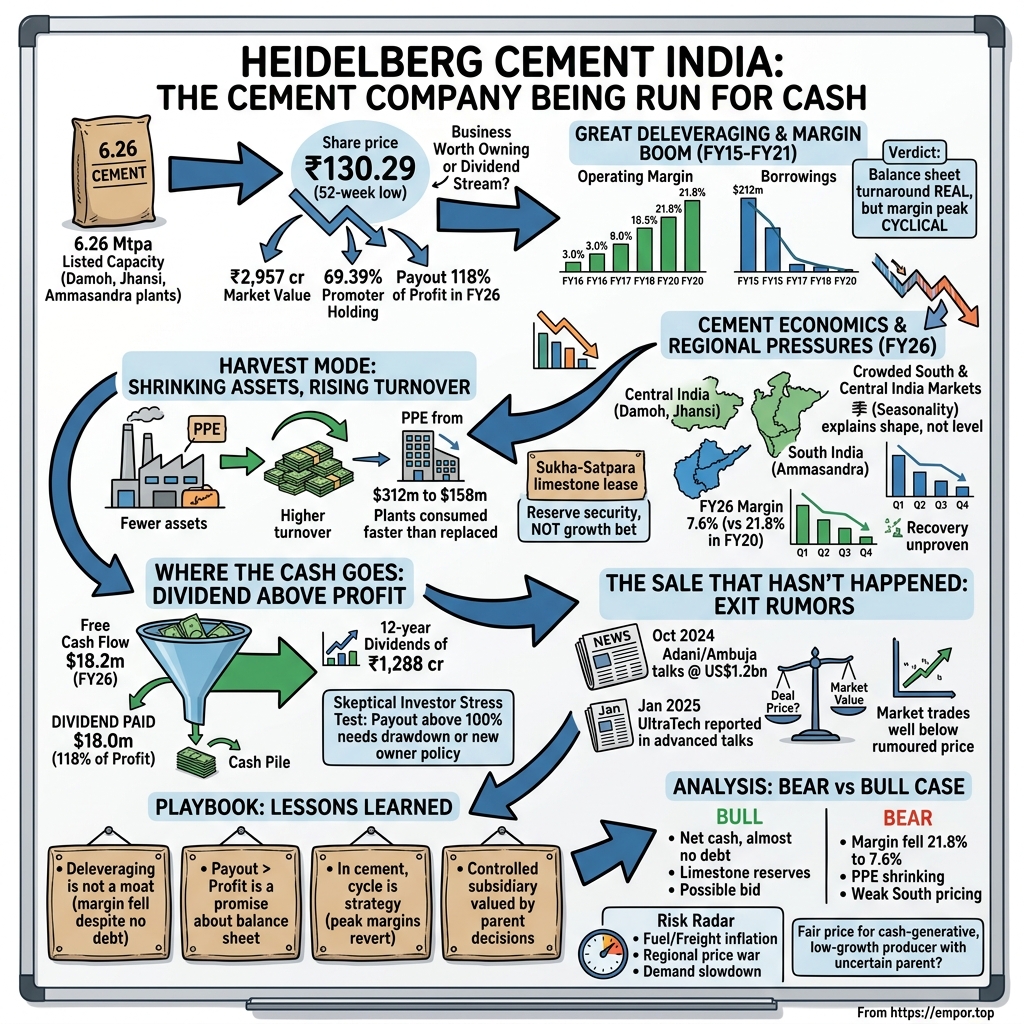
HeidelbergCement India: The Cement Company Being Run for Cash
I. Introduction & Episode Roadmap (≈5 min)
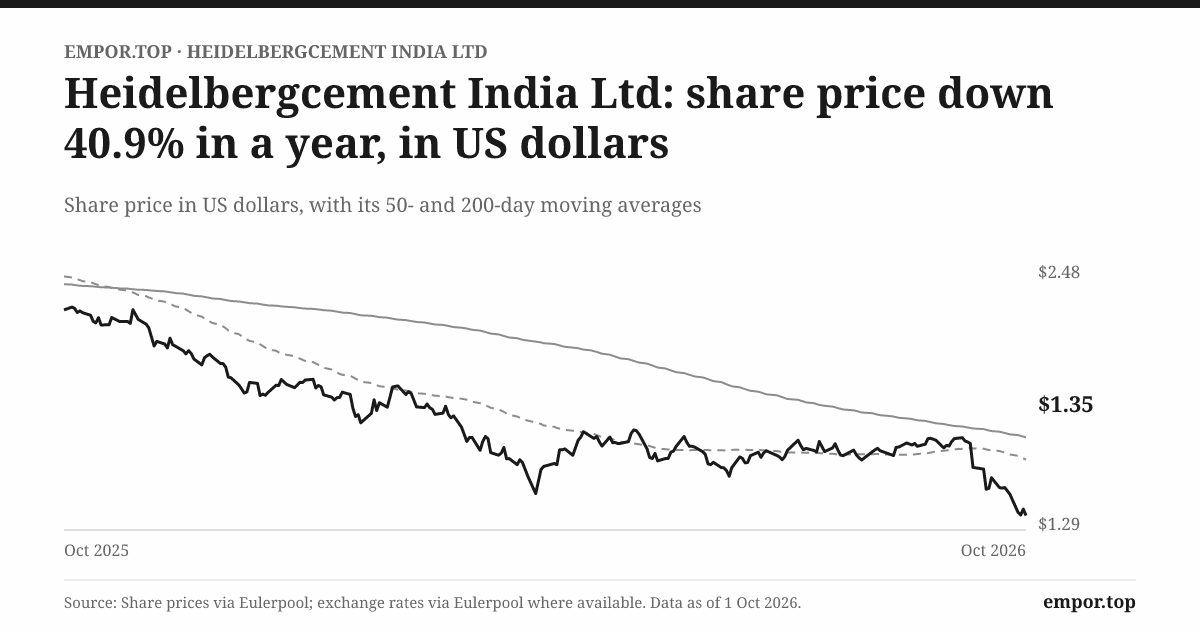
On the first day of October 2026, a share of HeidelbergCement India changed hands at ₹130.50. That was within a rounding error of its 52-week low of ₹130.29, and more than a third below the ₹203 it fetched at its high1. Nothing dramatic happened that day. No profit warning, no regulator's letter, no plant fire. The price simply settled at the bottom of its range, the way a building settles into soft ground.
And yet this is a company that, for nearly two years, has been talked about as a takeover target. In January 2025, the financial press reported that UltraTech, India's largest cement maker, was in advanced talks to buy the parent's 69.39% stake for about ₹3,381 crore5. Months earlier, Adani's cement arm had reportedly held talks of its own3. If you had told a shareholder in early 2025 that, by October 2026, there would be no completed deal and the stock would be at a one-year low, they might not have believed you. Here we are.
So the question for this episode is simple to state and hard to answer. At about ₹130 a share, is HeidelbergCement India a business worth owning, or is it a dividend stream waiting for a new owner?
The headline numbers frame the puzzle. The whole company is worth about ₹2,957 crore on the market, roughly $307 million1. One shareholder, Heidelberg Materials South Asia B.V., owns 69.39% of it16. And in the year to March 2026, the company paid out dividends equal to about 118% of its profit1. Read that last figure again. The company handed its owners more than it earned.
That is the first clue that this is not a normal growth story. It is a story about a mature industrial asset inside a multinational, where the owner has, over a decade, chosen to clear the debt, shrink the asset base, and send the cash home.
What exactly is the listed company?
Before any number makes sense, the entity boundary has to be drawn, because it trips up almost everyone who looks at this stock. The listed company, HeidelbergCement India Limited, owns three plants: Damoh in Madhya Pradesh, Jhansi in Uttar Pradesh and Ammasandra in Karnataka, with installed capacity of about 6.26 million tonnes a year19.
It is not the same thing as "Heidelberg in India." The German group's Indian footprint is about 12.1 million tonnes of integrated capacity across 12 states, and roughly half of that sits inside Zuari Cement, an unlisted company that came to the group through the 2016 Italcementi acquisition3. Zuari's plants, profits and growth belong to the parent, not to the minority shareholders of the listed company. When a headline says Heidelberg is selling "its India business," a reader has to ask which half.
The four questions
This episode is organised around four questions that decide whether the stock is cheap, fair or a trap.
First, is the dividend sustainable on a cash base that has been shrinking? Second, is the recent margin recovery real, or just seasonal noise on a commodity price? Third, is the company being run for harvest, and what is it deliberately not building? Fourth, what does the parent take out, and who protects the 30.6% of shareholders who are not the parent?
The verdict, stated up front and earned over the next ninety minutes, is this: HeidelbergCement India is a shrinking, cash-generating cement producer whose value depends on three things it does not fully control: the regional margin cycle, the dividend policy, and the parent's next move.
The story runs in order. First the boom and bust of FY15 to FY26, then the harvest, then the parent's deal talks, and finally the lessons. But to understand why a company would pay out more than it earns, you first have to understand who sits at the head of the table.
 Subscribe on LinkedIn
II. A Parent's Subsidiary in India: Just Enough History (≈6 min)
The company's corporate identity number tells an old story in a few characters: L26942HR1958FLC042301. The "1958" is the year of incorporation; "HR" is Haryana, where it was registered; "FLC" marks it as a foreign-controlled public company1. A cement company born in the first decade of Nehru's planned economy now sits, several corporate layers later, beneath a Dutch holding company owned by a German building-materials giant.
That chain of ownership is the most important fact about the business. HeidelbergCement India is not run by a founder who wakes up thinking about Damoh. It is a line item in the portfolio of Heidelberg Materials, a group whose investor relations pages talk about decarbonisation, aggregates in North America and capital returns to shareholders in Frankfurt10. India matters to that group, but the listed Indian subsidiary is one of several vehicles through which it participates.
A decade without a change of control
Here is the striking constancy. The promoter held 69.39% in March 2017. It held 69.39% in March 2022. It held 69.39% in March 2026, and still 69.39% in June 20261. Across the whole period, the promoter shares carried no pledge or encumbrance6.
That matters analytically because it removes a whole category of explanations. When margins rose from 3% to 22% and fell back to under 8%, it was not because a new owner arrived with a new strategy, or because a distressed promoter was pledging shares to fund something elsewhere. The same owner made every decision. Every swing in the numbers that follows came from the cement cycle and from choices made by one controlling shareholder.
Where the growth went
The 2016 Italcementi deal is worth a single paragraph, because it reveals where the group chose to grow in India. When Heidelberg bought Italcementi globally, Zuari Cement came along, roughly doubling the group's Indian capacity3. That capacity was not folded into the listed company. Growth happened above the listing; the listed company kept its three plants.
For a minority shareholder, that is the quiet fact underneath the whole story. The group expanded in India through an entity they do not own, while the entity they do own became smaller over time.
The merger that keeps not happening
The obvious fix is a merger. Put Zuari inside the listed company, and minority holders would own a slice of the bigger business. The idea has been in circulation for years. When India Ratings upgraded the company to IND AAA in November 2021, it cited potential simplification of the group structure through a merger with Zuari as one consideration4. In July 2023, the managing director was reported as saying the company was waiting for the right time3.
More than three years after that comment, the right time has not arrived. The two companies remain separate. No swap ratio has been announced, and no scheme has been filed on the exchanges78. That record of talk without action is something to carry forward, because it rhymes with the sale talks in section VIII.
The entity boundary, then, is not a technicality. Every figure in this story belongs to three plants and about 6 million tonnes, not to a 12-million-tonne Indian group. With that settled, the story can go back to the moment when this small company had a very large problem: debt.
III. The Great Deleveraging and the Margin Boom (FY15–FY21) (≈11 min)
Picture the company in the year to March 2016. Revenue had just dropped by about a fifth in dollar terms. Operating margin was 3%, which in cement is roughly the level at which a plant pays its power bill and little else. Customers were taking 72 days to pay, far beyond the few days normal for a business that sells bagged cement through dealers. And the balance sheet carried borrowings of about $115 million, down from about $212 million a year earlier but still large for a company earning under $8 million of operating profit18.
This was a company that had expanded its central India capacity in the years before and was now carrying the bill. Debt to equity stood at 1.5 at the start of the period1. In a cyclical industry, that is the kind of balance sheet that turns a bad year into a dangerous one.
Then something remarkable happened. Within four years, the same plants produced an operating margin of 21.8% and a return on equity of about 20%1. Net profit climbed from about $6 million to a peak of about $42 million in FY211. And the debt melted away, falling in every single year until, by March 2026, it was about $1.6 million1. Debt to equity went from 1.5 to 0.01.
How the cash was squeezed out
The turnaround shows up first in working capital, the money tied up in inventory and unpaid bills. Inventory days, which measure how long stock sits before it is sold, fell from about 195 in FY16 to about 45 by FY211. The company also learned to be paid fast and pay its suppliers slower, so that working capital turned firmly negative: suppliers and dealers were, in effect, financing the business.
The result was a surge in cash. Free cash flow, the cash left after capital spending, rose from about $11 million in FY15 to about $58 million in FY201. Almost all of it went to two places: repaying lenders, and, from FY18, paying shareholders. The first dividend arrived in FY18, and for four years the payout sat in a steady band of about 41% to 46% of profit1. That was a conventional, conservative policy. Hold on to that number, because it is the policy that later broke.
What drove the margin from 3% to 22%?
This is the most important question in the section, and the honest answer has to be built from the shape of the numbers. Revenue in FY20 was only about a fifth higher than in FY16 in dollar terms1. A business cannot go from a 3% margin to a 22% margin on a 20% revenue increase through volume alone. Either prices per tonne rose sharply in the company's markets, or costs per tonne fell sharply, or both.
The timing points to both, with cost doing a large share of the work. FY17 to FY20 was a period when the company stopped paying heavy interest, worked through high inventory, ran its central India plants harder and benefited from a relatively soft fuel market before the 2021–22 surge in coal and petcoke prices. Central India, where Damoh and Jhansi sell, was also a tighter market than the south during those years. The FY22 and FY23 collapse in margin, when global fuel prices spiked, is the reverse proof: the same plants, the same owner and broadly the same volumes produced a margin that fell from about 19% to under 7% within two years1. A margin that moves that much with fuel is a margin that was lifted by fuel.
The implication is uncomfortable for anyone who treats the FY19–FY21 margins as "normal." They were a cyclical high, built on favourable input costs and regional pricing, not a new structural level. The company has not seen them since.
The base rate to carry forward
This is why the five-year profit record looks so bad. Net profit fell about 15.7% a year from FY21 to FY26, but the starting point was the peak1. Over ten years, by contrast, profit grew about 13% a year, because the starting point was the trough1. Both numbers are true. Neither is the business's "growth rate." The honest base rate is a company whose earnings move with the margin cycle around a revenue line that has grown only about 2–3% a year in rupees1.
The deleveraging, on the other hand, was real and permanent in the sense that matters: it happened, and the cash is gone from the lenders' books. But deleveraging is a one-time event. Once the debt is paid, the cash that serviced it has to find a new home, and the margin that generated it has to be earned again every year in a crowded market.
So the next question is what that market actually looks like from the plant gate.
IV. The Cement Business: Per-Tonne Economics in a Crowded South and Central India (≈14 min)
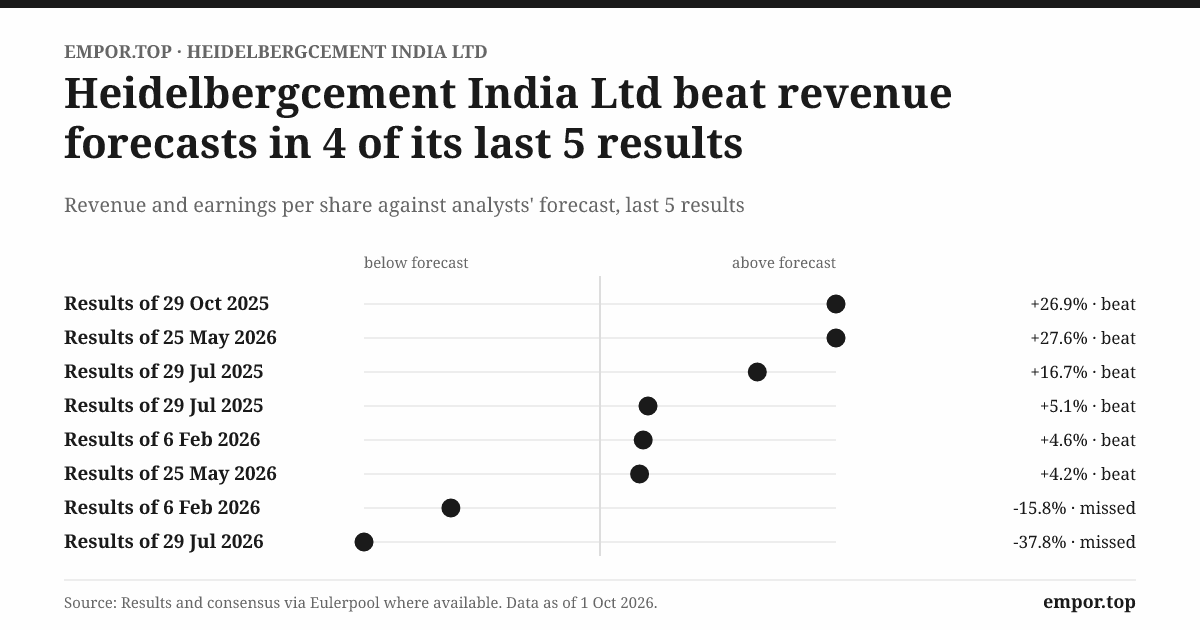
Look at the last five quarterly results side by side and a pattern jumps out. In the June 2025 quarter, the operating margin was about 10.3%. In September, 6.0%. In December, 4.4%. In March 2026, 9.4%. And then in June 2026, when the cycle should have brought it back to double digits, it came in at 6.0%1.
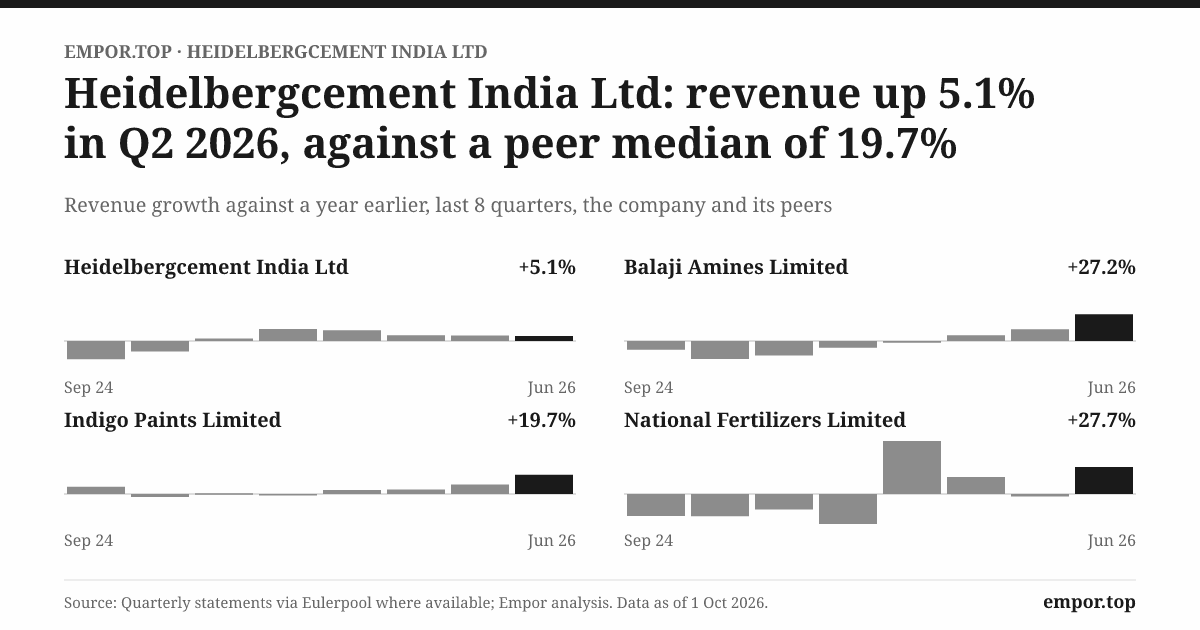
That last figure is the problem. Revenue in the June 2026 quarter was up about 5% on a year earlier, but operating profit fell about 38%1. The company sold more and made less. In a commodity business, that is the signature of either weaker prices per tonne, higher costs per tonne, or both.
How cement is actually sold
To understand why, it helps to understand the product. Cement is a grey powder sold by the tonne, mostly in 50-kilogram bags, through a network of dealers and retailers who sell to builders and households. There are no long-term contracts and no minimum volumes. Dealers buy what they think they can sell this month. The company is paid quickly, with debtor days around 9 in FY261, because dealers often pay in advance or on very short credit.
Demand follows construction, and construction in India follows the weather. The monsoon from June to September slows building sites, and the September and December quarters are typically the weakest. That explains why the company's Q2 and Q3 margins sit below Q1 and Q4 in almost every year1.
But seasonality explains the shape of the curve, not its height. In FY20, the company earned a full-year operating margin of about 21.8%. In FY26, it earned about 7.6%1. No amount of monsoon explains a gap that large.
Two regions, two markets
The three plants serve two very different markets. Damoh and Jhansi sit in central India, in Madhya Pradesh and Uttar Pradesh, a region with large demand from housing and infrastructure in the Hindi heartland. Ammasandra, in Karnataka, serves the south39.
The south is the harder market. Global Cement estimated that South Indian capacity was running at about 56% utilisation in 20233. When nearly half the region's kilns are idle, the producers who are running fight for every dealer, and the price per bag stays weak. Cement does not travel well: it is heavy and cheap, so freight eats margin quickly beyond a few hundred kilometres. That means regional overcapacity cannot easily be exported away. It sits on prices.
The company's response at Ammasandra is telling. In May 2024, clinker production there stopped3. Clinker is the intermediate product made in the kiln, the expensive, fuel-hungry step where limestone is cooked at high temperature. A plant that stops making clinker becomes a grinding unit, buying in clinker and mixing it with gypsum and other materials. That is a decision to stop investing in the southern kiln, and it is consistent with a market where running the kiln did not pay.
The giants in the room
Size matters in cement because the biggest costs, fuel, power and freight, fall with scale and with logistics networks. The listed company, at about 6 million tonnes, is a small player in an industry consolidating around two giants: UltraTech, the Aditya Birla group's cement arm, and the Adani group's Ambuja and ACC. Behind them come Shree Cement, Dalmia Bharat, JK Cement and others. The fact that both UltraTech and Adani reportedly looked at buying this company is itself a statement about the industry: the giants are buying capacity, and the small, independent producers are the inventory35.
A clean peer table of capacity and EBITDA per tonne for every listed competitor is not part of this company's own disclosure, and the comparison has to be framed carefully. What can be said is directional: a 6-million-tonne producer with no growth capex and no captive power expansion in the period is competing against groups adding tens of millions of tonnes and investing in cheaper energy. Its cost position is unlikely to improve relative to them.
Why margins actually moved
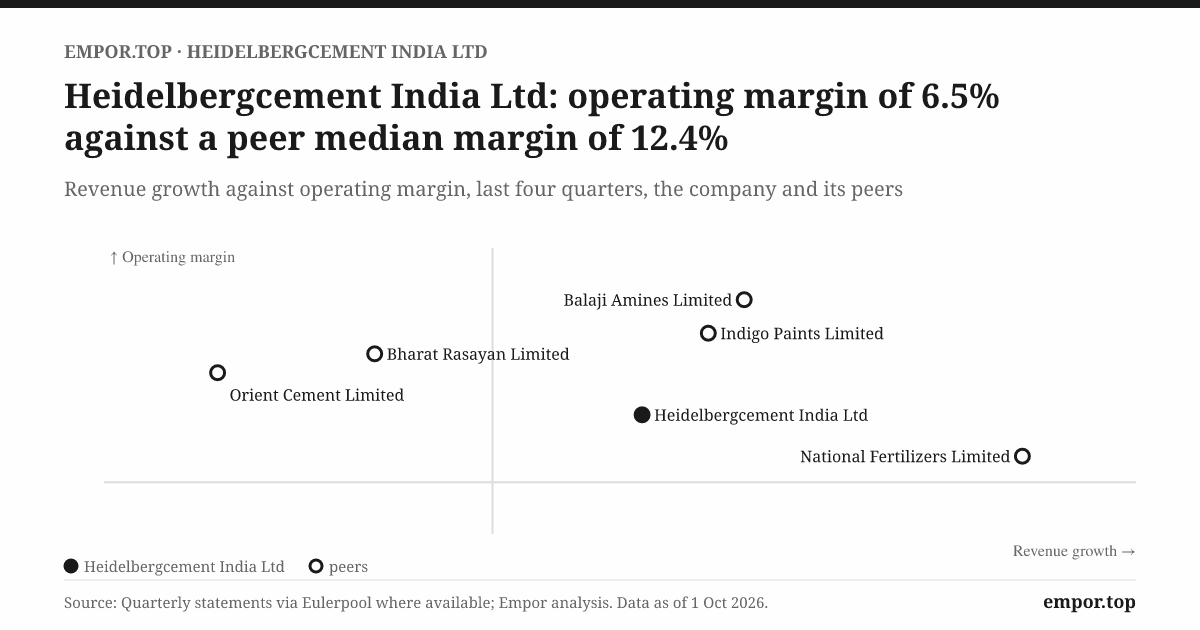
Margins in cement are driven by a handful of cost lines: power and fuel (coal and petcoke for the kiln and electricity for the mills), freight to get the bags to dealers, and raw materials, mainly limestone from the company's own leases. The shape of the record shows how these interacted. Margins collapsed from about 14.5% in FY22 to about 6.5% in FY231, the year global coal and petcoke prices peaked after the invasion of Ukraine. They recovered to about 9.0% in FY24 as fuel eased, then fell to about 6.0% in FY25, the year of weak realisations and a soft construction market in the first half, when revenue fell about 9%1. FY26 brought partial recovery, to about 7.6%, on higher volumes1.
The conclusion is that the margin is set mainly by regional price realisation and fuel costs, the two things the company least controls. Volume has helped at the edges. The recovery is not proven until the September and December 2026 quarters clear the 6.0% and 4.4% of a year earlier.
The moat, argued once
Run the industry through Porter's five forces and the picture is clear. Buyers are many, small dealers with low concentration, which is good, but they have easy alternatives in every town, which limits pricing. Suppliers of coal and petcoke sell into a global market the company cannot influence; limestone leases are a real asset, but every integrated rival has its own. Rivalry is fierce, especially in the south. Substitutes barely exist, which protects the industry, not this company. New entrants face high capital costs, but the big incumbents keep expanding, which is functionally the same as new entry.
Through Hamilton Helmer's 7 Powers lens, only two powers are even candidates: scale economies and a cornered resource in limestone. The company has neither in a way that beats its rivals. It is sub-scale against the leaders, and limestone is a requirement of the trade, not an edge. Brand matters a little in retail cement, but not enough to sustain a premium in a surplus market. The honest verdict is that this business has no durable competitive power; it has a decent cost position in central India and a weak one in the south.
That makes the first KPI simple. EBITDA per tonne, together with volumes sold, is the number that tells an investor whether the company is earning more on each bag or just selling more bags. With the competitive position this thin, the next question is what the owner has chosen to do with the plants.
V. Harvest Mode: Shrinking Assets, Rising Turnover (≈10 min)
In May 2024, the kiln at Ammasandra went cold3. No press conference, no grand restructuring. Just a decision that the southern plant would stop making clinker. It is the kind of decision that rarely makes headlines but says a great deal about how an owner sees an asset.
Seen in isolation, it is a sensible operating move in an overcapacity market. Seen alongside the rest of the decade, it looks like one more step in a long and consistent pattern: harvest.
The shrinking machine
The balance sheet tells the story without commentary. Property, plant and equipment, the book value of the kilns, mills, mines and buildings, fell from about $312 million in FY15 to about $158 million in FY261. Part of that fall reflects the weaker rupee over the decade, but the decline is about 3.4% a year in rupees too1. Total assets shrank about 0.8% a year over ten years1.
Meanwhile asset turnover, the revenue generated per dollar of assets, rose from 0.73 to 0.961. That is exactly what happens when a company keeps selling roughly the same volume from plants that are being depreciated and not replaced. The assets get smaller on paper while the revenue line holds up. Ratios that divide by assets start to look better, even though nothing about the business has improved.
Capex against depreciation
The cleaner test is to compare what the company spends on its plants against what the plants wear out each year. In FY26, cash from operations was about $24.1 million and free cash flow about $18.2 million, which means capital spending of roughly $6 million1. Depreciation, measured as the gap between EBITDA and operating profit, was about $15 million1.
Put plainly, the company spent roughly 40 cents on its plants for every dollar of wear and tear. That is not unusual for a single year; many companies have lumpy capex. But across the decade, the steady fall in PPE says the gap has been persistent. The plants are being consumed faster than they are being renewed. That is the definition of harvest: run the existing asset for cash, maintain it enough to keep it running, and do not build new capacity.
The $41.7 million that was not capex
There is one large number in FY26 that could confuse a reader. Cash used in investing activities was about $41.7 million, by far the biggest outflow of the decade1. A naive reading would say the company finally started building something.
It did not. The investments line on the balance sheet jumped from about $3.6 million to about $40.3 million in the same year1, almost exactly the size of the investing outflow. Cash moved from one pocket to another: from cash and short-term deposits into investments, most likely longer-dated deposits or liquid funds. That is a treasury decision, not a growth decision. It also explains part of why reported cash fell; the money did not leave the company, it changed category.
The limestone lease
The one forward-looking asset decision in the record is a mining agreement. In September 2026, the company was reported to have signed a 50-year agreement for the Sukha-Satpara limestone block, with estimated reserves of about 63 million tonnes1. That sounds big. It is worth translating.
A cement plant uses roughly 1.3 to 1.5 tonnes of limestone per tonne of clinker. A block of 63 million tonnes therefore supports decades of production at a plant the size of Damoh, but it does not add a single tonne of capacity. It secures raw material for plants that already exist. It is a reserve-security decision, consistent with keeping the central India plants alive for a long time, and also with making them more valuable to a buyer who wants a long-life mine. It is not a growth bet.
M&A and the falsification test
The listed company made no acquisitions in the period. The Zuari deal happened above it. Any future merger with Zuari would have to be judged against industry deal values, where precedents like UltraTech's purchase of Jaypee's cement assets and Adani's purchase of Holcim's Indian businesses set a high bar per tonne of capacity. Until a swap ratio is announced, there is nothing to benchmark.
The harvest claim has a clear falsification test: if the company announced a meaningful capacity expansion or a new grinding unit, the reading would have to change. Across the company's exchange filings and annual reports, no such plan has been announced78. The harvest reading stands.
What, then, happens to the cash a harvested business throws off? That is where the story gets interesting.
VI. Where the Cash Goes: The Dividend Above Profit (≈12 min)
Two numbers from FY26 sit next to each other like twins. Dividends paid: about $18.0 million. Free cash flow: about $18.2 million1. The company handed out almost exactly what it generated after maintaining its plants, and that amount was about 118% of reported profit1.
That is not a one-off. The payout was about 205% in FY23 and about 169% in FY251. Three of the last four years saw dividends above profit. For a business with no debt to repay and almost no growth capex, the question becomes: is this sustainable, or is it slowly emptying the tank?
The long view is reassuring
Start with the twelve-year record, because it is the better base rate. From FY15 to FY26, the company produced cash from operations of about ₹3,877 crore against net profit of about ₹1,870 crore1. In other words, cash earnings were about twice accounting earnings. That gap is mostly depreciation, a non-cash charge, plus the benefit of negative working capital.
Of the roughly ₹3,065 crore of free cash flow over those twelve years, the company paid about ₹1,288 crore in dividends, about 42%1. The rest went to clearing the debt and building the cash pile. Measured against cash rather than profit, the dividend was comfortably affordable for most of the decade.
The recent view is less so
The problem is direction. Cash from operations fell from about $64 million in FY20 to about $24 million in FY261. Free cash flow followed. Cash and short-term investments peaked at about $72.7 million in FY23 and fell to about $45.5 million by FY261, although part of that decline is the shift into the investments line noted earlier. And the share of EBITDA that arrived as operating cash dropped from about 93% in FY25 to about 69% in FY261, with working capital days moving from about −64 to −491. In plain terms, suppliers financed a little less of the business in FY26 than the year before, and that pulled cash in.
The treasury cushion is thinner than it used to be, too. Other income, mostly interest on deposits, was about ₹24 crore in FY26, down from about ₹135 crore in FY151. That is still roughly 12% of pre-tax profit, which means a meaningful slice of the earnings that pay the dividend comes from interest on cash, not from cement. Shrink the cash pile and that slice shrinks with it.
Shareholders currently see a dividend yield of about 5.35% on the share price1. At ₹130, that yield is the main reason many domestic funds hold the stock.
Who receives the dividend
There is a quieter way to read the payout. Of every rupee paid in dividends, 69.39 paise goes to the parent1. When a controlled subsidiary pays out more than it earns, with no debt to repay and no capacity to build, the dividend becomes the cleanest way to move cash upstream to the group. It treats minority shareholders equally, which is a point in its favour, but its timing and size are set by the owner's needs as much as the subsidiary's.
The stress test
Imagine a sceptical investor with a spreadsheet. Suppose free cash flow runs at about ₹150 to 180 crore a year, roughly where FY25 and FY26 landed in rupees, and the dividend stays about the same. Then almost nothing is left to reinvest, and every rupee of capex above maintenance has to come from the balance sheet. Now suppose margins stay in the 6–8% range of the last four years. Profit stays near current levels, the payout stays above 100%, and the cash pile, which has already fallen by roughly a third from its peak, keeps falling.
The arithmetic says the company can sustain a payout above profit for a few more years from its cash and investments, which together exceed $85 million1. It cannot sustain it indefinitely unless margins recover. A payout above 100% is a promise that the balance sheet will be drawn down, not a promise about the business.
So the second KPI is free cash flow after dividends, along with the size of the FY27 dividend. If it stays negative or near zero, the harvest is reaching its end. If margins recover and it turns positive, the dividend becomes safer.
That leaves the question of whether the dividend is the only channel through which value flows to the parent.
VII. What Does the Parent Take Out? (≈8 min)
In November 2021, India Ratings upgraded HeidelbergCement India to IND AAA, the highest rating on its scale, from IND AA+4. The reasons it gave were revealing. Not the plants, not the cement brand, but the company's "strong linkages" with its parent, along with the financial profile of both the parent and the combined Indian operations, including Zuari4. The downgrade triggers were weaker parent linkages or weaker Indian performance4.
In other words, the credit agency rated this company largely on who owned it. That is reasonable for credit risk. For an equity investor, it is a reminder that the parent relationship cuts both ways: it supports the balance sheet, and it also sets the terms of every transaction between the two.
The channels that matter
A listed subsidiary of a multinational can send value upstream through several channels besides dividends: royalties for the brand or technology, fees for technical services, shared-service charges, purchases from or sales to group companies, and deposits or loans placed with the group. Indian law requires material related-party transactions to be disclosed in the annual report's related-party note and in Form AOC-2 in the board's report, and to be approved by shareholders above certain thresholds, where the promoter cannot vote8.
The test for minority holders is proportion. Against revenue of about $264 million in FY261, fees of a few million dollars would be a small second channel; fees running into the tens of millions would be a central part of the story. The company's own disclosures in the annual report are where this is measured, and the shareholder-voting results on any royalty or related-party resolution, published on the exchanges, are where minority dissent would show78. The cleaner reading of the cash record is that the dividend is the main channel: the payout figures alone account for the large majority of cash leaving the company in recent years1.
Management and incentives
The company is run by a managing director and senior team appointed within the Heidelberg group structure. For an investor, the incentive question is straightforward: executives at a group subsidiary are typically rewarded on group targets and hold little or no stock in the listed company. That alignment points upward, towards the parent's priorities, rather than towards the minority's share price.
Credibility over time
The best test of management credibility here is the merger promise. In July 2023, the managing director was reported as saying the company was waiting for the right time to merge with Zuari3. Since then, the group has reportedly held sale talks with two buyers instead35. That is not a broken promise in a legal sense; "the right time" commits to nothing. But it is a pattern: the strategic language has been consistently open-ended, and the outcomes have not arrived.
The governance falsification
What would break the claim that minority holders are treated fairly? Large related-party fees growing faster than revenue, minority votes against royalty resolutions, auditor qualifications, or material contingent liabilities from tax, mining-royalty or competition disputes. Cement companies in India have historically carried such disputes, including Competition Commission cartel matters affecting many producers. Weighed against a market value of about ₹2,957 crore1, any single dispute would need to run into hundreds of crores to change the investment case. The company's clean balance sheet and AAA history suggest the governance risk is not about fraud or leakage; it is about the fact that one shareholder decides the timing of everything.
And the biggest decision of all is the one that has been talked about since 2024.
VIII. The Sale That Hasn't Happened (≈9 min)
October 2024. Reports emerged that the Adani group, through Ambuja Cements, was in talks to acquire Heidelberg's Indian cement businesses for about $1.2 billion3. That figure covered more than the listed company; it was a group-level number including Zuari.
January 2025. Business Standard reported that UltraTech was in advanced talks to buy the parent's 69.39% stake in the listed company for about ₹3,381 crore5. Global Cement, describing the industry's consolidation, later pointed to a possible completion in early 20273.
October 2026. Neither deal has closed. No open offer has been announced on the exchanges78. And the share price sits at its 52-week low.
The arithmetic of a rumour
Start with the numbers the market can check. ₹3,381 crore for 69.39% implies about ₹4,872 crore for the whole company. With about 22.7 crore shares in issue (market value of ₹2,957 crore divided by ₹130.501), the reported price works out to roughly ₹215 a share. That is above the 52-week high of ₹203 and about 65% above the current price1.
If the market believed that deal was coming, the stock would not be at ₹130. The gap is the market's verdict: it is not pricing a bid. It is pricing a cement company with falling profits and a dividend that exceeds its earnings.
What a buyer would actually get
The open-offer mechanics matter for minority holders. Under SEBI's takeover regulations, anyone who acquires 25% or more of a listed company, or acquires control, must make an open offer to buy at least a further 26% from public shareholders, at a price no lower than the highest of several benchmarks, including the negotiated price per share paid to the seller. But the promoter already owns 69.39%, so an acquirer of that stake could buy at most about 5.6% more before hitting the 75% cap on promoter holdings that keeps a company listed. In practice, minority shareholders would get the chance to tender part of their holding at or near the deal price, not all of it.
What would the buyer be paying for? Not growth. It would be paying for limestone reserves, now extended by the Sukha-Satpara lease; plant sites and permissions in central India, which take years to replicate; a dealer network; and capacity it can run harder within its own logistics. At ₹4,872 crore for about 6.26 million tonnes, the implied value is roughly ₹780 crore per million tonnes of capacity, before adjusting for the company's net cash. That is in the range of Indian cement deal values for older, smaller plants, but any comparison depends on plant condition and reserve life.
Who is buying, who is leaving
The shareholder register tells its own story. Foreign institutions held about 11.4% in March 2017 and about 1.1% by June 202612. They have nearly all left. Domestic institutions moved the other way, from about 7% to about 14%1. The named holders include SBI's ELSS tax-saver fund at about 4.7%, LIC at about 3.6%, ICICI Prudential's infrastructure fund at about 3.5% and Axis Small Cap at about 2.1%2. The number of shareholders fell from about 89,000 in March 2024 to about 78,000 in June 20262.
The pattern fits a stock that foreign funds see as a shrinking business with no catalyst, and domestic funds hold for its yield and the option on a bid.
The rumour as catalyst
Two reported bids within four months, followed by about twenty months of silence, is a long record of talk. The base rate for Indian cement deals that are "in advanced talks" and then go quiet is not good. Until a filing appears on the exchanges, the deal is an option, and the market is valuing it as one that may expire worthless.
What should an investor take from all this? That brings the story to its lessons.
IX. Playbook: Business & Investing Lessons (≈6 min)
Deleveraging is not a moat
In FY15, the company owed about $212 million. By FY26, it owed about $1.6 million1. It is one of the cleanest balance-sheet repairs in Indian mid-cap cement. And yet operating margin fell from about 21.8% to about 7.6% over the same period1. Clearing debt removes a risk; it does not create a competitive advantage. The lenders were paid, but the dealers in Bengaluru still had five other brands to choose from. Paying off the bank makes a company safer, not stronger.
A payout above profit is a promise about the balance sheet
In FY23, the company paid out about twice what it earned1. In FY25 and FY26, it paid out more than it earned again1. Each time, the dividend was funded partly by cash built up in the boom years. That works for a while. It is not a statement about the business's earning power; it is a statement about how much is left in the vault. When the dividend is bigger than the profit, the investor is being paid out of the past.
In cement, the cycle is the strategy
The margin went from 3% to 22% and back to under 8% in a decade, under a single owner, with no change in plants that could explain the swing1. The best years were not the result of a brilliant plan; they were the result of favourable fuel costs and regional pricing. The worst years were not the result of mismanagement; they were the reverse. For a small producer without scale, timing the cycle is the only lever. A cement margin is borrowed from the fuel market and must be returned.
A controlled subsidiary is valued by its parent's decisions
The stock trades not on what the plants earn, but on what the parent decides: whether to sell, to merge with Zuari, to change the dividend, or to keep harvesting. Every important number in this story was set at a board table in another country. When one shareholder owns seven of every ten shares, the other three are passengers.
Those lessons point straight at the valuation question.
X. Analysis & Bear vs. Bull Case (≈7 min)
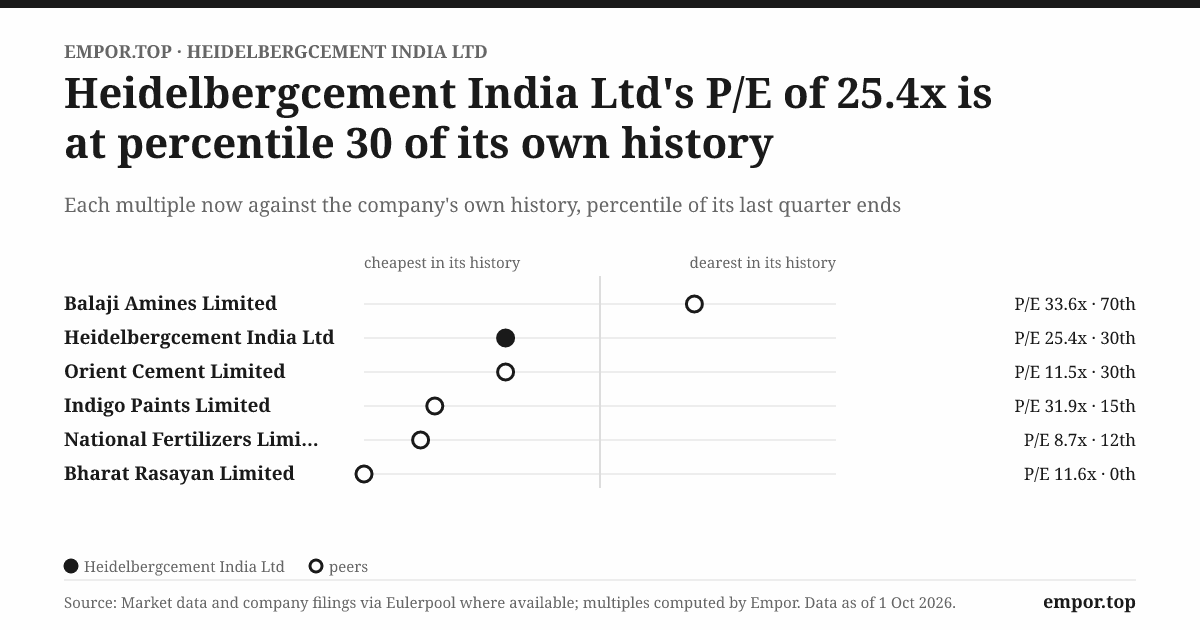
The share price stands about 36% below its 52-week high. The P/E is about 25x, against a five-year median of about 31x1. On that measure, the stock looks cheaper than its own history. But the history includes the boom years, when earnings were much higher and the multiple was paid for genuine profit.
The other measures paint a mixed picture. Enterprise value, market value minus net cash, is about ₹2,549 crore, or about 8.9 times EBITDA1. Price to book is about 2.2x1. Return on equity is about 8.5% and return on capital employed about 12.3%1. Those returns are modest, roughly in line with the cost of equity in India. The free-cash-flow yield on the trailing figures is about 2.1%1, well below the dividend yield of about 5.35%, which is the clearest sign that the dividend is being paid partly from the balance sheet.
The verdict on valuation is that the stock is neither obviously cheap nor obviously expensive on current earnings. What the price assumes is that margins stay low, the dividend continues for a while, and no deal arrives soon.
The bull case
The bull says the balance sheet is close to bulletproof, with net cash and almost no debt. Limestone reserves have just been extended by 50 years. Capacity is under-used, so any recovery in regional pricing drops straight to profit; a return to even the FY24 margin of about 9% would lift earnings meaningfully. And there is a free option: a bid at anything like the reported ₹215 a share would be a large premium to today's price, with an open offer for part of the minority's holding.
The bear case
The bear says the margin has fallen from about 22% to under 8% and has shown no sign of returning. PPE is shrinking every year. The dividend exceeds free cash flow on a trailing basis. The south remains oversupplied. Foreign investors have voted with their feet. And two years of deal talk without a deal suggests the parent is either unable to agree a price or unwilling to sell.
The risk radar
The risks that matter are narrow. Fuel and freight inflation hits margin directly, as FY23 proved. A price war in central India, where the giants are adding capacity, would hit the company's better region. A construction slowdown would hit volumes. A mining-lease or regulatory ruling could change raw-material costs. And the parent's decisions, to sell, merge or hold, will dominate the share price whatever the plants earn.
The KPIs that decide it
Three numbers tell the story from here. EBITDA per tonne, which shows whether the company is earning more per bag. Free cash flow after dividends, which was close to zero in FY261. And the quarterly operating margin against the same quarter a year earlier, which fell by about 4.3 points in June 20261.
And that sets up the next few months.
XI. Epilogue (≈3 min)
Tonight, the company stands at a crossroads it has been standing at for two years. The plants are running. The cash is in the bank. The parent holds its 69.39%1. And the market is waiting.
The next moments are already on the calendar. The September 2026 quarter, due within weeks, will show whether the margin can beat the 6.0% of a year earlier. The December quarter will face a low bar of 4.4%1. If both clear comfortably, the margin-recovery question tilts towards yes, and the dividend looks safer. If either misses, the bear case tightens.
The FY27 dividend will be the next test of the harvest. A cut would signal that the balance sheet can no longer carry a payout above profit. A dividend held steady while profit stays flat would mean the cash pile keeps shrinking. A higher dividend would suggest the parent wants cash out before a sale, or instead of one.
Then there are the events no one can schedule. An open-offer announcement on the exchanges would reset the price overnight. A Zuari merger scheme would change what minority holders own. A filing confirming the Sukha-Satpara lease details would add reserve life to the central India plants.
Each outcome answers one of the four questions. A strong margin answers the second. A sustained dividend answers the first. A sale or merger answers the third and fourth. But the tension remains: a company that has paid out more than it earns, owned by a parent that may be leaving.
XII. Outro (≈1 min)
Back to that share price, ₹130.50, a whisker above the year's low. Ten years ago, this company was drowning in debt and earning almost nothing. Today it owes almost nothing, has handed most of its cash back to its owners, and is waiting to learn whether those owners will stay.
It is a cement company that spent a decade becoming smaller, richer in cash, and more dependent on someone else's decision.
References
-
HeidelbergCement India Ltd — Screener.in company page, 2026-10-01 ↩↩↩↩↩↩↩↩↩↩↩↩↩↩↩↩↩↩↩↩↩↩↩↩↩↩↩↩↩↩↩↩↩↩↩↩↩↩↩↩↩↩↩↩↩↩↩↩↩↩↩↩↩↩↩↩↩↩↩↩↩↩↩↩↩↩↩↩↩↩↩
-
Heidelberg Cement India Ltd — Shareholding Analysis — Tijori Finance ↩↩↩
-
Adani aims at Heidelberg Materials in India — Global Cement ↩↩↩↩↩↩↩↩↩↩↩↩↩
-
India Ratings upgrades credit rating of HeidelbergCement India — Business Standard, 2021-11-08 ↩↩↩↩
-
UltraTech in advanced talks to acquire HeidelbergCement in Rs 3,381 cr deal — Business Standard, 2025-01-27 ↩↩↩↩
-
HeidelbergCement India promoter holds unencumbered shares in FY26 — ScanX ↩↩
-
HeidelbergCement India corporate announcements and annual reports — BSE ↩↩↩↩↩↩
 LinkedIn
 WhatsApp
 Reddit
 Hacker News
 Email
Email Kindle
 RSS Feed
 Spotify
 Apple Podcasts
 Amazon Music
 Audible
 YouTube