HDFC Life Insurance: Navigating the Shifting Tides of India's Premium Financial Moat
I. Introduction & Episode Roadmap
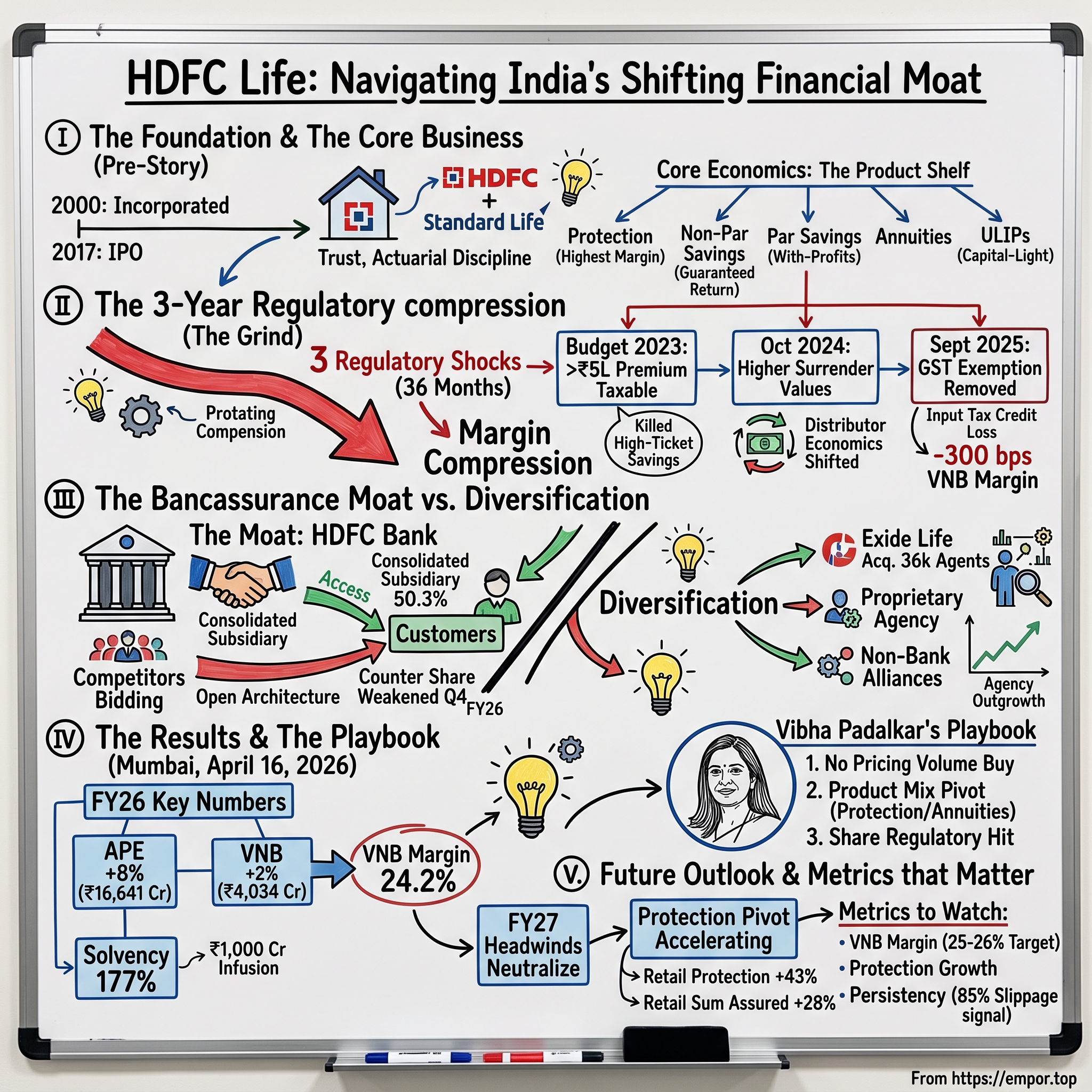
On the morning of April 16, 2026, HDFC Life's management team sat down in Mumbai to explain a number that, on its face, looked almost fine. Value of New Business — the actuarial measure of how much profit the year's freshly written policies would eventually throw off — had grown 2%, to ₹4,034 crore.1 Annualised Premium Equivalent, the industry's standard top-line yardstick, had grown 8%.1 Assets under management crossed ₹3,75,198 crore.1 Profit after tax rose 6% to ₹1,910 crore.1 For most Indian financial institutions, that would be a respectable year.
For HDFC Life, it was the third consecutive year of a slow, grinding compression. New business margin fell from 25.6% to 24.2%.1 The three-year compound growth rate in VNB — the single metric the market uses to value a life insurer — had fallen to roughly 3%, a figure management itself acknowledged on the earnings call was below where it should be.2 And the solvency ratio, the regulatory cushion that tells you how much capital sits behind the promises, had dropped from 194% to 177%, prompting the board to approve a ₹1,000 crore preferential share issue to its own parent, HDFC Bank, simply to top up the buffer.1
None of this happened because the business broke. It happened because, over roughly thirty-six months, the Indian state changed the rules underneath the business three separate times.
That is the story of this article. HDFC Life Insurance Company Limited, incorporated in 2000 as a joint venture between Housing Development Finance Corporation and the UK's Standard Life, is one of the great franchise-building exercises in modern Indian finance. It sits on top of the most trusted private financial brand in the country. It is now majority-owned — about 50.3% after the latest capital infusion — by HDFC Bank, India's largest private lender, following the July 2023 merger of HDFC Limited into the bank.[^3] It runs a pension subsidiary that has quietly accumulated ₹1,56,007 crore of assets, taking the group's total managed pool past ₹5.3 trillion.1 It is, by almost any structural measure, exactly the sort of business a long-term investor wants to own in an under-penetrated market.
And yet it has spent three years being systematically de-margined by its own regulator and its own finance ministry, in ways that were entirely legitimate, entirely pro-consumer, and entirely outside management's control.
The sequence matters. First came the Union Budget of February 1, 2023, when Finance Minister Nirmala Sitharaman made maturity proceeds taxable on non-ULIP policies with aggregate annual premiums above ₹5 lakh — killing, in a single sentence, the high-ticket guaranteed-return product that private bankers had been selling to wealthy customers as a tax-free bond substitute. HDFC Life's stock fell 10.96% that day; ICICI Prudential Life fell 10.97% and SBI Life 9.31%, on a day the Sensex actually rose.3 Then, effective October 1, 2024, the Insurance Regulatory and Development Authority of India mandated substantially higher surrender values for policyholders exiting early — transferring economics that insurers had historically kept, and used to fund upfront distributor commissions, back to the customer.[^5]4 And then, in September 2025, the Goods and Services Tax on life insurance premiums was removed altogether. Consumer-friendly on its face; but the exemption also stripped insurers of input tax credit, which management quantified on the H1 FY26 call as roughly 300 basis points of annualised headwind to new business margin.5
Three shocks, three different arms of the Indian state, one direction of travel: economics moving from the corporate margin to the end consumer.
So the question this article tries to answer is not "is HDFC Life a good company." It plainly is. The question is harder and more useful: when a regulator systematically compresses the profit pool of an industry, does a premium franchise actually keep its premium? Or does structural advantage — brand, bank ownership, distribution scale — turn out to be a claim on a shrinking pie rather than a growing one?
Here is where we're going. We start with the 1999 deregulation that created the private Indian life insurance industry and the specific reason HDFC was the right promoter for it. We trace the product cycle — the ULIP boom and its 2010 regulatory reckoning, the shift to participating and non-participating savings, and the recent violent swing back into unit-linked products. We dissect the bancassurance moat and ask the uncomfortable question of what happens when your captive bank starts letting competitors compete on its own counters. We stress-test the ₹6,687 crore Exide Life acquisition. We build up the actuarial vocabulary — APE, VNB, embedded value — in plain English, because you cannot analyse an insurer without it. We size HDFC Pension honestly, including the part where low fees make scale less lucrative than the headline suggests. We assess Vibha Padalkar's playbook and her credibility across successive earnings calls. And we close with an explicit why-win / why-not spine, run through Helmer's 7 Powers and Porter's Five Forces, plus the three operating metrics that will actually tell you whether the thesis is working.
The starting point is a country where, for four decades, buying life insurance meant buying from the government.
 Subscribe on LinkedIn
II. The Genesis: Deregulation & Building Trust in Fiduciary Products
To understand why HDFC Life exists at all, you have to understand what Indian life insurance looked like before it did — and the honest answer is that it barely looked like insurance.
From nationalisation in 1956 until the end of the century, the Life Insurance Corporation of India was the only game in town. LIC was not primarily an underwriter of mortality risk; it was a state savings mobiliser wearing an insurance costume. Its army of agents — hundreds of thousands of them, embedded in every district — sold endowment policies in the March quarter as a tax deduction. The pitch was never "your family will be protected if you die." The pitch was "buy this before the financial year closes and reduce your tax." Risk cover was an afterthought bundled into a savings product. Underwriting sophistication was minimal, because when you are a sovereign-backed monopoly, mispricing is absorbed rather than punished.
This produced a strange market structure. India had enormous insurance penetration by premium and almost no insurance protection by sum assured. Households were paying for policies that covered a fraction of what a breadwinner's death would actually cost them. The product was financially inefficient — bundled savings and insurance almost always are — but it was the only regulated long-term savings vehicle most middle-class Indians trusted.
The legislative pivot came with the IRDA Act of 1999, which established an independent insurance regulator and opened the sector to private companies, with foreign partners permitted to hold up to 26%.6 The design was deliberate: India wanted foreign actuarial and underwriting know-how without ceding control of long-duration domestic savings. Every private entrant therefore had to be a joint venture — an Indian promoter with distribution and brand, a foreign partner with technical capability.
The obvious question for any prospective Indian promoter was brutal: why would anyone buy a thirty-year promise from you instead of from the Government of India?
This is where HDFC's particular history mattered more than it might appear. Housing Development Finance Corporation, founded in 1977 and built over two decades by Deepak Parekh into India's dominant mortgage lender, had spent its entire existence in the business of very long-dated, trust-intensive contracts with middle-class households. A home loan is a twenty-year relationship in which the counterparty's conservatism is the product. HDFC had earned a reputation — through India's periodic financial scandals and NBFC blow-ups — as the institution that did not chase yield, did not window-dress, and did not fail. Parekh himself had become something close to the establishment's conscience, repeatedly the person governments called when a financial institution needed rescuing.
That reputation was the entry ticket. A brand-new private insurer selling a promise to pay in 2030 has, definitionally, no track record. It can only borrow one. HDFC's brand equity was precisely the collateral required to bridge the trust gap between a sovereign monopoly and a startup.
Standard Life, the Edinburgh-based mutual founded in 1825, brought the other half: actuarial discipline, product design, and the institutional memory of running with-profits funds through multiple interest rate cycles. The joint venture, HDFC Standard Life Insurance, was incorporated in 2000 as one of the first private licensees under the new regime, with the company's own offer documents recording the promoters' respective roles in brand, capital and technical expertise.[^12]
The early years were unglamorous. The fiduciary challenge in life insurance is unlike anything in retail banking or asset management. If a mutual fund underperforms, the customer sees it in a month. If a life insurer under-reserves, nobody finds out for fifteen years — at which point it is too late for everyone. The industry's central agency problem is that the people selling the product are compensated immediately and the consequences of bad selling appear a decade later in persistency and claims. Every regulatory intervention of the past twenty-five years, including the three shocks that define this article, traces back to that single structural mismatch.
The joint venture's ownership evolved over time. By the eve of the 2017 initial public offering, HDFC held 61.41% and Standard Life 34.86%.7 The IPO itself, which opened November 7 and closed November 9, 2017, was priced at ₹275–290 per share for an issue of roughly ₹8,700 crore — entirely an offer for sale, with HDFC divesting about 9.55% and Standard Life about 5.42%.7 No new capital went into the company; this was the promoters monetising a two-decade build. Standard Life — which later restructured and rebranded as abrdn — progressively sold down over subsequent years, and the foreign partner's role in the story faded as the Indian parent's grew.
Which sets up the more interesting structural question: once a life insurer has borrowed a brand's trust and built the balance sheet, what does it actually sell? That answer, in India, has changed roughly every seven years — and each change has been violent.
III. Product Architecture: Surviving the Cycles of the Indian Savings Mindset
There is a useful way to think about an Indian life insurer's product shelf: it is not a product portfolio so much as a portfolio of bets on where household savings will flow next, each with a completely different profit profile and a completely different risk sitting on the balance sheet.
Consider the four things HDFC Life sells, in plain terms.
A unit-linked insurance plan, or ULIP, is essentially a mutual fund in an insurance wrapper. The customer's premium, minus charges, is invested in equity or debt funds of their choosing. If markets go up, they win; if markets fall, they lose. The insurer takes a fee for managing the money and a small charge for the mortality cover. Crucially, the investment risk sits with the customer. That makes ULIPs capital-light for the insurer — you're not guaranteeing anything — but also low-margin, because you're competing directly with mutual funds on fees.
A participating (Par) plan is the with-profits structure Standard Life brought from Scotland. The insurer pools premiums, invests them conservatively, and shares the surplus with policyholders through discretionary annual bonuses. It is stable and it builds long relationships, but it is capital-heavy and the insurer's share of the surplus is regulated.
A non-participating (Non-Par) savings plan is where the insurer gets aggressive. It promises a specific, guaranteed return — lock in your money for twenty years, receive a defined stream of income at a rate fixed today. To customers in a country where fixed deposit rates fall and bond markets are hard to access directly, a guaranteed 6-something percent for two decades, historically tax-free, was an extraordinarily attractive product. It generated the highest savings margins in the business. It also parked a very real risk on the insurer's balance sheet: you have promised a fixed rate for twenty years, so you must find assets that match, and if interest rates fall further than you assumed, you eat the difference. This is why insurers hedge with forward rate agreements and long-duration government bonds, and why the asset-liability management team matters as much as the sales team.
Protection — pure term insurance and credit-linked cover — is the actual insurance product. No savings component, just a promise to pay if the insured dies. It is by far the highest-margin business on the shelf, because you are being paid to take mortality risk you understand well. It is also historically the hardest to sell in India, because the customer receives nothing if they survive, which cuts directly against a savings culture.
Annuities are the mirror image: the customer hands over a lump sum at retirement and receives income for life. The insurer takes longevity risk — the chance that customers live longer than the mortality tables assumed — in exchange for very long-duration, sticky assets.
The history of Indian life insurance is the history of these five categories violently trading places.
The first cycle was the ULIP boom. Through the 2000s equity bull market, private insurers discovered that a ULIP could be sold as a stock market product with tax benefits, and that the commission structures permitted enormous upfront payouts to distributors. Selling exploded. So did mis-selling: customers were routinely sold policies whose front-loaded charges meant they had to hold for a decade just to break even, and many surrendered in year two or three, losing most of their money. In 2010, the regulator intervened hard — capping charges, extending lock-ins, and slashing the commission economics that had powered the boom. Private insurance new business volumes fell sharply and the sector's short-term profitability was gutted. It was the industry's first lesson in a pattern that recurs throughout this story: in Indian life insurance, the most profitable product is usually the one closest to being regulated.
The pivot after 2010 pushed the industry back toward traditional savings, and eventually toward the non-par guaranteed products that dominated the late 2010s and early 2020s. HDFC Life's flagship here was the Sanchay family — long-dated guaranteed income plans, including structures offering guarantees running to age 99, a product lineage the company traces across successive annual reports.1[^13] They were commercially superb. They were also, by 2023, sitting directly in the finance ministry's crosshairs, for the simple reason that a tax-free guaranteed return sold to high-net-worth individuals looks less like insurance and more like a tax-arbitrage bond.
What is genuinely striking is how fast the mix has moved since. In FY25, HDFC Life's individual APE broke down as 39% unit-linked, 32% non-par savings, 5% annuity, 5% protection and 19% participating. One year later, in FY26, it was 44% unit-linked, 18% non-par savings, 5% annuity, 7% protection and 25% participating.1 Non-par savings — the high-margin engine of the previous era — nearly halved as a share of the book in twelve months.
That single line explains most of the margin compression this article is about, and it is worth being precise about causation. Part of the shift was customer-led: retail investors chasing a domestic equity market do not want a 6% guarantee. Part was regulatory: the ₹5 lakh tax cap removed the high-ticket buyer. And part was deliberate repricing by the company after the surrender value rules made low-persistency savings business meaningfully less profitable to write. Management would frame it as calibration; the honest reading is that it was substantially forced.
The one genuinely encouraging countertrend is protection. Retail protection APE grew 43% in FY26, accelerating to roughly 57% in the second half and 46% in the fourth quarter alone.1 Retail protection's share of individual business expanded by nearly 200 basis points to 7.2%, and including riders, protection contributed close to 10% of retail business; on a new business premium basis, including group and credit-linked cover, protection is around 30% of the book.1 Retail sum assured — the actual quantum of risk cover sold, which is the cleanest measure of whether an insurer is doing insurance rather than savings — grew 28%, and the company retained the number one position in individual sum assured.1
The proximate cause was, ironically, the same GST reform that damaged margins: removing the tax on premiums made term insurance visibly cheaper, and demand responded. Management noted that over 80% of post-GST protection sales came from first-time buyers, with a shift toward higher cover amounts.1 That is a genuinely healthy data point about market development, though it also means the growth rate benefits from a one-time price reset that will annualise away.
For an investor, the read-through is double-edged. A book shifting from non-par savings toward protection is shifting from a regulated-away product to a structurally under-penetrated one with better margins and better social utility. That is the right direction. But protection is 7% of individual APE and unit-linked is 44%, and ULIPs are the lowest-margin, most equity-market-dependent product on the shelf. HDFC Life's near-term earnings are now more levered to the Nifty than they have been in years — which is a risk nobody is being paid much of a margin to take.
Product mix, though, is downstream of something more fundamental: who is doing the selling.
IV. The Bancassurance Moat vs. The Multi-Channel Pivot
Here is a thought experiment that gets to the heart of Indian life insurance economics.
Imagine two ways to sell a twenty-year savings policy. In the first, you recruit an individual agent, train and license them, pay them a first-year commission large enough to make the effort worthwhile, and hope they last more than eighteen months — most don't. They sell perhaps a handful of policies a year, mostly to family and neighbours, and you carry the fixed cost of a branch and a manager to supervise them. In the second, a relationship manager at a bank branch pulls up a customer's balance, sees ₹40 lakh sitting in a savings account earning nothing, knows the customer's income, KYC, and risk profile from the bank's own systems, and recommends a policy across the desk. The customer already trusts the bank with their money.
The second model is not incrementally better. It is a different business.
That is bancassurance, and it is why the Indian private life insurance league table is essentially a ranking of parent banks. SBI Life sits on top of State Bank of India's unmatched national network reaching deep into semi-urban and rural India. ICICI Prudential Life was built on ICICI Bank. HDFC Life was built on HDFC Bank and, before the merger, HDFC Limited's mortgage customer base — which was itself a beautiful source of credit-linked protection, because a home loan borrower has an obvious reason to buy cover equal to their outstanding loan.
In FY26, bancassurance contributed 58% of HDFC Life's individual APE, with proprietary agency at 18%, non-bank alliances at 14% and direct at 10%.1 The bank channel is not a distribution partner. It is the company.
The July 2023 merger of HDFC Limited into HDFC Bank transformed the formal relationship. HDFC Life went from being an associate of a mortgage lender to being a consolidated subsidiary of India's largest private bank, which today holds roughly 50.3% following the ₹1,000 crore preferential allotment approved with the FY26 results.1[^3] On paper, that is the strongest possible alignment: the parent's economic interest in the insurer's profits is now direct and majority.
But this is exactly where a sceptical investor should push back, because the FY26 results contain an uncomfortable fact that management addressed directly on the April 2026 earnings call.
Counter share — the proportion of insurance business at HDFC Bank branches that goes to HDFC Life rather than to competing insurers — weakened in the fourth quarter relative to the nine-month average. Vibha Padalkar attributed this to competitors pricing and underwriting aggressively to buy shelf space, telling analysts that the behaviour was not sustainable over the long term.2 Executive Director Vineet Arora added that with the GST burden now absorbed, HDFC Life could price more competitively going forward.2
Take that seriously rather than at face value. Indian bancassurance operates under an "open architecture" framework in which a bank may distribute products from multiple insurers. HDFC Bank does exactly that. So the parent-subsidiary relationship guarantees access, not share. If a rival insurer offers a bank's relationship managers a better product or richer economics, business moves — even when the bank owns half the incumbent. The 50.3% stake means HDFC Bank captures the majority of HDFC Life's profits, but the bank also earns fee income from distributing anyone's product, and that fee income is immediate while the insurance profit is a long-dated equity-accounted return.
That is a real, structural conflict, and it is the single most important thing to understand about the "captive distribution" thesis. Ownership creates strong alignment. It does not create exclusivity. When management says competitor pricing is "not sustainable," the falsifiable version of that claim is simple: counter share should recover over the next several quarters without HDFC Life having to give up margin to get it. If share recovers only because HDFC Life repriced, then the moat was worth less than advertised — the company will have paid for its own shelf space at its own parent.
The diversification effort is genuine and worth crediting. HDFC Life ended FY26 with over 500 distribution partners across banks, NBFCs, small finance banks, microfinance institutions, brokers and digital ecosystems, spanning more than 41,000 partner branches.1 The proprietary agency channel added over 97,000 gross agents during the year to reach roughly 2.7 lakh, and the branch network passed 700, with more than 260 opened since FY24 and over 80% of new branches in tier-2 and tier-3 cities.1 Agency grew about 500 basis points faster than the company overall while maintaining a strong protection mix.1
The strategic logic here is sound and shows up in the numbers: agency is expensive to build and slow to scale, but it is owned. Nobody can outbid you for your own agent's loyalty in the way a rival insurer can outbid you at a bank counter. Building agency is, in effect, buying insurance against your own distribution concentration. The cost of that insurance is visible in the expense ratio, which rose from 19.8% to 21.2% of total premium in FY26 — some of that is GST-related, but branch and agency expansion is genuinely front-loaded spend against back-loaded returns.1
The peer comparison sharpens the picture. SBI Life's structural cost advantage is difficult to replicate: State Bank's branch network is so vast that its cost of acquisition per policy is the lowest in the industry, which is why SBI Life persistently converts less impressive product mix into strong margins. ICICI Prudential spent years painfully diversifying away from over-reliance on ICICI Bank — an unhappy transition that cost it market share and multiple. HDFC Life is trying to run the ICICI Prudential playbook before being forced to, while still enjoying the HDFC Bank engine.
Whether that succeeds is an open question, not a settled one. And the largest single move the company made in service of that diversification was not organic at all.
V. The M&A Landmark: The ₹6,687 Crore Exide Life Acquisition
On September 3, 2021, HDFC Life announced something no Indian life insurer had done before: it agreed to buy another life insurer outright.8
The target was Exide Life Insurance, a mid-sized player owned by Exide Industries — the battery manufacturer. That parentage tells you most of what you need to know about why the asset was available. Exide Life had been assembled over two decades (originally as ING Vysya Life, acquired by Exide in stages) and had built a real business, but a battery company is not a natural long-term owner of a life insurer. It lacked the capital appetite, the distribution synergy, and the strategic rationale to compete against bank-backed giants. It was sub-scale in a business where scale determines everything.
The terms were structured to preserve HDFC Life's cash: the company issued 8,70,22,222 shares at ₹685 each to Exide Industries, plus approximately ₹726 crore in cash, for a total consideration of ₹6,687 crore.8 Exide Life's embedded value as of June 30, 2021 was ₹2,711 crore, independently reviewed by Willis Towers Watson, against HDFC Life's own embedded value of ₹27,331 crore at the time.8 The deal closed on January 1, 2022, with a formal merger following.
Did HDFC Life overpay?
The headline answer is yes, on any standalone basis. At roughly 2.5 times embedded value for a sub-scale insurer with no bank parent, no meaningful protection franchise, and structurally weaker economics than the acquirer, the multiple was rich.8 Exide Life on its own was not a business anyone would pay 2.5x book-equivalent for. The market's immediate verdict was mildly negative for the buyer and emphatically positive for the seller: HDFC Life's shares slipped from ₹758 to around ₹742, while Exide Industries surged from ₹178 to ₹192.8 When the seller's stock jumps 8% and the buyer's drifts down, the market is telling you who captured the surplus.
But the standalone multiple is the wrong frame, and this is where the deal gets interesting. HDFC Life was trading at a substantial premium to its own embedded value at the time — meaningfully above the multiple it paid. When an acquirer whose stock trades at 4x book buys an asset at 2.5x book and pays predominantly in that stock, the arithmetic is immediately accretive on a relative basis, almost regardless of what happens operationally. HDFC Life issued paper the market valued richly to buy assets the market valued cheaply. That is not financial engineering in the pejorative sense; it is the correct use of a premium currency, and Padalkar's team, given her background as the company's former CFO, would have understood the mechanic precisely.
The strategic case was narrower and more specific than "consolidation." HDFC Life was — and remains — dangerously concentrated in bank distribution. Exide Life brought 36,710 agents and a genuine presence in South India's tier-2 and tier-3 towns, geographies where HDFC Life was underweight.8 The acquisition added roughly 10% to HDFC Life's embedded value.8 In effect, the company paid a premium to buy a proprietary agency force it could not have assembled organically at that speed.
The right question, then, is not "was 2.5x too much" but "was buying agency at that price better than building it?" Five years on, the evidence is mixed but leans positive. Agency has grown into a meaningful and faster-growing channel — 18% of individual APE in FY26, growing about 500 basis points ahead of the company, with a strong protection mix.1 The integration itself was completed without the kind of visible disruption that has derailed financial services mergers elsewhere, and Padalkar's spearheading of what the company describes as India's first life insurance M&A transaction is cited in its own materials as a defining achievement of her tenure.9
But scepticism is warranted on two counts. First, the counterfactual is unknowable: the same capital deployed into organic agency building over five years might have produced a comparable outcome without the goodwill. Second, and more importantly, the strategic vulnerability the deal was meant to address has not actually gone away. Bancassurance is still 58% of individual APE — barely changed from 59% the prior year.1 Buying 36,710 agents did not meaningfully reduce bank dependence; it grew the denominator alongside the numerator. The deal bought optionality and geographic reach. It did not buy independence.
The genuine, transferable lesson is about sequencing. HDFC Life addressed a structural vulnerability during a period of strength, using an inflated currency, before the vulnerability became acute. Most companies do the opposite — they diversify in a crisis, with a depressed stock, into whatever is available. That is a discipline worth recognising even if the price was full.
To evaluate whether any of this creates durable value, though, you have to understand how an insurer actually makes money. That requires unpacking some vocabulary.
VI. Deep Dive: Core Business Economics & Segment Analysis
Life insurance accounting is genuinely, deliberately strange, and it defeats a lot of otherwise capable investors. The core problem: a policy sold today generates a large accounting loss in year one — you pay commission and set up reserves immediately — and profits that emerge over the following twenty years. Reported profit after tax therefore tells you almost nothing about whether this year was good. A company that stopped writing new business entirely would show higher profits next year.
So the industry built a parallel vocabulary. Four terms carry the freight.
Annualised Premium Equivalent (APE) is the sales number. It equals the full value of regular annual premiums plus 10% of single-premium policies. The 10% weighting exists because a one-time ₹10 lakh payment is not economically equivalent to a ₹10 lakh annual commitment for twenty years; the discount normalises them. HDFC Life's individual APE was ₹14,635 crore in FY26, up 7%; total APE including group business was ₹16,641 crore, up 8%.1
Value of New Business (VNB) is the profit number. It is the present value, today, of all future profits expected from the policies written this year. Think of it as the economic earnings of the sales year, discounted back. VNB was ₹4,034 crore in FY26, up 2%.1
VNB margin is simply VNB divided by APE — the profitability of each rupee of sales. At 24.2% in FY26, HDFC Life earned roughly 24 paise of discounted lifetime profit for every rupee of annualised premium written.1 This is the number the market watches most obsessively.
Embedded Value (EV) is the balance sheet equivalent: adjusted net worth plus the present value of future profits from every policy already on the books. It is the closest thing to an insurer's intrinsic book value, and life insurers are typically valued as a multiple of it. HDFC Life's Indian Embedded Value stood at ₹62,139 crore at March 31, 2026, up 12%.1
The crucial thing to grasp about VNB and EV is that both are actuarial estimates, not measurements. They depend on assumptions about how long customers hold policies, how many die, what returns the assets earn, and what discount rate applies. Change the persistency assumption and VNB moves. This is not accounting abuse; it is unavoidable when you are valuing thirty-year promises. But it means an investor should treat these numbers as management's honest best estimate under a defined methodology, subject to audit and actuarial review, rather than as facts. The useful discipline is to watch operating return on embedded value, which measures how much the EV grew from actual business operations rather than market movements or assumption changes. HDFC Life's operating RoEV was 15.0% in FY26, down from 16.7%, and 15.4% on a normalised basis excluding GST, labour code and surrender regulation effects.1
Now to the segments, where the FY26 story becomes legible.
The mix shift described earlier — non-par savings collapsing from 32% to 18% of individual APE while unit-linked rose to 44% and participating to 25% — is a mix shift from a high-margin product to lower-margin products.1 Non-par savings historically carried the strongest savings margins in the business. ULIPs carry among the weakest, because the customer bears the investment risk and you are competing with mutual funds charging a fraction of a percent. Participating business sits in between. Even with protection growing 43% and annuities progressing, protection is only 7% of individual APE — not yet large enough to offset a fourteen-point swing in the savings mix.1
That is the honest margin bridge. Management's framing — that excluding GST and surrender regulation impacts, margins would have been flat at 25.5% and VNB would have grown broadly in line with APE — is defensible and clearly disclosed.1 But "excluding the things that happened" is always a claim worth examining. The GST change is genuinely exogenous and genuinely one-time in its input-credit effect; management quantified roughly 110 basis points of Q4 impact and about 300 basis points annualised at the H1 stage.25 The surrender value effect is more permanent: the regulator has structurally reduced the profitability of savings policies that lapse early, and no amount of product redesign fully restores it. Meanwhile the mix shift toward ULIPs is customer-driven, not regulatory, and it does not appear in the "excluding" adjustment at all.
There is a second-order item worth flagging for anyone reading the accounts closely. HDFC Life reported that persistency assumptions were strengthened during the year, contributing to the margin decline.2 Strengthening an assumption means becoming more conservative — assuming fewer customers stay than previously modelled. That is a prudent, shareholder-friendly move that lowers reported VNB today in exchange for lower risk of unpleasant surprises later. Investors should generally reward it, but should also note what prompted it: thirteen-month persistency slipped from 87% to 85%, even as sixty-first-month persistency improved from 63% to 64%.1 Management attributed the movement to changes in customer cohort and product mix — ULIP-heavy, tier-2/3-heavy business does tend to lapse differently than metro non-par business.1 That explanation is plausible. It also means the persistency slippage is a direct consequence of the growth strategy, not an anomaly.
Then there is the capital question, which received less attention than it deserved. Solvency fell to 177% from 194%.1 More striking, it had dipped to 135% at the half-year stage — against a 150% regulatory minimum — reflecting dividend payments, subordinated debt repayment and the GST hit, prompting a ₹750 crore sub-debt raise.5 The FY26 close required board approval for a ₹1,000 crore preferential issue to HDFC Bank, expected to lift solvency by roughly nine points to about 186%.1
An activist investor would ask the pointed question here: if the business is generating 15% operating returns on embedded value and paying dividends, why does it need repeated capital top-ups from its parent to stay comfortably above the regulatory floor? The technical answer is that writing new business consumes capital upfront and unit-linked growth carries capital charges; the strategic answer is that a majority parent with a fortress balance sheet is precisely the right source of that capital. Both are true. But investors should register that HDFC Life's growth is not currently self-funding, that minority shareholders were diluted (modestly) to fix a solvency buffer, and that the parent supplying the capital is also the parent whose branches are letting competitors compete for the same customers.
That combination — capital dependence plus distribution dependence on the same counterparty — is a governance concentration worth watching, even if HDFC Bank has every incentive to behave well.
Against that backdrop, the one part of the group that is genuinely capital-light deserves a closer look.
VII. The Hidden Growth Engine: HDFC Pension Management
Buried in the FY26 disclosure is a number that would be a mid-cap asset manager if it were listed separately: HDFC Pension Fund Management ended the year with ₹1,56,007 crore in assets under management, up from ₹1,15,600 crore a year earlier — roughly 35% growth, against 12% growth in the insurance company's own book.1 Combined, the group manages ₹5.3 trillion.1
To understand why this matters, you need the context of the National Pension System. India spent decades with a retirement architecture built for a small formal-sector workforce: government employees received defined-benefit pensions, and virtually everyone else received nothing. As the fiscal cost of those promises became unmanageable, the government moved new entrants to a defined-contribution system — the NPS — and then progressively opened it to the private sector and to voluntary individual subscribers. Pension fund managers compete to manage the resulting pool.
The structural tailwind here is unusually clean. NPS inflows are driven by demographics, formalisation of employment, tax incentives and, increasingly, corporate adoption. They are far less cyclical than insurance sales, because contributions are typically payroll-linked rather than discretionary. Money arrives every month whether or not the Nifty is up. For a group whose insurance business has just demonstrated painful sensitivity to tax policy and equity markets, a monthly-inflow annuity-like business is genuinely valuable diversification.
There is also a real strategic loop. NPS subscribers eventually retire, and at retirement, Indian regulation requires a substantial portion of the accumulated corpus to be used to purchase an annuity. HDFC Pension is therefore, structurally, a feeder into HDFC Life's annuity business — a channel where the company has an information advantage and an incumbent relationship at exactly the moment a large lump sum becomes available. Annuities were 5% of individual APE in FY26 and management flagged them as an area of meaningful progress.1 As the NPS cohort ages, that funnel widens mechanically.
Now the discipline, because this is exactly the kind of asset that gets over-valorised in bull-case narratives.
Pension fund management under the Pension Fund Regulatory and Development Authority is deliberately, aggressively low-fee. The regulator's explicit policy objective is to maximise retirement outcomes for subscribers, which means minimising the drag from fund management charges. Fees on NPS assets are a small fraction of what mutual funds charge, and a tiny fraction of what a private wealth manager charges. So ₹1.56 trillion of NPS assets does not generate revenue comparable to ₹1.56 trillion of mutual fund assets. It generates a fraction of it. The company does not separately disclose HDFC Pension's standalone revenue and profit contribution in its quarterly materials, and investors should not assume it is material to current earnings.
The bull case for the pension business therefore has to rest on three things, each of which is a genuine "if" rather than a fact. First, operating leverage: fund management at scale is close to a fixed-cost business, so incremental assets carry very high incremental margins even at low fee rates — but only if fees don't fall faster than assets grow, and the regulator has shown no reluctance to compress them. Second, the annuity funnel: real, mechanically supported by regulation, but the size of the conversion has not been quantified in disclosure. Third, the option that PFRDA eventually liberalises fees or permits higher-value adjacent services as the system matures — plausible over a decade, entirely speculative today.
The intellectually honest framing is this: HDFC Pension is a scale position in a structurally growing pool with a low current earnings contribution and meaningful long-term optionality whose value depends on regulatory choices nobody controls. It is a good thing to own. It is not, on current disclosure, a reason to pay a materially higher multiple for the group. Anyone building it into a valuation should be explicit that they are underwriting a regulatory assumption, not an earnings stream.
Which returns us to the theme that keeps recurring: in this industry, the regulator is not a background condition. The regulator is a primary actor in the profit and loss account.
VIII. Regulatory Shocks & Management Resilience
Consider the position of a life insurance CEO in India between February 2023 and September 2025.
Your most profitable product line — high-ticket guaranteed savings, sold through private banking channels to wealthy customers — is rendered commercially unattractive overnight by a single Budget paragraph. Your stock falls 11% in a session.3 Eighteen months later, the regulator restructures surrender values so that a customer who exits in year two receives materially more than before, which is unambiguously fairer but removes a source of economics that had historically subsidised the upfront commissions your distributors expect.[^5]4 You redesign commission structures. Then, a year after that, the government abolishes GST on life insurance premiums — a consumer win that cuts your product prices, boosts demand, and simultaneously strips your input tax credit, costing roughly 300 basis points of margin.5
None of these were mistakes. None were foreseeable with precision. All were pro-consumer. And all landed on the same line of the P&L.
The pattern is what matters analytically. Indian financial regulation has moved decisively and consistently toward the end consumer over the past decade — the same direction of travel that produced direct mutual fund plans, that compressed brokerage economics, and that has repeatedly forced insurers to disclose more and keep less. An investor in HDFC Life is, whether they frame it this way or not, underwriting a view on whether that trend continues. The base rate says it does.
So how did management respond, and does the response hold up?
The observable playbook has three elements. First, refusing to buy volume with price. Padalkar's response to competitive pressure in the HDFC Bank channel was not to match aggressive competitor pricing but to argue that such pricing is unsustainable and to pursue product innovation and granular engagement with the bank instead.2 This is a genuine choice with a genuine cost: HDFC Life gave up counter share in Q4 rather than chase it. Whether that reflects discipline or wishful thinking depends entirely on whether share returns.
Second, product restructuring around the constraint. Rather than fight the ₹5 lakh cap, the company pushed toward lower-ticket regular-premium products, expanded protection, and leaned into annuities — reconfiguring the shelf so that the regulated-away segment became a smaller part of the business. The FY26 mix data confirms this happened, though as noted, market forces pushed in the same direction.
Third, sharing the regulatory hit down the value chain. When surrender values rose, insurers across the industry redesigned distributor compensation — deferring commission payouts, introducing clawbacks tied to persistency, and moving away from purely front-loaded structures. The economic logic is sound: if the economics of early lapse have deteriorated, the party that controls selling quality should bear part of the consequence. This is arguably the most durable structural improvement to come out of the shock, because it better aligns distributor incentives with policyholder outcomes — the very agency problem that has plagued Indian life insurance since deregulation.
Now the credibility assessment, which is where reading successive earnings calls pays off.
Padalkar's narrative has been notably consistent across FY26. On the H1 call, management said the GST impact would be neutralised over two to three quarters through operational adjustments and distributor engagement, and that normalised VNB growth would return by FY27.5 On the full-year call in April 2026, the framing was materially the same: headwinds neutralising by H1 FY27, with a normalised three-year VNB CAGR target of around 9-10% adjusting for GST.2 That is consistency, and consistency is a positive signal — management has not quietly changed the story between quarters or reached for new explanations.
But consistency is not the same as accuracy, and there are two things a sceptic should hold management to.
First, the quantification is unusually specific and therefore unusually falsifiable, which is to management's credit. Margin recovery toward 25.5% ex-GST levels and VNB growth reconverging with APE growth in FY27 are testable claims. If FY27 VNB grows in single digits again, the "one-time headwind" framing will have failed its own test.
Second — and this is the sharper point — a normalised three-year VNB CAGR of 9-10% is a materially lower aspiration than what this business was expected to deliver historically. HDFC Life has long been valued as a high-teens compounder. The actual delivered three-year VNB CAGR of roughly 3% is well below that, and management's own normalised target of 9-10% is a step down from historical ambition.2 Management deserves credit for stating a number rather than hiding behind qualitative language. But investors should register the reset for what it is: a lowered growth expectation being introduced under cover of regulatory disruption. The correct response is not cynicism — the disruption is real and documented — but it is also not to accept the "normalised" framing uncritically. Some of the deceleration is regulatory. Some of it is a large business in a competitive market growing up.
On personnel, continuity is now secured. The board approved Padalkar's reappointment as Managing Director and CEO on April 21, 2026, for a five-year term effective September 12, 2026, subject to shareholder approval at the AGM and IRDAI clearance.9 Her profile is unusual for the role: a chartered accountant with memberships of both the ICAI and the Institute of Chartered Accountants in England and Wales, she joined HDFC Life in 2008 as CFO, led the 2017 listing, spearheaded the Exide Life transaction, and has been CEO since September 2018.9 A finance-trained CEO running an actuarial business through a period of margin compression is, on balance, the right skill set — this is a period requiring capital discipline and honest reserving rather than sales heroics. The five-year term removes succession uncertainty at a moment when the strategy needs several years to prove out.
The natural next step is to ask what, structurally, is left of the advantage after all of this — which is a question best answered with frameworks rather than adjectives.
IX. Hamilton Helmer's 7 Powers & Porter's 5 Forces Analysis
Frameworks are only useful if you're willing to score them honestly, including the ones that come out weak. Let's do that.
The 7 Powers, Applied Sceptically
Cornered Resource — real but overstated. HDFC Life's access to HDFC Bank's branch network and customer data is an asset only one competitor (SBI Life, via State Bank) can match in kind. Majority ownership at roughly 50.3% aligns the parent's economics with the subsidiary's profits in a way arm's-length partnerships never do.[^3] But FY26 demonstrated the limit precisely: under open architecture, competitors bid for the same counters, and HDFC Life's counter share weakened in Q4 when rivals priced aggressively.2 A cornered resource that competitors can rent access to is not fully cornered. Call it a strong preferential claim rather than an exclusive one — and note that its value is now partly contingent on HDFC Life's willingness to compete on price at its own parent's branches.
Brand — the most durable power here. In a product where the customer pays for thirty years before finding out whether the counterparty was good for it, perceived solvency is the product. The HDFC name, built across nearly five decades of conservative mortgage lending and now attached to India's largest private bank, carries genuine pricing and trust advantage over tier-two insurers. The evidence is indirect but real: HDFC Life maintains a top-three private position with 15.2% private market share and 11.0% overall industry share while explicitly declining to match competitor pricing.1 A brand that can hold share without leading on price is doing work. But brand does not protect against regulatory margin compression — every insurer, premium or not, took the same GST and surrender value hits.
Switching Costs — high, but with a caveat that just got worse. A customer eight years into a fifteen-year participating policy faces a bad economic outcome from surrendering, which locks them in and makes renewal premiums extraordinarily sticky. Renewal premium grew 15% in FY26 to ₹43,291 crore — more than double the growth rate of new business, and a far more reliable cash flow.1 But note the direction of the October 2024 surrender value rules: the regulator has deliberately reduced the penalty for leaving.[^5] The explicit policy intent was to lower switching costs. That is a moat the state is actively eroding.
Scale Economies — moderate and partly theoretical. A ₹3.75 lakh crore asset base amortises technology, compliance and actuarial infrastructure across more premium than a small insurer can. A larger mortality database supports better underwriting and reinsurance negotiation. But FY26's expense ratio rose from 19.8% to 21.2%, which is scale economies running backwards — a function of branch and agency investment plus GST, but a reminder that scale benefits are not automatic.1
Not present: Network Economies, Counter-Positioning, Process Power. Life insurance has no meaningful network effect — your policy is not more valuable because your neighbour bought one. HDFC Life is not counter-positioned against incumbents; it is a scaled incumbent using conventional economics. And while its underwriting and technology are competent, there is no evidence of a process advantage rivals cannot copy. Being honest about the absent powers matters: the moat here rests on brand and preferential distribution, and both are more contingent than the standard bull narrative allows.
Porter's Five Forces
Threat of new entrants — genuinely low. Life insurance requires large regulatory capital, an IRDAI licence, actuarial capability, and, decisively, distribution. A new entrant without a bank partner faces a customer acquisition cost that makes profitable scale nearly impossible. India has not produced a materially disruptive new life insurer in years, and increases in permitted FDI have brought capital rather than genuinely new competitors.
Supplier power — high, and underappreciated. Insurers have two critical suppliers. The first is global reinsurance — Munich Re, Swiss Re and peers effectively set the price floor for Indian term insurance, and when they repriced Indian mortality risk after the pandemic, every domestic insurer had to raise term premiums. Domestic brand equity provides no protection against a global reinsurer's view of your mortality experience. The second supplier is distribution itself, and FY26 showed exactly how much power distributors hold: even a 50%-owning parent's branches respond to better competitor economics.2
Buyer power — rising. Individual policyholders have limited leverage on any single transaction, but aggregators and comparison platforms have made pricing transparent for commoditised products, particularly term insurance, where policies are close to identical and price comparison is trivial. The bancassurance channel remains relationship-driven and less price-sensitive — which is precisely why it is so valuable, and why the competitive fight over bank counters is so intense.
Threat of substitutes — the most serious force. This is the one that should concern a long-term investor most. Every rupee in a savings-linked insurance policy is a rupee not in a mutual fund, a direct equity portfolio, or a fixed deposit. India's systematic investment plan culture has made monthly mutual fund investing routine for exactly the demographic that once bought endowment policies, at a fraction of the cost and with vastly better liquidity. The historical defence was tax arbitrage — and the 2023 Budget removed a large piece of it.3 The FY26 mix shift toward unit-linked products is, in a sense, HDFC Life competing with mutual funds on the mutual funds' own terrain, at mutual fund-like margins. The defensible ground is protection and annuities, which have no substitute — no mutual fund pays your family ₹1 crore if you die next year, and none guarantees income for life. This is why the 43% retail protection growth is the single most strategically important number in the FY26 results, well beyond its current 7% weight.1
Rivalry — intense and structurally so. LIC's scale still anchors the market. Among private players, SBI Life's distribution cost advantage, ICICI Prudential's rebuilt multi-channel model and Max Life's agency strength make for a market where four or five credible players fight over the same bank counters and the same customers. The 90-basis-point swing in HDFC Life's market share within FY26 — rising to 11.9% at one stage before finishing the year at 11.0% — shows how contestable share is quarter to quarter.15
Put together, the frameworks say something specific: HDFC Life has a real but narrowing moat, sitting in an industry with low entry threat but high supplier power and a genuinely dangerous substitute problem. The competitive dynamic is not that someone will take HDFC Life's business. It is that the entire industry's profit pool is being squeezed from three directions at once — regulators taking margin for consumers, mutual funds taking savings share, and rivals bidding up distribution costs.
That framing sets up the investment question directly.
X. The Investment Spine: Bull vs. Bear Case
Why HDFC Life Wins From Here
The bull case rests on four legs, and each should be judged on evidence rather than assertion.
The first is structural market growth. India remains materially under-insured on protection relative to its income level, household financial savings continue to formalise, and the demographic wave moving toward retirement makes annuities a structurally growing category. This is not a contested claim; it is arithmetic. HDFC Life's total premium of ₹79,387 crore in a country of 1.4 billion people speaks to how early the market still is.1 Even a compressed-margin business growing volumes for two decades compounds meaningfully.
The second is distribution alignment that no financial engineering can replicate. HDFC Bank's roughly 50.3% ownership means the parent's incentive to grow HDFC Life's profits is direct and majority-weighted, and unlike a distribution agreement, it cannot be terminated.[^3] The bank has publicly signalled intent to grow insurance wallet share. The Q4 counter share wobble is a real datapoint against the strength of this leg, but it is a wobble within a structure that remains the second-best distribution position in Indian life insurance.
The third is the protection and annuity pivot actually working. This is where the bull case has genuine new evidence rather than restated theory. Retail protection growing 43%, retail sum assured growing 28%, protection at roughly 30% of new business premium, market leadership in individual sum assured, and over 80% of post-GST protection buyers being first-timers together describe a company successfully migrating toward the highest-margin, least-substitutable products in the industry.1 If this continues for three or four years, mix improvement alone rebuilds margin without any regulatory relief.
The fourth is the headwinds genuinely being one-time in part. The GST input credit loss is a level shift, not a compounding drag; once annualised, it stops hurting growth rates. Management's claim that ex-GST and ex-surrender margins were flat at 25.5% is a specific, disclosed, auditable assertion.1 If it holds, FY27 should show margin stabilisation.
Why It May Not
The bear case is not that HDFC Life is a bad business. It is that the price of a premium franchise may be predicated on growth that the regulatory environment no longer permits.
Regulatory compression is a trend, not an event. Three interventions in three years, all in the same direction, from different arms of government. There is no indication the direction reverses. An investor buying a premium multiple is implicitly assuming the state stops taking margin. Nothing in the record supports that assumption.
The mix shift into ULIPs imports equity market risk into earnings. With unit-linked products at 44% of individual APE, a sustained domestic equity drawdown would hit sales volumes, fee income, and margin simultaneously — and in ULIPs, unlike guaranteed savings, the customer's negative experience is visible immediately, which historically triggers lapses and mis-selling complaints.1 The last time an Indian equity cycle turned against a ULIP-heavy industry, the outcome was a regulatory intervention that reset the whole sector.
Distribution costs are rising. Competitors bidding aggressively for HDFC Bank counters, the expense ratio moving from 19.8% to 21.2%, and 500 basis points of agency outgrowth funded by branch and headcount investment all point the same way.1 The optimistic reading is investment; the pessimistic reading is that the cost of acquiring an Indian life insurance customer is structurally rising while the margin on that customer is structurally falling. Both trends operating at once is how a good business becomes an ordinary one.
Growth has already reset lower. A three-year VNB CAGR of roughly 3% and a normalised aspiration of 9-10% represent a genuine step down from the growth profile that historically justified a premium valuation.2
Capital is not self-generating. Solvency touching 135% mid-year, a ₹750 crore sub-debt raise, and a ₹1,000 crore equity infusion from the parent within a single financial year is a lot of capital activity for a company earning 15% operating returns on embedded value.15 A sceptic would note that dividends were paid while solvency was falling toward the regulatory floor, and would ask whether the dividend policy and the growth ambition are properly reconciled.
Actuarial opacity is a permanent feature. VNB and EV rest on assumptions the outside investor cannot independently verify. HDFC Life's disclosure is above industry average and the persistency strengthening this year suggests conservatism rather than the opposite. But the structural point stands: you are trusting management and the appointed actuary on numbers that determine the entire valuation. That trust should be priced, not assumed.
The Activist's Question
If a concentrated, sceptical investor were to write a letter to the board, the sharpest challenge would not be about margins. It would be about the related-party structure. HDFC Life depends on HDFC Bank for the majority of its distribution, and now depends on HDFC Bank for capital top-ups, while HDFC Bank simultaneously earns fee income distributing competitors' products through the same branches to the same customers. Every element of that arrangement is disclosed, legal and commercially rational. But it concentrates strategic, commercial and financial dependence in a single counterparty whose interests are aligned but not identical. Minority shareholders of HDFC Life own a business whose most important commercial variable — counter share at the parent's branches — is determined by decisions made at the parent, in a channel where the parent profits either way.
That is not an accusation. It is the structural fact that should sit at the centre of any serious analysis of this company, and it deserves more disclosure than it currently receives.
The Three Metrics That Matter
Ignore most of what gets reported quarterly. Three numbers carry the thesis.
VNB margin. This is the direct test of whether HDFC Life is a premium franchise or a volume business. Management has claimed the ex-GST run rate is 25.5% and that headwinds neutralise through H1 FY27.12 If reported margin stabilises and then climbs back toward 25-26% without volume being sacrificed, mix improvement and pricing discipline are working. If it drifts below 24% while APE grows, the company is buying growth with margin and the moat thesis weakens materially.
Retail protection APE growth and retail sum assured growth. Together these measure whether HDFC Life is genuinely migrating toward products that mutual funds cannot substitute and that carry the industry's best economics. FY26's 43% and 28% set a high bar, boosted by a one-time GST-driven price cut.1 The question for FY27 is whether growth persists at a healthy rate once that base effect annualises. This is the cleanest single indicator of long-term franchise quality, and it is the one that decides whether HDFC Life is an insurer or a savings distributor.
Thirteen-month persistency. The quality control on everything else. It measures the share of customers still paying twelve months after purchase, and it is the earliest available signal of whether policies are being sold well or merely sold. At 85%, down from 87%, it warrants attention.1 A continued slide toward the low 80s, particularly alongside strong reported APE growth, would suggest the volume is coming from business that will not persist — and in life insurance, business that does not persist is business that destroyed value while appearing to create it.
XI. Epilogue & Playbook Lessons
Twenty-six years after the IRDA Act opened the sector, the Indian life insurance industry is unrecognisable from the state monopoly it replaced — and the specific things that have changed are more instructive than the fact of change itself.
Lesson one: owning distribution beats renting it, but ownership is not exclusivity. HDFC Life's entire competitive position rests on privileged access to a bank's customers, and that access is worth a great deal. But FY26 demonstrated the boundary condition with unusual clarity: under open architecture, even a subsidiary owned outright must compete for its parent's shelf space. Operators building distribution-dependent businesses should note the distinction. Structural alignment reduces the probability of losing access; it does not eliminate the need to win on merit every quarter.
Lesson two: in a regulated industry, the most profitable product is a liability. Every time Indian life insurance found an outsized profit pool — front-loaded ULIPs in the 2000s, high-ticket tax-free guaranteed savings in the early 2020s, surrender-value forfeitures throughout — the regulator eventually removed it. This is not regulatory caprice; it is the predictable consequence of profits that come from customer inattention rather than customer value. The operating implication is uncomfortable but clear: build the capability to reconstruct your product shelf and commission architecture within a quarter, because you will need it. HDFC Life's ability to swing its product mix by fourteen percentage points in a single year is, whatever else it says, evidence of that muscle.1
Lesson three: use a premium currency while you have one. The Exide Life transaction was expensive on standalone metrics and cheap on relative ones, executed at a moment of strength to address a vulnerability that had not yet become urgent.8 Most acquirers do the reverse. Whether the deal's specific returns justify the price remains genuinely debatable — bank dependence is essentially unchanged — but the timing discipline is worth copying.
Lesson four: consistency of narrative is the cheapest credibility management can buy, and the easiest to check. Reading HDFC Life's H1 and full-year FY26 calls back to back, management said the same thing about GST, about the timeline for neutralisation, and about the path to normalised growth.25 They quantified it. They will be measurable against it. That is a materially different posture from vague reassurance, and investors should reward it — while remembering that a consistent story and a correct story are not the same thing.
What HDFC Life is today is easier to describe than to value. It is a scaled, well-run, conservatively reserved franchise with the strongest brand in Indian financial services, majority ownership by the country's largest private bank, a ₹62,139 crore embedded value, a ₹5.3 trillion managed pool, and a genuine, evidence-backed migration underway toward the most defensible products in its industry.1 It is also a business whose growth rate has halved, whose margins have compressed for three consecutive years, whose capital needed topping up twice in twelve months, and whose most important competitive advantage was visibly contested at its own parent's branches in the most recent quarter.
Both descriptions are accurate. The tension between them is the investment case, and it will be resolved not by narrative but by three numbers over the next eight quarters: whether margin stabilises, whether protection keeps compounding, and whether the customers who bought this year are still paying next year.
XII. Outro
The deepest question HDFC Life poses is not about insurance at all. It is about what happens to a premium franchise when the state decides, quite reasonably, that the customer should keep more of the surplus.
For twenty-five years, Indian private life insurance built extraordinary businesses partly on genuine value creation — bringing underwriting discipline, product innovation and real protection to a market that had none — and partly on the gap between what customers understood and what they paid. The regulator has spent the last decade closing that gap, deliberately and effectively, and it has not finished. What remains on the other side is a smaller profit pool that must be earned rather than harvested: from mortality and longevity risk that requires actual skill to price, from persistency that requires actual quality to achieve, from distribution that requires actual competitiveness to hold.
HDFC Life is better positioned than almost anyone in India to compete in that world. Its brand is real, its parent is formidable, its management is experienced and its protection franchise is growing fast from a small base. Whether being better positioned in a structurally compressing industry is enough to justify the premium the market has historically assigned is the question every investor in this company is answering, consciously or not.
The next four quarters will make that answer considerably clearer than the last four did.
References
-
HDFC Life Insurance — Press Release and Investor Presentation, Performance for Twelve Months Ended March 31, 2026 — BSE Corporate Filings, 2026-04-16 ↩↩↩↩↩↩↩↩↩↩↩↩↩↩↩↩↩↩↩↩↩↩↩↩↩↩↩↩↩↩↩↩↩↩↩↩↩↩↩↩↩↩↩↩↩↩↩↩↩↩↩↩
-
HDFC Life Insurance Co Ltd (NSE:HDFCLIFE) Q4 2026 Earnings Call Highlights — Investing.com / GuruFocus, 2026-04 ↩↩↩↩↩↩↩↩↩↩↩↩↩
-
Union Budget 2023: Insurance policies with premium over Rs 5 lakh to be taxable — Business Today, 2023-02-01 ↩↩↩
-
Life insurance rule change: From October 1, 2024, you will get higher refund when you surrender your life insurance policy — The Economic Times, 2024-09-24 ↩↩
-
HDFC Life Insurance Co Ltd (NSE:HDFCLIFE) Q2 2026 Earnings Call Highlights — Investing.com / GuruFocus, 2025-10 ↩↩↩↩↩↩↩↩
-
Insurance Regulatory and Development Authority of India — Corporate Portal ↩
-
HDFC Standard Life sets price band at Rs 275-290 for Rs 8,700 crore IPO — Business Today, 2017-10-31 ↩↩
-
HDFC Life to acquire Exide Life for Rs 6,687 Cr — Moneylife, 2021-09-03 ↩↩↩↩↩↩↩↩
-
HDFC Life re-appoints Vibha Padalkar as MD & CEO for five-year term from September 2026 — Medianews4u, 2026-04 ↩↩↩
 LinkedIn
 WhatsApp
 Reddit
 Hacker News
 Email
Email Kindle
 RSS Feed
 Spotify
 Apple Podcasts
 Amazon Music
 Audible
 YouTube