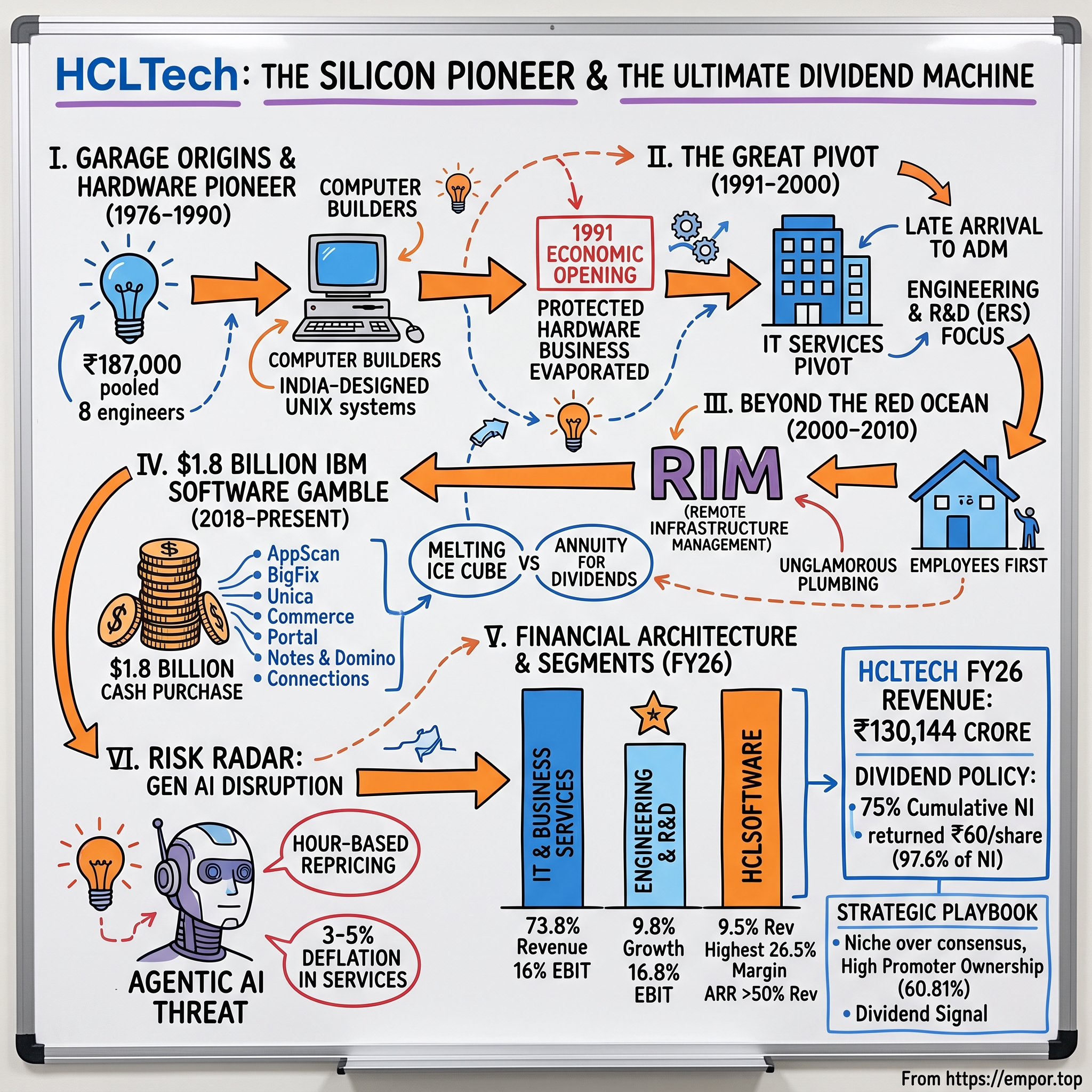
HCLTech: The Silicon Pioneer & the Ultimate Dividend Machine
I. Introduction & Episode Roadmap
In the summer of 1976, in a rented barsati above a shop in Delhi's Golf Links neighbourhood, a handful of young engineers were doing arithmetic on the back of an envelope. They had pooled ₹187,000 — about the price of a modest apartment at the time — and quit secure jobs at Delhi Cloth & General Mills, one of India's most establishment industrial houses.1 Their plan was not to write software for foreigners. Their plan was to build computers. Actual machines, with actual silicon, designed in India, in a country where importing a semiconductor required a licence, a queue, and a bureaucrat's signature.
Roughly seven thousand miles away, in a garage in Los Altos, California, two men named Steve were doing something similar. The parallel is irresistible, and HCL's own corporate mythology has never been shy about drawing it. But the parallel is also the point of this story — because the two ventures diverged so completely. One became the most valuable consumer hardware company in history. The other became something far stranger and, for a certain kind of investor, far more interesting: a $14.7 billion global IT services company that pays out virtually every rupee it earns.2
That is the puzzle at the heart of HCL Technologies Limited (HCLTech, HCLTECH.NS). Fifty years after its founding, the company that once designed multiprocessor UNIX boxes before Hewlett-Packard shipped them commercially now runs other people's data centres, tests other people's chips, and owns a portfolio of enterprise software products that IBM decided it no longer wanted. In FY26 — the fiscal year that ended March 31, 2026 — HCLTech generated revenues of ₹130,144 crore, grew 3.9% in constant currency, and returned ₹60 per share to shareholders, equivalent to 97.6% of its net income.23
Think about that last number for a moment. This is a technology company in the middle of the most disruptive platform shift since the internet, and it is distributing essentially all of its earnings rather than reinvesting them. That is either a statement of extraordinary capital discipline or an admission that the business cannot find enough high-return places to put money. Both readings are defensible. Which one you believe determines almost everything about how you see this company.
Here is the road we will travel. First, the garage years and the hardware heritage — brief, because 1978 matters mainly for the engineering culture it left behind. Then the near-death experience of 1991, when India opened its economy and HCL's protected hardware business evaporated. Then the pivot into services, the late arrival to an already-crowded party, and the single most consequential strategic decision in the company's modern history: the bet on remote infrastructure management, a business the rest of the Indian IT industry had dismissed as unglamorous plumbing.
From there we get to the argument that still divides analysts: the $1.8 billion cash purchase of a suite of legacy IBM software products in December 2018.4 We will look at what that portfolio has actually done in the seven and a half years since — not what management said it would do. We will examine the transition from founder-patriarch Shiv Nadar to his daughter Roshni Nadar Malhotra, and the compensation package of CEO C. Vijayakumar, which has become a governance talking point in its own right. And we will spend real time on the question that hangs over every services company on earth right now: what happens to a business built on billable engineering hours when the machine writes the code?
The short version of the investment debate: HCLTech looks like a high-quality cash bond with a services business attached. The bull case says the bond is safe and the business is better positioned than peers. The bear case says the coupon is being paid out of a franchise that is slowly being repriced by AI, and that the most recent quarter contains uncomfortable evidence for that view. Let us find out.
 Subscribe on LinkedIn
II. The Garage Origins & Hardware Pioneer Era (1976–1990)
To understand why eight engineers walked out of Delhi Cloth & General Mills, you have to understand what DCM was. It was a textile conglomerate that had, almost by accident, built one of India's few serious electronics units. Shiv Nadar, a mechanical engineering graduate from Coimbatore, had joined its data products division and found himself surrounded by people who wanted to build things the country did not yet know it needed. The group that eventually left included Nadar, Arjun Malhotra, Ajai Chowdhry, Subhash Arora, Yogesh Vaidya and D.S. Puri — six of the eight names that recur in every telling.1
The founding capital was ₹187,000.1 There is no way to make that sound like a lot of money, then or now. So the first company they registered was not a computer company at all — it was Microcomp Limited, and it sold teledigital calculators. Calculators were the bridge financing. They generated cash, they taught the founders how to sell hardware to Indian offices, and they bought time.
On 11 August 1976, the venture was renamed Hindustan Computers Limited.1 The choice of "Hindustan" was not sentimentality. In the India of the License Raj, a company's ability to manufacture anything depended on the state, and the founders solved this by partnering with the Uttar Pradesh state government — an arrangement that gave them manufacturing rights they could not otherwise have obtained. This is the first genuinely important thing to understand about HCL's DNA: from day one, the company was good at finding the structural workaround. Not the frontal assault, the flank.
Then came the engineering. In 1978, HCL shipped an indigenously developed microcomputer.1 The date matters because it lands in the same window as the Apple II, and because it was accomplished by a company that could not simply order components from a catalogue. Through the 1980s the pattern continued: a relational database, networking software, client-server architecture — all built in-house by 1983.1 By the mid-1980s HCL was designing multiprocessor UNIX systems, in some cases ahead of the American workstation vendors who would later define that market commercially.
What did all of this actually buy the company? Not global scale — HCL's hardware never escaped India and a handful of adjacent markets in any meaningful way. What it bought was a culture in which the hardest technical problem in the room was considered the interesting one. That sounds like a soft asset, and for two decades it produced very little shareholder value. But it explains why, forty years later, HCLTech's engineering and R&D services arm is the largest such business among Indian IT companies, and why the company was comfortable buying software products outright when its peers were not. Companies inherit their instincts from their founding conditions.
It is worth dwelling briefly on what "designing a computer in India in 1978" actually entailed, because modern readers underestimate the constraint. There was no local semiconductor fabrication of consequence. Components arrived through import licences that took months to obtain and were rationed by quota. Documentation for foreign chips was patchy and often out of date. Development tools — compilers, emulators, logic analysers — were expensive imports. The practical consequence was that HCL's engineers could not solve problems by buying a better part; they had to solve them by understanding the part they already had more deeply than the vendor's manual explained. That is an inefficient way to run a hardware company and an extraordinary way to train engineers.
The commercial model that resulted was equally distinctive. HCL sold complete systems to Indian banks, government departments and manufacturers — not just the box, but the operating environment, the application layer, the installation and the ongoing support. Because there was no ecosystem of third-party integrators, HCL had to be the integrator. In the process it learned something its future competitors would learn only much later: enterprises do not buy technology, they buy a working outcome, and whoever owns responsibility for the outcome owns the relationship. Two decades later, that insight became the entire logic of the infrastructure services business.
The instinct that was not inherited was cost paranoia, and that nearly killed them. Through the 1980s, HCL's hardware business enjoyed the enormous, invisible subsidy of import protection. Indian buyers could not easily buy an IBM or a Compaq, so they bought HCL. Margins were comfortable. The engineering was genuinely good, but nobody had ever tested whether it was good and cheap.
The test arrived in 1991. Facing a balance-of-payments crisis, India dismantled decades of import licensing and tariff protection almost overnight. Foreign hardware flooded in — better-supported, cheaper at scale, backed by global brands. HCL's core business went from protected to commoditised inside a couple of years. There was no clever workaround for this one. A company of engineers who had spent fifteen years designing machines was about to discover that the world did not need another machine designer; it needed people who could make software work.
The specifics of that collapse are worth a moment, because they explain the urgency of what followed. When tariffs fell and import licensing was dismantled, the Indian buyer who had previously chosen between HCL and one or two other domestic assemblers could suddenly choose an IBM, a Compaq or an HP — machines built on global volumes, supported by global service organisations, and increasingly running the same standardised operating environments everywhere. HCL's core competitive claim, which had always been "we can build this here," evaporated the moment the alternative was "you can simply buy it from there, cheaper." The engineering was not the problem. The engineering had never been the problem. The problem was that a domestic hardware business at Indian volumes had no path to the cost curve of companies shipping tens of millions of units.
Some of the founders eventually took different paths — Ajai Chowdhry stayed with the hardware and distribution side that became HCL Infosystems, while Shiv Nadar drove the software and services direction. That fork in the road, more than any single product decision, determined which part of the original venture compounded and which did not. Two businesses built by the same people, from the same starting capital, with the same engineering culture, produced radically different outcomes over the following three decades, and the difference was entirely a matter of which market they chose to serve.
For an investor, the lesson embedded in this era is worth holding onto, because it recurs in the AI section later: HCL's most dangerous moments have never been competitive defeats. They have been moments when the unit of value in its industry moved — from boxes to code in 1991, and arguably from hours to outcomes today. What the company did next set the template.
III. The Great Pivot: Spinoff & the Rise of Software Services (1991–2000)
Picture the strategic position in 1992. Your hardware business is being disassembled by imports. Across town in Mumbai, Tata Consultancy Services has been exporting software services since the 1970s. In Bangalore, a company called Infosys is building a reputation for process rigour that will eventually become a case study. Wipro, another diversified group turned technology firm, is scaling fast. Every one of them got to the offshore software party before you, and they have already claimed the most valuable table: application development and maintenance for Fortune 500 companies.
Application development and maintenance — ADM — was the beating heart of the Indian IT model. A large Western company has thousands of business applications; someone has to write them, patch them, migrate them, and keep them alive. Doing that from Chennai instead of Chicago at a fraction of the cost was, for two decades, one of the great arbitrages in modern business. It was also relationship-driven and sticky. Once TCS or Infosys was inside a client's application estate, displacing them required a reason.
HCL Technologies was incorporated in November 1991 to attack this market, carved out of the broader HCL enterprise to house the software and R&D activities.1 But arriving late to a market defined by incumbency is a strategic problem, not a sales problem. You cannot out-ADM the ADM incumbents by being 5% cheaper; the client's switching cost swamps the saving.
So HCLTech went where its heritage gave it an actual difference. Instead of chasing enterprise IT departments, it chased technology companies themselves — the firms building products. Kernel testing. Device drivers. Board bring-up. Systems engineering. The unglamorous, deeply technical work of making somebody else's hardware and embedded software function. This was work that Infosys and TCS were not structurally built for, and it was work HCL's engineers had been doing on their own products for fifteen years.
This is the origin of what is today the Engineering and R&D Services business, and it is the single clearest example of a company monetising an apparently stranded asset. HCL's hardware business had failed commercially. But the capability underneath it — people who understood how computers actually worked at the silicon and firmware level — turned out to be sellable to the very companies that had put HCL's hardware business out of business.
There was a second, more mundane advantage to this positioning that only became obvious later. Product companies buy engineering services against R&D budgets, which are approved annually by CTOs and engineering VPs. Enterprise IT departments buy application services against operating budgets, approved by CIOs and procurement. The two buyers behave differently, negotiate differently, and — crucially — are exposed to different economic cycles. By selling into both, HCLTech built a revenue base that was less correlated than a pure-play application shop's. That diversification has been genuinely valuable through multiple downturns. It has limits, and FY27 has been busy finding them, but the structural logic was sound.
The 1990s also embedded a discipline that shows up in the financials to this day. Because HCLTech was chasing work the leaders did not want, it could rarely command premium rates, which meant margin had to come from utilisation and delivery efficiency rather than pricing. Companies that learn to earn their margin operationally rather than commercially tend to be more resilient when the industry's pricing umbrella eventually folds. HCLTech has never had the highest margin in Indian IT. It has also never had the most dramatic margin collapse.
The capital markets arrived at the end of the decade, in the most spectacular way imaginable. HCL Technologies went public in December 1999, at the absolute crest of the global technology bubble, at a final issue price of ₹580 per share against a band of ₹500–580.5 The book-built portion was oversubscribed roughly 27 times, and total demand across the issue crossed ₹20,100 crore against an issue size of ₹823.6 crore — the largest demand an Indian technology IPO had ever generated at that point.5 The shares listed in January 2000.
It is worth pausing on the irony. A company founded to build hardware, nearly destroyed by liberalisation, raised its defining pool of capital by selling investors a story about offshore software, weeks before the dot-com bubble burst. The bubble did burst, and HCLTech's shares — like everyone's — were brutalised. But the money was raised, the delivery centres were built, and the international footprint was seeded.
What did the IPO money actually buy? Not products, and not acquisitions of consequence. It bought physical delivery capacity — campuses in Noida, Chennai and Bangalore, and the beginnings of an onshore presence in the markets where the clients were. This is the least glamorous use of equity capital imaginable and, for an offshore services business at that moment, precisely the correct one. Scale in this industry is not a brand; it is the ability to tell a Fortune 500 procurement committee that you can put four hundred qualified engineers on their programme within ninety days, in two geographies, with disaster recovery. Companies that could not make that claim in 2002 were never invited back.
The honest assessment of HCLTech's first decade as a listed company is that it was the fourth horseman. It had scale, it had a differentiated engineering niche, and it had a credible balance sheet. What it did not have was a way to grow faster than TCS and Infosys in the businesses that actually mattered. To close that gap it would need to find a market the leaders had looked at and deliberately walked away from.
IV. Bypassing the Red Ocean: The RIM Breakthrough (2000–2010)
Here is a question that seems trivial and is not: who turns the servers back on?
Every large company runs a technology estate — racks of servers, storage arrays, network switches, a help desk, monitoring dashboards, backup schedules, patch cycles. Somebody has to watch all of it, twenty-four hours a day, and fix it when it breaks at 3 a.m. In 2000, the industry consensus was that this work had to be done by people physically near the machines. You cannot reboot a server from Noida.
Except, increasingly, you could. Three things changed at once. Undersea fibre made intercontinental bandwidth cheap and reliable. Systems management software — the monitoring and remote-administration layer — matured to the point where an engineer could see and control a machine from anywhere. And enterprise hardware became standardised enough that a well-trained engineer in India could support a Dell rack in Ohio as competently as an engineer in Ohio.
The Indian IT majors saw this and mostly shrugged. Infrastructure management was viewed as low-margin, labour-heavy, and unglamorous — the janitorial work of enterprise IT, at rate cards well below the premium commanded by application development. Why would you build a business there when ADM was compounding?
HCLTech ran the arithmetic differently, and the person who drove that arithmetic hardest was Vineet Nayar. Nayar had founded Comnet within the HCL group in 1993, an internal venture that effectively incubated the remote infrastructure management model before the market had a name for it.[^6] Nayar became president of HCL Technologies in 2005 and CEO in 2007, and he brought the RIM thesis to the centre of the company's strategy.
The thesis had three legs. First, offshore leverage in infrastructure was higher than in applications, not lower — a follow-the-sun operations centre could support many clients from one facility, and utilisation could be pushed far above what project-based application work allowed. Second, infrastructure contracts were long, multi-year, and annuity-like, which smoothed the revenue profile against the lumpiness of discretionary project spend. Third — and this was the strategic prize — infrastructure was entangling. Once HCLTech held the runbooks, the monitoring configuration, the escalation trees and the institutional memory of a client's estate, moving the work to another vendor meant risking outages in production systems. The switching cost was not contractual. It was operational fear.
A useful way to picture the economics: imagine two ways to staff a building's security. In the first, you hire guards who sit in the lobby of each building you protect — one team per client, idle much of the night, impossible to redeploy. In the second, you build one control room with camera feeds from a hundred buildings, staff it with a smaller number of highly trained operators, and dispatch physical help only when the cameras show something. The second model costs less per building, gets better as you add buildings, and produces data the first model never generates. Remote infrastructure management was the control room. The reason competitors dismissed it was that they benchmarked the rate card — which was lower — instead of the utilisation and leverage, which were far higher.
There was a further, subtler benefit that took years to show up in the numbers. Running hundreds of enterprise estates gave HCLTech a proprietary view of what actually breaks in enterprise technology and how often. That accumulated operational telemetry became the raw material for automation: if you know that a particular class of alert resolves the same way 90% of the time, you can write a script to handle it, then a workflow, then eventually an agent. Every hour of manual monitoring HCLTech performed in 2008 was, in retrospect, training data for the automation it deployed in 2018 and the AI tooling it deploys today. Very few of the strategic assets in IT services compound this way.
Nayar paired the RIM push with a management philosophy he later wrote a book about — "Employees First, Customers Second," published in 2010 — which inverted the conventional hierarchy by making managers accountable to the frontline engineers doing the client work.[^6] It is easy to be cynical about corporate management books, and much of the genre deserves it. But the philosophy had a specific commercial logic here: RIM is a business where the quality of the experience is delivered by relatively junior engineers at odd hours, far from any executive. If those engineers are disengaged, the service degrades and the annuity leaks. Nayar was, in effect, solving an operational problem with a cultural instrument.
The results were substantial. HCLTech scaled infrastructure services into one of the largest such businesses among Indian IT firms and used it to win the kind of large, multi-year takeover deals that had previously gone to Western outsourcers like EDS, IBM Global Services and CSC. The Xerox relationship, which began in 2009 as a global partnership spanning product engineering and IT and process support, is a representative example of the pattern: an American technology company handing over the operational running of significant parts of its estate to an Indian vendor that had, a decade earlier, been nowhere in that market.6 Precise contract values for many of these engagements were never publicly disclosed, and investors should be wary of the headline figures that circulate for them.
The other name that matters in this chapter is the one that runs the company today. C. Vijayakumar joined HCL in 1994, in the middle of the post-liberalisation scramble, and spent the following two decades inside the infrastructure business — first building it, then leading it as it became the company's largest and most differentiated division. He is, in the most literal sense, a product of the RIM bet: an operator who rose by running a business that his industry's leaders had decided was not worth running. That biography explains a great deal about how he has behaved as CEO since 2016 — the willingness to buy assets others were discarding, the comfort with unglamorous annuity revenue, and the habit of talking about delivery mechanics rather than vision statements on earnings calls.
So what does the RIM era tell an investor today? Two durable things. First, HCLTech's competitive instinct is to find the segment the leaders have priced as commodity and prove it is not. That instinct is a genuine asset, and it is repeatable. Second — and this is the harder edge — the moat RIM created is a switching-cost moat, not a pricing-power moat. Clients stay because leaving is painful, not because HCLTech can charge more. Switching-cost moats are excellent at defending revenue and mediocre at defending price. That distinction becomes very important when a technology arrives that lets clients credibly ask for the same outcome at a lower price. Hold that thought.
By the mid-2010s, HCLTech had solved its differentiation problem and inherited a new one: infrastructure services itself was commoditising, cloud was moving workloads off client premises, and the growth rate of the whole Indian IT model was decelerating. Management concluded that services alone would not sustain the margin profile. The answer they chose was radical.
V. The $1.8 Billion IBM Software Gamble: M&A Under the Microscope (2018–Present)
On the morning of December 7, 2018, HCL Technologies' shares fell 4.98% to close at ₹961.55 on the BSE, having touched an intraday low that was 7.6% below the previous close. Across two sessions the stock shed 8.53%.7 The market had just been told that the company would spend $1.8 billion in cash — the largest acquisition ever made by an Indian IT firm — and it did not like what the money was buying.
What HCLTech agreed to buy, announced on December 6, 2018, was a portfolio of seven IBM software products: AppScan for application security testing, BigFix for endpoint management, Unica for marketing automation, Commerce for e-commerce, Portal for digital experience, Notes & Domino for email and low-code applications, and Connections for workstream collaboration.4 The deal was expected to close by mid-2019, subject to regulatory review. HCLTech pointed to a total addressable market above $50 billion across those categories, and C. Vijayakumar said the products were "well regarded by clients and positioned in the top quadrant by industry analysts."4 IBM's John Kelly framed it from the seller's side with revealing candour: "The time is right to divest these select collaboration, marketing and commerce software assets."4
Read those two statements next to each other and you have the entire bear case in two sentences. One party thought these were valuable assets in large markets. The other party was a technology company with world-class market intelligence that had decided it no longer wanted them.
The analyst reaction was blunt. Sudheer Guntupalli, then at Ambit Capital, said flatly: "I don't think it will help HCL on a long term basis... this deal is a negative from HCL's standpoint." His central objection was structural: HCLTech already had development partnerships covering five of the seven products, so it was paying $1.8 billion for assets it was substantially already servicing.7 Axis Capital's note argued the products sat in the middle or end of their life cycles and were unlikely to grow beyond mid-single digits. Reuters and the Indian business press amplified the framing.8[^10] The phrase that stuck, and has followed the deal for seven years, was "melting ice cube."
Let us be fair to the bull case, because it was not stupid. The logic ran roughly like this. A services business earns money by renting out people; its revenue is bounded by headcount times rate times utilisation, and its margin is structurally capped somewhere in the high teens. A software business, once built, earns money from a licence base that does not consume proportional labour. If you can buy a portfolio of mature enterprise software with a very high cash margin at a sensible multiple of its cash flow, you are effectively buying an annuity — and annuities fund dividends. HCLTech also acquired direct commercial relationships with thousands of large enterprises that were, in most cases, already HCLTech services prospects. And critically, management was not buying a growth story at a growth price. It was buying decline at a decline price, and betting the decline would be gentle.
The question, seven and a half years on, is whether the decline has been gentle. The evidence says: gentler than the ice-cube crowd feared, but not gentle enough to call it a growth asset.
In FY26, HCLSoftware — the division that houses the IBM products alongside HCLTech's other software assets — reported revenue of $1,395 million, a decline of 4.1% year-on-year in constant currency, on an EBIT margin of 26.5%.9 Its annual recurring revenue, the metric management prefers because it strips out the lumpy perpetual licence renewals, stood at $1,045 million, down 0.5% in constant currency.92 The segment represented roughly 9.5% of group revenue.
Two readings of that. The charitable one is management's: the total revenue line is distorted by the mechanical accounting of a shift from up-front perpetual licences to rateable subscription, and ARR — down half a percent — is the truer picture of the underlying franchise. There is real substance to this. When a customer converts from a perpetual licence to a subscription, reported revenue in the transition year falls even if the customer's lifetime value rises.
The less charitable reading is that after seven years of ownership, more than half a decade of investment, and the full attention of a management team that repeatedly described these as underappreciated assets in growing markets, the portfolio's recurring revenue is roughly flat and its total revenue is shrinking. The $50 billion addressable market cited in 2018 has not translated into share gains. On the Q4 FY26 call, Vijayakumar's own long-term framing for the software business was strikingly modest: "low single-digit or flattish or marginally declining."3 That is a very long way from the 2018 rhetoric, and to management's credit, they no longer pretend otherwise.
The Q1 FY27 print, reported on July 13, 2026, complicated the picture further. HCLSoftware revenue declined 5.3% year-on-year in constant currency, while ARR improved to $1.063 billion, up 2% year-on-year in constant currency.1011 The divergence between the two lines widened rather than closed — which is either the transition working exactly as described, or the legacy base eroding faster than the subscription base is building. Both are consistent with the data. An investor cannot resolve this from the outside; they can only watch ARR, quarter after quarter, and see which way it drifts.
Here is the honest scorecard on capital allocation. HCLTech spent $1.8 billion and got an asset that in FY26 generated roughly $1.4 billion of revenue at a 26.5% EBIT margin, with a software segment return on invested capital of 42.6%, up 274 basis points year-on-year.9 By the crude test of whether the cash flows justified the price, the deal has not been a disaster; the returns on capital reported for the segment are respectable. By the test management itself set in 2018 — that these were valuable products in large growing markets — it has not worked. The portfolio has functioned as a financing instrument for the dividend, not as a second engine of growth.
There is a second-order consequence of the deal that gets less attention and may matter more than the revenue line. Owning software products changed what HCLTech could sell into a services conversation. A services vendor bidding for a security programme can now propose its own application-security tooling alongside the engineers who deploy it; a vendor bidding for an endpoint management contract can bundle the product that does the managing. This is the "services on software" idea management refers to, and the logic is sound — it converts a pure labour sale into a mixed sale with a higher margin component. What is missing, publicly, is any disclosure that quantifies how much services revenue has actually been influenced by product ownership. Without that, the synergy remains an assertion, and investors should treat it as one.
There is also an accounting overhang worth naming explicitly. A large portion of the $1.8 billion sits on the balance sheet as goodwill and acquired intangibles. As long as the cash flows hold, no impairment is required. If the constant-currency decline accelerates materially from the current mid-single digits, an impairment charge becomes a live possibility. It would be non-cash and would not touch the dividend, but it would be a public admission that the 2018 sceptics were right, and it would be a genuine test of how this management team handles bad news. Nothing of the sort has been announced to date.
Myth vs Reality on the IBM Deal
Three consensus narratives have hardened around this transaction, and each is partly wrong.
Myth: HCLTech bought a melting ice cube and it melted. Reality: the portfolio has declined at a low-to-mid single-digit rate over seven years while throwing off a 26.5% EBIT margin and a 42.6% segment return on capital.9 "Melting ice cube" implies a collapse. What actually happened was a slow, profitable erosion — which, at the price paid, is a materially different and much better outcome than the phrase suggests.
Myth: the acquisition transformed HCLTech into a products company. Reality: software is roughly 9.5% of revenue and falling as a share of the group.9 HCLTech is a services company with a software annuity attached, and the gap between that reality and the 2018 positioning is the fairest criticism of management's communication on this deal.
Myth: the deal was about the $50 billion addressable market. Reality: on the evidence of seven years, the deal was about buying a cash flow stream to fund distributions. That was a defensible and arguably clever use of the balance sheet. It was simply not the reason given at the time, and investors are entitled to notice the difference between the stated rationale and the realised one.
Which brings us to the machinery underneath — the three engines that actually produce the cash.
VI. Segment-Level Deep Dive & Financial Architecture
If you want to understand HCLTech as a business rather than as a story, start with a single observation: it is three companies with three different economic characters, wearing one ticker.
IT and Business Services is the mass of the thing — roughly 73.8% of FY26 revenue, growing 3.7% year-on-year in constant currency at a 16.0% EBIT margin.9 This is the descendant of both the ADM ambitions and the RIM breakthrough: application modernisation, cybersecurity, cloud migration, managed infrastructure, business process work. It is a long-cycle, annuity-heavy business where the customer relationship is measured in decades and the contract renewal is where value is won or lost. Its margin is the lowest of the three, and its growth in FY26 was the sort of number that gets described as "resilient" when the alternative adjective is "modest."
Engineering and R&D Services was, for most of FY26, the star. It grew 9.8% year-on-year in constant currency, at a 16.8% EBIT margin.29 The work is genuinely different in kind: designing semiconductors, writing the embedded software inside a medical imaging device, building the software platform that runs a car's infotainment and driver-assistance stack. The customers are not corporate IT departments; they are product companies outsourcing pieces of their own R&D roadmap. In a services industry where everyone claims differentiation, this is one of the few places where the claim is verifiable — HCLTech's ERS franchise is the largest among the Indian majors, and it traces directly back to those UNIX boxes in the 1980s.
HCLSoftware we have already dissected: about 9.5% of revenue, the highest segment margin at 26.5%, and shrinking.9
Now hold those three characters against the group numbers. FY26 revenue was $14.7 billion, up 6% in reported dollars and 3.9% in constant currency; in rupees, ₹130,144 crore, up 11.2%.2 EBIT was ₹22,397 crore, a 17.2% margin, up 4.6% year-on-year but down 107 basis points as a percentage of revenue.23 Adjusted for restructuring costs, the margin was 17.9%, down 40 basis points.3 Net income was ₹17,361 crore, and earnings per share ₹64.01.12
Notice what that combination tells you. Revenue grew double digits in rupees, EBIT grew mid-single digits, and margin percentage fell. In plain English: HCLTech grew in FY26 largely because the rupee weakened, and it did not convert that growth into proportional profit. Currency is not a competitive advantage; it is weather. The constant-currency number — 3.9% — is the one that describes the business, and in the context of a global industry where large-cap peers struggled to grow at all, it was a respectable outcome. Wipro's IT Services revenue, by comparison, declined 1.6% in constant currency across the same fiscal year.13 HCLTech grew faster than most of its direct Indian large-cap peer set in FY26. That is a real, if modest, relative win.
Return on invested capital tells a flattering story: 40.3% for the consolidated business in FY26, up 235 basis points year-on-year, with the services business at 47%.9 These are elite numbers, and they are not an accident of accounting — services businesses genuinely require very little capital. You hire people, you rent buildings, you buy laptops. The capital intensity of running $14.7 billion of revenue is remarkably low. This is why the dividend policy is possible at all.
And the dividend policy is the most distinctive thing about this company as a security. HCLTech operates a formal commitment to return a minimum of 75% of cumulative net income over five-year periods, and on the Q4 FY26 call the board extended that policy for a further five years.3 In FY26 the company returned ₹60 per share, which worked out to 97.6% of net income.3 Against a share price of ₹1,221 as of mid-July 2026, that trailing distribution represents a yield close to 5% — in a market where the stock has traded between ₹1,030 and ₹1,780 over the preceding twelve months.14
That yield is the entire reason a certain type of investor owns this stock. It is worth being precise about what it is and is not. It is not a bond, because the coupon is not contractual — it is a policy, set by a board controlled by a family that has every incentive to keep paying it, but a policy nonetheless. It is backed by a business that converts earnings to cash efficiently and requires almost no reinvestment. The honest way to frame it: an investor is being paid a high-single-digit-equivalent total return for accepting the risk that the underlying revenue base is repriced downward by technology over the next decade. Whether that is a good trade depends entirely on your view of the next section.
The geographic and vertical mix adds useful texture to how that revenue is actually earned. In FY26, the Rest of World grew 17.8% in constant currency, India 5.7%, Europe 4.5%, and the United States — still the largest market by far — just 2.3%.2 By vertical, Technology and Services grew 15%, Financial Services 7.5%, and Telecom, Media, Publishing and Entertainment 5.2% across the full year, before that last category turned sharply negative in the fourth quarter.23 The pattern is consistent: HCLTech is growing fastest in its smallest markets and slowest in its biggest one. That is a real constraint on the group growth rate arithmetic, because a 17.8% growth rate on a small base cannot offset a 2.3% growth rate on a large one.
Client metrics tell a more encouraging story about relationship depth. Across FY26, HCLTech added one client to the $100 million-plus revenue band, eight to the $50 million band, and twenty-six to the $10 million band.3 Movement up the client pyramid is one of the more reliable indicators of health in an IT services company, because it measures wallet share expansion within existing accounts rather than the noisier metric of new logo acquisition. Landing a client is a sales achievement. Growing one from $10 million to $50 million is a delivery achievement, and delivery is what compounds.
The workforce picture rounds it out. HCLTech ended FY26 with more than 227,000 employees across 60 countries, having added 11,744 freshers over the year while last-twelve-months attrition fell to 12.5% from 13.0% a year earlier.2 Two things follow. Lower attrition reduces the cost of replacing and retraining people, which flows fairly directly to margin. And continuing to hire freshers in a soft demand year is either a bet on recovery or an attempt to lower the average cost of the pyramid — most likely both. Fresher hiring is one of the least-discussed and most informative signals in this industry, because it reveals what management genuinely expects demand to look like eighteen months out.
One further wrinkle, and it is a new one. Alongside Q1 FY27 results, the board approved an investment of up to ₹3,500 crore — roughly $370 million — to build AI data centres through a new subsidiary, with capacity scalable to 50 megawatts.10 For a company whose entire financial architecture rests on being capital-light, this is a genuine departure. It is not large enough to threaten the dividend. It is large enough to be the first visible crack in the "we return everything because we need nothing" narrative, and it deserves scrutiny rather than applause.
VII. The Leadership, Governance & Incentives Transition
On July 17, 2020, in the middle of a pandemic that had scattered HCLTech's workforce across a hundred thousand homes, Shiv Nadar stepped down as Chairman of HCL Technologies and handed the role to his daughter, Roshni Nadar Malhotra, with immediate effect.15 She became the first woman to chair a listed Indian IT major. Nadar remained as Managing Director with the title of Chief Strategy Officer — a deliberate half-step that told the market the founder was not leaving, only changing seats.
The transition has since been completed in the way these things ultimately are: through ownership. On March 6, 2025, Nadar executed gift deeds transferring 47% of HCL Corporation and Vama Delhi — the holding vehicles through which the family controls HCLTech — to Roshni Nadar Malhotra, making her the majority shareholder of the promoter entities.16 The exchange filing described it as "a private family arrangement intended to streamline succession."16 Nadar became chairman emeritus and strategic advisor. As of March 2026, the promoter group held 60.81% of HCLTech, with Vama Sundari Investments alone accounting for 44.21%.17
Sixty percent family ownership is one of those facts that cuts in exactly two directions, and honest analysis requires holding both.
On the constructive side: a controlling family with a fifty-year horizon has essentially no incentive to manage the business for the next quarterly print. It explains why HCLTech can commit to distributing three-quarters of its earnings for a decade running rather than accumulating a war chest for empire-building. It explains the absence of the sprawling, value-destructive acquisition programmes that have afflicted plenty of technology companies with diffuse ownership. Hostile takeover risk is zero. Strategic continuity is close to guaranteed.
On the other side: at 60.81%, minority shareholders do not have a vote that matters on anything the family cares about. Related-party arrangements, executive compensation, board composition and capital allocation are all effectively determined by one shareholder. Institutional investors can express displeasure only by selling. That is a governance structure, and a governance risk, and it should be priced as such.
It is worth being specific about what "the family" now means operationally, because succession in Indian promoter groups is frequently announced and rarely completed. Here it was completed. Roshni Nadar Malhotra did not simply inherit a title in 2020; she inherited the controlling economic interest in 2025, in a single documented transfer, while her father was alive and available to advise.16 That sequencing matters. The most destructive governance outcomes in family-controlled companies come from ambiguity — multiple heirs, contested vehicles, unresolved control after the patriarch's death. HCLTech has none of that ambiguity. Shiv Nadar, whose net worth Forbes put at $34.4 billion around the time of the transfer, retained an advisory role rather than a decision-making one.16
Malhotra's own profile is less that of an operator than of a steward. She did not build a division inside HCLTech the way Vijayakumar did; her contribution has been at the level of board composition, capital allocation policy and long-horizon strategy. The practical division of labour that has emerged — a professional CEO running the business, a family chair setting the frame — is the arrangement most likely to preserve both operating competence and capital discipline. It is also the arrangement most likely to under-police executive pay, because a chair whose family owns 60% of the equity bears 60% of the cost of an excessive package and therefore has less reason to fight it than an outside investor might wish.
Which brings us to the compensation question, because it is the sharpest live test of that structure. C. Vijayakumar joined HCL in 1994, built the infrastructure services business that became the company's differentiator, and became CEO in 2016. His FY25 compensation was approximately ₹94.6 crore, or $10.85 million — comprising about $1.96 million of base salary, $1.73 million of performance bonus, $6.96 million of restricted stock units exercised, and roughly $0.2 million of benefits.18 That made him comfortably the highest-paid CEO in Indian IT: Infosys's Salil Parekh earned ₹80.62 crore, Wipro's Srinivas Pallia ₹53.64 crore, and TCS's K. Krithivasan ₹26.52 crore in the same year.18 The board then approved an increase of roughly 71%, to approximately ₹154 crore ($18.6 million), effective April 1, 2025 — citing his "successful and long-tenured leadership."18
An activist investor would have a field day with this, and the argument would go beyond envy. In FY26, the year covered by that raise, group constant-currency revenue grew 3.9%, EBIT margin contracted 107 basis points, HCLSoftware revenue declined, and the shares traded down toward the bottom of their multi-year range.2314 A 71% increase in CEO compensation in a year of decelerating growth and contracting margin is a defensible decision only if the board can articulate a specific performance linkage — and the public disclosure of that linkage is, at best, thin. The structure is heavily weighted to RSU exercises, which means much of the reported figure reflects historical stock appreciation rather than current-year cash. That is a real mitigant. It is not a complete answer.
The counterargument for Vijayakumar's value is genuinely strong on operating grounds. He built RIM. He executed the IBM integration without the delivery catastrophe that large software carve-outs frequently produce. And on the evidence of the last several earnings calls, he does something that is rarer among CEOs than it should be: he quantifies bad news specifically. On the Q4 FY26 call, asked about AI-driven price deflation, he did not deflect — he put a number on it: "3% to 5%... that I mentioned in the AI disrupted services, based on the mix... would translate to 2% to 3% for our portfolio."3 Asked about the sudden weakness in the quarter, he named the causes precisely — two large US telecom clients cutting discretionary spend, two discontinued SAP programmes, delayed procurement decisions in March — and, pressed by Kotak's Sudheer Guntupalli on whether these were symptoms of one systemic problem, said plainly that they were not: "Two telecom clients and the two other clients are completely different."3
That is a management style worth noting, because it is the opposite of the pattern that destroys investor trust. Vague attribution to "macro headwinds," refusal to size a known risk, and quiet strategy shifts without acknowledgement are the classic warning signs. HCLTech's calls, on the evidence, do not exhibit them. The guidance record supports this too: the FY27 guidance of 1–4% constant-currency growth given in April 2026 was maintained unchanged in July 2026 after a quarter that included a 3.7% sequential decline in the engineering segment.31011 Reaffirming a range after a bad quarter is either discipline or denial; the fact that the low end of the range was explicitly built to accommodate exactly this scenario — Vijayakumar said the bottom of the range assumed "continued soft discretionary spend environment and the two clients... ramped down beyond the planned ramp downs" — suggests discipline.3
Credibility, then, is reasonably high on execution and communication, and genuinely questionable on the alignment between pay and outcomes. Both can be true. And both matter enormously for the question that dominates everything else.
VIII. Risk Radar: The GenAI Disruption & Industry Slowdown
Every conversation about Indian IT in 2026 eventually arrives at the same uncomfortable arithmetic. The business model prices an outcome by estimating how many engineer-hours it will take. If a machine can do in one hour what previously took eight, one of two things happens: either the vendor keeps the price and the client eventually notices, or the price falls to reflect the new cost of production. In competitive procurement, the second thing happens.
Vijayakumar has been unusually direct about this. His Q4 FY26 framing — 3–5% deflation in AI-disrupted services, translating to 2–3% across HCLTech's total portfolio — is a management estimate, not an audited fact, but it is a specific, falsifiable, and unflattering number, which makes it more credible than most industry commentary.3 He extended it to pricing: "A $100 million deal, normal ITO deal, would be much lesser today, maybe $80 million just on rough ballpark."3
Sit with that. A twenty percent haircut on the ticket price of the exact category of large infrastructure-outsourcing deal that HCLTech pioneered and built its franchise on. This is the switching-cost-versus-pricing-power distinction from the RIM section coming due. HCLTech may well keep the client — the operational entanglement is real, and the client is not going to hand its production estate to a stranger to save money. But it will renew at a lower number. Revenue retention and value retention have decoupled.
This is visible in the bookings data if you know where to look. FY26 net new bookings totalled $9.3 billion in total contract value, essentially flat year-on-year.23 Flat bookings against a growing revenue base is already a mild negative. But if the price per unit of work embedded in those bookings is falling, flat TCV represents more work won at less value — the treadmill speeding up. Q1 FY27 bookings of $2.407 billion were the highest first quarter in company history, which cuts the other way and is a genuine positive.10 One quarter is not a trend. It is, however, a data point that argues against the most catastrophic version of the deflation thesis.
The demand environment has been separately unkind. The Q4 FY26 quarter saw revenue fall 3.3% sequentially, driven by the telecom-and-media vertical and the two large US telecom clients who cut discretionary engineering and digital spend.3 That weakness carried straight into Q1 FY27: the engineering segment declined 3.7% sequentially, and Vijayakumar attributed it explicitly to "sharp cuts in discretionary spending in two large U.S. telcos," noting that the company had warned this would "play out in the subsequent quarters."11
That last point deserves emphasis, because it is the most analytically important development in this entire story. Engineering and R&D Services grew 9.8% in constant currency across FY26 and was presented — reasonably — as the structural hedge against software automation. A machine can write a CRUD application; it cannot yet validate a braking controller against a safety standard. But in Q1 FY27, ERS grew just 0.3% year-on-year in constant currency and shrank sequentially.1011 The hedge, it turns out, is not a hedge against client budgets. Engineering services are largely discretionary R&D spend, which means they are more cyclical than run-the-business IT, not less. A telecom company under margin pressure cuts next year's product roadmap before it stops paying the vendor who keeps its network monitoring alive.
So the ERS story needs restating honestly: it is a structural hedge against AI substitution and a cyclical amplifier of customer capex cycles. Those are different risks, and FY27's first quarter delivered the second one.
What "Agentic AI" Actually Means for This Business
The jargon deserves unpacking, because the investment implications turn on a distinction most coverage blurs.
The first wave of generative AI in software was assistive: a developer types a comment, the model suggests the next few lines. That saves time but does not remove the developer, because a human still owns the task from start to finish. Productivity gains from assistive tooling get partially competed away in price, but they mostly show up as more work done by the same people.
The second wave is agentic: instead of suggesting lines, the system is given a goal — "fix this failing test," "migrate this service to the new API," "triage this alert" — and executes a multi-step plan on its own, checking its own work. This is the wave that genuinely threatens billable hours, because it removes the task rather than accelerating it. The unit of work that a services company sells is no longer performed by a person at all.
Where does the threat actually bite? Overwhelmingly in the middle of the skill distribution. Highly standardised, well-documented, high-volume work — routine ticket resolution, test automation, boilerplate migration, first-line support — is where agents are already competent. Work that requires physical context, regulatory judgement, or knowledge that exists only in a client's undocumented institutional memory is where they are not. HCLTech's revenue base spans both, and the company does not disclose the split, which is precisely why an outside investor cannot model the exposure from the outside and must instead watch the margin and pricing outcomes.
Vijayakumar himself flagged the boundary on the Q4 FY26 call, cautioning that while models keep improving at writing code, "even the latest model... ability to run production environment fixes... is very limited."3 That is an honest and useful distinction: writing new software in a sandbox is a solved-ish problem; safely changing software that a bank is running live, at 2 a.m., under a change-control regime, is not. A great deal of HCLTech's revenue sits on the second side of that line. For now.
The small language model argument fits here too. A frontier model is a generalist that costs a great deal to run; a small, verticalised model fine-tuned on one industry's data can be far cheaper per query and often more accurate within its domain. For enterprises worried about cost, latency, and keeping proprietary data inside their own perimeter, small models deployed close to the data are attractive. HCLTech's positioning is that deploying and maintaining hundreds of such models — each needing data pipelines, evaluation, monitoring and governance — is itself a services business. That is a plausible argument. It is not yet a large revenue line, and investors should treat it as optionality rather than as an established offset.
One risk that rarely gets its due in these discussions: concentration of operational trust. A company that manages other people's production infrastructure and holds their credentials is an extraordinarily attractive target. A serious security incident at a vendor of HCLTech's scale would damage the very asset — client confidence in operational reliability — that the entire switching-cost moat rests on. No such incident has been publicly disclosed. The exposure is structural rather than evidenced, but it belongs on any honest risk list for this business model.
What is the counter-offensive? Three things, of unequal quality.
The strongest, on current evidence, is the Advanced AI revenue line. Annualised Advanced AI revenue crossed $620 million in Q4 FY26, and in Q1 FY27 the quarterly figure was $171 million, up 10.6% sequentially and 62.1% year-on-year in constant currency.210 On a $14.7 billion base this is still small — roughly 4-5% of revenue — but it is the fastest-growing thing in the company by a wide margin, and it is growing off a real base rather than a pilot pipeline. Vijayakumar has highlighted "AI Factory" work, including what he described as a "$100 million plus AI Factory deal for design, implementation."3 The caveat an investor should apply: "Advanced AI revenue" is a company-defined category with no external audit of what counts. Rapid growth in a self-defined metric is encouraging but not dispositive.
The second is AI Force, HCLTech's own GenAI platform embedded into service delivery, deployed across 75 accounts by the end of FY26 with versions 2.0 and 2.1 adding agentic capability and vertical-specific packages for SAP and medtech.3 The logic is straightforward margin defence: if the price of the work falls 20%, you survive by cutting the cost of delivering it by more than 20%. The FY27 EBIT margin guidance of 17.5–18.5% — above the 17.2% actually delivered in FY26 — is management effectively asserting that this arithmetic will work.23 That guidance is the single cleanest test of the AI thesis available to an outside investor. If margins expand into that range while revenue grows in the low single digits, the automation is real. If they do not, it is not.
The third is the AI data centre build. HCLTech's argument, articulated on the Q1 FY27 call, is that token costs will fall but total token consumption will rise faster: "Token costs could drop, but however, the overall consumption of tokens will go up, total cost will also go up."11 Combined with smaller, verticalised language models running on enterprise data, this frames AI as a service-consumption expander rather than a service-consumption destroyer. It is a coherent argument. It is also, for now, an argument rather than a demonstrated result — and the ₹3,500 crore of capex behind it moves HCLTech onto terrain where it competes with hyperscalers and specialist data centre operators who have structural cost advantages it does not.10
The workforce data quietly tells the same story from another angle. Headcount was above 227,000 at the end of FY26 and fell to 223,889 by June 2026, down 3,292 sequentially, while revenue per employee rose 3.3% year-on-year to $65,500.210 Fewer people, more revenue each. That is exactly what a company successfully automating delivery looks like. It is also exactly what a company quietly shrinking looks like. Twelve months of this data will distinguish them; one quarter will not.
IX. Strategic Frameworks: Porter's 5 Forces & Helmer's 7 Powers
Strip the narrative away and ask the structural question: what actually stops a competitor from taking HCLTech's business?
Switching costs are the company's strongest power, and they are real rather than rhetorical. In infrastructure services, the client's alternative to renewing is a migration project that risks production outages in systems the business cannot operate without. In HCLSoftware, products like BigFix and AppScan are wired into security and compliance workflows; ripping them out means re-certifying processes that auditors have already blessed. This power explains the annuity quality of the revenue base and the near-total absence of catastrophic client losses. What it does not do — and this is the crucial qualification — is protect price. The deal-value deflation Vijayakumar quantified is precisely what happens when a moat defends volume but not rate.
Cornered resource applies partially. Roughly 224,000 employees is not, in itself, a cornered resource; TCS employs more, and Accenture more still. The specific concentration of deep product-engineering talent in ERS — people who can validate embedded automotive software or contribute to semiconductor design flows — is closer to genuinely scarce, because it takes years to build and cannot be hired quickly at scale. But FY27's first quarter demonstrated the limitation: a scarce resource whose customers stop buying is an expensive scarce resource.
Scale economies are the most overstated of the three. HCLTech's 17.2% FY26 EBIT margin is respectable but not exceptional against the Indian large-cap peer set, and it contracted year-on-year.2 Spreading global sales offices and delivery infrastructure across $14.7 billion of revenue confers a real cost advantage over a $500 million mid-tier firm. It confers approximately none over TCS, Infosys, Accenture or Cognizant, who are all past the same scale threshold. Scale here is a ticket to the table, not an edge at it.
Two powers HCLTech conspicuously lacks are worth naming, because their absence shapes the whole investment case. There are no network economies — the value of HCLTech to a client does not increase because it serves other clients. And there is minimal branding power in the sense Helmer means it: no client pays a premium for the HCLTech logo the way a buyer pays a premium for a luxury good. This is a business that wins on capability and cost, and must keep winning on capability and cost, forever.
Through Porter's lens:
Rivalry is extreme and structurally so. Every large IT services procurement is competitively bid against TCS, Infosys, Wipro, Cognizant, Accenture, Capgemini, and increasingly the global consulting arms of the Big Four. In engineering specifically, HCLTech faces LTTS, Tata Technologies, and the captive R&D centres that clients can always choose to build themselves. The industry's structural problem is that no participant has meaningful pricing power over the others, which is why margins across the sector cluster in a narrow band and why an industry-wide cost deflation from AI will most likely be competed away to clients rather than retained by vendors.
Buyer power is high and rising. Enterprise clients run sophisticated procurement functions, multi-vendor strategies specifically designed to prevent lock-in, and — new in this cycle — a credible internal alternative in the form of AI tooling that lets a client's own team do more with less. The Q4 FY26 experience, where two clients unilaterally cut discretionary spend and materially moved a $14.7 billion company's quarterly revenue, is buyer power made visible.
Threat of new entrants is genuinely low. Building a global delivery organisation with security clearances, regulatory certifications, and multi-decade Fortune 500 relationships takes twenty years and enormous capital. No startup is displacing HCLTech from a mainframe modernisation programme. This is the most solid of the five forces in HCLTech's favour — but note that it protects the incumbent set collectively, not HCLTech specifically against the other incumbents.
Substitutes are the real threat, and they are not vendors. The substitute for an outsourced application maintenance team is not another outsourcer. It is the client's own smaller team armed with agentic tooling. That is the mechanism by which AI hurts, and no amount of competitive positioning against TCS addresses it.
Supplier power is low and getting lower. Labour is HCLTech's supplier, and last-twelve-months attrition of 12.5% at the end of FY26 and 12.7% in Q1 FY27 reflects a market in which engineers have far less bargaining leverage than they did in the 2021–22 boom.210 Falling headcount alongside stable-to-rising revenue per employee is the arithmetic of that shift.
The Competitive War-Game
It helps to think about who actually shows up when HCLTech competes, because "Indian IT" is not one competitor set but four.
Against TCS and Infosys, HCLTech competes on the same terms with the same delivery model, and the fight is decided by incumbency and relationship history rather than capability. Neither side has a structural cost advantage over the other. What HCLTech has is a mix skew — more infrastructure and engineering, less pure application maintenance — which in the current cycle has been an advantage in the run-the-business categories and a liability in the discretionary ones.
Against Accenture and the global consultancies, HCLTech is the value option. Accenture wins the boardroom conversation, the transformation programme, and the pricing premium that comes with being the safe choice for a CEO's signature initiative. HCLTech typically enters lower in the organisation, on operational scope, at a better rate. This is a stable equilibrium, but it caps the ceiling: the highest-margin work in enterprise technology is strategy-adjacent, and HCLTech has never credibly occupied that seat.
Against LTTS, Tata Technologies and the engineering specialists, HCLTech is the scale player competing with focus players. Scale wins large multi-year programmes where a client wants one vendor across mechanical, embedded and software engineering. Focus wins where deep domain reputation matters more than breadth. FY27's first quarter is a useful reminder that both lose simultaneously when the client simply stops spending.
Against the client's own internal team, which is the newest and least discussed competitor, HCLTech competes against a buyer who now has agentic tooling and a mandate to reduce vendor spend. This is not a competitor that shows up in a bid; it shows up as scope reduction at renewal. It is, on the current evidence, the most economically significant of the four.
There is one more structural exposure worth naming, because it sits underneath everything and is easy to forget in a good year. Roughly two-thirds of HCLTech's revenue is earned in dollars while a large majority of its costs are incurred in rupees. A weakening rupee flatters reported growth and margin — which is exactly what happened in FY26, when rupee revenue grew 11.2% against constant-currency growth of 3.9%.2 The reverse is equally true. Currency is neither a skill nor a moat, and investors should mentally strip it out before drawing conclusions about operating performance in either direction. Adjacent to this sits policy risk on both ends: visa and immigration rules in the United States, and any future change to India's tax treatment of export-oriented technology services. Neither has produced a material disclosed impact recently, but both are live variables in a business whose entire model is the arbitrage of labour across borders.
The composite picture: a business with a durable revenue moat, no pricing moat, and a substitution risk that its industry structure will prevent it from monetising even if it manages the transition well. That is not a bearish conclusion — plenty of excellent investments look exactly like this — but it does explain why the market has been unwilling to pay a growth multiple for a company delivering elite returns on capital.
X. The Playbook: Core Business & Investing Lessons
Three transferable lessons come out of HCLTech's fifty years, and each of them has a sharp edge.
The service-to-product transition is far harder than it looks, and HCLTech found the least-bad path. The graveyard of IT services companies that tried to become software companies is full. The usual failure mode is building a SaaS product from scratch: it requires years of upfront R&D, a completely different sales motion, and tolerance for cash burn — none of which a services organisation, optimised for utilisation and quarterly billability, is culturally or financially built to sustain. HCLTech sidestepped every one of those problems by buying mature, cash-generating, declining software rather than building young, cash-burning, growing software. The result is instructive precisely because it is mixed: the company got the cash flow it wanted and none of the growth it advertised. If you are evaluating a services company announcing a products strategy, the honest question is not "can they build good products?" It is "are they buying cash flow or buying a story?" HCLTech bought cash flow, and told a story about it.
Niche positioning against consensus works, but only until the consensus catches up. The RIM bet was correct precisely because everyone else thought infrastructure management was beneath them. The ERS bet was correct because everyone else's engineers came from computer science rather than electronics. Both were structural, both were durable for well over a decade, and both illustrate a general principle: in a commoditising industry, the highest-return move is to find the segment the leaders have mis-priced as commodity. But note the corollary that FY27's first quarter delivered — a niche is only as defensible as its customers' budgets. ERS's 9.8% FY26 growth collapsing to 0.3% in a single quarter is what happens when a differentiated business sells into a cyclical spend pool.210
High promoter ownership disciplines capital allocation and concentrates governance risk in the same act. The Nadar family's 60.81% stake is why HCLTech distributes nearly all its earnings instead of hoarding cash for acquisitions that gratify management egos.17 It is also why a 71% CEO pay increase in a decelerating year proceeded without meaningful shareholder friction.18 These are not two separate facts; they are the same fact viewed from two ends. Investors who value the capital discipline must accept that they hold no lever over anything else, and the correct response is to monitor the family's behaviour over time rather than to assume alignment. On the evidence of the last decade, that behaviour has been consistent and shareholder-friendly on distributions. The ₹3,500 crore data centre commitment is the first material test of whether that holds when a genuinely exciting technology arrives.10
A very high payout ratio is a signal, and investors should read it in both directions. The conventional reading is that distributing 97.6% of earnings demonstrates confidence and discipline.3 The less comfortable reading is that a company reinvesting almost nothing is telling you it cannot find internal projects clearing its cost of capital — which, in a business earning 40% on invested capital, is a genuinely striking admission. Both readings are simultaneously true for asset-light services companies, because the capital they could deploy has nowhere obvious to go: you cannot buy growth in a commoditising market without overpaying, and organic expansion requires people, not capital. The signal to watch is not the payout ratio itself but any change in it. If the distribution policy starts bending to accommodate capital projects, the character of the investment changes, and the ₹3,500 crore data centre commitment is the first instance of that pressure becoming visible.10
A fourth, quieter lesson runs underneath all three: the durable asset in this company has never been a product or a contract. It has been the willingness to abandon the previous business when the unit of value moved. HCL abandoned hardware in the 1990s, abandoned the pursuit of ADM leadership in the 2000s, and is now attempting to abandon time-and-materials pricing while the revenue base is still built on it. The first two transitions worked. The third is in progress and is not yet demonstrated.
XI. Bull vs. Bear Case
The case for HCLTech from here.
Start with what is not in dispute. This is a business earning 40.3% on invested capital, 47% in the services segment, requiring almost no reinvestment to sustain itself, run by a management team with a decade-long record of hitting the guidance it sets, controlled by an owner with a fifty-year horizon and no appetite for empire-building.93 It distributes essentially all of its earnings, and the board has committed to a minimum 75% distribution for another five years.3 At ₹1,221 per share against ₹60 of trailing distributions, an investor is being paid a substantial cash yield to wait.14
The bull's argument is that the market is pricing HCLTech as if the AI transition is already lost, and the operating evidence does not support that. Record Q1 bookings of $2.4 billion, Advanced AI revenue growing 62% year-on-year, revenue per employee rising while headcount falls, and margin guidance for FY27 set above FY26 delivery — these are the fingerprints of a company successfully substituting software for labour in its own delivery model.1023 If the automation is real, HCLTech absorbs the price deflation Vijayakumar has already quantified and comes out the other side with a smaller workforce, higher revenue per head, and an intact client base.
The bull adds a structural point: HCLTech's revenue mix is unusually weighted toward run-the-business annuity work and product engineering, and unusually light on the pure staff-augmentation application maintenance that is most exposed to code-generation tools. In FY26 the company grew constant-currency revenue faster than several of its large-cap Indian peers, including Wipro, whose IT Services revenue declined 1.6%.132 Relative outperformance in a hostile year is evidence of positioning, not luck.
And the software business, on the bull's reading, is finally turning: ARR grew 2% year-on-year in constant currency in Q1 FY27, the first genuinely positive ARR datapoint in some time, at a segment ROIC of 42.6%.109 Stabilise HCLSoftware, keep ERS in mid-single digits through the cycle, and the group compounds in the mid single digits with a 5% cash yield attached.
The case against.
The bear starts at the same place and reads it differently. Fifty percent of the bull case rests on a dividend that is funded by a business whose price per unit of output is falling by management's own admission. A 20% reduction in the value of a typical large infrastructure deal is not a cyclical wobble; it is a permanent repricing of the core franchise.3 Flat FY26 bookings at $9.3 billion, in a year when the revenue base grew, is consistent with exactly that: more work won for less money.2
The ERS collapse from 9.8% growth in FY26 to 0.3% in the June 2026 quarter is the bear's sharpest exhibit, because it dismantles the structural-hedge argument.210 If the business that was supposed to be immune to software automation can shrink sequentially because two telecom clients trimmed their R&D budgets, then HCLTech has cyclical exposure stacked on top of technological exposure, not instead of it.
HCLSoftware remains a live impairment risk. Revenue declined 4.1% in FY26 and 5.3% in the first quarter of FY27, and the gap between falling revenue and rising ARR has widened rather than closed.910 The management framing — accounting transition, not franchise erosion — is plausible and unproven. If the trajectory persists, a non-cash write-down of the goodwill from the $1.8 billion purchase becomes a real possibility, and with it a formal acknowledgement that the largest capital allocation decision in the company's history did not achieve its stated objective.
On governance, the activist case writes itself. A 71% CEO pay increase in a year of margin contraction, at a company where the controlling family holds 60.81% and minority shareholders cannot influence the outcome, is a textbook alignment concern.1817 Add a ₹3,500 crore capital commitment to AI data centres — a capital-intensive, competitively brutal business in which HCLTech has no demonstrated advantage against hyperscalers — from a company whose entire equity story rests on being capital-light, and the "diworsification" alarm is at least worth arming.10 It is small today. The question is whether it stays small.
The bear's macro overlay is simplest of all: if global discretionary technology spend stays soft for another two or three years, HCLTech's 1–4% constant-currency guidance range becomes the ceiling rather than the midpoint, margins compress toward the low end of the 17.5–18.5% band, and the dividend consumes a business that is no longer growing. A high yield on a slowly shrinking asset is not a bond. It is a liquidation, paid in instalments.
Where the two cases actually disagree.
Strip the rhetoric away and the bull and bear are not arguing about the facts, which are largely agreed. They are arguing about one question: whether AI-driven cost deflation in IT services is absorbed by vendors or passed to clients.
If it is absorbed — if HCLTech can cut the cost of delivering a unit of service faster than the price of that unit falls — then the company emerges from this decade smaller in headcount, similar in revenue, higher in margin, and still distributing nearly all of it. The dividend is safe and the equity is cheap.
If it is passed through — if competitive procurement forces vendors to hand the entire productivity gain to buyers — then revenue per client declines structurally, the industry's margin band compresses for everyone, and HCLTech's distribution becomes a slow return of capital from a shrinking base. The dividend survives for years before the arithmetic catches up, which is what makes this scenario dangerous rather than obvious.
History offers cold comfort on which way this resolves. In previous cost-deflation waves in this industry — offshoring itself, then automation of infrastructure operations, then cloud migration — the productivity gain went overwhelmingly to clients, not vendors, because the vendor set was fragmented and competitive procurement was ruthless. Nothing about the current industry structure has changed to make this time different. What has changed is that the volume expansion accompanying previous waves was enormous, and vendors grew into the price decline. The open question is whether AI generates enough new work — data platforms, model deployment, governance, AI infrastructure — to repeat that pattern. HCLTech's Advanced AI line is the closest thing to a real-time answer, and it is currently growing at 62% year-on-year off a small base.10
What to actually watch.
Amid all of this, three metrics carry most of the analytical signal. Everything else is commentary.
Services revenue growth in constant currency, quarter by quarter, against the 1.5–4.5% FY27 guidance band. This is the cleanest read on whether AI-driven deflation is being outrun by volume. Constant currency strips out the rupee, which flattered FY26's reported numbers considerably. If services growth trends toward the bottom of the range or below it across consecutive quarters, the deflation thesis is winning.
EBIT margin against the 17.5–18.5% FY27 guidance. Management has staked its automation narrative on delivering margin expansion from FY26's 17.2% while growing revenue only slightly. There is no way to achieve that except by genuinely reducing the cost of delivering a unit of service. This number is the audit of the AI Force story.
HCLSoftware annual recurring revenue in constant currency. Not segment revenue, which is distorted by the licence-to-subscription mechanics; ARR. If it grows consistently, the 2018 acquisition has completed its transition and the impairment risk recedes. If it rolls over, both the software thesis and management's explanation of it fail simultaneously.
An investor tracking those three across four quarters will know considerably more about HCLTech than one reading every press release the company issues.
XII. Epilogue
There is a particular kind of company that gets underestimated by markets obsessed with narrative, and HCLTech has been one of them for most of its listed life. It has never had the founder mythology of Infosys, the institutional heft of TCS, or the consulting glamour of Accenture. What it has had is an unusually clear-eyed willingness to notice when the ground is shifting and to move before it is forced to.
It noticed in 1991, when the hardware business it had spent fifteen years building was rendered uneconomic by policy, and it converted the stranded engineering capability into a services franchise. It noticed in the early 2000s that it could not win the market its competitors had already taken, and built a different one out of work nobody else wanted. It noticed in 2018 that services alone would not sustain its margin profile, and spent $1.8 billion on a portfolio that the world's most sophisticated software company was happy to sell — a decision that has delivered the cash flow it needed and none of the growth it promised.
There is a temptation, writing about a company like this, to reach for a verdict. Resist it. HCLTech in mid-2026 is genuinely unresolved in a way that most large listed businesses are not. The returns on capital are elite and the growth is anaemic. The management team communicates with unusual candour and is paid in a way that invites scepticism. The controlling family has been a superb steward of cash and holds a level of control that leaves minority holders without recourse. The largest acquisition in company history has produced good cash flow and failed on its own stated terms. Every one of these tensions is real, and none of them resolves in the investor's favour or against it automatically.
It is noticing again now. The AI transition is not a hypothetical for this company; it is being priced into deal renewals in real time, and management has been more specific about the damage than most of its peers. Whether the counter-offensive — automated delivery, verticalised models, an AI infrastructure business, a smaller and more productive workforce — succeeds is genuinely unresolved, and the first quarter of FY27 delivered evidence for both sides.
What remains true is the shape of the thing. Fifty years after eight engineers pooled ₹187,000 to build computers in a country that would not let them import the parts, HCLTech is a machine that turns roughly $14.7 billion of enterprise technology work into cash and hands almost all of it back. The engineering heritage is real and still visible in the work. The capital discipline is real and structurally protected by family ownership. And the central question — whether the revenue underneath that distribution holds its value through the most significant technology shift in the industry's history — will not be answered by a story. It will be answered, one quarter at a time, by three numbers.
References
-
HCLTech FY26 revenue up 3.9%, led by increasing demand for Advanced AI — PR Newswire / HCLTech, 2026-04-21 ↩↩↩↩↩↩↩↩↩↩↩↩↩↩↩↩↩↩↩↩↩↩
-
HCL Technologies Limited (HCLTECH) Q4 FY26 Earnings Call Transcript — AlphaStreet, 2026-04-21 ↩↩↩↩↩↩↩↩↩↩↩↩↩↩↩↩↩↩↩↩↩↩↩↩↩↩
-
HCL Technologies to Acquire Select IBM Software Products for $1.8B — PR Newswire, 2018-12-06 ↩↩↩↩
-
HCL Technologies IPO creates history with total demand crossing Rs 20,000 cr — CIOL, 1999-12 ↩↩
-
Xerox and HCL Technologies Announce Global Partnership — Xerox Corporation, 2009 ↩
-
HCL Technologies stock closes lower on $1.8-billion deal with IBM — Business Today, 2018-12-07 ↩↩
-
HCL Tech Shares Slide on $1.8 Billion IBM Software Deal — Reuters, 2018-12-07 ↩
-
HCLTech Q4 & Annual FY26 Financial Results — HCLTech Investor Relations, 2026-04-21 ↩↩↩↩↩↩↩↩↩↩↩↩
-
HCLTech delivers robust Q1 led by record deal bookings of $2.4 billion — PR Newswire / HCLTech, 2026-07-13 ↩↩↩↩↩↩↩↩↩↩↩↩↩↩↩↩↩↩
-
Earnings call transcript: HCLTech Q1 FY27 — Investing.com, 2026-07-13 ↩↩↩↩↩
-
Wipro Announces Financial Results for the Quarter and Year Ended March 31, 2026 — Wipro, 2026 ↩↩
-
HCLTECH.NS market quote — Financial Modeling Prep, 2026-07-17 ↩↩↩
-
Shiv Nadar Steps Down as HCL Tech Chairman, Daughter Roshni Nadar to Succeed — Bloomberg, 2020-07-17 ↩
-
Indian Billionaire Shiv Nadar Transfers HCL Technologies Controlling Stake To His Daughter — Forbes, 2025-03-10 ↩↩↩↩
-
HCLTech shareholding pattern and promoter holding — HCLTech Investor Reports, 2026-03-31 ↩↩↩
-
HCL Tech CEO C Vijayakumar earns ₹95 crore in FY25 — Upstox, 2025 ↩↩↩↩↩
 LinkedIn
 WhatsApp
 Reddit
 Hacker News
 Email
Email Kindle
 RSS Feed
 Spotify
 Apple Podcasts
 Amazon Music
 Audible
 YouTube