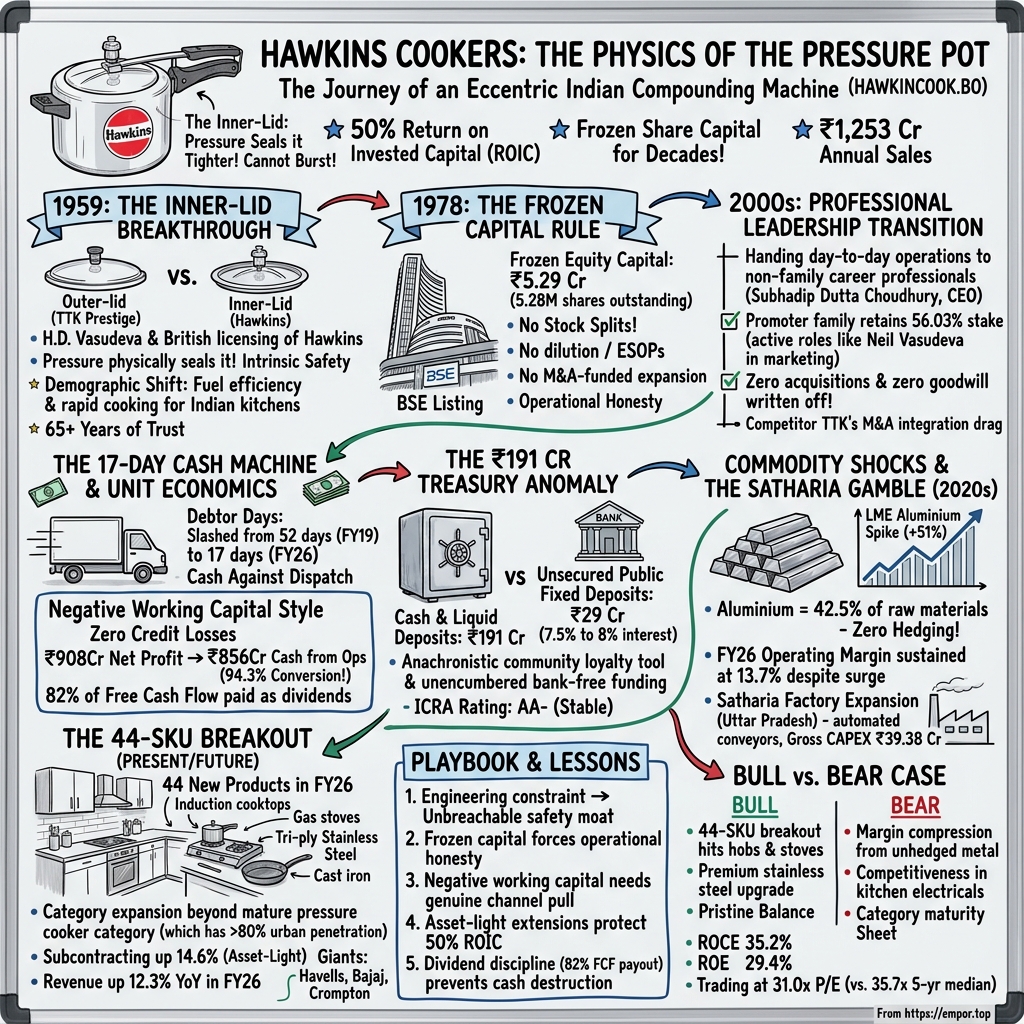
Hawkins Cookers: The Physics of the Pressure Pot
I. The Cooker That Cannot Burst: Three Riddles in an Aluminium Pot
Walk into almost any utensil shop in the lanes of Old Delhi and you can still see the oldest sales pitch in Indian kitchenware. The shopkeeper takes a Hawkins pressure cooker down from a shelf stacked to the ceiling, shows the customer the oval lid, and then does something that looks a little like a magic trick. He tips the lid sideways, slides it through the mouth of the pot, turns it so it sits flat against the underside of the rim, and locks it there. Then he explains what happens once the steam builds. The pressure inside pushes the lid outward, against the rim, harder and harder. While the cooker is hot and full of steam, no amount of tugging will get it open. The lid is not held shut by a clamp that can fail. It is held shut by the very force that makes a cooker dangerous.
That small demonstration, repeated across tens of thousands of counters for more than six decades, is the foundation of one of the strangest compounding stories in emerging-market consumer goods. Hawkins Cookers Limited sells pots, pans, pressure cookers, gas stoves and induction cooktops. It is not a technology company. It has no software, no network effects and no patents worth fighting over. And yet the market values it at about ₹4,204 crore, roughly $435 million, and its return on invested capital over the past twelve months was about 50%.1
The oddities pile up quickly. Hawkins has had the same 5,287,815 shares outstanding for as long as most of its shareholders can remember, and it has never raised fresh equity, never done a rights issue, never split its stock and never issued options that diluted anyone.1 It has no parent, no subsidiaries, no joint ventures and no associates, so every rupee of revenue and every rupee of risk sits inside a single legal company.1 It employs 577 people on its permanent payroll, a number that has barely moved in four years, while selling about ₹1,253 crore of goods a year.1 And it collects its money from dealers so fast that its receivables at the end of FY2026 equalled about 17 days of sales, the kind of figure usually seen at supermarkets rather than at a manufacturer selling through independent shopkeepers.1
Over the ten years to March 2026, net profit compounded at roughly 12.5% a year while revenue grew at about 8.4%.1 That gap, profits growing faster than sales for a decade, is the quiet signature of a company with pricing power and cost control. It is not a hyper-growth story. It is something rarer: a business that has kept getting a little better at the same thing for a very long time.
But tonight Hawkins sits at an awkward moment, and three riddles frame everything that follows.
The first is about growth. Pressure cookers are a mature product in urban India; most households that want one already have one. In FY2026 Hawkins launched 44 new products, pushing harder into tri-ply stainless steel cookware, gas stoves and induction cooktops, and revenue growth accelerated to about 12%.1 Can the company colonise the rest of the kitchen without walking into the low-margin bloodbath of small appliances and destroying the elite returns that made it special?
The second is about metal. Aluminium is the company's single biggest raw material, and global aluminium prices rose about 51% in the twelve months to April 2026.1 Hawkins does not hedge. Can its brand and its inner-lid engineering carry price increases through to shoppers without crushing volumes?
The third is about money, and it is the most eccentric of all. At the end of March 2026 Hawkins held about ₹191 crore in cash and bank deposits. At the same moment it owed about ₹29 crore to the public, members of the founding family among them, through a fixed-deposit programme that pays 7.5% to 8% a year.1 Why would a company that could repay every rupee of debt from the cash in its bank accounts keep borrowing from retail savers?
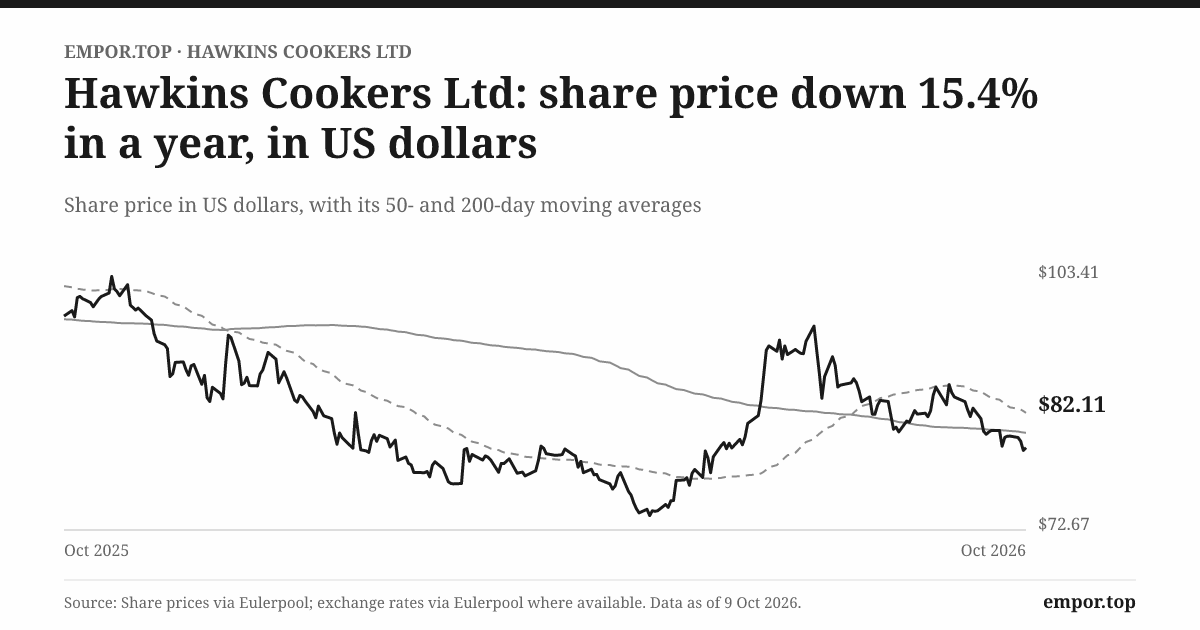
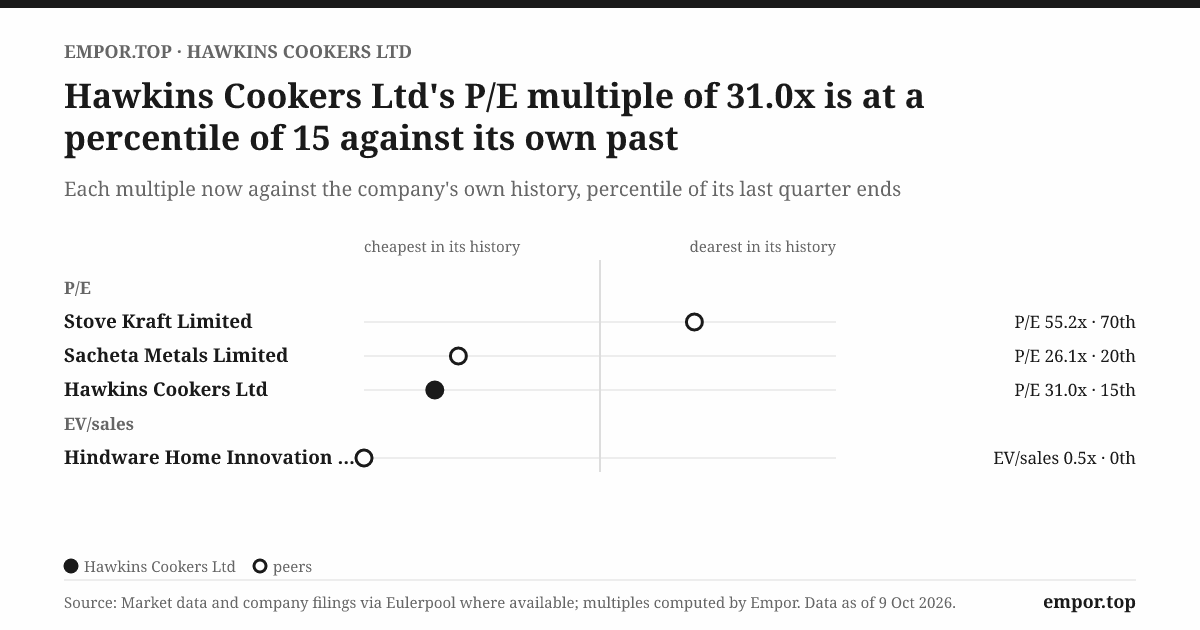
The market's view of all this is visible in the price. At about ₹7,947 a share on October 9, 2026, Hawkins traded at about 31 times trailing earnings, below its own five-year median of roughly 36 times.1 Investors still pay a premium multiple for the franchise, but less of one than they used to. They are asking, in effect, whether the pot can keep its seal.
To understand why it has held for so long, the story has to go back to a counter-intuitive engineering bet made in 1959.
 Subscribe on LinkedIn
II. The English Name and the Inner Lid: How Brahm Vasudeva Built an Indian Habit (1959–1990s)
Picture an Indian kitchen in the years after independence. Dal, rice, rajma and chana were the backbone of the national diet, and almost all of them needed long, slow boiling. The fuel was kerosene, coal or firewood, expensive and smoky, and the cook was almost always a woman who might spend hours a day tending a pot. A device that could cut cooking time sharply and save fuel was not a luxury in that world. It was a household productivity machine.
The pressure cooker was that machine, and it came with a reputation problem. A sealed vessel full of superheated steam is, physically, a small boiler. Early cookers around the developing world had a habit of being opened too soon, or of failing at the lid, and the stories travelled. Any company that wanted to sell pressure cookers to tens of millions of first-time buyers had to sell them safety before it could sell them speed.
Hawkins Cookers was incorporated in Maharashtra in 1959; its corporate identity number still carries that year and the state code for Maharashtra.1 The name was English, borrowed through a collaboration with a British firm at a time when an English brand signalled modern engineering to Indian buyers, and the venture was built by the Vasudeva family, with Brahm Vasudeva emerging as the founding figure who turned it into a national habit.1 The family still controls the company today, which is the most important continuity in this whole story.
The divergence that defined a category
The defining decision was mechanical. There are two broad ways to close a pressure cooker. In the outer-lid design, the lid sits over the top of the pot and locks onto the outside of the rim with lugs or a clamp, held tight by a gasket. That is the family of designs that TTK Prestige, Hawkins's great rival, became known for. In the inner-lid design that Hawkins championed, the lid is oval and slightly smaller than the opening. You slide it in at an angle, then lift it so it presses against the inside of the rim from below.
The difference sounds trivial until you think about the physics. Inside an outer-lid cooker, the steam pushes the lid away from the pot, and the only thing resisting it is the lock. Inside an inner-lid cooker, the steam pushes the lid into the rim, so rising pressure makes the seal tighter, not looser. And because the lid is wedged from inside, it cannot be pulled out while the cooker holds any meaningful pressure. A user simply cannot make the classic fatal mistake of opening a pressurised cooker. Think of it as a door that opens inward on a submarine: the deeper you go, the harder it is to open, which is exactly what you want.
That design was not something Hawkins could fence off forever. Inner-lid cookers were made by others, and over the decades whatever exclusivity existed fell away; today the company holds no patents on the core design that matter to its economics. What Hawkins did with the design was more durable than a patent. It turned a mechanical property into an emotional guarantee.
The company did that the slow way. Every cooker came with a cookbook, so a buyer learned not just how to use the device but what to cook in it, and the manual taught the habits that made the safety features work. Demonstrators fanned out to smaller towns to do what the Old Delhi shopkeeper still does: show, in person, that the lid will not budge. Quality tolerances in the casting and the fit of the lid became an obsession, because the whole promise collapsed if a lid did not seat properly. Over a generation, "Hawkins" stopped being a brand name and became, in many Indian homes, the word for the object itself.
Small capital, tight margins
The company listed on the Bombay Stock Exchange in 1978, and it did so with a share capital that was tiny then and is tiny now: about ₹5.29 crore, made up of 5.29 million shares of ₹10 each.12 That number matters because it never changed. The company that floated in the year Morarji Desai's government was in power has the same number of shares in the year of this story.
The environment in which that habit formed was the License Raj, the era when Indian manufacturers needed government permission to add capacity. A company that cannot simply build more factories when demand is strong learns to squeeze value from each unit instead. It prices for margin, not for volume, and it keeps its dealers loyal by making sure they earn money on every cooker. Whether that reflex was born of the regime or of the family's own temperament, it is the habit that shows up in the numbers decades later: a company that would rather sell fewer units at a good price than chase share with discounts.
When India liberalised in the 1990s, global consumer brands poured in. Many Indian incumbents in soaps, soft drinks and electronics were bought or flattened. Pressure cookers were different. Indian cooking was intensely local, the product was built around Indian grains and pulses, and foreign giants had no particular edge. Hawkins and TTK Prestige came out of the decade as the two dominant branded names, with a long tail of cheaper regional and unbranded makers beneath them.
So by the turn of the century, Hawkins had a brand nobody could copy by filing a patent and a culture of thrift that nobody had imposed by contract. The next question was who would run it once the founder stepped back, and what that person would do with the money it threw off.
III. Passing the Whistle: Professional Leadership and the Frozen Capital Structure (2000s–2010s)
The handover at Hawkins did not look like the typical Indian family succession, where a son or son-in-law moves into the corner office and the outside managers quietly leave. In the mid-2000s, executive control passed to a career professional, Subhadip Dutta Choudhury, who became chief executive and later chairman, while the Vasudeva family kept its shares, its board seats and a hand in marketing.1 Two decades later he is still there.
The team around him has been just as stable. Sudeep Yadav, vice-chairman and chief financial officer, has been the second pillar of the executive team for well over a decade, running capital allocation and the finance function.1 Tej Paul Sharma leads sales as an executive director.1 Neil Vasudeva, a descendant of the founding family and the company's largest individual shareholder, serves as executive director for marketing, which keeps the family's voice in the product range and the advertising while leaving the top job to someone else.1 In FY2026 he was paid about ₹2.6 crore, the least of the four executive directors.1
The family itself now holds about 56% of the company, spread across five branches: Neil Vasudeva at about 15.8%, Gitanjali Vasudeva Nevatia, Gayatri Yadav and Anuradha Khandelwal at roughly 11% each, and Nikhil Vasudeva at about 7.2%.1 The holding did not change during the year and none of it is pledged.1 That is an unusual arrangement. Power over the shares is split among several relatives, none with a majority on their own, and they have handed day-to-day control to professionals. It works only if the family agrees on what it wants from the company, and the evidence of the past twenty years is that what it wants is cash and caution.
What the executives cost
A skeptic's first question about any professionally run family company is whether the professionals are being paid like owners without carrying owners' risk. In FY2026, total remuneration for key managerial personnel was about ₹19.8 crore, a little over 15% of net profit.1 Choudhury earned about ₹8.15 crore, roughly 100 times the median employee's pay, and Yadav about ₹6.05 crore.1 Their pay rose about 15% in a year when net profit rose about 14%.1
That is generous, and an activist would note that one-seventh of profit going to a handful of executives is a meaningful slice for a ₹4,000 crore company. But the structure ties pay closely to profit, and shareholders have not objected: at the 64th and 65th annual general meetings, every resolution passed with overwhelming support, including the reappointment of Choudhury and Yadav for fresh three-year terms that run to September 30, 2028.13 The board adds weight. Its independent directors include Ravi Kant, a former managing director of Tata Motors, Shyamak R. Tata, a former Deloitte partner, and Sanjay Asher, a senior partner at the law firm Crawford Bayley.1 Related-party dealings are limited to pay, sitting fees, dividends, a small advisory fee of about ₹11 lakh to a promoter director, Susan Vasudeva, and fixed deposits placed on the same terms as the public.1 There are no brand royalties paid to a family company and no purchases from family-owned suppliers, which are the usual leaks in Indian mid-caps.1
The balance sheet in amber
The more remarkable inheritance is what the professionals did not do. In the two decades of this regime the company issued no new shares, ran no rights issue, did no stock split, granted no dilutive employee options and bought back nothing.1 Every rupee of expansion came from cash the business had already earned.1
The obvious temptation was diversification. Indian business history is littered with family firms that took a cash-rich consumer franchise and sprayed the money into hotels, real estate or overseas brands. The closest comparison is right next door. TTK Prestige, the outer-lid rival, bought the British cookware company Horwood Homewares, owner of the Judge brand, in 2016, and spent the following decade building out a broad kitchen-appliance range.[^4] Expanding abroad and across categories gave TTK more scale, but it also brought the usual integration work and margin dilution that comes with any overseas acquisition.
Hawkins over the same years did nothing of the kind. It completed no acquisitions and therefore has no goodwill to write down. Its only long-term investment is a holding of 2,500 unquoted shares in Saraswat Co-operative Bank, on the books at ₹25,000, the sort of stake an Indian company typically holds because it banks with a co-operative that requires members to own shares.1 Its auditors confirm it has no subsidiaries, associates or joint ventures at all.1
So the claim of extreme capital discipline survives the test of its own record: over at least twenty years, there is no failed deployment to point to because there were almost no large deployments of any kind. That is the strength and the limit. Management never destroyed capital buying growth, but it also never bought growth, which leaves the company entirely dependent on making new products itself. That dependence is exactly what the 44 new launches of FY2026 are testing.
Before getting there, though, it is worth looking at the machinery that turns a pressure cooker into cash, because that machinery is where Hawkins is most unlike its peers.
IV. Anatomy of an Indian Kitchen Monopoly: Unit Economics, Distribution, and the 17-Day Cash Machine
Imagine the dispatch bay at a Hawkins depot. Cartons of pressure cookers, tri-ply pans and induction cooktops are stacked on pallets, and the trucks backed up to the dock belong to dealers and distributors from across the region. In much of Indian consumer durables, a manufacturer ships first and waits two or three months to be paid, which means it is effectively lending money to its own retailers. At Hawkins the pattern is the reverse. A large share of goods leave once payment has cleared or on very short credit.
The evidence for that sits in the receivables. At the end of March 2026, dealers and other customers owed Hawkins about ₹58 crore, against sales of about ₹1,253 crore for the year.1 That is about 17 days of revenue. Seven years earlier, in FY2019, the figure was 52 days.1 In between it hovered in the mid-30s, and then in FY2026 it halved.1
The quality of that book is as striking as its size. Of the ₹58 crore, about 84% was not yet due at all.1 Most of the rest was less than six months overdue, and balances more than six months late came to under ₹1 crore.1 The company's provision for bad debts was ₹3.32 lakh, a rounding error that has not changed in years.1 There is no unbilled revenue and no contract asset to argue about.1 For a forensic accountant, receivables are where aggressive revenue recognition usually hides. At Hawkins there is nothing there to hide in.
Why the dealers accept it
The business model is simple. Hawkins sells products outright, at a fixed price per unit, through thousands of dealers and distributors, modern retail chains, e-commerce platforms, institutional canteen stores and export buyers.1 Nothing is sold on subscription. A household buys a cooker and may not buy another for five to eight years; repeat business comes from that replacement cycle, from families moving to LPG or piped gas and induction, from wedding and festival gifting, and from upgrades to better materials.1 Prices run from a basic aluminium cooker to stainless steel and tri-ply models costing several times as much.
No single customer accounts for even 10% of sales.1 That dispersion explains a lot. A retail chain that sells a fifth of a manufacturer's output can dictate terms. A neighbourhood utensil shop that sells a few dozen Hawkins cookers a month cannot, and it has every reason to stock the brand anyway, because customers walk in asking for it by name. When a product sells itself, the dealer's main concern is having it on the shelf, not the length of its credit. Short credit terms are the price of carrying a brand that turns.
There is a caution here. A drop from about 35 days to 17 in a single year is large, and the company does not publish a breakdown of what drove it. A shift in channel mix toward e-commerce or modern trade, tighter terms imposed during a year of rising prices, or simply the timing of year-end collections could each play a part. The direction over seven years is clear and the book is clean; whether 17 days is the new normal or an unusually good year-end reading will only be visible in the next few balance sheets.
The other side of the ledger is suppliers. Hawkins owed its suppliers about 46 days of cost of sales at year-end, and its dues to micro and small enterprises, about ₹37 crore, carried no overdue or disputed balances.1 Indian law penalises companies that pay small suppliers late, and plenty of large firms quietly finance themselves at small vendors' expense. Hawkins does not appear to. It also leans increasingly on outside manufacturers: subcontracting charges rose to about ₹103 crore in FY2026 from about ₹90 crore.1 That is a theme to return to.
Exports are handled with even more caution. Overseas sales of about ₹66 crore, about 5% of the total, are made against full advance payment or letters of credit payable on sight.1 The company carries no foreign-currency debt and uses no currency derivatives, and its foreign-exchange loss for the year was a few thousand rupees.1 Hawkins takes no foreign credit risk and almost no currency risk.
Where profit goes
The fairest test of whether earnings are real is whether they show up as cash. Over the twelve years from FY2015 to FY2026, Hawkins reported cumulative net profit of about ₹908 crore and generated about ₹856 crore of cash from operations, which is about 94% of profit arriving as cash.1 For a manufacturer that has to carry inventory of metal and finished goods, that is a very high conversion rate.
After paying for factories and machinery, the company produced about ₹669 crore of free cash flow over those twelve years. It paid out about ₹550 crore of that, roughly 82%, as dividends.1 The rest built up in the bank, where cash and short-term investments grew from about ₹52 crore at the end of FY2014 to about ₹191 crore at the end of FY2026.1
That combination tells you what kind of company this is. Hawkins earns high returns on a small capital base, needs little reinvestment, gives most of what it earns to its owners and keeps a cushion. The cushion, though, has become large enough to raise a question of its own, and Hawkins answers that question in a way almost no other listed company would.
V. The ₹191 Crore Treasury Anomaly: Why Hoard Cash While Borrowing from the Public?
Every year, Hawkins does something most Indian companies of its quality gave up long ago. It invites ordinary savers to lend it money. Under Section 73 of the Companies Act, the company accepts fixed deposits from the public and its own shareholders, for terms of roughly one to three years, at 7.5% to 8% interest.1 Retirees and small savers who know the brand roll these deposits over in much the way they would with a bank, and for many of them a fixed deposit with the cooker company is a familiar household investment.
At the end of March 2026, those deposits totalled about ₹29.4 crore, about ₹20 crore due after more than a year and about ₹9 crore within the year.1 That is the company's entire debt. There are no bank loans and no term loans.1
Now set that against the other side of the balance sheet. The company held about ₹15.7 crore in cash and current accounts, about ₹175 crore in short-term bank deposits, and about ₹3 crore more in longer bank deposits, for a total near ₹191 crore.1 Subtract the deposits it owes, and Hawkins has net cash of about ₹162 crore. Its cash is six and a half times its debt.
The arithmetic of a strange habit
Here is the puzzle in a sentence: why pay 8% to borrow ₹29 crore when you have ₹191 crore sitting in the bank?
The cost is small but real. Interest on the public deposits came to about ₹3.3 crore in FY2026.1 Meanwhile the company earned about ₹13 crore of interest on its bank deposits.1 So the treasury as a whole made money, about ₹9.7 crore net. But the deposit programme on its own runs at a small negative carry: if bank deposits yield less than the 7.5% to 8% Hawkins pays the public, then every rupee borrowed from savers and parked in a bank loses a little. Repaying the deposits would cost nothing but a cheque.
There is also a related-party wrinkle. About ₹5.5 crore of the deposits belong to related parties, including promoter directors, who earn the same scheduled rates as anyone else.1 The terms are uniform and the amounts are small relative to the family's dividend income, which was about ₹38 crore in FY2026.1 It is an optics issue rather than a leak. But it means some of the people who decide whether to keep the programme are also among its beneficiaries.
The rating agency, for its part, likes the arrangement. ICRA reaffirmed Hawkins's long-term rating at AA- with a stable outlook on July 22, 2026, for both the fixed-deposit programme, whose rated size was raised to about ₹130 crore from ₹105 crore, and for ₹22 crore of bank lines that the company keeps but does not draw.45 ICRA cited the brand's entrenched position, the debt-free net balance sheet, returns on capital above 35%, nationwide distribution and conservative treasury management, and flagged concentration in cookware, raw-material swings and competition as the constraints.4 Notably, raising the rated size of the programme means the company has headroom to take more deposits, not less.
Reading the intention
Management does not explain the programme at length, so the case for it has to be inferred from what it does. Three explanations fit the evidence. The first is independence: deposits are unsecured, carry no covenants, and come from thousands of small lenders rather than one bank that could tighten terms in a crisis. A company that remembers the License Raj and the credit squeezes that followed it might value a funding line no banker can pull. The second is loyalty: depositors are often customers and small shareholders, and the programme keeps them attached to the brand. The third is inertia, the simplest explanation for any half-century tradition.
A skeptical investor would push on two points. Retire the deposits and save the interest. And with ₹191 crore of cash earning bank rates, either pay a special dividend or buy back shares, which would also nudge the frozen share count down for the first time in memory. Neither has happened. The company's answer, in effect, is that the cash is a buffer for a business exposed to unhedged metal prices, which is a reasonable answer as far as it goes. FY2022, when operating cash flow turned sharply negative, is the strongest argument for keeping a cushion. Whether the cushion needs to be this large is a judgement call, and the board has consistently chosen caution.
The rest of the balance sheet reinforces the picture. Hawkins has no lease liabilities under Ind AS 116, because its plants and main offices are owned outright or held on prepaid long-term leases.1 Gross debt is 0.07 times equity, and net of cash the figure is negative.1 Contingent liabilities, mostly tax, excise, electricity-tariff and provident-fund disputes, came to about ₹11.5 crore, under 3% of equity.1 The auditors, Kalyaniwalla & Mistry, gave a clean opinion with no qualifications or emphasis of matter.1
The verdict on the treasury anomaly is that it is anachronistic and mildly inefficient, not dangerous. Its true cost is less the few crore of interest than what it reveals: a board that would rather hold too much cash than too little. That instinct is about to be tested by the one force Hawkins does not control at all, the price of the metal it is made of.
VI. The Aluminium Shock and the Satharia Gamble: Expanding Into a Commodity Squeeze (2020s–FY2026)
In April 2026, aluminium on the London Metal Exchange traded at about US$3,601 a tonne, against about US$2,381 a year earlier, a rise of roughly 51%.1 For most investors that was a line in a commodities report. For Hawkins it was the cost of the single most important ingredient in its products.
Break a pressure cooker into its costs and the picture is plain. Hawkins consumed about ₹486 crore of raw materials in FY2026. Aluminium accounted for about ₹207 crore of that, roughly 42%, and stainless steel for another ₹80 crore, about 16%.1 Together, two commodities make up close to three-fifths of what goes into the products. And management states in its corporate governance report that the company does no commodity hedging and holds no derivative contracts.1 When metal prices move, Hawkins feels it in full.
What happened the last times metal spiked
So the real question is whether the brand can pass those costs on. That is a claim about pricing power, and the company's own record offers two hard tests.
The first came in FY2019. Revenue grew about 17% that year, but working capital ballooned: debtor days hit their peak of 52 and working capital rose to about 45 days of sales.1 Cash from operations turned slightly negative, minus about $0.9 million.1 The business was profitable, but for a year almost none of that profit arrived as cash.
The second, more severe test came in FY2022, after the pandemic, when supply chains seized and aluminium soared. Revenue jumped about 24%, but inventory swelled to about 131 days of cost of sales, and cash from operations went to minus about $7 million.1 Operating margin slipped from about 14% to 12%.1
What those episodes show is specific. Commodity spikes did not break Hawkins's profitability. Net profit kept rising in both years.1 What they broke, temporarily, was cash conversion. When metal gets expensive, Hawkins buys ahead, carries more costly inventory and ties up cash, and its customers sometimes take longer to pay. Then, within a year or two, prices are reset and the cash comes back: operating cash flow rebounded strongly in the years that followed each squeeze.1 The pricing power is real but it works with a lag, and the lag is financed by the balance sheet. Which is, in fairness, the best argument for that ₹191 crore cushion.
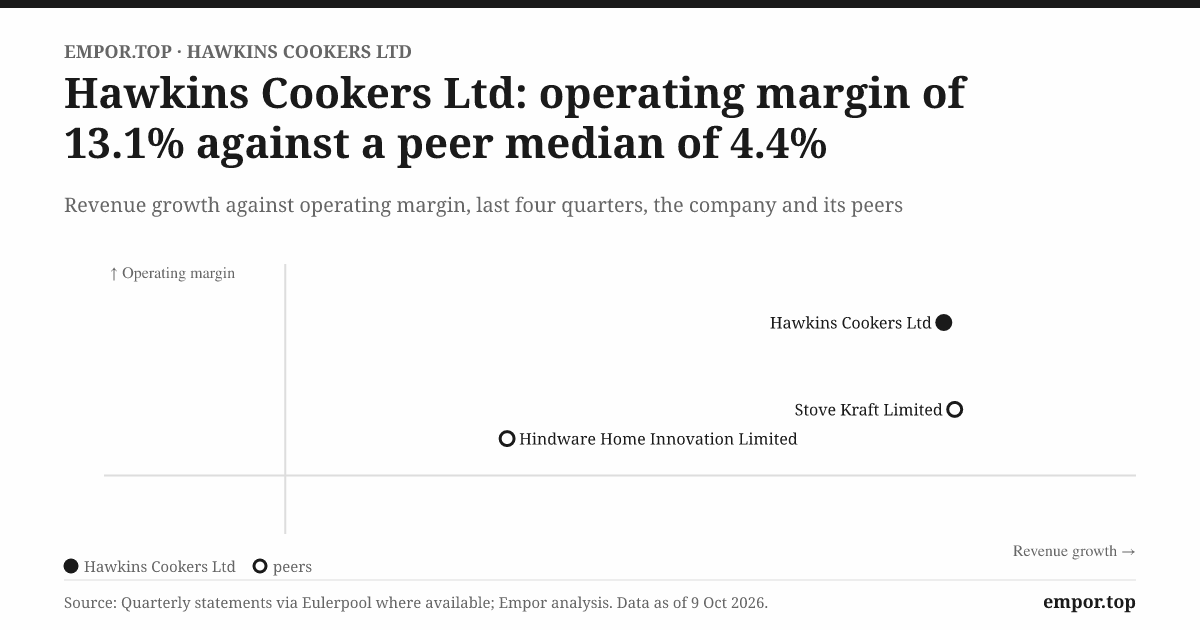
FY2026 followed the same script, with a better outcome on margins. Revenue rose about 12% and net profit about 14%, to about ₹131 crore.1 Operating margin held at about 13.7%, close to its range of recent years, and net margin was about 10.5%.1 In a year of sharply rising metal prices, Hawkins increased profit faster than sales, which is the cleanest evidence that its prices moved with its costs.
Cash, once again, told a different story. Operating cash flow fell to about ₹88 crore, from about ₹174 crore two years earlier.1 Working capital absorbed about ₹52 crore. Inventory grew by about ₹43 crore, as the company stocked metal at higher prices and filled shelves for its new products.1 Other current assets saw an increase of a similar size, mainly GST input tax credits that the company had paid but not yet recovered, which climbed to about ₹80 crore from ₹39 crore.1 That last item deserves attention. Input credits pile up when tax paid on purchases runs ahead of tax collected on sales, which can happen when input costs jump, and they are recoverable but not instantly. A company carrying ₹80 crore of tax credits has, in effect, lent that money to the government until the credits are used.
Building at Satharia
All of this happened while Hawkins was spending more on capacity than usual. Gross capital expenditure rose to about ₹39 crore in FY2026, about 3% of revenue, from about ₹33 crore the year before.1 Much of it went into the company's plant at Satharia in Jaunpur district, Uttar Pradesh, which gained conveyorised assembly lines and new machinery.1 Property, plant and equipment on the balance sheet has roughly quadrupled over a decade in dollar terms, from about $3.5 million in FY2016 to about $15 million in FY2026.1
That growth is a meaningful shift for a company that once ran on a very small fixed-asset base. It is also why return on capital employed has drifted down, from more than 50% in the late 2010s to about 35% in FY2026.1 Some of that decline comes from the pile of cash, which counts as capital and earns bank rates. Some comes from heavier plant investment. The business is still extraordinarily profitable, but it is no longer as capital-light as it was a decade ago.
Research spending is modest and practical: about ₹10 crore in FY2026, under 1% of sales, focused on manufacturing engineering, metal durability and safety-valve testing.1 Hawkins is not an R&D-led company. It is a manufacturing-led one, and its research budget exists mostly to make sure the lid always seats.
The verdict on metal is a narrowed version of the bull's claim. Hawkins has shown, across three commodity squeezes, that it can protect its margins. It has not shown it can protect its cash flow in the same year. That distinction matters most right now, because the company has chosen this exact moment, with metal at multi-year highs, to launch the most aggressive product push in its history.
VII. The 44-SKU Breakout: Can Hawkins Colonise the Rest of the Kitchen?
Step into a large appliance showroom in Mumbai and look at the cooktops section. A Hawkins induction cooktop sits on a shelf a few feet from models by Havells, Bajaj Electricals and Crompton, which owns Butterfly Gandhimathi. A Hawkins gas stove sits near Prestige, Butterfly and Pigeon. For most of its history Hawkins did not need to fight in this aisle. It owned its own aisle, the one with pressure cookers, and the competition there was a two-horse race. In the cooktop aisle, Hawkins is a newcomer among companies that spend heavily on advertising and run large appliance portfolios.
The reason Hawkins has walked into this aisle is simple arithmetic. Pressure cookers are close to universal in urban Indian homes, and a cooker lasts for years. A company whose core product is already in most kitchens grows mostly through replacement, price and premiumisation. Hawkins's revenue grew about 8.4% a year over the past decade, and only about 7.3% a year over the three years to FY2026.1 A company that wants to grow faster than that has to sell something new.
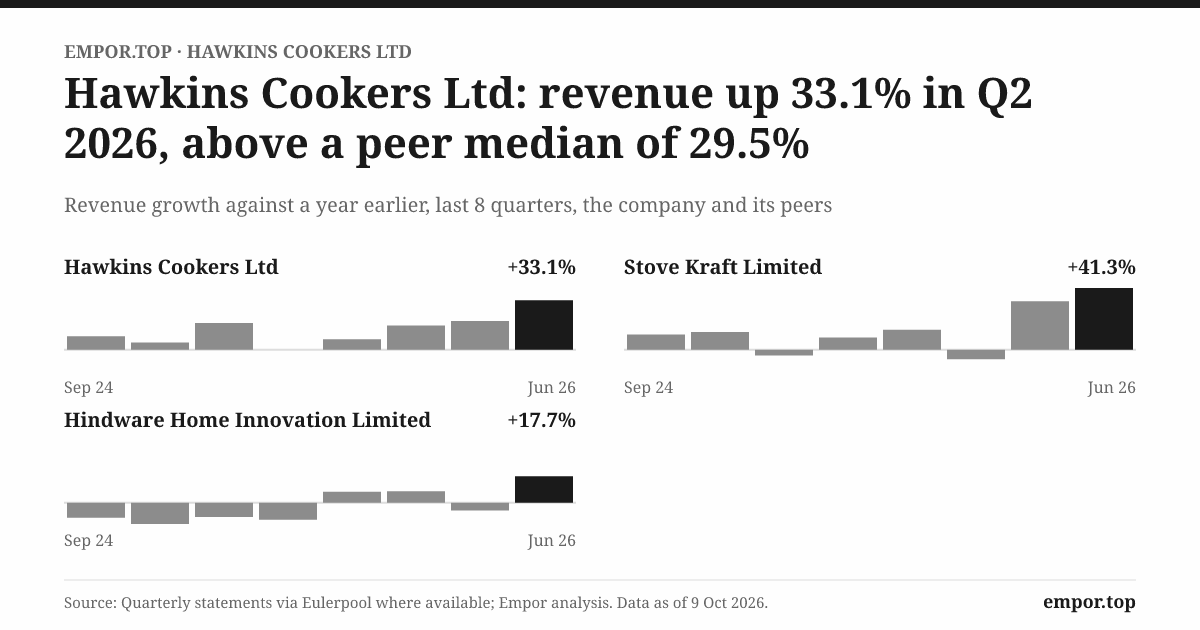
In FY2026 it did. Hawkins launched 44 new products across tri-ply stainless steel and cast-iron cookware, single and double induction cooktops, and fuel-saving gas stoves.1 Revenue grew about 12% to roughly ₹1,253 crore, comfortably above the long-run rate.1 And the acceleration continued. In the June 2026 quarter, revenue was up about 33% from a year earlier, and the three quarters before it grew at 32%, 16% and 19%.1 For a company that spent several recent years growing in low single digits, that is a distinct change of gear.
Making appliances without building appliance factories
The way Hawkins is making the new products matters as much as the products themselves. Subcontracting charges rose about 15% to about ₹103 crore.1 Headcount barely moved.1 The company appears to be using outside manufacturers for some of its newer lines while keeping its core cooker assembly in-house, though it does not break out which products are made where. That is the right instinct for a company whose returns depend on a small capital base. It limits the downside if a category flops. It also limits the edge: if a contract manufacturer can make a Hawkins induction cooktop, it can make one for someone else.
The quarterly figures carry an early warning. Operating margin in the June 2026 quarter was about 12.2%, down about 1.2 points from a year earlier, even as revenue jumped.1 Net margin slipped below 10%.1 One quarter proves nothing, and the June quarter is seasonally Hawkins's weakest. But it is exactly the signature one would expect if growth were coming from lower-margin products, higher metal costs, or both.
The old record on new categories
The bull case says the 44 launches mark the start of a second act. The company's own history argues for patience. Hawkins has sold electric and specialty products before, across the 2000s and 2010s, and none became a large share of the business. The clue is in the cost structure: aluminium and stainless steel still make up the bulk of raw materials, and ICRA's rating rationale explicitly cites the company's concentration in cookware and pressure cookers as a constraint.4 Hawkins does not publish a revenue split by product category, which is itself a limitation for anyone trying to track the strategy. Investors are being asked to judge a diversification push without the one disclosure that would show whether it is working.
The competition is the harder obstacle. In pressure cookers, Hawkins's safety story and its dealer loyalty are formidable. In small appliances, safety is table stakes, consumers compare features and prices online, and rivals such as Havells, Bajaj Electricals, Crompton, Philips and Preethi have deeper appliance portfolios and bigger marketing budgets. Hawkins has never been a big advertiser; its model has relied on word of mouth, dealers and the cookbook.
So the history narrows the claim. Hawkins has proven it can extend its brand to adjacent cookware, where its metalworking skills and premium positioning carry over. It has not yet proven it can build a durable, profitable business in electrical appliances against companies built for that fight. The test is clear. If non-cooker products grow to something like a quarter of sales while operating margins stay above about 12%, the second act is real. If revenue grows but margins slide toward single digits, Hawkins will have bought growth with the very returns that made it worth owning.
Which raises the question of what, exactly, sixty years of this company teach.
VIII. Playbook: Business & Investing Lessons
Picture the Hawkins board reviewing its capital plan: an acquisition idea that never comes up, a licensing deal that is not pursued, and a dividend that, over twelve years, takes most of the free cash. The lessons of this company are written in the things it chose not to do as much as in the things it did.
The first lesson is that a constraint can become a moat if you teach people to love it. The inner lid was harder to use than an outer lid. You had to learn to slide it in at an angle, and the company had to sell that awkwardness through cookbooks and demonstrations. But once buyers understood that the awkwardness was the safety, it became the brand. Hawkins did not have a patent that kept rivals out; it had a lid that kept a promise. A feature that customers have to learn becomes a feature they will not easily forget.
The second lesson is that a frozen share count is a form of corporate honesty. With the same 5.29 million shares for as long as anyone can remember, management had no acquisitions to hide behind, no fresh equity to paper over a bad year and no stock options to inflate. Every rupee of the company's growth had to come out of the cash register. When you cannot print shares, you have to earn every rupee you spend.
The third lesson is about who really holds power in a distribution chain. Hawkins sells through independent shopkeepers who could, in principle, demand long credit, and yet the company collects in about 17 days. It did not get there through legal muscle. It got there because customers walk in asking for the brand, and a dealer who wants the product on the shelf pays quickly to keep it. Channel power is not in the contract; it is in the customer who asks for you by name.
The fourth lesson is a warning wrapped in a virtue. Hawkins avoided the classic Indian conglomerate trap: no hotels, no real estate, no overseas brand bought at the top of the cycle. Its rival bought a British cookware maker; Hawkins bought nothing. But the discipline that protected returns also left the company with only one way to grow, which is to build new categories from scratch, and its record of doing that is thin. Refusing to buy growth is only a strategy if you can build it.
The fifth lesson is that paying out cash is a form of self-control. Over twelve years Hawkins paid out about 82% of its free cash flow as dividends.1 That left management little room for empire building, which is precisely the point. The exception is the ₹191 crore cushion and the fixed-deposit habit, which show that even a disciplined board can keep more than it needs. A dividend is the cleanest way for a company to admit it has nothing better to do with the money, and the most honest thing it can do when that is true.
Those lessons explain how Hawkins became what it is. The investment question is whether they are worth thirty-one times earnings at a moment of rising metal and new competition.
IX. Analysis & Bear vs. Bull Case
On an equity research desk in Mumbai, the comparison almost writes itself. On one side, Hawkins: higher returns on capital, faster collections, no acquisitions to digest, and a share count that never moves. On the other, TTK Prestige: a broader appliance range, more scale, and a longer record in the categories Hawkins is now entering. The market prices the two at similar multiples, with TTK in the low-to-mid 30s and Hawkins at about 31 times earnings, and a regional player such as Butterfly Gandhimathi lower.1 The question is which kind of company is worth more when the kitchen gets crowded.
Start with the numbers that define Hawkins today. Return on capital employed was about 35% in FY2026 and return on equity about 29%.1 Both have fallen over the past decade from levels above 50%, partly because the cash pile has grown and partly because the company is investing more in plant.1 Enterprise value is about $415 million, around 20 times EBITDA.1 At 31 times earnings the earnings yield is about 3.2%.1 With profit growing at about 12% a year over a decade, the PEG ratio sits at about 2.7.1 In plain language, the market is paying for durability. It expects Hawkins's earnings to keep compounding at roughly the old pace for a long time, and it is paying a little less than usual because it is less sure than usual.
Where the moat actually comes from
Hamilton Helmer's framework of seven powers is a useful way to ask what, specifically, protects those returns.
Brand is the strongest power. Six decades of association with safety mean that, in the pressure cooker category, buyers are paying for trust as much as metal. The proof is not advertising spend; it is pricing. Hawkins kept margins through three commodity squeezes, which a commodity metalworker could not do.
Process power is moderate to strong. Making a lid that seats perfectly every time, at high volume, with tight casting tolerances and calibrated safety valves, is a manufacturing skill built over decades. It is not a secret, but it is hard to replicate cheaply, and a failure would be catastrophic for the brand.
Counter-positioning is moderate. Hawkins has refused to supply unbranded products or to chase share with discounts, protecting dealer margins. Rivals who live on volume would find that stance hard to copy without hurting themselves.
The rest of the powers are weak. There is no cornered resource: the design is unprotected, and aluminium and steel come from the open market. There are no network effects, because one family's cooker gains nothing from the neighbour's. Switching costs for consumers are low, though dealer loyalty creates some stickiness in the channel. Scale economies exist in the core category but not in appliances, where Hawkins is the smaller player.
Michael Porter's five forces give the same picture from another angle. The threat of new entrants is low in pressure cookers, where trust is hard to build, and high in small appliances, where Chinese components and contract manufacturers make entry easy. Supplier power is high, because Hawkins buys commodity metal at world prices with no hedging. Buyer power is low, because no customer is even a tenth of sales. The threat of substitutes is moderate: electric multi-cookers, rice cookers and microwaves compete for the same tasks, though pressure cooking remains embedded in Indian cuisine. And rivalry is intense, with TTK Prestige, Butterfly, Stovekraft and appliance giants all competing for the same kitchen counter.
Put together, the moat is real but narrow. It is deep in the pressure cooker and in premium cookware, and shallow almost everywhere else.
Why it wins, and what could break it
The bull case rests on four pillars. First, the product launches are working: revenue has grown at double-digit rates for four straight quarters, and the June 2026 quarter was up about a third.1 Second, Indian households are trading up from basic aluminium to stainless steel, tri-ply and hard-anodised cookware, and those are exactly the products where Hawkins's metalworking and brand earn the best margins. Third, the balance sheet is a fortress: net cash, no bank debt, high returns and a long habit of paying most of its free cash out. Fourth, the valuation is below its own five-year median, so if growth stays above 10%, the stock does not need a higher multiple to compound with earnings.
The bear case is equally concrete. Metal prices could stay high long enough that price increases dampen demand, especially among the price-sensitive buyers of basic aluminium cookers. The appliance push could pull margins down, as the June quarter's slip from about 13.4% to 12.2% may be hinting.1 Working capital could keep absorbing cash, with more inventory for more products and a growing pile of tax credits. And the core cooker business, saturated in cities, could settle into low single-digit volume growth, leaving the company dependent on categories where it has no edge.
The honest assessment is that Hawkins's advantage is strongest where its growth is weakest and weakest where its growth is now coming from. That is not a reason to dismiss the strategy, but it is the central tension of the investment case.
Three indicators will tell investors which way it is breaking. The first is operating margin, which was about 13.7% for FY2026 and about 12.2% in the latest quarter, a downward drift worth watching.1 Holding it above about 13% through a commodity squeeze would confirm pricing power is intact. The second is working capital, where debtor days fell to 17 while overall working capital days rose to 40, the highest since FY2023.1 A company growing through new products will need more inventory, but if working capital keeps rising, cash conversion will keep lagging profit. The third is the share of sales from non-cooker products, which the company does not currently publish. Until it does, the success of the 44 launches has to be inferred rather than measured.
X. Epilogue
As the light fades over the Satharia plant in Jaunpur, trucks loaded with tri-ply cookware and induction cooktops pull out toward the highway, bound for the markets of Varanasi, Lucknow and beyond. Behind them, an expanded factory with new conveyor lines runs a product range larger than at any point in the company's history. Ahead of them lies the most consequential stretch for Hawkins in a generation.
The company approaches its 70th anniversary in 2029 with a revenue base of about ₹1,253 crore, net profit of about ₹131 crore and a leadership team locked in until September 2028.1 Choudhury and Yadav's reappointments mean the people who designed the current strategy will be the ones held to account for it.3 That continuity is a strength. It also means there will be no new management to blame if the appliance push disappoints.
Three sets of moments will decide the three riddles this story began with.
The first will come in the quarterly results. Every quarter now carries a test of pricing power: whether the company's price increases fully absorb the surge in aluminium, or whether margins keep easing as they did in the June quarter. A recovery toward 14% would suggest the dip was seasonal noise. A slide below 12% would suggest a structural change in mix.
The second will come in disclosure as much as in sales. Hawkins has told investors it launched 44 products; it has not told them how much those products sell. If the company begins to publish a category split, investors will be able to see whether induction cooktops and gas stoves are becoming real businesses. If revenue keeps growing at double digits and margins hold, the case will make itself even without the split. If revenue growth fades back to the old 7% to 8% once the launches lap their first year, the 44 products will look less like a second act and more like a busy year.
The third will come in the boardroom. The ₹191 crore cash pile and the fixed-deposit programme are choices the board makes every year, and ICRA's decision to raise the rated size of the programme suggests no change is imminent.4 A special dividend, a wind-down of the deposits, or a large investment in manufacturing would each signal a new view of what the company's capital is for. Continuing as before would signal what it has always signalled: that this board values safety above efficiency.
Hawkins will not become a sprawling conglomerate. It will not buy an overseas brand, issue shares to fund an acquisition, or chase a valuation with a reinvention. Its future depends on whether a company that spent sixty-five years perfecting one difficult mechanical object can now win in markets where the object is easy and the competition is fierce. The seal has never broken in the pot. The open question is whether it holds on the countertop.
XI. Outro
Go back to the stove. The cooker sits on the flame, the steam builds, and then comes the whistle, the sound that has marked mealtimes in millions of Indian homes for decades. The weight on the vent lifts, a jet of steam escapes, and the pressure inside drops a little before it builds again. Through all of it, the lid does not move. The harder the steam pushes, the tighter it holds.
That is the whole company in one image. For sixty-seven years Hawkins has let off steam in small, controlled bursts, a dividend here, a price increase there, a new product line when the moment seemed right, while the seal held: the same 5.29 million shares, no bank debt, no acquisitions, and about ₹856 crore of operating cash out of about ₹908 crore of profit over twelve years.1 It never needed financial engineering to build wealth for its owners. It needed a lid that would not come off and a board that would not let go.
The aluminium pot that refused to burst turned into a quiet corporate empire, built entirely inside its own seal. Whether that seal can stretch across the whole kitchen is the question the next chapter will answer.
References
-
Hawkins Cookers Limited 66th Annual Report 2025-26 — Hawkins Cookers Limited, 2026-05-28 ↩↩↩↩↩↩↩↩↩↩↩↩↩↩↩↩↩↩↩↩↩↩↩↩↩↩↩↩↩↩↩↩↩↩↩↩↩↩↩↩↩↩↩↩↩↩↩↩↩↩↩↩↩↩↩↩↩↩↩↩↩↩↩↩↩↩↩↩↩↩↩↩↩↩↩↩↩↩↩↩↩↩↩↩↩↩↩↩↩↩↩↩↩↩↩↩↩↩↩↩
-
BSE Stock Share Price & Regulatory Announcements: Hawkins Cookers Ltd (508486) — Bombay Stock Exchange ↩
-
Hawkins Cookers Limited 65th Annual Report 2024-25 — Hawkins Cookers Limited, 2025-05-28 ↩↩
-
Credit Rating Letter for Fixed Deposit Programme — ICRA Limited, 2026-07-22 ↩↩↩↩
-
Credit Rating Letter for Bank Facilities — ICRA Limited, 2026-07-22 ↩
 LinkedIn
 WhatsApp
 Reddit
 Hacker News
 Email
Email Kindle
 RSS Feed
 Spotify
 Apple Podcasts
 Amazon Music
 Audible
 YouTube