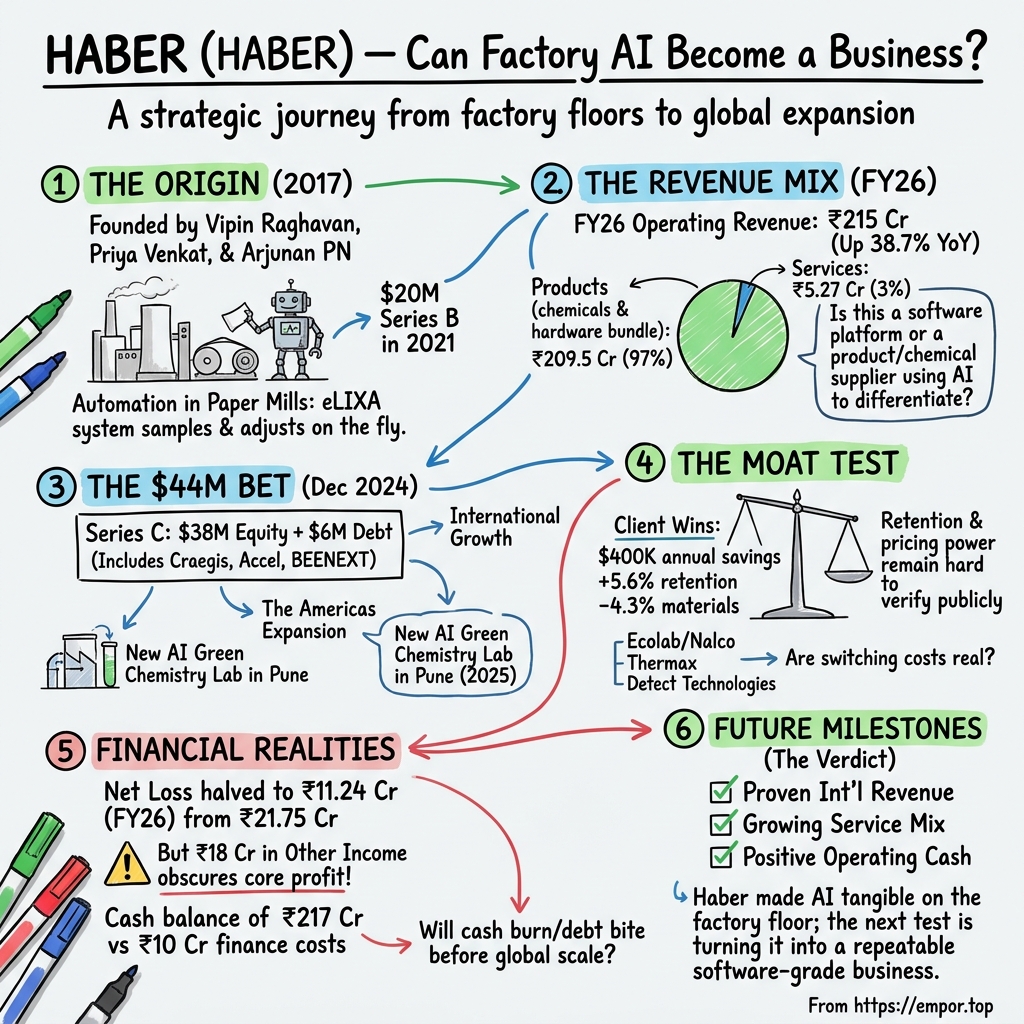
Haber: Can Factory AI Become a Business?
I. The Robot in the Paper Mill
Somewhere inside a paperboard mill that turns out more than 600,000 tonnes a year, a slurry of wood fibre, water and chemistry races across a moving wire at a speed no human hand could follow. Most of the water drains away. What the mill wants to keep is the fibre, the fines and the fillers, and the share of them that stays on the sheet in a single pass is a number papermakers call first-pass retention.
When it drops, expensive fibre washes back into the white water, the machine wobbles, and somebody in the control room reaches for the dosing pump. For most of the industry's history, that reach has been guided by a periodic sample, a lab result and an operator's instinct.
Haber's pitch is to replace that reach with a loop. Its systems sit beside the process, collect samples, measure them, run the numbers through models that combine chemistry with machine learning, and push a new instruction back to the plant: more flocculant here, less microparticle there. At that board mill, the company says its Mt. Fuji platform lifted first-pass retention from 71% to 75%, cut raw-material consumption by about 4%, and saved the customer roughly $400,000 a year.1 Collect, measure, analyse, intervene. It is the sort of story that makes "industrial AI" sound tangible rather than theatrical.
The harder question is what the customer is actually paying for. A plant manager who buys from Haber may believe they are buying automation. They may believe they are buying better chemistry. In the end they are buying better factory economics, and the way Haber gets paid for delivering them determines what kind of company it is. Haber's own accounts give an unusually sharp answer.
In the year to March 2026, the consolidated group behind the brand reported operating revenue of about ₹215 crore, roughly $25 million, up nearly 39% on the previous year. Of that, ₹209.5 crore came from product sales, which Entrackr describes as mainly chemicals supplied alongside software-enabled industrial solutions. Services brought in ₹5.27 crore, about 2.5% of the total.2 The robot is real. On the evidence of the revenue line, though, what customers mostly pay for is the stuff the robot doses.
That matters because of the money that has been placed on the opposite reading. In late 2024, Haber closed a Series C made up of $38 million of equity and a separately reported $6 million of debt, with expansion into the United States as a stated priority.3 The equity allotment was reported to value the company at about ₹1,242 crore after the money came in, around $148 million.4 At that mark, investors were paying roughly eight times the revenue the group would report for that financial year. That is a price for a technology platform. It is a hard price to justify for a specialty-chemicals distributor with clever instruments.
So the stakes are simple to state and harder to settle. Haber has grown from a three-founder start-up in Pune into a meaningful industrial supplier with customers that include ITC, Aditya Birla and Tata Steel.3 It has narrowed its losses. It has a large cash balance on paper. The question is whether it can turn plant-level results into repeatable, profitable growth as it pushes into North America, and whether the economics underneath that growth look like software, like chemicals, or like something new that the public markets do not yet have a shelf for.
A boundary needs drawing before the story begins. Haber is the brand of Elixa Technologies Private Limited, an unlisted company incorporated in Pune in 2017, with operating subsidiaries in the United States, the United Arab Emirates and Bangladesh.5 The "Startup" label attached to it is a description of its lifecycle stage, not a stock exchange. As of mid-November 2026, Elixa has not filed a draft red herring prospectus, or any other offer document, with the Securities and Exchange Board of India,6 and the company has said nothing public about a listing timetable.
Everything an investor can know comes from funding filings reported by the press, summaries of statutory accounts filed with the Registrar of Companies, interviews and the company's own marketing. That is a thinner record than a prospectus, and it changes the job. This is pre-IPO underwriting from the outside, and some of the most important answers, such as how much of Haber each shareholder owns and what rights its preference shares carry, are not yet public.
Three questions carry the rest of the story. The first is what actually drives the revenue: software-led recurring fees, or the repeat purchase of chemicals that the software helps sell. The second is how durable Haber's place inside a customer's plant really is, and whether the savings it publishes translate into pricing power and renewals. The third is whether expansion can outrun cash consumption and the cost of debt before the business has to prove, in a public filing, that it can fund itself.
 Subscribe on LinkedIn
II. From Factory Floor to First Funding Round
In 2017, three people who had spent years around industrial chemistry and consumer technology started a company in Pune around a deceptively plain observation. Process plants such as paper mills, sugar mills, distilleries and breweries run continuously, but the decisions that keep them on specification are made intermittently. A technician pulls a sample, walks it to a lab, waits for a reading, and an operator adjusts a valve. Between one check and the next, a machine can drift for hours. Every hour of drift costs fibre, chemicals, steam or water.
The founders were Vipin Raghavan, who became chief executive, Priya Venkat, who became chief operating officer, and Arjunan PN.7 Venkat brought more than a decade in the pulp and paper industry and had worked at Ecolab, Zynga and Infosys before Haber; she holds an MBA from NMIMS in Mumbai.8 The Ecolab line on that résumé is not a footnote.
Ecolab, through its Nalco Water business, is one of the world's largest suppliers of industrial water and process-treatment chemistry, which means one of Haber's founders learned the trade inside the kind of incumbent that Haber would eventually compete against. The combination of a gaming company and a chemicals giant on the same CV is an apt summary of what Haber set out to be: data-driven software habits applied to an old, physical, chemistry-heavy business.
The first product was eLIXA, launched in the founding year.9 It was framed in the trade press as "robotics-as-a-service in a box" for process manufacturing.10 In practice, it put sensors, automated sampling and edge computing at the customer's site, read process conditions in real time, and drove dosing pumps directly.
Venkat later described eLIXA as an AI platform for real-time data collection, accurate chemical dosing and optimised process conditions.8 The point was not to install a humanoid machine on the shop floor. It was to put a tireless, instrumented technician next to the process, one that sampled every few minutes instead of every few hours and never got bored of reading the same gauge.
The early commercial structure is revealing because it shows the founders thinking about adoption economics from the start. In a 2021 presentation to the paper industry, Haber described an offer in which it funded the field instruments and the software itself, offered flexible tenures running beyond 36 months, and charged a fixed monthly rental plus a share of the benefits, so that part of what the customer paid depended on performance.[^11]
For a conservative plant manager, that structure removes most of the risk of trying something new: no capital budget to approve, no upfront purchase, and a bill that grows only if the savings show up. For Haber, it meant carrying the hardware on its own balance sheet and waiting for the savings to compound into revenue. It was a sensible way to get through a mill's front gate. It was also, from the beginning, a capital-hungry way to grow, and it said nothing about whether the customer would keep paying once the easy savings had been captured.
The capital trail started early. Haber raised a Series A in 2019 to accelerate research and development, expanded across the Middle East in 2020,9 and in November 2021 closed a $20 million Series B led by Ascent Capital, with Accel, Elevation and BEENEXT participating.4 That round arrived at the height of a venture cycle in which Indian deep-tech and B2B software companies were raising money at generous prices, and it financed the next leap: in 2022, Haber introduced Mt. Fuji, a manufacturing-intelligence platform, and Kaiznn, a production-planning suite for paper mills.9 The product line was broadening from a dosing robot into a software stack.
What the 2021 round did not produce, at least publicly, is the kind of disclosure a future public investor would want. The press reported the amount and the lead investor. It did not report the valuation, the share of the company sold, the liquidation preference attached to the new shares, or the founders' remaining stake. Neither did Haber.
Those details sit in allotment filings and annual returns that the company has not published in a form that resolves them, and they matter: a $20 million round at a high price with strong downside protection is a very different signal from the same amount at a modest price with plain terms. On the public record, the most that can be said is that sophisticated venture investors backed the company twice in its first five years, and that the second round was large enough to fund a meaningful expansion of the product line.
There was also an early record of what the business was selling, and it already pointed to the tension that would define the next five years. Haber's portfolio in this period was described as chemical dosing for sugar mills, distilleries, paper mills, breweries, institutions and mining operations.3 The verb in that description is "dosing." The robot measured; the chemistry did the work; and somebody had to supply the chemistry. Whether Haber would earn its living from the measurement or the molecule was not yet obvious from the outside.
By the end of this first chapter, Haber had a product that solved a real problem on factory floors, a founding team with deep paper-industry knowledge, and two rounds of institutional capital behind it. What it had not yet shown was the thing that separates a clever industrial pilot from a business: proof that the offer could be sold, installed, supported and renewed at scale, plant after plant, without the founders standing beside every machine. That was the test the next round of capital had to pay for.
III. The Robot Became a Product Business
Open Haber's consolidated accounts for the year to March 2026 and the robotics-as-a-service story almost disappears. The group reported ₹215 crore of operating revenue. Product sales were ₹209.5 crore, up about 37%. Services, the line where rental fees, monitoring and support would most naturally land, were ₹5.27 crore. They grew faster, by about 82%, but from a base so small that the increase barely moved the mix.2 For every ₹100 of operating revenue, about ₹97 came from selling products. Entrackr describes those products as mainly chemicals supplied alongside software-enabled solutions.2
That is the most important single fact about Haber's economics, and it needs careful handling rather than a quick verdict. It does not mean the software is irrelevant. It may mean the opposite: that the software is the reason a customer buys its chemistry from Haber rather than from Ecolab, Veolia or a local formulator. What it does mean is that Haber does not, on its reported numbers, monetise its intelligence directly. It monetises it through the volume of consumables the intelligence helps place.
Today's offer makes sense of that structure. Haber describes Mt. Fuji as a platform that "securely connects to your mill, learns its operations, and scales from AI recommendations to autonomous control."11 Around it sits a family of tools: eLIXA for automated sampling and dosing, Kaiznn for planning and trim optimisation, FiMorph for fibre-morphology analysis and Kensei for web inspection.11
Frost & Sullivan, in a write-up for an award it gave Haber, describes the core as a hybrid of physics-based models and machine learning that plugs into existing programmable logic controllers and SCADA systems rather than replacing them, so a plant can start with one process unit and expand.12 In plain terms, Haber learns how a particular machine behaves, predicts where it is about to drift, and adjusts the chemical inputs before the drift becomes waste.
Haber has also said, in its own words, how it charges for this. In a November 2025 podcast, Raghavan's conversation was summarised under a chapter heading that reads "Pricing by the tonne, not by the seat," with Haber described as pricing "by production output instead of licenses."13 That line explains the revenue mix better than any analyst could. If a customer pays per tonne of paper produced, and what scales with tonnes is the chemistry consumed, then most of Haber's revenue will be recognised as product sales, because that is what physically leaves Haber's warehouse. The software is embedded in the price of the molecule.
There are good reasons for a company like Haber to bundle this way. Measured savings are the most persuasive sales tool in industrial markets, and the cleanest way to prove a saving is to own both the measurement and the input being optimised. If Haber controls the dosing of a retention aid and also supplies that aid, it can show the mill a lower total bill per tonne even while it captures margin on each kilogram sold.
Recurring product supply also keeps Haber inside the plant every day, which is where switching costs, if they exist, are built. A chemistry vendor who is also the plant's process-monitoring system is harder to swap out than one who only delivers drums.
The 2021 rental-plus-benefits-sharing structure, with Haber-funded instruments and tenures beyond three years, was one way to package the offer.[^11] It would be a mistake to assume it describes the whole book today. Haber does not disclose how many customers are on rental contracts, how many on per-tonne chemical pricing, how many on straightforward product purchases, or what share of revenue any of those arrangements represents. It also does not disclose contract lengths, minimum volumes or renewal rates. What it does disclose is the end result, and the end result is a product company.
That creates an evidential tension that the company's own messaging does not resolve. Frost & Sullivan's write-up, which footnotes its figures to an interview with Haber in September 2025, refers to "a strong annual recurring revenue base" and "consistent renewals."12 Haber's website advertises "$300M annual recurring savings" for customers across more than 100 manufacturing sites.11 Neither phrase is false on its face; repeated chemical orders at a plant that keeps running are recurring in an everyday sense.
But "annual recurring revenue" is a term of art borrowed from software, where it means contracted subscription fees that continue unless a customer actively cancels. Haber's accounts show ₹5.27 crore of services against ₹209.5 crore of products.2 If most of the "recurring revenue" is repeat chemical supply, it behaves like a consumables business, tied to the customer's production volumes, input prices and willingness to keep buying from the same vendor, not like a software subscription.
A second gap is even more striking. Haber says its systems produce about $300 million a year of savings for customers.11 Its own revenue is roughly $25 million. Taken at face value, Haber is capturing well under a tenth of the value it claims to create. That can be read two ways. The bullish reading is that Haber is underpricing its intelligence and has enormous room to raise prices or shift towards benefit-sharing contracts as its track record lengthens.
The sceptical reading is that the savings figure is a cumulative, company-calculated estimate that customers do not fully recognise, which is exactly why they will not pay more for it. The record does not settle which reading is right, but it does say that the pricing power implied by the savings claim has not yet appeared in the revenue line.
What would prove the platform thesis is not complicated to describe. Haber would need to show several years of revenue broken down into products, services and software or subscription fees; renewal rates by contract; the average duration of a customer relationship; and gross margin by line, so that an investor could see whether the intelligence earns a premium over plain chemical supply. A prospectus would have to provide most of this. Until then, the honest description of today's Haber is a product-and-chemistry supplier whose software is the wedge, the differentiator and the retention tool, but not yet a separately priced source of income.
That leaves the story's central tension in plain view. If Haber's real edge is its software and the process data it accumulates across a hundred-plus plants, why does its profit and loss account look so much like a chemicals distributor's? And if it is, at heart, a chemicals business with superior instrumentation, why was it priced like a technology company? Both questions came to a head when Haber went back to investors for a much larger cheque.
IV. A $38 Million Bet on the Americas
In October 2024, after three years without a priced round, Elixa's board passed a special resolution to issue 100 equity shares and 457,572 Series C compulsorily convertible preference shares. The money came to ₹317.2 crore, about $38 million. Creaegis, a growth-stage investor, put in about ₹200 crore and led the round; BEENEXT added ₹83.5 crore and Accel ₹33.4 crore.4 Haber later announced it as a $44 million round, including the debt facility, and said it would fund international expansion, particularly in the United States.3
The two announcements describe the same transaction from different angles, and it is worth keeping them apart. The October filing is the hard evidence: an allotment of a specific number of shares for a specific sum to named investors. The December announcement is the company's framing, which bundled a debt facility into the headline figure. The $6 million of debt is not equity risk capital. It carries interest, has to be repaid, and ranks ahead of every shareholder. Treating the round as "$44 million raised" flatters the cushion it created.
The allotment also gives the only public anchor for what Haber was worth. Entrackr, citing TheKredible, reported a post-allotment valuation of about ₹1,242 crore.4 Dividing the equity raised by the preference shares issued gives a price of about ₹6,930 per Series C share, and dividing the reported valuation by that price implies something on the order of 1.8 million shares on an as-converted basis.
Those are rough derivations rather than disclosed figures, but they show the structure: a relatively small number of high-priced shares, with Creaegis's ₹200 crore buying roughly a sixth of the company at that mark. Accel was reported to be the largest external shareholder with about 18%, followed by Creaegis and Elevation.4 The founders' combined stake, the size of the employee option pool and any outstanding warrants or convertible instruments are not public.
That last point matters more than it sounds. The new money bought mostly preference shares, not ordinary equity. In Indian venture practice, compulsorily convertible preference shares usually come with a shareholders' agreement that can include liquidation preferences, anti-dilution protection and veto rights. Haber has not disclosed the terms attached to its Series C shares or to its earlier classes.
If the Series C carries a one-times preference, for example, then Creaegis gets its ₹200 crore back before ordinary shareholders see anything in a sale below the round price. That protection is part of what Creaegis paid about ₹6,930 a share for. A future public investor buying ordinary shares after conversion would not get it. The ₹1,242 crore mark is therefore best read as a price agreed by a protected, well-informed buyer in a private negotiation, not as a valuation of the common equity.
Read against the operating numbers, the mark looks demanding. The consolidated group reported operating revenue of about ₹155 crore in FY25.2 Against FY26 revenue of ₹215 crore, the same mark is about 5.8 times.
The group had cash and bank balances of about ₹199 crore in March 2025 and ₹217 crore in March 2026,2 which reduces the operating business's implied value, but borrowings are not disclosed in enough detail to build a reliable enterprise value. Even on generous assumptions, investors in late 2024 were paying something like five to seven times revenue for a business that was losing money at the operating level and earning about 97% of its revenue from products.
There is a reason a sophisticated investor might still pay that. Entrackr reported FY23 revenue of about ₹82 crore and a loss of about ₹37 crore;4 Inc42's financial summary put FY25 revenue at ₹165 crore for Elixa, up about 55% in the latest year.14
The consolidated FY25 comparison used in the FY26 accounts is lower, at ₹155 crore,2 and the difference between the two FY25 figures is a scope question that only the filed statements can resolve. Even so, the direction was unambiguous: revenue had roughly doubled in two years while the loss had stopped widening. An investor writing a cheque in October 2024 was buying momentum, a product that worked in demanding paper-industry settings, and an option on international expansion.
That option was the declared purpose of the round. Haber said it had more than 100 clients across India, the Middle East and Africa, with its solutions then concentrated in pulp, paper and packaging, and named the Americas as its growth priority.15 It opened offices in the United States and Canada in 2025 and now lists Haber Inc. in Chicago as its American base.9
Venkat said in mid-2025 that Haber planned to expand its footprint in North America and move into mining and food and beverage.8 The logic is straightforward. North America has a large, ageing pulp and paper industry under cost pressure, plants that pay more for chemicals and labour than Indian mills do, and buyers more accustomed to paying for software. If Haber's per-tonne model works anywhere, the prices it can charge there should be higher.
At the time of the round, Haber also made a striking claim about its existing customers: it said revenue from key customers had nearly doubled while it maintained zero churn.15 Raghavan returned to the theme in late 2025, when a podcast chapter was titled "The pacemaker product and Haber's zero churn."13 The metaphor is apt: a pacemaker is a device a patient does not remove once it is working. But the claim, as made publicly, is unauditable.
Haber has not defined the period it covers, what counts as a "key customer", whether churn is measured by logo or by revenue, or how concentrated revenue is among its top accounts. A company with a handful of large mills generating most of its sales could truthfully report zero churn among them for a few years and still be fragile. Without the definitions, "zero churn" is a management assertion, not evidence of retention.
What the round visibly paid for is easier to see than what it returned. Haber opened its first AI-driven chemistry and sensor lab in Pune in 2023 and a larger green-chemistry lab in Pune in 2025, alongside the North American offices.9 Frost & Sullivan described an "eightfold expansion" of research and development laboratory capacity.12 Employee costs rose about 52% in FY26, to ₹38 crore.2
Haber has not published a reconciliation of how the ₹317 crore was used, how much remained in deposits at the end of each year, or what share went to working capital rather than research, hiring and offices. None of the spending visible on the record is an acquisition; Haber has built rather than bought, so there is no deal price to benchmark and no goodwill to test.
The next proof point is therefore not another funding round. It is revenue from the new markets, repeat orders from the new industries, and evidence that the expansion is producing customers who pay more per tonne than the Indian base. Haber has not yet disclosed any geographic split of revenue. There is one small, telling clue on Haber's own website. Among the anonymised customer testimonials is a pulp mill in the United States that is credited with a 10% cut in chemical consumption, alongside a kraft maker in the UAE that reduced its bacterial count to 5 colony-forming units per millilitre.11
A single American reference does not make a market, and Haber does not say how much the mill pays or whether it has expanded the relationship. But it does show that the proposition has at least been installed, and is producing a result Haber is willing to publish, on American soil. The question is whether one becomes ten, and ten becomes a revenue line.
Until it does, the Americas remain a stated strategy and a set of offices, not a demonstrated revenue engine, and the ₹1,242 crore mark remains a bet that they will become one.
V. The Factory Floor Is the Moat Test
Go back to the board mill. According to Haber, the problem there was a familiar one: retention on the paper machine swung with changes in furnish and machine conditions, and operators dosed retention and drainage aids by hand, reacting after the fact. Haber deployed Mt. Fuji to predict first-pass retention in real time and prescribe the dose of flocculant and microparticle needed to hold it on target.
The case study reported the same gains at the mill, with raw-material use down by about 4.3%.1 Published in September 2025, it describes the sequence in four steps: monitor the process in real time, predict retention, optimise the polymer dose, and keep learning as conditions change.1
That is a clean demonstration of how the product works. It is also, by design, a marketing document. The case study does not name the mill, its location or the period over which the savings were measured. The savings figure is Haber's calculation, not an audited statement from the customer, and the published table even mixes units in the raw-material line. None of that makes the result untrue. It does mean the $400,000 is a claimed outcome from one site, selected for publication, and should be weighed as such.
Haber has published nine such studies. They include a pulp mill said to save $2 million a year by improving white-liquor quality, a paper mill saving $1.36 million through refining optimisation, a specialty mill unlocking $4.4 million a year by cutting variability in wet strength, and a hospital that reduced fresh-water use by 36%.16
Frost & Sullivan's write-up adds a pulp-mill example in which batch-to-batch variation in kappa number, a key measure of cooking, fell from between 1.5 and 2.0 to 0.8, and chemical use fell by 2 to 3 kilograms per air-dried tonne.12 On its homepage, Haber summarises results "measured on customers' production lines" as roughly 15% yield improvement and about 20% lower raw-material cost.11 Not one of the published studies names its customer.
The pattern across these claims is consistent, and so is the gap in them. Haber's systems appear to deliver measurable improvements in specific, well-defined process loops, especially in pulp and paper, where small percentage gains in retention, yield or chemical consumption translate into large sums. What none of the published material shows is the conversion of those savings into Haber's own economics: how long the customer stayed, whether it expanded Haber to other machines or mills, whether it paid more per tonne after the first year, or whether it put the saving out to tender and bought the same chemistry more cheaply elsewhere.
The claimed impact figures also wobble when lined up over time. In October 2024, Haber's customers were said to have saved more than 50 billion litres of water.7 In June 2025, Venkat cited more than 25 billion litres.8 Haber's website now reports about 29 million cubic metres preserved, which is roughly 29 billion litres.11 A cumulative environmental saving should only go up. The likeliest explanation is a change in definition or method rather than anything sinister, but a cumulative number that halves between two interviews is a reason to treat headline impact claims as communication rather than measurement.
The real competitive question is what happens at the moment of purchase. A plant manager buying process chemistry has choices. Ecolab, through Nalco Water, and Veolia are global incumbents with service engineers in plants around the world. In India, Thermax and Ion Exchange have long-standing relationships in industrial water and process treatment. In the narrower field of industrial AI, Entrackr named Detect Technologies, Altizon and Fero Labs as Haber's competitors.4
None of these is a clean comparison. Ecolab sells far more than process chemistry and reported about $17.4 billion of trailing revenue at last count;17 Detect builds sensing and monitoring for safety and asset integrity; Fero Labs sells process-optimisation software without the chemistry. Haber sits in an awkward but potentially valuable middle: more software than the chemical incumbents, more chemistry than the software start-ups.
Run the purchase decision through Michael Porter's five forces and the shape of the market becomes clearer. Buyer power is high: Haber's customers include large industrial companies,3 along with paper producers whose logos appear on Haber's website, including West Coast Paper Mills, Seshasayee Paper and Boards, JK and Century.11
They run procurement departments, compare vendors and demand trials before expanding. Supplier power is moderate: Haber buys raw chemicals and instruments in competitive markets, but its material costs rose about 40% in FY26 to ₹133 crore, faster than revenue,2 which suggests it is not yet extracting better terms as it scales.
The threat of substitutes is real: a mill can keep its existing chemical supplier and buy optimisation software separately, or it can rely on its own process engineers and the incumbent's field service. Rivalry is intense among chemical suppliers who already sit in the same plants. And while the entry barrier for software is low, the barrier for credible, field-proven process control in a running mill is high, which works in Haber's favour against new start-ups but not against incumbents.
Where could Haber build lasting power? Hamilton Helmer's framework points to two candidates. The first is switching costs. Once Haber's models are tuned to a particular machine, integrated with the plant's control systems and trusted by operators, replacing them means retraining, recalibrating and accepting a period of instability on a machine that can cost a mill heavily for every hour it runs off-spec.
Frost & Sullivan describes the platform as integrating with existing control systems and learning continuously from every deployment.12 The second is a form of cornered resource: the process data and the tuned models accumulated across more than 100 sites.11 If that data lets Haber predict and control a new mill faster and better than a rival can, it compounds.
Both powers are plausible. Neither is proven in the public record. Switching costs would show up as long customer lives, expansions within accounts and rising revenue per site. Haber discloses none of those. A data advantage would show up as faster deployments and better results at newer sites than older ones, and as an ability to charge more than incumbents. Haber says deployments take weeks rather than months,12 but it publishes no trend.
Meanwhile, the counter-evidence is structural. Because most of Haber's revenue is chemistry, a customer that wants to squeeze costs can ask a rival to match the chemical price, and the incumbent chemical suppliers have their own monitoring and dosing systems. The moat, if it exists, has to be wide enough that a mill would rather pay Haber's per-tonne price than run the risk of switching. That is a test that only renewal data can pass.
The longest available record gives a useful falsification check. In 2017, Haber started as a robotics-as-a-service company, renting instruments and software to plants and charging partly on results.9[^11] Nine years later, its accounts show the product-heavy mix already noted.2 That is not a failed pivot; the business grew strongly through the change.
But it does reject the narrowest version of the platform thesis, the idea that automation or software fees would become the dominant way Haber captures value. The record narrows the claim to something more modest and still interesting: Haber uses software and automation to win and keep chemical-supply relationships on better terms than an ordinary supplier could. Whether those terms are actually better, in price, duration or share of wallet, remains unproven.
The customer list hints at how far the proposition has travelled beyond paper. Haber's website displays the logos of Tata Steel, ITC, Emami, the Taj hotel group and the UB group alongside its paper clients,11 and one of its case studies describes a hospital that cut fresh-water use by 36% and cooling-tower blowdown by 97%.16 Earlier descriptions also placed Haber beyond paper.3
Breadth of this kind can be read as proof that the core engine generalises across processes, which is what Frost & Sullivan argues.12 It can equally be read as a company still chasing applications where a cooling tower or a boiler gives it a foothold for water-treatment chemistry. Haber does not report revenue by industry, so the breadth cannot yet be weighed against depth. What the published case studies do show is that the strongest, most quantified results remain in pulp and paper, where the founders' expertise is deepest.
Three numbers would decide it. The first is the mix of revenue between products and services or software over several years, which today is overwhelmingly products. The second is repeat-site deployment and retention, measured by cohort: how much revenue a mill that started with Haber in, say, 2021 produces today.
The third is concentration: how much of revenue comes from the top five and top ten customers. Haber publishes none of these with definitions. A sceptic's question follows naturally. Do case-study savings translate into sustained pricing power and repeat business, or does Haber have to keep adding chemical volume, field engineers and new sites to grow? The financial statements offer the first serious clues.
VI. Growth, Losses and the Cash Question
On paper, FY26 was Haber's best year. The consolidated group's operating revenue rose about 39% to ₹215 crore. Total expenses rose more slowly, by about 28% to ₹245 crore. The net loss roughly halved, to ₹11.24 crore, and the EBITDA margin improved from about minus 10.5% to about minus 4.5%.2 For a company that had lost money on a much smaller revenue base three years earlier,4 the trend looks like the classic shape of a business growing into its cost base.
Look at where the improvement came from and the picture becomes more specific. Materials took about 62% of operating revenue in FY26, against roughly 61% a year earlier.2 In other words, Haber's gross margin after materials did not improve; it stayed at about 38%, and if anything slipped.
Employee costs also rose faster than revenue, consistent with a company hiring for its labs and overseas offices.2 Site labour and supervision contracts rose about 21% to ₹17 crore, and transport about 14% to ₹10 crore.2 The single line that fell outright was "other expenses", down about 11% to ₹26 crore.2
Put it in terms of a single ₹100 of FY26 operating revenue. About ₹62 went on materials. About ₹18 went on employees, about ₹8 on site labour and supervision, and about ₹5 on moving product to customers. Other expenses took about ₹12, depreciation about ₹5, and interest about ₹5. Add it up and Haber spent roughly ₹114 to earn each ₹100 of operating revenue,2 and closed most of the gap with other income. A year earlier, the same arithmetic produced a far wider gap. The direction is right; the distance still to travel is not trivial.
That decomposition matters for anyone underwriting the path to profitability. A software business improves its margins because each additional customer costs almost nothing to serve. Haber's FY26 improvement came instead from spreading field costs, logistics and overheads over a bigger revenue base while the gross margin stayed flat. That is real operating leverage, but it is the operating leverage of a distribution and services business, and it has a ceiling. If materials stay near 60% of revenue, Haber's eventual margins will be capped by what it can earn on the remaining 40% after paying for people, sites, trucks, labs and debt.
Then there is the line that sits below operations. Haber's other income in FY26 was ₹18 crore. Total revenue was ₹233 crore, against operating revenue of ₹215 crore. Other income was about ₹12 crore in FY25.2 In FY26, other income was larger than the entire net loss. Set it aside and the FY26 pre-tax loss would have been closer to ₹30 crore than ₹11 crore.
The company does not split other income into interest on deposits, gains on investments or anything else, but the arithmetic invites an obvious hypothesis: a cash pile of about ₹200 crore, placed in deposits and short-term instruments at Indian rates, would plausibly generate most of that ₹18 crore. If so, a good part of FY26's loss reduction came from the Series C money sitting in the bank rather than from the business.
None of that makes the operating improvement fake. The EBITDA margin, which excludes other income, also improved by about six percentage points.2 The operating loss before depreciation was roughly ₹10 crore on ₹215 crore of revenue, against about ₹16 crore on ₹155 crore a year earlier. That is a genuine step towards break-even. But the headline loss figure overstates the progress, and it will flatter less as the cash is spent on growth.
Cash and bank balances rose over FY26.2 A loss-making company whose cash rises looks as though it is generating money. Yet total current assets fell from ₹429 crore to ₹398 crore over the same year.2 Subtract cash and the remaining current assets, the bucket that holds receivables, inventory, short-term investments and advances, fell from roughly ₹230 crore to roughly ₹180 crore.
The likeliest explanation is that some short-term investments matured into bank balances, or that working capital was released, or both. Either way, the rise in cash does not by itself show that the business generated cash from operations. Haber's summarised accounts do not include a cash-flow statement, and the company does not publish one.
The size of the non-cash current assets is a diligence question in its own right. If a large part of that ₹180 crore is trade receivables and inventory, Haber is carrying working capital equivalent to most of a year's revenue, which would be heavy even for an industrial supplier. If most of it is fixed deposits and liquid funds, the business is better capitalised than the cash line suggests.
The company does not publish receivable ageing, credit-loss provisions or its split between receivables and treasury assets, so the question stays open. For an industrial supplier selling chemistry to large mills, it is perhaps the single most important balance-sheet question, because customers that pay slowly turn reported revenue into a financing burden for the vendor.
There is also a scope problem in the growth series. Inc42 reports FY25 revenue of ₹165 crore and a loss of about ₹26 crore for Elixa;14 the FY26 consolidated accounts compare against ₹155 crore.2 The consolidated figure should normally be the larger one, because it includes subsidiaries. A consolidated figure lower than the standalone one suggests intercompany sales being eliminated, a restatement, or a different definition of operating revenue.
The difference is about 6%, enough to change the growth rate meaningfully: FY26 growth is about 39% against ₹155 crore and about 30% against ₹165 crore. The careful reading uses the consolidated series as published and treats the latest year's growth as somewhere between those two numbers until the filed statements reconcile them. Either way, growth has decelerated from the 50%-plus pace of earlier years.
A clean answer to the cash question sits in documents Haber has filed but not summarised: the FY25 and FY26 consolidated statements lodged with the Ministry of Corporate Affairs, including the cash-flow statement, the note breaking down other income, the receivables note, the schedule of subsidiaries and the related-party disclosures.
The subsidiaries matter because Haber now earns money in the United States, the Gulf and Bangladesh,5 and a consolidated loss can mask very different results at each entity. Related-party flows matter because they show whether costs or margins sit in affiliates. A future offer document would have to lay all of this out. Until then, the investor is left with a direction rather than a verdict.
The direction is encouraging. Revenue is growing faster than costs, the operating loss is shrinking, and the company has a large cash buffer. But the business has not yet shown, from its published numbers, that core operations can fund the expansion. The loss reduction is partly a treasury story, the gross margin has not moved, and the expansion that Series C was meant to pay for is adding people and offices faster than it is adding revenue. That is the economic backdrop against which the founders' decisions have to be judged.
VII. Founders, Incentives and the Cost of Expansion
The founders built Haber around a problem they understood from the inside: process plants waste money between measurements. That experience gave the company credibility with mill managers who are rightly suspicious of software vendors who have never stood beside a headbox.8
Raghavan has been the public voice of the strategy.13 Now the founders face a different test: proving that growth capital can support international expansion without losing the financial discipline that a public market will eventually demand.
Judged by consistency, the founders have kept the company focused on industrial process control as it expanded its product line and geography.9 There has been no lurch into an unrelated market, no abandoned flagship product on the public record, and no visible down round. The narrative has shifted from "robotics" in 2019 to "industrial AI" and "manufacturing intelligence" in 2025, but that reflects the vocabulary of each funding market more than a change of strategy.
Judged by disclosure, the record is thinner. Haber's public messaging leans heavily on claims that cannot be checked, including customer retention and savings.151112 The Frost & Sullivan recognition, announced in January 2026, was based on figures attributed to a Haber interview.1812 It confirms that Haber tells a coherent story; it does not independently verify the story.
The company's news page lists that award as its only recent news item.19 For a company preparing, eventually, to ask public investors for money, the absence of voluntary disclosure on revenue mix, customer concentration or retention is notable. Private companies are under no obligation to publish such figures, but the gap between the confidence of the messaging and the sparseness of the numbers is the gap a prospectus would have to close.
Ownership and incentives remain opaque. Accel remains the largest reported external shareholder.4 The founders' stakes, their remuneration, any employee stock option pool, and the composition of the board are not public. Funding participation reveals who backed the company, not who controls it.
The public record does not establish whether the founders still hold a majority, whether investors hold board vetoes, or how management is paid relative to performance. Those are among the first things a public investor would look for in a draft prospectus, along with any related-party transactions between Elixa and entities connected to its founders or investors.
Capital allocation is easier to see, at least in outline. The visible spending has gone where the strategy says it should: research labs, hiring and international offices.9 Frost & Sullivan also cited an eightfold expansion of laboratory capacity and partnerships with the Indian Institute of Technology Delhi and the University of British Columbia.12
What is missing is any measure of return. Haber does not disclose its research spending, its capital expenditure, or what revenue the labs and new offices have produced. The 2023 lab has now had three years to contribute; the 2025 lab and the American offices barely one.
The organisation the founders run has also grown into something they can no longer supervise personally. Haber describes a team of more than 200 experts,9 Inc42 counts 242 employees,14 and The Company Check recorded 155 employees linked to the provident-fund system in 2024.5
The counts are not comparable, because they measure different things at different times, but all of them point to a company of a couple of hundred people generating a little under ₹1 crore of revenue each. For an industrial supplier with field crews and labs, that is respectable. For a software company, it would be low. The figure sits, again, between the two identities Haber is trying to choose between.
The financing constraint is real, if not yet threatening. Finance costs were about ₹10 crore in FY26, up only slightly from the year before.2 One identifiable instrument is a ₹10 crore private bond issue by Elixa carrying a 14% coupon, listed without a credit rating on Wint Wealth's platform, with the listing pointing to a maturity in 2027.20 A 14% coupon on unrated paper is the price of credit for a loss-making company, and it is high.
At that rate, the bond accounts for only about ₹1.4 crore of annual interest, which implies that other borrowings, lease liabilities or the $6 million debt facility account for most of the rest. If the bulk of the ₹10 crore of finance cost is interest at rates of 12% to 14%, total interest-bearing obligations could be in the range of ₹70 crore to ₹85 crore. That is a rough inference, not a disclosed figure; Haber has not published its total borrowings, maturity schedule, security or covenants.
The arithmetic still matters for the underwriting. A company with ₹217 crore of cash and perhaps ₹70 crore to ₹85 crore of debt is net cash positive by a comfortable margin, but it is paying double-digit rates on its borrowings while earning deposit rates on its cash. That spread is a quiet cost of growing on borrowed money while also holding a large precautionary balance. It also means interest expense and other income partly offset each other, and that both will change as the cash is deployed.
One further pattern is worth noting about how Haber talks about itself. Its figure for total capital raised varies with the source: "over $65 million" in October 2024, "over $70 million" in December 2024, and more than $109 million on Inc42's profile, which may include debt.4314 Neither the company nor the founders have published a clean capital history. That is not unusual for an Indian private company, but it is another item a prospectus would have to settle.
Because Haber holds no earnings calls, the best window into management thinking is the founders' interviews. Those show a team focused on customer outcomes, pricing by output and international expansion, and confident about retention.
They have not publicly addressed the financial questions raised by the reported figures. If Haber files a prospectus, that is where the bull case and the bear case will have to meet.
VIII. The Bull Case Needs a Factory-Side Answer
Picture the moment Haber has to repeat a thousand times. A mill's production head looks at a month of data and sees that a machine ran tighter, with less fibre lost and fewer chemicals poured in. The result is real at that site. The investor's question is whether it repeats at the next machine in the same mill, at the company's other mills, at a competitor's mill in another state, and at a pulp plant in Wisconsin, and whether each repetition earns Haber more than the last one cost.
The bull case starts with evidence that it can. Revenue has grown from about ₹82 crore in FY23 to ₹215 crore in FY26,42 which is roughly a 2.6-fold increase in three years, during a period when India's paper industry was growing its revenue at about 8% a year.21 Haber's systems are running at more than 100 manufacturing sites, and the company cites more than 200 deployments.119 Its customer list includes some of the most demanding industrial buyers in India.3
Its published case studies show savings in fibre, chemicals, energy and water that, if even half-true, would make it hard for a plant manager to justify switching off the system. Its operating loss is shrinking. Its founders know the industry. And its pricing model, by the tonne rather than by the seat, ties Haber's revenue to its customers' output in a way that grows automatically as plants run harder and as Haber is rolled out to more machines.
The bull case also has a market to grow into. India alone has more than 900 paper mills, of which 526 are operational, with production capacity of about 25 million tonnes a year and industry revenue of about ₹80,000 crore in FY24.21 Even a modest share of the chemical and process-optimisation spend in that industry would be worth several times Haber's current revenue, before counting sugar, distilleries, breweries, mining, food and beverage, or anything outside India.
Haber's own focus has been pulp, paper and packaging, so this is the reachable market today; the broader "industrial water and process chemicals" category that consultants size in the billions of dollars is a much larger, much more crowded space in which Haber is a newcomer.
The bear case deserves equal weight. Product sales are about 97% of revenue,2 which means Haber's economics are, for now, those of a chemicals supplier with differentiated instrumentation. Gross margin after materials has stayed at about 38%,2 with no sign yet that the software is allowing Haber to charge a premium over raw-material cost. Customer concentration and retention are not disclosed, so the "zero churn" claim cannot be tested.
The loss reduction in FY26 relied on ₹18 crore of other income,2 most likely interest on the Series C cash, which will shrink as the cash is spent. International expansion adds field engineers, logistics and working capital in markets where Haber has no brand, and where incumbents such as Ecolab already have service teams in every major mill. And the debt Haber carries costs it double-digit interest while the business is still loss-making.
The moat analysis comes down to one sentence. Haber's process know-how and site integration may create switching costs, but nothing in its disclosures quantifies retention, multi-vendor behaviour, renewal rates or price realisation, so the moat is plausible rather than proven.
The risks are tied directly to how the business works. An industrial slowdown in paper or packaging would delay new deployments and cut volumes at existing ones, because per-tonne pricing means Haber's revenue falls when customers produce less. Inflation in chemical inputs could squeeze margins if Haber cannot pass costs through quickly enough, and the FY26 rise in material intensity suggests it already cannot fully do so. Overseas growth increases the need for service staff and working capital before revenue arrives. And because Haber holds both cash and expensive debt, any slowdown in collections would show up quickly in its financing costs.
The "AI disruption" risk is worth framing concretely rather than abstractly. Haber is an AI company in the sense that its models predict and control processes. The relevant threat is not that some general-purpose AI makes Haber obsolete.
It is that incumbents with far larger installed bases, Ecolab and Veolia in particular, build or buy comparable predictive dosing tools and bundle them with chemistry they already supply, or that pure software vendors offer the optimisation without the chemistry, leaving Haber squeezed between them. The test is whether Haber's models and interventions outperform both existing plant teams and incumbent chemical-service vendors by enough to win and keep deployments at prices that leave Haber a margin.
What the price assumes
That brings the analysis back to price. The only public valuation anchor is the reported post-allotment value of about ₹1,242 crore set in October 2024.4 It is two years old, set by a protected investor buying preference shares, and based on a revenue base that has since grown by roughly 40%. It is a price, not a value.
To judge it, start with operating peers. The closest listed Indian business model is Ion Exchange, which sells water-treatment chemicals, resins and engineered systems to industrial customers. It is far larger, with trailing revenue of about ₹2,970 crore, and at its mid-November 2026 close it was valued at an enterprise value of about 1.4 times sales.22 That is the market's price for an established Indian industrial-chemistry and engineering business.
The aspirational benchmark is Ecolab, the global leader in water and process chemistry with a large service and digital layer, which traded at an enterprise value of about 5.75 times trailing sales of $17.4 billion at the same date.17 Ecolab earns that multiple through decades of high, stable margins and a global service network. Haber's direct private industrial-AI peers, such as Detect Technologies and Fero Labs, do not publish reliable recent valuations, and there is no recent Indian industrial-AI listing to use as a comparable. Software-only multiples are excluded on purpose: Haber's revenue is not software revenue, and applying them would mistake the wrapper for the product.
On those references, Haber's 2024 mark sits close to Ecolab's multiple, not Ion Exchange's. The ₹1,242 crore was an equity value, not an enterprise value, so the comparison has to be adjusted. If Haber's debt is in the rough range implied by its finance costs, its net cash in March 2026 was perhaps ₹130 crore to ₹150 crore, which puts the implied enterprise value at roughly ₹1,100 crore, or about five times FY26 revenue.
That is still several times the multiple of the listed Indian operating peer, and close to the global leader's, for a company that is loss-making at the operating level and has not demonstrated a margin premium. Because Haber's borrowings are not disclosed, even that bridge is an estimate, and the true enterprise value cannot be calculated reliably.
An intrinsic view gives a range rather than a point. Take three paths over the next five years, using FY26 revenue of about ₹215 crore as the base and a discount rate in the mid-to-high teens, appropriate for a loss-making private industrial company in India. In a sceptical path, growth slows to about 15% a year, revenue reaches roughly ₹430 crore by FY31, materials stay near 60% of sales, and EBITDA margins settle around 6%; at a dozen times EBITDA, the operating business would be worth less than ₹200 crore today, a fraction of the 2024 mark.
In a central path, growth averages about 25%, revenue reaches roughly ₹650 crore, and margins reach about 13% as field and overhead costs are spread over a much larger base; at around 18 times EBITDA, discounted back, the operating business is worth roughly ₹700 crore today, plus whatever net cash survives the build-out. In a strong path, growth stays near 35%, revenue approaches ₹950 crore, software and service fees grow into a meaningful share of revenue, and margins reach about 20%; at a premium multiple, the present value exceeds ₹2,000 crore.
The ₹1,242 crore mark sits between the central and strong paths. To justify it on fundamentals, Haber needs to sustain growth of around 30% a year for five more years, lift its EBITDA margin into the mid-teens or better, and avoid substantial further dilution. The most sensitive assumption is margin, not growth: each five percentage points of eventual EBITDA margin changes the central value by roughly a third, because it determines whether the business is valued like a distributor or like a technology company.
The next most sensitive is the revenue mix. If services and software rise from about 2.5% of revenue to, say, 15% or 20%, both the margin and the multiple rise together. If they stay where they are, Haber is valued as a fast-growing chemicals business, and its 2024 price looks rich.
None of this accounts for dilution, which matters a great deal. The FY26 operating loss was small, but the expansion is not finished, and Haber's working capital needs are large. If it raises again before listing, existing holders are diluted; if it lists, a fresh issue would add more shares. The preference rights attached to the existing classes would also matter in any downside scenario. A future prospectus would need to set out the fully diluted share count, the conversion terms of every preference class, the option pool and any warrants before any of these ranges can be translated into a per-share figure.
A future IPO price could still sit well above the central range. Indian public markets have recently paid generous multiples for scarce, narrative-rich technology listings, and an "industrial AI" company with strong growth would be one of very few such stories on the exchanges. A small free float, institutional demand for exposure to AI and manufacturing, and momentum in the first weeks of trading could all push the price beyond what the operating evidence supports. Those forces affect price. They do not change the business's cash flows, and the public market eventually reprices to the cash flows.
So the bull case is coherent, and its weak link is specific. Three measures would decide it: the share of revenue that comes from services, software and other recurring fees rather than products; repeat deployments and revenue retention by customer cohort; and operating cash flow after working-capital needs. If those move in the right direction, Haber looks more like an industrial platform that happens to sell chemistry. If they do not, it looks more like a well-run chemicals supplier that uses AI to differentiate its offer. The disclosures do not yet decide between those two readings, and the gap between them is worth several hundred crore of valuation.
IX. Business & Investing Lessons
The first robot Haber put into a paper mill did not have to impress anyone. It had to prove that one process change saved enough money to justify the next deployment. That modest standard turns out to be the right lens for every lesson Haber's story teaches.
The first lesson is about evidence. Haber's case studies make the point in the mill's own vocabulary: fibre recovered, chemical kilograms saved per tonne, dollars per year.116 The temptation for any industrial-AI company is to sell the sophistication of the model. Haber's experience says the opposite. In a factory, the model is only as good as the savings the operator can see.
The second lesson is about how platforms hide inside products. Haber entered mills with a rental-and-benefit-sharing robot and now earns about 97% of its revenue from product sales.[^11]2 That is not a failure: selling chemistry keeps Haber inside the plant, helps prove savings, and ties revenue to output. But investors who call Haber a platform are betting on something the accounts do not yet show. A platform can enter through a product, but it has to disclose what customers keep paying for.
The third lesson is about capital and geography. Series C gave Haber the means to pursue North America and expand its lab capacity.49 It did not buy customers. The next two years will show whether a per-tonne model proven in Indian mills can command American prices against American incumbents. Capital buys time to cross borders. Customer economics decide whether the crossing was worth it.
The fourth lesson is about technical milestones. Haber's award, expanded lab capacity, research partnerships and certifications are real achievements.1218911 None of them is revenue. The 2025 green-chemistry lab will be worth what its formulations earn in repeat orders, not what it cost or what it was called at the opening. A technical milestone is an option, not a business, until customers buy it repeatedly.
The fifth lesson is the discipline that ties the rest together. The gap between Haber's headline claims and the retention, revenue-mix and cash-flow data it has not yet published remains central. For founders, the lesson is that the metrics a company advertises shape how investors value it, and the gap between advertised and audited metrics eventually closes, usually in a prospectus. For investors, it is simpler. Measure growth by repeat deployments and cash contribution, not by funding raised or total savings claimed.
X. Epilogue
Tonight, Haber is a company with about ₹215 crore of annual revenue, a net loss of about ₹11 crore, roughly ₹217 crore of cash, and an unknown amount of debt.2 It has a lab in Pune, an office in Chicago, systems running at more than 100 sites, and a pricing model built on tonnes of output rather than software seats.91113 It has not filed to list. Its next annual accounts, for the year ending March 2027, will be the first full year after the American offices opened and the larger green-chemistry lab began work. Those accounts, whenever they surface in the public record, are the next moment that matters.
Several outcomes would change the story. If the next filing shows meaningful revenue from North America, the Series C thesis begins to look proven: Haber's model travels. If it shows only offices and salaries, the expansion becomes a cost waiting for a return. If the green-chemistry lab produces formulations that customers buy repeatedly, Haber has a second engine, proprietary chemistry, that could lift its margins above those of a chemical distributor. If it produces only pilots and awards, the lab is an expensive option that has not yet been exercised.
The revenue mix is the cleanest signal to watch. Services and software at about 2.5% of revenue2 describe a product business. A move to 10% or more over the next two or three years would describe a company whose intelligence is starting to be priced separately. Stagnation would confirm that the platform is a sales tool for chemistry, which is a respectable business but a smaller story.
Cash will tell the rest. Operating cash flow, receivable ageing, other income and total debt have to be read together, because each one can flatter or obscure the others. A shrinking loss funded by interest income, with rising receivables and borrowings, would mean the business is consuming cash despite the improving headline. A shrinking loss with positive operating cash flow, stable working capital and falling debt would mean Haber is approaching self-funding. Only the full statements can distinguish the two.
The next filing is also a chance to clear up the oldest question in the record: why FY25 revenue was ₹165 crore in one account and ₹155 crore in the comparison used for FY26.142 That is a small difference, but it is the kind of inconsistency that a prospectus would have to explain, and the kind that a public investor would treat as a test of reporting discipline.
Somewhere beyond those accounts lies the question this whole story has been circling. Haber may decide to list in a year or two, or it may raise privately again. Either way, the first offer document it files will have to answer what the press releases have not: who owns the company, what rights the preference shares carry, how much revenue recurs, how concentrated the customers are, and how much cash the business actually makes. Until then, Haber sits between two identities, a platform hiding inside a product business or a product business wearing a platform's clothes, and the tension remains unresolved.
XI. Outro
Go back to the board mill, where Haber's system still adjusts the dose minute after minute. Somewhere a ledger records that the mill saved $400,000 a year.1 Somewhere else, a different ledger records that Haber sold it the chemicals.
That is what makes Haber unusual in this space. It sells intelligence into factories, but its accounts still read mostly as product sales.2 The robot proves the saving. The renewal proves the business. Haber has made industrial AI tangible on the factory floor; whether it becomes a durable platform depends on turning those interventions into repeatable economics, one customer, one machine and one tonne at a time.
References
-
Paper Mill Cuts Fiber Costs by $400K with Mt. Fuji — Haber, 2025-09-13 ↩↩↩↩↩
-
Haber crosses Rs 200 Cr revenue threshold in FY26, narrows losses by 53% — Entrackr, 2026-11-13 ↩↩↩↩↩↩↩↩↩↩↩↩↩↩↩↩↩↩↩↩↩↩↩↩↩↩↩↩↩↩↩
-
B2B robotics maker Haber raises $44 Mn in Series C round — Entrackr, 2024-12-11 ↩↩↩↩↩↩↩↩
-
Exclusive: B2B robotics startup Haber raises $38 Mn in Series C — Entrackr, 2024-10-10 ↩↩↩↩↩↩↩↩↩↩↩↩↩
-
Elixa Technologies Private Limited company profile — The Company Check ↩↩↩
-
AI-Driven Robotics Startup Haber Nets Raises USD 38 Mn Funding Led by Creaegis, with Support from Accel and BEENEXT — Entrepreneur India, 2024-10-11 ↩↩
-
Haber: Interview With Co-Founder & COO Priya Venkat About The Actionable Intelligence Company — Pulse 2.0, 2025-06-02 ↩↩↩↩↩
-
How robotics-as-a-service in a box is helping process manufacturing industries — Express Computer ↩
-
Haber: AI-Led Automation for Smart Manufacturing — Haber ↩↩↩↩↩↩↩↩↩↩↩↩↩↩
-
Haber 2025 Technology Innovation Leader: Enhancing Customer Impact Through Powerful Technology Integration — Frost & Sullivan, 2026 ↩↩↩↩↩↩↩↩↩↩↩
-
Haber: Building Smarter, More Efficient Factories with AI-Driven Automation, Decoding Manufacturing — Anand Daniel, 2025-11-11 ↩↩↩↩
-
Industrial AI startup Haber raises $44 million from Creaegis, BEENEXT, Accel — Financial Express, 2024-12-11 ↩↩↩
-
Ecolab Inc. (ECL) statistics — Stock Analysis, 2026-11-13 ↩↩
-
Haber Receives Frost & Sullivan's 2025 Global Technology Innovation Leadership Recognition for Industrial AI — PR Newswire, 2026-01-29 ↩↩
-
Elixa Technologies Private Limited bond, INE11WB07049 — Wint Wealth ↩
-
Ion Exchange (India) Limited statistics — Stock Analysis, 2026-11-13 ↩
 LinkedIn
 WhatsApp
 Reddit
 Hacker News
 Email
 Kindle
 RSS Feed
 Spotify
 Apple Podcasts
 Amazon Music
 Audible
 YouTube