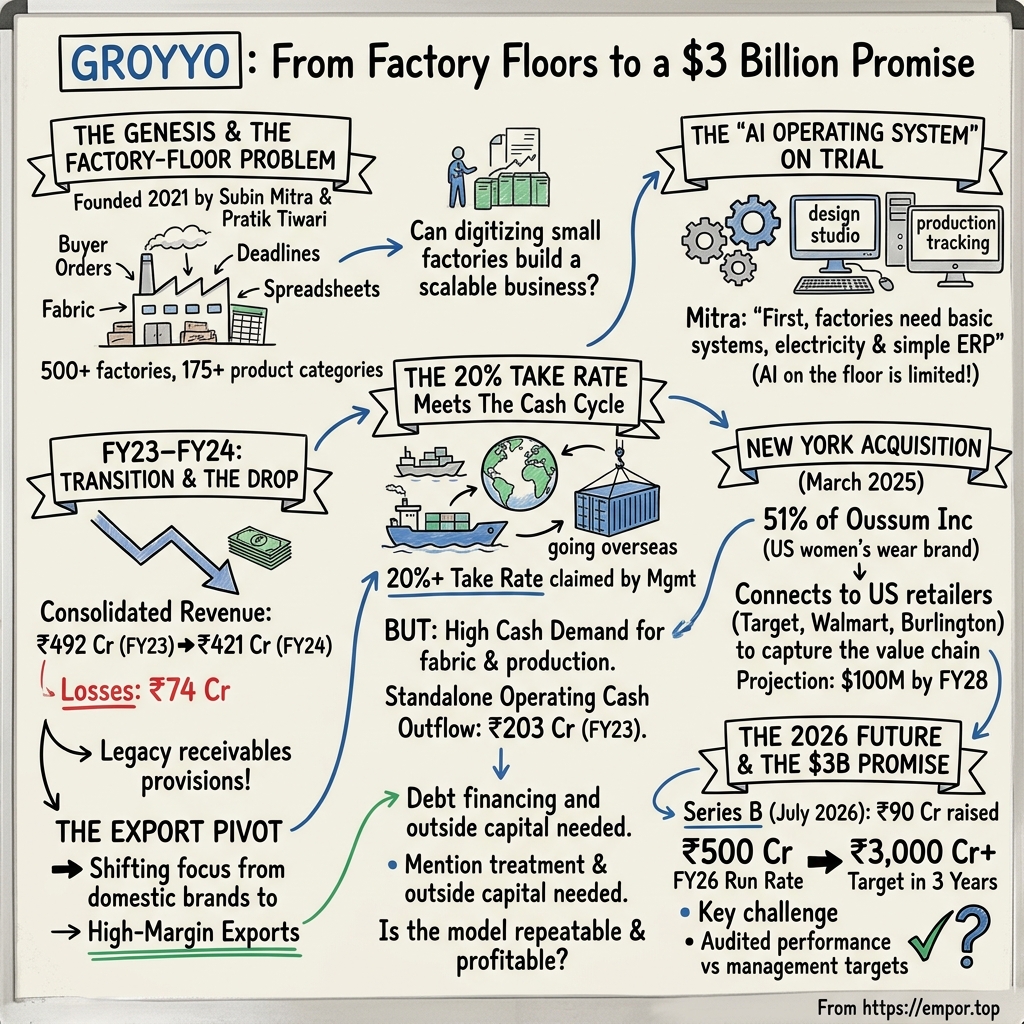
Groyyo: From Factory Floors to a $3 Billion Promise
I. The ₹500 Crore Run Rate
In the middle of July 2026, a Gurugram company that most investors had never heard of announced that it had raised ₹90 crore. The money came from Cornerstone Ventures, which led the round, and from the backers who had carried Groyyo through its first five years: Tiger Global, Alpha Wave, Sparrow Capital and Stride Ventures.1
The cheque was the first close of a Series B that the company hoped would reach ₹200 crore, and it came wrapped in a set of numbers designed to make the round look like the start of something much larger.1
Groyyo said that international expansion across the United States and the United Kingdom had taken it to a revenue run rate of ₹500 crore in the year to March 2026, that it was earning what it called "category-leading" profit margins, and that it was now aiming for more than ₹3,000 crore of revenue within three years.12
Three thousand crore rupees is roughly a third of a billion dollars. For a company that sells T-shirts, dresses and knitwear made in other people's factories, that would be a sixfold jump in three years, and the announcement presented the jump as the natural result of an artificial-intelligence platform that matches global fashion brands with a network of more than 470 small manufacturers.12 The money, the company said, would go to three places: a bigger factory network, a stronger AI-powered design and trend-forecasting platform, and a deeper presence in North America, Europe and the Middle East.13
That is the promise. The record behind it is shorter, louder and harder to reconcile. Groyyo was incorporated in July 2021.4 Within two years it had become one of the fastest-scaling business-to-business startups in Indian fashion, with consolidated gross revenue of about ₹492 crore in the year to March 2023, a nineteen-fold jump on the year before.5 Then the curve bent the other way. In the year to March 2024, consolidated gross revenue fell about 14% to ₹421 crore while the reported loss widened to ₹74 crore.5
Since then, the public has heard a series of management numbers that move faster than the filed accounts can follow: a target of a ₹450–500 crore run rate by the end of the year to March 2025, a claim of profitability before tax in the first quarter of the following year, a ₹900 crore revenue projection for that full year, a description of "₹600 crore ARR" on a podcast, and now the ₹500 crore run rate that accompanied the 2026 round.6781
The words in those claims matter, because they are not interchangeable. Annual revenue is what a company actually booked over twelve months, audited and filed. A run rate is a snapshot: take the best recent month or quarter, multiply it out to a year, and assume nothing changes.
Annual recurring revenue, the phrase borrowed from software companies, describes contracted subscriptions that renew automatically, which is a strange label for a business whose main revenue line has been the sale of finished garments.58 A company that announces a run rate is telling investors where it thinks it is heading. A company that files accounts is telling them where it has been. Groyyo has so far done much more of the first than the second in public.
The gap is not an accusation; it is the episode's central puzzle. Three questions sit inside it. The first is whether the company's pivot from supplying Indian fashion brands to exporting for international ones has produced profits that repeat, quarter after quarter, rather than a single good quarter announced at a convenient moment.
The second is whether Groyyo's technology gives it an edge that a well-connected sourcing agent with spreadsheets could not match, or whether the software is mostly the internal plumbing of a managed manufacturing business. The third is whether management's forecasts, which have shifted in definition and size with almost every announcement, can be reconciled to what Groyyo has actually filed with the Registrar of Companies.
Before any of that, an entity boundary has to be drawn, because the rest of the story depends on it. Groyyo Private Limited is an unlisted Indian private company.4 It has no share price, no market capitalisation and no exchange-traded valuation multiple. It has not filed a draft red herring prospectus or any other offer document with the Securities and Exchange Board of India or the stock exchanges, so there is no prospectus to anchor its financials, its customer list, its capital structure or its related-party dealings.
What exists instead is a patchwork: summaries of filed accounts published by company-data providers, a handful of press reports on its consolidated results, funding announcements, a Ministry of Commerce record of foreign investment inflows, insolvency and tribunal records in which Groyyo appears as a creditor, and long interviews in which the chief executive, Subin Mitra, talks with unusual candour about what his company can and cannot yet do.9510118
Even the filed numbers come in two flavours that refuse to line up. The operating company reported standalone revenue of about ₹446 crore in the year to March 2024, slightly higher than the consolidated figure for the same year.94 For the year to March 2025, standalone revenue fell to about ₹117 crore with a loss of about ₹47 crore.4
A group whose management was describing a ₹450–500 crore run rate during that same year cannot be measured by a ₹117 crore standalone figure, because a group's exports may be booked in subsidiaries rather than in the Indian parent; equally, nobody can assume the consolidated number was close to the target without the consolidated accounts. Groyyo has not published audited consolidated results for the years to March 2025 or March 2026, and until it does, the ₹500 crore run rate is a company statement, not an audited fact.
That makes Groyyo an unusual subject for a pre-listing underwriting. A public-market investor would normally start with a prospectus and work outwards. Here, the work runs the other way: from the management's own words, through the scraps of filed evidence, to an estimate of what would have to be true for the company to deserve the valuation its investors were discussing in 2025, when Inc42 reported, citing sources, that Groyyo was in talks to raise about $40 million at a valuation of around $200 million.12 That round, at that size and price, never materialised in public; what arrived eighteen months later was a smaller first close with no valuation attached.1
So the story begins with an ambition that is easy to state and a business that is hard to see. Groyyo wants to turn thousands of small, often chaotic apparel factories into one dependable supply chain for global brands, and to be paid well for doing it. Whether it can is a question about cash, customers and credibility, and it starts on a factory floor.
 Subscribe on LinkedIn
II. The Factory-Floor Problem
Picture a mid-sized garment unit on the edge of Delhi. Forty or fifty sewing machines sit in rows under tube lights. The owner has a buyer in London who wants three thousand women's tops in four colourways, delivered in eight weeks.
He has to find the right fabric, book it before the mill sells the run to someone else, pay for it before he is paid himself, cut and sew the order, fix the faults the buyer's inspector will find, and ship on time, all while tracking every step in a notebook, a WhatsApp group and an Excel sheet that only his nephew understands. If the order goes well, he will wait sixty or ninety days to be paid. If it goes badly, the buyer may cancel and he may never be paid at all.
On the other side of the world, a merchandiser at a European fast-fashion chain has the opposite problem. She needs small, fast runs from factories she can trust, with compliance audits she can show to her own board. Traditionally, the big buyers dealt with this by ordering huge quantities from large vendors.
Subin Mitra described the economics he set out to change in simple terms: brands had been used to minimum orders of around ten thousand pieces and lead times of about 180 days, and Groyyo's pitch was to bring minimums down to a few hundred pieces and turnaround to thirty to sixty days.8 By August 2025, the company was advertising minimum orders of 600 pieces and lead times cut in half.7
That is a real problem worth building a company around, and the founders knew it from the inside. Mitra studied economics at St. Xavier's in Mumbai, spent about two years in Bain's private-equity practice, moved to OYO, one of his Bain clients, and then spent about two years at Zilingo, where he set up the South Asian export business.8
His co-founder Pratik Tiwari came from the other end of the supply chain: a graduate of the National Institute of Fashion Technology in Kolkata, he worked with factories in Delhi, ran his own factory for a couple of years, and then spent eight years at Inditex, the owner of Zara, where he headed India sourcing, followed by spells at J.C. Penney and at Asmara in Vietnam.8 The two overlapped at Zilingo. A third co-founder, Ridam Upadhyay, was part of the founding team in July 2021.1
The Zilingo connection is not a footnote. It is the first piece of disconfirming evidence that any underwriter of Groyyo should hold up to the light, because it involves the same industry, the same geography and part of the same management team. Zilingo was a Singapore-based fashion platform that tried to digitise the supply chain for small sellers and manufacturers across Asia.
Mitra himself described it as having raised about $300 million in total while being "gross margin negative", buying at a hundred and selling at ninety.8 Its collapse became one of the cautionary tales of Asian startup investing.8 Mitra said that experience taught him to insist on positive unit margins from the first order; Groyyo's own record, as the rest of this story shows, suggests the lesson was learned in principle before it was fully learned in practice.
Groyyo started small. Mitra said that it began with about seven or eight factories in the National Capital Region and a single customer, with women's wear as its first category.8 From there it grew into a network that, by its own count, connected more than 500 small and mid-sized factories across India, Bangladesh and the Middle East by August 2025.7
In the July 2026 funding announcement the figure was "more than 470 manufacturers".1 The difference may reflect pruning, a change in definition or simple rounding, and Groyyo has not explained it. Either way, factory count is an input the company reports about itself. It is not proof that the factories are busy, that their output is improving, or that brands return to them.
The way the business works is easiest to understand by following an order. A brand sends a brief, or picks from designs that Groyyo's in-house team and its design software produce from trend data.8 The company says its merchandisers cost the garment, choose factories from the network, and source fabric and trims. It says production is tracked on the factory floor, and that its own staff run compliance audits, quality control and final inspection rather than leaving them to the factory.8
Groyyo says the goods ship to the brand and that it invoices for the finished product. The company says factories in the network are audited against standards modelled on those of large buyers such as Inditex.8 Alongside the order flow, the company offered consulting and training to factories, and says its work produced efficiency gains of 23–25% in apparel units in India and Bangladesh and delivered more than 300,000 training hours, with women making up about 37% of trainees.7
What emerges from this description is something more than a marketplace and less than a software company. Groyyo does not simply list factories and let brands pick; it takes responsibility for the order, carries the commercial relationship with the brand, and pays the factories. In that sense it resembles a modern buying house, the kind of intermediary that has connected Western retailers with Asian manufacturers for decades, run with better software and a startup's appetite for growth.
That does not make the technology irrelevant. In an industry where many factories still run on paper, the ability to see production status, fabric availability and quality data in one place can cut lead times, reduce errors and allow smaller runs to be economical. But the founders' original framing, which was to digitise small manufacturers while bringing them international orders, also contains the obstacle.
A factory that cannot reliably record its own output cannot instantly plug into a data-driven supply chain. Deployment has to happen machine by machine, line by line, owner by owner, and the speed of that adoption sets the speed at which any software advantage can compound.
That is the question the rest of this story tests.
The answer determines whether Groyyo should be valued like a technology platform with high margins and low capital needs, or like a sourcing intermediary whose margins are thin and whose growth eats cash. The early years of the company provide the first evidence, and it is not the evidence the platform narrative would prefer.
III. From Order Matching to Export Pivot
Groyyo's first full financial year, ending March 2022, produced standalone revenue of roughly ₹26 crore.9 Within weeks of that year closing, the company completed the round that defined its early identity. In June 2022, Tiger Global led a Series A that the company described as $40 million of equity and debt, with Alpha Wave, Sparrow Capital and Stride Ventures alongside; filings show the equity element at about ₹210 crore.45
Mitra later said the equity round was about $28 million, against an original plan to raise around $10 million.8 It was the peak of the startup funding boom, and Tiger Global was writing cheques across India's business-to-business sector at speed.
The money was put to work quickly. That rapid growth continued in the year to March 2023.5 In May 2023, VCCircle reported that the Tiger Global-backed company was nearing a $200 million revenue rate and had hit breakeven.13 It looked, from the outside, like the template of a hypergrowth platform.
The template rested on a particular revenue mix. Groyyo earned money through product sales, commissions, subscriptions and manufacturing and supply-chain services; by the year to March 2024, product sales were the dominant source.5 A large share of those sales went to Indian fashion brands, often fast-growing direct-to-consumer labels that wanted quick, small runs and paid on credit. That was where much of the early volume came from. It was also where the trouble started.
In the year to March 2024, the momentum reversed, and the reported loss widened.5 Costs tell the story of a business that had built for a bigger future than arrived: the cost of goods sold fell broadly in line with revenue, to about ₹409 crore, but employee costs jumped about 82% to roughly ₹49 crore, and total expenses of about ₹520 crore meant the company spent about ₹1.24 for every rupee it earned.5 The reported operating loss before depreciation was equal to about 13% of revenue.5
The May 2023 breakeven headline is the most direct disconfirming evidence on the record, because it involved the same business, the same management and the same financial year. Breakeven was reported a month into the year in which Groyyo went on to lose ₹74 crore. Management's explanation, given to Entrackr in March 2025, was specific: about ₹14 crore of the loss came from expenses related to employee stock options, which are non-cash, and the rest of the deterioration came largely from provisions against receivables from the legacy domestic business.5
A provision is an accounting admission that some money owed by customers will probably never arrive. Groyyo has not disclosed the size of those provisions, the age of the receivables or how much was later recovered, so the explanation narrows the question rather than closing it. Even adding back the full ₹14 crore stock-option charge, the year would still have produced a large operating loss. Something about the old model had stopped working, and the cost of finding out was paid in uncollected cash.
The solution management chose was a strategic turn. By early 2025, Groyyo said it had almost stopped supplying finished products to Indian brands and was focused on international ones; Inc42, citing sources, reported that about 90% of revenue came from international brands such as Zara, Mango and John Lewis.12 Mitra told Entrackr that the company had become 100% export-oriented and had moved to a "20%+ take rate business".5
In January 2025, the company said it had become profitable at the operating level before depreciation and was targeting an annual run rate of ₹450–500 crore by the end of the year to March 2025, with gross margins of about 20%.6 By August 2025, it said it exported all of its output to brands including Next, Mango, Inditex, Ross and the Bestseller Group, with the United Kingdom its largest market at roughly half to three-fifths of the business.7
The logic of the pivot is easy to follow. Large international chains tend to pay on predictable terms and are less likely to fold than young domestic labels. Exporting allows Groyyo to price in dollars, sterling or euros, to tap the trade advantages that come from India's free-trade agreement with the UK, which management links directly to its British business,7 and to sell compliance and speed as well as cheap production. A buyer who values a short lead time and an audited factory will pay more than one who only wants the lowest price per piece, so the share of each order Groyyo keeps for itself can rise.
But the numbers available on the other side of the pivot do not yet show the repair. Here the different revenue series need careful handling, because laying them on one chart would produce a fiction. The consolidated figures are the group's gross revenue as reported from its filings.5
The standalone figures for the Indian operating company are a different measure: around ₹474 crore for the year to March 2023.9 By the year to March 2025, the standalone company had reported a loss.4 Inc42's sources put operating revenue for the year to March 2024 at about ₹425 crore and said the following year was on course for about ₹480 crore.12 None of these numbers is wrong on its own terms; they simply measure different things.
The standalone collapse in the year to March 2025 is the most striking, and it is also the easiest to misread. If the export business is increasingly run through overseas entities, such as Groyyo's production team in Dhaka8 or the US business it bought in 2025, revenue could shift out of the Indian company without shrinking at the group level.
Groyyo does not publish a segment or entity split that would show whether that is what happened. What can be said is narrower and still important: the Indian operating company, the entity whose accounts are on file, lost money in the year that management had described as the year of the turnaround, and the consolidated figures that would show whether the group did better have not been made public.
There is one more way to read the pivot, and it is less flattering. Abandoning domestic brands removed the riskiest customers, but it also removed a large share of volume. A company that replaces many small domestic accounts with a handful of large international ones changes the shape of its risk rather than eliminating it: instead of many customers who might not pay, it has a few customers who might leave. That trade can be a good one, but only if the international customers order repeatedly, pay on time and do not use their bargaining power to squeeze the margin the pivot was meant to create.
The question the pivot leaves behind is therefore operational, not strategic. Changing the customer list changed the reported take rate, the share of each order's value that Groyyo keeps. Did it also change how long it takes Groyyo to turn an order into cash? That is where the economics of a sourcing business are won or lost, and it is where the next part of the story has to go.
IV. The 20% Take Rate Meets the Cash Cycle
When Subin Mitra describes Groyyo's economics today, he starts with a number that sounds like a software company's: a take rate of 20% or more.58 On a podcast in November 2025, the summary he and his interviewer settled on was a 20% take rate, a 6% margin before interest, tax, depreciation and amortisation, and a 5% net profit margin; at the level of an individual order, Mitra put the take rate higher still, at close to 28–30%.8
He also described an internal rule that Groyyo does not accept orders below a 20% margin without a strong strategic reason.8 The episode's own description framed the arc in one sentence: from "spending ₹1.24 to earn ₹1" to "20%+ take rates".8
Those are encouraging numbers. They are also, without exception, management statements. None of them comes from audited accounts, and they answer different questions. The take rate tells you how much of each order's value Groyyo keeps after paying the factory and buying the fabric; in a business that books the full value of the garment as revenue, it is essentially a gross margin.
The operating margin tells you what is left after paying merchandisers, designers, quality inspectors, engineers, offices and travel. The net margin tells you what is left after interest, depreciation and tax. And none of the three tells you how long the cash is out of the company's hands, which in a garment business is often the number that decides whether a profitable company survives.
To see why, follow the money through a single export order. A British brand places an order for a few thousand pieces. Groyyo or its factory partner has to commit to fabric within days, because mills sell runs to whoever pays first. Factories need advances to buy trims and pay workers. Production takes several weeks; shipping by sea takes several more. The brand receives the goods, inspects them, and then pays on its own terms, which for large retailers can stretch to sixty or ninety days after delivery.
At every stage before that final payment, someone is financing the order. If it is the factory, Groyyo's supplier relationships come under strain. If it is the brand, through advances or letters of credit, Groyyo's position is comfortable. If it is Groyyo, every rupee of growth requires a rupee of working capital, and fast growth requires a great deal of capital very quickly.
The early record shows which of those it was. In the year to March 2022, Groyyo's standalone accounts recorded an operating cash outflow of about ₹24 crore, covered by about ₹35 crore of financing inflows.9 In the year to March 2023, the year revenue rose nineteen-fold, the operating cash outflow jumped to about ₹203 crore, and financing inflows of about ₹309 crore paid for it.9
In plain terms, almost all of the money raised in the Series A, plus debt on top, went into funding orders that had not yet turned into cash. That is not unusual for a trading business in a growth spurt. It is, however, the opposite of what a software platform looks like. A marketplace that takes a commission on someone else's transaction can grow without its own balance sheet; a sourcing business that owns the order cannot.
The following year showed what can happen to that capital when customers do not pay. The provisions against legacy domestic receivables that management cited as a main cause of the loss in the year to March 2024 were, in effect, a write-down of working capital sunk into growth.5
One visible example of the credit risk lies in an insolvency file. When Manan Apparels, an apparel company, entered corporate insolvency, Groyyo lodged a claim as an operational creditor of about ₹1.42 crore, of which about ₹0.80 crore was admitted.11
In a separate case, Groyyo itself brought an insolvency petition against Shyam Indofab, and the tribunal's order in May 2024 was procedural, adjourning the matter.14 These are single cases, small relative to the company's revenue, and they do not establish a company-wide default rate. They do show what the downside of extending credit to small domestic counterparties looks like when it arrives: a creditor's claim, a partial admission and a long wait.
The pressure did not run in only one direction. Groyyo reported 84 payments to 20 micro and small suppliers that were overdue under the rules requiring companies to disclose delayed payments to such enterprises in the year to March 2024.4
Those returns describe a past period and do not by themselves show that arrears exist today. They do show that, during the year the domestic model was unwinding, the squeeze on cash reached the small suppliers at the other end of the chain, which matters for a company whose pitch to factories is that it is a reliable source of orders and payment.
The pivot to exports was supposed to fix this cycle. International chains are more creditworthy than young domestic labels, and some pay against letters of credit that banks will finance. A higher take rate also means that each order generates more gross profit to cover the time the cash is tied up.
Management's claim that the business had become cash-flow positive, and Mitra's remark in November 2025 that more than half of what Groyyo had raised was still on its balance sheet, both point that way.8 The consolidated accounts for the year to March 2024 showed about ₹99 crore of cash and bank balances within ₹256 crore of current assets, which implies that a large part of what remained was receivables and inventory.5
What cannot be established from the public record is whether the improvement has actually occurred in cash. Groyyo has not published consolidated cash-flow statements for the years after the pivot, receivables ageing, bad-debt charges, or a split between collections from legacy domestic accounts and from export customers.
The only standalone cash-flow data in the public domain are from the pre-pivot years. A 20% take rate is attractive. A 20% take rate on an order paid ninety days after the fabric was bought, financed with debt at double-digit interest, is a good deal less attractive, and a 20% take rate on an order that is never paid is a loss.
This is where the claims and the evidence part company most clearly. The claimed edge is a better margin structure. The evidence that would prove it is a shorter cash cycle: receivables collected in fewer days, provisions falling, operating cash flow positive across a full year, and growth funded by profits rather than by new equity and debt. Until Groyyo shows those numbers, the take rate remains a statement about pricing, not about the quality of the business. The same is true, as it turns out, of the technology that Groyyo says makes the pricing possible.
V. The AI Operating System, Still on Trial
Every funding announcement Groyyo has made since 2025 has described it as an AI-powered fashion supply-chain platform.21 The July 2026 round was explicitly framed as money to strengthen the company's AI-powered design and trend-forecasting capabilities.13 Mitra's quote in the announcement spoke of scaling what already works, naming "our factory network, our AI infrastructure" side by side.1
Eight months earlier, in a long podcast conversation, the same chief executive gave a much more sober answer when asked how much AI matters on the factory floor. His answer was "not a lot", at least for now.8 The foundation, he said, is basic things: electricity, energy, a simple ERP system that does nothing more than data entry, and that foundation needs to be built over the next ten years.8
He mentioned camera-based systems that could count stitches or pieces on a sewing line as possible, but not obviously worth the spending yet.8 On the same programme, he was candid about where Groyyo stood with its most demanding potential customer, saying the company was "not fully ready for Zara yet", because of quality and process.8
That candour is valuable, and it should change how the AI claim is read. It does not mean Groyyo has no technology. The company has an in-house design team and a design tool that helps it propose collections to brands, rather than waiting for a brand to send a finished technical pack.8 It runs production tracking and quality processes across hundreds of partner factories, which requires software to keep orders, materials and inspections in one place.
Those capabilities can shorten the cycle from idea to shipment, which is exactly what Groyyo sells. But the capability is mostly used by Groyyo's own staff to run Groyyo's own operation. That is valuable in the way a well-run logistics system is valuable to a freight forwarder: it lowers cost and improves service. It is not, on present evidence, a separate product that customers pay for.
Groyyo does not disclose software or subscription revenue as a separate line, and the revenue mix reported for the year to March 2024 showed product sales as the main source, with commissions, subscriptions and services trailing behind.5 No public figure shows how many factories pay for Groyyo's tools independently of orders, how many brands use the design software without buying the garments, or what either group pays. The phrase "AI platform" therefore describes how the company works rather than what it sells.
There is a useful way to test whether the technology creates an advantage, and it does not require the company to break out software revenue. A buyer who wanted to check would look for evidence of outcomes: whether brands come back and order again, how much faster Groyyo delivers than alternatives, how many pieces fail inspection, how full the partner factories' lines are, and whether Groyyo can charge more than a conventional buying house for the same garment.
The company has offered a few such claims, notably the halved lead times, the efficiency gains of about a quarter in factories it consulted for, and the reduction in minimum order sizes.7 It has not published retention rates, repeat-order rates, defect rates or factory utilisation.
Mitra has said that after four and a half years Groyyo had forty or fifty great clients and would rather add four or five customers a year than chase many.8 That is a sensible strategy for a managed service. It is also an admission that the customer base is small enough for each account to matter a great deal.
The competitive structure explains why that matters. The factories on one side of Groyyo's network are fragmented, small and hungry for steady orders, so they have little bargaining power individually, which is good for Groyyo. The brands on the other side are large, sophisticated and can spread their buying across many intermediaries, which is bad for Groyyo. Substitutes are everywhere: brands can buy directly from large Indian and Bangladeshi exporters, use established sourcing houses with decades of relationships, or move to rival platforms.
New entrants face some barriers, chiefly the time it takes to audit factories and win trust from compliance departments, but those barriers have not prevented several venture-backed rivals from entering the same market. In that structure, software alone rarely produces pricing power. What produces it is a record of reliability that a brand is unwilling to risk losing.
Hamilton Helmer's framework for durable advantage points to the same conclusion. Groyyo could, in principle, develop a network effect if more factories made it more useful for brands and more brands made it more attractive for factories; scale economies in compliance and quality control; or switching costs if brands integrated their planning with its systems.
The evidence for each is thin. A network effect requires that the network's value grows with its size, but the number of factories went from "more than 500" to "more than 470" in under a year with no apparent harm to the narrative.71 Switching costs require integration that the company has not described. Scale economies are plausible but unproven at Groyyo's present size.
The honest framing is therefore narrower than the funding rhetoric. The technology may well improve design, tracking and coordination, and it may become a moat if it produces measurable savings for customers and repeated use. Today, on the company's own description, its value is operational and service-led. The AI label raises money; the factory floor still runs on electricity, ERP and people. To find a strategic move that could genuinely change Groyyo's economics, it is necessary to look not at its software but at an acquisition it made in New York.
VI. A New York Acquisition and a New Kind of Bet
In March 2025, Groyyo announced that it had bought a 51% stake in Oussum Inc, a New York-based women's wear company.15 Oussum sold private-label clothing under its own name and under the Gypsie Blu label, and its products were already stocked, according to the announcement, in Target, Walmart, Burlington and TJ Maxx stores in the United States.15 Oussum's chief executive, Amit Bansal, said his company had been working closely with Groyyo for three years.15 The price was not disclosed.15
The headline numbers attached to the deal were large. Groyyo said its combined US operations had closed the year to March 2025 at about $8 million in revenue and projected they would reach $100 million by the year to March 2028.15 Mitra framed the acquisition as the natural extension of a backward-integrated small-manufacturer supply chain built over four years, arguing that the dominance of fast fashion in the US made the timing better than ever.15 The ambition was clear: instead of only making clothes for American retailers' suppliers, Groyyo would own a supplier, design and sell its own labels into those retailers, and handle warehousing in the US itself.
The strategic logic is coherent. A sourcing company that owns a brand with retail shelf space captures two margins rather than one, the manufacturing margin and the brand's wholesale margin. It also gets a guaranteed customer for its own factory network, which can smooth capacity planning.
And it gets closer to the American consumer at a time when retailers are rearranging supply chains away from China. Mitra had said that the US accounted for roughly a tenth of Groyyo's top line in late 2025, a sign that the American business was material but still secondary to Britain.87
It is also a different business. Selling garments to TJ Maxx or Burlington means selling to off-price chains that buy in large lots, negotiate hard on price and can return unsold goods or demand markdown support. Selling private labels at Target or Walmart means competing for shelf space against hundreds of other vendors, carrying inventory risk, financing receivables from very large customers on their terms, and maintaining a US warehouse. Every one of those features consumes working capital, and a company still proving that its own cash cycle is under control was taking on a second cash cycle with different risks.
What cannot be done responsibly is to value the deal. The purchase price is not disclosed, and neither are Oussum's standalone revenue, margins, inventory or debt. The $8 million figure covered the "combined US operations", not Oussum alone, so it cannot be used as the target's revenue.15 Without a price and a profit figure, no acquisition multiple can be calculated and no comparison with US apparel-brand transactions can be made.
Nor is it known whether Groyyo paid in cash, shares, deferred consideration or some combination, or whether the remaining 49% carries put or call options that could require Groyyo to buy it later. Those are exactly the details a prospectus would have to disclose, and they will matter for any future public shareholder because a forced purchase of the minority could absorb capital.
The $100 million projection deserves particular scepticism, for a reason that has nothing to do with Oussum itself. A twelve-fold increase in three years would require either a dramatic expansion of shelf space with existing retailers or new retail accounts, and it would require Groyyo to finance the inventory and receivables that come with them. The projection has not been updated publicly since the deal was announced.
In the July 2026 funding announcement, Oussum appeared as context, described as a majority stake bought the previous year to strengthen Groyyo's B2B fashion-retail presence in the US, with no update on its revenue.1 The use of proceeds named North America as one of three regions for expansion, but did not allocate a specific amount to the US business.1
Seen from the angle of historical evidence, the acquisition fits a pattern that has emerged across Groyyo's short life: a strategic move announced with a large forward target and little subsequent disclosure. That is not proof of failure. It does mean the US bet should be held at its proper weight.
It is a real option on future growth, potentially material if it works, and it gives Groyyo something few of its Indian rivals have, a direct line into American retail shelves. But nothing public shows that it is yet material to the group's profit, and a disclosed $8 million revenue pace against a group run rate of about ₹500 crore suggests it is still small.
The questions for a future prospectus are therefore precise. What did Groyyo pay? What has Oussum earned since the deal? How much inventory and receivable exposure does the US business carry? Are there obligations to buy the remaining stake? Until those questions are answered, the acquisition is a story about strategy, not a source of value that can be measured. And measurement, as the record of management's own forecasts shows, has been the hardest part of Groyyo's story to pin down.
VII. Can the Pivot Deliver What Management Promised?
Lay Groyyo's public milestones end to end, and they read like a series of goalposts placed at slightly different distances on slightly different pitches. In May 2023, the company was reported to have neared a $200 million revenue rate and hit breakeven.13
The filed results for that year showed a loss, despite the breakeven report.5 In January 2025, Groyyo made another operating-profit claim and set its next revenue target.6
In March 2025, management told Entrackr it expected to be profitable at the operating level in that year.5 In August 2025, the company announced profit before tax of ₹4 crore in the first quarter of the year to March 2026, said it had turned profitable after tax, and projected ₹900 crore of revenue and ₹25 crore of profit before tax for the full year.7
In November 2025, Mitra's podcast was promoted with a description of growth "from ₹25 crore to ₹600 crore ARR".8 In July 2026, after the year closed, the company announced a ₹500 crore run rate for that year and a three-year target of more than ₹3,000 crore.12
Put those statements together, and the most striking feature is the ₹900 crore projection. It was made in August 2025, five months into the year it described. The figure that emerged after the year ended, a run rate of ₹500 crore, is not the same measure, and it is possible that annual revenue exceeded or fell short of it. But a run rate is normally the most flattering way to present a year's revenue, because it extrapolates the best recent period.
If the best period, extrapolated, was ₹500 crore, it is hard to see how audited annual revenue could have been anywhere near ₹900 crore. Between November 2025 and July 2026, the headline scale figure also moved down, from "₹600 crore ARR" to a "₹500 crore run rate".81 Neither movement is acknowledged in Groyyo's public statements.
None of this is proof of a miss. The figures use different periods and definitions, some come from press summaries rather than from the company's own words, and none is audited. A consolidated annual figure could reconcile them in ways the public cannot see, for example if the ₹900 crore included gross merchandise value that is now recognised only as a net fee, or if the Oussum business was included in one figure and not another. But the burden lies with the company to provide that bridge. An investor who encounters a sequence of forward statements that cannot be reconciled with each other, let alone with filed results, is right to discount the next one.
The filed results that do exist make the discount harder to avoid. The Indian operating company's standalone accounts for the year to March 2025, the year of the run-rate target and expected turn to operating profit, show a loss.4
That figure may well understate the group, if export sales are booked in overseas subsidiaries. But the subsidiaries' accounts are not public, and the consolidated accounts for that year have not been reported. On the evidence available, the claim of profitability in the year to March 2025 is unconfirmed.
Management's explanation for the earlier loss deserves to be weighed in the same way. The two causes it named, stock-option costs of about ₹14 crore and provisions on legacy domestic receivables, are specific and plausible, and stock-option charges are non-cash.5 But a specific explanation is not evidence that the underlying problem is resolved.
Stock options are a real cost to shareholders, because they dilute them; ignoring them in an assessment of profitability flatters the company. And receivable provisions are a symptom of a credit process that failed. Groyyo has said it has exited that business, which removes one source of risk, but has not disclosed how its export receivables are performing.
The management team itself has changed. Ridam Upadhyay, one of the three founders, ceased to be a director in March 2025, and the July 2026 announcement noted that he had left the company the previous year.41 In December 2024, Nitin Jain, who had been managing director of exports, was elevated to co-founder.12
Elevating the head of exports at the moment the company became an exporter is a logical move, and departures of co-founders are common in young companies. But neither change was accompanied by an explanation, and both happened during the period in which the company was reshaping its strategy and preparing to raise money.
Alignment between management and future shareholders is impossible to judge from the outside. The founders' current percentage ownership, their pay, the size of the employee stock-option pool and the terms of any performance-linked awards are not disclosed. Entrackr, citing TheKredible, reported that Alpha Wave was the largest external shareholder, followed by Tiger Global, which suggests that the founders' stakes have been diluted below control.5 That is normal for a company that has raised about $50 million.1 It also means that the people making the forecasts may own a modest share of the downside if those forecasts prove wrong.
The verdict on management's record, then, is not that it has been dishonest, but that it has been loose with definitions and generous with forward numbers, and that the filed evidence trails the announcements by a wide margin. The candour Mitra showed about AI and about Zara is a counterweight; a chief executive who admits his company is not ready for its most demanding buyer is not simply selling.
The next proof point is clear, and it is the same one investors would demand of any company preparing to sell shares to the public: audited consolidated revenue, margin and cash flow on the same basis as the targets. Until that arrives, the most useful evidence about Groyyo's position lies not in what it says about itself, but in what its customers, suppliers and competitors reveal about who holds the power in this market.
VIII. The Suppliers, the Brands and the Bargaining Power
In August 2025, when Groyyo announced its first profitable quarter, it listed its export customers.7 It also said it connected hundreds of small and mid-sized factories across India, Bangladesh and the Middle East.7 The two lists describe a classic intermediary position, with a handful of very large buyers on one side and hundreds of small producers on the other. Who holds the power in that arrangement determines whether Groyyo's 20% take rate can last.
Start with the buyers. Seven months earlier, Inc42 had reported, citing sources, that nearly 90% of Groyyo's revenue came from international brands, naming Zara, Mango and John Lewis.12 Groyyo declined to comment on that report.12 By the time of the 2026 round, the company said it served more than 45 international brands across ten countries.1
Mitra's own description, forty or fifty great clients after four and a half years and a plan to add only four or five a year, implies a customer base where the largest accounts carry a large share of revenue.8 The United Kingdom alone was roughly half to three-fifths of the business in 2025.7
Groyyo does not disclose what share of revenue comes from its largest customer, its five largest or its ten largest. It does not publish how many customers placed repeat orders, how much each cohort of customers spends in its second and third years, or how many customers it has lost. Without those figures, there is no way to show that Groyyo has the kind of locked-in relationships that let an intermediary keep its margin when the buyer pushes back.
And fashion buyers do push back. A large chain can split an order among three vendors, move a category to Bangladesh or Vietnam, or ask for a lower price in exchange for more volume. Groyyo's own response to American tariffs, expanding into Sri Lanka and strengthening its presence in Vietnam and Cambodia, shows how quickly geography can be rearranged when trade conditions change.7
The supplier side is more favourable. Small Indian factories struggle to win international orders on their own because they lack compliance credentials, design capability and the working capital to finance large runs. Groyyo offers all three, along with training and process improvement.7 That gives it some leverage: a factory that depends on Groyyo for a large share of its orders is unlikely to bargain hard. But the relationship can also cut the other way.
Factories that Groyyo has helped to upgrade become more attractive to other buyers, including the brands Groyyo serves, which could choose to deal with them directly once they are certified. And the evidence of overdue payments to small suppliers in the year to March 2024 shows that when Groyyo's own cash was tight, the factories absorbed some of the pressure.4 A network that holds together only while orders and payments flow is a supply chain, not a moat.
The competitive landscape shows how crowded this middle ground has become, and what has happened to some of its occupants. The cleanest way to map it is by function rather than by market share, because no credible market-share data exists for these private companies. Fashinza, the closest early analogue, raised $100 million in a Series B led by Prosus Ventures and WestBridge Capital in May 2022, only a month before Groyyo's Series A, to build a business-to-business fashion supply-chain marketplace.16
By March 2024, it had begun returning most of the money it had raised to investors, with its chief executive saying the marketplace model had not worked and that the company was pivoting to manufacturing.16 Its revenue was about ₹185 crore in the year to March 2024, rose to about ₹200 crore the following year, and fell to about ₹140 crore in the year to March 2026, which management attributed to a market slowdown and US tariffs; losses narrowed to under ₹10 crore.17 A co-founder stepped away in December 2025.17
Geniemode, also backed by Tiger Global, is the closest direct competitor in scale. In the year to March 2025, it reported operating revenue of about ₹673 crore, up about a fifth, and a net loss of about ₹51 crore, down about a third, having raised about $87 million in total, including a $50 million Series C led by Multiples and others.18
Zyod, a younger rival, raised an $18 million Series A led by RTP Global in 2024 to build a digital-first apparel manufacturing and procurement business.19 Groyyo itself names Fashinza, Geniemode and Zyod as competitors, along with the broader B2B platform OfBusiness.1
Beyond the startups sit the incumbents. PDS Limited, a listed Indian sourcing and manufacturing group that serves global retailers through an established network of suppliers, reported revenue of about ₹13,110 crore in the year to March 2026.20 Its sourcing business earned an operating profit margin of about 2% on revenue of about ₹12,400 crore; its smaller manufacturing business earned about 5.5%; and the group's net profit margin was about 1.4%.20
PDS is not a perfect comparable: it is far larger, older and more diversified. But it shows what a mature, scaled sourcing business earns when buyers have decades of alternatives, and its margins are a fraction of the 5% net margin Groyyo's chief executive has described.8
Set against those comparisons, Groyyo's position is neither exceptional nor hopeless. It appears to have grown faster than Fashinza and to be roughly comparable in scale to Geniemode, with a similar mix of claimed advantages and similar funding history. Its claimed margins are better than those of the scaled incumbent, which is either evidence of a real edge or a sign that the claims are measured differently. And the fate of the best-funded early competitor shows that venture capital and a platform narrative are not enough to make an intermediary business work.
That leaves three operating measures that would most directly settle who has the power. The first is repeat-order retention: what share of each year's customers order again the following year, and whether they order more. The second is receivables days and the overdue share, which show whether customers pay on time and whether Groyyo has had to extend credit to win business.
The third is cash conversion after the export pivot: how much of each rupee of profit turns into cash within the year. None of the three is public. All three would be required in any offer document, and all three depend on the capital that has paid for Groyyo's growth so far.
IX. The Capital Behind the Growth
Groyyo's early financing came in two waves, and each tells a slightly different story about what investors thought they were buying. The first was the June 2022 Series A, led by Tiger Global.45
Foreign-investment records filed with the government name Alpha Wave Incubation and Internet Fund VII among the foreign investors whose equity flowed into the company.10 The second wave was debt: company records show financing of about ₹8 crore in October 2023 and about ₹45 crore in January 2024.4
Then came a long gap. In January 2025, Inc42 reported that Groyyo was in talks to raise about $40 million, mostly equity, from Tiger Global and others at a valuation of about $200 million, roughly ₹1,700 crore, about a quarter above the $160 million valuation of its previous round.12 That round did not close in that form.
What arrived in July 2026, eighteen months later, was a first close led by a new investor, Cornerstone Ventures, through its Enterprise Tech Fund II, with existing backers participating.13 No valuation was announced. The round was smaller than the one reportedly under discussion, slower to arrive and incomplete, and the earlier lead investor did not lead it.
None of that proves a down round. The valuation is unknown, and the delay could reflect the founders' preference to wait for better numbers, as Mitra suggested in November 2025 when he said a new raise was "not immediately" needed.8
But it is the kind of evidence that tests the claim that capital is readily available on attractive terms, and it narrows that claim: investors were willing to back Groyyo again, but in smaller amounts, over a longer period and, as far as the public can see, without endorsing the headline valuation that had been discussed.
What investors received in return is also not public. Indian venture rounds typically use preference shares that convert into ordinary shares and often carry liquidation preferences, which pay investors back first in a sale, and anti-dilution protections, which adjust their conversion price if a later round is priced lower. Groyyo has not disclosed the terms of its preference shares, any ratchets or side letters, the size of its employee stock-option pool, or a fully diluted share count.
Company-data providers show that the company has filed shareholding records, but not the percentages.4 That gap matters greatly for a future public investor. A $200 million headline valuation for a company whose investors hold protected preference shares is not the same as a $200 million value for ordinary shares sold on an exchange, because the preference shareholders' downside protections are worth something, and that value comes from the common shareholders.
The balance sheet is equally hard to read. The consolidated accounts for the year to March 2024 also reported cash and bank balances.5 Company records show open registered charges of about ₹87 crore and satisfied charges of about ₹28 crore, including registrations in favour of Axis Bank for ₹12 crore and HSBC for ₹7.5 crore, and a further ₹5 crore registered in November 2025.4 A charge is a lender's security over assets; it shows that a credit line exists, not how much has been drawn.
Groyyo does not publish its drawn borrowings, interest rates, maturity schedule or covenant terms. No credit-rating agency has published a rationale on the company. So the enterprise value of the business, which would add debt to the equity value and subtract cash, cannot be reliably calculated. The cash balance itself may include deposits pledged as security for those lines, which would make it unavailable for operations.
Then there is the question of where the new money is going. The July 2026 announcement named three uses: expanding the factory network, strengthening AI design and forecasting, and deepening presence in North America, Europe and the Middle East.1 It allocated no amounts to any of them.
In a business whose working capital needs have historically dwarfed its technology spending, the most likely destination for a large share of the money is the financing of orders, which is not wrong, but which means the round should be understood as fuel for a trading cycle as much as an investment in technology. Neither the round nor any earlier announcement has said how much of the Oussum acquisition was paid for in cash, or whether it has returned anything yet.
The scale of the capital required to meet the three-year target is the most revealing test. Groyyo's target implies adding about ₹2,500 crore of annual revenue. If each additional ₹100 of annual sales ties up even ₹15 to ₹20 of working capital in fabric, work in progress and unpaid invoices, a modest assumption for apparel exporting, the growth would absorb roughly ₹375 crore to ₹500 crore of cash before any profit arrives.
That is roughly twice the entire Series B, if the full ₹200 crore closes. Profits at the margins management claims would cover some of it, and trade finance could cover more. But the arithmetic makes one thing plain: the three-year plan depends either on much faster cash conversion than the company has shown in public, or on more capital, debt or equity, than it has yet raised.
X. Analysis & Bear vs. Bull Case
Three versions of Groyyo are on offer at once. The first is the AI-powered platform of the funding announcements, a technology company whose software turns fragmented capacity into dependable supply. The second is the export sourcing operation that its chief executive describes in interviews, a managed service with a healthy take rate and a careful approach to adding customers.
The third is the would-be owner of American retail brands, betting that factories in its network can supply its labels on Target's shelves. Each version implies a different valuation. Only one of them, the sourcing operation, is supported by most of the evidence.
The bull case begins with a real trend. Global brands want to diversify away from China, shorten lead times and order in smaller lots, and India has the capacity, the labour and, with Britain, a trade agreement that favours its exports.7 A managed network that can coordinate design, factories, compliance and delivery for those brands fills a genuine need.
If Groyyo's 20% take rate is real and sustainable, and if export customers pay reliably, the business could produce operating margins well above those of traditional sourcing houses. In that case, the factory network and the workflow software would compound: each new factory would add capacity, each new brand would add volume, and the data from both would make the next order cheaper and faster to deliver.
The bear case starts from the only full year of consolidated results in public view. In the year to March 2024, the business shrank by about 14%, lost about ₹74 crore and wrote down receivables from the customers it had grown with.5 Before that, it burned roughly ₹200 crore of operating cash in a single year to grow nineteen-fold.95 Those are not the marks of a platform; they are the marks of a working-capital-intensive intermediary that grew faster than its credit controls.
The pivot to exports changed the customer list, but public evidence has not shown whether it changed the cash cycle. The customer base is concentrated in a few large brands and one country, and the software has no separately disclosed revenue. Management's forecasts also remain unreconciled with filed results.
The technology thesis still rests on a possible improvement in how capacity is matched to demand. But a factory count and an AI feature list are inputs, not evidence of retention, pricing power or software margins. Fashinza's experience also shows the limits of a pure marketplace model.16
The customer-power concern remains: without repeat-order data, Groyyo's dependence on a few large brands leaves it vulnerable to price pressure. A buyer who can move an order to Geniemode, to a Bangladeshi vendor or to a large incumbent like PDS without losing much is a buyer who will eventually press on the take rate.
A sceptical public-market investor would therefore want a valuation built from the business that is visible, not the one that is promised. Here, the price evidence is thin. The only reported valuation, about $200 million or ₹1,700 crore, was a figure under discussion in January 2025 for a round that did not close in that form.12
Measured against the ₹480 crore of revenue that Inc42's sources expected for the year to March 2025, it implied about three and a half times revenue.12 Measured against a 5% net margin on a ₹500 crore run rate, which would be about ₹25 crore of profit, it implied a multiple of nearly seventy times earnings. For context, PDS earned a net margin of about 1.4% in the year to March 2026.20
A simple scenario framework, offered as a range rather than a target, shows what the reported valuation required. Take three paths to roughly the end of the decade. In a weaker path, Groyyo grows to around ₹800 crore of revenue at a net margin of about 2%, closer to PDS than to its own claims; that produces about ₹16 crore of profit and, at fifteen times earnings, an equity value of around ₹240 crore.
In a middle path, revenue reaches about ₹1,500 crore at a 4% net margin, producing about ₹60 crore of profit; at twenty times earnings that is worth about ₹1,200 crore in the future, or roughly ₹650 crore to ₹700 crore today after discounting at the 20% annual rate that venture-stage risk demands.
In a strong path, revenue reaches management's ₹3,000 crore at a 5–6% margin, producing ₹150 crore to ₹180 crore of profit; at twenty times, that is ₹3,000 crore to ₹3,600 crore in the future, or roughly ₹1,700 crore to ₹2,100 crore today. Every path is before dilution from the remaining Series B, the stock-option pool and any further capital needed to finance working capital, which the strong path would require in large amounts.
The reveal is that the $200 million figure discussed in 2025 is roughly what the strong path is worth today. It was, in effect, a bet that management's plan would be met in full, at margins three to four times those of the scaled incumbent, without significant further dilution.
The middle path, which still assumes Groyyo triples its revenue and earns margins well above PDS, is worth about half as much. The most sensitive inputs are the net margin and the cash needed to grow; a one-point change in margin moves the strong path by about a fifth, and a large equity raise to finance working capital could cut the per-share value even if the business performs.
A future market might price Groyyo above those ranges, and the reasons would be worth naming. Indian public markets have paid high multiples for new-economy listings, scarcity value can attach to the first listed company in a category, a small free float can amplify demand, and an AI narrative can attract buyers who pay little attention to cash cycles. Those forces can move a price. They do not change what the business earns.
The verdict therefore rests on three measures: audited consolidated results, cash conversion and repeat-order retention. Strong results on all three would support the bull case. A miss on any one would leave the bear case better supported.
XI. Playbook: Business & Investing Lessons
The first lesson comes from Mitra's public admission that AI still mattered little on factory floors.8 It was a rare piece of honesty, and it captured the central truth of building technology for physical industries.
Software does not create value until someone uses it, and in a garment unit with paper records and power cuts, adoption is a project measured in years, not in sprint cycles. In a physical business, the spreadsheet is a product only after the factory can use it. For founders, that means the real product is often the change in how a factory works, with the software as the instrument; for investors, it means that a technology label on a services business should be priced as a service until customers pay for the technology itself.
The second lesson comes from the reversal already on record: reported breakeven gave way to a ₹74 crore loss and provisions against receivables.135 Groyyo's response was to move upmarket to export customers and a 20%-plus take rate. That was the right instinct, because a higher margin gives a business more room to absorb the time its cash is tied up.
But a margin is earned when the invoice is raised; cash arrives when the customer pays. A higher take rate is not a cash cycle; prove it in collections. The wider point for anyone underwriting a business that sells physical goods on credit is that the growth rate and the gross margin tell you less than the number of days between paying for the fabric and receiving the cheque.
The third lesson is about networks. The network Groyyo has described sounds like a network effect.71 But a network becomes an advantage only when its members keep using it and when its value grows with its size.
A network is an advantage when both sides come back, not when both sides are merely counted. Fashinza's fate is a reminder that a network alone is no guarantee.16 For founders building two-sided businesses, the metric to publish is the repeat rate, not the head count. For investors, the absence of a published repeat rate is itself information.
The fourth lesson is about forecasts. The company's forecasts and scale figures have shifted across periods and definitions without reconciliation.781 A forecast is a promise; a run rate is a photograph of the best recent month. Management teams preparing for public markets should know that the first prospectus will set every prior public number beside its audited equivalent, and that investors will remember the difference.
Taken together, the lessons point to one thing Groyyo could genuinely offer the industry. Its opportunity is to make fragmented capacity legible and dependable, to turn hundreds of small factories into something a large brand can plan around. That is valuable. But the proof must come through operating outcomes, through orders delivered faster, invoices paid sooner and customers who come back, and not through factory counts or AI labels.
XII. Epilogue
Tonight, in November 2026, Groyyo is a private company with a ₹90 crore first close of a Series B that is still open, a majority stake in a New York clothing business, and a company-stated target of more than ₹3,000 crore in revenue within three years.115
It is also a company whose most recent audited consolidated results in public view are for the year to March 2024, when it shrank and lost money.5 Everything between those two facts is a claim, and the next two years will decide which of them was right.
The first moment that will matter is quiet: the filing of the consolidated accounts for the year to March 2026 with the Registrar of Companies. If those accounts show annual revenue near the ₹500 crore run rate, with a real profit after tax and positive operating cash flow, Groyyo will have done something most of its venture-backed rivals have not: turned a supply-chain platform into a self-funding business.
If they show revenue far below the earlier ₹900 crore projection without an explanation, or show profits but negative cash flow, the market will learn to read the company's announcements with a discount. Either result would tell investors more than any funding round.
The second moment is the second close of the Series B. A full ₹200 crore round, with a disclosed valuation and terms, would show that investors who have seen the accounts are willing to back the plan. A round that stalls at its first close would suggest the opposite. And either way, a new funding announcement should be read as evidence of financing, not of operating success; money arriving is not the same as money being earned.
The third set of moments concerns the measures the company does not yet publish. If Groyyo begins to disclose receivables days, bad-debt provisions and operating cash flow after the pivot, and if those numbers show export customers paying faster than the domestic brands did, the central question about the cash cycle will be answered. If it discloses repeat-order rates and customer shares, the question of bargaining power will be answered.
If software or managed-service revenue becomes visible as a separate line, the question of whether Groyyo is a technology company will be answered too. A company that intends to list would have to make all those disclosures in its offer document, along with its capital structure, related-party dealings, founder ownership and executive pay. Those are the diligence items that a future prospectus must resolve, and their absence today is not evidence of safety.
The US business has its own clock. Groyyo said its American operations would reach $100 million of revenue by the year to March 2028, from about $8 million in March 2025.15 That date is now about sixteen months away. Progress toward it, or its quiet disappearance from the company's announcements, will say a great deal about whether the Oussum acquisition was a focused extension of the core business or an expensive detour, and whether the remaining 49% of Oussum will become a further claim on Groyyo's capital.
None of this requires Groyyo to list. But if it does move toward a public offering, it will meet a market that is less forgiving than the venture rounds that built it. A prospectus would set the ₹900 crore projection beside the audited result, the 20% take rate beside the cash-flow statement, and the AI platform beside the revenue line. The tension that remains is whether the company that emerges from those comparisons is the one its announcements describe.
XIII. Outro
Go back to the garment unit on the edge of Delhi, where an order for three thousand women's tops is moving through the lines. The fabric was booked in time, because a Groyyo merchandiser saw the mill's schedule. The quality inspector found the stitching fault on day three instead of day thirty.
The production status sits in a shared system rather than in a nephew's spreadsheet, and the buyer in London can see it. That is the promise at its best: small manufacturers given access to global demand, and brands given a supply chain they can trust, one workflow at a time.
The ₹3,000 crore ambition becomes meaningful only when the order, the margin and the cash all arrive together, when the brand pays on time, the factory is paid in full, and Groyyo keeps enough in between to grow without asking for more money. The defining question is whether the operating system can make that promise repeatable, and profitable, before the next round of numbers asks it to prove that it already has.
References
-
B2B Garment Manufacturing Platform Groyyo Raises ₹90 Cr To Expand Supplier Network — Inc42, 2026-07-16 ↩↩↩↩↩↩↩↩↩↩↩↩↩↩↩↩↩↩↩↩↩↩↩↩↩↩
-
Groyyo raises ₹90 cr to expand AI-powered fashion supply-chain platform — Business Standard, 2026-07-16 ↩↩↩↩
-
Shardul Amarchand Mangaldas advises Groyyo on Series B fundraise — Bar & Bench, 2026-09-25 ↩↩↩
-
Groyyo Private Limited — Company profile and filed financial summary — The Company Check ↩↩↩↩↩↩↩↩↩↩↩↩↩↩
-
Tiger Global-backed Groyyo’s growth stalls in FY24; losses climb — Entrackr, 2025-03-17 ↩↩↩↩↩↩↩↩↩↩↩↩↩↩↩↩↩↩↩↩↩↩↩↩↩↩↩
-
Groyyo hits profitability, eyes Rs 500 crore revenue by FY25 — DFU Publications, 2025-01-28 ↩↩↩
-
Groyyo Turns Profitable: Posts INR 4 Crore PBT in Q1 FY26, Swings to PAT Positive — Textile South Asia, 2025-08-27 ↩↩↩↩↩↩↩↩↩↩↩↩↩↩↩↩↩↩
-
Subin Mitra (Groyyo) on Funding, Factories & Fast Fashion — Zencastr, 2025-11-18 ↩↩↩↩↩↩↩↩↩↩↩↩↩↩↩↩↩↩↩↩↩↩↩↩↩↩↩↩↩↩↩↩↩
-
Statement on remittance-wise details of FDI equity inflow — DPIIT, 2025 ↩↩
-
List of Operational Creditors: Manan Apparels Limited — IBBI, 2024-02-21 ↩↩
-
Exclusive: Groyyo In Talks To Raise $40 Mn From Tiger Global, Others — Inc42, 2025-01-07 ↩↩↩↩↩↩↩↩↩
-
Tiger Global-backed Groyyo nears $200 mn revenue rate, hits breakeven — VCCircle, 2023-05-08 ↩↩↩
-
Final orders dated 30.05.2024: Groyyo Private Limited v. Shyam Indofab Private Limited — NCLT, 2024-05-30 ↩
-
Groyyo picks up 51 pc stake in US-based Oussum Inc — The Week/PTI, 2025-03-24 ↩↩↩↩↩↩↩↩↩
-
Fashinza, Virgio To Return Investor Money After New Business Models Failed To Take Off — Inc42, 2024-03-11 ↩↩↩↩
-
Fashinza Cofounder Pawan Gupta Steps Down, Eyes New Venture In AI Space — Inc42, 2026-05-09 ↩↩
-
Tiger Global-Backed Geniemode Trims FY25 Loss By 35% To INR 51 Cr — Inc42, 2025-10-24 ↩
-
B2B apparel procurement startup Zyod snags $18 Mn to boost tech stack, expand overseas ops — Inc42, 2024 ↩
-
PDS FY26: Cash Flow Rebound, Tighter Balance Sheet, and a Margin Reset — multibagg.ai, 2026-05-15 ↩↩↩
 LinkedIn
 WhatsApp
 Reddit
 Hacker News
 Email
 Kindle
 RSS Feed
 Spotify
 Apple Podcasts
 Amazon Music
 Audible
 YouTube