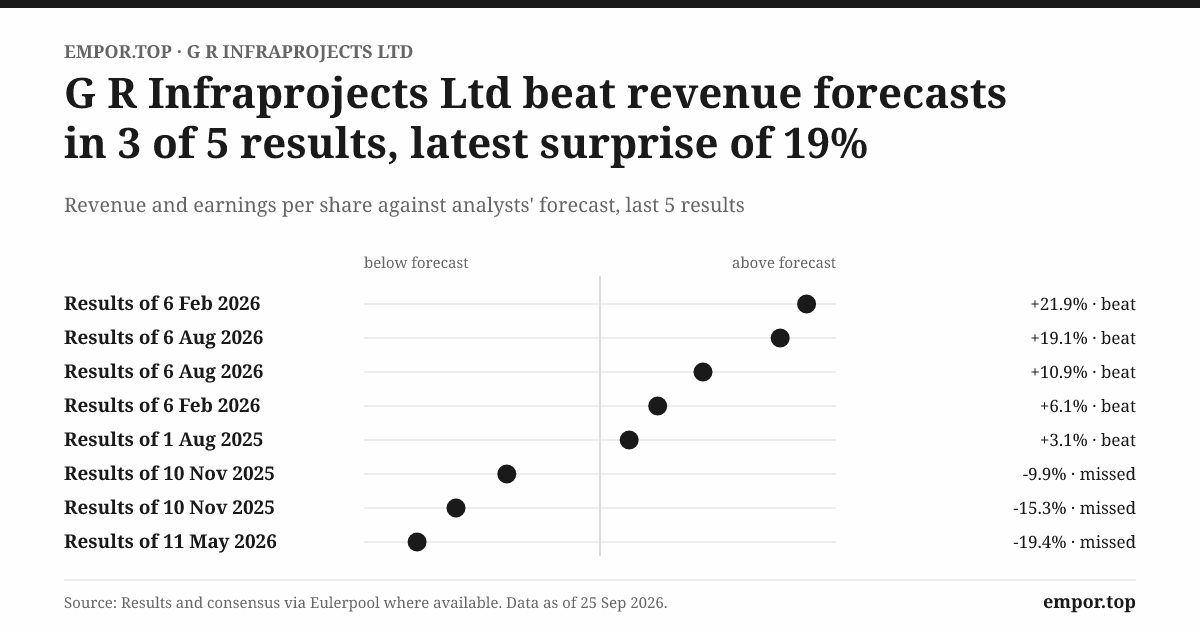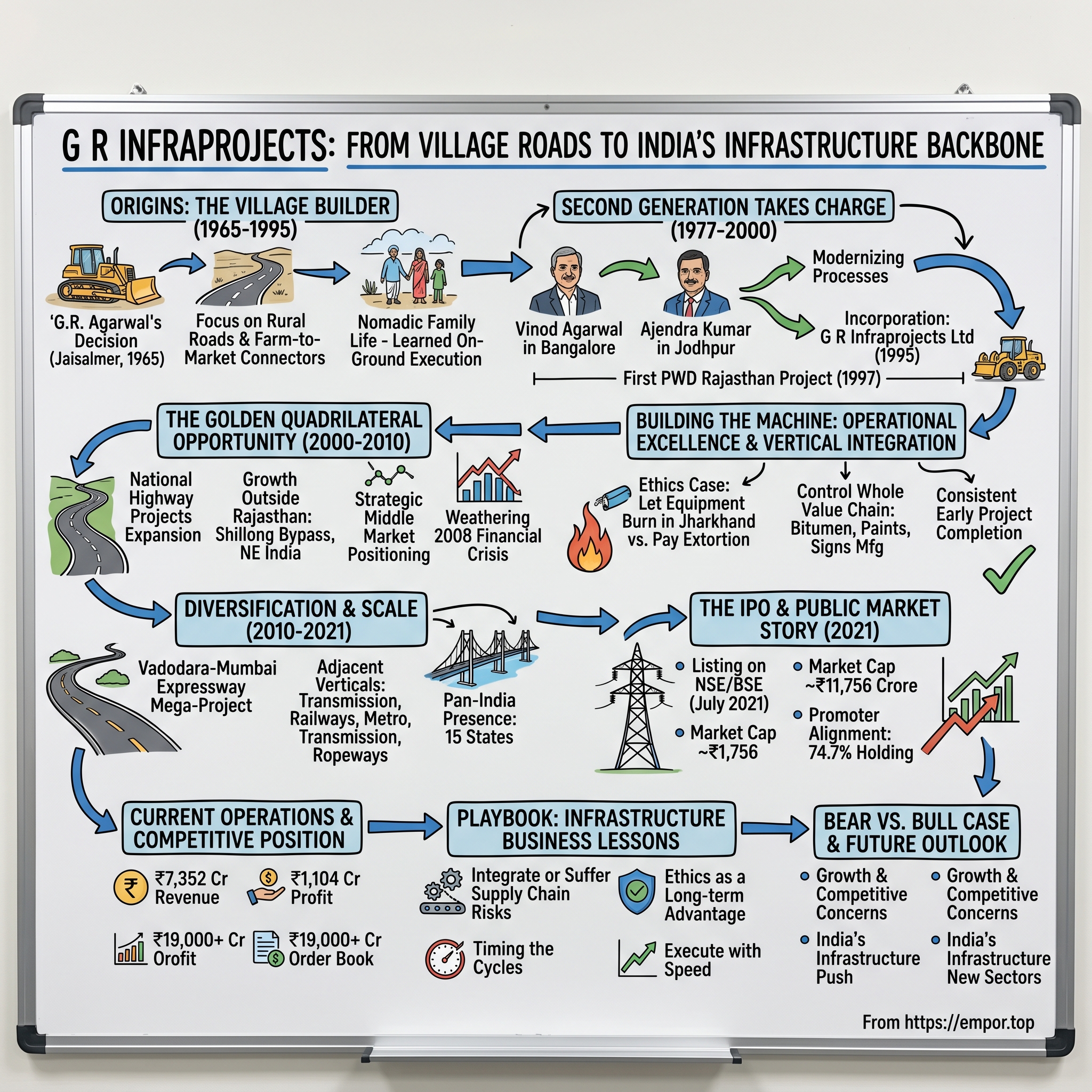
G R Infraprojects: The Concession Machine and the High-Stakes Math of Indian Infrastructure
I. Introduction & Cold Open (12–15 min)
The morning the investigators came
On the morning of June 13, 2022, teams from India's Central Bureau of Investigation fanned out across roughly 15 locations in Guwahati, Bengaluru, Gurugram, Shillong, and Patna.12 One of the addresses was the residence of Vinod Kumar Agarwal, the chairman of G R Infraprojects Limited (GRIL). Another was the company's corporate office in Gurugram, where searches were still underway when GRIL filed its official disclosure with the stock exchanges.3[^4]
By the end of the day, the CBI had arrested five people. Two were accounts officers from the National Highways Authority of India's (NHAI) regional office at Dispur in Guwahati. Three were GRIL employees, including Sunil Agarwal, whom the agency described as an "Executive Director" of the company.1 The allegation was specific and unglamorous: a ₹4 lakh bribe allegedly paid to accelerate bill processing, release bank guarantees, and secure a completion discharge certificate on a road-widening contract in Meghalaya. GRIL had completed that road in 2018, and its four-year maintenance period had expired on March 31, 2022. Investigators said they recovered approximately ₹2.33 crore in cash from the premises of the GRIL executive.12
The timing was awkward. Eleven months earlier, GRIL had staged one of the standout stock market debuts of India's 2021 IPO boom. The shares had opened at ₹1,700 on the BSE against an issue price of ₹837, more than doubling on day one.4
The company caught in the headlines had not started out in corporate boardrooms. Its story began with one man building a road to connect his village in the Rajasthan desert.
The central paradox
GRIL's business embodies a central paradox. Its founder, Gumani Ram Agarwal, was a grain trader from Rajasthan's Churu district who began building local roads in 1965.5 From those modest beginnings, the family built a vertically integrated highway contractor whose order book stood at roughly ₹25,300 crore as of June 30, 2026.6 Over the decades, it assembled in-house plants for road-marking paint, metal crash barriers, and bitumen emulsion, a dedicated equipment fleet numbering around 6,500 construction machines and vehicles by late 2020, and a track record of earning more than ₹247 crore in early-completion bonuses by the time of its public listing.5
Yet GRIL constructed this entire operating engine around essentially one monopsonist customer: the Indian state. That customer drafts the contract, sets the price ceiling, certifies execution milestones, holds the bank guarantees, and dictates when construction can actually start. The June 2022 raid laid bare the operational friction inherent in that dependence.
Where the company stands today
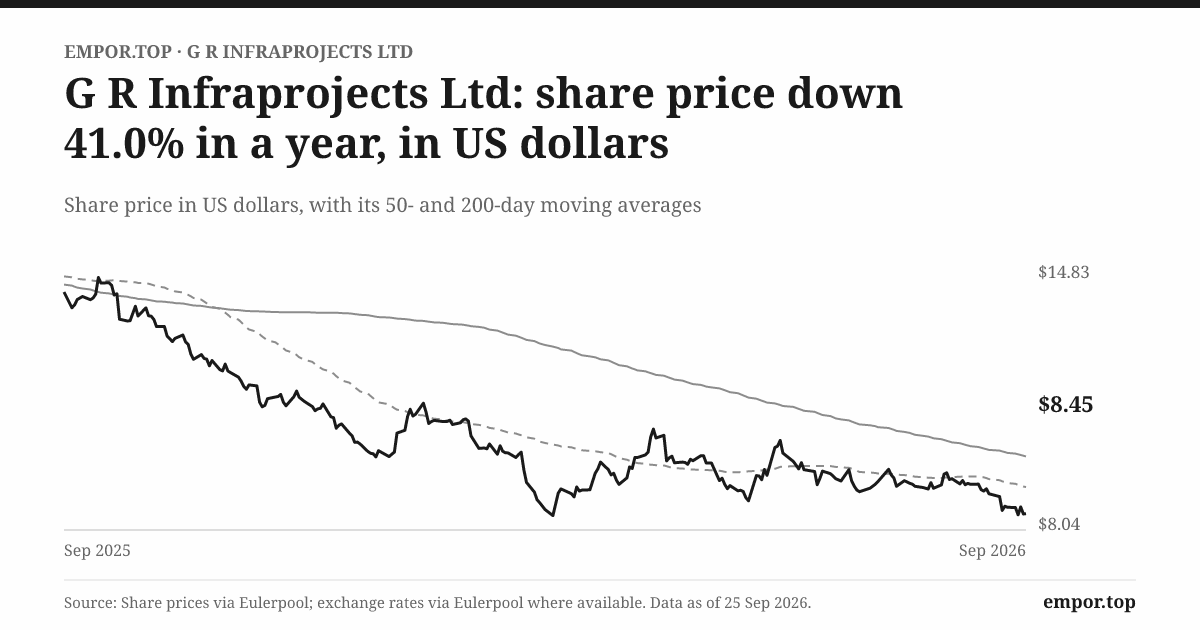
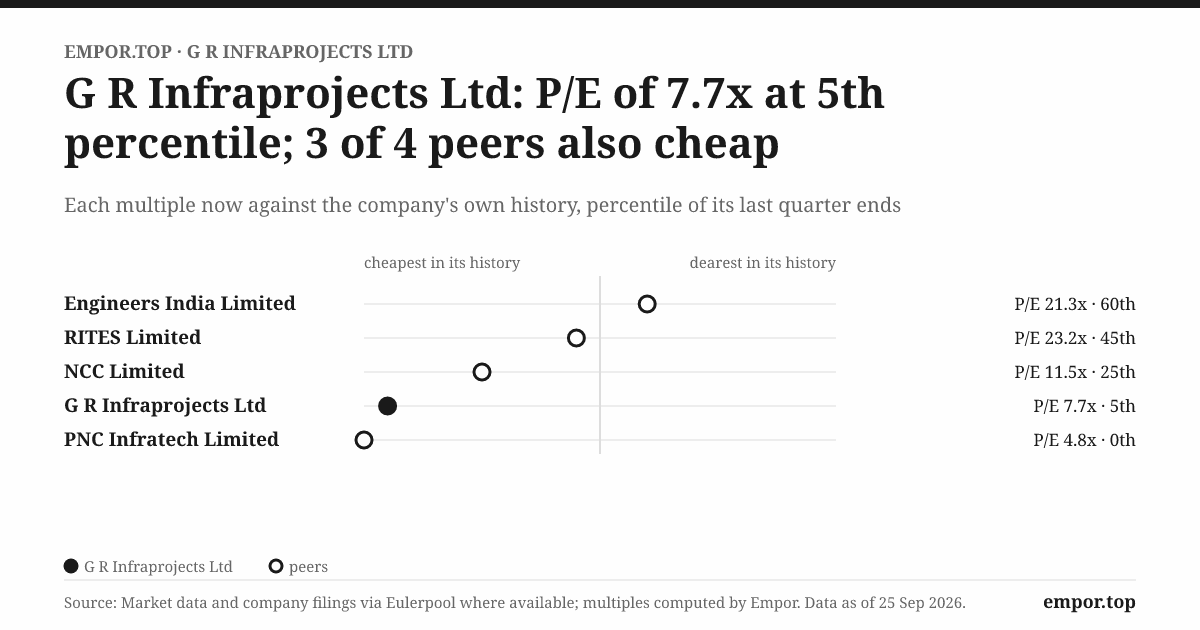
The market's current verdict is stark. On September 25, 2026, GRIL shares traded around ₹812—dipping below their ₹837 IPO price from five years earlier. That valuation gave the company a market capitalization of about ₹7,869 crore, trading at roughly 8.4 times trailing twelve-month earnings and 0.84 times book value.7
Over that same five-year stretch, GRIL's book equity more than doubled. Consolidated net worth expanded from roughly ₹3,980 crore at the time of the IPO to about ₹9,391 crore by March 2026.48 In other words, while the company steadily accumulated assets on its balance sheet, public markets assigned progressively less value to each rupee of equity. Explaining that valuation disconnect is the core puzzle of this story.
The operating picture breaks down into three key elements:
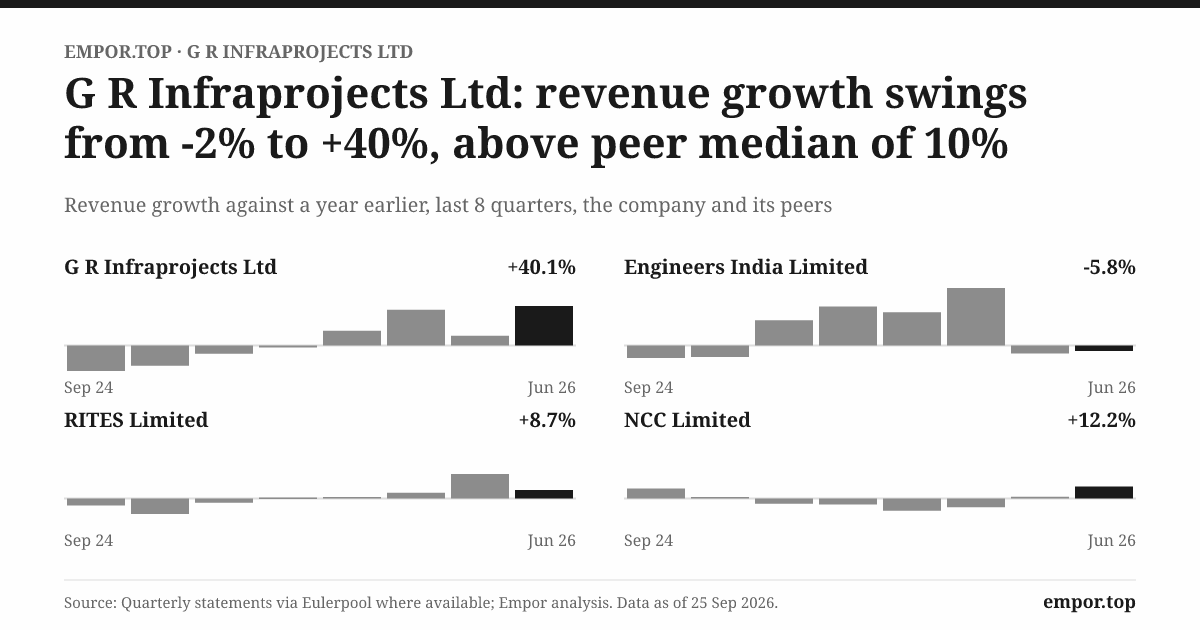
- Revenue growth has returned. Standalone revenue rose 17% to ₹7,620 crore in FY26, and expanded about 33% year-on-year to ₹2,423 crore in Q1 FY27.86
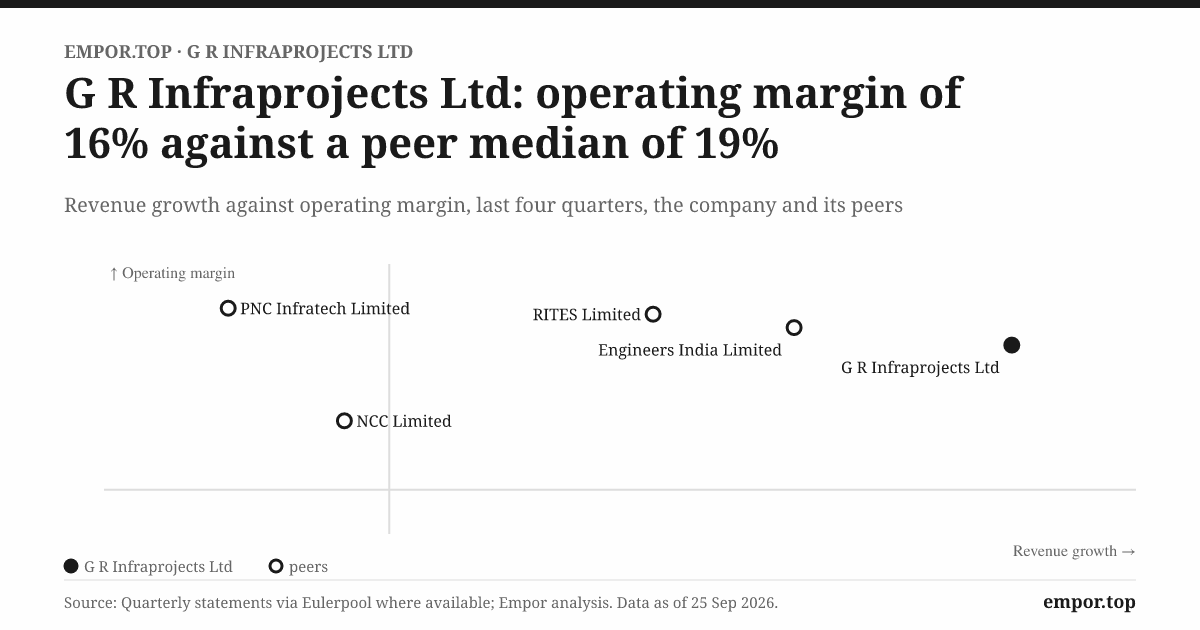
- Margins have reset lower. Standalone EBITDA margins stood at about 11% in FY26 and 11.0% in Q1 FY27, with management now guiding to a sustainable band of 10% to 11%.86
- The standalone parent is virtually debt-free, but the group is not. Standalone debt-to-equity is roughly 0.03 times, whereas consolidated borrowings of ₹4,845 crore—reflecting project-level concession debt—put overall group leverage near 0.5 times equity.8 CRISIL has reaffirmed its AA/Stable rating on the company's bank facilities.9
The roadmap
The rest of this story traces five interrelated dynamics:
- How India's road concession frameworks evolved from cash contracts (EPC) to traffic-risk toll concessions (BOT) and eventually the hybrid annuity model (HAM)—and how GRIL navigated each transition.
- Why the Agarwal family chose vertical integration, fabricating its own inputs and owning its equipment fleet, and where that model's operational moat ends.
- How relaxed bidding qualifications by the state increased competition and compressed operating margins across the sector.
- How GRIL recycles equity capital through its sponsored infrastructure investment trust (InvIT), alongside the corporate governance tensions that model introduces.
- Whether moving into power transmission, rail tunnels, oil and gas pipelines, and warehousing represents genuine operating optionality or an enforced search for replacement volume as national highway awards slow down.
To understand how the machine operates, one must return to the desert where it was first assembled.
 Subscribe on LinkedIn
II. The Desert Contractor: From PWD Culverts to Corporate Incorporation (1965–2000) (25–30 min)
A grain merchant looks at a dirt track
In the 1960s, Sahawa was an isolated village in Rajasthan's Churu district on the northeastern edge of the Thar Desert. Gumani Ram Agarwal traded food grain across a rural hinterland where paved connections barely existed, watching goods and people move at the mercy of dirt tracks. In 1965, he entered road construction.510
It was an unglamorous trade. A small contractor in Rajasthan during that era bid primarily for Public Works Department (PWD) tenders: local link roads, drainage culverts, and surface patching. Equipment was rudimentary, margins were thin, and government disbursements were notoriously slow.
The work also demanded a transient existence. According to an account by Business India, the family relocated across Chittorgarh, Dungarpur, Jodhpur, and Udaipur as individual contracts began and ended. Vinod Kumar Agarwal married in 1984 and settled in Kanbai, a village in Udaipur's hilly hinterland.5 The family eventually established Udaipur as its permanent operational base, and the company's industrial manufacturing roots remain there today.10
Life on those early projects followed an austere rhythm. A contractor won a PWD award, pitched a temporary camp along the alignment, brought in a portable crusher to break local rock into aggregate, and laid the road layer by layer: compacted subgrade earth, crushed stone base, and finally a bituminous surface. When the stretch was completed, the camp packed up and moved. Execution was strictly seasonal, as monsoon rains halted earthworks and asphalt laying. Cash flow was equally volatile: payment arrived only after a state engineer certified physical progress and the district treasury released funds. Working capital was, in essence, a rolling wager on how fast the state bureaucracy cleared its vouchers.
Six brothers joined the enterprise, and all six retained equity stakes in it.10 Over time, an internal division of responsibilities emerged. Vinod became the commercial leader of the firm, managing client negotiations, tenders, and administrative filings. His younger brother Ajendra Kumar Agarwal brought technical training the family business had previously lacked, having earned a civil engineering degree from Jodhpur University. Ajendra took charge of site operations and engineering execution.5 That split between a commercial negotiator and a technical executor—both anchored inside the promoter family—defined GRIL's leadership structure for the next four decades.
The father's two rules
The family has recounted the founder's ethos through two guiding principles. The first was an insistence on quality workmanship, regardless of contract delays. The second concerned capital allocation: "Buy the best equipment because instead of chasing numbers, if you focus on performance, your business will grow manifold."10
Both sound like standard founder lore, but the equipment mandate carried tangible financial friction. In an industry where regional road builders routinely rented machinery and recruited temporary labor gangs contract by contract, purchasing heavy fleet assets meant absorbing substantial depreciation and interest costs during slow construction cycles. Yet it also insulated the contractor from operational bottlenecks. An operator that owned its asphalt pavers and road rollers did not have to wait for third-party rental yards to deliver equipment during brief, weather-critical paving windows. That early preference for owning machinery and executing work in-house became the foundation of GRIL's operating model.
From partnership to company
On December 22, 1995, the family incorporated G. R. Agarwal Builders and Developers Limited, which formally took over the predecessor partnership firm, M/s Gumani Ram Agarwal.5 The company was later renamed G R Infraprojects in 2007.5
The decision to incorporate was practical rather than cosmetic. State procurement guidelines evaluate a bidder's technical qualification, audited turnover, and tangible net worth. While an informal family partnership could secure rural link roads, qualifying for major state highway tenders required corporate balance sheets audited to statutory standards. The formalization soon yielded results: according to Business India, the newly incorporated firm won its first Rajasthan PWD highway contract in 1997.5
According to Forbes India, the broader commercial opening arrived shortly after, when the Atal Bihari Vajpayee administration made highway modernization a national economic priority. Large-scale initiatives, particularly the Golden Quadrilateral and the Pradhan Mantri Gram Sadak Yojana (PMGSY) rural road scheme, created a continuous pipeline of civil works tenders. As a regional contractor, GRIL qualified for rural road packages worth roughly ₹1 crore to ₹3 crore each.10
What the early years taught
A degree of analytical skepticism is warranted here. Corporate origin stories often recast routine operational endurance into deliberate strategic foresight. The historical record shows a regional contractor that survived the slow payment cycles and seasonal stoppages inherent in state PWD contracts, emerging with an entrenched preference for self-reliance. It does not show that GRIL generated exceptional profit margins or capital efficiency during the 1990s; those partnership and early corporate accounts were never made public.
For investors evaluating the business today, however, the takeaway is structural. GRIL's habit of owning equipment fleets and fabricating its own construction inputs was established decades before its 2021 IPO, forged during an era when carrying fixed equipment costs was financially punishing. It was a deeply ingrained operating philosophy rather than a corporate strategy invented for public market marketing. Whether that capital-intensive posture remains a durable competitive advantage or a balance-sheet burden under modern concession frameworks is examined later in this story. When India's national highway boom accelerated after 2000, the family had acquired specialized machinery, formed a corporate vehicle, and built an execution track record in Rajasthan—leaving it prepared to scale.
III. The Golden Quadrilateral & The EPC Machine (2000–2015) (35–40 min)
The Shillong Bypass
For a contractor rooted in the arid plains of Rajasthan, Meghalaya represented an extreme operational pivot in both distance and terrain. While civil works around Udaipur involved dry rock and predictable grading, Shillong required navigating steep mountain slopes, intense monsoons, chronic landslide risks, and fragile supply chains. Taking on the Shillong Bypass signaled that GRIL was ready to construct complex alignments far beyond its home state.5
Further contracts soon followed in Manipur, Bihar, and Andhra Pradesh, alongside bids across Kerala, Tamil Nadu, and Jammu & Kashmir.5 The Northeast became an enduring anchor of GRIL's geographic footprint—including the Meghalaya road-widening contract that would later draw CBI scrutiny in 2022.1
Riding the national highway wave
That geographic expansion unfolded against the backdrop of the most ambitious road-building effort in modern Indian history. The Golden Quadrilateral linked Delhi, Mumbai, Chennai, and Kolkata, while the North-South and East-West corridors and the Pradhan Mantri Gram Sadak Yojana (PMGSY) extended modern paved alignments across states and into rural hamlets. The initiative generated a continuous pipeline of civil works tenders on an unprecedented scale.
Rather than leaping immediately into marquee prime contracts, GRIL scaled by subcontracting under established national developers before bidding in its own right. According to Forbes India, the firm subcontracted highway packages in Rajasthan for Ashoka Buildcon in 2005 and delivered ahead of schedule, followed by completing a ₹150 crore highway stretch in record time to establish its reputation with the national authority.10 Finishing ahead of schedule soon emerged as the company's primary operational signature.
The BOT bubble GRIL stayed out of
The defining strategic choice of this period, however, was a temptation GRIL declined.
Beginning in the mid-2000s, the Indian government pushed Build-Operate-Transfer (BOT) toll concessions as its primary infrastructure procurement model. Under BOT tolling, private developers took on the role of long-term asset owners: they raised debt and equity to finance construction, maintained the corridor over 20- or 30-year concessions, and recouped their capital solely by collecting user tolls. Bidders competed aggressively, frequently submitting optimistic traffic growth projections, while state-backed lenders provided generous non-recourse debt packages against those forecasts.
When macroeconomic growth decelerated, right-of-way acquisitions stalled, and realized traffic volumes fell well short of projections, the concession structure fractured. An industry analysis indicated that actual traffic across numerous corridors fell 30% to 50% below the underwriting assumptions that backed their bank loans.11 Non-performing highway debt ultimately formed a substantial portion of the corporate bad-loan crisis that burdened Indian lenders throughout the 2010s.
GRIL largely bypassed the boom. According to Forbes India, the company made a deliberate choice to remain an engineering, procurement, and construction (EPC) contractor rather than taking on BOT concessions, dodging aggressive bidding wars and long-dated leverage; by 2018, conventional EPC contracts still accounted for roughly 95% of its order book.10
The mechanics of an EPC contract were fundamentally different. The state funded the asset and assumed commercial traffic risk, while the contractor was paid against certified physical milestones. Although operating margins on pure EPC work were generally lower than the headline internal rates of return projected on paper by BOT toll developers, execution cash flows arrived as construction progressed, without burdening the builder with forecasting traffic volumes decades into the future.
Did GRIL "avoid" the trap, or just stay small?
The claim that GRIL exercised defensive discipline during the BOT cycle warrants critical scrutiny. Avoiding toll concessions could reflect prudent risk management, but it could just as easily reflect a mid-sized regional builder that lacked the pre-qualification credentials and balance-sheet scale to bid for mega-concessions.
The evidence suggests a combination of both, though management's subsequent actions support a deliberate philosophy. The Agarwal family remained committed to cash contracts even after the company expanded nationwide, accepting long-term concession equity only after the government introduced the Hybrid Annuity Model (HAM), which eliminated merchant traffic exposure entirely. More recently, when questioned about large NHAI BOT toll packages valued at ₹7,500 crore to ₹9,000 crore, the Group Chief Financial Officer maintained that the company would participate only if projected returns met its internal threshold.8 That stance aligns with its historical conservatism.
The caveat for investors is that this conservatism has never been tested in underwriting market demand. GRIL's record reflects an ability to refuse merchant traffic wagers, not a demonstrated ability to price commercial traffic risk accurately.
Private equity arrives
In 2011, external institutional capital entered the business. Motilal Oswal Private Equity invested approximately ₹50 crore, while IDFC invested roughly ₹30 crore and, according to Business India, exited with about ₹68 crore five years later.5 Forbes India reported that Motilal Oswal Private Equity held a 9.9% equity stake in 2018.10 Funds managed under Motilal Oswal's India Business Excellence Fund framework subsequently featured among the primary selling shareholders in GRIL's July 2021 initial public offering.4
Those minority private equity sponsors contributed more than growth capital. They introduced independent board representation, formal financial controls, audited reporting disciplines, and the governance rigor required to prepare a family-run enterprise for an eventual public exit. For a contractor built on regional PWD roots and sovereign procurement tenders, this institutionalization established the administrative framework that made a large-scale public listing feasible.
What this era means for investors
By 2015, GRIL had emerged as a disciplined, equipment-heavy EPC contractor with a nationwide footprint and a reputation for early project delivery. The unencumbered balance sheet of those pure EPC years—free of toll concession debt and stranded project equity—explains why the company retained the capital capacity to absorb equity commitments when the Hybrid Annuity Model arrived. Yet pure EPC contracting, with its open-tender bidding and commoditized margins, meant the firm still possessed no structural pricing power.
Then, in 2016, the government redesigned the highway contract.
IV. The Concession Revolution: Mastering the Hybrid Annuity Model (2016–2021) (40–45 min)
The problem Delhi had to solve
By 2015, India's highway development engine had run into a financial wall. Commercial banks, saddled with non-performing loans from distressed BOT toll projects, refused to underwrite fresh merchant traffic risk. At the same time, the central exchequer could not afford to finance the entire national highway buildout through direct cash EPC contracts. The Ministry of Road Transport and Highways (MoRTH), under Nitin Gadkari, needed a procurement structure that could draw private capital and bank credit back into road construction without repeating the balance-sheet overextension of the prior decade.
That structure was the Hybrid Annuity Model (HAM), introduced in January 2016.12
How HAM works
HAM functions essentially as a long-term mortgage where the state acts as the borrower:
- During construction, NHAI pays 40% of the bid project cost in five cash installments, each tied to a physical completion milestone.12
- The developer finances the remaining 60% through a combination of sponsor equity and project-level bank debt.
- After completion, NHAI repays that 60% outlay in semi-annual annuity installments over 15 years, adding benchmarked interest alongside operations and maintenance payments.12
- NHAI collects and retains user tolls, leaving the developer with zero commercial traffic risk.
The design was a pragmatic compromise. Pure EPC placed the entire cash burden on the sovereign exchequer, while BOT had forced private developers to gamble on long-term traffic forecasts they could not control. HAM split the upfront funding and transferred commercial traffic risk back to the state. With debt service guaranteed by semi-annual sovereign annuities rather than fluctuating toll booths, commercial lenders reopened credit lines.
For an infrastructure contractor, HAM offered a dual revenue stream. The parent company's EPC division booked an upfront construction margin while laying the road. Once the corridor opened, the project special purpose vehicle (SPV) collected predictable, sovereign-backed annuities. The structural trade-off was capital lockup: the developer's equity remained tied up in project SPVs for years, creating capital-recycling pressures that would shape the company's corporate structure in later years.
GRIL's sweet spot
HAM aligned closely with GRIL's operating strengths. Because the company fabricated key inputs in-house and deployed an owned equipment fleet, its actual execution costs frequently undercut NHAI's benchmark engineering estimates. In a fixed-price contract, every rupee saved on site execution flowed directly into the EPC division's upfront cash margin.
Early delivery amplified those gains. HAM concession agreements included financial bonuses for projects reaching commercial operation ahead of schedule. GRIL turned rapid commissioning into an operational routine, accumulating more than ₹247 crore in early-completion bonuses by the time of its initial public offering.5 In the first quarter of FY23 alone, the company booked roughly ₹132 crore in early-completion bonuses; that single payout drove its quarterly EBITDA margin to 19.6%, compared with a core operational margin of 14.3% once the bonus was excluded.13
Finishing ahead of schedule yielded two distinct financial dividends. The headline cash bonus provided an immediate earnings windfall, but the operational dividend mattered even more over the cycle: vacating an alignment early freed up heavy machinery and crews to deploy immediately onto the next contract. For a contractor carrying substantial fixed depreciation on owned equipment, cycling the same asset base across more revenue per year drove higher capital productivity—provided the government handed over unencumbered land on time.
Contract sizes scaled alongside the model. Business India reported an NHAI award on the Vadodara–Mumbai Expressway valued at approximately ₹2,747 crore, a dramatic departure from the ₹1 crore to ₹3 crore rural road packages the Agarwal family had built twenty years earlier.510
The financial figures disclosed in GRIL's IPO prospectus captured that accelerating momentum. Between FY19 and FY21, restated consolidated total income rose from roughly ₹5,326 crore to ₹7,907 crore, while profit after tax grew from about ₹717 crore to ₹953 crore.4 Consolidated EBITDA reached about ₹1,913 crore in FY21, representing an EBITDA margin above 24%—a figure that incorporated project-level HAM annuity income and was therefore not directly comparable with standalone contracting margins.4
Myth vs reality: is execution speed a lasting moat?
The claim. During the post-listing rally, the prevailing investment thesis held that GRIL's captive equipment fleet and backward integration gave it an enduring execution speed advantage that would sustain industry-leading margins, supplemented by recurring early-completion bonuses. Management reinforced that expectation. As late as November 2022, leadership guided investors to a sustainable core operating margin of 15% to 16%, excluding any bonus payouts.14 Even in August 2024, management told analysts that once project execution normalized, returning to EBITDA margins of around 15% would "not be difficult."15
What actually happened. The margin trajectory told a very different story. Standalone EBITDA margins stood at about 16% in FY23 and roughly 15% in FY24, according to Keynote Capitals' reconstruction of the company's reported numbers.15 Profitability compressed to 13.88% in FY25, a figure supported by approximately ₹123 crore in one-time claims income. By FY26, standalone EBITDA margins had declined to around 11%.8
Crucially, execution volumes rebounded strongly in FY26, with standalone revenue expanding 17%. Yet margins failed to recover toward 15%.8 That divergence undermined the argument that compressed margins were merely a temporary consequence of equipment sitting idle during execution pauses.
Why it broke. Management acknowledged the structural shift during its May 2026 earnings call. Historically, winning bids cleared close to NHAI's benchmark project cost estimates. Over time, aggressive bidding pushed contract awards "30%–40% down from NHAI estimate," the Group CFO explained, attributing the pricing pressure squarely to heightened competition.8 The underlying cost of physical materials had not changed; rather, price realization per contract had dropped. "The road has to be built, bitumen has to be used, stone has to be used," he observed, pointing out that only the price concessionaires were willing to accept had shifted.8
Independent industry data corroborated the shift. According to Nuvama research cited by The Tribune, the proportion of national highway awards won by listed infrastructure developers plunged from 61% between FY16 and FY18 to roughly 24% by FY25.16 A crowded field of mid-sized and unlisted regional contractors, benefiting from relaxed pre-qualification rules, aggressively undercut established players on price.
Furthermore, early-completion bonuses depended on a critical factor beyond any contractor's control: the timely delivery of right-of-way. When statutory clearances stalled or government agencies delivered land piecemeal, specialized machinery remained stranded on site regardless of engineering speed.
Verdict. The historical record recalibrates the moat thesis. GRIL's execution capabilities and speed are verifiable operational strengths that unlock bonuses and qualify the firm for large-scale corridor packages. However, execution speed alone could not defend operating margins once the sovereign client expanded the bidding field. What public markets initially priced as a permanent competitive moat was largely the operational windfall of a favorable procurement cycle. The key metric for investors going forward is whether GRIL can sustain standalone EBITDA margins above 11% across a full award cycle without relying on exceptional claims or one-off bonuses.
Every infrastructure contractor eventually confronts the same strategic question: once a highway is completed and handed over, what proprietary advantage does it retain that rivals cannot replicate? For GRIL, the answer the Agarwal family had spent three decades assembling lay deeper within its supply chain.
V. The Vertical Integration Moat: Asphalt, Crushed Stone, and In-House Steel (30–35 min)
Inside the plants
A typical GRIL highway site is supplied directly by the company's captive manufacturing network rather than third-party vendors. Dedicated plants at Udaipur in Rajasthan, Guwahati in Assam, and Sandila in Uttar Pradesh manufacture thermoplastic road-marking paint, road signs, electric poles, and metal crash barriers, while a specialized fabrication and galvanization facility at Ahmedabad produces structural steelwork.4
Bitumen emulsion, the primary binding agent used in road surfacing, is blended in-house. CRISIL puts the combined capacity of GRIL's emulsion plants at 84,960 tonnes a year.9
The company has applied this self-fabrication model to its newer operating segments as well. In Q1 FY27, management said it had started manufacturing transmission towers in-house to avoid third-party supply delays, adding that it might eventually sell surplus capacity internationally.17
The fleet
By December 2020, GRIL's operational footprint encompassed more than 15,000 employees, about 6,500 construction machines and vehicles, and a gross block of property, plant, and equipment totaling roughly ₹1,774 crore.5
To put that capital base in perspective, Dilip Buildcon, the infrastructure peer best known for operating a massive captive fleet, carried a gross block of about ₹4,062 crore in March 2022. In its credit assessment, CARE Ratings credited that machinery fleet with enabling fast project mobilization, early completions, and contractual bonuses, while also noting that the substantial capital tied up in equipment limited the free cash available to fund equity commitments for hybrid annuity model (HAM) projects.18
That comparison highlights an important industry reality: maintaining an extensive equipment fleet is not a proprietary strategy unique to GRIL. Indeed, the sector's largest fleet owner ultimately faced severe balance-sheet strain and had to monetize operational assets to deleverage.
The unit economics, with an honest caveat
The industrial logic behind vertical integration is straightforward. A general contractor that purchases crash barriers, signboards, and bitumen emulsion from external vendors pays those suppliers' profit margins and remains vulnerable to their delivery schedules. A contractor that fabricates those components in-house captures that supplier margin and dictates delivery timing directly to the project alignment.
What GRIL has not publicly disclosed, however, is what this captive supply chain is worth in practice—whether measured in basis points of operating margin or in construction cost per lane-kilometer compared with peers. Any precise figure circulating in the market is an analyst estimate. The clearest empirical evidence comes from reported financial results: GRIL did hold standalone margins around 15% to 16% through FY24, when most peers earned less, before competitive bidding cut those margins to around 11%.158 Vertical integration can lower internal processing costs, but it cannot prevent a monopsonist customer from accepting cheaper bids across the sector.
Commodity input costs represent an equally pressing vulnerability. On the May 2026 earnings call, the Group CFO pointed to fuel and bitumen, both petroleum products, as the main swing factor in margins while the conflict involving Iran continued, cautioning that if it persisted "nothing can be said about the margin."8 In Q1 FY27, management said NHAI had compensated for part of the bitumen cost increase, but diesel costs were unhedged.17 Vertical integration covers the downstream processing steps, but it does not protect GRIL from global crude oil volatility.
Hamilton Helmer's 7 Powers, applied narrowly
In his strategic framework 7 Powers, Hamilton Helmer identifies persistent structural advantages that allow a company to generate sustained economic rents. Applied to GRIL, only two of those powers plausibly fit:
- Process power. Over three decades of project delivery, GRIL developed deeply embedded operational routines for mobilizing machinery across diverse terrains, executing preventative equipment maintenance, siting portable crushers and batching plants along remote alignments, and coordinating complex site logistics. A newer regional contractor cannot easily replicate those organizational capabilities overnight. Yet this power remains moderate: it produces financial value only when the client delivers unencumbered right-of-way on time and contract pricing leaves room to generate a profit.
- Scale economies. Spreading fixed manufacturing overhead, central plant depreciation, and bulk procurement over an operating revenue base of roughly ₹7,600 crore lowers unit costs. In a lowest-bidder (L1) public procurement framework, however, scale advantages tend to get competed away. When bidding intensifies, contractors are forced to pass those cost savings directly to the state through discounted bid prices simply to win work.
The takeaway for investors is that vertical integration provides a tangible operational and scheduling advantage that helps GRIL qualify for and execute large, complex infrastructure packages. But it has not created durable pricing power, nor has it shielded operating margins from an increasingly crowded bidding field.
The next test of the company's reputation came from somewhere unexpected: the public markets, and then the investigators.
VI. The Public Market Debut & The Guwahati Crucible (2021–2023) (35–40 min)
July 2021: the IPO
When the initial public offering opened on July 7, 2021, priced in a band of ₹828 to ₹837 per share, it was structured as a pure offer for sale. The company raised no fresh primary capital. Instead, existing shareholders offloaded about 1.15 crore shares for roughly ₹962 crore, led by promoter entity Lokesh Builders and Motilal Oswal's India Business Excellence Fund investment vehicles.4[^20] Institutional and retail demand was intense, leaving the issue oversubscribed many times over.4
When trading commenced on July 19, 2021, the stock opened at ₹1,715.85 on the National Stock Exchange and closed its debut session at ₹1,747.10.4 At the upper issue price of ₹837, the company had carried an initial market capitalization of roughly ₹8,100 crore—trading at about 8.5 times its FY21 consolidated net profit of ₹953 crore, based on a post-issue equity base calculated from the 38.67 lakh shares the promoters later disclosed as representing 4.00% of total equity.419 In a single trading session, public markets effectively doubled that valuation.
Why was the offering priced at such a modest multiple, and why was the debut reaction so explosive? Both questions shared the same underlying answer. Indian road developers historically traded at deep valuation discounts because institutional investors remembered the painful lessons of the BOT boom, where paper profits had routinely vanished into levered project concessionaires and non-performing loans. GRIL presented a fundamentally different profile: a predominantly cash-contract EPC builder, disciplined by private equity oversight, recognized for early project delivery, and operating with negligible parent-level debt. The listing-day surge was the market's enthusiastic endorsement of that thesis.
Five years later, with the stock trading back below that ₹837 issue price, that initial market enthusiasm has steadily eroded even as the underlying balance sheet continued to accumulate net worth. Explaining why that multiple compressed requires examining how execution realities caught up with the narrative.
The promoter structure
Promoter ownership before the public listing was exceptionally concentrated, and the offer for sale did not reduce the family's stake to the 75% ceiling mandated by the Securities and Exchange Board of India's (SEBI) minimum public shareholding norms. By December 2023, the promoter group still held roughly 79.74% of the equity. To achieve regulatory compliance, four promoter-group members each sold a 1% stake via open-market transactions on March 7, 2024, lowering the aggregate family holding to about 74.70%.19 Subsequent shareholding disclosures place promoter ownership at 74.69%.7
Executive control remained tightly held within the founding family. Vinod Kumar Agarwal served as Managing Director from 2008 to 2021, before transitioning to Chairman and Whole-Time Director through 2025.20 Ajendra Kumar Agarwal, who had served on the board since 2006, subsequently assumed the combined role of Chairman and Managing Director.8
Myth vs reality: "clean execution"
The claim. Leading up to the public offering, market sentiment framed GRIL as an unusually clean operator navigating an historically compromised sector. Business India highlighted that perception, quoting an investor's assessment of the firm's culture: "We don't get into business unless it is clean and we do not compromise on ethics."5
What happened. The June 2022 CBI investigation outlined in the cold open directly collided with that reputation. The allegations involved operational practices serious enough to prompt arrests, coordinated raids at the Chairman's personal residence and the corporate headquarters, and the recovery of significant unaccounted cash from a senior executive's premises.13 Assessing the immediate fallout, ICICI Securities characterized the development as distinctly negative, cautioning that regulatory uncertainty would weigh on the stock "in the short to medium term."3
GRIL's formal defense rested on containing responsibility to site personnel. In its credit assessment, CRISIL noted that the arrests involved three field-level employees, that agency findings indicated no involvement by senior executive leadership or the promoter family, and that the company "is cooperating fully with the CBI." CRISIL maintained that it would continue monitoring legal developments.9
By February 2023, the CBI had submitted its charge sheet, leaving the proceedings pending before a special court in Guwahati.21 As of late 2026, no final judicial verdict has been delivered on the public record.
The regulatory consequence was not zero. While subsequent market commentary often assumed the investigation resulted in no commercial sanctions, that characterization is incomplete. In November 2022, ICICI Securities reported that the Ministry of Road Transport and Highways (MoRTH) had issued a debarment order prohibiting GRIL from participating in tenders for one month, effective mid-November 2022. The company filed an official response, with management downplaying the practical impact by pointing out that national highway contract awards typically cluster between December and March.14 However, a follow-up report from the same brokerage in February 2023 characterized that debarment window as spanning six months.21
That discrepancy across analyst notes underscores a persistent disclosure gap; public investors must look to primary regulatory filings to establish the exact scope and duration of the sanction. Regardless of the precise window, the sovereign client did enforce a temporary bidding exclusion rather than letting the matter pass without consequence, even if it stopped short of permanent blacklisting.
Verdict. The historical record disproves the absolute thesis that GRIL operated entirely insulated from the ground-level friction of Indian public procurement. What survives is a much narrower operational reality: the alleged infractions were officially attributed to project-level staff, the company avoided permanent disqualification, and it resumed securing major NHAI contracts once the debarment lapsed. Yet the legal overhang has not dissipated. A judicial conviction or any expanded finding implicating executive leadership could reopen statutory debarment risks, making the Guwahati court proceedings an ongoing compliance variable rather than a settled legacy issue.
What the governance record says
From an institutional governance perspective, an equity analyst or auditor evaluating the episode confronts three uncomfortable realities:
- Site-level cash controls. The fact that federal investigators conducted searches at the executive Chairman's residence, even without filing charges against the promoter family, highlights the vulnerability of internal cash controls across far-flung project sites and regional offices.
- Reliance on third-party characterizations. Rather than publishing an independent forensic audit or a comprehensive internal review, the company's public narrative relied largely on credit rating summaries to reassure the market that senior leadership remained unblemished.
- Related-party complexity. The investigative fallout coincided with GRIL establishing extensive, long-term transaction structures with its sponsored infrastructure investment trust (InvIT)—an asset-monetization model where internal governance, asset valuation, and arm's-length transfer pricing require exceptional transparency.
On the commercial side of the ledger, the company demonstrated operational resilience. Project execution proceeded without interruption, CRISIL reaffirmed its AA rating on underlying credit facilities, and NHAI continued awarding GRIL major corridor packages once bidding resumed. The Guwahati crucible damaged the contractor's unblemished reputation and cost it bidding momentum, but it did not impair its core operating franchise.
Yet as the legal proceedings wound their way through the courts, an entirely separate structural pressure was mounting on the company's balance sheet.
VII. Capital Recycling & The InvIT Pivot: Bharat Highways / Indus Infra Trust (2023–2024) (25–30 min)
HAM's hidden problem: trapped equity
The Hybrid Annuity Model introduced an operational friction that never appeared on the profit-and-loss statement: sponsor equity remains locked inside project special purpose vehicles for years.
For a highway builder securing multiple concessions each award cycle, the balance sheet quickly congests with project equity that repays only across a 15-year annuity schedule. By the first quarter of FY25, GRIL had invested approximately ₹1,840 crore in its project subsidiaries, with roughly ₹2,000 crore in additional equity commitments still pending.15 By March 2026, remaining equity commitments across operational and under-construction HAM and BOT corridors had climbed to ₹3,486 crore, with about ₹1,000 crore scheduled for deployment in FY27 alone.8
Management confronted a narrow set of choices: issue fresh equity and dilute existing shareholders, scale back bidding volumes, or construct an asset-monetization mechanism to divest commissioned roads and redeploy the proceeds.
The InvIT as a conveyor belt
GRIL opted for capital recycling. It sponsored Bharat Highways InvIT, an infrastructure investment trust registered with SEBI and managed by GR Highways Investment Manager.1422 A formal Right of First Offer (ROFO) agreement gave the trust priority acquisition rights over GRIL's operational road concessions.23
Functioning like a real estate investment trust for transport infrastructure, an InvIT acquires operating corridors, aggregates their annuity cash flows, and distributes the vast majority of that income to yield-seeking unitholders. For GRIL, the vehicle established an operational conveyor belt: construct the highway, establish commercial operations, hold the asset through its mandatory stabilization window, and transfer project equity to the trust to replenish parent liquidity.
The operational lag in that loop is significant. Management noted that a project qualifies for transfer only after completing a full year of commercial operations following physical completion.8 Consequently, the conveyor belt operates with a structural delay: sponsor equity enters during the roughly two-and-a-half-year construction phase, sits through the first operating year, and only then can be monetized.
The economic logic resolves a fundamental mismatch in investor horizons. A civil contractor runs on execution velocity and needs its capital back quickly to bid for the next project; institutional unitholders, such as pension funds and insurers, seek long-dated, sovereign-backed yields stripped of construction risk. Without a monetization platform, GRIL had to function simultaneously as both contractor and permanent asset owner. The trust enabled the company to hand off long-term yield obligations to institutional capital while returning equity to the core construction business.
The trust's initial public offering ran from February 28 to March 1, 2024, raising ₹2,500 crore at an issue price of ₹100 per unit, before listing on March 12, 2024, at ₹103.05.2324 The trust launched with an initial portfolio of seven operational HAM concessions spanning roughly 497 kilometers across Punjab, Gujarat, Andhra Pradesh, Maharashtra, and Uttar Pradesh, with the bulk of the proceeds deployed as project-level loans to retire existing commercial bank debt.23 On November 11, 2024, the vehicle was renamed Indus Infra Trust.22
The transactions since
The asset conveyor belt continued to turn over the following two years:
- By May 2025, CRISIL recorded nine operational HAM projects transferred to the trust, valuing GRIL's unitholding at approximately ₹2,100 crore—a substantial liquid buffer on the parent balance sheet.9
- In FY26, GRIL monetized four additional HAM assets for an aggregate consideration of ₹321 crore, recognizing an exceptional gain of ₹253 crore on the transactions.8 Three of those corridors—Bilaspur–Urga, Ena–Kim, and Ujjain–Badnawar—concluded their transfers on March 25, 2026, with the trust financing the acquisitions through a ₹1,940 crore term loan facility from HDFC Bank.25
- By mid-2026, cumulative portfolio transfers reached 13 operational HAM concessions. In the first quarter of FY27, cash distributions from the trust to GRIL totaled approximately ₹70 crore, with leadership targeting another three to four asset drop-downs during FY27.6
The related-party question
For governance analysts and public shareholders, this structure introduces an inherent tension.
GRIL holds a 43.56% stake in Indus Infra Trust and, as the trust's statutory disclosures acknowledge, exercises "significant influence over it." Consequently, every asset drop-down represents a related-party transaction.25 The parent developer is effectively selling assets to an investment vehicle in which it remains the largest single unitholder and sponsor.
Regarding transfer valuations, management maintains that acquisition pricing is established through independent discounted cash flow appraisals. The Group CFO acknowledged that valuation multiples across completed transfers have varied significantly, fluctuating "between 1.25 to 2.25" times book value, with recent corridor sales clearing at approximately 1.18 to 1.2 times book.8
That dynamic creates a structural dilemma:
- If the trust pays an elevated price, it subsidizes the parent sponsor's cash flow at the expense of third-party InvIT unitholders who suffer yield dilution.
- If the trust acquires assets at a steep discount, it preserves InvIT distribution yields at the expense of GRIL's public equity investors, who see parent-level capital transferred below intrinsic economic value.
The compressed multiples observed on recent asset sales indicate that the second risk is far from theoretical. When a sponsor exercises significant influence across both sides of a negotiating table, market confidence hinges entirely on independent appraisal integrity and minority unitholder voting thresholds. Those governance safeguards help mitigate conflicts of interest, but they do not eliminate the structural friction.
Comparing with peers
The peer contrast is instructive. Dilip Buildcon, facing severe leverage constraints, pursued a different monetization route. In 2022, it agreed to transfer ten HAM concessions to Shrem InvIT at an equity valuation of ₹2,350 crore, comprising roughly ₹900 crore in upfront cash and ₹1,450 crore in listed units, with a contingent cash tranche tied to NHAI approving an underlying change-of-law claim.18 Dilip Buildcon separately divested another three HAM assets to Cube Highways, an independent financial sponsor.18
GRIL's captive approach preserves strategic influence over the road corridors and generates recurring quarterly distributions. However, it also concentrates balance-sheet exposure inside a single, captive vehicle rather than offloading assets cleanly to unaligned global infrastructure funds. Over a full infrastructure cycle, whether this captive model outperforms arm's-length third-party divestments remains an open question. Mechanically, the recycling apparatus has achieved its primary goal: projects are built, equity is repatriated, and the standalone parent remains virtually unencumbered by debt. Whether it generates superior shareholder value over time depends entirely on transfer pricing discipline inside a related-party architecture.
With balance-sheet capacity unlocked, the company faced a different strategic choice: where to deploy that recycled capital next.
VIII. The Next Vector: Power Transmission, Rail, and Parvatmala Optionality (30–35 min)
When the road contracts dried up
In FY22, the National Highways Authority of India awarded roughly ₹1.5 lakh crore of projects. In FY23, it awarded about ₹1.3 lakh crore. Then sovereign procurement contracted sharply, with annual awards falling to about ₹35,000 crore in FY24 and about ₹47,000 crore in FY25.16 Brokerage analysis from Nuvama linked the sudden drop to the central government's decision to pause project awards under the Bharatmala program.16
GRIL's top line moved in lockstep. Standalone revenue fell 16%, from ₹7,795 crore in FY24 to ₹6,515 crore in FY25, a contraction that CRISIL attributed directly to weak order inflows in FY24.9
On the company's May 2026 earnings call, Chairman and Managing Director Ajendra Agarwal was candid about the sovereign client's award pace over the previous two years: "no doubt in the last 2 years, they haven't done as much as they said."8
What the order book really looks like
Evaluating GRIL's diversification requires separating strategic aspirations from awarded backlog.
As of June 30, 2026, the company's ₹25,319 crore order book remained heavily concentrated: roads accounted for roughly 79%, power transmission for 9%, and tunnels for 7%. NHAI alone accounted for about 64% of total orders.6 That backlog describes an incumbent road contractor taking its first steps toward diversification, not a broadly diversified infrastructure conglomerate.
Transmission: the most credible diversification
In power transmission, GRIL participates through tariff-based competitive bidding (TBCB). Under this concession framework, the winning developer finances, builds, owns, and operates the transmission line, collecting a fixed annual unitary tariff over several decades without bearing power volume risk. The company has established a verifiable track record in the segment:
- Rajgarh Transmission (Madhya Pradesh): won in May 2022, commissioned in March 2024.26
- Pachora Power Transmission (Madhya Pradesh): won in February 2024.26
- Tumkur-II REZ (Karnataka): won in September 2024.26
- Bijapur REZ (Karnataka): won in January 2025.26
- Rajgarh–Neemuch (Madhya Pradesh): GRIL emerged as the lowest bidder in August 2025. This is a ₹3,472 crore scheme to carry 2,500 MW of renewable power from two special economic zones over about 850 circuit km of 400 kV lines, with annual transmission charges of about ₹367 crore.2627
The economic logic is sound. Heavy renewable generation capacity being installed across Rajasthan's deserts and the plains of Madhya Pradesh and Karnataka must be evacuated across long distances to urban consumption centers. Transmission counterparties are typically state-backed off-takers with strong credit profiles, and concession agreements insulate the developer from volume fluctuations. Delivering the Rajgarh link on schedule also provided GRIL with a tangible proof point in a new asset class.
The open question is how rapidly this segment converts into meaningful revenue. Transmission revenue totaled just ₹110 crore in Q1 FY27, compared with ₹75 crore a year earlier.6 Management targets about ₹5,000 crore of new transmission orders in FY27.8 Achieving targeted profitability, however, will take time: in August 2024, leadership acknowledged that emerging verticals like transmission and tunneling would reach 13–14% margins "only once it has a stronger presence, which could take a couple of years."15
Oil and gas: the diversification test that is failing
The oil and gas pipeline business, executed as cash-contract EPC work, provides the clearest illustration of the operational friction involved in entering unfamiliar territory. While pipeline contracts contributed to FY26 growth, and management targets more than ₹1,000 crore of revenue in FY27,86 profit margins have disappointed.
The Group CFO was blunt about expected returns, guiding to a target of "at least 10%, 8% to 10%." He acknowledged the operational learning curve: "because we are the, you know, new entrant into the sector, so we have to learn through this process… let us complete one or two cycle on this particular sector and then only we'll be able to give you some guidance."8
Pipeline contracting has also strained cash flow. Milestone-based billing contributed to the rise in working capital days from 128 to 148 in Q1 FY27.176
Myth vs reality. The optimistic thesis assumes that heavy civil engineering capabilities transfer across adjacencies without friction. Operating results in oil and gas directly challenge that assumption: margins trail the core highway business, the company is still navigating an operational learning curve, and the contracts tie up substantial working capital. In transmission, by contrast, the diversification thesis remains narrower but intact: GRIL has won five schemes and commissioned one on schedule. The decisive test will be whether transmission margins expand toward the guided 13% to 14% once the business achieves operational scale.
The rest of the portfolio
The company's remaining diversification bets are smaller:
- A ₹414 crore battery storage project for NTPC.28
- BharatNet rural fiber work, expected to contribute about ₹400 crore of revenue in FY27.6
- Warehousing and logistics, with ₹450–500 crore planned for FY27 and ₹600–700 crore of equity planned over the next few years.629
- Tunnels and hydro, with a tunnel project won in Q4 FY26 and a stated target of ₹2,000–3,000 crore of new orders in FY27.8
- Ropeways, where management frequently highlights a pipeline under the central government's Parvatmala initiative, though ropeways still account for a negligible share of the current order book.
Management frames each bet against a large addressable sovereign pipeline. In transmission, it says it will focus on about 20% of a ₹1.2 lakh crore bid pipeline. In tunnels and hydro, it cites a government target of about ₹3 lakh crore of tunnel projects over the next decade, and says it is focusing on ₹23,000 crore of an ₹87,000 crore pipeline.8
Headline pipeline numbers, however, do not equal contract wins. Pipeline size reveals little about win rates, and win rates reveal nothing about realized margins. The more informative metric for investors is what proportion of annual order intake GRIL secures outside the highway sector, and what operating margins that work generates.
A market skeptic would view this as classic diworsification—scattering capital and managerial bandwidth across multiple niches, each with its own technical learning curve. Warehousing, in particular, is a long-gestation asset-ownership business requiring years of upfront equity before generating cash returns, in a sector where GRIL's heavy civil construction fleet offers virtually no competitive advantage.
The verdict across these adjacencies is uneven. Power transmission represents a credible second growth engine, but its revenue contribution remains modest. Oil and gas EPC has diluted margins and tied up working capital. The rest of the portfolio remains exploratory optionality that has yet to prove it can convert bids into profitable revenue.
This strategic search for replacement volume matters because GRIL has never commanded pricing power in its core market. To understand why those road margins compressed in the first place, one must examine the shifting competitive landscape.
IX. Competitive Landscape & Structural Dynamics (The Concession Trap) (30–35 min)
The monopsony
On an NHAI bid-opening day, dozens of sealed submissions arrive for a single corridor package, and the award invariably goes to whoever quotes the lowest price.
The Indian highway sector operates under a single dominant buyer—what economists describe as a monopsony, where many competing sellers vie for the business of one sovereign counterparty that dictates terms. NHAI, the Ministry of Road Transport and Highways, and allied agencies determine the model concession agreement, penalty schedules, price-escalation formulas, dispute-resolution forums, and the timeline for releasing bank guarantees. The 2022 Meghalaya investigation centered precisely on that operational choke point: who certifies physical completion and authorizes the release of financial security.
Within standard procurement procedure, one administrative milestone dictates execution more than any other: the "appointed date." Securing a contract award does not mean construction can begin. Groundwork commences only after NHAI formally issues the appointed date, typically once the state acquires sufficient right-of-way and statutory clearances fall into place. Until that date is gazetted, an awarded project sits in the backlog generating no revenue, while the contractor continues carrying overhead and equipment depreciation for machinery assigned to the alignment.
In mid-2024, approximately ₹7,000 crore of GRIL's roughly ₹15,000 crore backlog remained stalled awaiting appointed dates, which served as the primary reason management guided to flat revenue for FY25.15 The appointed date is where sovereign control over contractor economics manifests most directly.
The sovereign client can also alter statutory terms in ways that shift legal and financial risk onto developers. In June 2024, the Ministry of Finance directed that government procurement disputes exceeding ₹10 crore be referred to civil courts rather than arbitration tribunals, a procedural pivot that industry critics argue has introduced legal delays and complicated project debt financing.11
When terms swing too far against developers, however, the procurement mechanism stalls. In 2026, NHAI attempted to revive merchant BOT toll concessions, but drew zero bids across three packages spanning 912 kilometers and valued at roughly ₹18,885 crore, even after extending tender deadlines and revising concession terms.11 A monopsonist can dictate contractual conditions, but it ultimately depends on solvent contractors willing to accept them.
Where GRIL fits
GRIL's principal structural advantage in this landscape is balance-sheet scale relative to mid-sized regional competitors. When a corridor package is exceptionally large, technically demanding, or requires sponsor equity under HAM or BOT frameworks, stringent pre-qualification criteria and equity requirements winnow out unlisted bidders. Management has argued that BOT and toll-cum-annuity frameworks naturally favor well-capitalized developers by reducing competitive crowding.17 The parent company's standalone debt-to-equity ratio of roughly 0.03 times and its AA credit rating provide genuine financial headroom when competing for capital-intensive packages.89
Its operational disadvantage lies in smaller, commoditized cash EPC tenders. In that segment, aggressive regional contractors bidding 30% to 40% below NHAI benchmark engineering estimates set price realizations GRIL has declined to chase. As Chairman and Managing Director Ajendra Agarwal observed regarding the segment: "In EPC, there is a bit of scope because there is a lot of margin pressure."8
The peers
A comparison across industry peers illustrates how different developers have navigated this concession trap:
- Dilip Buildcon represents the sector's cautionary balance-sheet tale. The company assembled the industry's largest captive equipment fleet and capitalized on early-completion bonuses, but carrying heavy fixed asset costs constrained the free cash flow required to support HAM equity commitments. That capital lockup forced asset divestments to Cube Highways and Shrem InvIT, with portions of cash proceeds contingent on protracted regulatory approvals.18 Its trajectory exemplifies the balance-sheet overextension GRIL sought to avoid by building an InvIT recycling conduit.
- KNR Constructions long served as the public market benchmark for bidding discipline, yet it confronted identical right-of-way bottlenecks. Highlighting sector-wide land delivery friction, KNR noted that it had bid on packages where only "60–65% of the required land was available at the time of bid."11
- PNC Infratech and H.G. Infra Engineering remain GRIL's closest listed competitors across highway HAM and EPC tenders, and both have similarly pursued diversification outside road construction into rail and urban civil works to preserve top-line momentum.
- Larsen & Toubro occupies a different competitive tier altogether. Operating as a diversified engineering conglomerate, L&T's scale limits its direct participation in routine highway packages, but it presents a formidable barrier at the high-complexity end of the market—including hydro schemes, rail tunnels, and metro networks—where GRIL is attempting to expand.
The aggregate industry data confirms a structural displacement: the share of national highway awards captured by listed developers fell from 61% to roughly 24% over the span of a decade.16 GRIL has positioned its defense at the high-capital, high-qualification end of the concession spectrum, choosing to forfeit volume on smaller EPC contracts rather than chase bidding margins to the bottom.
The next section examines this operating landscape through classic strategic frameworks.
X. Strategic Analysis: Porter's Five Forces & Hamilton Helmer's 7 Powers (20–25 min)
Porter's Five Forces
- Buyer power: extreme. NHAI and MoRTH draft the concession contracts, certify physical milestones, hold bank guarantees, and control when construction actually begins. A three-project, ₹7,250 crore block of GRIL's order book, including the Agra–Gwalior BOT corridor, was still awaiting appointed dates in mid-2026.6 Chairman and Managing Director Ajendra Agarwal indicated that the delayed Agra–Gwalior project should receive its start date after the monsoon.8 Until the sovereign client formally gazettes that appointed date, a contractor cannot bill revenue while continuing to absorb overhead and equipment depreciation.
- Supplier power: low to moderate. Captive manufacturing of bitumen emulsion, road-marking paint, metal crash barriers, and structural steel reduces dependence on external vendors. However, crude-linked inputs such as bitumen and fuel reflect global commodity cycles, and management does not hedge diesel.17
- Threat of new entrants: high at the small end, moderate at the large end. While large-scale concessions require substantial net-worth qualification and upfront equity, the barriers to entry on commoditized cash EPC contracts are low. The sharp drop in the proportion of national highway awards captured by listed developers provides concrete evidence of mid-sized regional builders crowding into the sector once qualification rules were relaxed.16
- Threat of substitutes: low. In an expanding economy, direct physical alternatives to paved highways, high-voltage power transmission lines, and rail corridors do not exist. The primary commercial threat is not a substitute product, but a sovereign slowdown or reprioritization of infrastructure capital expenditure.
- Rivalry: very high. In a lowest-bidder public procurement framework, the least disciplined bidder sets clearing prices across the market. Winning bids coming in 30% to 40% below NHAI's benchmark engineering estimates illustrate how intense that price competition has become.8
Hamilton Helmer's 7 Powers
- Cornered resource: absent. No patent, proprietary technology, or exclusive concession right protects GRIL from competitors.
- Process power: present, moderate. Over three decades, the company established deeply ingrained routines for mobilizing equipment fleets, maintaining heavy machinery in-house, and managing supply logistics across remote alignments, as examined in Section V.
- Scale economies: present, moderate. Fabricating inputs and purchasing bulk materials across an operating revenue base of roughly ₹7,600 crore lowers unit costs. In an L1 tender system, however, aggressive bidding typically forces contractors to pass those cost savings directly to the sovereign client through discounted bid prices.
- Counter-positioning: absent. GRIL operates under the same standard concession templates and EPC contract structures as its industry peers.
- Switching costs: absent. The government incurs zero contractual friction when awarding a subsequent corridor package to a rival qualified contractor.
- Network effects: absent. Paving an additional lane-kilometer confers no structural advantage or network utility on the contractor's next tender bid.
- Branding: weak. While GRIL maintains an established track record with lenders and rating agencies, corporate reputation carries no formal weight in an anonymous, lowest-price public auction.
One structural nuance warrants clarification. A resilient balance sheet is not formally categorized as one of Helmer's seven powers, but in the Indian infrastructure sector it functions as an essential pre-qualification filter. HAM and BOT concessions require upfront sponsor equity, project lenders demand a solvent sponsor, and bidding pipelines consume substantial bank guarantee lines. A contractor operating with negligible parent-level debt and an AA credit rating can bid for capital-intensive packages that eliminate overleveraged rivals. That financial strength provides a genuine competitive edge, but its value is tied directly to the state's procurement mix: it confers a decisive advantage when NHAI awards HAM and BOT concessions, but provides little pricing defense when procurement shifts back toward commoditized EPC contracts.
The structural picture that emerges is a business with two moderate operational strengths—process power and scale—competing in a market where the sovereign buyer holds overwhelming leverage. A contractor configured this way can earn attractive profits during an expanding procurement upcycle, but struggles to generate sustained economic rents across a full infrastructure cycle. The company's reported return on capital employed (ROCE) of 11.9% reflects that structural ceiling.7
Whether GRIL can earn returns above that baseline depends heavily on capital allocation and operational execution—and that executive leadership team underwent a meaningful transition over the past year.
XI. Management, Governance, & Capital Allocation Scorecard (25–30 min)
A generation passes
On November 10, 2025, Vinod Kumar Agarwal stepped down as Chairman and Whole-Time Director, citing health reasons, with the company confirming there was no other material cause.30 He passed away on June 25, 2026, and was subsequently reclassified out of the promoter group under SEBI disclosure rules.20
Having guided the business since its formal incorporation in 1995, Vinod spent three decades as the firm's primary commercial leader and public face, institutionalizing the founder's operating rules around workmanship and heavy machinery ownership.
His younger brother Ajendra Kumar Agarwal, the civil engineer who historically oversaw technical execution on site, now combines the roles of Chairman and Managing Director.8 On July 24, 2026, the board elevated the next generation, appointing Ashwin Agarwal as a Whole-Time Director.30 Promoter-group ownership remains tightly held near the regulatory ceiling at roughly 74.7%.7
The transition marked the end of an era, but it left executive control firmly within the founding family. For governance-focused investors, combining the Chairman and Chief Executive roles concentrates authority at a sensitive juncture—precisely when related-party transactions with the company's sponsored InvIT are expanding in volume and complexity.
Capital allocation: the ledger
On the positive side:
- Avoiding the merchant-traffic trap. GRIL stayed out of the aggressive toll concessions of the 2000s BOT boom, dodging the optimistic traffic forecasts and non-recourse project leverage that incapacitated peers.10
- Balance-sheet conservatism. The company funded its equipment fleet largely out of internal cash flow, keeping standalone leverage remarkably low. With standalone debt of ₹234 crore in March 2026, its debt-to-equity ratio stood at roughly 0.03 times.8
- Operationalizing capital recycling. Management built an effective monetization vehicle in Indus Infra Trust, successfully divesting 13 operational concessions to liberate trapped project equity and fund the next construction cycle.6
On the negative side:
- Margin-dilutive diversification. Venturing into oil and gas pipeline EPC has diluted operating margins while tying up substantial managerial and operational capital.
- Elongating working capital. The cash-conversion cycle has stretched materially, with working capital days rising from 117 in FY25 to 128 in FY26 and reaching 148 by June 2026.86
- Cash flow volatility. Operating cash flow contracted sharply, tumbling from approximately ₹868 crore in FY25 to about ₹19 crore in FY26 as working capital absorbed liquidity.6
- Trapped subsidiary receivables. Standalone trade receivables have grown heavily weighted toward internal concession vehicles: of the ₹2,655 crore outstanding in June 2026, roughly ₹1,784 crore was due from HAM project SPVs.6
- Subdued shareholder returns. Over the past three years, dividend distributions have averaged roughly 4.9% of net profit—a conservative payout for a mature business trading below book value.7
Credibility: what was promised and what was delivered
Operating margins reveal the widest gap between management guidance and delivered results. Leadership guided to sustainable margins of 15% to 16% in late 2022, and reiterated in mid-2024 that returning to roughly 15% was within reach once project execution normalized. Instead, standalone EBITDA margins compressed to about 11% in FY26, prompting management to reset its sustainable target band down to 10% to 11%.14158 The current explanation—that intense bidding competition has structurally lowered contract pricing across the industry—is analytically grounded. However, it represents a complete departure from earlier conference-call narratives that framed compressed margins as a temporary delay while idle equipment waited for government appointed dates.
Revenue delivery has tracked stated targets far more consistently. In August 2024, management guided for 10% to 20% top-line growth in FY26, ultimately delivering a 17% expansion.158 For FY27, leadership initially indicated 10% to 15% growth in February 2026, raised that outlook to 15% to 20% in May 2026, and projected roughly 20% growth for FY28.288
Order inflows have repeatedly lagged corporate projections:
- FY23 target: about ₹15,000 crore.14
- FY25 target: ₹15,000 crore to ₹20,000 crore.15
- FY26 actual: ₹10,700 crore of new awards secured.8
- FY27 target: ₹20,000 crore to ₹22,000 crore.8
While a substantial portion of this shortfall stems from NHAI's sudden award freeze—an external variable the company cannot control—the repeated variance suggests public investors should heavily discount prospective inflow targets until contracts are formally signed.
Handling misses. Executive leadership deserves credit for speaking plainly during quarterly earnings calls. Management has acknowledged openly that it chose margin defense over contract volume, that NHAI underdelivered against stated national award targets, and that the firm faces a steep operational learning curve in oil and gas. What remains missing, however, is a concrete operational program to lift core profitability beyond waiting for market conditions to improve. When an investor asked on the May 2026 call about specific internal initiatives to expand operating margins, the response focused almost entirely on the external competitive environment rather than remedial operational actions.8
The broader scorecard reveals a management team that is financially conservative, operationally disciplined, and transparent about near-term setbacks. Yet leadership has consistently overestimated its structural pricing power while underestimating how completely its financial destiny remains tied to the procurement decisions of a monopsonist sovereign client.
That tension between internal balance-sheet strength and external customer dependence frames the investment debate itself.
XII. The Investment Spine: Bull vs. Bear Case & The 3 Critical KPIs (20–25 min)
The bull case
1. The valuation already assumes little. Trading at roughly 0.84 times book value and about 8 times trailing earnings, the market prices GRIL as if compressed operating margins are permanent and its diversification initiatives will yield zero economic value.7 If standalone operating margins merely stabilize within management's guided band of 10% to 11% while revenue expands 15% to 20%, earnings would rebound meaningfully from a depressed base.8
2. The balance sheet provides substantial shock absorption. Standalone debt remains negligible at roughly 0.03 times equity. The parent company holds approximately ₹2,100 crore in liquid InvIT units that can be monetized if liquidity tightens, backed by a CRISIL AA credit rating.98 Few mid-sized competitors possess the balance-sheet depth to finance ₹3,486 crore in pending equity commitments across HAM and BOT concessions without resorting to dilutive equity offerings.
3. The commercial pipeline is reconstituting. As of late June 2026, roughly ₹32,000 crore in tender bids were awaiting opening, alongside an awarded backlog of about ₹7,250 crore stalled only for government-gazetted appointed dates.6 If NHAI tilts future procurement toward BOT tolling and capital-heavy HAM packages, elevated net-worth hurdles will thin out unlisted regional bidders, potentially restoring pricing discipline across the bidding field.17
The bear case
1. Compressed margins reflect a structural reset, not a temporary dip. Historical results demonstrate that operating margins continued to erode even as construction execution volumes rebounded. Management has officially reset its sustainable standalone EBITDA guidance to 10% to 11%, abandoning its prior 15% target.8 Any investment thesis predicating a return to mid-teens profitability runs directly contrary to disclosed operating reality and management's own forecasts.
2. Monopsonist friction can freeze the pipeline. Project timelines, land handover, dispute forums, and statutory clearances remain entirely within the sovereign client's discretion. If NHAI pivots toward merchant BOT concessions and private developers decline to underwrite traffic risk—exemplified by the 912 kilometers of corridor packages that drew zero bids in 2026—the entire procurement pipeline can grind to an abrupt halt.11
3. Cash conversion is deteriorating. Standalone operating cash flow collapsed to approximately ₹19 crore in FY26 as the cash-conversion cycle stretched, signaling that reported accounting profits are failing to convert into liquid cash.6 With contingent liabilities standing at roughly ₹2,558 crore, trade receivables due from captive HAM concession vehicles now represent the parent company's single largest balance-sheet exposure.7
4. Governance and legal overhangs persist. The CBI bribery prosecution remains pending before a special court in Guwahati, past administrative debarments demonstrate that the sovereign customer is willing to enforce commercial sanctions, and asset drop-downs to Indus Infra Trust operate across an extensive related-party architecture.2125
The risk radar
Beyond generic macroeconomic variables, four distinct operational and structural risks dominate the company's risk profile:
- Crude oil and geopolitical volatility. Bitumen and diesel represent the primary operational inputs directly exposed to global crude cycles. Management explicitly tied its margin defense to geopolitical developments involving Iran, noting that Brent crude spiked toward $126 per barrel in late April 2026.8 While standard concession contracts incorporate statutory price-escalation formulas, compensation arrives with an operational lag, and fuel expenses remain unhedged on site.17
- Interest rate sensitivity across concession SPVs. While hybrid annuity payments incorporate interest benchmarked to the Reserve Bank of India's policy rate, project subsidiaries carry floating-rate commercial bank debt. Consolidated group borrowings of ₹4,845 crore leave overall equity returns far more sensitive to interest rate fluctuations than standalone leverage ratios suggest.8
- Operational friction across non-road verticals. Moving into adjacent civil sectors introduces technical and contractual hurdles that highway paving routines cannot resolve. Oil and gas pipeline contracts enforce rigid milestone-based billing that locks up working capital, BharatNet optic-fiber rollouts face complex local right-of-way clearances, and industrial warehousing demands multi-year upfront equity outlays in an asset class where heavy civil fleets offer zero competitive edge.17
- Sovereign procurement and policy pivots. A sudden transition in concession frameworks, shifts in dispute-resolution procedures from arbitration to civil courts, or an unexpected freeze on national highway awards can disrupt order intake and revenue conversion within a single fiscal year.
The activist's questions
An institutional investor or activist shareholder evaluating the board's capital stewardship would focus on five pointed inquiries:
- Capital returns versus speculative diversification: With the stock trading below book value and dividend payouts averaging under 5% of net profit, why deploy balance-sheet equity into capital-intensive warehousing rather than funding accretive share buybacks or expanding cash dividends?
- Transfer pricing inside the InvIT conveyor belt: What rigorous, independent valuation protocols govern asset drop-downs to Indus Infra Trust, and who specifically advocates for parent-company minority shareholders when assets are transferred at multiples near 1.2 times book value?
- Operational road map for margin recovery: Beyond waiting for industry-wide bidding competition to abate, what specific, measurable internal initiatives are being implemented to defend and rebuild core EBITDA margins?
- Site-level governance and cash controls: Following the Guwahati CBI investigation, what systemic compliance safeguards and forensic oversight mechanisms have been instituted across regional offices to govern interactions with state engineers and project cash disbursements?
- Underwriting discipline in unfamiliar verticals: What minimum return on capital employed (ROCE) hurdle does management enforce before committing capital and equipment to non-road sectors like oil and gas pipelines, where operating margins have lagged highway baselines?
The three KPIs to watch
1. Standalone EBITDA margin, excluding one-time items. The critical operational baseline to monitor is the 11% threshold. If standalone operating margins hold at or above 11% without the benefit of one-off claims or early-completion bonuses, it will demonstrate that vertical integration and internal fleet efficiencies provide a genuine operating floor against price competition. Conversely, a sustained decline into single digits would confirm that competitive bidding and learning-curve frictions in non-road verticals have neutralized the company's historical cost advantages.
2. Order intake velocity and appointed-date conversion. Investors must evaluate order inflows against management's stated target of ₹20,000 crore to ₹22,000 crore for FY27, tracking both the proportion secured outside highway construction and the conversion rate of awarded backlogs into gazetted appointed dates. In public infrastructure contracting, an awarded project generates zero billing until the sovereign client authorizes groundwork to commence.
3. Cash conversion and working capital compression. The decisive metric of balance-sheet health is whether working capital days recede from the elevated 148-day level back toward the historical 110- to 120-day band, and whether operating cash flow rebounds to track reported earnings. Progress on this front depends on whether GRIL can liquidate trade receivables owed by captive HAM project subsidiaries and restructure milestone billing schedules across its expanding oil and gas pipeline contracts.
XIII. Epilogue & Core Investing Lessons (10–15 min)
The state learns to finance roads
The six-decade arc from a Churu grain trader's first rural link road to a publicly traded corporation sponsoring an infrastructure investment trust mirrors the evolution of Indian highway finance: from Public Works Department cash vouchers, through the debt-fueled rise and collapse of BOT tolling, into the shared-risk architecture of the hybrid annuity model, and finally toward capital recycling through InvITs.
Each procurement regime rewarded a distinct operational capability. Pure EPC rewarded rapid execution and equipment turnover. HAM rewarded executing below sovereign engineering benchmarks while securing non-recourse project debt. The InvIT era rewards the capacity to monetize commissioned corridors and liberate trapped project equity. GRIL adapted across each transition. The structural lesson for investors is that an Indian civil contractor survives by engineering its balance sheet as deliberately as its construction alignments.
The limits of vertical integration
Owning emulsion plants, metal fabrication facilities, and a dedicated equipment fleet insulates a contractor from input shortages and site-level logistical delays. It provides no defense against a sovereign buyer that chooses to expand the bidding field. GRIL sustained industry-leading operating margins until pre-qualification barriers fell; once procurement opened to mid-sized competitors, operating profitability compressed regardless of internal fleet scale or captive supply lines.
For equity investors, the fundamental economic lesson is straightforward: an internal cost advantage translates into economic rent only if the buyer permits the contractor to retain it.
That dynamic governs any enterprise reliant on a dominant sovereign client, whether in highway concessions, defense procurement, or railway electrification. When a state monopsonist chooses to distribute awards across a broader supplier base, it relaxes qualification thresholds, and the contractor's accumulated efficiencies are transferred directly to the exchequer through discounted bids. The decisive question for investors is whether a contractor retains any advantage that cannot be competed away at auction. For GRIL, that defense rests not on proprietary technology or captive asphalt, but on balance-sheet depth—the net worth, credit rating, and bank guarantee lines required to pre-qualify for capital-heavy concessions that eliminate undercapitalized rivals.
The founder's road
Vinod Kumar Agarwal did not live to see how the company's diversification beyond highways would ultimately resolve. What he and his brothers established over three decades remains substantial: a disciplined construction business that delivers alignments ahead of schedule, maintains an unencumbered parent balance sheet, and operationalized an asset conveyor belt when equity congestion threatened to stall growth.
Yet public markets trade on future cash flows rather than past operational achievements. Pricing the company at a discount to book equity reflects an unresolved tension: operational excellence on site is a necessary condition for survival, but an insufficient guarantee of superior equity returns when a sovereign monopsonist dictates contract pricing, controls the appointed date, and writes the rules of engagement. For GRIL and the investors evaluating it, durable value creation requires more than engineering velocity—it demands relentless bidding discipline, rigorous capital allocation across unfamiliar adjacencies, and the financial endurance to outlast the procurement cycles of the state.
References
-
CBI arrests 5 including two NHAI officials and executive director of GR Infra in bribery case — The Print, 2022-06-13 ↩↩↩↩↩
-
CBI conducts searches across 15 locations in NHAI bribery case involving GR Infraprojects — India Today, 2022-06-13 ↩↩
-
CBI arrests NHAI, GR Infra officials amid alleged irregularities in highway project — ICICI Direct, 2022-06 ↩↩↩
-
G R Infraprojects IPO: dates, price, subscription, listing and financials — Chittorgarh.com ↩↩↩↩↩↩↩↩↩↩
-
GR Infraprojects emerges from the shadows — Business India ↩↩↩↩↩↩↩↩↩↩↩↩↩↩↩
-
GR Infraprojects Q1 FY27: Faster execution, softer margins, and a broader playbook — Multibagg, 2026-08 ↩↩↩↩↩↩↩↩↩↩↩↩↩↩↩↩↩
-
G R Infraprojects Ltd — consolidated financials and key ratios — Screener.in, accessed 2026-09-25 ↩↩↩↩↩↩↩
-
G R Infraprojects Limited — Transcript of Q4 FY26 Earnings Conference Call — G R Infraprojects / BSE filing, 2026-05-12 ↩↩↩↩↩↩↩↩↩↩↩↩↩↩↩↩↩↩↩↩↩↩↩↩↩↩↩↩↩↩↩↩↩↩↩↩↩↩↩↩
-
G R Infraprojects Limited — Rating Rationale — CRISIL Ratings, 2025-05-22 ↩↩↩↩↩↩↩
-
GR Infraprojects: Road paved with success — Forbes India, 2018 ↩↩↩↩↩↩↩↩↩↩
-
The Two-Year Trap: Why India's Highways Are Getting Stalled — The Core, 2026 ↩↩↩↩↩
-
Concession Agreement Framework for HAM Projects — National Highways Authority of India ↩↩↩
-
G R Infraprojects Ltd — Q1 FY23 Result Update — ICICI Direct, 2022-08 ↩
-
G R Infraprojects Ltd — Q2 FY23 Result Update — ICICI Direct, 2022-11-13 ↩↩↩↩↩
-
G R Infraprojects Ltd — Quarterly Update Q1 FY25 — Keynote Capitals, 2024-08 ↩↩↩↩↩↩↩↩↩
-
Road awards by NHAI declined for second year, construction pace rises: Nuvama — The Tribune, 2025-07-02 ↩↩↩↩↩
-
Earnings call transcript: G R Infraprojects posts strong Q1 2027 growth — Investing.com, 2026-08 ↩↩↩↩↩↩↩↩
-
Dilip Buildcon Limited — Press Release — CARE Ratings, 2023-04-04 ↩↩↩↩
-
GR Infra Promoters Sell 4% Stake to Meet Public Shareholding Rules — Whalesbook ↩↩
-
G R Infraprojects Founder Vinod Agarwal Passes Away — Construction World, 2026-06-26 ↩↩
-
G R Infraprojects Ltd — Q3 FY23 Result Update — ICICI Direct, 2023-02-16 ↩↩↩
-
Bharat Highways InvIT has Changed its Name to Indus Infra Trust — MarketScreener, 2024-11-11 ↩↩
-
Bharat Highways InvIT IPO: dates, price, listing and details — Chittorgarh.com ↩↩↩
-
Bharat Highways InvIT debuts at 1.1% premium on stock exchanges — The Economic Times, 2024-03-12 ↩
-
Indus Infra Trust Acquires ROFO Assets for INR 1,940 Crore from GR Infraprojects — ScanX, 2026-03 ↩↩↩
-
G R Infraprojects set to win its fifth ISTS-TBCB scheme, emerges L1 for Rajgarh-Neemuch — T&D India, 2025-08 ↩↩↩↩↩
-
GR Infraprojects Wins RECPDCL's Project to Evacuate 2.5 GW Renewable Energy — Mercom India, 2025-08-18 ↩
-
G R Infraprojects Limited: Navigating Growth with Strategic Diversification in Q3 FY26 — Multibagg, 2026-02 ↩↩
-
G R Infraprojects Ltd Q4 2026 Earnings Call Highlights — GuruFocus, 2026-05 ↩
-
G R Infraprojects Limited Announces Resignation of Vinod Kumar Agarwal as Chairman and Wholetime Director — MarketScreener, 2025-11 ↩↩
 LinkedIn
 WhatsApp
 Reddit
 Hacker News
 Email
Email Kindle
 RSS Feed
 Spotify
 Apple Podcasts
 Amazon Music
 Audible
 YouTube