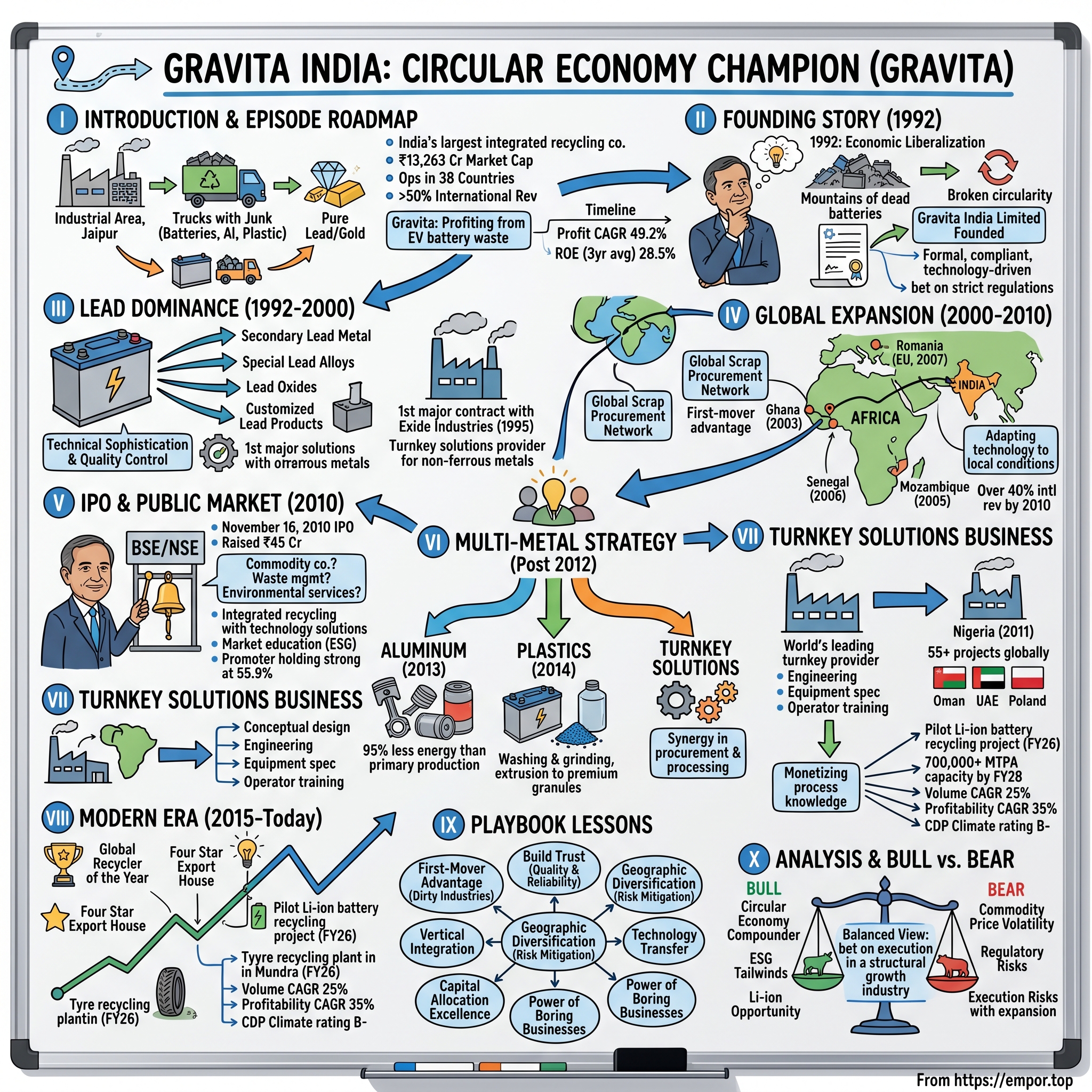
Gravita India: The Chemistry of the Spread
I. Introduction & Episode Roadmap
Picture a dead battery. It could come from an auto-rickshaw in Hyderabad, a diesel generator backing up a telecom tower in Accra, or an inverter that finally gave out during a Jaipur summer blackout. It weighs a few kilograms. Most of that weight is lead, locked in grey paste and grid plates soaked in sulphuric acid. Wrapped around it is a polypropylene case engineered to outlast almost anyone who handles it.
For most of the past three decades, that battery traveled down one of two paths. On the first, it went to a backyard furnace run by an informal smelter who cracked the casing with a hammer, poured the acid into the nearest drain, and melted the plates over an open fire while workers breathed the toxic fumes. On the second, far narrower path, it went to a licensed recycler that paid taxes, captured emissions, and produced secondary metal pure enough for a battery manufacturer to reuse. For years, informal operators held the advantage: unburdened by pollution-control expenses or taxes such as GST, backyard smelters could consistently outbid compliant recyclers for scrap.
Gravita India built its business on that second path, and for much of its history, formal compliance was an expensive discipline. Incorporated in Jaipur in 1992 by first-generation entrepreneur Rajat Agrawal,1 the company expanded over three decades into a multi-material recycler operating 14 manufacturing plants across four continents, serving more than 400 customers in 37 countries, and producing over 213,000 tonnes of recycled output.2 In FY26, it reported consolidated revenue of ₹4,265 crore and profit after tax of ₹378 crore.3
The core paradox
From the outside, Gravita resembles the kind of business conventional market wisdom suggests avoiding. It is a secondary smelter. It processes a hazardous metal. It procures scrap across volatile developing markets, and its top line fluctuates with London Metal Exchange (LME) lead prices. Throughout the 2010s, public markets priced it accordingly, treating it as an erratic commodity processor.
Internally, however, the company spent the past seven years redesigning itself into something closer to a toll road. Since mid-2019, Gravita has hedged not only its forward sales but also the "core inventory" residing inside its furnaces and operating pipelines.4 The objective is a model that captures a conversion spread per tonne, largely insulated from whether LME lead trades at $1,800 or $2,500. Between FY22 and FY25, consolidated adjusted EBITDA margins remained in a tight 9–11% band while lead EBITDA per tonne rose from approximately ₹15,900 to about ₹20,100.5 That operational stability forms the central thesis of the modern Gravita story—and the primary claim this study examines.
The structural inflection
The second pillar of the story is regulatory. India's Battery Waste Management Rules, notified in August 2022, placed Extended Producer Responsibility (EPR) obligations on battery producers and required manufacturers and recyclers to register on an online Central Pollution Control Board (CPCB) portal.67 Discarded batteries now require a verifiable paper trail. Informal smelters cannot generate one, whereas certified recyclers like Gravita can.
Why win, and what could break it
The bull case rests on three legs: Gravita operates as a hedged converter rather than a price speculator; formalisation is redirecting scrap toward certified operators; and a sourcing web built over two decades across Africa, Asia, and Latin America secures feedstock that domestic rivals cannot easily replicate. Yet each leg exhibits documented strain. Management guided to 25% annual volume growth, but on a January 2026 earnings call an analyst pointed out that five-year volume growth had tracked closer to 16–17%.8 Non-lead businesses such as aluminium, copper, and plastics cannot be hedged the way lead is.5 And in mid-2026, disruptions in the Middle East cut off the Gulf sourcing lanes that supplied 15–20% of the company's scrap imports.9
The narrative unfolds in six acts. Act I covers the Jaipur origins and the cross-border African arbitrage. Act II examines the public listing and the commodity trap. Act III details the 2019 balance-sheet and hedging reset. Act IV explores domestic formalisation under the 2022 battery rules. Act V assesses capital allocation: the ₹1,000 crore qualified institutional placement, the push into copper, and a strategic reality check on lithium-ion recycling. Act VI evaluates the company's competitive moats, the bear cases, and the key operating metrics worth tracking. It begins outside Jaipur, where the first furnace nearly killed the company before it had truly begun.
 Subscribe on LinkedIn
II. Jaipur Origins & The Africa-First Scrap Arbitrage (1992–2000)
Gravita's origin story departs from the familiar script of India's post-liberalisation industrial champions: it had neither a family conglomerate's balance sheet nor a legacy licence-raj monopoly. According to the company's milestone disclosures, its initial operations in 1992–93 focused on welding technology and powder metallurgy.[^10] Lead recycling began two years later. In 1994–95, Gravita set up a recycling unit in Jaipur with an annual capacity of 600 tonnes, a modest pilot by contemporary standards.[^10] It expanded into pure lead in 1996–97, and into grey oxide, red lead, and litharge in 1997–98—the essential chemical feedstocks battery plants require to produce active paste.[^10]
The founder and the economics of scrap
Rajat Agrawal established the enterprise as a first-generation entrepreneur.1 More than three decades after founding Gravita, he continues to steer the business as Chairman and Managing Director, with the board approving his re-appointment as MD for another three-year term in July 2024.1 Beyond corporate filings, public disclosures offer little personal biography; the company's operating record provides the clearer narrative.
Recycling lead is conceptually straightforward but operationally unforgiving. A spent lead-acid battery comprises roughly half to two-thirds recoverable lead by weight, with the remainder consisting of sulphuric acid, polypropylene casings, and inert residue. A recycler must break the battery, segregate the components, smelt the lead-bearing paste and grid plates in a furnace, and refine the crude bullion in heated kettles until it achieves commercial purity or a customer's specific alloy formulation. The operator's margin is simply the spread between the procurement cost of scrap and the selling price of refined metal, minus the costs of energy, labour, logistics, and environmental compliance. When a scrap collector adulterates the plates or furnace recovery slips, that spread quickly evaporates.
The Basel shock that closed the first plant
The most consequential event of Gravita's formative decade proved nearly fatal. In a 2021 initiation report, Emkay Global reconstructed how India's shifting trade regime, influenced by the Basel Convention on hazardous waste, disrupted the young business. New tariff schedules raised the import duty on lead scrap to approximately 30% while duty on finished lead stayed at about 5%.4 By taxing the raw material at six times the rate of the finished product, the policy inverted processing economics and forced Gravita to close the Jaipur plant.4
While subsequent accounts often frame Gravita's international footprint as an early search for scrap arbitrage, the initial foray abroad was born of sheer survival. Gravita did not venture overseas at the turn of the century to capture an opportunistic spread; it left because domestic tariff policy had rendered home manufacturing unviable.
Sri Lanka: the first escape hatch
That escape route opened in 2000–01, when Gravita acquired Navam Lanka Ltd., a lead and lead-alloy manufacturer in Sri Lanka.[^10] According to Emkay's analysis, the Sri Lankan acquisition turned profitable quickly, benefiting from a free trade agreement that let refined lead enter India duty-free.4 Capital generated through a mandated stake sale in Sri Lanka then retired the debt on the shuttered Jaipur facility, enabling Gravita to restart the Jaipur plant in the mid-2000s.4
The episode established a recurring theme in Gravita's corporate development. The company's initial competitive edge stemmed less from proprietary metallurgy than from jurisdictional arbitrage—siting processing assets where duty structures and trade treaties supported viable spreads, then moving refined metal across borders to wherever it commanded the highest value.
Correcting the calendar
While external accounts sometimes date Gravita's entry into Africa to 2000, company filings document a different sequence. Gravita's official records identify Ghana as its "first facility" in Africa in 2006–07, followed by Mozambique and Senegal in 2007–08.[^10] The 1992–2000 period was therefore not an aggressive African rollout, but a grueling decade of triage: starting a modest Jaipur smelter, absorbing an existential policy shock, shutting down, and securing a lifeline in Sri Lanka. The African expansion came later, executed by a business that had already learned how profoundly regulatory shifts can alter recycling economics.
That dynamic remains central to the company's operating reality. The same regulatory sensitivity that nearly destroyed Gravita in the late 1990s explains why formalisation mandates in India have become so structurally advantageous. Policy can eliminate a recycler's spread overnight or erect a protective moat around it, and the company's subsequent decade reflected a management team learning to position its balance sheet accordingly.
III. The Emerging Market Network & Turnkey Pivot (2000–2010)
Picture a coastal West African town in the mid-2000s. A scrap dealer backed an aging pickup truck into a fenced yard with a bed full of cracked, acid-stained batteries. There was no GST invoice and no hazardous-waste manifest. Instead, a local agent quoted a cash price per kilogram, calculated that morning against the London Metal Exchange benchmark. The yard belonged to an Indian recycler few locals recognized. Within days, those batteries would be broken, smelted into unrefined lead bullion, and loaded onto container vessels bound for India or Europe.
Why Africa worked
Emkay Global laid out the economic logic behind Gravita's African expansion in greater detail than the company's early regulatory filings provided. Africa offered abundant scrap feedstocks generated by an expanding fleet of imported, second-hand vehicles. Regional trade pacts allowed goods to move across borders with minimal friction, and informal competition was muted because local indirect tax frameworks were still rudimentary. Host governments, eager to encourage industrialisation, offered generous tax holidays: a complete corporate tax exemption for the initial ten years, stepping down to 50% and then 25% over subsequent five-year windows.4
Two structural advantages turned a modest operation into a lucrative cross-border arbitrage. Mozambique, Senegal, and Tanzania were classified as Least Developed Countries, allowing the 80–85% remelted lead Gravita produced there to enter India entirely duty-free. Ghana maintained a trade agreement with the European Union, providing an export corridor where Gravita sold the bulk of its Ghanaian refined lead and alloys.4 Furthermore, several African administrations barred the export of unprocessed scrap metal—the exact restriction that compelled Gravita to build local smelting plants rather than merely export raw batteries.4
That operating footprint delivered commanding market share across frontier territories that mainstream competitors bypassed. Emkay estimated that Gravita controlled roughly 60% of scrap collection across its operating jurisdictions, capturing about 30% in Ghana and over 85% in its other African markets. By FY21, the company maintained 27 overseas collection yards operating on a "reverse B2C" procurement model, recalculating local purchase prices daily against benchmark LME quotes.4 Emkay calculated that while Africa generated approximately 30% of consolidated revenue, it delivered more than 60% of consolidated net profit in FY21.4
The jurisdictional tax differential explained much of that earnings skew. Emkay observed that while statutory corporate tax rates across Gravita's African jurisdictions averaged around 25%, statutory holidays brought Gravita's effective tax rate down to roughly 10%.4 A company capturing identical pre-tax conversion margins in India and Ghana retained substantially higher net earnings in Ghana. Because tax incentives eventually sunset, opening a new facility in a fresh jurisdiction functioned partly as a mechanism to reset that holiday clock.
The turnkey business: selling the shovels
Operating smelting furnaces in regions plagued by unstable power grids, demanding climates, and sparse industrial supply chains compelled Gravita to engineer its own hardware. In 2002–03, the company institutionalised that engineering capability by incorporating Gravita Exim Limited to design and supply turnkey lead-processing plants.[^10] In 2011–12, it commissioned a dedicated fabrication facility within the Mahindra World City Special Economic Zone in Jaipur.[^10] Gravita has reported executing more than 70 recycling installations globally.[^11]
Strategically, the turnkey business carries far greater significance than its standalone financials suggest. In the quarter ended December 2025, turnkey solutions contributed roughly ₹3 crore in segment revenue out of more than ₹1,000 crore in consolidated turnover—a negligible top-line contribution.5 The primary advantage is internal. In-house engineering enables Gravita to fabricate and commission capacity at low capital intensity. On a January 2026 earnings call, executive director Naveen Sharma noted that the business operates at a capex-to-revenue ratio of approximately 8x to 10x, making it commercially feasible to maintain reserve capacity at overseas facilities where scrap deliveries arrive unpredictably.8 Emkay calculated that these low-cost installations achieved capital payback within approximately two years, while offering the flexibility to decommission, liquidate, or relocate equipment if host-country regulations turned adverse.4
Myth versus reality: the "unassailable" low-cost advantage
The conventional investment narrative of this era attributes Gravita's growth to an insurmountable low-cost feedstock advantage across emerging markets. The historical record indicates a more qualified reality.
First, the frontier playbook had clear boundaries. Gravita exited operations in Ethiopia and subsequently downgraded its Jamaican subsidiary to a collection depot after encountering adverse regulatory changes and insufficient regional scale.4 Frontier expansion carried real execution risk, and not every outpost proved viable.
Second, the competitive edge was never grounded purely in structural cost advantages. It rested on an intricate scaffold of preferential tariffs, host-government tax holidays, raw scrap export bans, and bilateral trade treaties. Each element represented a discretionary political choice subject to revision or repeal. An operational moat anchored to another nation's tariff schedule is functional, but ultimately rented.
Third, geographic diversification offered no shelter from global commodity volatility. LME cash lead surged to nearly $3,890 per tonne in October 2007 before plummeting roughly 75% to approximately $960 per tonne by December 2008 during the global financial crisis.10 For an unhedged processor shipping unrefined bullion across open oceans on 30- to 60-day transit lanes, that collapse served as an expensive operational lesson. Because Gravita remained closely held at the time, its inventory markdowns from that crash do not appear in the historical disclosures reviewed for this analysis. The economic transmission mechanism, however, was inescapable: work-in-progress inventory floating on the water was repriced daily by market forces, regardless of how cheaply the original scrap was procured.
The historical evidence leaves the cross-border arbitrage thesis valid, but bounded. Gravita established a defensible sourcing apparatus in specific frontier markets where it consolidated scrap collection—provided those host nations preserved their prevailing trade and tax frameworks. The critical indicator is the overseas contribution to total earnings. Management reported that international operations generated 24% of net profit in the third quarter of FY26, down sharply from Emkay's estimate of more than 60% in FY21.84 That compression reflects both the rapid expansion of Gravita's domestic Indian business and a narrowing of overseas spreads. Determining the relative magnitude of each factor remains a central question for capital allocators.
By 2010, Gravita had established nine manufacturing facilities spanning Africa and Asia.11 It also faced an inescapable constraint: self-funded cash flows could no longer sustain its capital ambitions, prompting a turn toward public equity markets.
IV. IPO, Commodity Whiplash, & The Hedging Crisis (2010–2019)
On November 16, 2010, Gravita India shares debuted on the BSE and the National Stock Exchange of India (NSE).11 The offering itself was modest: the company issued 36 lakh fresh shares at ₹125 each to raise ₹45 crore during a subscription window that ran from November 1 to 3.11 Investor interest, however, was substantial, with the book subscribed 42 times over.11 For a Jaipur-based lead recycler operating overseas facilities in Ghana and Mozambique, the listing marked a significant vote of confidence from public markets.
What the IPO money was for
The prospectus disclosures outlined how management intended to deploy the proceeds. Approximately ₹13 crore was earmarked for capacity expansion at Jaipur and a new manufacturing facility at Wada in Maharashtra. Another ₹24 crore was allocated to overseas investments and cross-border expansion, while the remaining ₹10 crore was directed toward working capital requirements.11 More than half the net capital raised was targeted outside India, confirming that the African sourcing and smelting network remained central to the company's growth strategy.
The years immediately following the listing brought continuous capacity additions. Gravita acquired two lead plants in Jammu & Kashmir in 2011–12 and established a facility in Gujarat in 2012–13, alongside new operating subsidiaries in Nicaragua and Trinidad & Tobago.[^10] Production of value-added products began at Jaipur in 2013–14, aluminium recycling was introduced in 2015–16, and a lead smelting plant at Chittoor in Andhra Pradesh commenced commercial operations in 2016–17.[^10]
The lost decade in the income statement
Yet physical footprint expansion failed to generate consistent bottom-line returns. Consolidated accounts compiled by Screener show that net profit stood at roughly ₹10 crore in FY15 before slipping to about ₹5 crore in FY16 alongside weaker sales. Although profit recovered to approximately ₹35 crore in FY17 and ₹48 crore in FY18, it tumbled back to about ₹19 crore in FY19—even as consolidated revenue touched a record ₹1,242 crore.12 Operating margins halved that year, compressing from about 9% to roughly 5%.12
An industrial enterprise whose revenue expanded by more than 20% while net profit dropped by over 60% was clearly not functioning as an insulated conversion toll road. It was behaving like an unhedged commodity processor exposed to open-market pricing shocks.
The core-inventory blind spot
The mechanism behind the FY19 earnings contraction provides an instructive case study in secondary metals economics. Beginning in June 2016, at the start of FY17, Gravita instituted what it termed back-to-back sales hedging. Whenever scrap was procured, the company sold the equivalent volume of refined metal on the same day, either through bilateral customer agreements or through London Metal Exchange forward contracts squared off upon final product delivery.4
That protocol hedged operational flow, but it overlooked operational stock. A smelting enterprise must continuously carry a structural layer of metal inside its production pipeline: charges inside furnaces, molten bullion sitting in refining kettles, and work-in-progress inventory moving between collection yards and processing plants. Gravita left this "core inventory" unhedged. When global lead prices fell sharply in FY19, that pipeline inventory faced steep markdowns. Emkay Global's reconstruction revealed an inventory loss substantial enough to turn the consolidated inventory line negative, even while underlying processing margins remained intact.4 LME cash lead had climbed to roughly $2,680 per tonne in 2018 before retreating, leaving an operator carrying thousands of tonnes of unhedged metal fully exposed to the price contraction.10
The operational vulnerability was systemic: management had hedged the metal moving through the plant gates, but left the metal residing inside them exposed to commodity volatility. Much like an airline hedging upcoming fuel deliveries while leaving fuel reserves already sitting in storage tanks unhedged, the enterprise remained vulnerable to broader commodity swings.
The June 2019 reset
Gravita addressed the vulnerability in June 2019 by taking LME forward contracts against its core inventory as well.4 Emkay's post-implementation analysis showed the structural outcome: starting in FY20, the company avoided inventory write-downs while simultaneously forfeiting unhedged inventory windfalls when benchmark prices rose.4 Credit rating agency Brickwork Ratings recorded consolidated EBITDA margins widening from 5.23% in FY19 to 8.6% in FY21, noting that the enterprise had begun hedging "the entire commodity price exposure and foreign currency exposure" through daily LME forward positions.13
Public records do not definitively attribute the design of this hedging framework to an individual executive. Yogesh Malhotra was appointed Chief Executive Officer in January 2020, having previously served as a director of Gravita Global Pte Ltd and as General Manager of Projects at Euro Chemicals. He held an undergraduate degree from Malaviya Regional Engineering College and an MBA from the National University of Singapore.14 While the hedging overhaul coincided with his executive progression, disclosed filings do not detail the internal division of responsibility for its implementation.
Weighing the evidence
Did the June 2019 transition convert Gravita into a genuinely market-neutral toll processor? The subsequent financial record suggests it largely did, subject to two important caveats. Consolidated adjusted EBITDA margins remained within a predictable 9–11% range between FY22 and FY25 despite significant movements in LME lead benchmarks,5 and consolidated net profit grew in every fiscal year following FY19.12
Two operational nuances remain relevant. First, balance-sheet hedging does not eliminate interim reporting volatility. As Emkay highlighted, open LME derivative contracts generate mark-to-market gains and losses across quarterly reporting cycles that only resolve once physical deliveries conclude.4 Second, the strategy depends fundamentally on deep and liquid derivatives exchanges—a structural condition largely unique to lead. As Gravita scales secondary processing across aluminium, plastics, and copper, each non-lead vertical tests whether its spread-capture model can operate with equal price neutrality.
V. The Anatomy of a Spread Business: How Gravita Actually Makes Money
Inside a Gravita lead plant, tracing a single battery illustrates the operational physics of the business. Cracked in a mechanical breaker and washed through a hydro-separation system, the battery's polypropylene casing floats, its metallic fractions sink, and its sulphuric acid drains away. The recovered lead paste and grid plates feed directly into a furnace. The resulting crude bullion flows into refining kettles to be desilvered, purified, or alloyed to a customer's specification. Finished ingots emerge stamped for battery manufacturers such as Amara Raja in Andhra Pradesh or automotive original equipment manufacturers across Southeast Asia. Moving from scrap breaker to refined ingot takes anywhere from several days to several weeks. The company's primary operational objective across that window is ensuring that the profit earned during processing remains indifferent to fluctuations on the London Metal Exchange.
Price in, price out
The pricing formula makes that balance-sheet insulation possible. On an earnings call in January 2026, CEO Yogesh Malhotra explained that Gravita procures scrap "at a discount over the LME prices." When benchmark prices rise, the absolute purchase cost of scrap rises in tandem, but the discount remains relatively stable, "so the margin between the selling price and the buying price remains intact, more or less."8 Gravita's annual report outlines the revenue side: finished goods are generally sold at monthly average prices linked to the LME and India's Multi Commodity Exchange (MCX).1
Because both input and output are indexed to identical market benchmarks, commodity price risk reduces almost entirely to a timing mismatch. Scrap procured today reaches customer loading docks weeks later as refined alloy. Gravita's back-to-back hedging protocol neutralises that lag: the company sells the equivalent volume of finished metal forward on the day scrap is purchased, then closes out the derivative position upon physical delivery. What remains is an unadulterated conversion spread: the discount secured on scrap, plus any custom alloy premium, minus operating conversion costs.
A worked example
Consider a stylised transaction. A Gravita yard procures 1,000 tonnes of lead-bearing scrap on a Monday at an agreed discount to prevailing LME cash quotes. That same day, the treasury desk sells the recoverable lead content forward, either via a fixed-price customer order or an LME forward contract. Over the subsequent weeks, the scrap is broken, smelted, refined, and cast into ingots.
If benchmark lead drops 10% during the processing cycle, the physical ingots fetch 10% less upon final delivery. However, the short forward position entered on Monday gains an equivalent amount when closed, cancelling the revenue shortfall. If lead surges 10%, the higher realization on the physical metal offsets the loss incurred on the hedge. In either scenario, Gravita retains the spread established on day one: the procurement discount on the scrap, the premium for secondary metallurgical purity, and furnace recovery efficiency. It is the structural distinction between a speculator holding inventory in hopes of a price rally and a toll processor capturing a fee for industrial service.
The June 2019 balance-sheet reset extended this logic to the permanent metal residing within the operating pipeline. Before that overhaul, incoming daily procurement was hedged, but molten metal and work-in-progress circulating inside the kettles remained exposed.
A diligence footnote on "100% hedged"
Management frequently asserts that Gravita is "100% hedged in lead."8 Disclosures in the FY25 annual report provide essential nuance. Standalone lead exposure totaled ₹5,422 crore across approximately 350,646 tonnes, of which 33.05% was hedged through derivative instruments, mostly on international exchanges.1 The reporting note tallies procurement and sales on a gross basis and explicitly excludes natural hedges, meaning customer contracts priced off the same index.1
These disclosures do not contradict management's broad claim. Natural contractual alignment carries the bulk of the hedging burden, while exchange-traded derivatives cover the residual timing exposure. For investors, however, the distinction matters: Gravita's protection does not rely solely on a trading desk shorting every physical tonne on the LME, but on rigorous contractual indexing across both procurement yards and customer agreements.
Why EBITDA per tonne is the number that matters
For a toll converter, traditional percentage margins obscure operational health. If London lead quotes double, consolidated revenue doubles while the absolute per-tonne conversion spread remains flat—halving reported percentage margins despite unchanged operating cash generation. Conversely, declining commodity prices flatter percentage margins. Consequently, EBITDA per tonne serves as the primary metric of processing discipline.
Evaluated on that metric, performance following the 2019 hedging reset showed sustained expansion. Financial analysis by JM Financial recorded lead EBITDA per tonne at approximately ₹15,900 in FY22, ₹19,000 in FY23, ₹19,600 in FY24, and ₹20,100 in FY25.5 Realisations strengthened further across FY26, logging roughly ₹21,800, ₹23,200, and ₹23,000 in the first three quarters, before reaching ₹24,181 in Q1 FY27.59
Management's public guidance, however, remained noticeably more conservative than its actual prints, consistently reiterating ₹19–20 per kilogram (₹19,000–20,000 per tonne) as the sustainable baseline. Questioned on the January 2026 earnings call about the reluctance to raise guidance in light of realised numbers exceeding ₹23 per kilogram, Malhotra clarified that the premium reflected transitory arbitrage achieved by redirecting African intermediate bullion into Indian processing facilities. He added that "we will have to probably wait for maybe six more months to see whether we can sustain these kind of margins or not."8 That acknowledgement underscores a critical distinction: a meaningful portion of recent per-tonne margin expansion reflected cross-border freight and tariff arbitrage rather than permanent pricing power.
Four businesses hiding inside "lead"
The consolidated lead segment conceals four distinct operating engines. According to JM Financial's operational breakdown:5
- Overseas recycling, representing approximately one-third of total volumes. This remains the most profitable channel, generating roughly ₹28,000 of EBITDA per tonne by leveraging frontier scrap consolidation and host-nation tax holidays.
- Imported scrap processed in India, accounting for another third of volumes, delivering approximately ₹18,000 to ₹19,000 per tonne.
- Domestic institutional scrap collection, generating 8% to 10% of volumes at roughly ₹12,000 per tonne.
- Tolling arrangements for battery OEMs, comprising roughly a quarter of volumes. Here, automotive battery makers provide spent batteries and receive refined lead. Tolling commands only ₹7,000 to ₹8,000 of EBITDA per tonne, but requires minimal working capital, yielding return-on-capital figures substantially higher than the headline margin implies.
This composition explains the operational cross-currents beneath Gravita's reported averages. A quarter tilted toward tolling suppresses segment margins while boosting capital efficiency; a period weighted toward African facilities inflates per-tonne earnings. Furthermore, when management routes African bullion into domestic plants to exploit regional price discrepancies, reported consolidated volumes can optically contract because intercompany sales are eliminated, even though more metal was processed.8
Value-added products: the premium layer
Product mix provides an additional margin lever. Standard refined lead trades strictly at commodity parity. Specialised lead alloys—such as antimonial or calcium formulations tailored to proprietary battery grid designs—and high-purity lead oxides command commercial premiums above LME cash prices. Historical tracking by Emkay Global documented value-added products (VAP) expanding from 28% of total revenue in FY17 to 42% in FY20, highlighting that VAP premiums tend to widen during commodity downturns, which cushions realisations.4
By FY25, VAP was 46% of revenue.1 In Q1 FY27 it jumped to 63%, although that figure is swollen by the newly consolidated copper business, whose products are by nature processed metal.2
The operational record demonstrates that Gravita's lead segment functions effectively as a spread-capture business. Yet the steady widening of that spread owes as much to geographic channel shifts and temporary regional arbitrage as to structural conversion power—a nuance management itself has treated with deliberate caution. How domestic environmental regulations reshaped the availability and cost of that scrap feedstock forms the next chapter of the transformation.
VI. The Great Formalization: BWMR 2022, EPR, & The Fall of the Backyard Smelter
In the alleyways behind India's scrap markets, the informal lead trade ran on cash for decades. A mechanic swapped a driver's spent battery for a replacement, sold the casing to a local kabadiwala for cash, and the dealer passed it along to an unlicensed backyard smelter who could outbid formal recyclers by pocketing the unpaid taxes. No tax was collected, no environmental controls were maintained, and no paper trail was generated. The price advantage informal smelters held was never massive, but it did not need to be: in a secondary processing trade where operating spreads amount to a few rupees per kilogram, a cost advantage of just a few percentage points is decisive.
The size of the shadow market
Emkay Global's 2021 industry analysis estimated total Indian lead demand at roughly 1.2 million tonnes in FY21. Secondary recycling supplied approximately 0.77 million tonnes of that total, yet barely 30% of recycled volume flowed through organized operators.4 India had introduced Extended Producer Responsibility frameworks decades earlier: the Batteries (Management and Handling) Rules of 2001 formally required manufacturers to establish organized buyback and recycling networks, but Emkay estimated that actual compliance hovered around 30%.4 The mandates existed on paper; enforcement was virtually nonexistent.
What BWMR 2022 changed
In August 2022, the Ministry of Environment, Forest and Climate Change overhauled that structure by notifying the Battery Waste Management Rules, 2022.6 The updated framework replaced paper declarations with digital traceability. Battery manufacturers and producers must register with the Central Pollution Control Board (CPCB) and fulfill mandatory collection, recycling, and refurbishment quotas that escalate over multi-year schedules.7 Crucially, every stakeholder across the supply chain—producers, recyclers, and refurbishers alike—must log transactions through a centralized online portal.7 Producers failing to meet their obligations incur environmental compensation fines, while non-compliant recyclers face the revocation of their operating registrations.7 Furthermore, the regulations instituted mandatory recycled-content thresholds for newly manufactured batteries, requiring 5% domestically recycled lead starting in 2027–28 and scaling to 20% by 2030–31.7
That recycled-content mandate carries profound commercial implications: rather than merely penalizing uncollected scrap, the law establishes legislated demand for secondary metal processed inside India.
Complementary policy mechanisms have compounded that compliance pressure. Research by JM Financial highlighted that mandatory recovery quotas for automotive batteries stepped up to 60% beginning in 2025–26, while the application of Goods and Services Tax reverse-charge mechanisms—which shift tax liability from informal scrap sellers to commercial buyers—substantially raised operating hurdles for cash-based smelters.5 On an earnings call in January 2026, Gravita executives informed analysts that government think-tank NITI Aayog had recommended integrating the CPCB's EPR registry directly with GST invoice networks to tighten scrap audit trails and close remaining tax-evasion loopholes.8
Where Gravita fits
For certified operators, the new regulatory regime transformed recycling from a transactional commodity sale into an essential compliance partnership. Automotive and industrial battery manufacturers now required verified audit documentation demonstrating that scrap was handled by accredited facilities, redirecting volumes toward corporate recyclers equipped with environmental permits, laboratory standards, and digital reporting systems.
Disclosed operational data confirms this domestic shift, though its trajectory has been uneven. Gravita's FY25 annual report credited "stringent regulations" with driving a 60% expansion in domestically sourced scrap.1 JM Financial observed that the domestic proportion of scrap feeding Gravita's Indian smelters rose from approximately 36% to roughly 52%.5 Bilateral tolling agreements with Amara Raja had long formed an operational anchor, and Gravita expanded its engagement with Exide Industries across both secondary metal supply and scrap reclamation contracts. However, as of January 2026, Exide had not yet entered Gravita's list of top ten customers.8
The mechanics of tolling illustrate how formalization manifests in practice. Under a tolling agreement, the battery manufacturer retains title to its discarded scrap, delivers it to Gravita for smelting and refining, and takes back pure metal or specialized alloys for a pre-negotiated conversion fee. In FY21, tolling accounted for 14% of Gravita's standalone revenue.4 By early 2026, JM Financial estimated that tolling had expanded to roughly a quarter of consolidated volume.5 That expansion demonstrates automotive OEMs actively utilizing certified recyclers to satisfy statutory obligations. Yet as the operational economics detailed earlier highlight, tolling delivers the leanest per-tonne EBITDA in Gravita's portfolio—generating roughly ₹7,000 to ₹8,000 per tonne, cushioned primarily by negligible working capital requirements. Formalization delivers assured operating volumes and counterparty security, but does so through the lowest-margin channel in the business. Models that treat regulatory compliance as unmitigated per-tonne margin upside overlook that compositional dilution.
Under the BWMR framework, accredited recyclers generate EPR certificates on the central portal that original equipment manufacturers purchase to validate regulatory compliance.1 Because Gravita does not disclose EPR certificate monetization as a separate line item in the financial reports reviewed, external claims that certificate trading constitutes a lucrative new profit stream remain unverified. On the January 2026 investor call, management consistently emphasized volume throughput and auditable sourcing rather than trading revenues from regulatory credits.
Testing the regulatory moat
The bullish investment thesis contends that the 2022 rules construct an unassailable domestic moat that guarantees sustained volume growth. Gravita's reported operating figures suggest a more qualified reality.
First, domestic scrap procurement has fluctuated widely. In the third quarter of FY26, domestic scrap accounted for just 25% of Indian plant feedstock, while imports surged to 75%. Gravita's chief financial officer explained that normal domestic procurement tracked closer to 45%, attributing the quarterly slump to inventory pre-stocking ahead of planned capacity additions and tactical arbitrage from African bullion.8 By the first quarter of FY27, the domestic share stood at 35%.9 A structural regulatory barrier that completely locked up domestic feedstock would not exhibit procurement swings spanning from 25% to 52% in the course of a single year.
Second, regulatory enforcement remains thoroughly decentralized. While the Ministry of Environment crafts national policy, operative consents to establish and operate are administered by state pollution control boards. In January 2026, regulatory clearance for Gravita's expanded capacity at Mundra in Gujarat was delayed because state environmental officials were occupied with the Vibrant Gujarat Global Summit, according to Malhotra.8 While management characterized the approval as a procedural formality, that formality still consumed an entire operating quarter. The regional administrative apparatus tasked with licensing compliant corporate plants is the same overburdened machinery responsible for shutting down backyard smelters across sprawling industrial corridors.
Third, the informal sector retains dominant volumes. JM Financial estimated that only 35% to 40% of India's spent battery scrap reached organized recyclers in 2026, with Gravita capturing roughly 6% to 7% of total market volume.5 That modest share highlights an expansive addressable runway, but it also demonstrates that four years after the 2022 rules were notified, the majority of spent lead batteries still bypassed compliant industrial recyclers.
Formalization is undeniably a structural tailwind, but it operates as a multi-year industrial grind rather than an immediate binary shift. Its speed remains tethered to state-level administrative capacity outside Gravita's control. For investors tracking the domestic thesis, the critical metric is the proportion of domestic scrap feeding Indian facilities: if that share stabilizes comfortably above management's 45% baseline, formal compliance channels are consolidating. If it repeatedly retreats toward 25%, the informal market remains deeply entrenched. The subsequent question is how durable Gravita's position is against rivals who can read the same rulebook.
VII. Competitive Landscape & Strategic Moats: 7 Powers & Five Forces
Suppose a well-funded entrant wanted to build Gravita from scratch in 2026. Securing furnaces is straightforward: Gravita designs and fabricates its own equipment and sells turnkey systems to third parties. The real hurdle lies in assembling everything surrounding the hardware: navigating state pollution control board clearances that can take months even when treated as procedural formalities, establishing a sourcing network of roughly 1,900 touchpoints and 33 owned scrap yards, cultivating direct channels with global commodity traders, passing OEM qualification audits for specialized alloys, and running a treasury desk capable of executing daily hedges on the LME.58 The strategic question is which of those pieces represents a durable competitive moat rather than merely accumulated operational complexity.
The field
Historically, India's organized lead-recycling peers have operated at smaller scale and lower margins. In FY21, Emkay Global contrasted Gravita's revenue of about ₹1,410 crore and EBITDA margin of 7.9% with Pondy Oxides & Chemicals at about ₹1,004 crore and 2.3%, and Nile Ltd at roughly ₹536 crore and 4.6%.4 Emkay also identified Chloride Metals, Exide's in-house recycling arm, as a primary competitor—a critical dynamic, because a battery giant that recycles for itself functions simultaneously as an important customer and an integrated rival.4
By early 2026, the competitive picture had shifted. A March 2026 peer comparison by JM Financial showed Pondy Oxides at a market capitalization of about ₹3,400 crore against Gravita's ₹11,300 crore, while Jain Recycling stood at approximately ₹13,200 crore, overtaking Gravita in equity value.5 Jain Recycling emerged as an aggressive listed challenger, posting revenue growth of 121% in FY24 and 48% in FY25.5 Gravita no longer commands the formal Indian secondary metals trade in isolation.
Globally, Ecobat refines close to one million tonnes of lead annually, operating at several times Gravita's scale, while Boliden runs integrated secondary recycling alongside primary mining.4
Operating profitability is where Gravita separates itself most clearly. JM Financial found that Gravita generated adjusted EBITDA margins of 9–10.5% between FY22 and FY25, compared with mid-single-digit margins at most listed Indian peers.5 Part of that premium reflects the higher-margin African collection hubs and a richer value-added product mix, rather than superior domestic conversion spreads alone. Equity valuations reflected that performance gap: in March 2026, Gravita traded at about 26 times estimated FY26 EV/EBITDA, while global integrated players such as Boliden and Aurubis traded at roughly 7.5 and 10.8 times.5 Public markets rewarded Gravita's growth profile and hedged stability, leaving little cushion if volume execution falters.
Hamilton Helmer's 7 Powers, tested
Process Power: partially earned. Gravita's in-house engineering, a capex-to-revenue ratio of 8–10x, and Indian plant utilization above 90% provide measurable cost and execution efficiencies.8 Management claims its operating costs and recovery yields outpace global competitors, though public filings offer no independent metallurgical benchmarking to verify the extent of that advantage. The hedging discipline established in 2019 is an effective operational shield, but it relies on established derivatives practices rather than proprietary science—a skill rather than a secret.
Scale Economies: modest. A 6–7% share of India's fragmented scrap market does not confer decisive production scale economies over domestic rivals.5 Scale matters more in procurement and logistics, where operating plants near coastal ports allows Gravita to switch between domestic feedstock and imported scrap depending on landed costs. That supply-chain flexibility proved essential when geopolitical disruption shut down Gulf shipping corridors in mid-2026.
Counter-Positioning: historically effective, now fading. Moving into frontier African markets in the mid-2000s, when established recyclers viewed the region as unmanageable, was a classic counter-positioning strategy. Two decades later, those operating footholds are mature, and domestic Indian competitors are pursuing their own cross-border sourcing. The more relevant test is whether Gravita can execute a similar playbook in mature Western markets, such as its planned collection outpost in the United States.9
Cornered Resource: rented, not owned. Gravita's African sourcing presence and its Indian regulatory registrations carry genuine commercial value. However, the African procurement advantage depends on host-country export bans on raw scrap and temporary tax holidays, while Indian CPCB registrations are available to any compliant recycler meeting statutory environmental standards.4 These assets represent regulatory licenses to compete rather than proprietary monopolies.
Switching Costs: moderate and rising. Custom alloy formulations tailored to proprietary battery grids and multi-year tolling contracts tie OEMs more closely to a recycler. Yet closer commercial alignment increases concentration risk: Brickwork Ratings data showed that Gravita's top ten customers accounted for over 70% of FY21 sales, up from 45% in FY19.13 Customer concentration cuts both ways.
Network Economies and Brand: largely absent. The London Metal Exchange's registration of the "GRAVITA M" brand in 2026 is an important credential for delivering refined lead directly into global bonded warehouses, but it represents an industrial quality certification, not a self-reinforcing network effect.9
Porter's Five Forces
Bargaining power of buyers is moderate to high. Battery manufacturers are consolidated and negotiate procurement contracts on index-linked terms. Management has stated that it targets selling 70% of lead volumes directly to OEMs and 30% to institutional trading houses such as Trafigura, Glencore, and Thyssen, acknowledging that delivering metal to terminal exchanges yields lower realizations than direct commercial sales.8 The liquidity of the LME and MCX provides a guaranteed clearinghouse, but only at the expense of value-added fabrication premiums.
Bargaining power of suppliers is moderate. Fragmented scrap aggregators routinely withhold physical material during rising commodity cycles to speculate on higher cash prices—behavior Gravita cited as the primary reason for its aluminium volume contraction in Q3 FY26.8 Maintaining proprietary collection yards tempers this merchant friction, but cannot eliminate it entirely.
Threat of substitutes is low in the medium term, uncertain over the long horizon. Lead-acid batteries retain dominant cost and performance advantages across internal combustion engine starting, stationary inverters, and telecom backup systems throughout developing markets. Nevertheless, JM Financial highlighted the secular transition toward lithium-ion alternatives as an ongoing strategic risk to lead-acid demand over the next decade.5
Threat of new entrants is moderate. Stringent environmental clearances, extensive multi-jurisdictional logistics, and sizable working-capital requirements create meaningful hurdles, yet the rapid rise of Jain Recycling demonstrates that well-funded domestic challengers can scale quickly under the new formalization rules.
Rivalry is moderate and shifting. JM Financial observed that persistent pricing pressure from informal players in low-value-added products has kept baseline conversion margins largely stable rather than widening, despite industry consolidation.5
Gravita's competitive moat is not an impregnable single barrier, but an intricate bundle of moderately difficult disciplines: frontier scrap aggregation, in-house equipment fabrication, core-inventory balance-sheet hedging, and institutional customer qualification. Coordinating all four disciplines across multiple continents provides a genuine operational edge, but maintaining that bundle requires continuous capital reinvestment—which is where the company's capital allocation strategy faces its next test.
VIII. Capital Allocation & The Multi-Material Frontier
In December 2024, Gravita executed the largest capital raise in its corporate history. The scale illustrated how dramatically the market's perception had shifted: an enterprise that had raised ₹45 crore at its public debut fourteen years earlier now approached institutional investors for ₹1,000 crore.
The QIP
The qualified institutional placement opened on December 16, 2024, and closed on December 19. Gravita issued 4,770,537 equity shares at ₹2,096.20 each, representing a 5% discount to the regulatory floor price of ₹2,206.49.15 Anchor interest was concentrated: Oxbow Master Fund and Mirae Asset Mutual Fund each absorbed 12.40% of the issue, with the top five allottees taking approximately 41% of the total offering.15 According to the FY25 annual report, the book was oversubscribed 3.5 times, and the proceeds extinguished net corporate debt.1
The capital infusion transformed the balance sheet. Analysis by JM Financial documented net debt of approximately ₹133 crore at the end of FY24 swinging to a net cash surplus of roughly ₹281 crore by the close of FY25.5 Management designated the fresh capital for capacity expansions and diversification into adjacent materials. The capital expenditure framework outlined in the FY25 annual report earmarked ₹1,500 crore through FY28, directing approximately ₹1,000 crore toward existing business lines and allocating the remaining ₹500 crore toward lithium-ion, paper, and steel recycling.1
For public shareholders, however, the valuation commanded during the placement proved exacting. Trading data from Screener showed the stock at approximately ₹1,515 on September 24, 2026—roughly 28% below the QIP allotment price.12 The institutional investors who underwrote the multi-material expansion were left holding unrealized losses as the operational rollout unfolded.
The segment picture
Lead remains Gravita's operational core. In FY25, lead processing contributed approximately ₹3,419 crore out of ₹3,869 crore in consolidated turnover, while aluminium generated about ₹341 crore and plastics brought in roughly ₹85 crore.5 Under the "Vision 2029" roadmap articulated in the FY25 annual report, management targeted deriving more than 30% of consolidated turnover from non-lead segments and lifting value-added products to at least 50% of total revenue.1
The non-lead verticals, however, have not replicated lead's financial profile:
- Aluminium. Production volumes contracted from approximately 19,100 tonnes in FY23 to about 14,700 tonnes in FY24. Unit economics exhibited notable volatility: EBITDA per tonne fell from roughly ₹22,100 in FY22 to ₹12,400 in FY24, before recovering to about ₹19,900 in FY25.5 Crucially, management acknowledged that Gravita conducts no aluminium recycling within India because its principal output—the ADC12 casting alloy—cannot be hedged on any domestic or international commodity exchange. Gravita spent over eighteen months awaiting regulatory approval for the Multi Commodity Exchange of India (MCX) to list an ADC12 derivative contract, a clearance that remained pending as of July 2026.89 Without an exchange-traded contract, the company cannot replicate the back-to-back hedging protocol that shields its lead division.
- Plastics. Volumes retreated from roughly 16,300 tonnes in FY22 to about 12,100 tonnes in FY25, generating approximately ₹10,000 in EBITDA per tonne.5 Management guided to modest near-term volume growth of 8–10%, citing prolonged customer qualification cycles as consumer brand owners moved cautiously in approving recycled polypropylene for primary packaging.8 While the operational feedstock synergy is genuine—given that spent lead batteries supply their own polypropylene casings—meaningful volume scale has yet to materialize.
- Turnkey solutions. Segment revenue remained modest and intermittent, though in-house engineering continues to provide capital-light equipment fabrication for internal expansions.
The RMIL copper deal
The most significant capital allocation decision in Gravita's history arrived swiftly in early 2026. On an investor call on January 23, when asked about prospects in copper, Malhotra acknowledged that copper "can also be one of the segments that Gravita would go into."8 Shortly thereafter, JM Financial reported that the company had executed a binding term sheet to acquire up to 100% of Rashtriya Metal Industries Limited (RMIL) for an aggregate consideration of up to ₹565 crore.5 On March 12, 2026, Gravita announced a definitive share purchase agreement to acquire a 98.95% stake in RMIL for ₹559.08 crore in an all-cash transaction scheduled to close by March 31.16 Subsequent filings confirmed that Gravita raised its holding to 99.44% for a total cash payout of ₹561.84 crore.2
Established in 1946, RMIL operates a 31,200-tonne-per-annum copper and copper-alloy manufacturing facility at Sarigam in Gujarat.1716 The enterprise maintains an established international client base, generating approximately 40% of its sales from export shipments to markets including the United Arab Emirates, the United States, and Saudi Arabia.16 For FY26, RMIL reported revenue of roughly ₹1,040 crore and EBITDA of about ₹82 crore.2 Measured against the equity consideration alone, the acquisition valued RMIL at approximately seven times trailing EBITDA, though the full enterprise valuation inclusive of assumed debt was not detailed in disclosed corporate filings.
The strategic rationale rests on supply-chain integration. Management argued that Gravita's global scrap collection apparatus could supply secondary feedstock directly to RMIL's fabrication mills. To support that integration, Gravita announced plans to construct a 29,400-tonne copper recycling facility at Mandvi in Gujarat at an estimated cost of ₹160 crore, targeting commissioning within twelve months.3 Over a three-year horizon, management projected roughly doubling RMIL's operational capacity to approximately 60,000 tonnes per annum.2
Historical capital expenditure patterns, however, warrant scrutiny. On the January 2026 earnings call, an analyst observed that quarterly capital outlays had steadily decelerated, totaling approximately ₹125 crore across the first nine months of FY26 against an annual budgeted target of ₹200 crore. Executive director Naveen Sharma responded that brownfield project modularity reduced required capital outlays, while also acknowledging that "there have been some delays" in equipment installation and regulatory clearances.8 While lean brownfield fabrication reflects disciplined engineering, recurring execution slippage represents an operational vulnerability for an enterprise whose compounding thesis depends on punctual capacity commissioning.
Initial operating results under Gravita's ownership presented a nuanced picture. In the first quarter of FY27, copper contributed ₹376 crore in revenue, generating ₹55,151 in EBITDA per tonne, yet the Sarigam plant operated at only 50% capacity utilization. The segment's EBITDA margin registered at roughly 5.2–5.3%, trailing the consolidated group average.9 Management attributed the compressed margin percentage to surging underlying metal prices as benchmark copper climbed from roughly $9,000 to $13,500 per tonne, while guiding to long-term conversion spreads of ₹70,000 to ₹75,000 per tonne within two and a half years.9 When an analyst observed that Gravita's network of more than 39 overseas scrap depots resides predominantly in developing economies that generate minimal industrial copper scrap, management conceded the structural mismatch, stating that an overseas collection depot in the United States would be established to secure mature copper feedstocks.9
Testing the optionality: the record on new verticals
Evaluating these capital projections requires examining Gravita's track record in incubating new materials. In December 2021, Emkay Global documented an ambitious slate of diversification targets articulated by management: a 1,600-tonne copper and brass facility in Tanzania and a rubber recycling plant in Ghana scheduled for the first half of 2022; a 24,000-tonne copper recycling plant at Mundra targeted for FY25; a 90,000-tonne steel plant in Africa by FY24–25; a 96,000-tonne waste-paper processing unit in Nicaragua by FY25–26; and commercial lithium-ion recycling toward the end of the decade.4
Nearly five years later, execution has diverged significantly from that blueprint. Steel and paper remain deferred line items in long-range capex presentations.8 Commercial copper processing was achieved through an opportunistic domestic acquisition in 2026 rather than organic commissioning at Mundra. Rubber processing was established primarily via an acquisition in Romania, while a planned rubber facility at Mundra was "temporarily shelved" in July 2026 to redirect capital toward copper integration.9 Lithium-ion recycling stands as the sole initiative tracking its original calendar: Gravita commissioned a 6,000-tonne pilot facility at Mundra in FY26 at a modest outlay of approximately ₹14 crore.517 Management, however, characterized the unit strictly as an experimental pilot, cautioning that material commercial revenues should not be anticipated in the near term.18
This operating history does not imply that Gravita's diversification ambitions lack substance, but it demonstrates that capital allocation timelines have frequently slipped and that project selection pivots opportunistically. The RMIL transaction may ultimately deliver attractive industrial integration. Nevertheless, capital allocators must weigh the targets in Vision 2029 against this uneven execution record, assessing copper's progress by plant utilization rates and per-tonne EBITDA spreads rather than headline capacity announcements.
The lithium-ion reality check
The investment narrative surrounding lithium-ion recycling warrants similar analytical discipline. India's electric-vehicle and grid-storage adoption remains in its early stages, meaning the vast majority of deployed packs will not enter scrap channels for several years. Available domestic feedstock today is scarce and intensely contested. Globally, the industry is dominated by deeply capitalized Chinese specialists, including CATL's recycling arm Brunp (邦普) and GEM Co. (格林美). Gravita's management indicated that it plans to develop refining capabilities beyond basic black-mass shredding while waiting for domestic battery retirement volumes to reach commercial scale.9 While that cautious pacing represents prudent operational sequencing, it also confirms that lithium recycling will not contribute meaningfully to consolidated earnings over the intermediate forecast horizon.
Non-lead hedging is the binding constraint
JM Financial summarized the central structural vulnerability: while Gravita rigorously insulates its lead operations, it "remains exposed to commodity volatility in aluminium and plastic recycling, wherein exchange-based hedging is currently unavailable."5 Copper benefits from deep terminal markets on the LME and MCX, and management stated that its open copper positions are hedged.9 Yet a derivative hedge is only as effective as the contractual price linkage of the underlying scrap, and the operating results in Q1 FY27 indicate that procurement discounts and conversion spreads in copper remain in flux. As non-lead materials expand toward the 35–40% share targeted by management, consolidated earnings volatility will likely rise in tandem.2
Every one of these strategic commitments—from balance-sheet resets to cross-border acquisitions—was executed by a tightly held leadership team exercising concentrated executive authority. How that governance structure operates, and how its incentive architecture functions, forms the subject of the next chapter.
IX. Management, Governance, & Incentives
Every quarter, the same three executives represent Gravita on its earnings calls, answering questions from analysts in Mumbai and Singapore: the chief executive, the chief financial officer, and an executive director. Rajat Agrawal, the founder whose name sits on the original 1992 incorporation papers, rarely fields questions. Yet he continues to hold roughly a third of the company directly, and the promoter group maintains majority control. Corporate shareholding records compiled by Screener show promoter ownership at 55.88% as of June 2026, down from 73.06% in March 2017.12 Strategic control remains concentrated in the founder's hands, while day-to-day operational accountability rests with the professional management team.
The people
Rajat Agrawal, Chairman and Managing Director, remains the strategic anchor of the enterprise three decades after founding it.1 The board approved his re-appointment as managing director for an additional three-year term on July 20, 2024.1
Yogesh Malhotra, Whole-Time Director and Chief Executive Officer, serves as the public face of the company on investor calls, handling detailed operational and financial scrutiny. His commentary on the January 2026 call was notably candid: he acknowledged project commissioning delays, cautioned that lead margins running above guidance might prove transitory, and noted that domestic aluminium growth remains constrained by the lack of an exchange-traded hedging contract.8
Sunil Kansal, Whole-Time Director and Chief Financial Officer, oversees corporate treasury, working-capital lines, and the LME derivative hedge book.1
Naveen Sharma, Executive Director, manages capital expenditure and operational execution. On the January 2026 call, he addressed project delivery bottlenecks, acknowledging that "there have been some delays we admit that."8
Pay
Disclosures in the FY25 annual report show Rajat Agrawal's total remuneration at ₹6.66 crore (₹665.91 lakh), consisting almost entirely of fixed salary and allowances. That represented a 108.10% increase over the prior year, bringing his compensation to 268.51 times the median employee's pay.1 Chief executive Yogesh Malhotra received ₹4.74 crore (₹473.56 lakh), of which roughly 80%—₹3.77 crore—was structured as a performance-linked incentive. Chief financial officer Sunil Kansal received ₹1.42 crore (₹142.23 lakh).1
The contrasting compensation designs illustrate an asymmetrical incentive structure. The professional CEO's earnings are predominantly variable and tied to operational milestones. In contrast, the founder-chairman's compensation is almost entirely fixed, and it doubled in a fiscal year when consolidated profit after tax grew by about 29%.5 For public shareholders, that divergence raises a valid governance question regarding what specific performance benchmarks govern executive compensation at the board level.
Promoter selling and the QIP
In May 2025, five months after Gravita raised ₹1,000 crore from institutional investors at ₹2,096.20 per share, Rajat Agrawal sold 25 lakh shares—representing approximately 3.38% of the company—in a block transaction at an average price of ₹1,991.52, realizing roughly ₹498 crore.19 The divestment reduced his direct individual stake from 35.77% to 32.39%.19 Secondary share sales by founders are standard practice for personal asset diversification and improving market float. However, the sequence drew market scrutiny. Gravita had tapped institutional balance sheets for fresh corporate equity at a multi-year valuation peak, and the founder sold a sizable personal block just below that issuance price within five months. The equity's subsequent decline of roughly a quarter from the promoter's selling price does not alter the underlying governance question, but it sharpens it.12
Audit and controls
Walker Chandiok & Co LLP, the statutory auditor, issued an unmodified opinion on the consolidated FY26 financial statements.3 Disclosures within the FY25 annual report, however, highlighted two operational control lapses:
- The secretarial audit report recorded that "digital attackers" impersonated an established vendor, successfully diverting a ₹2.43 crore payment to a fraudulent bank account in FY25. The company reported the theft to cybercrime authorities and stepped up employee awareness.1
- The consolidated auditor's report included a formal qualification under the Companies (Auditor's Report) Order (CARO) clause xi(a), which covers reported fraud against or by the company.1 In context, the qualification appears directly tied to the same vendor-impersonation diversion.
While an unauthorized diversion of ₹2.43 crore is financially immaterial against annual consolidated turnover exceeding ₹4,000 crore, the episode illustrates the operational vulnerabilities inherent in coordinating payments across dozens of overseas collection yards and international accounts.
Separately, the statutory auditor identified revenue recognition as the primary Key Audit Matter for the standalone accounts, citing diverse, multi-jurisdictional contract terms with customers.1 For an enterprise moving metal across borders on index-linked terms, hedging open derivative commitments, and eliminating intercompany intermediate bullion transfers between Africa and India, that audit scrutiny reflects the core complexity of the operating model.
The capital-discipline scorecard
Management maintains that every new venture must satisfy a hurdle rate of roughly 25% return on capital employed (ROCE).8 Reported performance metrics show mixed results against that benchmark. In FY26, Gravita reported a return on invested capital of approximately 24%.17 On a July 2026 earnings call, management stated that consolidated ROCE of approximately 20% had absorbed the initial balance-sheet impact of the RMIL copper acquisition, projecting that the copper division would cross the 25% threshold within two to two and a half years.9 Standardized financial calculations on Screener, however, placed FY26 ROCE lower, around 16%, reflecting the cash raised in the QIP and the enlarged capital base.12
Evaluating management's public targets against historical delivery reveals a distinct contrast between margins and volumes. On conversion spreads, leadership has guided conservatively, maintaining a baseline of ₹19 to ₹20 per kilogram for lead EBITDA even as realized spreads consistently ran higher. On volume expansion, however, projections have routinely outpaced execution. The 25% volume CAGR target was restated in January 2026 as "intact" after an analyst noted that five-year volume growth had run at about 16–17%.8 By mid-2026, the corporate investor presentation adjusted that phrasing to a 20–25% volume growth target.2
Long-range physical capacity goals have experienced similar upward revisions alongside expanding budgets. Gravita's capacity target moved from more than 700,000 tonnes by FY28 in the FY25 annual report,1 to more than 800,000 tonnes by FY29 under a relabelled Vision 2030 roadmap.2 Over that same stretch, the projected capital expenditure budget climbed from approximately ₹1,200 crore to roughly ₹1,700 crore.18
None of this is unusual for a growing industrial enterprise. For capital allocators, however, it underscores the importance of anchoring valuation models to delivered quarterly throughput and realized cash returns rather than long-range aspirational decks. The lessons from Gravita's operational path so far remain more transferable than its future targets.
X. Playbook: Business & Investing Lessons
Lay Gravita's thirty-year operating record beside a London Metal Exchange price chart, and a distinct pattern emerges. The difficult years were rarely the stretches when underlying operations deteriorated; they were the periods when the enterprise remained exposed to a price it could not control—whether through an inverted import tariff, a long ocean transit corridor, or an unhedged smelting furnace. The strategic takeaways from that history were largely learned through expensive missteps.
1. Own the spread, not the price
The inventory markdown in FY19 stands as an instructive case study because Gravita bore the full cost of discovering it: a secondary processor that leaves any layer of inventory unhedged runs an unacknowledged directional bet on commodity benchmarks. Extending derivatives protection to core inventory in June 2019 surrendered the windfall gains that accompany surging metal markets.4 Forfeiting speculative upside, however, is the central bargain of a spread-based model. The trade-off yields an enterprise whose durable economic engine is compounding a stable per-tonne conversion margin. For capital allocators, the critical analytical check is monitoring EBITDA per tonne and derivative gains or losses rather than headline percentage margins.
2. Go where the scrap is abandoned, but price in the rent
Gravita's African operations delivered outsized returns because the company entered frontier jurisdictions that larger rivals avoided, capitalizing on raw scrap export bans and host-nation tax holidays that heavily favored local processing.4 For operators in emerging markets, moving early into unorganized territories can secure commanding collection share. Yet when an operational advantage depends on another nation's tariff schedule or tax exemption, that edge is fundamentally rented rather than owned. Disciplined capital allocation requires discounting those cash flows as tax holidays sunset or trade treaties face political renegotiation.
3. Formalisation is a slow catalyst, not a switch
Regulatory mandates reshape informal supply chains gradually rather than overnight. India's Battery Management and Handling Rules of 2001 remained on the books for two decades with compliance hovering near 30% before the Battery Waste Management Rules of 2022 introduced digital traceability and binding quotas.4 While the updated framework has strengthened domestic scrap flows, four years after its notification the majority of spent battery feedstock continues to bypass certified recyclers.5 The primary beneficiary in a formalizing sector is the operator that endured the shadow era with fully accredited infrastructure already in place. Even with statutory tailwinds, however, capturing that shadow market remains an extended operational grind constrained by decentralized state enforcement.
4. Modular capex beats monumental capex
Gravita expands processing capacity through modular brownfield additions fabricated by its own engineering division, achieving an efficient capex-to-revenue ratio of 8x to 10x and an estimated payback period of roughly two years.84 If regulatory or fiscal conditions in a host country deteriorate, modular equipment can be dismantled, liquidated, or redeployed to another jurisdiction. In an operating footprint spanning multiple developing markets, that physical mobility provides far greater strategic resilience than building monumental, site-specific smelting complexes.
5. By-product circularity is real, but it is not a growth engine by itself
Every discarded battery arrives encased in polypropylene, making plastic recycling appear to be a self-funding secondary feedstock. Yet Gravita's annual plastics output contracted between FY22 and FY25, with management explaining that scaling the vertical remains constrained by prolonged technical qualification cycles among packaging brand owners.58 Process circularity can reduce raw material acquisition costs, but it cannot manufacture downstream customer demand. For investors evaluating multi-material expansions, captive scrap supply is only an advantage if end-market buyers are ready to purchase the recycled product. Those lessons frame the risks worth watching now.
XI. Skeptical Investor Radar & Bull vs. Bear Case
In early 2026, conflict in the Middle East began choking maritime shipping lanes out of the Persian Gulf. Management had already attributed softer performance in the fourth quarter of FY26 to freight disruptions and elevated logistics costs.18 For most domestic equity investors, the conflict was an international headline; for Gravita, it was an immediate raw-material bottleneck. On an earnings call on July 28, 2026, management disclosed that "around 15% to 20% of our imports come from the Gulf territory," with physical shipments trapped at origin ports and logistics halted.9 Lead volumes contracted in the first quarter of FY27 even as consolidated revenue climbed 42% on the consolidation of copper and higher metal prices.9 The equity market responded swiftly, knocking the stock down roughly 7% following the earnings release.2
The bear case
Sourcing is more fragile than the global network implies. The Gulf disruption struck just as domestic scrap accounted for only 35% of Indian plant feedstock.9 Meanwhile, overseas recycling facilities operated at roughly 65% capacity utilisation in the third quarter of FY26 because, as Malhotra explained, these units cannot import scrap and remain entirely dependent on local collection.8 Maintaining collection yards across dozens of countries shields the enterprise if a single host nation falters, but it offers little insulation when trade corridors across an entire region seize up.
Working capital is increasingly stretched. Net debt returned to approximately ₹150 crore in the first quarter of FY27, working capital stretched to roughly 95 days, and balance-sheet inventory climbed to about ₹1,040 crore.9 Management guided that the cash conversion cycle would stabilize near 90 days.18 Yet in January 2026, the company estimated that expanding operations would require approximately ₹1,500 crore in incremental working capital over two to three years, over and above planned capital outlays.8 An industrial processor that successfully hedges commodity price risk can still find its cash flows squeezed by balance-sheet expansion.
Earnings quality warrants close scrutiny. Out of ₹47 crore reported as other income in the first quarter of FY27, roughly ₹35 crore was classified as "operational income" stemming from foreign-exchange hedge gains that compensated for underlying commodity trading results—a contribution management conceded was not sustainable.9 Furthermore, net profit growth of 14% across the quarter lagged well behind EBITDA growth of 29%.9
Non-lead expansion brings margin dilution. While copper generates substantial EBITDA per tonne in absolute terms, its operating margin percentage is roughly half the consolidated group baseline, while aluminium and plastics remain difficult to hedge or slow to scale.95 Lifting the proportion of non-lead revenue toward management's 30% to 40% target will likely introduce greater earnings volatility.
Unresolved governance overhangs. The sizable promoter block sale following the institutional equity raise and the sharp expansion in founder remuneration remain lingering governance questions, even as long-term volume and capacity targets continue to be redrawn.2
The activist's letter
A skeptical long/short investor would likely press management on four specific fronts:
First, segment disclosure. Gravita does not provide a recurring quarterly breakdown of net profit by geography or procurement channel, preventing external investors from discerning how much of its per-tonne spread expansion reflects temporary cross-border arbitrage from Africa rather than enduring domestic pricing power.8
Second, portfolio sprawl. Management regularly discusses lead, aluminium, plastics, rubber, copper, lithium-ion, steel, and waste paper in concurrent breath, even while domestic aluminium waits for an exchange derivative contract and plastics scaling remains subdued.89 An activist would demand a disciplined ranking of these verticals, complete with ring-fenced capital budgets and return hurdles for each.
Third, executive compensation. The founder-chairman's fixed remuneration doubled in FY25 without a disclosed link to specific operational performance metrics.1
Fourth, capital sequencing. The company executed a ₹1,000 crore equity placement, deployed over ₹560 crore into a copper acquisition fifteen months later, and saw its net cash position revert to net debt as working capital expanded.15169 While each individual capital allocation decision has an operational rationale, taken together they demand a more transparent hurdle framework than an informal commitment to "25% ROCE on every project."8
Long-run chemistry risk. While lead-acid chemistries continue to dominate Indian automotive starter, telecom backup, and stationary inverter batteries, the secular penetration of lithium-ion and emerging sodium-ion alternatives could decelerate expansion of the addressable lead scrap pool over the coming decade.5
The bull case
The hedging framework has withstood genuine stress. Consolidated net profit expanded every fiscal year from FY20 through FY26, absorbing severe swings in benchmark lead prices, a global pandemic, and sharp volatility across non-ferrous metals.12 Over that same span, lead EBITDA per tonne demonstrated steady structural expansion rather than cyclical compression.5
Regulatory formalisation offers a multi-year runway. With only 35% to 40% of spent battery scrap currently reaching compliant industrial processors, and Gravita accounting for roughly 6% to 7% of total market volume, the company can sustain double-digit growth simply by absorbing shadow-market displacement without necessarily taking volume from formal peers.5 Mandatory statutory recycled-content quotas taking effect in 2027–28 will introduce an escalating demand pull from domestic battery makers.7
The institutional balance sheet has matured. On June 10, 2026, credit rating agency ICRA upgraded Gravita's long-term rating on ₹1,000 crore of credit facilities to AA (Stable) from AA-, pointing to its expanding operational scale and market leadership.20 That represents a marked financial transition from 2021, when Brickwork rated the company's bank facilities at BWR A.13
Substantial physical capacity is coming onstream. Approximately 80,000 tonnes of lead recycling capacity was commissioned at Mundra in February 2026, while the Phagi facility outside Jaipur added 40,500 tonnes in the first quarter of FY27, expanding total capacity at that site to 75,819 tonnes.52 Management expects both facilities to ramp up utilization progressively throughout the fiscal year.9 In addition, the London Metal Exchange's registration of the "GRAVITA M" brand provides an institutional conduit for delivering refined metal directly into global terminal warehouses.9
Valuation multiples have moderated. Trading around 28.5 times trailing earnings in September 2026, the equity multiple has compressed meaningfully below the 31.9 times estimated FY26 earnings cited by JM Financial in March 2026.125 Whether that current valuation represents an attractive entry multiple depends fundamentally on whether delivered volume expansion finally accelerates to match management's guidance.
How the frameworks net out
Evaluating Gravita through strategic frameworks yields a consistent diagnosis. The company's primary competitive advantages—disciplined conversion spreads and an intricate cross-border scrap collection apparatus—are operational rather than structural moats. They cannot be patented or permanently defended; they must be executed anew every quarter. On Porter's Five Forces, Gravita faces structural limits: concentrated battery manufacturers and exchange-indexed pricing constrain value-added premiums on the buyer side, while scrap aggregators can withhold feedstock during commodity upswings on the supplier side. Crucially, environmental formalisation insulates Gravita from unregulated backyard smelters, but it does nothing to deter well-capitalised formal competitors such as Jain Recycling or Exide's captive recycling arm, Chloride Metals.54 The bull case requires Gravita to translate its operational capabilities into market share gains faster than compliant domestic rivals can add capacity. The bear case requires only that those competitors keep pace.
Weighing the two
The operating record supports a more nuanced version of the bull thesis than promotional market commentary suggests. Gravita has convincingly demonstrated that it can insulate lead processing from commodity whiplash and reliably capture an operational spread. It has yet to demonstrate, however, that it can compound processing volumes at the aggressive rates it routinely guides to, or that its hedging and margin discipline can be replicated in copper and aluminium. The subsequent two years will test both propositions. How those answers reshape the ultimate corporate trajectory forms the focus of the final chapter.
XII. Epilogue & The 2029 Horizon
Picture the Mundra plant in 2029, if management's blueprint materialises. Ships from the United States, Africa, and the Gulf discharge scrap at the port. Processing lines for lead, copper, aluminium, and plastics run side by side. A modular lithium unit recovers materials from India's first generation of retired electric-vehicle batteries, while refined metal cast with the "GRAVITA M" brand moves into London Metal Exchange warehouses. That is the vision articulated in company roadmaps: an integrated multi-material recycler operating more than 800,000 tonnes of annual capacity by FY29, targeting 20–25% annual volume growth and 30–35% annual profit expansion.218
Gravita's operating history suggests a more measured base case: an industrial lead recycler that remains dominant in its niche, compounds volume in the mid-to-high teens, establishes copper as a meaningful second pillar, and maintains other materials at the periphery. That remains an attractive commercial business; it simply does not match the compounding pace displayed in investor presentations.
The three KPIs to track
1. Lead EBITDA per tonne. This single metric tests the core spread thesis. Management consistently reiterates ₹19 to ₹20 per kilogram as the sustainable baseline, while recent quarterly realisations climbed above ₹23 on cross-border arbitrage that leadership cautioned might prove transitory.89 If per-tonne margins hold comfortably above baseline as African bullion arbitrage fades, the expanded spread is structural. If they retreat, the recent margin surge was cyclical.
2. Total recycled volume alongside the domestic feedstock share. Processing volume is where management's long-range targets and delivered performance have most noticeably diverged.8 Tracking the domestic share of scrap feeding Indian facilities reveals whether regulatory formalisation under the Battery Waste Management Rules is genuinely redirecting feedstock into Gravita's yards or stalling across state enforcement corridors.59
3. Copper EBITDA per tonne and plant utilisation. Acquiring Rashtriya Metal Industries represents the largest capital commitment in Gravita's history.2 Management guided to conversion spreads of ₹70,000 to ₹75,000 per tonne and plant utilisation exceeding 60% by the close of FY27. Achieving those operating milestones would demonstrate that Gravita can successfully export its toll-processing discipline to a new metal.9
What would change the picture
Several catalysts would shift the investment thesis decisively. On the upside: the Multi Commodity Exchange listing an ADC12 contract, which management indicates would allow the company to resume domestic aluminium recycling under a hedged structure;8 copper utilisation climbing decisively past 60% alongside per-tonne EBITDA moving toward the ₹70,000 target;9 or delivering two consecutive years of consolidated volume growth at or above 20%.
On the downside: extended shipping bottlenecks across the Persian Gulf or Africa, host governments revising scrap export bans or sunsetting tax holidays, domestic feedstock share sliding further toward 25%, or working capital remaining stretched past 90 days as the copper division scales.918
Public market valuations provide a clear reference point for those risks. When Gravita went public in 2010, it raised ₹45 crore. By September 2026, the equity traded at approximately 28 times trailing earnings—a multiple that assumes conversion spreads remain insulated and projected volume acceleration finally arrives.12
Final reflection
Gravita's trajectory is the story of an industrial processor that learned through costly trial to stop speculating on commodity benchmarks. It shut its first furnace when Indian import tariffs inverted in the late 1990s. It rebuilt through Sri Lanka and Africa by navigating trade regimes more nimbly than its peers. It absorbed a severe profit contraction in FY19 by leaving operational pipeline inventory unhedged, then closed that structural gap in June 2019. Now the company is attempting to repeat that hedging and spread-capture playbook in copper, aluminium, and eventually lithium-ion—arenas where terminal hedging mechanisms are less developed and its operating track record is far shorter. Whether Gravita compounds into the multi-material champion envisioned for 2029 will depend less on the breadth of its presentations than on the discipline recorded in those three operating numbers.
References
-
Annual Report 2024–25 — Gravita India Limited, 2025 ↩↩↩↩↩↩↩↩↩↩↩↩↩↩↩↩↩↩↩↩↩↩
-
Gravita Q1 FY27 slides: 42% revenue growth, copper entry via RMIL — Investing.com, 2026-07 ↩↩↩↩↩↩↩↩↩↩↩↩↩
-
Gravita India Board Approves Audited FY26 Results: Revenue ₹4,265.27 Crore, Net Profit ₹378.33 Crore — ScanX, 2026-05-07 ↩↩↩
-
Gravita India: A Recycling Major in the Making (Initiating Coverage) — Emkay Global Financial Services, 2021-12-21 ↩↩↩↩↩↩↩↩↩↩↩↩↩↩↩↩↩↩↩↩↩↩↩↩↩↩↩↩↩↩↩↩↩
-
Gravita India: Recycling Growth, Compounding Returns (Initiating Coverage) — JM Financial Institutional Securities, 2026-03-06 ↩↩↩↩↩↩↩↩↩↩↩↩↩↩↩↩↩↩↩↩↩↩↩↩↩↩↩↩↩↩↩↩↩↩↩↩↩
-
Battery Waste Management Rules (BWMR) 2022 Notification — Ministry of Environment, Forest and Climate Change / CPCB, 2022-08-24 ↩↩
-
Battery Waste Management Rules 2022 — International Energy Agency Policies Database ↩↩↩↩↩↩
-
Gravita India Limited 3QFY26 Post Results Conference Call Transcript — Gravita India / Antique Stock Broking, 2026-01-23 ↩↩↩↩↩↩↩↩↩↩↩↩↩↩↩↩↩↩↩↩↩↩↩↩↩↩↩↩↩↩↩↩↩↩
-
Gravita India Ltd (GRAVITA) Q1 FY27 Earnings Call Transcript — AlphaStreet, 2026-07-28 ↩↩↩↩↩↩↩↩↩↩↩↩↩↩↩↩↩↩↩↩↩↩↩↩↩↩↩↩↩
-
Lead Price History: LME Lead Records & Chart — MetalCharts, 2026 ↩↩
-
Gravita India IPO: Date, Price, Subscription and Details — Chittorgarh.com, 2010-11 ↩↩↩↩↩
-
Gravita India Ltd: Consolidated Financials and Shareholding — Screener.in, 2026-09-24 ↩↩↩↩↩↩↩↩↩↩
-
Rating Rationale: Gravita India Ltd — Brickwork Ratings, 2021-10-14 ↩↩↩
-
Yogesh Malhotra: Positions and Background — MarketScreener India ↩
-
Gravita India concludes Rs 1,000-cr QIP of equity shares — Capital Market via Blinkx, 2024-12-20 ↩↩↩
-
Gravita India to acquire Rashtriya Metal Industries for Rs 559.08 crore — Business Upturn, 2026-03-12 ↩↩↩↩
-
Gravita India FY26 Results & RMIL Acquisition Strategy — InvestyWise, 2026-05 ↩↩↩
-
Gravita India Ltd Q4 2026 Earnings Call Highlights — GuruFocus via Yahoo Finance, 2026-05 ↩↩↩↩↩↩
-
Promoter of Gravita India Pares 3.4% Stake for Rs 498 Crore — Outlook Business, 2025-05 ↩↩
-
Gravita India Credit Rating Upgraded by ICRA to AA (Stable) — InvestyWise, 2026-06-10 ↩
 LinkedIn
 WhatsApp
 Reddit
 Hacker News
 Email
Email Kindle
 RSS Feed
 Spotify
 Apple Podcasts
 Amazon Music
 Audible
 YouTube