Grauer & Weil (India): The Story of the Metal-Finishing Chemist That Kept Its Cash
I. Introduction & Episode Roadmap
A steel bracket for a motorcycle swings slowly on a hook above a row of tanks. It goes down into a degreasing bath, then a rinse, then an acid dip. Then it sinks into a tank of plating solution where an electric current lays a layer of nickel or zinc onto its surface, a few microns thick. When it comes out it is bright, corrosion-resistant, and ready to be bolted onto a machine that will spend fifteen years in Indian monsoons. The same thing happens, with gold instead of zinc, to a bangle in a jewellery workshop. Nobody who buys the motorcycle or the bangle thinks about the bath. But somebody has to sell the chemistry in that bath, and keep selling it, drum after drum, month after month.
In India, one of the companies that sells it is Grauer & Weil (India) Limited, a 1957 company whose products go to market under the Growel name14. It is not a household name even among Indian investors. It has no glamorous founder story in the press and no stream of brokerage reports. It trades on the NSE as GRAUWEIL and on the BSE as scrip 50571015. The More family controls it. Umeshkumar More chairs the board, and his son Nirajkumar More runs it as managing director1.
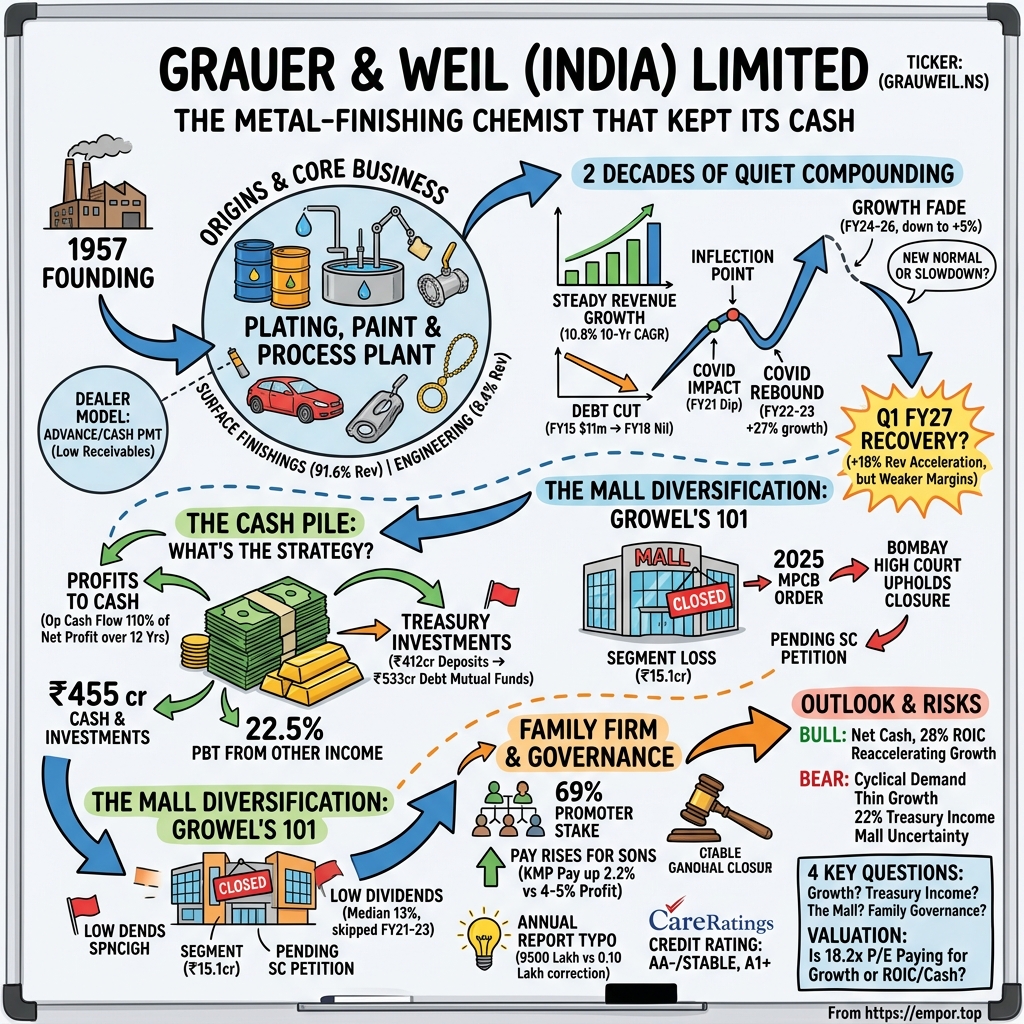
The headline numbers describe a solid mid-sized industrial business. Standalone revenue in the year to March 2026 was about ₹1,178 crore1. On 1 October 2026 the market valued the whole company at about ₹2,753 crore3. And on the balance sheet sat roughly ₹455 crore of cash, bank deposits and debt mutual funds, about a sixth of that market value1. The promoter group owns about 69% of the shares36.
That combination sets up the tension this story chases. On one reading, Grauer & Weil is a quiet compounder: decades of steady margins, almost no debt, a return on invested capital in the high twenties3. On another, it is a pile of cash with a chemicals business attached, run by a family that pays out little and keeps the rest.
Four questions decide which reading is closer to the truth.
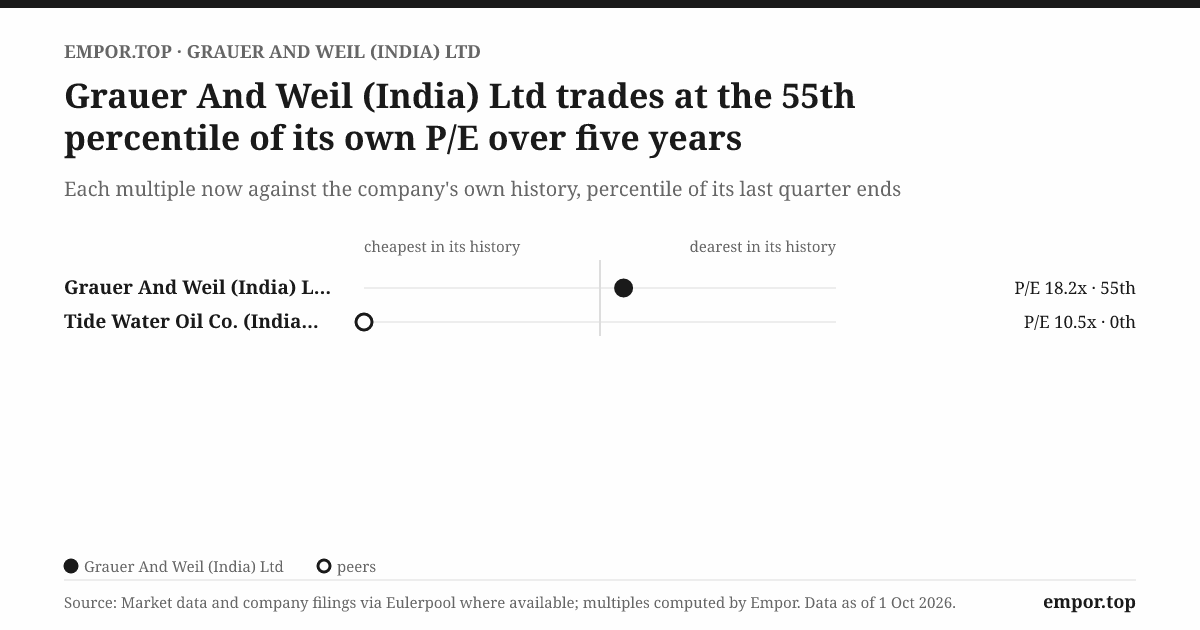
The first is growth. Revenue grew just 5% in FY2026, yet the stock trades at about 18 times earnings, well above its five-year median of about 13 times3. A multiple like that usually assumes growth will come back.
The second is treasury income. About a fifth of pre-tax profit comes from interest and fund gains, not from selling chemicals1. How good is the core business once that is stripped out?
The third is a shopping mall. Yes, a mall. A pollution regulator shut the company's Mumbai shopping centre, Growel's 101, in March 2025, and the case is still before the Supreme Court1.
The fourth is family governance. The board is family-led, two grandsons of the chairman hold paid jobs, and the 2025-26 annual report needed a correction for a related-party figure misprinted by a factor of nearly 100,0001.
The verdict, stated up front and tested through the rest of the piece: the operating business is strong and stable. What remains open is whether growth returns, how much profit is really treasury, and whether the family runs the company for all its shareholders or mainly for itself. To understand any of that, start with what the company actually sells.
 Subscribe on LinkedIn
II. Plating, Paint and Process Plant: How the Business Makes Money
Picture a chemicals dealer in an industrial belt — Pune's auto corridor, say, or the small-workshop clusters of Rajkot. His customers are plating shops, many of them small family businesses running a few tanks. Every few weeks they need more brightener, more nickel salts, more passivation solution, more degreaser. They call the dealer, and the dealer calls Grauer & Weil. Then the dealer pays. Usually he pays in advance, or cash on delivery. That detail, buried in the financial-risk note of the annual report, is one of the most telling facts about the whole company: most sales go through dealers where "payments are generally in advance/cash on delivery", while direct customers buy on credit within set limits1.
A supplier that gets paid before it ships has bargaining power somewhere in the chain. The question is where it comes from.
Two businesses, one of which matters
Grauer & Weil reports two operating segments that count. Surface Finishings brought in about ₹1,079 crore in FY2026, or about 92% of standalone revenue1. It covers plating and metal-treatment chemicals, industrial paints and coatings, lubricants, and the plant and equipment used to run finishing lines. Engineering brought in about ₹99 crore, the remaining 8%1. It builds process equipment and systems, partly for the same finishing customers. A third segment, Shoppertainment, was the mall; it had shrunk to almost nothing after the closure and gets its own section later.
Surface Finishings is where the profit comes from. Its segment profit rose from about ₹194 crore to about ₹232 crore in FY20261, a stronger rise than the company's overall profit growth. When analysts talk about Grauer & Weil as a "quality" business, they are really talking about this one segment.
To see why surface-finishing chemistry is a decent business, think about what a plating bath actually is. It is less like a commodity and more like a recipe. A nickel bath has a base of metal salts, but its performance — how bright the finish is, how evenly it covers a complex shape, how well it holds up in salt spray — depends on small amounts of proprietary additives. A plating shop that has tuned its line to one supplier's chemistry, and whose automotive customer has approved parts made with that chemistry, does not switch lightly. A change means re-testing, possibly re-qualifying parts with the end customer, and risking a batch of rejects. The additive might be a small slice of the part's cost. A failed batch is not.
That is the economic heart of the business: a cheap consumable that is expensive to get wrong.
What gets sold, and to whom
The company lists its end markets as automotive, aerospace and defence, electronics, jewellery and general engineering1. That is a broad spread. It also means that demand rises and falls with Indian manufacturing. When car and two-wheeler output slows, plating volumes fall, dealers carry less stock, and Grauer & Weil feels it within a quarter.
Nobody is big enough to squeeze the company. The annual report says no single customer reached 10% of revenue, and that there is no significant concentration by industry or country1. The thousands of small plating shops at the end of the dealer chain have little individual bargaining power.
Pricing shows up in one line worth watching. Trade discounts, the price concessions given mostly to dealers, fell to about 8.1% of gross sales in FY2026 from about 9.8% a year earlier1. Gross product sales were about ₹1,272 crore, and discounts took about ₹103 crore off that1. Falling discounts while revenue still grows suggests the company did not have to buy its volume. Still, one year of improvement is a clue, not a trend.
Exports are small: about ₹73 crore, or about 6% of standalone revenue, up a little under 4%1. Currency moved results only slightly, with a foreign-exchange loss of about ₹0.65 crore in FY20261. Currency is a rounding error here, not a theme.
The cost side
Raw materials are the big cost. Materials consumed came to about ₹579 crore, roughly 49% of revenue1. Many inputs are metal salts and specialty chemicals, and the company buys a large share through trading houses: the top ten trading houses accounted for about 51% of purchases from trading houses, according to the corrected sustainability report1. That is a moderate concentration in sourcing, not a dependence on one supplier. But it means input prices are the main swing factor in gross margin. When nickel or other inputs jump, the company has to pass costs through to thousands of small buyers, and the speed of that pass-through decides a quarter's margin.
Employee costs were about ₹115 crore, just under 10% of revenue1. R&D spending was about ₹17 crore, or about 1.4% of revenue, rising slightly faster than sales1. That is modest by global specialty-chemical standards. It fits a company that mostly adapts proven process chemistry for Indian customers rather than inventing new chemistries.
Who else is in the bath
Grauer & Weil does not compete in a vacuum. The global surface-treatment chemicals business is led by large specialty groups. Atotech (now part of MKS Instruments), MacDermid Enthone (part of Element Solutions) and Henkel's surface-technology business all sell plating and pretreatment chemistry worldwide, and all serve India's automotive and electronics supply chains, typically with a tilt toward the multinational OEMs and their tier-one suppliers. Domestically, the field is fragmented, with many small regional formulators and some paint and chemical companies competing in pieces of the range.
What cannot be stated with confidence is market share. Grauer & Weil does not publish a share figure, and there is no reliable public estimate of the Indian surface-finishing chemicals market by supplier. So any claim that Growel is "number one" or that it out-prices Atotech should be treated as unproven. The more defensible reading is that it is one of the larger Indian-owned suppliers, with its strongest position in the small and mid-sized plating shops reached through dealers, while global players dominate the most technically demanding work.
The moat, argued once
Run the business through Michael Porter's five forces and Hamilton Helmer's seven powers, and a fairly clear picture emerges.
Buyer power is low. No customer is above 10% of revenue, and dealers pay up front1. Supplier power is moderate: inputs are about half of revenue, bought partly through trading houses, and pass-through takes time. The threat of substitutes is limited in the medium term: metal parts still need protective and decorative finishes, though powder coatings, alternative coatings and stricter environmental rules on chemicals like hexavalent chromium keep shifting which chemistry wins. New entrants face the cost of building process know-how, approvals and a dealer network, but small formulators enter at the low end all the time. Rivalry is real: global groups at the top, local players at the bottom.
Of Helmer's powers, two show up in the evidence. The first is switching costs: a tuned and approved plating line is sticky. The second is something close to a cornered distribution position. A dealer network that pays cash in advance and reaches thousands of small shops is hard for a global player to copy cheaply. Scale economies matter a little — in purchasing and in spreading R&D. Branding, network effects and counter-positioning barely apply.
The financial record supports a real but modest moat. Operating margins held between about 13% and 16% for a decade13. Return on invested capital, which strips out the cash pile, ran between roughly 20% and 35% in recent years3. A business without some protection would not earn that consistently through a pandemic and an input-cost spike. The limit is pricing power against the global groups. Margins that are steady but never expand beyond the mid-teens suggest a business that defends its price rather than one that dictates it. The moat is a good fence around a mid-sized field, not a castle wall.
The fence has held for decades. The harder question is how fast the field inside it is growing.
III. The Long Climb: Two Decades of Quiet Compounding
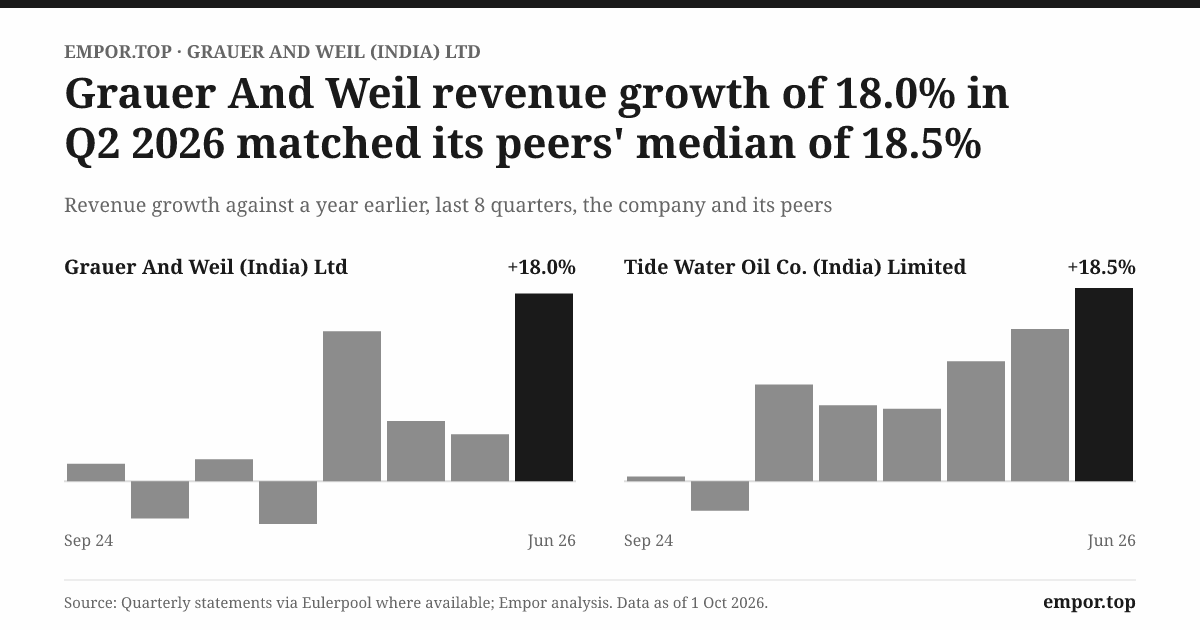
There were two years when Grauer & Weil looked like a growth stock. In FY2022 revenue rose about 27%. In FY2023 it rose about 28% again13. Factories that had idled during Covid restarted, auto production recovered, and plating lines that had run half-empty filled back up. Anyone who discovered the stock in 2023 and drew a straight line through those two years would have imagined a company doubling every three years.
Then the line bent. Growth slowed to about 9% in FY2024, about 6% in FY2025, and about 5% in FY20263. The question for investors is which story is the real one: the two hot years, or the three cooling ones.
The base rate
The cleanest way to answer is to measure across different windows. Over three years, revenue grew about 6.6% a year. Over five years it was about 14.5% a year. Over ten years, about 10.8%3.
The five-year number is the flattering one, and it is flattering for a specific reason: it starts from FY2021, the Covid trough, when revenue had actually shrunk about 2%3. Measuring from a dip makes any recovery look like growth. The ten-year figure is more honest, but it includes the same rebound. The three-year figure is the most recent and the least flattering.
Put together, the honest base rate for Grauer & Weil's rupee revenue is mid-to-high single digits, not double digits. That is roughly the rate of Indian industrial production plus some inflation and modest share gains. It is a respectable number. It is not the number that justifies an earnings multiple well above the stock's own history.
Profit tells a slightly better story. Net profit grew about 13% a year over three years3, roughly twice as fast as revenue. Part of that came from margin gains in FY2024. Part came from rising interest income on a growing cash pile — a point the next section takes apart.
The decade that built the balance sheet
To see what kind of company this is, go back to FY2015. That year Grauer & Weil carried borrowings of about $11 million and a debt-to-equity ratio of about 0.3113. It was not stretched, but it owed the banks real money. Operating margin was about 13%3.
Over the next three years, the company paid most of that down. By FY2018 borrowings had fallen to about $1 million, and debt-to-equity was close to zero3. Margins rose to about 16.5% in the same year3. That combination — less debt, better margins, no dilution — is what quiet compounding looks like. Nothing dramatic happened. The business simply earned more cash than it spent and used the surplus to clear its loans.
After that came a pause. Margins slipped back to about 13% in FY2020 and stayed in the 13–14% range through FY2023, before rising to about 16% in FY2024 and settling near 14% in FY20263. The Covid year, FY2021, cut revenue but not dramatically, and profit fell about 9%3. For a business tied to auto production, that was a mild dip. It is one of the better pieces of evidence that the dealer model and the spread of end markets cushion the cycle.
The quiet operational win
The least glamorous improvement of the decade is also one of the most important. The cash conversion cycle — roughly, how many days of sales the company has tied up in inventory and receivables after netting off what it owes suppliers — fell from about 129 days in FY2015 to about 65 days in FY20263. Debtor days alone fell from about 79 to about 543.
In plain terms, the company now gets paid weeks faster than it did a decade ago, and it needs far less working capital to support each rupee of sales. Some of that reflects the dealer model maturing, some reflects tighter credit to direct customers. Either way, it means growth now costs less cash than it used to. That is a real competitive improvement, and it gets almost no attention.
Q1 FY27: a signal, or just a quarter?
Then came the June 2026 quarter. Consolidated revenue rose about 18% to roughly ₹299 crore, from about ₹253 crore a year earlier5[^8]. After a year of mid-single-digit growth, that looked like the turn bulls had been waiting for.
But profit went the other way. Net profit fell about 9%, to roughly ₹40 crore from about ₹44 crore5[^8]. The company's EBITDA margin dropped to about 16% from about 21% a year earlier5[^8]. Revenue rose sharply while margin fell, which can mean several things: lower-margin engineering projects billing in the quarter, input costs rising faster than prices, or the company accepting thinner margins to win volume. The company's filing does not break the margin move down by cause, and Grauer & Weil does not host regular earnings calls where an analyst might have asked.
One data warning. Third-party data feeds show operating margins of about 38% for that quarter and about 36% for the March 2025 quarter3. Those numbers do not match the company's own EBITDA margins and almost certainly reflect how the data provider treated treasury income or one-off items. They should be ignored.
Weighing it
The record supports one claim firmly and narrows another. The quality claim stands: margins in a narrow band for a decade, debt eliminated, working capital roughly halved. The growth claim shrinks to something smaller: a mid-single-digit grower with one strong quarter, whose most recent acceleration came at the cost of margin. The test is the September 2026 quarter. If revenue grows in double digits again and the Surface Finishings margin holds, the recovery is real. If revenue fades or the margin slips further, Q1 was a blip.
Either way, the business throws off more cash than it can use. Where that cash goes is the next part of the story.
IV. The Pile: How Much of the Profit Is Treasury?
At the end of March 2025, Grauer & Weil had about ₹412 crore sitting in bank deposits longer than three months1. A year later, that figure had fallen to about ₹211 crore1. The money had not gone anywhere dramatic. During FY2026 the company bought about ₹533 crore of investments, mostly debt mutual funds, up from about ₹154 crore of purchases the year before1. It had simply moved its savings from one kind of account to another.
That reshuffle is a useful window into the company. The treasury desk was active. The operating side was steady. And the pile kept growing.
How big is the treasury slice?
Start with the profit and loss account. Other income — mostly interest, fund gains and small one-offs — was about ₹49 crore in FY2026, out of standalone pre-tax profit of about ₹219 crore1. That is about 22.5% of pre-tax profit, almost unchanged from about 22% the year before1. Interest income alone was about ₹37 crore, with fair-value gains on debt funds of about ₹5 crore and profits on selling investments of about ₹3 crore1.
Remove other income, and FY2026 pre-tax profit falls to about ₹170 crore1. So roughly one rupee in every five of pre-tax profit comes from money sitting in banks and funds rather than from chemicals and equipment.
That does not make the core business weak. It makes it smaller than the headline. And the ratios show it clearly. Return on equity — profit divided by all shareholders' money, cash included — was about 15%3. Return on invested capital — operating profit after tax divided by the capital the business actually uses, cash excluded — was about 28.5%3. The gap between those two numbers is the cash pile. The chemicals business earns very well on the capital it uses. Shareholders as a whole earn much less, because a large part of their money is parked in debt funds earning around 7% before tax.
Asset turnover makes the same point from a different angle. It fell from about 1.03 in FY2023 to about 0.82 in FY20263. Factories are not getting less productive. The denominator is swelling with cash.
Profit into cash
Is the profit real cash? Over the twelve years to FY2026, the company reported cumulative net profit of about ₹1,061 crore and operating cash flow of about ₹1,167 crore, or about 110% of profit13. That is a healthy conversion. Depreciation, a non-cash charge, explains part of the excess.
But the record is not smooth. In FY2019 and FY2022, operating cash flow was only about 30–34% of EBITDA3, as inventories and receivables soaked up cash during strong sales periods. In FY2026 it was about 75%3. Part of the gap between EBITDA and operating cash is a quirk of presentation: interest income on the cash pile is shown under investing activities, not operating1. In FY2026, the company's operating profit before working-capital changes was about ₹202 crore, and operating cash flow after tax was about ₹154 crore1.
The conclusion is that profit converts to cash reliably in normal years, with occasional working-capital squeezes. There is no sign that earnings are being dressed up.
Where the cash went
Here is the capital-allocation scorecard over the twelve years from FY2015 to FY2026. The business generated about ₹871 crore of free cash flow after capital spending3. It paid about ₹138 crore in dividends, or about 16% of that free cash3. And its cash and short-term investments rose from about ₹6.5 crore at the end of FY2014 to about ₹455 crore at the end of FY202613.
That is the story in one line. The company earned a lot, invested a little, paid a little, and kept the rest.
Capital spending is modest. In FY2026 the company spent about ₹49 crore on plant and equipment, about 4% of revenue, against depreciation of about ₹24 crore1. So it is investing a bit more than it wears out, but not dramatically. Projects include a second unit in Jammu, funded partly by a small new term loan of about ₹2.6 crore for machinery1. Remaining capital commitments were about ₹9 crore, down from about ₹19 crore1. Nothing in the plan suggests a big capacity push that would soak up the pile.
Acquisitions barely feature. The company has three small overseas subsidiaries, one of them Grauer & Weil Middle East FZE in Dubai, and a partly paid investment in Growel Chemical Co. in Thailand1. Its total investment in subsidiaries was about ₹4.7 crore at the end of FY2026, and it lent about ₹1.3 crore to the Dubai unit during the year1. Consolidated pre-tax profit was slightly below standalone, so the subsidiaries together lost a little money1. These are distribution outposts, not deals. There is no acquisition record to benchmark, because Grauer & Weil has put its capital mostly into organic capex and treasury.
The share count is about 45.3 crore shares of ₹1 face value2. The company's filings over the last decade show no rights issue, preferential allotment, buyback or open offer. So shareholders have not been diluted. But they also have not been given back much of the surplus.
The dividend record
The dividend history is where the capital-allocation question becomes a governance question. Over twelve years the payout ratio ranged from zero to about 40%, with a median of about 13%3. For three straight years, FY2021 to FY2023, the company paid no dividend at all3. Those were not years of financial stress: profit kept rising from FY2022, and the cash pile kept growing. Dividends resumed in FY2024. For FY2026, the board recommended ₹0.50 per share, about ₹23 crore, or roughly 13.5% of standalone profit1.
A family that owns 69% of a company has a choice. Dividends go to every shareholder pro rata, and are taxed in shareholders' hands. Cash kept inside the company stays under the family's control. A low payout is not proof that the family is acting against minorities. But it does mean minorities are relying on the family to eventually do something useful with ₹455 crore.
What an activist would ask
Imagine a skeptical investor at the AGM with a simple spreadsheet. Their argument would go like this. The chemicals business needs perhaps ₹50 crore a year of capex and a working-capital cushion. A business with near-zero debt, a high credit rating and steady cash flow does not need ₹455 crore of cash on top. Every rupee parked in debt funds earns maybe 7% before tax, while the operating business earns close to 30% on its capital. Either reinvest the cash at operating returns — through capacity, adjacent products, or an acquisition that fits — or return it.
They would ask for one of three things: a materially higher payout, a buyback, or a credible plan to deploy the money. As of October 2026, the company has offered none of these as stated policy.
What the market pays for
The cash also changes how to read the valuation. Strip out the roughly ₹455 crore of cash and investments, and the market is valuing the operating business at around ₹2,300 crore — close to the reported enterprise value of about ₹2,298 crore3. On that basis the business trades at about 11 times EBITDA3.
The headline P/E of about 18 against a five-year median of about 133 is therefore not mostly a bet on rapid growth. It is mostly a price for high returns on capital and a cash cushion — plus, implicitly, a hope that the cash will one day be put to work. If growth stays at mid-single digits and the cash just keeps piling up, that hope looks expensive.
Not all of the company's past deployments were in debt funds, though. One of them was a shopping mall.
V. The Mall That Wouldn't Stay Closed: Growel's 101
On 5 March 2025, the Maharashtra Pollution Control Board ordered Growel's 101 Mall to shut18. For the shoppers and tenants of the mall in suburban Mumbai, it was an abrupt end. For investors in a plating-chemicals company, it was a reminder of something many had forgotten: their company owned a mall.
The company went to the Bombay High Court. On 19 March 2025, two weeks after the order, the court upheld the closure1. Grauer & Weil then filed a Special Leave Petition in the Supreme Court, which remains pending19.
Why a chemicals maker owned a mall
The mall sits on land the company held in Mumbai, and Grauer & Weil developed and ran it as a separate business segment it called Shoppertainment1. It is a familiar pattern in older Indian family companies: valuable urban land, often once used for industrial operations, turned into real estate rather than sold. The logic is that the land earns rent, the family keeps the asset, and the core business carries on elsewhere.
At its peak the arrangement was modest but useful. In FY2025 the mall segment brought in about ₹33 crore of revenue1. After the closure, that collapsed to about ₹0.56 crore in FY20261.
The filings do not set out the full detail of the regulator's grounds in the company's own words beyond the closure order itself, and the company has not published a detailed account of what it would take to reopen. That silence is itself part of the story: minority shareholders know the outcome, not the remedy.
The cost
The mall is small against the whole company, but it is not nothing. In FY2026 the segment lost about ₹15 crore1. Against standalone pre-tax profit of about ₹219 crore, that is a drag of roughly 7%. Its segment assets stood at about ₹67 crore on the books1. And the mall is pledged as a second charge to the banks as security for the company's working-capital loans1.
That last point matters more for the banks than for shareholders, given how little the company borrows. But it shows that the mall is woven into the balance sheet, not cleanly ring-fenced.
The accounting judgment
The auditor, M M Nissim & Co LLP, gave the accounts a clean, unmodified opinion1. But it added an emphasis of matter on the mall closure — an auditor's way of telling readers to look closely at a particular disclosure without disagreeing with the accounts1. The key phrase is in the company's note: no provision has been made for related claims, except full and final claims already agreed1.
In plain English, the company is carrying a closed mall at roughly its previous book value, and it has not set aside money for possible claims from tenants or others arising from the closure. That is a judgment, and it rests on the outcome of the Supreme Court case and on the land's underlying value. If the court rules against the company, or the property has to be repurposed or sold, the ₹67 crore carrying value could face a write-down. Against shareholders' equity of roughly ₹1,180 crore3, even a full write-down would cut book value by about 6%. That would sting, but it would not threaten the company. The open risk lies in what the note leaves unquantified — "other consequential claims."
The lesson in the mall
The mall is the clearest test of the claim that Grauer & Weil's capital allocation is disciplined. A company that kept nearly all its money in chemicals and cash also put land and capital into a retail business it had no special skill in running, in a sector exposed to municipal and environmental regulators. It earned rent for years. Then a regulator closed it, and the company is now fighting to save a ₹67 crore asset through the courts.
The fair verdict is narrow. The mall does not show reckless capital allocation; it was a land-use decision more than a strategic bet. But it does show that the family has been willing to run a non-core business inside the listed company, and that the company has not resolved it quickly. Anyone praising Grauer & Weil's "discipline" has to set the mall next to the cash pile.
The smaller overhangs
The rest of the legal picture is proportionate. Disputed tax and other claims not provided for totalled about ₹15 crore at March 2026, about the same as a year earlier1. The single largest item was an income-tax demand of about ₹4.6 crore for assessment year 2021-22, under appeal1. Bank guarantees stood at about ₹39 crore, mostly in the normal course of the engineering business1. The auditor's CARO report raised no qualifications and found no overdue undisputed statutory dues1. These are normal for an Indian manufacturer of this size and do not change the picture.
A mall closed by a regulator raises a wider question: who decided to own it, and who is accountable? That brings the story to the family.
VI. A Family Firm: Who Runs It and Who Gets Paid
On 31 August 2026, Grauer & Weil filed an addendum to its freshly published annual report1. Among the corrections was a line in the related-party note. The original version showed an asset purchase from an enterprise connected to key management of ₹9,500 lakh — about ₹95 crore. The correct figure, the company said, was ₹0.10 lakh, or ₹10,0001. Another correction fixed the share of sales to related parties in the sustainability report, from 5.75% to 0.06%1.
These were misprints, not economic events. But anyone who read the original document would have seen a ₹95 crore asset purchase from a family entity. In a family-controlled company, a typo in the related-party note is the worst possible place for a typo.
The same AGM season brought another item. The notice for the 2026 meeting sought shareholder approval for revised pay for two of Nirajkumar More's sons, Aman More and Yash More, employed by the company, with Yash's pay capped at up to ₹50 lakh a year1.
Neither item is large. Together they frame the real governance question at Grauer & Weil: not whether money is leaking to the family, but how the family discloses its dealings and plans its succession.
The people
Umeshkumar More chairs the company and personally holds about 10.1% of the shares1. His son Nirajkumar More is managing director and holds about 7.9%1. Nirajkumar was re-appointed MD for five years from 1 July 20221. Rohitkumar More, also of the family, is a whole-time director whose term runs to March 2027, with a renewal to 2032 sought1. The one non-family executive on the board is Yogesh Samat, a whole-time director whose term was renewed for two years from 1 July 20261. Four independent directors complete the board1.
The company publishes little about the personal styles of its leaders. There are no regular investor presentations, no earnings calls, and few interviews. What can be judged is behaviour over time, as recorded in filings.
Pay against profit
Executive pay is not excessive by the standards of a company this size. Nirajkumar More earned about ₹2.46 crore in FY2026, combining salary, perquisites and a commission of about ₹1.14 crore1. That is about 1.1% of standalone pre-tax profit. Interestingly, the best-paid executive by salary was not a family member: Yogesh Samat's salary and commission came to about ₹2.06 crore1. Total managerial pay for key management was about ₹6.91 crore, about 3% of pre-tax profit, up about 2% while profit rose about 4–5%1. Relatives of directors received another ₹3.1 crore or so in salaries1. The structure is salary plus commission; the filings show no stock-option plan.
Independent directors received sitting fees plus a commission of about ₹4.4 lakh each1. That is a modest sum, which cuts both ways: they are not financially dependent on the company, but neither are they paid enough to be expected to spend much time challenging management.
The gratuity puzzle
One line deserves a question. The related-party note shows a "reversal of provision for gratuity payable to KMP" of about ₹7.75 crore, against about ₹0.41 crore the year before1. Gratuity is a statutory retirement benefit; a reversal would normally mean a release of an earlier provision, which would add to profit, not take from it. But the size of the figure, about 3.5% of pre-tax profit, and the way the note is worded leave it unclear whether this was money paid, money provided, or money released. The company has not explained it. A one-paragraph clarification would settle the matter. Its absence is a disclosure problem, not evidence of wrongdoing.
Money flowing between company and family
The rest of the related-party ledger is small. Purchases from related parties came to about 0.7% of revenue1. The company borrowed about ₹3.7 crore from family members and a family enterprise, repayable on demand at 8% interest, unchanged from the previous year1. Rent paid to family members and their entities was about ₹1.1 crore1. The board states that transactions are at arm's length and that none conflicts materially with the company's interests1.
The family loans are a curious detail for a company sitting on ₹455 crore of cash. Borrowing ₹3.7 crore from the family at 8% while holding hundreds of crores in debt funds earning roughly the same makes little financial sense either way. It is small enough not to matter economically. But it is the kind of arrangement a careful board would tidy up.
Credibility through behaviour
Judged by actions rather than words, the More family's record is mixed but more good than bad.
On the positive side: they cleared the company's debt in the three years after FY2015 and have kept it near zero since3. They resumed dividends after the three-year gap. They have not diluted shareholders. The promoter stake has held at about 69% from 2017 to 202636, so there has been no quiet selling. The auditor's opinion is clean1. CARE Ratings rates the company's long-term bank facilities AA- with a stable outlook and its short-term facilities A1+17, a sign that lenders see little financial or governance risk — though for a company with almost no debt, that rating says more about the balance sheet than about how minorities are treated.
On the negative side: the three-year dividend holiday came while cash was piling up. The mall was closed by a regulator, not exited by choice. The annual report needed a correction for a large misprint in exactly the note minorities read most closely. The gratuity line is unexplained. And the next generation is being brought into paid roles through shareholder resolutions.
What minorities have said
The decisive evidence on how minorities feel would be the voting results for the resolutions on the sons' pay and the directors' renewals at the September 2026 AGM. Those results are filed with the exchanges as a scrutinizer's report510. With the promoters controlling about 69% of votes, the resolutions will pass on ordinary items. But for related-party resolutions, where promoters may have to abstain, the vote of the minority actually counts. How many minority shares voted against is the clearest available test of confidence.
Talking to shareholders
Grauer & Weil does not hold regular earnings calls and does not publish investor presentations. Its communication with the market consists of statutory filings: quarterly results, the annual report, and the AGM notice5. That means there is no record of management explaining, in its own words and under questioning, why the Q1 FY27 margin fell or what it plans to do with the cash. For a company with thin institutional ownership, the result is a quiet stock with few people asking questions.
The verdict on governance is that the economic leakage to the family is small and the accounts are clean, but the quality of disclosure and the direction of succession are the open issues. The evidence leaves governance intact but unproven. It does not support calling it proven good. The AGM votes and an explanation of the gratuity line are what would move the verdict.
Step back from the details, and the company's long record offers lessons that reach well beyond plating chemicals.
VII. Playbook: Business & Investing Lessons
In FY2015, Grauer & Weil owed its bankers about $11 million and had about ₹6.5 crore in cash13. Eleven years later it owed almost nothing and held about ₹455 crore1. In between there were no acquisitions, no equity raises, no dramatic pivots. Debt-to-equity went from about 0.31 to about 0.013. The cash conversion cycle halved3. Return on invested capital sat in the high twenties3. It is one of the least eventful success stories in Indian industry. Its lessons are sharper than its quiet suggests.
Lesson one: a balance sheet can be a strategy or a hiding place
Clearing debt in the late 2010s was a strategy: it made the company resilient enough to sail through Covid with only a mild dip. Keeping ₹455 crore idle in debt funds in 2026, with a payout around 13%, is a different thing. The same habit of saving that protected shareholders in a downturn now dilutes their returns in an upturn. Cash protects a business until the day it starts to protect management from having to decide anything. The test of a cash pile is not its size but whether management can say what it is for — and Grauer & Weil has not said.
Lesson two: diversify only into what you can run, or what regulators will let you keep
Growel's 101 was a reasonable land decision that turned into a regulatory trap. A chemicals company with a strong niche business decided to run a mall, and in March 2025 a pollution regulator decided otherwise1. The lesson for family companies with legacy land is not "never diversify". It is that every non-core asset brings a non-core regulator, and that regulator does not care about your return on invested capital. The chemicals business earned its returns by doing one thing well. The mall lost money by doing something else.
Lesson three: in a family company, disclosure is the governance
Grauer & Weil's related-party flows are small. Its managers are not overpaid. Its auditor is satisfied. And yet the company's 2025-26 annual report carried a ₹95 crore misprint in the related-party note and an unexplained ₹7.75 crore gratuity line1. When one family controls 69% of the votes, minority shareholders cannot rely on voting power to protect them. They rely on being able to see. A typo in the related-party note is a small thing in a widely held company. In a family company, it is the governance.
Lesson four: working capital is the quiet profit
The most valuable thing Grauer & Weil did over the decade may have been getting paid faster. Debtor days fell from about 79 to about 54, and the whole cash cycle shrank from about 129 days to about 653. That freed up cash with every rupee of growth, without a single new factory or a single press release. Investors chase margin expansion and revenue acceleration. The More family's biggest operational win came from dealers who pay before delivery. It shows up nowhere in the P&L and everywhere in the bank balance.
Lesson five: steady is not the same as growing
A decade of 13–16% margins proves a business is protected. It does not prove the business is expanding. Grauer & Weil is the kind of company that rewards patience when bought at 13 times earnings and tests it at 18. The deepest investing lesson here is that quality and growth are different claims, and the market often pays for both after only proving one.
Those lessons point straight at the question the market has to answer today: what is all this worth?
VIII. Analysis: Bull vs Bear, KPIs and Risks
Two investors look at the same number on 1 October 2026: a market value of about ₹2,753 crore3.
The first sees a debt-free company with about ₹455 crore of cash, a return on invested capital near 28%, a stable dealer franchise, a AA- credit rating, and a first quarter in which revenue jumped 18%135. To this investor, about 18 times earnings is a fair price for quality, and the cash is a free option.
The second sees revenue growth of about 6.6% a year over three years, a margin that fell sharply in the most recent quarter, a fifth of profit coming from interest, a family-controlled board, and a closed mall whose fate is in the Supreme Court13. To this investor, the stock used to trade at about 13 times earnings for good reason, and nothing has happened yet to justify the rerating.
Both are looking at real evidence. The task is to weigh it.
The valuation, in plain terms
The stock trades at about 18.2 times trailing earnings, against a five-year median of about 13.23. Its PEG ratio, which compares the P/E with growth, is about 1.43. Enterprise value — market value minus net cash — is about ₹2,298 crore, or about 10.8 times EBITDA3. The free-cash-flow yield is about 3.6%, and the earnings yield about 5.5%3.
Here is what those numbers imply. An earnings yield of 5.5% is below what the company's own debt funds earn before tax. So an investor buying at this price is accepting a lower starting return than a bank deposit, in exchange for growth. At 3.6% free-cash-flow yield, the business needs to grow its cash flow at high single digits or better for many years to make that bargain good. That is above its three-year record and roughly in line with its ten-year record.
The market is therefore pricing something like a return to the long-run growth rate of about 10%, not the recent 5–6%. One strong quarter supports that hope but does not confirm it.
The peer comparison is where the analysis is thinnest. Indian listed specialty-chemical companies often trade at higher multiples, but few are pure surface-finishing businesses, and the global leaders sit inside large groups. A fair comparison would need similar size, growth and cash position. Without one, there is no basis to call Grauer & Weil cheap or dear relative to peers — only relative to its own past, where it is clearly dearer.
The bull case, tested
The bull case rests on five claims.
First, the business is protected. The decade of steady margins and high returns on invested capital supports this3. The moat argued in Section II holds — switching costs in process chemistry and a cash-paying dealer network. Verdict: intact.
Second, the balance sheet is a fortress. Net cash, near-zero debt and a high credit rating support this13. Verdict: intact, though a fortress that is never used becomes a drag on returns.
Third, growth is coming back. Q1 FY27 revenue rose about 18%5. Trade discounts are falling1. Verdict: unproven. The same quarter's profit fell, and one quarter is not a trend.
Fourth, the customer base is diversified. No customer reaches 10% of revenue1. Verdict: intact — and it means no single loss can break the business.
Fifth, the cash is optionality. Bulls argue the family could one day deploy it into capacity, an acquisition, or higher payouts. Verdict: unproven. The family's twelve-year record is to accumulate it.
The bear case, tested
The bear case also rests on five claims.
First, growth has slowed structurally. The three-year rate of about 6.6% supports this3. But Q1 FY27 contradicts it, and India's manufacturing push could lift demand. Verdict: narrowed to "growth is cyclical, and the base rate is mid-to-high single digits".
Second, margins are under pressure. The Q1 EBITDA margin fell to about 16% from about 21%5. But margins have moved within a band for a decade. Verdict: open — the September quarter is the test.
Third, a fifth of profit is treasury income. True: about 22.5% of pre-tax profit1. But the core business still earns high returns on its capital. Verdict: correct as a description, but it argues for a lower multiple on the cash, not a weak business.
Fourth, governance favours the family. Partly supported: low payouts, family succession, disclosure lapses1. But related-party leakage is small and the auditor is clean1. Verdict: narrowed to a disclosure and capital-allocation concern rather than an extraction concern.
Fifth, the mall is unresolved. True: ₹67 crore of assets with a pending Supreme Court case and unprovided claims1. Verdict: material to book value but not to the business.
The risks that actually matter
Four risks are material.
The first is an industrial slowdown. The mechanism is direct: when auto, two-wheeler and engineering output slows, plating shops run fewer batches, dealers hold less stock, and orders fall. Dealer destocking can make the dip in sales sharper than the dip in end demand.
The second is input costs. With materials at about half of revenue1, a spike in metal salts or specialty chemicals hits gross margin before prices can catch up. The Q1 FY27 margin drop may already reflect this.
The third is receivables quality. Receivables older than six months rose to about 11.2% of the total from about 8.8%1. Over the last two years the company wrote off about ₹6.3 crore of bad debts while holding a provision for expected credit losses below ₹1 crore1. The amounts are small against revenue, but the pattern — write-offs running well ahead of provisions — suggests the provisioning is optimistic. Watch whether the over-180-day share keeps climbing.
The fourth is the mall's legal outcome, discussed in Section V.
Currency is a minor swing factor, given exports of about 6%1. Technology disruption, including AI, has no direct path to substituting a plating bath.
Thin ownership
The share register is unusual. Foreign institutional investors held only about 0.35% in June 2026, down from a peak of about 1.4% in March 20233. The number of shareholders grew from about 18,600 in 2017 to about 53,3003. With promoters at about 69%, the free float is small and dominated by retail investors.
That has two effects. Liquidity is thin, so the share price can move sharply on small trades — which may help explain why the rating moved from 13 to 18 times earnings without a corresponding change in the business. And there are few large outside holders to press management on capital allocation. The activist questions in Section IV are unlikely to be asked by anyone with enough shares to matter.
The KPIs that matter
Three numbers capture most of what an investor needs to track.
The first is Surface Finishings segment revenue and margin. This is the business. Segment profit rose from about ₹194 crore to about ₹232 crore in FY20261. The question is whether the Q1 FY27 margin dip reverses.
The second is other income as a share of pre-tax profit. It was about 22.5% in FY2026, up slightly from about 22%1. If it rises, the core is shrinking relative to the treasury. If it falls because operating profit grows, the quality case strengthens.
The third is the payout ratio and the cash line. The payout was about 13.5% for FY2026, and cash and investments about ₹455 crore1. A payout that rises meaningfully, or cash that falls because it has been deployed, would answer the capital-allocation question. Another year of both standing still would answer it the other way.
The case for Grauer & Weil is intact but unproven. The business is better than its growth suggests. The valuation already assumes growth will come back. What happens next will decide which investor was right.
IX. Epilogue
Tonight Grauer & Weil stands where it has stood for most of its recent history: profitable, debt-free, a little underrated by the wider market and a little overrated by its recent share-price move. Its plating chemicals are still flowing through dealers who pay in advance. Its bank balances are still growing. And four questions still hang over it.
The first will be answered in a matter of weeks. The results for the September 2026 quarter are due in the coming weeks. If revenue grows again in double digits and the Surface Finishings margin climbs back toward its historical range, the growth question tilts toward recovery and the higher multiple starts to look earned. If revenue fades back to mid-single digits, or the margin slips further, the market will have paid for a recovery that did not arrive, and the multiple has a long way to fall back to its median.
The second is in the hands of the Supreme Court. A ruling on the mall's Special Leave Petition would end the uncertainty one way or another. A win could let the company reopen or monetise the asset. A loss would likely force a write-down of some part of the ₹67 crore carrying value, and possibly bring the unprovided "consequential claims" into the accounts. Even then, the business would not be at risk. But the outcome would tell investors whether the company's accounting judgment — no provision — was prudent or hopeful.
The third will be decided at a board meeting, not in a court. Next year's dividend recommendation will show whether a family sitting on ₹455 crore of cash is willing to raise its payout above the 13% median, announce a buyback, or set out a plan to deploy the money. A meaningful rise would be the clearest sign yet that minorities are being treated as partners. Another 13% payout, with the pile growing again, would confirm that the cash is a family reserve that happens to sit in a listed company.
The fourth is already on file. The voting results from the September 2026 AGM, and especially the minority vote on the pay of Niraj More's sons, will show how much confidence outside shareholders have in the family's succession plans. An explanation of the ₹7.75 crore gratuity line in the next set of disclosures would close a small but needless gap in the record.
Each outcome maps onto one of the four questions. Strong September numbers settle growth. A court ruling settles the mall. A higher payout settles the cash. Clean disclosures and a respectable minority vote settle governance. If all four break the right way, Grauer & Weil earns its 18 times. If they break the wrong way, it goes back to being a 13-times company with a lot of money in the bank.
The tension is that the company controls three of the four answers, and has rarely felt the need to explain itself.
X. Outro
Go back to the plating line. The bracket comes out of the bath with a bright, even finish that will protect it for years. The chemistry did its job precisely because nobody sees it. That is what Grauer & Weil has been for nearly seven decades: the invisible layer on India's metal parts, sold by dealers who pay before delivery, made by a family that pays down debt and keeps its counsel.
The company's own finish is plainer. Beneath a steady business lies a ₹455 crore pile of cash, a closed mall, and a family that has not yet said what it plans to do with either. The firm that sells the finish has built a beautiful surface. The question now is whether it will show its shareholders what lies underneath.
References
-
Annual Report 2025-26 with Addendum dated 31 Aug 2026 — Grauer & Weil (India) Limited via BSE, 2026-08-26 ↩↩↩↩↩↩↩↩↩↩↩↩↩↩↩↩↩↩↩↩↩↩↩↩↩↩↩↩↩↩↩↩↩↩↩↩↩↩↩↩↩↩↩↩↩↩↩↩↩↩↩↩↩↩↩↩↩↩↩↩↩↩↩↩↩↩↩↩↩↩↩↩↩↩↩↩↩↩↩↩↩↩↩↩↩↩↩↩↩↩↩↩↩↩↩↩↩↩↩↩↩↩
-
Outcome of Board Meeting and Q1 FY26 results — Grauer & Weil via Business Standard, 2025-08-13 ↩
-
Grauer & Weil (India) Ltd consolidated company page — Screener ↩↩↩↩↩↩↩↩↩↩↩↩↩↩↩↩↩↩↩↩↩↩↩↩↩↩↩↩↩↩↩↩↩↩↩↩↩↩↩↩↩↩↩↩↩↩↩↩↩↩↩↩↩↩
-
Grauer & Weil (India) Limited — company website (investor relations) ↩
-
Grauer & Weil (India) Ltd corporate announcements — BSE (scrip 505710) ↩↩↩↩↩↩↩↩↩
-
CARE Ratings — rating rationales search (for the Grauer & Weil rating action) ↩
 LinkedIn
 WhatsApp
 Reddit
 Hacker News
 Email
Email Kindle
 RSS Feed
 Spotify
 Apple Podcasts
 Amazon Music
 Audible
 YouTube