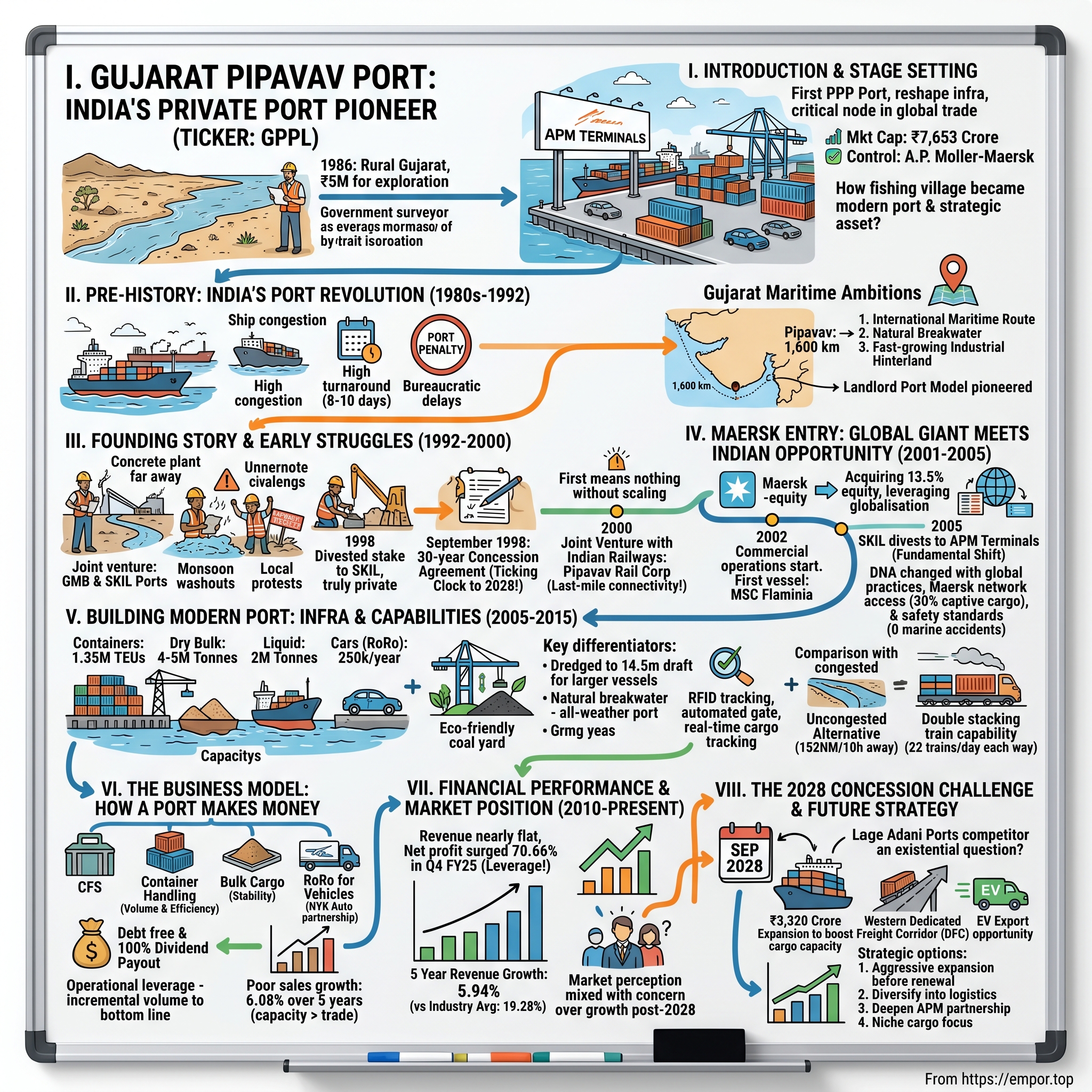
Gujarat Pipavav Port: India's Private Port Pioneer
I. Introduction & Episode Roadmap
On August 26, 2026, a letter from Gandhinagar arrived at a port on a dry, wind-scoured stretch of the Saurashtra coast in Gujarat's Amreli district. It was not a binding contract. It specified no royalty rate, no renewal fee, and no extension term. Instead, it was a "Comfort Letter" from the Gujarat Maritime Board indicating that the state would formally process Gujarat Pipavav Port Limited's application to extend its concession. The letter arrived with explicit requirements: within 90 days, the company had to submit its historical performance record under the current concession alongside an Investment and Business Plan for the proposed extension period.1 For an operator whose concession expires in September 2028, that administrative communication may carry greater strategic consequence than any quarterly earnings report delivered over the past decade.
The underlying irony is difficult to overlook. Pipavav was India's pioneer private port—the test case that proved private capital could construct and operate commercial maritime infrastructure in a market where every major harbour had long belonged to the state. Three decades later, the pioneer is seeking government permission to extend its operational life, while a younger competitor up the coast at Mundra has expanded into India's dominant port enterprise.
Financially, Gujarat Pipavav Port Limited—or GPPL—presents an unusual profile. Borrowings stand at roughly ₹37 crore against reserves of about ₹1,672 crore, leaving the balance sheet virtually debt-free. Return on capital employed hovers near 30%. In every financial year since FY21, the company has distributed approximately 100% of its net profit as dividends, supporting a dividend yield in the 6% range.2 Management rests with APM Terminals, the port operating arm of Denmark's A.P. Møller - Mærsk, which holds a 44.01% controlling stake.2 Operational efficiency remains high: its container facility ranked 28th globally in the World Bank and S&P Global Container Port Performance Index for 2025, the highest standing of any private container terminal in India.3
Top-line growth, however, reveals a starkly different reality. Revenue grew from approximately ₹660 crore in FY16 to about ₹1,158 crore in FY26, translating to compound annual growth of roughly 6% over ten years.2 Container volumes, historically the company's primary earnings driver, peaked at 808,000 twenty-foot equivalent units (TEUs) in FY24 before declining to 694,000 TEUs in FY25 and 668,000 TEUs in FY26.45 That throughput leaves the terminal operating at roughly half of its rated annual capacity of 1.35 million TEUs.6 Across the same period, Adani Ports and Special Economic Zone reported 25% revenue growth for FY26 and controlled 45.5% of the national container market. In fact, Adani's rail network alone transported approximately 695,000 TEUs in FY26—surpassing the total volume Pipavav handled across its entire quay.7
This divergence raises a fundamental investment question. Is Pipavav an exemplar of disciplined capital allocation—a cash-generative toll bridge prudently returning excess capital to shareholders rather than misallocating it? Or is it an asset constrained by an approaching concession deadline that rendered long-term reinvestment unviable? The evidence points to an interplay of both dynamics. The Comfort Letter represents the inflection point where that equilibrium begins to shift.
This account unfolds across nine chapters. It begins with the chronic congestion of India's state-run ports in the 1980s and Gujarat's initiative to bypass them. It examines Nikhil Gandhi's original venture on a remote coastline and the dedicated rail link required to connect it to the hinterland. It traces Maersk's entry from minority partner to operating controller, analyzes how Pipavav generates revenue across containers, bulk, liquid cargo, and automotive transport, and details its sustained competition with Mundra for northern Indian freight corridors. It then evaluates the 100% dividend payout structure, the 2028 concession timeline, a strategic assessment using the frameworks of Michael Porter and Hamilton Helmer, the core metrics defining the bull and bear theses, and the broader capital allocation lessons for infrastructure investors.
The narrative starts with an operational crisis that was less about maritime engineering than about elapsed time: how many days a commercial vessel was forced to wait before an Indian berth could receive it.
 Subscribe on LinkedIn
II. Pre-History: India's Maritime Bottleneck & The Birth of the PPP (1980s–1992)
The Crisis of the Major Ports
In the mid-1980s, cargo vessels regularly sat in the swell outside Bombay harbour for days, waiting for berths that state-run port trusts struggled to deliver. Dock labour pools operated under pre-independence work rules, and inland freight movement was chronically unpredictable. An exporter in Ludhiana could rarely tell a buyer in Rotterdam when a consignment would clear an Indian quay, because port authorities themselves could not provide reliable schedules.
That gridlock was standard across India's "Major Ports"—the federally owned trusts handling the vast majority of the country's maritime trade. They operated like bureaucratic departments: tariffs were set centrally, capital budgets depended on allocations from New Delhi, and administrative incentives rewarded procedural continuity over operational speed. Vessel turnarounds were slow, approach channels were shallow, and mainline container ships on Asia-Europe routes had little economic reason to call directly. As a consequence, most Indian containerized trade relied on small feeder vessels routing through overseas transshipment hubs in Colombo, Dubai, and Singapore. Indian exporters paid twice—first in feeder freight surcharges, and again in the financing costs of working capital delayed at sea.
The physical bottleneck came down to draft: the depth of water required to keep a laden ship afloat. Much like a passenger vehicle whose chassis settles lower as more weight is added, a container vessel sits deeper in the water as its cargo load increases. A port with shallow berths can accommodate large vessels only if they arrive partly loaded, defeating the economies of scale that modern maritime logistics require. In the 1980s, most Indian major ports could not accommodate standard container ships of that era even at partial capacity. That fundamental constraint—at an exponentially larger scale—continues to shape Pipavav's competitive position today.
By the end of the decade, Indian policymakers no longer debated whether the country required modern port capacity. The unresolved question was funding. Constrained by widening fiscal deficits and depleted foreign exchange reserves, the central government lacked the capital to modernize maritime gateways. A state government with a long coastline and separate regulatory jurisdiction offered a different solution.
Gujarat Builds Its Own Institution
Gujarat held both the longest coastline of any Indian state and maritime commercial traditions dating back centuries. Under India's federal framework, ports not designated as "Major Ports" fell under state jurisdiction. Until 1982, the state government administered these minor ports directly. In April 1982, it established the Gujarat Maritime Board (GMB) under the Gujarat Maritime Board Act, 1981—the first statutory maritime agency of its kind in India.8 GMB was mandated to act as both regulator and commercial developer: identifying port sites, leasing waterfront land, and structuring mechanisms for private capital to earn a commercial return.
GMB's initial assets were modest. The board inherited scattered minor ports, many functioning as basic lighterage anchorages where vessels anchored offshore and transferred cargo via barges. It had little investment capital of its own. Crucially, however, it operated outside the central tariff regimes and operational mandates of the Major Port Trusts. Over time, that regulatory flexibility formed the foundation for a landlord-port model, wherein the state retained waterfront ownership and regulatory authority while private companies financed, built, and managed modern cargo terminals.
That institutional framework remains central to GPPL's business model. The company's most consequential regulatory counterparty is neither an equipment vendor nor a shipping line, but GMB—the agency that grants the concession, collects waterfront royalties, and holds authority over the 2028 concession renewal.
Pipavav and the 1991 Inflection
Pipavav sits on the southern coast of Saurashtra, along the western approach to the Gulf of Khambhat. Offshore islands provide natural breakwaters and sheltered deep water, and the harbour lies close to the primary east-west maritime lane connecting East Asia with the Suez Canal and Europe—roughly 152 nautical miles, or about ten hours' steaming time, from Nhava Sheva.6 On paper, the site offered natural nautical advantages. In practice, it was isolated by hundreds of kilometres of undeveloped transport links from the industrial centres and consumer markets of North India.
The catalyst for development arrived with India's 1991 balance-of-payments crisis and the structural economic reforms that followed. As the Comptroller and Auditor General later documented, GMB took its "first step in the process of liberalisation in port sector" by signing a Memorandum of Understanding on February 7, 1992, with Gujarat Pipavav Port Limited, then a joint-sector company, to develop the port.8 Pipavav thus preceded Gujarat's formalized port policy, which arrived in December 1995 and designated ten new port sites for joint or private development.8 On July 29, 1997, the state issued its Build, Own, Operate and Transfer (BOOT) Principles. Concession terms were established for 30 years, granting developers autonomy to set commercial tariffs while remitting a state-notified waterfront royalty at concessional rates until approved capital investments were amortized. At the end of the term, port assets were slated to pass to the state "at the fair value of the assets."8
That fair-value transfer provision is central to evaluating terminal asset risk. Popular commentary regarding Pipavav's 2028 concession overhang often assumes that quays and terminal infrastructure simply revert to the state without compensation. While the CAG's summary confirmed that the statutory BOOT framework provided for transfer at fair value, the detailed contractual clauses of Pipavav's specific concession agreement remain undisclosed, meaning non-renewal compensation mechanics cannot be treated as settled.
For investors, this early period set the structural rules of the game: private capital deployed against a 30-year lease, with the state retaining control over royalties and renewal terms. With the regulatory structure established, the question turned to who would assume the commercial risk of turning an isolated Saurashtra coastline into an operating port.
III. The Pioneer's Gamble: Nikhil Gandhi, SKIL, and Building PRCL (1992–2000)
A Promoter With a Map and a Coastline
Infrastructure ventures often begin with someone who can envision commercial traffic long before the first vessel drops anchor. At Pipavav, that figure was Nikhil Gandhi, a Mumbai-based promoter whose SKIL group partnered with GMB in 1992 to launch the initial joint venture.9 Gandhi's commercial premise was straightforward: a newly liberalized Indian economy would inevitably outgrow its congested public docks, and any developer who secured strategic deepwater coastline early could extract economic rents for decades. While that thesis proved prescient, the financial reality proved unforgiving—specifically, the yawning gap between an ambitious infrastructure blueprint and the patient, large-scale capital required to fund it.
On June 18, 1998, the state government divested its equity stake, turning Pipavav into an entirely private port venture. A few months later, on September 30, 1998, GPPL executed its formal concession agreement under Gujarat's BOOT Principles.8 That signing started the 30-year operational countdown that culminates in the September 2028 concession deadline.
The Hinterland Trap
Commercial ports operate under an unyielding physical reality: a harbour is only as valuable as the land corridor behind it. A deepwater quay that cannot evacuate containers cost-effectively into the interior is little more than a parking spot for ships. Pipavav's nautical assets were initially stranded by its geography. The primary manufacturing and consuming belts of northern India—spanning Delhi, Punjab, Haryana, and Rajasthan—sat hundreds of kilometres away. Between the waterfront and those industrial freight pools lay an obsolete metre-gauge rail line incapable of carrying standard broad-gauge rakes, alongside coastal roads never engineered for heavy container trucking.
Gandhi's answer to this bottleneck remains the most enduring operational contribution of the early venture. Rather than waiting indefinitely for Indian Railways to close the transit gap, he offered to co-finance the connection.
PRCL: India's First Rail PPP
In January 2000, the Ministry of Railways and GPPL signed a memorandum of understanding to establish a special-purpose vehicle for a broad-gauge rail corridor between Surendranagar and Pipavav. A shareholders' agreement was completed in March 2001, culminating in a 33-year concession and lease agreement executed with the Ministry that June.10 The resulting company was Pipavav Railway Corporation Limited (PRCL), an equal joint venture in which GPPL and the Ministry each contributed ₹100 crore in equity. Formally recognized as the Ministry's first "flagship Joint Venture Company," PRCL became the first non-government enterprise granted the legal status of a "Railway Administration" under the Railways Act, 1989.10
The project required a total capital outlay of ₹373 crore, funded through ₹200 crore in equity alongside ₹173 crore in term-loan debt.10 Spanning 271 kilometres through 22 stations, the single-track alignment was engineered for speeds of 100 kilometres per hour, providing an annual carrying capacity of 26 million tonnes.10
In practical terms, PRCL operates like a toll road on steel tracks. It owns the commercial right to move freight along the line and collects an apportioned share of the freight revenue earned on it, while Western Railway manages physical train operations and track maintenance. Passenger trains run toll-free over the line, and PRCL retains a contractual right of first refusal when its own concession nears expiration.10 The corridor opened for commercial traffic in 2003. Three years later, in 2006, Pipavav dispatched India's first commercial double-stack container trains,11 stacking two tiers of containers onto a single flatcar. Double-stacking effectively doubled the volume a single locomotive and crew could haul, delivering one of the few genuine step-change productivity gains in Indian logistics.
Yet this breakthrough carried a heavy structural cost. To convince Indian Railways to commit to the partnership, GPPL agreed to underwrite volume risk by guaranteeing minimum traffic thresholds. Case-study documentation established a steep ramp: 1 million tonnes in the first year, 2 million in the second, and 3 million in the third. If actual traffic missed those marks, GPPL was contractually obligated to reimburse the railway for the freight earnings it would have collected.10 In an era before mainline container vessels called regularly at the port, that guarantee quickly turned into a substantial cash drain.
The Entrepreneurial Ceiling
Developing a commercial port and an intercity railway simultaneously—long before either had established baseload volume—proved too heavy a burden for a mid-sized domestic promoter. Capital expenditure escalated while cash flows lagged, and the quayside still lacked an anchor shipping line to guarantee steady container rotations. Following the 2000–2001 dot-com collapse, risk capital for emerging-market infrastructure evaporated. The SKIL-led consortium hit a financing ceiling: it urgently needed a strategic partner capable of providing not just balance-sheet support, but dedicated container traffic.
Myth vs. Reality: Did Being First Build a Moat?
The claim: Being India's first private port endowed GPPL with a durable first-mover advantage.
The evidence: The historical record demonstrates otherwise. Pipavav executed its port concession in September 1998. By comparison, Mundra's port limits were declared in January 1998, but its concession agreement was not signed until February 2001, following an initial captive-jetty permission dating from 1994.8 Mundra arrived later, yet scaled far faster. Its promoter assembled vast tracts of contiguous land, developed integrated private rail corridors and logistics parks, and used heavy debt financing to build ahead of demand.
GPPL, by contrast, remained unprofitable for years. In FY2009 alone, the company recorded a net loss of ₹117.66 crore. Compounding the pressure, GPPL had to pay ₹107.69 crore in 2008 and ₹30.64 crore in 2009 in cash penalties under the minimum rail-traffic guarantees that had made PRCL possible in the first place.12
The verdict: Early arrival does not constitute an economic moat in heavy infrastructure. Being first secured Pipavav a critical rail corridor and established a regulatory model for Indian public-private partnerships, but it also forced the pioneer to bear the disproportionate costs of market creation—including paying penalties for underutilized rail capacity before hinterland traffic matured. In capital-intensive transport infrastructure, long-term competitive advantage was determined not by who arrived first, but by access to low-cost capital, control over adjacent land, and aggressive reinvestment. The PRCL rail link survived as Pipavav's primary strategic asset, though even that corridor would eventually face competition from rivals operating their own container trains.
With the founding promoter stretched thin, the port required a well-capitalized backer capable of filling the berths with its own fleet.
IV. The Maersk Takeover: From Struggling Promoter to Global Hub (2001–2010)
The Foot in the Door
In 2001, the A.P. Møller - Mærsk Group acquired an initial minority stake in GPPL. APM Terminals' corporate timeline placed the purchase at 12.5%, while secondary accounts recorded it as 13.5%.119 Maersk's strategic rationale was driven by terminal congestion rather than pure geography. Jawaharlal Nehru Port (Nhava Sheva), India's primary container gateway, was chronically backlogged. A global carrier operating scheduled liner services between India, Europe, and the United States required an alternative west-coast gateway where it could command operating influence. Buying into a capital-constrained domestic promoter offered an economical entry point.
The 2005 Control Deal
By 2005, the balance of control had shifted. APM Terminals, backed by IDFC Private Equity, acquired majority control. Gandhi and the SKIL group exited the venture,9 with APM Terminals' official timeline recording 2005 as the year it "acquires controlling stakes."11 By the time of the initial public offering, the shareholder register showed APM Terminals holding 57.90%, IDFC Infrastructure Fund at 10.20%, and IDBI Bank at 8.90%.12
Gandhi's subsequent trajectory proved to be among the most tumultuous in modern Indian corporate history. Adjacent to the commercial port, he developed Pipavav Shipyard, later renamed Pipavav Defence and Offshore Engineering Company. On March 4, 2015, Reliance Infrastructure agreed to purchase roughly 18% of the shipyard from the Gandhi-led promoter group for ₹819 crore, alongside a mandatory open offer for an additional 26%, ultimately rebranding the business as Reliance Naval and Engineering. In March 2018, Reliance Infrastructure served an arbitration notice on the Gandhi brothers and SKIL entities claiming ₹5,440.38 crore for alleged breach of warranties.13 While these corporate disputes had no legal or operational bearing on GPPL, they underscored the capital-intensive reality of Pipavav's origins: the visionary promoter capable of initiating a greenfield deepwater gateway lacked the long-term balance sheet to fund its expansion.
Professionalisation, Slowly
The transition from an entrepreneurial venture to an institutional terminal operator unfolded gradually. The container terminal in its modern operational configuration commenced service in 2009,11 though operating performance heading into the public listing remained subdued. Annual container traffic rose from roughly 0.19 million TEUs in 2007 to 0.32 million TEUs in 2009.12 GPPL continued to post operating losses, recording a net loss of ₹27.76 crore in the January–March quarter of 2010 alone.12
The management team profiled by Forbes India following the public offering reflected Maersk's operational playbook. Prakash Tulsiani, a chartered accountant who had overseen Maersk's terminal operations at Jawaharlal Nehru Port, was appointed managing director, while Ravi Gaitonde, who had established Maersk's three Indian container freight stations, joined as chief operating officer.9 The new leadership installed post-Panamax quay cranes capable of reaching across 18 container rows—up from 13 rows on older Panamax cranes—and consolidated procurement under a single primary equipment vendor. Crane productivity reportedly doubled from approximately 15 moves per hour to more than 30.9 In container logistics, doubling moves per crane-hour effectively cuts vessel berth time in half, directly reducing the operating expenses that shipping lines pay to call at a port.
The 2010 IPO
GPPL approached the public markets with an operational turnaround that was still materializing. The initial public offering opened from August 23 to 26, 2010, priced at ₹46 per share. The issue raised ₹554 crore in total, comprising ₹500 crore in fresh equity, and was subscribed 18.32 times.14 The stock debuted on September 9, 2010, opening on the National Stock Exchange at ₹56.10—roughly 22% above the issue price.14 The capital allocation plan reflected immediate balance-sheet priorities: approximately ₹300 crore was earmarked to prepay debt, with only ₹82.54 crore allocated to capital expenditures.12 The listing served primarily as a deleveraging exercise, earning an IPO grade of 4 from CRISIL, indicating "above average" fundamentals.12
The operational restructuring soon began to show in the reported earnings. Calendar year 2011 marked GPPL's first profitable year, generating a net profit of ₹57.10 crore on revenue of ₹366.19 crore, reversing a net loss of ₹54.72 crore recorded in 2010.9 Following the listing, APM Terminals held an equity stake of approximately 43%.9 This established the global operator as a stable, controlling minority shareholder—a governance structure that has persisted ever since. The promoter stake stands at 44.01%, and in April 2026 management confirmed that none of those shares were pledged.215
The Post-IPO Decade: Diversify Around the Constraint
The decade following the listing illustrated how management adapted to a container business confronting structural growth constraints: it diversified. Liquid bulk cargo operations commenced in 2014. Roll-on/roll-off (RoRo) automotive handling followed in 2015, with the terminal handling its 100,000th vehicle within 20 months of launch. Container handling capacity was expanded to 1.35 million TEUs in 2016. In 2018, the port secured Authorized Economic Operator certification, enabling accredited logistics partners to clear customs with fewer physical inspections.11 Each initiative leveraged existing quay, yard, and railway infrastructure for incremental cargo streams. While this represented disciplined, capital-light expansion, it also signaled that the primary container franchise had ceased physical capacity additions after 2016.
Financial performance across that span remained subdued. Financial compilations show top-line revenue peaking near ₹867 crore in FY15, dipping to roughly ₹660 crore in FY16, and remaining largely range-bound between ₹650 crore and ₹740 crore through FY22.2 Over the same period, GPPL's dividend payout ratio rose from 48% in FY16 to more than 80% by FY18, before settling near 100% starting in FY21.2 In effect, commercial revenue plateaued for six years while the proportion of earnings returned to shareholders steadily increased. Entering the final decade of its 30-year concession, Pipavav was being managed for cash generation rather than aggressive volume expansion.
The public listing validated APM Terminals' operational turnaround, but it also posed a deeper strategic question: how far could an efficient single-site port on a remote coastline scale without major hinterland expansion? Evaluating that constraint requires a detailed examination of how the terminal generates revenue across its core cargo streams.
V. The Port Machine: Operational Mechanics, Segments, and Unit Economics
A Day at the Quay
Before dawn along the Saurashtra coast, a container vessel approaches Pipavav's fairway. A harbour pilot boards, tugs guide the ship alongside the 735-metre container quay, and eight post-Panamax cranes begin cycling containers across the berths.6 Behind the waterfront apron, rubber-tyred gantry cranes organize storage blocks in the container yard. Beyond the stacks, rail-mounted gantry cranes load container flatcars across the port's 11 railway sidings, capable of dispatching up to 12 trains daily.6 Within hours of discharge, import cargo moves north on double-stack rail corridors. The commercial logic of Pipavav depends entirely on the speed and reliability of this chain: vessel, crane, yard, railway, and hinterland corridor.
The Asset Base
The physical installation spans 632 hectares under concession. According to the company's published specifications, the waterfront provides a container berth with 14.5 metres of draft at chart datum, accommodating vessels up to 367 metres in overall length. Annual nameplate capacity across the terminal stands at 1.35 million TEUs of containerized cargo, 4 to 5 million tonnes of dry bulk, 2 million tonnes of liquid cargo, and 250,000 vehicles through its dedicated RoRo yard.6 The 14.5-metre water depth allows Pipavav to handle standard mainline container vessels deployed on major Indian trade lanes. Crucially, however, that draft falls well short of the water depth required by fully laden ultra-large container vessels, establishing a physical ceiling on vessel size that heavily influences its competitive positioning against regional rivals.
How the Money Is Made
Port terminal revenue divides into two primary streams. Marine services—encompassing port dues, pilotage, and berth hire—are levied on vessel owners based on vessel gross tonnage and time alongside the quay. Cargo handling charges are billed to cargo owners or logistics intermediaries on a per-unit basis (per container or per metric tonne) for quayside handling, yard storage, and rail transfer. Container tariffs at Pipavav are largely dollar-linked, providing a structural foreign-exchange hedge during rupee depreciation and directly supporting higher rupee realizations in FY27.16
Revenue composition reflects this tariff structure. On its Q1 FY27 earnings call on August 13, 2026, management disclosed that container handling generated roughly 60% to 65% of total revenue, yielding realizations of approximately ₹9,500 to ₹10,000 per TEU (twenty-foot equivalent unit). By comparison, dry bulk cargo yielded realizations of roughly ₹650 to ₹750 per metric tonne, while liquid cargo earned between ₹650 and ₹700 per tonne.16 Operating margins for the business have historically exhibited stability, remaining within a 55% to 61% band across the past decade.2 Following a fourth-quarter FY26 operating margin print of 70%, management clarified on its earnings call that the elevated figure was inflated by one-off credits and reaffirmed that 59% to 61% remained a "reasonable assumption" for baseline operations.17
The financial architecture of a commercial port is defined by high operational gearing. Quay structures, navigation channels, berth aprons, and yard paving represent upfront capital expenditures whose depreciation and maintenance costs remain largely fixed regardless of vessel throughput. In an expanding volume environment, incremental revenue drops straight to operating profit. Conversely, when container volumes contract, margin resilience depends on product mix: if vacated berth space and yard capacity can be reallocated to higher-margin cargo, aggregate profitability can withstand lower box counts. Pipavav's performance in recent years demonstrates this rebalancing: even as container throughput slipped, volumes shifted toward RoRo vehicles and liquid handling—segments identified in a 2024 brokerage analysis as relatively more profitable—enabling operating margins to remain steady.18
The Four Businesses
Containers. Container handling remains Pipavav's core business, but operational volume has faced persistent headwinds. Quayside container throughput expanded to 808,000 TEUs in FY24 before declining to 694,000 TEUs in FY25 and 668,000 TEUs in FY26.45 For FY27, management projected throughput of roughly 700,000 TEUs,16 leaving the terminal operating at approximately half of its rated 1.35-million-TEU capacity. While network realignments by parent A.P. Møller - Mærsk accounted for a meaningful portion of this reduction, external geopolitical disruptions also weighed on volumes: the suspension of the Middle East feeder service Shaheen in March 2026 alone eliminated an estimated 70,000 to 80,000 TEUs of annualized traffic.19
Dry bulk. Dry bulk operations encompass fertilizers, minerals, and occasional shipments of coal and agricultural commodities. The segment is characterized by high volumes and low unit realizations, fluctuating heavily with central government import policies and fertilizer subsidy allocations. Throughput rose 31% in FY26 to 2.90 million tonnes,5 though management subsequently guided for volume contraction in FY27.16 Commercially, dry bulk provides supplementary berth utilization rather than serving as the central pillar of the equity investment thesis.
Liquids and LPG. Pipavav operates its liquid cargo berth on a landlord model, under which physical terminal operations are managed by Aegis Logistics, primarily handling semi-pressurized LPG carriers.18 Liquid cargo represents the sole segment where GPPL committed major capital expenditure ahead of a formal concession renewal. The development of a second liquid berth is designed to expand total liquid capacity from roughly 2 million tonnes to 5 million tonnes annually. In September 2024, brokerages reported an anticipated project budget of approximately $90 million, with commercial commissioning targeted for the third quarter of FY26.18 By the fourth-quarter FY26 earnings call, management revised the capital outlay to ₹720 crore—with ₹250 crore deployed—and pushed expected completion to the third quarter of FY27.17 On the first-quarter FY27 call, management targeted commercial operations by March 2027.16 While an 18-month construction delay is common in complex marine engineering, the shifting schedule illustrates execution risk for any larger capital deployment planned under a post-2028 concession extension.
RoRo. Automotive roll-on/roll-off handling has emerged as the port's fastest-growing segment since operations commenced in 2015.11 Vehicle volumes grew from 97,000 units in FY24 to 229,000 in FY26.45 Management guided for 260,000 to 270,000 exported vehicles in FY27, backed by a 53% year-on-year surge in first-quarter FY27 volume.16 A 2024 brokerage report identified Maruti Suzuki and Honda Cars as anchor export accounts leveraging Gujarat's automotive manufacturing cluster.18 GPPL does not disclose RoRo per-unit realizations, citing commercial sensitivity and customer concentration.20 While this business confirms that regional automakers value Pipavav as an efficient export gateway, high customer concentration also creates vulnerability: volume commitments remain susceptible to renegotiation or diversion if competing ports offer lower handling tariffs.
Reading the Latest Numbers Carefully
Recent quarterly financial results demonstrate strong headline expansion, though decomposing reported earnings reveals significant non-operating contributions. In the first quarter of FY27, consolidated revenue reached approximately ₹332 crore compared to ₹250.44 crore in the prior-year period, while net profit rose to roughly ₹148 crore from ₹104.32 crore.21 Management noted that reported results included approximately ₹31.6 crore in one-off gains stemming from duty-credit scrips and provision reversals. Adjusting for these items, underlying revenue expanded by 20% and EBITDA by 25%, well below the reported headline figures of 33% and 45% respectively.16 Fourth-quarter FY26 earnings followed a similar pattern, when ₹49.6 crore in past export-incentive scrips were recognized in other income, partially offset by settlement payments to GMB.17
The underlying operational improvement remains substantial, driven by three distinct catalysts: a 5% upward revision in marine service tariffs implemented on January 1, 2026,20 foreign-exchange gains from rupee depreciation across dollar-denominated container tariffs, and rapid RoRo volume expansion.16 Notably, two of those three drivers stem from pricing adjustments and currency fluctuations rather than underlying container growth. While pricing power and currency hedges bolster near-term earnings, they do not indicate a structural volume recovery across the core container terminal.
The Rail Lifeline
Pipavav's defining operational characteristic remains its dedicated rail connectivity. In FY24, the port evacuated 512,000 TEUs via 2,281 container trains, accounting for over 63% of its total 808,000-TEU throughput.4 By FY26, the terminal handled 1,747 container trains carrying 414,000 TEUs out of 668,000 TEUs handled quayside.5 This rail modal share far exceeds the national average for Indian commercial ports, where road haulage dominates container evacuation. Consequently, Pipavav's commercial trajectory is intimately tied to long-haul rail corridors connecting northwestern industrial hubs.
That rail franchise, however, faces growing competitive pressure. In the first quarter of FY27, train rotations fell to 346 from 447 a year earlier, and rail-evacuated container volume declined to 88,000 TEUs from 99,000 TEUs, even as aggregate quarterly container throughput increased.21 Despite these quarterly numbers, management maintained on its fourth-quarter earnings call that it had observed "no material shift" in modal transportation patterns away from rail.17 Tracking subsequent rail evacuation ratios will be critical for determining whether inland rail connectivity remains an unassailable advantage or is gradually yielding share to rival corridors.
Myth vs. Reality: Does Maersk Ownership Guarantee Cargo?
The claim: As an APM Terminals-operated gateway, Pipavav enjoys captive container volumes from Maersk Line, insulating the port from commercial volatility.
The evidence: The commercial relationship between port and parent is substantial. In the early 2010s, Maersk Line supplied approximately half of Pipavav's container volume and roughly 30% of its total revenue.9 By 2024, a brokerage analysis estimated that Maersk still accounted for more than 23% of port revenue.22 However, global carrier network optimization takes precedence over terminal-level volume stability. In March 2022, Maersk introduced the Jade Express service calling at Pipavav, adding transshipment container throughput.23 When maritime disruptions in the Red Sea forced carriers to reroute Asia-Europe strings around the Cape of Good Hope, Maersk withdrew the Jade service; Pipavav's container volume promptly dropped 17% year-on-year in the first quarter of FY25.18 That single network withdrawal was the primary catalyst in annual container volume falling from 808,000 TEUs to 694,000 TEUs. While Maersk launched a replacement service, FI2, in June 2026—which management anticipated would gradually offset the lost Shaheen feeder volumes19—the episode demonstrated that parental network decisions can remove container services as rapidly as they allocate them.
The verdict: The claim holds only in qualified form. Controlling ownership by APM Terminals guarantees Pipavav a baseline of scheduled carrier calls and preferential access to new consortium services. It does not, however, insulate the terminal from global route reorganizations designed to optimize Maersk's international fleet rather than protect a 44.01%-owned Indian subsidiary. The critical metric remains the net balance of weekly mainline services calling at the quay. Importantly, volume shifts do not correlate linearly with financial returns: brokerage analysis noted that transshipment cargo carried lower operating margins, meaning that the exit of the Jade service actually supported blended margin expansion.18 Throughput declines and margin compression are not synonymous.
With Pipavav's operational mechanics and segment unit economics established, the strategic evaluation turns to its primary competitive battleground: the race against Mundra for the export-import freight of northern India.
VI. The Shadow of Mundra: The Battle for the Northern Hinterland
The Ship That Was Too Big
In early August 2026, the MSC Ambra, an ultra-large container vessel roughly 400 metres long, berthed at Mundra and handled 21,085 TEUs—setting a cargo throughput record for a single vessel call at any Indian port.24 Set against Pipavav's scale, the comparison is striking: that single call at Mundra moved more than an eighth of the total container volume Pipavav handles across an entire quarter. Pipavav could not have berthed the vessel fully laden, as its container quay provides 14.5 metres of water depth at chart datum and caps vessel length at 367 metres.6 In a single vessel rotation, the structural divide between the two western gateways is thrown into sharp relief.
Three Rivals, One Hinterland
Pipavav's freight originates predominantly across North and Northwest India, drawing from industrial and agricultural basins across the National Capital Region, Punjab, Haryana, Rajasthan, and Gujarat itself. Its primary commercial rivals are not transshipment hubs like Colombo or Singapore, but the competing domestic gateways contesting the same inland freight corridors.
Mundra (Adani Ports and SEZ). APSEZ closed FY26 with revenue expanding 25% to ₹38,736 crore, controlling 45.5% of India's container market and moving 695,517 TEUs across its inland rail network.7 To widen its operational lead, the company deployed ₹15,320 crore in capital expenditures during FY26, guided for between ₹12,000 crore and ₹14,000 crore in FY27, and maintained net debt at 1.9 times EBITDA.7 This balance sheet operates on debt-financed expansion, building massive infrastructure ahead of baseline demand.
Nhava Sheva (JNPA). India's premier public container gateway, modernized by private terminal concessions and improved freight corridor links. In the 2025 Container Port Performance Index, JNPA ranked 22nd globally, narrowly ahead of Pipavav's 28th-place standing.3
Kandla (Deendayal Port). A major state-owned trust whose throughput centers on bulk cargo. It serves as an active competitor for Pipavav's dry bulk and liquid cargo volumes rather than its container traffic.
Two Opposite Playbooks
The strategic divergence between Adani Ports and APM Terminals Pipavav represents two fundamentally opposed capital allocation models. APSEZ reinvests the bulk of its operating cash flows and leverages its balance sheet to finance continuous expansion. It controls extensive land reserves surrounding its quays, owns dedicated locomotives and logistics parks, and bundles end-to-end evacuation for shippers. GPPL, by contrast, operates as a mature cash generator: it returns virtually all earnings to shareholders, maintains negligible debt, has added no new container capacity since 2016, and relies on operational turnaround speeds to attract cargo. APSEZ captures aggregate volume and market share; GPPL maximizes return on a fixed capital base. Neither model is inherently flawed. Rather, they reflect disparate corporate mandates: an aggressive domestic conglomerate pursuing national market dominance, set against a multinational terminal operator managing a single site under a concession expiring in September 2028.
Where Pipavav Can Still Win
Management's defense of Pipavav's competitive positioning rests on operating agility and niche advantages. On its fourth-quarter FY26 earnings call, leadership argued that Mundra's competitive moat is largely confined to water depth for ultra-large container ships, asserting that Pipavav competes on equal or favorable terms across other cargo categories. Regarding rail connectivity, management acknowledged that Pipavav's route to the Western Dedicated Freight Corridor is approximately 150 to 200 kilometres longer, but maintained that total transit times remain broadly comparable.17 Operational reliability provides an additional buffer: during the disruptive monsoon season in the first quarter of FY27, the managing director reported that "there are no congestions in Pipavav" and zero berthing delays, enabling the terminal to capture spillover transshipment boxes and lucrative storage revenue while regional rivals experienced logjams.16 Independent benchmarking corroborates this operational discipline, with Pipavav's index score in the Container Port Performance Index climbing from 78 in 2020 to 92.6 in 2025.3
Yet an efficiency-driven thesis faces structural limits. Spillover container traffic materializes primarily when competitor berths are backlogged; as Mundra commissions incremental terminal capacity, those congestion windfalls dissipate. While high operating productivity allows Pipavav to retain its core accounts, empirical volumes indicate that efficiency alone has not reclaimed container services once diverted to rival quays.
Myth vs. Reality: Would the Freight Corridor Tilt the Game to Pipavav?
The claim: Pipavav held the premier rail position on the northwest coast as the first maritime gateway connected to the Western Dedicated Freight Corridor at two separate junctions,22 supported by an electrified rail link providing direct access.6 Consequently, the commissioning of the freight corridor was expected to funnel northern hinterland container volumes disproportionately toward Pipavav.
The evidence: Anticipating that demand, GPPL's board approved a ₹700 crore capital expenditure plan in August 2020 to expand annual container capacity to 1.6 million TEUs. However, then-Managing Director Jakob Friis Sorensen noted that management would evaluate actual volume acceleration following the corridor's commissioning before committing capital to expand the container yard.25 That volume inflection failed to materialize. The company's published specifications still register container capacity at 1.35 million TEUs.6 Container train dispatches from Pipavav contracted from 2,281 rakes in FY24 to 1,747 in FY26.45 Over the same interval, APSEZ grew its rail container volume by 8% in FY26 to approximately 695,000 TEUs.7 Because the Dedicated Freight Corridor is open-access public infrastructure, Mundra connected to it as well, deploying larger captive rake fleets and integrated inland logistics packages that eroded Pipavav's early rail lead.
Furthermore, PRCL's operating mandate contains a structural nuance often overlooked by equity markets: the joint venture holds administrative rights to operate container rakes across corridors serving multiple competing maritime gateways, including Mundra, Chennai, Ennore, Visakhapatnam, and Kochi.10 While this network flexibility supports PRCL's financial performance, it confirms that the railway special-purpose vehicle's commercial haulage rights were never dedicated exclusively to feeding Pipavav's waterfront.
The verdict: Historical throughput disproves the thesis that the Dedicated Freight Corridor constituted a proprietary competitive moat for Pipavav. Common-carrier rail infrastructure reduces transit friction and freight costs for all connected gateways simultaneously. Translating inland rail access into sustainable market share requires quayside draft, spare berth capacity, and aggressive commercial bundling. The critical operational indicator remains rail-evacuated TEUs: specifically, whether inland rail volume expands in tandem with aggregate throughput or continues to lag, as observed in the first quarter of FY27.21
War-Gaming the Next Five Years
Projecting competitive dynamics across the medium term highlights several distinct operational scenarios. If APSEZ continues to commission deepwater container berths at Mundra, the periodic congestion that diverted spillover traffic to Pipavav will abate, forcing GPPL to defend its baseline liner calls purely on commercial pricing and transit reliability. Concurrently, if global carrier consortia upsize vessel deployments across Indian trade lanes, mainline loops utilizing ships that exceed Pipavav's 14.5-metre water depth will either bypass the port entirely or call with restricted load factors.
Pipavav's strategic defense rests on three pillars: leveraging its parentage to anchor replacement liner services such as FI2, marketing predictable rail evacuation cycles to time-sensitive northern exporters, and scaling specialized cargo niches where Mundra's container scale offers less of an advantage—specifically automotive RoRo, LPG handling, and marine offshore support. On its third-quarter FY26 earnings call, management disclosed securing an offshore supply base contract with the Oil and Natural Gas Corporation (ONGC), though it declined to provide financial guidance regarding its expected revenue contribution.2026
A secondary hinterland catalyst involves Gujarat's planned Dholera Special Investment Region, where Tata Electronics has committed to building a commercial semiconductor fabrication facility. Given Dholera's geographic proximity to Pipavav relative to other deepwater hubs, a 2024 brokerage note highlighted the industrial hub as a potential freight driver, though it cautioned that "progress on this front must be closely monitored."18 At present, the Dholera corridor represents long-dated optionality rather than visible cargo volume.
Compounding these structural pressures are external commercial and geopolitical headwinds. On the fourth-quarter FY26 earnings call, analysts highlighted prospective U.S. tariffs on Indian textiles and apparel—a critical export commodity for northern industrial belts—as an emerging demand constraint.20 Simultaneously, Middle East maritime instability disrupted both regional container strings and LPG shipping, causing Pipavav's liquid cargo volume to contract by nearly half in the first quarter of FY27.16 For a mid-sized, single-site operator dependent on a focused roster of shipping strings, individual external shocks exert a far more visible drag on consolidated earnings than they do on diversified port networks.
Pipavav has been heavily outspent by its larger neighbor, even as its operational efficiency remains peer-leading. That divergence leads directly to the defining capital allocation question of the business: if the port generates such steady free cash flow, why has management chosen not to reinvest it?
VII. Current Management & The Capital Allocation Puzzle
The Operator From Nhava Sheva
In January 2023, Girish Aggarwal assumed leadership as managing director. He arrived from Gateway Terminals India, APM Terminals' facility at Nhava Sheva, where he had served as chief operating officer, while his predecessor, Jakob Friis Sorensen, transitioned to an advisory role in Indonesia.27 Aggarwal's professional background is uncommon for a maritime executive: an engineering graduate and IIM Bangalore alumnus whose prior career spanned Unilever India, Ariba, Genpact, and the Arvind Group, he is a corporate general manager steeped in finance and operations rather than a traditional harbour master.27 His public commentary is characteristically measured and concise. When pressed by analysts regarding the central strategic uncertainty hanging over the port—the pending concession renewal—his response has remained unvarying: "No red flags."17
The broader governance structure reflects standard practice across the Maersk group. The board comprises APM Terminals nominees alongside independent directors, supported by a chief financial officer who routinely delineates non-operating items and a company secretary who manages investor interactions. Detailed executive compensation figures appear in statutory annual filings, though whether GPPL's remuneration framework explicitly rewards volume expansion is not disclosed in quarterly call transcripts. More broadly, incentive design across Maersk affiliates historically prioritizes operating margins and safety metrics over aggressive asset growth.
The 100% Payout Record
GPPL's dividend trajectory illustrates a company operating as a mature cash distributor. In FY16, the port paid out 48% of its net profit. That distribution ratio climbed steadily through the late 2010s before reaching approximately 100% in every financial year between FY21 and FY26.2 For FY26, standalone net profit totaled roughly ₹500 crore alongside consolidated net profit of about ₹515 crore.228 The full-year dividend reached ₹10.40 per share, comprising an interim distribution of ₹5.40 and a final dividend of ₹5.00.17 On the first-quarter FY27 earnings call, management observed that annual dividend distributions had expanded for four consecutive years.16
The magnitude of that capital return is substantial. The FY26 final dividend alone required approximately ₹241.7 crore, recommended on top of the earlier ₹5.40 interim tranche.17 Measured across roughly 48.3 crore outstanding shares on an equity capital base of ₹483 crore at a par value of ₹10,2 the full ₹10.40 payout returned approximately ₹500 crore—repatriating virtually all standalone earnings to shareholders. As a consequence, retained earnings provide minimal funding for terminal expansion. The ongoing liquid jetty development is being financed primarily through cash accumulated in prior periods alongside operating cash flow that would otherwise have been distributed as dividends.
This distribution profile invites two contrasting interpretations. The benign view holds that a mature, fully depreciated terminal generates little incremental return from reinvested cash, making a full payout the most disciplined capital allocation choice available. The skeptical view contends that an operator unable to commit capital to long-dated projects—without knowing whether it will retain the terminal beyond 2028—simply had nowhere else to deploy the cash. The operational record supports the second interpretation, with one notable qualifier.
What the Calls Reveal
Earnings call commentary demonstrates that container expansion has remained largely suspended, with the approaching concession deadline cited as the primary obstacle. A 2024 brokerage report noted that container and dry bulk throughput was expected to remain subdued "on account [of] lack of capacity expansion on the container side (due to lack of clarity on concession agreement)" and highlighted that the port "hasn't been able to secure an extension (lack of policy clarity on the part of GMB)."18 When analysts on the fourth-quarter FY26 call probed the viability of a proposed ₹17,000 crore expansion blueprint, Aggarwal remained guarded: "It's too early to give a context on that INR 17,000 crore CapEx. I think we'll wait for some time."17 Asked whether future capital outlays would alter the dividend payout ratio, he was equally non-committal: "There are many factors dependent on the dividend payout... it's a board decision."17 Neither response offered definitive guidance in either direction.
The critical qualifier is that GPPL has not restricted its capital outlays entirely to routine maintenance. The ₹720 crore liquid jetty project represents a genuine growth investment, undertaken prior to any formal concession extension.17 Management's articulated hurdle, stated on its third-quarter FY26 call, requires that "any CapEx that we do, has to result in profitable growth for the company."20 That liquid berth stands as the sole major instance where the board committed capital without concession certainty—presumably structured to achieve payback within the remaining concession term or to be reimbursed under the statutory BOOT fair-value transfer provision. It offers the clearest contemporary benchmark for how management deploys capital when it chooses to invest.
Promises Versus Delivery: A Fifteen-Year Scorecard
Management credibility in capital-intensive infrastructure is best assessed by tracking commitments against ultimate delivery over extended cycles. On this measure, Pipavav presents a mixed record.
Shortly after the 2010 public offering, the turnaround leadership informed Forbes India that container yard capacity would expand from 850,000 TEUs to 1.5 million TEUs by the end of 2012, while a dedicated liquid terminal—anchored by commercial agreements with Aegis, Gulf Petrochem, and IMC—would be operational by 2014.9 The liquid facility materialized on schedule, commencing commercial operations in 2014.11 The container expansion, however, arrived late and below target: capacity reached 1.35 million TEUs only in 2016.11 In August 2020, the board approved a ₹700 crore plan to expand container capacity to 1.6 million TEUs,25 yet that project was never executed. More recently, commissioning of the second liquid jetty has slipped from the third quarter of FY26 to approximately March 2027.1816 Conversely, around the time of the listing, the company carried roughly ₹675 crore of debt bearing interest rates near 12% while generating a return on capital below 5%.9 Its subsequent transition to an unleveraged balance sheet earning a return on capital employed near 30%2 represents an undeniable operational achievement.
The broader historical pattern is consistent. Management has reliably delivered modular, capital-light projects that integrate into existing footprints—including liquid handling, RoRo vehicle export yards, and tariff and productivity enhancements. In contrast, large-scale container expansions requiring long-dated capital commitments have been repeatedly announced and subsequently shelved. While the expiring concession explains much of this hesitation, it also means the operating team possesses little recent experience executing multi-thousand-crore greenfield engineering works. Leadership deserves credit for candidly acknowledging project deferrals, but it has yet to demonstrate a track record of executing megaprojects.
Myth vs. Reality: Do the Summit MoUs Mean Expansion Is Coming?
The claim: GPPL's high-profile Memoranda of Understanding with the state government signal that an aggressive capital expansion cycle is imminent.
The evidence: Non-binding investment pledges have expanded steadily even as actual container handling capacity has remained flat. In August 2020, the board sanctioned ₹700 crore to expand capacity to 1.6 million TEUs,25 yet container capacity remains unchanged at 1.35 million TEUs.6 On January 11, 2024, at the Vibrant Gujarat Global Summit, GPPL and GMB signed an MoU outlining an estimated ₹3,320 crore in potential investments across a liquid berth, container berths and yards, handling equipment, and marine infrastructure.29 That headline figure already incorporated the committed liquid jetty expenditure.18 On October 29, 2025, at a ceremony attended by Gujarat's Chief Minister and Maersk chair Robert Mærsk Uggla, the parties executed an MoU for ₹17,000 crore—roughly $2 billion—that is explicitly contingent on securing a long-term concession extension.26 Across all of these announcements, only the liquid jetty has progressed to active construction, and that project is running behind schedule.1716
The verdict: These summit agreements demonstrate strategic alignment and political intent, not binding capital commitments. Regarding the ₹17,000 crore proposal, management has confirmed that any capital expenditure would be executed directly by GPPL rather than its multinational parent,16 meaning that any eventual financing requirements will fall squarely on GPPL's balance sheet and cash flows, with direct consequences for its dividend distribution. Infrastructure investors should attach limited weight to summit announcements until a formal concession agreement is executed and a phased, board-approved capital expenditure budget is publicly released.
That brings the story back to the one document everything else depends on.
VIII. The 2028 Concession Reckoning & The Comfort Letter Pivot
The Thirty-Year Clock
When GPPL executed its formal concession agreement on September 30, 1998, the 30-year operational term seemed comfortably distant.8 For most of the company's tenure as a publicly listed entity, the terminal date remained too remote to weigh meaningfully on equity valuations. Over recent years, however, that expiration date has come to dominate investor discourse. Capital expenditure plans, dividend payout debates, and discounted cash flow models invariably trace back to an unresolved question: what happens to the terminal when the calendar reaches September 2028?
Why It Took So Long
The prolonged ambiguity surrounding renewal was not unique to Pipavav. Gujarat's first-generation private ports were established under a statutory framework that defined a 30-year operating horizon without codifying an explicit mechanism for what happens when that horizon expires. In resolving that gap, the state government faces competing policy imperatives. Automatic renewals would reward capable incumbents and ensure uninterrupted infrastructure investment, but risk public criticism for transferring commercial waterfront too cheaply. A competitive auction might maximize upfront state revenue, but would disrupt an operator the government frequently highlights as an institutional success. A third path—granting an extension while raising the waterfront royalty or introducing a gross revenue share—transfers economic rent directly from equity shareholders to the state exchequer. Past audit observations by the Comptroller and Auditor General regarding GMB's administration of concessions and waterfront royalty waivers8 indicate that any negotiated extension will be framed with intense administrative scrutiny in mind.
GPPL's public commentary reflects these high stakes. On the fourth-quarter FY26 earnings call, management declined to speculate on post-renewal royalty rates or whether state authorities might ultimately require an open bidding process.17 That same quarter, the company absorbed an ₹18.8 crore charge to resolve a legacy bank-guarantee dispute with GMB.17 It served as a modest but telling reminder that relations between the port operator and its landlord remain an active commercial negotiation over cash.
The August 26, 2026 Letter
The arrival of the Comfort Letter on August 26, 2026, converted an open-ended strategic cloud into a structured administrative schedule. GMB formally agreed to process GPPL's extension application, conditioned on the company submitting its historical operating track record alongside an updated Business and Investment Plan within 90 days.1 Institutional equity analysts responded swiftly. Brokerage JM Financial noted that the communication materially diminished a primary structural overhang, reiterating its rating with a valuation model that had already factored in a 20-year extension alongside assumed royalty rates ranging between 5% and 15%, while identifying the final royalty settlement as the decisive variable for equity returns.30 Shares traded near ₹165 following the announcement.30
Examined closely, the letter offers important negative and positive clues. It does not grant a formal extension, fix the duration of a renewed term, or define the governing commercial economics. Crucially, however, it signals that the state is not pursuing a disruptive open re-auction, and that any eventual extension will be conditioned on substantial capital commitments. That requirement explains the mandated long-term business plan: Gujarat is demanding balance-sheet reinvestment in exchange for continued tenure.
The Activist's Stress Test
A skeptical investor examining this transition would emphasize three critical vulnerabilities.
First, baseline economics. GPPL's existing margins reflect a founding-era regulatory regime under which, as stipulated in the 1997 BOOT Principles, private developers paid concessional waterfront royalties while amortizing initial project costs.8 Should the extension introduce a substantially higher royalty rate or an explicit gross revenue share, operating margins that have historically anchored within a 55% to 61% range2 could face permanent compression. The 5% to 15% royalty spectrum modeled by JM Financial30 illustrates the potential impact: at the upper boundary, a significant portion of today's operating cash flow would be redirected to state coffers.
Second, capital structure. A ₹17,000 crore capital expenditure program represents nearly 15 times GPPL's total revenue for FY26.262 Even amortized across a decade or more, an investment of that magnitude cannot be self-funded through organic free cash flow while preserving a 100% dividend distribution. The port would inevitably be forced to introduce leverage, curtail dividend payouts, or both. Transitioning from a mature cash annuity to a capital-intensive reinvestment vehicle would fundamentally reshape the company's shareholder register.
Third, corporate governance. APM Terminals holds a 44.01% controlling stake and serves as one of the terminal's primary customers, while determining how much capital its Danish parent allocates to Indian operations. While the commercial incentives of the multinational operator and public minority shareholders frequently align, they are not identical. Rerouting a lower-margin liner service to Pipavav optimizes Maersk's international shipping network, but may offer muted financial returns to the port. Similarly, any volume-based tariff concessions granted to the parent carrier benefit the global liner more than the standalone terminal company. Related-party transactions between GPPL and Maersk entities are detailed in statutory annual reports, representing a governance touchpoint that warrants heightened scrutiny during concession restructuring.
Three Paths From Here
From this juncture, the terminal's trajectory splits across three distinct operating scenarios.
The smooth path. GMB grants an extended concession term accompanied by a manageable royalty adjustment, paired with a phased capital deployment schedule that GPPL can comfortably fund through retained earnings and conservative debt. Dividend distributions are trimmed rather than eliminated, and quayside container capacity expands for the first time since 2016.
The expensive path. The renewal entails a steep waterfront royalty or an aggressive revenue-sharing formula alongside heavy upfront capital commitments. GPPL retains the gateway, but operates with structurally lower margins across an expanded asset base. Return on capital employed contracts from current 30% levels, even if absolute earnings eventually rise with added scale.
The contested path. Regulatory hesitation, political friction, or audit concerns stall administrative approvals, driving the state toward competitive re-bidding or extended bureaucratic delays. While Gujarat's statutory BOOT framework mandates asset transfer at fair value,8 partially capping downside risk, years of protracted legal and operational uncertainty would freeze capital deployment through 2028.
The August 2026 Comfort Letter renders the first two trajectories far more probable than the third. What it does not yet resolve is which of those two economic regimes investors will confront.
The balanced reality is clear: the Comfort Letter substantially alleviates the existential risk of the port ceasing operations as a going concern in September 2028. In doing so, it elevates two critical, still-undisclosed parameters: the revised waterfront royalty rate and the ultimate capital expenditure commitment. GPPL stands at the threshold of a fundamental corporate transition—shifting from a predictable, fully distributed cash dividend machine toward an enterprise whose long-term equity returns will depend on its ability to execute an extensive reinvestment program.
Before evaluating that capital trade-off, it is essential to examine the company through the structural frameworks of competitive strategy.
IX. Strategic Tear-Down: Porter's 5 Forces & Hamilton Helmer's 7 Powers
A Different Kind of Moat
At first glance, a commercial port's competitive moat appears entirely physical: reinforced concrete quays, offshore breakwaters, post-Panamax cranes, and dedicated rail spurs. Yet strategic frameworks demand a sharper distinction: which of those physical assets enable Gujarat Pipavav Port Limited to sustain returns above its cost of capital over the long run, and which can be replicated or surpassed by a better-capitalized competitor? Hamilton Helmer's 7 Powers addresses durable competitive advantage directly, while Michael Porter's Five Forces framework evaluates who captures the economic value that the port creates.
Helmer's 7 Powers
Cornered resource: real, but leased. Pipavav's sheltered deepwater coastline, its 632-hectare physical footprint, and its 50% equity stake in the 271-kilometre PRCL rail corridor are difficult to replicate.610 Yet these core assets are operated under fixed-term concessions rather than held in freehold ownership, with the railway concession extending for 33 years from 2001.10 A cornered resource leased from the state is only as secure as the commercial terms of its extension. While the August 2026 Comfort Letter meaningfully improved the probability of retaining the waterfront, the economic price of that renewal remains unsettled.
Process power: genuine operational discipline, constrained by volume. The terminal's 28th-place global standing in the Container Port Performance Index3 and its ability to maintain zero berthing congestion during adverse monsoon seasons16 reflect genuine operational capabilities transferred from the global APM Terminals network. Quayside efficiency, rapid crane moves, and predictable turnaround cycles lower unit operating costs and deliver commercial reliability. The strategic limitation of process power, however, is that operational speed alone cannot reverse systemic declines in container throughput when broader shipping line rotations shift elsewhere.
Scale economies: largely absent in container operations. With an annual nameplate capacity of 1.35 million TEUs operating at roughly 50% utilization, Pipavav contests container traffic against a dominant conglomerate commanding a 45.5% national container market share.67 In maritime infrastructure, scale economies materialize through capital-intensive channel dredging, captive train rake fleets, and commercial leverage when negotiating long-term contracts with global liner alliances—dimensions where Pipavav operates at a substantial structural disadvantage.
Switching costs: moderate for inland cargo, negligible for ocean carriers. Inland exporters and importers with established rail freight warehousing and logistics routines linked to Pipavav face operational friction when shifting corridors. Global ocean carriers, by contrast, confront minimal friction: a shipping line can redeploy a scheduled string or cancel a port call overnight during a broader network restructuring, as demonstrated by the sudden withdrawal of Maersk's Jade Express service.18
Network effects, counter-positioning, and brand: weak or nonexistent. While a container terminal becomes more commercially attractive as the frequency of liner calls increases, this represents an operational scale dynamic rather than a true network effect that locks users into a proprietary ecosystem. GPPL operates as a conventional landlord-concession terminal, offering no structural counter-positioning against regional incumbents. Shippers and freight forwarders evaluate gateways on total landed logistics cost, draft availability, and transit reliability, leaving little scope for consumer-style brand equity.
In sum, through Helmer's lens, GPPL possesses one genuine strength in process power, a vital yet leased cornered resource, and acute strategic exposure on scale.
Porter's Five Forces
Buyer power: high. Global shipping lines operate through consolidated carrier alliances that wield significant commercial leverage, capable of adding or eliminating tens of thousands of TEUs in a single network reconfiguration. Pipavav's largest customer is simultaneously its controlling promoter shareholder,22 a relationship that guarantees baseload calls but heavily concentrates volume and commercial counterparty risk.
Supplier power: high, and concentrated in the state. The Gujarat Maritime Board holds statutory authority over the port's operating concession and royalty schedules, while Indian Railways dictates long-haul freight tariffs. In traditional industrial sectors, supplier power governs operating input costs; for GPPL, supplier power determines the contractual conditions under which the company is permitted to operate beyond September 2028.
Threat of substitutes: high. For export-import freight originating in North and Northwest India, Mundra and Nhava Sheva provide established alternatives, each offering deep draft, frequent liner calls, and direct connectivity to the Western Dedicated Freight Corridor.
Barriers to entry: exceptionally high. Constructing a greenfield deepwater commercial port requires extensive environmental clearances, dedicated railway rights-of-way, and decades of patient capital. While these hurdles insulate existing coastal gateways from new entrants, they offer Pipavav no protection from aggressive capacity additions by existing regional incumbents.
Competitive rivalry: intense. APSEZ competes aggressively through commercial pricing, integrated inland logistics bundling, and substantial berth capacity, deploying an annual capital expenditure budget that exceeds GPPL's total annual revenue by more than ten times.72
The Peer Lens
Evaluating GPPL alongside its two primary container rivals clarifies its distinct financial and operational identity. Measured against APSEZ, Pipavav maintains minimal financial leverage, distributes substantially more capital through dividends, and registers far slower revenue expansion. APSEZ's domestic ports portfolio generated a return on capital employed of approximately 23% in FY26,7 compared to roughly 30% for GPPL.2 In capital allocation terms, Pipavav extracts a higher return on each rupee deployed, but deploys far fewer rupees into expanding its operating base. Compared with Nhava Sheva (JNPA) and its private concessions, Pipavav benefits from a high rail modal share but contends with a narrower direct hinterland and fewer weekly mainline vessel calls. In operational efficiency, both gateways rank among the upper tiers of global benchmarking, with JNPA placing 22nd worldwide and Pipavav 28th in the 2025 Container Port Performance Index.3 Pipavav emerges as a high-return niche terminal competing directly against a well-capitalized scale leader and a legacy national gateway. In that structural position, quayside productivity protects operating returns on existing assets, but it cannot single-handedly expand aggregate market share.
Both strategic frameworks converge on the same fundamental reality: Pipavav is an exceptionally disciplined operating asset situated within an industry architecture where shipping lines, state regulators, and a dominant neighbor exert substantial commercial influence. Its sustained profitability stems from operational efficiency and balance-sheet conservatism rather than pricing power or market control. Consequently, the balance between the bull and bear theses hinges directly on whether those operating strengths can withstand the revised commercial terms of a post-2028 concession.
X. The Bull vs. Bear Case & Key Performance Indicators
The Three Numbers That Matter
For an investor tracking Gujarat Pipavav Port, quarterly financial statements generate considerable noise around three decisive operating signals:
-
Container throughput (TEUs per quarter). Container volumes provide the most direct gauge of whether Pipavav is maintaining its commercial footing in the northwestern corridor. Management's FY27 throughput guidance of approximately 700,000 TEUs16 serves as the immediate benchmark. A sustained recovery toward the FY24 peak of 808,000 TEUs4 would indicate that volume contractions across FY25 and FY26 were largely cyclical disruptions. Continued stagnation, by contrast, would confirm they reflect structural market-share losses.
-
Rail-evacuated container volume. Dedicated rail connectivity represents Pipavav's primary operational differentiator. If container volumes evacuated by rail continue to decline while overall quayside throughput rises—as occurred in the first quarter of FY2721—the port's competitive advantage in inland freight transit is steadily eroding.
-
Container realization per TEU versus revised royalty terms. Quayside container handling currently generates realizations of approximately ₹9,500 to ₹10,000 per TEU.16 Once concession extension terms are finalized, the critical metric will not be headline tariff realization, but the net revenue the terminal retains after remitting revised waterfront royalties or revenue shares to the Gujarat Maritime Board.
The Bull Case
In the optimistic scenario, the Gujarat Maritime Board grants a concession extension on manageable commercial terms—potentially spanning 20 years with waterfront royalties settling near the lower bound of market assumptions. That regulatory clarity unlocks a phased, board-approved capital program to deepen navigation channels, expand container quayside, and scale diversified cargo facilities. The second liquid jetty is commissioned around March 2027, expanding total liquid handling capacity toward 5 million tonnes annually.16 Concurrently, automotive roll-on/roll-off throughput expands toward the roughly 500,000-vehicle capacity that management anticipates once a new pre-delivery inspection facility developed with NYK is completed.17 Parent company A.P. Møller - Mærsk routes incremental regional loops such as the FI2 service through Pipavav, stabilizing container rotations. GPPL finances initial expansion phases through internal accruals and conservative debt, while the terminal's proven operating efficiency3 sustains attractive returns on incremental capital. In this outcome, Pipavav evolves from a static cash annuity into a compounding infrastructure asset, where shareholders comfortably accept a moderated dividend payout in exchange for visible earnings expansion.
The empirical support for this thesis rests on an exceptional operating record, an active liquid expansion already under construction, rapid volume gains across automotive exports, and a state regulator that has officially signaled its intent to process a concession extension.
The Bear Case
In the pessimistic scenario, the concession extension imposes a substantially elevated waterfront royalty or an aggressive gross revenue share, permanently compressing operating margins below the historical 55% to 61% corridor.2 The ₹17,000 crore capital expenditure blueprint26 proves to be an onerous prerequisite for lease renewal rather than an unconstrained commercial choice, forcing heavy capital deployment ahead of verified cargo demand under the shadow of a dominant neighbor whose annual capital outlays exceed GPPL's entire book equity. Quayside container throughput continues to stagnate as Mundra commissions incremental berths capable of receiving ultra-large container ships.24 To fund heavy construction commitments, management curtails the dividend payout, triggering an outflow among income-oriented institutional investors who hold the stock primarily for its yield. Concurrently, recurring geopolitical turbulence continues to destabilize shipping strings, replicating the volume shocks caused by the withdrawal of the Jade Express and the suspension of the Shaheen feeder.1819
The empirical support for this thesis lies in three consecutive years of container volume contractions, seven consecutive quarters of year-on-year container declines leading up to the third-quarter FY26 call,20 an 18-month commissioning delay on the liquid berth, and a controlling shareholder whose international network optimizations have repeatedly demonstrated that parent fleet efficiency takes precedence over terminal-level volume.
The Risk Radar
Beyond everyday terminal operations, four distinct external variables dominate Pipavav's risk profile:
Geopolitical instability. As a mid-sized facility reliant on a focused schedule of shipping strings, Pipavav is acutely sensitive to regional maritime disruptions. Security crises across the Red Sea and the Middle East have already eliminated two dedicated container services and caused liquid cargo volumes to contract sharply.181916
Foreign-exchange movements. Dollar-denominated container tariffs currently bolster rupee revenue during periods of domestic currency depreciation,16 but an appreciating rupee would erode reported realizations.
Trade policy and tariff barriers. Prospective international tariffs on Indian textile and apparel shipments pose a direct threat to export-oriented manufacturing clusters in northern India, which supply the terminal's baseline container cargo.20
Execution and engineering risk. After a decade devoted primarily to routine maintenance, management is overseeing a delayed marine engineering project alongside a prospective multi-billion-dollar expansion blueprint. While automated operational systems within global networks also carry inherent cybersecurity exposures, GPPL does not disclose facility-specific mitigation measures.
Weighing the Two
Neither investment thesis can be declared definitive based on historical financials alone. The central question is regulatory: the final royalty rate and mandatory capital expenditure conditions embedded in GMB's eventual concession extension. The second is competitive: whether world-class quayside efficiency can preserve profitable cargo volumes against a neighbor possessing superior draft, captive rakes, and vast scale. The third is execution: whether an operational management team that has avoided major capital programs for most of a decade can deliver complex marine infrastructure on budget and on schedule.
Investors evaluating the transition need not speculate on management intent. Each variable will resolve through verifiable operational milestones: the contractual terms of the formal concession renewal, quarterly trajectories across quayside and rail-evacuated container volumes, and the commercial commissioning of the second liquid jetty.
XI. Playbook: Durable Business & Investing Lessons
1. The Pioneer's Curse vs. the Scaler's Advantage
Nikhil Gandhi recognized the commercial opportunity first, yet Pipavav bore the full cost of being first: years of cumulative losses, severe cash penalties under minimum rail-traffic guarantees, and an eventual forced surrender of operational control. The enduring winner along Gujarat's coastline was not the pioneer, but the later entrant armed with patient, low-cost capital and an aggressive appetite for contiguous land and vertical logistics integration. For infrastructure investors, the structural lesson is clear: the first mover often pays the exorbitant price of market creation, while well-capitalized followers harvest the economic rents.
2. The Illusion of Captive Parent Volume
Controlling ownership by APM Terminals provided Pipavav with institutional management, world-class operational systems, and a baseload customer. It did not, however, insulate the terminal from global route reorganizations driven by the parent carrier's broader fleet economics. When a controlling corporate parent is simultaneously an anchor commercial client, investors must evaluate that counterparty as a customer first. In shipping consortia and global supply chains, vessel rotations will invariably track overall network optimization rather than the earnings stability of a 44%-owned subsidiary.
3. The Life Cycle of a Concession
Pipavav's thirty-year arc illustrates the classic life cycle of a build-own-operate-transfer concession. The initial decade was defined by heavy capital outlays, persistent accounting losses, and acute hinterland connectivity risk. The intermediate decade formed a financial golden era: initial debts were extinguished, operating margins stabilized near 60%, and cash payouts rose. The final phase, governed by the approaching terminal date, saw long-term capital deployment freeze, dividend payout ratios reach 100%, and equity valuation hinge almost entirely on the terms of regulatory renewal. For public-market investors, this trajectory serves as a diagnostic framework for assessing long-term concessions across ports, airports, and tollways: a rising cash distribution in the twilight of an operating lease is often a symptom of constrained reinvestment rather than an unalloyed operational virtue.
4. The Regulator Is the Most Important Counterparty
In traditional commercial enterprises, management's primary relationships are forged with customers and competitors. In a concession asset, the statutory grantor supersedes both. The Gujarat Maritime Board sanctioned Pipavav's original joint venture, established its baseline waterfront royalties, and retains sole authority over the duration and economics of any operational extension. Investors evaluating concession-backed assets—whether commercial ports, airports, highway tollways, or city gas distribution networks—must dedicate as much analytical rigor to interpreting the regulator's statutory incentives, audit vulnerabilities, and political constraints as they devote to the operator's quayside unit economics.
5. Capital Efficiency vs. Terminal Value
A return on capital employed near 30% alongside a 100% dividend distribution reflects exceptional operating discipline across a fixed asset base. Yet long-term compounding requires an avenue to reinvest incremental cash at attractive rates of return. For the better part of a decade, regulatory uncertainty left GPPL with nowhere viable to deploy its free cash flow. The August 2026 Comfort Letter opens a pathway toward reinvestment, but at an economic cost—in revised waterfront royalties and mandated capital expenditure—that the state has yet to codify. Whether those revised terms leave adequate room for Pipavav's operational efficiency to generate healthy returns on newly deployed capital remains the central question governing its next era.
References
-
Gujarat Pipavav Port update on proposal for extension of concession period — Shipping Tribune (via Business Standard), 2026-08-27 ↩↩
-
Gujarat Pipavav Port Ltd — financial history, shareholding and key ratios — Screener, accessed 2026-09-24 ↩↩↩↩↩↩↩↩↩↩↩↩↩↩↩↩
-
APM Terminals Pipavav ranks 28th globally in World Bank's CPPI 2025 — Maritime Gateway, 2026-06-12 ↩↩↩↩↩↩
-
Gujarat Pipavav Port's total container volume down 17.08% in Q1, dry bulk volumes fall 18% — Upstox News, 2024-07 ↩↩↩↩↩↩
-
Gujarat Pipavav Port sees container traffic drop to 668K TEUs as train volumes fall — ScanX, 2026-04-07 ↩↩↩↩↩↩
-
APSEZ FY26 revenue grows 25%, outperforms guidance — Adani Ports and SEZ, 2026-04-30 ↩↩↩↩↩↩↩
-
Report of the Comptroller and Auditor General of India, Report No. 4 of 2014 (Gujarat), Chapter II: Functioning of Gujarat Maritime Board — CAG, 2014 ↩↩↩↩↩↩↩↩↩↩
-
Gujarat Pipavav: Profit in Sight For This Port — Forbes India ↩↩↩↩↩↩↩↩↩↩
-
Pipavav Railway Corporation Limited — case study presentation by Mohd. Jamshed, Sr. Vice President (M&O), PRCL — Asian Institute of Transport Development ↩↩↩↩↩↩↩↩↩
-
Will the Gujarat Pipavav Port IPO sail through? — Moneylife, 2010-08 ↩↩↩↩↩↩
-
Reliance Infra seeks Rs 5,440 crore from Gandhis of Pipavav — Business Today, 2018-03-06 ↩
-
Gujarat Pipavav Port IPO — dates, price, subscription and listing details — Chittorgarh ↩↩
-
Promoter APM Terminals confirms unencumbered shareholding in FY26 — ScanX, 2026-04-07 ↩
-
Earnings call transcript: Gujarat Pipavav Port Q1 FY27 (call of 2026-08-13) — Investing.com, 2026-08 ↩↩↩↩↩↩↩↩↩↩↩↩↩↩↩↩↩↩↩↩
-
Earnings call transcript: Gujarat Pipavav Port Q4 FY26 (call of 2026-05-29) — Investing.com, 2026-05 ↩↩↩↩↩↩↩↩↩↩↩↩↩↩↩
-
Gujarat Pipavav Port Ltd — 'RO(RO)aring on the Liquid Voyage!' — Dalal & Broacha Stock Broking, 2024-09-03 ↩↩↩↩↩↩↩↩↩↩↩↩↩
-
Gujarat Pipavav Port Ltd (Q1 2027) Earnings Call Highlights — Yahoo Finance / GuruFocus, 2026-08 ↩↩↩↩
-
Earnings call transcript: Gujarat Pipavav Port Q3 FY26 (call of 2026-02-11) — Investing.com, 2026-02 ↩↩↩↩↩↩↩
-
Gujarat Pipavav Port Q1 FY27 profit rises 42% to Rs 148 crore — Maritime Gateway, 2026-08 ↩↩↩↩
-
Gujarat Pipavav Port Ltd (GPPL) — Accumulate — Eastern Financiers, 2024-02-21 ↩↩↩
-
APM Pipavav secures Maersk's Jade Express for transhipment — ITLN, 2022-03 ↩
-
Mundra Port record TEU handling — Channel IAM, 2026-08-04 ↩↩
-
Pipavav port secures ₹700-cr expansion — NBM&CW, 2020-08-28 ↩↩↩
-
Gujarat Pipavav Port shares surge 5% on ₹17,000 crore MoU — Business Today, 2025-10-29 ↩↩↩↩
-
Girish Aggarwal joins APM Terminals Pipavav as Managing Director — APM Terminals, 2023-01-16 ↩↩
-
Margin expansion pushes Gujarat Pipavav Port's FY26 net profit up 29% to ₹515 Cr; recommends ₹5 dividend — Trade Brains, 2026-05 ↩
-
APM Terminals plans to expand operations at Pipavav Port — Maritime Gateway, 2024-01-11 ↩
-
Gujarat Pipavav shares: JM Financial retains target, sees 27% upside — Business Today, 2026-08-27 ↩↩↩
 LinkedIn
 WhatsApp
 Reddit
 Hacker News
 Email
Email Kindle
 RSS Feed
 Spotify
 Apple Podcasts
 Amazon Music
 Audible
 YouTube