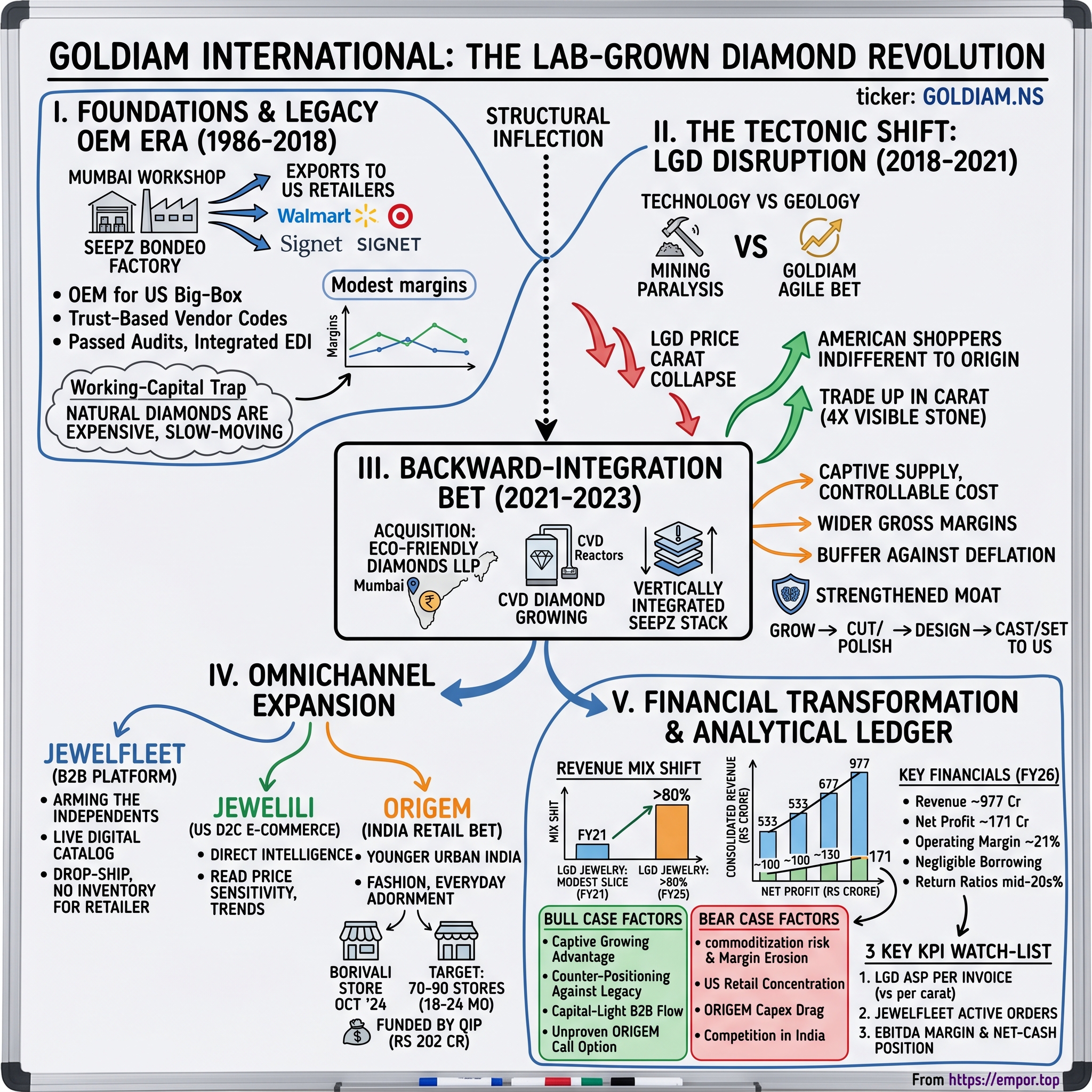
Goldiam International: The Lab-Grown Diamond Revolution
I. Introduction & Episode Roadmap
Picture the Santacruz Electronics Export Processing Zone — SEEPZ — a walled enclave in Mumbai's Andheri East, established in the 1970s so that electronics and, later, gems-and-jewelry exporters could import raw material duty-free and ship finished goods straight to the West. It is not a place of showrooms and velvet trays. It is loading docks, security checkpoints, air-conditioned workshops, and the low hum of casting machines. Out of this zone, a company incorporated in 1986 and listed on Indian exchanges in 1994 quietly built itself into one of North America's most important suppliers of lab-grown diamond jewelry.12
The scale today is worth stating plainly, because it frames everything that follows. In the fiscal year ended March 2026, Goldiam's consolidated revenue reached roughly ₹977 crore, up from about ₹603 crore two years earlier, with net profit of ₹171 crore and an operating margin holding around 21%.3 The balance sheet carries negligible borrowing against a cash-and-investments pile that ran to nearly ₹289 crore at the close of FY2025.4 The Bhansali promoter family owns roughly 58.5% of the equity.3 And the engine driving the growth is almost entirely lab-grown: by the fourth quarter of FY2025, lab-grown diamond jewelry made up 81.8% of the export sales mix, up from 54% just a year earlier.4
The central thesis of this episode is a single strategic idea that the investor Hamilton Helmer would call counter-positioning. The world's natural-diamond establishment — miners, polishers, trading houses — sat on billions of dollars of inventory whose value depended on the belief that a mined diamond is categorically different from a lab-grown one. To embrace lab-grown diamonds (LGDs) wholeheartedly was, for them, to light a match near their own balance sheet. Goldiam carried none of that baggage. It was a manufacturer, not a hoarder of rough. So when the price of a lab-grown carat began collapsing and American shoppers proved indifferent to origin, Goldiam leaned in: it backward-integrated into Chemical Vapor Deposition (CVD) diamond growing, and it deepened its distribution into US big-box retail.[^5]5
The architecture of the story runs in five movements. First, the legacy OEM era — 1986 to roughly 2018 — when Goldiam earned its stripes and, more importantly, its vendor codes with American mass retailers. Second, the structural inflection: the collapse of natural-diamond unit economics and the rise of LGDs. Third, the backward-integration bet — the acquisition of Eco-Friendly Diamonds LLP and the decision to grow its own crystals. Fourth, the omnichannel act — the B2B platform JewelFleet, the US direct-to-consumer brand Jewelili, and the Indian retail brand ORIGEM. And fifth, the analytical core: management, capital allocation, earnings-call forensics, competitive frameworks, the risk radar, and the bull-versus-bear ledger.
A neutral observer should hold one caution throughout. Much of what makes Goldiam attractive on paper — expanding margins, captive supply, a debt-free balance sheet — is also, in part, a function of a commodity deflation cycle that is still playing out. The interesting question is not whether Goldiam has done well. It plainly has. The question is which parts of that success are durable structural advantage and which parts are a favorable moment that could reverse. Let us start where the moat was actually built: not in a lab, but on the receiving docks of American superstores.
 Subscribe on LinkedIn
II. Foundations & The Legacy OEM Era (1986–2018)
Every family business has an origin myth, and Goldiam's is unusually literal about geography. The company was founded by the late Manhar Bhansali, a diamond man of the old Mumbai school, and today it is run by his son, Rashesh Bhansali, as executive chairman, and his grandson, Anmol Bhansali, as managing director.6 Its registered home has always been the same address inside SEEPZ — a Gems & Jewellery Complex unit that let the firm import gold, platinum, and rough diamonds without duty on the promise that everything came back out as finished exports.6 For a jeweler with global ambitions and modest capital, SEEPZ was less a location than a business model: it turned a Mumbai workshop into a bonded factory pointed squarely at the West.
The old Goldiam did one thing, and did it for decades. It designed and manufactured natural-diamond-studded gold and platinum jewelry, and it shipped that jewelry to North American mass-market retailers. It was, in the language of the trade, an OEM — an original equipment manufacturer — the invisible hand behind jewelry that carried a department store's name, not Goldiam's. Incorporated in 1986 and brought to the public markets in 1994, it spent the following two decades earning something that is easy to underrate and very hard to buy: the trust of American retail buyers.1
Here is the part of the OEM game that outsiders miss. Getting a purchase order from Walmart or Target or a Signet-owned banner is not a sales call; it is an onboarding gauntlet. A vendor must pass factory-compliance and social-audit inspections, integrate with the retailer's electronic data interchange (EDI) systems so that orders, invoices, and shipping notices flow automatically, and then — the hard part — build a multi-year track record of hitting delivery windows and quality specs without drama. A single blown holiday season can end a relationship. This is why big-box vendor slots behave less like contracts and more like tenure: they take years to earn and are painful to switch. Goldiam spent the 1990s and 2000s becoming exactly this kind of trusted, low-drama partner — a design-and-execution shop that buyers could hand a concept and forget about, rather than an order-taker they had to babysit.
But the economics of that old business had a ceiling built into them, and it is important to be honest about how modest they were. Natural-diamond OEM work is a working-capital trap. To make a studded ring you must first own the diamond, and natural stones are expensive and slow-moving; capital sat idle in inventory for months. Operating margins hovered in the low double digits, inventory turned slowly, and the entire cost base was hostage to the price of natural rough — a market historically dictated by a tight oligopoly at the top, above all De Beers and Russia's АЛРОСА Alrosa. A jeweler at the bottom of that pyramid was, in effect, renting price risk it could not control.
So the pre-2018 Goldiam was a good business trapped inside a mediocre category. It had the distribution — the vendor codes, the EDI pipes, the buyer relationships — that competitors would kill for. What it lacked was a product whose economics deserved that distribution. When one arrived, Goldiam would already own the hardest part of the value chain. The catalyst came from an unlikely direction: a technology that the diamond establishment had spent years dismissing as a gimmick.
III. The Tectonic Shift: The Lab-Grown Diamond Disruption (2018–2021)
To understand why Goldiam's next move worked, you have to understand what a lab-grown diamond actually is — because the single most important fact about it is the one the industry spent a decade trying to obscure. A lab-grown diamond is not a fake diamond. It is not cubic zirconia or moissanite, which are different materials that merely look diamond-ish. It is carbon, arranged in the identical crystal lattice as a mined stone, with the same hardness, the same refractive sparkle, the same chemistry. A gemologist cannot tell them apart by eye; it takes specialized machines reading trace growth signatures to distinguish origin. The only real difference is where the carbon crystallized: a billion years underground, or a few weeks inside a reactor.
Two technologies grow these crystals. High Pressure High Temperature (HPHT) mimics the earth's mantle by squeezing carbon under enormous pressure and heat. Chemical Vapor Deposition (CVD) — the method Goldiam bet on — is more elegant: a diamond "seed" is placed in a vacuum chamber, a carbon-rich gas like methane is introduced, and microwave energy strips the carbon atoms loose so they rain down and build the crystal layer by atomic layer, almost like 3D-printing a gemstone. By the late 2010s, CVD had matured to the point where it could reliably produce large, high-clarity, colorless stones suitable for bridal jewelry — the highest-value category.
Now the consumer math, which is where the disruption becomes unstoppable. Because a lab can grow a large, clean stone in weeks, the price per carat of lab-grown diamonds fell dramatically and kept falling. Put concretely: an American shopper who could once afford a half-carat natural diamond engagement ring could suddenly buy a two-carat lab-grown ring — four times the visible stone — for a similar outlay, with no perceptible difference to anyone but a lab technician. Faced with that trade, a large and growing share of price-conscious Western buyers, particularly in the mass and mid-market where Goldiam's retailers played, simply switched. Origin sentimentality turned out to be far thinner than the mining industry had assumed.
This is precisely where the incumbents froze, and their paralysis is the whole game. Consider the position of a traditional polished-diamond trading house sitting on hundreds of millions of dollars of natural-diamond inventory. To publicly concede that a lab-grown stone is "the same" is to concede that the premium on your inventory is a story, not a fact — and to invite a write-down that could wipe out years of profit. The mining giants, for their part, spent years framing LGDs as mere "synthetics," a novelty for costume jewelry, even as their own retail data told a different story. Their incentives demanded denial. Their balance sheets made honesty expensive.
Goldiam's leadership read the same tea leaves and reached the opposite conclusion, because they could afford to. On the company's own telling, chairman Rashesh Bhansali and his son Anmol concluded that their North American customers cared about price-to-carat and design, not geology — and that resisting the shift would simply hand the volume to someone else.[^5] So Goldiam began redirecting capital away from natural-diamond inventory and toward lab-grown capability. It is worth stating the analytical point without cheerleading: this was less a stroke of visionary genius than a clear-eyed reading of incentives. Goldiam had no legacy rough to protect, so the "brave" move was also the economically obvious one. The genius, if there was any, was in refusing to let sentiment or industry peer pressure override arithmetic — and then in moving faster than firms that reached the same conclusion later. The next step was to make sure it didn't just ride the trend but owned a piece of the supply chain underneath it.
IV. The Backward-Integration Bet: Acquiring Eco-Friendly Diamonds (2021–2023)
The decisive move was small enough in rupee terms that it barely registered as news, which is exactly why it rewards a second look. Goldiam acquired a controlling 88% stake in Eco-Friendly Diamonds LLP, a CVD lab-grown diamond grower, folding captive diamond-manufacturing capacity into its orbit — the transaction structured in tranches and effective from late 2020, for an outlay on the order of ₹21 crore.7 For a company that would soon be doing hundreds of crores of LGD business, spending roughly the price of a couple of Mumbai apartments to own the top of its own supply chain was, in hindsight, one of the highest-return capital allocation decisions in its history.
Why did it matter so much? Think of the alternative. An unintegrated jewelry maker buys lab-grown rough on the open market, where prices swing and margins get squeezed from both ends. By owning growing capacity — reactors that the company later expanded, taking capacity to roughly 630 carats of CVD diamond per month — Goldiam converted a volatile input cost into a controllable in-house process.7 It no longer had to guess where spot rough would trade; it could grow what it needed, when it needed it, at a known cost.
The strategic elegance is in the full vertical stack this created, all under effectively one roof in SEEPZ. Raw LGD crystals are grown in the reactors. They are precision-cut and polished. In-house CAD teams design the jewelry. Casting and stone-setting happen in the same complex. And finished pieces ship directly into US retail distribution centers through Goldiam's American arm. Each handoff that a competitor outsources — and pays a margin on — Goldiam captures internally. In a business where the final studded piece is where most of the value sits, controlling both the cheap end (the stone) and the valuable end (the design and setting) is a genuinely strong position.
The unit-economics consequence is the crux, and it deserves a plain-English translation. Captive growing meaningfully lowered Goldiam's raw-material cost versus rivals buying rough on the market. That did two things at once. It widened gross margins outright. And — more subtly — it gave Goldiam a buffer against the very deflation roiling the industry. As the price of lab-grown rough kept falling, an unintegrated competitor's revenue-per-carat fell with it, squeezing them. Goldiam, growing its own stones cheaply, could absorb that deflation on the input side while still capturing high value on the finished setting. Falling rough prices, in other words, hurt its competitors more than they hurt Goldiam.
There is a sober caveat a neutral analyst must attach here. Backward integration is a double-edged sword. Owning growing capacity is an advantage only so long as captive production is cheaper than the spot market — and in a technology where global capacity, much of it from low-cost Chinese producers, keeps expanding, spot rough could conceivably fall so far that owning reactors becomes a liability rather than an edge. Goldiam's integration is a real advantage today. Whether it remains one depends on a commodity curve no one controls. With the supply chain secured, the story now moves to what all this did to the financial statements.
V. Financial Transformation & Segment Economics
If you overlaid Goldiam's revenue mix from FY2021 against FY2026, you would see one line collapse and another take over the chart. Lab-grown diamond jewelry, a modest slice of exports at the start of the decade, became the overwhelming majority of the business — reaching 81.8% of the export sales mix by the fourth quarter of FY2025, versus 54% a year earlier.4 The company did not simply add LGD on top of its natural-diamond business; it actively phased out lower-margin natural-diamond lines, choosing profitability of mix over vanity of scale. That is a meaningful signal about how management thinks: it was willing to shrink one part of the business to improve the whole.
The headline financials tell the rest. Consolidated revenue climbed from roughly ₹533 crore in FY2023 to about ₹603 crore in FY2024, then to the ₹780–800 crore range in FY2025, and onward to approximately ₹977 crore in FY2026 — a near-doubling in three years.3 More telling than the top line is what happened to margins. Full-year FY2025 EBITDA reached about ₹179 crore, growing roughly 40% year on year, and the EBITDA margin expanded to 22.4%, up about 159 basis points over the prior year.4 Net profit tracked from ₹117 crore in FY2025 to ₹171 crore in FY2026.34 For context, this is a business that historically operated in the low-teens on margin; the LGD pivot added the better part of ten percentage points of profitability.
What do those numbers actually mean, stripped of the spreadsheet? Two things. First, the margin expansion is evidence that the vertical-integration thesis is real, not rhetorical — a company merely riding a demand wave without a cost edge does not expand margins by this much while its category deflates. Second, and this is the counterweight, some of that margin gain is a timing artifact. When you sell finished jewelry at prices that adjust slowly while your input cost (lab-grown rough) is falling fast, your margin balloons in the interim. That is genuinely good, but it is partly a spread that competition and further price pass-through could compress. A careful investor should treat 22% as a high-water mark to be defended, not a permanent floor.
The return ratios reinforce the quality of the business without needing embellishment. Return on capital employed has run in the low-to-mid twenties percent, and return on equity in the high teens — strong figures for a manufacturer, and a direct consequence of the working-capital revolution underneath.3 This is the least glamorous but most important part of the whole story. A natural diamond could sit in inventory for four to six months before it became a sold ring — capital frozen the entire time. A lab-grown stone can be grown, cut, set, and shipped in a small fraction of that cycle. Faster inventory turns mean the same capital does more work per year, which is why a debt-free Goldiam can fund growth, dividends, and buybacks out of its own cash flow without tapping lenders or diluting shareholders much.4
The through-line for investors is this: Goldiam's financial transformation is not an accounting illusion, but it is not entirely a permanent structural gift either. It is a genuinely better business — higher-margin, faster-turning, cash-generative — that happens to be enjoying an unusually favorable phase of a commodity cycle on top of that. Separating the two is the single hardest and most important judgment in the whole analysis. With the export engine humming, management turned its attention to a harder question: how to grow when you already supply nearly everyone worth supplying. The answer was to go around the middlemen entirely.
VI. The Omnichannel Expansion: JewelFleet, Jewelili, and ORIGEM
A concentrated wholesale business has an obvious vulnerability: a handful of giant customers own the relationship with the end shopper, and they can squeeze you. Goldiam's response was to build three different bridges to demand it did not previously control — one aimed at small American jewelers, one at American consumers directly, and one at the Indian shopper. Each is at a different stage of maturity, and a neutral read requires sizing them honestly rather than lumping them into a single growth story.
JewelFleet: arming the independents. The first bridge, launched around 2021 in the wake of the Eco-Friendly Diamonds acquisition, was a B2B platform called JewelFleet, run through Goldiam's US arm.8 The problem it solves is specific. Thousands of independent "mom-and-pop" American jewelers cannot afford to stock a deep range of lab-grown bridal inventory on their own shelves — tying up cash in slow-moving diamonds is precisely the trap Goldiam itself escaped. JewelFleet lets these small retailers show customers a live digital catalog of Goldiam's designs, take a custom order, and have it drop-shipped from Goldiam USA — no upfront inventory required.9 In effect, Goldiam offers the independent jeweler the muscle of a large vendor's catalog without the balance-sheet risk. It is a clever, capital-light way to aggregate the long tail of American retail that the big-box relationships never reached. The honest caveat: it is early, and Goldiam has not disclosed platform economics in the granular way a pure software business would, so investors should watch adoption rather than take the concept's promise on faith.
Jewelili: testing the consumer directly. The second bridge is Jewelili, a US direct-to-consumer e-commerce brand. Its strategic value is less about near-term revenue and more about intelligence: selling straight to American consumers gives Goldiam a live read on price sensitivity, promotional response, and design trends — the kind of demand signal that a pure OEM, sitting one step removed behind a retailer, never sees. It is a listening post as much as a storefront.
ORIGEM: the India bet. The third and most capital-intensive bridge points home. India has historically treated diamonds as a store of value — something closer to gold, bought for weddings and hoarded for worth. The wager behind ORIGEM is that a younger, urban India is starting to treat diamonds the way the West does: as fashion and self-expression, where the low price of lab-grown makes everyday adornment affordable. Goldiam opened its first ORIGEM store in Borivali, Mumbai, in October 2024, and moved quickly — six outlets within about ten months, with a stated ambition of 70–90 stores over the following 18–24 months and talk of scaling toward 200 over time.1011 These are company-owned, company-operated stores, which means Goldiam controls the brand and the experience but also carries the full cost and risk of every lease and every unsold display case.
To fund this without abandoning its debt-free discipline, Goldiam raised roughly ₹202 crore through a qualified institutional placement in August 2025, earmarked to accelerate ORIGEM.12 This is where a neutral posture matters most. A retail rollout is a fundamentally different, and riskier, animal than an export-manufacturing business. It burns cash upfront, its unit economics live or die on same-store sales and footfall, and it pits Goldiam against domestic jewelry titans with vastly larger marketing budgets. Management frames ORIGEM as high-optionality — a small part of revenue today with a large potential prize. That framing is fair. But optionality is not the same as value, and the QIP means outside shareholders are now partly funding a bet whose payoff is years away and far from assured. The right stance is neither dismissal nor enthusiasm, but attention: ORIGEM is the part of the story most likely to either surprise on the upside or quietly disappoint. Whether it does depends heavily on the people making the calls — so it is worth examining them directly.
VII. Management Credibility, Governance & Capital Allocation
Family-run Indian smallcaps are a minefield precisely because governance and capital allocation are so often where value quietly leaks away — through empire-building, related-party dealings, or promoters who treat public shareholders as an afterthought. Goldiam is interesting because, on the evidence, it has largely avoided those traps. That is worth examining not as praise but as a testable claim.
Start with the two people who matter. Rashesh Bhansali, the executive chairman, is the continuity figure — a second-generation diamond man who spent decades navigating export cycles, currency swings, and the grind of big-box vendor relationships. His defining trait, visible in the balance sheet more than in any speech, is conservatism: an almost stubborn insistence on staying debt-free and cash-rich through cycles that tempted peers into leverage. Anmol Bhansali, his son and the managing director, is the architect of the pivot. A 2017 graduate of Wharton, he returned to a business that could have coasted on its legacy and instead pushed it toward the technology shift, the JewelFleet platform, the D2C experiments, and the ORIGEM retail gamble.13 The generational division of labor is almost archetypal: the father guards the downside, the son chases the upside. For a shareholder, that pairing is reassuring only to the extent the father's discipline continues to check the son's ambition — a dynamic worth watching as ORIGEM's capital needs grow.
On alignment, the promoter family holds roughly 58.5% of the company.3 That is a large, meaningful stake — the family's own wealth rises and falls with public shareholders' — but it is worth noting the number has drifted down from around 66% a few years earlier, partly a function of the QIP and other actions.3 Dilution of promoter stake is not inherently bad, but it is a line item to track: skin in the game is the bedrock of the alignment case here.
The capital-allocation record is where Goldiam earns most of its credibility, and it is concrete rather than rhetorical. The company has stayed net-debt-free through volatile cycles — a genuine discipline, not a slogan, given how easy leverage would have made the LGD build-out. It has returned cash steadily: over roughly a five-year window it distributed on the order of ₹200 crore to shareholders through dividends and buybacks, including a tender buyback in 2021 at ₹150 per share and a consistent dividend habit.1114 And crucially, its one major acquisition — Eco-Friendly Diamonds — was a small, bolt-on, strategically central asset bought cheaply, not a splashy, ego-driven global purchase. The pattern that emerges is a management team that prefers synergistic tuck-ins and shareholder returns to value-destructive empire-building.
The activist's counter-question, which a neutral analyst should raise rather than dodge, is whether ORIGEM breaks this pattern. A cash-rich, disciplined exporter suddenly pouring capital — including freshly raised outside money — into a capital-hungry retail rollout is exactly the kind of "diworsification" that skeptics watch for. It is not yet a red flag; the sums are moderate and the logic is coherent. But it is the first move in years that runs against the grain of the company's own frugal reputation, and the burden is on management to prove ORIGEM earns its keep. That burden is precisely what analysts have started pressing on, quarter after quarter.
VIII. Earnings Call Forensics & Q&A Dynamics
The most revealing moments in Goldiam's story do not happen in press releases; they happen in the give-and-take of the quarterly analyst call, where prepared optimism meets pointed skepticism. Across recent FY2024–FY2026 calls, one question surfaces again and again, and how management answers it tells you whether the business model is as robust as the margins suggest.15
The question is deceptively simple: if the price of lab-grown diamonds keeps falling, doesn't Goldiam's revenue fall with it? On its face this is the whole bear case in one sentence — a company selling a product whose per-unit price is in structural decline. Management's counter-argument, repeated with notable consistency across calls, is the single most important idea to understand about the business. Goldiam does not sell loose rough diamonds by the carat; it sells finished jewelry pieces by the invoice. As the price per carat of the center stone falls, the American consumer does not spend less — they trade up. The shopper who would have bought a one-carat stud upgrades to a two-and-a-half-carat one for a similar total ticket. The dollar value of the finished piece holds, or even rises, even as the price per carat collapses. Carat inflation, in effect, absorbs price deflation.
This is a genuinely elegant argument, and the margin data lends it real support. But a neutral listener should press on where it could fail, and management's own framing hints at the vulnerability. The mechanism works only so long as consumers keep trading up in size fast enough to offset falling per-carat prices. There is a physical and social ceiling to that: at some point a stone is simply too large for an everyday ring, and the upgrade cycle stalls while prices keep dropping. On the calls, this is the friction point — analysts probe whether the "consumers upgrade" story is a durable structural truth or a comfortable narrative that works until it doesn't. Management's answers have been concrete and consistent, which is a credibility positive; whether they are ultimately right is unproven.
Two other pushback themes recur, and both are legitimate. The first is concentration risk: a large share of revenue flows through a small number of US retail majors, and analysts reasonably ask what happens if one of them destocks, switches vendors, or gets squeezed in a US recession. The second is the durability of 20%-plus EBITDA margins if low-cost Chinese HPHT and CVD producers flood the world with cheap rough and finished goods, dragging pricing down industry-wide. And a third, more recent, thread concerns the ORIGEM capex — analysts want to know when the Indian retail stores turn profitable rather than merely opening.
What is notable across these exchanges is the tone. Management tends to answer with specifics — mix percentages, capacity figures, store counts — rather than deflection, and the narrative has stayed consistent from one call to the next. That consistency is itself a form of evidence: promoters who are improvising or hiding something tend to shift their framing quarter to quarter. Goldiam's has not. The story they tell in Q&A matches the story in the numbers. Whether that story survives contact with a tougher competitive environment is the question the next section war-games directly.
IX. Competitive Landscape, Helmer's 7 Powers & Porter's 5 Forces
Strip away the narrative energy and ask the hard structural question: what, exactly, stops someone else from doing what Goldiam does? The honest answer is a mix of powers that are genuinely strong, genuinely real, and genuinely limited — and it pays to be precise about which is which.
The strongest power, and the one that organizes the entire story, is counter-positioning in Hamilton Helmer's sense. This is not merely "Goldiam moved early." Counter-positioning describes a situation where an incumbent cannot copy a newcomer's model without damaging its own existing business. That is exactly the trap the natural-diamond establishment fell into: a firm sitting on billions in mined-diamond inventory could not fully embrace lab-grown without implicitly admitting its own inventory was overpriced, inviting write-downs it could not stomach. Goldiam, carrying no such inventory, cannibalized the market with a free hand. This is a powerful and durable advantage against legacy players. Its critical limitation is that it offers no protection against new entrants who, like Goldiam, have no legacy baggage — and there are many of those.
The second power is closer to a cornered resource or, more precisely, distribution power: three decades of vendor relationships, EDI integrations, compliance track records, and buyer trust with the top US big-box retailers. This is the moat that predates the LGD story and, arguably, matters more than the reactors. A new competitor can buy a CVD reactor next week; it cannot buy a fifteen-year on-time-delivery record with a major retailer's jewelry buyer. This is Goldiam's most under-appreciated and most defensible edge.
The third claimed power, scale economies from the integrated SEEPZ facility, is real but should be held modestly. Combining growing, cutting, casting, and setting under one roof yields genuine cost and coordination advantages. But Goldiam is not a globally dominant-scale player in absolute terms, and the CVD-growing step in particular is a technology where scale advantages are eroding as global capacity proliferates. Integration is an efficiency edge, not an insurmountable one.
Running Porter's five forces sharpens the picture. The threat of new entrants is genuinely mixed: low in the big-box US supply chain, where vendor approval is a years-long moat, but only moderate in diamond growing, where reactors are increasingly available capital equipment. Buyer power is high — US retail giants are famously ruthless on price and payment terms — and Goldiam mitigates this only through design value-add and its low-cost captive position, not by escaping it. Supplier power is low, and getting lower, precisely because captive growing reduced dependence on external rough sellers; the key inputs become power, gas, and gold rather than a scarce, oligopoly-controlled commodity. And the threat of substitutes — natural versus lab-grown — is the whole disruption, except that Goldiam sits on the winning side of it rather than the losing side.
The war-game conclusion is balanced. Goldiam's moat is strongest where people underestimate it — in unglamorous US retail distribution — and weakest where the marketing emphasizes it, in the reactors themselves. The distribution relationships and counter-positioning against legacy players are durable. The manufacturing-technology edge is a lead, not a lock. A skeptical investor should weight the former heavily and discount the latter. Those competitive realities feed directly into the concrete risks that could break the case.
X. Risk Radar & Activist Stress Test
A useful way to pressure-test any bull case is to ask what a sharp short-seller would put in the deck. For Goldiam, the material risks are specific and mechanical, not vague macro hand-waving, and each connects to a real feature of the business.
First, severe ASP erosion outrunning carat inflation. The entire margin story rests on the "consumers trade up in size" mechanism described earlier. The risk is that finished lab-grown jewelry prices fall faster than shoppers expand their carat expectations. If the average selling price per piece — not per carat, per piece — starts declining, the whole revenue-and-margin edifice compresses at once. This is the single most important thing to monitor, because it is where a comfortable narrative could quietly turn false.
Second, US retail macro and tariff exposure. Goldiam's revenue is overwhelmingly tied to North American discretionary spending, funneled through a handful of large retailers. A US consumer slowdown, a retail destocking cycle, or an adverse shift in US–India trade duties on jewelry would hit Goldiam's core with little geographic diversification to cushion it — though the company has noted some spread into Middle East, Israel, and Australia B2B markets.12 Concentration cuts both ways: it delivers efficiency in good times and amplifies pain in bad ones.
Third, the ORIGEM capex drag. If the Indian retail rollout fails to hit store-level profitability — if same-store sales and footfall disappoint — then a growing overhead of leases, inventory, and staff sits on top of a lean export business, diluting the very margins that make Goldiam attractive. Retail is unforgiving of half-measures; a store that doesn't work still costs money every single day. This is the self-inflicted risk, the one entirely within management's control and therefore the fairest test of their discipline.
Fourth, competition from India's jewelry titans. The domestic LGD opportunity that makes ORIGEM exciting is the same opportunity that will draw giants like Titan's Tanishq and Kalyan Jewellers, with brand recognition and marketing budgets that dwarf Goldiam's. In its home market, Goldiam would be the challenger, not the incumbent — the reverse of its comfortable position in US wholesale. A neutral analyst should assume this competition is coming and ask whether ORIGEM has a defensible reason to win, beyond being early.
The activist's summary would run like this: a genuinely well-run, cash-generative business, but one whose peak margins may be a cyclical high, whose revenue is dangerously concentrated in one geography and a few customers, and whose promoters have just started spending outside capital on an unproven retail venture against much larger rivals. None of these is a smoking gun. Together they define the boundary of the bull case — which is exactly what the final ledger must weigh.
XI. Bull vs. Bear Case & Key Investor KPIs
Lay the two cases side by side, and the disagreement is not really about whether Goldiam is a good company. Both sides largely concede that it is. The disagreement is about whether today's economics are a durable structure or a favorable moment.
The bull case rests on continuation and optionality. Lab-grown penetration in US retail is still expanding — spreading from bridal into everyday fashion jewelry, a larger and more repeat-driven market. JewelFleet could scale into a genuinely capital-light way to aggregate thousands of independent American jewelers without taking inventory risk, a high-margin flywheel if adoption compounds. The debt-free balance sheet keeps throwing off cash that funds dividends, buybacks, and growth without dilution or leverage. And ORIGEM offers a real, if unproven, call option on a domestic Indian LGD market that could become large. In this telling, the counter-positioning against legacy players and the three-decade distribution moat carry Goldiam through, and the margin structure holds because integration and design value-add are real cost advantages, not accounting spreads.
The bear case rests on commoditization and concentration. Lab-grown rough is a technology product, and technology products deflate relentlessly as global — especially Chinese — capacity floods in. If finished-jewelry prices follow rough down, the 20%-plus margins revert toward the low-teens where jewelry manufacturing historically lives. Add a US retail destocking cycle or a demand wobble, and a concentrated revenue base amplifies the hit. Layer on an ORIGEM rollout that burns cash without reaching store-level profitability against far larger domestic rivals, and the pristine financial profile erodes from two directions at once. In this telling, Goldiam did brilliantly to catch the wave, but riding a commoditizing wave is not the same as owning a durable franchise.
The synthesis a neutral investor should hold is that both cases are partly right, and the truth turns on evidence that will reveal itself over the next several years — not on rhetoric available today. Goldiam has proven execution, real distribution advantages, and genuine capital discipline. It has not yet proven that its peak margins survive full commoditization, or that it can win in Indian retail. The case is neither a slam-dunk nor a trap; it is a well-run business at an unusually good moment, and the question is how much of the moment is permanent.
Which is why the diligence collapses to a short, disciplined watch-list. Three KPIs matter more than all the rest, and a reader tracking only these will know how the story is actually unfolding:
-
LGD export share and average realization per finished piece (ASP). Not per carat — per piece. This is the direct, unspoofable test of whether the "consumers trade up" mechanism is holding. If ASP per invoice stays flat or rises while volumes grow, the bull thesis is intact. If it starts sliding, the bear thesis is arriving.
-
JewelFleet onboarding and active-order velocity. The count of independent US jewelers on the platform and how actively they order is the leading indicator of whether the capital-light distribution flywheel is real or merely a slide in a presentation.
-
Consolidated EBITDA margin alongside the net-cash position. The single number that captures whether the transformation is durable. Holding the high-teens-to-20% margin while staying net-debt-free would confirm the moat; a drift back toward the low-teens, especially if paired with rising retail overhead, would confirm the commodity-cycle skeptics.
Watch those three, and the rest of the Goldiam story — the reactors in SEEPZ, the vendor codes in America, the new stores in Mumbai — becomes legible as it happens. The company transformed itself once, decisively, by reading incentives more clearly than an entire industry. Whether it can defend that transformation against the same deflationary force that created it is the question the next few years will answer.
References
-
Goldiam International Company History & Financial Evolution — Business Standard, 2025-08-01 ↩↩
-
Goldiam International NSE Equity Quote & Company Filings — National Stock Exchange of India, 2026-05-15 ↩
-
Goldiam International Ltd Consolidated Financials — Screener.in, 2026-06-01 ↩↩↩↩↩↩↩
-
Outcome of Board Meeting with FY2025 Results & Investor Update — Goldiam International, 2025-05-26 ↩↩↩↩↩↩
-
Goldiam International Business Model & Segment Breakdown — Tijori Finance, 2026-03-15 ↩
-
Goldiam International Company Profile & Financial Metrics — Economic Times, 2026-05-10 ↩↩
-
Goldiam International Ltd Share Analysis — Congruence Advisers, 2025-01-15 ↩↩
-
Goldiam International Debuts B2B Website For US Retail Jewelry — PYMNTS, 2021-06-01 ↩
-
Goldiam USA Launches Custom Jewelry Platform — National Jeweler, 2021-06-01 ↩
-
Backed by Goldiam, ORIGEM Plans 200 Store Launch for LGD Jewellery — Indian Retailer, 2025-08-01 ↩
-
Goldiam raises Rs 202 Cr to scale lab-grown diamond retail play — YourStory, 2025-08-01 ↩↩
-
Goldiam raises Rs 202 crore to expand Origem, its lab-grown diamond jewellery retail brand — The Retail Jeweller India, 2025-08-01 ↩↩
-
Anmol Rashesh Bhansali: Positions, Relations and Network — MarketScreener, 2026-05-01 ↩
-
Goldiam International soars 12%, hits new high on buyback plan — Business Standard, 2021-07-07 ↩
-
Goldiam International Ltd Q3 2025 Earnings Call Highlights: Record Revenue Growth — Yahoo Finance / GuruFocus, 2025-02-12 ↩
 LinkedIn
 WhatsApp
 Reddit
 Hacker News
 Email
Email Kindle
 RSS Feed
 Spotify
 Apple Podcasts
 Amazon Music
 Audible
 YouTube