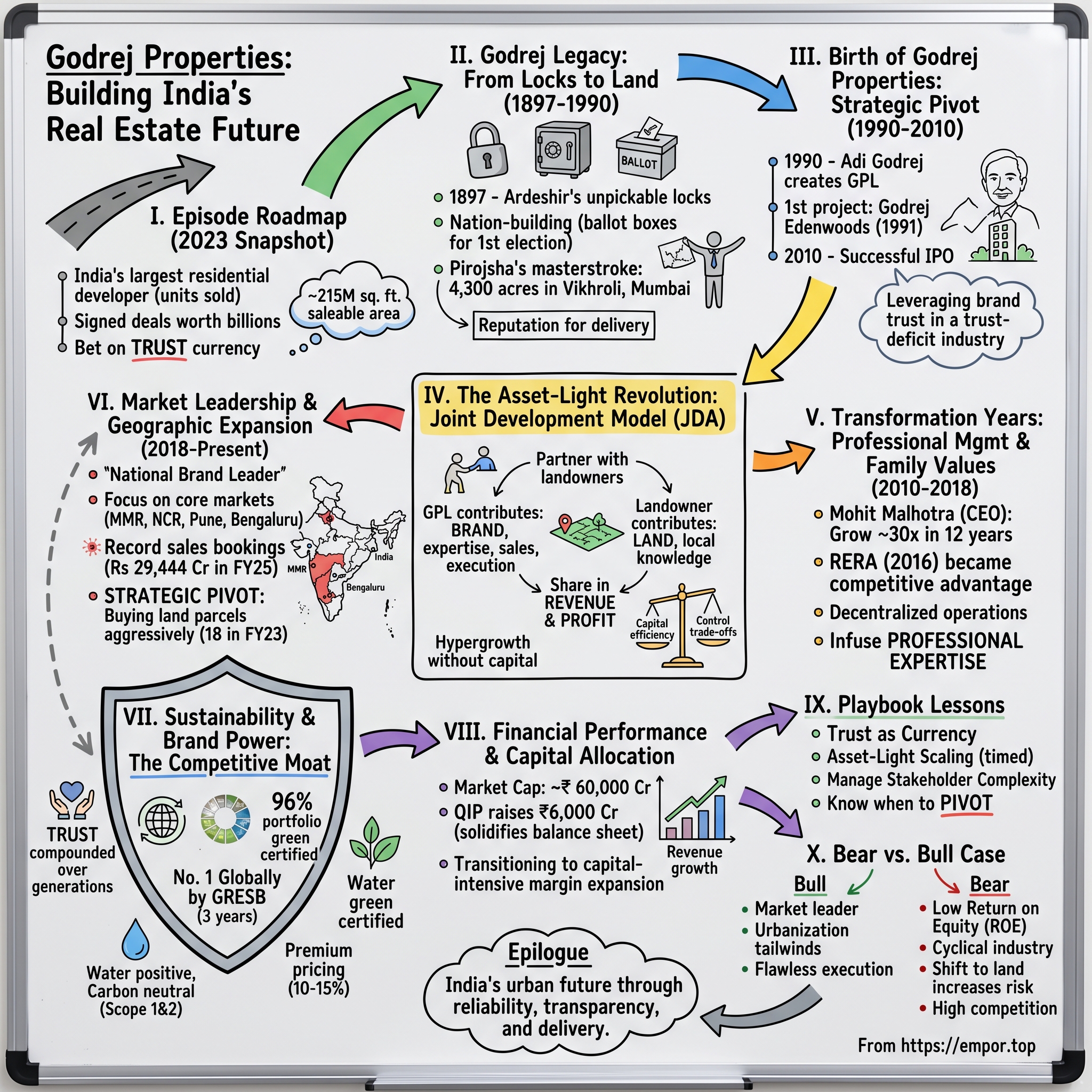
Godrej Properties: Engineering Trust in India's Real Estate Frontier
I. Introduction & Episode Roadmap
A Lockmaker's Name on a Building Site
Consider a sales gallery on the edge of Gurugram in April 2024. The residential towers did not yet exist. Where Godrej Zenith would eventually stand in Sector 89, there was little more than dust, rebar, and perimeter hoardings. Yet inside the air-conditioned gallery, homebuyers were writing cheques for apartments they would not be able to occupy for years. In three days, more than 1,050 homes worth over ₹3,000 crore changed hands, in what the company reported as its most successful launch ever1.
What buyers were purchasing was not concrete or brickwork, but a promise anchored by a corporate name that most Indian households first encountered on a steel almirah, a padlock, or a refrigerator. That dynamic highlights the central puzzle of Godrej Properties Limited (NSE: GODREJPROP): a business that translated a 129-year-old industrial reputation for durability into the largest residential sales engine among India's listed developers.
The Scale Today
That engine operates at an unprecedented scale. In the financial year ended March 2026 (FY26), Godrej Properties booked ₹34,171 crore in residential presales—up 16% year-on-year—and collected ₹19,965 crore in cash from customers2. Those numbers made it the largest listed developer in India by sales value, surpassing Prestige Estates, Lodha Developers, and DLF3. The multi-year trajectory has been steep: booking value surged 84% in FY24 to ₹22,527 crore4, reached ₹29,444 crore in FY255, and management has guided to ₹39,000 crore for FY276.
The Analytical Paradox
Alongside that operating momentum sits an unresolved financial paradox. On September 24, 2026, the stock trades around ₹1,6717—substantially below the ₹2,595 per share at which institutional investors purchased ₹6,000 crore of newly issued equity in December 20248. Underlying profitability has consistently lagged headline volume: over the past decade, return on equity has averaged roughly 6%, and about 7% over the past five years7. For a cyclical development business in an emerging market, returns at that level fall well short of a standard cost of equity.
This disconnect raises three core questions.
First, how did the volume leader of Indian housing spend a decade generating single-digit equity returns?
Second, why did a developer celebrated for its capital-light joint development agreement (JDA) model pivot after 2021 toward aggressive outright land acquisitions on its own balance sheet?
Third, what did the 2024 corporate split of the Godrej family reveal about the group's historic Vikhroli land bank in Mumbai, which many retail investors had long assumed belonged to Godrej Properties?
The Road Ahead
This analysis examines the company's trajectory across six chapters. It begins with the Swadeshi-era lockmaker and the consumer trust that established the brand. It traces the slow, complicated establishment of the real estate arm in Mumbai's fragmented land market, followed by the capital-light JDA expansion led by Pirojsha Godrej. It evaluates the regulatory shocks—demonetisation, the Real Estate (Regulation and Development) Act, and the non-bank financing crisis—that cleared the market of weaker competitors. It revisits the governance controversy of February 2022, when a proposed investment in DB Realty triggered a 10% intraday share price decline and was rescinded within twenty-four hours. Finally, it assesses the Gaurav Pandey era of balance-sheet land purchases, an operating phase that must now demonstrate whether record presales can translate into commensurate returns on capital.
Management has set a clear operational benchmark, targeting a 20% return on equity in FY289. Evaluating whether that target is achievable—and what execution risks could disrupt it—forms the center of this story. Understanding that journey begins with the origin of the brand itself: a simple brass padlock.
 Subscribe on LinkedIn
II. The Conglomerate Shadow & The Trust Moat (1897–2000s)
The Lawyer Who Became a Lockmaker
In 1897, Ardeshir Godrej, a trained lawyer turned entrepreneur, established a lock workshop in a small shed in Bombay's Lalbaug area, going on to patent a springless lock in 190910. The early business was founded on a simple value proposition: an Indian-manufactured lock secure enough for customers to entrust with their most valuable possessions.
From locks, the enterprise expanded into security safes, establishing an operating pattern of entering product categories where consumer anxiety centered on product failure. In 1918, Godrej launched a washing soap bar. By 1920, the firm developed what it marketed as the world's first toilet soap made entirely from vegetable oil, appealing directly to domestic households concerned about animal fats10. In 1955, the group introduced the Godrej Prima, billed as Asia's first locally produced typewriter10. In 1958, it rolled out India's first domestically manufactured refrigerator, built in collaboration with General Electric10.
Building the Republic's Ballot Boxes
The defining showcase of the group's institutional standing arrived alongside Indian independence. The group's manufacturing plant in north-east Bombay's Vikhroli suburb commenced operations on July 4, 1951, positioned to fulfill an emergency contract for steel ballot boxes ahead of India's first general election, producing more than 15,000 units per day10. Entrusting the physical custody of the infant democracy's first vote to a private manufacturer conferred a degree of institutional credibility that conventional corporate marketing could not replicate.
Decades later, that same Vikhroli industrial campus would become the epicenter of a widespread investor misconception regarding the listed real estate company's asset base.
The Trust Deficit in Indian Housing
Following economic liberalisation in the 1990s, Indian residential real estate presented conditions antithetical to the reliability associated with the Godrej name. Homebuyers routinely disbursed substantial cash advances for housing units that existed purely on paper. Land titles were frequently disputed, municipal clearances hinged on discretionary administrative relationships, and customer advances were routinely diverted to fund subsequent land purchases. The operational and legal risks fell almost exclusively on the consumer.
For a consumer-goods conglomerate, this market dislocation represented a structural opportunity. In an industry where buyers could not independently verify execution quality or title integrity in advance, an established corporate brand offered an implicit guarantee. The strategic test was whether that governance-driven proposition could remain viable while navigating localized land markets, municipal bureaucracy, and contractor friction.
A Slow Start
The corporate origin of the real estate entity was modest. The business that evolved into Godrej Properties was originally incorporated on February 8, 1985, as Sea Breeze Constructions and Investments Private Limited. The entity was renamed Godrej Properties and Investments in 1990, before adopting its current corporate identity, Godrej Properties Limited, in November 200411. The company's initial project, Godrej Edenwoods in Thane, launched in 1991, with its first residential tower completed in 199411. Geographic diversification proceeded deliberately: entering Pune in 1999, Bengaluru in 2004, Kolkata in 2005, and Hyderabad in 200611.
That deliberate pace illustrated the operational hurdles of the sector. Over its first two decades, the Godrej brand alone did not automatically yield a scalable real estate business. Housing required specialized core competencies that a consumer products conglomerate did not inherently possess: direct land acquisition, navigating regulatory approvals, and managing multi-year construction cycles. A conservative group adherence to statutory compliance also limited participation in the speculative land-banking tactics favored by prevailing regional competitors.
Enter Pirojsha
The organizational inflection arrived with Pirojsha Godrej, son of group chairman Adi Godrej and a member of the family's fourth generation. After completing undergraduate studies at the Wharton School, a master's degree in international affairs, and an MBA at Columbia University—alongside a period working in public policy—he joined Godrej Properties in 200412. His background was not in civil engineering or construction; his focus centered on capital allocation and corporate strategy. He identified that combining a nationally trusted corporate brand with institutional finance could outmaneuver fragmented, balance-sheet-constrained regional developers.
The 2010 Listing
The commercial validation of that strategy materialized in the public equity markets. The company's initial public offering ran from December 9 to 11, 2009, priced at ₹490 per share to raise approximately ₹469 crore in primary capital. The issue closed 3.56 times subscribed, and the company listed on January 5, 2010, commanding a market capitalization of roughly ₹3,750 crore13. Pirojsha led the listing process12.
At the time of its market debut, Godrej Properties remained a mid-tier developer distinguished primarily by its conglomerate parentage. It had yet to establish a scalable operational template that could drive national volume without encumbering its balance sheet with expensive land inventory. Resolving that constraint through an innovative, if complex, partnership model would define the company's next phase of growth.
III. The Asset-Light Revolution & The JDA Engine (2010–2016)
The Landowner's Dilemma
Consider a family on the outskirts of Pune in 2011 that owned 20 acres of farmland absorbed by urban sprawl. The family held title deeds, faced localized parcel disputes, and lacked the technical apparatus to secure municipal building approvals, manage general contractors, or market hundreds of residential units. Regional builders seeking to acquire the plot offered buyout terms, but prospective sellers were wary of counterparties defaulting on deferred installment payments.
When representatives from Godrej Properties arrived, the proposition bypassed an outright buyout: the family retained title, while Godrej agreed to design, permit, construct, and sell the development in exchange for a contracted share of project proceeds.
Replicated across dozens of urban submarkets, that partnership structure became the company's core growth engine.
The Lesson of 2008
The timing proved critical. In the aftermath of the 2008 global financial crisis, Indian developers that had accumulated debt-funded land banks at market peaks were burdened by carrying costs, illiquid inventory, and compounding interest. Over the subsequent decade, prolonged project delays and corporate insolvencies engulfed several leveraged developers across northern India. Lacking both the balance sheet and the inclination to compete directly in debt-fueled land auctions against regional incumbents, Godrej Properties pursued an alternative structural pathway.
How the JDA Works
The joint development agreement (JDA) and its related joint venture models bifurcated project execution. The local counterparty contributed land with clear title. Godrej Properties supplied corporate infrastructure: master planning, architectural design, statutory clearances, contractor oversight, brand licensing, sales distribution, and customer collections. In place of an upfront purchase consideration, the landowner received a proportionate share of project revenue or profits.
In operating terms, the model functioned like an inverted franchise agreement: the property owner retained the physical asset, while the operating brand managed execution and shared top-line proceeds. Management framed JDAs as a mechanism to expand rapidly across major metropolitan centers while avoiding debt accumulation on its balance sheet14.
Revenue-sharing ratios varied by deal and jurisdiction. Because the company did not disclose standardized contract terms, prevailing market splits served as broad industry benchmarks rather than company-specific disclosures.
The Velocity Advantage
The strategic advantage was capital velocity. By avoiding multi-year capital commitments to raw land, a single rupee of equity supported multiple concurrent projects. By FY16, Godrej Properties reported operating turnover of ₹2,728 crore—nearly double its FY13 revenue—and maintained an active development portfolio of approximately 12 million square feet across 12 cities15. While most Indian real estate firms remained confined to single regional hubs, Godrej Properties assembled an unusually broad national footprint for a residential developer.
The Professional Layer
Pirojsha Godrej assumed the role of chief executive officer in 201212. He assembled an executive tier of professional managers, led by Mohit Malhotra, an alumnus of IIM Calcutta who joined the firm in 2010 and subsequently oversaw pan-India operations15. In February 2017, the company announced a succession framework effective April 1, 2017: Pirojsha became Executive Chairman, Malhotra was elevated to Managing Director and CEO, and Adi Godrej transitioned to Chairman Emeritus15. That executive architecture persisted: the promoter family directed overarching strategy and capital allocation, while professional executives managed operational execution. This governance boundary ensured that strategic capital accountability remained with the promoter family across executive transitions.
The Disconfirming Record: When a Partner Is the Weak Link
Bullish investment theses initially characterized the JDA model as virtually risk-free and frictionlessly scalable. Operational outcomes revealed structural vulnerabilities.
The clearest friction emerged in Ahmedabad, where Godrej-branded developments were executed in partnership with a local entity, the Shree Siddhi Group. At Godrej Celesta, launched in 2022, homebuyers reported that roughly ₹233 crore was collected across approximately 1,169 buyers, against promised possession dates in 2025. By April 2026, protesting buyers asserted that construction remained stalled at early stages, alleged that project funds had been diverted to unrelated developments, and cited regulatory proceedings under the Real Estate (Regulation and Development) Act (RERA) that had spanned more than a year. According to buyers, both development partners traded blame over project responsibilities16. While those claims represented unresolved regulatory allegations rather than final judicial determinations, the reputational hazard was evident: retail homebuyers attributed delivery obligations to the Godrej brand displayed on project hoardings rather than the underlying partner entity.
This dynamic underscored the operational hazard of asset-light development. While a corporate brand can be extended across external partnerships, reputational capital cannot be shielded if an operating partner falters. A parallel economic friction emerged on profitability: landowners entitled to significant revenue shares captured a substantial portion of cyclical land-value appreciation.
Historical performance thus constrained the broader investment claims surrounding the JDA model. Capital-light partnerships provided an efficient vehicle for acquiring market share and geographic diversification without balance-sheet strain, but they diluted returns on equity and exposed the developer to operational counterparties beyond its direct managerial control. A central operational test going forward was whether projects with majority economic ownership would replace legacy joint ventures, reducing partner friction. Management's medium-term target of raising its economic interest in projects to between 85% and 90% signaled a strategic alignment with that reality6.
That structural limitation would become increasingly apparent over time. In the immediate term, however, a series of systemic shocks was about to reshape India's real estate sector.
IV. The RERA Watershed & The Great Consolidation (2016–2020)
The Night the Cash Died
On the evening of November 8, 2016, the Indian government announced that ₹500 and ₹1,000 banknotes, accounting for roughly 86% of the currency in circulation, would cease to be legal tender at midnight17. In residential real estate, where informal cash transactions had long underpinned secondary sales and land deals, the disruption was immediate. Resale transactions froze, and construction sites reliant on physical cash disbursements to daily-wage labourers scrambled to maintain basic operations17.
For unorganised regional builders, unaccounted cash had served as an informal source of both operational liquidity and project margin. For corporate developers like Godrej Properties, whose operations relied on banking channels and audited accounts, demonetisation altered the competitive landscape. Absolute sales across the sector contracted in the immediate aftermath, but the operational gap separating formal corporate developers from grey-market operators widened permanently.
RERA: Locking the Customer's Money
The second regulatory shock arrived with the Real Estate (Regulation and Development) Act, 2016 (RERA), implemented across Indian states throughout 2017. The statute's most consequential provision appeared deceptively administrative: Section 4(2)(l)(D) mandated that 70% of all customer advances collected for a real estate project be deposited into a dedicated escrow account, earmarked exclusively for that specific project's land acquisition and construction expenditures. Withdrawals were restricted strictly in proportion to physical progress, requiring concurrent certification from an engineer, an architect, and an independent chartered accountant, alongside mandatory annual statutory audits18. Misrepresentation or regulatory non-compliance carried penalties reaching up to 5% of the estimated project cost18.
The operational implication was profound: developers were legally prohibited from deploying current customer receipts as interest-free bridge capital to fund speculative, future land parcels. That restriction dismantled the cash-flow dynamics that had sustained many regional builders, who relied on rolling presales advances across successive projects. For Godrej Properties, whose marketing already emphasized institutional fiduciary standards, RERA converted a corporate differentiator into a statutory mandate that financially constrained competitors struggled to satisfy.
The Shadow Banks Blink
The third structural shock struck in September 2018, when the default of Infrastructure Leasing & Financial Services (IL&FS) triggered a liquidity freeze across India's shadow banking system. In the years preceding the crisis, non-banking financial companies (NBFCs) had become the primary liquidity spigot for real estate, accounting for more than half of an estimated ₹4 trillion in developer financing in FY18. When institutional debt mutual funds and commercial banks abruptly cut off wholesale credit to NBFCs, shadow lenders halted disbursements on previously sanctioned credit lines to real estate projects19. Leveraged regional developers that had relied on expensive mezzanine debt to service legacy liabilities found their refinancing channels entirely closed.
Flight to Quality
The convergence of demonetisation, RERA, and the shadow banking crisis catalyzed a structural consolidation across Indian housing. Prospective homebuyers, wary of stalled residential towers dotting suburban skylines, diverted their demand toward well-capitalised corporate brands with proven delivery track records. Concurrently, distressed landowners who had entered agreements with overextended regional builders actively sought partnership deals with credible national developers. Godrej Properties—supported by an unencumbered balance sheet, an established multi-city operational apparatus, and high corporate recall—became a primary beneficiary of this industry shakeout.
By FY21, Godrej Properties emerged as India's largest listed developer by residential booking value20. It marked a decisive transformation for an enterprise that a decade earlier had relied primarily on the goodwill of its industrial lineage.
The Launch Playbook
Capitalizing on this consolidation required more than brand equity; it demanded an aggressive operational mechanism to capture demand. Godrej Properties refined a standardized, high-velocity project launch model. Months before a development officially opened, the company aggregated demand through extensive channel-partner broker networks, proprietary customer databases, and targeted digital marketing campaigns. Rather than releasing inventory gradually over years, it concentrated sales into rapid, high-profile launch windows.
This front-loaded sales model delivered crucial balance-sheet advantages. Rapid project sell-outs locked in early buyer commitments, generating immediate cash inflows that flowed directly into RERA-designated escrow accounts to self-fund construction milestones, thereby reducing the developer's equity commitment.
Yet this velocity-driven architecture introduced operational vulnerabilities. Because the business model relied on continuous front-loaded presales to generate self-funding construction capital, the company became sensitive to regulatory approval bottlenecks and cyclical demand downturns. When new project approvals stalled or local demand cooled, the pipeline of upfront operational cash flows contracted, exposing the execution risks inherent in a rapid-turnover strategy.
The Price of Growth: Dilution
Sustaining this national expansion required substantial balance-sheet equity, which Godrej Properties secured through repeated dilutive capital raises. The company raised ₹1,000 crore through a preferential equity placement in 2018, followed by a ₹2,100 crore qualified institutional placement (QIP) in 201921. In March 2021, amid the dislocations of the COVID-19 pandemic, it executed a further ₹3,750 crore QIP priced at ₹1,450 per share, representing a modest discount to the statutory floor price of ₹1,513.39. Institutional sovereign and global asset managers anchored the issue: Singapore's sovereign wealth fund GIC deployed roughly $110 million, while Invesco's Developing Markets Fund committed approximately $150 million22. Management justified the capital issuance on the grounds of "augmenting long-term capability building and scaling the business rapidly," specifically pointing toward countercyclical land acquisitions at attractive valuations22.
Institutional investors underwrote this dilution on a clear strategic thesis: post-RERA consolidation and the non-bank credit freeze would allow Godrej Properties to deploy dry powder to acquire distressed land parcels at steep discounts.
What the Dilution Did to Returns
Repeated equity issuances expanded the denominator of shareholder value. When equity expansion outpaces accounting profit generation, return on equity (ROE) compresses even as headline business volume expands. The reported financial metrics demonstrated that dilution drag: in FY21, the company posted a net loss of approximately ₹189 crore on top-line revenue that fell to ₹765 crore, while its return on equity across the decade averaged roughly 6%7. While a portion of this return compression reflected real estate revenue recognition accounting—where revenue is deferred until project completion rather than recognized at presale booking—it also reflected structural capital inefficiency: substantial pools of newly raised equity sat idle in low-yielding cash reserves or were deployed into long-gestation joint ventures.
For public shareholders, industry consolidation translated into verifiable market-share gains, yet it failed to produce commensurate per-share profitability. By late 2021, Godrej Properties held significant cash reserves alongside mounting investor expectations to deploy that liquidity into accretive projects. How executive leadership chose to deploy that capital in February 2022 triggered the most contentious corporate governance confrontation in the company's modern history.
V. The Capital Allocation Crucible & The DB Realty Revolt (2020–2022)
A Thursday Filing
On Thursday, February 3, 2022, Godrej Properties released a regulatory filing that caught the market entirely off guard. Its board had approved an investment of approximately ₹400 crore to acquire roughly a 10% stake in DB Realty via warrants. In addition, the two developers would each commit ₹300 crore to create a ₹600 crore joint platform targeting slum rehabilitation and Maharashtra Housing and Area Development Authority (MHADA) redevelopment projects across Mumbai23.
On paper, the strategic rationale was understandable. In land-constrained Mumbai, the largest reserves of untapped residential footprint are locked in urban redevelopment: dilapidated chawls, aging public housing colonies, and prime slum-encumbered parcels. DB Realty held established relationships and localized land positions across that exact terrain.
Why the Market Revolted
Investors, however, did not see a shrewd redevelopment play. They saw an existential risk to the brand's core asset: its governance premium.
DB Realty's promoters, Shahid Balwa and Vinod Goenka, had been high-profile accused in the 2G spectrum trial. While a special court acquitted all accused on December 21, 2017, appeals filed by the Central Bureau of Investigation and the Enforcement Directorate remained pending before the Delhi High Court24. Although an acquittal subject to appeal carries no criminal liability, entering a formal corporate alliance with such counterparties startled institutional investors whose core thesis rested on Godrej's clean reputation. Furthermore, slum rehabilitation represents arguably the most legally litigious and politically sensitive segment of Mumbai real estate, defined by protracted timelines, disputed tenant eligibility lists, and deep dependence on administrative discretion.
The transaction structure compounded investor discomfort. Subscribing to equity warrants in a listed peer was fundamentally different from acquiring project land. It exposed Godrej Properties to another company's enterprise-level liabilities without securing operating control. A subsequent company disclosure acknowledged that shareholder objections centered on the deal structure, the commercial rationale for backing DB Realty, and the strategic merits of investing through an external platform23.
Friday: The Stock Speaks
The market's verdict was swift and punitive. On Friday, February 4, Godrej Properties shares opened 9.4% lower at ₹1,511 against the prior close of ₹1,669.25, before sliding to an intraday trough of ₹1,502.35—a drop of more than 10%25. Institutional investors, particularly those who had backed the ₹3,750 crore equity placement less than a year earlier on the premise of disciplined capital deployment, expressed immediate resistance.
The Reversal
Within hours, the board executed an abrupt retreat. "After prolonged discussions and taking into consideration the feedback from the stakeholders and minority investors, the Board has decided not to proceed with any further evaluation of potential investment," the company said in a late-evening disclosure25. Pirojsha Godrej was equally direct: "We've decided against going ahead post the feedback we received from various stakeholders including our minority investors"23. While calling off the warrant subscription and platform investment, the company left open the possibility of partnering with DB Realty on specific standalone projects23.
How to Read It
The episode permits two contrasting interpretations, both grounded in fact.
The favorable reading highlights rare promoter accountability. In an Indian corporate landscape where family-controlled promoters frequently override minority objections, executive management listened to institutional feedback and scrapped a contentious transaction within twenty-four hours, entirely in the public eye.
The skeptical reading suggests the proposal should never have reached the board room. An enterprise that raised billions of rupees on the explicit promise of brand stewardship and underwriting discipline had agreed to deploy capital into a legally sensitive developer operating in the highest-risk segment of municipal real estate, reversing course only when public markets wiped out more value in a single morning than the proposed transaction was worth. Agility in retreat could not fully disguise a serious misjudgment in deal origination.
A deeper governance question remained unanswered. Disclosed corporate records shed little light on which internal champions originated the transaction or what formal safeguards were subsequently added to the investment committee's review protocols. That procedural ambiguity was significant, given that the ensuing operating phase placed vastly larger capital sums at the discretion of executive management.
The strategic consequence, however, was unequivocal. The DB Realty revolt permanently closed the door on acquiring stakes in distressed corporate peers. Instead, it redirected the developer's accumulated equity toward outright land purchases in prime micro-markets—a strategic pivot that would define the tenure of its incoming chief executive.
VI. The Strategic Pivot: Outright Land Dominance & The Gaurav Pandey Era (2022–Present)
The Operator from the North
Gaurav Pandey arrived at the corner office through an unconventional route. Rather than emerging from the founding family or a management consultancy, he studied economics at the University of Delhi and completed his management education at IIM Kozhikode. His operational career wound through the less polished corners of Indian real estate: Sahara's housing arm, Ascendas, Sheth Creators, the research firm PropEquity, and as CEO of the Burman family's real estate vehicle. Along the way, he co-anchored NDTV's The Property Show26. Joining Godrej Properties as business head of the North Zone, he took charge of Delhi-NCR—a micro-market that had long been a graveyard for homebuyer confidence. According to the company, Pandey expanded regional booking value roughly sixfold and collections fourfold, transforming the zone into its largest profit contributor26.
When Mohit Malhotra stepped down at the end of 2022, Pandey assumed the role of Managing Director and CEO on January 1, 20232627. Shareholders subsequently approved a three-year extension to his term beginning January 1, 202627. Pirojsha Godrej remained Executive Chairperson, continuing to direct capital allocation and corporate strategy.
Why the JDA Stopped Being Enough
The economic rationale underpinning the strategic pivot was arithmetic. Under a standard joint development agreement, suppose a project achieves ₹1,000 crore in gross sales and the landowner is entitled to a 35% revenue share. If market selling prices rise 20%, project turnover expands to ₹1,200 crore. The partner's share automatically climbs from ₹350 crore to ₹420 crore, while Godrej Properties remains fully exposed to cost inflation across steel, cement, and site labour. In an owned project, the entire ₹200 crore uplift accrues directly to the developer, less any cost inflation.
In a stagnant market, the JDA structure insulates developer equity. In an accelerating upcycle, it cedes the bulk of the economic upside to the landowner. As Indian metropolitan housing entered an expansive cycle after 2021, the incentive to acquire land directly became compelling. Management's stated target of expanding its average economic interest in projects to between 85% and 90%6 signaled an explicit shift away from the pure JDA model as the company's primary growth vehicle.
The Buying Spree
The pace of direct land acquisition accelerated rapidly. In FY23, Godrej Properties added 18 new projects representing an estimated ₹32,000 crore in potential booking value. That haul included an 18-acre land parcel in Kandivali, Mumbai, acquired for approximately ₹750 crore. At the time, Pirojsha Godrej projected that the company would deploy roughly ₹7,500 crore toward land acquisitions and project construction over the subsequent 12 to 18 months28. FY25 added a further 14 projects with approximately ₹26,450 crore of booking potential5. In FY26, acquisitions reached 18 projects representing ₹42,100 crore in projected bookings—nearly double its initial business-development guidance2. The first quarter of FY27 added three additional parcels worth roughly ₹9,500 crore, securing 48% of the full-year target of ₹20,000 crore within three months6.
Several transactions carried significant brand resonance. The developer had previously acquired the historic RK Studios property in Chembur in May 2019, prior to Pandey's appointment; in February 2023, it acquired Raj Kapoor's family bungalow on nearby Deonar Farm Road29. In total, the company reported that Pandey led more than 58 land transactions with an estimated gross development value exceeding ₹126,000 crore26.
Gurugram as Proof
Pandey's primary operational base generated the most dramatic headline volumes. In FY24, the company's Gurugram sales expanded by 473%, led by Godrej Zenith's three-day sell-out, which set a corporate launch record1. "Gurugram is an extremely important market for Godrej Properties, and we will look to further strengthen our presence in Gurugram in the years ahead," Pandey noted at the time1.
While those launch metrics verified strong end-user absorption and pricing power, they highlighted an underlying underwriting question. The marquee parcels that generate dramatic launch sell-outs are frequently secured through competitive auctions and bidding contests, precisely when land valuations are at cyclical peaks.
The Balance Sheet Swings
This transition toward direct land acquisition altered the company's debt profile. Net debt stood at ₹6,198 crore by the end of March 2024, representing a net debt-to-equity ratio of 0.62—a level management pledged to maintain between 0.5 and 1.0 times4. In December 2024, the company executed another major equity raise, issuing 2.31 crore shares at ₹2,595 each via a QIP to raise ₹6,000 crore8. By March 2026, net debt registered at ₹6,414 crore, bringing the net gearing ratio down to 0.33 times equity. By June 2026, however, net debt had climbed again to ₹7,637 crore, or 0.39 times equity6. On the Q1 FY27 earnings call, Pirojsha Godrej identified ₹10,000 crore of net debt as an operational ceiling "that we would not like to exceed"9.
Reading the Pivot
That capital cycle revealed a clear underlying dynamic. The developer financed an aggressive land-acquisition campaign partly with short-term borrowings, replenished its balance sheet through a third large-scale institutional equity dilution within six years, and subsequently resumed borrowing. While a debt-to-equity ratio below 0.5 times remained conservative by domestic real estate standards, the pattern challenged the proposition that operating cash flow was self-funding corporate expansion. The December 2024 equity issuance functioned, in practice, as upfront shareholder funding for the land bank to prevent balance-sheet leverage from becoming uncomfortably high.
Operating cash flow metrics showed measurable improvement alongside that expansion. Operating cash inflows reached ₹4,334 crore in FY244 and expanded to a record ₹7,830 crore in FY262, with management setting a guidance target of ₹9,000 crore for FY276. If net cash collections sustain those levels after factoring in ongoing land commitments, the successive equity raises will appear in retrospect as prudent bridge capital. If collections falter, however, shareholders will have subsidized the land portfolio twice: first through per-share dilution, and subsequently through depressed returns on capital.
What the Latest Call Revealed
The company's Q1 FY27 earnings call on August 4, 2026, laid out how leadership sought to position its operational performance. Pirojsha Godrej stated that the developer was "on track for 13.5 million sq ft of deliveries in the full year and for achieving 20% ROE in FY 2028"9. When analysts questioned the quarter's muted financial print, executive answers addressed the operational mechanics: because only one project had received an occupancy certificate during the period, accounting revenue and profit recognition remained negligible, while operating cash flow softened due to the timing of collections9.
The more consequential remarks centered on capital discipline. By reiterating a ₹10,000 crore net debt ceiling and deliberately tempering business-development targets, management sought to signal that it would not chase land acquisitions at peak valuations9. The commentary reflected an executive team mindful of its principal market critique—the hazard of overpaying for raw land at cyclical highs—and attempting to defuse those concerns preemptively. Whether that underwriting discipline holds will depend on the land prices already contracted, whose true economic returns the income statement will disclose only gradually over coming project cycles.
Before those financial results can be evaluated, however, another chapter of corporate history requires examination: an expansive land asset that Godrej Properties never owned.
VII. The 2024 Godrej Family Realignment: Decoding the Vikhroli Land Myth
The Mangroves and the Myth
Along the Eastern Express Highway in north-eastern Mumbai sits an unusual urban landscape: dense mangrove forest, an aging industrial township, and clusters of modern residential towers. This is Vikhroli, the site of the industrial campus Godrej established in 1951. The broader group controls more than 3,400 acres in the area, much of it ecologically sensitive mangrove, with roughly 1,000 acres estimated to have development potential—a landholding valued at around ₹1 lakh crore30.
For years, a pervasive retail investment thesis surrounded this footprint: as the group's listed real estate vehicle, Godrej Properties was assumed to possess or directly benefit from this vast urban land bank. That assumption was always incorrect, and the corporate events of 2024 formalized the reality.
The Great Partition
On April 30, 2024, the 127-year-old Godrej family announced a formal division of its conglomerate holdings into two distinct operational groups[^31]. The Godrej Industries Group, led by Adi Godrej and Nadir Godrej and their immediate families, retained the listed operating entities: Godrej Industries, Godrej Consumer Products, Godrej Properties, Godrej Agrovet, and Astec LifeSciences[^31]. The Godrej Enterprises Group, headed by Jamshyd Godrej as Chairperson and Managing Director, consolidated the unlisted manufacturer Godrej & Boyce[^31]. Critically, it is Godrej & Boyce that owns the Vikhroli land30.
Corporate succession progressed further in 2026. On April 14, 2026, the group announced that Nadir Godrej would retire upon turning 75 to assume the title of Chairman Emeritus, stepping down from the board of Godrej Properties alongside other group directorships. Pirojsha Godrej succeeded him as Chairperson of Godrej Industries Limited and the broader Godrej Industries Group, effective August 14, 202631. He remains Chairperson of Godrej Properties20.
What Godrej Properties Actually Has at Vikhroli
Following the announcement of the family division, both branches confirmed that their operational arrangements at Vikhroli would continue. Under this framework, Godrej & Boyce acts as the project owner and primary developer, while Godrej Properties serves strictly as the development manager under memorandums of understanding signed periodically30. Prior collaborations under this structure include Godrej Platinum, a four-phase residential project spanning approximately 1 million square feet, which was designed and constructed by Godrej & Boyce's construction division and marketed by Godrej Properties. More recently, Godrej Vistas launched under a similar arrangement in March 202430.
The specific fee schedules Godrej Properties receives for managing Vikhroli developments are not publicly disclosed in regulatory filings. The economic implications, however, are governed by the underlying commercial structure: a development manager collects a management fee tied to sales velocity and execution milestones, but retains no equity ownership in the underlying real estate and captures none of the long-term land-value appreciation.
Myth vs. Reality
Myth: Godrej Properties holds the Vikhroli land bank, making the stock an equity claim on one of Mumbai's largest private land parcels.
Reality: The land belongs to Godrej & Boyce, which now sits in the other half of the family. Godrej Properties' economic interest is limited to development management under periodic MoUs30.
Corporate history dismantles the myth. Vikhroli represents a contractual fee stream contingent on another entity continuing to engage Godrej Properties, rather than an unencumbered land asset sitting on the listed company's balance sheet. This arrangement introduces an ongoing commercial counterparty risk: following the family split, the two branches function as independent corporate entities. While leadership on both sides has reiterated a commitment to collaborative development, future management at Godrej & Boyce could theoretically renegotiate contractual terms, internalize project execution, or hire competing developers. The practical indicator of this revenue stream's durability will be the renewal terms—or potential non-renewal—of subsequent project-specific MoUs.
The corporate realignment also alters the governance risk surrounding the Godrej brand. Prior to 2024, the corporate identity displayed on a real estate hoarding and the nameplate on an industrial appliance belonged to a unified family conglomerate. Following the division, both corporate branches retain rights to use the Godrej name across their respective operating businesses. For an individual homebuyer, this structural distinction is largely invisible. For public shareholders, it introduces an asymmetric brand dependency: the brand equity underwriting the developer's sales premium is now shared with an entirely separate corporate organization, meaning operational or reputational friction within either entity could affect the shared trademark.
Dispelling the Vikhroli land myth clarifies the investment thesis. Stripped of the speculative land-bank premium, Godrej Properties must be evaluated on its operating mechanics alone. That operational engine, however, presents distinct analytical challenges, shaped by statutory accounting rules that defer reported profits several years behind cash collections and sales bookings.
VIII. Business Model, Economics, & The Accounting Distortion
A Hotel Guest Who Pays for Five Years Upfront
An intuitive analogy for real estate accounting under Indian Accounting Standard (Ind AS) 115 is a hotel that collects full upfront payment for a five-year stay on day one, but is permitted to recognise revenue only when the guest finally checks out. The cash arrives immediately. The contractual obligation begins at once. Yet the income statement registers nothing for years, and then recognises everything in a single reporting period.
From POCM to Completion
Prior to April 1, 2018, Indian residential developers routinely employed the percentage-of-completion method (POCM), booking revenue and profit incrementally as physical construction advanced. Ind AS 115 dismantled that practice by conditioning revenue recognition on the transfer of control to the customer—a standard that, in residential real estate, typically occurs only upon final physical handover. While the accounting standard permits percentage-of-completion accounting where an asset has no alternative use and the developer holds an enforceable legal right to payment for performance completed to date, prevailing domestic sale agreements rarely meet that test32.
For Godrej Properties, this accounting standard decouples reported profitability from operational sales velocity. In FY24, the company generated ₹22,527 crore of presale bookings4, yet reported accounting revenue of about ₹3,036 crore7. Similarly, on the Q1 FY27 earnings call, management explained a 42% contraction in net profit to ₹350 crore by noting that only one project had achieved completion and received its occupancy certificate during the quarter96. Presale bookings, by contrast, rose 22% over that same three-month period6.
Why the Mirage Cuts Both Ways
Bullish investment narratives frequently invoke this reporting lag to argue that depressed accounting return on equity understates underlying economic profitability during an expansionary cycle. In a rapidly growing business, that arithmetic holds: a developer growing sales bookings at 30% a year will inevitably report accounting profits that lag current sales volume.
Yet this structural lag functions as a double-edged sword. While it obscures immediate top-line momentum, it also shields operational friction from timely scrutiny. Unanticipated cost overruns, price discounts on residual unsold inventory, and margin compression from aggressively priced land parcels remain sequestered within balance-sheet work-in-progress until a project is completed. An investor scrutinising FY26 profits is effectively examining the unit economics of developments underwritten and presold around FY22 and FY23. By extension, the commercial returns from the competitive land auctions contracted between 2024 and 2026 will not appear on the income statement until roughly FY29 to FY31.
A Worked Timeline
To see how this multi-year transmission mechanism operates in practice, consider the trajectory of a single hypothetical apartment. When a homebuyer books an apartment at a project launch in 2024, the initial instalment is recorded on the balance sheet as a customer advance liability, with 70% deposited directly into a dedicated RERA escrow account. Over the subsequent three to four years, the buyer disburses construction-linked instalments as individual floors are cast, while the developer capitalises construction expenditures into inventory. Only when the residential tower secures its occupancy certificate and keys are handed over, around 2028, is the full sale price recognized as revenue and matched against accumulated construction costs.
Throughout that four-year development cycle, customer disbursements enhance cash collections and operating cash flow, but register zero impact on reported profits. That lag is why analyzing the enterprise requires evaluating three operational metrics in sequence: presale bookings to measure underlying customer demand, collections to measure immediate liquidity, and physical completions to anticipate accounting profit recognition.
This accounting dynamic produces pronounced quarterly margin volatility. Godrej Properties reported an adjusted EBITDA margin of 58.1% in Q1 FY26 and 41.7% in Q1 FY276, whereas in Q4 FY26 the reported EBITDA margin was about 15%33. Under Ind AS 115, quarterly margins primarily reflect the idiosyncratic historical margins of whichever specific projects happened to secure completion certificates during that period, rather than current operational efficiency or competitive pricing power.
Three Ways to Make Money
Godrej Properties operates across three commercial structures simultaneously. Because the company does not disclose project-level margins by operating structure in regulatory filings, their economic profiles are best understood qualitatively.
Outright ownership. The company purchases the land, finances the development, assumes all capital and entitlement risk, and retains all future price appreciation. This represents the highest-return model in a rising housing market and the most vulnerable during a cyclical downturn.
Joint development or joint venture. The counterparty contributes the land in exchange for a contracted share of revenue or profit. Godrej Properties commits less balance-sheet equity, but forfeits a substantial portion of any price upside and remains exposed to execution or regulatory friction from its operating partner, as demonstrated in Ahmedabad.
Development management. The developer oversees master planning, statutory approvals, construction, and marketing for a fee on a third party's land, with minimal capital at risk. The Vikhroli partnership with Godrej & Boyce represents the primary example. Return on invested capital is exceptionally high, but the absolute rupee profit pool is constrained and remains dependent on the client renewing project agreements.
Management's forward guidance helps frame these blended portfolio economics. On the Q1 FY27 earnings call, leadership guided to a 15% net profit margin on the roughly ₹40,000 crore of booking value it expects to deliver and recognise over the medium term, with Pandey noting some projects will land above that threshold and some slightly below9. For an owner-developer, a 15% net margin represents a respectable but disciplined return profile, reflecting a project pipeline that still carries an extensive proportion of margin-sharing joint ventures.
The Cash Flow Treadmill
The operational friction introduced by the strategic pivot toward direct land ownership surfaces most clearly in the cash flow statement. Customer collections materialize incrementally as construction milestones are certified, and construction spending proceeds in a steady cadence. Land acquisition payments, particularly competitive municipal and government auction disbursements, require large, concentrated cash outflows. When the developer acquires land aggressively, operating cash flow after land spending can contract sharply even as headline bookings set company records. Q1 FY27 demonstrated this dynamic: while customer collections rose 18% to ₹4,348 crore, operating cash flow stood at only ₹399 crore, compared with ₹4,631 crore in the preceding quarter6.
The decisive financial test is whether full-year operating cash flows can sustainably fund forward land commitments. If operating cash generation reliably covers new land outlays, net debt will remain within management's guided corridor without requiring additional equity issuances. If cash flows fall short, the ₹10,000 crore ceiling9 will emerge as a binding constraint on corporate growth.
With the structural accounting dynamics established, evaluating Godrej Properties requires examining how its operating engine compares against the regional rivals competing for the same urban land, homebuyers, and general contractors.
IX. Competitive Arena: The Battle for India's Metros
A War Map
Viewed across India's four primary housing markets, the competitive landscape resembles a regional battle map. In Gurugram, DLF sits on decades-old land acquired at nominal historical cost. In Mumbai, Lodha dominates the skyline and controls sprawling suburban townships. In Bengaluru, Prestige Estates commands its home territory. In the premium enclaves of Mumbai, Oberoi Realty defends a compact, high-margin redoubt. Godrej Properties is the only developer competing simultaneously across all four fronts at scale.
The Scoreboard
In FY26, the 28 major listed developers booked a combined ₹1.95 lakh crore of sales, up 17% year-on-year. The top five accounted for roughly 60% of the total3. Godrej Properties led with ₹34,171 crore. Prestige Estates ranked second with ₹30,024 crore, surging 76%. Lodha Developers booked ₹20,530 crore and DLF recorded ₹20,143 crore, down 5%3. Brigade booked ₹7,424 crore, Sobha ₹8,135 crore, and Oberoi ₹5,447 crore3.
Two dynamics stand out from those numbers. First, Godrej Properties captured about 17.5% of total bookings across the listed peer group—a position of meaningful scale, but far short of market dominance. Second, Prestige's 76% jump demonstrated that national leadership can be swiftly challenged by an entrenched regional rival expanding aggressively into other metropolitan centers.
The first quarter of FY27 underscored the inherent quarterly lumpiness of the residential sector. Combined bookings across the 28 listed developers contracted 21% to about ₹39,964 crore, even as Godrej Properties grew 22% to ₹8,651 crore. DLF fell to ₹657 crore from ₹11,425 crore because of launch timing34. In this industry, quarterly market share largely reflects launch calendars rather than structural shifts in demand. Annual figures provide a far more reliable gauge of competitive standing.
DLF: The Fortress of Gurugram
DLF's primary advantage is structural: an expansive land bank acquired generations ago at costs that are negligible compared with current land valuations, complemented by an extensive commercial office portfolio generating predictable annuity income. When DLF launches luxury residential towers on that legacy land, its underlying cost basis is minimal relative to realized selling prices, generating project margins that Godrej Properties cannot replicate on recently acquired parcels. The competitive divergence is not fundamentally about operational execution; it is about land vintage. Godrej Properties relies on national sales velocity, whereas DLF relies on exceptionally low land costs.
Lodha: The King of MMR
Lodha represents Godrej Properties' most direct competitor in the Mumbai Metropolitan Region (MMR). It booked ₹20,530 crore in FY263, anchored by its dominant home-market franchise and vast suburban township holdings. While Godrej Properties competes vigorously across Thane, the western suburbs, and Pune, in Mumbai's core luxury tier it remains one established player among several, rather than the market leader.
Prestige: The Southern Challenger
Prestige's 76% growth3 reflects an entrenched Bengaluru stronghold paired with aggressive expansion into Mumbai and the National Capital Region—the very multi-city playbook that Godrej Properties pioneered. The two developers are now colliding directly: Bengaluru was Godrej Properties' largest market in the first quarter of FY27, accounting for 44% of its quarterly presale bookings6. That geographic overlap places the two companies in direct competition within the metropolitan market driving the largest share of Godrej's near-term growth.
Oberoi: The Margin Purist
Oberoi Realty pursues an operating philosophy diametrically opposed to Godrej Properties: a disciplined, low-volume pipeline, concentration in high-margin Mumbai micro-markets, and a willingness to defer launches rather than discount prices. Its FY26 bookings were about one-sixth of Godrej's3. That contrast illustrates that volume leadership and return leadership represent fundamentally different strategic choices, and Godrej Properties has chosen volume.
The Risk Radar
Three macroeconomic risks shape the operating outlook for this business, each acting through a distinct mechanism.
Interest rates. Because most homebuyers rely on mortgages, higher interest rates reduce borrowing capacity and dampen sales velocity, which forms the operational core of the Godrej model. Rising rates also increase the financing burden of carrying land inventory on the balance sheet.
Construction costs. Inflation in steel, cement, and site labour affects developers directly, because apartment prices are locked in at the time of launch while construction outlays occur over subsequent years. A fixed-price sales model paired with rising input costs squeezes project margins without registering immediately in headline presale bookings.
Regulation and approvals. Housing developments depend on layered state and municipal clearances. A shift in zoning rules, an environmental delay, or a court stay can freeze capital in a project for years—an operational drag that becomes significantly more punitive when land is acquired outright rather than contributed by a joint development partner.
Secondary factors such as technological disruption and global supply-chain tensions are less relevant here. Residential development in India remains an intrinsically local business, exposed primarily to domestic credit cycles, input inflation, and municipal bureaucracy.
How Godrej Wins, and How It Loses
Godrej Properties wins through launch velocity, national brand recall, and geographic diversification. Concentrating demand into rapid sell-out launches brings in customer advances early to self-fund construction through escrow accounts, reducing the corporate equity required for each development. Maintaining a presence across multiple metropolitan markets also allows management to reallocate capital and launch pipelines away from cities where statutory approvals encounter delays.
It loses on land cost and realization margins. Competitors with legacy land banks will consistently generate higher margins on every rupee of revenue. Entrenched regional builders can outbid national developers for prime local parcels in their home markets. Furthermore, operating across dozens of metropolitan sites increases operational exposure to third-party general contractors working under disparate regional conditions.
Whether that corporate brand provides an enduring competitive moat, or merely a head start that regional rivals are steadily closing, is the strategic question addressed in the subsequent section through formal analytical frameworks.
X. Strategy Teardown: Porter's 5 Forces & Hamilton Helmer's 7 Powers
Hamilton Helmer's 7 Powers
Hamilton Helmer's 7 Powers framework evaluates the structural mechanisms that enable a company to generate persistent economic returns above its cost of capital. When applied to Godrej Properties, the analysis reveals a striking vulnerability: an operating model heavily reliant on a single, heavily taxed power, flanked by several weak or unquantified advantages.
Branding (the primary power, but contested). In a market where homebuyers commit substantial life savings years before physical handover, a trusted corporate name sharply reduces perceived completion risk. The evidence is behavioral rather than pricing-driven: it surfaces in rapid sell-outs such as Godrej Zenith1 and sustained national leadership in booking value3. What remains unproven is whether that brand commands a durable pricing premium over unbranded or regional competitors. The company does not disclose like-for-like pricing premiums against comparable adjacent projects, making assertions of a fixed brand premium difficult to substantiate. Furthermore, operational friction in outsourced joint ventures—such as the customer protests and regulatory disputes surrounding Godrej Celesta in Ahmedabad16—demonstrates that brand equity can be impaired by developments the company does not directly control.
Scale economies (moderate and unquantified). Centralized national procurement of steel, cement, elevators, and interior fixtures should theoretically deliver purchasing advantages over single-city developers. However, Godrej Properties does not publish procurement cost savings, and the real-world benefit is diluted because residential construction remains fundamentally local, executed through regional subcontractors and localized labor pools.
Counter-positioning (faded). During the 2010s, the capital-light joint development model represented a powerful counter-positioning strategy. Incumbent regional developers, burdened by expensive debt-funded land banks, could not replicate the JDA structure without acknowledging that their balance-sheet models were flawed. Over the subsequent decade, however, that structural asymmetry eroded: regional peers widely adopted JDAs, while Godrej Properties pivoted toward outright balance-sheet land ownership. The counter-positioning advantage has effectively disappeared.
Cornered resource (weak). Unlike DLF, which controls thousands of acres of legacy urban land acquired decades ago at nominal cost, Godrej Properties possesses no proprietary, low-cost land bank. The sprawling Vikhroli estate belongs to Godrej & Boyce30, limiting the listed developer to a contractual fee stream as a development manager. Moreover, the Godrej trademark is a shared conglomerate asset rather than proprietary intellectual property owned exclusively by the listed company, exposing the developer to group-level reputational fallout outside its managerial control.
Process power (plausible, but unverified). A refined launch playbook, standardized architectural templates, and institutionalized business-development underwriting should theoretically accelerate the cycle time from land acquisition to customer monetization. Yet the company publishes no comparative cycle-time data against peers, leaving process power as a plausible operating thesis rather than an empirically demonstrated structural advantage.
Network effects (absent) and switching costs (low). Residential real estate transactions offer no demand-side network effects; an apartment does not gain intrinsic value simply because another buyer purchases a neighboring unit. Switching costs are similarly negligible: a household purchasing a home faces no structural friction in selecting an alternative developer for its next property.
The diagnostic outcome under Helmer's framework is revealing: a business anchored by a single primary power—brand equity—that is behavioral, unquantified in pricing terms, and vulnerable to partner missteps, supported by modest procurement scale and unverified process efficiencies. That fragile strategic architecture is consistent with a decade of single-digit return on equity. An enterprise protected by deep, multiple structural moats does not require three dilutive equity raises within six years to sustain corporate growth.
Porter's Five Forces
Threat of new entrants: low to moderate. Statutory escrow mandates under RERA Section 4(2)(l)(D)18 and the contraction of non-bank wholesale lending after 201819 raised the capital and compliance barriers for small, unorganized builders. However, the threshold for well-capitalized industrial conglomerates and institutional platforms remains manageable, and corporate entrants continue to establish residential development arms.
Bargaining power of buyers: cyclical and bifurcated. During high-momentum launch windows, buyer power is minimal, as customers accept non-negotiable launch price points. In cyclical downturns or protracted sales phases, however, accumulating unsold inventory swiftly shifts leverage to buyers, forcing discounts, payment-plan concessions, and extended brokerage incentives.
Bargaining power of suppliers: high. Specialized general contractors capable of executing large-scale, multi-tower high-rises are scarce across Indian metropolitan centers, while raw material inputs—particularly steel and cement—are subject to sharp inflationary volatility. A developer managing dozens of concurrent projects across multiple states competes for the same Tier-1 contractors as its rivals, with limited ability to hedge multi-year site labor and material costs.
Threat of substitutes: low. For the urban Indian middle class, residential homeownership represents both a primary social milestone and a core vehicle for wealth accumulation. Rental housing provides a functional alternative, but cultural preferences for physical homeownership ensure that structural demand for owned housing remains durable.
Competitive rivalry: high and intensifying. Industry consolidation has concentrated competition among a disciplined cadre of well-funded, listed corporate developers. Because these firms compete directly for the same prime urban parcels in municipal auctions and private bids, aggressive competition often bids land prices up to levels that compress prospective development margins.
While post-2016 regulatory reforms improved the industry's structural attractiveness for organized corporate players, competitive rivalry among those formal developers is where economic margins are now won or lost. In an operating environment defined by intense bidding for raw land and sticky input costs, management's ability to deliver on its margin and return targets cannot be taken on faith. That tension sets up a rigorous evaluation of the company's core investment claims.
XI. The Historical Falsification Layer: Testing Core Theses
Test 1: "The Untarnished Brand and Governance Moat"
The claim: The Godrej name guarantees superior project execution and governance standards across the portfolio.
The strongest evidence against it: In February 2022, leadership proved willing to commit capital and corporate standing to DB Realty2325—a counterparty whose promoters were defending appealed criminal acquittals24—in the litigious domain of Mumbai slum redevelopment, reversing the decision only after public markets staged an immediate revolt. On project execution, joint-venture developments in Ahmedabad triggered persistent buyer protests over handover delays, while Godrej Celesta faced buyer allegations of diverted project funds and an extended RERA dispute16.
Weighing it: Both episodes exposed real operational friction, though neither involved a wholly owned development in the company's core metropolitan markets. The DB Realty transaction was abandoned before capital was disbursed, and the primary delivery disruptions emerged from a partnership model that management has since deprioritized.
Verdict: Narrowed rather than rejected. Brand equity remains an effective mechanism for driving launch sales, yet its protective value is constrained by the reliability of external partners and boardroom underwriting discipline. The key metric to monitor is delivery execution against annual operational guidance: while completions reached 121% of guidance in FY2633, the developer achieved only 7% of its full-year target of 13.5 million square feet in Q1 FY276. Whether full-year delivery commitments are met will test the durability of that narrowed moat.
Test 2: "The High-Return, Asset-Light Compounding Machine"
The claim: The joint development agreement model generates high returns on equity without placing demands on the corporate balance sheet.
The strongest evidence against it: A decade of financial results reveals a ten-year average return on equity of roughly 6% and a five-year average of about 7%7. Repeated equity dilutions were required to sustain corporate expansion, including equity raises in 2018 and 201921, 202122, and 20248. Furthermore, management's strategic pivot toward outright land acquisitions and its target of securing an 85% to 90% economic interest in projects6 served as an implicit acknowledgment that sharing development upside with landowners could not generate top-tier equity returns.
Verdict: Rejected as originally framed. The asset-light partnership structure expanded national market share and geographic reach, but it failed to compound value for equity holders over a full business cycle. The revised investment thesis—that outright land ownership will lift return on equity to 20% by FY289—remains intact but unproven. That thesis will be confirmed or falsified by reported returns in FY28, preceded by whether completed projects in FY27 achieve management's guided 15% net profit margin.
The deployment of the March 2021 capital raise serves as a revealing case study within this test. The qualified institutional placement was underwritten on the premise of acquiring distressed land parcels at attractive, pandemic-era valuations22. Within a year, management proposed directing a portion of that cash into DB Realty warrants. The largest wave of land acquisitions occurred between FY23 and FY26, during an accelerating real estate upcycle with rising land prices. The capital was eventually put to work, but largely outside the distressed pricing window that originally justified the dilution.
Test 3: "Immunity to Cycle Risk via Diversification"
The claim: Operating across four major metropolitan markets insulates the developer from regional real estate downturns.
The strongest evidence against it: Geographic diversification did not prevent reported revenue from falling to ₹765 crore and operations sliding into a net loss in FY217, even though that dislocation was driven by nationwide pandemic disruptions that affected all urban centers concurrently. In addition, recent land monetization has concentrated heavily within specific submarkets; Bengaluru, for example, accounted for 44% of total presale bookings in Q1 FY276. Geographic spread mitigates localized friction, such as stalled municipal approvals, but provides little insulation against national interest-rate hikes or a broad macroeconomic slowdown in housing demand.
Verdict: Intact but strictly conditional. Geographic diversification protects against localized administrative bottlenecks, not against the national credit and real estate cycle. The key signal to watch is whether sales volume remains resilient during a broader downturn across the listed developer sector. The 21% industry-wide contraction in Q1 FY27 bookings, set against Godrej's 22% presales growth34, provides a favorable early data point, though a single launch-dependent quarter remains an incomplete indicator.
Taken together, these three tests illuminate the strategic instincts of the leadership team directing capital allocation, setting the stage for an examination of the executives at the helm.
XII. Management Credibility, Incentives, & Governance
The Chairperson
Pirojsha Godrej straddles dual leadership responsibilities. Alongside his role as Executive Chairperson of Godrej Properties, on August 14, 2026, he assumed the chairmanship of the broader Godrej Industries Group, overseeing operating businesses that include Godrej Consumer Products, Godrej Agrovet, and Godrej Capital3120. Across his two decades at Godrej Properties, his profile has been that of a capital-markets architect: leading the initial public offering, directing national geographic expansion, orchestrating successive equity issuances, and steering the strategic pivot toward direct land acquisition. That record also includes the aborted investment in DB Realty, an episode that demonstrated agility in responding to shareholder revolt alongside a willingness to endorse an aggressive capital-allocation proposal.
For institutional investors, that expanded group remit introduces a practical governance question: can the chairperson of an expansive multi-sector conglomerate dedicate sufficient managerial oversight to a cyclical, capital-intensive real estate developer at the exact juncture when its balance-sheet land investments are being tested? Public corporate disclosures provide no formal answer. For public shareholders, the practical gauge will be board-level engagement and the consistency of capital-allocation oversight across ongoing project cycles.
The CEO
Gaurav Pandey's operational record is formidable against the volume metrics the company highlights. Under his executive tenure, booking value expanded roughly 4.3 times over four years to reach ₹34,171 crore in FY26, with cumulative booking value under his leadership totaling ₹98,374 crore26. The granular incentive architecture governing executive compensation—specifically how annual bonuses and equity awards are weighted between upfront presales bookings, actual cash collections, and long-term return on equity—is not disclosed in the corporate records reviewed. In a long-gestation development business where accounting profits and cash realizations lag sales by three to five years, compensation plans heavily indexed to headline presales risk encouraging volume expansion over disciplined underwriting returns.
Guidance Discipline
On operational forecasting, management has built a reliable track record of meeting or exceeding public targets. After booking ₹22,527 crore in FY24, the company set an initial FY25 presales target of ₹27,000 crore4. Actual bookings reached ₹29,444 crore, delivering 109% of guidance5. In FY26, presales exceeded initial guidance by 5%, physical completions reached 121% of target, and new business development additions finished at roughly double the original forecast233.
That outperformance, however, warrants a nuanced reading. On the Q1 FY27 earnings call, management acknowledged that its ₹20,000 crore business-development guidance was "intentionally" set at a conservative level "because we don't want to have any pressure"9. Deliberately moderating land acquisition targets is sound operating practice in a cyclical market, as arbitrary volume goals frequently induce developers to overpay in competitive auctions. Yet it also indicates that guidance beats on business development are partly structural, cautioning against interpreting regular target outperformance as unexpected operational upside.
Ownership and Alignment
The promoter group held 51.66% of the company as of June 2026, a decline of 6.82 percentage points over three years that largely reflects dilution from qualified institutional placements. Foreign institutional investors accounted for 25.32% of the register, while domestic institutions held 9.03%7. While the Godrej family maintains decisive voting control, institutional shareholding is concentrated enough to exercise meaningful corporate governance influence, as demonstrated during the DB Realty revolt in February 2022.
Capital return to shareholders remains modest relative to the scale of the business. The FY26 dividend of ₹10 per share33 represents a minor distribution of cash flow, yet it marks a symbolic transition for an enterprise that historically retained all surplus capital to fund balance-sheet expansion.
An Activist Stress Test
A skeptical institutional investor evaluating Godrej Properties through a long-short lens would confront four fundamental structural questions.
First, dilution risk. The company executed four major equity issuances in roughly seven years. The December 2024 placement, priced at ₹2,595 per share8, trades well above the September 2026 market price of roughly ₹1,6717, leaving institutional participants nursing an unrealized loss exceeding 35%. If cash disbursements for committed land parcels outpace operational collections, what structural mechanism prevents a fifth dilutive equity offering to maintain net debt below management's guided ceiling?
Second, delayed margin visibility. Because Ind AS 115 defers revenue recognition until physical handover, reported earnings reflect the cost basis and pricing environment of projects underwritten years earlier. If the aggressive land acquisitions contracted during the 2024–2026 upcycle were secured at excessive valuations, the resultant margin compression will remain concealed within balance-sheet inventory until those developments deliver around the end of the decade.
Third, brand ownership and indemnity. The Godrej trademark is a shared conglomerate asset rather than proprietary intellectual property owned exclusively by the real estate company. Disclosed corporate filings do not specify the contractual terms governing brand licensing, royalty structures, or cross-default protections if an operational or reputational controversy emerges elsewhere across the broader group.
Fourth, related-party transparency. Following the 2024 corporate realignment, the development-management arrangement at Vikhroli links the listed company to an entity controlled by a distinct corporate branch of the family. The specific fee formulas, renewal milestones, and benchmarked governance approvals governing those agreements remain largely undisclosed.
None of these inquiries points to financial impropriety; rather, each highlights an operational area where heightened disclosure would strengthen institutional underwriting confidence. Synthesizing these governance, operational, and financial dimensions yields the broader analytical conclusions that conclude this study.
XIII. Playbook: Business & Investing Lessons
Lesson 1: Trust Is a Hard Asset in High-Friction Markets
In an industry where buyers commit substantial personal capital years before taking physical possession, consumer trust functions as a measurable economic asset rather than a branding slogan. In practice, brand equity reduces customer acquisition costs, accelerates sales velocity during launch windows, and pulls cash receipts forward into construction escrow accounts. Godrej Properties' national presales volume illustrates the commercial power of that dynamic. The partner friction and regulatory disputes in Ahmedabad, however, demonstrate the operational vulnerability: a multi-generational corporate reputation can still be compromised by execution missteps at a project managed by a third party.
Lesson 2: Asset-Light Models Have an S-Curve
Capital-light partnership models are well suited for expanding market share during early growth phases, when capital is constrained and localized land markets are opaque. Yet as an industry enters an expansive upcycle with escalating property prices, the economic surplus shifts toward the party that owns the underlying asset. Godrej Properties encountered that structural limit around 2021 and pivoted toward outright land purchases. For investors, the broader lesson is structural: when an enterprise celebrated for an asset-light model begins committing substantial balance-sheet equity to acquire physical assets, the central analytical task is discerning whether the transition reflects an accretive capture of economic margins or an expensive race to sustain volume growth.
Lesson 3: Read Cash, Not the Income Statement
Under project-completion accounting standards such as Ind AS 115, reported net profit lags operational realities by several years. For residential developers, presale bookings, customer collections, physical completions, and operating cash flow net of land spending provide a far more timely evaluation of business momentum than the income statement. A 42% profit contraction in a quarter marked by expanding bookings6 does not necessarily indicate operational weakness; rather, it reflects the lumpiness of project delivery schedules. A persistent multi-year deficit between operational cash collections and capital outlays for land, by contrast, would signal genuine structural strain.
Lesson 4: Shareholder Pushback Can Save a Franchise, but It Is Not a Substitute for Judgment
The prompt abandonment of the proposed DB Realty investment demonstrated executive sensitivity to minority shareholder dissent. Yet a corporate governance model that relies on an abrupt 10% share price decline to intercept questionable capital allocation represents a reactive backstop rather than institutionalized underwriting discipline. The enduring operational test is whether deal origination and investment committee vetting were formally restructured to prevent similar misjudgments—a procedural evolution that public disclosures have yet to confirm.
These operational lessons lead directly to the final strategic evaluation: how do the competing bull and bear investment theses stand today, and which key operational metrics will determine the outcome?
XIV. Bull vs. Bear Case & What to Watch
The Bull Case
The delivery wave arrives. Management expects approximately ₹40,000 crore of presale booking value to be completed and recognized by FY28 at an average net profit margin of around 15%, which leadership projects will elevate return on equity to 20%96. The operational sales booked between FY23 and FY26 represent committed customer contracts; as those developments secure occupancy certificates, accounting revenue will finally flow through the income statement. That transition is already partially visible: FY26 generated a record net profit of ₹1,850 crore33.
Higher economic ownership, expanding margins. As the company increases its average economic interest in projects toward 85% to 90%6, an expanding share of project revenue will accrue directly to the corporate balance sheet rather than being shared with joint development partners, capturing the full operating upside of rising residential property prices.
Structural consolidation endures. Industry data from Q1 FY27—in which Godrej Properties expanded presales by 22% while combined bookings across major listed peers contracted 21%34—demonstrates that well-capitalized corporate leaders continue to absorb market share from fragmented regional developers, supported by Pandey's observation that market absorption had expanded between 10% and 25%9.
The Bear Case
Acquiring land at cyclical peaks. Substantial land parcels secured through competitive auctions and private bidding between 2023 and 2026 will impact the income statement only toward the end of the decade. If end-user residential price appreciation moderates while construction inputs inflate, realized project margins could compress significantly below management's 15% threshold—an underwriting erosion that project-completion accounting will obscure for years.
Multi-city execution strain. Handing over 13.5 million square feet in FY276 while simultaneously sustaining high-velocity launches across four disparate metropolitan regions places severe demands on Tier-1 general contractors and operational supervision. With Q1 FY27 delivering just 0.9 million square feet6, an execution shortfall would defer the FY28 return-on-equity target and jeopardize consumer goodwill at the point of physical handover.
Persistent equity dilution. Having executed four major equity offerings in roughly seven years21228, with net debt climbing back to ₹7,637 crore by June 20266 against management's self-imposed ₹10,000 crore threshold9, the balance sheet retains narrow headroom if operational collections slow. A fifth dilutive equity issuance would once again suppress per-share compounding.
Intensifying corporate competition. Prestige Estates' 76% presales surge in FY263 confirms that regional peers can replicate the multi-city expansion strategy. Godrej Properties' brand recall may face diminishing returns as competing corporate developers build comparable delivery track records across its primary metropolitan markets.
What Would Change the Picture
Several empirical developments would quickly tilt the balance between these two outlooks.
On the upside: consecutive years in which operational cash flow comfortably covers forward land commitments without balance-sheet leverage rising, net debt declining organically without recourse to fresh equity dilution, and the initial wave of wholly owned Pandey-era developments generating completion margins above the guided 15% benchmark.
On the downside: a material failure to meet annual delivery commitments, an escalation in RERA consumer disputes on wholly owned projects, widespread price discounting or payment-scheme concessions in core metropolitan submarkets, or net debt approaching the ₹10,000 crore ceiling9 during a period of slowing presale velocity.
Weighing the Two
Weighing these arguments reveals a clean dichotomy. The bull thesis rests on an explicit, time-bound management commitment: achieving a 20% return on equity in FY28 anchored by a 15% net margin on delivered developments—assumptions that incoming financial disclosures will either substantiate or falsify over the next six to eight quarters. The bear thesis is rooted in historical precedent: a decade of single-digit equity compounding, recurring per-share dilution, and an aggressive land-acquisition campaign executed during an expansive real estate upcycle.
The historical track record warrants analytical skepticism until the delivery pipeline translates into audited accounting profitability. Concurrently, the recent operational performance cautions against premature dismissal: executive management has consistently met or exceeded its annual guidance across sales bookings, collections, and physical handovers for four consecutive years.
The Three KPIs That Matter Most
1. Full-year operating cash flow net of land spending. This metric provides the most definitive test of whether the developer's expansion is self-funding or structurally reliant on external equity. Against management's full-year FY27 operating cash flow target of ₹9,000 crore6, the crucial figure is the surplus remaining after settling capital commitments for new land acquisitions.
2. Physical completions against annual guidance. Handing over finished apartments triggers accounting revenue recognition under Ind AS 115 and safeguards the corporate brand's delivery reputation. For FY27, the operational benchmark is delivering 13.5 million square feet6.
3. Realized net profit margins on completed developments. Management's 15% net margin guidance9 represents the mathematical foundation of its 20% ROE target. The financial closeouts of projects acquired outright during the Gaurav Pandey era will reveal whether balance-sheet land ownership genuinely enhances unit economics, or whether competitive bidding in prime submarkets has already absorbed the anticipated gains.
The descendants of Ardeshir Godrej's lockmaking enterprise have assembled a residential sales engine unprecedented in Indian corporate history. Whether that engine can evolve into an enduring vehicle for shareholder value creation will be determined not inside the air-conditioned launch gallery, but at the physical construction gate and on the cash flow statement.
References
-
Godrej Properties Sells 1,050 Luxury Homes for Over Rs 3000 crore Within 3-days of Gurugram Project Launch — Outlook Business, 2024-04-08 ↩↩↩↩
-
Godrej Properties Reports Record FY26: Annual Bookings Hit ₹34,171 Crore — Realty n More, 2026-05 ↩↩↩↩
-
Godrej Properties leads listed realty firms as combined FY26 sales bookings rise 17% to INR 1.95 lakh crore — PropNewsTime, 2026-06-25 ↩↩↩↩↩↩↩↩↩
-
Godrej Properties cuts net debt by 10 pc in Q4 on strong cash flow: Pirojsha Godrej — Daily Excelsior (PTI), 2024-05 ↩↩↩↩↩
-
Godrej Properties Reports Record-Breaking FY25 Bookings of INR 29,444 Cr — SME Street, 2025-05 ↩↩↩
-
Godrej Properties Q1 FY27 slides: bookings surge, profit lags on timing — Investing.com, 2026-08-04 ↩↩↩↩↩↩↩↩↩↩↩↩↩↩↩↩↩↩↩↩↩↩
-
Godrej Properties Ltd consolidated financials, ratios and shareholding pattern — Screener.in, accessed 2026-09-24 ↩↩↩↩↩↩↩↩
-
Godrej Properties raises Rs 6,000 crore via QIP — The Week (PTI), 2024-12-02 ↩↩↩↩↩
-
Earnings call transcript: Godrej Properties Q1 FY27 (August 4, 2026) — Investing.com, 2026-08-04 ↩↩↩↩↩↩↩↩↩↩↩↩↩↩↩
-
#IconsOfIndia: How Godrej Introduced 5 'Famed Firsts' to Modern Indian Homes — The Better India ↩↩↩↩↩
-
Godrej Properties Ltd company summary and history — IIFL (India Infoline) ↩↩↩
-
Who is Pirojsha Godrej? Meet the next gen leader of Godrej Industries — Business Today, 2026-04-14 ↩↩↩
-
Godrej Properties: Scripting a modern chapter of urban development — Forbes India ↩
-
Pirojsha Godrej takes over as Godrej Properties chairman — Forbes India, 2017-02-02 ↩↩↩
-
Home buyers protest against stalled Godrej Celesta project in Ahmedabad, allege fund diversion — DeshGujarat, 2026-04-18 ↩↩↩
-
Demonetisation in India and Real Estate — Cyril Amarchand Mangaldas India Corporate Law blog, 2016-12 ↩↩
-
The NBFC Real Estate Crisis After IL&FS Defaults – What, Why and What Next? — Moneylife, 2018-12-03 ↩↩
-
Godrej Properties raises Rs 3,750 crore via QIP issue — Free Press Journal, 2021-03-17 ↩↩↩↩↩
-
Godrej Properties calls off DB Realty deal — ThePrint (PTI), 2022-02-04 ↩↩↩↩↩
-
2G scam: CBI commences fresh arguments in HC in appeal against acquittals — The Tribune, 2021-01-14 ↩↩
-
Godrej Properties decides not to proceed with DB Realty investment plan — Business Today, 2022-02-04 ↩↩↩
-
Godrej Properties reappoints Gaurav Pandey as MD & CEO — Storyboard18, 2025-08-02 ↩↩
-
Godrej Properties acquires 18 land parcels in FY23 to build new projects with Rs. 32,000 crore sales potential — IBEF, 2023 ↩
-
Godrej group acquires Raj Kapoor's Chembur bungalow — Moneylife, 2023-02-17 ↩
-
Godrej & Boyce and Godrej Properties to continue alliance for land development in Vikhroli — Business Today, 2024-05-01 ↩↩↩↩↩↩
-
Nadir Godrej to retire as Godrej Industries Group Chairperson, Pirojsha Godrej to take over in August 2026 — Storyboard18, 2026-04-14 ↩↩
-
Impact of Ind AS 115 on Real Estate Companies — Bombay Chartered Accountants' Journal ↩
-
Godrej Properties Q4 results: Net profit grows 73%, board recommends final dividend for FY26 — Upstox, 2026-05-04 ↩↩↩↩↩
-
India Realty Sales Bookings Fall 21% in Q1; Godrej Properties Leads — Whalesbook, 2026-08-23 ↩↩↩
 LinkedIn
 WhatsApp
 Reddit
 Hacker News
 Email
Email Kindle
 RSS Feed
 Spotify
 Apple Podcasts
 Amazon Music
 Audible
 YouTube