Godrej Agrovet: The Story of the Company That Sells Feed to Farmers, Buys Their Palm Fruit, and Bets on the Rain
I. Introduction & Episode Roadmap
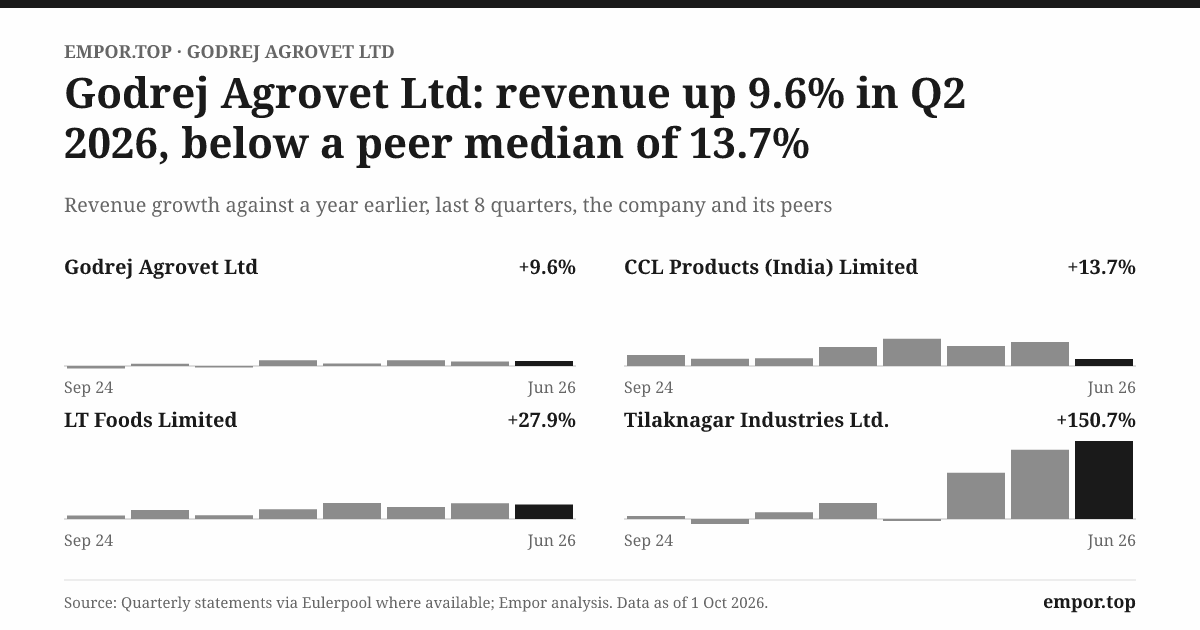
In late July 2026, Godrej Agrovet reported a quarter that looked fine on the top line and felt wrong underneath. Sales for the three months to June rose about 10% to roughly ₹2,852 crore.1 Profit after tax went the other way, falling to ₹134.5 crore from ₹160.5 crore a year earlier.12 The explanation was not a lost customer, a fraud or a failed plant. It was the sky. June rainfall had come in about 40% below normal, and the company's most profitable business, the agrochemicals arm called Crop Care, sold less into fields that were too dry to spray.1
That single quarter is a good doorway into one of India's stranger listed companies. Godrej Agrovet is a member of the Godrej Industries group, and in the year to March 2026 it crossed ₹10,000 crore of revenue for the first time.3 Inside one set of accounts sit five businesses that would each make sense as a standalone story: Animal Nutrition, which makes cattle, poultry and aqua feed; Oil Palm, which buys fruit from farmers and crushes it into oil; Crop Care, which sells branded agrochemicals; Creamline Dairy, which sells milk and dairy products under the Jersey brand; and Godrej Foods, which sells chicken and processed meat.3
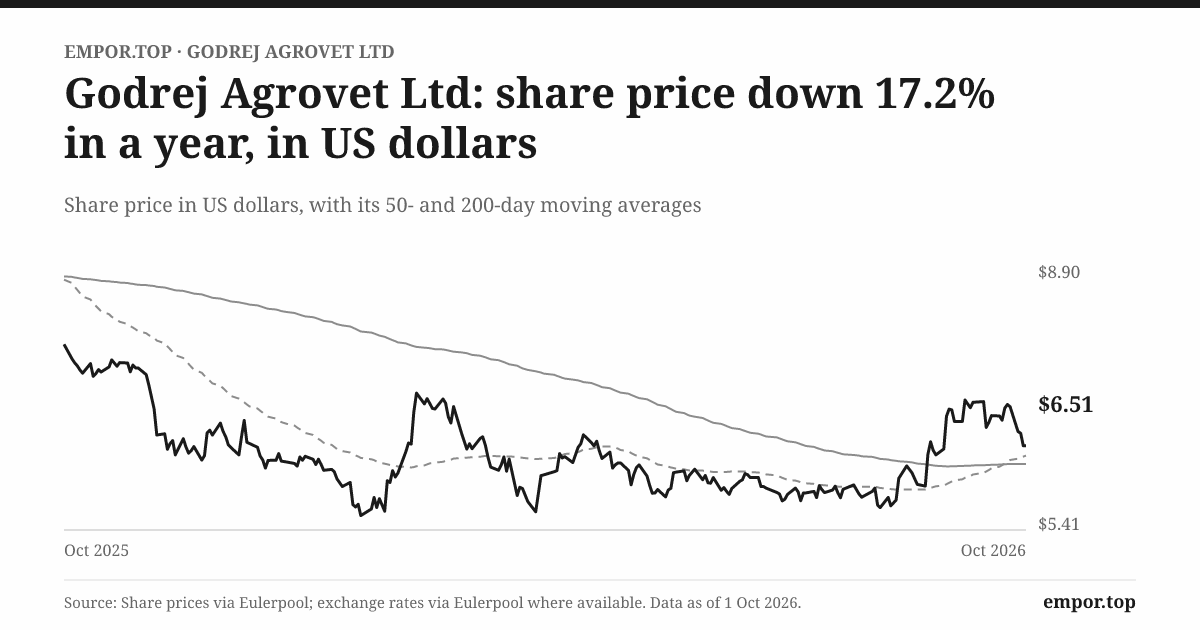
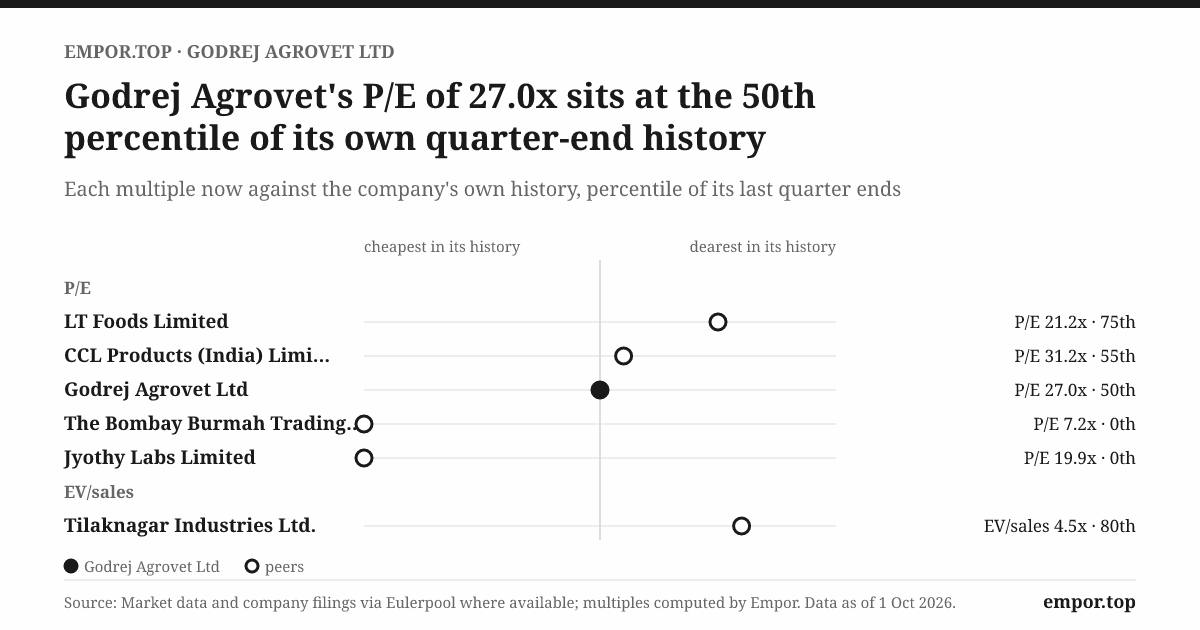
On 1 October 2026 the market valued the whole bundle at about ₹12,054 crore, or about $1.3 billion.4 The shares traded at 27 times trailing earnings, against a five-year median of 28 times, and about 10% below their 52-week high.4 In other words, the market is paying the usual price for a profit line that has just improved. That is either a quiet vote of confidence or a quiet vote of doubt, and the purpose of this story is to work out which.
Five questions run through it. First, is the FY26 profit improvement real, or is it oil palm prices, other income and a land sale? Second, did buying out Creamline Dairy, and the "reset" that followed, create value or destroy it? Third, can Crop Care and the contract manufacturer Astec LifeSciences turn a monsoon-dependent portfolio into a steadier one? Fourth, how much of the improved cash flow repeats? Fifth, does belonging to the Godrej group make the returns better, or only the capital cheaper?
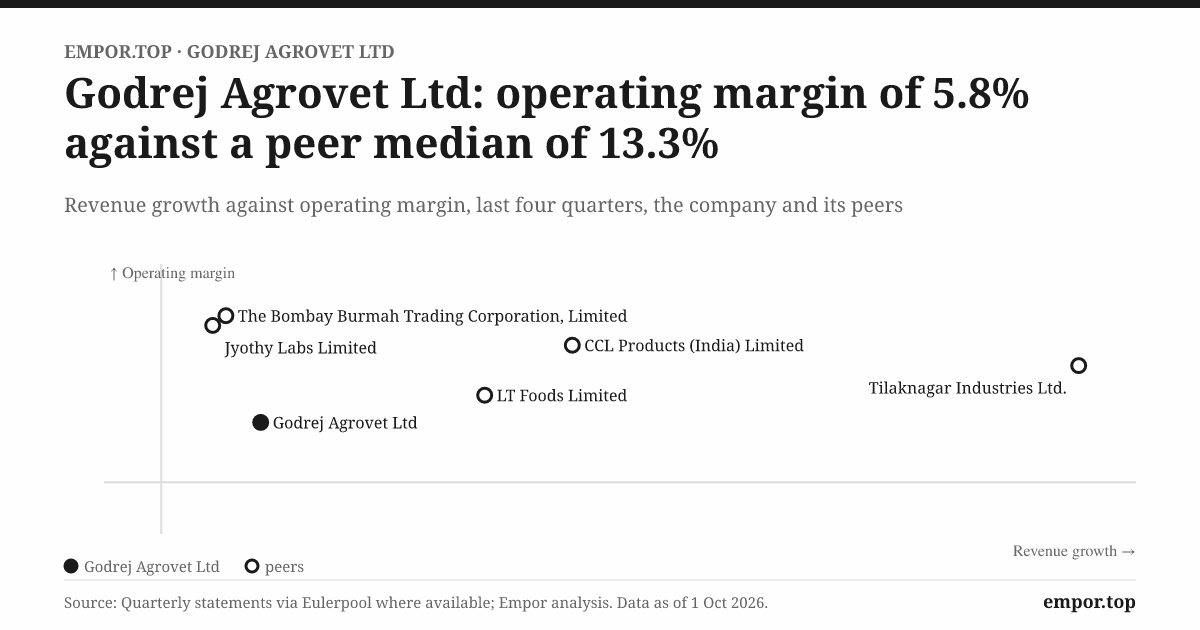
One housekeeping note before the story starts. The standard data feeds show this company's operating margin falling from about 21% in the June 2025 quarter to about 6% in the September 2025 quarter. That is a change in how a data provider classifies items, not a collapse: annual EBITDA and profit before tax both rose in FY26. For margin discussion this story uses the company's own figure, FY26 EBITDA of ₹936 crore, a 9.1% margin excluding non-recurring items.3
The thing to hold in mind from the start is that almost every line in this company moves with something it does not control: the monsoon, the global price of palm oil, the price a dairy farmer demands for a litre of milk, and the cost of maize and soya meal. Management knows this. In mid-2026 it began sorting its own portfolio into tiers, labelling some businesses for growth, some for a "reboot", some as restricted and some as sources of cash.1 A company that publicly grades its own children is telling investors something about its past. To understand what, the story has to begin with a feed mill.
 Subscribe on LinkedIn
II. From Cattle Feed to a Farm-to-Fork Portfolio
Picture three sites, all under the same Godrej logo, each born in a different era. A feed plant, where maize and soya meal are ground, blended with minerals and pressed into pellets for cattle and broilers. A weighbridge in a palm-growing district, where a tractor trailer of fresh fruit bunches is weighed and the farmer is paid by the tonne. And a chilling centre in southern India, where milk from small dairy farmers is cooled within hours of milking so it does not spoil on the way to a packing plant. These are three different businesses with three different raw materials and three different ways of losing money.
Feed came first and was the base of everything. Animal feed is the original Godrej agri business, and as recently as FY2012 it made up about 80% of the company's revenue.5 By FY2026 that share had fallen to about 48%.5 The other half of the company was added piece by piece: oil palm plantations and mills, a crop protection business, a controlling stake in Astec LifeSciences, a joint venture with Tyson Foods in chicken that became Godrej Foods, and a majority stake in Creamline Dairy that eventually became full ownership.53 The logic each time was adjacency. The same farmer who buys cattle feed might grow oil palm, spray pesticides, sell milk or raise broilers. A company with a field force in rural India could, in theory, sell him more and buy more from him.
Was that a strategy or an accumulation? The long-run numbers give a mixed answer. Revenue grew from about $540 million in FY2015 to about $1.2 billion in FY2026, compounding at about 10.6% a year in rupees over ten years and 10.4% over five.48 That is a respectable pace for a commodity-heavy business. But the last three years tell a different story: revenue grew only about 3% a year, with FY2024 roughly flat and FY2025 slightly down in dollar terms before an FY2026 rebound of about 9%.4
Profit lagged further behind. Net profit grew about 6% a year over the decade, slower than revenue, because the net margin slid from about 6.3% in FY2015 to about 4.6%.4 Put plainly, each new rupee of sales has brought in less profit than the rupees that came before. A diversifier that was compounding a single advantage would show the opposite pattern.
The FY26 segment numbers show why. Animal Nutrition brought in about ₹4,941 crore of revenue and a segment result of about ₹347 crore.3 Oil Palm brought in only ₹1,908 crore of revenue but a result of ₹384 crore, up almost 68% on the year.3 Crop Care brought in ₹772 crore and a result of ₹224 crore.3 Creamline sold ₹1,589 crore of dairy for EBITDA of only ₹53 crore, and Godrej Foods sold ₹768 crore for EBITDA of about ₹50 crore.3
Read those together and the shape of the company appears. The biggest revenue line is not the biggest profit line. Oil Palm and Crop Care together are about a quarter of revenue but earn more segment profit than the entire feed business. Dairy and poultry together are close to a quarter of revenue and earn about ₹100 crore of EBITDA between them, a thin return on a lot of milk and chicken. Each addition did reduce the company's dependence on feed. Each also brought its own commodity to the table: palm oil prices, pesticide seasons, milk procurement prices and broiler cycles.
There is also the matter of the Godrej name. Promoters held about 67.75% of the company at March 2026.4 The group gives the company access to capital and a brand that bankers and farmers recognise. CRISIL, which rates the company's short-term debt, describes that group support as implicit, with no formal arrangement behind it.5 That distinction matters for the entity boundary: the revenues of Godrej Consumer Products or Godrej Properties have nothing to do with Godrej Agrovet's economics, and the support of the parent is a relationship, not a guarantee.
So the verdict on the first question is that diversification worked as insurance and less well as a compounding engine. The company today is not one machine that gets better with scale. It is a portfolio that needs pruning, and the clearest sign of that is management's own decision in 2026 to start pruning it in public. Before getting to the pruning, though, the story has to deal with the business that made FY26 look so good.
III. The Oil Palm Windfall: Is the Profit Real?
The Q4 FY26 results came out in the spring of 2026, and the headline was pleasing. Revenue had crossed ₹10,000 crore for the year and full-year profit before tax had risen about 17%.3 The fourth quarter alone produced about ₹102 crore of profit.6 Then analysts started taking that number apart. About ₹34 crore of it came from a one-time gain on the sale of land.6 Other income for the quarter was about ₹67.8 crore, equal to about 52% of the quarter's profit before tax once other income was stripped out.6 In plain English, a large part of the quarter's profit did not come from feeding animals, crushing palm fruit or selling pesticides.
How the oil palm machine works
To judge the oil palm number, it helps to understand how the business works. Oil palm is a tree crop. Farmers under contract with the company plant the palms, which take a few years to start bearing fruit and then produce for decades. The farmer harvests fresh fruit bunches and brings them to the company's mill. The company pays for the fruit, crushes it, and extracts crude palm oil and palm kernel oil. It sells those oils at prices linked to the commodity market.
The key ratio is the oil extraction rate: how much oil the mill gets from each tonne of fruit. A better extraction rate is genuine operational skill, the equivalent of a refinery getting more petrol out of each barrel. CRISIL describes the company as the second-largest palm oil producer in India.5 That scale matters because India imports most of its edible oil and the government has been promoting domestic oil palm cultivation.
There is a catch that every farmer understands. The price the company pays for fruit is generally linked to the price of the oil that comes out of it. When palm oil prices rise, both the farmer's payment and the company's revenue rise. The company's spread can widen in a rising market, but the spread is not fully within its control. The supplier is a farmer with a long-lived tree, and the buyer is a commodity market.
Taking the windfall apart
The oil palm segment result rose about 68% in FY26 to ₹384 crore.3 Management did something useful here: on the Q4 call it split the gain, saying roughly 65% came from operations, including record extraction ratios, and the rest from price.3 That attribution is the single most important piece of disconfirming evidence in the whole FY26 story, and it comes from management itself. About a third of the jump in the company's largest profit engine was the market being kind.
Price can reverse. Operations, mostly, cannot be undone overnight. The fair reading is that the oil palm business genuinely got better at what it does, and that the market also handed it a bonus that should not be capitalised as permanent.
Now look at what management plans to do next. Guidance for FY27 put capex at about ₹350 crore, with 75–80% for growth and about half of the total going into oil palm.3 The company is putting more money into the business at the moment when its profit is partly a price windfall. That may be sensible, since palms planted today pay off over decades, not quarters. But it means the company's capital is concentrated in a business whose recent profit includes a component everyone agrees is temporary.
Netting out the noise
FY26 also carried items that pulled in both directions. On the plus side were the land gain of about ₹34 crore and other income of about ₹116 crore for the year.64 On the minus side were a ₹32.96 crore impairment on the investment in Godrej Cattle Genetics and about ₹30.44 crore of costs related to India's new labour codes.6 The two minus items together roughly offset the land gain plus a slice of the treasury income. Net them all out and the underlying improvement remains positive: FY26 profit before tax still grew in rupees, and the company's EBITDA margin excluding non-recurring items was 9.1%.3 The improvement survives scrutiny. It just shrinks.
What the calls revealed
On the Q4 FY26 call, the mood was celebratory: a revenue milestone, record extraction, higher profit.3 Analysts pressed on how much of oil palm's gain was price, which is why management offered the 65-35 split. By the Q1 FY27 call in late July, the tone had changed. Management explained that palm margins had compressed and that Crop Care had been hit by the weak June monsoon, and it presented the new portfolio tiers.12 The comparison is instructive. In April the oil palm story was mostly about operational excellence. By July it was about a margin squeeze. Both statements can be true, but taken together they confirm what the 35% figure already implied: this profit line breathes with prices.
The Q1 FY27 result is the first test. Net profit fell about 16% from a year earlier even as sales rose.41 A quarter without the price tailwind and with bad weather showed the base without its lucky components.
The verdict and the price
The verdict on the first question is part real, part rented. The record extraction ratio, the better feed margins and the overall operating base are real. The price component of oil palm, the land gain and much of the treasury income are not repeatable. The improvement is intact but unproven until the company produces a quarter without one-offs that still grows. The cleanest forward test is Q2 FY27 profit after tax, excluding other income and one-time items.
The market price adds a twist. At 27 times earnings, the stock's earnings yield is about 3.7%, a multiple equal to its five-year median.4 The market is not paying a premium for the FY26 profit, but it is paying the normal multiple on a profit base that includes items no one expects to recur. If the clean base is lower than the reported base, the stock is a little more expensive than it looks. Which raises the question of what the clean base rests on, and that brings the story to the least glamorous business in the building.
IV. Feed: The Boring Machine That Pays for Everything
A poultry farmer in Andhra Pradesh is choosing feed for the next batch of broilers. He thinks in two numbers: the price per kilogram of feed, and the feed conversion ratio, the kilograms of feed it takes to put a kilogram of weight on a bird. A better ratio means fewer kilos of feed per bird, which can justify a higher price per kilo. Across the table, a salesman from a branded feed company offers him a slightly better ratio, some advice on flock health, and terms on payment. A regional mill down the road offers a lower price per kilo. The farmer can switch next month if he wants. That is the business Godrej Agrovet was built on.
Animal Nutrition is the largest segment by a long way, with about ₹4,941 crore of revenue in FY26 and a result of about ₹347 crore.3 That is a segment margin of roughly 7%. In the June 2026 quarter, management reported that the segment's margin expanded by about 130 basis points.1 CRISIL credits the company with leadership in organised animal feed in India.5
Industry structure
The feed market is fragmented. On one side are regional mills and unorganised makers that sell on price. On the other are large organised players: multinational groups such as Cargill, aquafeed specialists such as Avanti Feeds, and integrated poultry groups such as Suguna and CP that make feed for their own birds and for contract farmers. Several large buyers of broiler feed are themselves integrators with their own mills, which caps what an independent feed maker can charge them. Relative market shares in Indian compound feed are not published in a way that allows a clean comparison, so the claim of leadership rests on scale and on the credit agency's assessment rather than on a share figure.
The economics are simple and unforgiving. Most of the cost of feed is the raw material: maize, soya meal, de-oiled rice bran and minerals. When those prices rise, the feed maker has to raise its prices or eat the difference. Branded feed makers can pass through cost increases with a lag, but they cannot charge much more than the farmer's next-best option.
Where the advantage lies, and where it does not
The claimed advantages are scale and distribution: bigger plants that spread fixed costs, procurement muscle on raw materials, and a dealer and field network that reaches farmers across states. These are real but modest. Scale economies in feed are limited by freight, since a feed mill can economically serve only a radius around it, which is why regional players survive. Distribution helps, but a dealer can carry more than one brand.
The best evidence for the strength of the business is not a share number but the receivables. Debtor days fell from about 52 in FY2021 to about 24 in FY2026.4 In a business where farmers and dealers routinely expect credit, halving the time it takes to get paid is a sign of bargaining power, or at least of discipline. Inventory days also fell to about 62, and the cash conversion cycle shrank to about 15 days.4 The annual report's receivables note is the place to confirm whether this reflects tighter credit terms rather than sold or discounted receivables; the improvement is consistent across several years, which argues for policy rather than a one-off.8
The weakness is the margin. A 7% segment margin in a commodity business is a living, not a fortune. It is enough to fund the rest of the company, but it is not evidence of pricing power.
The tiering in feed
When management laid out its new portfolio tiers with the Q1 FY27 results, feed was split in two. Cattle feed went into the "Growth" tier. Broiler feed went into the "Restricted" tier.1 That is a more honest statement than most companies make. Broiler feed is where the farmer is most price-sensitive, where integrators make their own feed, and where returns are lowest. By declaring it restricted, the company is saying it will not chase volume there. It is also conceding that part of its core business earns returns it does not like.
Customer and supplier concentration in feed is not disclosed in detail by the company. Given a farmer and dealer base, concentration on the sales side is unlikely to be high, but the input side is concentrated in a few commodities whose prices the company does not set.
The verdict on feed is narrowed, not rejected. Leadership in organised feed is real and visible in scale and receivables discipline, but the moat is narrow: the inputs are commodities, the farmer can switch, and the company itself has restricted a piece of the business. Feed pays the bills. It does not explain why the stock should trade at 27 times earnings. For that, investors have to look at the businesses the company bought, starting with the dairy.
V. The Creamline Buyout and the Reset
In April 2025, Godrej Agrovet bought the remaining 48% of Creamline Dairy Products, the Hyderabad-based dairy behind the Jersey brand, making it a wholly owned subsidiary.5 It was the end of a long journey toward full control of a business the company had held a majority stake in for years. Within a year, dairy EBITDA had fallen about 33% to ₹53 crore, and in July 2026 management placed dairy in the "Reboot" tier of its portfolio.31 A business bought outright had, twelve months later, been formally marked for repair.
The deal and the hole in the balance sheet
The accounting of the buyout explains a number that otherwise looks alarming. When a company buys out a minority in a subsidiary it already controls, Indian accounting rules treat the deal as a transaction between shareholders. Any amount paid above the book value of the minority stake does not become goodwill. It goes straight out of shareholders' equity. CRISIL estimates the hit to net worth at about ₹616 crore.5 That is why shareholders' equity fell from about $281 million to about $230 million in FY2026 even in a year of higher profit.4
The effect on leverage was immediate. CRISIL's measure of adjusted debt to net worth rose from about 0.57x to about 0.81x, and total outside liabilities to tangible net worth rose from 1.3x to 2.2x.5 Net profit was not hurt, but the balance sheet was. The company paid for the minority out of its equity at a time when the asset it was buying was about to earn less.
Was the price fair?
This is where the evidence gets thin. A ₹616 crore premium above book for 48% of a dairy that earned ₹53 crore of EBITDA in its first year of full ownership looks full. The right test is the price paid against Creamline's earnings at the time of the deal and against listed Indian dairy peers such as Hatsun Agro Product, Parag Milk Foods and Heritage Foods on an EV/EBITDA basis. The full consideration and implied valuation are set out in the company's exchange disclosures and annual report.89 Until that comparison is made, the fair claim is narrower than "overpayment": the company paid a meaningful premium to book value, and the earnings that premium was supposed to buy fell in the year after.
Why dairy margins are so thin
Dairy is a spread business. The dairy pays farmers for milk, processes and chills it, and sells it to consumers at a price that is set by competition with cooperatives such as the state dairy federations and private brands. When the procurement price of milk rises faster than the price consumers will accept, the spread collapses. That is what happened in FY26: higher milk procurement costs squeezed Creamline's EBITDA.3 The supplier here is a dairy farmer with alternatives, including cooperatives, and the product is perishable. There is little room for the processor to wait for better prices.
There is one bright spot. Value-added products, such as curd, paneer and flavoured milk, which carry better margins than liquid milk, rose from about 42% to about 49% of dairy sales.3 That is the right direction for a dairy trying to escape the commodity spread. But in FY26 it was not enough to offset the procurement squeeze.
The capital allocation record
Creamline is not the only reset. Astec LifeSciences, the agrochemical contract manufacturer the company controls, lost about ₹61 crore at the EBITDA level in FY25 before returning to breakeven in FY26.3 The investment in Godrej Cattle Genetics was impaired by about ₹33 crore in FY26.6 Weighed by scale, the genetics impairment is small. The Astec losses and the dairy reset are material and recent.
Is the pattern "buy, then reset"? On the evidence, partly. The company bought more of dairy just before its profits fell, and it built up Astec only for it to run losses before breakeven. Against that, the tiering announced in 2026 is a course correction made in public. Putting dairy, Astec and the ACI Godrej joint venture in a "Reboot" tier rather than calling them growth engines is an admission, and admissions are rare in Indian investor presentations.1
Godrej Foods
The poultry business deserves a brief look. Godrej Foods brought in about ₹768 crore of revenue and about ₹50 crore of EBITDA in FY26.3 Management placed branded chicken and processed foods in the Growth tier and the business-to-business chicken trade in the Restricted tier.1 The logic mirrors feed: the branded consumer product earns better returns, and the commodity trade does not. It is a small business strategically tied to the Godrej brand rather than a major profit contributor.
How the story changed
In 2025, the buyout was framed as consolidating a strategic consumer business. By the Q1 FY27 call, the framing was a "reboot".2 That is a material narrative shift inside fifteen months, and it came alongside a change of chief executive. The new management has not blamed the old; it has re-labelled the business and promised a plan. Investors should hold it to specifics.
Liquidity and ratings
None of this has put the balance sheet in danger. CRISIL reaffirmed its A1+ rating on the company's ₹1,500 crore commercial paper programme in July 2026, reported interest cover of about 7.2x for FY26, and set gearing sustained above 1.0x as a downgrade trigger.5 At 0.81x on its measure, the company has room, but less than it had a year ago.
The verdict on the second question is that the buyout looks like an equity adjustment, not an operating loss, and that the price looks full against the earnings that followed. It is unproven either way until dairy EBITDA beats ₹53 crore in FY27. If dairy is the business that ate capital, the next section is about the businesses that were supposed to steady the whole.
VI. Crop Care and Astec: A Weather Hedge or a Weather Bet?
June 2026 was dry. Rainfall across India ran about 40% below normal in the first month of the monsoon.1 Farmers who had not sown could not spray, and farmers who had sown were in no hurry to buy herbicides and insecticides for crops that might not make it. In the June quarter, Crop Care sales fell about 17% to ₹271 crore, and its margin dropped from about 42% to about 32%.1 The company's best business had a bad quarter for a reason no salesman could fix.
How Crop Care makes its money
Crop Care sells branded agrochemicals: herbicides, insecticides, fungicides and plant growth regulators. Margins are high because the products are branded, often protected by registrations, and sold through a dealer network into a seasonal calendar where timing matters more than price. A farmer facing a pest outbreak will pay for a product he trusts. In FY26 the segment earned a result of about ₹224 crore on revenue of ₹772 crore, roughly 29%, the highest margin in the company.3
The same features make it fragile. Sales are concentrated in the kharif and rabi sowing seasons, and a weak monsoon delays or cancels spraying. Agrochemicals are also regulated: the government can ban molecules, tighten registration requirements or restrict usage, and CRISIL lists agrochemical regulation among the company's rating constraints.5 Competition comes from much larger players, including UPL, PI Industries, Bayer CropScience and Dhanuka Agritech, several of which have deeper product pipelines and bigger distribution.
So Crop Care is the profit engine and the weather-exposed one. It does not hedge the monsoon risk elsewhere in the portfolio. It concentrates it. In a good monsoon, Crop Care and feed both do well; in a bad one, Crop Care falls first and hardest.
Astec: the contract manufacturer
Astec LifeSciences is different. It is a contract development and manufacturing organisation for agrochemicals, which means it makes active ingredients and intermediates for other companies, often global agrochemical firms, to their specifications. Think of it as a specialist kitchen that cooks to someone else's recipe. Its revenue depends on winning and keeping manufacturing contracts, not on Indian rainfall, so in principle it diversifies the weather exposure.
In practice, Astec has been a drag. It lost about ₹61 crore at the EBITDA level in FY25 and reached breakeven in FY26.3 Management has guided to growth of more than 20% in FY27.3 Breakeven is a milestone, not a return. The capital sunk into Astec's plants and the losses along the way have not yet earned anything back. The global agrochemical industry went through a destocking cycle in 2023 and 2024 that hit contract manufacturers hard, which explains part of the loss, but it also shows that Astec's customers can cut orders sharply when their own inventories are too high.
The test is simple. If the September and December 2026 quarters show Astec growing at the guided pace, the turnaround claim strengthens. If not, the claim narrows to "breakeven, with optionality". Management placed Astec in the "Reboot" tier, not Growth, which suggests it is not yet counting on it either.1
The verdict on the third question is that the optionality is real but unproven. Crop Care is a high-margin business that amplifies rather than offsets weather risk, and Astec is a technical turnaround that has not yet become a profit contributor. The portfolio is not yet steadier. Whether it pays for itself is, in the end, a question about cash.
VII. The Cash Question: What Repeats?
Go back to FY2021 and FY2022. The company was growing, and yet cash from operations was negative in both years.4 Working capital had swollen: inventories piled up, receivables stretched, and the cash conversion cycle reached about 93 days in FY2022.4 Every rupee of growth was being financed by the balance sheet. Now jump to FY2026: the cash conversion cycle was about 15 days, and cash from operations was about 126% of EBITDA.4 The same company, four years apart, looks like two different businesses.
The long arc
Over twelve years, from FY2015 to FY2026, the company generated about ₹5,853 crore of operating cash against about ₹3,867 crore of net profit, or about 151%.4 That is a strong record. Most of the gap is depreciation, a non-cash charge that was about ₹229 crore in FY26 alone.4 Depreciation reduces reported profit without reducing cash, so a business with heavy plants and mills naturally shows cash flow above profit. That is not a sign of hidden earnings. It is a sign that the plants will need replacing.
Where the cash went
Capex runs at about ₹300–350 crore a year, roughly 3% of revenue, funded from internal accruals.5 Dividends took a median 37% of profit over the period, with a peak of about 61% in FY2023 and about 45% in FY2026.4 Over twelve years, about 46% of free cash flow went out as dividends, and the cash pile grew only from about ₹121 crore to about ₹312 crore.4 CRISIL put unencumbered cash at about ₹33 crore at March 2026.5 This is not a cash-rich company. It distributes a large share of what it earns, invests most of the rest, and borrows when it needs to.
FY26 is flattered
Free cash flow in FY26 was about $106 million, roughly ₹900 crore at the period's exchange rates.4 Average net working capital fell from about ₹988 crore in FY25 to about ₹686 crore in FY26, and working capital was about 21 days in Q1 FY27.32 That release added several hundred crore to FY26 cash flow. It cannot be repeated at the same pace: once working capital is down to about three weeks, there is little left to squeeze.
Management's own guidance confirms the point. It has guided to a cash surplus of about ₹100–125 crore after capex.3 Set that against FY26's headline free cash flow and the gap is large. Guidance is far lower than the headline because management knows the working-capital release was a one-time event. The FY26 cash figure is a high-water mark, not a run rate.
Debt
Borrowings stood at about ₹1,574 crore at March 2026.4 About ₹148 crore of non-convertible debentures fall due in FY2027, and CRISIL considers market access adequate, with the A1+ rating on a ₹1,500 crore commercial paper programme and Creamline separately rated AA/Stable.5 Contingent liabilities, about ₹165 crore at March 2026 against about ₹175 crore a year earlier, are small against equity.8
The verdict on the fourth question is that the twelve-year cash record is strong, but FY26 was flattered by a working-capital release that cannot repeat at the same pace. The cash generation is intact but partly one-time. The forward test is FY27 free cash flow after dividends, and whether working capital stays near three weeks. Whether those tests are passed now depends on a new set of people.
VIII. Who Runs It, and Who Owns It
In the space of a year, almost everyone at the top changed. Balram Singh Yadav, the long-serving managing director, retired on 31 August 2025.7 Sunil Kataria became chief executive and managing director from 1 September 2025 for five years.7 Burjis Godrej, a member of the next generation of the family, was approved as Chairperson from 14 August 2026.7 And with the Q1 FY27 results, the company announced a new chief financial officer.2 A company that had been run for years by a single executive now has a new CEO, a new chair and a new CFO, all within twelve months.
The new CEO's first year
Kataria's tenure so far is short but eventful. His first full fiscal year produced record revenue and higher profit.3 It also produced the portfolio tiering, the dairy "reboot" label and the Q1 FY27 margin squeeze.1 On the calls, prepared remarks emphasised the portfolio clarity and the operating improvements, while analysts pushed on oil palm prices, Crop Care weather exposure and dairy margins.23 The tiering is the clearest sign of his style: categorise, prioritise and say so out loud. Credibility will come from whether the "Reboot" businesses actually improve or are restricted further.
Pay and voting are the governance tests. Remuneration of the previous managing director and of the current CEO, and how it compares with profit, is set out in the annual report, and the voting results of the 5 August 2026 annual general meeting show whether shareholders dissented on any resolution.87 Neither suggests, on its face, a governance crisis, but those are the documents where any tension would show.
Who owns it
Promoter holding moved in two steps. It rose to about 74% by March 2023 as the free float shrank from about 24% to about 11%, then fell to about 67.6% by March 2025 and stood at about 67.75% in March 2026.4 Public holding moved the other way, rising back to about 20%.4 Foreign institutional holding fell from about 9.7% to about 6.3% over the same period.4 The exchange shareholding pattern is the authoritative figure, as different data cuts show different foreign institutional numbers.9 The promoter stake reduction coincides with the leadership change and the reset, and gives the market more free float than it had two years ago.
The board had 12 directors at March 2026, six of them independent.7 Related-party transactions with other Godrej group companies, including any brand or royalty arrangements, are set out in the annual report's related-party note.8 In a group structure, those payments are the first place an activist would look; they are worth reading against the company's profit.
The verdict on the fifth question is that promoter control is stable and the group connection lowers the cost of capital, as the credit ratings show. Whether it improves returns for minority shareholders is less clear. The returns on equity of about 20% are respectable, but they have been earned alongside a ₹616 crore equity hit on a related acquisition. Credibility is a record still being built under the new team. And the lessons from the record so far are worth stating plainly.
IX. Playbook: Business & Investing Lessons
Diversification buys stability only if each leg is run for returns. Godrej Agrovet went from 80% feed to under half feed, and in doing so swapped one commodity for five. The palm mill and the agrochemical brands earn their keep. The dairy and the contract manufacturer have spent years earning less than their capital. The lesson for any conglomerate in the making: a new business that reduces your exposure to one cycle has to earn its keep in its own, or it is not a hedge but a second problem.
Know which part of the profit is the weather. When management said about a third of the oil palm windfall was price, it gave investors the most useful sentence of the year. When June rain fell 40% short, Crop Care's margin fell ten points. In an agribusiness, the honest profit figure is the one you would have earned with average rain and average prices. Everything above that is a gift from the sky that the sky can take back.
Release working capital once; you cannot do it twice. The cash conversion cycle went from 93 days to 15. That was a real achievement, and it showed up as one of the best cash years in the company's history. But a company cannot shrink working capital below zero forever. Management's own lower guidance is the tell. A one-time release is a gift to the balance sheet, not a new run rate.
Pay for the minority only when you can show what it earns. Buying the last 48% of Creamline wiped about ₹616 crore off equity, and dairy EBITDA fell a third in the next year. Buying out a partner feels like tidying up. On the balance sheet, it is a cash acquisition like any other, and it should be judged by the same yardstick: what does the stake earn, and what did it cost?
Prune in public. The 2026 tiers, Growth, Reboot, Restricted and Cash generation, are a confession and a commitment at the same time. They tell investors where the company will and will not spend. The value of that confession depends entirely on what comes next: whether "Restricted" businesses actually shrink and whether "Reboot" businesses recover or are sold.
X. Analysis & Bear vs. Bull Case
At 27 times earnings, the market is paying a normal multiple for a business where about a third of the oil palm gain came from price.43 Other measures tell a similar story: enterprise value is about 12.6 times EBITDA, return on equity is about 20.6%, the dividend yield about 1.8% and the free cash flow yield about 1.5%.4 The market is pricing a steady, good-quality mid-cap. The question is whether the business is steady.
The bull case
The bull case rests on real positions. The company leads in organised animal feed and is the second-largest palm oil producer in India.5 Return on capital employed rose from about 16% to about 20% over the past few years.4 Credit ratings are strong. The new management has started steering capital toward the Growth tier and away from low-return businesses. If oil palm and Crop Care hold most of their FY26 gains, dairy stops dragging, and Astec delivers on its guidance, earnings could grow faster than the 10% revenue pace.
The bear case
The bear case rests on the same facts seen from the other side. Every segment is exposed to weather or commodity swings. Feed and dairy earn thin margins. A ₹616 crore equity hit has raised gearing. Other income and one-offs inflated FY26 profit. And the cash flow surge was partly a one-time working-capital release. If oil palm prices fall and the monsoon disappoints again, earnings could drop well below the FY26 level, and a 27 multiple on lower earnings would not hold.
Porter's five forces
Supplier power is high across the portfolio. Corn and soya prices set feed costs; palm fruit growers are paid off commodity prices; dairy farmers demand higher milk prices; agrochemical intermediates come from global supply chains. Buyer power varies. Farmers buying feed can switch; poultry integrators make their own feed; consumers of milk have cooperatives as alternatives; palm oil buyers pay market prices. Rivalry is intense in feed and dairy, less so in branded agrochemicals. The threat of substitutes is low for feed and palm oil but real for branded agrochemicals, where generics compete. Barriers to entry are moderate: building a feed mill is not hard, but building a farmer network for oil palm or a brand in agrochemicals takes years.
Hamilton Helmer's seven powers
Of Helmer's seven powers, scale economies and a form of cornered resource apply most. Scale in feed and palm processing lowers unit costs, though freight limits the radius. The oil palm farmer network, built over years under government-allotted zones, is the closest thing to a cornered resource: competitors cannot easily replicate long-lived trees under contract. Branding offers some power in Crop Care and in Godrej Foods' branded chicken. Switching costs, network effects, counter-positioning and process power are weak or absent. The overall moat is narrow, strongest in oil palm and Crop Care, weakest in feed and dairy.
Valuation in context
The multiple sits at its five-year median, so the market is not paying extra for the improvement. Comparisons with Indian peers, such as Avanti Feeds in feed, Hatsun Agro in dairy, and Dhanuka and PI Industries in agrochemicals, show a wide range of multiples, reflecting each business's growth and margins. Godrej Agrovet sits in the middle: richer than pure commodity players, cheaper than the agrochemical specialists. That fits a mixed portfolio.
KPIs to track
Three numbers matter most. First, the Oil Palm segment result excluding the price effect, which tells investors whether the operating gains hold; FY26's result was ₹384 crore, with about 65% attributed to operations.3 Second, Crop Care's margin through the monsoon, which fell from about 42% to about 32% in Q1 FY27.1 Third, net working capital days, which stood at about 21 in Q1 FY27 and determines whether FY26's cash flow repeats.2
Risk radar
Weather and monsoon variability hits Crop Care first and feed and dairy demand second. Commodity input costs drive feed and dairy margins. Agrochemical regulation can remove products overnight. Gearing, at about 0.81x on CRISIL's measure, sits below the 1.0x downgrade trigger, but further acquisitions or a weak year would close the gap.5 And execution in the Reboot tier, dairy and Astec, is the company's single largest management test.
The verdict is that this is a well-run mid-cap with real positions in feed, palm and crop care, priced for the improvement to hold. The case turns on repeatable oil palm and Crop Care earnings and on dairy stopping the drag.
XI. Epilogue
Tonight, Godrej Agrovet stands at a crossroads it chose for itself. It has a new chief executive, a new chair, a new finance chief, and a portfolio sorted into four tiers. It has a record revenue year behind it and a quarter of falling profit in front of it.
The next moments that decide the story are already on the calendar. The Q2 FY27 results will show profit after tax excluding other income and one-offs: if it grows, the first question tilts toward "real"; if it falls, it tilts toward "rented". The September and December quarters will show whether Crop Care recovers as the monsoon rains catch up, and whether Astec grows the 20% management promised. Creamline's FY27 EBITDA against ₹53 crore will answer whether the ₹616 crore buyout bought a business worth owning. FY27 free cash flow after dividends and the ₹148 crore debenture repayment will show how much of FY26's cash was the business and how much was the working-capital release. And Burjis Godrej's first year as chair, alongside the new CFO's first guidance, will show whether the family's next generation runs the portfolio for returns or for size.
Each outcome maps onto the five questions. Good numbers on all fronts would turn a mixed portfolio into a steadier one. Mixed numbers would confirm what the market already prices: a decent business, not a great one. Bad numbers would mean the tiering was a list of problems, not a plan.
XII. Outro
It started with a quarter where sales rose and profit fell because the rain did not come. That is the whole company in one image. Godrej Agrovet sells feed to the farmer, buys fruit and milk from the farmer, sells pesticides to the farmer, and is paid, in the end, by the weather. Its managers can choose which businesses to grow and which to restrict. They cannot choose the monsoon. The investors who do best with it will be the ones who remember the difference.
References
-
Godrej Agrovet Q1 FY27 slides: strategic reset amid mixed results — Investing.com, 2026 ↩↩↩↩↩↩↩↩↩↩↩↩↩↩↩↩
-
Godrej Agrovet Q1 FY27 earnings call summary — Investywise, 2026 ↩↩↩↩↩↩↩
-
Godrej Agrovet Q4 FY26 earnings call: revenue crosses ₹10,000 crore, PBT rises 17.2% — Scanx, 2026 ↩↩↩↩↩↩↩↩↩↩↩↩↩↩↩↩↩↩↩↩↩↩↩↩↩↩↩↩↩
-
Godrej Agrovet consolidated financials and shareholding — Screener ↩↩↩↩↩↩↩↩↩↩↩↩↩↩↩↩↩↩↩↩↩↩↩↩↩↩↩
-
Rating Rationale: Godrej Agrovet Limited — CRISIL, 2026-07-06 ↩↩↩↩↩↩↩↩↩↩↩↩↩↩↩↩
-
Godrej Agrovet Q4 FY26: profit surge masks margin pressures — MarketsMOJO, 2026 ↩↩↩↩↩↩
-
Godrej Agrovet Annual Report FY 2025-26 summary and 35th AGM notice — Scanx, 2026 ↩↩↩↩↩
-
Godrej Agrovet corporate announcements and shareholding — NSE ↩↩
 LinkedIn
 WhatsApp
 Reddit
 Hacker News
 Email
Email Kindle
 RSS Feed
 Spotify
 Apple Podcasts
 Amazon Music
 Audible
 YouTube