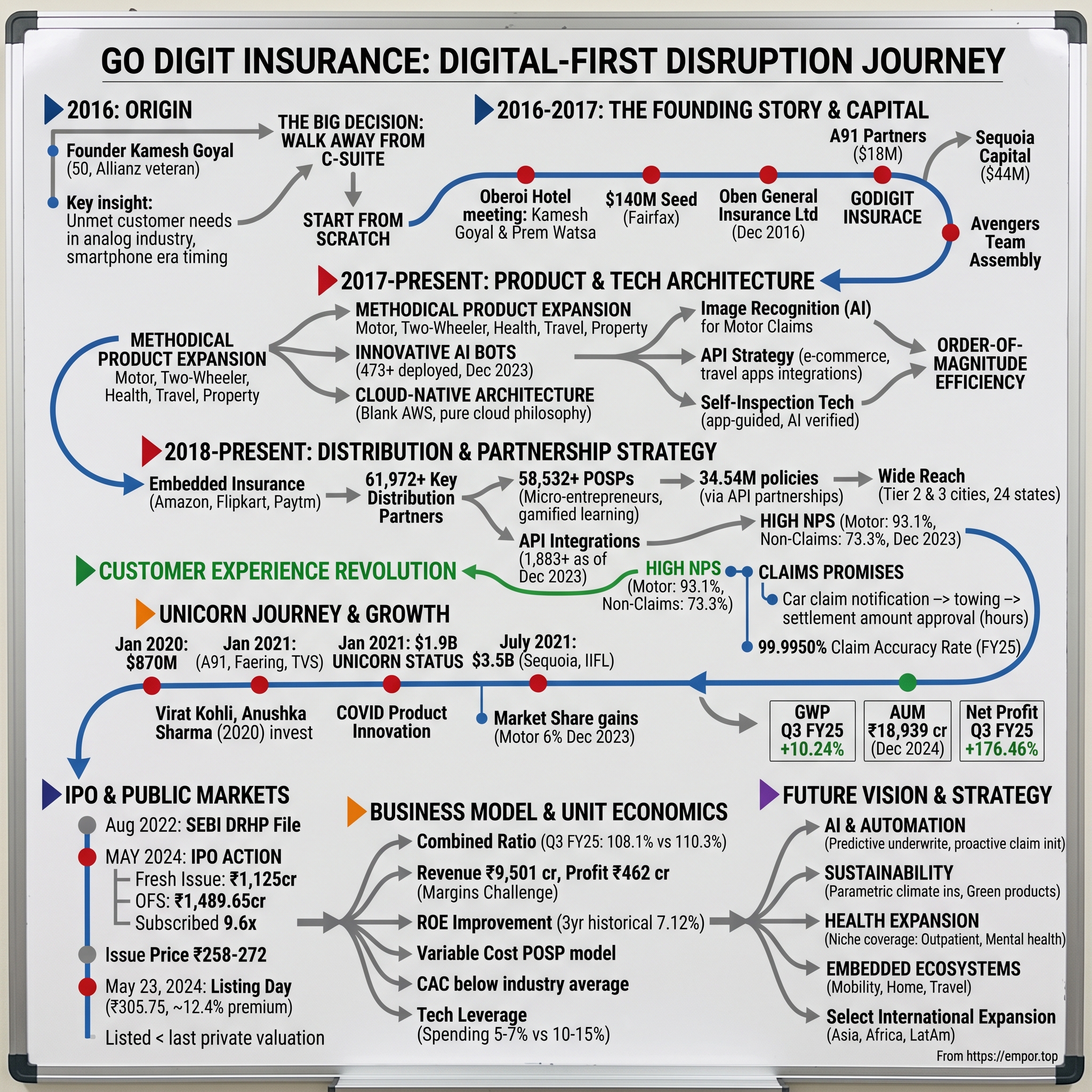
Go Digit General Insurance: The Digital-First Disruption of India's Insurance Industry
I. Introduction & Episode Roadmap
A founder who wanted his company smaller
On the evening of July 23, 2026, a 60-year-old insurance executive told a room of sell-side analysts that he hoped the pricing pressure in his industry would last at least another year. Kamesh Goyal, founder and chairman of Go Digit General Insurance, had just reported a first-quarter performance in which gross written premiums fell 8%, reported profit dropped by more than a third, and the company's share of India's motor insurance market slipped from 6.25% to about 5.6%.12 He did not apologize for the contraction. Instead, he cited Warren Buffett's praise of National Indemnity for cutting premium volume by roughly 85% rather than writing unprofitable business, reminded listeners that about 80% of his personal wealth remained invested in Digit, and reiterated that he had no intention of selling a single share.2
That stance is rare among venture-backed insurtech founders. Silicon Valley's class of 2020—including Lemonade and Root—went public promising rapid top-line expansion. Go Digit, which sold its first policy in October 2017, took the opposite approach when it listed in May 2024: its founder pledged to sacrifice volume whenever market pricing turned inadequate.3
The paradox
That tension sits at the heart of Digit's story. The company is frequently portrayed as a software startup that happens to underwrite risk. The operating record suggests the reverse: it is a conventional insurer, run by an executive who spent nearly three decades inside legacy carriers, that uses proprietary software primarily as an efficiency and distribution lever.
Digit's May 2024 initial public offering raised ₹2,614.65 crore at ₹272 per share, closed 9.6 times oversubscribed, and valued the business at more than 130 times trailing net profit.456 Two years later, in late July 2026, the stock traded around ₹283, representing a market capitalization of roughly ₹26,166 crore.1 Investors who bought into the IPO have largely marked time: while net earnings expanded substantially over the period, the valuation multiple compressed, leaving the share price almost flat.
A second paradox involves the founder. Tech disruption lore celebrates youthful dropouts. Goyal was 50 when he left Allianz in 2016, having built Bajaj Allianz General Insurance into one of India's most profitable private underwriters, led Allianz's Asia-Pacific division from Singapore, and served in the parent group's planning and controlling division in Munich.3
What this story tests
This deep dive evaluates Go Digit across seven pivotal questions:
- The corporate renegade: Why a senior Allianz executive walked away from a global leadership track to build a greenfield carrier from Pune and Bengaluru.
- The Fairfax anchor: How Prem Watsa's Fairfax Financial trimmed its ICICI Lombard holding to fund Digit, and how that holding-company structure later attracted regulatory scrutiny.
- The motor beachhead: How Digit captured roughly 6% of India's motor market, and why common assumptions about its direct-to-consumer distribution miss reality.
- The health gamble: The pandemic-era expansion into health policies, followed by heavy claim ratios in corporate group cover.
- The regulatory crucible: Why SEBI returned the company's draft IPO papers over employee stock appreciation rights, and why the IRDAI penalized Digit regarding preference-share disclosures.
- The float engine: Underwriting with combined ratios persistently above 100%, recurring breaches of regulatory operating expense ceilings, and a ₹23,000-crore investment portfolio that converts underwriting deficits into reported net profits.
- Powers, playbook, and the bear vs. bull case: Which competitive advantages are durable, and the three financial metrics that will determine whether the business compounds capital over the long term.
The broader question for insurance investors is straightforward: Is Digit an efficient engine designed to gather durable, low-cost float, or an expensive intermediary simply accumulating premium volume? The answer starts with the founder and the domestic insurance market he spent 28 years mastering.
 Subscribe on LinkedIn
II. The Insurance Architect: Kamesh Goyal & The Indian Non-Life Landscape
Paris, 2016
In 2016, Kamesh Goyal spent close to two months on a family holiday in Paris unable to stop brooding. He had spent 16 years at Allianz and was, by any conventional measure, still ascending: eight months into a role overseeing asset management and US life insurance for the global group.3 Friends in India and colleagues in Germany urged him to build something of his own, but the obvious counterargument was his age. He was 50, financially comfortable, and failure at that stage felt unthinkable.3
His mother settled the matter. "Ab samay aa gaya hai. Apne upar paisa lagao," she told him—the time had come to put money on himself after decades of investing in stocks and other people's companies.3 In August 2016, he resigned. By December, he had incorporated the business and applied for an underwriting licence.3
An accidental insurance man
Nothing in Goyal's early life pointed toward insurance. He grew up in Khetri, a copper-mining township in Rajasthan, where, as he later put it, childhood ambition was defined by the public-sector general managers running the local complex.3 After missing the admission cutoff for BITS Pilani by a single mark, he enrolled at St. Stephen's College in Delhi, an outcome he later called the best thing that could have happened to him.3 His formal qualifications, as disclosed in Digit's offer documents, include a science degree, a law degree, and an MBA, all from the University of Delhi, alongside an associateship from the Insurance Institute of India.7
His entry into the industry in March 1988, at state-owned New India Assurance, occurred largely by accident. He followed a college senior who was applying for public-sector openings and later admitted he could not name the companies operating in the sector when he walked into the interview.3 He spent nearly a decade there before moving to KPMG in 1997, where Allianz was a client, and joined Allianz in November 1999 as general manager of its India liaison office.3
That timing proved decisive. India had just opened general insurance to private capital, ending decades of state monopoly. When Allianz partnered with the Bajaj Group, Goyal became the founding managing director of Bajaj Allianz General Insurance, later taking charge of the life insurance joint venture as well.3 He went on to lead Allianz Asia Pacific as regional chief executive from Singapore and, in February 2012, moved to Munich to head group planning and controlling.3
What an incumbent learns about incumbents
Nearly three decades inside legacy underwriters gave Goyal a granular view of structural industry flaws, and software was only a fraction of the problem. Indian non-life insurance was, and remains, a trust-deficit business: dense policy wordings, slow claims processing, surveyor visits that could take days, and a public that viewed general cover primarily as an obligatory tax on vehicle ownership. The opportunity, as Digit framed it in its offer documents, was to make insurance "so simple that even a 15-year old can understand it," drafting policies in "jargon-free" English and providing summaries that explain coverage "in a nut-shell."7
By the mid-2010s, the private underwriters that emerged from the 2000 deregulation—ICICI Lombard and Bajaj Allianz among them—had built large, profitable franchises, while state-owned insurers still commanded a substantial share of the market. Premium growth concentrated in two categories: mandatory motor policies and employer-paid group health plans. In both segments, consumers rarely chose an insurer directly; a car dealership, a bank, or an employer chose for them. That dynamic meant the true customer of a general insurer was frequently the intermediary, and the carrier that served intermediaries best—with the fastest quotes and the smoothest paperwork—tended to win the business. That operational reality explains almost everything about how Digit structured its distribution.
The core insight is that legacy carriers do not suffer from ignorance of these customer frustrations. Rather, resolving them requires overhauling core systems, retraining thousands of employees, and renegotiating entrenched distribution relationships, all while the existing business must keep operating. A newcomer possessing the same institutional knowledge but unburdened by legacy systems enjoys a significant head start. How long that window stays open is a question Digit's operating trajectory continually tests.
The founding team
Goyal did not build the enterprise in isolation. Digit's initial leadership bench drew heavily from his network at Allianz and Bajaj Allianz. Jasleen Kohli, who had served as head of operations at Bajaj Allianz General and later as a director at Allianz Technology, joined in 2017 as chief distribution officer and became the company's first employee.78 Vijay Kumar, another industry veteran from the same corporate ecosystem, served as the first chief executive from Digit's inception until April 2022.8
Goyal credited that founding group as the company's "biggest differentiator," pointing to executives who were already "at the top of their game" in each function.3 The operating record supports that assessment: very few Indian general insurers achieved meaningful scale within their first three years, whereas Digit did. Yet that distinction also reframes the nature of the business. Digit was never a cohort of tech outsiders trying to decipher insurance from first principles. It was an incumbent management team that gained the freedom to build what it already knew the market required, backed by patient institutional capital.
III. The Fairfax Backing & Day Zero: Building a Cloud-Native Full Stack
A Canadian investor clears the decks
Every new insurer requires two things before selling a single policy: substantial capital and regulatory trust. Goyal secured the capital through a relationship spanning nearly a decade. Prem Watsa, the Indian-born founder and chairman of Toronto-based Fairfax Financial Holdings, later recalled that he had been impressed by Goyal's operating record at Bajaj Allianz and "his intimate knowledge of the details of the company," characterizing him as "honest, ethical" and "an exceptionally hard worker."3
Backing Digit, however, required Fairfax to clear a regulatory hurdle first. At the time, Fairfax held roughly 35% of ICICI Lombard, one of India's largest private general insurers. On May 28, 2017, ICICI Lombard disclosed that Fairfax was selling approximately 12.18% to investors including Warburg Pincus for ₹2,473 crore, as part of a plan to divest 25% and "start a new insurance joint venture."9 Indian regulations prohibited a promoter from holding significant stakes in two competing general insurers simultaneously. To back an unproven greenfield venture, Watsa effectively had to pare down his ownership in a proven, highly profitable market leader.
Fairfax deployed roughly $56.5 million in June 2017, around the time Digit secured in-principle licensing approval, and by early 2021 was reported to have invested approximately $140 million in aggregate.103 That commitment gave Digit an advantage few venture-backed insurtechs possessed: a balance-sheet sponsor steeped in underwriting discipline and float-driven compounding.
The two-tier structure
The corporate architecture was assembled in two tiers. The operating carrier, Go Digit General Insurance, was incorporated on December 7, 2016, in Pune under its original name, Oben General Insurance Limited.7 Sitting above it was a holding company, Go Digit Infoworks Services Private Limited, whose equity capital was divided among Goyal directly (14.96%), his entity Oben Ventures LLP (39.79%, in which he held a 99.99% interest), and Fairfax's affiliate FAL Corporation (45.25%).7 In addition to its common equity, FAL held all of Infoworks's compulsorily convertible preference shares.7
The structural layering addressed a regulatory constraint. Under prevailing Indian law, domestic insurers were required to remain "Indian owned and controlled," with foreign direct investment strictly capped.7 The two-tier model allowed Fairfax to supply the bulk of the economic risk capital while legal control remained anchored with an Indian resident promoter. While standard practice across the financial sector at the time, that holding arrangement later generated the company's most acute regulatory frictions with both the insurance supervisor and the capital-markets regulator.
The golden ticket
The Insurance Regulatory and Development Authority of India (IRDAI) granted Digit its certificate of registration on September 20, 2017, and the company wrote its first policy the following month.73 Fresh non-life underwriting licences had been exceptionally rare in the years leading up to the grant, reflecting the supervisor's stringent demands around capitalization, promoter integrity, and operating architecture. Goyal's executive pedigree and Fairfax's institutional balance sheet were instrumental in navigating that vetting process with unusual speed.
Building on the cloud from day one
Digit's technological claims are frequently framed in sweeping startup jargon, but its regulatory filings describe a more pragmatic reality. The carrier was architected from inception on the public cloud, running proprietary software supported by modular application programming interfaces (APIs) designed to integrate directly into partner platforms.7 This allows a car dealership's inventory portal, a digital broker, or an online travel aggregator to pull instant underwriting quotes and bind coverage without manual human intervention at Digit. As Business Standard noted, Digit emerged as "one of the first non-life insurers in India to be fully operated on the cloud."11
In operational terms, legacy insurers maintain mainframe systems akin to historic railway stations: dependable, but requiring bespoke infrastructure whenever a new line or partner is added. Digit designed standard software docking gates, allowing any distributor that meets its protocol to plug in immediately. The efficiency shows up in operating metrics: in FY25, 48.2% of Digit's policies were issued automatically via APIs, while manual issuance accounted for just 0.46% of the total.12 Digit also deployed automated software bots across customer onboarding, underwriting, policy servicing, and claims, while enabling vehicle pre-inspections and self-inspections through customer-uploaded photos and video streams via mobile apps, web links, or APIs.7
What the technology does and does not prove
That technical stack generated two distinct operational advantages: rapid partner onboarding and a low administrative cost per transaction on small-ticket policies. It did not, however, solve the fundamental challenge of underwriting profitability. Digit has never reported a full-year statutory combined ratio below 100%. What it did accelerate was early volume: gross written premiums expanded from ₹104.1 crore in FY18 to ₹2,252.3 crore in FY20.3 Over the same span, net losses narrowed from ₹270.6 crore in FY19 to ₹175.2 crore in FY20, culminating in a modest net profit of ₹5.2 crore in the third quarter of FY21.3
The agile setup also accommodated notable missteps. Goyal later acknowledged an early product failure in jewellery insurance, an offering conceived on the thesis that India represented the world's largest consumer gold market, which promptly "bombed."3 For underwriting analysts, the lesson was clear: cloud infrastructure significantly lowers the cost of product experimentation, but it does not eliminate the hazard of mispricing risk. And risk pricing was precisely the arena that defined Digit's core engine: the high-volume motor insurance market.
IV. The Core Engine: Motor Insurance & The Distribution Arbitrage
The shopkeeper who sells insurance
Picture a mobile-phone repair stall in a district town across Uttar Pradesh or Karnataka. Its owner has completed a brief, regulator-prescribed training course and now also sells vehicle insurance as a Point of Sale Person, or POSP—a simplified intermediary classification the IRDAI created in 2015.7 When a customer's two-wheeler policy approaches expiry, the shopkeeper opens an app, enters a registration number, and issues a fresh certificate within minutes. Between March 2020 and December 2022, Digit's roster of contracted POSPs expanded from 3,245 individuals to 43,891.7
It is the defining image of Digit's retail storytelling: grassroots digital empowerment. It is also, by the numbers, a modest fraction of the actual business.
Myth vs reality: who actually sells Digit's policies
The myth: Digit built its underwriting volume either by selling directly to consumers over the web or through a decentralized network of digitally enabled POSP shopkeepers.
The reality: In the first nine months of FY23 (through December 2022), POSPs generated only 9.2% of Digit's gross written premiums, down from 19.4% in FY20. Institutional brokers accounted for 67.2%, up from 26.7% in FY20.7 In Indian motor underwriting, "brokers" include online comparison aggregators as well as the captive corporate broking entities tied to automotive dealership networks. Digit's expansion came overwhelmingly from embedding its APIs into external distribution channels and paying intermediaries for volume.
That distinction reframes the investment thesis. A direct-to-consumer distribution engine implies an enduring customer franchise with declining marginal acquisition costs. A broker-dominated book means the underlying customer relationship belongs to an intermediary who can steer renewals to whichever underwriter offers the most attractive combination of pricing and distribution payouts. That structural reality explains why Digit's expense ratio has proved difficult to rein in, and why regulatory revisions to distributor commission caps in 2023 and 2024 exerted such heavy operational pressure on the business.
The size of the motor bet
Motor insurance in India divides into two statutory components. Own damage (OD) covers physical damage to or theft of the policyholder's vehicle. Third-party (TP) liability covers bodily injury, death, or property damage inflicted on others, and is mandatory under federal law. Third-party liability is long-tail business: contested claims can take years to resolve in Motor Accident Claims Tribunals and civil courts, enabling insurers to retain and invest premiums over extended settlement horizons. That is float in its purest form.
Motor policies generated 59.1% of Digit's gross written premiums in the nine months ending December 2022.7 Beneath that headline, the internal portfolio mix shifted materially. In FY23, third-party liability alone constituted 44% of Digit's total premium volume, with own damage contributing 19%; by FY25, third-party had contracted to 35% while own damage rose to 22%.12 By FY25, Digit controlled roughly 5.9% of India's motor insurance market and 3.3% of the broader non-life sector.12
The two-wheeler arbitrage
Two-wheelers represent the vehicle segment where Digit's technology infrastructure yields its clearest operational advantage. Individual policy premiums are small, and legacy underwriters' manual administrative workflows made them uneconomic to issue. An automated, API-driven policy issuance system makes a small-ticket policy nearly as inexpensive to process as a high-value commercial policy. In addition, new two-wheelers carry mandatory multi-year third-party coverage: management structures new two-wheeler sales as "1 plus 5"—one year of own-damage cover paired with five years of third-party liability—and new private passenger cars as "1 plus 3."2 That mechanism locks in upfront, multi-year float.
The segment has continued to compound. In the first quarter of FY27 (ending June 2026), new two-wheeler business expanded 26% year-on-year, generating ₹546 crore in collected premiums compared to ₹433 crore a year earlier.2 Yet rapid growth carries upfront costs: management acknowledged that aggressive two-wheeler expansion elevated Digit's expense ratio by roughly 3.5 percentage points in a single quarter of FY26, as multi-year contracts require booking significant distributor acquisition payouts upfront.13
Historical falsification: the commercial-vehicle reversal
The moat claim: Proprietary algorithmic pricing and automated claims assessment allow Digit to underwrite vehicle risk more effectively than legacy carriers across every automotive segment.
The evidence: Digit's early volume ramp relied heavily on commercial vehicles—such as trucks, buses, and commercial taxis—where third-party liability exposures are severe and claims costs run high. During the Q2 FY26 earnings call, Goyal noted that motor had comprised roughly 75% of total gross premiums four years earlier, with commercial vehicles accounting for about 45 percentage points of that total, before CV exposure retreated to roughly 17% to 18% of gross premiums.14 On the July 2026 call, he stated that commercial vehicles had once constituted 65% of the motor book but had receded to around 23% to 24%, with commercial vehicle premiums contracting 27% year-on-year during that quarter.2
Management presents this contraction as deliberate underwriting discipline: Goyal explained that when legacy insurers retreated from third-party risks, Digit "saw the opportunity first," but subsequently began trimming its third-party market share in April 2026 after five consecutive years without an administrative price hike from the regulator, even as wage inflation and judicial awards pushed claims settlement costs steadily higher.2 That strategic rationale aligns with Digit's published reserving triangles—the multi-year development records tracking initial loss estimates against ultimate settlements—which management cites as evidence of conservative reserving.2 For the 2018–19 accident year, Digit reported that initial claims reserves of ₹204 crore settled down to ₹132 crore seven years later.2
Verdict: The operating record qualifies the moat claim rather than invalidating it. Digit demonstrated an ability to write premium volume when pricing was adequate and curtail exposure when margins deteriorated—a fundamental underwriting discipline. However, the necessity of slashing its original cornerstone book by more than half demonstrates that software algorithms cannot overcome an unremunerative pricing cycle. Technology is an operational lever, not an absolute defense against an inadequate tariff environment.
The private car mistake
The subsequent underwriting test emerged in private passenger cars. During FY25, Digit wrote substantial volumes of new-car business. As those initial one-year policies expired, many vehicle owners returned seeking standalone own-damage renewals—a line Goyal characterized as "particularly not profitable."2 Management chose to retain these renewal policies in the expectation that claim loss ratios would normalize. They did not. When an Investec analyst asked on the July 2026 call why the company had failed to anticipate escalating own-damage losses, Goyal responded directly: "I own this failure… in hindsight, I made the wrong call… I was completely wrong."2
The structural mechanism behind the misjudgment had been detailed by Goyal in January 2025. Within Digit's own-damage portfolio, private cars accounted for roughly 70% of premium, two-wheelers about 22%, and commercial vehicles only 8%.16 New cars carry the lowest loss ratios but require the highest broker commissions because franchised dealerships command point-of-sale distribution. As vehicles age and policies shift to direct renewal, distribution commissions drop, but loss ratios rise because older vehicles register higher claim frequencies for cosmetic damage and minor collisions. Goyal warned at the time that own-damage loss ratios "could be going slightly up" as new-car originations normalized.16 The direction was foreseen; the magnitude, aggravated by automobile manufacturers pushing through sharp price increases for replacement parts, paint, and workshop labor, was not.2
That degree of executive candor is rare among public financial institutions and deserves recognition. Yet it also defines the limitations of Digit's pricing moat. Motor own-damage underwriting is intensely competitive, and Digit's corrective measures—pruning standalone own-damage renewals and curtailing used-car underwriting—directly surrendered market share. The immediate operational test remains near at hand: management told analysts it expects own-damage loss ratios to stabilize in the September 2026 quarter.2 If claims fail to flatten, the private-car portfolio—which Goyal previously described as Digit's fastest-growing motor segment—will prove structurally more fragile than the initial thesis suggested.13 That trajectory of aggressive volume acquisition followed by painful repricing unfolded even more abruptly in health insurance.
V. Pandemic Crucible & The Health Expansion: Scale vs. Underwriting Reality
March 2020
When India entered a nationwide lockdown in March 2020, general insurers faced an unprecedented product dilemma: clinical data on Covid-19 was scarce, regulators were improvising guidelines, and consumer demand for hospitalization coverage spiked overnight. Digit moved rapidly, launching a dedicated Covid-19 policy that Goyal later characterized as "a blockbuster."3 While multiple underwriters introduced pandemic policies in rapid succession, making claims of industry priority difficult to verify, the commercial impact on Digit was unmistakable: the company wrote ₹2,221.4 crore in gross premiums during the first nine months of FY21—nearly matching its entire FY20 top line—and generated net profits in the first half of that fiscal year.310 Prem Watsa observed at the time that Digit was tracking toward full-year operating profitability in FY21, calling it "highly unusual for a startup" entering only its third full operating year.3
The pandemic period demonstrated a core operational capability: a cloud-native underwriter could design, file, and distribute a novel policy within weeks through digital partner integrations while branch-bound legacy carriers were physically shuttered. That velocity provided compelling validation for Digit's technological architecture. Yet it also reinforced a hazardous premise: that rapid product rollout equates to sound underwriting. The health portfolio would soon test that assumption.
The episode also accelerated Digit's transition into mainstream visibility. In early 2020, cricketer Virat Kohli and actor Anushka Sharma invested roughly ₹2.2 crore as part of an $84 million financing round that valued the underwriter at approximately $870 million.15 By January 2021, Digit closed a follow-on round led by existing backers A91 Partners, Faering Capital, and TVS Capital at a $1.9 billion valuation, making it India's first unicorn of that calendar year.103
Why health looked attractive
The strategic rationale for diversifying beyond motor was compelling. Capital markets routinely award premium valuation multiples to multi-line carriers over monoline underwriters, health stood as one of the fastest-expanding segments in Indian non-life insurance, and an automated platform capable of generating bulk group policies was well positioned to court corporate human-resource desks. As a result, health, travel, and personal accident surged from 13% of Digit's gross premium in FY23 to 22% by FY25.12
Historical falsification: the group-health trap
The claim: Proprietary digital onboarding and automated claims processing allow Digit to scale profitably within group health insurance.
The evidence: The segment's claims experience told the opposite story. Digit's loss ratio across health, travel, and personal accident registered at 71.9% in FY23, spiked to 93.9% in FY24, and eased back to 83.8% in FY25.12 In property and casualty underwriting, a 94% loss ratio means that claims payouts consume ₹94 of every ₹100 in earned premium before accounting for distributor commissions, administrative payroll, or technology overhead. Factoring in operating expenses, the segment operated at a steep underwriting deficit in FY24.
The underlying vulnerability was structural. Digit's health portfolio was overwhelmingly anchored in institutional group cover rather than individual retail policies. During FY26, Goyal disclosed that retail policies represented less than 6% to 7% of the health book, while employer-employee group coverage accounted for roughly 73% and non-employer group plans made up about 22%.13 Large corporate buyers routinely tender employee health benefits annually, switching underwriters over marginal differences in quoted rates. Compounding that pressure, Digit took on health business through inward reinsurance treaties written by primary carriers.13 Neither channel affords an underwriter pricing power or leverage over network hospital billing rates.
What management did about it
Faced with rising claims inflation, management curtailed underwriting. In the first quarter of FY27 (the June 2026 quarter), the bulk of Digit's 8% contraction in gross premium stemmed from walking away from inward reinsurance treaties in group health and crop cover, segments where Goyal indicated that pricing had become unremunerative.2 Management had previously disclosed relinquishing approximately ₹200 crore of unprofitable health premium during a single quarter of FY26.13 Overall, Digit's footprint in Indian health insurance remains modest, commanding roughly 1.3% to 1.4% of the market by management's estimate.13
Market commentary frequently assumes that Digit redirected that freed capital into building out individual retail health. The earnings records contradict that assumption. In January 2025, when asked whether revised regulatory frameworks for retail health pricing had altered his strategy, Goyal stated that the company continued "to be cautious in this segment" and was "not seeing opportunity to grow retail health with a higher growth rate" than the broader industry.16 Retail health has remained a negligible component of the aggregate health book.13
Verdict: The operating history falsifies the thesis that digital distribution confers an underwriting edge in corporate health. Modern onboarding infrastructure facilitated rapid balance-sheet expansion, but it could not insulate the carrier from aggressive institutional bidding cycles or clinical claims inflation, forcing a sharp tactical retreat. What survives is an operational ability to exit unviable business lines quickly when returns deteriorate. The key performance indicators for any renewed health push remain the full-year statutory health loss ratio and an expansion into stickier retail cover—a pivot management has so far declined to pursue.
Those portfolio corrections were playing out just as Digit prepared to access the public markets, where the initial public offering became an operational and regulatory trial of its own.
VI. The Regulatory Crucible & The IPO Ordeal (2022–2024)
August 2022: the first attempt
Digit filed its draft red herring prospectus with the Securities and Exchange Board of India (SEBI) on August 17, 2022, proposing a fresh issue of ₹1,250 crore alongside an offer for sale of roughly 10.94 crore equity shares by existing investors.1711 Media reports at the time pointed to an expected valuation near $3.5 billion.17 Within a month, however, the capital-markets regulator placed its processing of the draft "in abeyance"—a procedural pause that does not constitute a formal rejection, but signals unresolved regulatory inquiries.17
On January 30, 2023, SEBI formally returned the draft papers.11 The underlying issue was technical on the surface, but pointed to deeper governance friction. SEBI's Issue of Capital and Disclosure Requirements (ICDR) regulations permitted conventional employee stock option plans to remain outstanding when a company filed its draft prospectus, but withheld that same exemption from employee stock appreciation rights, or ESARs.11 Digit's scheme entitled employees to cash- or equity-settled payouts pegged to share-price gains without granting them underlying shares upfront. In response, the company announced that it would restructure the incentive program and refile.11
Why ESARs mattered
A stock appreciation right allows an employee to capture the economic upside of a share without requiring upfront capital or direct equity issuance. For an unlisted venture, it offers a flexible mechanism to incentivize staff. For a securities regulator, however, unlisted appreciation rights represent contingent economic claims on corporate value that sit outside standard pre-IPO capitalization tables. Digit converted its ESAR 2018 program into a conventional ESOP 2018 plan and refiled its draft papers in early 2023.18 Goyal had told Forbes India in 2021 that anyone with one year of tenure at Digit was eligible for stock-linked rewards, describing the policy as "a big differentiator as an employer."3 Yet the broad-based incentive architecture management celebrated became the exact mechanism that stalled the public listing.
The CCPS problem
A more complicated challenge stemmed from Fairfax's preference shares in the holding company. Under the original 2017 joint-venture terms, the conversion ratio for 63 lakh compulsorily convertible preference shares (CCPS) was established at "1 CCPS for 2.324 equity shares." That formula was subsequently amended to "2.324 CCPS for 1 equity share," and the issuance expanded to 78 lakh CCPS instead of 63 lakh.1918 The practical consequence of those conversion terms was that they governed Fairfax's ultimate ownership of the holding company. Offer documents disclosed that upon conversion, Fairfax affiliate FAL Corporation could hold up to 82.07% of the holding company, representing an indirect economic interest of up to 68.65% in the operating underwriter on a fully diluted basis.7
Digit had applied to the IRDAI in June 2022 for regulatory approval to execute the conversion. On July 26, 2022, the insurance authority replied that it could not consider the application, because conversion would make the holding company a subsidiary of FAL—an arrangement prohibited under Indian regulations governing domestic ownership and control at the time.7 In October 2023, the IRDAI escalated the matter by issuing a show-cause notice alleging that Digit had failed to disclose full particulars of the revised conversion ratio, constituting a potential breach of Section 26 of the Insurance Act.18 The regulator also issued cautionary advisories, citing Digit's failure to secure regulatory approval for adjustments to chief executive remuneration when the company converted ESAR 2018 into ESOP 2018.18
On May 2, 2024, just days before the IPO opened, the IRDAI imposed a ₹1 crore penalty for an "inordinate delay" in filing the particulars, directing that the fine be charged to the shareholders' account rather than policyholder funds. Digit characterized the non-submission as "purely inadvertent and unintentional."19
How to read the penalty
The financial fine was modest, but the pattern was substantive. Within roughly eighteen months, the capital-markets regulator returned an IPO prospectus over an unexempt employee compensation structure, while the insurance supervisor penalized the underwriter for failing to properly disclose revised equity-conversion terms for its primary institutional backer, alongside unauthorized modifications to executive pay. None of these regulatory findings alleged fraud, balance-sheet manipulation, or harm to policyholders. Rather, they revealed an enterprise operating at venture-backed speed whose compliance documentation and statutory filings had lagged behind its corporate structuring. For public-market investors, these episodes represented remediated procedural failures rather than bad faith, but they underscored the need for continuous scrutiny over the company's disclosure quality.
May 2024: the listing
The initial public offering opened on May 15, 2024, and closed on May 17. The issue comprised ₹1,125 crore in newly issued shares alongside an offer for sale of ₹1,489.65 crore by existing shareholders, marketed within a price band of ₹258 to ₹272 per share.46 Demand was strong across investor tiers: the issue closed 9.6 times subscribed overall, led by qualified institutional buyers at 12.56 times, non-institutional investors at 7.24 times, and retail bidders at 4.27 times.5 Anchor investors committed ₹1,176.59 crore the day before books opened.5 Following the float, the promoter group's equity stake declined from 83.3% to 73.6%.5
When the initial draft was submitted in 2022, neither Fairfax nor minority backer Virat Kohli was slated to divest shares.17 On May 23, 2024, the stock debuted at ₹281.10 on the BSE, representing a 3.35% premium to the offer price, and at ₹286 on the National Stock Exchange.206 At the issue price of ₹272, Digit was valued at more than 130 times its FY24 net profit of ₹182 crore.126 Over the two years following the debut, the stock traded largely sideways near its issue level even as underlying net earnings roughly tripled. The steep valuation multiple demanded at listing was gradually absorbed by earnings expansion rather than rewarded with share-price gains. To evaluate how that capital structure translates into operational control—and how regulatory limits continue to shape shareholder power—the story turns to corporate governance.
VII. Corporate Governance, Current Leadership & Shareholder Structure
The generational handover
On April 20, 2022, Jasleen Kohli stepped into the role of managing director and chief executive at age 42, becoming one of the youngest chief executives in Indian general insurance upon the retirement of Vijay Kumar.8 Her executive background was rooted in operations and distribution rather than actuarial science, following a management degree from the K J Somaiya Institute, leadership of operations at Bajaj Allianz General, and a directorship at Allianz Technology.78 Announcing her appointment, Goyal pointed to her "agile market strategies and her prudent operational planning."8
The division of executive responsibility visible on quarterly earnings calls is pronounced. Goyal, serving as non-executive chairman, commands the investor narrative, dictates capital and reserving philosophy, and fields nearly every strategic inquiry. The finance division is steered by chief financial officer Ravi Khetan, with Piyush Bothra directing financial reporting and investor relations.2 Fairfax's governance presence is anchored by board nominee Chandran Ratnaswami, a veteran Fairfax executive who holds an engineering degree from IIT Madras and a Toronto MBA.7 Offer documents disclosed that both Ratnaswami and Goyal hold board seats at companies operating in similar commercial lines, noting the shared directorships as a potential conflict of interest.7
Kohli's posture on investor calls is noticeably more reserved than the chairman's. She rarely commands the floor at length. When Goyal quipped on the July 2026 call that he hoped soft market pricing would persist through March 2027, he remarked that Kohli and the CFO, seated beside him, appeared from their facial expressions to disagree.2 The exchange captured a central operational tension: the chairman's contrarian underwriting convictions define Digit's public posture, while the executive team manages the daily friction of contracting premium volume, distributor negotiations, and staff morale.
For public-market investors, this executive concentration presents both an operating compass and an undeniable key-person risk. The underwriting discipline demonstrated during the 2026 pricing downturn reflects Goyal's personal convictions, and the chairman turned 60 in May 2026.2 How deeply that counter-cyclical mindset has been institutionalized across Kohli's executive bench—and how much depends on Goyal himself—remains an open question that regulatory disclosures cannot resolve.
The cap table, and why it is being rebuilt
At the May 2024 initial public offering, the promoter group controlled roughly 73.6% of the company, held primarily through the Go Digit Infoworks holding company.5 That layered holding structure is now being collapsed. On December 19, 2025, Digit's board approved a scheme of amalgamation to merge Go Digit Infoworks directly into the listed underwriter.21 The transaction requires no cash consideration: Infoworks shareholders will receive equity in the listed carrier, with approximately ₹43 crore of newly issued shares priced at ₹375.10 each.21 The transaction barely alters the aggregate promoter holding, shifting it from 72.18% to 72.21%.21
The restructuring has advanced steadily through regulatory review. The Competition Commission of India cleared the amalgamation on July 28, 2026; following completion, Fairfax affiliate FAL Corporation is slated to hold 57.28% of the listed underwriter directly.22 In mid-August 2026, the Mumbai bench of the National Company Law Tribunal approved the procedural roadmap and instructed the company to convene a shareholder meeting within 90 days.23 Regulatory formalities remain active: on September 4, 2026, the IRDAI issued an advisory requesting that the amalgamation specifically reference Section 35 of the Insurance Act, leading Digit to submit an amended scheme on September 23, 2026, which still requires final shareholder and IRDAI approvals.24
Why this matters
The amalgamation resolves the structural friction that produced the preference-share disputes prior to the IPO. The original holding-company framework was established to comply with legacy regulations mandating domestic ownership and control. Those legal barriers have since been removed: following incremental statutory relaxations, the Indian Parliament passed the Sabka Bima Sabki Raksha legislative amendments in December 2025, allowing up to 100% foreign direct investment in domestic insurance carriers.25 With foreign investment caps dismantled, Fairfax can hold an unencumbered direct majority in the listed operating company.
In practice, the transaction formalizes Digit as a Fairfax-controlled underwriter guided by a founder-chairman. For public shareholders, this structure requires balancing two considerations. Fairfax has historically acted as a patient, long-horizon sponsor. At the same time, a direct majority shareholder exercises unmediated control over balance-sheet capital allocation, dividend payouts, and potential secondary share sales. During the Q4 FY26 earnings call, an analyst inquired directly whether Fairfax intended to trim its position once the holding became liquid.13 Corporate disclosures offer no definitive guidance on the matter. Reflecting the evolving governance framework, credit rating agency CRISIL maintained its AA- rating on the company under "Rating Watch with Developing Implications" in June 2026, pointing to an ongoing institutional transition.26
The Go Digit Life distinction
A common point of analytical confusion requires clarification. Go Digit Life Insurance is a separate legal entity that received IRDAI approval to begin life insurance operations in June 2023.27 In 2022, HDFC Bank entered into a non-binding term sheet to invest up to ₹69.9 crore for an equity stake of up to 9.94% in the life venture, and Axis Bank subsequently executed a non-binding agreement for a comparable holding.2829 Offer documents identified Go Digit Life as an affiliated company sharing common promoters, highlighting potential conflicts of interest—including the risk that promoter commitments to the life company could constrain their capacity to supply additional equity capital to the general insurer.7
Shareholders in the listed general insurer hold no equity stake or disclosed economic interest in the life business. While offer documents detailed formal expense-reimbursement arrangements between the two underwriters, the pending amalgamation scheme makes no provision for absorbing the life venture.7 Rather than representing embedded upside, the parallel life company remains an affiliated entity whose related-party transactions and demands on management attention require independent monitoring. With the ownership architecture and corporate governance framework established, the analysis turns to the float engine that finances the operating balance sheet.
VIII. The Financial Engine: Float, Combined Ratios, and Investment Yields
An insurer is a bank that doesn't know its cost of funds
The basic economics of general insurance resemble an inverted bank: policyholders pay premiums upfront, claims emerge later, and in the intervening period, the underwriter invests the accumulated capital. That pool of investable reserves is float. When earned premiums exceed claims settlements and operating overhead, float carries a negative cost of capital—the insurer is effectively paid to hold other people's money. When claims and expenses outstrip premium collections, the resulting underwriting deficit functions as the interest rate the insurer pays to finance its float.
The standard industry gauge of that balance is the combined ratio, which sums the net claims ratio (claims paid and reserved relative to earned premium) and the expense ratio (distribution commissions and management overhead relative to premium). A combined ratio below 100% indicates an underwriting profit. A ratio above 100% means the underwriter is paying a financing charge on its float and relying entirely on portfolio yields to generate net earnings.
Digit's record
On the statutory Indian GAAP accounting basis, Digit's combined ratio stood at 107.4% in FY23, 108.7% in FY24, and 109.3% in FY25.12 In FY26, the ratio climbed to 110.7%, and reached 112.3% in the first quarter of FY27 (the June 2026 quarter), compared to 108.6% a year earlier.3031 On a statutory basis, underwriting margins have shown no structural improvement.
Management contends that the statutory presentation distorts operational reality. Starting in October 2024, the IRDAI introduced the "1/n" accounting rule, requiring underwriters to recognize multi-year premiums evenly across the policy term rather than front-loading them. Because distribution commissions are paid immediately at inception, the reported statutory expense ratio expands mechanically.16 Adjusting for that accounting shift, Digit's FY25 combined ratio was 108.6%.12 Goyal went further during an earnings call in January 2025, arguing that the statutory metric obscured underlying unit economics: "IGAAP combined ratio doesn't make any sense at all," he said, urging analysts to adopt an IFRS-aligned framework.16
Digit's preferred internal metric measures performance against net earned premium while capitalizing deferred acquisition costs (DAC)—the upfront broker and agent commissions incurred to originate premium that remains unearned. On that adjusted basis, Digit's FY26 combined ratio registered at 105.7%, reflecting a 1.2 percentage point improvement, before rising to 107.2% in the June 2026 quarter.132 Factoring in the discounting of future claims liabilities—a standard global accounting practice under IFRS 17 that Goyal noted foreign carriers routinely adopt but Digit has declined to implement in statutory reports—the June 2026 quarterly ratio would have settled at roughly 104.3%.2
Myth vs reality: which combined ratio is "true"?
Both metrics reflect financial reality, but they address different analytical questions. The adjusted IFRS-style figure offers a clearer view of underlying unit economics by matching upfront distribution costs directly against the revenue streams they produce over time. The statutory Indian GAAP figure, however, is what the insurance supervisor evaluates to assess capital adequacy, solvency margins, and statutory expense ceilings.
The decisive underwriting takeaway is that both methodologies yield combined ratios consistently above 100%. Under either accounting framework, Digit pays an ongoing financing charge to gather its float. The analytical debate centers on the exact price of that funding, not whether a deficit exists.
By way of peer benchmark, market leader ICICI Lombard posted an FY26 combined ratio of approximately 102% to 103% alongside a return on equity of 17.8%.32 That underwriting spread of several percentage points represents the primary operational hurdle Digit must clear to justify an elevated valuation multiple.
The expense cap Digit keeps breaching
During FY24, the IRDAI overhauled distribution economics by eliminating sub-segment commission ceilings and instituting a single company-wide cap on expenses of management (EoM), established at 30% of gross premium for general insurers.33 While the reform was designed to grant underwriters operating flexibility and lower policy acquisition costs, Goyal argued that the revision triggered unintended market distortions: distributor commissions escalated, prompting rival underwriters to write unprofitable group health and crop reinsurance treaties purely to dilute their consolidated expense ratios.2
Digit has remained in persistent breach of the statutory ceiling. On October 18, 2024, the IRDAI issued a show-cause notice regarding Digit's excess management expenses in FY24, prompting the underwriter to apply for regulatory forbearance covering a three-year window retroactive to April 1, 2023.33 The compliance gap widened in subsequent filings: Digit's FY26 financial statements disclosed an EoM ratio of 40.5% of gross direct premium, acknowledging that operating expenses sat "in excess of regulatory limits" and noting that a renewed forbearance application had been submitted to the supervisor.30 In the first quarter of FY27 (June 2026), the EoM ratio stood at 39.0%.31
Management's defense rests on portfolio composition rather than operational bloat: Goyal argued that if Digit maintained the diversified product mix of India's largest private general insurer, its EoM ratio would be "very, very close" to regulatory compliance.13 While Digit's administrative overhead per transaction remains comparatively low thanks to cloud automation, portfolio mix is a strategic choice, and statutory compliance is evaluated on consolidated performance. This ongoing non-compliance constitutes a meaningful regulatory overhang: an outright denial of forbearance by the supervisor could prompt financial penalties, restrict business expansion, or mandate abrupt adjustments to distribution payouts. The supervisor's final determination has not been publicly disclosed.
The long tail: why TP float is cheap until it isn't
Third-party motor liability forms the foundation of Digit's float engine, but its long-tail dynamics make it uniquely vulnerable to structural repricing. When a commercial vehicle or private automobile is involved in a severe collision, the liability claim proceeds through a Motor Accident Claims Tribunal. Compensation awards are determined by judicial formulas that evolve over time, meaning a single appellate precedent can retroactively inflate the settlement cost of claims incurred years earlier. Goyal referred to this dynamic as "legal inflation," highlighting landmark Supreme Court precedents—including the Sarla Verma and Pranay Sethi rulings—and pointing specifically to a June 2026 Supreme Court decision establishing a notional monthly income of ₹30,000 for homemakers, approximately ten times the historical benchmark cited by an analyst on the July 2026 earnings call.2 Periodic state-level minimum wage increases exert a similar upward pull on tribunal awards, as liability payouts are directly tied to the victim's presumed earnings.2
This structural mechanism illustrates why third-party liability is simultaneously lucrative and precarious. A carrier collects premiums upfront and retains the investable float across protracted litigation cycles. Yet if initial reserves prove inadequate, the ultimate liabilities compound silently in the background. Management insists that its actuarial models build prospective legal inflation and statutory wage hikes into baseline loss reserves, emphasizing that previous judicial shifts have taken roughly three years to permeate the tribunal system and stating that Digit would adjust underwriting selections immediately rather than await a tariff increase from the regulator.2 Management also highlighted that the High Courts of Allahabad and Karnataka had, within weeks of the apex court's ruling, applied narrow interpretations in specific disputes.2 Outside investors cannot directly audit loss reserves, leaving Digit's published annual reserving triangles as the primary benchmark to verify whether the June 2026 ruling forces retroactive reserve strengthening.
The float and how it is invested
Because underwriting operates at a persistent statutory deficit, balance-sheet returns depend entirely on the investment portfolio. Total assets under management expanded from ₹15,764 crore in March 2024 to ₹19,703 crore in March 2025, and reached approximately ₹23,000 crore by March 2026.1213 Over that period, the portfolio's investment yield held relatively steady, registering at 7.2% in FY25 compared to 7.3% in FY24 and 6.3% in FY23.12
Beneath that stable headline yield, however, the portfolio's asset allocation shifted markedly toward higher-risk instruments. Sovereign government securities, which represented 70.4% of aggregate holdings in FY23, dropped to 36.4% by FY25. Over the same span, AAA-rated corporate bonds expanded to 38.2%, while exposure to Additional Tier-1 (AT1) bank bonds—quasi-equity instruments that absorb losses during distress and carry statutory write-down provisions—grew to 11.2% of the book.12 Equity holdings, including real estate and infrastructure investment trusts (REITs and InvITs), rose from roughly 3.5% of assets at the May 2024 IPO to 9.5% by June 2026, holding ₹268 crore in unrealized capital gains.2 Goyal noted that Digit's regulatory solvency buffer was robust enough to permit expanding equity allocations to between 13% and 14% if broad market valuations retreated.2
Management has demonstrated notable discipline in its realization policy. Goyal stated that Digit refrained from opportunistically harvesting equity gains to smooth quarterly earnings, noting that realized capital gains contributed only about 10% of Digit's cumulative pre-tax profits over a three-year period, compared to an average of roughly 40% among the top five or six industry incumbents, citing an equity research report.2 That restraint provides higher accounting quality than aggressive gain-realization cycles allow. Nevertheless, the asset rotation into AT1 debt and listed equities means the investment portfolio carries greater credit and market volatility than it did three years earlier, even as that 7.0% to 7.5% yield remains the sole engine bridging the statutory underwriting deficit.
From losses to profits
When assembled, the operational mechanics of the business become transparent: modest underwriting deficits are comfortably absorbed by investment income generated from an investable float that exceeds annual earned premiums. As float expanded, reported profit after tax advanced from ₹182 crore in FY24 to ₹425 crore in FY25, reaching ₹544 crore in FY26.1234 In FY26, however, reported earnings were buoyed by an effective tax rate of just 13.8% as the carrier absorbed unexpired tax loss carryforwards; management guided that Digit will face the standard statutory corporate tax rate of 25.2% beginning in FY27, creating an automatic headwind for headline net profit growth.13
Return on equity displays the same divergence between statutory accounting and management's adjusted framework. Digit's Indian GAAP return on average equity improved from 7.5% in FY24 to 13.0% in FY25.12 By contrast, management's preferred metric—incorporating IFRS-style deferred acquisition costs—placed FY26 return on equity at approximately 17.7%.13 The June 2026 quarter underscored the operating sensitivity of that model: Indian GAAP net profit contracted to ₹86 crore from ₹138 crore in the prior-year period as own-damage vehicle claims escalated.1 The balance sheet itself remained adequately capitalized, with a solvency ratio of 2.43 times, well clear of the statutory 1.5 times threshold.2
The operational record demonstrates that Go Digit is a profitable enterprise, but its bottom-line surplus is derived entirely from float compounding rather than technical underwriting profits—and its statutory cost of float has not narrowed. Whether Digit's technological infrastructure and distribution network can transform that dynamic into durable, structural advantage forms the core of the competitive evaluation that follows.
IX. Competitive Dynamics & Strategic Positioning (Porter's Five Forces & 7 Powers)
A war game on an aggregator screen
Consider a vehicle owner in Pune comparing annual renewal quotes on a digital aggregator screen. Five underwriters appear in a clean column, each presenting a premium quote, an add-on menu, and a claims settlement score. The policyholder selects the cheapest familiar brand and completes checkout within two minutes. Twelve months later, the exact same comparison repeats. That comparison screen is where Digit competes for the bulk of its motor and retail travel volume, and it illustrates the structural realities governing its competitive moat.
Hamilton Helmer's 7 Powers, tested
Counter-positioning: moderate and fading. In 2017, Digit entered the market offering simplified policy wording, smartphone-based self-inspections, and direct API distribution while incumbents remained anchored to legacy mainframe systems and physical branch networks. By 2026, incumbent carriers have replicated many of those customer-facing digital features. The original counter-positioning wedge has steadily narrowed, even as Digit management maintains that its cloud architecture delivers leaner underlying operating costs.13
Scale economies: real in technology, weak in distribution. Digit's marginal cost of issuing a policy is minimal, as demonstrated by an operating model where 48.2% of policies are issued automatically through APIs and only 0.46% require manual intervention.12 Yet policy administration is only a fraction of an underwriter's total cost base. Intermediary distribution payouts constitute the dominant expense, and there Digit commands no scale advantage: its expenses of management ratio exceeded 40%, sitting significantly above the regulator's 30% statutory ceiling.30 Technological scale in processing has not translated into total operating cost leadership.
Switching costs: close to zero. General insurance contracts are one-year instruments with no structural exit penalties. Digital comparison portals and price-sensitive broking channels make shifting a vehicle or travel policy to a rival underwriter virtually frictionless.
Network effects: none. Underwriting risk does not inherently benefit from user density. Insuring an additional vehicle provides incremental loss data, but creates no direct utility or network lock-in for other policyholders.
Process power: the most credible power, but narrower than claimed. Digit's claims workflows demonstrate genuine operational differentiation. The carrier reported settling 29.4 lakh claims since inception alongside a 95.8% customer satisfaction score on motor claims.12 In third-party liability, management disclosed that the company has settled approximately 36,000 claims since launch, with 83% resolved through negotiated compromise settlements rather than protracted tribunal awards—a workflow it indicates restrains legal inflation and statutory interest penalties.2 The limitation is that this claims discipline has not insulated the business from escalating loss ratios in private-car own damage or employer group health.
Cornered resource: none. The essential assets required to compete in Indian general insurance—equity capital, software engineers, actuarial talent, and intermediary distributor agreements—remain freely accessible to well-funded competitors.
Branding: moderate. Digit has built recognizable brand equity among urban, digitally native retail consumers, amplified by high-profile celebrity investors and sports endorsements. However, it lacks the institutional trust and default distribution pull enjoyed by bancassurance-backed peers carrying established banking brand names.
Summary: Evaluated against Helmer's framework, Digit possesses no structural power capable of supporting sustained premium pricing above market rates. Its most verifiable operational advantage lies in specialized process power across claims servicing, paired with an executive willingness to prune unprofitable premium volume. That combination is an effective risk-management filter, but it functions as operational discipline rather than an insurmountable economic moat.
Porter's Five Forces
Buyer power: very high. Institutional brokers, web aggregators, and corporate human-resource desks control the point of sale and can redirect multi-crore premium blocks at annual renewal. Intermediary brokers generated roughly two-thirds of Digit's gross written premiums prior to its initial public offering.7
Supplier power: moderate to high. Automobile dealership networks, original equipment manufacturer (OEM) broking arms, and hospital networks exercise considerable leverage over repair costs, medical billing, and distribution access. During the January 2025 earnings call, Goyal noted that select automotive OEMs were shifting to real-time dynamic pricing for vehicle rollover business, giving dealerships increased leverage when selecting underwriters.16 In reinsurance—a critical supplier of balance-sheet capacity—Digit cedes approximately 80% of its fire risk and actively cultivates long-horizon partner treaties, with management describing those relationships as "stronger than a marriage."2
Threat of new entrants: low to moderate. Stringent regulatory capital requirements and supervisory vetting historically slowed fresh non-life licensing. Nevertheless, analysts on the July 2026 earnings call noted that new underwriting competitors continue to enter the sector despite depressed industry-wide margins.2 Furthermore, the Sabka Bima Sabki Raksha legislative reforms passed in December 2025, which permit up to 100% foreign direct investment in domestic insurers, lower long-term structural barriers to entry for global carriers.25
Threat of substitutes: negligible in third-party motor; moderate in discretionary lines. Third-party motor liability is legally mandatory under federal transport statutes, eliminating substitute risk for Digit's primary float engine. Discretionary lines—including comprehensive own damage, standalone personal accident, and retail health—face indirect substitution from consumer self-insurance and out-of-pocket spending.
Rivalry: intense. Dozens of state-owned insurers, private multi-line carriers, and standalone health underwriters compete aggressively on broker commissions and policy pricing. As Goyal characterized the pricing landscape in July 2026, "pricing across most lines of business has drifted down, and now it is down across the board."2
Where Digit stands against peers
Compared to market leader ICICI Lombard, Digit operates with a smaller balance sheet, a consistently higher statutory combined ratio, and no proprietary bancassurance branch network to source captive low-cost premiums. Yet ICICI Lombard's own gross direct premium income expanded by only 7% in FY26—trailing the broader general insurance industry's 9.2% expansion—demonstrating that even entrenched market leaders face intense cyclical headwinds.32
Against venture-backed digital full-stack carriers, Digit holds an overwhelming market lead, having written approximately 82% of that group's aggregate gross written premiums in the period leading up to its IPO.75 That benchmark, however, requires qualification: the comparison originates from an industry report commissioned by Digit for its draft prospectus, and the peer cohort comprised only two other digital underwriters, Acko and Navi.7 Commanding the lion's share of a three-player digital subcategory offers limited validation of competitive power across the broader 30-plus carrier non-life market.
A subtler competitive dynamic centers on accounting disclosure. During the July 2026 earnings call, Goyal contended that several established rivals had bolstered reported results using two accounting supports that upcoming regulatory transitions will curtail: booking inward reinsurance commissions upfront—a practice phased out under the transition toward Ind AS accounting standards—and opportunistically harvesting equity gains to meet annual earnings expectations.2 Goyal also suggested that peer underwriters hesitated to voluntarily release Ind AS figures because their financial statements would appear significantly less flattering under the new framework, while acknowledging to analysts that his observation derived from informal conversations with market participants.2 Those assertions cannot be verified externally until peer carriers publish audited comparative Ind AS accounts. If Goyal's assessment is accurate, statutory accounting transitions will compress the apparent performance gap between Digit and traditional carriers. If his critique proves overstated, the underwriting divergence between Digit and top-tier private incumbents remains a structural reality.
The ultimate strategic question is not whether Digit can outmaneuver earlier venture-backed insurtech peers; its commercial scale has already answered that. The question is whether a technology-led underwriter can match the underwriting returns of legacy leaders in an environment where incumbents have modernized their software stacks and retain vastly superior distribution access. The operational evidence from Digit's first nine years points to how that strategic tension is likely to resolve.
X. Playbook & Core Operating Lessons
Lesson 1: the incumbent-founder advantage
Many venture-backed insurtech founders have struggled with the unglamorous mechanics of balance-sheet underwriting: loss reserving, reinsurance treaties, statutory solvency buffers, and supervisory relations. Digit's founder spent 28 years navigating those exact corporate rooms before launching the carrier.3 The benefits of that background emerge in operational nuances: publishing transparent reserving triangles, preserving reinsurance counterparty economics across cycles, and instituting an early compromise settlement process for third-party liability claims. Yet executive pedigree has clear limits. Veteran experience did not insulate Digit from underwriting missteps in corporate group health or private passenger car own damage. Seasoned founders may commit fewer strategic errors, but they are not immune to underwriting miscalculations.
Lesson 2: the intermediary-free utopia is a myth
Digit did not disintermediate traditional brokers; it integrated with them more efficiently. Institutional brokers generated approximately two-thirds of the underwriter's gross premiums prior to its public listing, while point-of-sale shopkeepers accounted for less than a tenth.7 That architecture enabled rapid, capital-light volume growth through software integrations, but it came at the cost of high intermediary commission payouts. The broader lesson for financial technology platforms is structural: in regulated financial products, distribution is almost always rented rather than owned, and the cost of that rent escalates whenever supervisory authorities loosen distributor commission caps.
Lesson 3: float is the destination, but only if it is cheap
Property and casualty insurance is not fundamentally a software enterprise; it is an operating mechanism designed to gather investable float from policyholders. Technology serves primarily as a tool to acquire and administer that capital at an attractive cost. Digit accumulated a substantial investment float in short order, but with an operating combined ratio consistently above 105% even under its preferred accounting adjustments, the business continues to pay several percentage points annually to finance those funds.13 The historical parallel Goyal frequently invokes—Warren Buffett's National Indemnity—centered on an underwriter willing to contract its volume dramatically so its investable float remained cost-free.2 Digit has demonstrated a willingness to trim unremunerative books, but it has yet to generate genuinely free float.
Lesson 4: disciplined de-growth, with a caveat
The sharp retreat from commercial vehicles, the curtailment of corporate group health treaties, the restructuring of fire reinsurance lines, and the 2026 contraction in private passenger cars all demonstrate an executive willingness to surrender market share when pricing turns inadequate.214 That counter-cyclical posture is exceptionally rare among venture-backed enterprises. The critical caveat is that each tactical retreat followed an aggressive underwriting expansion that proved, in hindsight, too large. A significant portion of what resembles strategic foresight is reactive correction. The more accurate characterization is responsive underwriting discipline rather than immaculate clairvoyance.
Lesson 5: regulation is a tax on speed
The return of Digit's initial draft prospectus over employee stock appreciation rights, the regulatory penalty regarding preference-share conversion terms, and persistent breaches of statutory management expense caps share a common origin: an enterprise expanding faster than its compliance apparatus could absorb.111933 While management has openly criticized rigid supervisory frameworks, portions of that friction stemmed directly from late statutory filings and administrative omissions. That friction imposed tangible balance-sheet costs. During the 16-month delay between the returned draft papers and the eventual May 2024 listing, Digit relied on private capital injections and subordinated debt to maintain statutory solvency; the balance sheet carried ₹350 crore of borrowings, and a significant portion of the primary IPO proceeds went directly toward solvency capital.305 A fully compliant regulatory posture in 2022 would have unlocked public equity capital much earlier. For public-market investors, regulatory compliance operates as an essential performance metric rather than a minor administrative footnote. With those operating lessons established, the core bull and bear cases can be directly evaluated.
XI. Analysis: Bull vs. Bear Case & Skeptical Investor Stress Test
The skeptic's opening question
A skeptical long-short investor would open with valuation. At about ₹26,166 crore in late July 2026, Digit was valued at roughly 48 times its FY26 statutory profit of ₹544 crore, and more than five times its Indian GAAP net worth of about ₹4,674 crore.1342 Measured against its Ind AS net worth of roughly ₹8,200 crore, the multiple compressed closer to three times.2 By comparison, market leader ICICI Lombard delivers a lower combined ratio alongside a comparable or higher return on equity, backed by the distribution muscle of a major banking parent.32 The central valuation question follows naturally: what justifies Digit's premium multiple?
The activist's checklist
Which combined ratio? Digit presents at least three variations of its combined ratio and two distinct calculations of net profit. Management has remained consistent regarding the metrics it tracks internally and publishes regular reconciliations.132 While that transparency is welcome, it forces analysts to work harder when comparing Digit against peers that report purely on a statutory basis. A skeptic would also note that the company's preferred accounting adjustments consistently paint a more flattering picture than its statutory filings.
The expense cap. Digit has exceeded the regulator's statutory expense of management ceiling for several consecutive years, relying on regulatory forbearance to operate outside the 30% limit.3330 Management attributes the ongoing breach to statutory formulas and product mix. An activist shareholder would demand a concrete, dated roadmap to achieve compliance, rather than an expectation that the supervisor will adjust the rules to fit the business model.
The investment portfolio. Expanding allocations to Additional Tier-1 bank bonds, corporate credit, and listed equities have enhanced portfolio yield while elevating balance-sheet risk.122 Management insists this allocation is disciplined and emphasizes that it has resisted opportunistically harvesting equity gains to smooth quarterly earnings.2 Even so, a cautious investor would scrutinize how that asset mix behaves during a severe market downturn.
Governance. Historical frictions over employee stock appreciation rights and preference-share conversion ratios, regulatory advisories regarding executive remuneration, related-party links with unlisted affiliate Go Digit Life, and the pending holding-company amalgamation all require sustained monitoring.18724
Management credibility. The operating record is nuanced but largely constructive. Leadership declines to provide forward earnings guidance, withholding the standard benchmark public markets use to track executive predictability.2 Offsetting that opacity, management has maintained consistency in explaining quarterly performance metrics, published multi-year reserving triangles, and explicitly acknowledged underwriting mistakes—most visibly in private passenger car own damage.2 Its stance on retail health has also remained consistently cautious since early 2025.16 Where narrative has outrun reality is in competitive framing: the 2024 IPO marketing emphasized leadership among digital full-stack underwriters, benchmarking the business against an insular cohort of just two small venture-backed peers.5
The structural bear case
No captive bancassurance. Traditional competitors such as ICICI Lombard, HDFC ERGO, and SBI General source substantial, low-cost volume through their parent banks' branch networks. Lacking an affiliated banking franchise, Digit must pay institutional brokers and web aggregators for distribution, a structural burden that elevates its expense ratio.30
Motor concentration in a soft market. Motor policies still represent more than half of aggregate premium, third-party liability tariffs have remained frozen for five years, and a June 2026 Supreme Court ruling establishing higher notional income benchmarks for homemakers threatens to push tribunal claims awards higher.2 Management maintains that its loss reserves are conservative, notes that the general insurance council has filed a review petition, and points out that two state high courts have since read the apex ruling narrowly.2 The structural liability risk remains acute regardless of near-term judicial nuances.
The corporate tax step-up. Having exhausted past tax loss carryforwards, Digit's effective tax rate steps up from 13.8% in FY26 to the statutory corporate rate of 25.2% in FY27, creating an automatic headwind for headline net profit growth.13
Valuation multiple compression. If public markets conclude that Digit is fundamentally a mid-sized underwriter operating with a higher combined ratio than established leaders, its valuation multiple has room to contract further.
The structural bull case
A compounding float pool. Indian general insurance remains deeply underpenetrated, and investable float compounds as premium volumes expand. Digit's assets under management grew approximately 16% in FY26, reinforcing its balance-sheet earning power.13
Balance-sheet resilience through the cycle. Management contends that Digit is built to perform across pricing cycles by minimizing reliance on volatile realized capital gains and upfront reinsurance commissions—mechanisms Goyal characterizes as artificial accounting "props."2 Under this thesis, as mandatory Ind AS reporting and softer investment markets expose weaker balance sheets across traditional peers, Digit stands well positioned to take market share on more favorable underwriting terms.
Operating leverage on distribution costs. Every percentage point of combined ratio improvement flows directly to operating earnings. If supervisory reforms succeed in curbing excessive intermediary commissions, as the insurance regulator has signaled, Digit's primary cost disadvantage could ease considerably.2
Emerging capital returns. Supported by a solvency ratio well above statutory minimums, Goyal noted that Digit has the balance-sheet capacity to initiate shareholder dividends under Indian GAAP, stating that management plans to present the matter to the board around the fourth-quarter FY27 results.2
The risk radar
Beyond the primary bull and bear arguments, several operational risks directly influence the enterprise:
Technology and platform concentration: Issuing nearly half of all policies through external APIs on public cloud infrastructure concentrates operational exposure across partner networks.12 An infrastructure disruption or security breach could paralyze policy binding and claims adjudication simultaneously, while dispersing sensitive customer data across thousands of intermediary endpoints widens data-security vulnerabilities.
Catastrophe and reinsurance dependence: In commercial fire and engineering portfolios, Digit retains only about 20% of underwritten risk, leaving its balance sheet exposed to global reinsurance pricing and treaty terms. Goyal highlighted a period where a flash flood in Sikkim coincided with a major industrial power-plant loss to depress quarterly earnings.2 If recurring catastrophe events lead reinsurers to tighten terms, underwriting capacity will contract.
Accounting transition ambiguity: While the IRDAI established Ind AS as the mandatory accounting framework effective April 1, 2026, the regulator granted Digit a formal exemption from preparing statutory Ind AS financial statements until March 31, 2027.31 As a result, statutory disclosures remain anchored to Indian GAAP even as management publishes parallel, non-statutory Ind AS figures, leaving investors to reconcile performance across conflicting accounting regimes through early 2027.
Interest-rate and duration volatility: Management actively adjusts the duration of its fixed-income portfolio, shifting average maturity from 5.2 years in March 2025 down to 4.4 years, before lengthening it back to 4.9 years by June 2026.2 While active duration management has protected portfolio yields, tactical interest-rate positioning represents an active balance-sheet bet rather than a passive, liability-matched hedge.
Weighing it
Ultimately, the bull thesis depends significantly on external catalysts outside Digit's direct control: statutory tariff increases in third-party motor lines, effective regulatory intervention to rein in distributor commissions, and an industry-wide firming of non-life pricing. By contrast, the bear thesis is grounded in the company's published statutory accounts: an elevated Indian GAAP combined ratio, operating expenses that persistently exceed the regulatory ceiling, and a deliberate slowdown in premium expansion.
The operating record supports a more balanced conclusion than either extreme suggests. Go Digit is a disciplined, conservatively reserved carrier whose current profitability rests entirely on investment float rather than technical underwriting margins. Its premium valuation multiple reflects market expectations that cloud automation and operational scale will eventually compress its operating cost structure. Whether that transformation materializes will be determined by a concise set of verifiable metrics and upcoming regulatory milestones.
XII. Epilogue: The Horizon, Strategic Bets & The 3 Critical KPIs
The next horizon
Two regulatory initiatives could reshape Digit's competitive landscape. The first is Bima Sugam, the IRDAI's planned digital insurance exchange—a public electronic marketplace designed to allow consumers to compare and purchase coverage, conceptually modeled on India's Unified Payments Interface. IRDAI chairman Ajay Seth indicated in June 2026 that the project was running behind schedule, but noted that initial product rollouts were targeted by the end of September 2026.35 If the exchange compresses distribution overhead across the industry, an API-native carrier should capture meaningful operational efficiencies. If Bima Sugam simply replicates existing web aggregator interfaces, it will merely intensify screen-level price competition.
The second catalyst is distribution commission reform. The insurance supervisor has publicly challenged elevated intermediary payouts, questioning the economic rationale for paying high distributor commissions on legally mandatory third-party liability cover, with draft regulations anticipated around late July 2026.2 Addressing the issue, Goyal remarked that Digit would welcome any regulatory intervention that benefits policyholders.2 For an underwriter whose primary financial bottleneck remains distributor acquisition expense, statutory commission curbs could prove far more consequential than any internal product launch.
A third structural opportunity aligns directly with Digit's founding architecture: embedded insurance integrated into third-party transactions. A travel booking, a smartphone checkout, an automotive loan, or a retail banking account opening can instantly bind coverage through an automated API in the background. Digit's cloud-native stack positions it as an agile balance-sheet supplier for commercial partners, and management reported that its bancassurance and institutional digital-partner relationships—including direct-to-consumer portals—continued expanding even during the subdued June 2026 quarter.2 Yet the commercial caveat remains unchanged: embedded distribution channels belong to the commercial partners that control customer access, and those partners extract distribution rent. Embedding coverage can scale policy volume rapidly, but whether it accumulates low-cost float depends entirely on contractual commission payouts, not software code.
Concurrently, the holding-company amalgamation scheme awaits final shareholder and IRDAI clearance, while prospective risk-based capital regulations—which could fundamentally recalibrate carrier solvency thresholds—remain slated for introduction within the current fiscal year.242
The three KPIs that matter most
1. Combined ratio, on both lenses. Investors must track the statutory Indian GAAP combined ratio alongside management's adjusted net-earned-premium metric incorporating deferred acquisition costs. The decisive operational test is whether the adjusted measure moves sustainably toward the low-100s range maintained by top-tier peers such as ICICI Lombard, and whether the statutory figure halts its upward drift. The reconciliation spread between the two frameworks must also remain transparent and defensible. This metric provides the definitive answer to whether software automation translates into an aggregate operating cost advantage.
2. Non-motor premium share, at acceptable loss ratios. Expanding the share of underwritten premium outside automotive lines—particularly across retail health, commercial fire, and small-business property—tracks whether Digit can build a diversified multi-line balance sheet. That expansion creates value only if underlying claims loss ratios remain disciplined: accelerating corporate group health volume at loss ratios above 90% signals margin erosion rather than sustainable scale.
3. Cost of float. Calculated as the statutory underwriting loss divided by average invested assets, this ratio establishes the effective financing charge Digit pays to gather investable reserves. As long as this funding cost remains comfortably below aggregate portfolio yields, the float engine compounds shareholder equity. If the cost of float rises toward investment yields, balance-sheet expansion destroys economic value.
Alongside these operating benchmarks, an immediate compliance catalyst demands attention: the regulatory resolution of Digit's management expense forbearance applications and any prospective enforcement action from the insurance supervisor regarding past ceiling breaches.30
The founder's bet
In July 2026, Goyal concluded his prepared quarterly remarks by observing that "instead of keeping feet in two boats," Digit had put its "feet on the profitability boat rather than the growth."2 That remark captures an underwriter that has pivoted from a venture-backed growth narrative into a conventional balance-sheet enterprise: an insurer seeking to demonstrate that it can underwrite risk with superior discipline and accumulate investable float at an attractive cost.
The operating record indicates that Digit has validated half of that thesis. It gathers and deploys investable float effectively, maintains conservative claims reserving, and exhibits rare executive transparency when underwriting selections falter. What it has yet to prove is that it can write property and casualty risk at a combined ratio that renders its float genuinely free. Kamesh Goyal walked away from a senior corporate career at Allianz at age 50 to test whether institutional domain expertise paired with a greenfield technology stack could outperform legacy incumbents. Nine years into that enterprise, the technological architecture is established; the underwriting economics remain under active testing, one pricing cycle at a time.
References
-
Go Digit reports 38% decline in Q1 FY27 profit as claims surge — Entrackr, 2026-07-23 ↩↩↩↩
-
Q1 FY27 Earnings Conference Call Transcript — Go Digit General Insurance, 2026-07-23 ↩↩↩↩↩↩↩↩↩↩↩↩↩↩↩↩↩↩↩↩↩↩↩↩↩↩↩↩↩↩↩↩↩↩↩↩↩↩↩↩↩↩↩↩↩↩↩↩↩↩↩↩↩↩
-
Kamesh Goyal: Roaring in the fifties with a $1.9 billion valuation — Forbes India, 2021 ↩↩↩↩↩↩↩↩↩↩↩↩↩↩↩↩↩↩↩↩↩↩↩↩↩
-
Go Digit General Insurance Limited IPO details — Zerodha, 2024-05 ↩↩
-
Go Digit General Insurance IPO ends with better subscription — Business Standard, 2024-05-18 ↩↩↩↩↩↩↩↩
-
Go Digit General Insurance IPO: dates, price, subscription and listing — Chittorgarh, 2024-05 ↩↩↩↩
-
Go Digit General Insurance Limited — Draft Red Herring Prospectus — SEBI, 2023-04 ↩↩↩↩↩↩↩↩↩↩↩↩↩↩↩↩↩↩↩↩↩↩↩↩↩↩
-
Digit Insurance names Jasleen Kohli as MD and CEO — afaqs!, 2022-04 ↩↩↩↩↩
-
Fairfax sells 12% stake in ICICI Lombard to Warburg Pincus for Rs 2,473 cr — Business Standard, 2017-05-28 ↩
-
Digit Insurance reaches unicorn status in 3 years — Faering Capital, 2021-01-20 ↩↩↩
-
Sebi returns Go Digit General Insurance IPO papers; firm to refile — Business Standard, 2023-02-07 ↩↩↩↩↩↩
-
Investor Presentation, Q4 and FY 2024-25 — Go Digit General Insurance, 2025-04-28 ↩↩↩↩↩↩↩↩↩↩↩↩↩↩↩↩↩
-
Q4 FY26 Earnings Conference Call Transcript — Go Digit General Insurance, 2026-05-06 ↩↩↩↩↩↩↩↩↩↩↩↩↩↩↩↩↩↩
-
Q2 FY26 Earnings Conference Call Transcript — Go Digit General Insurance, 2025-11-03 ↩↩
-
Cricket star Virat Kohli and actress Anushka Sharma invest in digital insurance platform 'Digit' — The Tech Portal, 2020-02-19 ↩
-
Q3 FY25 Earnings Conference Call Transcript — Go Digit General Insurance, 2025-01-22 ↩↩↩↩↩↩↩
-
SEBI Puts Fairfax Group-backed Go Digit's IPO in 'Abeyance' — Moneylife, 2022-09-22 ↩↩↩↩
-
IPO-Bound Go Digit Gets Show Cause Notice, Multiple Advisories From Insurance Regulator — Inc42, 2023-11 ↩↩↩↩↩
-
IRDA imposes Rs 1 Cr fine on Go Digit Insurance — Entrackr, 2024-05-08 ↩↩↩
-
Go Digit General Insurance gains on debut — Business Standard, 2024-05-23 ↩
-
Go Digit General Insurance Board Approves Amalgamation with Holding Company — ScanX, 2025-12 ↩↩↩
-
CCI Clears Go Digit Merger; Fairfax to Hold 57.28% Stake — Whalesbook, 2026-07-28 ↩
-
Go Digit General Insurance secures NCLT approval for amalgamation with Go Digit Infoworks — Business Upturn, 2026-08 ↩
-
Go Digit General Insurance Updates Amalgamation Scheme for IRDAI Compliance — InvestyWise, 2026-09-23 ↩↩↩
-
The Sabka Bima Sabki Raksha (Amendment of Insurance Laws) Bill, 2025 — PRS Legislative Research, 2025-12 ↩↩
-
Intimation of Credit Rating (Crisil AA-, Rating Watch with Developing Implications) — Go Digit General Insurance, 2026-06-30 ↩
-
Go Digit Life Insurance receives IRDAI's approval to start business — Business Standard, 2023-06-09 ↩
-
HDFC Bank to acquire 9.94% stake in Go Digit Life Insurance — Trade Brains, 2022-08-24 ↩
-
Axis Bank enters into non-binding agreement with Go Digit Life for 9.94% stake — Business Standard, 2022-09-28 ↩
-
Outcome of Board Meeting and Financial Results for Q4 FY 2025-26 — Go Digit General Insurance, 2026-04-28 ↩↩↩↩↩↩↩
-
Outcome of Board Meeting and Financial Results for Q1 FY 2026-27 — Go Digit General Insurance, 2026-07-23 ↩↩↩
-
ICICI Lombard General Insurance Q4 2026 Earnings Call Highlights — Yahoo Finance, 2026-04-15 ↩↩↩
-
Go Digit Gets Show Cause Notice From IRDAI For Exceeding Spending Limit — Inc42, 2024-10 ↩↩↩↩
-
Go Digit's profit rises 28% YoY to Rs 149 Cr in Q4 FY26 — Entrackr, 2026-04-28 ↩↩
-
Bima Sugam's first products set for Sept-end launch: Irdai Chairman — Business Standard, 2026-06-30 ↩
 LinkedIn
 WhatsApp
 Reddit
 Hacker News
 Email
Email Kindle
 RSS Feed
 Spotify
 Apple Podcasts
 Amazon Music
 Audible
 YouTube