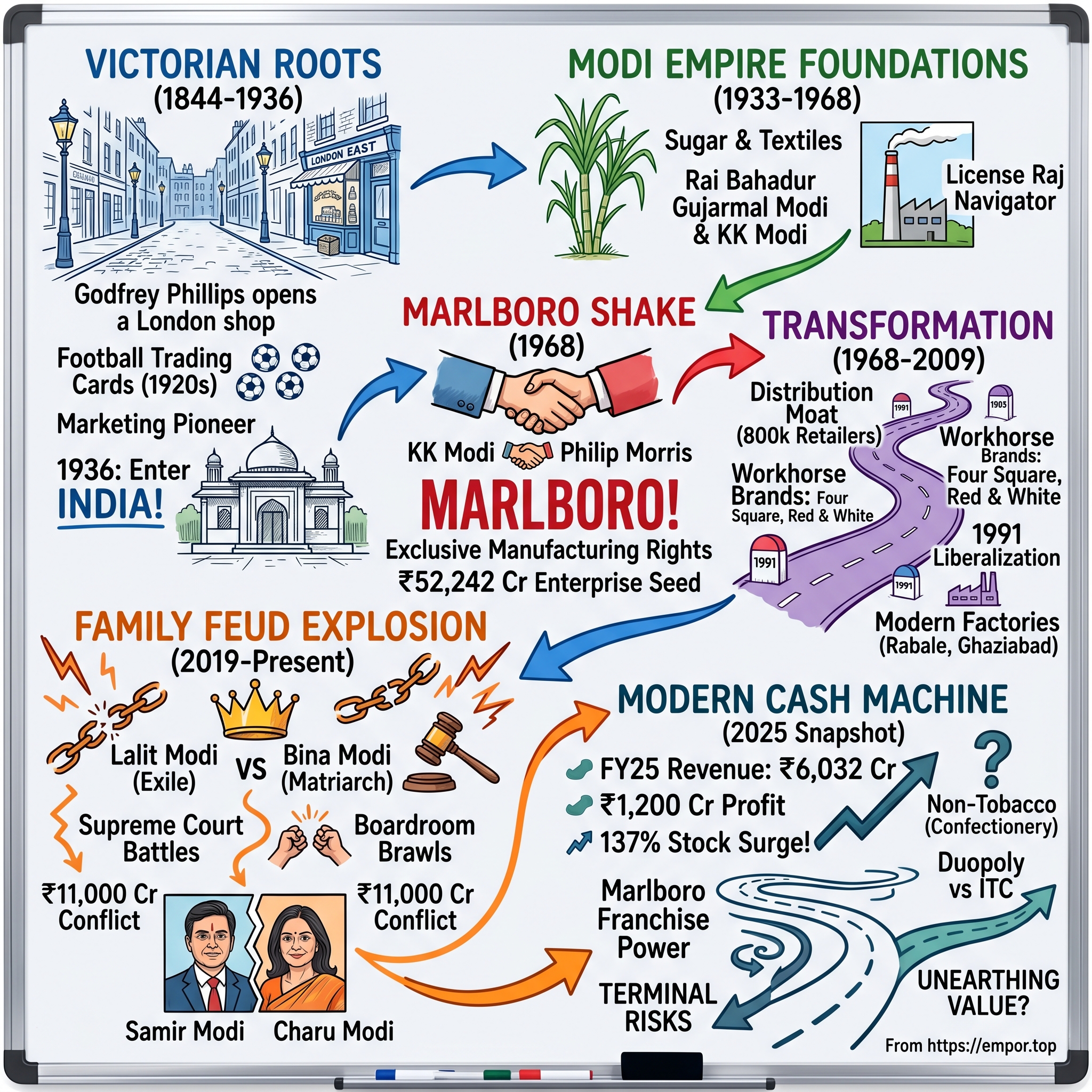
Godfrey Phillips India: The Marlboro Monopoly, The Family War, and The Cash Machine
I. Introduction & Cold Open: The ₹50,000-Crore Tobacco Paradox
A boardroom, a broken finger, and a ballot box
In the first week of September 2024, shareholders of Godfrey Phillips India logged in to vote at one of the most contentious annual general meetings Dalal Street had witnessed in years. Three months earlier, on May 30, 2024, the company's executive director, Samir Modi, had attempted to enter a board meeting at the corporate office. According to his formal complaint, a personal security officer assigned to his mother—Chairperson and Managing Director Dr. Bina Modi—blocked his entrance and assaulted him when he persisted. He suffered a fractured right index finger that required corrective surgery with screws and wires.1 The dispute prompted extensive media coverage, police complaints, and court filings, while the company dismissed the allegations as a smear campaign and stated that CCTV footage was available to disprove them.2
The shareholder meeting itself proved decisive once the ballots were tallied. The Delhi High Court had ruled in advance that Bina Modi was entitled to vote the shares held by the K.K. Modi family trust—the family vehicle controlling roughly 47.5% of the company—and dismissed injunction petitions brought by Samir Modi and Ruchir Modi.3 Philip Morris, which held just over 25% as the other co-promoter, voted alongside her. The resolution reappointing Bina Modi as Managing Director passed with 86.6% support, while her daughter Charu Modi secured appointment as an executive director with about 87% of the vote.4 Samir Modi's directorship, which came up for retirement by rotation, was left vacant "for the time being."3 Shareholders also approved a dividend of ₹56 per share.3
Within days, the stock surged to a fresh record high, propelled further by the board's announcement of the company's first-ever bonus issue.5
The paradox
That market reaction captured the central puzzle of Godfrey Phillips India (GPI). The company manufactures and markets a consumer product subject to an outright advertising ban, levied with some of the highest indirect tax rates in the economy, and required by law to carry graphic health warnings across 85% of its packaging.6 It remains a distant second in an industry dominated by ITC, which commands more than three-quarters of the domestic market, leaving GPI with an estimated share of roughly 14%.78 Its controlling family was openly feuding in courtrooms and corporate corridors. Yet by September 20, 2024, the stock had gained approximately 268% within that single calendar year.9 Following a 2:1 bonus issue the following year, the share price rallied to an all-time peak of ₹3,540.10 Based on 15.6 crore shares outstanding,11 GPI's market valuation briefly surpassed ₹50,000 crore.
Then the cycle turned. By September 24, 2026, the stock traded near ₹1,974, corresponding to a market capitalisation of about ₹30,800 crore and a trailing price-to-earnings ratio of roughly 22.5—a contraction of approximately 42% over twelve months.8 The catalyst was not the dynastic quarrel. In February 2026, the central government overhauled the cigarette taxation framework, and GPI's net profit for the June 2026 quarter dropped 44% year-on-year.7
The paradox therefore presents two distinct questions. How did an advertising-constrained, second-tier tobacco manufacturer manage to earn a return on capital employed of roughly 30% in FY26 while more than tripling net earnings over six years?8 And why did the market slash its valuation by nearly half within twelve months of its peak?
Three pillars, tested
Three primary assumptions have historically underpinned the bull case for GPI, each warranting close examination.
The first is the Marlboro moat. GPI manufactures and distributes Marlboro cigarettes in India. Because the government banned foreign direct investment in cigarette manufacturing in 2010, Philip Morris cannot establish a wholly owned domestic production facility.12 Popular commentary frequently labels this relationship a monopoly. In practice, the legal structure is narrower: GPI functions as Philip Morris's contract manufacturer and domestic distributor, while Philip Morris's local subsidiary retains brand ownership. That precise operating arrangement attracted an Enforcement Directorate investigation in 2019.12
The second is the capital allocation turn. In April 2024, the board approved an exit from 24Seven, the loss-making convenience-store retail chain the company had operated for nearly two decades.13 Market proponents heralded the move as GPI's transformation into a streamlined, high-return cash generator. A closer review of the cash-flow statement reveals that the reality is more nuanced.
The third is the dynastic overhang: the protracted succession battle over the K.K. Modi family trust, in which Bina Modi, her sons Lalit and Samir, and her daughter Charu serve as trustees and beneficiaries of an estate estimated in press reports at ₹11,000 crore or more.2 While portions of the dispute reached settlement in 2026, core disagreements remain unresolved.
The narrative traces an arc from a Victorian tobacconist in London's Aldgate through License Raj industrial policy, a half-century alliance with Philip Morris, a regional stronghold across northern India, a twenty-year retail misadventure, a high-stakes family feud, and an export boom in unmanufactured leaf, culminating in a fiscal overhaul that demonstrated which partner holds the ultimate pricing power. The story begins where the brand originated: London, in 1844.
 Subscribe on LinkedIn
II. Victorian Origins: The Colonial Conduit (1844–1968)
Bevis Marks, 1844
Bevis Marks is a narrow street on the eastern edge of the City of London, best known as home to the oldest surviving synagogue in Britain. In 1844, a cigar maker named Godfrey Phillips established a workshop there in the Aldgate district, rolling cigars and blending pipe tobacco for the merchants and clerks of the world's pre-eminent trading city.14 He died on August 21, 1900. By that point, the business had expanded beyond its founder's personal trade; in 1908, the partnership dissolved, reconstituting as Godfrey Phillips Limited under a corporate board.14
The cardboard loyalty programme
What made Godfrey Phillips memorable to the Edwardian and interwar public was not its cigars, but the cardboard stiffener tucked inside each packet. The company issued its first series of collectible cigarette cards in 1904.14 Amid the surging popularity of football after the First World War, it transformed those inserts into a mass collecting habit, issuing roughly 1,100 football cards in 1920, 2,462 in 1922, and 940 in 1923.14 While popular lore occasionally misreports the output as 4,000 complete sets, the actual production spanned nearly 4,500 individual player cards across that three-year run.
The commercial mechanic mirrored modern digital loyalty programmes: a consumer determined to complete a team roster had to purchase the same brand repeatedly. The cards converted an interchangeable consumer product into an ingrained habit decades before marketers coined the term customer retention. Paper shortages during the Second World War ultimately forced the company to halt card production in the 1940s.14 Yet the underlying commercial lesson endured: in the tobacco trade, where physical products are difficult to differentiate, manufacturers compete on branding, visibility, and habit.
India, 1936
In 1936, the London parent company incorporated an Indian subsidiary and constructed a factory—noted at the time for its indigenous architectural motifs—to manufacture its British brands domestically, including Cavanders, De Reszke, and Greys.14 The operating rationale followed standard colonial-era multinational strategy: local manufacturing bypassed steep import tariffs and positioned finished inventory closer to the wholesale distributors supplying India's fragmented network of small retail shops.
While public corporate archives provide scant detail on how the Indian operating unit negotiated the transition through independence in 1947 and the subsequent implementation of foreign-exchange controls, the enterprise endured intact, preserving its core brand portfolio. One of those initial labels has remained in active commercial production for nearly nine decades.
Two eras, one habit
The enterprise that emerged into the post-war decades remained a foreign subsidiary marketing Western-style cigarettes to a population that overwhelmingly consumed bidis—the inexpensive, hand-rolled tendu-leaf sticks favoured by working-class smokers. That structural market dynamic has persisted. Factory-made cigarettes have long represented merely the formal, heavily taxed, and branded apex of India's vast tobacco consumption base, forcing every manufacturer to determine how far down the income ladder to price its portfolio. Godfrey Phillips addressed that divide by maintaining a bifurcated lineup: aspirational British names at the top and economical everyday brands at the bottom.
Why Cavanders still matters
Cavanders still features in GPI's brand portfolio alongside Four Square, Red & White, Stellar, Focus, and Marlboro.15 Today, the vintage colonial label anchors the price-sensitive tier of the market, where legal cigarettes compete most directly with bidis and unorganised smokeless tobacco. That longevity underscores an enduring characteristic of the tobacco sector: established brands, once woven into regional consumer routines, routinely outlast the corporate and political empires that spawned them. Yet it also introduces the strategic constraint that defines GPI's modern operating model: a reliance on value-tier heritage brands offers minimal independent pricing power.
Godfrey Phillips's Indian operation might have remained an ordinary colonial outpost. Its trajectory changed entirely when control shifted to an industrial family from a sugar town in western Uttar Pradesh.
III. The House of Modi & The License Raj Playbook (1933–1979)
A sugar mill becomes a town
In 1933, Rai Bahadur Gujarmal Modi established a sugar factory on farmland between Delhi and Meerut. The industrial township that expanded around the facility took the family's name: Modinagar.1615 Over the subsequent four decades, the Modi group diversified into textiles, vanaspati edible oils, and a broad array of industrial enterprises. That expansion reflected the conglomerate model fostered by India's pre-liberalisation licensing regime, where securing administrative permits and production quotas presented a far steeper barrier to entry than constructing physical plants.
K.K. Modi: the builder
Krishan Kumar Modi was born in Patiala on August 27, 1940, the eldest son of Gujarmal Modi and his second wife, Dayawati.16 Inducted into the family enterprises early, he travelled across Europe at age nineteen in 1959 alongside his uncle Kedarnath Modi to inspect modern textile machinery, subsequently oversaw production at the family's silk mill, and by 1965 became vice-president of Modipon, the group's nylon-yarn joint venture.16 He married Bina in 1961; their three children—Charu, Lalit, and Samir—would become the central figures in the family's subsequent corporate conflicts.16
Following Gujarmal Modi's death in 1976, K.K. Modi assumed leadership of the broader industrial group. The conglomerate held together until 1989, when the family divided its assets among Gujarmal's five sons.16 K.K. Modi's allocation centered on cigarettes, agrochemicals, leather, and specialty chemicals, establishing an operating base that by 2012 earned him a ranking among India's hundred wealthiest individuals on the Forbes list.16 While GPI's corporate history designates him as the founder of Godfrey Phillips India and credits him with modernising the enterprise,15 the commercial appeal of the tobacco trade lay in its fundamental economics. Cigarettes required daily cash purchases from consumers, generated high repeat volumes, and exhibited minimal brand switching. Unlike cyclical commodity lines such as sugar or textiles—where operating margins fluctuated with monsoon rains or international commodity prices—tobacco offered a recurring, predictable cash stream shielded by regulatory barriers that prevented new domestic competitors from establishing manufacturing capacity.
The Ghaziabad bridge, 1967
The operational link between the Modi group and Godfrey Phillips originated in northern manufacturing. In 1967, the London parent company arranged for International Tobacco Company to establish a factory in northern India to manufacture cigarettes on its behalf, anchoring the Indian enterprise's corporate headquarters in Delhi ever since.14 GPI continues to operate that plant in Ghaziabad, alongside manufacturing facilities at Rabale near Navi Mumbai and a leaf-processing complex at Guntur in Andhra Pradesh.14
Public records regarding precisely how and when the Modi family transitioned from manufacturing partner to co-promoter remain sparse, with company disclosures, regulatory filings, and press archives presenting divergent timelines. For investors, the decisive outcome was structural: a domestic industrial group possessing manufacturing licenses, industrial land, and regulatory access formed a lasting alliance with an international tobacco house offering proprietary blends and production expertise.
1968: Philip Morris arrives
In 1968, Philip Morris acquired the London parent company, Godfrey Phillips Limited, through a contested takeover bid.14 The American multinational had not set out to acquire an Indian cigarette manufacturer, yet the purchase left it with a major domestic operating asset. That transaction initiated a co-promoter relationship between Philip Morris and the Modi family that has endured for more than half a century.
The regulatory architecture of the License Raj defined each partner's bargaining position from the start. Under India's industrial licensing regime, expanding or establishing cigarette manufacturing capacity required explicit government approval, while foreign corporations operated under strict foreign-ownership caps and exchange-control limits on capital repatriation. Philip Morris controlled global brands and blending formulations but lacked the regulatory freedom to operate independently. The Modis possessed manufacturing permits, factory infrastructure, and domestic political access, but lacked an internationally recognised marquee brand. Each side depended on the other—a structural arrangement that remains foundational to GPI's corporate framework.
While mutual dependence can either cement a durable alliance or introduce long-term friction, the relationship functioned primarily as an engine of commercial expansion for the next four decades. Together, the partners developed the domestic brands and regional distribution strongholds that continue to generate the bulk of GPI's operating earnings.
IV. The Philip Morris Accord & The Regional Fortress (1979–2009)
Two promoters, one company
This era is often depicted as a balanced power-sharing arrangement, with the Modi family and Philip Morris exercising mutual vetoes over corporate strategy. Because public filings prior to 2010 provide limited year-by-year shareholding data, the exact ownership split during those earlier decades remains unverified. The eventual distribution, however, is on the public record. By June 2024, promoters held 72.58% of GPI: the K.K. Modi family trust held 47.48% and Philip Morris held 25.10%, while foreign portfolio investors owned roughly 10.8%, domestic institutions about 1.9%, and public retail shareholders approximately 14.7%.2
The practical result was a corporate structure governed by two promoters whose commercial interests overlapped without fully converging. The Modi family relied on the business for steady dividend income and operational leadership in India. Philip Morris derived earnings from licensing the Marlboro brand and, in later years, emerged as a major overseas buyer of GPI's unmanufactured leaf tobacco. For decades, the two partners collaborated smoothly enough that the alliance attracted little public scrutiny. That stability, however, lasted only as long as the Modi family remained united.
The brand ladder
GPI designed its domestic brand portfolio for India's middle- and lower-income consumers rather than the metropolitan elite. Four Square, the company's flagship, targeted urban working- and lower-middle-class smokers. Red & White established itself as a staple across semi-urban northern India. Cavanders defended the lower-priced value tier against bidis and unorganised alternatives.15
The company's most visible marketing initiative during this era bypassed conventional commercial channels altogether. In 1990, GPI established the Red & White Bravery Awards to honour ordinary citizens for exceptional physical and social courage.17 The campaign was commercially shrewd: every press report detailing the civic bravery of a schoolteacher or auto-rickshaw driver reinforced consumer awareness of a cigarette label. Critics flagged the initiative as surrogate advertising, and in 2003, following public protests, the programme was renamed the Godfrey Phillips National Bravery Awards.17 That same year, Parliament enacted the Cigarettes and Other Tobacco Products Act (COTPA), prohibiting tobacco advertising across virtually all mass media.6
The statutory advertising ban fundamentally altered the competitive landscape. By halting mass promotion, the law froze consumer brand recognition at early-2000s levels. Established incumbents retained their built-in consumer loyalty, while prospective challengers were stripped of the marketing tools required to alter purchasing patterns. The regulatory ceiling shielded GPI from prospective new entrants, even as it fortified ITC against aggressive market-share challenges from GPI.
The ITC wall
ITC is to the Indian cigarette market what the monsoon is to Indian agriculture: the overarching reality to which every participant must adapt. Today, ITC commands more than 75% of the domestic market, and the three organised manufacturers—ITC, GPI, and VST Industries—together account for over 90% of an annual industry volume estimated at 100 to 120 billion sticks.7 GPI's national volume share has historically settled near 14%.8
Geographically, GPI established a regional stronghold concentrated across northern and western India—predominantly in Delhi, Uttar Pradesh, Rajasthan, and Punjab—while ITC's distribution infrastructure maintained a commanding grip across the eastern, southern, and central states.
Myth vs reality: was GPI ever a national challenger?
The claim: GPI's distribution network and Philip Morris-backed blends gave it the ability to take on ITC nationally.
The evidence: Disclosures detailing individual regional sales campaigns and their associated capital costs between the 1980s and the 2000s are not available in public regulatory records, but the long-term industry outcome provides the clearest gauge. After roughly half a century of co-ownership alongside the world's largest international tobacco company, GPI remains a distant second with about a seventh of the domestic market,8 while ITC holds more than three-quarters.7 Whatever expansion pushes took place, none restructured the competitive hierarchy of the domestic industry.
The verdict: The historical record narrows the claim. GPI's competitive advantage has remained regional and segment-specific: deeply entrenched across northern and western corridors, but thin across the rest of the country. A notable exception emerged in recent operational performance. In FY26, GPI's domestic cigarette volumes grew 20%,18 supported by a 25% volume expansion during the first nine months of that fiscal year19—a pace well above baseline industry trends. Management attributed the gains to "increased direct retail outlet coverage."20 If that expansion reflects sustained market-share capture beyond legacy northern strongholds, the historical volume ceiling may be shifting. If instead the momentum reflects temporary wholesale restocking, channel pipeline filling, or a cyclical lift from Marlboro, the acceleration will subside. For investors, the decisive benchmark is domestic volume growth measured against ITC quarter after quarter, rather than a single high-growth fiscal year.
In 2009 and 2010, two regulatory and commercial milestones arrived twelve months apart, transforming the partnership with Philip Morris permanently.
V. The 2010 Inflection: Equity Shift, FDI Freeze & The Marlboro Machine (2009–2019)
A deal signed just before the gate closed
In May 2009, Godfrey Phillips entered a commercial arrangement with IPM Wholesale Trading, an Indian affiliate of Philip Morris International, under which GPI would manufacture Marlboro cigarettes in India.12 The timing proved decisive. In 2010, the Indian government banned foreign direct investment in cigarette manufacturing, stating that the prohibition would support public health efforts to curb smoking.1221
The policy functioned like an iron gate swinging shut behind incumbents. Foreign shareholders could retain their existing equity holdings, but overseas tobacco companies were barred from deploying fresh capital into domestic manufacturing. Philip Morris could neither construct a wholly owned factory, acquire an existing plant, nor increase its equity stake in GPI. To produce Marlboro locally for the world's second-largest tobacco consumer market, Philip Morris had to rely on the manufacturing pact negotiated barely twelve months prior.
The equity picture after the freeze
Around the same period, GPI's ownership structure settled into its contemporary shape: the K.K. Modi family vehicles as the primary promoter and Philip Morris holding 25.1%.142 While some public summaries recorded a lower figure for Philip Morris around 2011, corporate filings consistently reflect an ownership stake of 25.10%.22
That exact percentage carries substantial statutory leverage. Under Indian company law, special resolutions—governing charter alterations, executive reappointments, and major corporate actions—require a 75% supermajority of votes cast. A shareholder controlling more than 25% wields a permanent veto. Because the foreign direct investment ban prevented Philip Morris from increasing its equity, that negative control became a structural feature of corporate governance. The constraint works in both directions: Philip Morris cannot be sidelined, yet the Modi family trust cannot pass special resolutions without outside backing.
That arithmetic proved pivotal at the September 2024 annual general meeting. The special resolution reappointing Bina Modi required 75% of votes cast. With the Modi trust holding 47.48% and Philip Morris holding 25.10%—a combined promoter block of 72.58%—passage required Philip Morris's assent alongside support from public institutions and retail shareholders. Backed by the multinational partner, the resolution cleared with 86.6% approval.4
What the Marlboro machine really is
Popular market narratives often describe GPI as owning the Marlboro franchise in India. The underlying legal contracts describe a far more circumscribed relationship. Godfrey Phillips acts as a contract manufacturer, while Philip Morris's local corporate unit operates as a wholesale trading enterprise and oversees brand marketing.12 GPI's own corporate disclosures define the arrangement precisely, noting that Marlboro is distributed under arrangement with Philip Morris.15
In March 2019, investigative press reports citing internal Philip Morris records from May 2009 to January 2018 stated that the American multinational had routinely reimbursed manufacturing expenses incurred by GPI to produce Marlboro. Critics alleged the arrangement circumvented statutory foreign direct investment restrictions. The Enforcement Directorate subsequently launched an investigation into both corporations under foreign-exchange laws, which permit financial penalties of up to three times the value involved in an infraction.12 Legal practitioners contested whether the cost reimbursements breached investment guidelines, and the regulatory proceedings have yielded no publicly disclosed outcome.
For Philip Morris, local manufacturing provided compelling commercial benefits. A premium global tobacco label commands maximum pricing power when delivered fresh and priced in rupees, rather than imported in small volumes under heavy customs duties. Manufacturing Marlboro locally transformed it from an occasional duty-free indulgence into a widely available product on the same retail shelves as Four Square. For GPI, the partnership opened access to affluent metropolitan smokers—the demographic most inclined to trade up as personal incomes expand—while providing sales teams with leverage to secure premium shelf placement across urban retail counters.
From an investment perspective, the operational distinction between an exclusive commercial franchise and a contract manufacturing agreement is fundamental. A franchisee captures local brand equity and long-term customer economics under a multi-year territorial license. A contract manufacturer earns fees governed by renegotiable commercial agreements, and GPI does not disclose Marlboro's sales volumes, standalone revenues, or profit margins. While Marlboro bolsters GPI's retail visibility and distribution reach, the share of brand economics retained by GPI versus remitted to Philip Morris remains unstated. Any investment valuation treating Marlboro as a wholly owned GPI asset capitalizes revenue streams the company does not legally own.
Myth vs reality: the adjacency engine
The claim: Management possessed the FMCG distribution muscle necessary to build multiple non-tobacco consumer pillars atop its cigarette network.
The evidence: Three commercial initiatives define the track record.
Chewing products. GPI spent over a decade establishing Pan Vilas as a premium pan masala label within its chewing division. While the segment approached operational break-even around FY19, it never generated durable operating earnings. Following ongoing operating losses, the company agreed on October 12, 2022, to sell the business to Vishnu and Company Trademarks and its affiliate VLC Innovations for ₹80 crore. Chewing products generated less than 2% of company revenue at the time of the divestment.23 Years of brand-building concluded with a cut-price sale to a category specialist.
Confectionery. The company introduced its Funda Goli candy line to capitalize on point-of-sale visibility at cigarette counters. During the first nine months of FY26, gross confectionery sales reached roughly ₹51 crore, while a distribution arrangement for Ferrero India products contributed about ₹37 crore. Combined, other non-tobacco packaged consumer lines accounted for roughly 2% of net sales.19 After years of market presence, confectionery remains an immaterial contributor to corporate earnings.
Tea and other ventures. Historical forays into packaged tea and related consumer goods similarly failed to achieve commercial scale before being phased out.23
The verdict: The operational record refutes the broader diversification thesis. GPI's distribution infrastructure excels at moving low-ticket, habit-forming, cash-settled tobacco products through neighborhood paan stalls, but it has not demonstrated an ability to generate consumer demand in categories where it lacks organic brand loyalty. The Ferrero arrangement, in which GPI routes an established third-party brand through its wholesale channels, illustrates a more disciplined model: it monetizes distribution reach without incurring the brand-building losses that eroded capital in Pan Vilas. For investors evaluating future adjacency plans, the critical distinction lies between distribution agreements like Ferrero and capital-intensive brand-building ventures like Pan Vilas. The historical record clearly favors the former.
Yet none of these packaged-goods adjacencies matched the financial drain of GPI's largest corporate diversification, which persisted for nearly two decades.
VI. The 24Seven Retail Debacle: A 20-Year Capital Allocation Post-Mortem (2004–2024)
The 7-Eleven dream
In the mid-2000s, organised retail emerged as a defining investment theme across urban India. Modern shopping malls were multiplying, and the concept of an all-night convenience store stood out in a market where traditional retail shutters routinely closed by ten at night. In 2005, GPI launched 24Seven, a chain of round-the-clock convenience stores modelled loosely on 7-Eleven.24 The venture became closely associated with Executive Director Samir Modi, who later fought through the courts to keep it operating.2
The strategic rationale appeared coherent on paper. For a tobacco manufacturer confronting tightening advertising and sales regulations, owning a consumer retail footprint offered a commercial hedge. The stores provided dedicated modern-retail shelf space for GPI's cigarettes, confectionery, and snacks, while offering direct operational exposure to the fast-food and packaged-goods trades.
The reality
Convenience retail is a demanding format under any conditions. In metropolitan India, the model confronted high real estate rents for prime street corners, round-the-clock staffing expenses across three shifts, inventory spoilage on fresh food, and municipal regulations that periodically restricted late-night trading. The structural challenge compounded with the rise of quick commerce: by the early 2020s, instant-delivery platforms were fulfilling grocery and impulse orders within minutes, eroding the primary convenience proposition of walking to a physical neighbourhood store.
By December 2023, 24Seven operated roughly 150 stores and kiosks across Delhi-NCR, Punjab, and Telangana.1325 For FY23, the retail division reported revenue from operations of ₹396 crore—representing about 9.3% of the company's consolidated total—on gross sales of ₹482 crore, up 19% year-on-year. Yet the business carried a negative net worth by March 31, 2023, "as a result of accumulated losses."2513 In essence, after eighteen years of commercial operations, the retail venture had consumed more capital than its entire invested equity base.
GPI never published a comprehensive year-by-year loss ledger for 24Seven in public disclosures. While external market commentary frequently circulated estimates of its annual operating cash drain, those figures remain unverified approximations. The audited record establishes that the venture absorbed capital for nearly two decades, wiped out its equity, and was ultimately shuttered by the board rather than divested as a going concern at a meaningful valuation.
The exit and the fight
On April 12, 2024, the board announced that GPI would exit the retail division, citing "stakeholders' feedback, long-term performance of the division since inception, prevailing market conditions of retail sector and long-term business strategy."25[^26]
Samir Modi challenged the decision. In June 2024, he secured a court order temporarily restraining the company from executing the closure while granting interim protection for his board seat. On August 1, 2024, a district court in Saket, Delhi, vacated both protections, permitting the exit to proceed and ruling that any reappointment of Samir Modi must follow standard nomination and remuneration committee procedures.2627 According to GPI's disclosures in subsequent litigation, store operations ceased on July 31, 2024, and the company discontinued use of the 24Seven trademark on October 10, 2024.24
The dispute continued into another forum. In December 2024, Twenty Four Seven Retail Store Private Limited, alongside Samir Modi, filed suit against GPI in the Delhi High Court, alleging unauthorized post-exit use of the 24Seven trademark.2428 On April 8, 2026, the High Court recorded an unconditional withdrawal of the suit as part of "a broader resolution involving Mr. Modi and his associated entities."28
The post-mortem: discipline, or just the end of the tolerance?
Market commentators frequently framed the shutdown as a decisive act of capital allocation discipline. A closer examination of the operational timeline suggests a more qualified assessment.
The positive case is straightforward: the board eliminated a business that had drained corporate capital for two decades, overriding vocal opposition from a promoter-family director. Following the closure, GPI's consolidated return on capital employed expanded from 23% in FY24 to 26% in FY25 and roughly 30% in FY26.8 Reclassifying 24Seven as a discontinued operation also presented investors with a cleaner financial profile for continuing operations.29
The counter-thesis warrants equal weight. That operational improvement cannot be attributed exclusively to the retail exit. The same period coincided with an export boom in unmanufactured leaf tobacco and 20% growth in domestic cigarette volumes,18 and GPI did not disaggregate margin expansion between the retail shutdown and core operational momentum. Market claims that closing 24Seven expanded consolidated operating margins by 150 to 200 basis points find no explicit confirmation in company filings. More fundamentally, capital discipline is evaluated over the entire life of an investment, not merely its liquidation. The same corporate governance framework that closed 24Seven in 2024 had funded its operating losses since 2005 until its net worth turned negative. Furthermore, the decision materialized in the midst of an escalating family conflict, targeting a division championed by the faction on the losing side of that dispute. It remains an open question whether the board would have acted with comparable urgency had the venture been led by leadership aligned with the controlling camp.
The closure succeeded in removing a persistent drag on earnings, marking an operational improvement. Yet by itself, the exit does not confirm a permanent shift in capital allocation philosophy. The real test for shareholders lies ahead: whether future surplus cash flows are returned to equity holders or redirected into speculative adjacencies outside the core tobacco business.
The contest over 24Seven, however, formed merely one skirmish in a far broader family war.
VII. The Succession War: Boardroom Coups & Kingmaker Philip Morris (2019–Present)
The deed
K.K. Modi died on November 2, 2019, aged 79.16 He left his family a trust. The deed, made in London and recording an oral family settlement from 2006, named his wife and three children as trustees and beneficiaries.30 Its terms, as described in court and in the press, gave the four of them equal shares, with Bina Modi's share passing equally to the three children after her death.312
The explosive part is the dissolution mechanism. As the Supreme Court heard it, the deed allows the trust's assets to be sold if the beneficiaries cannot reach a settlement within 30 days of K.K. Modi's death, with a year to complete the sale.30 (Some later retellings describe a year-long window for unanimous agreement. The court record summarised here is the more precise version.) The trust's largest single asset is its roughly 47.5% stake in GPI.3 A forced sale would put control of the company in play.
Three positions
Lalit Modi, the founder of the Indian Premier League who has lived in the UK for years, took the most direct position: dissolve the trust and divide the assets. He started arbitration in Singapore, which his mother and siblings went to court in India to stop, and pursued litigation in India.30 In July 2022 a Supreme Court bench led by Chief Justice N.V. Ramana told the parties to "come up with solutions," noted that mediation by retired judges had failed, and ordered the status quo on property sales.30
Bina Modi took the opposite view. She took over as Chairperson and Managing Director of GPI and has argued, in effect, that the family's businesses should be run rather than sold. Her daughter Charu has been her closest ally and was elevated to the board in September 2024.4
Samir Modi began on his mother's side in the early litigation against Lalit and then broke away. In February 2024 he argued publicly for keeping GPI in the family through buy-outs among family members, and accused his mother of controlling the company in breach of the trust deed.31 The 24Seven closure turned a family disagreement into open warfare.
The climax, May–September 2024
After the May 30, 2024 incident, Samir Modi filed an FIR in June. On March 1, 2025, police filed a charge sheet naming only the security officer, Surendra Prasad, and clearing Bina Modi and senior lawyer Lalit Bhasin for lack of evidence. A trial court later found prima facie material pointing to "conspiracy or common intention" against all three.1[^33]
In the boardroom, though, the result was decisive. The Delhi High Court allowed Bina Modi to vote the trust's shares.3 Philip Morris voted with her. Samir Modi left the board, Charu Modi joined it, and Bina Modi was reappointed.43
Philip Morris acted as kingmaker, and its incentives explain why. A board controlled by one family faction, working closely with Philip Morris, keeps the Marlboro contract stable. A forced trust sale could bring in an unknown controlling shareholder, possibly one with closer ties to ITC or with different plans. For Philip Morris, backing the sitting management was the lower-risk choice.
The governance stress test
This is where a sceptical investor has to look closely, and the record contains real signs of dissent.
Proxy advisers said no. Ahead of the 2024 meeting, leading proxy advisers recommended that institutions vote against Bina Modi's reappointment.4 The resolution passed anyway, which shows how much voting power sits with the two promoters.
Minority shareholders have already won once. At the AGM on September 1, 2023, shareholders rejected a material related-party transaction under which GPI would export up to ₹1,000 crore a year of unmanufactured tobacco to Philip Morris Products SA, an affiliate of its own promoter. The vote was 57.94% against. Proxy adviser IiAS had objected that the resolution was "valid in perpetuity," with automatic annual renewal and no periodic review by shareholders.2232 Under SEBI rules related parties cannot vote on such resolutions, so this was a vote of the non-promoter shareholders alone, and they said no. The episode shows two things. Minority shareholders can discipline promoter dealings when the rules give them the vote. And Philip Morris is not only GPI's partner and shareholder but also a potential major customer for its leaf, which makes the relationship more tangled than "Marlboro licensor" suggests.
What an activist would ask. Who succeeds Bina Modi, and on what timeline? How independent is the board, given that one side of the family controls the trust's votes? Why has no Marlboro-level disclosure (volumes, revenue, margins, contract term) ever been published? And what happens to the GPI stake if the trust is eventually dissolved?
The 2026 truce, and what it did not settle
The truce is often dated to August 2026, but it came in stages. On April 8, 2026, the 24Seven trademark suit was withdrawn as part of a broader resolution.28 On April 28, 2026, the Delhi High Court quashed the criminal case over the assault after Samir Modi withdrew his complaint and told the court, by video, that the disputes had been settled.133 On August 4, 2026, reports that Samir Modi had withdrawn his remaining cases against his mother sent the stock up about 3%, to around ₹2,317.34
What remains unresolved is the bigger question. Settlement terms have not been disclosed. The litigation led by Lalit Modi over the trust has not reached a final resolution in the sources reviewed for this article, and the deed's dissolution mechanism has not gone away. The truce removes a headline risk and a distraction for the board. It does not remove the possibility that control of the 47.5% block could one day change hands.
While the family fought over the business, the business itself kept doing what it has always done.
VIII. The Core Machine: Cigarette Economics, Distribution & The Illicit Trade Barrier
Six in the evening, a paan shop in Lucknow
Picture a wooden kiosk the size of a wardrobe, lit by a single bulb, wedged between a chemist and a phone repair shop. The owner sits cross-legged behind a counter lined with glass jars of supari, while behind him, in neat rows, stand open cigarette packs. A customer walks up, names a brand, pays in cash, and leaves with a single stick rather than a pack, lit from a smouldering rope hanging by the counter. The entire transaction takes eleven seconds. It repeats hundreds of times a day at that kiosk, and across more than a million retail outlets that stock GPI's brands nationwide.
That counter is GPI's true operational engine. Everything else serves it.
The oligopoly
The legal Indian cigarette trade functions as an established three-player oligopoly. ITC holds more than 75% of the market. GPI operates as the clear second-ranked manufacturer, while VST Industries—with brands such as Total, Editions, and Charms—anchors a value-focused third. Together, the three control over 90% of an annual industry volume estimated at 100 to 120 billion sticks.7
GPI's portfolio spans each distinct price band: Cavanders and legacy value labels at the base, Four Square and Red & White in the core mid-market, compact formats such as Stellar and Focus, Marlboro at the premium apex, alongside regional heritage names including North Pole and Tipper.157 Stick length carries greater commercial significance in India than in almost any other market, because excise duty is structured around it. The central government levies excise per thousand sticks across specific statutory slabs linked to physical length.35 Shorter cigarettes incur lower duty rates and sell at lower price points, providing manufacturers with a critical pricing lever to prevent consumers from migrating out of the legal market as tax rates climb.
The distribution engine
GPI reports that its distribution network reaches more than one million retailers through over 1,100 distributors, supported by a field sales force exceeding 9,000.15 The commercial dynamics of that wholesale network underpin the entire business model. Retailers pay upfront in cash, inventory operates in compact formats with rapid shelf turnover, and point-of-sale visibility drives impulse purchasing in an environment where mass advertising is prohibited by law. For a brand excluded from broadcast television and print media, the most valuable real estate in Indian commerce is the few inches of countertop confronting the customer.
This rapid conversion also explains why analysts frequently characterize tobacco as a negative working capital business. In the domestic cigarette channel, cash collection is immediate. Yet as Section IX demonstrates, that working-capital profile does not apply to the company as a whole.
The tax machine, rebuilt
Until January 2026, cigarettes were taxed under a structure combining a 28% Goods and Services Tax (GST) with a length-based compensation cess. Effective February 1, 2026, the central government restructured the framework: it replaced the compensation cess with a new central excise duty ranging from roughly ₹2,050 to ₹8,500 per thousand sticks depending on length, and elevated the basic GST rate on cigarettes to 40%.357 Brokerage analyses estimated that the total effective tax burden rose to approximately 53% of the retail price, up from roughly 40%, with the steepest duty increases falling on regular-size filter and longer sticks, which together represent about 55% of industry volumes.35 GPI's shares dropped more than 8% on the day the notification was issued.35
The industry responded as a coordinated oligopoly typically does: manufacturers raised retail prices in tandem, but selectively. Retail prices advanced 15% to 20% across most portfolio tiers, translating to ₹22 to ₹25 increases on a pack of ten, and up to ₹55 on select premium brands. Analysts at UBS observed that the market leader passed through the tax hike in full on premium offerings while moderating increases across price-sensitive value segments.36 On February 18, 2026, GPI's stock rallied 12% as equity markets concluded that the retail price adjustments would hold.36
The commercial mechanics of the length-based tax schedule resemble a toll road that charges vehicles by length. A premium king-size cigarette pays the heaviest toll, whereas an economical 64mm stick pays the lightest. Every structural tax adjustment redistributes consumer demand between stick lengths as well as between competing brands, making a manufacturer's length mix as critical as its brand equity. The February 2026 overhaul raised levies most sharply on the regular and longer formats where the mass market concentrates,35 setting up the operational quarter that followed as a rigorous test for the entire sector.
Myth vs reality: pricing power
The claim: GPI possesses robust pricing power, underpinned by addictive consumer habits and rational competitor behaviour that enable full tax pass-through.
The first disconfirming mechanism: illicit trade. Legal factory-made cigarettes account for only about 10% of India's aggregate tobacco consumption, yet they generate approximately 80% of all tobacco tax revenue.37 Industry-cited Euromonitor figures estimate illicit cigarettes at roughly 26% of the domestic market, dominated by contraband labels such as ESSE and MOND. The same dataset indicates that legal cigarette consumption contracted 28% between 1981–82 and 2023–24, while alternative forms of tobacco expanded by roughly 70%.37 Because these illicit-trade figures originate primarily from industry-aligned sources seeking to dissuade fiscal authorities from tax increases, they are appropriately interpreted as an upper bound. Nevertheless, the underlying economic dynamic is clear: every aggressive tax-induced price hike inevitably redirects a segment of smokers toward bidis, smokeless tobacco, or smuggled alternatives.
The second test: the June 2026 quarter. The first quarter of FY27 provided the most transparent real-world test of GPI's pricing power on record. Domestic cigarette volumes demonstrated notable resilience, slipping only about 2% year-on-year to roughly 1,866 million sticks a month despite the steep retail price hikes.1038 Net revenue excluding excise duties declined 18.8% to ₹1,206 crore. By comparison, net revenue in ITC's cigarette division contracted by roughly 31%.7 However, GPI's profit after tax dropped 44% to ₹198 crore, while operating EBITDA fell 46% to ₹182 crore, driving operating margin down from 8.3% to 3.2%.1038
The verdict: The operational record narrows the investment thesis. GPI exhibited remarkable volume resilience, as core smokers continued to purchase its brands following the price adjustments, but demonstrated only partial margin pass-through, as management elected—or was compelled—to absorb a significant portion of the fiscal increase to defend market share. Chief Executive Officer Sharad Aggarwal had flagged this operational trade-off in May 2026, observing that the magnitude of the tax revision would require measured, phased retail price increases rather than an immediate, full pass-through.18 True pricing power in the Indian tobacco market is bounded from below by contraband and non-cigarette alternatives, and bounded from above by sovereign revenue targets. The critical variable for investors is whether gross margins recover across subsequent quarters as phased price increases take effect, or whether FY27 establishes a structurally lower margin baseline.
An additional reporting dynamic warrants caution. In the March 2026 quarter, GPI's net profit surged 86% year-on-year to ₹521 crore.18 A portion of that earnings spike likely reflected distributor inventory accumulation ahead of the anticipated February price adjustments. Because the company does not disclose channel restocking volumes, the sequential quarters between December 2025 and June 2026 must be evaluated as an integrated cycle rather than as isolated data points.
Capacity
In May 2026, GPI entered into a nine-year exclusive contract-manufacturing agreement with Polisetty Somasundaram Tobacco Products, under which the partner will construct a facility and secure operating licenses within twelve months to produce cigarettes according to GPI's specifications. Management stated that the partnership aimed to "augment production capacity and ensure the uninterrupted availability of products."39 The agreement provides an instructive strategic signal: following a fiscal year of 20% domestic volume growth, the operational constraint management prioritized was manufacturing capacity rather than retail demand. The arrangement also means that a meaningful share of incremental volume will originate in a factory GPI does not directly own.
While the domestic cigarette network serves as the primary cash generator, an export-driven second engine—operating far from neighbourhood paan stalls—has contributed substantial revenue expansion over the past three years.
IX. The Dark Horse: Leaf Tobacco Exports & Global Arbitrage
Guntur, auction season
In the flat black-soil plains of coastal Andhra Pradesh, flue-cured Virginia tobacco cures in brick barns heated by wood fires, the leaves turning slowly from green to lemon yellow and deep orange. During auction season, the cured bales go under the hammer across regulated platforms, where leaf merchants and exporters—GPI prominent among them—inspect, purchase, grade, and pack the tobacco for cigarette manufacturers across other continents. GPI anchors its primary leaf-processing complex in Guntur.14
This operation functions on entirely different commercial principles from the domestic cigarette business. It sells no consumer brands and mounts no advertising campaigns. Instead, it procures an agricultural commodity, applies industrial grading and processing, and supplies bulk leaf to international cigarette manufacturers at prices dictated by global supply and demand.
The boom
The export division expanded rapidly between FY24 and FY26. In FY26, unmanufactured tobacco exports reached approximately ₹1,945 crore, accounting for roughly 21% of net sales.18 Across all international operations, revenue reached about ₹2,014 crore, or 22% of corporate net sales, shipped to buyers across roughly 30 countries spanning Latin America, the Middle East, Southeast Asia, and Eastern Europe.20 Management attributed this export expansion to long-term investments in crop development and consistent quality grading.19
That export momentum materially lifted GPI's headline top line. In corporate disclosures, the company highlighted a gross turnover of approximately ₹14,480 crore including duties for FY25,15 while gross sales value reached ₹18,379 crore in FY26.18
Myth vs reality: structural growth or a cycle?
The claim: Leaf exports represent a high-margin, structural growth engine that permanently insulates GPI against domestic cigarette regulatory risk.
The evidence against:
The reversal. In the June 2026 quarter, unmanufactured tobacco exports dropped sharply to approximately ₹248 crore, representing just 7% of net sales, a contraction management attributed to geopolitical disruptions.38 A division that generated more than a fifth of net sales across the prior fiscal year shrank to roughly one-fourteenth within three months—a stark illustration of how cyclical agricultural trading operations behave.
Undisclosed operating margins. GPI aggregates leaf exports within its consolidated cigarettes-and-tobacco reporting segment, withholding standalone margin disclosures. While popular commentary routinely estimates leaf export EBIT margins in the single digits to low teens—well below the profitability of branded domestic cigarettes—those figures remain unverified approximations. The structural reality is that GPI earns an industrial processing and trading margin on bulk leaf rather than an unencumbered consumer brand premium.
Working-capital intensity. Leaf exports require heavy upfront capital commitments: raw leaf must be purchased at seasonal auctions, cured, stored for months, and shipped on extended commercial credit terms. A fire on October 10, 2025, at a third-party processing plant and warehouse in Prakasam district, Andhra Pradesh, where GPI stored leaf, underscored the operational risk: the company submitted an insurance claim of ₹344.49 crore and received an interim settlement of ₹100 crore by May 2026.40 Carrying hundreds of crores of perishable inventory in regional storage facilities presents a fundamentally different risk profile from distributing finished cigarette packs that convert into cash within days.
The operational contrast is pronounced. The domestic cigarette business functions like a high-volume neighbourhood café: supplies arrive, customers pay cash across the counter, and the till balances daily. By contrast, the leaf export business operates like a bulk agricultural exporter: raw material is procured once a year during harvest, inventory sits in curing facilities for months, and overseas buyers pay on commercial invoice terms. Both models can generate profit, but only the domestic cigarette franchise generates cash at the same speed it records accounting income.
Promoter-group customer concentration. The shareholder vote in September 2023—where non-promoter investors rejected a proposal to supply up to ₹1,000 crore of leaf annually to an affiliate of Philip Morris—revealed that a promoter group represented, or sought to establish, a dominant buyer relationship.22 GPI provides no disaggregated disclosures regarding customer concentration in its export book.
The verdict: The operational record does not diminish the leaf business as a legitimate commercial capability or an established profit contributor. However, it refutes the thesis that leaf exports offer a structural, permanent hedge against domestic cigarette headwinds. Bulk leaf trading is inherently cyclical and capital-intensive. The business enjoyed a pronounced global upswing between FY24 and FY26, but the sharp contraction in the June 2026 quarter demonstrated that GPI possesses no pricing power over global leaf benchmarks and remains exposed to international trade volatility. For investors, the critical metrics are quarterly export revenue share and the working-capital burden required to sustain it—a reality that leads directly to the cash-flow analysis in the following section.
X. Financial Autopsy & Capital Allocation Discipline
Two revenue lines, one business
In tobacco accounting, headline turnover figures often mislead because indirect taxes pass directly through the top line. When GPI reported a gross sales value of ₹18,379 crore for FY26,18 the majority of that total represented excise duty and statutory levies collected on behalf of the exchequer. The more illuminating metric is net revenue excluding duties. On that underlying basis, financial database records indicate FY26 sales of approximately ₹6,391 crore and operating profit of about ₹1,585 crore, translating to an operating margin near 25%.8 The June 2026 quarter illustrates the divergence starkly: reported gross turnover nearly doubled year-on-year because it incorporated ₹2,614 crore in excise collections under the restructured tax regime, even as net revenue excluding duties fell 18.8%.7
A decade of compounding
Behind that accounting veil lies an impressive multi-year trajectory of earnings compounding. Consolidated net profit rose from ₹170 crore in FY16 to ₹385 crore in FY20, reaching ₹690 crore in FY23, ₹884 crore in FY24, ₹1,072 crore in FY25, and ₹1,526 crore in FY26.8 Over that period, return on capital employed expanded from roughly 16% in FY19 to approximately 30% in FY26.8 Across the five-year stretch through FY26, net sales expanded at a compound annual rate of about 20%, while net profit advanced at roughly 34%.8
That acceleration stemmed from four distinct drivers, differing markedly in their structural durability: disciplined price pass-through within a rational oligopoly, robust domestic volume expansion across FY25 and FY26, a cyclical boom in leaf exports, and the elimination of operating losses following the 24Seven closure. Of these, only pricing power in the core domestic franchise has demonstrated multi-decade resilience. The volume and export surges emerged far more recently, and the June 2026 quarter revealed how rapidly both can compress under fiscal and external shocks.
Myth vs reality: the cash machine
The claim: GPI functions as a negative-working-capital cash machine that routinely converts more than 85% of its operating EBITDA into free cash flow.
The evidence: The audited cash-flow statement directly contradicts that narrative. Cash generated from operations came in at ₹290 crore in FY24, ₹107 crore in FY25, and ₹518 crore in FY26, measured against reported net profits of ₹884 crore, ₹1,072 crore, and ₹1,526 crore respectively.8 Across those three fiscal years, GPI converted barely a quarter of its cumulative reported earnings into operating cash.
The source of that leakage appears clearly on the balance sheet. Working-capital days lengthened from approximately 9 days in FY19 to roughly 115 days in FY26, trade debtor days expanded from about 10 to 52, and inventory holding periods hovered above 200 days for much of the period.8 While the domestic cigarette trade continues to settle across the counter in cash, the consolidated enterprise—burdened by seasonal leaf procurement, extended export receivables, and wholesale channel credit—became increasingly capital-intensive.
The verdict: The empirical record invalidates the unencumbered "cash machine" thesis for the recent cycle. A more precise characterization is a highly profitable consumer franchise whose rapid top-line growth was financed by its own working capital. That dynamic does not imply financial distress. GPI maintained a resilient balance sheet, holding reserves of roughly ₹6,181 crore against total borrowings of only about ₹234 crore as of March 2026.10 Yet it remains far from debt-free, and working-capital conversion represents the single most critical financial indicator as leaf exports normalize. If unmanufactured exports recede and trapped working capital unwinds, operating cash flow could comfortably exceed accounting profit in FY27. If it fails to do so, investors must examine where and why corporate capital remains tied up in the operating cycle.
The quarter-to-quarter whiplash
Recent sequential results underscore how volatile this transitional phase has been. In the March 2026 quarter, consolidated net profit surged 86% year-on-year to roughly ₹521 crore, lifting full-year FY26 earnings per share to ₹97.80 on the post-bonus share count.29 Just three months later, the June 2026 quarter generated net earnings of only ₹198 crore.38
Neither performance provides a reliable baseline for steady-state earnings power. The March quarter was inflated by wholesale channel stocking ahead of the February tax revision, while the June quarter bore the unmitigated impact of higher tax slabs before phased retail price increases could take hold. Management acknowledged as much in May 2026, noting that navigating FY27 would depend on "phased price hikes and continued focus on operational efficiency."29 Until several quarters under the restructured fiscal regime have elapsed, projecting normalized run-rate profitability remains an exercise in speculation.
Dividends
Alongside earnings expansion, GPI steadily lifted its payout ratio, returning an increasing portion of net profits to equity holders: from roughly 23% in FY15 and 32% in FY20 to 46% in FY25 and 51% in FY26.8 For FY26, the board distributed a total dividend of ₹50 per share on the post-bonus capital base, comprising an interim payout of ₹17 and a final distribution of ₹33.18 At prevailing prices in September 2026, the trailing dividend yield hovered near 2.5%.8
Financing cash outflows, driven primarily by dividend distributions, totaled about ₹491 crore in FY25 and ₹619 crore in FY26. In FY26, that capital return surpassed the ₹518 crore generated in operating cash flow, while in FY25 the gap was bridged partly because investing activities provided a net cash inflow.8 Maintaining a cash distribution that outpaces operating cash generation is unsustainable over the long run unless working-capital conversion improves—making cash-flow generation an essential metric for income-focused investors to monitor.
The bonus that needed a regulator
In September 2024, immediately following the contentious annual general meeting, GPI announced that its board would evaluate a first-ever bonus issue on a 2:1 ratio. The stock responded by jumping 14.5% in a single trading session to a record pre-bonus peak of ₹7,320.5 Yet on September 20, 2024, the board informed exchanges that executing the corporate action required "appropriate clarification/approval" from the Reserve Bank of India, given that foreign direct investment in cigarette manufacturing remains prohibited and a bonus issuance would allot additional equity to non-resident shareholders, most notably Philip Morris.941
Resolution ultimately arrived from the central government. In April 2025, the Department for Promotion of Industry and Internal Trade issued Press Note 2 (2025 Series), clarifying that domestic companies operating in FDI-prohibited sectors may issue bonus shares to existing non-resident equity holders provided their percentage ownership remains unchanged. Media reports indicated that GPI had actively sought that exact regulatory clarification.42 With the policy hurdle cleared, the company established September 16, 2025 as the record date and allotted 10.40 crore bonus shares on September 17, 2025, expanding its equity base to 15.60 crore shares with a par value of ₹2 each.11
While the corporate action appeared routine on the surface, the procedural delay illuminates GPI's operating reality. Under the foreign direct investment freeze, even a neutral administrative capitalization involving Philip Morris requires inter-ministerial interpretation of rules designed to keep foreign capital out. That statutory moat insulates GPI from overseas competition, but it simultaneously imposes regulatory friction on corporate decision-making.
These financial results and capital allocation patterns rest on a distinct set of competitive advantages. The following section examines whether those moats remain durable.
XI. Strategy Radar, Porter's Five Forces & Hamilton Helmer's 7 Powers
A war-game framing
Consider the strategic calculus confronting an ambitious, well-capitalised new entrant evaluating India's cigarette market. An incoming competitor would discover immediately that mass advertising is prohibited by law, foreign direct investment is legally barred, local production requires an elusive industrial manufacturing licence,21 and three entrenched incumbents control over 90% of organized volume. From its very first stick, more than half of the retail price would be absorbed by indirect taxes. Turning to consumer alternatives, the entrant would observe bidis, smokeless chewing tobacco, and illicit contraband, discovering that the primary competitive struggle is not merely capturing share within the legal perimeter, but preventing consumers from abandoning factory-made cigarettes altogether. That dynamic defines the competitive landscape in miniature.
Hamilton Helmer's 7 Powers
Cornered resource: genuine, but narrower than commonly assumed. The co-promoter alliance with Philip Morris is commercially potent and difficult for rivals to replicate, because statutory foreign direct investment prohibitions prevent the multinational from establishing a wholly owned manufacturing subsidiary.12 Yet the Marlboro brand belongs entirely to Philip Morris, the operating arrangement is a contract manufacturing agreement whose underlying economics remain undisclosed, and the structure has previously drawn regulatory scrutiny under foreign-exchange laws.12 Furthermore, statutory investment rules do not explicitly prevent Philip Morris from contracting production to another domestic manufacturer. The asset GPI has cornered is not the global brand itself, but an entrenched institutional relationship reinforced by a 25.10% equity partner with strong commercial incentives to preserve the status quo.
Scale economies: moderate and regionally concentrated. High distribution density across northern and western India delivers meaningful cost efficiencies per stick within GPI's regional strongholds. Nationally, however, ITC commands vastly superior operational and procurement scale. Furthermore, GPI's recent reliance on a third-party contract manufacturer suggests that its own factory infrastructure has reached operational capacity limits.39
Switching costs: low to moderate. While brand attachment and taste preferences create habitual loyalty, the June 2026 quarter demonstrated that consumers readily migrate down to shorter formats, economical labels, or non-cigarette tobacco alternatives when tax-driven retail prices jump.37
Network effects: non-existent. Tobacco consumption is an individual habit; the utility a smoker derives from lighting a cigarette does not increase with the number of other consumers choosing the same brand.
Process power: moderate and difficult to verify independently. Decades of proprietary blending formulations, alongside leaf procurement and processing standards rigorous enough to sustain exports to roughly 30 countries,20 demonstrate genuine operational competence. However, transparent public benchmarks to assess how those capabilities compare against domestic or global peers remain limited.
Branding: high for Marlboro (owned by Philip Morris); moderate for GPI's proprietary portfolio. The statutory advertising ban under COTPA permanently froze brand equity across the sector.6 While this protects legacy labels like Four Square and Red & White from prospective entrants, it simultaneously restricts GPI from deploying conventional marketing campaigns to elevate those heritage brands into higher-margin premium tiers.
Counter-positioning: non-existent. India's 2019 legislation prohibited electronic cigarettes and heated tobacco products outright, banning their manufacture, import, distribution, sale, and advertising.436 Philip Morris's international transformation revolves around migrating smokers toward heated-tobacco platforms such as IQOS, but that commercial pathway is statutorily foreclosed in India. Consequently, GPI has no alternative reduced-risk platform to commercialize, while potential disruptors are equally barred from deploying novel delivery technologies against its combustible lineup.
The overarching strategic assessment reveals a business shielded primarily by external statutory barriers—the foreign direct investment freeze, the comprehensive advertising prohibition, and industrial manufacturing licensing—rather than by proprietary competitive powers created organically by GPI. That reliance introduces an inherent asymmetry: regulatory walls that protect corporate incumbents can just as readily erode profitability when sovereign fiscal priorities shift.
Porter's Five Forces
Threat of new entrants: negligible. The foreign direct investment ban, the statutory advertising prohibition, and restrictive industrial licensing make de novo entry by a formal cigarette manufacturer virtually impossible.216 In practice, the only meaningful "new entrant" eroding domestic market share is the illicit smuggler.
Bargaining power of buyers: low. Millions of dispersed individual consumers and hundreds of thousands of fragmented neighborhood retailers possess virtually no collective bargaining leverage. Independent distributors operate as channel partners rather than buyers capable of extracting price concessions.
Bargaining power of suppliers: low to moderate. Agricultural tobacco growers are fragmented and sell cured leaf through regulated auction platforms where price discovery is institutionalized. The one supplier possessing substantial commercial leverage is Philip Morris, which controls access to the Marlboro brand relationship on terms it largely dictates.
Threat of substitutes: high. Bidis, smokeless chewing tobacco, and contraband cigarettes constitute the vast majority of aggregate domestic tobacco consumption, and factory-made legal cigarettes have steadily ceded ground to alternative formats over the past four decades.37
Competitive rivalry: low to moderate. The coordinated price adjustments following the February 2026 tax overhaul demonstrated disciplined, tiered pricing across the organized oligopoly rather than destructive price competition.36 ITC's commanding market share allows it to establish pricing umbrellas, while GPI operates most effectively as a disciplined follower.
The decisive sixth force: the sovereign state. Any rigorous structural appraisal of the Indian cigarette sector requires incorporating a sixth, and overwhelmingly dominant, force: the government. The state determines the effective tax burden, which now accounts for more than half of the retail price,35 dictates whether alternative product categories are permitted to exist,43 and in February 2026 demonstrated its willingness to dismantle and reconstruct the entire fiscal schedule in a single legislative notification. In a fundamental commercial sense, GPI's most influential counterpart is neither Philip Morris nor the Modi family trust, but the Ministry of Finance.
That structural reality leads directly to the core assessment confronting investors: weighing what could go right against what could go wrong across the business.
XII. The Bull vs. Bear Case & 3 Critical KPIs
The bull case, tested
Clean core business. Following the closure of 24Seven and the divestment of the chewing segment, GPI operates almost exclusively as a tobacco enterprise, deriving roughly 98% of net sales from tobacco.19 A return on capital employed of about 30% in FY26 ranks among the highest in the consumer sector.8 Test: A streamlined corporate perimeter does not automatically ensure cash generation. Subpar working-capital conversion means a cleaner balance sheet has yet to deliver an unencumbered cash machine.
Volume momentum and resilience. Domestic cigarette volumes expanded 20% in FY2618 and slipped only about 2% year-on-year in the first quarter under the restructured tax regime,10 outperforming ITC's net revenue contraction over the same period.7 Test: This resilience forms the strongest leg of the bull thesis. However, verifying whether this performance signals lasting market-share capture or merely a cyclical volume peak requires several more quarters of comparative operating data.
Governance calmer after 2026. The quashing of the criminal complaint and the formal withdrawal of the 24Seven trademark litigation removed immediate courtroom overhangs, sending the share price higher on news of the settlements.3433 Test: The core succession dispute remains unsettled. The ultimate fate of the K.K. Modi family trust and Lalit Modi's litigation remain unresolved, while the board has articulated no public succession roadmap for executive leadership.
Valuation already reflects the tax shock. Trading near 22.5 times trailing earnings after a 42% pullback from its peak,8 the stock has largely priced in the immediate disruption of the fiscal overhaul. Test: Multiple compression offers protection only if underlying profitability stabilizes. The operating margin contraction to 3.2% in the June 2026 quarter10 confirms that corporate earnings have yet to establish a stable post-tax baseline.
The bear case, tested
The state can reset the economics at any time. The February 2026 tax overhaul shifted cigarette taxation from a GST Council cess to a central excise duty that the central government can adjust unilaterally on its own schedule.35 Test: While historical precedent suggests organized manufacturers eventually pass through tax revisions, the severe earnings compression in the June 2026 quarter demonstrates the substantial margin drag endured during the transition.
No access to smoke-free products. India's 2019 statutory ban on electronic cigarettes and heated-tobacco systems prevents GPI from participating in Philip Morris's global commercial transition toward reduced-risk alternatives.43 Test: While the prohibition shields legacy combustible volumes from near-term disruption, it permanently binds GPI to a product category whose legal consumption has contracted relative to alternative tobacco formats for four decades.37
Dependence on Philip Morris. Standalone unit economics and contractual tenure for the Marlboro arrangement remain undisclosed, the relationship previously drew scrutiny from the Enforcement Directorate, and minority shareholders exercised their veto in 2023 to block a promoter-linked leaf supply transaction.1222 Test: Although foreign direct investment restrictions make an outright rupture improbable, commercial terms and operating arrangements can be renegotiated without minority shareholder oversight.
The trust could be forced to sell. If the litigation pursued by Lalit Modi succeeds in triggering the family trust deed's dissolution clause, the 47.5% controlling block would be put up for sale.303 Test: Indian courts have preserved the status quo for years. A court-directed divestment could introduce a well-capitalized strategic owner as readily as it creates operational turmoil, rendering the ultimate governance outcome uncertain rather than unambiguously adverse.
Leaf exports are cyclical. The abrupt decline of unmanufactured tobacco exports to 7% of net sales in the June 2026 quarter38 indicates that the multi-year export boom has crested. Test: Subsequent quarterly results in FY27 will determine whether this contraction represents a temporary geopolitical shipping disruption or the beginning of a prolonged downcycle in global leaf trade.
Long-term decline and regulation. Packaging mandates requiring 85% pictorial health warnings, an absolute ban on commercial advertising, and persistent public-health oversight constrain structural expansion.6 Test: While regulatory pressure exerts a gradual rather than catastrophic drag, it imposes an enduring ceiling on secular volume growth.
An activist's short list
A skeptical long-short investor evaluating GPI in September 2026 would likely press management on five core governance and operational issues: (1) disclose standalone Marlboro unit volumes, revenues, operating margins, and contractual tenure; (2) account for why three years of cumulative net earnings yielded barely a quarter of that total in operating cash flow;8 (3) articulate an orderly, transparent succession roadmap for the positions of chairperson and managing director; (4) commit formally that surplus cash will be returned to shareholders rather than deployed into speculative non-tobacco adjacencies; and (5) publish detailed segment disclosures regarding leaf export operating margins and customer concentration.
The three KPIs that matter
-
Domestic cigarette volume (million sticks per month) and volume growth rate. Disclosed quarterly, this metric provides the cleanest indicator of core brand equity, domestic market share, and resistance to illicit trade. Monthly volume stood at roughly 1,866 million sticks in the June 2026 quarter;10 tracking this figure against ITC's quarterly volume trajectory reveals whether GPI is sustaining genuine market share gains.
-
Unmanufactured tobacco export revenue and its share of net sales. This indicator tracks the global leaf cycle and working-capital exposure. Leaf exports declined from approximately 21% of net sales in FY26 to 7% in the June 2026 quarter,1838 signaling a swift normalization of international trading demand.
-
Operating cash flow relative to net profit, alongside the dividend payout ratio. This conversion ratio determines whether GPI functions as the resilient cash generator portrayed by market bulls. Investors must monitor whether trapped working capital unwinds as leaf exports moderate, and whether high dividend distributions are funded out of recurring operating cash flow rather than drawing down balance-sheet reserves.
XIII. Strategic Playbook & Durable Investing Lessons
The power of grandfathered moats
When a government closes the door to fresh foreign direct investment, the incumbents already inside gain an enduring advantage. GPI's relationship with Philip Morris was cemented by the 2010 foreign direct investment prohibition, coming barely a year after the local Marlboro manufacturing agreement began.12 Yet that protection carries a crucial caveat: a moat conferred by the state can be reshaped by the state at will. The same sovereign authority that insulated GPI from overseas competition overhauled the cigarette tax structure in a single fiscal notification and prohibited the reduced-risk alternatives Philip Morris champions globally. Regulatory moats are formidable, but they are never owned by the enterprises they shelter.
The two-promoter trap
While GPI is not an equal fifty-fifty joint venture, it shares the same structural vulnerability: two controlling shareholder blocs whose commercial incentives overlap without fully aligning. In stable periods, the arrangement functions smoothly. Under stress, however, the dynamic transforms. Philip Morris served as kingmaker in the 2024 boardroom reappointment, while minority shareholders demonstrated in 2023 that promoter-related transactions still require outside institutional consent. Investing in a two-promoter enterprise requires evaluating what occurs when those controlling interests diverge—or when one promoter faction fractures into open internal warfare.
Sunk costs and the long road to exit
Shuttering 24Seven was the correct strategic decision, but it arrived nineteen years late. For investors, the salient lesson is not that the board demonstrated capital allocation discipline in 2024, but that corporate governance tolerated a cash-draining retail operation from 2005 until its net worth turned negative,24 while similarly subsidising a pan masala venture for over a decade before offloading it for ₹80 crore.23 A management team's capital allocation record must be evaluated by how long value-eroding experiments are permitted to run, rather than merely celebrated when they are finally dismantled.
Dynasty versus free cash flow
The final takeaway is perhaps the most counterintuitive. For more than five years, GPI's controlling family feuded across the Supreme Court, the Delhi High Court, the Saket district court, and corporate corridors. Yet across that identical period, the underlying business compounded net profit from ₹385 crore to more than ₹1,500 crore.8 An entrenched, habit-forming consumer oligopoly operating behind regulatory moats can absorb an extraordinary degree of dynastic friction without disrupting daily sales. What it cannot bypass, however, is a sovereign state that dictates its fiscal burden, or the working-capital mechanics that govern whether accounting income converts into tangible cash for equity holders. The courtroom warfare captured the headlines; the tax overhaul and working-capital drag are what ultimately dictated the stock's valuation once the cycle turned.
References
-
Samir Modi's assault case against mother Bina Modi, two others quashed by Delhi HC — Business Today, 2026-04-28 ↩↩↩
-
Everything about the Godfrey Phillips family feud — Trade Brains, 2024-09 ↩↩↩↩↩↩
-
Shareholders approve Samir Modi's ouster from Godfrey Philip Board — Business Today, 2024-09-06 ↩↩↩↩↩↩↩
-
Bina Modi Wins Shareholder Vote to Continue as Godfrey Phillips Head — The Economic Times, 2024-09-06 ↩↩↩↩↩
-
Godfrey Phillips shares defy market correction, zoom 15% to hit record high; here's why — Business Today, 2024-09-06 ↩↩
-
India: Tobacco Control Legislation Summary — Tobacco Control Laws (Campaign for Tobacco-Free Kids) ↩↩↩↩↩↩
-
Higher Tobacco Taxes Hit ITC, Godfrey Phillips and VST Industries in Q1 FY27 — The Daily Pioneer, 2026-08 ↩↩↩↩↩↩↩↩↩↩
-
Godfrey Phillips India Consolidated Financial Ratios & Balance Sheet Deep-Dive — Screener.in, accessed 2026-09-24 ↩↩↩↩↩↩↩↩↩↩↩↩↩↩↩↩↩↩↩
-
2:1 Bonus Issue, First Ever: Rs 7,600 Tobacco Stock Is 2024 Multibagger With 268% Gains; Big Update — Goodreturns, 2024-09-20 ↩↩
-
Godfrey Phillips: After a 50% Correction, ₹6,000 Cr Reserves and Low Debt: Should Investors Look at the Cigarette Stock More Closely? — Trade Brains, 2026 ↩↩↩↩↩↩↩
-
Godfrey Phillips Completes 2:1 Bonus Issue, Capital Up — HDFC Sky, 2025-09-17 ↩↩
-
ED investigates Marlboro makers Philip Morris, Godfrey Phillips over FDI violation rules — Business Today, 2019-03-09 ↩↩↩↩↩↩↩↩↩↩
-
Godfrey Phillips to exit from retail sector, put 24Seven biz on block — The Tribune, 2024-04-12 ↩↩↩
-
Godfrey Phillips Q4 results: Net profit soars 87% YoY to ₹531 crore; ₹33/share dividend recommended — Upstox, 2026-05 ↩↩↩↩↩↩↩↩↩↩
-
Godfrey Phillips India: Igniting Growth with Strong Q3 FY26 Performance — Multibagg, 2026-02 ↩↩↩↩
-
Godfrey Phillips India: Strong FY26 Sales and Profit Growth (Annual Report FY2025-26) — InvestyWise, 2026 ↩↩↩
-
Department for Promotion of Industry and Internal Trade (DPIIT) Consolidated FDI Policy: Tobacco Prohibition — Ministry of Commerce and Industry, Government of India ↩↩↩
-
Godfrey Phillips India Shareholders Reject Proposal To Sell Unmanufactured Tobacco To Philip Morris Products — Outlook Business, 2023-09 ↩↩↩↩
-
Godfrey Phillips India to exit from Chewing Business; What Will be its Impact? — Yadnya Investment Academy, 2022-10 ↩↩↩
-
Trademark Battle: Twenty Four Seven Retail Store Takes Godfrey Phillips India to Delhi High Court — 24Law, 2024-12-24 ↩↩↩↩
-
Godfrey Phillips Leaving "24Seven" Retail Behind — India Infoline, 2024-04 ↩↩↩
-
Delhi Court Allows Godfrey Phillips to Exit 24Seven, Refuses Protection to Samir Modi for Seat on Board — Outlook Business, 2024-08-01 ↩
-
Godfrey Phillips row: Delhi court adds fresh twist to dispute between Samir and Bina Modi — Business Today, 2024-07-31 ↩
-
Godfrey Phillips India Drops Modi Lawsuit Unconditionally — Whalesbook, 2026-04 ↩↩↩
-
Godfrey Phillips India Q4 2026 Earnings Summary — Quartr, 2026-05 ↩↩↩
-
"Come Up With Solutions": Supreme Court Tells Lalit Modi & His Mother Bina Modi In Family Property Issue — LiveLaw, 2022-07-28 ↩↩↩↩↩
-
Modi family inheritance dispute: Samir Modi wishes to keep ownership of flagship company Godfrey Philips — Storyboard18, 2024-02-09 ↩↩
-
Godfrey Phillips Shareholders Reject Related-Party Proposal with Philip Morris — The Economic Times, 2023-09-04 ↩
-
Delhi High Court quashes assault case against Bina Modi, Lalit Bhasin after Samir Modi withdraws complaint — Bar & Bench, 2026-04-27 ↩↩
-
Godfrey Phillips Shares Rise 3% After Family Case Withdrawal — Whalesbook, 2026-08-04 ↩↩
-
ITC, Godfrey Phillips Shares Fall After Excise Duty Move — PL Capital, 2026-01-01 ↩↩↩↩↩↩↩
-
ITC, Godfrey Phillips India, VST Industries shares rise up to 12% today; here's why — Business Today, 2026-02-18 ↩↩↩
-
India: Illicit Cigarette Influx Disadvantages Industry and Farmers — Tobacco Asia, 2025-02-03 ↩↩↩↩↩
-
Godfrey Phillips India Q1 FY27 Earnings Summary — Quartr, 2026-07 ↩↩↩↩↩↩
-
Godfrey Phillips signs nine-year contract manufacturing agreement — ScanX, 2026-05-27 ↩↩
-
Godfrey Phillips receives Rs 100 crore interim insurance payout for Andhra plant fire — Storyboard18, 2026-05 ↩
-
Godfrey Phillips Delays 2:1 Bonus Issue, Awaits RBI Clarity on FDI Norms — Business Standard, 2024-09-20 ↩
-
India's DPIIT clarifies on issue of bonus shares in prohibited sectors — Majmudar & Partners, 2025-04-15 ↩
-
E-Cig Act – India — Tobacco Control Laws (Campaign for Tobacco-Free Kids) ↩↩↩
 LinkedIn
 WhatsApp
 Reddit
 Hacker News
 Email
Email Kindle
 RSS Feed
 Spotify
 Apple Podcasts
 Amazon Music
 Audible
 YouTube