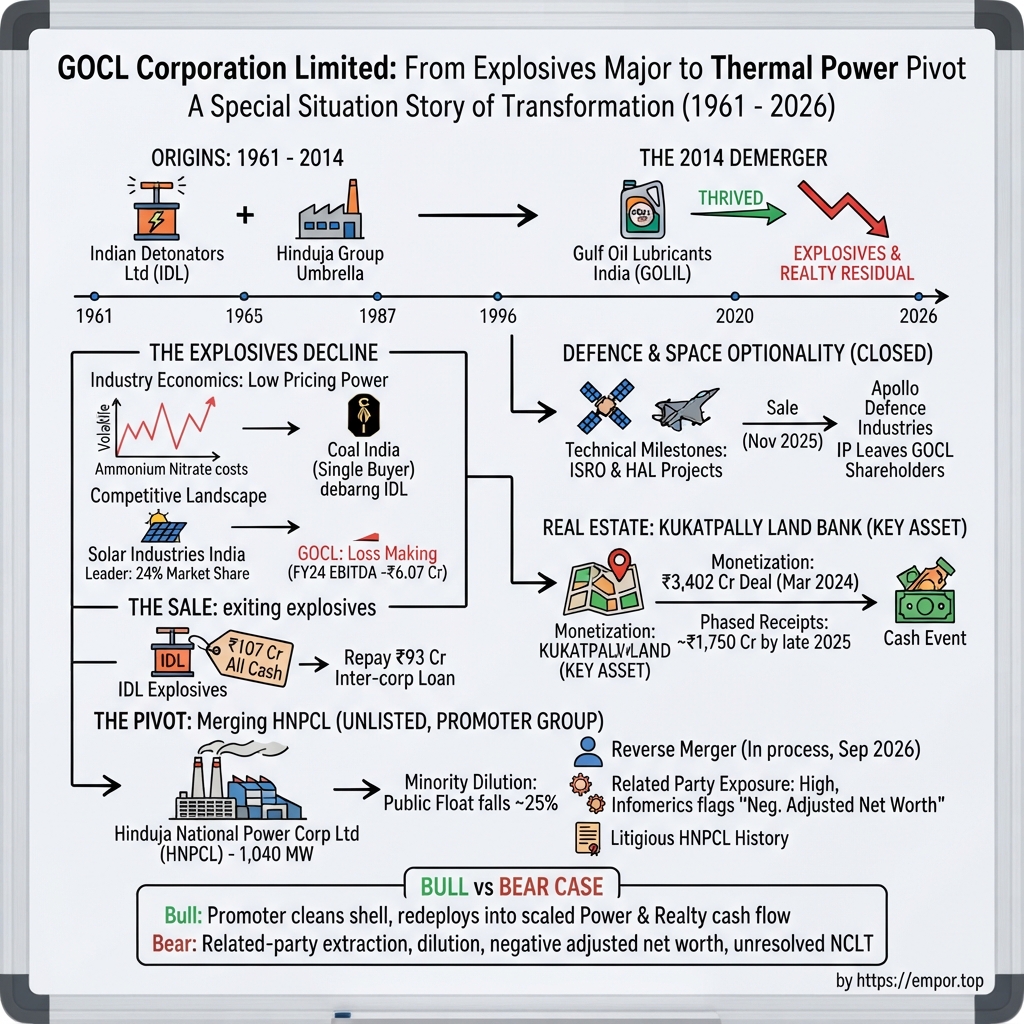
GOCL Corporation Limited: The Explosives Major That Sold Itself and Became Something Else
I. Cold Open & Roadmap
On November 15, 2025, a transaction closed in Hyderabad that ended a sixty-four-year story with almost no ceremony. GOCL Corporation Limited — a company incorporated in 1961 as Indian Detonators Limited, the enterprise that taught independent India how to make its own blasting caps, the supplier whose detonators went down into Coal India's pits for decades — sold one hundred percent of its explosives subsidiary to a buyer for ₹107 crore in cash.12 Roughly thirteen million dollars. For the entire operating business.
There was no farewell press conference. The rating agency noted it in a single clause. The stock barely reacted.
A month later, on December 15, 2025, the same board approved something far stranger: a scheme of merger by absorption that would fold Hinduja National Power Corporation Limited — an unlisted, promoter-owned company running a 1,040 MW coal-fired power station outside Visakhapatnam — into the now-empty listed shell.34 The exchange ratio was set at 206 GOCL shares for every 10,000 HNPCL shares. The stock jumped nine percent.3
That is the whole story in two paragraphs, and it is why this episode exists. GOCL Corporation today is not a company you analyse by studying its products. Its revenue from operations in the June 2026 quarter was ₹4.29 crore.5 Four crore. Not four hundred. The entity that once did over ₹900 crore of consolidated sales in FY23 now runs a rounding error of an operating business, sits on ₹3,133 crore of reserves, and is waiting on a tribunal to decide what it becomes next.6
So the question this piece asks is not "does the moat hold?" The moat, whatever it was, has been sold. The question is narrower and sharper: is this value creation or value extraction?
The bull reading is that a promoter group looked honestly at a structurally loss-making explosives business trapped under a single dominant customer, sold it for what it was actually worth, monetised a spectacular legacy land bank, and is now redeploying a clean listed vehicle into a scaled, cash-generating power asset. Corporate reinvention, executed unsentimentally.
The bear reading is that a promoter is using a listed shell as a landing pad for a leveraged group asset it needs to refinance, diluting public shareholders from roughly 32% to roughly 25% in the process, at a moment when the shell is flush with cash and has no independent business to defend itself with.3
Both readings fit the same facts. That is precisely what makes this interesting — and it is why the honest answer, as of September 2026, is that the case is unresolved. The National Company Law Tribunal raised observations on the scheme on July 30, 2026, and the company has been moving to appeal to the National Company Law Appellate Tribunal.5 Nobody, including management, currently knows what GOCL Corporation will be twelve months from now.
The arc runs like this: detonators in Hyderabad, absorption into a sprawling Hinduja conglomerate, a 2014 demerger that split off the genuinely good business and left the rest behind, a decade of slow erosion under customer power, a debarment that froze the largest customer relationship, a sale at a price that told the truth, a land bank that turned out to be worth thirty times the operating business, and a pivot into thermal power that regulators are currently declining to wave through. Along the way, a recurring lesson about what happens to minority shareholders when the corporate structure itself becomes the product.
 Subscribe on LinkedIn
II. Origins: From Indian Detonators to Gulf Oil Corporation
To understand why a detonator company existed in Hyderabad in 1961, you have to understand what India was trying to do that decade. The Second and Third Five-Year Plans were built on a simple industrial logic: coal, steel, and cement first; everything else follows. But you cannot mine coal at scale without blowing rock apart, and you cannot blow rock apart without initiators — the small, precisely engineered devices that turn a signal into a detonation at exactly the right microsecond. In 1961, India imported them.
Indian Detonators Limited was incorporated that year to change that.1 The company's equity was listed on the Bombay Stock Exchange as early as 1963 — two years after incorporation, which tells you something about how capital formation worked in that era of Indian industry, and how central the enterprise was considered.1 It would take until 2007 for the shares to also list on the National Stock Exchange.1
The business had the shape you would expect of a licensed-industry incumbent. Explosives manufacture in India sat behind statutory licensing, physical siting requirements, and a customer base that was overwhelmingly the state. IDL grew up as a supplier to the public sector, and that formative relationship — decades of selling into government tenders — shaped the company's commercial instincts in ways that mattered enormously later.
Somewhere in the following decades, IDL was absorbed into the orbit of the Hinduja Group, one of the largest diversified family conglomerates in the world, with a direct presence in dozens of countries across automotive, banking, energy, power, healthcare, IT, real estate, and media.7 The listed vehicle was renamed Gulf Oil Corporation Limited, and the explosives operation found itself sitting alongside a lubricants business under one ticker.
Here is where the first analytically important pattern shows up, and it is worth naming early rather than saving as a reveal. In its own credit rating documentation — not a critic's characterisation, but the company's disclosed history — GOCL is described as having "forayed into various segments like lubricants, mining, real estate, wind energy, food chemicals, pharmaceuticals, etc. through various joint ventures/ subsidiaries" over its life.1 Most of those forays are gone. The same document notes that the company's presence is now "mainly in energetic with realty segments constituting a small proportion of revenue."1
Read that carefully, because it is a compact history of capital allocation. Wind energy. Food chemicals. Pharmaceuticals. Mining services. These were not idle press releases; they were joint ventures and subsidiaries — structures that consume management attention, balance-sheet capacity, and cash. And they were, one by one, abandoned or wound down.
This matters for a specific reason. Later in this story, GOCL's management will execute a sequence of moves — a divestment, a land monetisation, a merger — that can be narrated as decisive, surgical capital allocation. Any such narration has to be weighed against a multi-decade record of entering businesses and then exiting them without a durable franchise to show for it. A company that has diversified into and retreated from six adjacent industries does not get the benefit of the doubt on the seventh by default. It has to earn it with outcomes.
The pre-2014 history is otherwise not where the value is. What matters is that by the early 2010s, this single listed entity contained two very different businesses: a consumer-facing, brand-led lubricants operation with genuine pricing power, and a tender-driven industrial explosives operation selling into state monopsony buyers. Those two things have almost nothing in common — different customers, different capital intensity, different margin structures, different reasons to win.
Someone at the Hinduja Group worked that out. What they did about it is the next chapter, and it produced the cleanest, most defensible corporate action in this company's modern history.
III. The 2014 Demerger: Splitting the Good Business from the Rest
In January 2014, Gulf Oil Corporation confirmed publicly what the market had been anticipating: it would demerge its lubricants division into a separate listed company, and the parent would retain three divisions — explosives, mining and infrastructure services, and property development.8 The Scheme of Arrangement was sanctioned by the Andhra Pradesh High Court in April 2014, and the mechanics were documented in the information memorandum filed with the NSE ahead of the new entity's listing.9 By 2015, the residual parent had been renamed GOCL Corporation Limited.1
Structurally, this was textbook. Two businesses that shared a balance sheet but not a business model were separated so that each could be valued, capitalised, and managed on its own terms. Shareholders received paper in both. No cash left the system. Nobody was diluted.
And then — this is the part that makes the 2014 demerger the single most useful control experiment in this entire story — the two halves went in opposite directions, and we can watch it happen over twelve years.
Gulf Oil Lubricants India Limited, the spun-off entity, compounded. For the year ended March 2026, its consolidated sales rose 11.7% to ₹4,056 crore, from ₹3,631 crore in FY25.10 Lubricant volumes grew roughly 11% year on year, which management characterised as growing at multiples of the underlying industry rate, and the company declared total dividends of ₹51 per share for the year.10 It is a real, growing, cash-generative consumer-industrial franchise with a brand, a distribution network, and the ability to price.
GOCL Corporation, the residual, went the other way. It ends this period with a de-listed-in-all-but-name operating business, negative EBITDA in every recent year, and a strategy that consists of merging in someone else's power plant.
What does the divergence actually tell us? It is tempting to say the demerger "worked," and in a narrow sense it did — it liberated the good business. But that framing flatters the decision more than the evidence supports. The demerger did not make Gulf Oil Lubricants good; lubricants was already the better business, with branded distribution, aftermarket pull, and thousands of small customers rather than one giant one. What the demerger did was reveal, in public, which of the two halves had a franchise. It removed the accounting camouflage that let a strong business subsidise a weak one inside a single P&L.
That is a genuinely useful thing for a promoter to have done. It is also, notably, the last capital-allocation action in this story that unambiguously served minority shareholders without a governance asterisk attached.
One point of housekeeping, because it trips up investors constantly. Gulf Oil International Limited is not GOCL Corporation. Gulf Oil International is the Hinduja Group's global lubricants and specialty-chemicals arm — a separate, much larger structure that holds interests including a stake in NYSE-listed Quaker Houghton following the 2012 Houghton International acquisition. It shares a brand lineage and a promoter family with the Hyderabad company, and it shares almost nothing else.7 If you are screening Indian small caps and you see "Gulf Oil" in a corporate history, check which entity you are actually looking at. The ticker GOCLCORP.NS refers to the residual explosives-and-realty company, not the global lubricants group.11
So the first data point on how this promoter treats corporate structure is a favourable one: when a business could stand alone, it was allowed to. Hold that thought. The structure question returns in 2025 in a very different form, and the direction of travel is reversed — instead of separating a good business out to a listed vehicle, the group proposes to bring a leveraged one in.
But before that, GOCL had to spend a decade discovering that the business it kept was not the business it thought it kept.
IV. The Explosives Business: Industry Structure and Why GOCL Lost the Plot
Start with the physical reality, because it explains the regulation, and the regulation explains the myth.
A commercial explosive is, in engineering terms, a very carefully controlled failure. You want an ammonium-nitrate-based compound that is stable enough to be trucked down a highway, stored in a magazine through an Indian summer, and lowered into a wet borehole — and then, on a signal measured in milliseconds, converts into gas and shock front with enough energy to fracture a few thousand tonnes of overburden. The initiator — the detonator — is the trigger. A blast in an open-cast coal mine involves hundreds of holes firing in a designed sequence, each delay tuned to throw rock in the intended direction rather than at the equipment or the crew.
Because getting this wrong kills people, the Indian state regulates every step. Manufacture, storage, and transport of explosives sit under the Explosives Rules and are licensed by the Petroleum and Explosives Safety Organisation, and the physical infrastructure — magazines, buffer distances, licensed transport — is not something a new entrant assembles in a quarter.
Which brings us to the myth. For most of GOCL's investable life, the bull case rested on a version of this sentence: explosives is a regulated industry with high entry barriers, and GOCL has been in it since 1961. Licensing plus incumbency equals moat.
Here is the disconfirming evidence, and it comes from the company itself. GOCL's own disclosures attributed losses in the Explosives and Cartridges business to "intense competition, low price realization... and loss of business from major PSU customers."11 That is not a cyclical excuse. That is a licensed incumbent stating, in its own filings, that competitors got in anyway, that price was set against it, and that its largest customers walked. A moat that permits intense competition and low price realisation is not functioning as a moat. It is functioning as a compliance cost.
The reason is structural, and it is the single most important fact about this industry. The Indian commercial explosives market sells overwhelmingly to a small number of very large buyers, dominated by Coal India and its subsidiaries, through competitive tender. When one customer accounts for a large share of national demand and buys via price-discovered tender with technically qualified multi-vendor panels, the licensing barrier does not accrue to the seller. It accrues to the buyer. PESO licensing determines who is allowed in the room; the tender determines what price gets paid, and with a monopsony on the other side of the table, that price gets pushed toward cost.
This is the mechanism people miss when they screen for "regulated industry, high barriers." Barriers to entry are only valuable if what is behind them is scarce relative to demand. In Indian explosives, the licensed capacity behind the barrier exceeded what the dominant buyer needed to buy. Scarcity ran the wrong way.
The benchmark: what winning actually looks like
If you want to know whether GOCL's problem was the industry or the company, look at the company that ran the same race and won it.
Solar Industries India is the clear number one in Indian industrial explosives — described in industry coverage as holding roughly a quarter of the domestic market and dominating the country's explosives export trade, with a manufacturing footprint spanning Africa, West Asia, Turkey, Kazakhstan, Thailand and Indonesia.12 In FY26, Solar reported record revenue of ₹9,838 crore, up around 30% year on year, with profit after tax up roughly 35%.13
The number that should stop you is the segment split. Solar's defence business alone did ₹2,634 crore in FY26 — 27% of revenue, up from ₹1,355 crore and 18% of revenue in FY25.14 Its order book stood above ₹21,300 crore, and management guided to ₹14,000 crore of revenue and ₹4,500 crore of defence revenue in FY27.14
Sit with the comparison. Solar's defence division, in a single year, generated more than four times GOCL's entire consolidated revenue in its final full year as an explosives company. And Solar built that from the same starting point — an Indian industrial explosives manufacturer, working under the same PESO regime, selling to the same PSU miners.
Premier Explosives, the smaller listed peer also active in defence energetics, solid rocket motors and propellant work for ISRO, sits in between.15 It is not a giant. But it converted energetics capability into a defence identity that the market recognises, which is exactly why it became an acquisition target.
The conclusion is uncomfortable but clear: the industry was not the constraint. Two Indian peers, operating under identical regulation and facing the same dominant domestic buyer, escaped monopsony by building export franchises and defence programmes. GOCL did not. The gap is a company-level execution gap, not a sector-level structural one.
The debarment: customer power, demonstrated
If the argument above still feels abstract, July 2024 made it concrete.
Coal India debarred IDL Explosives from participating in contracts or order awards by CIL or its subsidiaries for two years, via a letter dated July 2, 2024.16 The stated ground was IDL's failure to satisfy a tender requirement relating to local-content certification.16 GOCL disclosed the development to the exchanges that month.17
Consider what that sentence means for a company whose largest customer relationship is Coal India. One administrative letter, on a certification technicality, removed the company from the table at its most important buyer. Not a price cut. Not a lost tender. Removal.
IDL fought it, and fought it well. The Calcutta High Court directed CIL in an order dated January 20, 2025 to dispose of IDL's representation within four weeks. When CIL's subsequent February 27, 2025 communication maintained the position, the High Court invalidated it on April 11, 2025 and directed CIL's Chairman to re-evaluate the matter on the principle of proportionality.16 The debarment was eventually cut from two years to one, and — the one year having by then elapsed — IDL regained eligibility to bid for CIL and other PSU tenders.18
So IDL won on the law. It is worth being precise about what winning meant. The legal victory established that the punishment was disproportionate; it did not restore the year of business. For roughly twelve months, a company already running negative operating margins was excluded from its primary demand pool while carrying the fixed cost of licensed plants, magazines, and people. And it had to litigate through three separate judicial interventions to get a state buyer to reconsider an administrative decision on a paperwork ground.
That is what customer bargaining power looks like when it is fully expressed. Not a tough negotiation — an off switch, held by the counterparty, with the courts as the only appeal.
The numbers, and what they say
By the end, the financial picture had stopped being ambiguous.
Consolidated total operating income fell 8.90% in FY25 to ₹571.09 crore, from ₹626.92 crore in FY24 — a decline Infomerics attributed "primarily on account of decline in turnover in IEL owing to fall in realisations."1 Note the mechanism named there: not lost volume, fall in realisations. Price.
Consolidated EBITDA was negative ₹6.07 crore in FY24, a margin of –0.97%, and worsened to negative ₹10.09 crore in FY25, a margin of –1.77%.1 Interest coverage was negative in both years — –0.04x in FY24 and –0.09x in FY25 — meaning operations did not cover interest, let alone principal.1 Total debt to EBITDA was, definitionally, meaningless at negative 110x.1
Strip away the presentation and here is what those figures describe: a business that consumed cash to produce revenue. Every unit sold made the group's operating position slightly worse. The group reported positive profit after tax in both years — ₹48.25 crore in FY24 and ₹157.21 crore in FY25 — but that profit came from other income and asset transactions, not from making and selling explosives.1 The distinction matters enormously for what happens next.
Through FY25, Energetics and Explosives constituted essentially the entire revenue base; the realty and nascent electronics segments were, in the rating agency's language, "a small proportion of revenue."1 This was, until it wasn't, a one-business company.
For an investor, the takeaway is a rule you can carry to other names: when a company with a supposed regulatory moat starts reporting negative operating margins while a direct competitor under identical regulation compounds at 30%, the moat hypothesis has been falsified by observation. The remaining question is only what management does about it. In GOCL's case, the answer arrived from an unexpected direction — not from fixing the explosives business, but from what the explosives business had been sitting on for sixty years.
V. Real Estate: The Quiet Asset That Turned Out to Matter
There is a particular kind of Indian corporate asset that exists because of a decision made when the map looked different. In the 1960s, you built an explosives factory well outside the city, because explosives factories need buffer zones and nobody wants one next door. Then the city grew for six decades, and the buffer zone became prime metropolitan land.
GOCL's Hyderabad manufacturing operations sat on a legacy industrial land bank at Kukatpally. Over the decades, Kukatpally stopped being the outskirts and became a dense, well-connected part of the Hyderabad urban sprawl. The land had been on the books at historical cost for as long as anyone could remember, doing nothing, while the explosives business that justified its existence slowly stopped making money.
The company had tested the water before — in August 2021 it sold 44.25 acres in Hyderabad, and the stock responded.19 But the transformational move came in March 2024, when GOCL agreed to monetise approximately 264.5 acres at Kukatpally for ₹3,402 crore in a phased structure.20 A separate arrangement covered joint development of 32 acres with Hinduja Estates and Hinduja Healthcare.20
Note that second counterparty. The joint-development partner is a related Hinduja Group entity. This is a pattern that recurs throughout the modern history of this company, and it is worth flagging every time it appears rather than at the end: when GOCL transacts, the counterparty is frequently in the family.
The scale of what this land represents is where the story genuinely inverts. Against a total monetisation MOU value of ₹3,418 crore, ₹1,750 crore had been received by June 30, 2025 — meaning that by the middle of last year, more than half the money was in.1 By June 30, 2026, the company had sold a cumulative 157.21 acres of the Kukatpally holding, with no incremental sale during the June 2026 quarter, and had obtained an extension to August 2026 to complete the remainder.521
Put those two numbers next to each other and the entire investment case reorders itself. The land is worth roughly thirty times what the operating explosives business sold for. Not thirty percent more. Thirty times. Every hour of analyst attention spent modelling explosives volumes and ammonium nitrate spreads over the past decade was, in hindsight, attention spent on the smaller half of the page.
And it did not stop at Hyderabad. GOCL also held a realty position in Bengaluru — a special economic zone development described in its credit documentation as under development.1 On March 23, 2026, the board approved early monetisation of that project, branded "Ecopolis," at Yelahanka: a roughly 38-acre parcel held under a joint development agreement with Hinduja Realty Ventures Limited, to be sold along with associated buildings, at a total transaction value of approximately ₹2,261 crore, of which GOCL expected to receive around ₹815 crore.22 The company confirmed the agreement in its June 2026 quarter disclosures at approximately ₹815 crore for its share, pending completion of conditions precedent including SEZ de-notification.5
Once again, the joint-development counterparty is a Hinduja entity.
The asterisk on the land
It would be too easy to write this section as an unqualified win, so here is the qualification. In 2026, GOCL disclosed an order of the Endowment Tribunal in Telangana directing the company not to alienate leased land at Kukatpally, or alternatively to furnish adequate security. The company stated it was reviewing the order and taking legal advice, and assessed no material adverse impact on its operations or financial position.21
Take that at face value and it is a procedural skirmish. Take it seriously and it is a reminder that a very old industrial land bank in an Indian metro carries very old title questions — leasehold histories, endowment claims, use-conversion approvals — and that the gap between "agreement to monetise ₹3,402 crore" and "cash received" is filled with exactly this kind of item. The extension of the deal timeline from its original schedule to August 2026, and the fact that only 157 of 264.5 acres had transferred by mid-2026, are the observable evidence that the gap is real.521
So what should an investor conclude? The land monetisation is the most successful capital-allocation outcome in GOCL's recent history — and it is important to be precise about why. It was not the product of operating skill. It was the realisation of an asset the company happened to own because of a siting decision made in the 1960s, unlocked by six decades of urban growth in Hyderabad. That is a legitimate source of shareholder value. It is not evidence of management capability, and it is explicitly non-recurring: you can only sell 264 acres once.
Which raises the question that dominates the rest of this story. The cash is coming in. What is it going to be spent on?
Before we get there, one more chapter needs closing — because at the same time the land was being sold, GOCL was telling a different story about its future entirely.
VI. Defence and Space: Technical Milestones That Never Became a GOCL Business
In October 2023, GOCL's board met and afterwards told the exchanges something that made the stock move. The company disclosed that it had been among the contributors to ISRO's Chandrayaan mission, and that it had applied for a manufacturing licence for certain defence products related to aircraft pilot safety.23 The shares rose about 4% the following day to ₹581.60.23
The underlying capability was real, and it is worth explaining what it actually is, because "explosives company enters defence" sounds like a stretch and isn't.
The core competence in a detonator business is energetic initiation: making a compound that does nothing at all until a precise input arrives, and then releases a precise amount of energy in a precise direction within a precise number of milliseconds. That skill transfers directly into aerospace. A solid rocket motor needs an igniter grain — a small energetic charge that lights the main propellant reliably in vacuum, at temperature, on command. That is a detonator problem with different packaging.
The pilot-safety application is the more vivid one. In a fighter aircraft, ejecting through a closed canopy would kill the pilot, so the canopy has to go first. A canopy severance system is a shaped explosive cord embedded in or laid against the transparency, which fires milliseconds before the seat and cuts the canopy into a clean opening. It has to work the first time, after years of sitting in an airframe through thermal cycles and vibration, with no opportunity to test the specific unit. That is a hard energetics problem, and being trusted with it is a genuine technical credential.
So GOCL had the capability. It had ISRO association. It had customer access at the level of Indian aerospace primes. It had a board that had publicly declared the intent and applied for the licence.
And then apply the test that matters: did any of it become revenue?
Here the record is what it is. Through the company's disclosures up to the sale of the explosives subsidiary in November 2025, no recurring, separately disclosed defence revenue line emerged in GOCL's reported segments. The rating agency review of FY25 describes a company "mainly in energetic with realty segments constituting a small proportion of revenue," with the forward-looking commentary directed at generating revenue from the electronics segment — not from defence.1 Segment reporting through FY25 remained dominated by explosives.11
Now hold that next to Solar Industries, which in the same window went from ₹1,355 crore to ₹2,634 crore of defence revenue in a single year, published it as a segment, guided to ₹4,500 crore for the next year, and carried a ₹21,300 crore order book.14 Solar did not merely have defence capability. It had defence customers, defence contracts, defence disclosure, and defence guidance — the four things that distinguish a business from a press release.
This is the certification-is-not-commercialisation problem in its cleanest form. A contribution to a lunar mission is a magnificent thing to have done and a poor thing to value. A licence application is permission to try. Neither is a purchase order, and the distance between them — qualification cycles, programme timelines, production orders, sustained delivery — is where most defence optionality stories die.
And then comes the punchline that closes the question entirely.
Whatever defence-manufacturing capability, licensing, and customer relationships IDL Explosives had built are now owned by Apollo Defence Industries, which acquired the subsidiary in November 2025.12 They are not owned by GOCL shareholders. Any defence upside that eventually flows from that energetics capability accrues to the buyer.
For anyone modelling GOCL today, this is not a "difficult to quantify" line item. It is a closed line item. The defence and space optionality left the building with the subsidiary. Whether that optionality was worth anything is now Apollo's question to answer, and — as we will see — Apollo is answering it very aggressively.
The record here also does something useful for the rest of the analysis: it gives us a base rate. When GOCL announced an adjacent growth vector, how often did it convert into disclosed, recurring revenue within a few years? On the defence and space evidence, and on the wind-energy, food-chemicals, and pharmaceuticals evidence before it, the answer is: not often. Keep that base rate handy when we get to electronics manufacturing.
Which brings us to the transaction itself.
VII. The Sale: Exiting Explosives for ₹107 Crore
The decision came in stages, with the deliberateness of a group that had already made up its mind.
In May 2025, GOCL's board approved the divestment of 100% of IDL Explosives Limited to Apollo Defence Industries Private Limited for ₹107 crore.2 Shareholders approved in June 2025. And on November 15, 2025, the disinvestment was completed — with the transaction also involving repayment of inter-corporate loans that IDL owed to its parent.124 With that, the Hinduja Group's presence in the explosives and detonators business, which began in 1961, ended.24
Now let us do the thing that matters: benchmark the price.
IDL Explosives represented the overwhelming majority of GOCL's consolidated turnover — the group did ₹626.92 crore of total operating income in FY24, of which the explosives subsidiary was the dominant contributor.1 The business sold for ₹107 crore. That is well under a fifth of one year's revenue.
The instinctive reaction to a multiple like that is fire sale. The evidence says otherwise, and it is important to get this right, because it changes how you judge management.
An asset that generates negative EBITDA is not worth a revenue multiple. It is worth, at most, the recovery value of its assets minus the cost of the liabilities and obligations that come attached — licensed sites, magazines, employees, environmental and safety compliance, and in this case a business that had just spent a year excluded from its largest customer. On a discounted-cash-flow basis, a business consuming ₹10 crore of EBITDA a year with declining realisations and monopsony pricing pressure has a negative enterprise value unless someone can fix it.
So the correct read is not "management gave away a crown jewel." It is "management sold something that was genuinely worth very little as a going concern, and got cash rather than continuing to fund losses." The evidence — two consecutive years of negative consolidated EBITDA, negative interest coverage, revenue declining on realisations rather than volumes, and a customer relationship that had just been forcibly interrupted — supports that reading directly.1
That is a defensible transaction. It is also a damning verdict on the preceding decade, because a business only reaches negative going-concern value after a long period during which somebody failed to change its trajectory.
The company offered its own framing for the plant closure at Hyderabad: that the operation no longer fit the city's evolving metropolitan profile. That is true as far as it goes — an explosives plant inside a growing metro is an anachronism, and the land underneath it was worth far more than the factory on top of it. It is also, conveniently, a framing that emphasises urban geography over operating performance. Both explanations are real. Only one of them was under management's control.
The subplot: the buyer is running the play GOCL couldn't
Here is where the transaction becomes genuinely interesting rather than merely sad.
Apollo Defence Industries is part of Apollo Micro Systems, a Hyderabad-based defence electronics company. And at roughly the same time as it was absorbing IDL Explosives, Apollo Micro Systems signed a definitive share purchase agreement to acquire a 41.33% promoter stake in Premier Explosives Limited in an all-cash transaction valued at approximately ₹1,550 crore, triggering a mandatory open offer for up to a further 26% under SEBI's takeover code, with completion expected around the December 2026 quarter.15
Think about what that combination is designed to be. Apollo brings defence electronics — guidance, fuzing, control systems. Premier brings high-energy materials, solid rocket motors, munitions, and propellant plant operations for ISRO.15 IDL brings licensed energetics manufacturing capacity and PSU-qualified production infrastructure. Assembled, that is a vertically integrated defence energetics platform, built by acquisition, in about eighteen months.
And it is being built on foundations that include the exact asset GOCL sold, to execute the exact thesis GOCL announced in October 2023 and never delivered.
There is no more instructive way to close this section. The defence-energetics opportunity in India was real. GOCL's technical claim to it was real. What GOCL lacked was not permission or capability — it was the willingness or ability to commit capital and management focus to converting the capability into a business. A different owner, paying ₹107 crore, is now attempting exactly that.
Meanwhile, GOCL's own capital was heading somewhere else entirely.
VIII. The Pivot: Merging In a Related-Party Power Plant
One month after the explosives business changed hands, on December 15, 2025, GOCL's board approved a scheme of merger by absorption under which Hinduja National Power Corporation Limited would be folded into GOCL.34
HNPCL is an unlisted company, majority-owned within the Hinduja Group, that operates a 1,040 MW (2 × 520 MW) sub-critical coal-fired thermal power station at Village Palavalasa in the Visakhapatnam district of Andhra Pradesh, commissioned in April 2016.25 Prior to the proposed transaction, it was held 51.05% by Hinduja Energy (India) Limited, 40.27% by Hinduja Energy (Mauritius) Limited, 4.84% by Machen Development Corporation, with the balance held by Steag Energy Services GmbH.25
The exchange ratio: 206 fully paid-up GOCL shares of ₹2 face value for every 10,000 HNPCL shares of ₹10 face value.4 The stated rationale was consolidation of operations, improved efficiency, optimised use of assets and cash, a simplified corporate structure, and enhanced long-term growth.4 The stock rose 9%.3
This is a reverse merger, and the arithmetic says so
HNPCL's power generation business recorded revenue of approximately ₹2,437 crore in FY25.3 GOCL's continuing operations, post-divestment, generated ₹4.29 crore of revenue in the June 2026 quarter.5
There is no polite way to describe that ratio. The incoming asset is not a diversification, a bolt-on, or a new segment. It is the entire company. GOCL, the listed entity with sixty-four years of corporate history, becomes a listing vehicle; HNPCL becomes the business. Every question about GOCL's future is really a question about a coal-fired power station outside Visakhapatnam.
So the correct analytical response is not to evaluate a merger. It is to evaluate HNPCL as if you were being asked to buy it — because you are.
What the ratings file says about the asset you are being given
This is where independent evidence beats corporate framing, and CARE Ratings' September 2025 assessment of HNPCL is unusually direct.
Start with the good. HNPCL has a 25-year power purchase agreement with Andhra Pradesh discoms for its entire 1,040 MW capacity, on a cost-plus basis approved by the Andhra Pradesh Electricity Regulatory Commission, running from commercial operation date in April 2016.25 Cost-plus means fuel costs are largely a pass-through and the plant earns a regulated return on approved capital, subject to hitting normative operating parameters. It also has a long-term fuel supply agreement with Mahanadi Coalfields for 4.624 million tonnes per annum — enough coal to run at roughly 75% plant load factor, which materially de-risks the input side.25 For a thermal asset, that is a genuinely defensive contractual structure: known offtake, known fuel, regulated return.
Now the problems, and there are four, each of which independently matters.
One: the regulator refused to recognise about ₹2,000 crore of the money spent building it. APERC's August 2022 order approved a capital cost roughly ₹2,000 crore below what HNPCL actually incurred.25 Under cost-plus regulation, your return is calculated on approved capital, not spent capital — so ₹2,000 crore of the project is earning nothing, permanently, unless overturned. HNPCL's review petition was dismissed by APERC in June 2023, and its appeal to the Appellate Tribunal for Electricity was still awaiting judgement as of the September 2025 review.25 APERC also tightened normative parameters — station heat rate, auxiliary consumption, specific fuel oil consumption — which compounds under-recovery on the energy charge.25 Separately, APERC's April 2024 order set the revised base variable cost at ₹3.03 per unit plus a 15% ceiling, against ₹3.16 claimed by the company, and directed the discoms to deduct ₹0.58 per unit from HNPCL's claims from August 2023 over pending railway corridor work — a deduction HNPCL has stayed in the High Court.25 Coverage of the broader APERC settlement put the approved capital cost at ₹5,810.75 crore against ₹7,758 crore claimed.26
Two: the plant hasn't been running well enough to earn its capacity charges. Under this tariff structure, the plant must be available 85% of the time — the normative plant availability factor — to fully recover fixed costs. Actual PAF was around 62% in FY25 and about 53% in Q1 FY26, against causes CARE identified as sea water turbidity, ash pond constraints, and coal supply disruptions.25 Management told the agency performance improved from June 2025 onward.25 But availability below normative means fixed-cost under-recovery regardless of how well the tariff is designed. The contractual protection only pays out if the machine turns up.
Three: the customer isn't paying on time, at scale. The average collection period stretched beyond 400 days in FY25, from 290 days the prior year, with debtors reaching ₹5,020 crore as of June 30, 2025, against ₹4,538 crore in FY24 and ₹2,578 crore in FY23.25 CARE attributes much of the increase to late payment surcharge accruing on past dues, and notes roughly 100% collection efficiency on regular billing.25 Read plainly: current bills get paid, historical dues do not, and the receivable balance now exceeds two years of revenue. A ₹5,020 crore receivable against a ₹2,289 crore top line is not a working capital item. It is a structural financing obligation being carried on behalf of a state distribution utility.
Four: the capital structure. External debt to EBITDA stood at 9.9x as of March 31, 2025, worsened from 6.9x, on rated long-term bank facilities of ₹7,775.95 crore.25 Interest coverage was 0.84x in FY25 and 0.65x in FY24 — below one in both years, meaning operating profit did not cover interest.25 FY24 total operating income was ₹3,285 crore with PBILDT of ₹955 crore; FY25 provisional figures showed ₹2,289 crore and ₹650 crore.25 Working capital limit utilisation averaged 99% over the trailing twelve months to March 2025.25 The Hinduja Group infused approximately ₹700 crore into HNPCL during FY25.25
And then CARE's own summary sentence, which is about as blunt as rating language gets: in the agency's assessment, "the company is unlikely to be self-sustainable in the current context and would rely on support from the group to ensure ti[m]ely debt servicing."25
That is the asset. It is not a bad asset in the sense of being worthless — a 1,040 MW plant with a 25-year cost-plus PPA and a coal linkage is a real piece of infrastructure with a real claim on future cash. It is an asset whose economics are currently held hostage by three things outside its control: an appellate tribunal ruling on ₹2,000 crore of disallowed capital, the operating reliability of the plant itself, and the payment behaviour of Andhra Pradesh discoms.
The governance question, stated plainly
The company characterises this as an arm's-length related-party transaction. Here is what it does to the share register.
Promoter holding — Hinduja Capital Limited — rises from approximately 67.82% to a projected 74.87%. Public shareholding falls from approximately 32.18% to 25.13%.36
The sequence deserves attention. First the company sold its only real operating business. Then, with a cash-rich, business-light shell, the promoter proposed to inject a group asset in exchange for newly issued shares that raise its own stake by seven percentage points and push public float to just above the 25% minimum public shareholding threshold. Minority shareholders were not asked to contribute capital, and they were not offered an exit. They were diluted.
That is not, by itself, evidence of wrongdoing. Reverse mergers of unlisted group assets into listed vehicles are legal, common in Indian conglomerate structures, and sometimes genuinely good for everyone. What makes this one worth scrutiny is the combination: the dilution, the timing relative to the divestment, the fact that the incoming asset is one a rating agency describes as not self-sustainable, and the fact that the exchange ratio is set by a valuation exercise commissioned within a structure the promoter controls on both sides.
The related-party exposure, and the number that should stop you
Now add the balance sheet context, again from an independent source rather than inference.
Infomerics flagged, as a key rating weakness, that GOCL's exposure to group and related entities at the consolidated level stood at ₹2,482.45 crore as of March 31, 2025, up from ₹2,130.03 crore a year earlier.1 The bulk of it comprises loans extended by GOCL's subsidiary HGHL Holdings Limited to 57 Whitehall Investments SARL in Luxembourg — an entity in which HGHL also holds a 10% stake, and which in turn has invested in a downstream joint venture developing a residential and hospitality project in the United Kingdom.1
Follow that chain once more slowly. A Hyderabad-listed explosives-turned-power company, through a UK subsidiary, has lent roughly ₹2,500 crore into a Luxembourg vehicle funding a British property and hospitality development. That is the actual location of a very large share of the assets a GOCL shareholder owns.
And here is the line that reframes the balance sheet entirely. Infomerics noted that while GOCL's gearing looked comfortable at 0.71x as of March 31, 2025, improved from 0.84x, "adjusted tangible net worth remained negative due to significant exposure to group companies and subsidiary."1
Negative. Strip out the intra-group receivables, and the reported tangible net worth of ₹1,565 crore does not survive.1 Any framing of GOCL as a clean, well-capitalised shell with a fresh start is directly contradicted by its own rating agency.
Infomerics also named, among its downgrade triggers, a "sizeable increase in direct and indirect exposure to group companies, large acquisitions, or capex" — and kept the rating on Rating Watch with Developing Implications precisely because of the proposed HNPCL acquisition.1 The agency is, in effect, saying that the transaction management is proposing is the thing it is watching for as a risk.
The postal ballot
Then there is the June 2026 postal ballot, which is a small item that tells you a lot.
GOCL sought shareholder approval, with e-voting running from June 8 to July 7, 2026 and results by July 9, for a package that included: a proposed security or guarantee of up to ₹300 crore in favour of Hinduja Energy (India) Limited; ratification of a past ₹220 crore guarantee to HEIL, described as fully repaid; and ratification of past guarantees to HNPCL originally of ₹1,096.10 crore, refinanced to ₹450 crore, with ₹387.05 crore outstanding.2728 The same ballot sought approval for the re-appointment of Ravi Jain as Whole-Time Director and Chief Financial Officer for one year from July 4, 2026 to July 3, 2027, at proposed remuneration of ₹233.28 lakh per annum comprising ₹174.96 lakh fixed and ₹58.32 lakh variable.27
By the June 2026 quarter, the company disclosed ratified corporate guarantees aggregating ₹1,316.10 crore extended to HNPCL and Hinduja Energy (India) Limited.5
The substance is that GOCL — a company whose own operating revenue is now measured in single-digit crores — is standing behind more than ₹1,300 crore of group obligations. The process point is that a vote on related-party guarantees to the promoter's power business was placed on the same ballot as the re-appointment of the executive who runs the company. Those are two entirely different questions with two entirely different answers available, and a shareholder who wants to support the executive while questioning the guarantees has to think carefully about how to vote. Bundling is legal. It is also, reliably, a thing worth noticing.
The inherited litigation
Finally, if the merger completes, GOCL inherits a legal history that predates its involvement by three decades.
HNPCL's relationship with Andhra Pradesh's power sector began with a memorandum of understanding with the erstwhile Andhra Pradesh State Electricity Board on July 17, 1992, followed by a power purchase agreement on December 9, 1994, and an amended and restated PPA on April 15, 1998.29 Between 1998 and 2007, the amended and restated PPA was simply not implemented.29 Nearly a decade of a signed contract producing nothing.
The dispute worked through the Appellate Tribunal for Electricity, which directed the state commission to determine capital cost and approve the amended PPA, and then to the Supreme Court on the discoms' appeal.29 The Supreme Court's reasoning in the broader line of PPA-termination cases was notable: state regulatory commissions must be guided by public interest in approving power purchase tariffs, and discoms should not unilaterally terminate PPAs given the scale of investment made by developers.30
That litigation history is not colour. It is the operating environment. This is a counterparty relationship in which a signed contract went unimplemented for nine years, a capital cost claim was cut by roughly a quarter, an energy charge deduction is currently under a High Court stay, and receivables exceed two years of revenue. The tariff regime is cost-plus in design and adversarial in practice.
Where the scheme actually stands
As of this writing, it is unresolved — and the resolution has been going the wrong way.
BSE issued its observation letter dated May 20, 2026 with no adverse observations, subject to specified disclosure and liability-transfer conditions, valid for six months, permitting the company to proceed to file the petition with the NCLT.31 NSE issued its no-objection on May 22, 2026.32 Both exchange clearances were obtained.
Then, on July 30, 2026, the NCLT made certain observations regarding the scheme, and GOCL indicated it was in the process of preferring an appeal before the NCLAT.5
The specific content of the tribunal's observations has not been detailed in the disclosures reviewed for this piece; readers should treat the reporting as thin and the outcome as genuinely open. What can be said with confidence is that the exchanges cleared it, the tribunal did not simply wave it through, and the company is litigating rather than restructuring the terms. For a shareholder, that is the single largest unresolved variable in the entire investment case, and it will be decided by a tribunal rather than by operating performance.
IX. Management: Transition, Incentives, and the Capital Allocation Record
Every corporate transformation has an author. GOCL's is unusually hard to identify, and that is itself informative.
On May 23, 2024, GOCL's board accepted the resignation of Pankaj Kumar as Managing Director and Chief Executive Officer, effective June 30, 2024.33 Kumar had been the executive most associated with the company's diversification narrative of the early 2020s — the electronics manufacturing push, the defence and space announcements, the framing of GOCL as a company with adjacent growth vectors rather than a declining explosives franchise.
He left before any of it was proven, and the company did not replace him with another Managing Director and Chief Executive Officer. Instead, Ravi Jain, the Chief Financial Officer, was elevated to Whole-Time Director and CFO, and has functioned as the senior executive since.27 The re-appointment sought in the June 2026 postal ballot was for a single year — July 4, 2026 to July 3, 2027 — which is a notably short runway for the person steering a company through a contested reverse merger.27
The observable structure, then, is a company undergoing the most consequential transformation in its history under a finance executive on annual reappointment, with no separately identified MD/CEO. Readers should verify the current board composition against the FY26 annual report and the AGM materials before drawing conclusions about who holds strategic authority. But the shape is consistent with what the transactions suggest: strategy for GOCL is being set at the promoter level, and the listed company's executive function is primarily financial and administrative.
The promoter is Hinduja Capital Limited, holding approximately 67.82% as of mid-2026, rising toward a projected 74.87% if the HNPCL scheme completes.36 CARE's documentation identifies Machen Holdings SA as the ultimate holding entity of the relevant Hinduja structures, with Hinduja Capital Limited (Mauritius) as the holding company of GOCL — the same apex structure that sits above Ashok Leyland through Hinduja Automotive.25
Scoring the record
Rather than list capital-allocation actions, let us weigh them.
The 2014 lubricants demerger. Clean, court-sanctioned, no cash out, and it liberated a business that has compounded to ₹4,056 crore of revenue.910 This is the strongest item in the file, and it is twelve years old.
The multi-decade diversification record. Lubricants, mining, real estate, wind energy, food chemicals, pharmaceuticals — entered via joint ventures and subsidiaries, most since abandoned.1 This is not an interpretation; it is the company's own disclosed history. The pattern is capital and attention deployed into adjacencies and later withdrawn, without a surviving franchise. When the same company later announces defence, space, and electronics as growth vectors, this is the relevant base rate.
The explosives divestment. Correctly priced given the asset's condition, and it stopped the bleeding.12 Credit for recognising reality; no credit for the decade during which the reality formed.
The land monetisation. The largest genuine value realisation in the company's recent history, and — as established — a function of 1960s geography rather than 2020s strategy.2022
The FY26 dividend. The board recommended a final dividend of ₹30 per share, or 1500% on the ₹2 face value, for FY26.34 Set that against the FY26 result: consolidated net profit of ₹1,52,194.70 lakh against ₹15,702.16 lakh in FY25, of which ₹1,24,235.91 lakh came from discontinued operations — that is, from the divestment and related asset transactions — while total income was ₹42,557.34 lakh and revenue from operations was ₹976.31 lakh.34 Screener's consolidated view shows the same shape: FY26 sales of ₹10 crore, operating profit of negative ₹31 crore, and net profit of ₹1,522 crore driven by other income and investment gains rather than operations.6
A ₹30 dividend paid out of a year whose profit came almost entirely from selling a business and realising assets is a distribution of proceeds, not a signal about earning power. It is a perfectly reasonable thing to do with sale proceeds. It should not be read as the beginning of a payout policy, because there is currently no operating cash flow to sustain one.
The credibility test
The sharpest way to assess management is not to grade its plans but to check its past ones against outcomes.
The clearest documented public target in this company's recent record was an electronics manufacturing services ambition articulated in 2022: growing EMS revenue from roughly ₹20 crore to ₹100 crore within about two years. That target was set under the previous CEO, who departed in mid-2024.33 By FY25, EMS and realty combined contributed a small proportion of consolidated revenue — Infomerics describes realty as small and notes the company was still "in the process of generating revenue from its EMS segment" as of late 2025.1 There is no evidence in the disclosures reviewed that the ₹100 crore target was met on the stated timeline.
What is notable is not the miss. Missing a target in a small emerging business is unremarkable. What is notable is that the target appears to have simply dissolved — no restatement, no explanation of the shortfall, no revised timeline that was then scored. The same is true of the October 2023 defence and space announcement: declared with a stock-moving exchange filing, never subsequently reconciled against results, and rendered moot by the sale of the subsidiary that housed the capability.23
That is the management-credibility pattern in this file: growth vectors are announced with specificity and retired with silence. It is not fraud and it is not unusual. But it means that when the current management tells you what the merged entity will look like, you should attach the confidence level that this track record supports — which is low — and demand that the claims be scored against disclosed outcomes rather than accepted on statement.
Which brings us to the one operating business GOCL actually decided to keep.
X. EMS: The Small Business Getting a Second Look
There is a room in Gummadidala, in Telangana's Sangareddy district, where GOCL Corporation's entire operating future currently resides — at least until a tribunal decides otherwise.
Electronics Manufacturing Services is the business GOCL retained and is investing behind. Manufacturing operations at the relocated Gummadidala facility commenced in January 2026, and the company disclosed to the exchanges that the new EMS facilities had become fully operational, following receipt of the necessary factory licence and completion of regulatory requirements.35 The formal inauguration was conducted by the management team and board of directors.35
What GOCL EMS actually does is straightforward contract manufacturing with design capability attached. It positions itself as an original design manufacturer offering end-to-end services: product design support, engineering, component procurement, printed circuit board assembly, box-build integration, testing, and final delivery.36 For a listener unfamiliar with the sector: PCB assembly is populating a circuit board with components; box build is assembling those boards, wiring, housings and displays into a finished product a customer can ship. The economics are volume-driven, working-capital-hungry, and margin-thin unless you own design IP or hold a qualified position in a demanding end market.
The stated strategic logic is that GOCL EMS is positioned as an electronics platform for the Hinduja Group — a captive-plus-external play, leaning on group demand across automotive, energy and other verticals to build a base load, with third-party work layered on top.36 That logic is coherent. A group with Ashok Leyland in it consumes a lot of electronics.
Now size it honestly, because the temptation to build a narrative here is strong and the numbers do not support one yet. In FY25, EMS and realty combined were a small fraction of consolidated revenue.1 GOCL's revenue from operations in the June 2026 quarter — which is essentially EMS plus residual realty — was ₹4.29 crore, up 26% year on year from ₹3.39 crore, and up 84% sequentially from ₹2.33 crore.5 The growth rates are real and the base is negligible.
Against the roughly ₹2,437 crore power business proposed to be merged in, EMS is a rounding error.3
So how should an investor hold it? Three things are true simultaneously. First, EMS is the only business GOCL currently controls and operates, which gives it disproportionate importance in a scenario where the HNPCL merger fails. Second, the strategic positioning — a group captive with external ambitions, in a sector India is actively trying to build — is plausible rather than fanciful. Third, this company's record of converting announced adjacent businesses into disclosed, scaled revenue is poor, the prior EMS target does not appear to have been met on schedule, and the executive who championed the strategy has left.
The honest framing is that EMS is potentially material to a future investment case and is currently immaterial to the present one, and the burden of proof sits with the company. The thing to watch is a quarterly EMS revenue line that compounds toward a two-digit crore run rate with disclosed customer wins — not another facility announcement.
XI. Bull vs. Bear: What GOCL Corporation Is Actually Betting On Now
Let us war-game this properly, because the usual frameworks produce unusually clear answers when applied to a company in this condition.
The bull case
A promoter group looked at a structurally loss-making, customer-captive explosives business and did the unsentimental thing: sold it for cash rather than funding it indefinitely.2 Simultaneously, it unlocked a legacy land bank worth multiples of the operating business, with ₹1,750 crore already received against the Hyderabad monetisation by mid-2025 and a Bengaluru transaction adding roughly ₹815 crore of expected proceeds.122 It then proposed to redeploy the resulting listed vehicle into a scaled infrastructure asset with a 25-year cost-plus PPA covering its entire capacity and a coal linkage sufficient for 75% PLF.25
If the APTEL appeal restores a meaningful share of the ₹2,000 crore of disallowed capital cost, if plant availability sustains above the 85% normative threshold, and if Andhra Pradesh's discoms work down a ₹5,020 crore receivable, then GOCL becomes a regulated-return power company with a large realised cash pile and a genuine corporate reinvention story. That is not a fantasy scenario. Each of those three conditions is a specific, identifiable event with a real probability attached.
The bear case
The same facts support a colder reading. A promoter sold the listed company's only operating business, and then — with the shell holding cash and no operating defence — proposed to inject a group asset that a rating agency assessed as unlikely to be self-sustainable without group support, in exchange for shares that lift promoter ownership by roughly seven percentage points and cut public float to just above the regulatory minimum.325
The listed entity already carries ₹2,482 crore of related-party exposure routed through a UK subsidiary into a Luxembourg vehicle funding a British property venture, and its own rating agency states that adjusted tangible net worth is negative once that exposure is stripped out.1 It has extended ₹1,316 crore of guarantees to the promoter's power entities.5 The regulatory approval process is contested and now before an appellate tribunal.5 And the incoming asset brings a three-decade litigation history with its own counterparty.29
Layer on a documented multi-decade pattern of entering adjacencies — mining, wind energy, food chemicals, pharmaceuticals, defence, space — and exiting them without durable businesses.1
Porter, applied
Run the five forces on what GOCL is becoming, and the picture is sobering.
Buyer power: extreme, and structurally so. In explosives, the buyer was Coal India, which demonstrated in 2024 that it could remove a supplier by letter.16 In power, the buyer is a set of Andhra Pradesh discoms holding a receivable that has grown from ₹2,578 crore to ₹5,020 crore in two years and stretching payment beyond 400 days.25 The company has swapped one monopsony for another. This is the single most important continuity across the transformation, and it is rarely stated.
Supplier power: mixed, and better than before. A long-term fuel supply agreement with Mahanadi Coalfields for 4.624 MTPA converts what would be a volatile input into a contracted one, and cost-plus tariff design passes actual fuel cost through.25 That is genuinely stronger than the ammonium nitrate exposure of the explosives business.
Rivalry: largely absent, but replaced by something worse. A contracted 1,040 MW plant with a 25-year PPA does not compete for customers day to day. What it competes against is a regulator. APERC disallowing ₹2,000 crore of capital cost and tightening heat rate norms is functionally identical to a competitor cutting price — it reduces the return on the same asset, and you cannot out-execute it.25
Threat of substitution: real, slow, and directionally negative. Sub-critical coal generation is the part of the Indian power stack that renewables plus storage most directly displace over a multi-decade horizon. A 25-year PPA from 2016 provides contractual insulation to 2041. It does not provide economic insulation if merit-order economics shift underneath it, and it creates renegotiation risk at exactly the moments when a state utility is under fiscal pressure.
Threat of new entry: low. Nobody is building a competing 1,040 MW sub-critical coal plant into an Andhra Pradesh PPA. That is the one force that genuinely favours the asset.
Seven Powers, applied
Helmer's framework is even less generous, because it asks specifically what produces persistent differential returns.
Scale economies: HNPCL is a single-site plant. There is no fleet effect. Network economies: none. Counter-positioning: none — this is incumbent infrastructure, not a business model competitors cannot copy. Switching costs: present but contractual, not behavioural. The discoms cannot easily switch because of a PPA, not because HNPCL is hard to replace. Branding: irrelevant to a regulated bulk power seller. Cornered resource: arguably the PPA and the coal linkage together. This is the strongest claim, and it is a legal entitlement rather than an operating capability. Process power: the operating record — 62% PAF against 85% normative, with turbidity, ash pond and coal supply disruptions cited — argues against it.25
So on Helmer's terms, the merged entity would possess approximately one power: a contractual entitlement. That is not nothing. Regulated infrastructure with contracted offtake can be a perfectly good investment. But it should be underwritten as what it is — a leveraged, regulated cash-flow claim subject to counterparty payment behaviour and tribunal outcomes — not as a business with a durable competitive advantage.
The activist stress test
No activist investor has publicly engaged with GOCL as far as this review found. But it is worth being explicit that the fact pattern here is the archetype that attracts one, and it is not hard to write the letter.
An activist would ask: Why is a listed company with public shareholders extending guarantees exceeding ₹1,300 crore to promoter power entities while its own operating revenue is ₹4 crore a quarter?5 Why is ₹2,482 crore of shareholder capital deployed in intra-group lending to a Luxembourg entity funding UK property, when the company describes itself as a manufacturer?1 Why was the vote on those guarantees bundled with the CFO's re-appointment?27 Why, having realised thousands of crores from land, is the proposed use of the shell the absorption of a group asset with 9.9x debt/EBITDA and sub-1x interest coverage, rather than a return of capital or an independent acquisition?25 Why is the exchange ratio fair, when the promoter sits on both sides and public float falls to the statutory floor?3
Those are not rhetorical. Several may have good answers. The point is that GOCL has not, in the public materials reviewed, provided them in a form a minority shareholder could test.
The synthesis
Here is the calibrated conclusion, because piling bull facts next to bear facts and walking away is not analysis.
The claim that GOCL possessed a regulatory moat in explosives is rejected by the evidence — the company's own attribution of losses to competition, price realisation and lost PSU business, the debarment episode, and the contrasting trajectory of Solar Industries under identical regulation together falsify it.111613
The claim that GOCL has defence and space optionality is closed, not open: the capability was sold with the subsidiary in November 2025 and now belongs to Apollo.115
The claim that management is a skilled capital allocator is narrowed to a much smaller version: it executed one clean structural separation in 2014 and correctly recognised an impaired asset in 2025, against a multi-decade record of abandoned diversifications and announced targets that were never scored.19
The claim that the HNPCL merger creates shareholder value is unproven and currently unfalsifiable, because the transaction has not been approved. The evidence available — the dilution, the rating agency's assessment of the incoming asset, the related-party exposure, the negative adjusted tangible net worth, the bundled ballot — leans toward caution rather than confirmation.
What would change these conclusions? A favourable APTEL ruling restoring disallowed capital cost. Sustained PAF above 85%. A material reduction in discom receivable days. An NCLT/NCLAT approval on terms materially better for minorities than currently proposed. Each is observable. None has happened.
XII. Risk Radar
The risks that matter for this company are almost entirely structural and governance-related, not macro. Sector demand for electricity is not the question. Technology disruption is not the near-term question. What follows are the mechanisms that can actually damage a shareholder here.
Merger completion and regulatory risk. The NCLT's July 30, 2026 observations, and the company's move to appeal to the NCLAT, mean the transformation is not a plan being executed — it is a proposal being contested.5 Two failure modes exist and they differ. If the scheme is rejected outright, GOCL is left as a cash-rich shell with a ₹4 crore-per-quarter operating business, a large related-party loan book, and no scaled asset. If the scheme is approved on materially restructured terms, the economics change in ways nobody can currently model. Both outcomes are live.
Related-party and governance risk. This is the most under-appreciated mechanism, so it is worth stating precisely how it damages a minority shareholder. It is not that group lending is illegal — it is that ₹2,482 crore of assets sitting as intra-group receivables produce no operating cash flow available for distribution, and the negative adjusted tangible net worth Infomerics identifies means the equity cushion supporting those receivables is thin once they are excluded.1 Add ₹1,316 crore of guarantees to promoter power entities and the listed company is a credit support provider as much as an operating business.5 A minority shareholder can own a claim on a growing asset base and still receive nothing, if the cash circulates within the group.
Inherited legal and tariff risk. If the merger completes, GOCL inherits the APTEL appeal on ₹2,000 crore of disallowed capital cost, the stayed ₹0.58/unit deduction over railway corridor work, and a counterparty relationship with a documented history of non-implementation and litigation.2529 CARE named failure to receive a regulatory order on full capital cost recovery by end-December 2025 as a specific negative rating trigger.25
Receivable and counterparty risk. Over 400 days of collection period and ₹5,020 crore of debtors is not a footnote; it is a working capital position larger than two years of revenue, financed with debt at 9.9x EBITDA.25 Any deterioration in Andhra Pradesh's fiscal position transmits directly into HNPCL's liquidity, and from there into whatever GOCL becomes.
Land title and completion risk. The Endowment Tribunal order restricting alienation of leased Kukatpally land, and the fact that only 157.21 of 264.5 acres had transferred by June 30, 2026 against an August 2026 target, together mean the remaining monetisation proceeds are probable rather than certain.521
Execution risk in EMS. A business at a ₹4 crore quarterly run rate carrying the strategic weight of "the company's operating future" is, by definition, unproven. The prior target in this exact segment was not met on schedule.1
XIII. Playbook: What This Story Teaches About Corporate Reinvention
Lesson one: track corporate actions, not just quarterly results. An investor who followed GOCL by monitoring revenue and margins would have learned that a business was slowly dying, which was true and almost useless. Everything that actually determined shareholder outcomes over the past decade happened in the corporate-action layer: the 2014 demerger that decided which half of the company you owned, the 2024 land monetisation agreement that dwarfed a decade of operating profit, the 2025 divestment that changed what the company was, and the 2025 merger proposal that will change it again. In companies where the structure is the strategy, screening on fundamentals tells you about the past and nothing about what you own next year.
Lesson two: a cheap sale price is not automatically bad capital allocation. ₹107 crore for a business that did the bulk of ₹627 crore of group revenue looks, on the screen, like a giveaway.12 It was not. Negative EBITDA, negative interest coverage, falling realisations and a monopsony buyer that had just switched itself off produce an asset whose going-concern value is genuinely small. The mistake investors make is anchoring the sale price to revenue rather than to cash generation. The more important question is never the price — it is what happens to the proceeds and the shell afterwards, which in this case is precisely the unresolved question.
Lesson three: evaluate promoter reverse mergers on two axes, separately. Asset quality and deal fairness are independent variables, and conflating them is how minority shareholders get hurt. A 1,040 MW plant with a 25-year cost-plus PPA is a real asset — that is the first axis, and it scores reasonably. Whether 206 shares per 10,000 is a fair price, set by valuers appointed within a structure the promoter controls on both sides, with public float falling to just above the statutory floor and no exit offered — that is the second axis, and it is the one minorities can actually be harmed on.34 A good asset injected on bad terms transfers value to the promoter just as efficiently as a bad asset would. The questions to ask are always the same: who appointed the valuer, what does the promoter's stake do, is an exit offered to dissenters, and what does the asset's own credit file say about its ability to stand alone?
A fourth, unstated in the outline but earned by the evidence: when a company announces adjacent growth vectors, keep a scorecard. GOCL announced wind energy, food chemicals, pharmaceuticals, mining services, defence, space, and electronics across its history.123 The base rate of conversion into disclosed, recurring revenue was low. Base rates like that are the cheapest form of diligence available, and they are sitting in the company's own rating documentation.
XIV. Epilogue: What to Watch
If you track three things about GOCL Corporation from here, track these — and note that none of them is a conventional operating metric, because this is not currently a conventional operating company.
One: the NCLT/NCLAT outcome on the HNPCL scheme. This is the KPI that dominates everything else. Approval on the proposed terms means GOCL becomes a leveraged regulated power company with a large receivable and a pending tariff appeal. Rejection means it remains a cash-rich shell with a ₹4 crore quarterly operating business and a ₹2,482 crore related-party loan book to explain.15 There is no version of this stock that is understandable without resolving that question first.
Two: cash actually received against the land monetisations, and where it goes. The Kukatpally programme had transferred 157.21 of 264.5 acres by June 30, 2026 against an August 2026 target, and the Bengaluru Ecopolis transaction is pending SEZ de-notification and conditions precedent for roughly ₹815 crore to GOCL.522 Watch the acres and the rupees received — and then watch, with equal attention, whether the proceeds are retained, distributed, or lent within the group. That destination decision is the clearest read available on how this promoter treats minority capital.
Three: if the merger completes, HNPCL's plant availability factor. Not revenue, not PAT — availability. Under a cost-plus PPA with an 85% normative threshold, PAF is the single number that determines whether fixed costs get recovered, and it ran at roughly 62% in FY25 and 53% in Q1 FY26 before management reported improvement from June 2025.25 Sustained PAF above normative would validate the operating case; sustained under-recovery would mean the asset continues to require group support to service ₹7,776 crore of debt.25
Behind those, two secondary markers. Whether EMS revenue compounds from its current single-digit-crore quarterly base toward something that could be called a second business line, with disclosed customer wins rather than facility announcements.5 And whether the Andhra Pradesh discom receivable — ₹5,020 crore, over 400 days — starts to come down, because a regulated return that arrives thirteen months late is a very different asset from one that arrives on time.25
Sixty-five years after it was incorporated to make detonators for a newly industrialising country, GOCL Corporation Limited holds a lot of cash, a large loan book pointed at its own promoter group, a small electronics factory in Sangareddy, and a merger proposal in front of an appellate tribunal. What it becomes is, for now, a question for the courts rather than the market.
References
-
GOCL Corporation Limited — rating rationale, Infomerics Valuation and Rating, 2025-11-26 ↩↩↩↩↩↩↩↩↩↩↩↩↩↩↩↩↩↩↩↩↩↩↩↩↩↩↩↩↩↩↩↩↩↩↩↩↩↩↩↩
-
GOCL Corp inks deal to sell 100% stake in IDL Explosives for Rs 107 crore — Business Standard, 2025-05-03 ↩↩↩↩↩↩
-
GOCL Corp jumps 9% as board approves merger of Hinduja National Power — Business Standard, 2025-12-16 ↩↩↩↩↩↩↩↩↩↩↩↩
-
GOCL Corporation Board Approves Merger Scheme with HNPCL at 206:10,000 Ratio — ScanX, 2025-12 ↩↩↩↩↩
-
GOCL Corporation Ltd — Q1 FY27 rapid results analysis, ICICI Direct, 2026-08 ↩↩↩↩↩↩↩↩↩↩↩↩↩↩↩↩↩↩
-
GOCL Corporation Ltd — consolidated financials and shareholding, Screener.in ↩↩↩↩
-
Gulf Oil Corp to retain 3 divisions after demerger — Business Standard, 2014-01-28 ↩
-
Information Memorandum — Gulf Oil Lubricants India Ltd demerger scheme, NSE, 2014 ↩↩↩
-
Gulf Oil Lubricants India consolidated net profit declines 2.65% in the March 2026 quarter — Business Standard, 2026-05-28 ↩↩↩
-
Solar Industries India: "The King of Explosives" — AlphaStreet ↩
-
Solar Industries India reports record Rs 9,838 crore revenue in FY26 — Business Upturn, 2026 ↩↩
-
SOLARINDS: Strong FY26 growth with robust defence and international sales; FY27 revenue guided higher — TradingView News, 2026 ↩↩↩
-
Apollo Micro Systems to acquire 41.33% stake in Premier Explosives for Rs 1,550 crore — TipRanks, 2026 ↩↩↩↩
-
Coal India still maintains bans on IDL Explosives Ltd despite court order demands re-evaluation — PSU Connect ↩↩↩↩↩
-
GOCL Corporation update on business with Coal India — Business Standard, 2024-07-04 ↩
-
GOCL Corporation's IDL Explosives ban reduced, regains eligibility for Coal India tenders — ScanX, 2025 ↩
-
GOCL Corp surges on selling 44.25 acres land in Hyderabad — Business Standard, 2021-08-30 ↩
-
GOCL to monetise 264 acres of land parcel in Kukatpally for Rs 3,402 crore — Business Standard, 2024-03-27 ↩↩↩
-
GOCL Corporation faces Endowment Tribunal order on Kukatpally land alienation — ScanX, 2026 ↩↩↩↩
-
GOCL Corporation approves Rs 2,261 crore Yelahanka land monetisation deal in six months — Free Press Journal, 2026-03 ↩↩↩↩
-
GOCL Corp shares rise as company plans to enter defence, space sector — Business Today, 2023-10-26 ↩↩↩↩
-
GOCL completes sale of IDL Explosives to Apollo Defence Industries, marks Hinduja Group's exit from explosives business — smallcapspotlight, 2025-11 ↩↩
-
Hinduja National Power Corporation Limited — press release, CARE Ratings, 2025-09-09 ↩↩↩↩↩↩↩↩↩↩↩↩↩↩↩↩↩↩↩↩↩↩↩↩↩↩↩↩↩↩↩↩
-
APERC resolves issue pending for 24 yrs with Hinduja Power — Bizz Buzz ↩
-
GOCL seeks nod for CFO re-appointment and related party deals — ScanX, 2026-06 ↩↩↩↩↩
-
Newspaper advertisement — Postal Ballot notice, GOCL Corporation Limited, NSE, 2026-06-08 ↩
-
M/S Hinduja National Power Corporation Ltd vs State of Andhra Pradesh — Supreme Court of India, 2024-04-12 (Indian Kanoon) ↩↩↩↩↩
-
Unilateral termination of PPAs by DISCOMs is against public interest – Supreme Court — Mercom India ↩
-
Intimation — Observation Letter from BSE, GOCL Corporation Limited, NSE, 2026-05-20 ↩
-
GOCL gets NSE no objection for Hinduja National Power merger — ScanX, 2026-05 ↩
-
Resignation of Managing Director — GOCL Corporation Limited, NSE, 2024-05-23 ↩↩
-
GOCL Corporation FY26 net profit soars; Q4 profit at Rs 751M, dividend declared — ScanX, 2026-05 ↩↩
-
GOCL Corporation says new EMS facilities at Gummadidala become fully operational — TradingView News / Reuters, 2026 ↩↩
-
Electronics Manufacturing Services & End-to-End ODM — GOCL EMS ↩↩
 LinkedIn
 WhatsApp
 Reddit
 Hacker News
 Email
Email Kindle
 RSS Feed
 Spotify
 Apple Podcasts
 Amazon Music
 Audible
 YouTube