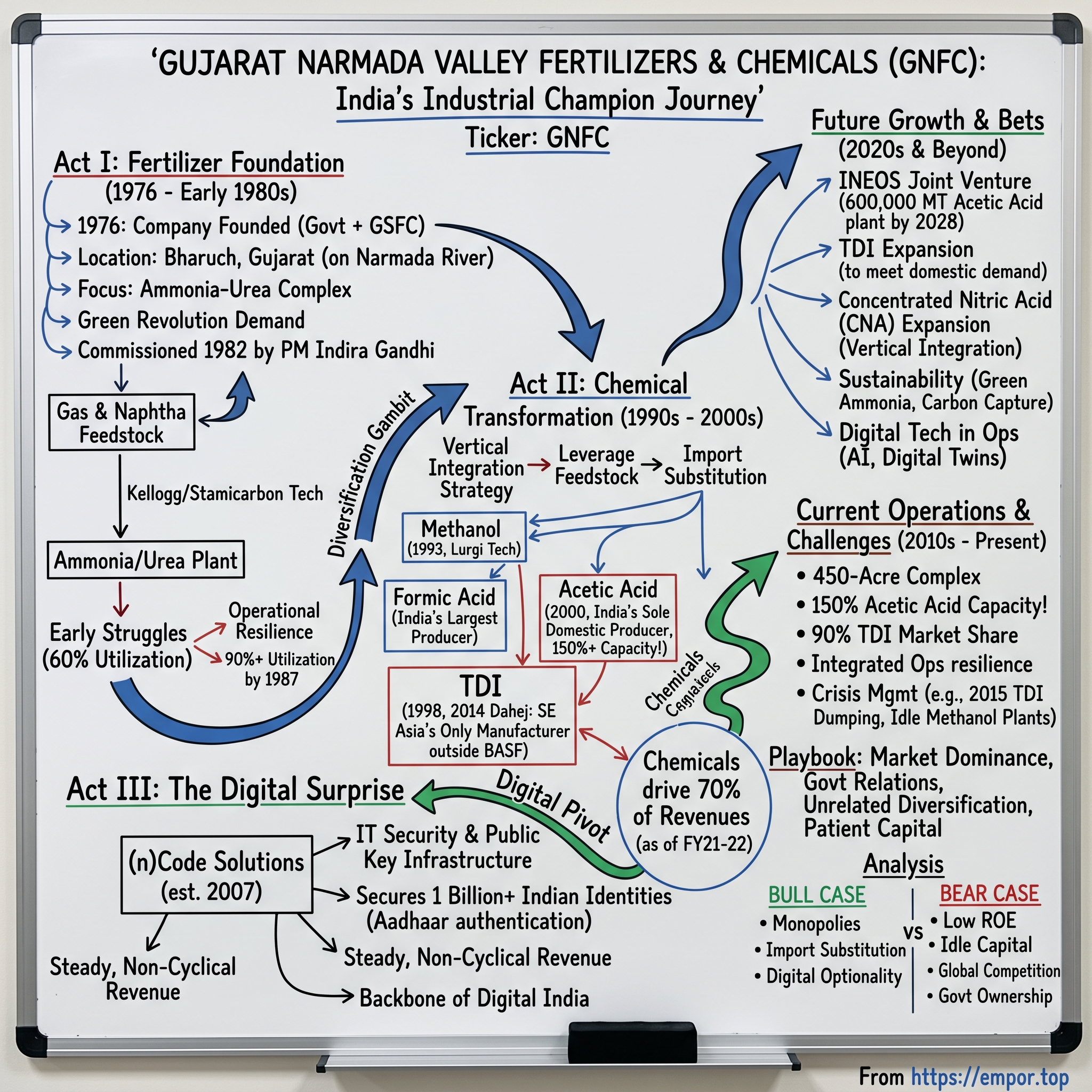
Gujarat Narmada Valley Fertilizers & Chemicals (GNFC): India's Industrial Chemical Champion
I. Introduction & Episode Roadmap
The Month the Trucks Almost Stopped
In late February and early March 2026, conflict escalated in West Asia, turning the Strait of Hormuz from a critical shipping artery into a heightened risk premium. India's modern diesel vehicle fleet, built to BS-VI emission standards, relies on diesel exhaust fluid to operate within legal environmental thresholds—a fluid formulated from technical grade urea. When overseas supplies of that feedstock were abruptly threatened, domestic supply chains faced an immediate crisis. According to the company's executive director, Nitin Patel, India's freight logistics "was on the verge of collapsing."[^1]
A five-decade-old, state-promoted enterprise on the banks of the Narmada River in Bharuch, Gujarat, intervened. Gujarat Narmada Valley Fertilizers & Chemicals doubled its technical grade urea output from roughly 15,000 tonnes a month to about 30,000 tonnes across March and April 2026, deliberately curtailing production of subsidized agricultural urea to plug the shortfall.[^2] At the Coal Ministry's request, the company also ramped up its output of ammonium nitrate melt for mining explosives after foreign imports were cut off.[^2]
The episode highlights GNFC's operational duality. Beneath its corporate identity as a fertilizer supplier lies a state-created hub of hazardous industrial chemistry whose strategic importance surfaces during national emergencies. Yet GNFC remains fundamentally vulnerable to external factors it cannot control: volatile international commodity pricing cycles, rigid government subsidy frameworks, and routine administrative transfers across Gujarat's civil service.
A Name That No Longer Describes the Business
While the company's legal name leads with "Fertilizers," its financial accounts reveal a very different reality. In FY 2023–24, the industrial chemicals division generated ₹4,726 crore in revenue and ₹402 crore in segment profit. By contrast, the fertilizer division generated ₹3,054 crore in revenue and recorded an operating loss of ₹104 crore—a ₹140 crore negative swing from a modest profit the prior year.[^3] By FY 2025–26, that structural divergence widened further: chemicals generated ₹913 crore in segment profit on revenue of ₹4,899 crore, whereas fertilizers lost ₹186 crore on ₹2,764 crore in revenue.[^4] In operational terms, the chemical business generated more than the company's entire net operating profit, while the fertilizer segment actively eroded it.
That reliance on industrial chemicals also explains the severe cyclicality in GNFC's corporate earnings. In FY 2021–22, boosted by pandemic-era global supply constraints, GNFC posted a record net profit of ₹1,704 crore. In FY 2022–23, revenue from operations reached an all-time peak of ₹10,227 crore, with net profit holding at ₹1,464 crore. But when global chemical realizations corrected in FY 2023–24, revenue dropped 22% to ₹7,930 crore and net profit fell 67% to ₹485 crore.[^3] GNFC operates as a highly cyclical specialty commodity chemical producer wrapped inside an agricultural public-sector brand.
The Central Tension
This disparity highlights the central question surrounding the enterprise: can an organization administered by rotating officers of the Indian Administrative Service (IAS), and bound to a regulated, low-margin agricultural mandate, maintain durable competitive advantages across complex and hazardous chemical value chains? GNFC's portfolio includes toluene diisocyanate (TDI), manufactured using phosgene—a toxic gas first deployed as a chemical weapon in World War I. It also encompasses glacial acetic acid, produced via a technological route unmatched by any other domestic manufacturer, and formic acid, where GNFC remains India's largest volume producer.[^4]
The operational record presents a mixed picture. GNFC commands deep engineering expertise and controls several genuinely scarce industrial assets. Yet its corporate history also documents a severe operational crisis, fatal toxic gas leaks, an idle methanol complex, a marquee foreign joint venture that was quietly restructured and scaled down, and a ₹21,370 crore contingent demand from the central government that remains disclosed in financial notes but unprovided for on the balance sheet.[^5]
The Roadmap
This analysis examines GNFC across seven acts. Act I covers the company's origins: Green Revolution food security imperatives, the strategic selection of Bharuch, and the construction of a world-scale single-stream ammonia-urea plant running on heavy fuel oil. Act II charts the European-licensed chemical diversification that laid India's manufacturing foundation for acetyls and isocyanates. Act III examines the Dahej TDI-2 crisis: a ₹330 crore asset impairment, fatal phosgene leaks, the first annual net loss in the company's history, and its subsequent operational turnaround. Act IV assesses (n)Code Solutions, measuring the state-backed digital-signature and IT services business against its actual corporate footprint. Act V provides a granular product-by-product breakdown across TDI, acetic acid, formic and nitric acids, alongside the operational paradox of its idle methanol asset. Act VI analyzes the restructured INEOS acetic acid joint venture. Finally, Act VII evaluates state civil-service governance, valuation frameworks, balance-sheet stress tests, the core bull and bear cases, and key corporate lessons.
Like many foundational stories in Indian heavy industry, GNFC's history began with a nation struggling to feed itself.
 Subscribe on LinkedIn
II. Origins & The Gujarat Development Model (1976–1982)
A Nation That Had to Borrow Its Bread
In the mid-1960s, India lived "ship to mouth," relying on emergency grain shipments from abroad after successive monsoon failures. The Green Revolution altered that trajectory by introducing high-yielding dwarf varieties of wheat and rice, but those crops demanded intensive applications of nitrogen fertilizer. Urea quickly turned into a strategic national commodity, and the state stepped in as the primary architect of domestic manufacturing capacity.
Gujarat adopted an unconventional approach. Rather than relying solely on New Delhi's central public sector undertakings, the state government championed "joint sector" enterprises—commercial entities promoted and controlled by state bodies, yet listed on public bourses and managed under corporate law. GNFC was established in Bharuch in 1976 under this framework, co-promoted by the Government of Gujarat and Gujarat State Fertilizers & Chemicals (GSFC).[^4] The company marked its fiftieth anniversary on May 10, 2026.[^1]
This hybrid structure continues to define the business. Because the state government and its entities retain a controlling interest, Gandhinagar selects executive leadership. Because the company is publicly listed, minority shareholders own the majority of the equity capital while absorbing the consequences of policy-driven governance and public-interest mandates. That structural tension runs through every chapter of GNFC's history.
Why Bharuch
The site was chosen for logistical and operational advantages. Bharuch sits in South Gujarat along what the state designates its "Golden Corridor," an industrial belt offering direct rail and highway links to commercial centers in Mumbai and agricultural consumption hubs across northern and central India.[^6] The adjacent Narmada River secured the vast volumes of fresh water required for continuous cooling and chemical synthesis in an ammonia-urea complex. Coastal proximity to the Gulf of Khambhat later provided port infrastructure to handle bulk feedstock imports and finished chemical despatches. Corporate archives document planners, agronomists, and chemical researchers converging around national agrarian priorities, with township construction underway in 1978 and the primary ammonia flare and boiler stacks rising by 1979.[^6]
Betting Big on Fuel Oil
The core engineering decision was technologically daring. In 1981, GNFC commissioned its ammonia plant utilizing Texaco's partial-oxidation fuel-oil gasification process paired with Haldor Topsoe's synthesis loop. Downstream urea production commenced in 1982, licensed from Saipem of Italy.[^6] The enterprise described the resulting asset as the world's largest single-stream ammonia-urea fertilizer complex.[^4] In chemical engineering, a "single-stream" design routes the entire throughput through one unified production train rather than multiple modular lines. That configuration delivers superior unit economics when operating at high capacity, but inflicts complete, costly outages whenever an operational failure trips the system.
Gasifying heavy fuel oil requires converting viscous, residual refinery bottoms into synthesis gas—a mixture of hydrogen and carbon monoxide—by partially combusting the feedstock with pure oxygen. After carbon monoxide is shifted and removed, the hydrogen is reacted with atmospheric nitrogen to synthesize ammonia. Compared to standard steam methane reforming of natural gas, fuel-oil gasification involves heavier capital costs, complex soot extraction, and abrasive slag handling. Yet it endowed GNFC with processing capabilities that became an unexpected strategic hedge decades later: GNFC maintains that it is still the only manufacturer in India producing ammonia from fuel oil.[^4] In FY 2025–26, the company generated roughly 300,000 tonnes (3 lakh tonnes) of its ammonia from heavy oil and approximately 360,000 tonnes (3.6 lakh tonnes) from natural gas.[^1]
The Administrators Who Built It
Throughout its opening decades, GNFC was managed by chief executives drawn almost exclusively from the Indian Administrative Service on secondment from the Gujarat state government. One administrator left a particularly defining mark. N. Vittal served as managing director from 1982 to 1987, guiding the complex as it shifted from construction into steady commercial operation.[^6] Vittal was not a conventional bureaucratic steward. An energetic technocrat, he steered the fertilizer company into electronics manufacturing by producing rural automatic exchanges for the Centre for Development of Telematics (C-DOT). He later headed India's Department of Electronics, chaired the Telecom Commission, and earned national prominence as Central Vigilance Commissioner. In administrative folklore, he was known for rejecting the notion that "administrators could cover ignorance with authority."1
Vittal's tenure established an enduring institutional pattern. GNFC's leadership became characterized by capable, generalist civil servants with an appetite for lateral diversification, subject to sudden transfer at the discretion of the state government. His foray into telecommunications hardware was the first manifestation of a recurring corporate tendency to initiate ventures far removed from core agricultural chemicals. At times, this lateral ambition yielded lucrative strategic options; at other times, it stranded capital and created long-dated operational burdens.
What the Origin Story Means for Investors
These founding choices continue to anchor GNFC's investment profile. Its strategic location, secure water allocations, heavy-oil gasification infrastructure, and world-scale single-stream train constitute durable physical barriers to entry. Yet the joint-sector model means the controlling shareholder will always pursue social and policy imperatives alongside corporate profitability—such as national food security, regional employment, or, as demonstrated in March 2026, diverting chemical streams to keep the country's logistics fleet moving. Valuing GNFC requires pricing both motivations simultaneously.
The next structural challenge arrived through New Delhi's fertilizer subsidy formula.
III. The Subsidy Trap & The Early Chemical Diversification (1985–2000)
The Cost-Plus Cage
For much of the late twentieth century, Indian urea manufacturers operated under the Retention Price Scheme (RPS). Under this cost-plus regime, the central government assessed each facility's operating expenses against normative energy consumption and efficiency benchmarks, reimbursing the deficit between production costs and artificially low, controlled farm-gate prices through direct subsidies. The mechanism insulated producers from financial insolvency, but it effectively eliminated economic upside. A plant operating above normative standards retained modest margin gains, while an inefficient unit absorbed punitive losses; structural profitability remained capped.
Variations of that regulatory architecture have persisted into the present. On an earnings call in May 2026, GNFC's Chief Financial Officer, D.V. Parikh, characterized urea as "a regulated kind of business segment," contrasting it with industrial chemicals as "more or less an unregulated one," where "at times we lose, at times we gain."[^1] GNFC's contemporary fertilizer marketing footprint reflects an agricultural franchise whose commercial fortunes remain tethered to state budgetary allocations and policy mandates.[^6]
Using the Byproducts
Recognizing that cost-plus fertilizer pricing offered limited earnings growth, GNFC's leadership identified early that an ammonia-urea complex generated valuable intermediate streams alongside farm nutrients. The fuel-oil gasifiers produced synthesis gas rich in carbon monoxide and hydrogen, the synthesis loop yielded surplus ammonia, and the utility island generated spare steam and captive power. Each output represented an accessible feedstock for downstream chemical synthesis. GNFC moved quickly to monetize these side streams: its Methanol-I facility came online in 1985, followed by a formic acid unit in 1989, Methanol-II in 1991, and plants producing ammonium nitrophosphate, weak nitric acid, and calcium ammonium nitrate that same year.[^4] The nitrophosphate facility, brought online in September 1990 using BASF process technology, established the company's regional agricultural brand, "Narmada Phos."[^6]
Formic acid epitomized this byproduct-integration model. Used widely in leather tanning, textile dyeing, natural rubber coagulation, and pharmaceuticals, formic acid is synthesized by reacting carbon monoxide with methanol—intermediates GNFC already produced on site. GNFC licensed the production process from Kemira of Finland.[^4] Today, the enterprise maintains that it is the largest producer of formic acid in India.[^4]
The Acetic Acid Beachhead
The company's most consequential capital investment of the decade arrived in 1995, when GNFC commissioned an acetic acid plant utilizing licensed technology from the UK's BP Chemicals.[^4] Industrial acetic acid—the concentrated, pungent chemical compound that forms the basis of vinegar—serves as an indispensable precursor for ethyl acetate in paints and coatings, acetic anhydride in pharmaceuticals, and purified terephthalic acid (PTA) in polyester fibers.[^4] GNFC manufactures the molecule via methanol carbonylation, catalytically reacting methanol directly with carbon monoxide—an efficient process of fusing two single-carbon building blocks into a two-carbon industrial acid. GNFC maintains that it remains India's only manufacturer producing glacial acetic acid through this carbonylation route.[^4]
The asset's nameplate capacity is currently rated at 150,000 tonnes per annum (150 KTPA).[^4] Over subsequent decades, its defining operational hallmark became an ability to run consistently far beyond its engineered baseline. In FY 2014–15, the acetic acid unit recorded a capacity utilization of 159%, while the formic acid plant reached 209%.[^8] This capacity to extract surplus volume from installed assets through continuous, incremental engineering debottlenecking emerged as one of GNFC's most durable and verifiable operating strengths.
The foundational technology relationship with BP's acetyls franchise—subsequently acquired by INEOS—spanned nearly three decades and laid the groundwork for a major joint-venture agreement announced in 2024.2
Entering Isocyanates
In 1998, GNFC commissioned an aniline and toluene diisocyanate (TDI) complex at Bharuch, deploying process engineering licensed from Sweden's Chematur AB.[^4] When reacted with polyether or polyester polyols, TDI produces flexible polyurethane foam, the foundational cushioning material in mattresses, furniture upholstery, automotive seating, and specialty adhesives.[^4] GNFC noted that its aniline facility constituted India's largest single-stream aniline plant.[^6] To develop and commercialize this specialized chemistry, it co-promoted an affiliate entity, Narmada Chematur Petrochemicals Limited.[^6]
Isocyanate manufacturing is technologically unforgiving. Synthesizing TDI requires reacting toluene diamine with phosgene—a lethal, volatile gas requiring hermetically sealed, high-integrity continuous loops at industrial scale. Decades later, GNFC still asserts that it is the only manufacturer of TDI in South East Asia and the Indian subcontinent.[^4]
What the Diversification Achieved
By the turn of the century, GNFC had leveraged its baseline fertilizer intermediates to transform into a diversified, multi-product chemical manufacturer. Corporate records estimate that average annual turnover grew from roughly ₹260 crore during its initial operating era to approximately ₹850 crore across the 1991–2000 decade.[^6] Yet this lateral expansion fundamentally reshaped the company's economic profile, exposing its balance sheet directly to global commodity price cycles. Every new chemical molecule GNFC synthesized was manufactured at immense scale abroad, subject to overseas cost advantages, and capable of landing at an Indian port within weeks to depress domestic realizations. To defend its margins and achieve global unit economics, the company's next strategic move was to build on an unprecedented scale—an ambition that led GNFC directly to Dahej.
IV. The Dahej TDI-2 Catastrophe & Turnaround (2008–2018)
A Winter Morning, and a Valve That Failed
On January 17, 2014, Gujarat's industrial safety authorities issued a closure order for GNFC's new TDI plant at Dahej after a phosgene leak sickened more than fifteen employees. Bharuch's deputy director of industrial safety was unambiguous: "There was negligence on the part of GNFC. A transfer valve failed to develop the required pressure at the plant." Officials also noted that the facility had been operating without the required factory inspectorate licence.3
The accident occurred before the asset had even been declared commercial. The strategic rationale behind the expansion was straightforward: domestic demand across India's foam and automotive markets was expanding, GNFC already possessed operational experience with isocyanate chemistry at Bharuch, and a new 50,000-tonne-a-year plant at Dahej—once again deploying Chematur technology—would give the company world-scale capacity. Commercial production was declared on March 24, 2014.[^8] What followed was the most financially punishing year in the company's history.
The Plant That Would Not Stabilize
GNFC's annual report for FY 2014–15 described the breakdown in unsparing terms. Although commercial production had been declared, "the stabilization of plant has not been achieved," and the complex faced "various problems in stabilizing and bottleneck for attaining sustained plant load."[^8] Across the entire twelve-month period, the Dahej facility produced just 6,316 tonnes of TDI, translating to an anemic capacity utilization of 12.6%.[^8]
The operational failure coincided with a global market collapse. Substantial new TDI capacity came on stream worldwide, driving international prices down to levels the annual report noted were "hovering around 10 years' lowest."[^8] In heavy continuous chemistry, an underutilized plant burdened with massive fixed capital costs produces a loss on every single tonne. The company remained liable for full depreciation and debt service whether the reactors ran or sat idle.
The First Loss in Company History
When financial accounts were published in May 2015, the full toll became clear. For FY 2014–15, GNFC reported a net loss of ₹452 crore, plunging from a ₹292 crore net profit the year before. The directors observed that the company "has incurred loss for the first time in the history of the Company."[^8] The divisional numbers were stark: while legacy operations at Bharuch generated ₹318 crore in pre-tax profit, the Dahej TDI plant lost ₹440 crore from operations, forcing the company to book a ₹330 crore non-cash impairment against the plant's book value.[^8] No dividend was paid.[^8]
The balance sheet buckled under the weight of the project. Annual finance costs tripled from ₹92 crore to ₹275 crore, and total borrowings reached ₹3,832 crore.[^8][^3] Management retained consultancy A.T. Kearney to assess "the business viability" of the Dahej plant and "recommend the way forward," while warning shareholders of the "risk of further impairment loss."[^8]
For investors, the episode offers a timeless lesson in capital allocation. The crisis was not simply a streak of bad pricing luck. Dahej was a concentrated, highly leveraged bet on unforgiving chemistry, brought into commercial status before its process loops were stabilized, in a commodity market where GNFC had zero pricing power. A healthy legacy business saw its entire operating surplus wiped out by a single stalled project.
November 2016: The Deaths
Stabilizing the Dahej complex eventually came at a tragic human cost. Late on the night of November 2, 2016, a mechanical failure in a reactor gasket triggered a lethal release of phosgene gas. Four contract labourers were killed and thirteen others injured. The district collector confirmed the fatalities, while a company official stated that the victims were contract labourers "working in nearby units."4 Authorities immediately shuttered the complex. In December 2016, GNFC notified the stock exchanges that Lloyd's Register had completed an independent safety audit and that technology licensor Chematur was reviewing engineering modifications before any restart.[^12]
Yet on the morning of January 15, 2018, the facility suffered another "sudden leakage." While the company reported that there was no loss of life or property damage, it closed the plant indefinitely, sending GNFC shares falling 8.15% to ₹496.50 the following day.5 Three serious toxic leaks at a single newly built plant within four years pointed to systemic operational and containment vulnerabilities rather than an isolated mechanical fluke.
The Trade-Defence Lifeboat
What ultimately salvaged the plant's commercial viability was government trade protection. In October 2016, India's trade remedy authority—now the Directorate General of Trade Remedies (DGTR)—initiated an anti-dumping investigation into TDI imports from China, Japan, and Korea, issuing preliminary findings in March 2017 and final findings in December 2017.6 Anti-dumping duties were imposed for five years from the provisional duty notification on June 5, 2017, despite a brief collection hiatus between December 2017 and January 2018.7 That tariff shield was subsequently extended when a sunset review concluded in June 2022 kept the regime in place.6 A companion tariff structure covers alternative origins: on an earnings call in November 2025, the chief financial officer noted that a duty extension had been recommended for imports from the European Union, Saudi Arabia, and Taiwan,[^16] before telling analysts in February 2026 that the TDI tariff had been formally "extended for another five years."[^17]
The Recovery, Measured Honestly
Supported by trade barriers and incremental engineering fixes, profitability gradually returned. Net profit rebounded from the FY 2014–15 loss to ₹173 crore in FY 2015–16, ₹521 crore in FY 2016–17, ₹790 crore in FY 2017–18, and ₹741 crore in FY 2018–19. Total borrowings plummeted from ₹3,832 crore to ₹208 crore by March 2019, falling to nearly zero by March 2021.[^3] Paying down nearly ₹3,800 crore of debt in six years while operating a hazardous chemical facility was a significant operational feat, guided by a succession of state-appointed managing directors—most prominently Dr. Rajiv Kumar Gupta, IAS, who helmed the company from May 2013 to July 2018.[^6]
Yet the popular market narrative that Dahej evolved into a frictionless cash cow does not match the operating record. The plant was taken down for maintenance on December 27, 2019, and restarted only in March 2020, just as national COVID-19 lockdowns took effect and GNFC shares traded near ₹100.8 In FY 2024–25, recurring technical problems forced the Dahej complex to sit idle for four months.[^17] On September 19, 2025, another "sudden leakage" forced a precautionary shutdown, though management reported that the release remained confined within the boundary wall with no loss of life.9 Commercial production resumed on September 28, 2025.10 In May 2026, management put overall TDI capacity utilization at "close to 80%," describing that level as roughly the global operating benchmark for this demanding chemistry.[^1]
Dahej has certainly generated cash, but the notion that it moved seamlessly from chronic dysfunction to running continuously above nameplate capacity is false. It became a viable plant, heavily shielded by anti-dumping tariffs, running at roughly 80% utilization under continuous surveillance. For investors, its history of toxic releases and unscheduled shutdowns represents an active, ongoing operational risk rather than a settled legacy issue.
During the very years GNFC was wrestling with phosgene loops at Dahej, however, the enterprise was quietly cultivating an entirely different venture—far removed from chemical reactors and factory gates.
V. Digital Vignette: Sizing (n)Code Solutions Proportionately
A Fertilizer Company Becomes a Certifying Authority
In 2003, far removed from its chemical reactors in Bharuch, GNFC launched an unexpected corporate venture. It established (n)Code Solutions as a licensed Certifying Authority under India's Information Technology Act, 2000, regulated by the Controller of Certifying Authorities.[^21] Operating essentially as a digital notary, a certifying authority issues cryptographic digital signature certificates that enable individuals and corporate entities to sign electronic filings, submit tax returns, or bid in public procurement tenders with legally verified identity, using public key infrastructure (PKI).
(n)Code describes itself as one of India's oldest licensed certifying authorities, distributing its security solutions through more than 200 registration authorities and over 2,500 resellers nationwide.[^21] In its FY 2014–15 annual report, GNFC claimed the division had secured market leadership in digital signature certificates and had expanded into Aadhaar-based biometric authentication services.[^8]
The Myth and the Reality
A recurring thesis in retail investor forums suggests that GNFC harbors an overlooked, high-margin software enterprise waiting to be unlocked by public markets. The financial disclosures in GNFC's FY 2025–26 annual report tell a much more modest story. For the fiscal year, the division generated total income of ₹95 crore, up 19% from ₹80 crore the prior year, while profit before tax more than doubled from ₹17 crore to ₹35 crore.[^5] Its flagship product line, the (n)Procure e-procurement platform—mandated across all Government of Gujarat departments—recorded its strongest performance to date, generating ₹42 crore in revenue.[^5]
On its own terms, (n)Code is a healthy, asset-light niche operation: it commands attractive operating margins, requires minimal capital expenditure, and demonstrates meaningful operating leverage as earnings expand against stable overhead. But set against the broader enterprise, its financial footprint is negligible. GNFC posted total corporate revenue of ₹7,773 crore in FY 2025–26, meaning that even in a banner year, (n)Code represented barely 1% of total sales.[^4] When an investor on an earnings call in August 2026 pressed management on why the IT division was absent from corporate investor presentations, the chief financial officer estimated the unit's annual turnover at "around ₹100 crores," adding that any broader strategic initiatives in digitization and artificial intelligence were "yet in a very formative stage."[^22]
The division's competitive moat also faces clear structural limitations. Because (n)Procure relies primarily on mandatory adoption by Government of Gujarat administrative bodies, its captive customer base is shielded from outside competition, but offers limited scope for independent commercial expansion. Ultimately, a 10% shift in global TDI price realizations moves GNFC's operating cash flow far more than anything (n)Code can generate.
The Digital Detour's ₹21,370 Crore Bill
The most consequential legacy of GNFC's early technology diversifications is not its current software revenue, but a massive balance-sheet overhang. During the 1990s and early 2000s, continuing the lateral expansion model pioneered during N. Vittal's administration, GNFC secured telecommunications licences to operate very small aperture terminal (VSAT) satellite communications and internet service provider (ISP) networks. In 2012, the Gujarat High Court sanctioned a scheme demerging these telecom activities into an unlisted entity, ING Satcom, for ₹6 crore, with an appointed demerger date of April 1, 2010. However, the central government's Department of Telecommunications (DoT) never formally approved the transfer of the underlying operating licences.[^5]
The regulatory consequences escalated dramatically over the subsequent decade. In FY 2014–15, the DoT issued an initial demand of ₹2,752 crore covering licence fees, accumulated interest, and penalties. Following the Supreme Court of India's landmark October 2019 ruling on Adjusted Gross Revenue (AGR)—which permitted the government to include non-telecom corporate revenue in calculating licence fee liabilities—the DoT aggressively raised its claims against non-telecom public-sector operators. It demanded ₹15,020 crore from GNFC in December 2019, increased the claim to ₹16,359 crore in March 2020, and by July 2022 revised the total assessment to ₹21,370 crore, spanning the period from FY 2005–06 through FY 2019–20.[^5] GNFC has vigorously contested the assessment, arguing that its agricultural fertilizer and industrial chemical revenues bear no legal or commercial connection to telecom operations. Relying on subsequent judicial observations, the Union government's 2021 telecom relief package distinguishing non-telecom public-sector units, and formal counsel from senior legal advocates, management has "neither provided for this amount in its books of account nor recognized it under contingent liability."[^5] Statutory auditors have consistently highlighted the unprovided claim as an Emphasis of Matter in their audit reports.[^5]
The scale of this demand is staggering: at ₹21,370 crore, it represents more than double GNFC's entire net worth of ₹8,981 crore as of March 31, 2026.[^4] While the company's legal defenses appear robust—and precedent suggests New Delhi is unlikely to destabilize a critical industrial chemical producer over legacy telecom definitions—the decision to exclude the claim entirely from contingent liabilities remains a significant accounting judgment. For public equity investors, the most tangible legacy of GNFC's digital diversification is not a hidden software spin-off, but an unresolved statutory demand that dwarfs its balance sheet.
That reality redirects attention back to the factory floor, where GNFC's true economic drivers—and its most complex operational hazards—actually reside.
VI. Core Operations & Segment Economics Today
A Walk Through the Bharuch Complex
At Bharuch, physical pipelines mirror the company's chemical value chains: synthesis gas routes carbon monoxide to formic and acetic acid units; ammonia feeds the nitric acid facilities; nitric acid supplies the aniline and TDI trains; and acetic acid moves directly downstream into ethyl acetate. Across this integrated footprint, GNFC lists annual installed nameplate capacities of 636,000 tonnes (636 KTPA) of urea, 142 KTPA of ammonium nitrophosphate, 348 KTPA of weak nitric acid across two plants, 166 KTPA of concentrated nitric acid across four plants, 158 KTPA of ammonium nitrate melt, 150 KTPA of acetic acid, 50 KTPA of ethyl acetate, 40 KTPA of aniline, 20 KTPA of formic acid, 169 KTPA of technical grade urea, 269 KTPA of methanol across three facilities, and 67 KTPA of TDI split between Bharuch and Dahej.[^4]
That operational integration provides substantial logistical efficiency, but none of these molecules is insulated from overseas competition. GNFC prices virtually its entire industrial portfolio on an "import parity" basis—benchmarked against the landed cost of imports entering Indian ports—on variable contracts that reset monthly or quarterly.[^1] Across its commercial footprint, GNFC functions fundamentally as an open-market price-taker.
1. The Isocyanates Position: Toluene Diisocyanate (TDI)
India consumes roughly 100,000 tonnes (1 lakh tonnes) of TDI annually for flexible slabstock foam, alongside an additional 10,000 to 15,000 tonnes absorbed by "system houses" producing specialty polyurethane formulations. Selling roughly 60,000 tonnes domestically, GNFC commands a market share of approximately 60%, with foreign imports supplying the remainder.[^17] According to marketing head Tejash Shah, domestic TDI demand expands at roughly 10% per year, an absorption rate sufficient to clear GNFC's normalized annual production run-rate of 65,000 to 70,000 tonnes.[^17] In FY 2025–26, the company produced approximately 57,000 tonnes.[^1]
Yet holding the dominant domestic position as the nation's sole indigenous manufacturer has not translated into independent pricing power. As the chief financial officer frankly outlined, the company "calculates the import parity price, and prices its products. At times, it is at a premium. At times, it is at a discount," with anti-dumping duties factored directly into that parity benchmark.[^17] Global supply-demand balances dictate local realisations. When multinational majors like China's Wanhua Chemical or Germany's Covestro take capacity offline for routine turnarounds, Shah observed, structural global overcapacity dampens the impact: "1 month shutdown of Covestro and Wanhua will not affect the overall pricing," even if temporary domestic supply tightness offers brief regional support.[^22]
The spread between finished TDI and its primary petrochemical feedstock, toluene, illustrates this earnings volatility. Company disclosures show that average TDI realisations surged from roughly ₹194,000 per tonne in FY 2021–22 to ₹229,000 in FY 2022–23, before retreating to around ₹173,000 per tonne in FY 2025–26, while toluene procurement costs fluctuated within a narrower band of ₹66,000 to ₹89,000 per tonne.[^4] In the first quarter of FY 2026–27 (April–June 2026), geopolitical disruptions lifted TDI realisations back to ₹255,000 per tonne.[^23] Because raw toluene costs do not track TDI price spikes in lockstep, GNFC's operational profitability expands or contracts based on an international spread it cannot set.
To structurally defend conversion margins, GNFC pursued thermal efficiency. A 10-megawatt, coal-based captive steam and power co-generation plant at Dahej, sanctioned in October 2022, began generating process steam by August 2026, with power generation reaching an advanced commissioning phase.[^2] Management estimated operational savings of ₹30,000 to ₹40,000 per tonne of TDI at prevailing coal and natural gas tariffs, while cautioning that "the dynamic will keep changing" alongside fluctuating fuel indices.[^22] Execution slipped behind schedule: originally targeted for an April 2026 commissioning, the commercial timeline shifted to a June grid synchronization and an August performance trial after engineering contractors missed project milestones, yielding penalty recoveries for GNFC.[^1]
2. The Acetyls Lifeline: Acetic Acid
India imported approximately 1.25 million tonnes of glacial acetic acid in FY 2025–26 through February 2026, up from 0.94 million tonnes in FY 2018–19.[^4] GNFC's installed capacity of 150 KTPA supplies only a modest fraction of that structural requirement. When INEOS and GNFC announced their proposed partnership in November 2024, both partners noted that India relied on foreign shipments for roughly 85% of its acetic acid consumption.2
On paper, operating as the sole domestic producer in an import-dependent growth market resembles a classic competitive moat. The operating realities of 2026 revealed its commercial limits. During an earnings call in May 2026, the chief financial officer highlighted an "inverted relationship" in acetyl spreads: international acetic acid prices were softening even as methanol feedstock costs escalated.[^1] By August 2026, management disclosed that the acetic acid plant had been kept completely shut down between May 6 and August 1, 2026, because commercial synthesis was operating at cash losses. Throughout that twelve-week outage, GNFC imported finished acetic acid directly to preserve supply commitments to downstream ethyl acetate clients.[^22] The company evaluates margins on a weekly basis, dynamically choosing whether to procure merchant methanol to produce acetic acid or simply import finished acid for merchant distribution.[^1]
While this commercial posture reflects prudent working-capital discipline, it underscores the absence of pricing leverage. A manufacturing asset that must periodically suspend production because finished import prices undercut domestic conversion economics does not possess an economic moat; it possesses operational flexibility and commercial hedging capabilities.
3. Formic Acid & Nitric Acid Integrations
Formic acid represents a smaller absolute earnings contributor, yet it clearly highlights GNFC's engineering debottlenecking capabilities. Against an engineered nameplate capacity of 20 KTPA, GNFC produced roughly 34,000 tonnes in FY 2025–26, registering its highest-ever commercial sales volume.[^1][^2] Even so, formic acid was the solitary chemical product across GNFC's portfolio whose domestic realisations failed to appreciate during the supply squeeze in the fourth quarter of FY 2025–26.[^1] India continues to import approximately 30,000 tonnes of formic acid annually.[^4]
The nitric acid value chain constitutes GNFC's primary capital expenditure focus. In FY 2025–26, the company produced approximately 430,000 tonnes of weak nitric acid and 147,000 tonnes of concentrated nitric acid, selling roughly 45% of its concentrated acid output into open merchant markets.[^1] A fourth concentrated nitric acid plant came online in 2023.[^4] Downstream, ammonium nitrate melt—a critical component in industrial mining explosives—has emerged as a structural growth category. With India importing roughly 400,000 to 450,000 tonnes (4 to 4.5 lakh tonnes) each year, marketing leadership anticipates that domestic capacity additions across Chambal Fertilisers, Deepak Fertilisers, and GNFC will progressively replace imported volumes.[^1] The company's ongoing ₹2,800 crore capital expenditure program is concentrated along this corridor: a ₹1,420 crore weak nitric acid plant, a ₹450 crore ammonium nitrate plant, a ₹331 crore ammonia loop debottlenecking, and the ₹613 crore Dahej captive power utility.[^16]
Aniline demonstrates the structural ceiling of domestic chemical substitution. Despite annual Indian aniline imports exceeding 250,000 tonnes (2.5 lakh tonnes), GNFC has refrained from expanding its 40 KTPA unit. Executive Director Nitin Patel explained that massive Chinese producers utilize low-cost coal gasification to generate cheap hydrogen at scale, operating plants seven to eight times larger than GNFC's train, and periodically dump surplus aniline into India whenever the international market for methylene diphenyl diisocyanate (MDI) softens. "On a stand-alone, we are not viable in aniline," Patel acknowledged, prompting GNFC to utilize its installed reactors for third-party custom manufacturing on fixed tolling margins.[^1]
4. The Methanol Paradox: Stranded Asset vs. Merchant Trading
GNFC maintains 269 KTPA of methanol nameplate capacity across three separate production units erected between 1985 and 2006.[^4] Because methanol synthesis requires hydrogen- and carbon monoxide-rich syngas, its conversion economics are bound to underlying hydrocarbon costs. Middle Eastern and Chinese producers tap low-cost domestic wellhead natural gas or scale coal gasification, whereas GNFC relies on imported liquefied natural gas (LNG) and residual fuel oil. As early as FY 2014–15, corporate filings acknowledged that GNFC's methanol complexes were operated "only when market conditions were favourable."[^8] By February 2026, marketing leadership was explicit: "we are not manufacturing methanol at present."[^17] During the final quarter of FY 2025–26, elevated landed oil and gas tariffs rendered even the heavy-oil-based methanol unit unviable to run.[^1]
Rather than operating high-cost reactors, GNFC transitioned into a merchant aggregator: it imports bulk methanol when foreign supply is cheap, and purchases merchant acetic acid directly whenever international methanol benchmarks spike.[^22] While these physical plants remain capitalized on GNFC's balance sheet, they sit largely cold. They serve as a clear balance-sheet case study that installed industrial capacity is not synonymous with an economic advantage.
5. The Fertilizer Anchor: Low Margin, High Regulation
The agricultural fertilizer division operates under strict regulatory oversight. GNFC is mandated to manufacture a baseline quota of roughly 637,000 tonnes of neem-coated agricultural urea for allocation by the central Department of Fertilizers; only volumes generated above this statutory commitment can be upgraded and diverted into non-subsidized technical grade urea.[^22] Urea subsidy receipts totaled ₹1,690 crore in FY 2025–26, with statutory auditors designating its accounting a Key Audit Matter due to reliance on evolving government norms, complex energy escalation formulas, and management estimates.[^5]
The persistent operating losses within the fertilizer segment stem from regulatory benchmarks that lagged operational inflation. In May 2026, the chief financial officer noted that overdue administrative revisions to both energy consumption allowances and fixed-cost compensation formulas meant that "we see almost no chance in case of urea" of reaching operational breakeven.[^1] Regulatory relief arrived on June 30, 2026, when the Department of Fertilizers formally increased GNFC's recognized energy consumption norm from 6.20 to 6.37 gigacalories per tonne, retroactive to April 1, 2025. This revision unlocked an anticipated one-time subsidy adjustment of approximately ₹61 crore in the second quarter of FY 2026–27, though a structural overhaul of fixed-cost reimbursements remains unresolved.[^23] In the first quarter of FY 2026–27, the fertilizer segment recorded an operating loss of ₹85 crore.[^22] Furthermore, government guidelines cap profit margins on complex phosphatic fertilizers around 10% under reasonableness criteria, effectively ceiling upstream equity returns.[^16]
The Quiet Winner: Technical Grade Urea
Between regulated agricultural nutrients and market-linked petrochemicals sits technical grade urea (TGU), an intermediate that demonstrates the strategic flexibility of GNFC's fuel-oil ammonia infrastructure. Chemically identical to agricultural prills, technical grade urea is sold without subsidy at open-market prices into industrial resins, plywood adhesives, cattle feed formulations, and diesel exhaust fluid.[^1] Executive Director Patel noted that roughly 20% of the company's urea output, produced from heavy-oil ammonia synthesis, can be legally diverted into industrial grade channels. GNFC manufactured more than 210,000 tonnes of technical grade urea in FY 2025–26—surpassing its rated 169 KTPA capacity—and identified peer Gujarat State Fertilizers & Chemicals as its sole domestic competitor, operating at significantly smaller volumes.[^1] When questioned in August 2026 on the divisional drivers behind GNFC's record quarterly results, the chief financial officer affirmed that technical grade urea was "one of the significant contributor[s]."[^22]
The operational economics are notable: the identical synthesis loop that records operating deficits under regulated agricultural urea pricing generates healthy cash margins when supplying unregulated industrial channels. GNFC's fertilizer "anchor" houses an embedded, high-margin chemical option. However, its upside remains constrained by public policy: GNFC must satisfy its subsidized agricultural delivery obligations before marketing industrial batches, with management guiding FY 2026–27 technical grade production to match the prior year's output.[^22]
Myth vs Reality: The Record Quarter
Financial results for the first quarter of FY 2026–27 (ended June 30, 2026) appeared to signal an operational inflection: operational revenue reached ₹2,238 crore, pre-tax profit climbed to ₹416 crore, and net profit expanded fourfold year-over-year to ₹310 crore, up from ₹78 crore in the prior-year period.[^23]
Management's subsequent earnings commentary framed these numbers in proper perspective. The chief financial officer explained that headline margins expanded primarily because international chemical realisations surged during the West Asian maritime bottleneck, even as raw feedstock prices escalated, prompting management to suspend uneconomic acetic acid, ethyl acetate, and secondary TDI units and build up finished inventories as sales lagged physical production.[^22] Furthermore, the year-earlier comparison was distorted by an extensive annual maintenance turnaround at the Bharuch complex.[^23] "This typically happens in a war-like situation, it can go either side," the chief financial officer cautioned, emphasizing that earnings windfalls tied to conflict premiums are transitory.[^22] The quarter was driven by a temporary supply-side geopolitical dislocation rather than a permanent structural reset in baseline conversion margins.
What This Adds Up To
Across its operational footprint, GNFC's financial performance surges when international chemical logistics tighten, as demonstrated in the April–June 2026 quarter when the enterprise recorded its second-highest quarterly net profit.[^22] Conversely, when overseas chemical supply stabilizes, GNFC possesses limited margin protection against incoming bulk imports. The company's engineering capability to operate mature chemical plants well beyond nameplate capacity is thoroughly established; its long-term pricing power is not. The strategic question is whether GNFC's major prospective capital investments can fundamentally alter that equation.
VII. The Future Growth Vector: The INEOS 600 KTPA Acetic Acid Mega-JV
A Handshake Thirty Years in the Making
On November 20, 2024, INEOS Acetyls and GNFC announced a memorandum of understanding to establish a 50:50 joint venture to construct a 600,000-tonne-a-year (600 KTPA) acetic acid plant at GNFC's Bharuch site, targeting completion around 2028.2 David Brooks, chief executive of INEOS Acetyls, framed the initiative around domestic market growth: "We are delighted to be working with our partner GNFC on this new project. India is recognised as being a key growth market for our products over the coming years."11 GNFC's managing director at the time, Pankaj Joshi, IAS, highlighted the underlying import-substitution opportunity, pointing out that India relied on overseas shipments for roughly 85% of its acetic acid consumption.2
The commercial rationale appeared compelling. INEOS would contribute proprietary carbonylation technology and global marketing scale, while GNFC would provide industrial land, utility infrastructure, three decades of operational experience running the synthesis loop, and an established domestic client network. At 600 KTPA, the proposed facility would have quadrupled GNFC's installed acetic acid capacity, approaching the unit economics of world-scale merchant competitors. It matched New Delhi's domestic manufacturing agenda and promised to pair GNFC with a seasoned global private partner, reducing the operational and financial risks of executing a major chemical expansion alone after the costly experience at Dahej.
The Fine Print
Yet the initial agreement was far less definitive than headline announcements suggested. An INEOS corporate publication described the pact as a "non-binding agreement," while the memorandum itself was designed merely to "explore the feasibility" of the plant.112 Neither party ever disclosed a formal capital expenditure budget, an equity contribution schedule, or a firm feedstock agreement.
Feedstock supply represented the fundamental strategic vulnerability. Methanol carbonylation requires two primary inputs: carbon monoxide, which GNFC can generate captive from its fuel-oil gasification line, and methanol, which GNFC cannot produce competitively and must import in bulk. A world-scale Indian plant reliant on imported merchant methanol faces severe structural cost disadvantages against integrated producers along the U.S. Gulf Coast, the Middle East, and China, who synthesize methanol from cheap domestic natural gas or scale coal gasification. The prolonged shutdown of GNFC's existing Bharuch plant in mid-2026—triggered when rising landed methanol costs collided with falling international acetic acid realisations—demonstrated exactly how quickly that conversion margin can vanish.
What Changed in 2026
By May 2026, the prospective partnership began to unravel. In its FY 2025–26 investor presentation, GNFC included an understated note under corporate updates: "In place of earlier discussion with INEOS about JV, company is trying licensing route."[^4] On the subsequent earnings call, Chief Financial Officer D.V. Parikh confirmed the shift: "we had earlier plan of JV with INEOS. Now we are talking to them about licensing for additional capacity."[^1] GNFC's active capital expenditure disclosures subsequently reclassified the Bharuch acetic acid project from an active development into an initiative merely "under consideration," scaled down to 350 KTPA, alongside a proposed 150 KTPA bisphenol-A unit and a 100 KTPA polyols plant at Dahej.[^23] Management indicated that definitive investment decisions regarding these prospective projects would become clearer only "by end of this calendar year."[^1]
This transition carries three significant implications. First, the plant's proposed scale was cut by more than 40%, shrinking from 600 KTPA to 350 KTPA and forfeiting the world-scale parity initially envisioned. Second, GNFC would carry the entire financial and operational risk on its balance sheet, forfeiting the global procurement leverage and balance-sheet sharing an equity partner would provide. Third, the targeted 2028 commercial commissioning date was effectively left without a committed project structure. GNFC's disclosures offered no explanation for why the equity joint venture was abandoned in favor of a licensing arrangement, and analysts on the quarterly call did not probe the reversal.
Weighing the Growth Claim
The narrative that GNFC would co-develop a world-scale acetyls complex alongside INEOS by 2028 is no longer supported by the evidence. The joint venture has been replaced by preliminary technology licensing discussions, planned capacity has been sharply scaled back, and the project has returned to early evaluation. The tangible thesis is far more modest: GNFC may eventually license proprietary technology to build a standalone 350 KTPA unit on its own balance sheet at some point after 2028, provided capital economics align.
The critical milestones for investors to monitor are formal board sanction, a fully funded capital expenditure budget, and, above all, a long-term methanol supply structure capable of withstanding periods when global conversion spreads invert. GNFC's operational track record at Dahej—where constructing capacity proved far simpler than stabilizing process loops—warrants analytical caution regarding execution timelines and capital commitments.
This deferred acetyls initiative also sits within a much larger capital-allocation dilemma. GNFC's prospective diversification into bisphenol-A and polyols, which incorporates an upstream phenol line, was estimated in November 2025 at roughly ₹7,000 to ₹8,000 crore.[^16] That capital commitment approaches the company's entire net worth of ₹8,981 crore. Committing that scale of capital to cyclical, capital-intensive chemical value chains ultimately depends on the priorities and stability of corporate decision-makers—a dynamic that leads directly into the question of governance.
VIII. Management, Governance, & Capital Allocation: The Bureaucratic Paradox
The Revolving Door at the Top
On September 9, 2026, Sanjeev Kumar, IAS, assumed charge as GNFC's managing director. A 1998-batch Gujarat cadre officer who had been serving as Principal Secretary to the Chief Minister, Kumar holds a bachelor's degree in technology from IIT Kharagpur and a master's degree in public affairs from the University of Minnesota's Hubert H. Humphrey School. His predecessor, Rajkumar Beniwal, IAS, stepped down the same day. GNFC's board approved Kumar's appointment on September 16 for a tenure of up to five years, explicitly "subject to Government of Gujarat orders." GNFC shares rose 9.46% to ₹591.25 on the announcement.12
Beniwal had served in the role for less than nine months, having taken charge on December 29, 2025, from Dr. T. Natarajan, IAS, who had held the managing directorship as an additional responsibility alongside his post as Additional Chief Secretary for Finance.[^5] At the board level, leadership turnover was equally swift: Chairman Pankaj Joshi retired from civil service on October 31, 2025, and Manoj Kumar Das, IAS, assumed the chairmanship the following day.[^5] Corporate historical records reflect a persistent institutional pattern: GNFC lists more than twenty managing director tenures since 1977, with many lasting two years or less.[^6]
What the Incentives Actually Are
Corporate filings outline the formal administrative structure governing executive leadership. The board appoints the managing director "in consultation with Government of Gujarat," notes that the appointee is "usually a Senior IAS Officer," and pegs executive compensation strictly to civil service pay scales. A government notification in January 2026 designated the managing director position as equivalent to an IAS cadre post, ensuring the chief executive draws standard administrative remuneration.[^5] GNFC's corporate disclosures reveal no equity options, performance shares, or structural mechanisms linking top executive compensation to long-term shareholder value creation.
This structural design produces two divergent operational dynamics. Day-to-day operational continuity rests primarily with permanent professional technocrats and senior management. On quarterly earnings calls, Chief Financial Officer D.V. Parikh and executive directors Nitin Patel and P.K. Purohit field virtually all detailed operational, commercial, and engineering questions.[^22] This managerial bench has overseen steady plant operations and incremental engineering debottlenecking. Conversely, major strategic decisions—such as abandoning the INEOS equity joint venture in favor of licensing, or contemplating ₹7,000 crore to ₹8,000 crore in capital expenditures across new chemical value chains—are governed by a board chaired and directed by rotating civil servants who may be reassigned well before multi-year projects reach commercial commissioning.
The enterprise's capital markets communication directly mirrors this bureaucratic posture. Investor presentations explicitly state that the company does "not comment or give guidance on future results."[^23] When an institutional analyst pressed for directional guidance on an earnings call in August 2026, the company secretary responded plainly: "we have never given any guidance as such."[^22] While this conservative approach protects management from overpromising in volatile commodity markets, it also leaves investors with few forward operational commitments against which to measure management performance.
The Balance Sheet: A Cash Pile, and Where It Sits
Aggressive debt repayment following the Dahej turnaround left GNFC with substantial balance-sheet liquidity. By August 2026, the chief financial officer reported liquid reserves of approximately ₹4,000 crore, allocated across sovereign government securities, bank fixed deposits, and Gujarat State Financial Services (GSFS).[^22] Approximately ₹2,400 crore of this balance was placed in inter-corporate deposits with GSFS, earning an interest yield of roughly 7.25%. When an analyst questioned the modest yield during an earnings discussion, the CFO defended the allocation: "Our company's governance doesn't allow loan to private sector like that. It is only our own arm where we can draw for the real capex needs."[^1] While warehousing surplus liquidity within state treasury conduits shields capital from private credit risk, it simultaneously confines public-company cash to state-promoted entities at yields influenced by the promoter group—an arrangement that institutional minority shareholders view with persistent skepticism.
The April 2023 Mandate and the Buyback
On April 26, 2023, the Government of Gujarat instituted a comprehensive capital-restructuring and dividend-distribution policy for its listed state enterprises. Under the framework, companies were mandated to declare a minimum annual dividend of "30 per cent of profit after tax or 5 per cent of net worth, whichever is higher." Share repurchases were made mandatory for state entities maintaining a net worth of at least ₹2,000 crore alongside liquid cash balances exceeding ₹1,000 crore. Furthermore, bonus issues were prescribed whenever free reserves exceeded ten times paid-up equity share capital, while stock splits were mandated if market price or book value reached fifty times face value. GNFC shares rallied approximately 17% following the announcement.13
GNFC executed its mandated share buyback in December 2023, repurchasing 8,478,100 equity shares—representing 5.46% of total equity—at ₹770 per share for an aggregate consideration of ₹652.81 crore. Open from December 1 to December 7, the tender offer was oversubscribed 2.91 times.[^27] The primary beneficiaries of the repurchase were the promoter entities themselves: Gujarat State Investments Limited tendered 1,719,888 accepted shares, while Gujarat State Fertilizers & Chemicals saw 1,593,158 shares accepted.[^27] At the ₹770 offer price, the state promoter entities absorbed approximately ₹255 crore—nearly 39% of the total cash disbursed. While this capital return satisfied the state's broader fiscal objectives, it illustrated that public-sector corporate distributions often align primarily with the budgetary cash requirements of the controlling shareholder.
Dividend distributions have tracked underlying chemical earnings. GNFC declared dividends of ₹30 per share for FY 2022–23 and ₹16.50 per share for FY 2023–24.[^3] For FY 2025–26, the board recommended a dividend of ₹21 per share, amounting to ₹308.58 crore and representing roughly 39% of net profit.[^2]
Yet measured strictly against Gandhinagar's April 2023 policy directives, the capital return record reveals notable divergences. With net worth standing at ₹8,981 crore as of March 31, 2026, the mandated 5% net-worth distribution threshold would have required an annual payout of approximately ₹449 crore—well above the ₹308.58 crore actually declared.[^4][^2] Similarly, paid-up equity capital remained unchanged at ₹146.94 crore following the buyback, even though GNFC's accumulated reserves exceeded that figure by more than fifty-fold, comfortably meeting the nominal criteria for a bonus issue.[^4] Corporate filings provide no reconciliation explaining how the state's dividend and bonus share thresholds are formally interpreted or enforced in practice. When questioned on a potential follow-on share repurchase in May 2026, the company secretary was direct: "As of now, we have nothing in the pipeline."[^1]
The Governance Verdict
Two competing narratives define GNFC's corporate governance: that state sponsorship provides an impenetrable safety net, and that bureaucratic administration permanently caps shareholder value creation. The historical record partially validates both viewpoints. Controlling state ownership facilitated the disciplined deleveraging after the Dahej crisis, mandated a substantial share buyback, and anchored a steady dividend yield. Yet that same administrative framework has fostered executive turnover measured in months, parked billions of rupees in state financing vehicles at modest rates, quietly downgraded the company's flagship acetyls growth project, and left a ₹21,370 crore statutory telecom demand unrecorded on the primary balance sheet. Prudent investors must view GNFC as a state-controlled industrial enterprise that periodically acts in alignment with minority shareholder interests, rather than a commercial entity operated primarily to maximize them.
Evaluating that reality requires a rigorous, systematic stress test of the underlying investment thesis.
IX. Historical Falsification Layer (Mandatory Stress Test)
Method
Every investment case for GNFC rests on a small set of core assumptions. This section subjects each claim to historical stress testing against the company's operating record, arriving at one of three verdicts: rejected, narrowed, or left intact. It then identifies the forward-looking metrics that will determine whether each thesis holds up.
Claim 1: The Domestic Chemical Moat Confers Pricing Power
The bullish thesis posits that as India's sole domestic manufacturer of toluene diisocyanate and glacial acetic acid, GNFC possesses an enduring pricing franchise. The historical evidence reveals a different commercial mechanism when global markets face oversupply. In FY 2014–15, even while operating as the sole domestic producer, GNFC saw TDI prices plunge to decade lows, leaving the Dahej complex with a ₹440 crore operating loss.[^8] Segment profitability recovered only after government trade authorities imposed anti-dumping duties starting in 2017.7 Similarly, between May and August 2026, GNFC suspended production at its acetic acid plant for nearly three months because landing imported acid proved cheaper than manufacturing it in Bharuch.[^22] Executive leadership routinely characterizes its commercial realization model as import parity.[^17]
Verdict: narrowed. GNFC's actual competitive advantage is that of an incumbent domestic supplier sheltered by anti-dumping tariffs in an import-parity pricing regime. That position provides tangible benefits in logistics speed, working capital, and domestic customer relationships, but it does not confer independent pricing power. The decisive indicators to monitor are the scheduled renewal of anti-dumping protections across key originating countries and GNFC's realized product spreads during the next global petrochemical downcycle.
Claim 2: GNFC Can Execute Large Projects
The strongest counter-evidence emerges directly from GNFC's own operational track record and administrative governance model. Regulators shuttered the Dahej TDI-2 plant before it was even declared commercial; the asset achieved an anemic 12.6% capacity utilization in its first full year, triggered the first annual net loss in corporate history, suffered a fatal phosgene release in 2016, and sustained recurring leaks in 2018 and 2025.3[^8]459 More recent capital execution presents a mixed record. The Dahej co-generation power plant was commissioned months behind schedule, and the weak nitric acid expansion ran roughly three months late, though management expressed confidence that contractors would recover the lost time.[^1][^22] Concurrently, companion projects debottlenecking ammonia synthesis and expanding ammonium nitrate capacity remain on schedule.[^22]
Verdict: rejected for greenfield mega-projects; intact but unproven for brownfield expansions. The critical benchmark is whether the ongoing ₹2,800 crore capital expenditure program achieves commercial commissioning by mid-2027 within budget, generating the ₹1,200 crore to ₹1,500 crore in annual revenue and ₹500 crore to ₹600 crore in operating contribution outlined by the chief financial officer.[^22]
Claim 3: Methanol Is an Import-Substitution Asset
The historical record spans two decades of shifting economics. As early as FY 2014–15, GNFC's annual report acknowledged that its methanol trains operated only when international market conditions proved exceptionally favourable, and by 2026 the complex sat largely idle.[^8][^17]
Verdict: rejected. Installed methanol capacity functions at best as an emergency operational backup, not an active import-substitution driver. An economically viable restart would require domestic natural gas or heavy-oil feedstock tariffs far below prevailing market indices—a development that forms no part of GNFC's baseline capital planning.
Claim 4: Fertilizers Provide Defensive Cash Flows
Rather than providing stable countercyclical cash generation, the fertilizer division swung from a modest ₹36 crore operating profit in FY 2022–23 into consecutive operating losses of ₹104 crore in FY 2023–24, ₹180 crore in FY 2024–25, and ₹186 crore in FY 2025–26.[^3][^4] While the central government's June 2026 upward revision of energy consumption allowances provides near-term relief, the chief financial officer acknowledged that there is "almost no chance" of urea reaching operational breakeven until legacy fixed-cost compensation formulas are fundamentally overhauled.[^1] Meanwhile, subsidy receivables tied up ₹438 crore of working capital as of March 31, 2026.[^5]
Verdict: rejected as a source of baseline earnings; partially intact as a strategic enabler. The agricultural segment secures regulatory goodwill, sustains the regional "Narmada" brand, and, as demonstrated during the 2026 logistics crisis, preserves the operational flexibility to divert heavy-oil ammonia into profitable technical grade urea. The key metric to watch is whether the fertilizer division can reach sustained operating breakeven following pending fixed-cost policy revisions.
Claim 5: (n)Code Solutions Is Hidden Tech Optionality
More than two decades after its establishment, (n)Code Solutions generates ₹95 crore in annual turnover—roughly 1% of GNFC's corporate revenue—and remains heavily reliant on captive mandates from Government of Gujarat departments.[^5]
Verdict: rejected as an equity valuation driver. The division represents a healthy, asset-light niche IT operation, but its scale is immaterial to the consolidated business. The far more significant legacy of GNFC's technology diversifications is the unprovided ₹21,370 crore Department of Telecommunications demand, not unrealized software upside from (n)Code.[^5]
Claim 6: A Fortress Balance Sheet
This claim finds the strongest support in the financial record. Having fully extinguished long-term debt after the Dahej turnaround, GNFC carries zero borrowings and maintains roughly ₹4,000 crore in liquid cash and treasury reserves.[^4][^22] The balance sheet has absorbed severe cyclical contractions without external funding, navigating a 67% plunge in net profit during FY 2023–24 entirely out of internal cash flow.[^3] However, two material qualifications qualify this fortress status: the unprovided ₹21,370 crore statutory telecom demand remains an unresolved tail risk, while prospective capital commitments of ₹7,000 crore to ₹8,000 crore across proposed downstream chemical lines could rapidly deplete liquid buffers if greenlit simultaneously.[^5][^16]
Verdict: intact, conditional on the resolution of the DoT assessment and future capital allocation discipline.
With the foundational claims tested against the operating record, standard strategy frameworks can isolate where GNFC's genuine competitive advantages reside.
X. Frameworks: Porter's 5 Forces & Hamilton Helmer's 7 Powers
The War Room
Consider how a competitor might challenge GNFC's domestic toluene diisocyanate franchise. The obvious strategy is not to build a rival manufacturing plant on Indian soil. It is to load chemical tankers at massive, integrated facilities in China, Saudi Arabia, or Europe and undercut GNFC directly at the port. That import-parity reality governs GNFC's commercial environment, and it explains why formal competitive strategy frameworks arrive at a consistent conclusion.
Hamilton Helmer's 7 Powers
Scale economies: moderate domestically, weak globally. While GNFC operates large facilities by Indian standards and runs them at high rates of capacity utilization, its absolute scale remains modest against international peers. Executive leadership acknowledged that Chinese aniline plants operate at seven to eight times the scale of GNFC's train.[^1] In an industrial market where domestic realisations track landed import parity, domestic market leadership provides limited insulation against global scale advantages.
Network economies: absent. Industrial chemical molecules do not exhibit network effects; each additional tonne sold creates no inherent value for the next buyer. Similarly, (n)Code Solutions operates on standardized public key infrastructure protocols without proprietary network lock-in.
Counter-positioning: absent. GNFC relies on conventional licensed technologies from established global providers including BASF, BP, Chematur, Topsoe, and Linde.[^4] It deploys traditional chemical synthesis loops that do not pioneer disruptive business models or force incumbents to cannibalize legacy assets.
Switching costs: low. Most customer contracts run for one to three months on formula pricing linked to international indices, enabling industrial buyers to pivot to landed imports whenever overseas pricing softens.[^1]
Branding: moderate in fertilizers, negligible in industrial chemicals. While "Narmada" is an established and trusted agricultural brand among regional farming communities,[^6] industrial chemical buyers purchase commodity molecules strictly on technical specifications and landed price.
Cornered resource: moderate, anchored by physical and regulatory barriers. GNFC holds environmental clearances to handle hazardous phosgene, commands integrated brownfield infrastructure, operates the sole fuel-oil ammonia gasifier in India, and controls the only operational TDI capacity in the region.[^4] While these physical assets and regulatory permissions present formidable entry barriers to new domestic challengers, they offer no protection against incoming foreign shipments.
Process power: genuine operational skill, qualified by process safety. GNFC's ability to operate formic acid at 170% of rated capacity, run acetic acid above nameplate, and push nitric acid units beyond design thresholds reflects decades of accumulated operational knowledge that would take a new entrant years to replicate.[^1] However, the facility's history of toxic phosgene releases qualifies this advantage: in hazardous continuous chemistry, process power requires uncompromising safety containment alongside high asset utilization.
Porter's Five Forces
Threat of new entrants: low for domestic greenfield manufacturing. Severe environmental clearances, stringent phosgene permitting, heavy capital expenditure requirements, and complex syngas integration deter prospective domestic competitors. However, the effective entry threat arrives via ocean freight, where international producers require no domestic footprint to access Indian buyers, making anti-dumping tariffs GNFC's primary barrier.
Supplier power: high. Fuel-oil feedstock is procured from Indian Oil Corporation under contracts tethered to global benchmarks, domestic toluene and benzene agreements were renewed only on short-term arrangements during the 2026 West Asian conflict, and natural gas and merchant methanol track global market indices.[^1] Corporate investor disclosures in August 2026 highlighted that fuel-oil input costs escalated 64% quarter-over-quarter,[^23] demonstrating GNFC's exposure to upstream feedstock inflation.
Buyer power: moderate to high. Commercial purchasers of TDI, acetic acid, and aniline—ranging from flexible-foam converters to coatings manufacturers and pharmaceutical producers—maintain direct access to import terminals and can shift procurement offshore if domestic quotations dislocate. In agricultural nutrients, the central government acts as both GNFC's primary fertilizer client and the regulatory body that dictates farm-gate pricing and subsidy disbursements.
Threat of substitutes: low at the molecular level, moderate across downstream applications. Although toluene diisocyanate faces selective substitution from methylene diphenyl diisocyanate (MDI) across certain rigid and molded polyurethane applications, and bio-based alternatives are emerging in specialty acetyl niches, foundational building blocks like acetic acid, nitric acid, and TDI have no direct drop-in chemical substitutes at commercial scale.
Competitive rivalry: high and globally contested. While GNFC faces zero domestic manufacturing competition in toluene diisocyanate or carbonylation-route acetic acid, it competes continuously against global commodity titans such as Wanhua Chemical and Covestro.[^22] Pricing and operating utilization are constantly pressured by international supply-demand swings and foreign export volumes.
Reading the Frameworks Together
Synthesizing both frameworks reveals an enterprise whose competitive advantages are rooted in internal operational engineering and regulatory approvals, but whose commercial weaknesses stem from open commodity market structures. GNFC commands scarce physical infrastructure and an impressive ability to extract surplus output from installed assets. Yet it sells into an import-parity regime where global competitors wield lower hydrocarbon costs and vast scale advantages.
This structural dynamic produces a business that generates exceptional returns during overseas supply squeezes, but modest or depressed returns during global cyclical downturns. The financial results for FY 2025–26 provide a representative mid-cycle benchmark: return on equity stood at 9.15%, while return on capital employed reached 11.65%.[^4] While solid, these figures reflect a cyclical commodity converter rather than an enterprise protected by an impenetrable economic moat. Drawing together the operational history and structural realities leads to the central strategic lessons of the GNFC story.
XI. Playbook: Business & Investing Lessons
1. Single-Stream Scale Cuts Both Ways
A world-scale, single-stream chemical plant delivers excellent unit economics when running near capacity, but inflicts punishing cash losses when it falters. In its first full operating year, the Dahej TDI complex achieved an anemic 12.6% capacity utilization and generated an operating loss of ₹440 crore.[^8] Once stabilized, that identical fixed-cost asset helped deliver record corporate net profits during the pandemic-era chemical upcycle of FY 2021–22.[^3] For investors, valuing capital-intensive continuous chemistry requires modeling cash flows across an entire commodity cycle—factoring in unscheduled outages and spread compressions—rather than annualizing peak earnings from an exceptional year.
2. Import Parity Caps the Domestic Moat
Operating as the sole domestic manufacturer of a globally traded commodity resembles owning a toll bridge adjacent to a free ferry. GNFC's domestic pricing ceiling is set by the landed cost of imports, inclusive of ocean freight, customs tariffs, and anti-dumping duties.[^17] Consequently, government trade remedies—rather than physical plant assets—often represent the most valuable component of the domestic franchise. Those protective tariffs remain political instruments that expire and require continuous administrative defense.
3. Feedstock Decides Winners
GNFC's cold methanol units and uncompetitive aniline operations underscore an uncompromising reality in heavy chemistry: domestic manufacturing ambition cannot overcome structural feedstock disadvantages. An Indian plant relying on imported liquefied natural gas or oil-derived synthesis gas cannot compete against global producers anchored to low-cost wellhead gas or scaled coal gasification, regardless of national import-substitution priorities.[^1] GNFC's operational adjustments—commissioning a captive coal-fired utility at Dahej to displace expensive gas and exploring underground coal gasification with Gujarat Mineral Development Corporation (GMDC)—demonstrate a hard-earned recognition of this fundamental constraint.[^22]
4. Rotating Civil Servants Are Good at Preserving, Less So at Compounding
GNFC's administrative governance model exhibits distinct institutional strengths: state-appointed leaders successfully paid down nearly ₹3,800 crore of project debt, maintained high operational uptime across mature facilities, and preserved a multi-decade record free of labor disputes.[^3][^4] Yet that same administrative framework has seen managing directors rotate out within nine months and quietly scaled back the company's flagship acetyls expansion without formal explanation.12[^4] Public equity investors can rely on this civil-service model for disciplined asset stewardship and balance-sheet repair, but should treat multi-year mega-project capital commitments with healthy analytical skepticism.
5. Mandated Capital Return Has Limits
State policy directives can unlock corporate cash that might otherwise sit idle: the Gujarat government's April 2023 restructuring guidelines prompted a ₹653 crore share buyback and higher annual dividends that GNFC might not have initiated on its own.13[^27] Yet the framework's formal payout benchmarks remain inconsistently applied in practice, and nearly 39% of the buyback's cash outlay flowed directly to state promoter entities.[^27] Minority shareholders benefit when a controlling state shareholder requires dividend income, but that capital return reflects the promoter's fiscal priorities rather than a synchronized corporate distribution strategy.
These lessons lead directly to the balance of arguments.
XII. Analysis: Bear vs. Bull Case & The 3 Critical KPIs
The Bull Case
The optimistic thesis rests on four structural pillars. First, secular domestic chemical consumption continues to expand. Management highlights that the Indian chemical market—valued between US$155 billion and US$165 billion—is projected to grow at 8% to 9% annually through 2030, while domestic TDI demand continues to expand at roughly 10% each year.[^2][^17] Second, GNFC's ₹2,800 crore brownfield capital expenditure pipeline is targeted to deliver incremental operational revenue and cash contribution by FY 2027–28, tapping expanding demand for mining explosives via its new ammonium nitrate capacity.[^22][^1] Third, operational efficiency initiatives could structurally compress unit costs: the newly commissioned Dahej captive coal-fired utility provides thermal savings, while management consultant A.T. Kearney projected potential annual cost optimizations of ₹250 crore to ₹300 crore.[^22] Fourth, the balance sheet operates as a debt-free fortress, maintaining roughly ₹4,000 crore in liquid cash and treasury investments while supporting an established dividend payout.[^22] By March 2026, public markets valued the enterprise at ₹5,385 crore—representing a steep discount to its book value and net worth of ₹8,981 crore.[^4]
The Bear Case
The counter-thesis is equally substantiated by the operating record. Underlying corporate profitability remains bound to volatile international commodity spreads over which GNFC exercises zero pricing power. The company's standout performance in early FY 2026–27 stemmed largely from geopolitical disruptions in West Asian shipping corridors—a temporary windfall that the chief financial officer frankly acknowledged "can go either side."[^22] Concurrently, the agricultural fertilizer division remains structurally unprofitable. The flagship acetic acid expansion has been scaled down by over 40% and abandoned by its equity partner, shifting the entire execution risk back to GNFC.[^4] Projected consulting savings also warrant skepticism; the chief financial officer observed that while "any management consultant will make a claim of a certain amount, but then some of the initiatives do materialize and some do not."[^17] Furthermore, process safety remains an ongoing operational hazard, evidenced by an unscheduled toxic release at Dahej as recently as September 2025.9 Executive leadership remains characterized by rapid administrative turnover among rotating civil servants.12 Dominating the entire balance sheet is the unprovided ₹21,370 crore Department of Telecommunications statutory demand.[^5] Finally, prospective capital commitments of ₹7,000 crore to ₹8,000 crore across bisphenol-A and polyols could quickly exhaust accumulated cash reserves to enter complex chemistries where the enterprise lacks operating experience.[^16]
The Risk Radar
Three immediate vulnerabilities warrant close monitoring. The first is raw material volatility and supply-chain exposure. GNFC procures residual fuel oil from Indian Oil Corporation under market-linked contracts, while its toluene, benzene, and merchant methanol inputs track global benchmarks. When geopolitical hostilities flared in West Asia, GNFC's corporate disclosures revealed that fuel-oil input costs spiked 64% in a single quarter, with materials leadership noting that the conflict "has not resolved."[^23][^22] The second vulnerability is regulatory and trade policy dependency. Fertilizer segment margins hinge entirely on administrative revisions to fixed-cost allowances and energy norms, while the industrial TDI franchise relies heavily on the administrative renewal of anti-dumping protections. The third vulnerability is operational concentration: because toluene diisocyanate accounts for a major share of chemical profits, an isolated containment failure or process trip at Dahej can extinguish an entire quarter's segment earnings. None of these factors is driven by India's underlying secular consumption growth; all are governed by external variables beyond management's control.
What the Market Has Said
Public equity valuations reflect this structural duality. GNFC traded near ₹496 in January 2018, collapsed to roughly ₹100 during the pandemic panic of March 2020, and reached ₹770 during the state-mandated share buyback in December 2023.58[^27] By late September 2026, shares traded around ₹590, yielding a market capitalization of approximately ₹8,660 crore—up roughly 75% over five years, yet down about 10% across a three-year horizon.14 Equity markets have consistently valued GNFC as a cyclical commodity converter burdened by bureaucratic governance and legal overhangs. The historical record offers little justification to dispute that valuation framework.
The Three KPIs That Matter
1. The TDI-toluene and acetic acid-methanol spreads. Published in GNFC's quarterly disclosures, these benchmark spreads serve as the primary engine of consolidated earnings.[^23] When the acetic acid spread inverts against imported methanol, domestic synthesis halts; when international TDI spreads expand, operating margins surge in tandem.
2. Capacity utilization and process uptime at the Dahej TDI complex. Executive management considers roughly 80% utilization the sustainable operating norm for hazardous isocyanate synthesis.[^1] Operational rates trailing significantly below that threshold, or fresh toxic containment failures, signal resurfacing execution risks. Conversely, sustained utilization at or above benchmark—supported by lower operating costs from the captive coal co-generation utility—would validate the structural bull case.
3. Fertilizer segment profitability following regulatory revisions. With the upward revision in normative energy allowances finalized, the critical variable remains New Delhi's pending fixed-cost compensation overhaul.[^23] If the division fails to reach operating breakeven once both policy adjustments are implemented, the agricultural business will be confirmed as a permanent structural drag on consolidated capital rather than a temporary accounting mismatch.
These three operational benchmarks will determine GNFC's economic trajectory far more decisively than any high-level strategic roadmap. What remains is evaluating the specific initiatives an incoming leadership team must prioritize.
XIII. Epilogue & "If We Were CEOs"
The New Managing Director's Inbox
When Sanjeev Kumar took charge in September 2026, he inherited an enterprise marking its fiftieth year: record chemical earnings, a manufacturing hub that had just intervened to avert a national supply crisis, approximately ₹4,000 crore in liquid cash, and a demanding docket of strategic dilemmas.[^22][^2] Kumar brings technical training as an engineer alongside administrative experience in energy and petrochemicals, having arrived at GNFC directly from the Chief Minister's office.12 That background positions him at the intersection of process engineering and state politics.
The Strategic Agenda
Disentangle fertilizer economics. Carving out the agricultural fertilizer division into a separate operating subsidiary—or merging it into sister promoter entity GSFC—would crystallize the standalone valuation and margins of GNFC's industrial chemical franchise. While unwinding integrated synthesis loops, cross-subsidized utilities, and statutory urea quotas presents formidable legal and administrative hurdles, enhanced segment disclosures would provide immediate clarity. Reporting agricultural losses separately by detailing the drag from legacy fixed-cost norms versus underlying energy efficiencies would enable public markets to value the high-margin chemical cash flows without an opaque regulatory discount.
Anchor the acetic acid decision to feedstock economics, not headline capacity. Any standalone 350 KTPA acetic acid expansion should proceed only if backed by an ironclad, long-term methanol sourcing agreement capable of withstanding global spread inversions like the one that shuttered Bharuch in mid-2026. Furthermore, management owes public shareholders an explicit, detailed accounting of why the 600 KTPA equity joint venture with INEOS was abandoned in favor of a scaled-down licensing route.
Rationalize or repurpose stranded assets. GNFC's 269 KTPA of idle methanol capacity has functioned as an unremunerative balance-sheet relic for over a decade. Corporate leadership must decisively address these assets—whether by evaluating syngas tie-ins through coal gasification, converting units toward green chemical synthesis, or taking a formal accounting impairment. Permitting cold reactors to linger indefinitely without a clear operational roadmap ties up capital and burdens statutory returns.
Elevate process safety to an institutional benchmark. Four serious toxic containment failures at Dahej in twelve years demonstrate that chemical process safety cannot be treated as a secondary operational variable. Establishing independent, third-party technical oversight, mandating regular public disclosures on containment integrity, and linking plant managers' evaluations directly to safety audits would rebuild credibility with host communities and institutional investors alike.
Pursue definitive administrative resolution on the telecom demand. Allowing an unprovided ₹21,370 crore Department of Telecommunications assessment to hang over the balance sheet—exceeding double GNFC's consolidated net worth—represents the single largest structural overhang depressing equity valuations. While legal counsel and statutory precedents appear favorable, executive leadership should actively leverage its administrative channels in Gandhinagar and New Delhi to secure formal closure or a binding waiver, eliminating a multi-decade tail risk.
Align executive incentives with multi-year value creation. Mitigating the disruption of rotating civil-service appointments requires introducing performance-linked compensation frameworks and long-term incentive plans for permanent professional technocrats and senior operational leadership. Concurrently, the state government should extend managing director tenures to predictable three- to five-year terms, ensuring that major capital allocation decisions are executed and seen through by the administrators who sanction them.
Establish transparent dividend and capital allocation guidelines. While the Government of Gujarat's April 2023 mandate unlocked significant shareholder distributions, the inconsistent application of its dividend, bonus share, and equity split thresholds breeds market uncertainty. Executive leadership should publish a formal capital return policy reconciling state guidelines with corporate reinvestment requirements, offering minority shareholders predictable visibility into surplus cash deployment.
Closing Reflection
GNFC stands as an enduring emblem of the Gujarat development model: a hybrid public-sector enterprise that paired state patronage with European process licensing to build a world-scale industrial chemical foundation that no domestic private player was then prepared to finance. Half a century later, it continues to synthesize scarce molecules unmatched across the subcontinent, and in March 2026, it proved capable of mobilizing overnight to keep the nation's logistics networks running.
Yet the company also bears the persistent costs of that founding architecture: an unprofitable, tightly regulated agricultural business; a price-taking commercial posture vulnerable to global commodity cycles; rotating administrative leadership; and strategic decisions guided by public policy rather than pure equity compounding. Whether GNFC's next fifty years are defined by its chemical engineering triumphs or its bureaucratic constraints will ultimately be determined not along the riverbanks of Bharuch, but within the administrative secretariat in Gandhinagar.
References
-
N Vittal's Work As Central Vigilance Commissioner Overshadowed His Real Legacy: Unshackling The Nascent Electronics Industry In The 1990s — Swarajya, 2023 ↩
-
INEOS and GNFC sign a Memorandum of Understanding to build a new world scale Acetic Acid unit in India — INEOS, 2024-11-20 ↩↩↩↩↩
-
GNFC TDI Dahej plant gets closure order — K-Online, 2014-01 ↩↩
-
4 killed, 13 injured in phosgene gas leakage at GNFC plant in Dahej — Business Standard, 2016-11-03 ↩↩
-
GNFC tumbles after announcing closure of Dahej plant — Business Standard, 2018-01-16 ↩↩↩
-
Anti-dumping investigation concerning imports of Toluene Diisocyanate (TDI) from China PR, Japan and Korea RP — Directorate General of Trade Remedies ↩↩
-
Customs Notification: Anti-dumping Duty on Toluene Di-isocyanate from China, Japan and Korea — World Trade Scanner, 2018-02-23 ↩↩
-
GNFC rises as TDI-II plant resumes production — Business Standard, 2020-03-24 ↩↩
-
GNFC shuts Dahej TDI-II plant after leakage — Indian Chemical News, 2025-09 ↩↩↩
-
Gujarat Narmada resumes operations at TDI-II plant in Dahej after gas leak shutdown — Business Upturn, 2025-09-28 ↩
-
INEOS Acetyls signs non-binding agreement with Indian company — INEOS INCH Magazine, 2024 ↩↩
-
GNFC appoints Sanjeev Kumar as Managing Director; stock reacts — Business Today, 2026-09-17 ↩↩↩↩
-
Gujarat PSU stocks rally: GSFC, GSPL are biggest beneficiaries of new policy on dividend, share buyback — Business Today, 2023-04-26 ↩↩
-
GNFC shares jump 11% after 50th annual meeting; here's what investors should know — Upstox, 2026-09-17 ↩
 LinkedIn
 WhatsApp
 Reddit
 Hacker News
 Email
Email Kindle
 RSS Feed
 Spotify
 Apple Podcasts
 Amazon Music
 Audible
 YouTube