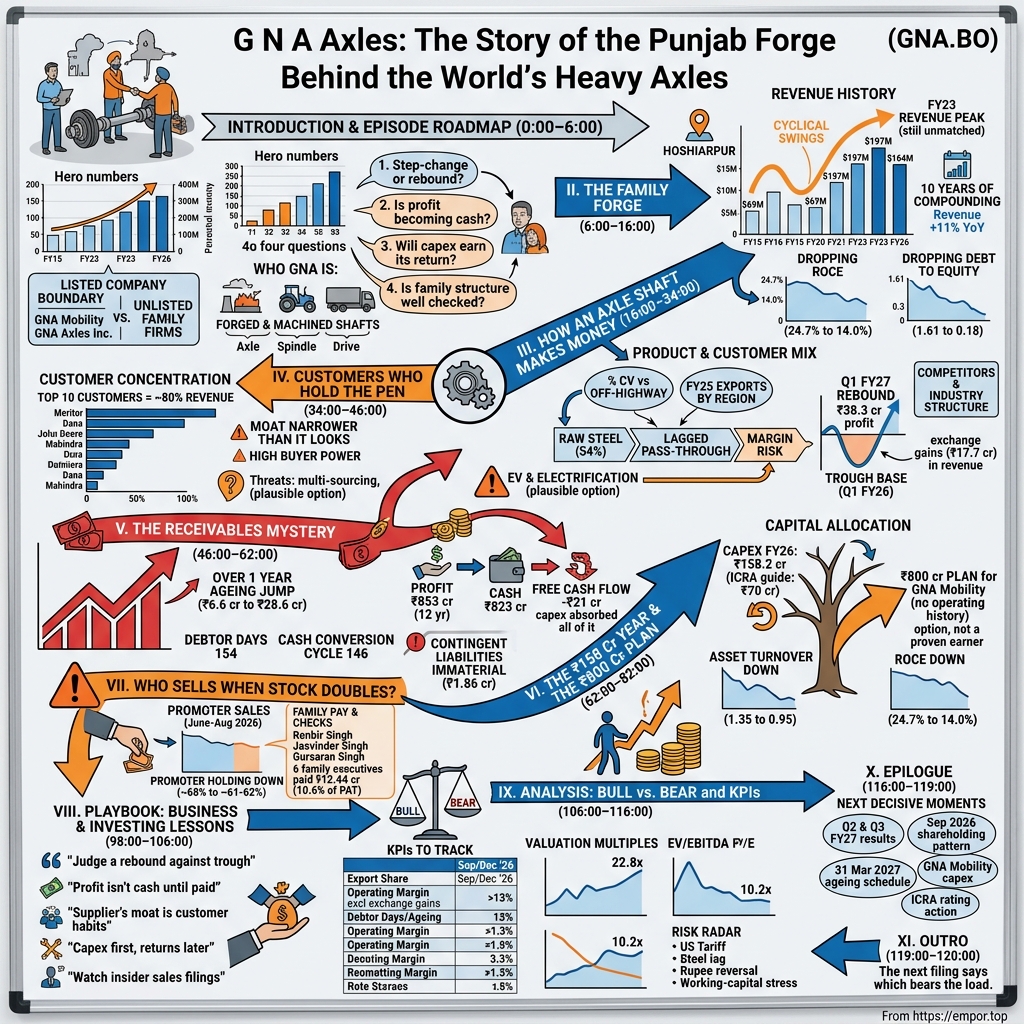
G N A Axles: The Story of the Punjab Forge Behind the World's Heavy Axles
I. Introduction & Episode Roadmap
In the summer of 2026, two pieces of news about G N A Axles came out within weeks of each other. They pointed in opposite directions.
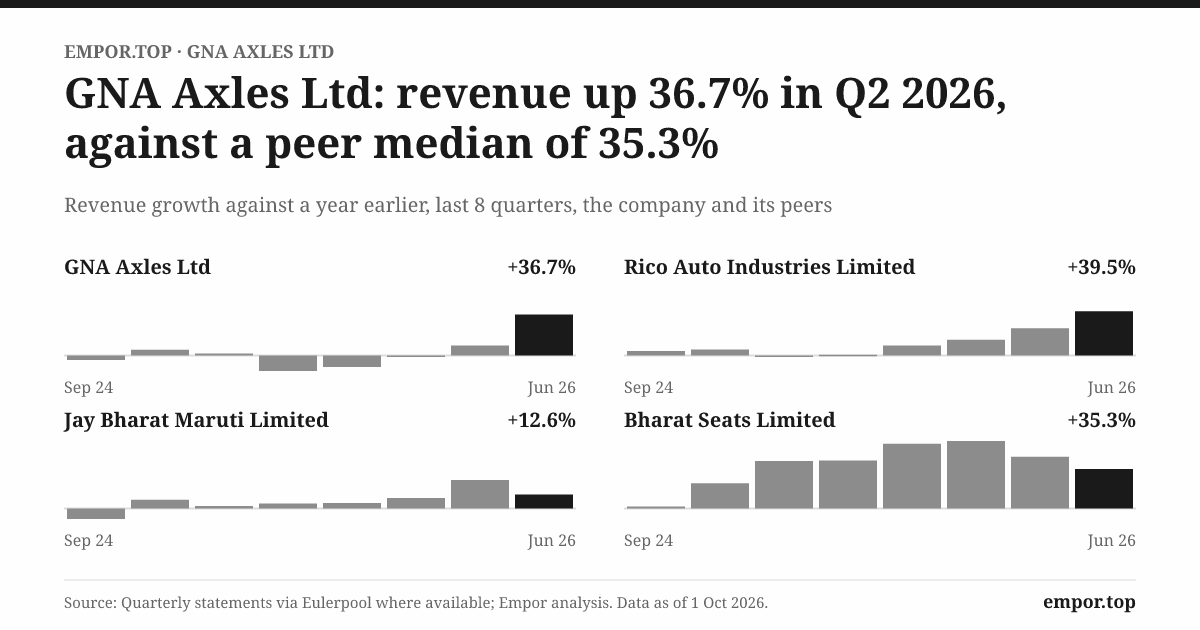
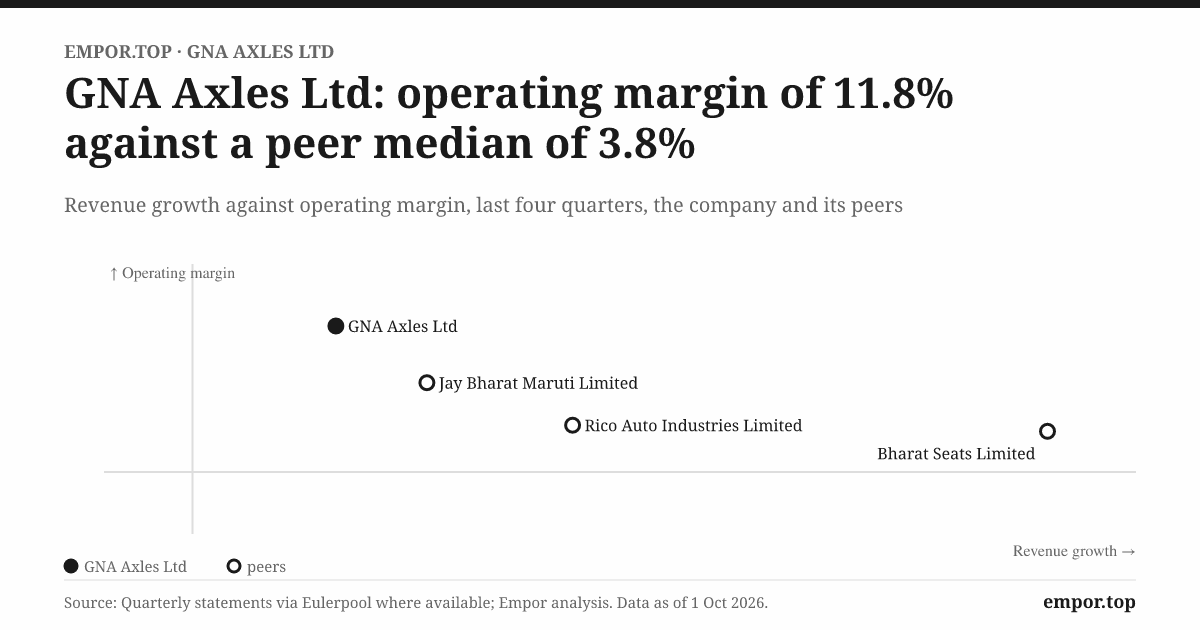
The first was a results release. For the quarter to June 2026, the Punjab axle-shaft maker reported standalone net profit up 66.5% from a year earlier, to ₹38.3 crore, on revenue up 36.6% to ₹470 crore.1 It was the best quarter the company had ever reported. The release said EBITDA margin was 15.4%, a level that a forging shop on the road between Jalandhar and Hoshiarpur rarely reaches.1
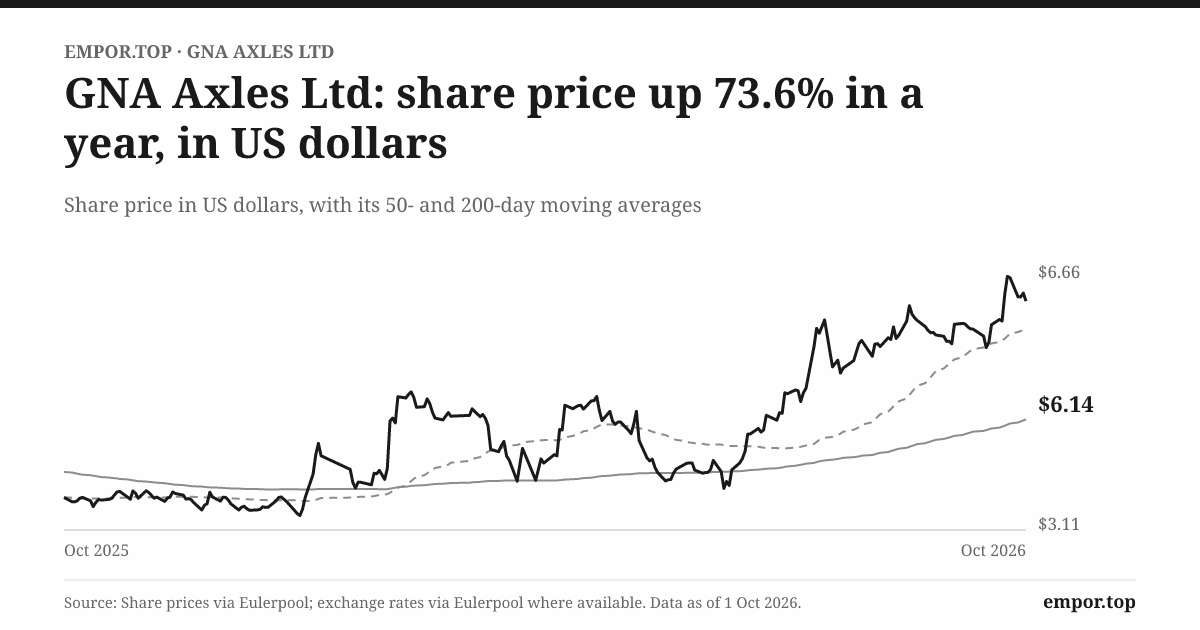
The second came through stock-exchange disclosures. Over six trading days in late June, Maninder Singh, a member of the promoter family, sold about 11.4 lakh shares into the market for roughly ₹48.6 crore.2 He kept selling in July and August.2 The shares he was selling were among the hottest in Indian auto components. GNA's market value was about ₹1,531 crore at the end of March 20263 and about ₹2,538 crore by 1 October.4 In six months the stock rose roughly two-thirds.
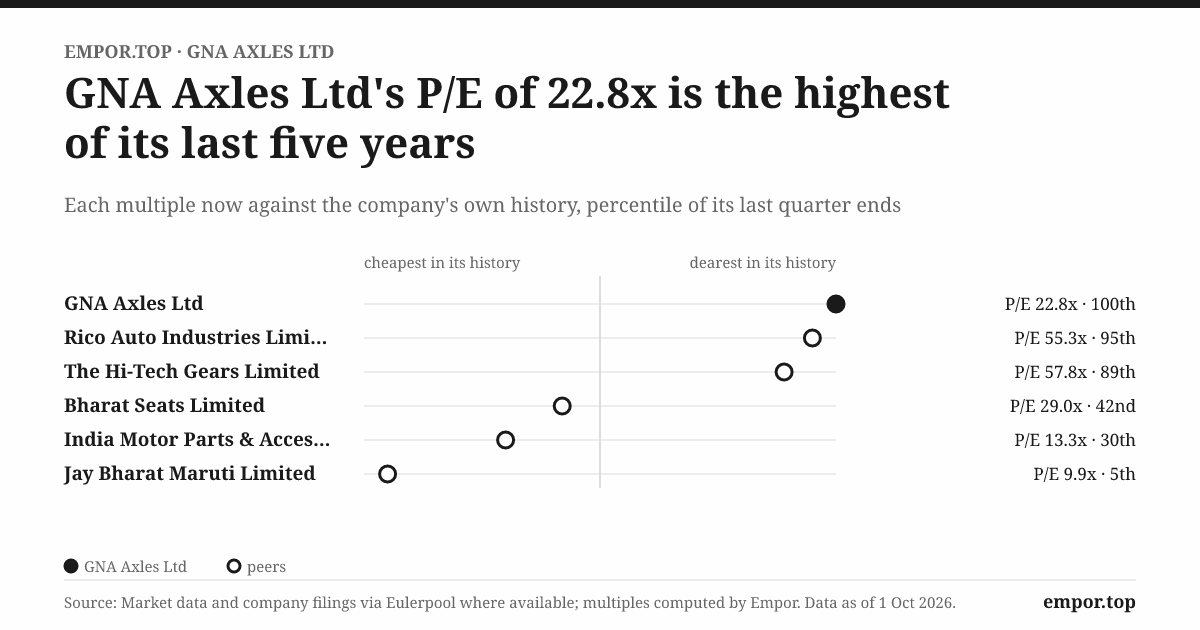
So one side reported a record quarter while a family member was taking money off the table. That tension runs through this story. The market now values GNA at about 22.8 times trailing earnings, against a five-year median of about 14.1 times.4 Investors who paid 14 times were buying a cyclical forging shop. Investors paying 23 times are buying something closer to a compounder. The question is whether the business has changed enough to justify the change in price.
First, what GNA actually is. G N A Axles Limited was incorporated in 1993 and is run by the Singh/Seehra family. It forges and machines rear-axle shafts, spindles and drive shafts at plants in Mehtiana, Hoshiarpur district, Punjab.5 Its customers make trucks, buses, tractors and off-highway machines. In recent years it has also started supplying SUVs.5 The company listed in September 2016 and trades on the BSE under code 540124 and on the NSE as GNA.56
One boundary matters before going further. The family owns a cluster of unlisted businesses with "GNA" in the name: GNA Gears, GNA Drivelines, GNA Transmission (Punjab), GNA Investment, Amarson Automotive, and partnership firms such as GNA Sons, GNA Duraparts and GNA Autotech.3 None of them is part of the listed company. Any "GNA Group" figure for capacity, headcount or revenue describes the family, not the shares on the exchange. The listed company has two wholly owned subsidiaries, GNA Mobility Ltd and GNA Axles Inc. in Michigan. At 31 March 2026, both were yet to start business.3 For now, the listed entity's consolidated and standalone accounts are effectively the same thing.
The story is organised around four questions.
First: is the June 2026 quarter a step-change or a rebound? A 36% jump looks very different measured against a long trend than against the worst quarter in years.
Second: is profit becoming cash? GNA has reported profits steadily for a decade. Its customers have also taken longer and longer to pay.
Third: will the capex earn its return? The company spent more on plant in FY26 than in any recent year, and its board approved an ₹800 crore plan for a subsidiary that has not yet made anything.
Fourth: is the family structure well checked? Half of the board are family executives, a family member is selling, and some shares are encumbered.
None of these is answered in this opening. The answers are in the details: steel prices, debtor ledgers, sourcing reviews in Michigan and Brazil, and a shareholding pattern due on the exchange in the coming weeks. The story starts in Punjab, where an unglamorous part became a business worth a few thousand crore.
 Subscribe on LinkedIn
II. The Family Forge: From Hoshiarpur to a ₹1,500 Crore Supplier
Hoshiarpur sits in the Doaba belt of Punjab, between the Beas and Sutlej rivers. The region is known for its farms and for the remittances its families send home from abroad. It is not known for heavy industry. In 1993 the Singh family incorporated a company there to make one of the least glamorous parts of a vehicle: the long steel bar that carries torque from the differential to the wheel.5
An axle shaft is easy to overlook and hard to replace. A forging press shapes a heated steel billet into the flanged end. Machines turn, drill and spline it. Induction heat treatment hardens the surface so it can twist under a loaded truck for hundreds of thousands of kilometres without cracking. If a shaft fails, the vehicle stops, and on a highway that can be dangerous. That is why commercial-vehicle and tractor makers qualify their suppliers carefully and change them reluctantly. GNA started with tractor shafts for Punjab's own farm-equipment market. It then moved into heavier and more demanding work: commercial-vehicle rear axles, off-highway equipment, and eventually exports to the global axle majors.5
The company is still run by the family that started it. Gursaran Singh is Executive Chairman. Jasvinder Singh is Executive Vice Chairman. Ranbir Singh is Managing Director and CEO, and the largest individual shareholder.3 By March 2026, Ranbir Singh held about 36.2% of the company and Jasvinder Singh about 15.0%.3 This is a family company in the full Indian sense. The people who own it also run the plant, sign the customer contracts, and personally guarantee the bank debt.3
The 2016 IPO gave the family outside capital and public scrutiny. Its most visible effect is on the balance sheet. In FY15, borrowings were about 1.6 times equity. By FY17, after the listing, that ratio was about 0.4.3 It has kept falling, to about 0.18 at March 2026.4 This is not a business that gets through downturns with borrowed money.
What growth has looked like. The decade after listing is the base rate for every recent number in this story. Over ten years, revenue grew about 11% a year in rupees and net profit about 16% a year.4 In dollars, revenue went from about $69 million in FY15 to a peak of about $197 million in FY23.4 That is a real record. It is about what a well-run Indian component supplier with exports should achieve, though not a startup's growth curve.
The record has also been uneven. Revenue fell in FY20 and FY21 during the CV downturn and the pandemic. It rose 43% in FY22 and another 25% in FY23 as global truck demand recovered.4 Since then, the three-year trend has been slightly negative, at about −3% a year for both revenue and profit from the FY23 peak.4 FY26 revenue was about $164 million, and the last twelve months come to about $177 million.4 The peak year has not been beaten. Even after the record quarter, trailing revenue is still below FY23.
Returns tell a quieter story. Return on capital employed was about 24.7% in FY23. By FY26 it was 14.0%. Return on equity fell from about 18.2% to 11.6% over the same period.4 Some of this is the cycle: a lower-revenue year earns less on fixed plant. Some of it is the company's own choice to expand capacity before demand arrived. That second cause comes back in Sections VI and VII.
Before the IPO-era deleveraging, the record shows only a small amount of equity activity. Paid-up capital is 4.293 crore shares of ₹10 each, and it did not change during FY26. There was no preferential allotment, private placement or public issue that year.3
The verdict for this section is about calibration. GNA's long-run growth rate is about 11% a year, and the swings around it are large. Any quarter, including a record one, has to be read against that. Doing so requires understanding how a piece of steel becomes profit.
III. How an Axle Shaft Makes Money
Picture the factory floor in FY26, the worst year in the recent record. A US tariff regime had reached Indian auto components, and American trucking was in a freight recession. Fleets that would normally have ordered new Class 8 tractors held off. GNA's export orders shrank. Over the year, exports fell about 19% to roughly ₹679 crore.3 On the other side of the plant, Indian farmers were buying tractors, and domestic sales rose about 13.9% to roughly ₹766 crore.3 Total revenue from operations ended near ₹1,478 crore, down about 4%.3 Even so, profit after tax rose 9.2% to about ₹117 crore.3
How does profit rise when revenue falls? The answer is in how the business is built.
The pricing unit. GNA sells individual parts to vehicle makers and Tier-1 axle assemblers. The largest cost is steel, about ₹792.5 crore in FY26, or roughly 54% of revenue.3 Contracts pass steel costs through to customers, but with a lag.7 When steel prices rise, GNA pays more first and recovers the cost months later. When they fall, it gains for a while. This is a conversion-margin business. GNA is mainly paid for turning steel into a finished, hardened, machined shaft. The lag is where margin is most at risk, and it explains some of the quarter-to-quarter noise.
Think of a tailor whose fabric is supplied at cost. The customer pays for the cloth and also pays for cutting, sewing and fitting. The tailor's real income is the stitching fee. If the cloth price changes before the bill is settled, the tailor carries the difference for a few weeks.
The mix. Commercial vehicles account for about 65% of revenue, and off-highway applications, mainly tractors, account for most of the rest.7 Exports were about 56% of revenue in FY25 and fell to about 46% in FY26.73 By region in FY25, Asia took about 48% of exports, North America 23%, South America 16% and Europe 12%.7 The Americas have historically been 25–30% of exports, and Mexico alone has been 5–7% of revenue.7 GNA does not publish profit by segment or by geography. That means nobody outside the company can say whether a tractor shaft for Mahindra earns more or less than a truck shaft shipped to a Dana plant in Brazil.
Competition. GNA operates in a crowded field. Global axle and driveline groups make some shafts themselves. Other Indian forgers compete for the same export programmes. Chinese forgings set the global price floor. The company does not publish its market share, and there is no reliable independent measure of it. Peer comparisons on cost position or scale have to come from those peers' own filings. Without them, claims about GNA's relative size would be guesses.
The trough and the bounce. The quarterly record shows how flat the business was before June 2026. For three years, revenue stayed between about $40 million and $49 million a quarter, and operating margin stayed between about 9% and 13%.4 The quarter to June 2025, the base for the latest comparison, was one of the weakest. Revenue was about $40.2 million, down nearly 14% from a year earlier, and profit was about ₹23 crore.41 Then came June 2026: revenue of about $49.7 million, the highest quarter in the series.4
So which is it? Three points suggest a rebound.
The base was a trough. A 66% profit increase over the weakest quarter in years tells you less than the headline suggests. It mostly says the business returned to its normal level and then went a bit further.
Currency helped. In FY26, GNA booked about ₹17.7 crore of foreign-exchange gains inside operating revenue, up from about ₹7.2 crore in FY25.3 That equals roughly 11% of the year's profit before tax. Add about ₹13.2 crore of duty drawback, and export incentives plus currency make up a noticeable share of what looks like operating margin.3
Quarterly margin quality is unproven. The 15.4% EBITDA margin in the June quarter is impressive.1 It does not show how much of it came from currency, steel timing, or genuine operating leverage on a fuller plant.
Currency exposure. In FY26, GNA earned about ₹678.7 crore in foreign exchange and spent about ₹61.7 crore, leaving it net long by roughly ₹617 crore, mainly in dollars and euros.3 The only hedging facility shown in its credit file is a ₹9 crore forward-contract limit.7 The company does not disclose a written hedging policy. A weaker rupee has been helping profits. If the rupee strengthens, that help will go away.
Myth vs reality. Myth: GNA is a resilient exporter that grows through cycles. Reality: revenue was roughly flat to down from FY23 to FY25 and fell again in FY26. ICRA had expected FY26 revenue to fall 7–10%.7 The business did better than that pessimistic forecast, and the domestic tractor business covered part of the export gap. That is real resilience in profit. It is not growth through a cycle.
The verdict leans toward rebound. A step-change is possible, and the SUV line could be the second growth engine. But that case needs evidence that has not come in yet. The quarters to September and December 2026 will be the first test against more normal bases. The next question is who sets the terms of GNA's business, and the answer is a short list of very large customers.
IV. The Customers Who Hold the Pen
Picture a sourcing review at a global axle maker such as Dana or Meritor. A procurement team spreads a cost model across a conference table. For each programme, they list the shaft, the supplier, the price per unit, steel indexation, freight from Mundra to Houston or Santos, and quality data on defective parts per million. One option on the page is a second supplier for the same part number. Another is a specification change that would allow a cheaper process. The supplier is not in the room.
That is GNA's real competitive situation. Its customers are not just buyers. They write the specifications.
Who they are. GNA names Meritor, Dana (supplying its US, Mexican and Brazilian operations), John Deere India, Mahindra & Mahindra and Automotive Axles Ltd among its customers.73 The top ten customers have provided about 80% of revenue in recent years.7 The company does not disclose any individual customer's share, including any above 10%. Readers cannot tell whether Dana is a quarter of the business or a tenth.
The moat, argued once. The rest of this story refers back to this section.
Buyer power is high. When ten customers provide four-fifths of revenue, each has leverage in price talks. Several of them are large global groups with their own forging capacity or alternative suppliers.
Supplier power is moderated. Steel is the main input, and pass-through clauses move most steel risk to customers, apart from the timing lag described in Section III.7
Switching costs are real but limited. An axle shaft must pass a customer's validation before it goes into production: metallurgy, fatigue tests, dimensional audits and plant audits. Once qualified, a supplier is usually kept for the life of the programme. ICRA notes that GNA is the single-source supplier for certain products.7 This is GNA's strongest advantage. It lasts for the length of a programme, though, not forever. When the next platform is sourced, every incumbent has to compete again.
Scale and cornered resources are thin. GNA is a mid-sized forger. Nothing public shows that its cost per tonne is structurally below Indian or Chinese rivals. It has no proprietary process, patent portfolio or scarce input. The company keeps no separate R&D records.3
Threats are specific. Customers can add a second supplier, move forging in-house, or award new programmes to rivals in China or India.
In Hamilton Helmer's 7 Powers terms, GNA's best claim is switching costs, plus a modest version of process power in heat treatment and machining consistency. It has no evidence of network effects, brand power, counter-positioning or a cornered resource.
Testing the moat. The way to break a supplier moat is substitution: lost bids, forced price cuts, or a customer moving volume elsewhere. GNA's public record shows none of these. The company has not reported any lost programmes, customer exits or bankruptcies, and its rating agency has not flagged any.7 That supports the moat, but the absence of bad news is not proof. The company also does not publish customer-level shares, retention or price realisation. A moat that cannot be measured from outside can only be assumed.
FY26 offers one useful data point. Export revenue fell about 19%, mainly because of US end-demand and tariffs.3 If customers had been moving volume to other suppliers, the fall would likely have been deeper and the domestic side weaker. Instead, profit rose. That suggests GNA kept its position on existing programmes. It does not show that GNA is winning new ones.
The verdict: the moat is narrower than it looks, unproven rather than rejected. Two things would strengthen the claim: operating margin holding at or above the 9–13% range through a full down-cycle, and management naming specific new programme wins on earnings calls. A disclosed lost programme or a margin squeeze after a renegotiation would weaken it.
Electrification. Battery-electric trucks and SUVs still need axle shafts. ICRA's comment that the company could benefit from EV segment growth reflects that.7 Electric drivetrains change torque profiles and sometimes integrate the axle into an e-axle module, which can change what gets sourced and from whom. For GNA this is a plausible opportunity, not a sized one. Nobody has shown how much EV revenue it will bring.
Customers have one more source of leverage beyond specifications and second suppliers: when they pay.
V. The Receivables Mystery: Profit Into Cash
The most important page in GNA's FY26 annual report is a schedule in the notes, not a chart or a chairman's letter.
It lists trade receivables, the money customers owe GNA, at 31 March 2026: about ₹610.9 crore.3 Most of it is recent. About ₹498.5 crore was less than six months old, and about ₹83.8 crore was six to twelve months old.3 Below that sit the older buckets: about ₹24.7 crore aged one to two years and about ₹3.9 crore aged two to three years.3 A year earlier, everything older than a year came to about ₹6.6 crore. Now it is about ₹28.6 crore, more than four times as much.3
Every rupee of it is classified as "considered good". No receivable is marked disputed or doubtful, and the company discloses no expected-credit-loss provision.3 The expense for unrecoverable amounts was nil in FY26.3
The puzzle. GNA has been profitable for a decade. Is that profit arriving as cash?
Clue one: the long view looks fine. From FY15 to FY26, net profit added up to about ₹853 crore and cash from operations to about ₹823 crore, about 96% of profit.4 Over twelve years, the earnings have largely turned into cash. This is not a company whose profits disappear.
Clue two: none of it was left over. Over the same twelve years, free cash flow, meaning operating cash minus capital spending, added up to about −₹21 crore.4 Plant expansion consumed everything the operations produced. Dividends of about ₹67.8 crore over the period were paid out of a business that produced no surplus cash, and so in effect were funded by borrowing and operating cash rather than spare money.4
Clue three: customers pay slowly, and more slowly over time. Debtor days, receivables expressed as days of revenue, were about 107 in FY15 and about 154 in FY26.4 The full cash conversion cycle has roughly doubled, from about 76 days to about 146.4 Working-capital days have gone from about 19 to about 136.4 Over a decade, GNA's growth has been financed more and more by tying up cash in customer credit.
Clue four: FY26 relied on suppliers. FY26 looked like a good cash year. Cash from operations was about 91% of EBITDA, the best in a decade, against about 43% in FY25.4 Look at how it was produced. Standalone operating cash flow was about ₹213.9 crore, helped by a ₹91.5 crore increase in payables and other current liabilities, which more than offset a ₹54.1 crore build in inventory.3 Days payable went from about 53 to about 96.4 GNA got paid slowly by customers and in turn paid its own suppliers more slowly. That kind of cash improvement can reverse in a single year.
Why the cycle is so long. Part of the answer is structural. Exports travel by sea for weeks, and global axle makers impose long payment terms. ICRA estimates net working capital at about 40% of operating income.7 That explains a high level of receivables. It does not explain why balances older than a year quadrupled in twelve months, or why none of them carries a provision. One possibility is that a single export customer is in a dispute or slowed its payments during the US freight recession. That is speculation, because the company does not say which customer is involved.
What the cash is not. This is not a treasury story. Other income was about ₹3.0 crore in FY26, mostly interest, which is under 2% of pre-tax profit.3 The more relevant items are the currency gains and drawback described in Section III, which sit inside operating revenue. Contingent liabilities are small, about ₹1.86 crore in total, mostly disputed Punjab VAT and GST reverse-charge demands from years ago.3 The auditor, G.S. Syal & Co., issued a clean opinion and reported no default on borrowings and no fraud.3 Neither the legal record nor the audit record suggests a hidden problem.
The verdict. Over a decade, the profit is real and it has turned into cash. But free cash is zero, FY26's conversion was helped by stretching suppliers, and the aged receivables need an explanation that the filings do not give. This is the main earnings-quality question at GNA. The test is the ageing schedule at 31 March 2027. If balances older than twelve months shrink, and payable days fall back without operating cash dropping well below 60% of EBITDA, this was a temporary problem. If those balances grow again, the "considered good" label will be hard to keep.
If all the free cash went into capex, the next question is what that capex bought.
VI. The ₹158 Crore Year and the ₹800 Crore Plan
In January 2026, GNA's rating agency wrote down its expectation for the year's capital spending: about ₹70 crore for FY26, then ₹100–110 crore for FY27.7 When the year closed in March, the cash-flow statement showed about ₹158.2 crore, more than double that estimate.3 It was about 10.7% of revenue, up from about 7.2% the year before.3
The board then went further. It approved an ₹800 crore investment plan for GNA Mobility Ltd, a wholly owned subsidiary that had not yet started business, along with an initial ₹25 crore equity infusion.31 For comparison, ₹800 crore is more than half of GNA's annual revenue and about a third of its current market value. The plan was approved in a year when revenue fell and exports dropped by a fifth.
What the money has bought. Gross capacity has clearly grown. Property, plant and equipment, including work in progress, rose from about ₹405.6 crore to about ₹493.6 crore in FY26.3 Depreciation went from about ₹57.1 crore to about ₹70.0 crore.3 The only new business line with a public start date is the SUV plant, which began production in 2023.7 It is the one real proof point for the diversification strategy. The company does not report its revenue or margin separately.
What it has not yet bought. Returns. Asset turnover, revenue per rupee of assets, fell from about 1.35 in FY23 to about 0.95 in FY26.4 Return on capital employed fell from about 24.7% to 14.0% over the same period.4 Part of that is the cycle, because FY26 revenue was depressed. Part of it is that new capacity has not been filled. The numbers cannot separate the two, which is why FY27 matters so much.
No deals to judge. GNA has made no acquisitions in its listed history, so there is no purchase price to compare with peers and no write-down history to examine. The capital-allocation test is internal: do the new lines earn what the old forging lines earned at their best? The company's own record from FY18 to FY19 and FY22 to FY23 shows that a full plant can earn more than 20% on capital employed.4 If the expansion brings returns back toward that range, the spending was well judged. If ROCE settles in the low teens, the company will have grown without creating much value.
Funding. Total borrowings fell in FY26 to about ₹218.1 crore from about ₹259.3 crore.3 The mix changed in a notable way. Working-capital and packing-credit lines, repayable on demand, fell from about ₹143.2 crore to ₹88.2 crore. Borrowing from Bajaj Finance, a non-bank lender, rose from about ₹60.4 crore to about ₹100.7 crore.3 Bank term loans were about ₹29.2 crore.3 The lending is secured by the company's assets and the personal guarantees of the promoter directors.3 NBFC money usually costs more than bank money and comes with different terms. It is a reasonable choice for capex funding, but it is not a sign of excess cheap credit.
The credit metrics remain comfortable. ICRA reaffirmed GNA at AA- (Stable) on ₹390 crore of bank facilities in January 2026, with A1+ on short-term lines.7 Debt to operating profit before depreciation was about 0.9x in the first half of FY26, and interest coverage about 17x.7 The company's own debt-service coverage ratio for FY26 was 4.22x. That is below the roughly 6x ICRA expected and down from 6.55x in FY25, but well above the 2.5x level that would trigger a downgrade.73 No new equity was issued in FY26.3 The balance sheet can carry the plan.
Certification is not commercialisation. GNA Mobility has no operating history, no published product roadmap with revenue targets, and no customers named in public filings. The parent keeps no separate R&D records.3 The ₹800 crore plan is best treated as an option on a larger business. It is not yet an engine already running. Neutral framing is appropriate. Being able to forge a shaft for an SUV does not prove anyone will buy enough of them to earn a return on ₹800 crore.
A small team. GNA had 1,702 permanent employees at 31 March 2026.3 That is a lean base for nearly ₹1,500 crore of revenue, and it shows how automated a modern forging and machining line is. It also means the ₹800 crore plan will need significant hiring and management capacity from a family-run organisation.
The verdict: the company is investing, not harvesting, and the evidence of returns is thin. The settling numbers are FY27 ROCE against FY26's 14.0%, and the first full-year contribution of the SUV and new lines if management chooses to disclose it. The family is spending heavily on the company's future, and at the same moment one family member has been selling shares.
VII. Who Sells When the Stock Doubles? Family, Pay and Checks
The selling began on 18 June 2026. Over six trading days, Maninder Singh sold about 11.4 lakh GNA shares, roughly 2.65% of the company, for about ₹48.6 crore.2 His holding fell from about 10.6% to about 7.95%.2 In July he sold another chunk of about 1.1%. In August he sold 4.18 lakh shares, and then another 4.48 lakh in the week of 18–24 August, ending at about 3.69%.2 Within a single season, one of the five largest family holders sold about two-thirds of his stake.
Where ownership stands. At 30 June 2026, the promoter group held 65.78%, down from 68.43% at the previous quarter-end.4 Mutual funds held about 11.4% and foreign institutions about 1.7%, both slightly higher.4 Adding the July and August sales implies promoter holding somewhere around 61–62% by late summer. That is arithmetic from the individual disclosures, not a reported number, so the September shareholding pattern will confirm or correct it. Separately, an annual disclosure filed on 7 April 2026 showed about 12.8 lakh shares, roughly 3% of equity, encumbered across promoter and promoter-group names, including GNA Gears Ltd.8 The lender and purpose were not stated.
No reason has been given for the sale. Family members sell shares for many ordinary reasons, including estate planning, diversification, and funding other businesses. The disclosures do not say which applies here.
Control is not at risk. Ranbir Singh and Jasvinder Singh together hold more than 51%.3 The seller is one branch of the family, not the controlling one.
The people in charge. Ranbir Singh, the Managing Director and CEO, is both the largest owner and the operating leader. He was paid about ₹3.24 crore in FY26.3 Jasvinder Singh, the Executive Vice Chairman, received about ₹3.11 crore, and Gursaran Singh, the Executive Chairman, about ₹2.86 crore.3 Three more family whole-time directors received about ₹1.0–1.1 crore each.3 Altogether, six family executives received about ₹12.44 crore, up 7.5% while profit rose 9.2%. That is about 10.6% of net profit.3 The CEO's pay is about 169 times the median employee's.3 Contracts carry six months' notice and no severance, and no separate bonus is shown.3 Pay is high relative to the company's size, but it has moved with profit rather than ahead of it.
Credibility as behaviour. Over FY26, the record shows stability. There was no change in key managerial personnel. CFO Rakesh Gupta and Company Secretary Gourav Jain stayed in place.3 Shareholders raised almost no objections. At the 30 June 2026 AGM, 31.68 million valid votes were cast and 51 were against on each resolution.6 The auditor's report was clean.3
The most useful credibility test, promises against outcomes, is harder to apply. GNA does not publish formal annual guidance. The nearest benchmarks are ICRA's expectations, which were missed in both directions: capex came in at twice the estimate, revenue fell less than feared, and DSCR came in below the expected level.7 Guidance discipline cannot be graded from public documents alone. The best evidence would be a comparison of management's statements on successive earnings calls about the tariff impact, the SUV ramp and the receivables build.
Related parties. The annual report lists more than a dozen related family businesses, several in the same forging and machining chain as GNA. The only amounts shown against them are remuneration to directors, key managers and one relative.3 The corporate-governance report says there was no "materially significant" related-party transaction, and the auditor confirms compliance with the Companies Act's related-party sections and that no loans or advances went to related parties.3 Whether the family firms do no business with the listed company at all, or do business below the disclosure threshold, cannot be determined from the annual report.
The board. After independent director Jasminder Singh Johal retired in June 2025, the board had six independent directors and six executive directors, all from the family.3 That meets India's rules for a board with an executive chair. It is still a board where family members hold half the seats.
The skeptic's stress test. An activist reviewing GNA would raise four points. Debt is guaranteed by promoters personally, which links the family's own finances to the company's lending. An increasing share of borrowing comes from an NBFC. Group firms in the same supply chain have no disclosed transaction values. And a family member sold into a sharp rally while the company committed ₹800 crore to a new subsidiary. That is the bear reading.
The benign reading also holds up. Promoter guarantees are standard for Indian mid-caps, NBFC term money is a common capex tool, the auditor found no related-party breaches, and one sibling's diversification says little about the controlling holders' view. Both readings fit the facts. The verdict: the structure is intact but lightly checked. The audit committee's view of the receivables ageing, the half-yearly related-party filing, and whether the selling stops in the September shareholding pattern will show which reading is closer.
VIII. Playbook: Business & Investing Lessons
"Judge a rebound against the trough, not the trend." GNA's June 2026 quarter produced headlines about 66% profit growth. It was measured against a quarter when US tariffs and a freight recession had pushed profit down to about ₹23 crore. A record quarter after a trough is a recovery until the following quarters show it is something more. The lesson applies to every cyclical supplier: check the comparison quarter before reacting to the growth rate.
"Profit isn't cash until the customer pays." GNA reports steady profits and gives customers about five months to pay. In FY26 the receivables older than a year quadrupled, and every rupee was labelled "considered good". For a supplier with long export cycles, the receivables ledger matters more than the income statement. The ageing schedule tells you more than the headline profit.
"A supplier's moat is its customers' habits, and habits can change." Being the single qualified supplier for a Dana or Meritor shaft is valuable because a buyer does not change it lightly. With ten customers providing four-fifths of revenue, though, the same buyers who keep GNA in place also decide its price at every new programme. For an Indian component maker, qualification is the start of the advantage, not a guarantee of it.
"Capex first, returns later, and 'later' needs a date." GNA doubled its capex beyond what its rating agency expected and then approved a plan worth a third of its market value. Meanwhile, asset turnover and ROCE fell. Building ahead of demand is how forgers grow. The investor's job is to set a date by which returns should recover and to check the numbers when that date arrives.
"When insiders sell into a rally, read the next filing, not the first." A single block sale by a family member can mean many things. A run of sales over four months is a pattern. What matters is the next shareholding pattern: whether the selling stopped, spread to others, or came with an explanation.
Capital allocation in brief. No acquisitions, so no failed deals to write down. About ₹158 crore of organic capex in a weak year. A dividend payout of roughly 8–13% of profit in most years. Debt kept low. That is a conservative, organic, reinvestment-led record. Whether it was a good one depends on returns that have not yet been reported.
IX. Analysis: Bull vs. Bear and the KPIs
The share price rose about 66% in six months while FY26 earnings grew about 9%.34 Most of the gain came from a higher multiple, not higher profits. The market is paying more for each rupee of earnings because it expects more rupees in future.
What the price assumes. At 1 October 2026, GNA traded at about 22.8 times trailing earnings, about 2.5 times book value, about 10.2 times EV/EBITDA and about 14.3 times EV/operating profit.4 The earnings yield is about 4.4%. The free-cash-flow yield is about −0.7%.4 Return on invested capital in FY26 was about 9.9%.4 The price assumes that the June quarter is the new run-rate, that new capacity will push returns back toward FY23 levels, and that the receivables will be collected. Peer multiples for Indian forging and axle-shaft makers are not compared here. Without them, it is unclear whether GNA's re-rating is specific to the company or part of a sector-wide move.
The bull case. GNA just reported its best quarter. It has a second domestic growth driver in tractors, and SUVs offer a third. It has an AA- rating, debt at about 0.18 times equity, and DSCR above 4x.47 It has compounded revenue at about 11% a year for a decade, owner-managers with large stakes, and qualification positions that are hard to dislodge. If the SUV lines fill and US trucking recovers, operating leverage on the expanded plant could push ROCE back above 20%. That would make today's multiple look reasonable.
The bear case. Three-year growth is negative. ROCE has fallen about 11 percentage points in three years. Free cash over twelve years is negative. Currency gains and export incentives support reported margins. Customer concentration is high, and the receivables ageing is getting worse. US tariffs and the CV cycle are still live risks. The stock has fallen as much as 58% within the past five years and its one-year volatility is about 46%.4 Buying at twice the historical multiple a business whose returns are falling leaves little room if the June quarter turns out to be the peak.
The Porter and Helmer analysis is in Section IV: high buyer power, steel pass-through, switching costs that last for a programme, and no clear scale or cost advantage. That analysis supports neither a premium multiple nor a deep-value one.
The risk radar, material items only.
US tariffs and the CV cycle. The mechanism is export volume. FY26 showed that a US slowdown can remove a fifth of export revenue in one year.
The steel lag. The mechanism is margin. A sharp move in steel prices goes straight into a quarter's conversion margin before pass-through catches up.
A rupee reversal. The mechanism is currency gains, which reached about ₹17.7 crore in FY26 and would turn into a drag if the rupee strengthened.
Working-capital stress. The mechanism is aged receivables combined with stretched payables. If payables normalise while debtors stay high, operating cash will fall.
Execution on the ₹800 crore plan. The mechanism is capital tied up in a subsidiary without operating history, managed by a small family team.
The KPIs that matter. Three numbers capture most of the investment case.
Export revenue and its share of sales in the September and December 2026 quarters. The share fell from about 56% to about 46% between FY25 and FY26.73 A recovery toward the higher level would support the rebound-plus thesis.
Debtor days and receivables older than twelve months. Debtor days were about 154 at FY26, up from about 107 a decade earlier. Receivables older than a year rose from about ₹6.6 crore to about ₹28.6 crore.43 Both are heading the wrong way.
Return on capital employed. ROCE was 14.0% in FY26, down from 24.7% in FY23.4 This is the measure that will show whether the capex spending is working.
What to listen for. The most useful comparison is between management's prepared remarks and the analyst Q&A on the Q4 FY26 and Q1 FY27 calls. The topics to watch are how management describes the tariff damage and recovery, what share of the June margin came from operations rather than currency, the SUV ramp, the old receivables, and whether anyone asks about the promoter-group sales. Evasive answers on the last two would tell investors as much as clear ones.
The verdict for this section is neutral. The bull case rests on real growth in one quarter and a strong balance sheet. The bear case rests on cyclicality, weak free cash flow, concentrated customers, and a multiple that rose while returns fell. The next few months will produce evidence on both.
X. Epilogue
As of 1 October 2026, the stock sits about 5% below its 52-week high of about ₹620.4 The September quarter has ended and its results are due within weeks. The September shareholding pattern is due before that.
The shareholding pattern comes first. It will show the actual promoter holding after the summer's sales. If the figure is close to 61–62% and Maninder Singh's selling has stopped, the episode looks like one family member's personal decision. If promoter holding has dropped further, or other family members appear as sellers, the governance question becomes much harder to set aside. Any SAST disclosures in October will give an early signal.
Then the September and December quarters. The base for the September quarter is revenue of about $39.8 million, almost as weak as the June 2025 trough.4 Strong growth against that base would not prove much. The December quarter, against a base of about $42.2 million with a 13.4% operating margin, is a harder test.4 If GNA keeps operating margin above about 13% excluding currency gains in both quarters, the step-change thesis gains its first real support. If margin falls back to 9–10% once currency and the trough base stop helping, June 2026 will look like a peak quarter.
Then the filings investors rarely read. These include the half-yearly related-party disclosure, which will show whether GNA does business with the family's unlisted companies, and the 31 March 2027 receivables ageing schedule, which will show whether the older balances were collected.
Then GNA Mobility. The first capital spending at the subsidiary will show whether the ₹800 crore plan is moving from approval to construction. The first disclosed revenue from the SUV lines will show whether the 2023 plant has started earning.
And ICRA. The agency set its upgrade trigger at debt to operating profit below 1.0x on a sustained basis.7 GNA was at about 0.9x in the first half of FY26.7 An upgrade would confirm that the expansion is being funded sensibly. A spike in borrowing at the subsidiary could reverse that.
Each of the four opening questions has a filing that will help settle it. None of those filings is out yet.
XI. Outro
The story began with two events close together: a record quarter from a forging plant in Punjab, and a family member selling shares after it. Both are real, and neither cancels the other.
GNA's shafts carry loaded trucks across Texas, tractors through Punjab's wheat fields and mining machines in South America. They are built to take years of stress without failing. The company's shares now carry a larger expectation: a doubled multiple, an ₹800 crore plan and a story about a new growth phase. The next quarterly results, shareholding pattern and receivables schedule will show whether the business can carry that expectation.
References
-
GNA Axles Standalone Net Profit Jumps 66.5% YoY in Q1 FY27 — Sahi ↩↩↩↩↩
-
Maninder Singh sells 447,644 GNA Axles shares, stake drops to 3.69% — Scanx, 2026-08 ↩↩↩↩↩
-
GNA Axles Annual Report 2025-26 — G N A Axles Ltd, 2026-05-08 ↩↩↩↩↩↩↩↩↩↩↩↩↩↩↩↩↩↩↩↩↩↩↩↩↩↩↩↩↩↩↩↩↩↩↩↩↩↩↩↩↩↩↩↩↩↩↩↩↩↩↩↩↩↩↩↩↩↩
-
GNA Axles company page, shareholding and results — Screener ↩↩↩↩↩↩↩↩↩↩↩↩↩↩↩↩↩↩↩↩↩↩↩↩↩↩↩↩↩↩↩↩↩↩↩↩
-
GNA Axles website and investor pages — G N A Axles Ltd ↩↩↩↩↩
-
ICRA rating rationale, ratings reaffirmed — ICRA, 2026-01-09 ↩↩↩↩↩↩↩↩↩↩↩↩↩↩↩↩↩↩↩↩↩↩↩↩
-
GNA Axles promoters disclose encumbrance on 12,80,000 shares — Scanx, 2026-04 ↩
 LinkedIn
 WhatsApp
 Reddit
 Hacker News
 Email
Email Kindle
 RSS Feed
 Spotify
 Apple Podcasts
 Amazon Music
 Audible
 YouTube