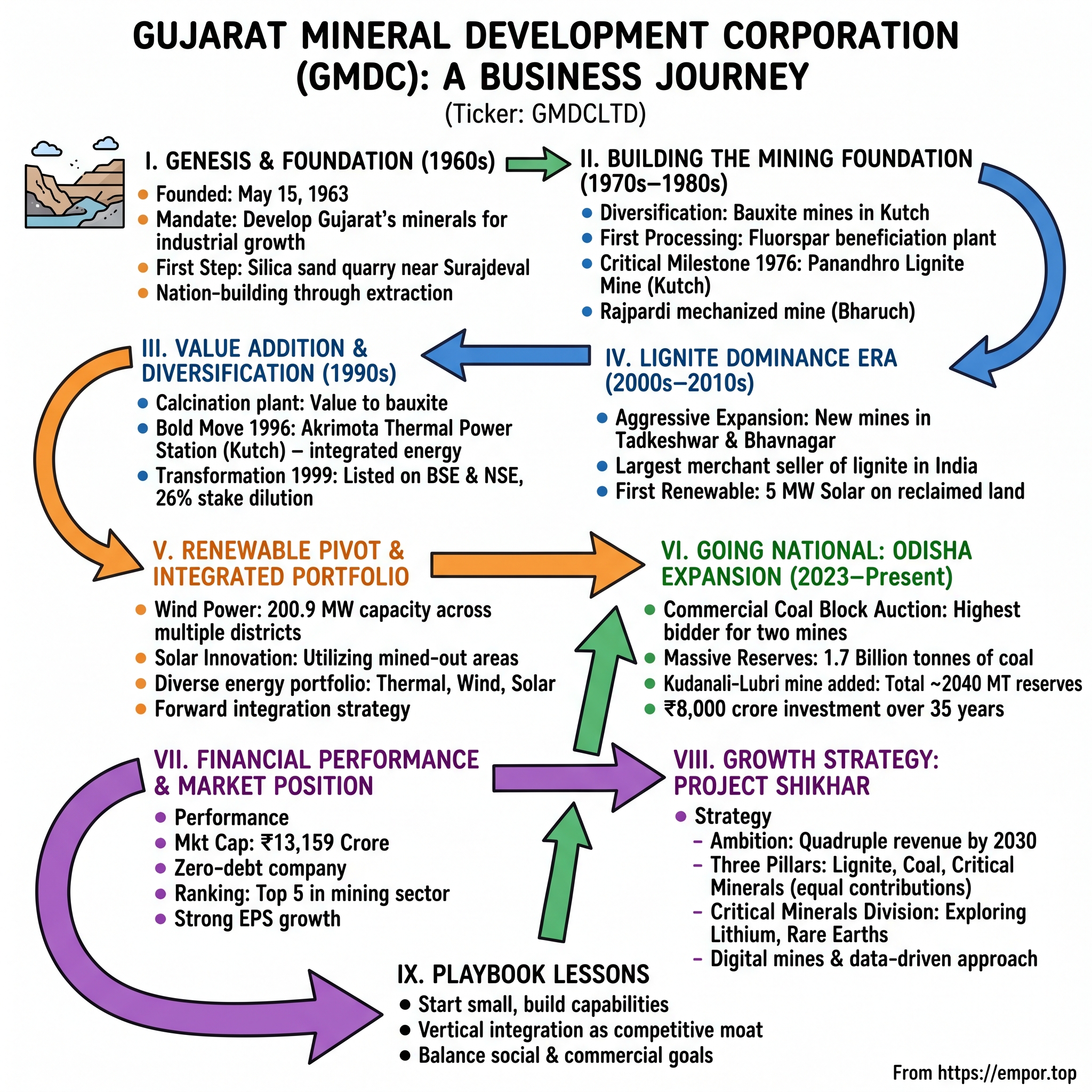
Gujarat Mineral Development Corporation (GMDC): The Cash Machine and the Odisha Frontier
I. Opening & Episode Framework
The Hook: A Brown-Coal Toll Booth on the Edge of the Arabian Sea
Picture a truck yard in Kutch just before dawn. Dozens of trucks idle in queue before a weighbridge, their drivers waiting for dispatch slips. Each flatbed will haul roughly twenty-five tonnes of crumbly, damp, dark-brown fuel eastward toward the ceramic kilns of Morbi, the textile dye houses of Surat, and the chemical plants of Bharuch. The cargo is lignite, a sedimentary rock that barely qualifies as coal: moist, smoky, and possessing too low an energy density to justify long-distance rail haulage. No one has ever called it glamorous. Yet for six decades, this low-grade fuel has underwritten one of India's most unusual listed enterprises.
Gujarat Mineral Development Corporation is a state-owned mining company in which the Government of Gujarat holds a 74% stake, with roughly 2.5 lakh shareholders on its register.1 In late September 2026, its market capitalization sits near ₹17,700 crore. The stock trades around ₹557, approximately 28% below the all-time high of ₹771.50 reached on April 17, 2026.12 The balance sheet carries minimal leverage: borrowings stood at about ₹317 crore as of March 2026 against net worth and reserves of roughly ₹7,000 crore,1 leading CARE Ratings to classify the enterprise as net-debt-free, underpinned by more than ₹2,150 crore in unencumbered cash and liquid investments as of March 2025.3 GMDC regularly returns a substantial portion of its profits through dividends, channeling most of those disbursements straight into the state treasury in Gandhinagar.
The underlying mining engine, however, faces a finite horizon. Lignite has historically generated 85% to 90% of GMDC's operating income, yet as of March 2025, the company's four operating lignite pits held only about 79 to 80 million tonnes of remaining reserves—representing an average mine life of nine to ten years.3 The regional cash machine is steadily running out of extractable ground.
The Central Dramatic Question
Management's proposed solution to resource depletion is to transform GMDC into something it has never been: an interstate thermal-coal miner. Between March 2023 and July 2024, the corporation secured three commercial coal blocks in Odisha, situated more than 1,500 kilometres from its western base. Together, these eastern blocks encompass approximately 2.1 billion tonnes of geological resources.4 Around them, the company established an operational blueprint branded Project Shikhar ("Summit"), targeting ₹14,500 crore in annual revenue by 2030, underpinned by an estimated ₹13,000 crore capital expenditure program.5 By contrast, GMDC's revenue from operations in FY2026 was approximately ₹2,650 crore.6
The central dramatic question is straightforward to formulate but difficult to answer: Can a regional public-sector enterprise, directed by rotating civil servants, successfully export the discipline and margins of a protected home-state monopoly into India's most congested and politically complex coal heartland? Or will classic public-sector friction points—protracted land acquisition, missed capital expenditure schedules, and capital-draining downstream diversions—deplete the surplus that the legacy lignite franchise built?
The Core Paradox
On paper, GMDC has periodically ranked among the most profitable resource extractors in the market. In the quarter ended March 2023, its operating margin peaked at 42%.7 Yet that margin was never entirely under its internal control. GMDC does not dictate energy pricing in western India; imported seaborne coal does. By benchmarking lignite selling prices just below the landed cost of imported thermal coal, GMDC captures an automatic windfall whenever Indonesian coal spikes, and surrenders that premium whenever global benchmarks decline. The high-margin GMDC and the baseline GMDC are the exact same enterprise operating the identical opencast pits; the swing in cash flow originates almost entirely from overseas markets.
The Roadmap
This account unfolds across seven movements. It starts with the post-bifurcation state-building mandate of the 1960s and the 1976 lignite discovery that converted an administrative exploration bureau into an essential energy utility. It then analyzes why low-rank fuel supported an unassailable geographic franchise, contrasted against the power generation and alumina processing ventures that demonstrated the company's operational vulnerabilities beyond the mine mouth. The narrative moves to the 2021–2023 thermal energy windfall, the high-stakes expansion into Odisha, the portfolio option in critical minerals, and the governance mechanisms that dictate capital allocation. It closes with strategic frameworks, bull and bear theses, and the operational milestones that will signal GMDC's long-term trajectory. First, however, lies the historical context: why Gujarat required a state-directed mining enterprise in the first place.
 Subscribe on LinkedIn
II. Genesis & The State-Building Mandate (1963–1980s)
A New State With No Fuel
When Gujarat was carved out of the bilingual Bombay State in May 1960, it inherited merchants, commercial ports, and textile mills, but virtually no indigenous fuel. The new state possessed no metallurgical coal, negligible hydroelectric potential, and no oil yet flowing in the commercial volumes that would arrive in later decades. Gujarat's industrial ambitions—spanning textiles, basic chemicals, salt derivatives, and glassware—depended entirely on energy and raw materials hauled across the subcontinent from the coalfields of eastern India.
The state government's response was institutional. On May 15, 1963, it incorporated Gujarat Mineral Development Corporation to develop the state's mineral resources.89 The founding mandate was modest. GMDC began with a small silica sand quarry, supplying the raw material that feeds glass furnaces and foundries.10 Bauxite mining in Kutch followed in 1964. A fluorspar operation at Amba Dongar in the tribal hills of eastern Gujarat started in 1971, supplied by a beneficiation unit the company had set up in 1968.910
This formative decade established an organizational ethos that still defines GMDC today: it was conceived as a development agency first and a commercial business second. Its remit was to put Gujarat's geology to work for Gujarat's industry, judged on regional economic development rather than return on invested capital. That foundational DNA persists in who manages the company, how its selling prices are determined, and the political rhetoric surrounding its capital commitments.
Consider a recent illustration: when GMDC signed the allocation agreement for its third Odisha coal block in July 2024, the public announcement highlighted development-agency metrics, citing about 40,560 direct and indirect jobs alongside the investment and revenue estimates.11 Managing Director Roopwant Singh has also described GMDC's lignite customers as "smaller MSME players" who are "slightly emotional," noting that the company is "vocal to their needs."5 That is not how a profit-maximizing private miner speaks about its customer base; it is how a state institution addresses a domestic constituency. For public investors, the practical takeaway is clear: GMDC answers to non-financial stakeholders, and those social obligations continue to steer pricing, project selection, and capital allocation.
1976: The Brown Rock Under Kutch
The structural turning point arrived with a geological discovery. Gujarat has none of the ancient Gondwana basins that hold India's prime bituminous coal deposits in Jharkhand and Odisha. What it possesses instead are younger sedimentary basins along its coastline and in the Kutch hinterland. Those formations contain lignite: plant matter that was never subjected to the subterranean heat and pressure needed to convert it into high-rank coal.
In 1976, GMDC opened its first lignite mine at Panandhro in Kutch's Lakhpat taluka.10 A second pit followed at Rajpardi near Bharuch in 1983–84.108 Decades later came Tadkeshwar near Surat in 2005 and a project near Bhavnagar in 2009.10 Each new deposit extended GMDC's reach toward a separate industrial cluster: Panandhro anchored the western frontier, Rajpardi supplied the Bharuch–Ankleshwar chemical belt, Tadkeshwar fed Surat's textile powerhouses, and Bhavnagar served the Saurashtra coast.
From Surveyor to Fuel Supplier
These discoveries transformed the nature of the enterprise. An entity created to quarry silica sand and bauxite evolved into the primary merchant energy supplier for a power-deficit state. Lignite fueled the state electricity utility's thermal stations and powered a burgeoning ecosystem of small and medium-sized factories. Over the decades that followed, fuel sales pushed GMDC's other industrial minerals to the periphery of the income statement. By the 2020s, CARE Ratings described GMDC as India's largest merchant seller of lignite and its second-largest lignite producer overall.3
This origin story also introduced two structural tensions that run throughout GMDC's modern history. The first is depletion: the company's core franchise is a collection of finite open-cast pits, where every dispatched rake or truck brings each pit closer to exhaustion. The second is mission creep: a state-owned enterprise faces persistent pressure to venture beyond extraction into downstream industrial projects—building captive power plants, sponsoring alumina refineries, or championing rare-earth facilities. How GMDC navigated those downstream ventures is explored in Section IV. First, however, it is essential to examine why this low-rank brown fuel became such an extraordinary cash engine.
III. The Lignite Monopoly: Economics of Brown Coal
A Fuel That Cannot Travel
Pick up a lump of Gujarat lignite, and it feels damp to the touch—because it is. Lignite typically carries a large share of its weight as embedded moisture. It burns with high volatile matter and delivers far less thermal energy per kilogram than the bituminous steam coal arriving by ship from Indonesia or South Africa. On GMDC's May 2025 earnings call, Managing Director Roopwant Singh pegged the company's lignite at roughly 3,500 kilocalories of gross calorific value, contrasting it with the Odisha thermal coal GMDC had secured, which he described as "G11, G12" grades of "4,000 calories plus."5
That modest energy density means every dispatched truck carries significant quantities of water and non-combustible ash alongside usable carbon, causing freight costs per unit of effective heat to climb steeply with distance. Lignite is also notoriously prone to spontaneous combustion if stockpiled carelessly. The resulting commercial reality is that brown coal is economical only within a narrow radius of where it is extracted. That single physical constraint explains the core of GMDC's economics: the company does not compete in a national fuel market; it competes for the boiler rooms within immediate trucking distance of its opencast pits.
Who Buys It
The buyers are predominantly the small and medium-sized enterprises anchoring Gujarat's manufacturing belts. Credit rating reports from CARE describe a customer base spread across textiles, steel, cement, power generation, and other industrial sectors. GMDC sells strictly on advance payment or against letters of credit, extending credit terms only to state utilities such as Gujarat Urja Vikas Nigam.3 That customer profile, however, has grown increasingly concentrated: the top ten buyers accounted for about 16% of operating income in FY22 and rose to roughly 25% by FY25.73
For a textile processor in Surat or a ceramic tile manufacturer in Morbi, the appeal is intensely practical. These smaller enterprises cannot commit to long-term seaborne import contracts or marshal the volume required to book dedicated railway rakes from Coal India's eastern coalfields. They require fuel delivered by truck, in flexible lots, on short notice. GMDC's merchant dispatch network caters directly to those operational needs. Management reports that the enterprise supplies more than 25% of Gujarat's aggregate lignite demand.3 That figure is instructive because it qualifies the popular perception of GMDC as an absolute monopoly: it is the dominant merchant supplier of indigenous Gujarat lignite, but far from the sole source of industrial heat in the state.
How a Factory Owner Chooses a Fuel
To understand the business, one must think like an industrial boiler operator. A ceramic tile manufacturer in Morbi has no sentimental attachment to domestic brown coal, imported Indonesian coal, or petroleum coke. The decisive metric is the delivered cost per unit of thermal energy, adjusted for handling expenses, ash disposal logistics, and boiler metallurgical tolerances. Seaborne coal arrives at Gujarat's commercial ports with a known price per tonne and a certified calorific value; trucking it to an inland factory gate adds an easily calculated freight surcharge. That calculation establishes an import-parity price: the threshold at which domestic lignite matches imported coal on an effective rupee-per-kilocalorie basis.
GMDC's commercial strategy is to set its realization just beneath that parity ceiling. The dynamic resembles an independent petrol station operating across the road from a national brand that posts its fuel price on a highway billboard every morning. The local station can undercut the posted rate slightly and fill every vehicle on the street, but it cannot charge a premium without watching traffic turn into the competitor's forecourt. When the rival slashes its price, the local operator must follow within days. What protects GMDC is the physical distance between coastal ports and its inland pitheads, which keeps its production and delivery costs lower than the delivered cost of imported coal within its immediate catchment. What limits GMDC is that it has no control over the price posted on the billboard.
Myth vs. Reality: "GMDC Has Pricing Power"
The prevailing bullish investment narrative asserts that GMDC commands an unassailable resource monopoly with sovereign pricing power. The historical record reveals a far more conditional advantage.
What is undeniably true: GMDC holds statutory mining leases over Gujarat's merchant lignite deposits, and no private competitor can assemble equivalent reserves. Geography reinforces that regulatory wall: thermal coal railed across the subcontinent from Odisha or Jharkhand, or discharged at Mundra and Kandla ports and hauled inland, incurs logistical costs that pithead lignite simply avoids.
What the operational record demonstrates: GMDC benchmarks its prices off seaborne coal rather than its internal cost of extraction. In August 2021, the board delegated pricing authority directly to the managing director, establishing a mechanism where prices are adjusted on roughly a 15-day cycle "after considering the demand trends, and response from customers."7 During the May 2025 earnings call, an analyst inquired where GMDC's price stood relative to imported Indonesian coal. Singh's response offered the most transparent assessment of the moat on record: "We are at a discount... If we eliminate that discount, we don't sell." He estimated the prevailing discount at "10% to 15% easily," while the analyst recalled that the discount had reached 60% to 70% during FY21–FY22.5
That dialogue illuminates both sides of the ledger. GMDC successfully compressed its discount after 2021, capturing substantial economic surplus that it had historically left on the table for industrial buyers—a clear demonstration of commercial discipline facilitated by the August 2021 pricing delegation. Yet the absolute ceiling remains anchored to a competitor's landed cost, and management acknowledged that dispatch volumes evaporate at parity. GMDC possesses a regional cost shelter rather than autonomous pricing power: it operates a toll booth whose rate is effectively determined by the cost of taking the alternative road.
The Falsification Test: Substitution and Depletion
Two structural mechanisms can disrupt this economic engine, and both have repeatedly surfaced in GMDC's disclosed operating figures.
Substitution. When seaborne thermal coal becomes cheap, GMDC must either lower its prices or surrender sales volume. The sharpest test arrived in FY24: as international coal benchmarks receded from post-crisis peaks, CARE reported that GMDC's operating profit plunged 52% year-on-year, driven by compressed lignite realisations and a 16% decline in sales volume.12 In FY25, sales volume rebounded by 25%, but average realisations continued to slide alongside softening imported steam coal benchmarks, pulling the operating margin down to about 22.6% from approximately 26%.3 Prior to the global energy supply crunch, the company's operating margin had collapsed to roughly zero in FY21.1 A business with genuine pricing autonomy does not oscillate between break-even and a 42% quarterly margin. GMDC's peak profitability is borrowed directly from global thermal coal markets.
Depletion. The second vulnerability is quieter, inexorable, and geological. Rajpardi, the 1980s pit that supplied the Bharuch chemical corridor, shut down in FY25. CARE attributed the closure to reserve exhaustion, whereas Singh informed analysts that the corporation "had to close that mine subsequent to" a safety incident.35 The same CARE evaluation noted that Mata-No-Madh is expected to exhaust its extractable reserves within three to four years.3 Panandhro, the 1976 pioneer mine, vanished from CARE's operating rosters by 2024 and 2025, which listed only Mata-No-Madh, Tadkeshwar, Bhavnagar, and Umarsar.312 GMDC's corporate website, however, continues to list Panandhro among its operational lignite mines.13
Physical geology can also disrupt extraction without warning. Consecutive slope failures at Tadkeshwar impeded operations during FY23, and a major landslide in FY24 forced the temporary closure of a pit that historically generated 10% to 15% of company production, resuming operations only in the fourth quarter of FY24.712 Near Bhavnagar, agricultural landowners watched farmland adjacent to the lignite workings of a sister state utility buckle and heave 30 to 40 feet on the morning of November 16, 2020, prompting environmental organizations to demand an immediate halt to mining in the district.14 Lignite extraction in Gujarat is neither an uninterrupted nor an uncontested occupation.
What It Adds Up To
The historical evidence qualifies the moat thesis rather than dismissing it. GMDC controls a genuine, lease-protected, freight-insulated regional franchise, and management has priced that franchise with far greater commercial intent since 2021. Yet three boundaries hem it in: the landed price of imported coal, the finite and geologically vulnerable reserves beneath its active pits, and an industrial clientele that will switch boiler feeds whenever relative economics dictate. The operational indicator that tests this franchise in real time is pithead realization per tonne relative to imported coal. If GMDC can protect dispatch volumes while maintaining its 10% to 15% discount to landed seaborne coal, the franchise remains sound. If it must widen that discount to clear its pits, the moat is deteriorating.
The logical question that follows is what a state-backed miner chose to do with its regional cash flows the first time it attempted to climb downstream into the industrial value chain.
IV. The Downstream Trap: Akrimota (ATPS) & Value-Addition Failures
The Chess Move That Looked Obvious
In the mid-1990s, when India faced chronic power shortages, Gujarat's industrial planners reached a conclusion common to commodity producers: why sell raw fuel to third parties at modest margins when you can burn it yourself and capture the higher value of finished electricity? GMDC ventured into the power sector in 1996 with plans for a lignite-fired thermal station at Nani Chher in Kutch.910 In 1999, the Government of Gujarat, until then the sole owner, divested a 26% stake to the public and listed the enterprise on the BSE and NSE.10 The equity listing and the power ambitions belonged to the same developmental philosophy: an administrative mining company attempting to transform itself into an integrated energy utility.
The plant—known for most of its operating life as the Akrimota Thermal Power Station and now designated by GMDC as the Lakhpat Thermal Power Station—houses two 125 MW units generating 250 MW in aggregate. It was designed to burn lignite sourced directly from adjacent Kutch pits.15 The first unit synchronized with the grid on March 31, 2005; the second synchronized in December 2005 and achieved commercial operation on March 12, 2007.8 On paper, the strategic logic was straightforward: captive pithead fuel, a guaranteed state utility buyer, and a predictable utility return.
How the Move Failed
In practice, the venture unraveled on two fronts: engineering and economics.
First, the engineering. Lignite is inherently difficult to burn efficiently. It carries high moisture, exhibits variable calorific values, and in Kutch contains elevated sulphur levels. Boilers designed for such feedstocks must endure punishing corrosion and slagging over decades. By the 2020s, CARE reported that Akrimota's availability factor languished between 10% and 20%, noting that operational performance remained impaired by chronic equipment defects across its boilers and turbines.3 For a baseload power facility, operating at an availability factor of 10% to 20% means the asset sits idle for the vast majority of the year.
Second, the economics. Even when the turbines spun, the commercial arrangement guaranteed losses. Under the original power purchase agreement with state distribution utility Gujarat Urja Vikas Nigam, the transfer tariff fixed by the government stood at roughly ₹2.40 per unit, later described in rating evaluations as ₹2.40 to ₹3.50 per unit.73 At that realized price, the station lost money despite owning its fuel supply. Managing Director Roopwant Singh offered a blunt retrospective on the May 2025 earnings call: "the PPA was slightly harsher and because of that harsh PPA the plant could not invest in itself and it gradually degraded to a point of crisis."5
The accounting reckoning arrived in the quarter ended March 2021, when GMDC recorded an impairment loss of ₹396.59 crore on the station after years of operational cash drains.16 That write-down, compounded by a cyclical trough in lignite profitability, pushed the enterprise into a consolidated net loss for FY21.1
The Repair Job, and Its Own Delays
Rather than decommissioning the asset, current management attempted a rehabilitation. The power purchase agreement was renegotiated on a cost-plus basis designed to yield a 14% return on equity, and GUVNL approved roughly ₹300 crore in renovation capital expenditure, funded through an 80:20 debt-to-equity structure.3 Singh assured investors that the ₹300 crore to ₹400 crore outlay would be recovered "as a pass through from the purchaser and the regulator," while acknowledging that full capital recovery remained contingent on the regulator allowing "most of the expense."5
Execution of the repair, however, mirrored earlier project delays. A 2023 rating review by CARE had projected the plant would turn profitable from FY25 onward.7 By August 2025, CARE reported that the overhaul—originally expected to conclude within FY25—had slipped due to late equipment deliveries and changes in work scope, pushing completion into FY26 and deferring target availability above 77% until FY27.3 Singh cited "critical delays in certain spares which are supposed to come from abroad," noting that disassembling the units revealed unanticipated mechanical degradation: "once the plant was opened up there were more surprises."5 In FY26, the consolidated power segment—which also incorporates GMDC's profitable wind and solar installations—still reported an operating loss of roughly ₹80 crore on approximately ₹216 crore of revenue.6
The Aluminium Park That Never Was
The thermal power plant was not GMDC's only attempt to ascend the industrial value chain. The corporation holds extensive bauxite deposits across Kutch and Devbhumi Dwarka,3 and for years Gujarat policymakers sought to convert those coastal ores into refined alumina and finished aluminium. In 2011, GMDC partnered with central public-sector enterprise National Aluminium Company (NALCO) to develop a ₹5,400 crore alumina refinery in Kutch, envisioned as the anchor of a ₹15,000 crore integrated aluminium park. GMDC was slated to hold a 26% equity stake in the joint venture. The partners acquired roughly 100 of the planned 300 hectares, with NALCO providing ₹151 crore in upfront capital. The commercial thesis quickly collapsed: NALCO's detailed project report concluded that a 500,000-tonne-per-annum facility was commercially unviable, leading the partners to formally abandon the venture in 2017. GMDC committed to refund NALCO's ₹151 crore advance without interest, subject to state government approval.17 Six years of administrative work and land acquisition left GMDC precisely where it began: a merchant seller of raw bauxite. As recently as May 2025, Singh observed that the Kutch bauxite mines "used to bleed us," noting that their restored revenue contribution of roughly ₹80 crore to ₹100 crore continued to "pale in comparison to what Lignite generates."5
What the Record Says About Capital Allocation
Tested against its historical record, GMDC's capital allocation reveals a sharp divide. Opencast extraction and merchant fuel distribution have generated strong cash returns for half a century, reserve depletion notwithstanding. Ambitious downstream value-addition projects, by contrast, have repeatedly destroyed or immobilized capital. Akrimota inflicted a substantial impairment write-off, sustained operating losses, and a renovation program that has repeatedly missed schedule targets. The alumina joint venture tied up management attention and land for years before its central partner declared it unviable. Neither outcome was purely the product of bad luck; both reflected the structural gap between a state developmental agency tasked with sponsoring regional industrial projects and the specialized operational discipline required to run them profitably.
One diversification effort did succeed. Over the past decade, GMDC built roughly 200 MW of wind power capacity alongside a 5 MW solar installation. CARE characterizes the renewable business as steadily profitable, noting that its cash flows have partially cushioned the thermal plant's operating losses.3 The distinction is instructive: wind and solar assets are contractor-built, turnkey installations with standardized operating envelopes, predictable output, and straightforward utility offtake. They did not require GMDC to master complex thermal engineering or process metallurgy. The sole downstream venture that reliably generated returns was the one demanding the least operational mastery.
That historical record does not mean every future capital commitment will fail, but it establishes that investors should apply a strict burden of proof whenever GMDC moves beyond extraction and merchant hauling. The thermal plant's post-renovation availability factor remains the clearest near-term test of whether management can systematically rehabilitate a troubled legacy asset rather than merely renegotiate its paper economics. Before GMDC embarked on its next major round of capital allocation, however, an extraordinary macro shock filled its balance sheet with unprecedented cash.
V. The 2021–2023 Supercycle Windfall & Financial Fortunes
The Price Signal From Across the Ocean
In the spring of 2022, the price of a tonne of coal loaded at ports in Indonesia or Richards Bay turned into a high-stakes geopolitical indicator. Russia's invasion of Ukraine sent European power producers scrambling for combustible alternatives to Russian natural gas. Utilities that had spent years scheduling thermal plant retirements entered the seaborne market to secure emergency cargoes, pushing international thermal coal prices—already strained by the post-pandemic industrial recovery—to historic highs. For industrial importers in western India, the landed cost of imported steam coal at Gujarat's maritime ports surged in tandem.
For GMDC's regional industrial customers, that spike was an acute cost shock. For GMDC itself, it was an immediate commercial windfall. Because the pricing ceiling on domestic brown coal was anchored directly to the landed cost of seaborne imports, the company's pricing room expanded dramatically. The internal mechanism required to capture that margin was already operational: in August 2021, GMDC's board had delegated pricing authority directly to the managing director, enabling price adjustments on a roughly fortnightly cycle without waiting for formal board approvals.7 Roopwant Singh had assumed additional charge as managing director on June 14, 2021, two months before that delegation took effect.1819 The global commodity shock arrived precisely as the enterprise gained the operational flexibility to reprice its pits in real time.
What the Windfall Looked Like
The financial transformation was swift. In the quarter ended June 2021, GMDC generated an operating margin of just 7% on net sales of ₹500 crore. By the March 2022 quarter, net sales had more than doubled to ₹1,060 crore as the operating margin expanded to 40%, ultimately touching a peak of 42% in the quarter ended March 2023.7 Over the full fiscal year 2023, operating income expanded 28% to approximately ₹3,509 crore, while operating profit roughly doubled to ₹1,355 crore—delivering an annual operating margin near 38%.7 Consolidated net profit crossed ₹1,200 crore for the year.112 Just two years earlier, in FY21, the corporation had recorded a consolidated net loss.1
Equity markets responded swiftly to the cash surge. In March 2022, GMDC's shares rallied 18% in a single trading session to reach a four-year high on expectations of commodity-driven earnings,20 and by September 2023 the stock had climbed past ₹320 to set another milestone.21
The Detail That Matters: Volumes Fell
The most revealing operational reality of FY23 was easily overlooked amid record headline earnings: profitability peaked while extraction volumes shrank. Credit evaluations by CARE showed that GMDC sold only 6.6 to 7.0 million tonnes of lignite in FY23—a 17% to 18% contraction from the prior year, caused primarily by consecutive slope failures and pit-stability disruptions at Tadkeshwar. The earnings surge was generated entirely by a roughly 45% increase in average sales realization "without corresponding increase in lignite extraction cost."7
In fundamental terms, GMDC extracted less physical fuel while generating record earnings simply because external energy markets spiked. That dynamic represents the classic textbook definition of a terms-of-trade windfall rather than operational enhancement or productivity gains. The distinction is critical: market commentary and subsequent valuation re-ratings frequently treated the exceptional margins of FY23 as a permanent structural baseline rather than a cyclical high-water mark.
The Comedown
The cyclical retreat arrived quickly. As international coal benchmarks eased from their crisis highs, GMDC's operating income for FY24 dropped to approximately ₹2,481 crore, while operating profit fell to roughly ₹644 crore and net profit settled at about ₹617 crore.12 In FY25, sales volume rebounded to approximately 8.02 million tonnes, but softer realizations kept operating profit flat at about ₹644 crore.3 Consolidated revenue from operations contracted further in FY26, falling 7% to approximately ₹2,653 crore, driven by a 7.5% drop in core mining revenue.22
On the surface, reported net profit for FY26 appeared to surge roughly 41% to ₹957 crore.22 Nearly the entire increase, however, was generated by a non-recurring statutory adjustment. When India restructured its GST framework on lignite on September 22, 2025—raising the headline tax rate from 5% to 18% while abolishing the compensation cess—the inverted duty structure that had long locked up GMDC's input tax credits dissolved. GMDC recognized ₹492.63 crore of previously expensed credits as an exceptional gain, alongside another ₹30.02 crore of restored credit following the withdrawal of an indirect tax appeal, generating an aggregate exceptional boost of approximately ₹522.65 crore.622 Stripping out those tax adjustments reveals that underlying operational earnings in FY26 fell below FY25 levels. Data compiled by Screener placed GMDC's FY26 operating margin at approximately 18%—its lowest level since the FY21 deficit.1
What the Treasury Actually Became
The cash reserves generated by the windfall were also more circumscribed than headline figures suggested. CARE evaluations tracked GMDC's unencumbered cash and liquid investments from more than ₹2,100 crore in mid-2023 to approximately ₹1,800 crore by March 2024, before recovering to more than ₹2,150 crore as of March 2025.7123 Peak-period cash flows were heavily absorbed by statutory dividend distributions under Gujarat's state enterprise payout guidelines, detailed in Section VIII. Concurrently, capital commitments began to immobilize liquid reserves: balance-sheet capital work-in-progress climbed from roughly ₹28 crore in March 2023 to about ₹1,248 crore by March 2026.1
A distinct governance consideration also dictates where that treasury sits. CARE noted that Gujarat state enterprises routinely park surplus liquidity with Gujarat State Financial Services (GSFS), an unlisted state-owned non-banking finance company, where GMDC earned a return of approximately 7%.3 While these deposits carry implicit sovereign backing within the state government apparatus, the arrangement effectively transfers liquid corporate capital back to another arm of the controlling shareholder. For institutional and minority investors, that custodial relationship poses persistent questions regarding independent treasury optimization.
Myth vs. Reality: "The Re-Rating Reflects a Better Business"
Since 2022, public markets have repeatedly re-rated GMDC, with each upward move tethered to a shifting thesis: initial commodity price spikes, followed by the state's mandatory dividend policy, commercial coal block allocations, and prospective critical-mineral ventures. Certain operational enhancements are undeniable. The corporation executes pricing revisions far more dynamically than in the past, enforces tighter commercial payment terms, and oversees a total geological resource base vastly larger than it held in 2021.
Yet the operational financial record has not demonstrated a fundamentally transformed enterprise. Revenue from operations in FY26 remained below FY23 levels, underlying operating margins compressed significantly, dispatched lignite volumes only recently returned to pre-supercycle rates, and reported bottom-line expansion depended on an exceptional tax settlement.122 The company's valuation as of late 2026 prices in ambitious expectations for commercial coal production in Odisha and rare-earth processing that the current operating statement cannot yet substantiate. That divergence does not invalidate management's strategic roadmap, but it underlines that the investment case must ultimately be judged by commercial fuel delivered to market rather than administrative announcements.
The Lesson
The global energy supercycle demonstrated that GMDC's merchant franchise can generate extraordinary cash flows when external benchmarks align in its favor. It did not demonstrate that the regional franchise had become structurally larger. What the windfall uniquely provided was the capital required to fund a strategic pivot. By 2023, the corporation possessed surplus liquidity, proactive executive leadership, home-state pits facing unavoidable depletion, and a central government auctioning commercial coal blocks at an unprecedented scale. The stage was set for the most consequential gamble in the enterprise's six-decade history.
VI. Project Shikhar: The Odisha Frontier & Going National
The Auction Room
In March 2023, GMDC ventured far beyond its home borders to compete for fuel in eastern India. A decade earlier, in 2014, a landmark Supreme Court judgment had cancelled 204 of 218 coal blocks allotted since 1993 on grounds that the administrative screening process was "arbitrary." In response, Parliament transitioned coal allocation to competitive auctions,23 later opening those bidding rounds to commercial mining, which allowed winning operators to sell coal on the open merchant market rather than restricting fuel to captive end-use plants. GMDC entered the commercial arena and emerged as the highest bidder for two blocks in Odisha: Burapahar in Sundargarh district, holding 548 million tonnes of geological reserves, and Baitarani West in Angul district, with 1,152 million tonnes.24 "We are delighted to have won two blocks in Odisha," Singh said at the time, pledging to develop the assets "to their fullest potential while ensuring the highest standards of safety and environmental sustainability."24
The interstate expansion did not proceed without setbacks. GMDC bid in the seventh auction tranche in mid-2023 and came away empty-handed.7 In July 2024, however, on a second attempt under that same tranche, the corporation signed a coal mine development and production agreement for Kudanali-Luburi in Angul, a 396-million-tonne thermal coal deposit situated adjacent to Baitarani West.11 Corporate disclosures later consolidated the picture: GMDC's website places aggregate geological resources across the three Odisha blocks at 2,095 million tonnes, with Baitarani West revised to 1,097 million tonnes.4
Venturing outside western India was not entirely unprecedented. Company archives record that GMDC had secured coal blocks in Jharkhand and Chhattisgarh between 2006 and 2008,9 though neither ever advanced into an active producing mine. By 2023, CARE Ratings still characterized commercial coal mining as a domain "where the company does not have any prior experience."7
The Blueprint
Project Shikhar is the strategic blueprint structured around these eastern deposits. As analysts and investors have frequently reiterated on earnings calls, the roadmap targets ₹14,500 crore in annual revenue by 2030 across three strategic pillars: commercial coal, expanded domestic lignite, and metals and critical minerals.5 Backing that target is a capital expenditure commitment of "Rs. 13,000 crore plus" scheduled through 2030, with Singh projecting that capital deployment would proceed at "a steady rate of at least Rs. 2,000 crore" annually, heavily concentrated across two peak execution years.5 A project evaluation by CARE Ratings broke down the ₹12,000 crore to ₹13,000 crore outlay over five to six years into roughly ₹5,000 crore for lignite expansion, ₹4,000 crore for Odisha coal, and ₹4,000 crore for multi-metal initiatives. Crucially, about 45% of the total budget was allocated to land acquisition and 15% to rehabilitation and resettlement, with only the remaining 40% dedicated to plant, equipment, and machinery.3
That capital distribution represents the central operational reality of the entire plan. Nearly two-thirds of the projected expenditure is earmarked for purchasing surface rights and relocating local communities rather than deploying earthmoving machinery. As Singh observed regarding project execution: "Land and R&R, these are two elements which continue to surprise us... if it gets resolved, it goes very, very quickly."5
The Operating Model
GMDC does not plan to extract its Odisha coal with an in-house fleet and corporate payroll. Instead, it is adopting the Mine Developer and Operator (MDO) model, contracting with an external mining partner to strip overburden, excavate seams, and transport fuel while GMDC retains the statutory mining lease, secures regulatory clearances, acquires land, pays the state its financial share, and markets the coal. In December 2025, GMDC announced that it had onboarded a mining partner for Baitarani West and secured both Environmental Clearance and Stage-I Forest Clearance from the Ministry of Environment, Forest and Climate Change, though the partner's identity was not disclosed in public reporting.2526 Singh characterized the milestone as "advancing the Baitarni-West coal mine to this stage within 2.5 years."25 The announcement was warmly received by public equity markets, sending the stock up more than 7% on the day.26
The MDO framework is far less capital-intensive than purchasing captive equipment fleets, and it mirrors GMDC's established operational practices in Gujarat, where commercial contractors handle much of the physical digging. Structurally, however, it means the cash margins generated in Odisha will be divided three ways: between the operating contractor, the government through statutory royalties and auction revenue shares, and GMDC itself.
Reading the Clearance Alphabet
To outside observers, mining approvals can easily sound like bureaucratic formality. In Indian resource extraction, they represent the critical operating path. An Environmental Clearance approves the mine's ecological baseline and operating safeguards. Forest diversion follows a sequential two-stage process: Stage-I provides in-principle clearance subject to conditions such as compensatory afforestation deposits, while Stage-II grants final legal permission to enter and clear forest land. In parallel, the company must purchase or lease private acreage, take formal possession of revenue land, and complete comprehensive rehabilitation and resettlement frameworks for displaced households—a sequence exposed to protracted village negotiations and civil litigation. Only when those statutory thresholds are crossed can earthmoving contractors begin clearing topsoil.
Once those gates open, the stripping ratio dictates how swiftly and economically an open-cast pit can operate. If one imagines a coal seam as a layer of filling inside a cake, the stripping ratio measures how much waste cake must be cut away to uncover each spoonful of fuel. At Baitarani West, Singh noted that roughly 1.5 units of waste must be removed for each unit of coal extracted.5 Gujarat's coastal lignite formations, by comparison, lie buried beneath much heavier overburden. At Lakhpat, Singh described a sequence of soil, then limestone, and finally lignite—a "year long journey" before the first seam of fuel is reached.5 A low stripping ratio makes coal cheaper and faster to extract once a pit is open, but it does not compress the multi-year land acquisition and forest clearance process that must precede groundbreaking.
The Other Two Blocks
GMDC has deliberately prioritized Baitarani West ahead of its other eastern assets. Singh explained in May 2025 that Burapahar had been "staggered... by a year" while GMDC evaluated strategic partners for underground coal gasification, a technology that converts subterranean coal into synthetic gas rather than excavating it mechanically.5 In August 2026, state-backed fertilizer and chemical producer GNFC approved a memorandum of understanding with GMDC to evaluate coal-to-chemicals opportunities, including underground gasification.27 Kudanali-Luburi remains at an earlier exploration and surveying stage, with an evacuation rail link under planning.4 Burapahar's gasification concept is technically complex with minimal commercial precedent in India. Similar to the critical-mineral ambitions explored in Section VII, it represents a long-dated strategic option rather than an immediate operating asset.
Economics: Volume Over Margin
Executive leadership has acknowledged that Odisha will operate on fundamentally different unit economics than Gujarat's protected lignite franchise. "In Odisha, since the volumes are high and it is a crowded market, there we will be chasing volumes," Singh noted in May 2025, adding that "we should look at slightly lesser margins there, but more volumes."5 He pointed out that the stripping ratio at Baitarani West—the volume of waste rock excavated per tonne of combustible coal—stands around 1.5, substantially lower than in Gujarat's lignite pits, which is why commercial extraction can ramp up relatively quickly once physical groundbreaking occurs.5
The statutory fiscal burden, however, is heavy. When asked about the government's take, Singh stated: "The share that we give to the government is in the range of 30% for one mine and 40% for the other one."5 Because these auction revenue-share percentages apply against a notified baseline value regardless of GMDC's internal cost structure, a cyclical downturn in thermal coal prices compresses operating margins far more aggressively than Gujarat's legacy lignite royalties do. Regarding realization strategy, Singh indicated that GMDC would avoid selling at Coal India's "fairly low" notified price and remain "mindful of international price," while declining to specify exact realization targets.5
Promises vs. Outcomes: The Execution Record So Far
This operational divide brings the investment thesis to its central test: Can GMDC execute an ambitious greenfield expansion beyond its home state on schedule? The operational record across its first three years provides concrete baseline evidence.
Capex slippage. In February 2024, GMDC's board sanctioned a capital expenditure outlay of ₹3,041 crore for FY25, including ₹629 crore for the Odisha coal blocks and ₹1,138 crore for domestic lignite projects.28 On the May 2025 earnings call, an analyst pointed out that actual capital spending reached "only Rs. 644 crore" of the roughly ₹3,000 crore budgeted. Singh acknowledged the variance, attributing the underspend to land acquisition and resettlement procedures that deferred capital deployment "by a few quarters."5 In FY26, net cash used in investing activities stood at roughly ₹614 crore,1 remaining well below management's targeted "steady rate of at least Rs. 2,000 crore" per year.
Timeline slippage at Baitarani West. In a 2023 rating review, CARE anticipated that the Odisha blocks would be developed "over a period of four years in a phased manner" to achieve full commercial capacity by FY28.7 By May 2025, after an analyst noted that initial production had been guided for the first quarter of FY26, Singh indicated that groundbreaking was targeted for later that year, anticipating roughly one million tonnes in the initial year before ramping "very quickly" to three and five million tonnes.5 In August 2025, CARE adjusted its operational forecast, deferring commercial production to "Q4FY26/FY27."3 Tracking data compiled by Global Energy Monitor, citing Ministry of Coal review minutes, similarly scheduled the planned mine opening for 2027.29 Through late September 2026, public corporate filings and industry records have not confirmed commercial coal dispatches from Baitarani West.
Timeline slippage in Gujarat lignite. Greenfield execution at home has mirrored eastern delays. In 2023, CARE reported that management planned to develop six new lignite mines "over the next 1.5-2 years" to sustain aggregate production above 10 million tonnes annually.7 By 2025, the projected commissioning window for those deposits had slipped to "from Q4FY26 or Q1FY27."3 The first project to cross the regulatory threshold, the integrated Lakhpat–Punrajpur lignite and limestone mine in Kutch, secured its environmental clearance on February 27, 2026, permitting 3.0 million tonnes per annum of lignite and 29.81 million tonnes of limestone,30 before achieving formal commissioning in June 2026.8 Conversely, the larger Walia block in Bharuch—one of management's three flagship projects—encountered sustained local opposition. According to Land Conflict Watch, all 18 affected tribal-majority village councils passed formal resolutions rejecting the project, which encompasses roughly 3,011 hectares and affects approximately 12,000 residents.31
Volume guidance. For FY25, GMDC guided to roughly 10 million tonnes of lignite dispatches but delivered approximately 8 million tonnes, with Singh citing the closure of Rajpardi and land-related delays at Bhavnagar.5 For FY26, management guided to 10% to 15% volume growth from existing pits.5 Output in the first quarter of FY26 subsequently dropped 14% year-on-year due to an early monsoon,3 contributing to an overall decline in full-year mining revenues.22 Operating momentum finally rebounded in the first quarter of FY27, as lignite dispatch volumes expanded 22% year-on-year to 2.41 million tonnes,32 driving record quarterly revenue of approximately ₹907 crore.33
What the Record Says
Synthesizing this record does not invalidate the Odisha thesis, but it substantially compresses the execution timeline. GMDC has navigated early statutory procedures with notable administrative speed: it won competitive auctions, signed concession agreements, secured environmental and Stage-I forest clearances, and selected an MDO partner faster than many public-sector peers. What it has yet to demonstrate is the operational mastery where Indian greenfield mining projects routinely stall: taking physical possession of contested land, executing household resettlement, securing final Stage-II forest diversion, completing rail evacuation corridors, and sustaining dispatched train rakes. The corporation's capital spending and production volumes between 2023 and 2026 reflect repeated schedule slippages of several quarters across precisely those friction points.
Management's 2030 revenue ambition of ₹14,500 crore is therefore best assessed as unproven and running behind initial projections rather than dismantled. The operational milestone that would validate the turnaround is straightforward: regular commercial coal dispatches from Baitarani West during FY27, followed by a visible ramp toward multi-million-tonne annual volume. If first commercial coal slips past FY27, the 2030 financial targets will become increasingly difficult to defend. While this interstate coal campaign plays out, GMDC has also begun marketing a second, far more speculative frontier.
VII. The Speculative Portfolio: Rare Earths & Critical Minerals
A Hill Full of Magnets
Amba Dongar is a volcanic hill in Gujarat's tribal Chhota Udepur district, situated along the state's border with Madhya Pradesh. Geologically, it is a carbonatite—a rare igneous formation that can concentrate light rare-earth elements, notably the neodymium and praseodymium used in high-strength permanent magnets for electric vehicle traction motors and wind turbines. GMDC has mined fluorspar at the site since 1971.10 In public disclosures and investor presentations, the company now highlights the deposit as hosting "1 million+ tonnes of Total Rare Earth Oxides."34
In an international market where China dominates rare-earth refining and Indian policymakers are actively seeking sovereign alternative supply chains, that headline figure has attracted intense market attention. GMDC's stated blueprint is ambitious: an opencast mine and beneficiation concentrator designed to produce roughly 18,000 tonnes per annum of mixed rare-earth carbonate, a separation hub near Bharuch with approximately 12,000 tonnes of annual oxide capacity, and dedicated output of about 1,800 tonnes per annum of refined neodymium-praseodymium oxide, with longer-term ambitions extending into finished metals and permanent magnets.34
What Has Actually Happened
Across the operating record, progress to date consists of administrative agreements and early-stage technology transfer rather than physical commercial production:
- On January 19, 2026, the Bhabha Atomic Research Centre transferred an indigenous flow-sheet process to GMDC for producing mixed rare-earth concentrate from Amba Dongar's ankeritic carbonatite ore, a method GMDC plans to validate first at pilot scale.35
- On March 16, 2026, GMDC signed a memorandum of understanding with central public-sector miner NMDC to explore collaboration spanning exploration, mining, beneficiation, chemical processing, and downstream value addition.36
- In June 2026, GMDC announced a two-year, £600,000 research partnership with the University of Cambridge to develop an artificial-intelligence-based rare-earth supply chain observatory.37
Alongside rare earths sits the renamed Copper Project Ambaji, an underground polymetallic deposit situated near a residential area in Banaskantha district. Managing Director Roopwant Singh was candid about the operational hurdles during the May 2025 earnings call, acknowledging that "GMDC does not have past experience of underground mines," and noting that it would represent "the first underground mine in Western India." He pointed to FY28 as a realistic window to begin work, indicating that commercial copper revenue would accrue only "towards the end" of the 2030 plan.5
Sizing the Option Honestly
As of late September 2026, none of these projects generate commercial revenue. The capital requirements attached to them, however, are substantial. Project evaluations by CARE Ratings allocate approximately ₹4,000 crore of the Project Shikhar budget to multi-metal initiatives spanning rare earths, copper, limestone, and bauxite.3 Singh similarly estimated the capital outlay for critical minerals at "Rs. 3,000 crore to Rs. 4,000 crore" across two prospective projects.5
The falsification test for these ambitions draws directly on GMDC's historical operating record. The corporation has held the Amba Dongar concession for more than five decades, and throughout that time it has operated as a merchant quarry selling raw fluorspar rather than a chemical refiner. Its most recent downstream venture—the Kutch alumina refinery with NALCO detailed in Section IV—was formally abandoned after a detailed feasibility study deemed the plant commercially unviable. Commercial rare-earth processing is technically far more demanding than alumina refining: it requires complex multi-stage solvent extraction, hazardous reagent handling, and rigorous management of low-level radioactive thorium in the tailings. The BARC technology transfer, the NMDC memorandum, and the Cambridge partnership represent legitimate initial milestones, but they do not constitute commercialization, and GMDC has not historically demonstrated the specialized operational discipline required to convert early-stage research into operating profits.
A disciplined assessment treats critical minerals as a long-dated strategic option supported by domestic policy tailwinds, but conservative financial analysis must value that option near zero until an operating pilot plant demonstrates saleable commercial-grade concentrate at a disclosed unit cost. The primary operational risk is not simply that these projects fail to achieve commercial scale; it is that they absorb capital and executive bandwidth away from the Odisha thermal coal ramp, which represents the core volume driver for the corporation's next decade of cash flows. How GMDC balances that allocation between legacy fuels and speculative frontiers is ultimately decided by the executives who lead the company and the state government that appoints them.
VIII. Current Management, PSU Governance & Capital Allocation
The Man in the Corner Office
Roopwant Singh was born in Amritsar in 1978. He studied history and political science before joining the Indian Administrative Service in the 2003 batch, where he was allotted the Gujarat cadre.38 He arrived at GMDC from the state's Commissionerate of Geology and Mining, initially assuming additional charge as managing director on June 14, 2021,19 before receiving a full-time appointment on April 7, 2023.18 Since June 2023, the board has been chaired by Hasmukh Adhia, a 1981-batch Gujarat IAS officer who previously served as Union Finance Secretary and acts as Principal Advisor to Gujarat's Chief Minister.3
On earnings calls, Singh has displayed a candid, combative directness uncommon among public-sector executives, openly challenging shareholder assumptions. When a retail investor suggested in May 2025 that GMDC aspired to match Coal India by 2030, Singh pushed back immediately: "One humble submission, Coal India is 100 times the size of GMDC... the aspiration is to be 7%-8%-10% of Coal India."5 Asked on the same call whether the ₹14,500 crore revenue target had been reduced, he insisted: "there is nothing to hide. It would be a few quarters here or there, but we hold on to our numbers."5 When pressed for near-term profitability guidance, he offered only that "margins will determine how much is left at the bottom of the table."5
While that candour distinguishes him from conventional public-sector leadership, the operating record presents a more complex picture. Singh's tenure spans the most commercially assertive period in GMDC's history: fortnightly dynamic fuel pricing, three commercial coal blocks secured in eastern India, six greenfield lignite deposits advancing through regulatory approvals, the commercial restructuring of the Akrimota thermal plant, and exploratory ventures into rare earths and copper. Yet it has also witnessed the persistent capital expenditure shortfalls and timeline slippages documented in Section VI. Management's tendency to characterize execution delays as "a few quarters" has proven accurate for administrative milestones such as Baitarani West's early clearances, but overly optimistic regarding physical extraction timelines, such as the six greenfield lignite pits projected in 2023 to enter production within 18 to 24 months.
The IAS Dilemma
GMDC's organizational structure poses a deeper institutional challenge for long-term investors. Managing directors of Gujarat state enterprises are serving civil servants on administrative deputation rather than career corporate executives recruited by an independent board. Singh has led GMDC for more than five years—an unusually durable tenure by public-sector standards—yet his posting remains subject to state bureaucratic transfers rather than corporate milestones or total shareholder return. The broader board similarly rotates with the civil service. In January 2026, for instance, the state government issued an administrative order replacing director Arti Kanwar with Sandeep Kumar, the Finance Department's Secretary for Economic Affairs.39
Executive leadership holds no meaningful equity stake and receives no stock-based compensation. That arrangement does not imply operational indifference; rather, it means management's primary incentives are tied to state developmental priorities, bureaucratic reputations, and administrative targets rather than per-share intrinsic value. An administrative reshuffle in Gandhinagar could alter the tempo of Project Shikhar overnight, and a successor might not share Singh's appetite for interstate expansion.
The Promoter as Tax Collector
The Government of Gujarat simultaneously serves as GMDC's 74% controlling shareholder, its statutory mining lease regulator, the captive customer for its thermal power station, the custodial depository for its surplus liquidity via GSFS, and the chief beneficiary of its cash distributions. That fiscal relationship was codified on April 26, 2023, when the state's Finance Department issued a mandatory capital return directive requiring state enterprises to distribute a minimum annual dividend equal to 30% of profit after tax or 5% of net worth, whichever is higher. The policy also established mandatory frameworks for bonus shares, stock splits, and share buybacks for entities possessing net worth of at least ₹2,000 crore and cash balances above ₹1,000 crore.40 Shares across listed Gujarat state enterprises surged between 8% and 15% on the day of the announcement.40
GMDC's dividend payouts have expanded substantially under this regime, reaching approximately 51% of reported profits in FY24, 47% in FY25, and 32% in FY26, the last delivering a dividend of ₹9.50 per share on earnings bolstered by the one-off GST settlement.16 Measured against underlying operating income stripped of that tax gain, the FY26 payout ratio was considerably higher than the headline 32%.
This statutory distribution policy creates a sharp divergence for minority shareholders. On one hand, it guarantees a predictable, cash-backed dividend that corporate managers cannot quietly suspend to fund empire-building. On the other hand, it siphons substantial liquidity out of the enterprise at the exact moment GMDC is undertaking the largest capital investment program in its history. Every rupee remitted to Gandhinagar is capital that may eventually need to be replaced with external debt to develop Odisha. Because the state treasury receives nearly three-quarters of every distribution, the dividend functions economically as a fiscal transfer from GMDC's balance sheet into the state budget—with the state simultaneously controlling both the dividend mandate and the capital spending schedule.
The Capital Tug-of-War
This governance reality directly shapes the corporate balance sheet. The state's dividend mandate creates a rigid cash drain against an expanding equity base, whereas GMDC's capital expenditure program is inherently lumpy and back-loaded. In May 2025, Singh informed analysts that the corporation did not intend to borrow during FY26 and would "probably towards the end of next Financial Year... start taking on debt," while cautioning that "1 or 2 years of very heavy CAPEX where we may have to take on slightly more debt than we had planned" lay ahead.5 Leverage has already begun to accumulate: balance-sheet borrowings rose from approximately ₹3 crore in March 2024 to about ₹317 crore by March 2026, driven in part by the Akrimota thermal plant renovation,13 while interest expense in the first quarter of FY27 jumped roughly twelvefold over the prior-year level.33 Simultaneously, GMDC committed approximately ₹1,746 crore of its ₹2,020 crore in sanctioned non-fund bank facilities, primarily as performance guarantees furnished to the Ministry of Coal.3
Credit rating agencies are monitoring this balance closely. Reaffirming its AA+ Stable rating in August 2025, CARE Ratings outlined clear triggers for a negative credit action: net debt exceeding 1.5 times gross cash accruals on a sustained basis, annual lignite dispatch volumes dropping below seven million tonnes, the state's equity holding falling below 51%, or the undertaking of "large-size capex plans intended for unrelated business."3
The Activist's Checklist
For institutional and minority investors, four structural friction points define the governance landscape:
First, treasury management. GMDC's surplus cash remains parked with a state non-banking finance company, an arrangement that delivers a fixed financial yield but prioritizes state liquidity requirements over independent treasury optimization.
Second, disclosure transparency. GMDC does not publicly disclose the identity of its commercial Mine Developer and Operator for Baitarani West, its long-term coal realization assumptions, or its projected project-level internal rates of return. During the May 2025 call, management declined to provide price or EBITDA margin estimates for future Odisha production.5
Third, the downstream thermal power burden. After two decades of commercial losses, the Akrimota station continues to depend on regulatory benevolence and a renegotiated cost-plus tariff structure to avoid draining cash from the core mining business.
Fourth, portfolio dispersion. A single rotating executive leadership team is currently tasked with managing legacy open-cast lignite, interstate commercial thermal coal, underground coal gasification, polymetallic copper mining, rare-earth processing, bauxite extraction, a troubled thermal power station, and commercial renewables.
This governance model is not inherently dysfunctional. CARE highlights meaningful institutional strengths, including a separated chairman and managing director role, experienced independent directors, and compliant public reporting frameworks.3 Rather, it reflects an enterprise fundamentally organized around sovereign developmental mandates, where minority public shareholders benefit primarily when state policy priorities happen to align with commercial equity returns. With the institutional players and incentives defined, GMDC's business model can be evaluated through standard strategic frameworks.
IX. Strategic Frameworks: Porter's 5 Forces & Hamilton Helmer's 7 Powers
Hamilton Helmer's 7 Powers: Where the Advantage Actually Comes From
Cornered Resource: strong, but depleting and time-limited. GMDC's statutory mining leases over Gujarat's merchant lignite, alongside six newer blocks containing approximately 360 million tonnes of reserves,3 represent its sole definitive source of Power under Hamilton Helmer's rubric. No private operator can assemble equivalent reserves in western India. Yet two structural qualifications apply. Existing pits hold roughly a decade of remaining mine life, while replacement blocks must clear protracted land acquisition, environmental approvals, and local community resistance, as highlighted by village council opposition at Walia.31 In Odisha, the resource is not cornered at all: GMDC acquired the blocks through competitive national auctions, encumbered by an onerous 30% to 40% revenue share remitted directly to the government.5
Scale Economies: moderate in Gujarat, weak in Odisha. In Gujarat, GMDC operates at sufficient scale to hire specialized mining contractors and amortize fixed administrative costs far better than any small local quarry, though its pits remain modest by national standards. In Odisha, Baitarani West's targeted capacity of 15 million tonnes per annum—potentially expanding to 22.5 million tonnes5—would represent significant single-pit output. However, it will sit directly adjacent to Mahanadi Coalfields, a Coal India subsidiary that operates at vastly greater scale.
Process Power: low. Opencast strip-mining is a mature, highly commoditized engineering discipline. Where GMDC has attempted complex mineral beneficiation or downstream thermal power generation, the assets have historically stalled or destroyed economic capital.
Switching Costs: low. Industrial boiler operators switch seamlessly between domestic lignite, imported seaborne coal, and petroleum coke based entirely on the delivered cost per unit of effective heat. Managing Director Roopwant Singh acknowledged that dispatch volumes evaporate if GMDC eliminates its pricing discount relative to landed imported coal.5
Network Effects, Counter-Positioning, and Branding: none. Run-of-mine lignite is an undifferentiated industrial commodity, and GMDC possesses no structural business-model counter-positioning against established coal producers.
Evaluated through Helmer's lens, GMDC relies on a solitary Power: a geographically insulated cornered resource that is expiring on a schedule dictated by geology. Project Shikhar represents an attempt to acquire an interstate replacement before that legacy advantage exhausts itself. Yet the Odisha concession provides a materially diluted version of that power, purchased in an open auction and encumbered by heavy sovereign revenue-sharing.
Porter's Five Forces: The War-Game
Threat of new entrants: very low in Gujarat lignite, moderate to high in Odisha coal. In Gujarat, statutory lease allocations, regulatory hurdles, and state ownership effectively bar private entrants. In Odisha, the commercial coal auction framework was deliberately designed to attract new market entrants, with GMDC participating as merely one of many competing miners.
Bargaining power of buyers: moderate to high. Although GMDC's customer base is fragmented across numerous small and medium enterprises, their collective willingness to substitute alternate fuels establishes an effective price ceiling. Furthermore, the share of operating income generated by the company's top ten customers expanded from roughly 16% to 25%,73 marginally increasing the commercial leverage of larger industrial buyers.
Bargaining power of suppliers: low to moderate for operations, severe from sovereign gatekeepers. Commercial mining contractors compete intensely for development tenders. However, two non-negotiable suppliers command immense bargaining power: the state government, which dictates royalties, cesses, and auction revenue shares, and local communities, which govern land acquisition and resettlement costs. Together, those two sovereign gatekeepers establish the baseline economics in Odisha.
Threat of substitutes: high and intensifying. Imported steam coal, petcoke, natural gas, and long-term industrial electrification all compete for the same regional boilers. The September 2025 GST restructuring, which raised the headline tax rate on lignite from 5% to 18%, demonstrated how sovereign fiscal policy can alter relative fuel economics overnight, even if industrial buyers can claim input tax credits.22
Rivalry: low in Gujarat merchant lignite, intense in Odisha thermal coal. GMDC commands a regional toll booth in western India, but in the eastern coal belt it must compete directly against Mahanadi Coalfields and well-capitalized private miners, prompting Singh to acknowledge that the corporation will be "chasing volumes."5
Peer Context
India's merchant lignite market remains modest in scope. Credit assessments by CARE placed national lignite demand at approximately 45 to 50 million tonnes annually between FY19 and FY23, with GMDC supplying roughly 8 to 10 million tonnes.7 NLC India, the country's largest producer, consumes the overwhelming majority of its output within captive thermal power stations rather than selling into the merchant market, limiting direct commercial overlap between the two state entities. In thermal coal, however, Singh's stated ambition to achieve roughly 7% to 10% of Coal India's overall volume5 would still leave GMDC as a marginal price-taker in an interstate market where the central public-sector incumbent sets the reference price.
Both strategic frameworks lead to the identical conclusion: GMDC's durable profitability rests on a freight-sheltered, lease-protected regional monopoly that faces unavoidable depletion, while its growth capital is being deployed into an interstate market where it commands no structural economic edge. That strategic tension defines the bull and bear arguments that follow.
X. Bull vs. Bear Case & What to Watch
The Bull Case
1. A real option on scale. If Baitarani West achieves its planned 15 million tonnes a year by the end of the decade, as Singh outlined,5 and Burapahar and Kudanali-Luburi follow, GMDC's commercial coal output would dwarf its legacy lignite operations. As Singh observed on the May 2025 earnings call, "All this 8-10 million lignite may look peanuts in front of it at some point of time."5 When signing Kudanali-Luburi, GMDC estimated that its three Odisha mines could generate approximately ₹2,991 crore in annual revenue on roughly ₹4,500 crore of capital expenditure.11 At those volumes, eastern coal would match the corporation's existing revenue base entirely on its own.
2. A balance sheet capable of funding the runway. Underpinned by more than ₹2,150 crore in liquid reserves, an AA+ credit rating from CARE, and sanctioned bank facilities,35 GMDC can self-fund the initial years of Project Shikhar without diluting equity. That financial headroom compares favorably against leveraged private-sector mining competitors.
3. Signs of operational recovery. Operating performance rebounded sharply in the first quarter of FY27, generating record quarterly revenue of approximately ₹907 crore and a 22% year-on-year expansion in lignite dispatch volume,3332 while the first replacement pit, Lakhpat–Punrajpur, achieved commercial commissioning in June 2026.8 If ongoing dispatches from Bhavnagar and these replacement pits continue to stabilize, the home-state cash engine can finance the Odisha rollout rather than competing with it for capital.
4. Policy alignment and import substitution. India imported approximately 187 million tonnes of thermal steam coal in FY24,12 cementing New Delhi's policy mandate to displace seaborne imports with domestic coal. Concurrently, sovereign initiatives to build indigenous supply chains for critical minerals provide policy tailwinds for GMDC's prospective multi-metal ventures.
5. A statutory dividend floor. The Gujarat government's mandatory capital return framework establishes a cash yield and payout floor rarely found among cyclical resource extractors.40
The Bear Case
1. Execution friction in an unfamiliar jurisdiction. Nearly two-thirds of the Project Shikhar capital expenditure budget is allocated to land acquisition and community resettlement.3 GMDC's operational record between 2023 and 2026 shows persistent schedule slippage across capital deployment and mine development milestones,528 and acquiring surface rights in Odisha has historically delayed larger, far more experienced mining operators.
2. Structural margin compression. The Odisha concessions carry heavy statutory revenue-share burdens of 30% to 40% remitted to the government, reflect a deliberate volume-driven, lower-margin strategy,5 and face pricing competition from Coal India's notified price baseline. If seaborne coal softens, GMDC would face a double squeeze: home-state lignite realisations would compress just as capital expenditure in Odisha reaches peak intensity.
3. The downstream precedent. GMDC's major past ventures beyond raw extraction—the Akrimota thermal power station and the proposed Kutch alumina refinery—culminated in an impairment write-down and outright abandonment respectively.1617 While commercial coal extraction is closer to GMDC's core capabilities than alumina refining or power engineering, the geographic scale and logistical complexity in Odisha are vastly larger.
4. Earnings quality and valuation multiples. Reported net profit for FY26 relied almost entirely on an exceptional ₹522 crore one-off tax settlement.6 In the first quarter of FY27, other income accounted for roughly one-third of pre-tax earnings, depreciation climbed about 51%, and the core operating margin settled near 21%.33 Trading at roughly 31 times trailing earnings—a denominator artificially flattered by that statutory tax credit—the market price implies flawless execution on growth projects that have yet to ship fuel.1 In July 2025, Nuvama maintained a "Reduce" rating, pointing to prolonged ramp-up timelines and "rich" valuation levels.41
5. The long-term decarbonization overhang. Lignite and thermal coal rank among the most carbon-intensive fossil fuels. Tightening environmental standards, carbon border adjustments on Indian manufacturing exports, and the electrification of industrial process heat across clusters like Morbi will progressively narrow GMDC's addressable market. While the domestic energy transition will unfold over decades, GMDC's newly acquired coal concessions carry operating horizons of thirty to fifty years.
The Risk Radar
A few operational vulnerabilities warrant closer monitoring than generic macroeconomic risks, because each exerts direct leverage on a specific segment of the business.
- Weather and geological disruptions. Monsoon downpours routinely submerge opencast workings and constrain trucking logistics. In the first quarter of FY26, dispatch volume dropped 14% year-on-year due to an unseasonal early monsoon,3 demonstrating that quarterly output must be evaluated against seasonal patterns. Furthermore, pit-wall instability of the scale experienced at Tadkeshwar can sideline a primary producing asset for months.
- Regulatory cost inflation. CARE notes that prospective increases in statutory royalties or National Mineral Exploration Trust contributions could erode lignite's delivered cost advantage over alternative fuels, while mine closure regulations demand dedicated escrow funding.3 An incremental levy of several hundred rupees per tonne would erase much of GMDC's 10% to 15% pricing discount to landed seaborne coal.
- Social license and community resistance. The unanimous formal rejection of the Walia lignite project by 18 village councils31 and historical farmer protests over land subsidence near Bhavnagar14 demonstrate that community consent represents a tangible operational barrier in Gujarat, not merely an interstate challenge in Odisha.
- Fiscal and tax volatility. The September 2025 GST realignment generated an immediate balance-sheet gain for GMDC,6 but it equally highlighted the speed with which statutory tax adjustments can reshape relative fuel economics. Future excise or cess revisions could just as swiftly impair lignite's competitiveness.
- Bureaucratic continuity and policy shifts. A routine administrative transfer of the managing director or an adjustment in state developmental priorities could alter the cadence and capital commitments of Project Shikhar, irrespective of underlying asset performance.
Weighing It
Neither narrative is definitively settled. The bull case hinges almost entirely on a single milestone: the commercial commissioning and volume ramp of Baitarani West. The historical record indicates that this inflection will arrive later and require more capital than management's original schedule assumed, without necessarily failing. The bear case finds its strongest footing in near-term valuation multiples, compromised earnings quality, and the inescapable depletion of the legacy pits that underwrite the company's dividend. In effect, public equity markets are asking investors to pay a premium today for an interstate coal franchise that has yet to dispatch its first commercial train.
The Three KPIs That Matter
1. Lignite realization per tonne relative to imported coal. This metric is the real-time health indicator of GMDC's regional moat. A stable or narrowing discount alongside steady dispatch volumes confirms an intact franchise. A widening discount required to clear pithead inventories signals that alternative boiler fuels are eroding GMDC's pricing room.
2. Baitarani West execution milestones. The critical operational path follows a strict sequence: physical land handover, Stage-II forest clearance, rail siding connectivity, and first commercial coal dispatches measured in train rakes. Sustained commercial shipments during FY27 would keep the 2030 roadmap credible; further deferrals beyond FY27 would fundamentally invalidate management's growth trajectory.
3. Aggregate lignite dispatch volumes. Annual dispatches must remain comfortably above CARE's seven-million-tonne rating threshold3 and progress toward management's 10-million-tonne target as new domestic pits ramp up. That cash-flow baseline determines whether the legacy franchise can continue to fund the interstate transition, or whether GMDC must resort to dilutive borrowing.
The concluding question is what kind of enterprise GMDC will become when the brown coal finally runs out.
XI. Epilogue & Playbook Lessons
Lesson 1: The Sovereign Cornered Resource
A low-value, moisture-heavy commodity that cannot travel economically, combined with sovereign mining rights, can sustain a remarkably durable regional cash engine in an emerging market. For six decades, GMDC's merchant lignite franchise weathered shifting fuel-price cycles, technological transitions, and chronic capital drains from downstream power assets. Yet its structural vulnerabilities—inexorable reserve depletion and an import-parity price ceiling set by seaborne coal—never stemmed from direct local competition. They were dictated by physical geology and international substitutes. For investors evaluating state-sheltered resource extractors, the analytical test boils down to two fundamental questions: how many years of extractable reserves remain, and what external benchmark sets the price ceiling?
Lesson 2: The Value-Addition Illusion
Owning raw fuel did not make GMDC an adept power operator, and controlling coastal bauxite did not make it a viable alumina refiner. Downstream integration creates economic value only when an enterprise brings specialized technical mastery or operational discipline to the subsequent link in the industrial chain. When the underlying motivation is primarily developmental or administrative, the cash surplus generated at the pithead is routinely consumed by operating deficits at the processing plant. GMDC's multi-metal and critical-mineral ambitions—from rare-earth processing at Amba Dongar to underground copper extraction at Ambaji—must be evaluated against that historical operating record rather than the geological size of the deposits.
Lesson 3: What a Windfall Is For
The 2021–2023 global energy crisis handed GMDC a cash-rich balance sheet that was the product of external macro tailwinds rather than internal productivity gains. From a capital-allocation perspective, management directed that windfall toward the only asset capable of outliving depleting home-state pits: long-dated geological reserves. Yet the prudence of that allocation cannot be judged by successful auction bids or administrative allotment ceremonies. It will be decided by whether commercial coal from Odisha reaches western boilers on schedule, at what all-in extraction cost, and with what residual margin once the state's 30% to 40% revenue share is deducted.
The Closing Reflection
On an industrial map, GMDC's strategic dilemma is clear. The coastal Kutch and Bharuch pits that underwrote the enterprise for half a century are nearing exhaustion, while its prospective future lies more than 1,500 kilometres east, in the forested hills and agricultural communities of Angul and Sundargarh. Bridging that geographical divide requires navigating the friction points where public-sector mining ventures routinely falter: contested land records, protracted village consultations, multi-stage forest diversion clearances, dedicated rail sidings, and MDO contract execution. Six decades of operating history establish that GMDC excels at extracting fuel from protected pits in its home state, but remains unproven as an interstate commercial developer. The coming years will demonstrate whether the corporation can successfully evolve into a diversified national miner, or whether it ultimately remains what it has always been: a regional cash machine tethered to Gujarat's brown coal.
References
-
Gujarat Mineral Development Corporation Ltd — Consolidated Financials, Shareholding & Ratios — Screener.in ↩↩↩↩↩↩↩↩↩↩↩↩↩↩
-
Gujarat Mineral Development Corporation Ltd — Company Information & Price History — Business Standard ↩
-
Gujarat Mineral Development Corporation Limited — Rating Rationale — CARE Ratings, 2025-08-22 ↩↩↩↩↩↩↩↩↩↩↩↩↩↩↩↩↩↩↩↩↩↩↩↩↩↩↩↩↩↩↩↩↩↩↩↩
-
Transcript of Q4 & FY'25 Earnings Conference Call — Gujarat Mineral Development Corporation Ltd via BSE, 2025-05-23 ↩↩↩↩↩↩↩↩↩↩↩↩↩↩↩↩↩↩↩↩↩↩↩↩↩↩↩↩↩↩↩↩↩↩↩↩↩↩↩↩
-
GMDC FY26 Results: PAT Up 45% to ₹991 Cr, Exceptional GST Credit of ₹523 Cr, ₹9.50 Dividend Declared — PSU Connect, 2026-05-14 ↩↩↩↩↩↩
-
Gujarat Mineral Development Corporation Limited — Rating Rationale — CARE Ratings, 2023-09 ↩↩↩↩↩↩↩↩↩↩↩↩↩↩↩↩↩
-
Gujarat Mineral Development Corporation Ltd — Company Summary & History — IIFL Capital ↩↩↩↩↩
-
GMDC — History, Latest Updates, Milestones, Subsidiaries — Enrich Money ↩↩↩↩
-
Gujarat Mineral Development Corporation — Wikipedia ↩↩↩↩↩↩↩↩
-
GMDC inks pact for Kudanali-Lubri coal mine in Odisha — DeshGujarat, 2024-07-15 ↩↩↩
-
Gujarat Mineral Development Corporation Limited (Revised) — Rating Rationale — CARE Ratings, 2024-08 ↩↩↩↩↩↩↩
-
Gujarat lignite mining in Bhavnagar causing 'dreadful' disaster: Activists protest — Counterview, 2020-12 ↩↩
-
Thermal Power — Gujarat Mineral Development Corporation Ltd ↩
-
GMDC spurts on turnaround Q4 numbers — IIFL / India Infoline, 2022-04-26 ↩↩
-
GMDC, NALCO drop Rs 5,400 cr alumina refinery project in Kutch — News On Projects, 2017-10-04 ↩↩
-
Roopwant Singh IAS appointed MD - GMDC, Gujarat — Indian Bureaucracy, 2023-04-07 ↩↩
-
Gujarat Mineral Development Corporation announces change in MD — Business Standard, 2021-06-14 ↩↩
-
Stock of this state-owned mining company has zoomed 120% in two months — Business Standard, 2022-03-03 ↩
-
Stock of this Gujarat government-owned company has zoomed 91% in 7 weeks — Business Standard, 2023-09-29 ↩
-
GMDC Q4 profit falls 14%; FY26 earnings lifted by ₹522 cr GST-linked ITC gains — A2Z Taxcorp, 2026-05 ↩↩↩↩↩↩
-
Coal Block Allocations and the 2015 Bill — PRS Legislative Research ↩
-
GMDC emerges as highest bidder for two coal mines in Odisha — DeshGujarat, 2023-03-13 ↩↩
-
GMDC Advances 15 MTPA Baitarni-West Mine To Operational Stage — Construction World, 2025-12-12 ↩↩
-
GMDC shares jump over 7% as company moves closer to operationalising Baitarni West coal mine — Business Today, 2025-12-12 ↩↩
-
GNFC: Q1 FY27 Results Show Revenue at ₹2,339 Cr, Approves GMDC MOU — InvestyWise, 2026-08-05 ↩
-
GMDC approves capex of Rs 3,041 cr for FY25, targets Rs 800 cr this fiscal — Business Standard, 2024-02-22 ↩↩
-
GMDC Gets Environmental Clearance for Lignite & Limestone Mine in Kutch — DeshGujarat, 2026-02-28 ↩
-
Tribals oppose GMDC's lignite mining project in Gujarat's Valia — Land Conflict Watch ↩↩↩
-
GMDC Strengthens Core Lignite Business with 22% Volume Growth in Q1 FY27 — The Newsman of India, 2026-08-17 ↩↩
-
GMDC Q1 FY27: Revenue Surge Masks Profit Decline Amid Valuation Concerns — MarketsMojo, 2026 ↩↩↩↩
-
Rare Earth Elements & Strategic Minerals — Gujarat Mineral Development Corporation Ltd ↩↩
-
GMDC Acquires Indigenous Rare Earth Processing Technology from BARC for Ambadungar Project — Indian Masterminds, 2026-01-19 ↩
-
GMDC–NMDC sign MoU for rare earth development at Ambadungar deposit — AlCircle, 2026-03-16 ↩
-
GMDC Reports Q1 Consolidated Net Profit Of ₹163 Crore Versus ₹164 Crore YoY — Sahi, 2026-07-31 ↩
-
GMDC Appoints IAS Sandeep Kumar as Director — APAC News Network, 2026-01 ↩
-
Gujarat govt's new PSU policy mandates bonus shares, dividends, buybacks — Business Standard, 2023-04-26 ↩↩↩
-
Nuvama sees downside in GMDC; retains 'Reduce' rating post Q1 results — Business Today, 2025-07-29 ↩
 LinkedIn
 WhatsApp
 Reddit
 Hacker News
 Email
Email Kindle
 RSS Feed
 Spotify
 Apple Podcasts
 Amazon Music
 Audible
 YouTube