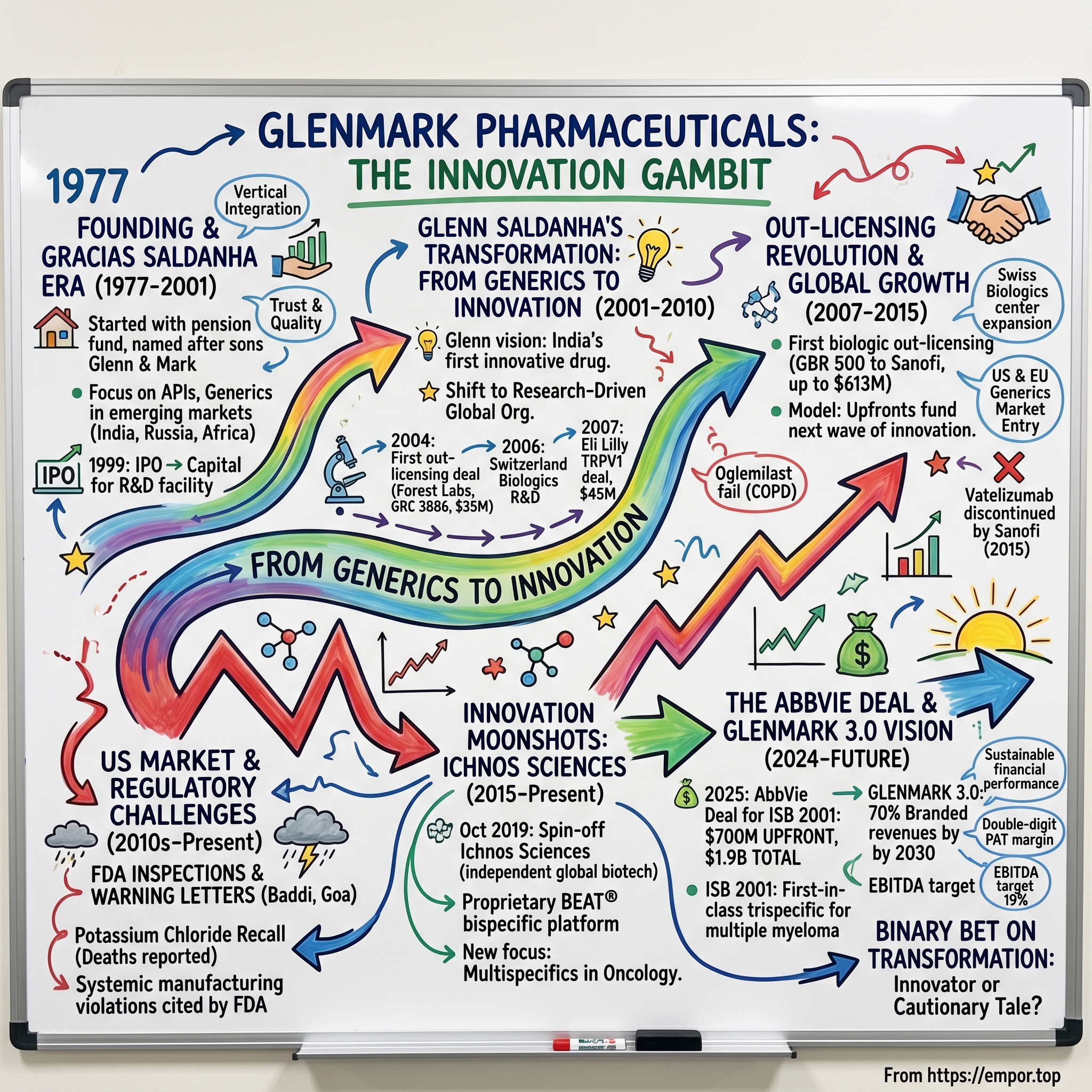
Glenmark Pharmaceuticals: The High-Wire Innovation Gambit of Indian Pharma
I. Introduction & Episode Roadmap (10–12 min)
In the second week of July 2025, a press release crossed the wire from North Chicago that made pharmaceutical executives in Mumbai read twice. AbbVie, one of the world's most valuable drugmakers, had licensed a multiple myeloma antibody called ISB 2001 from Ichnos Glenmark Innovation (IGI). AbbVie agreed to pay $700 million upfront, up to $1.225 billion more in development, regulatory, and commercial milestones, and tiered double-digit royalties on sales.1 In exchange, AbbVie secured commercial rights across North America, Europe, Japan, and Greater China. At the time of signing, the molecule was still in Phase 1 clinical trials.1 By September 2025, the upfront cash had cleared.2
What made the transaction remarkable was the asset's origin. IGI is the novel research arm of Glenmark Pharmaceuticals, an enterprise Gracias Saldanha founded in 1977 with roughly ₹1 lakh in capital and named after his two sons, Glenn and Mark.3 For most of its history, Glenmark manufactured dermatological creams, cough syrups, and cardiovascular medications for Indian physicians, later expanding into generic copies of off-patent pharmaceuticals in the United States. That single wire transfer from AbbVie exceeded twice the cumulative out-licensing revenue Glenmark had generated over the previous two decades.
Yet the opposite side of the ledger reveals an equally stark record. During the same years Glenmark's scientists engineered a proprietary trispecific antibody platform, the company's American subsidiary entered into a Deferred Prosecution Agreement with the US Department of Justice to resolve criminal price-fixing charges on a generic cholesterol treatment.4 Four of its manufacturing facilities received FDA Warning Letters within a six-year span.5 Another plant recalled tens of millions of potassium chloride capsules after units failed dissolution testing.6 And in 2023, facing an unsustainable debt burden, the parent company surrendered majority control of its most profitable subsidiary—the active pharmaceutical ingredient manufacturer Glenmark Life Sciences—selling it to Nirma, an industrial group synonymous with low-cost laundry detergent.7
The Paradox
The central paradox is straightforward to outline yet difficult to reconcile: How does a single pharmaceutical company engineer cutting-edge science worthy of a $700 million upfront commitment from AbbVie, while its commercial plants repeatedly stumble over basic regulatory audits and its American operations settle federal antitrust investigations?
For investors, the underlying question is sharper: Is Glenmark a genuine research pioneer breaking free from the commoditized generics treadmill, or a serial gambler funding speculative global drug development with the cash flows of its domestic prescription franchise while underinvesting in the unglamorous discipline of manufacturing compliance?
The Roadmap
This story does not start with a verdict; it examines the operational and financial record across seven acts:
- Act I covers Gracias Saldanha and the domestic branded formulations engine built between 1977 and 2000.
- Act II evaluates Glenn Saldanha's novel discovery push, which established Glenmark as the first Indian drugmaker to license proprietary molecules abroad, and tallies what those agreements actually delivered.
- Act III charts the American generics expansion, examining the lucrative Zetia exclusivity windfall, the subsequent price-fixing litigation, and recurring FDA enforcement actions.
- Act IV traces the accumulation of balance-sheet leverage that culminated in the divestment of Glenmark Life Sciences to Nirma.
- Act V audits current operations across therapeutic segments, focusing on commercial execution behind the respiratory asset Ryaltris.
- Act VI analyzes the AbbVie agreement through the competitive lenses of Hamilton Helmer's 7 Powers and Michael Porter's Five Forces.
- Act VII outlines operational takeaways, synthesizes the bull and bear theses, and isolates the core metrics that determine long-term shareholder value creation.
A consistent theme connects each phase of this journey: Glenmark has repeatedly demonstrated technical sophistication—a landmark licensing pact, a first-to-file generic approval, or a proprietary multi-specific antibody design—yet it has struggled to translate scientific breakthroughs into steady, compounding cash flow. Each chapter tests that gap between headline milestones and realized shareholder value.
The journey begins with the foundation that financed every subsequent ambition: a skin cream introduced to Indian clinics in 1979.
 Subscribe on LinkedIn
II. The Founding Story & Gracias Saldanha Era (1977–2001) (20–25 min)
Saligao is a quiet village in North Goa, defined by laterite roads, whitewashed churches, and a long tradition of families sending sons to Bombay and the Persian Gulf. Gracias Saldanha grew up there, becoming one of the community's early residents to earn a master's degree in science.3 He spent roughly twelve years working in managerial roles for multinational pharmaceutical subsidiaries before resolving to build his own enterprise.3 In 1977, he established Glenmark with approximately ₹1 lakh in seed capital—roughly the price of a modest passenger car at the time—naming the venture after his two young sons, Glenn and Mark.3
A Country Built for Copycats
India in 1977 operated under a distinctive regulatory architecture. The Patents Act of 1970 had eliminated product patents on pharmaceuticals, allowing domestic manufacturers to reverse-engineer any foreign drug so long as they developed a novel chemical process to produce it. While this policy fostered the process-chemistry skill base that underpins modern Indian pharma, it also saturated the domestic market with generic copies. A newly formed firm operating with minimal capital could not outspend established domestic houses or compete purely on standard chemical synthesis. It needed a defensible therapeutic niche.
The First Brand
Saldanha focused on dermatology. In 1979, Glenmark introduced Candid, a topical clotrimazole cream for fungal infections.8 In a hot, humid climate where fungal dermatoses were endemic, the therapeutic selection proved strategically sound. Dermatology was a category where physician prescribing habits and patient brand familiarity created pricing power that undifferentiated bulk chemistry could not command. Nearly five decades after its launch, Candid remains an anchor of Glenmark's domestic consumer-care portfolio, generating double-digit revenue growth across its brand extensions in the quarter ended March 2026.9
Glenmark expanded outward in deliberate phases. The company established export operations in Russia and the Commonwealth of Independent States (CIS) in 1980, commissioned its first manufacturing facility in Nashik in 1983, and entered respiratory therapeutics in 1987 with Ascoril, an expectorant formulation.8 The early push into Russia and the CIS proved prescient: long before Indian peers built global commercial infrastructures, Glenmark established branded prescription franchises in regions where Western multinational products were prohibitively expensive and domestic production was limited. Russia and the CIS remain integral to Glenmark's emerging-markets business, where IQVIA audit data showed secondary sales expanding by 11% in the year ended March 2026.9
The operating model was straightforward and capital-efficient. Glenmark manufactured branded generics—off-patent molecules marketed under proprietary trade names directly to medical practitioners through a dedicated sales force. This commercial model offered three structural advantages: robust gross margins supported by brand recognition rather than commodity discounting; stable prescription volumes driven by entrenched clinical habits; and modest capital expenditure, since growth was driven primarily by sales coverage rather than heavy manufacturing assets.
Listing and Backward Integration
Two strategic initiatives closed this formative era and established the framework for the company's subsequent evolution. In 1999, Glenmark established its initial formulation research center in Sinnar, and around 2000, it listed shares on the BSE and NSE at an initial market capitalization of approximately $40 million.83 In 2001, the company commissioned an active pharmaceutical ingredient (API) facility at Kurkumbh in Maharashtra, bringing chemical synthesis in-house to secure raw-material supply for its formulations.8 That bulk-chemical unit eventually expanded into Glenmark Life Sciences, the subsidiary Glenmark would later monetize to deleverage its balance sheet.
The public listing also set up a generational transfer of executive power. A founder-led business built on methodical domestic brand-building and physician detailing was handed to an elder son with a substantially higher risk tolerance. Gracias Saldanha's philosophy prioritized domestic brand equity, commercial defense, and expansion into markets where the company could establish leadership without confronting larger global rivals. Glenn Saldanha's strategy pivoted toward speculative, capital-intensive novel drug discovery. The coexistence of these two divergent approaches—and the structural friction between them—became the central dynamic of Glenmark's next quarter-century.
The founder's era underscored a durable commercial reality: the core domestic cash flows that underwrote every subsequent experimental project were generated by the patient accumulation of brand loyalty in products like Candid and Ascoril, fortified by entrenched prescriber networks. Gracias Saldanha died in 2012.3 He lived long enough to witness his elder son reshape that regional branded-formulations business into a complex global drug development platform.
III. Glenn Saldanha's Revolution: Inventing the Out-Licensing Playbook (2001–2014) (40–45 min)
In 1998, a young pharmacist with an American MBA returned to Mumbai after five years in the United States. Glenn Saldanha had worked at Eli Lilly and as a consultant at PricewaterhouseCoopers, advising clients such as Bristol-Myers Squibb, SmithKline, and Johnson & Johnson.10 He had witnessed the inner workings of the multinational pharmaceutical industry: blockbuster economics, patent cliffs, and clinical pipelines that create immense wealth when molecules succeed and destroy capital when they fail. He returned convinced that an Indian drugmaker could invent novel therapeutics rather than solely reverse-engineer off-patent compounds. Around 2000, he took over as Managing Director and CEO of the enterprise his father had founded.8
His strategic logic was straightforward: generic manufacturing of off-patent molecules is a business that inevitably competes on price alone. As additional Indian drugmakers met regulated-market standards, generic pricing would compress toward marginal production costs. The structural escape route, Saldanha argued, lay in proprietary intellectual property—first through New Chemical Entities (novel small molecules) and subsequently New Biological Entities (novel antibody therapies). "Our biggest high would be to bring the first Indian molecule to worldwide market," he told Forbes India in 2011.10
The Playbook: Discover Cheaply, License Early, Keep the Emerging Markets
The strategy that followed was novel for the Indian pharmaceutical sector. Glenmark planned to identify drug candidates in lower-cost domestic laboratories, advance them through preclinical testing and Phase 1 safety trials, and then out-license global development and commercial rights to multinational pharmaceutical companies equipped with the capital and clinical infrastructure to fund expensive late-stage trials. Glenmark would collect an upfront cash payment, retain commercial rights across India and other emerging markets, and structure contracts to capture milestone payments and royalties down the road.10 According to Forbes India, the company deployed approximately $10 million from its public equity listing to seed this discovery effort.10
The commercial results arrived in rapid succession. In September 2004, Glenmark licensed oglemilast (GRC 3886), a PDE4 inhibitor for asthma and chronic obstructive pulmonary disease (COPD), to Forest Laboratories in a transaction valued at up to $35 million in upfront and milestone commitments.8 In 2005, it licensed Japanese rights for the same molecule to Teijin Pharma for a $6 million upfront payment.8 In 2006, Glenmark signed an agreement with Merck KGaA for the diabetes candidate melogliptin, worth up to $31 million in total payments.8 In October 2007, Eli Lilly paid $45 million upfront for a portfolio of TRPV1 pain assets led by GRC 6211, alongside up to $215 million in potential milestones for the initial indication plus commercial royalties if the drug reached the market.[^11] Sanofi followed in 2010, licensing GRC 15300, a first-in-class TRPV3 antagonist, for $25 million upfront.8 Then, in May 2011, Glenmark announced the largest transaction of the era: Sanofi committed $50 million upfront for GBR 500, a monoclonal antibody targeted at inflammatory disorders, with up to $613 million more in contingent development and commercial milestones.11
The underlying science followed a distinct logic. A PDE4 inhibitor like oglemilast calms the intracellular inflammatory signaling that constricts airways in asthma and COPD. The biological mechanism was later clinically validated when roflumilast reached the market, though PDE4 inhibitors have historically been constrained by systemic side effects, such as nausea, that limit effective dosing. A DPP-4 inhibitor like melogliptin lowers blood sugar by preserving incretin hormones that stimulate insulin secretion; because Merck & Co.'s sitagliptin had already established the class, any new candidate faced a rigorous standard to prove clinical superiority. TRPV1 and TRPV3 are transient receptor potential ion channels located on sensory nerve cells—acting as molecular switches that fire when exposed to extreme heat or chemical irritation. Blocking these channels offered the theoretical promise of a potent analgesic without opioid addiction risks. The strategic common thread across these programs was that Glenmark focused primarily on validated or commercially prominent targets where the biology was already understood. That approach made early-stage assets easier to out-license to risk-conscious multinational partners, but it also placed Glenmark in crowded clinical categories where downstream differentiation proved difficult.
For a mid-sized Indian manufacturer, these upfront inflows represented substantial capital. By 2010, Forbes India estimated that Glenmark had brought in approximately $200 million in cumulative licensing revenue against roughly $125 million in total research and development spending.10 On paper, the model appeared highly attractive: Indian laboratories generated candidate molecules at a fraction of Western discovery costs, multinational partners underwrote expensive Phase 2 and Phase 3 development, and Glenmark's public equity narrative paired an innovative discovery engine with a stable, cash-generative branded generics business.
Testing the Claim: Did Out-Licensing Build a Royalty Moat?
This historical record provides the empirical baseline to evaluate a central investment thesis—one revived by the 2025 AbbVie agreement. The claim is that Glenmark constructed a repeatable, high-margin out-licensing platform that produces lasting royalty streams from multinational drugmaker partnerships. The definitive measure of that claim is clinical and commercial conversion: of the novel molecules out-licensed during this era, how many successfully advanced through pivotal trials, secured regulatory approvals, and generated commercial royalties?
The clinical record provides a clear answer. By 2011, Forbes India reported that only two of Glenmark's first six licensing agreements remained active.10 The TRPV1 class licensed to Eli Lilly encountered class-wide efficacy and safety obstacles—including impaired heat sensation—that prompted drugmakers across the industry to abandon similar programs. GBR 500, the headline $613 million partnership, survived longer but ultimately faltered in 2015: Sanofi returned all rights after a pre-planned Phase II interim analysis in multiple sclerosis missed its primary efficacy endpoint.12 Glenmark completed subsequent out-licensing transactions in later years—including an mPGES-1 inhibitor licensed to Forest Laboratories in 2012 for $15 million upfront and GBR 1302 partnered with Harbour BioMed in Greater China in 2018.8 Yet none of the novel chemical or biological entities out-licensed between 2004 and 2018 ever reached commercialization or produced ongoing royalty streams. Glenmark's sole self-described "first global branded specialty drug" is Ryaltris, a combination of two off-patent active ingredients (olopatadine and mometasone) approved by the US FDA in 2022.8
In the broader context of global biotechnology, early-stage candidate attrition is the statistical norm; the vast majority of preclinical and Phase 1 molecules never reach the market. Judged strictly as an early-stage biotechnology discovery unit, Glenmark's attrition record was not exceptional failure—it was typical. The fundamental issue for Glenmark's equity story lay in market valuation: throughout this period, public markets often valued the pipeline using aggregate headline deal figures—such as $613 million or $260 million—rather than the modest upfront payments that constituted the only cash that ever materialized. While Glenmark disclosed that milestone payments were contingent contractual maximums, the recurring gap between headline deal announcements and realized economic returns became a defining feature of how investors evaluated management's pipeline guidance.
The evidence therefore narrows the original strategic claim. Glenmark proved that its scientists could design valid biological molecules that sophisticated global drugmakers were willing to acquire at an early stage. It did not prove that it could navigate the clinical development hurdles required to produce approved drugs or durable royalty streams. In practice, the upfront licensing checks functioned as non-dilutive research funding—external capital that subsidized corporate laboratories without diluting existing shareholders. Non-dilutive R&D funding is operationally valuable, but it does not constitute an economic moat. Furthermore, it left Glenmark's pipeline entirely dependent on external partners who repeatedly halted development when clinical signals proved ambiguous.
This out-licensing history also introduced structural volatility into Glenmark's financial accounting. Upfront licensing payments arrived in irregular, multi-million-dollar tranches that flattered reported operating margins in the years they were received, conditioning the market to anticipate speculative milestone revenues that did not follow. That accounting pattern remains directly relevant in 2026, as the $700 million upfront payment from AbbVie is recognized across Glenmark's reported North American revenue as deferred income over time.9 When a company's largest licensing pacts have historically yielded their initial upfront payments and little else, disciplined valuation requires treating prospective milestones as unearned until Phase 2 and Phase 3 clinical conversion is demonstrated.
A specialized discovery laboratory can operate on episodic licensing checks, but an expanding international pharmaceutical company cannot. To finance both its capital-intensive novel pipeline and broader corporate obligations, Glenmark required a far larger, self-sustaining profit engine. In the mid-2000s, the obvious destination to build that engine was the United States.
IV. The US Generics Gold Rush, Antitrust Indictment & The Quality Crisis (2010–2024) (50–55 min)
In December 2016, trucks began leaving warehouses carrying the first generic copies of Zetia (ezetimibe), Merck's cholesterol blockbuster. Glenmark had the first-to-file position, which meant a period of limited competition during which a generic can sell at prices far closer to the brand's than to commodity levels.8 Those months are among the most profitable a generic company ever sees, and for Glenmark they helped fund a decade of ambition. They also came with legal exposure that took more than eight years to resolve.
Building the American Machine
Glenmark's American push had started a decade earlier. It set up its US subsidiary in 2003, launched its first US generic in 2005, and opened a factory in Goa built to FDA standards in the same year.8 In 2014 it commissioned a plant in Monroe, North Carolina, for injectables and oral solids, which gave it manufacturing on American soil.8 The strategy followed the industry playbook of the time. File many applications for generic approval (ANDAs), challenge patents where possible, and use India's lower costs to supply American pharmacies.
For several years it worked. The early 2010s patent cliff put a large wave of branded drugs off-patent, and Indian companies captured a big share. Glenmark's timeline shows limited-competition launches and a growing ANDA pipeline. Zetia was the high point.
The Hidden Cost of the Windfall
The Zetia exclusivity had a history. In 2010, Merck and Glenmark settled their patent dispute. Plaintiffs later argued that the settlement was a "pay-for-delay" deal that kept Glenmark's generic off the market for about five years.13 In 2023 Glenmark agreed to pay $87.5 million over two years to settle with direct purchasers, retailers and payers, while denying any wrongdoing.14 Merck paid far more.13 More claimants who opted out settled later: $7 million in February 2025, and another settlement with UnitedHealthcare in November 2025.8 The Zetia profits were real. Part of them came back as legal costs over the next decade.
Price Deflation and the Price-Fixing Cases
After 2016 the American generic market changed. Large pharmacy chains and wholesalers merged into a few purchasing groups with enormous bargaining power, while the FDA approved record numbers of generics, which added competitors to almost every molecule. Prices for plain oral solids fell year after year, and every Indian exporter felt it.
Glenmark then faced a harder problem. In 2020 federal prosecutors charged Glenmark's US subsidiary in the government's broad investigation of generic-drug price-fixing. On August 21, 2023, Glenmark Pharmaceuticals Inc., USA, entered a Deferred Prosecution Agreement with the DOJ Antitrust Division. It agreed to pay a $30 million criminal penalty over a conspiracy to fix prices of the cholesterol drug pravastatin and to divest its pravastatin business.4 The DOJ then pursued civil claims. Glenmark paid $25 million to resolve False Claims Act allegations that between 2013 and 2015 it had made arrangements with competitors over pravastatin pricing, supply and customer allocation.15
The long-running state case ended most recently. In July 2026 a coalition of attorneys general announced a settlement of about $29.7 million ($25 million plus interest over four years), covering alleged conduct from May 2009 to December 2019.16 Glenmark agreed to seven years of injunctive relief, an antitrust compliance program, and cooperation in the states' continuing litigation against other companies.17 Glenmark's own disclosures say its US subsidiary has been named in more than 35 related complaints since 2016 and that it denies the allegations in the settled matters.9 In FY2026 the company booked provisions of about ₹323 crore for a direct-purchaser class settlement and ₹278 crore for the state settlement, as exceptional items.8
Added up, the antitrust record has direct cost. More than $170 million in Zetia and pravastatin settlements and penalties are publicly disclosed, before counting class-action provisions and legal fees. It also has an indirect cost that is harder to measure: a US generics business that spent years under legal scrutiny while its prices fell.
The Factory Problem
The most damaging thread is manufacturing quality, because it goes to the one thing a generic company must do well.
The chain started at Baddi, in Himachal Pradesh. In 2017 FDA inspectors examined complaints about a watery cream from the plant and found product that had been stored at temperatures as high as 112°F for up to 30 hours.18 After a further inspection, the FDA issued a Warning Letter in October 2019.19 In October 2022 the Baddi site was placed on Import Alert 66-40, which allows US authorities to detain its products at the border.5 In November 2022 the Goa plant received a Warning Letter. Glenmark had rejected 15 batches of desmopressin tablets for failing content-uniformity tests, and the FDA said its investigation had not extended to other batches and products made on the same machines.20 In June 2023 the Monroe, North Carolina plant received its own Warning Letter. Glenmark had already recalled the plant's products in 2021 and stopped commercial manufacturing there.21
Then came Pithampur, near Indore in Madhya Pradesh. In May and June 2024, Glenmark recalled nearly 47 million extended-release potassium chloride capsules made there because they were not dissolving properly. The FDA classified it as a Class I recall, its most serious category.6 The risk was concrete. Potassium chloride has a narrow safe range, and a pill that releases its dose unpredictably can push blood potassium to dangerous levels, which can cause fatal heart rhythms. ProPublica reported in December 2024 that the plant had issued seven recalls for the same kind of flaw, and that the FDA had not inspected it in more than four years.6 It later reported that Glenmark told the FDA of eight deaths among patients who took the recalled capsules between July and December 2024. The reports carried few details and do not establish causation.22
Why is dissolution such a big deal? An extended-release capsule is designed like a slow-drip irrigation system. It should release the drug steadily over hours, so the body never gets too much at once or too little overall. Manufacturers prove this in the lab by placing samples in a solution that imitates the gut and measuring how much drug is released over time. If that test fails, the release profile inside a patient is unknown. Stability testing repeats the check months after production to confirm the product still behaves as intended on the shelf. A plant that falls behind on stability testing can only find problems after the product has already reached patients.
The FDA inspected Pithampur in February 2025 and issued a Warning Letter on July 11, 2025. It cited inadequate investigation of dissolution failures, stability testing delayed by three months or more for a large share of samples, and test methods that had not been properly validated.5 The letter pointed to the Baddi, Goa and North Carolina actions and concluded: "These repeated failures at multiple sites demonstrate that management oversight and control over the manufacture of drugs is inadequate."22 The FDA told Glenmark to hire a qualified CGMP consultant and review its manufacturing network worldwide.5
Testing the Claim: Is There a Low-Cost Manufacturing Moat?
The bullish version of Glenmark's US generics story rested on a cost advantage: Indian factories that could make regulated-market pills for less than anyone else. The disconfirming evidence is strong. It comes from the same business, the same regulator and the same management team. Four Warning Letters at four different sites between 2019 and 2025, one import alert, one Class I recall and a formal FDA finding of inadequate management oversight show that the low cost was partly the result of under-investment in quality systems. A cost advantage that the regulator can remove at the border is not an advantage.
There is some evidence of repair. The Monroe plant received an inspection classification of Voluntary Action Indicated in November 2025, which allowed commercial manufacturing to restart.9 The first generic of the FloVent HFA 44 mcg inhaler, with 180-day Competitive Generic Therapy exclusivity, shows that Glenmark can still win on technical difficulty rather than on price.9 But the history rejects the broad version of the claim. What remains is narrower: Glenmark may be able to compete in complex, hard-to-make generics such as inhalers and injectables, if its plants stay compliant. The test is simple and binary. Do Pithampur and the rest of the network clear FDA re-inspection without new enforcement?
By 2023, losses from price erosion, legal bills, remediation and research had accumulated into a problem the domestic business could no longer absorb. The company was about to pay for it with its best subsidiary.
V. The Balance-Sheet Reckoning: Selling Glenmark Life Sciences to Nirma (2021–2024) (35–40 min)
On September 21, 2023, the board of Glenmark Life Sciences approved a share purchase agreement with a buyer that caught many industry observers off guard.23 Nirma, the Ahmedabad industrial group whose catchy advertising jingle for low-cost washing powder is embedded in Indian popular culture, was acquiring control of one of the country's better-run active pharmaceutical ingredient (API) manufacturers. Nirma's managing director, Hiren Patel, noted that the acquisition would position Nirma among the top five independent API manufacturers in India.7 For Glenmark, however, the transaction was driven by balance-sheet necessity rather than corporate synergy.
How the Debt Built Up
The financial strain had been compounding for years. Glenmark's net debt stood at approximately ₹2,260 crore in FY2022 and rose to roughly ₹3,189 crore in FY2023.8 In FY2023, the company reported a small consolidated loss of about ₹90 crore.8 Several cash drains had converged at once: substantial annual research spending on novel biologic antibodies, extensive remediation and legal bills in the United States, heavy capital sunk into the sterile injectables facility in Monroe, and severe generic price deflation that compressed the American cash flows meant to service those obligations. The result was a leveraged business pairing an exceptionally strong domestic branded franchise with an unsustainable load of global liabilities—and public equity markets discounted the stock accordingly.
Carving Out the Jewel
The mechanism for relief had been established two years earlier. Glenmark carved out its API business into Glenmark Life Sciences (GLS) in 2019.8 In July 2021, it took GLS public through an IPO priced at ₹695 to ₹720 per share, raising up to ₹1,513.6 crore through fresh issuance and an offer for sale by the parent, which lowered Glenmark's holding to 82.84%.24 GLS was the group's steadiest earner: it supplied chemical ingredients to Glenmark and third-party customers, carried none of the US legal liabilities, and provided public markets with a clean, observable valuation for the bulk-chemistry business.
Under the September 2023 agreement, Nirma bought 75% of GLS at ₹615 per share, for ₹5,651.5 crore. The deal closed on March 12, 2024.23 Business Today reported that Glenmark planned to deploy the proceeds to eliminate approximately ₹4,340 crore of corporate debt, and noted that the two companies extended their reciprocal API supply agreement by five years from April 2024.7 Glenmark subsequently moved to sell its remaining minority stake.25 GLS now operates under new ownership as Alivus Life Sciences.8
Why Nirma, and Was the Price Fair?
At first glance, a detergent and soda-ash manufacturer buying an advanced pharmaceutical ingredients business seemed incongruous. From Nirma's perspective, however, the strategic logic was sound. API manufacturing is chemical synthesis at industrial scale: multi-ton reactors, solvent management, process controls, effluent treatment, and the operational rigor required to run continuous production lines. Nirma had spent decades operating large chemical operations. GLS gave it an immediate entry into regulated international markets, complete with FDA-cleared sites, a global roster of generic customers, and a guaranteed baseline customer in Glenmark under the extended supply agreement.7 Business Today cited analyst estimates that Nirma's investment could produce a seven-year return on invested capital of approximately 14%, which is respectable but not spectacular.7
For Glenmark, the transaction terms reflected an eager seller. The agreed price of ₹615 per share stood roughly 2% below the prevailing market price at announcement, according to Business Today.7 Grossing up the 75% stake implied an equity valuation of roughly ₹7,500 crore for all of GLS. That figure fell below the 2021 IPO price band of ₹695 to ₹720 per share.24 Put simply, Glenmark surrendered control of its most predictable division for less than public investors had paid for non-controlling minority shares two years earlier, without extracting a control premium. While not a distressed fire sale, it was unmistakably the transaction of a company pressed to deleverage quickly. Alternate options—such as a dilutive rights issue, selling equity in the core domestic formulation engine, or executing a slow open-market selldown—would have diluted existing shareholders, compromised the core franchise, or left debt overhang intact. Measured against those choices, the Nirma transaction was the least damaging exit available. Yet it was an exit the company should not have required.
The Autopsy
The financial sequence shows both an immediate rescue and a sobering strategic admission. In FY2024, the year of the divestment, Glenmark absorbed heavy exceptional charges to report a consolidated net loss of about ₹1,831 crore, but it ended that fiscal year with net cash of roughly ₹668 crore.8 That balance-sheet buffer proved short-lived. By the end of FY2025, Glenmark had slipped back into net debt of about ₹489 crore as US antitrust settlements, manufacturing remediation, and pipeline investments continued to draw capital.8 It returned to a net-cash position of roughly ₹1,176 crore with zero gross debt only at the end of FY2026, the year AbbVie's $700 million upfront cash arrived.8
That trajectory offers an important test of executive guidance. The commitment in 2023 was that monetizing GLS would permanently reset Glenmark as a net-cash business. In practice, that cushion lasted barely twelve months. It took a second, external windfall from a global licensing partner to re-establish a debt-free balance sheet. A critical appraisal shows that Glenmark was forced to liquidate its most predictable cash-flow generator to pay down debt accumulated through aggressive US generic expansion, compliance failures, and two decades of discovery spending that had yet to yield commercial royalties. A supportive interpretation holds that management executed a pragmatic monetization that bought essential breathing room for both its domestic brand engine and its novel clinical pipeline. The historical record accommodates both conclusions.
One operational consequence is often underestimated. In divesting GLS, Glenmark gave up captive control of its chemical supply chain. The five-year transitional contract mitigated near-term disruption, but it converted an internal cost structure into a negotiated commercial price with an external counterparty.7 In an operating environment shaped by volatile input costs and freight shifts, that structural change directly pressures formulation gross margins.
Selling Glenmark Life Sciences bought Glenmark time. The central question was whether its remaining operating businesses could capitalize on the reprieve.
VI. The Core Business Today: Segment Economics, India Formulations & Ryaltris (2020–Present) (50–55 min)
At the opening of FY2026, Glenmark operated as a four-region formulations business. In FY2025, it generated consolidated revenue of approximately ₹13,322 crore.9 India served as the largest contributor at roughly ₹4,485 crore, North America delivered about ₹3,017 crore, Europe brought in roughly ₹2,846 crore, and Emerging Markets—spanning Russia and the CIS, Latin America, the Middle East, Africa, and Asia-Pacific—added roughly ₹2,814 crore.9 Because Glenmark does not publish segment-level EBITDA margins, public investors must infer regional profitability from therapeutic mix, channel disclosures, and executive commentary.
The financial results for FY2026 proved significantly harder to parse. Reported top-line revenue expanded 27.5% to approximately ₹16,983 crore, while operating EBITDA roughly doubled to ₹4,572 crore.8 The vast majority of that headline expansion, however, did not stem from core volume growth. Instead, it reflected the phased recognition of the upfront ISB 2001 licensing income booked through the North American segment, which reported ₹7,139 crore in revenue for the fiscal year.9 Excluding that deferred licensing revenue, North American base business revenue grew at a far more modest 7.8% in the quarter ended March 2026.9 Concurrently, Glenmark absorbed roughly ₹2,266 crore in exceptional pre-tax charges, primarily driven by US antitrust settlements, related legal expenses, and inventory and receivables write-downs.8 The consolidated headline figures effectively blended extraordinary licensing windfalls with one-off legal penalties. The underlying operational run rate became clearer in the first quarter of FY2027: for the quarter ended June 2026, consolidated revenue rose 23.1% to roughly ₹4,019 crore with a 20% EBITDA margin, with management stating that base business revenue growth—excluding the ISB 2001 amortization—exceeded 18%.2627
India: The Profit Engine, With a Stress Test
The domestic prescription business represents the analytical anchor of Glenmark's investment profile. In FY2026, that foundation endured an unprecedented operational stress test.
Over a multi-year horizon, Glenmark's commercial positioning in India remains formidable. According to IQVIA market data for the year ended March 2026, the company ranked 13th across the Indian pharmaceutical market with a 2.34% market share, holding the number-two position in dermatology, third in respiratory therapies, and fourth in cardiac care, with 11 distinct brands ranking among India's top 300 pharmaceutical products.9 For the twelve months to March 2026, Glenmark's secondary sales—the volume of product dispensed by retail pharmacies to patients—grew 13.5%, comfortably outpacing the broader Indian market's 9.0% expansion rate.9 On an investor call in August 2026, management indicated that the company deployed a field force of approximately 5,600 medical representatives, expanded by 300 to 400 representatives annually, and maintained that organic domestic growth of 12% to 15% remained sustainable "on a consistent basis from here on."27 In-licensed commercial launches further broadened the portfolio: BeiGene oncology therapies Tevimbra and Brukinsa surpassed ₹100 crore in aggregate domestic sales within their first twelve months on the market, while Glenmark marketed a novel nebulized triple-therapy formulation for chronic obstructive pulmonary disease that it described as a global first.279
Yet in the quarter ended September 2025, that commercial engine suffered a severe supply-chain seizure. Anticipating revisions to India's Goods and Services Tax (GST) framework, independent stockists and wholesalers aggressively liquidated channel inventory, deferred purchase orders, and returned unsold inventory. Glenmark's primary formulation shipments in India plummeted by roughly 87%, dropping from ₹1,282 crore in the prior-year period to approximately ₹165 crore.28 Over that identical three-month span, pharmacy-level secondary sales expanded 10.8%, demonstrating that end-patient prescription demand remained intact while the distribution pipeline emptied.28 Management attributed the outsized volatility to Glenmark's "unique legacy 3-tier distribution system."28 Later in the fiscal year, the company recorded an exceptional inventory provision of approximately ₹369 crore following the GST transition and a subsequent overhaul of its domestic inventory management model.8 Due to that channel contraction, full-year reported domestic formulation revenue fell 17%, even as the company's underlying brands continued to capture market share from competitors.9
Testing the Claim: Is the Domestic Moat Unbreakable?
The central investment thesis behind Glenmark's domestic business is that deep brand equity and entrenched prescribing habits among Indian physicians create a commercial moat insulated from regulatory changes and wholesale distribution turbulence. The empirical record confirms the resilience of clinical demand, but it reveals operational vulnerabilities elsewhere.
Patient and physician loyalty proved genuine: secondary prescription sales advanced steadily through the tax-induced channel reset, and Glenmark's market share in core dermatology and respiratory categories expanded throughout the year.9 However, two factors qualify the broader thesis. First, the supply-chain paralysis of late 2025 demonstrated that Glenmark's legacy three-tier distribution architecture was far more fragile than its brand equity, turning a regulatory tax adjustment into a quarter of near-total revenue collapse followed by material inventory write-downs.28 Second, in chronic therapeutic classes characterized by rapid commoditization, the company's pricing defense showed clear limits. In diabetes, where Indian prescribers shifted toward generic alternatives, Glenmark's sales contracted 4.1% during the year ended March 2026 against overall category growth of 11.5%, depressing its therapeutic market share from 1.2% to 1.1%.9 While the company introduced Glipiq, an oral semaglutide formulation, in the March 2026 quarter, it entered an intensely competitive, multi-brand race.9 Furthermore, as an equity analyst highlighted during the August 2026 earnings discussion, Glenmark's domestic sales remain heavily concentrated in its flagship hypertension brand, Telma, and its line extensions—a dependence Glenn Saldanha defended as a commercial strength rather than a portfolio risk.27
The evidence does not dismantle the domestic franchise thesis, but it defines its boundaries. Glenmark maintains strong pricing and volume power in specialized, doctor-directed categories like dermatology and respiratory medicine, where physical formulation characteristics and brand trust govern clinical choices. Conversely, its pricing power erodes in large, chronic therapeutic categories saturated with generic alternatives. The operational indicator for investors is whether reported primary shipments realign with double-digit secondary prescription growth in FY2027. The 15.5% domestic revenue rebound reported for the June 2026 quarter indicated that the channel normalization was taking hold.26
Europe, North America and Emerging Markets
Europe delivered steady baseline performance, growing 8.9% across FY2026 before accelerating to a 21.4% expansion rate in the March 2026 quarter, lifted by branded generic sales in Central and Eastern Europe and early contributions from Ryaltris.9 Glenmark's operational footprint in Europe traces back to 2004 and the strategic acquisition of Czech drugmaker Medicamenta in 2007.8 To build beyond generic tenders, the company moved into branded dermatology by licensing Winlevi, a topical androgen receptor inhibitor for acne, from Cosmo Pharmaceuticals; the therapy debuted in the United Kingdom in 2025 and secured European Union regulatory clearance in October 2025.9 Management guided to high-single-digit European revenue growth for FY2027, characterizing Winlevi as a specialized, niche commercial asset.27
North America is undergoing a strategic pivot toward complex, barrier-to-entry formulations. Glenmark commercialized 13 products in the United States during FY2026, emphasizing sterile injectables and specialized inhalation treatments, ending March 2026 with 220 approved generic applications and 52 abbreviated new drug applications pending FDA review.9 Securing approval for the first generic version of FloVent HFA 44 mcg inhalers—supported by 180 days of Competitive Generic Therapy exclusivity—alongside plans to launch two to three additional respiratory assets in FY2027, reflected a commercial pipeline centered on technical manufacturing complexity rather than high-volume oral tablets.9 Nevertheless, the North American division remains the segment most exposed to regulatory inspection risks, warning letters, and secular price deflation.
Emerging Markets expanded 4.5% across FY2026 before surging 27.7% in the June 2026 quarter.926 Executive leadership positioned the division as the primary launch vehicle for in-licensed specialty oncology therapies: the EGFR inhibitor aumolertinib from Hansoh Pharma, the antibody-drug conjugate trastuzumab rezetecan from Jiangsu Hengrui, and the checkpoint inhibitor envafolimab. Saldanha projected that these three in-licensed oncology brands could generate between $500 million and $600 million in cumulative revenue over a five-to-six-year horizon.27 That figure remains an executive forecast: none of the three therapies has yet launched commercially within Glenmark's designated geographic territories. The region also carries structural operational hazards that do not appear in short-term sales growth. Sustained business in Russia and the CIS exposes Glenmark to ruble exchange-rate volatility, international sanctions compliance, and complex cross-border logistics. Concurrently, operations across parts of Latin America and Africa confront chronic local currency depreciation and stringent government price controls, both of which can erase underlying volume growth when consolidated into Indian rupees. While Glenmark's localized branded sales model provides commercial differentiation, reported earnings across these jurisdictions have historically exhibited elevated volatility.
Ryaltris: The First Real Brand
Ryaltris represents Glenmark's most successful effort to create a global branded pharmaceutical. A fixed-dose combination nasal spray engineered for seasonal allergic rhinitis, the medication pairs an antihistamine, olopatadine, with a corticosteroid, mometasone. While neither compound is patent-protected on its own, Glenmark holds proprietary rights to the stable combination formulation. The US FDA granted marketing approval in January 2022, marking what the company categorized as its first global branded specialty drug.8 Glenmark initially out-licensed commercialization rights to established regional partners, transferring US marketing rights to Hikma Pharmaceuticals in 2020.29 By March 2026, regulatory filings had been submitted across more than 90 countries, the nasal spray was commercially marketed in 55 jurisdictions, and global secondary retail sales grew by more than 50% year-on-year. Chinese regulators approved the formulation in October 2025, leading commercial partner Grand Pharmaceutical to introduce the therapy in March 2026; Organon launched the product in Thailand the preceding month, with commercial entry into Brazil scheduled for FY2027.9
The therapeutic logic of Ryaltris illustrates why it achieved commercial success while Glenmark's earlier novel chemical entities struggled. Moderate-to-severe allergic rhinitis patients routinely manage their condition with two distinct nasal sprays: an antihistamine for rapid symptomatic relief and an intranasal steroid to suppress chronic inflammation. Unifying both active ingredients within a single delivery device provided immediate clinical convenience and improved patient compliance. Furthermore, the clinical development hurdle was significantly lower than for a novel molecular entity: because both active molecules had decades of documented safety and efficacy, Glenmark faced minimal translational risk in Phase 3 trials. It was an unglamorous, pragmatic form of innovation—far removed from novel multi-specific biologics, but far more likely to secure regulatory approval and reach commercial scale. That reality also defines its long-term competitive ceiling. Because it relies on off-patent active ingredients delivered through a proprietary formulation, Ryaltris faces eventual generic combination competition once its device and formulation protections expire, functioning as an extended specialty brand rather than a permanent therapeutic monopoly.
On April 1, 2026, Glenmark terminated its US distribution agreement with Hikma, assuming direct commercial control and distribution of Ryaltris across the American market.3031 Reclaiming commercial rights eliminated partner revenue splits and preserved full product gross margins, but it simultaneously saddled Glenmark with direct sales-force overhead, payer formulary rebate negotiations, and distribution expenses in the world's most costly pharmaceutical market.31 Although management has not disclosed standalone product sales figures, the transition marked the first time since Glenn Saldanha launched the novel discovery initiative that Glenmark assumed direct commercial execution risk on a branded specialty therapy in the United States.
Ryaltris established that Glenmark could successfully navigate clinical development and build a multi-market specialty franchise. The pivotal question for investors is whether Ichnos Glenmark Innovation can replicate that commercial trajectory with an entirely novel biological entity.
VII. The Innovation Holy Grail: Ichnos Glenmark Innovation & the $700M AbbVie Triumph (2019–Present) (40–45 min)
In Epalinges, on the wooded hills above Lausanne, Glenmark has pursued biologics discovery since the mid-2000s. The company established its first research center dedicated to new biological entities in Switzerland in 2006.8 That Swiss facility forms the direct physical bridge connecting Glenmark's early licensing efforts to the 2025 AbbVie transaction. The antibody engineering lineage that yielded GBR 500 in 2011 represents the exact scientific tradition that, after nearly two decades of persistent capital allocation, engineered ISB 2001.
The Spinout Logic
In 2019, Glenmark spun out its novel biologic operations into Ichnos Sciences as a separate innovation subsidiary focused on immuno-oncology.8 The strategic rationale addressed capital-markets architecture as much as laboratory science. Indian public markets evaluate pharmaceutical firms on current price-to-earnings multiples and steady operating cash flow. Western biotechnology investors, by contrast, price risk-adjusted clinical pipelines and option value. Trapped inside a listed Indian generics manufacturer, a capital-consuming novel discovery unit routinely depressed consolidated operating margins without earning public-market valuation credit for its pipeline. Establishing a distinct corporate entity offered a path to attract external private capital, structure targeted biopharma collaborations, and eventually command an independent valuation. Ichnos was subsequently rebranded as Ichnos Glenmark Innovation (IGI), the entity that signed the licensing agreement with AbbVie.1
Prior to the AbbVie transaction, IGI demonstrated that it could execute mid-tier licensing agreements outside the spotlight of global blockbusters. In 2021, the subsidiary licensed ISB 880, an IL-1RAP antagonist targeting autoimmune diseases, to Spanish dermatology specialist Almirall for an upfront payment of €20.8 million, which Almirall advanced into a Phase 2 study in hidradenitis suppurativa, a painful chronic inflammatory skin condition.89 In October 2023, IGI licensed its OX40 antagonist program, including telazorlimab, to Astria Therapeutics.9 These transactions provided non-dilutive capital that preserved the Swiss facility's operational viability and established scientific credibility. Yet they also adhered to Glenmark's historical template: monetizing drug candidates at an early stage, collecting modest upfront payments, and leaving ultimate commercial value contingent on the development budgets and clinical execution of external partners.
IGI's proprietary technological foundation is the BEAT (Bispecific Engagement by Antibodies based on the T-cell receptor) platform. A conventional monoclonal antibody resembles a Y-shaped structure, with two identical arms designed to bind to a single molecular target. Multispecific antibodies, by contrast, are engineered with arms that bind distinct targets simultaneously—holding a cancer cell and an immune cell in close physical proximity, effectively acting as a molecular tether that directs cytotoxic T cells toward tumor targets. The fundamental bioprocessing challenge in multi-specific engineering is the chain-pairing problem: ensuring that diverse heavy and light protein chains assemble accurately during manufacture rather than producing non-functional, mismatched combinations. AbbVie describes BEAT as combining a common light-chain library with a heavy-chain pairing interface based on the T-cell receptor, offering a reliable method to assemble stable multi-specific antibodies at commercial manufacturing scale.1
The Deal
The lead asset generated by this platform, ISB 2001, is a first-in-class trispecific T-cell engager engineered with three distinct binding domains. Two arms recognize BCMA and CD38, proteins expressed on the surface of multiple myeloma cells, while the third binds CD3 on T cells to recruit the patient's own immune cells to kill the cancer.1 Co-targeting two tumor antigens is designed to counteract antigen escape—a pervasive resistance mechanism where myeloma cells downregulate or shed a single target protein to survive bispecific therapy. At ASCO in 2025, IGI presented Phase 1 data from 35 evaluable patients: a 79% overall response rate and a 30% complete or stringent complete response rate at therapeutic dose levels of 50 µg/kg and above.1 Reflecting that clinical signal, the drug received US FDA Orphan Drug designation in July 2023 and Fast Track designation in May 2025.1
Under the definitive partnership signed in July 2025, AbbVie committed $700 million in upfront cash, up to $1.225 billion in development, regulatory, and commercial milestones, and tiered double-digit royalties on net sales. AbbVie secured exclusive rights in North America, Europe, Japan, and Greater China, while Glenmark will lead commercialization in emerging markets.19 On an earnings call in August 2026, Glenn Saldanha confirmed that only the upfront payment had been received and no development milestones had yet been triggered.27 He also reported that clinical trial enrollment had accelerated, with more than 160 patients dosed in the ongoing Phase 1 trial.27
What the Cash Does
The $700 million upfront inflow fundamentally altered IGI's funding mechanics. Management has guided to annual IGI spending of about $70 million, projecting that the upfront payment covers the progression of the next pipeline candidate, ISB 2301, into Phase 1 and funds clinical programs over a two-to-three-year runway.3227 That spending discipline followed an internal restructuring in FY2025, when IGI incurred severance and related rationalization expenses to rein in overhead.8 Concurrently, the upfront cash flows through Glenmark's reported revenue as deferred income recognized within the North American segment, elevating reported FY2026 and FY2027 revenues relative to the underlying operating business.9 For investors evaluating organic growth rates, removing that non-recurring licensing amortization is necessary to gauge true operational performance.
Testing the Claim: Is IGI a Multi-Billion-Dollar Engine?
The bull claim is that the AbbVie transaction demonstrates IGI is an innovation engine worth billions of dollars as an independent business. The empirical evidence supports part of that proposition while rejecting the rest.
The BEAT platform has unquestionably earned validation from a sophisticated global buyer paying hard cash. A $700 million upfront commitment for a Phase 1 asset reflects urgent commercial interest in differentiated oncology mechanisms. Yet the $1.225 billion in prospective milestones does not represent equity value today. Historically, only a small fraction of early-stage oncology molecules advance through clinical trials to final regulatory approval. Fierce Biotech described ISB 2001 as a prospective challenger to approved therapies from Johnson & Johnson and Pfizer.33 Multiple myeloma remains one of the most crowded battlegrounds in oncology, dominated by commercial bispecific antibodies and autologous CAR-T cell therapies. Glenmark's own operating history provides the most sobering parallel: GBR 500 once carried a headline transaction value of $663 million, yet yielded only a single $50 million upfront check before Sanofi returned the license following clinical trial failure.12 The key difference in 2026 is the magnitude of AbbVie's initial cash commitment and the strength of the Phase 1 response data. The underlying contractual architecture—where the multinational partner controls clinical development while the originator waits—remains unchanged.
The clinical context illustrates the commercial hurdle. Over the past decade, multiple myeloma therapy has transformed. Monoclonal antibodies targeting CD38 established themselves as the universal standard of care. For relapsed or refractory patients, regulators approved BCMA-directed CAR-T cell therapies alongside off-the-shelf bispecific antibodies against BCMA and alternative antigens. ISB 2001 attempts to improve on existing bispecifics by attacking two myeloma markers at once, so that tumor cells that lose one target can still be destroyed. That biological thesis is coherent. But whether it delivers more durable remissions or a cleaner safety profile than established commercial therapies can only be proven in large, randomized clinical trials that AbbVie will design and run.
The investment claim survives in a narrower, more disciplined form. The upfront payment is realized cash on the balance sheet. The BEAT platform is an empirically validated source of licensable assets. It is not yet a proven drug-approval engine. The evidence required to confirm that higher status is concrete: a Phase 2 or registrational trial start by AbbVie, which would trigger the partnership's first milestone payment, and a second BEAT candidate—such as ISB 2301—out-licensed on comparable financial terms. The first would validate the drug; the second would validate the platform.
With the operational pieces and novel pipeline laid out, the strategic question turns to durable economic value: which of Glenmark's competitive advantages actually defend profits against industry rivals?
VIII. Strategic Frameworks: Porter's 5 Forces & Hamilton Helmer's 7 Powers (25–30 min)
Consider three scenes. A dermatologist in Pune writes "Candid" on a prescription pad almost on reflex. A purchasing manager at an American wholesaler compares three suppliers of the same generic pill and awards the contract to whichever is pennies cheaper this week. In North Chicago, AbbVie's business development team tallies what it would cost to build a trispecific antibody platform in-house and decides it is faster to license one from Switzerland. These three counterparties view Glenmark through entirely different commercial realities, and competitive frameworks help explain why.
Hamilton Helmer's 7 Powers
Counter-Positioning (historical, now faded). In the 2000s, Glenmark's model of discovering in India, licensing to the West, and retaining emerging-market commercial rights was an approach established Western drugmakers could not easily copy without disrupting their own internal R&D economics. That model has since become commonplace across Asia: Chinese biotechnology companies now license novel molecules to Western pharmaceutical giants at scale, and Glenmark itself has increasingly in-licensed Chinese oncology assets such as Hansoh's aumolertinib and Jiangsu Hengrui's antibody-drug conjugate.9 Whatever structural moat Glenmark derived from being an early mover has largely evaporated.
Process Power (absent). Helmer defines process power as an embedded operational capability that competitors cannot replicate without extraordinary cost or time. Glenmark's manufacturing record definitively rules this out: four Warning Letters across four plants, an import alert at Baddi, and the US FDA's formal determination that "management oversight and control over the manufacture of drugs is inadequate."225
Cornered Resource (moderate, unproven). The BEAT multispecific antibody platform and the protein-engineering team in Epalinges represent the company's only credible candidate for a cornered resource. AbbVie's $700 million upfront commitment validates their scientific value to a sophisticated global buyer. Under Helmer's framework, however, a cornered resource creates enduring economic power only if it reliably generates proprietary assets over time. A single validated compound proves technical capability, but it does not yet establish a repeatable pipeline.
Branding (strong, India-specific). In India, legacy trade names such as Candid, Ascoril, and Telma possess durable pricing power rooted in physician prescribing habits. That equity is corroborated by domestic secondary prescription growth consistently outperforming broader market expansion across dermatology and respiratory medicine.9 That brand moat, however, stops at India's borders: in commodity American generics, brand recognition is virtually non-existent, and purchasing decisions turn purely on wholesale acquisition cost.
Switching Costs (split). Switching costs are bifurcated across geographies. In the domestic formulation business, established clinical habits and patient familiarity create moderate friction against switching to rival brands. In the American retail generics channel, switching costs for wholesalers and pharmacy benefit managers are essentially zero.
Scale Economies (weak). With a 2.34% share of the Indian pharmaceutical market and a ranking of 13th, Glenmark lacks the domestic distribution leverage and volume manufacturing scale enjoyed by domestic giants like Sun Pharma or Cipla.9 In North America, its generic product catalog remains modest alongside global volume leaders.
Network Economies (absent). Network effects do not operate in pharmaceutical manufacturing: an additional patient taking a tablet or inhaler confers no structural utility to other patients.
Viewed through Helmer's lens, Glenmark's economic foundation consists of two genuine yet isolated powers—domestic brand equity and a potentially cornered antibody discovery engine—bolted to a global manufacturing apparatus that possesses no durable competitive power.
Porter's Five Forces
Threat of new entrants: low to moderate. In regulated Western markets, stringent FDA compliance hurdles, costly bioequivalence trials, and multi-year regulatory review cycles deter new entrants. In India, capital requirements for branded formulations are low, prompting regional manufacturers to introduce copycat molecules constantly. While new entrants rarely displace entrenched leaders in doctor-directed dermatology and respiratory therapies, they steadily erode margins in chronic therapeutic categories.
Buyer power: severe in the US, low in India. American generic purchasing is dominated by three consolidated wholesale buying groups that command immense volume leverage and can shift supplier allocations overnight, perpetuating secular price deflation. In India, fragmented retail pharmacies and doctor-directed prescriptions keep direct buyer leverage minimal. Nevertheless, the FY2026 GST disruption proved that intermediate distributors still wield enough channel power to temporarily paralyze primary shipments.28
Supplier power: moderate and increasing. Following the divestment of Glenmark Life Sciences to Nirma, Glenmark procures active pharmaceutical ingredients as an arm's-length commercial customer rather than from a captive, in-house synthesis division.7 That vulnerability surfaced on the August 2026 earnings call, where executive leadership acknowledged that input, packaging, and logistics costs had climbed amid macroeconomic disruptions, forcing the company to rely on higher-margin product mix to defend consolidated gross margins.27
Threat of substitutes: high. In small-molecule generics, therapeutic substitutes are chemically bioequivalent by design, leaving little room for defense once patent barriers expire. In oncology, ISB 2001 enters a crowded multiple myeloma landscape where it must compete against established commercial bispecific antibodies, autologous CAR-T cell therapies, and emerging antibody-drug conjugates. Domestically, low-cost generic pharmacy chains and hospital formularies exert continuous substitution pressure on branded chronic prescriptions.
Competitive rivalry: intense. Glenmark contends with formidable rivals across every major operating theater: Sun Pharma in dermatology, Cipla in respiratory medicine, and dozens of domestic contenders in cardiology. In the United States, multiple generic competitors contest nearly every off-patent molecule. In novel drug discovery, IGI must compete against well-funded Western biotechs and aggressive Chinese biopharma developers racing for multinational out-licensing partnerships.
Peer Lens
Evaluating Glenmark alongside its domestic peers illustrates the distinct path Glenn Saldanha chose. Sun Pharma channeled its American generic cash flows into assembling a de-risked, commercial-stage specialty dermatology portfolio through targeted acquisitions and late-stage in-licensing, deliberately sidestepping early-stage translational biology risk. Cipla anchored its global strategy in respiratory engineering and complex inhaler delivery, remaining predominantly a high-barrier formulation house. Glenmark pursued a far more speculative course: building an organic, proprietary discovery engine for novel chemical and biological entities from an Indian corporate base. The AbbVie partnership suggests that long-term laboratory investment engineered genuine scientific value that neither Indian peer has matched in multi-specific oncology. The parallel history of manufacturing citations and leveraged divestitures, however, suggests Glenmark paid for that scientific ambition partly by starving its core operational infrastructure.
These frameworks converge on a singular strategic reality: Glenmark's economic defensibility is concentrated in two distinct redoubts—its Indian branded prescription franchise and an early-stage antibody engineering platform—while its broader commercial operations remain exposed to severe competitive forces. The concluding act turns to the operational lessons of that high-wire balance, synthesizing the bull and bear arguments to identify the metrics that will decide Glenmark's compounding trajectory.
IX. The Playbook: Business, Governance & Investing Lessons (30–35 min)
Consider the board meeting in September 2023 when directors approved selling majority control of Glenmark Life Sciences. Over two decades, executive leadership had assembled an ambitious corporate architecture: an active pharmaceutical ingredient manufacturer, an American commodity generics division, a biologics research outpost in Switzerland, and a domestic branded prescription engine. The meeting was about dismantling an essential pillar of that structure to preserve the rest. Episodes of corporate distress clarify which operational assumptions held up and which failed. Glenmark's twenty-five-year trajectory yields five core lessons for operators and investors.
Lesson 1: Value upfront cash, discount milestones heavily
Between 2004 and 2015, Glenmark's novel licensing agreements brought in tangible upfront cash, but not one candidate yielded commercial sales or ongoing royalties. In early-stage biopharma, when corporate priorities shift or clinical efficacy wavers, external partners terminate agreements and return the asset, leaving the originator with lost development time and zero residual economics. For equity analysts and investors, the operational rule is straightforward: recognize upfront cash as non-dilutive balance-sheet support, but value prospective milestones as deeply out-of-the-money call options until registrational trial results validate clinical conversion. That principle applies as rigorously to ISB 2001 today as it did to GBR 500 in 2011.
Lesson 2: Quality compliance is a balance-sheet item
Glenmark's market valuation was suppressed for years not by scientific inadequacy, but by recurring operational breakdowns in its manufacturing facilities. A single Class I recall at Pithampur led directly to an FDA Warning Letter, remediation expenses, class-action litigation, and broader reputational fallout across the American commercial operation.56 In commoditized generics, where gross margins are continually squeezed, an inspection citation or an import alert can instantly wipe out years of commercial progress. Regulatory compliance is not merely an unglamorous shop-floor discipline; it is an existential capital-allocation priority with direct balance-sheet consequences.
Lesson 3: A saleable subsidiary works as an emergency valve
Glenmark Life Sciences functioned as a distinct, publicly traded subsidiary with an observable market price, independent third-party customer relationships, and a clean regulatory record. That corporate separation enabled a rapid, non-dilutive monetization when consolidated balance-sheet leverage became untenable.23 Conglomerates that bundle distinct operations into a single unsegmented corporate entity forfeit that strategic flexibility. That emergency valve, however, comes with an inherent structural limit: an enterprise can only surrender majority control of its steadiest cash-flow generator once, and Glenmark has already exercised that option.
Lesson 4: One cash cow cannot fund every ambition indefinitely
For over two decades, Glenmark treated its Indian branded formulations business as an inexhaustible financial engine, using its dependable domestic cash flows to subsidize American generic price erosion, novel antibody discovery in Switzerland, and mounting legal penalties. Long-term value creation only began to emerge when novel innovation spending was ring-fenced within IGI alongside dedicated, independent capital. Even then, securing that operational independence ultimately required a $700 million wire transfer from AbbVie rather than corporate capital discipline alone.
Lesson 5: Look through reported numbers
Glenmark's reported income statements obscure underlying operational performance by mixing extraordinary inflows and non-recurring penalties. Deferred licensing income recognized across multiple reporting periods artificially elevates North American segment revenue, while sizable provisions for antitrust settlements, legal expenses, and inventory write-downs depress net profit. In FY2026, both forces collided: consolidated operating profit doubled while the Indian standalone entity recorded a net loss.8 Rigorous analysis requires stripping away non-recurring licensing amortization to isolate base formulation run rates, and distinguishing truly one-off restructuring charges from legal and compliance costs that have recurred across a decade.
Management and governance
Glenn Saldanha serves as Chairman and Managing Director, and the promoter family holds approximately 46.65% of the company's equity, creating close economic alignment with public minority shareholders.34 Saldanha's record reveals genuine strategic ambition and prescience: he pioneered out-licensing before domestic peers recognized the model, funded biologics research for nearly two decades before the AbbVie transaction validated the science, and successfully steered Ryaltris from formulation chemistry into a global branded respiratory asset.
The operational record, however, exposes chronic execution gaps where organizational discipline and sustained follow-through were required. Management's 2023 commitment to establish a permanent net-cash balance sheet lasted barely twelve months before net debt resurfaced.8 Manufacturing remediation timelines repeatedly lagged executive guidance; the FDA's Warning Letter in July 2025 cited recurring procedural failures across facilities that had faced regulatory enforcement since 2019.5 Furthermore, the severe domestic distribution seizure during the FY2026 GST transition caught management unprepared.
Recent investor communications reflect greater transparency. On the August 2026 earnings call, executive leadership clarified that no AbbVie milestones had yet been triggered, outlined a defined annual spending envelope for IGI, and reaffirmed a commitment to zero gross debt.27 Management was noticeably more guarded, however, regarding its net-cash position: the Chief Financial Officer urged analysts to model the business on "gross debt 0" and pointed to ₹800 to ₹900 crore in operating cash generation, stopping short of disclosing a complete consolidated cash-and-investments figure.27
The historical pattern illustrates an executive leadership team that excels at long-range strategic vision while struggling with operational execution. That divergence sets up the opposing bull and bear theses.
X. Bull vs. Bear Case & Activist Stress Test (25–30 min)
Two Readings of One Annual Report
A long-short fund manager holding Glenmark and a rival shorting it could read the same FY2026 annual report and each find strong support for their thesis. That interpretive divide illustrates why the business remains difficult to value.
The Bull Case
The balance sheet has been repaired. Glenmark concluded FY2026 with zero gross debt and approximately ₹1,176 crore of net cash.8 For the first time in a decade, the company is not relying on debt to finance its strategic agenda.
The novel platform has external validation. A $700 million upfront commitment from AbbVie fully finances IGI's planned development runway and demonstrates that a sophisticated multinational buyer placed substantial value on the BEAT platform.1 If ISB 2001 advances through clinical trials, prospective milestones and royalties represent substantial economic upside that Glenmark does not need to fund itself.
Ryaltris is an established global brand. Commercially marketed across 55 countries, the respiratory formulation saw secondary sales expand by more than 50% in FY2026, while reclaiming direct US commercial distribution captures full product economics.930
India has resumed double-digit expansion. Pharmacy-level secondary sales are running well ahead of the broader market, new in-licensed oncology rollouts are gaining traction, and management has guided to 12% to 15% domestic revenue growth.27 Corporate financial targets include 13% to 15% medium-term top-line growth, generating over 70% of revenue from branded markets by FY2030, a return on capital employed exceeding 23%, and a return on equity above 20%, all while maintaining a net-cash balance sheet.8
The Bear Case
The regulatory overhang persists. The Pithampur Warning Letter remains unresolved, the Baddi facility has been restricted under an import alert since 2022, and the FDA has mandated a network-wide quality review.5 Any subsequent adverse inspection findings would threaten pending US regulatory approvals and risk additional import bans.
Legal liabilities keep recurring. While the multistate settlement resolved one major antitrust chapter, Glenmark continues to litigate residual claims, having booked approximately ₹2,266 crore in exceptional pre-tax charges in FY2026 alone.89
Reported numbers overstate base operating performance. Recognizing deferred revenue from the ISB 2001 transaction inflates North American top-line figures, while exceptional write-downs have surfaced in each of the past five fiscal years—ranging from approximately ₹261 crore in FY2022 to roughly ₹2,266 crore in FY2026.8 "Adjusted" earnings have become a structural feature of financial reporting rather than an occasional anomaly.
The domestic moat has clear boundaries. The severe GST channel contraction and market-share losses in diabetes expose vulnerabilities in distribution logistics and competitive erosion in commoditized chronic therapies.289 Operating without captive API manufacturing also leaves Glenmark more exposed to raw-material and freight inflation.27
The Risk Radar
Beyond the headline debate, three specific operational hazards require scrutiny:
Input costs and geopolitical friction. On the August 2026 investor call, executive leadership noted that raw-material, packaging, and freight expenses had climbed alongside geopolitical disruptions, warning that cost pressures would persist.27 Having divested its active pharmaceutical ingredient division, Glenmark no longer possesses an internal hedge to buffer those margin headwinds.
Execution risk across simultaneous transitions. Management is currently assuming direct US commercialization for Ryaltris, overhauling domestic inventory distribution, coordinating three emerging-market oncology rollouts, and remediating warning-letter manufacturing sites simultaneously. While each initiative is individually feasible, executing all four concurrently places heavy operational demands on an executive team whose shop-floor track record has historically been its greatest vulnerability.
Domestic policy and substitution pressure. Expanding national price controls on essential formulations and government support for generic retail pharmacy networks place continuous downward pressure on chronic drug pricing. Glenmark's market-share contraction in diabetes illustrates the real-world impact of that pricing pressure.9
Activist Stress Test
A skeptical activist investor would challenge management on three fronts:
First, capital allocation and shareholder returns. Glenmark brought in roughly ₹5,650 crore from the Nirma divestment and $700 million from AbbVie. Yet for FY2026, the board recommended a modest dividend of ₹2.50 per share, representing a total cash outflow of approximately ₹70.5 crore.8 Meanwhile, executive leadership continues to deploy capital into in-licensing emerging-market oncology assets, expanding its domestic sales force, and funding IGI's pipeline. An activist would ask whether each of these internal reinvestment avenues reliably clears management's stated return-on-capital target of 23%, and why none of the windfall proceeds have been allocated toward share repurchases.
Second, manufacturing governance. Following four Warning Letters across four plants and an explicit FDA finding of inadequate management oversight, why has the board not established an independent quality and compliance committee, assigned named executive accountability, and published explicit remediation timelines for resolving the Pithampur warning letter and lifting the Baddi import alert?
Third, reporting transparency. Why does Glenmark still omit segment-level operating margins, standalone product revenues for Ryaltris, and an unambiguous quarterly net-cash figure from its investor disclosures? For a management team requesting public-market multiples for specialty and novel innovation, providing verifiable unit-level economics is the essential prerequisite.
The concluding act connects this operational journey back to the broader arc of Indian pharmaceutical history and isolates the vital signposts that will determine which thesis prevails.
XI. Epilogue: The Indian Pharma Paradox & The 1–3 Forward KPIs (15–20 min)
The Arc of an Industry
Glenmark's history mirrors the broader evolution of the Indian pharmaceutical sector over the past half-century. It began under the Patents Act of 1970, which rewarded chemical reverse-engineering. It expanded through branded formulation exports in neglected emerging markets like Russia, rode the lucrative American generic pricing boom, and eventually ran headlong into Western regulatory enforcement and federal antitrust scrutiny. Today, it is attempting the most demanding transition in global pharmaceuticals: pivoting from a commodity copycat into a proprietary drugmaker. The defining difference is that Glenmark attempted that transformation years before its domestic peers, stumbled repeatedly in full public view, and continued to double down.
Executive leadership has framed this next chapter as "Glenmark 3.0," describing it as a multi-year pivot toward an innovation-led commercial portfolio. Its stated targets include deriving more than 70% of consolidated revenue from branded markets by FY2030 and expanding the proportion of sales generated by proprietary specialty therapies.832 For FY2027, management guided to an EBITDA margin between 21% and 22%—below its longer-term 23% aspiration—citing upfront operational investments ahead of planned emerging-market oncology rollouts.27 In light of the company's twenty-five-year trajectory, disciplined investors must evaluate these corporate targets against demonstrable execution rather than forward commitments alone.
Myth vs. Reality
Myth: "Glenmark is permanently debt-free." Reality: While gross debt stands at zero and net cash is positive, that balance-sheet buffer was achieved twice in three years through external windfalls—first the Nirma divestment, then AbbVie's upfront licensing payment. The balance sheet slipped back into net debt between those two liquidity events.8 A net-cash posture will remain durable only if core operations consistently generate positive free cash flow after absorbing legal settlements, facility remediation, and ongoing capital expenditures.
Myth: "The AbbVie partnership is worth $1.9 billion to Glenmark." Reality: The company has received $700 million in upfront cash. The remaining $1.225 billion consists of development, regulatory, and commercial milestones strictly contingent on clinical outcomes that AbbVie controls, and no milestones had been triggered as of August 2026.27
Myth: "Glenmark's operational headaches are confined to the United States; its Indian business is unassailable." Reality: While underlying prescription demand in India remains robust, the acute channel inventory paralysis during the FY2026 GST transition and market-share contraction in diabetes demonstrate that the domestic franchise remains vulnerable to distribution friction and price competition.289
Myth: "The price-fixing legal saga is entirely behind the company." Reality: While Glenmark settled its criminal indictment, the DOJ False Claims Act allegations, and the multistate attorneys general lawsuit, corporate disclosures confirm that the company continues to defend against ongoing private class-action litigation stemming from the investigation.9
The Three Numbers That Matter
The fundamental question remains the one posed at the outset: Can Glenmark bridge the gap between headline scientific milestones and durable compounding cash flow? Over the next three to five years, three operational indicators will provide the answer:
1. Ryaltris secondary volume expansion and the unit economics of direct US commercialization. Ryaltris is the only therapy in Glenmark's history to transition from its internal research laboratories into an approved, multi-market brand. If secondary sales maintain their rapid growth while Glenmark manages direct commercialization in the United States without excessive sales-force overhead eroding product margins, management will have proven it can commercialize complex therapies independently. If growth stalls or marketing expenses mount after severing the Hikma partnership, the specialty brand narrative will falter.
2. Network-wide FDA regulatory remediation, specifically lifting the Baddi import alert and closing the Pithampur Warning Letter. The entire future of the North American commercial pipeline hinges on manufacturing compliance. Securing Voluntary Action Indicated status at Pithampur and clearing the Baddi import alert would restore stalled abbreviated new drug approvals and eliminate persistent remediation overhead. A subsequent warning letter, by contrast, would confirm that manufacturing deficiencies remain systemic across the enterprise.
3. ISB 2001 clinical milestone conversion and financial discipline within IGI. The achievement of a development milestone from AbbVie would mark the first time in Glenmark's history that an out-licensed novel asset advanced past the clinical inflection points where previous global partners walked away. Concurrently, IGI must demonstrate that it can advance its subsequent pipeline assets within its self-funded operational envelope without drawing once again on the domestic business's cash flow.
Glenmark began with a topical skin cream detailed to Indian physicians. Today, its market valuation hinges on whether that foundational prescription business, a branded nasal spray, and a trispecific antibody can outpace a compounding record of regulatory sanctions and balance-sheet volatility. The technical sophistication of the science has been established. The unresolved question is whether executive leadership can govern its manufacturing network and allocate corporate capital with the same rigor its scientists bring to the laboratory bench.
References
-
AbbVie and Ichnos Glenmark Innovation (IGI) Announce Exclusive Global Licensing Agreement for ISB 2001, a First-in-Class CD38xBCMAxCD3 Trispecific Antibody — AbbVie News Center, 2025-07-10 ↩↩↩↩↩↩↩↩↩
-
Glenmark Pharma shares rise as arm receives an upfront payment of $700 mn — Business Standard, 2025-09-09 ↩
-
Meet man who worked for others for many years, then started his company (Gracias Saldanha, Glenmark) — DNA India ↩↩↩↩↩↩
-
Teva, Glenmark enter deferred prosecution deal with DOJ over price fixing — CNBC, 2023-08-21 ↩↩
-
Warning Letter to Glenmark Pharmaceuticals Limited (Pithampur), MARCS-CMS 708270 — U.S. Food and Drug Administration, 2025-07-11 ↩↩↩↩↩↩↩↩
-
The FDA Hasn't Inspected This Drug Factory After 7 Recalls for the Same Flaw, 1 Potentially Deadly — ProPublica, 2024-12-12 ↩↩↩↩
-
Nirma's acquisition of majority stake in Glenmark Life Sciences to make Glenmark Pharma debt free — Business Today, 2023-09-23 ↩↩↩↩↩↩↩↩
-
Integrated Annual Report FY2026 — Glenmark Pharmaceuticals, 2026 ↩↩↩↩↩↩↩↩↩↩↩↩↩↩↩↩↩↩↩↩↩↩↩↩↩↩↩↩↩↩↩↩↩↩↩↩↩↩↩↩↩
-
Management Discussion & Analysis: Q4 FY2025-26 — Glenmark Pharmaceuticals, 2026-05 ↩↩↩↩↩↩↩↩↩↩↩↩↩↩↩↩↩↩↩↩↩↩↩↩↩↩↩↩↩↩↩↩↩↩↩↩
-
Glenmark in $613-mn deal with Sanofi — Business Standard, 2011-05-17 ↩
-
Glenmark to Continue Developing MS Candidate After Sanofi Ends Up-to-$663M Collaboration — GEN, 2015-10-30 ↩↩
-
Merck, Glenmark wrap up Zetia pay-for-delay case after pharmacies take settlement — Fierce Pharma, 2023 ↩↩
-
Glenmark to pay $87.5 million to settle lawsuits over a product in US — Business Standard, 2023-04-25 ↩
-
Pharmaceutical Company Pays $25M to Resolve Alleged False Claims Act Liability for Price-Fixing of Generic Drug — U.S. Department of Justice, 2024-09 ↩
-
Attorney General James Secures More Than $29 Million From Glenmark Pharmaceuticals for Illegal Scheme to Inflate Drug Prices — New York State Office of the Attorney General, 2026-07-15 ↩
-
Glenmark to pay $29.6 million to settle price-fixing allegations in long-running battle with states — STAT, 2026-07-15 ↩
-
Glenmark gets FDA warning letter for plant that produced defective creams — Fierce Pharma, 2019 ↩
-
Warning Letter to Glenmark Pharmaceuticals Limited (Baddi), MARCS-CMS 582701 — U.S. Food and Drug Administration, 2019-10-03 ↩
-
Warning Letter to Glenmark Pharmaceuticals Limited (Goa), MARCS-CMS 637314 — U.S. Food and Drug Administration, 2022-11-22 ↩
-
US FDA Issues Warning Letter to Glenmark Pharma's Monroe Factory — Bloomberg Law, 2023 ↩
-
The FDA Is Cracking Down on an Indian Drugmaker Investigated by ProPublica Last Year — ProPublica, 2025-07-28 ↩↩↩
-
Nirma completes acquisition of 75% stake in Glenmark Life Sciences — Business Standard, 2024-03-12 ↩↩↩
-
Glenmark Life Sciences prices its IPO between Rs 695-720 per share — Business Standard, 2021-07-21 ↩↩
-
Glenmark Pharma shares slide on plans to divest stake in Glenmark Life — Business Standard, 2024-07-11 ↩
-
Glenmark Pharmaceuticals Announces Q1 FY27 Results — Glenmark Pharmaceuticals, 2026-07-31 ↩↩↩
-
Glenmark Pharmaceuticals Limited Q1 FY27 Earnings Conference Call Transcript — Glenmark Pharmaceuticals, 2026-08-03 ↩↩↩↩↩↩↩↩↩↩↩↩↩↩↩↩↩
-
Glenmark Pharmaceuticals Ltd Q2 2026 Earnings Call Highlights — GuruFocus, 2025-11 ↩↩↩↩↩↩↩
-
Hikma and Glenmark Pharmaceuticals Enter into Exclusive Licensing Agreement for Commercialising Ryaltris in the US — Hikma, 2020 ↩
-
Glenmark Pharmaceuticals Announces Strategic Shift to Direct Commercialization and Distribution of RYALTRIS in the U.S. — PR Newswire, 2026-04-01 ↩↩
-
Glenmark goes direct with new US Ryaltris marketing plan as it drops partner model — Fierce Pharma, 2026-04 ↩↩
-
Glenmark targets 13-15% revenue CAGR, 23% EBITDA margin by FY27 — ScanX, 2026-06 ↩↩
-
AbbVie pays $700M upfront for trispecific rival to J&J, Pfizer in blood cancer — Fierce Biotech, 2025-07-10 ↩
 LinkedIn
 WhatsApp
 Reddit
 Hacker News
 Email
Email Kindle
 RSS Feed
 Spotify
 Apple Podcasts
 Amazon Music
 Audible
 YouTube