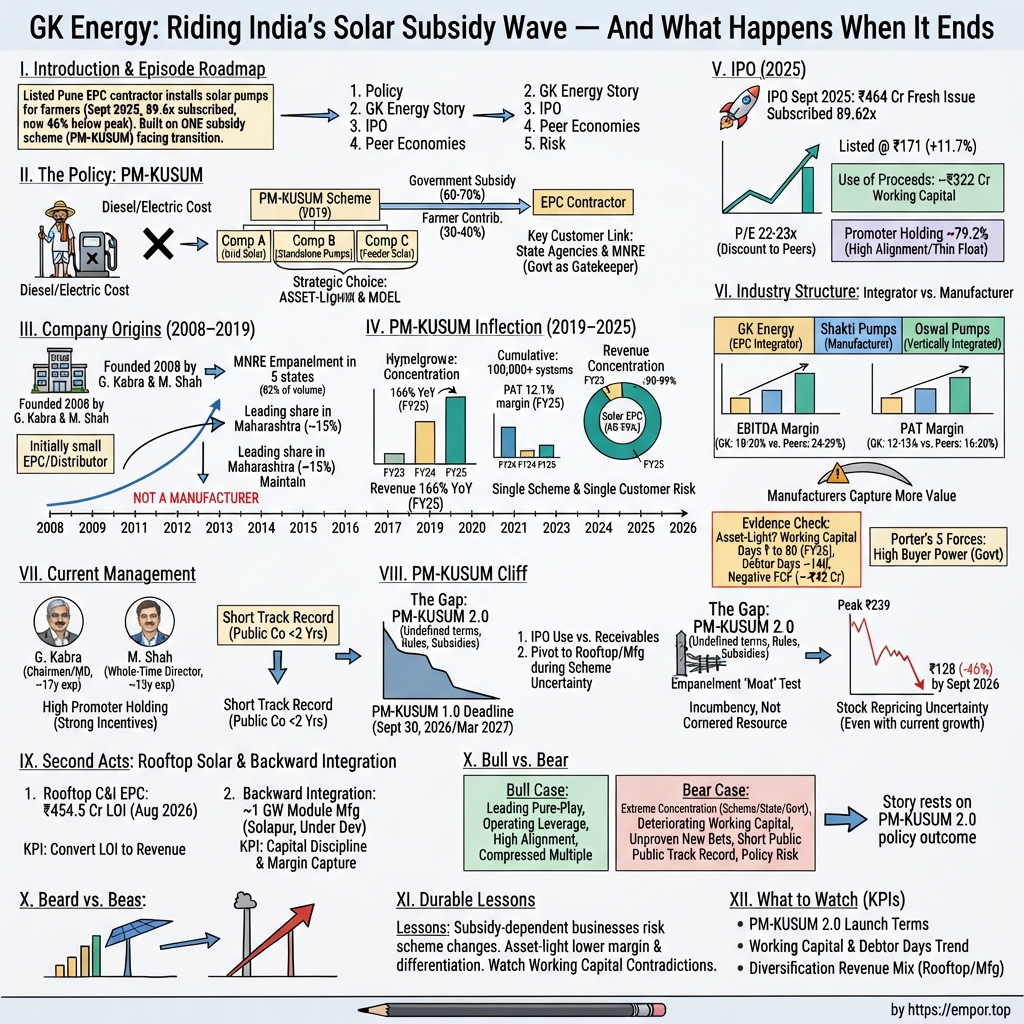
GK Energy: Riding India's Solar Subsidy Wave — And What Happens When It Ends
I. Introduction & Episode Roadmap
On the morning of September 25, 2025, a company that most Indian equity investors had never heard of two months earlier began trading on the National Stock Exchange. GK Energy Limited, headquartered in Pune, installs solar-powered water pumps on farms. Not glamorous. Not deep tech. The product is a panel array, a submersible pump, a controller, a borewell, and a technician on a motorcycle who drives to a village in Solapur district and makes the thing work.
The order book for its shares told a different story. The initial public offering was subscribed 89.62 times by the final day.1 The stock listed at ₹171 against an issue price of ₹153, an 11.76% opening premium, and kept climbing. Within weeks it was one of the most talked-about small-cap listings of the year, a "solar pump play" in a market that had decided solar pumps were the next thing.
Almost a year later, on September 8, 2026, the same stock trades at ₹129.61.2 The 52-week range runs from ₹239.60 at the top to ₹87.20 at the bottom.2 An investor who bought at the high and sold at the low would have lost nearly two-thirds of their money in a company whose revenue grew 40% and whose profit grew 51% over that same period.3
That gap between operating performance and market performance is the entire subject of this story. Because GK Energy is not a business that stumbled. By almost every operating measure, it has done what it said it would do. Revenue went from ₹70 crore in FY2022 to ₹1,533 crore in FY2026 — a twenty-two-fold increase in four years.43 Profit after tax went from ₹2 crore to ₹201 crore.43 Operating margins roughly tripled. In the June 2026 quarter the company posted its largest revenue print ever at ₹505 crore, up 71% year over year.5
And the market marked it down anyway.
The reason is not hidden. It sits in plain view in the company's own credit rating report, which notes that the PM-KUSUM scheme "directly and indirectly accounted for ~99% of revenue in FY2025," and that the top five customers — nearly all of them state government nodal agencies — contributed roughly 99% of that revenue.6 GK Energy is not a company that sells to farmers. It is a company that sells to the Government of India and to five state governments, under one central subsidy program, with the overwhelming majority of the work in a single state.
That program is now being wound down and replaced. The commissioning deadlines for the current phase of PM-KUSUM have been extended to September 30, 2026 for the individual-pump component, with select project categories pushed to March 31, 2027.7 In March 2026, the Union Minister for New and Renewable Energy announced that a successor scheme — PM-KUSUM 2.0, with a dedicated 10 GW agrivoltaics component — was being prepared.8 As of this writing, the formal notification, the benchmark costs, the subsidy split, and the vendor qualification rules for that successor program have not been published.
So the question this story tries to answer is a specific one. GK Energy's stated competitive advantage is that it is empanelled — approved as a vendor — across five states that account for more than 85% of national PM-KUSUM allocations.6 Is that a moat, or is it a queue position in a line that the government is about to rearrange?
Here is the route. First, the policy that manufactured this industry out of nothing, and why India's diesel irrigation pumps became a fiscal emergency. Then the origins of GK Energy itself, and the single structural decision — not to manufacture anything — that defines both its returns and its ceiling. Then the hypergrowth years, the IPO, and a hard look at what the money was actually raised for. Then the part that matters most: a comparison against the two manufacturer-peers who compete for the same government orders, an evidence check on whether the "asset-light, capital-efficient" story survives contact with the cash flow statement, and a test of the empanelment moat against the strongest disconfirming evidence in the company's own record. Finally, the second acts — rooftop solar and a solar module factory — and what an investor would actually need to watch to know whether any of this works.
 Subscribe on LinkedIn
II. The Policy That Created an Industry: PM-KUSUM and India's Diesel-Pump Problem
To understand GK Energy, you first have to understand a problem that has haunted Indian state finances for fifty years: the agricultural electricity connection.
Picture a farm in Maharashtra's Marathwada region. Two hectares, maybe three. The monsoon is unreliable and increasingly so. Groundwater sits sixty to a hundred metres down. To grow anything beyond a single rain-fed crop, the farmer needs a pump — and a pump needs energy.
Historically there were two options, and both were bad. The first was diesel. A five-horsepower diesel pumpset burns roughly a litre of fuel an hour, and in irrigation season it runs for hours a day. For a smallholder, diesel is the single largest cash cost in the crop budget, and it is denominated in a commodity whose price is set in Rotterdam and Singapore, not in the village. The second option was a grid connection — which in most Indian states came with electricity priced at or near zero for agricultural users, because no state government has ever found it politically survivable to charge farmers for power.
That second option is where the fiscal damage lives. State electricity distribution companies buy power at market rates and supply it to agricultural consumers at a fraction of cost. The gap is either absorbed as a subsidy from the state budget or, more commonly, absorbed as accumulated losses on the distribution company's balance sheet. India's distribution utilities have been through repeated central bailouts over the decades for exactly this reason. Every new agricultural connection is, in accounting terms, a new liability.
Now consider what a solar pump does to that equation. A standalone solar pumping system has no fuel cost and no grid connection. Once installed, it produces water during daylight hours — which, conveniently, is when irrigation happens — at zero marginal cost to the farmer and zero ongoing subsidy cost to the state. The capital cost is high and the operating cost is nearly nil. It converts a permanent operating subsidy into a one-time capital subsidy.
That is the insight behind PM-KUSUM — Pradhan Mantri Kisan Urja Suraksha evam Utthan Mahabhiyan — launched by the Ministry of New and Renewable Energy in 2019. The scheme has three components. Component A supports small grid-connected solar plants on farmland, where the farmer sells power to the distribution utility. Component C funds feeder-level solarisation, where an entire agricultural feeder line is backed by solar generation. And Component B — the one that matters for this story — funds standalone, off-grid solar pumps for farmers who have no grid connection at all.
The Component B architecture is what created a whole contracting industry. The central government contributes a share of the benchmark cost, the state government contributes a matching share, and the farmer pays the remainder — in most implementations, the two levels of government together cover the substantial majority of the system cost, with the farmer's contribution the smallest slice. Critically, the money does not go to the farmer. It flows through a state nodal agency, which runs the empanelment process, allocates volumes to approved vendors, verifies installations, and releases payment.
This is the detail that determines everything else. Because the subsidy is administered rather than granted directly, the transaction is not a sale to a farmer. It is a contract with a government agency to design, procure, deliver, install, commission, and maintain a system on a farmer's land. That is engineering, procurement and commissioning work — EPC — and it requires a completely different company than a pump factory does. It requires warehouses in rural districts, a network of installation crews, logistics into places without addresses, a service organisation that can handle warranty claims across thousands of villages, and above all the working capital to fund the entire deployment before the nodal agency pays.
A useful way to think about it: PM-KUSUM did not create demand for solar pumps. It created demand for a distribution and installation layer that could convert a government budget line into hardware standing in a field. The panels and pumps were already commodities. The scarce capability was the last mile.
It also created a gatekeeper. Under the scheme, a vendor must be empanelled with the relevant state agency to receive any allocation at all. Empanelment requires demonstrated capability, financial capacity, quality certifications, and compliance with the government's approved-list requirements for solar modules. It is an administrative barrier, not a technological one — and administrative barriers have a specific property that technological barriers do not. They can be rewritten by the same authority that wrote them.
Companies like GK Energy positioned themselves precisely on top of that gatekeeper. The empanelment list was the market. Get on it early, in the states with the biggest allocations, and the scheme's growth becomes your growth. For six years, that is exactly what happened.
The company that would exploit that opening more aggressively than any other, though, had already been quietly building the pieces for a decade before the scheme existed.
III. Company Origins and the Asset-Light Bet (2008–2019)
In 2008, solar photovoltaic modules cost several times what they cost today, India's installed solar capacity was a rounding error, and the idea of running an irrigation pump off a panel array was closer to a demonstration project than a business. That is the year Gopal Rajaram Kabra incorporated GK Energy in Pune.6
Kabra's background contains no venture capital, no engineering doctorate, and no obvious pedigree for renewable energy. He holds a commerce degree from Swami Ramanand Teerth Marathwada University — a regional university serving the Marathwada districts of Maharashtra, some of the most drought-prone agricultural land in the country — and an MBA in marketing from the Vishwakarma School of Business Management in Pune.9 By the company's own account he has spent over seventeen years in the solar power industry, which places his entry effectively at the founding.9 He received the Udyog Ratan Award in 2013, a business recognition of the sort common in Indian regional industry circles.9
The detail worth pausing on is the university. A commerce graduate from Marathwada building a solar irrigation business is not a coincidence of geography. Marathwada is where the water problem is most acute, where diesel pump economics bite hardest, and where a person growing up in the region would have watched families make irrigation decisions with a calculator rather than an agronomy textbook. The founding insight here was almost certainly commercial rather than technical: not "solar panels are interesting" but "there is a group of customers for whom the fuel bill is the binding constraint."
In April 2011, Mehul Ajit Shah joined as a promoter and became the operational half of the partnership.9 Shah, also a commerce graduate with an MBA from the University of Pune, has around thirteen years in the industry and serves as Whole-Time Director and Chief Operating Officer.9 The division of labour has been stable ever since — Kabra on strategy, government relationships and the external face of the business; Shah on execution.
Then came the decision that determines the shape of this entire investment case. GK Energy does not manufacture anything.
It does not make solar modules. It does not make pumps. It does not make motors, controllers, or inverters. It sources all of these from specialised vendors and sells the assembled outcome — survey, design, supply, installation, commissioning, and maintenance — as an integrated service.6 The company brands the systems as its own and controls the last mile through a network of decentralised warehouses and its own vehicle fleet, but the value-added manufacturing happens on someone else's shop floor.10
Understand what this choice does to the financial model. A manufacturer of solar pumps carries a factory: land, buildings, machinery, an inventory of work-in-progress, a fixed cost base that has to be covered whether orders arrive or not. In exchange, it captures the manufacturing margin on every unit it ships. An integrator carries none of that. Its balance sheet is receivables, inventory in transit, and a modest amount of logistics equipment. It earns a thinner margin per unit, but it earns that margin on a much smaller invested capital base — and it can scale volume by hiring more installation crews rather than by building another factory.
In a normal industrial market, that trade is roughly neutral. In a subsidy-driven rollout with volatile, government-set volumes, the integrator model has a real advantage: it can expand and contract with allocation cycles without stranding capital in idle plant. GK Energy's rating agency later described exactly this dynamic, noting that reliance on third-party suppliers and installation partners "enables scalability without significant capex."6
For eleven years, though, none of that mattered very much, because there was not much to scale. The pre-2019 GK Energy was a small distribution and contracting business serving whatever fragmented state-level solar pump programs existed. There is no publicly disclosed revenue history from that era; the company's audited financial record in its listing documents begins in FY2022, when revenue from operations was ₹70 crore.4 Even that figure comes three years after PM-KUSUM's launch. Whatever the business looked like in 2015, it was small enough that nobody outside Pune had reason to track it.
That is the honest characterisation of the first decade: a founder-run regional contracting firm with the right capability assembled before the market for that capability existed. Not a visionary bet on a policy that had not been written, but a business patiently accumulating the one thing that would turn out to be scarce — the ability to physically install thousands of systems across villages that logistics companies do not serve.
When the scheme arrived, that latent capability converted into growth at a rate that is genuinely difficult to find comparables for.
IV. The PM-KUSUM Inflection and Hypergrowth (2019–2025)
The gating asset in this business is a document. Not a patent, not a factory, not a brand — an empanelment letter from a state nodal agency saying that a company is approved to receive allocations under the scheme.
GK Energy accumulated five of them that mattered: Maharashtra, Haryana, Rajasthan, Uttar Pradesh and Madhya Pradesh.6 Those five states together account for more than 85% of national PM-KUSUM allocations by the rating agency's estimate, or roughly 82% of sanctioned Component B pump volume by the company's own framing.610 Either way, the point stands: GK Energy secured approval in the states where the money was.
Beyond the central scheme, the company also empanelled under a set of state-run programs with their own budgets — Maharashtra's Magel Tyala Saur Krushi Pump Yojana, Madhya Pradesh's Pradhan Mantri Krishak Mitra Surya Yojana, and Chhattisgarh's Saur Sujala Yojana.6 These matter less for revenue than they appear to, for a reason we return to later: they are all still government subsidy programs, so they diversify the source of the cheque without diversifying the type of counterparty at all.
What followed was one of the steeper revenue ramps in recent Indian mid-cap history. Revenue from operations went from ₹70 crore in FY2022 to ₹285 crore in FY2023, to ₹411 crore in FY2024, to ₹1,095 crore in FY2025.46 The rating agency computed the three-year compound growth rate at 418%.6 The FY2025 number alone represented 166% growth over the prior year.6
Growth that fast usually comes at the cost of margin. Here it did the opposite. Operating margin rose from 6.0% in FY2023 to 13.1% in FY2024 to 18.2% in FY2025, with profit-after-tax margin climbing from 8.8% to 12.1% between FY2024 and FY2025.6 Absolute profit went from ₹36 crore to ₹133 crore in a single year.6
Management's explanation for the margin expansion was operating leverage plus volume-based procurement efficiencies.6 That explanation is plausible and worth unpacking, because it reveals how this business actually makes money. In an EPC model where you buy finished components, the largest cost line is materials — solar modules above all. One research note tracking the company observed that material costs fell from roughly 89.5% of revenue in FY2023 to 64.2% in FY2025.11 A drop of that magnitude in two years is not primarily an efficiency story. It reflects two things happening at once: a collapse in global solar module prices through 2023 and 2024 as Chinese manufacturing overcapacity flooded the market, and GK Energy's growing order volume giving it more purchasing leverage with suppliers.
That distinction matters enormously for how an investor should read the margin. Procurement scale is a genuine, durable advantage — the largest buyer gets the best price, and that advantage compounds. Falling module prices are not an advantage at all. They are a windfall available to every competitor simultaneously, and they reverse when the cycle reverses. Since the government sets the benchmark cost per pump, a fall in input prices flows straight to the contractor's margin until the government resets the benchmark. Which it periodically does.
The operating footprint that produced these numbers is genuinely impressive as physical infrastructure. By the end of FY2026 the company reported cumulative installations of more than 140,000 renewable energy systems and 617 MW of commissioned capacity, with 61,085 systems deployed and 276 MW commissioned in that year alone.3 It operates across more than 7,500 villages with over 1,200 installation and commissioning partners and a network of decentralised warehouses.310 By the June 2026 quarter, cumulative installations had passed 164,500 systems and 726 MW.5
Building a distribution network that reaches 7,500 villages is not easy, and it is not quickly copied. That is the strongest version of the bull case, and it deserves to be stated at full strength.
Now the part that has to sit directly next to it.
Over exactly the period in which the business scaled, its dependence on a single revenue source did not decline. It intensified. EPC of solar-powered pump systems accounted for 90.55% of revenue in FY2023, 91.07% in FY2024, and 99.32% in FY2025.12 The rating agency put the PM-KUSUM dependence at approximately 99% of FY2025 revenue and noted that the top five customers contributed roughly 99% of revenue — with those customers named as state nodal agencies including the Maharashtra Renewable Energy Development Agency, the Maharashtra Energy Development Agency, and the Haryana Renewable Energy Development Agency.6
Read that carefully. A company with ₹1,095 crore of revenue had five customers. All five were arms of state governments. And the concentration got worse, not better, in the year immediately before the company asked public market investors for money.
The rating agency's own summary of the risk is unambiguous: the entity "receives entire of its revenue from the agricultural sector and has significant dependence on orders from the PM KUSUM Yojana and other state sponsored schemes directly or indirectly for future growth."6
For an investor, the FY2019–FY2025 record establishes two things clearly and one thing not at all. It establishes that GK Energy can execute at scale — the installations happened, the capacity is commissioned, the profits are audited. It establishes that the company built a last-mile network of real operational value. What it does not establish is whether any of that constitutes a competitive advantage, because for six years there was no real test. When a government program grows at triple-digit rates and you are on the approved vendor list, growth is not evidence of an edge. It is evidence of being present.
The test comes when the program stops growing. Before that arrives, though, the company did what companies at the top of a growth curve do: it went public.
V. The IPO: Cashing In at the Top of a Subsidy Cycle?
September 2025 was an unusually receptive moment for an Indian small-cap listing. The primary market was hot, retail participation was heavy, and any story that combined "renewable energy" with "government scheme" with "triple-digit growth" had a natural audience.
GK Energy's offer was structured accordingly. The total issue came to ₹464.26 crore, comprising a fresh issue of ₹400 crore and an offer for sale of ₹64.26 crore, on top of a pre-IPO placement of approximately ₹100 crore — roughly ₹500 crore of gross proceeds in aggregate.6 The price band was set at ₹145 to ₹153 per share. Books closed on September 23, 2025 with total subscription of 89.62 times.1 The shares listed on September 25, 2025 at ₹171, an opening premium of 11.76%.6
Now look at where the money went, because the use of proceeds is the most informative document in any IPO and it is routinely ignored.
Of the fresh issue, approximately ₹322 crore was earmarked for funding long-term working capital requirements, with the balance to general corporate purposes.12 Not a factory. Not an acquisition. Not R&D. Working capital.
That is worth sitting with. A company whose entire equity story rested on being asset-light — on scaling without capital intensity — raised the majority of its listing proceeds to fund the cash it needed to carry receivables and inventory. Those two things are not contradictory, but they are in tension, and the tension is the heart of this business.
Here is the mechanism in plain terms. GK Energy wins an allocation from a state nodal agency to install, say, 10,000 pumps. It must then buy 10,000 sets of modules, pumps and controllers from suppliers, ship them to district warehouses, and deploy installation crews — typically within a contractually tight window. In one representative case from July 2026, the execution period was sixty days from the notice to proceed.13 The company therefore pays its suppliers, its logistics providers and its installers over roughly two months. It then submits claims to the nodal agency, which inspects the installations, verifies them, and pays. That last step has historically taken a great deal longer than sixty days.
The result is a business that consumes cash as it grows, no matter how asset-light the fixed asset base is. "Asset-light" describes the property, plant and equipment line. It says nothing about the current assets line, which is where the money actually goes.
The rating agency documented the strain directly. Net working capital as a percentage of operating income rose to 31% in FY2025 from 22% in FY2024. Debtor days stood at 120 at the end of FY2025 — an improvement from 135 the prior year, but the improvement was attributed to a mix effect, specifically a relatively higher revenue contribution from private customers versus government nodal agencies in the earlier period. Creditors funded 60 days of the cycle and inventory absorbed 30 days. The remainder was funded with borrowings of about ₹218 crore as of March 31, 2025, and internal accruals.6 Gearing stood at 1.04 times at that date.6
So the honest reading of the IPO is this: it was a working capital financing, structured as an equity raise, executed at a moment when public market demand for the story was at a peak. That is not a criticism — it is a rational and arguably necessary act of corporate finance. The rating agency noted approvingly that the proceeds "strengthened the net worth, capital structure and liquidity position," with gearing expected to fall below 0.6 times during FY2026 and unutilised IPO proceeds of approximately ₹300 crore sitting on the balance sheet as of September 2025.6
But it does reframe the equity story. The company was not raising growth capital to fund a strategic expansion. It was raising the money required to keep doing what it was already doing, at a larger scale, because the counterparty pays slowly.
Two other features of the offer deserve mention. First, valuation. At the issue price, the stock came to market at roughly 22 to 23 times FY2025 earnings — a visible discount to the listed manufacturer-peers in the same scheme.14 The market was not being asked to pay up for a category leader. It was being offered a faster-growing challenger at a lower multiple, which is precisely how a discerning market prices a business with thinner margins and higher counterparty risk.
Second, ownership. Promoter holding after the offer stood at approximately 79.2%.4 That is high even by Indian standards, where 50-60% promoter stakes are common. It cuts both ways with real force. On one hand, Kabra and Shah retained overwhelming economic exposure to their own decisions — the alignment is about as strong as public-market alignment gets. On the other, a free float below 21% in a company with a ₹2,500 crore market capitalisation produces a thin, volatile market. One data provider assessed the stock's volatility at roughly four times that of the Nifty index.2 Investors experienced that arithmetic directly over the following twelve months.
The listing also placed the company, for the first time, alongside two direct comparables in the public market — and that comparison turns out to be considerably more revealing than any of the standalone numbers.
VI. Industry Structure: Integrator vs. Manufacturer, and Who Actually Wins
On July 4 and 5, 2026, the Maharashtra State Electricity Distribution Company issued a batch of empanelment letters for off-grid solar photovoltaic water pumping systems. The awards went out as follows: Shakti Pumps received 15,000 pumps worth ₹353.89 crore. GK Energy received 10,000 pumps worth ₹235.92 crore. Oswal Pumps received 10,000 pumps worth ₹235.92 crore. Jupiter International received 5,000 pumps worth approximately ₹108 crore. The total across the four vendors came to roughly ₹825 crore for about 40,000 pumps.15
Look at the second and third lines again. GK Energy and Oswal Pumps received identical volumes at identical values. Not similar — identical, to the rupee. The implied price works out to ₹23,592 per pump for both, which tells you that MSEDCL was not running a price auction. It was distributing a fixed allocation at an administered benchmark rate among a set of pre-approved vendors.
That single procurement round is the most useful piece of evidence in this entire story, and it should reshape how anyone thinks about competitive advantage here. In its home state, in its core product, GK Energy was allocated two-thirds of what Shakti Pumps received, at exactly the same unit price as Oswal, in a round where four vendors were served from the same pool. Empanelment did not win GK Energy a better price. It did not win a larger share. It won admission to the room.
This is the frame to carry through the rest of the analysis. Let us now compare the three companies properly.
Shakti Pumps is the incumbent. It is a genuine manufacturer of pumps, motors and controllers, with a domestic brand and an export business predating PM-KUSUM entirely, and it has been listed for years. Its FY2026 revenue was ₹2,643 crore against GK Energy's ₹1,533 crore.163 It has been investing in a 2.2 GW solar cell manufacturing facility — a far more capital-intensive backward integration than anything GK Energy has attempted.16
Oswal Pumps is the vertically integrated challenger, which listed in 2025 shortly before GK Energy. It manufactures solar-powered pumps, electric motors and solar modules under its own brand and supplies turnkey systems under PM-KUSUM.17 FY2026 revenue was ₹1,796 crore with profit after tax of ₹282 crore.17
The structural difference is straightforward. Both peers capture a manufacturing margin layer that GK Energy purchases from third parties. Historically that showed up exactly where you would expect: in FY2025, Oswal's operating margin reached 28% and Shakti's profitability peaked, against GK Energy's 18.2%.17166
Then FY2026 happened, and the comparison inverted in a way that is genuinely instructive.
Shakti Pumps grew revenue only modestly, from ₹2,479 crore to ₹2,643 crore, while profit after tax fell from ₹394 crore to ₹244 crore — a decline of roughly 38%.16 Its operating margin compressed toward 10% on a trailing basis, down from 14% two years earlier.16 Oswal's operating margin fell from 28% to 22%, though profit still grew.17 GK Energy, meanwhile, expanded its operating margin to 20.44% and grew profit 51% to ₹201 crore.3
For one year, the integrator out-executed both manufacturers. That is a real data point and it should not be waved away. It suggests the manufacturing margin layer is not automatically protective — a factory is a fixed cost, and when volumes are lumpy and government benchmark prices tighten, fixed costs cut the wrong way.
But now apply the same scrutiny to the capital efficiency claim, which is the load-bearing element of GK Energy's equity story.
The pre-IPO return ratios were spectacular and were marketed as such. The rating agency computed return on capital employed of 76% in FY2025 and 60% in FY2024.6 Screener's calculation for the same period produces 41% for FY2025, which illustrates a point worth making plainly: return metrics on a company with a tiny equity base and rapidly changing capital structure are extremely sensitive to how the denominator is defined and which period-end is used.4 Reported return on equity now sits around 37% on a trailing basis, and one rating service computed 22.8% from the Q4 FY2025-26 quarterly result.418
None of those numbers are wrong. They measure different things. The mechanical reality is that adding roughly ₹500 crore of fresh equity to a company that previously operated on a net worth of ₹209 crore compresses return on equity arithmetically, regardless of what happens to the underlying business.6 An investor who treats the pre-IPO 60-76% figure as the "true" return is being misled by a pre-dilution equity base; an investor who treats the post-IPO figure as a deterioration in unit economics is being misled in the opposite direction. The underlying operating return on the deployed asset base did not change on listing day. The equity denominator did.
The genuinely troubling evidence lies elsewhere — in the cash flow statement.
In FY2026, GK Energy reported profit after tax of ₹201 crore. Cash generated from operations was ₹53 crore. Free cash flow was negative ₹42 crore.4 That is a cash conversion ratio of roughly 26% of accounting profit, in the first full year after an IPO raised specifically to relieve working capital pressure.
The underlying metrics tell you where the cash went. Working capital days rose from 44 in FY2025 to 80 in FY2026. Debtor days reversed direction and climbed from 120 to 140. The cash conversion cycle stretched from 91 days to 112.4 Borrowings stood at ₹203 crore at the end of FY2026, roughly where they were before the IPO, though the company simultaneously held cash reserves of ₹240.61 crore, leaving it in a net cash position.43
So the evidence check on "asset-light and capital-efficient" resolves as follows. The first half of the claim is true and verified: the company genuinely does not carry a factory, and its fixed asset intensity is far below its manufacturer-peers. The second half is not supported by the FY2026 record. Capital efficiency measured through the cash flow statement rather than the income statement deteriorated materially in the year after listing, and the equity raised to fix the problem was absorbed by the problem growing faster than the fix.
There is, however, an important piece of context that stops this from being an indictment of GK Energy specifically. Look at the peers over the same period. Shakti Pumps ended FY2026 with debtor days of 174 and a working capital cycle of 82 days.16 Oswal Pumps ended FY2026 with debtor days of 224 and working capital days of 185 — up from negative 21 days in FY2022.17 Every company selling into this scheme experienced the same receivables blowout at the same time.
That pattern points to a single cause: the government stopped paying as quickly. One research note attributed the receivable extension to inspection-linked payment delays from government agencies.11 When the buyer sets the price, sets the volume, and sets the payment timing, the vendor's working capital is not a management performance metric. It is a policy outcome.
Which brings us to the industry structure itself. Run Porter's framework across this market and the results are unusual.
Supplier power is moderate and, for now, favourable to the buyers. Solar modules are a globally oversupplied commodity, though India's approved-list requirements narrow the eligible pool and reintroduce some pricing power for domestic manufacturers. Pumps and motors have a competitive domestic supplier base. The rating agency nonetheless flagged supply chain concentration as a risk, noting the company depends on "a concentrated supplier base" for key components.6
Buyer power is the dominant force in the industry and it is close to absolute. The buyer is a state nodal agency executing a central scheme. It determines the benchmark price per pump, the volume allocated to each vendor, the inspection standard, the payment schedule, and the identity of the approved vendor list. The July 2026 MSEDCL round is the demonstration: four vendors, administered prices, allocated volumes. Vendors compete for a share of a fixed pool, not for customers.
Rivalry is therefore structurally muted in price terms and intense in allocation terms. Competitors do not undercut each other on price because price is set. They compete on execution credibility and on the capacity to absorb the working capital burden — which is precisely why the largest players keep winning allocations and why the barrier to entry is financial rather than technical.
Barriers to entry are real but administrative. Empanelment requires track record, quality compliance and financial capacity. None of these are impossible to acquire — but they take years, and the working capital requirement alone excludes most would-be entrants. This is a genuine barrier. It is simply a barrier of a particular kind: one written by an authority that can rewrite it.
Substitutes are the quiet long-term question. Grid extension and feeder-level solarisation under Component C both solve the same farmer problem through a different technical route, and Component C spending competes with Component B for the same scheme budget.
The net picture: GK Energy operates in an industry with weak internal rivalry, moderate supplier power, real but administrative entry barriers, and one overwhelmingly powerful buyer who is simultaneously the source of all demand and the setter of all terms. That configuration produces good returns as long as the buyer's program is expanding and its rules are stable.
The buyer has announced that its program is being replaced.
VII. Current Management: Incentives, Ownership, and a Short Track Record
Assessing management quality at a company with under twelve months of public reporting history is a genuinely constrained exercise, and it is more honest to state the constraint than to fill it with inference.
The two principals are unchanged since the founding partnership formed. Gopal Rajaram Kabra serves as Chairman, Managing Director and Chief Executive Officer; Mehul Ajit Shah as Whole-Time Director and Chief Operating Officer.9 Both have spent essentially their entire professional lives in this one business. Combined promoter holding of roughly 79.2% means their personal wealth moves almost entirely with the share price.4
That alignment is real, and it is worth noting that it survived the listing without significant monetisation — the offer for sale component was ₹64.26 crore against a total raise of roughly ₹500 crore, meaning the overwhelming majority of the money went into the company rather than to the founders.6 Promoters who take a small cash-out at listing and retain 79% are behaving differently from promoters who use an IPO as an exit. That is a meaningful, verifiable behavioural signal.
The professional layer around them is new. The Chief Financial Officer, Sunil Kamalkishor Malu, a Fellow of the Institute of Chartered Accountants of India with thirteen years in finance and management consultancy, joined in October 2024.9 The Company Secretary and Compliance Officer, Jeevan Santoshkumar Innani, joined in October 2024.9 Non-Executive Director Navaniit Mandhaani joined in October 2024.9 Several senior management appointments — project head, assistant general managers for finance, operations and human resources — cluster in the second half of 2024 as well.9
The obvious inference is that the corporate governance and finance function was assembled specifically to take the company public. That is entirely normal for a founder-run business making the transition, and it is better than the alternative of listing without those functions. But it does mean the finance organisation reviewing a business with 140 days of receivables and ₹1,500 crore of revenue has been in place for less than two years.
The board composition contains one entry worth naming explicitly. Independent Director Chandra Iyengar joined the Indian Administrative Service in July 1973 and spent over thirty-seven years in the administrative services, holding senior positions in the Maharashtra government including Additional Chief Secretary.9 A retired senior Maharashtra bureaucrat sitting on the board of a company that derives the overwhelming majority of its revenue from Maharashtra state agencies is not improper, and such appointments are common across Indian corporate boards. It is simply a fact an investor should hold consciously rather than discover later: the company's independent oversight includes deep familiarity with the counterparty that pays its bills.
The board does carry genuine technical and financial expertise alongside it — Subhash Vasant Ghaisas holds a doctorate in experimental physics with four decades in solar energy and semiconductor research, and two independent directors are chartered accountants, one with a forensic accounting certification.9 Two of the six directors listed are women, including the former Additional Chief Secretary.
One related-party observation: Darshana Gopal Kabra was appointed Vice President – Administration and designated senior management personnel in November 2025, two months after listing.9 Family appointments to senior management in a promoter-controlled Indian company are unremarkable in frequency and unremarkable in size here. It is disclosed, which is the relevant test. An activist investor would note it; it would not be their strongest argument.
Now the harder question: what does the behavioural record actually show?
The single verifiable test available so far concerns the order book, and it does not flatter the company's communication practices. At the time of the IPO, the outstanding order book stood at approximately ₹1,029 crore as of August 15, 2025.6 By December 31, 2025, it had fallen to ₹803.24 crore — comprising ₹787.58 crore of solar pump systems representing 33,067 pumps, and ₹15.66 crore of rooftop solar representing 3.55 MW.19 That is a 22% decline in the order book over roughly four and a half months, in the first two reported quarters as a public company.
The decline was disclosed in a stock exchange filing, so there is no concealment issue. But it is not what the growth narrative in the market at the time suggested, and it means that for the first half of FY2026, the company was consuming its backlog faster than it was replenishing it. Order inflows recovered strongly in FY2027 — the company reported allocations and empanelments exceeding ₹1,092 crore including GST between April 1, 2026 and late August 2026.20 But the intervening dip is exactly the kind of operational data point that separates a growth business from a lumpy allocation business, and it happened within months of listing.
On disclosure quality generally, the record is adequate but thin. The company has filed earnings call transcripts with the exchanges, including for the September 2025 quarter, and made its FY2026 audited-results call available.2122 The published corpus amounts to roughly four calls. That is not enough to assess guidance discipline, to observe how management explains a miss, or to see how they behave when a strategy has to change. It also means there is no observable record of this management team operating through a downturn, a scheme gap, or a period of profit decline — because none has yet occurred.
The correct conclusion is a limitation, not a verdict. Alignment is strongly evidenced. Execution capability is strongly evidenced. Capital allocation judgment, guidance discipline, and crisis behaviour are simply not yet evidenced in either direction, and any thesis that assumes them is assuming rather than concluding.
Two decisions currently in flight will produce the first real evidence. The first is whether the IPO proceeds visibly convert into operating cash flow rather than being absorbed by receivables. The second is the decision to commit capital to a manufacturing facility and to a new business line at precisely the moment the core scheme's future became uncertain. Both are examined next.
VIII. The PM-KUSUM Cliff: Testing the Empanelment "Moat"
On March 11, 2026, Union Minister for New and Renewable Energy Pralhad Joshi stood at the 4th National Agro-RE Summit in New Delhi and announced that the government was preparing to launch PM-KUSUM 2.0, featuring a dedicated 10 GW agrivoltaics component that would allow farmers to generate solar power alongside crops on the same land.8
It was framed as expansion. Joshi cited agrivoltaic potential ranging from 3,000 GW to nearly 14,000 GW, and suggested farmer income could rise from around ₹60,000 per acre to more than ₹1 lakh per acre by combining generation with cultivation.8 Press coverage put the successor scheme's expected total outlay at roughly ₹50,000 crore, with the annual PM-KUSUM budget allocation for FY2026-27 nearly doubling to about ₹5,000 crore.
For a company whose entire revenue base sits inside PM-KUSUM, this should have been unambiguously good news. It was not received that way, and the reason is what the announcement did not contain.
There was no implementation timeline. No rollout date. No budget allocation mechanics. No eligibility criteria. No subsidy structure. No application procedure. Critically, no vendor qualification framework.8 As of this writing in September 2026, six months later, the formal MNRE notification with guidelines and benchmark costs has not been published.
Meanwhile the current scheme is running out its clock. In March 2026, MNRE extended the deadlines: financial closure for Components A and C to September 30, 2026 with commissioning to March 31, 2027, and commissioning for the individual pump solarisation under Components B and C to September 30, 2026.7 The stated reason for the extension was that banks and financial institutions had been unable to extend financing within the existing timelines.7 And there is a hard eligibility gate: the revised deadlines apply only to projects with power purchase agreements or notices to proceed issued on or before December 31, 2025, with any further extensions to be considered case by case.7
Parse what that means operationally. The current PM-KUSUM pipeline is a closed set. Nothing sanctioned after December 2025 gets the extended runway. The Component B commissioning window closes in three weeks from this writing. Everything beyond that depends on a successor program whose rules do not yet exist in published form.
Now let us test the moat claim directly, because this is the point on which the entire investment case turns.
The claim, as the company and its supporters state it, is that GK Energy has a durable competitive advantage from being empanelled across states representing 82-85% of national PM-KUSUM allocation, combined with a last-mile network across 7,500 villages.6103
The first half of that claim is factually correct and commercially valuable — under the current scheme's rules. The second half is a genuine operating asset that is not scheme-specific. But "empanelled under the current rules" is a categorically different thing from a moat, and here is the mechanism that distinguishes them.
A moat is a structural feature that makes it costly or impossible for a competitor to reach your customer. Switching costs, network effects, scale economies, brand, cornered resources. In each case, the customer's behaviour is what protects you. Empanelment does not work that way. It protects you because a regulator has drawn a line and put you inside it. The regulator can redraw the line at any time, and redrawing the line is exactly what happens when a program is redesigned.
The disconfirming evidence for the moat claim does not require speculation about PM-KUSUM 2.0. It is already in the record. That July 2026 MSEDCL round, in which four vendors received allocations at identical administered prices, is a demonstration that the state agency treats empanelled vendors as a pool of interchangeable suppliers to be portioned out, not as differentiated partners to be retained. The competitor that received the largest allocation in GK Energy's home state was not GK Energy.15 Empanelment is a licence to receive allocation. It is not a claim on any particular allocation.
There is a second layer of concentration risk sitting on top of the first. GK Energy's revenue is not merely concentrated in one scheme — it is concentrated in one state. The listing documents disclosed Maharashtra as the source of approximately 93% of FY2025 revenue, and one research note put continuing dependence at 85-90%.1211 A single state government's execution pace, budget position and administrative decisions therefore drive the majority of the company's revenue. When MSEDCL's inspection process slows, GK Energy's receivables extend. That is not a diversifiable risk within the current business model; it is the business model.
The market has been repricing this uncertainty steadily and severely. From a 52-week high of ₹239.60, the shares fell to a low of ₹87.20 — a decline of 64% at the trough — before recovering to roughly ₹130, still about 46% below the peak.24 Rating services followed the price: one quantitative platform downgraded the stock from Buy to Hold in July 2026, citing a reassessment across quality, valuation, financial trend and technical parameters.18 Note the nature of that downgrade — it was driven substantially by the technical trend shifting from mildly bullish to sideways, which is a description of the price action rather than an independent analysis of the business.18 Coverage of this company remains thin, and investors should not mistake a quantitative rating change for deep fundamental work.
What makes the situation analytically interesting is that the operating results have not deteriorated at all. The June 2026 quarter produced record revenue of ₹505.19 crore, up 71.1%, with profit after tax of ₹59.67 crore, up 61.55%.5 Order inflows accelerated sharply, exceeding ₹1,092 crore of allocations between April and late August 2026.20
There is one caution buried in those results. EBITDA in the June 2026 quarter was ₹86.11 crore, up 47.72% against revenue growth of 71.1%.5 That implies an operating margin of roughly 17%, down from approximately 19.7% in the year-ago quarter. Revenue accelerated and margin compressed simultaneously — consistent with the pattern already visible at Shakti Pumps and Oswal Pumps, and consistent with the possibility that benchmark prices are tightening as module costs fall. It is one quarter, and one quarter is not a trend. It is a number to watch rather than a conclusion to draw.
So how should an investor weigh all of this?
The historical record does not reject the claim that GK Energy is a leading EPC player in solar agricultural pumps. Installations, commissioned capacity, order inflows and profit all support it, and the operating network across 7,500 villages is a genuine asset that would take a new entrant years to replicate.
But the record does narrow the claim substantially. It does not support "durable structural moat." It supports "incumbent advantage under a specific scheme design that the government has publicly stated it is replacing." The distinction is not academic. A structural moat would justify capitalising current earnings at a premium multiple on the assumption of persistence. An incumbent advantage under a sunsetting program justifies exactly the opposite — a discount, because the persistence assumption has an expiry date attached that the market can read as easily as the company can.
The KPI that resolves this is specific and identifiable. When MNRE publishes the PM-KUSUM 2.0 guidelines, the vendor qualification framework will either carry forward existing empanelments, reopen the vendor list entirely, or restructure eligibility around new criteria — agrivoltaics is a materially different technical undertaking from standalone pump installation, and a scheme centred on 10 GW of co-located generation may favour developers with generation assets and grid experience over pump installers. Which of those three outcomes occurs is the single highest-impact event on this company's horizon, and it will be determined in a government office rather than in a factory or a field.
Management, to its credit, has not waited passively for that answer. It has committed capital to two alternatives.
IX. Second Acts: Rooftop Solar and Backward Integration
In February 2026 — five months after listing, one month before the PM-KUSUM 2.0 announcement — GK Energy declared its entry into retail rooftop solar EPC, framing the move as a transition "from a product-centric solar pump player to a Solar EPC enterprise."23
The timing was explicitly policy-driven. The company tied the expansion to the Union Budget's increased allocation for the PM Surya Ghar Muft Bijli Yojana, India's residential rooftop solar subsidy program, which rose from ₹17,000 crore to ₹22,000 crore.23 The stated geographic focus was Tier-2 and Tier-3 cities, leveraging the rural and semi-urban presence the company had already built for pumps.23
Note what that logic reveals. The second growth engine is a second government subsidy scheme. The customer type does not change — it remains a government or utility counterparty operating an administered program with benchmark pricing and inspection-linked payment. The distribution asset being leveraged is real, and rooftop installation genuinely benefits from having warehouses and installation crews already deployed in the same districts. But an investor looking for diversification away from policy risk should recognise that this move diversifies the scheme while preserving the dependency.
The rooftop business took a substantial step forward in August 2026. On August 26, GK Energy announced a Letter of Empanelment for grid-connected rooftop solar photovoltaic projects worth ₹454.50 crore, covering 100,000 residential systems of 1 kW each — 100 MW of aggregate distributed capacity — together with five years of operations and maintenance.2024 The contracted rate was fixed at ₹45,450 per kW including tax, and the execution window was sixty days from the work order.20
That is a genuinely large win in absolute terms. It is roughly 30% of the company's entire FY2026 revenue in a single award, and it moves rooftop from a rounding error — ₹15.66 crore of the December 2025 order book — to a material business line.19
It is also, at this moment, a letter of empanelment rather than collected revenue. The relevant historical caution is one the company's own record supplies: this business converts orders into cash slowly, through a government inspection and payment process that stretched debtor days to 140 in FY2026. An award of 100,000 one-kilowatt residential systems to be executed within sixty days implies an enormous simultaneous procurement and deployment effort, funded by the company, ahead of verification and payment by the utility. If the pump business consumes working capital at scale, a rooftop award of this shape will consume it faster — the systems are smaller, the sites are more numerous, and the coordination burden per rupee of revenue is higher.
The honest framing is therefore: plausibly material to the future case, not yet proven as a recurring revenue stream, and carrying the same working-capital signature as the core business rather than relieving it. The test is whether the next two to three quarters show rooftop converting into booked revenue and, more importantly, into collected cash.
The second act is more consequential and more contentious.
GK Energy is developing a 1 GW solar module manufacturing facility in Maharashtra, at Solapur, targeted for completion around September 2026, with the stated aim of internalising the supply chain and capturing the margin layer that separates it from Shakti and Oswal.11 Research tracking the project has indicated that 875 MW of domestic content requirement cell procurement has been secured.11 Specific capital expenditure figures for the plant have not been disclosed publicly by the company.
The strategic logic is easy to state. Solar modules are the largest single component of direct cost in a solar pump system. Making them internally converts a purchase into a manufacturing margin, and it reduces exposure to a supplier base that the rating agency has already flagged as concentrated.6 Both peers have made the same bet — Shakti with a 2.2 GW solar cell facility, Oswal with in-house module production.1617
But this is where the "asset-light" identity that has defined the company for eighteen years gets abandoned, and the funding structure deserves direct attention. The rating agency's assessment is explicit and does not match the softer framing that has circulated in the market. ICRA described the project as a "largely debt-funded solar module assembly plant for captive consumption," to be built in a phased manner over FY2026 to FY2028, and stated that it "is expected to lead to lower asset turnover over the medium term, while the same should also aid margins due to backward integration."6
Three things follow from that sentence, and each of them matters.
First, this is debt-funded, not funded from the IPO proceeds — which were committed to working capital. So the company is adding leverage for a manufacturing project while simultaneously running a working capital cycle that consumed ₹42 crore of free cash flow in FY2026.4 The rating agency named exactly this risk in its downgrade triggers: "Any larger than envisaged debt-funded capital expenditure adversely affecting the company's financial metrics may also result in a downgrade."6
Second, asset turnover falls. The entire high-return-on-capital story rests on generating large revenue from a small asset base. A module factory is the opposite of that. ICRA stated directly that return on capital employed "is expected to remain healthy but gradually moderate over the medium term due to backward integration efforts."6 The company's own credit assessor has therefore already told investors that the headline capital efficiency numbers will come down as a consequence of management's chosen strategy. Anyone modelling persistent 40%-plus returns on capital is modelling against the rating agency's stated expectation and against management's own capital plan.
Third — and this is the sharpest question an activist investor would ask — the sequencing is uncomfortable. The company is committing its largest-ever capital outlay, funded with debt, into module manufacturing, at a moment when Chinese and Indian module capacity is abundant, when its own core scheme is in a transition with undefined successor terms, and when it has less than two years of public-company track record in capital allocation. Is that prudent preparation for a lower-margin future, or is it a pressured pivot executed from a position of narrowing options?
The honest answer is that there is not yet evidence to distinguish between them, and this is precisely the kind of decision where an investor should refuse to fill the gap with a favourable assumption. What can be said is that the decision is being made by a management team with no observable prior record of large capital deployments, into a business — manufacturing — in which neither principal has operating experience, financed with debt, while the operating business is consuming rather than generating cash. Those are facts, and they raise the burden of proof rather than settling it.
The third diversification vector is the smallest and the most easily overstated. Empanelment under Maharashtra's Magel Tyala Saur Krushi Pump Yojana, Madhya Pradesh's Pradhan Mantri Krishak Mitra Surya Yojana, and Chhattisgarh's Saur Sujala Yojana genuinely broadens the set of programs the company can bid into.6 The July 2026 MSEDCL award of ₹235.92 crore for 10,000 pumps came under Magel Tyala Saur Krushi Pump Yojana, and cumulative orders from that single utility reached ₹637.83 crore.1513 These are real revenues from a scheme other than central PM-KUSUM.
But they are state subsidy schemes administered by state agencies with the same benchmark-price, inspection-linked-payment structure. They reduce exposure to any one program's timeline. They do not reduce exposure to the category of counterparty, to administered pricing, or to the political economy of agricultural subsidy in India. Calling this diversification is accurate only in the narrowest sense.
Which sets up the central argument.
X. Bull vs. Bear: The Case For and Against
The bull case, stated at full strength.
GK Energy is the largest pure-play EPC franchise in solar agricultural pumps in India, empanelled precisely where the volumes are, with an installation and logistics network reaching 7,500 villages through 1,200 partners and a decentralised warehouse system.63 That network is the hard part of the business and it is not quickly replicated.
The financial trajectory has been exceptional and the profitability is real, audited, and improving: profit growing faster than revenue for three consecutive years, operating margin expanding from 6% to over 20%, and — unusually for a hypergrowth Indian small cap — an actual net cash position of ₹240.61 crore against borrowings of ₹203 crore at FY2026 year end.34 The company holds an investment-grade credit rating of [ICRA]BBB+ (Stable) with an A2 short-term rating on ₹300 crore of working capital facilities.6 It has even paid a dividend in its first year as a listed company.4
Promoter ownership of 79.2% means the people making the decisions bear almost all of the consequences.4 The company is moving early rather than late into rooftop solar and backward integration, building a second leg before the core scheme transitions rather than after. Order momentum in FY2027 has been strong, with over ₹1,092 crore of allocations secured in under five months and a record quarterly revenue print.205 And after a 46% de-rating from the high, the stock trades at roughly 12 times trailing earnings — a multiple that already embeds substantial policy pessimism.24
The bear case, stated at full strength.
Almost every element of this business runs through a single point of failure. One scheme accounted for approximately 99% of FY2025 revenue. Five customers accounted for roughly 99% of revenue, all of them state government agencies. Approximately 93% of FY2025 revenue came from a single state.612 There is no meaningful diversification anywhere in the revenue base, and the concentration increased rather than decreased through the growth years.
That scheme is being restructured into a successor whose vendor qualification rules do not exist in published form, whose technical emphasis — agrivoltaics — differs materially from standalone pump installation, and whose launch date has not been announced.8 The current phase's Component B commissioning deadline expires at the end of September 2026, and only projects sanctioned on or before December 31, 2025 qualify for the extension.7
Working capital and cash generation deteriorated in the first full year after an IPO raised expressly to fix them: working capital days nearly doubled, debtor days reversed and rose to 140, operating cash flow converted only 26% of accounting profit, and free cash flow was negative.4 Margins sit structurally below manufacturer-peers and the June 2026 quarter showed operating margin compressing even as revenue accelerated.5
The remedies are unproven and costly. Rooftop solar is one large empanelment letter, not a demonstrated revenue stream, and it carries the same cash-consumption profile. The module factory is a debt-funded departure from the asset-light model that the company's own rating agency expects to reduce asset turnover and moderate return on capital.6 Management has under eighteen months of public track record, no observable experience in manufacturing, no record of navigating a downturn, and a finance function assembled in late 2024.9 The order book fell 22% in the first four and a half months after listing before recovering.619
Applying Hamilton Helmer's 7 Powers.
This framework is useful here precisely because it forces a distinction between advantages that persist and advantages that merely exist.
Scale economies — partially present. Procurement leverage from being among the largest buyers of modules and pumps for this application is genuine and showed up in falling material cost ratios.11 But the peers are similarly scaled, and much of the observed input-cost improvement came from a global module price collapse available to everyone.
Network economies — absent. There is no value to a farmer in other farmers using GK Energy. The 7,500-village network is a distribution asset, not a network effect, and the two are frequently conflated.
Counter-positioning — absent. Nothing about the integrator model is something the manufacturer-peers cannot copy; indeed GK Energy is currently copying them by building a module plant, which is the reverse of counter-positioning.
Switching costs — essentially absent, and this is the crux. The customer is a state nodal agency that allocates volumes administratively among a pre-approved vendor pool. The July 2026 MSEDCL round, in which two vendors received identical volumes at identical prices, is direct evidence that the buyer bears no switching cost whatsoever.15 Five years of maintenance obligations on installed systems create a service relationship with farmers, but farmers are not the paying customer.
Branding — weak. The company brands its systems, but the buying decision is made by a procurement process against a benchmark specification.
Cornered resource — this is where the empanelment argument is usually made, and it does not hold. A cornered resource is preferential access to a coveted asset on terms that create differential value. Empanelment is preferential access, but the terms are set by the granting authority, the authority grants it to multiple parties simultaneously, and the authority has announced it is redesigning the program under which the grant exists.
Process power — the most credible candidate, and the one worth watching. The capability to deploy tens of thousands of systems across thousands of villages within sixty-day windows, at consistent quality, with a distributed partner network, is an accumulated organisational capability that is genuinely hard to build quickly. If GK Energy has a durable edge, it lives here — in logistics execution — rather than in anything regulatory.
That conclusion should reframe the whole thesis. The moat, to the extent one exists, is operational rather than regulatory. Which means the correct question is not "will GK Energy stay empanelled" but "does its execution capability transfer to whatever the next program requires?" Rooftop solar is the first live test of exactly that transferability, and it is being run right now.
The activist stress test.
A skeptical investor with a short bias would press on five points. Why did working capital deteriorate in the year after raising ₹500 crore to fund working capital, and where specifically did the money go? Why is the company adding debt-funded manufacturing capital expenditure while operating cash conversion sits at 26% of profit? What is the actual capital expenditure number for the Solapur facility, which has not been publicly disclosed? Why did the order book fall 22% in the first two reported quarters after listing without prominent explanation? And what is the company's specific contingency plan — not aspiration, plan — if PM-KUSUM 2.0's vendor framework reopens empanelment to new entrants or restructures around generation developers rather than installers?
None of these are accusations. All of them are answerable, and the answers would be genuinely informative. The absence of published answers is itself a disclosure observation about a company less than a year into public life.
Net assessment.
The two sides of this case are not symmetric, and it is worth saying why rather than leaving them side by side. The bull case rests on things that are already demonstrated — execution, network, profitability, alignment. The bear case rests on things that are not yet determined — the successor scheme's terms, the conversion of rooftop orders to cash, the outcome of a manufacturing venture. That asymmetry means the bull case is better evidenced today, and the bear case is more likely to be resolved by events outside the company's control.
The practical consequence is unusual: over the next several quarters, government policy news will probably matter more to this equity than company execution news. A company can control its installation quality and its supplier negotiations. It cannot control whether the ministry's next notification preserves or dissolves the basis of its current position.
XI. Durable Lessons: Subsidy-Cycle Businesses and the IPO-at-the-Peak Pattern
Strip away the specifics and three generalisable patterns remain, each of which recurs across markets and decades.
The first is that a vendor list is not a moat.
Businesses built entirely inside a time-boxed government program develop what looks, from the income statement, exactly like a structural growth story. Revenue compounds. Margins expand with scale. Returns on capital reach levels that in any other industry would signal a formidable competitive position. And the mechanism producing all of it is that a government decided to spend money and put your name on an approved list.
The tell is in who bears the switching cost. In a genuine moat, leaving you is expensive for the customer. In an administered program, leaving you costs the agency nothing — it simply allocates the volume to the next name on the same list, at the same price, as MSEDCL demonstrated in a single procurement round in July 2026.15 The advantage is real while the program persists and evaporates in the interval between one program design and the next. Investors capitalising subsidy-cycle earnings at multiples appropriate to structural franchises are making a category error, and it is a category error that is very difficult to see while the subsidy is still flowing.
The corollary is that the correct thing to watch in these businesses is never the current order book. It is the design of the next program.
The second is that asset-light and capital-light are not the same thing.
The "asset-light" label describes the fixed asset side of the balance sheet, and GK Energy genuinely qualifies: it owns warehouses and vehicles rather than factories. But capital intensity is the sum of fixed assets and net working capital, and in businesses that deploy hardware for slow-paying institutional buyers, the working capital half dominates.
FY2026 supplied the demonstration in an unusually clean form: ₹201 crore of accounting profit converted into ₹53 crore of operating cash flow and negative ₹42 crore of free cash flow, in the year immediately after an equity raise dedicated to solving that exact problem.43 And the same year saw Shakti Pumps' debtor days at 174 and Oswal Pumps' at 224.1617 Three companies, three different business models — integrator, manufacturer, vertically integrated manufacturer — one common counterparty, one common outcome.
That last observation is the most transferable insight in this story. When every firm in an industry experiences the same balance sheet deterioration simultaneously, the cause is not in any of the firms. It is in the customer. And no amount of operational excellence at the vendor level fixes a buyer who has decided to inspect more carefully before paying.
The trade-off between the integrator and manufacturer models in subsidised infrastructure rollouts is therefore narrower than it first appears. The manufacturer captures more margin per unit and carries more fixed cost; the integrator captures less and scales more flexibly. But both are downstream of the same administered price and the same payment behaviour, and neither model confers protection from the thing that actually determines outcomes.
The third is about newly listed companies specifically.
There is a recurring pattern in which a company lists after its best year, on the strength of that best year, and the first evidence of strain appears in the working capital metrics rather than in the profit line. Profit is an accounting outcome that reflects revenue recognition; working capital is a cash outcome that reflects what the customer actually did. When a growth narrative and a cash conversion trend disagree, the cash conversion trend is usually earlier and usually right.
GK Energy is not a case of accounting aggression — the numbers are audited, the disclosures are in the filings, and the credit rating is investment grade with a stable outlook.6 It is a case of a genuine business whose fastest-growing year was also the year it sold shares to the public, which is not a coincidence anywhere and is not evidence of bad faith. It simply means that a public investor bought in at the point of maximum demonstrated momentum, and momentum in a subsidy-driven business has a schedule.
XII. What to Watch: The KPIs That Actually Matter
Three indicators carry more information about this company's trajectory than anything else in its reporting, and none of them is revenue growth.
First: the vendor qualification terms of PM-KUSUM 2.0.
This is not a financial metric and it will not appear in a quarterly result. It will appear in a Ministry of New and Renewable Energy notification, and it is the single highest-impact event on this company's horizon. The specific things to read for when that document is published are whether existing empanelments carry forward automatically, whether the vendor list is reopened to new applicants, and whether qualification criteria shift toward capabilities relevant to agrivoltaic generation rather than pump installation. A framework that grandfathers current vendors preserves GK Energy's position largely intact. A framework built around 10 GW of co-located generation, favouring developers with grid and generation experience, would reset the competitive field entirely. Watch for management's characterisation of the transition in the next two to three earnings calls, and note whether the answers are specific about the company's qualification status or general about the opportunity size.
Second: operating cash flow conversion, read alongside debtor days.
This is the honest real-time read on both execution quality and government payment behaviour, and it is the metric that most directly contradicts the equity story if it keeps moving the wrong way. The reference points are established: working capital days moved from 44 in FY2025 to 80 in FY2026, debtor days from 120 to 140, and operating cash flow converted 26% of profit after tax.4 The relevant question each period is whether cash generation is closing the gap with reported profit, or whether reported profit is increasingly a claim on state agencies rather than money in the bank. Because the same deterioration is visible at both listed peers, this metric also serves as a policy sensor: an industry-wide improvement would indicate that government payment cycles are normalising, which would matter more to the equity than any single quarter's revenue.
Third: revenue mix outside PM-KUSUM and outside Maharashtra.
This is the clearest available signal of whether diversification is real or aspirational. The starting point is stark — approximately 99% of FY2025 revenue from one scheme and approximately 93% from one state.612 The August 2026 rooftop empanelment of ₹454.50 crore is large enough to move that mix meaningfully if it converts.20 The Solapur module facility, if commissioned and ramped, would add a second non-EPC revenue stream. The question is not whether the company announces these initiatives but whether they show up as booked, collected revenue in the segment disclosure over the next four to six quarters. An order announcement changes the mix on a press release. Only collected revenue changes the risk profile.
Everything else — installation counts, cumulative megawatts, order announcements — is context. These three are the story.
XIII. Outro
There is a version of GK Energy's history that reads as an unambiguous success, and it is not wrong. A commerce graduate from a drought-prone district of Maharashtra started a solar company in 2008, spent eleven years building an unglamorous rural distribution capability that nobody wanted, and then found himself perfectly positioned when the Indian government decided to spend tens of thousands of crores solving exactly the problem that capability addressed. Revenue rose twenty-two-fold in four years. The company installed more than 164,500 systems, went public at a healthy premium, and has remained profitable and net cash throughout.534
There is another version, equally supported by the same evidence, in which almost none of that is about the company. In this version, a government program grew very fast, GK Energy was on the approved list, and growth followed mechanically — which is why 99% of revenue came from one scheme, 93% from one state, and 99% from five government customers, and why in the one procurement round where we can observe the buyer's behaviour directly, it handed out identical allocations at identical prices to multiple vendors as though they were interchangeable.61215
Both readings are true simultaneously, which is what makes this a genuinely difficult company to underwrite rather than an obviously good or bad one. The operating capability is real and hard to build. The commercial position that capability currently occupies is granted rather than earned, and the grantor has announced it is rewriting the terms.
The next chapter will not be written in Pune or Solapur. It will be written in a Ministry of New and Renewable Energy notification setting out who qualifies to build the next ten gigawatts of solar on Indian farmland, and on what terms. Until that document exists, the current growth rate is a description of the past rather than a baseline for the future, and the most useful thing an investor can do is read the policy news with more attention than the quarterly results.
References
-
GK Energy's ₹464-crore IPO gets 89.62 times subscription by final day — Business Standard, 2025-09-23 ↩↩
-
GKENERGY Share Price Live Today: GK Energy NSE Chart — Tickertape ↩↩↩↩↩
-
GK Energy Reports 40% Revenue Growth in FY2025–26 Amid Expansion of Decentralised Renewable Energy Projects Across India — SolarQuarter, 2026-05-14 ↩↩↩↩↩↩↩↩↩↩↩↩↩
-
GK Energy Ltd — Financial data, ratios, working-capital trend — Screener.in ↩↩↩↩↩↩↩↩↩↩↩↩↩↩↩↩↩↩↩↩↩
-
GK Energy Reports INR 505.19 Crore Q1 FY2026–27 Revenue, PAT Surges 61.55% to INR 59.67 Crore — SolarQuarter, 2026-08-07 ↩↩↩↩↩↩↩
-
GK Energy Limited — ICRA Credit Rating Rationale, [ICRA]BBB+ (Stable)/[ICRA]A2 assigned — ICRA, 2025-11-12 ↩↩↩↩↩↩↩↩↩↩↩↩↩↩↩↩↩↩↩↩↩↩↩↩↩↩↩↩↩↩↩↩↩↩↩↩↩↩↩↩↩
-
MNRE extends timelines for projects under PM KUSUM scheme — Renewable Watch, 2026-03-31 ↩↩↩↩↩
-
Govt to Launch PM-KUSUM 2.0 with 10 GW Agri-PV Component: MNRE Minister — Energetica India, 2026-03-11 ↩↩↩↩↩
-
GK Energy Ltd. — company research note — EquityEdge Research ↩↩↩↩↩↩
-
GK Energy Limited — Red Herring Prospectus, SEBI filing — SEBI, 2025-09 ↩↩↩↩↩↩
-
GK Energy wins Rs 236 crore solar pumping project — Projects Monitor, 2026-07 ↩↩
-
Shakti Pumps, GK Energy & Oswal Pumps Bag Rs 825cr Solar Pump Orders From MSEDCL — Saur Energy, 2026-07 ↩↩↩↩↩↩
-
Shakti Pumps (India) Ltd — financial data and ratios — Screener.in ↩↩↩↩↩↩↩↩
-
Oswal Pumps Ltd — financial data and ratios — Screener.in ↩↩↩↩↩↩↩
-
MarketsMOJO Downgrades GK Energy Ltd to Hold Amid Mixed Technical and Financial Signals — MarketsMojo, 2026-07-23 ↩↩↩
-
GK Energy Limited — stock exchange filing, order book as on December 31, 2025 — BSE India, 2026-02-16 ↩↩↩
-
GK Energy Secures ₹454.50-Crore Solar Empanelment, One Lakh Homes Set For Rooftop Systems — Free Press Journal, 2026-08 ↩↩↩↩↩↩
-
GK Energy Q2 FY26 Earnings Call Transcript, 2025-11-20 — BSE India ↩
-
GK Energy Expands Into Retail Rooftop Solar, Shifts Beyond Solar Pumps — Saur Energy, 2026-02-04 ↩↩↩
-
GK Energy secures Rs 454-cr grid connected rooftop solar PV project — Business Standard, 2026-08-26 ↩
 LinkedIn
 WhatsApp
 Reddit
 Hacker News
 Email
Email Kindle
 RSS Feed
 Spotify
 Apple Podcasts
 Amazon Music
 Audible
 YouTube